Sociedade civil e construção democrática: do maniqueísmo essencialista à abordagem relacional
Marcelo Kunrath Silva
Doctor in Sociology at UFRGS. Professor of the Department of Sociology/Post-Graduation Program in Rural Development/UFRGS. E-mail: mksilva@ufrgs.br. Brazil
Translated by Roberto Cataldo Costa
Revised by Marcelo Kunrath
Translation from Sociologias, Porto Alegre, n.16, p.212-241, July./Dec. 2005.
ABSTRACT
This article aims at debating an "object" that has deserved little attention when traditional and authoritarian traits that block democratic construction in Brazil are examined: "civil society". Based on the theoretical-methodological support of Norbert Elias's "relational sociology" and the empirical foundation provided by comparative analysis between civil society and municipal governments in two cities of the metropolitan area of Porto Alegre, Brazil, we challenge an essentialist and unifying approach of social actors that fails to see civil society as a space for diversity, power relations and conflict, where actors marked by several orientations meet and keep distinct relations to democracy.
Key words: Civil Society, Relational Sociology, Social Participation, Democratization
RESUMO
Este artigo tem como objetivo problematizar um "objeto" pouco abordado quando se analisam as características tradicionais e autoritárias que bloqueiam a construção democrática no Brasil: a "sociedade civil". A partir do suporte teórico-metodológico da "sociologia relacional" de Norbert Elias e da fundamentação empírica fornecida pela análise comparativa das relações entre sociedade civil e governos municipais em duas cidades da Região Metropolitana de Porto Alegre, questiona-se uma apreensão essencialista e unificadora dos atores sociais, que deixa de perceber a sociedade civil como um espaço de diversidade, de relações de poder e de conflitos, no qual se encontram e intervêm atores marcados por diversas orientações e mantendo diferentes relações com a democracia.
Palavras-chave: sociedade civil, sociologia relacional, participação social, democratização.
]]> Introduction
This article1 is aimed at debating an "object" that has been getting little attention when analyzing the traditional and authoritarian characteristics that block the democratic construction in Brazil: the "civil society". 2
Several approaches to analyzing civil society stress the positive relation between societal organization and democratization: either working as citizenship "schools", allowing public expression of social representations and interests, controlling and guiding State action or yet developing relations for collective trust and involvement, social organizations would play an intrinsically positive role for democracy.
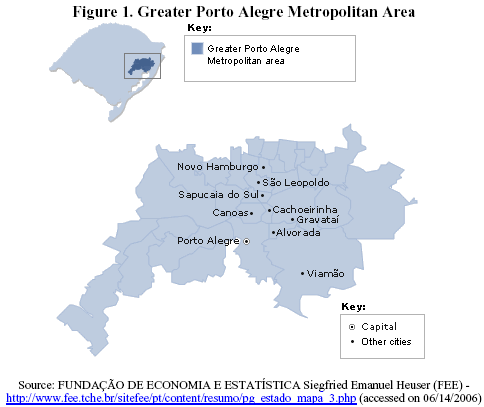
With theoretical-methodological support on Norbert Elias's "relational sociology" and the empirical basis provided by comparative analysis between civil society and municipal governments from the metropolitan area of Porto Alegre3, an essentialist and unifying appreciation of social actors is challenged for failing to see civil society as a space of diversity, power relations, and conflicts where actors marked by several orientations and which keep distinct relations with democracy meet and intervene.
From essentialist Manichaeism to the relational approach
From the early 80s on, breaking away from a long tradition of social and political thinking in Brazil (Sader & Paoli, 1986), researchers and political agents gradually stressed the role played by social actors in reconstructing, sustaining, and/or strengthening democracy in the country. Initially under strong prevalence of the debate on "social movements", the discussion about the central role played by social actors starts taking place, already in the 1990s, under the frameworks of the concept of "civil society", to which several positive meanings were normatively associated from the viewpoint of democratization.
Under such theoretical approach, located within a critical perspective regarding the essentially political-institutional approach in the process of "transition" (here understood as the resumption of basic procedures and institutions of representative democracy, especially periodic, competitive, and free elections), the concern would turn to the way relations between State and society were defined, in terms of breaking away from traditional forms of political exclusion and domination of vast segments of Brazilian society. Therefore, based on a theoretical perspective built by articulating Habermasian theory and the theoretical debate on "civil society", authors such as Sérgio Costa (1994, 1997) and Leonardo Avritzer (1994, 1996) underscore the role played by civil society actors – especially social movements and other organizational forms that should channel to the public sphere the "societal issues" that are born and emerge in real life – in the construction of new relations with the political-institutional system, which would allow real democratization, as they guarantee that the "power flow" is directed from civil society to the State and not the opposite, as it is the case with Brazil's authoritarian political tradition.
However, such perspective has been subject to increasing criticism that stress the lack of synchrony between the normative and essentialist prescriptions of the theoretical model and the empirical actors that configure Brazil's "civil society", which would be highly heterogeneous and marked by several characteristics (clientelism, authoritarianism, low associational density, heteronomy before political and government actors, etc.) that came to question such natural and direct link between civil associativism and democratization.4
Another focus of criticism to the perspective that naturalizes the democratic virtues of civil society comes from the analyses of experiences with new institutional designs (for instance, the processes of Participatory Budget and Councils for Social Policies) which, especially in the 1990s, opened political management to the intervention of social actors, either directly or mediated by new forms of representation. Those experiences, that have been gradually expanding and to a certain degree are related to the perspective that an effective democratization would depend upon creating institutional mechanisms and procedures that allow the expression of civil society's interests as well as their processing and incorporation into political-administrative structures, have been challenged as in most cases they have not been able to cause significant change in traditional political structures and dynamics.5
]]> However, some analyses that take on a critical perspective regarding the democratic potentials of "civil society" also represent an essentialist bias, although in the opposite way. That is, against the assumption of the inherent democratic character of civil society, its presupposed insignificance is assumed or, in distinct versions, its negative influence on democracy. That is, from being a "core of virtue", that would embody positiveness and take on a central role in the process of democratic construction, civil society becomes a space for reproduction of inequalities, of challenging of democratic institutions and/or emptying politics itself (Kerstenetzky, 2003).Based on theoretical-methodological assumptions developed by Norbert Elias's "relational sociology" (1994, 1998, 1999), this article attempts to face some limitations observed in the aforementioned "essentialist" perspectives, in terms of their ability to generate proper reading on the complexity of empirically observable configurations of relations between civil society and democratic construction in Brazil.
A first problematic aspect of "essentialist" perspectives is their tendency to a non-relational approach on civil society. That is, civil society tends to be seen as an "object" with certain intrinsic characteristics that would pre-establish a certain way to relate to the State, to politics and therefore, to democracy itself. Such approach results in a reified apprehension of civil society, which would have a predetermined specific "nature".
Norbert Elias's perspective criticizes vigorously the predominance of non-relational approaches in sociological analysis, whose power is expressed even in the way we build our concepts, which tend to be presented in noun-like ways (the civil society or the State, for instance). That would induce us to think about our "objects" as something that preexists and that later enters a relationship with other "objects", and not as an "object" that only exists in relation to other "objects", then becoming what it is after such relation. As pointed out by Elias (1999:135),
the forced tendency of our languages to make us speak and think as though all ‘objects' of our reflection, including men themselves, were in principle merely objects not only without movement but also without relations is extremely troubling for understanding the complex humans that constitute the object of sociology.
The adoption of a relational perspective for analyzing civil society allows us to break away from the notion of a pre-established "nature" and would realize the need to analyze, in each specific empirical configuration, how civil society is constituted in and by its relation to other dimensions of the social reality under study. That would imply the rejection of the idea that there is a civil society whose characteristics would be defined beforehand; rather, there are distinct configurations of civil society, in which it can take on specific and even contradictory characteristics.
Besides the non-relational perspective and, to a certain degree, because of that perspective, "essentialist" approaches are also marked by a dichotomous and Manichaeist bias. According to that approach, reality is interpreted from a polarized view (in this case, opposing civil society and political society or institutional-political field as unified and homogeneous blocks), where each of the cores embodies positiveness or negativeness that are therefore absolutized.
Such unifying and Manichaeist view, as well as the non-relational perspective, constitute a serious obstacle to understanding the diversity and complexity of both civil society and the institutional-political field, since the adoption of that simplifying conception tends to "purge" from the analyses – in general in a non-conscious way – those aspects or actors that do not correspond to the prescriptions of theoretical models.
A third troublesome aspect in the "essentialist" approaches is the tendency to a static, non-historic apprehension of its "objects" of analysis (in this case, civil society). In this regard, we should again resort to Norbert Elias's theoretical constructions and his emphasis in the need for a process-oriented approach to analyze "objects" empirically presented as constituted by and constituting social processes that demand a diachronic analysis. That is, it is only through such perspective that it is possible to apprehend the processes that forged certain sociopolitical configurations based on which we can understand civil society, in a given time and place, in its specificity and complexity.
]]> In an attempt to move away from non-relational, dichotomous, Manichaeist, and static perspectives, this article seeks to sustain the argument that there is no univocal relation between civil society and democratic construction. On the contrary, such relation presents differentiations according to the distinct local context analyzed, which constituted, along their trajectories, specific local configurations in and by which relations between civil society actors and democratization of public management are defined.In the specific cases of the Brazilian cities of Gravataí and Sapucaia do Sul during the period 1997-2000, which will be examined now, most of civil society actors tended to become obstacles to the efforts of democratizing municipal management (here explicitly express by the introduction of the Participatory Budget in 1997 by Gravataí's mayor Daniel Bordignon, a member of the Worker's Party, PT), taking an active part in the reproduction of hierarchical political structures and practices (especially exemplified by the administration of Sapucaia do Sul's mayor Valmir Martins, a member of PDT/PMDB).
Characterizing the empirical environments of the research
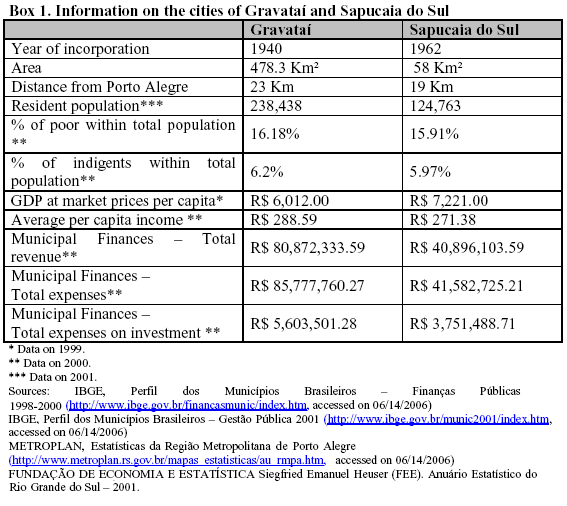
Comparing the cases of Gravataí and Sapucaia do Sul.
The analysis of trajectories and characteristics of Gravataí and Sapucaia do Sul shows relevant similarities that qualify them as comparable cases for investigating the relationship between civil society and democratization.
We can observe a relative similarity in terms of economic-social reality and the sociopolitical context in the period before the 1997-2000 administration. Both cities have a solid industrial base that allows, through tax generation, significant resources to fund the actions of the municipal government. On the other hand, they are cities marked by strong urbanization problems, concentrating a population with strong needs in terms of access to urban infrastructure and with low income levels.
From the political point of view, both are cities with traditional political elites whose strategies for reproduction are focused basically on particularist and clientelist bonds with the local population. In the case of Gravataí, those practices are illustrated by the action of PDT-member Mayor Mariano Motta (1989-1992), who invested in building direct relations between the municipal government and residents' associations, chosen as privileged interlocutors of the mayor in exchange for political support. On the other hand, the two cases show practices of creating organizations based on government initiatives, favoring the demands of those that support the mayor, donating resources and public assets to those aligned with the government, and appointing "community leaders" for positions in the government.
Such pattern of relationship between civil society and the political-institutional realm offered few opportunities for the constitution of more autonomous and demanding forms of organizations within civil society. On the contrary, local civil societies find themselves strongly subordinated to local political elites, depending especially on those groups that rule the municipal government, to which they establish relations marked by a significant power asymmetry. The few social movements and organizations that defined their actions based on the search for more autonomous relations to the municipal government, such as residents' associations created after the grassroots activity of religious mediators oriented by Liberation Theology or local chapters of the Movement of Struggle for Housing and the Central of Popular Movements (the latter two in Sapucaia do Sul), tended to be excluded from access to public assets and services, thus occupying a marginal position in the local sociopolitical dynamic.
The dependence and the asymmetry in relations between civil society and the political-institutional realm were expressed and at the same time reinforced by the configuration of the two cities' associational fabric. In both cases, the numerically predominant organizations are residents' associations and entities that provide social services, which act as intermediaries between the population and the municipal government, thus depending significantly on the government's "goodwill" to have access to public assets, resources and/or services they need/demand. On the other hand, the presence of popular movements oriented to direct mobilization and action, in conflictive and autonomous intervention logic, is not very significant.
Labor Unions, except for those representing municipal public servants,6 are usually chapters of larger unions located in other cities and play a limited role, basically on professional demands, with little or no influence on the city's political life. Business segments, in turn, tend to influence municipal politics by informally supporting certain candidates for public office and by establishing direct channels with the Executive7, seeking the pragmatic advocacy of their interests.
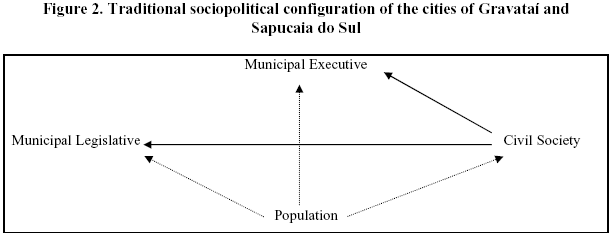
Such configuration of relations between civil society and the political institutional realm can be summarized in the following scheme:
]]> Figure 2
What such scheme8 indicates is the presence of a sociopolitical configuration marked by the central role played by the municipal executive, which, by opening up spaces for privileged action of certain social and political actors, provides them with the possibility of becoming intermediaries between the population's demands and the municipal government's action and decision centers. Such intermediation, in turn, becomes the fundament of power and therefore of social and political reproduction of those actors.
Just as the relationship between social and political actors and the municipal Executive is established in a particularist way, so is their relationship with the population. That is, the population's demands are presented and occasionally met as particular demands, thus blocking the construction of any collective or public sense among identical demands that end up positioned as competing demands by the privileged access to public assets and services.
In sum, we observe a sociopolitical configuration marked by hierarchic, clientelist and particularist relations that are reproduced by the actions not only of political and government actors acts, but also of a large part of social actors that make up the civil society that "really exists" in the two cities.
In both cases, it can be seen that the political scenario along the 1990s is marked by certain instability, with a change of political forces in the municipal government. In Gravataí, the following sequence of mayors is observed in the government: Mariano Motta, PDT (1989-1992); Edir Oliveira, PTB (1993-1996), and Daniel Bordignon, PT (1997-2000). In Sapucaia do Sul, the sequence is: Valmir Martins, PDT (1989-1992); Barbosa, PTB (1993-1996), and Valmir Martins, PDT/PMDB (1997-2000). In both cases, the 1996 elections were polarized between PT and PDT. Besides, the two mayors of the 1997-2000 term were re-elected for the 2001-2004 term.
Therefore, the main difference seen in the political trajectory of the two cities in the 1990s is that Gravataí sees an unprecedented rise of left-wing political forces grouped around the PT candidate, while in Sapucaia do Sul that option is defeated by the city's traditional political sectors that, in face of an increasing threat by PT, gradually form a wide party alliance around Valmir Martins candidacy to re-election, which again defeats PT.
That is, according to this succinct description of the recent developments in the two cities, the major difference seen is the rise of a new political force in Gravataí after 1997, with the election of the PT candidate who brings as one of his main proposals the search for democratization of municipal management through the introduction of social participation devices, especially the Participatory Budget (PB).9 Which is the impact of that change on the traditional relations between civil society and the political-institutional realm previously described? What are social actors' stances before that experience of social participation that would hypothetically break away from those hierarchical, clientelist, and particularist relations?
To start an analysis of the impact of that change in Gravataí, in comparison with Sapucaia do Sul, one can see that the introduction of the PB meant a significant change in the relationship between the population and the municipal government. The PB established a formal channel between society and government, with clear rules that are publicized in advance (even though there are several "obscure" points), thus changing the personalized and casuistic treatment of specific demands – the basis on which are reproduced clientelist practices so prominent in the case of Sapucaia do Sul. Such change can be expressed as the following scheme.
]]> Figure 3
That change modifies the whole local political dynamics by altering the sources of power of political and social actors, especially city councilors and "community leaders". With the PB, they tend to lose a core element of their political reproduction: intermediating social demands through privileged access to government decision centers, since those demands gain a formal space where they can be presented and processed, which starts to be favored by the population as it proves itself effective.
In the case of Sapucaia do Sul, on the contrary, in the 1997-2000 administration, the traditional pattern of relationship between the population, social, and political actors and the municipal Executive illustrated on Figure 2 is maintained. And, significantly in this case, the introduction of a channel for "social participation" (the "consultation" process10), driven by the political context and legal pressures, did not entail any relevant change in terms of democratizing municipal management. Such fact demonstrates the limits of the mere "legal-institutional innovation" from the point of view of changing the instituted political practices, whose ability to survive and use the innovation to reproduce itself is exemplarily illustrated in Sapucaia do Sul.
In spite of those deep differences, both cities see the maintenance of a dynamics that characterizes Brazil's political tradition: direct relationship between the population and the administration. As a result of the configuration of Brazil's political system, where parties and organizations tend to have scarce social insertions and therefore, low ability for mobilization and representation, the direct relationship of the population to the government (embodied by the mayor) was established as a structural characteristic of Brazilian politics, as the longstanding populist tradition illustrates. Apparently, the introduction of mechanisms for direct participation such as the PB might contribute to reproduce and even reinforce such characteristic. And that is a particularly strong trend, as expressed the aforementioned scheme, in contexts such as those in Gravataí, where the weakness of the associational fabric and opposition by many "community leaders" to participation in the PB make it largely individualized, with no autonomous social actors able and interested in playing a mediating role and therefore counterbalance government power.11
In direct relation with this aspect, an apparently paradoxical element emerges when we compare the stance of civil society organizations in the two cases. In Gravataí, due to the tensions in the relations between the municipal government and most organizations existing in the city (since these were mostly controlled by oppositional political forces), the participatory process was based on direct contact with the unorganized population, causing leaders to oppose the PB, since it was accused of weakening their organizations. In Sapucaia do Sul, in turn, "community leaders" underscored the fact that the government focused on and increased their influence as they started to have direct contact with the mayor and in some cases had their demands met. Therefore, paradoxically, from the data collected in the research we can conclude that the introduction of the PB contributed to "weaken" civil society in Gravataí and, on the other hand, the maintenance of clientelist practices "preserved/strengthened" the action and influence of social organization in Sapucaia do Sul.
That apparent paradox becomes less surprising when we have in mind the characteristics of civil society in those two cities, described earlier. As social organizations are to a large degree the result of a long history of subordination to and dependence on traditional political forces, it is understandable that the maintenance of an "environment" where those relations are reproduced tends to encourage the functioning of those organizations. On the other hand, the introduction of a mechanism such as the PB, breaking apart processes of clientelist intermediation between social demands and public management (where not only political actors but also several social leaders were involved and reproduced), as seen in Gravataí, tends to weaken organizations and "leaders" structurally rooted in society and dependents on those process of intermediation.
Therefore, when breaking away from the reproduction of those traditional structures, the introduction of the PB allowed new sectors of the population the opportunity to access the municipal government. In this respect, the dynamics taken on by the PB in Gravataí, on the one hand, was extremely effective in the sense of allowing the participation of a dispersed population with little or no associational experience. The simplification of the process focused basically on prioritizing local construction works and their dissemination over virtually the whole city, transferring deliberation to over 80 micro-regional plenary meetings, encouraged and allowed wide popular participation that reached 20,000 people present at micro-regional and regional meetings in 1999 and 2000 (which amounts to practically 10% of the city's total population!).
On the other hand, such design for the PB, focused on deliberating about public works without discussing more general policies and programs of and for the city, tended to limit participation to the restricted realm of more isolated and immediate actions, without dealing with more strategic initiatives, which remained restricted to the deliberations of the municipal Executive12. Therefore, the characteristics that became attractions of the PB in Gravataí from the point of view of popular mobilization – its objectivity and dispersion – became a limiting factor in terms of its comprehensiveness and ability to impact upon the lines of action of the municipal government.
Such characteristic of the PB in Gravataí deeply changed the form of processing demands made by popular segments to the Government – a marked difference from the case of Sapucaia do Sul, where the practices of individualized demands to city councilors and officials were maintained. For business segments, in turn, there were no significant changes in Gravataí, since they do not demand the basic infrastructure works that prevail in the PB in the one hand and, on the other hand, they sought forms for direct interlocution to the municipal Executive, which maintained its grip on the debate and definition of strategic actions.13
]]> With the introduction of the PB, a significant increase is seen in the possibility for social control over the actions of the municipal government. Through massive social participation the definition of a range of actions to be carried out – even though it was not more widely publicized as a Plan of Works and/or Investments – gave more transparency to the actions of the Executive in Gravataí, which came under constant scrutiny by the participants of the process. Furthermore, city councilors themselves, especially those belonging to the opposition, take on a role of "watchers" over the execution of PB decisions, since any delay or change in applying the deliberations would provide arguments to be used in the municipal political dispute.In Sapucaia do Sul, in turn, the dynamics is quite different. Since negotiations between the demanding civil society and the government remained particularized, reproducing a relationship where meeting a demand means "favoring", the space for social control is much more limited. What is seen is a game of individualized pressures involving mainly city councilors and community leaders, all seeking positive responses from the Executive to their interests, without a real public mechanism for social control and/or accountability.
Therefore, based on the comparison between the cities of Gravataí and Sapucaia do Sul and also taking into account the history of Gravataí, the most significant result of the introduction of the PB is the change in the local political dynamics regarding the relationship between the municipal Executive, political actors, civil society, and the unorganized population. The PB allowed the intervention of social segments historically excluded from government decisions, thus breaking away from clientelist dynamics between the Executive, political actors, and social organizations.
Those changes challenged established political practices, especially mechanisms of reproduction of local political elites fundamentally centered on the intermediation of social demands to the government execution and decision centers.
The potential of that change introduced by the PB to democratize local politics is limited both by the dynamics of municipal political institutions and by the structure of civil society. The conjunction between an institutional framework strongly concentrated on the municipal Executive (and more than that, in its embodiment: the city Mayor) and a civil society with low autonomy due to historical subordination to municipal officials, tends to prevent Gravataí's PB, at least during the 1997-2000 administration, from creating, besides significant mobilization and participation of pragmatic character, an organizational stimulus and therefore strengthening of civil society. Given that limit, the result tends to be a continuity of the dependency to political forces governing the city (which ultimately decide whether they "accept" or not participation and social control, since civil society is not strong enough to impose such participation and control) and the inability for more autonomous action dynamics on the part of social actors.
Conclusions
To close this analysis, some conclusions can be drawn regarding the focus of this article – relations between civil society and democratic construction. Based on the cases examined, it can be concluded that the reproduction of hierarchical and personalist political structures and dynamics does not take place only by the action of political and economic elites, but also involves significant segments of civil society. Both in Sapucaia do Sul and Gravataí, an important share of social organizations took and still takes an active part in relations based on clientelism and subordination to dominant political agents, becoming an obstacle to the introduction of democratic institutional innovations.
On the contrary, such innovations tend to be seen as threatening the reproduction of a field of traditional political relations through which those social leaders were constituted as such and act, therefore coming under criticism and facing opposition.
Would such conclusion lead us to rejecting the perspective that stresses the inherently democratic character of civil society? Would it lead us to sustain the opposite view, which points out its character of obstacle to democratic construction? The answer is, at once, yes and no.
]]> On one hand, the answer is "Yes", regarding the advocacy of the need to break away from the notion that there would be an intrinsic democratic "nature" marking the action of civil society actors. As previously sustained and empirically demonstrated through the cases analyzed in this article, the concept of civil society delimitates a heterogeneous field of social actors that may represent several kinds of representations and practices regarding democracy (usually disagreeing even about its meaning). Civil society is thus characterized by both diversity and change, causing the inexistence of a pre-established "nature" and the existence of a permanent process of construction, reproduction and transformation of actors based on the configurations generated by the field of relations they establish. That is to say, based on a relational and process-based approach, civil society can take on distinct characteristics that cannot be derived from a previously defined essential and/or normative theoretical framework, but must rather be identified and analyzed based on empirical research.In the specific cases under study here, we observe the constitution of very similar sociopolitical configurations, in and by which social actors were forged whose predominant forms of action tend to confer a not very democratic character to local civil societies. Produced by and reproducing political practices and representations marked by clientelist, personalist, and hierarchic characteristics, those actors tend to take stances against the introduction of democratic innovations, since they break away from the traditional mechanisms from which they used to obtain access (limited and subordinated) to certain material and/or symbolic gains. In those cases, then, not for a question of nature, but rather of sociopolitical configurations constituted along a historical trajectory, local civil society presents itself as an obstacle to democratization through the introduction of channels for social participation in public management, such as that proposed by the political forces that assumed the municipal government in Gravataí in 1997.
On the other hand, however, our answer is "No", as the identification in the cases analyzed of a certain relation between civil society and democratization does not authorize its generalization as an empirical fundament to sustain the opposite stance (according to which civil society takes on a role of reproducing inequalities and authoritarianism). The same relational and process-based approach that serves to prevent naturalization and homogenization of the "idealizing" view serves to avoid the opposite risk, expressed in the "condemnatory" view that also naturalizes and sees as homogeneous what is dynamic and diverse.
Specifically regarding the critical perspective on civil society, it is important to carry out an effort at denaturalization, since there is an old and strong tradition that holds Brazil's social actors (seen as "naturally" backward, lacking awareness, immature, irrational, and unable to reproduce associational patterns and sociopolitical practices of other countries seen as "models") "accountable" for the country's long history of authoritarianism. Based on such configurational perspective, the explanation for the authoritarian characteristics perchance observed in the action of Brazilian civil society actors is not found in their "nature", but rather in the sociopolitical configurations in and by which they were historically constituted. That is, the clientelist character of a large part of community organizations in Gravataí or Sapucaia do Sul is not due to an inherent characteristic, to an "essence", but rather to the field of relations in which and by which they were forged. Therefore, other configurations, constituted in historical trajectories, might open opportunities for the constitution of actors with distinct characteristics and, more specifically, with other relationships to process of democratization.14
Besides, institutional changes might constitute new relations, open new opportunities, and encourage new organizational practices that change, to a higher or lesser degree, the configuration of civil society and its relations to the political-institutional realm. Knowing the possibilities and the reach of institutional innovations in face of the constraints of historic trajectory is a core issue for the current agenda of empirical research about democratic construction in Brazil, to be answered by new investigations that, as a starting point, reject any essentializing and naturalizing notion of social and political actors.
References
ABERS, Rebecca. Do clientelismo à cooperação: governos locais, políticas participativas e organização da sociedade civil em Porto Alegre. Cadernos da CIDADE, volume 5, no. 7, May 2000. [ Links ]
AVRITZER, Leonardo (ed.). Sociedade civil e democratização. Belo Horizonte: Del Rey, 1994. [ Links ]
AVRITZER, Leonardo. A moralidade da democracia: ensaios em teoria habermasiana e teoria democrática.São Paulo: Perspectiva; Belo Horizonte: Editora da UFMG, 1996. [ Links ]
COSTA, Sérgio. Esfera pública, redescoberta da sociedade civil e movimentos sociais no Brasil – uma abordagem tentativa. Novos Estudos, São Paulo, no. 38, p.38-52, March 1994. [ Links ]
COSTA, Sérgio. Movimentos sociais, democratização e a construção de esferas públicas locais. Revista Brasileira de Ciências Sociais,São Paulo, v.12, no. 35, p.121-134, October 1997. [ Links ]
DAGNINO, Evelina (ed.). Sociedade Civil e Espaços Públicos no Brasil. Rio de Janeiro: Paz e Terra, 2002. [ Links ]
ELIAS, Norbert. Sociologia Fundamental. Barcelona: Gedisa, 1999. [ Links ]
ELIAS, Norbert. Envolvimento e alienação. Rio de Janeiro: Bertrand Brasil, 1998. [ Links ]
ELIAS, Norbert. A sociedade dos indivíduos. Rio de Janeiro: Zahar, 1994. [ Links ]
KERSTENETZKY, Celia Lessa. Sobre associativismo, desigualdades e democracia. Revista Brasileira de Ciências Sociais, vol.18, no. 53, p.131-142. 2003. [ Links ]
LAVALLE, Adrián Gurza. Sem pena nem glória: o debate sobre a sociedade civil nos anos 1990. Novos Estudos, São Paulo, no. 66, p.91-109, July 2003. [ Links ]
SADER Eder; PAOLI, Maria Célia. Sobre "classes populares" no pensamento sociológico brasileiro. In: CARDOSO, Ruth C. (ed.). A aventura antropológica: teoria e pesquisa. Rio de Janeiro: Paz e Terra, p.39-67. 1986. [ Links ]
SCHNEIDER, Sérgio; SILVA, Marcelo Kunrath; MARQUES, Paulo E. Moruzzi (ed.). Políticas públicas e participação social no Brasil Rural. Porto Alegre: Editora da UFRGS, 2004. [ Links ]
SILVA, Marcelo Kunrath. A expansão do Orçamento Participativo na Região Metropolitana de Porto Alegre. In: AVRITZER, Leonardo; NAVARRO, Zander. (ed.). A inovação democrática no Brasil: o Orçamento Participativo. São Paulo, p.157-185. 2003a. [ Links ]
SILVA, Marcelo Kunrath. Participation by design: the experiences of Alvorada and Gravataí, Rio Grande do Sul, Brazil. In: BAIOCCHI, Gianpaolo. (Ed.). Radicals in power: the Workers' Party (PT) and experiments in urban democracy in Brazil. New York, p.113-130. 2003b. [ Links ]
SILVA, Marcelo Kunrath. Construção da "participação popular": análise comparativa de processos de participação social na discussão pública do orçamento em municípios da Região Metropolitana de Porto Alegre/RS. 2001. Thesis (Doctorate in Sociology) – Institute of Philosophy and Human Sciences, Federal University of Rio Grande do Sul, Porto Alegre. [ Links ]
Received: 30/06/06
Accept: 21/08/06
1 A preliminary version of this article was presented at the Thematic Seminar "Decision process and implementation of public policies in Brazil: new times, new perspectives for analysis", in 2004, during the 28th Annual Meeting of ANPOCS. ]]>
2 The term "civil society" is used in this article to apprehend a set of social organizations, formal and informal, which makes up the "associational fabric" empirically existing in a given context.
3 The cities examined are Gravataí and Sapucaia do Sul, durinf the 1997-2000 administration. The empirical work for this study was conducted within project "Evaluation of participatory budgeting initiatives in Brazilian municipalities", coordinated by Gianpaolo Baocchi, Shubham Chaudhuri, and Patrick Heller and funded with World Bank resources. Besides, it received funds from Fundação de Amparo à Pesquisa do Estado do Rio Grande do Sul (FAPERGS), through a so-called "Recent Doctor Grant".
4 A vehement criticism to the perspective of the "new civil society" and especially to its normative stance is found in the article by Lavalle (2003). In this article, differently from Lavalle's, the objects of criticism is not normative theory in itself, but rather its application as a model for reality that tends to eventually overcome "empirical objects", this hiding them. On the other hand, however, such normative perspective is seen as analytically fertile by focusing investigation on relations between society and the political-institutional system, thus allowing an analysis of the processes of democratic construction far beyond institutional actors and spaces.
5 A critical balance of participation experiences can be found in Dagnino (2002). For a specific analysis of the establishment and functioning of Rural Development Municipal Councils, see Schneider, Silva & Marques (2004).
6 The fact that the union of municipal public servants of Sapucaia do Sul was founded only in 2003 is an indication of the obstacles to social organization in the city.
7 In Sapucaia do Sul, that is illustrated by the indication of a representative of the business segment, though the Commercial and Industrial Association, to be the city's Industry and Trade Secretary.
8 Such scheme is based on a graphic representation made by Shubham Chaudhuri in one of the meeting of the research team.
9 A crucial element to sustain the PT candidate in Gravataí was the "success" of the party's administration in the nearby state capital Porto Alegre (whose image was chiefly based on the PB experience), already in its second term in office and, according to all predictions at the time, to be re-elected in the 1996 election (as it actually was).
10 In the first three years in office (1997, 1998 e 1999), Mayor Valmir Martins carried out meetings with presidents of residents' associations, who would bring and negotiate specific demands, off the process of making the budget; in 2000, the last year of his first term in Office, after pressure under the Law of Fiscal Accountability, but also for the state's political scenario (in which the subject of "popular participation" was one of the main points of dissent, opposing the "Popular Consultation" created by then state governor Antônio Britto in the last year of his term as state governor and the "Participatory Budget" established by PT in Porto Alegre and advocated for the state administration), Mayor Valmir Martins established a process of "consultation" to the population to define priorities.
11 Such trait significantly distinguishes the participation dynamics at Gravataí's PB from that seen in Porto Alegre by Abers (2000). For a comparison between the experience of the PB in Porto Alegre and other three experiences in cities in the same Metropolitan Area, see Silva (2001). ]]>
12 A characteristic that expresses that limitation to the focus of intervention of the PB in Gravataí is the absence, in the 1997-2000 period, of the so-called Theme-oriented Plenary Meetings, that is, spaces that articulated the debate on sector policies with the presentation of social demand priorities.
13 The relationship between Gravataí's business sector with the PT municipal government developed from a situation of criticism and suspicion in the first years of the 1997-2000 administration to a relationship marked by proximity and cooperation, whose main trait was the participation of former president of the city's Commercial and Industrial Association as the Secretary for economic development in Daniel Bordignon's second term in office (2001-2004).
14 In fact, strong differences can be seen in realities that are very close in spatial terms. Specifically regarding the cases of Gravataí and Sapucaia do Sul, it is interesting to compare to the city of Porto Alegre, where a totally opposed relationship can be seen between civil society and democratization, which cannot be explained by any natural superiority of Porto-Alegreans, but rather by the distinct sociopolitical configuration seen there. For a comparative analysis involving the city of Porto Alegre, see Silva (2001, 2003a & 2003b).