Sociologia Brasileira: tendências institucionais e epistemológico-teóricas contemporâneas
Enno Dagoberto Liedke Filho
PhD in Sociology, Brown University, USA; Professor at the Graduate Program in Sociology, Institute of Philosophy and Humanities, Federal University of Rio Grande do Sul (UFRGS), Brazil; email eliedke.voy@terra.com.br
Translated by Cristina Perna
Translation from Sociologias, Porto Alegre, n.9, p.216-245, Jan./June 2003.
]]>
ABSTRACT
In the first moment, the article revises themes pertaining to the themes of Sociology of Knowledge and Sociology of Science, both relevant for the study of Sociology of Sociology. In a second moment, it proposes to analyze seven themes concerning the development of contemporary sociology in Brazil.
Key-words: Brazilian sociology, sociology of knowledge, sociology of development, history of sociology.
RESUMO
O artigo revisa, em um primeiro momento, temas da Sociologia do Conhecimento e da Sociologia da Ciência, relevantes para o estudo da Sociologia da Sociologia. Em um segundo momento, propõe-se analisar sete temas referentes ao desenvolvimento da sociologia contemporânea no Brasil.
Palavras-chave: sociologia brasileira, sociologia do conhecimento, sociologia do desenvolvimento, história da sociologia.
]]> Presentation
One of the main problems faced by Sociology and, in general, by the Social Sciences in Brazil, has to do with the capacity of facing, in a theoretical-methodological way, the thematic and historical challenges that the present situation of the Brazilian society poses. Do the Brazilian Social Sciences and, in special, the Brazilian Sociology, have paradigmatic-thematic and institutional-professional requirements to appropriately face the new theoretical-methodological as well as practical-political challenges arising from the contemporary Brazilian social processes?
The present text is divided in two complementary sections, which focus:
1 – The Sociology of Knowledge, the Sociology of Science and the Sociology of Sociology; and
2 – Seven main themes on Contemporary Sociology in Brazil.
I - The Sociology of Knowledge, the Sociology of Science and the Sociology of Sociology
The concern about Sociology, its origins, developments, promises and failures has been a constant activity among the practitioners in this field, such as, for instance, is reflected in the classical works Course of Positive Philosophy by Comteandthe Inaugural Class of the Course in Sociology byDurkheim. Nowadays, this concern is expressed in major works such as The Sociological Imagination by Wright Mills, as well as Jeffrey Alexander's Theoretical Logic in Sociology. In Latin America, some of the classical examples of this social-historical concern are works such as Historia de la Sociología Latinoamericana (History of Latin-American Sociology)and Nueva Historia de la Sociologia Latinoamericana (New History of Latin-American Sociology) by Alfredo Poviña, As Ciências Sociais no Brasil (The Social Sciences in Brazil) by Costa Pinto and Edison Carneiro, La Sociología Científica (The Scientific Sociology) by Gino Germani and A Sociologia numa Era de Revolução Social (The Scientific Sociology in an Era of Social Revolution)by Florestan Fernandes. The deep political intellectual crisis caused by the New Authoritarian cycle in Latin America, which started by the mid-sixties, followed by the renovation of socio-political and cultural hopes, given the redemocratization processes during the eighties, caused the onset of new reflections on the meaning of Sociology in Latin-America, and of its role in a democratic society. These theoretical concerns are exemplified in works such as A Sociologia Brasileira (The Brazilian Sociology)by Florestan Fernandes, A Sociologia da Sociologia Latino-americana (The Sociology of Latin-American Sociology) by Octavio Ianni, Imperialismo, Lucha de Clases y Conocimiento: 25 años de Sociologia en Argentina (Imperialism, Class Struggles and Knowledge: 25 years of Sociology in Argentina) by Verón and, more recently, the collective work edited by Sergio Micelli, História das Ciências Sociais no Brasil (History of the Social Sciences in Brazil), and the book by Brunner and Barrios Inquisición, Mercado y Filantropia ‑ Ciencias Sociales y Autoritarismo en Argentina, Brasil, Chile y Uruguay (Inquisition, Market and Philanthropy ‑ Social Sciences and Authoritarianism in Argentina, Brazil, Chile and Uruguay).
At the same time, a number of articles, reports and interviews have been produced and published, some of them tending to a kind of intellectual production, which, less than fullfiling the task of Sociology of Sociology , tend more to ‑ using in a free form an expression from an althusserian origin ‑, a sort of a “spontaneous sociology of sociology of the sociologists”. Contrariwise, in this article it is argued that the Sociology of Sociology is a specific intradisciplinary area, which can be classified as a Special Sociology, requiring therefore specific teaching and research training and skills, without losing sight of its specificities and its boundaries so as of the possibilities of a fruitful cooperation with other special sociologies, such as the Sociology of Knowledge, the Sociology of Science and Political Sociology, as well as with other disciplines such as History and Political Economy. The instigating book by Wolf Lepenies, Between Literature and Science (1994), demonstrates in the works and life of authors like Comte, Durkheim and Weber, some crucial connections of sociology with other cultural areas ‑ such as religion and literature ‑, which apparently seem distant from it.
The Sociology of Knowledge and the Sociology of Science
]]> Among the so-called special sociologies, the field of investigation in Sociology of Knowledge occupies a remarkable position regarding its effects on Sociology of Sociology, as well as on other special sociologies. Sociology of Knowledge may be defined in general as the branch of sociology that studies the relation between thought and society. It is concerned with the social and existential conditions of knowledge. Scholars in this field, other than being restricted to the sociological analysis of the cognitive sphere, as the term may imply, have dedicated themselves to the analysis of a whole spectrum of intellectual products, such as ideologies, political doctrines, philosophies and theological thoughts. In all these thematic areas of research, Sociology of Knowledge attempts to relate the ideas that constitute its focus of study to the social-historical context in which they were produced and received (Coser, 1968, p. 428).Among the various contributions to Sociology of Knowledge, it is interesting to point out here the work by Mannheim1, who attempted to evaluate, in the beginning of the twentieth century, the contribution of the main philosophical-systematic “viewpoints” for the elaboration of the Sociology of Knowledge: a) positivism (Durkheim and Levi-Bruhl); b) formal apriorism (neokantism); c) material apriorism (i. e., the modern phenomenological school, as for instance, represented by Scheler's works); and d) historicism (Troeltsch e Luckàcs)2. Mannheim presented, based in his critical analysis of these contributions, the task of Sociology of Knowledge as being:
To specify, for each transversal cut of the historical process, the various systematic intellectual positions in which the thought of creative groups and individuals was based. However, after having done this, these different trends of thought should not be confronted as positions in a merely theoretical debate, but its vital, non-theoretical roots should also be explored. In order to do this, we first have to find out the metaphysical premises that underlie the various systematic positions. Then we must ask which of the “postulates about the world” that coexist in a determined given area correlate with a determined style of thought. When these correspondences become established, we will have identified the intellectual strata in struggle (Mannheim, 1974a, p. 78).
Mannheim adds that:
The sociological task, however, begins only after this “immanent” analysis is made – it consists in finding out the social strata that compose the intellectual strata in focus... it is only in terms of the role of these last strata within the global process, in terms of their attitudes in relation to the new emergent reality, that we may define the existing fundamental aspirations and the postulates about the world in a determined moment, which may absorb ideas and pre-existing methods and subject them to a change of function – not to mention the recently created forms (Mannheim, 1974a, p. 79).
Mannheim proposed three complementary methodological steps to fulfill the task of the Sociology of Knowledge:
First Step – The documented expressions of thoughts, feelings or tastes are examined so that we can reveal their inherent or intended sense, while the queries about their intrinsic validity or veracity are delayed to the third step;
]]> Second Step – All the types of social relations in which these expressions are conceived and accomplished are delineated and established. Special attention must be given to the choices and to the order of preferences implicitly manifested by the actions of the participants in a given situation;Third Step – The analysis of the content of the manifestations is recovered in the restored context of original social interaction, rebuilding completely its situational meaning (Mannheim, 1974b, p. 36)3.
It is interesting to point out that Mannheim indicated the main obstacles, in the German cultural field of the beginning of the twentieth century, for the acceptance of a Sociology of Knowledge or of a Sociology of the Spirit (Geist):
1 – the typical alienation of professors, who create between intellectual and real life a fictitious atmosphere of values and ideas, placing thought at an extraordinary distance from real life;
2 – the work peculiar to the humanists creates to them an illusion of an immanent chain of ideas that can only be completely explained by means of their own or others' ideas;
3 – the religious, sacral, origin of the idea of Geist (spirit); and
4 – the notion of spiritual freedom, opposed to determinism, in this realm (Mannheim, 1974b, p. 12-16).
The analysis of the relations between science and society has been developed in the field of Sociology by a special discipline – the Sociology of Science, which assumes certain pressupositions of the Sociology of Knowledge as background references, calling for the need of paying permanent attention to their interrelations.
Merton (1961) asserts that the Sociology of Science is the most elaborate attempt to develop a theory and propositions about the interdependence between the particular knowledge that “emerges from and returns to the controlled observation” and the surrounding social context. From this viewpoint, the development of a field of intellectual investigation may be examined under three aspects:
]]>1 – the historical affiliation of the ideas under analysis and their interrelations to previous ones;
2 – the effects of the social structure within which the intellectual field is developing; and
3 – the social interaction processes among the members of an intellectual community.
Ben-David (1975) suggests, in a more specific way, that the first aspect corresponds to the typical task of Intellectual History, whereas the second theme is typical of the Sociology of Knowledge and the third aspect corresponds to the interactionist approach developed inside the Sociology of Science. Crawford (1971), analyzing the similarities and differences between the Sociology of Knowledge and the Intellectual History, proposes a characterization of the tasks for these disciplines in the following terms:
Common to the sociology of knowledge and to the intellectual history is the concern with the reciprocal influences between knowledge or thought and the social context, as well as a wide definition of their objects of research, which are defined as knowledge, thought, ideas and beliefs. While the sociologist of knowledge aims at developing propositions and generalizations about the relation between the production of ideas and the socio-cultural context, without any concern with the delimitation of time, the scholar of intellectual history is worried with the description and analysis of knowledge or beliefs of a particular historical period (Crawford, 1971, p. 15).
The Sociology of Science and the Sociology of Sociology
Crawford (1971), analyzing the Sociology of the Social Sciences, pointed out some main changes ‑ both internal to the scientific community as in its relations with other institutions and with the social environment ‑, which have stimulated since the mid of the twentieth century the rapid development of the intellectual production in this specialized discipline. These changes were:
]]> 1 – changes related to “professionalization”, i.e., to the creation of occupational roles, organizational srtructures and specific collective images for the production and use of knowledge in Social Sciences;2 – the influence of social scientists and of the knowledge of Social Sciences over the general social thought, as well as over the specific problems related to policies and practices in different areas of social life; and
3 – the notion of crisis that affected the Social Sciences in general and Sociology in particular (Crawford, 1971, p. 9-10).
According to Crawford (1971) the literature of Sociology of Social Sciences may be classified in six thematic groups, which focus:
1 – the alternative conceptions on the Social Sciences as a social phenomenon;
2 – the social and professional characteristics of the social scientists;
3 – the patterns of stratification of the scientific community;
4 – the normative patterns of the scientific community;
5 – the communication patterns within the scientific community; and
]]> 6 – the relation between the social and political sciences and the social practices (Crawford, 1971, p. 13).
We suggest that these six approaches focus on complementary themes and that the research work developed in the field of Sociology of Sociology, even when electing one or more of these themes as its main subject, must always keep in mind their possible connections with the other enunciated themes, delineating alternatives for their integrated analytical treatment4.
II – Seven themes on Contemporary Sociology in Brazil
A) A first relevant theme concerns the stages of institutionalization of Sociology as an academic-scientific discipline. Clark (1972), in his analysis of the evolution of Durkheim's School in France, proposed an interesting division of the evolution of French sociology. According to him, this evolution is divided in five stages or moments: (1) the stage of individual social thinkers; (2) the onset of small scientific non-academic schools (similar to the Historical-Geographical Institutes in Brazil); (3) the creation of specialized academic cathedras; (4) the formation of departments of sociology, which tended to be related to graduate programs; and finally (5) the creation of undergraduate programs and the organization of a specialized scientific community, characterizing this stage of sociology as the a stage of “big science”5.
These stages reflect the French and in broader lines the European and North-American experiences. however, as will be seen in detail later, they do not apply to the case of the evolution of Sociology in Latin America, where the undergraduate programs have preceded the formation of the graduate ones. In the case of Brazil, the firsts undergraduate programs in Social Sciences were created by the mid-thirties, while the graduate programs only became generalized after the University Reform of 1969.
B) A second theme regards the typology of the institutional evolution and of the conflicting patterns concerning the styles of sociological work proposed by Merton in his intervention in the World Congress of Sociology, held in Louvain in 1959, when he asserted that the emergence and consolidation of a new scientific and academic discipline takes place through three typical stages.
A first stage of the evolution of a new discipline is characterized by the efforts in differentiating it from a "mother-discipline", as in the case of Sociology and its differentiation from Social Philosophy. The Comte-Durkheim sequence may illustrate this attempt of differentiation and of establishing a new field, although Comte's work is still impregnated by Social Philosophy principles, whereas Durkheim's already represents the sociological scientificism.
A second stage is characterized by the search for academic autonomy, consolidation and legitimacy. In this stage, one of the main tactics used is to occupy academic spaces by “any means”. Among these are included the great controversies with the nearby disciplines, such as those between Sociology and Anthropology or Sociology and Political Science and even Sociology and History.
Associated to the attempts on the part of each discipline to introduce itself – as the true and the only – Social Science, sometimes there were institutional divisions, with the creation of departments, specific undergraduate and graduate programs. This is one of the most difficult and dramatic moment of interdisciplinary confrontations, with the use of multiple resources so as to reach the institutional legitimacy and consolidation “at any cost”.
]]> Finally, in a third stage, when this academic legitimacy has been consolidated, a discipline may open itself up for interdisciplinary work with the bordering disciplines. It is necessary to call the attention to the fact that this typology proposed by Merton aims at apprehending both intra and interdisciplinary conflicts6.C) A third theme of interest concerns the different periodizations formulated on the evolution of Sociology in Latin America. The analysis of the onset and evolution of Sociology as a specialized academic-scientific discipline in Latin America has been presented by means of multiple models, depending on the analytical paradigm, on the dimensions and on the themes emphasized by different authors.
By analyzing alternative evolution models of the Latin-American Sociology, we have verified that there is, at least among most authors, no cummulativity between a new and previous proposals. This may be due to ideological-paradigmatic divergences, to processes of self-presentation as the true precursors in these studies, or to the “lack of knowledge” of the predecessors contributions, therefore failing to take into account the state of the art.
Germani (1959) proposed a periodization of the evolution of Sociology in Latin America, which became a classical reference even for critics such as Graciarena (1964) and Verón (1974)7. According to Germani (1959), sociology in Latin America has gone through three essential moments:
a) The Stage of the Pre-Sociological Thought, from the Independence Wars until the end of the 19th Century;
b) The Stage of the Catedras (Chairs), from 1890/1900 until 1950; and
c) The Stage of the “Scientific” Sociology, which began around 1950.
Having this classical periodization as a reference, we suggest that the evolution of Sociology, as an academic-scientific discipline in Brazil and in Latin America, may be divided in the following stages:
]]> 1 – The Historical-Cultural legacy of Latin-American SociologyThe Stage of the Social Thinkers
The Stage of the Chairs of Sociology
2 – The Contemporary Period of Latin-American Sociology
The Stage of Scientific Sociology
The Stage of Crisis and Diversification
The Search for a New Professional-scientific Identity
The Historical-Cultural legacy of Latin-AmericanSociology is formed by the Stage of the Social Thinkers8, which extended itself from the wars for independence of the Latin-American nations in the early XIXth Century to the beginning of the XXth Century. During this period, the elaboration of social theory in Latin America tended to be developed by thinkers under the influence of European or North-American socio-philosophical ideas, such as the French illuminism, Cousin's eclectism, Comte's positivism and Spencer's evolutionism.
]]> The Stage of the Chairs of Sociology began in most of the Latin-American countries by the begining of the past century, when Chairs of Sociology were introduced in the Faculties of Philosophy, of Law and of Economics. In Brazil, this period only began around the mid 1920's, when Chairs of Sociology were created in Escolas Normais (Normal Schools). This stage was characterized by the publication of manuals for the teaching of Sociology, which attemped to spread the ideas of renowned European and North-American scientists, as well as sociological explanations on social problems such as urbanization, migration, illiteracy and poverty.The beginning of the Contemporary Period of Latin-American Sociology has, as its landmark, the emergence of the “Scientific” Sociology, which aimed to accomplish a pattern of institutionalization of the teaching and research practices in Sociology, similar to the ones of the central countries sociological centres under the aegis of the structural-functionalist paradigm. The conception of development of this approach is expressed by the Modernization Theory and its analysis of the transitional process from traditional to modern society.
During the Latin-American social and political crisis that took place in the end of the fifties and beginning of the sixties, ocurred the onset of the The Stage of Crisis and Diversification of Latin-American Sociology. It was characterized by the institutional and professional crises of Sociology, due to the political-cultural repression of the authoritarianregimes and, simultaneously, due to a deep paradigmatic crisis, i.e., by the crisis of hegemony of “Scientific” Sociology with the emergence of theoretical alternatives such as National Sociology, the Theory of Dependence and the Theory of the “New Authoritarianism”9.
As it will be seen in detail ahead Brazilian Sociology has achieved nowadays a significant level of institutionalization of its research and teaching activities, at the same time that, since the mid-eighties, it has gone through some very dramatic theoretical, methodological and thematical shifts aiming to cope with the new social problems, entering therefore, in a new stage of its history: a Stage of Search for a New Professional-scientific Identity
D) A fourth theme on Contemporary Sociology in Brazil is concerned with the situation experienced by Sociology and by the Social Sciences in the Latin-American Societies under the Recent Authoritarian Cycle. A hypothesis that has been widely accepted in Latin America suggests that situations that are favorable to the academic and scientific-technological development are necessarily linked to democratic situations, whereas authoritarian situations imply in negative conditions for this development10.
In Latin America, liberal and leftist sectors shared, during the fifties and the sixties, a conception that Latin-American societies were heading to an autonomous socio-economical development, characterized by accelerated industrialization and urbanization as well as by socio-political democratization. The modernization and democratization of the educational opportunities, together with the scientific-technological development, occupied a strategic place in this conception, being postulated, for example, as one of the Reformas de Base (Base Reforms) by the Brazilian developmentism11.
With the emergence of the authoritarian cycle of the sixties and seventies, putting end to the democratic-developmentist experiences of the fifties and the sixties, the educational and scientific-technological question acquired new patterns. The repressive and recessive educational policies of the authoritarian governments, with the breakdown of the university autonomy and the cassações (purges), arrests and intellectual-academic diaspora (as in the Argentinian case), seemed to yield the most pessimistic forecasts. However, the positive educational and scientific evolution under the Brazilian authoritarian governments, mainly during the so-called democratic transition (1974/75-1986), contrasts with these forecasts and with the dramatic experiences of the Argentinian, Uruguayan and Chilean cases12.
The comparative analysis of these cases indicates that, historically, four types of contrasting situations have ocurred :
Type 1 Situation – political democracy associated to a favorable situation for the expansion of educational opportunities, to the democratization of education and to the scientific-technological development (Brazil, 1950-1964; Brazil, 1990- ...; Argentina, 1955-1966, 1973-1974 and 1983-1989);
]]> Type 2 Situation – political democracy associated to an unfavorable situation for the expansion of educational opportunities, to the democratization of education and to the scientific-technological development (Argentina, 1974-1976 and 1989- ...);Type 3 Situation – political authoritarianism associated to an unfavorable situation for the expansion of educational opportunities, to the democratization of education and to the scientific-technological development (Argentina, 1966-1969 and 1976-1983); and
Type 4 Situation – political authoritarianism associated to a relatively favorable situation for the expansion and democratization (although partial and selective) of educational opportunities and to the scientific-technological development (Brazil 1964-1968; during the harsh period from 1968 to 1974; and during the long political opening from 1974 to 1985).
In order to understand these possibilities it is necessary to grasp not only the interrelations among the political model, the cultural context and the educational and scientific-technological fields, but also the interrelations with the current economic-social model. It is also necessary to make a clear distinction between two authoritarian models, with significant differences concerning their socio-cultural implications, for they lead to the constitution of different redemocratization scenarios with different implications for the scientific-technological and educational evolution.
Two main types of authoritarian situation occured in the most recent Latin-American authoritarian cycle. The Brazilian authoritarianism represents a type of capitalist development that, although it was excludent in relation to the masses and bore an utterly high social cost, implied in a minimum of academic development and technological research expansion and consolidation. This orientation was consubstantiated in the various development plans formulated in the 60's and 70's. With the model proposed for industrialization, there was a need for a minimum scientific-technological research as well as for the constitution of technical-scientific teams. Such demands did not occur in Argentina. While during the first authoritarian period (1966-1970), Argentina tried unsucessfully to follow a development model similar to the “Brazilian miracle”, during the second authoritarian period (1976-1983), the “regressive authoritarianism” model led to the destruction of the existing bases of economical and university development.
These differences allow us to identify two recent authoritarian models in Latin America: developmentist authoritarianism and anti-developmentist authoritarianism. This distinction is illustrated by the contrast between the socioeconomical model of the “economic miracle”, postulated by the Brazilian authoritarian regime and the socioeconomical model of the Argentinian authoritarian regime of the Process (1976-1983), with its political de-industrialization.
Therefore, it is of utmost importanceto analyse the dominant trends in the cultural field, distinguishing historical cases of progressive cultural climate and regressive cultural climate. A regressive cultural situation is characterized by the quantitative and qualitative reduction in production, circulation and consumption of cultural goods and services, whereas a progressive situation is characterized not only by the quantitative and qualitative increment of cultural goods and services available, but also by their growing democratization. Taking for granted that the cultural field is the locus of elaboration, dispute and ideological confrontation, it is understandable that there is interest, presence and permanent intervention in the cultural arena of collective social players of the civil society (churches, political parties, unions, associations and socio-cultural movements) and of the political society (government and burocracy), proposing and implementing progressive or regressive cultural policies.
If some authoritarian policies may even be characterized as forms of cultural genocide (Sorj and Mitre, 1985), we consider that the concept of cultural regression best reflects the results of authoritarian cultural policies, which, based on cultural repression and censorship, tend to produce dramatic negative results by means of a double process: (a) a quantitative and qualitative reduction in production, circulation and consumption of cultural goods and services (including both the acces to elementary and higher education and to mass culture, as well as to the development of scientific-technological activities and products); and (b) the organic impossibility of authoritarian regimes, neither of restoring traditional culture and values nor of creating a new culture that goes beyond the artificialism of its salvationist discourse.
The importance of this distinction for the analysis of the question of education in societies that have gone through the authoritarian cycle is illustrated by Brunner and Barrios (1987) assertion:
]]> The authoritarian military experiences produced an intense process of cultural restructuration, characterized in each country by the specific nature of the political regime, by the predominant ideological combination and by the “style of development” adopted, factors that combine to operate over the pre-existing cultural organization, with their peculiarities, traditions, institutions, movements and players (Brunner and Barrios, 1987, p. 40).
Focusing on the university fate in this context, Brunner and Barrios (1987) argue that:
In particular, the military authoritarianisms – with extreme differences among the cases in Argentina, Chile and Uruguay on one hand, and the case of Brazil, on the other – affected the university institutionality, considered by all as the strategic part for the formation of elites, for the reproduction of the high culture of the nation, for the social mobility of the middle class, for the distribution of the professional and semiprofessional personnel in the various segments of the occupational market and for the political socialization of the youth.
In the cases of the countries of the Southern Cone, the fundamental objective of these authoritarian military regimes was to obtain the political control of the universities, reducing or suppressing its autonomy, purging their faculties and reducing their expansion. In the case of Brazil, on the contrary, the military regime intervened in some universities (including the removal of professors and the introduction of control measures), nevertheless it promoted their expansion, allocated more resources, promoted their modernization and recognized them as a place of autonomy (Brunner and Barrios, 1987, p. 42).
Although it is possible to stress an elective affinity between democratic regime and progressive cultural climate, as between authoritarian regime and regressive cultural climate, it is important to call the attention to the fact that the two other combinations – democratic regime with regressive cultural climate and authoritarian regime with progressive cultural climate – characterized and still characterize the socio-cultural life in Latin-American countries in the contemporary period. The cultural crisis during the formally democratic regime in Argentina, in the period between 1974 and 1976 and the relative cultural progressivism during the long political opening in Brazil, exemplify these possibilities.
The extension of the higher education crisis, and particularly of the negative conditions for the development of technical-scientific research activities within the context of the recent neoliberal governments in Brazil and in the other countries of the Southern Cone, portrays dramatic cases of possible cultural regression in contexts that are formally constitutional democratic .
The neglect with the public university in Brazil during the nineties, the systematic attempts to change labor legislation and retirement laws in general and particularly of professors and researchers, resulting in early retirements, the dismantling of research groups and the migration of highly qualified personnel to the private universities ‑ a migration that is considered by some as a kind of “democratization” of human resources concentrated in the public universities ‑, are some of the features of the present crisis experienced by Sociology and by the sciences in general in Brazil.
Together with the systematic reduction of available resources for research, the alteration of the system for granting graduate scholarships by the National Council of Research (CNPq), such as the arbitrary 12% reduction of the funds for research and graduation programs, included in the federal government measures to cope with the recent crises in the stockmarket, reveal the neglect with the maintenance and necessary renewal and expansion of the place that the scientific-technological research and teaching have reached along these last thirty years.
At the same time, the priviledges of some academic-scientific areas and institutions and the lack of an ample discussion with the scientific community and its representatives ‑ among which the most renowned is the Sociedade Brasileira para o Progresso da Ciência - (SBPC, Brazilian Society for the Development of Science) ‑, in the shaping of a new profile of scientific-technological development in Brasil, reveal the selective character of the scientific-technological policy in Brazil nowadays.
]]> E) A fifth theme on Contemporary Sociology in Brazil has to do with the concept of Scientific-Academic Communityand refers to the significance that the social interaction model among social scientists acquires, in establishing an internal climate within the scientific communitiy and in creating or not possibilities for a productive interaction with other scientific communities.Guerrero (1980) suggests that, in spite of the classical sociological reflection on the theme of community (Tönnies, Weber, Durkheim and Human Ecology of Chicago), the concept of scientific community and its application to the studies of the history of sciences originate from formulations that do not belong to the field of Sociology, arising particularly from the contributions by Polayni and Kuhn.
Polayni's theoretical position – his radical defense of freedom, or better, of autonomy of science – is a liberal response to the English humanistic scientists. This group of scientists, who acted in England in the thirties,
inspired by Marxism and by the way science was planned in the USSR as an element of economy,was particularly concerned with the problem of the complex relations between science and society, the first justifying itself by the needs of the second (Menezes, 1975, p. XII).
Polayni's formulation, embeded in his ideological conception of freedom of science, especially in face of the political and religious interferences, sees the scientific community as a group that is composed by scientists proceeding from different disciplines, and that has the function of directing the research activity. As he puts it,
The scientists today cannot practice their activity in isolation [...]. The different scientist groups together form a scientific community. The opinion of this community has a deep influence in the course of individual investigation. The recognition of the demands of discovery is under the jurisdiction of the scientific opinion, expressed by the scientists as a whole. (Polayni, 1951, in Guerrero, 1980, p. 1222).
Guerrero (1980) suggests that Kuhn's main contribution resides in the fact that he derives the problem of the social organization of scientists in communities from the imperatives given by the research activity itself. In Kuhn's proposal, a leading theoretical role is played by the concepts of paradigm, normal science and paradigmatic crisis, through which this organization permanently presents the possibility of radical changes given the emergence of a new paradigm.
It is important to indicate the relativization of Kuhn's position concerning the status of the Social Sciences, which initially in his work The Structure of Scientific Revolutions, were conceived as inherently pre-paradigmatic or, in other terms, as pre-scientific, while later, in The Essential Tension, came to be considered as intrinsically pluri-paradigmatic.
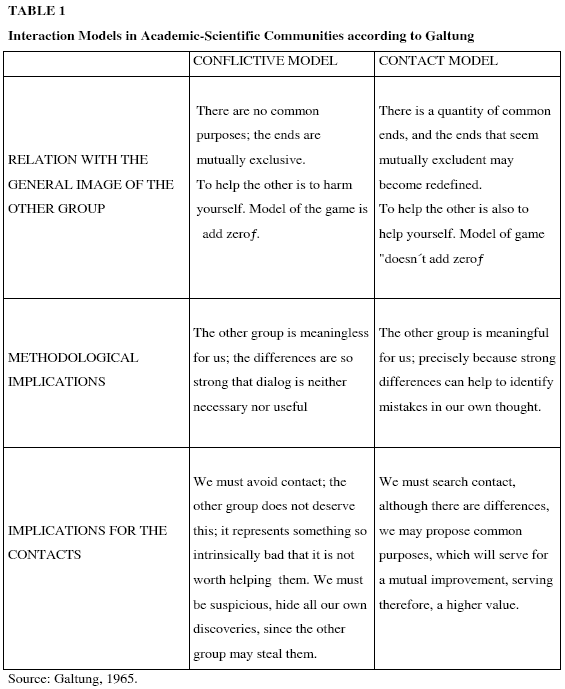
]]> Within this context, it is appropriate to recall Galtung's (1965) analysis of the divisions inside the Latin-American sociological community in the sixties. Galtung proposes a bipolar model of the extreme ways of interaction among groups of a certain scientific community: the contact model and the conflictive model. In his view, the conflictive model predominated in the Latin-American Sociology by then, given the exasperated confrontation between the traditional and the modern Sociology. The principles which orient the social interaction among the scientific groups in each one of these models may be seen in Table 1.In our view, the first model is characterized as being typical of a uni-paradigmatic field in Kuhn's language, once the cooperation within a single paradigm tends to be easier than the cooperation among different paradigms. The conflicting model is, in Galtung's conception, a sign of academic-scientific immaturity (or in Kuhn's words, a sign of the pre-paradigmatic state of a discipline). Besides these two models, Galtung suggests the possibility of occurrence of a third model, in which a group may act, aiming to harm another group or, in extreme cases, aiming its destruction.
Having Galtung's models as reference, we suggest that it is necessary to consider that the conflictive model includes situations that range from intra or inter-paradigmatic conflicts to harsh conflicts over academic spaces and resources. In a limit-case, these conflicts may lead to the appearance of another model – a genocide interaction model – characterized by the aim of a group to eliminate another group within the academic-scientific space. As examples, we may cite the purges processes that occurred at the universities during the authoritarian regimes in Latin America, as in the Brazilian, Uruguayan, Argentinian and Chilean cases. These processes tended to sistematically count with the support and even participation of groups from the affected communities or from nearby intellectual communities, sometimes disguising particularistic intitutional and/or political interests with paradigmatic discourses13.
In recent Latin-American history, sad examples of these extreme cases of inter or intra-disciplinary behaviors multiply. Coertion and repression happened, many times, by the actions of an academic-scientific group against another, revealing an inquisitorial vocation and character, which some analysts consider to be an inheritance of the Iberian-Catholic past.
Besides these three above refered models of interaction among scientific groups – conflictive, cooperative and genocidal models – we considered necessary to refer two other alternatives of academic-scientific interaction: the segmental model and the cooperative-competitive model.
The segmental model is characterized by the existence of multiple, insulated, specific circuits of production, distribution and consumption of academic-scientific products by intellectual currents and/or disciplines, without a minimum interest in the dialog with other circuits, or the knowledge of their achievements. This model represents a very sad, deplorable and unproductive intellectual situation. In the case of Latin-American sociology, for instance, during the sixties and seventies, nationalist sociologists “did not read” what functionalist-modernizing sociologists wrote, whereas Marxist sociologists “did not read” what nationalists and modernizing ones wrote.
The cooperative-competitive model places the issue of democratic coexistence and dialog among different paradigms and/or among different groups within a disciplinary field or between disciplinary fields, a situation in which the ideological-theoretical and practical-political differences are positively potentialized for the fullfilment of the requirements of the collective and individual role as scientists and citizens.
In the realm of this typology, it becomes important to indicate the need to distinguishing between the quest for interdisciplinarity in academic-scientific terms and the issue of a pluralistic coexistence among diferent disciplines within a same academic-institutional and administrative setting.
At times, interdisciplinarity is used as a symbolic weapon especially in contexts of fiercely fight for scarce financial and/or institutional resources, leading to harsh academic-scientific verbalizations on the low scientificity, objectivity and relevance of opponent's works, masking and justifying particularistic disciplinary, or even intra-disciplinary groups interests.
On the other hand, the hypothesis of an inherent incommunicability among different paradigms is the most extreme challenge to be faced. A pluralistic, democratic coexistence of different theoretical-methodological currents in the interior of a discipline as well as in disciplines involved in processes of inter-disciplinary cooperation, is the main issue in the agenda for a productive intra and inter-disciplinary dialog.
]]> Currently, Brazilian Sociology presents institucional and paradigmatic-thematical trends which characterize a new stage of its history: a Stage of Search for a New Professional-scientific Identity. It has achieved, as will be seen in the analysis of the next two themes, a significant level of institutionalization of its research and teaching activities (Theme F), at the same time that, since the mid-eighties, it has gone through some very dramatic theoretical, methodological and thematical shifts aiming to cope with the new social problems (Theme G).F) A sixth theme refers to the presence of Sociology in the Research Groups Directory of the Conselho Nacional de Pesquisa (CNPq – National Council of Research).
Nowadays, there are in Brazil 84 undergraduate programs in Social Sciences, with approximately 15,000 students. The Brazilian Sociologists Federation calculate that since 1934, circa of 40,000 Social Sciences degrees were attained. At the graduate level, there are nowadays, 36 Masters Programs and 25 Doctoral Programs in Sociology; 14 Masters Programs and 10 Doctoral Programs in Anthropology; 17 Masters Programs and 10 Doctoral Programs in Political Science (CAPES, 2006).
The main areas of work for sociologists are: teaching in elementary and high schools; teaching and research in public and private universities; research activities in non-university research centers; research and planning activities in public offices, as well as conducing social projects; research and consulting activities in the private sector, including private institutions of sociological research; and consulting activities for NGOs and social movements.
The Research Groups Directory of the Conselho Nacional de Pesquisa (CNPq) registers the existence of 19.470 recognized research groups in all scientific areas in Brazil. In 2004, Sociology has 296 research groups, representing 1,5% of the total of groups. As a means of comparison, Anthropology has 181 groups and Political Science, 128 research groups, revealing together with Sociology, a widely institutionalized base of research in Social Sciences existing today in Brazil (CNPq, 2006). Moreover, the research groups in Sociology are composed by 1.485 researchers, having 942 of them a Doctoral Degree, whereas Anthropology has 1.019 researchers (602 Doctors) and Political Science, 657 researchers (395 Doctors).
Sociology comprehends 900 Linhas de Pesquisa (Research Lines-RL)14, encompassing a wide range of research themes. The classification of the Research Lines of the research groups in Sociology by the sub-areas of knowledge proposed by the National Council of Research (CNPq), shows the following order of research interests: Sociology of Knowledge (60 RL); Rural Sociology (59 RL); Sociology of Development (50 RL); Urban Sociology (50 RL); Theory and History of Sociology (39 RL); and Sociology of Health (23 RL).
Moreover, a careful analysis of the Linhas de Pesquisa (Research Lines - RL) classified in the Directory under the title of Other Special Sociologies revealed that the main emergent Special Sociologies are: Sociology of Labor (64 RL); Political Sociology (42 RL); and Sociology of Culture (29 RL). Other thematic areas that deserve to be mentioned are: Sociology of Education (20 RL); Sociology of Religion (19 RL); Studies on Violence (19 RL); Environmental Studies (15 RL); Demography and Society (14 RL); Gender Studies and Gender Relations (10 RL); Race Relations (10 RL); and Studies on Social Movements (8 RL).
G) Finally, a seventh important theme regards the capacity of Sociology, and by extension, of the Social Sciences, of facing in a theoretical and methodological way the thematic and historical-theoretical challenges that the present situation of the Latin-American societies poses. In other words, do Social Sciences and, in particular, Sociology, have the appropriate paradigmatic-thematic conditions required to face the new theoretical-methodological and practical-political challenges that the redemocratization processes have been placing to the Social Sciences in Latin America?
It seems that with the loss of political initiative of the democratic-popular social movements along the processes of redemocratization, Sociology followed a very problematic epistemological and theoretical-methodological path, enclosing itself, and granting a privilege to micro-social approaches and sometimes an extreme emphasis on the issue of social identities and representations of the social actors.
The -of the challenges placed by this seventh and last theme can be evaluated having as reference some of the main aspects of the case of Brazilian contemporary Sociology. Sociology in Brazil, in the period from the sixties and seventies, until the nineties, experienced a passage from a macro-sociological analysis style of work, characterized by a criticism of the excludent social-economic model of the “Brazilian miracle” and of the authoritarian political model, to a micro-sociologization of studies.
]]> During this period ocurred a paralel inter-related thematic change in Brazilian Sociology: from the great macro-structural interpretations of the economic-political-cultural model of the authoritarian regime, Brazilian Sociology turned to an analysis of the actors and of the characteristics of democratic transition, which was followed by analyses of the theme of the, then, necessary democratization, of the social movements and of the strategies for the reactivation of civil society.Right after, a dissociation in the approach of the social movements in relation to the macro-structural conditions occurred, and Sociology began to focus on social identities and representations of urban and rural movements, of union movement, of feminist movement, gay movements, of black movements and ecological movements. Philosophically we may say that in classical terms, there was a kind of passage from the centrality of the analythical category of the “for itself” to the centrality of the analythical category of the “in itself” of the social movements.
Brazilian Sociology moved from objectivism to subjectivism and, in this process, a theoretical-methodological connection ‑ which had an important role in the critical analysis of the excludent social-economic model of the authoritarian period ‑, was lost: the connection between Political Economy and Social Sciences, comprehending Sociology as well as Anthropology and Political Science.
This connection was substituted by a discovery of subjectivity associated to a process of psychologization of the discourses of the Social Sciences, without the occurrence of a consistent systematic specialized training, especially in Social Psychology, of the majority of those social scientists. This psychologization mainly happened due to the privileging of studies on social identities, discourses and representations. We understand that these studies are necessary; however, their development demands a theoretical-methodological rigor not yet achieved, and they also need to search for the articulation of the themes treated with macro-sociological hypotheses.
Simultaneoulsly, another extremely problematic process happened – the semantic stylization of the discourses in the Social Sciences – with a change from the denotative discourse of the disciplinary traditions, to a valorization of the connotative, or even figurative discourse in the Social Sciences, privileging a para-ethnograpic reproduction of “tribal” discourses and their meanings.
The growing presence of the theory of methodological individualism and of rational choice theory began to pose disturbing issues when applied , for instance, to themes of Sociology of Education, such as the issue of unequal educational opportunities, as well as the issue of the educational policies and the discussion on the aims of the pedagogical practices. In the last case, would we postulate a pedagogy that privileges the construction or socialization of rational individuals, free-riders and tendentially selfish?
These movements of subjectivation, psychologization and semantization or esthetization occurred in articulation with processes that are internal to the own history of Sociology and Social Sciences such as, for instance, the simultaneous influence of phenomenology and post-structuralism.
Recently, the themes of Globalization, of Post-modernity and Multiculturalism have deserved special attention in the studies of Brazilian sociologists and social scientists. A second reading of these themes already acclaimed, has occurred has taken place, under the optics of their possible conections with emergent themes such as, for instance, Religiousness in a Context of Globalization, or Education and Multiculturalism15.
In an attempt of answering the questions initially posed in this article, we may state that, when considering the institutional-professional bases previously described, it is possible to verify, in the current Stage of Search for a New Professional-scientific Identity of Brazilian Sociology, the presence of a structured and consolidated scientific community, whose aim is to be aware of the demands of its time and contribute, with its specialized scientific work, for the knowledge and solution of the social problems of our time.
]]> References
BEN-DAVID, J. et al. Sociologia da Ciência. Rio de Janeiro: Editora da Fundação Getúlio Vargas, 1975. [ Links ]
BERTELLI A. et al. Sociologia do Conhecimento. Rio de Janeiro: Zahar Editores, 1974a. [ Links ]
BRUNNER, J.; BARRIOS, A. Inquisicion, Mercado y Filantropia. Ciencias Sociales y Autoritarismo en Argentina, Brasil, Chile y Uruguay. Santiago: Flacso, 1987. [ Links ]
CAPES, 2006. http://www1.capes.gov.br/
CARDOSO, F. H. As Idéias e seu Lugar: Ensaios sobre as Teorias do Desenvolvimento. In: Cadernos Cebrap, 33. Petrópolis: Editora Vozes, 1980. [ Links ]
CARDOSO, F. H.; FALETTO, E. Dependência e Desenvolvimento na América Latina. Rio de Janeiro: Zahar Editores, 1973. [ Links ]
CLARK, T. N. The Stages of Scientific Institutionalization. In: International Social Sciences Journal, v. 24, n. 4, 1972. [ Links ]
CNPq, 2006. http://dgp.cnpq.br/censo2004/
COSER, L. Sociology of Knowledge. In: International Encyclopedia of the Social Sciences. David L. Sills, Ed. New York: The MacMillan Company and The Free Press, 1968. 17 vols. [ Links ]
CRAWFORD, E. T. The Sociology of the Social Sciences. In: Current Sociology, v. XIX, n. 2. The Hague-Paris: Mouton & CO, 1971. [ Links ]
DURAND, J. C. (Org.) Sociologia de desenvolvimento. Rio de Janeiro: Zahar Ed., 1969. [ Links ]
FERNANDES, F. A Sociologia numa era de revolução social. Rio de Janeiro: Zahar Editores, 1976. [ Links ]
GALTUNG, J. Los factores socioculturales y el desarrollo de la sociología en América Latina. In: Revista Latinoamericana de Sociología, v. III, n. 1, 1965. [ Links ]
GERMANI, G. The Development and Present State of Sociology in Latin America. In: Transactions of the Fourth World Congress of Sociology, v. I. Milan and Stresa: International Sociological Association, 1959. [ Links ]
GIDDENS, A. Novas regras do método sociológico. Rio de Janeiro: Zahar Editores, 1978. [ Links ]
GRACIARENA, J.; FRANCO, R. Social Formation and Power Structures in Latin America. In: Current Sociology, v. 26, n. 1, 1978. [ Links ]
GUERRERO, R. C. La Idea de comunidad científica: su significado teórico y su contenido ideológico. In: Revista Mexicana de Sociología,Ano XLII, v. XLII, n. 3, júlio/septiembre 1980. [ Links ]
IANNI, O. A Sociologia da Sociologia Latino-americana. Rio de Janeiro: Editora Civilização Brasileira, 1971. [ Links ]
KUHN, T. S. The essential tension. Chicago: The University of Chicago Press, 1977. [ Links ]
KUHN, T. S. A estrutura das revoluções científicas. São Paulo: Perspectiva, 1987. [ Links ]
KUKLICH, H. The Sociology of Knowledge: Retrospect and Prospect. In: Annual Review of Sociology, 1983. [ Links ]
LEPENIES, W. Las Tres Culturas: La Sociología entre la Literatura y la Ciencia. México: Fondo de Cultura Económica, 1994. [ Links ]
LIEDKE FILHO, E. D.; BAETA NEVES, C. E. Para Uma Sociologia da Sociologia Brasileira: A trajetória da Sociologia no RS e na UFRGS. Porto Alegre: Departamento de Sociologia, 1997. [ Links ]
LIEDKE FILHO, E. D. Teoria Social e Método na Escola da USP. Dissertação de Mestrado. Brasília: UnB, 1977. [ Links ]
LIEDKE FILHO, E. D. Sociologia e Sociedade no Brasil e na Argentina 1954-1985. In: Cadernos de Sociologia, v. 1, n. 2, Porto Alegre: PPG Sociologia /UFRGS, 1990. [ Links ]
LIEDKE FILHO, E. D. Sociology and Society in Brazil and Argentina 1954-1985.Providence: Ph. D. Dissertation, Brown University, 1991. [ Links ]
LIEDKE FILHO, E. D. Teoria Social Contemporânea e Educação Superior. In: MOROSINI, M. et al. Universidade e Integração no Cone Sul. Porto Alegre: Editora da UFRGS, 1992. [ Links ]
MACHADO NETO, A. L. Formação e Temática da Sociologia do Conhecimento. São Paulo: EDUSP/Convívio, 1979. [ Links ]
MANNHEIM, K. O Problema de uma Sociologia do Conhecimento. In: BERTELLI, A. et al. Sociologia do Conhecimento. Rio de Janeiro: Zahar Editores, 1974a. [ Links ]
MANNHEIM, K. Sociologia da Cultura. São Paulo: EDUSP/Editora Perspectiva, 1974b. [ Links ]
MENEZES. Introdução à Edição Brasileira. In: BEN-DAVID, J. et al. Sociologia da Ciência. Rio de Janeiro: Editora da Fundação Getúlio Vargas, 1975. [ Links ]
MERTON, R. Social conflicts over styles of sociological works [1961]. In: MERTON, R. Sociology of Science: Theoretical and Empirical Investigations. Chicago: University of Chicago Press, 1973. [ Links ]
MERTON, R. Sociology of Science: Theoretical and Empirical Investigations. Chicago: University of Chicago Press, 1973. [ Links ]
MICELLI, S. (Org.) O que ler na Ciência Social Brasileira (1970–1950). Vol. I Antropologia. São Paulo: ANPOCS, 1999a. [ Links ]
MICELLI, S. (Org.) O que ler na Ciência Social Brasileira (1970–1995). Vol. III Ciência Política.São Paulo: ANPOCS, 1999b. [ Links ]
MICELLI, S. (Org.) O que ler na Ciência Social Brasileira (1970–1995). Vol. II Sociologia.São Paulo: ANPOCS, 1999c. [ Links ]
MOROSINI, M. et al. Universidade e Integração no Cone Sul. Porto Alegre: Editora da UFRGS, 1992. [ Links ]
PÉCAUT, D. Os Intelectuais e a Política no Brasil. Entre o Povo e a Nação. São Paulo: Editora Ática S. A., 1990. [ Links ]
SIGAL, S. Intellectuels et Politique en Argentine. Paris: Centre D'Etúde des Movements Sociaux, 1986. [ Links ]
SOLARI, A. E. et al. Teoría, Accíon Social y Desarrollo en América Latina. México: Siglo XXI Editores, 1976. [ Links ]
SORJ, B.; MITRE A. Intelectuais, Autoritarismo e Política - O CEBRAP e as Ciências Sociais no Brasil, 1985. Digitado. [ Links ]
STAVENHAGEN, R. Sete Teses Equivocadas sobre a América Latina. In: DURAND, J. C. (Org.) Sociologia de desenvolvimento. Rio de Janeiro: Zahar Ed., 1969. [ Links ]
VERÓN, E. Imperialismo, Lucha de Clases y Conocimiento: 25 años de Sociología en la Argentina. Buenos Aires: Editorial Tiempo Contemporaneo S. A, 1974. [ Links ]
Attachments
1 Mannheim, 1974a; these issues are analyzed in Machado Neto (1979).
2 Mannheim, 1974a.
3 It is interesting to point out that this methodological proposal anticipates the contemporary appropriation and revalorization of the hermeneutical model, by the new history of sociology (Kuklich, 1983; Giddens, 1982).
4 This methodological presupposition was applied by us in studies about the School of Sociology of the University of São Paulo USP, on Brazilian Sociology and, in particular, in comparative research on Brazilian Sociology and Argentine Sociology (Liedke Filho, 1977, 1990, 1991 and 1992).
5 This model was applied for the study of the formation and evolution of the Faculdade de Filosofia, Ciências e Letras of the Federal University of Rio Grande do Sul (UFRGS) within the socio-cultural context. When the Faculdade was created in the fourties it included a Chair of Sociology, which, in the 50s, contributed to the creation of the undergraduate program in Social Sciences and of the Department of Social Sciences. Later on the early 70s, occurred the creation of the graduate program in Anthropology, Political Science and Sociology, which originated the current specialized programs. (Liedke Filho and Baeta Neves, 1997).
6 This ideal typical model may also be frutfully applied in case studies, as it was in the refered study of the history of sociological activities at the Faculdade de Filosofia of the Federal University of Rio Grande do Sul (UFRGS). (Liedke Filho and Baeta Neves, 1997).
7 Alternative periodizations of the history of sociology in Latin America and Brazil are analyzed in Liedke Filho, 1990, 1991 and 1992.
8 An analysis of the issue of Arielism (anti-technicist humanism) of the Latin-American social thinkers is developed by Solari et al. (1976).
9 The works by Stavenhagen, 1969; Cardoso and Faletto, 1973; Cardoso, 1976 and 1980, among others, are relevant bibliographical references for the study of these themes. ]]>
10 As relevant examples we cite Fernandes, 1976; Graciarena and Franco, 1978.
11 Pécaut (1990) analyzes this issue in detail, concerning the Brazilian case; Verón (1975) and Sigal (1986) do the same for the Argentinean case.
12 Brunner and Barrios, 1987; Liedke Filho, 1990 and 1991.
13 Unfortunately, the analyses developed about the repressive processes and the purges that took place in the field of Social Sciences and university life in general have revealed not only a connivance by silence, but also the active participation of some members of these communities in the repression process. Verón, 1975; Brunner, 1986; Pécaut, 1990 and Liedke Filho, 1990.
14 Linha de Pesquisa (Research Line-RL) is an official institutional-organizational format of Brazilian sciences. Each Research Group may develop research activities in one or more Research Lines, which may include one or more research projects. In 2004, Anthropology had 592 Research Lines, while Political Science had 354 registered Research Lines (CNPq, 2006)
15 The Readers on Brazilian Contemporary Social Sciences organized by Micelli (Org., 1999a, 1999b and 1999c), present rich panel of the main theoretical trends and research interests of Brazilian Social Sciences today.