<?xml version="1.0" encoding="ISO-8859-1"?><article xmlns:mml="http://www.w3.org/1998/Math/MathML" xmlns:xlink="http://www.w3.org/1999/xlink" xmlns:xsi="http://www.w3.org/2001/XMLSchema-instance">
<front>
<journal-meta>
<journal-id>1515-3371</journal-id>
<journal-title><![CDATA[Relaciones Internacionales ]]></journal-title>
<abbrev-journal-title><![CDATA[Relac. int. (B. Aires)]]></abbrev-journal-title>
<issn>1515-3371</issn>
<publisher>
<publisher-name><![CDATA[Instituto de Relaciones Internacionales]]></publisher-name>
</publisher>
</journal-meta>
<article-meta>
<article-id>S1515-33712006000100003</article-id>
<title-group>
<article-title xml:lang="en"><![CDATA[Troop deployment and foreign policy (1989-2005)]]></article-title>
</title-group>
<contrib-group>
<contrib contrib-type="author">
<name>
<surname><![CDATA[Simonoff]]></surname>
<given-names><![CDATA[Alejandro]]></given-names>
</name>
<xref ref-type="aff" rid="A01"/>
<xref ref-type="aff" rid="A02"/>
</contrib>
<contrib contrib-type="author">
<name>
<surname><![CDATA[Assenti del Rio]]></surname>
<given-names><![CDATA[Andrea]]></given-names>
</name>
</contrib>
</contrib-group>
<aff id="A01">
<institution><![CDATA[,UNLP  ]]></institution>
<addr-line><![CDATA[ ]]></addr-line>
</aff>
<aff id="A02">
<institution><![CDATA[,IRI Centre of Reflection on International Policy ]]></institution>
<addr-line><![CDATA[ ]]></addr-line>
</aff>
<pub-date pub-type="pub">
<day>00</day>
<month>00</month>
<year>2006</year>
</pub-date>
<pub-date pub-type="epub">
<day>00</day>
<month>00</month>
<year>2006</year>
</pub-date>
<volume>1</volume>
<numero>se</numero>
<fpage>0</fpage>
<lpage>0</lpage>
<copyright-statement/>
<copyright-year/>
<self-uri xlink:href="http://socialsciences.scielo.org/scielo.php?script=sci_arttext&amp;pid=S1515-33712006000100003&amp;lng=en&amp;nrm=iso"></self-uri><self-uri xlink:href="http://socialsciences.scielo.org/scielo.php?script=sci_abstract&amp;pid=S1515-33712006000100003&amp;lng=en&amp;nrm=iso"></self-uri><self-uri xlink:href="http://socialsciences.scielo.org/scielo.php?script=sci_pdf&amp;pid=S1515-33712006000100003&amp;lng=en&amp;nrm=iso"></self-uri><abstract abstract-type="short" xml:lang="en"><p><![CDATA[Kirchner´s government’s decision to send troops to Haiti started a discussion in which arguments for and against this action hid a beeper debate: the one on the shape the present foreign policy should take. Such debate has made us wonder not only about what happened in this but other governments since 1999 which have sought to distance themselves from the Menemist agenda. Due to different factors, the pressures around troop deployment are connected to all kinds of matters such as strategic alliances with Brazil and the return to autonomist policies, as well as the ghost of "carnal relationships" and the intention to align with Washington. It is our aim to see in this kind of decision a sign of each foreign policy which helps us clarify their objectives, challenges, strengths and weaknesses.]]></p></abstract>
<kwd-group>
<kwd lng="en"><![CDATA[International Relations]]></kwd>
<kwd lng="en"><![CDATA[Argentine Foreign Policy]]></kwd>
<kwd lng="en"><![CDATA[Peace Missions]]></kwd>
</kwd-group>
</article-meta>
</front><body><![CDATA[ <p><font face="Verdana, Arial, Helvetica, sans-serif" size="4"><b>Troop deployment    and foreign policy (1989-2005)<a href="#_ftn1" name="_ftnref1" title=""><sup>1</sup></a></b></font></p>     <p>&nbsp;</p>     <p>&nbsp;</p>     <p><font face="Verdana, Arial, Helvetica, sans-serif" size="2"><b>Alejandro Simonoff</b><a href="#_ftn2" name="_ftnref2" title=""><sup>2</sup></a></font></p>     <p><font face="Verdana, Arial, Helvetica, sans-serif" size="2">Translated by Andrea    Assenti del Rio    <br>   </font><font face="Verdana, Arial, Helvetica, sans-serif" size="2">Translation    from <b>Relaciones Internacionales</b>, Buenos Aires, v.14, n.28, p.127-155,    Dec./May 2005.</font></p>     <p>&nbsp;</p>     <p>&nbsp;</p> <hr size="1" noshade>     <p><font face="Verdana, Arial, Helvetica, sans-serif" size="2"><b>Abstract</b></font></p>     <p><font face="Verdana, Arial, Helvetica, sans-serif" size="2">Kirchner´s government’s    decision to send troops to Haiti started a discussion in which arguments for    and against this action hid a beeper debate: the one on the shape the present    foreign policy should take.    ]]></body>
<body><![CDATA[<br>   Such debate    has made us wonder not only about what happened in this but other governments    since 1999 which have sought to distance themselves from the Menemist agenda.    Due to different factors, the pressures around troop deployment are connected    to all kinds of matters such as strategic alliances with Brazil    and the return to autonomist policies, as well as the ghost of “carnal relationships”    and the intention to align with Washington.    <br>   It is our    aim to see in this kind of decision a sign of each foreign policy which helps    us clarify their objectives, challenges, strengths and weaknesses.</font> </p>     <p><font face="Verdana, Arial, Helvetica, sans-serif" size="2"><b>Key words:</b>    International Relations, Argentine Foreign Policy, Peace Missions.</font></p> <hr size="1" noshade>     <p>&nbsp;</p>     <p>&nbsp;</p>     <p><font face="Verdana, Arial, Helvetica, sans-serif" size="2">Discussion around    the sending of troops to Haiti    generated debate on Argentine foreign policy and also made clear the connection    between this instrument and its relationship with the world. Additionally, as    Joseph Tulchin points out, our inability to make minimal agreements on it is    made evident. (Tulchin, 2004, 36). While the presidential speech supporting    the initiative referred to Southern Cone participation, with a certain autonomy-promoting    tendency –in contrast with the attitude of the 90s-, the opposition highlighted    the connection to Washington policies towards the region and therefore closer    to alignment with the States, as in a remake of the Menemist period.</font></p>     <p><font face="Verdana, Arial, Helvetica, sans-serif" size="2">In the face of    markedly contradictory views on the same event, we believe it is necessary to    examine them rationally and, consequently, we need to observe the process of    troop sending in more structural terms in order to see what is happening more    clearly. Because of this, we will see how foreign policy and troop deployment    were connected in the 90s and in recent governments in order to, finally, make    some conclusions in this respect.</font></p>     <p>&nbsp;</p>     <p><font face="Verdana, Arial, Helvetica, sans-serif" size="3"> <b>1.The 90s</b></font></p>     <p><font face="Verdana, Arial, Helvetica, sans-serif" size="2">Menem´s government´s    decision to alienate itself from the USA led the country to increase the sending of Argentine troops to    other countries. This took two shapes: under multinational coalitions (e.g.    in the Persian Gulf or Haiti) or those commanded by the United Nations.</font></p>     ]]></body>
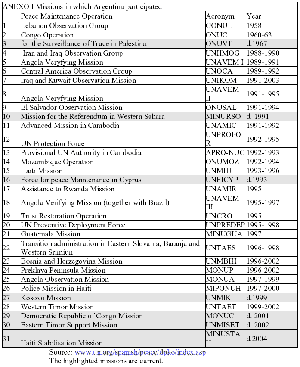
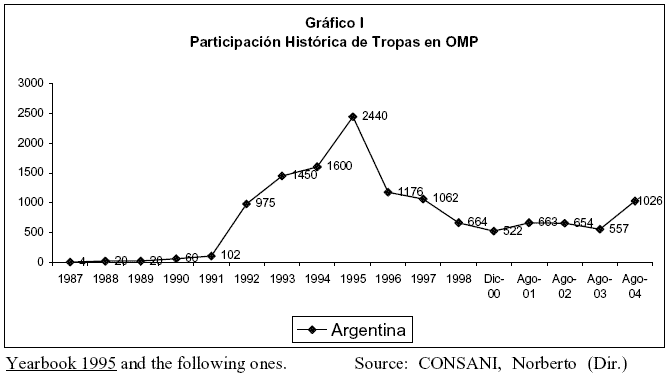
<body><![CDATA[<p><font face="Verdana, Arial, Helvetica, sans-serif" size="2">Argentine intervention    in the Gulf<a href="#_ftn3" name="_ftnref3" title=""><sup>3</sup></a> was a reflex of that special relation    which “meant a change in foreign policy, for it broke with traditional Argentine    neutrality in war conflicts which do not involve the country directly” (Bologna    and Busso, 1994, 36)<a href="#_ftn4" name="_ftnref4" title=""><sup>4</sup></a>.    According to the main supporter of this change, Carlos Escudé, this action helps    “Argentineans to be perceived as privileged in the West” (Escudé, 1992, 198).</font></p>     <p><font face="Verdana, Arial, Helvetica, sans-serif" size="2">This resource of    alignment with the West is based on the challenge that Iraq imposed on the international community. Although    in fact the government set this position as a form of thematic closeness to    the American agenda and showed its will<a href="#_ftn5" name="_ftnref5" title=""><sup>5</sup></a>,    even in contrast with the continent, for neither Brazil    –Argentine’s main socio-commercial partner-, nor the Rio Group –the main regional    forum-, accompanied Buenos Aires’s    attitude<a href="#_ftn6" name="_ftnref6" title=""><sup>6</sup></a>.</font></p>     <p><font face="Verdana, Arial, Helvetica, sans-serif" size="2">According to Felperin    and Romero, the situation linked three arguments: opportunity, reliability and    assigning a role to the armed forces. Opportunity is given    by the fact that the country was to “have an active role in the pision of roles    in the new international order”. The second argument has to do with the “creation    of an image of reliability of the Argentine government”. The third involves    the armed forces recovering the role they had lost at the Malvinas War. (Felperin    and Romero, 1993, 46).</font></p>     <p><font face="Verdana, Arial, Helvetica, sans-serif" size="2">Participation in    the conflict benefits in the Menemist government’s discourse is twofold: political    and economic. </font></p>     <p><font face="Verdana, Arial, Helvetica, sans-serif" size="2">The Argentine government    believed that by abandoning the non-intervention principle –main political factor    in the relationship with Washington-, huge benefits would be achieved, which would    mean a new international status for Argentina<a href="#_ftn7" name="_ftnref7" title=""><sup>7</sup></a>.    What was not taken into account is that in this new order our country’s position    and that of the USA are substantially    different. Our country did not attain a significant status, except for its integration    as an Extra NATO Ally<a href="#_ftn8" name="_ftnref8" title=""><sup>8</sup></a>”.</font></p>     <p><font face="Verdana, Arial, Helvetica, sans-serif" size="2">The second part,    the economic one, was based on Kuwait’s reconstruction plans, although hopes    were too high, for the USA got 70 per cent of the contracts in that pision,    in contrast with a tiny number of its allies such as Great Britain, France,    Germany and Japan. (Oribe Riva, 1994, 73)<a href="#_ftn9" name="_ftnref9" title=""><sup>9</sup></a>.</font></p>     <p><font face="Verdana, Arial, Helvetica, sans-serif" size="2">Political intervention    in Haiti is where we witness    the abandonment, or as Chancellor Di Tella said, the “obsolescence” of the non-intervention    principle<a href="#_ftn10" name="_ftnref10" title=""><sup>10</sup></a>. People close to the    government maintain that this action in the Caribbean was “not only desirable    but absolutely essential”, the main reason being that Argentina is “disarmed” opposing Chile and England and this intervention    would be “ our only fragile reassurance” for the “consolidation of our military-political    alliance with the USA” (Escudé 1994, 23)<a href="#_ftn11" name="_ftnref11" title=""><sup>11</sup></a></font></p>     <p><font face="Verdana, Arial, Helvetica, sans-serif" size="2">Troop deployment    during the Menem administration within the framework of the Peace Maintenance    Operations  was done based on the belief that:</font></p>     <p><font face="Verdana, Arial, Helvetica, sans-serif" size="2">...after the Gulf    War the collective security mechanism consolidates as one of the most remarkable    strategies in the post Cold War, counting with the endorsement and encouragement    of the US. (Busso, 1994, 87)</font></p>     <p><font face="Verdana, Arial, Helvetica, sans-serif" size="2">The increase of    Argentine participation in the UN Peace-Maintenance Operations was significant;    although our country had participated since 1958 it had always done so in a    symbolic way, both as regards the number of missions, as well as the intervening    troops<a href="#_ftn12" name="_ftnref12" title=""><sup>12</sup></a>. As it is said in the Libro Blanco    de la Republica Argentina (1998), this change    was qualitative as well as quantitative:</font></p>     ]]></body>
<body><![CDATA[<p><font face="Verdana, Arial, Helvetica, sans-serif" size="2">...until 1988 missions    of “classical mandate” predominated (truce observants and interposition forces);    from then onwards the sphere of action enlarged polyfunctionally towards activities    such as protection of humanitarian action, assistance of victims, refugees,    mine removal, supervision of elections, human right surveillance, infrastructure    reconstruction, among others (&#91;<a href="http://www.mindef.gov.ar/secciones/libro_blanco_de_defensa.doc" target="_blank">www.mindef.gov.ar/secciones/libro_blanco_de_defensa.doc</a>&#93;</font></p>     <p><font face="Verdana, Arial, Helvetica, sans-serif" size="2">Out of the thirty-one    missions in which our country has taken part, twenty-two took place during Menem’s    government<a href="#_ftn13" name="_ftnref13" title=""><sup>13</sup></a>. The number of soldiers increased    from 1998 to 1995 from twenty to more than two thousand and later abruptly decreased    over a few years, to about six hundred, stabilising at that level. The decrease    in the second half of the 90s is “owing to a tightening up in which our country    accompanies the decrease curve of general UN participation and it has to do    mainly to budget-reduction issues of the contributing countries.”</font></p>     <p><font face="Verdana, Arial, Helvetica, sans-serif" size="2">&#91;<a href="http://www.mindef.gov.ar/secciones/libro_blanco_de_defensa.doc" target="_blank">www.mindef.gov.ar/secciones/libro_blanco_de_defensa.doc</a>&#93;</font></p>     <p>&nbsp;</p>     <p><font face="Verdana, Arial, Helvetica, sans-serif" size="2">The relevance of    these changes is expressed in the Lbro Blanco objectives, where it is pointed    out that this policy has to do with the “co-operation framework and under a    strict legality criterion, given case by case by international sponsorship”,    under the following conditions:</font></p>     <p><font face="Verdana, Arial, Helvetica, sans-serif" size="2">...that there is    a real threat to international peace and security, that the reach and objectives    proposed by the mission are clear, that they are according to an international    juridical instrument; and that the parts have accepted and agreed to the presence    in the peace mission.</font></p>     <p><font face="Verdana, Arial, Helvetica, sans-serif" size="2">&#91;<a href="http://www.mindef.gov.ar/secciones/libro_blanco_de_defensa.doc" target="_blank">www.mindef.gov.ar/secciones/libro_blanco_de_defensa.doc</a>&#93;</font></p>     <p><font face="Verdana, Arial, Helvetica, sans-serif" size="2">This formula is    not so clear as regards the legitimisation of an intervention, as an “international    juridical instrument” is referred to as support, which enables justification    of multinational coalition action, as well as a Peace Maintenance Operation    or unilateral action.</font></p>     <p><font face="Verdana, Arial, Helvetica, sans-serif" size="2">It is not minor    that the USA distanced themselves from the UN towards organisations    such as NATO which allowed them more freedom of action<a href="#_ftn14" name="_ftnref14" title=""><sup>14</sup></a>. This is evident through the fact    that the UN have been very careful before getting involved in new cases, strengthening    their preventive role. &#91;SIPRI, 1995 y 1996&#93;</font></p>     <p><font face="Verdana, Arial, Helvetica, sans-serif" size="2">Regarding international    coalitions, as opposed to what happened in the Gulf, when NATO intervention    in Ex Yugoslavia took place, Chancellor Di Tella pronounced himself against    Argentine participation<a href="#_ftn15" name="_ftnref15" title=""><sup>15</sup></a>.    </font></p>     ]]></body>
<body><![CDATA[<p><font face="Verdana, Arial, Helvetica, sans-serif" size="2">It is extremely    clear that these actions are part of a redesign of foreign policy and can be    explained by the so-called participation in the New World Order, in fact a form    of partisanship of American foreign policy which generated conflict with its    neighbours<a href="#_ftn16" name="_ftnref16" title=""><sup>16</sup></a>; additionally, they mean a role and an opportunity    of training and modernisation of the Argentine armed forces.</font></p>     <p>&nbsp;</p>     <p><font face="Verdana, Arial, Helvetica, sans-serif" size="3"><b>2.&nbsp;Recent    governments (since 1999)</b></font></p>     <p><font face="Verdana, Arial, Helvetica, sans-serif" size="2">There are two elements    in order to analyse subsequent policies in this area, namely, the general characteristics    of foreign policy in the period, as well as changes in the international system.</font></p>     <p><font face="Verdana, Arial, Helvetica, sans-serif" size="2"> The    big axes in postmenemist foreign policies are: tensions in the triangular relation    between Buenos Aires, Brasilia and Washington,    and the impact of negotiations with International Financial Organisms in the    foreign policy agenda. Another element to take into account is that the governments    of the Alianza, Duhalde and Kirchner have a strong interest in differentiating    themselves from the Menemist government more than between each other<a href="#_ftn17" name="_ftnref17" title=""><sup>17</sup></a>.</font></p>     <p><font face="Verdana, Arial, Helvetica, sans-serif" size="2">Just as a general    presentation, <a href="/img/revistas/s_iri/v1nse/html/a04gra2.htm">Graph II</a>    shows the number of troops which took part in Argentinean, Brazilian<a href="#_ftn18" name="_ftnref18" title=""><sup>18</sup></a> and US Peace Maintenance Operations,    as well as that of Chile<a href="#_ftn19" name="_ftnref19" title=""><sup>19</sup></a>,    incorporating the latter because it is relevant to the construction of a wider    Mercosur, not only in terms of trade. &#91;TOKATLIAN, 2004ª&#93;</font></p>     <p><font face="Verdana, Arial, Helvetica, sans-serif" size="2"> Although    UN peace operations spread widely from 1999 onwards, with the new missions to    the Democratic Republic of Congo, Eastern Timor, Kosovo, etc, reaching in 2003    the highest number of new annual missions since the end of the Cold War, each    of them showed the challenges of post conflict reconstruction and the constraints    in order to build a sustainable peace in the international community. Since    2001, it is possible to observe increasing participation of regional actors    in the peace-making process and efforts to deal with crises. The missions that    started in 2002 were smaller, short-term and had specific aims, but they also    tended to play a peace-keeping role and serve a counselling function in order    to organise future governments. &#91;SIPRI, 2000, 2001, 2003 y 2004&#93;</font></p>     <p><font face="Verdana, Arial, Helvetica, sans-serif" size="2">The behaviour of    actors does not accompany general performance, as while American participation    slightly decreases, Argentina, Brazil and Chile remain relatively stable    as regards sending troops to Haiti. With the creation of MINUSTAH, the three    Latin American countries increase their participation by adjusting to the general    scene and expressing a common pattern of behaviour, above all by taking into    account that Santiago and Brasilia are “usually reluctant to send troops beyond    the domestic area” &#91;RODRIGUEZ GIAVARINI, 2004, 27&#93;</font></p>     <p><font face="Verdana, Arial, Helvetica, sans-serif" size="2">The decrease of    Americans is the result of a strategic change after George W Bush became the    president and the 9.11 attacks in 2001. Its impact was securitisation of the    international agenda and the abandonment of a multilateral strategy in favour    of a unilateral attitude. As it is pointed out in 2003 SIPRI Yearbook:</font></p>     <p><font face="Verdana, Arial, Helvetica, sans-serif" size="2">The US decision to defend their position as the only superpower by searching,    punching, and, if necessary, actively anticipating to those who threatened them    has dominated perceptions of global security over the last 18 months. Shared    worries among friends and foes are mainly in the area of how long such strategy    may last. (SIPRI, 2003)</font></p>     ]]></body>
<body><![CDATA[<p><font face="Verdana, Arial, Helvetica, sans-serif" size="2">This is the emergence    of the application of Richard Hass’s theory, who claims for the US the role of global police, with partial dedication    against those states which do not accept its will, like a sheriff who unites    voluntary states that help them restore order, and once this action is finished,    it dissolves. This took other powers out of the game, being now excluded from    big strategic decisions (HASS, 1994)</font></p>     <p><font face="Verdana, Arial, Helvetica, sans-serif" size="2"><b>2.1. Fernando    De la Rua’s government.</b></font></p>     <p><font face="Verdana, Arial, Helvetica, sans-serif" size="2">The main challenge    of the new government was to build an alternative model in foreign policy. It    was evident when talking about Menem’s government that “ carnal relations” had    an increasingly tense focus with Brazil    and led the country to have low profile in Latin American matters, aspects that    needed to be solved.</font></p>     <p><font face="Verdana, Arial, Helvetica, sans-serif" size="2">The new agenda    shows a predominance of economic matters which confirms a certain general tendency    similar to the previous government’s<a href="#_ftn20" name="_ftnref20" title=""><sup>20</sup></a>. Even if the Letter to Argentinean citizens claims    that our foreign policy “ cannot be tied up to the decisions of a member of    the international community” and that “ strategic priority lies in MERCOSUR”    (GODIO; 1998, 277)<a href="#_ftn21" name="_ftnref21" title=""><sup>21</sup></a>,    after De la Rua’s    triumph in elections over Justicialist candidate Eduardo Duhalde, the most important    newspapers claimed that there would be no significant changes in bilateral relations    even if they said there would be a change of style<a href="#_ftn22" name="_ftnref22" title=""><sup>22</sup></a>.    A sample of that change was the assertion that policies towards the US would be “intense” instead of the bold “carnal”    ones of Menemism<a href="#_ftn23" name="_ftnref23" title=""><sup>23</sup></a>.    </font></p>     <p><font face="Verdana, Arial, Helvetica, sans-serif" size="2">Although the proposal    of a coalition sought to be profound “ because it aimed at a substantial ideological    conception in foreign affairs” (MIRANDA, 2003, 15), it is also true that more    than a few analysts reduced the question to a mere change in diplomatic style,    with a certain conservative presidential profile. </font></p>     <p><font face="Verdana, Arial, Helvetica, sans-serif" size="2">This foreign policy    lacked the capacity to adapt to a changing international scene, which had an    impact on decision-making and discursive spheres. Cavallo’s arrival at the Ministry    of Finance was key in this sense, due to the fact that he did not agree with    the idea that MERCOSUR was a priority, going into bureaucratic fights in an    attempt to get closer to ALCA, which affected the relationship of Brazil    with the US<a href="#_ftn24" name="_ftnref24" title=""><sup>24</sup></a>,    and, internally, the ruling coalition.</font></p>     <p><font face="Verdana, Arial, Helvetica, sans-serif" size="2">The intention of    setting MERCOSUR as a strategic priority and the adjustment of relations with    the US created discursive disagreements which grew deeper as mechanisms to reach    objectives became unclear, such as how to refound and widen MERCOSUR<a href="#_ftn25" name="_ftnref25" title=""><sup>25</sup></a>,    how to take foreign policy towards a South-south dialogue and make it coincide    with North-South dialogue, etc.</font></p>     <p><font face="Verdana, Arial, Helvetica, sans-serif" size="2">Alter 10 years    of carnal relations with Washington, the promotion of MERCOSUR seems to oscillate    between two poles, not as the product of a pendulum policy but as the result    of a wandering without a clear aim and this is why it fell into the trap of    double dependency. The idea was to overcome the commitment to a strategic alliance    with Brazil without failing    to recognise hegemonic American power. However, soon actions were characterised    by “confusion and reactive policies predominated over rational ones” (MIRANDA    2003, 45). Beyond their intentions:</font></p>     <p><font face="Verdana, Arial, Helvetica, sans-serif" size="2">…diplomatic behaviour    of the Alianza  did not respond to a foreign policy initiative. Such behaviours    became trapped between changes in American policies and Brazilian promises around    MERCOSUR (MIRANDA, 2003, 53)</font></p>     <p><font face="Verdana, Arial, Helvetica, sans-serif" size="2">A possible explanation    for the latter is twofold: to reinforce regional power in relation to Washington,    and to have a policy which was functional to those with autonomising aims, i.e.    Brazil (MIRANDA, 2003, 59)</font></p>     ]]></body>
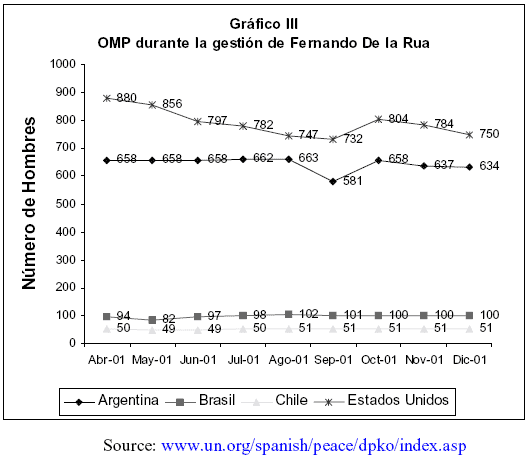
<body><![CDATA[<p><font face="Verdana, Arial, Helvetica, sans-serif" size="2">Within this framework,    Peace Maintenance Operations are a key element in order to describe governmental    action. Before the Alianza was in power, the Clinton administration made some enquiries, through its Defence Secretary,    William Cohen, in order to find out whether it would continue with Peace Maintenance    Operations, the answer being it would, provided they were not encouraged by    the UN<a href="#_ftn26" name="_ftnref26" title=""><sup>26</sup></a>. De la    Rua was very sensitive to this, and he pointed it out in his    opening speech as a salient point in his foreign policy<a href="#_ftn27" name="_ftnref27" title=""><sup>27</sup></a>.</font></p>     <p><font face="Verdana, Arial, Helvetica, sans-serif" size="2">The democrat government    continued putting pressure in order to strengthen such operations, even though    the De la Rua administration shared its    objectives, the Minister of Defence, Ricardo Lopez Murphy, as a response of    a new enquiry by Cohen:</font></p>     <p><font face="Verdana, Arial, Helvetica, sans-serif" size="2">…replied that our    country could not afford to continue doing so due to budget reasons. From this    it can be inferred that there was not a deep change, as regards valuing Peace    Maintenance Operations as a means to guarantee world peace, increase Armed Forces    performance or any other consideration related to defence policies, as financial    reasons were taken into account (BUSSO, 2001, 81)</font></p>     <p><font face="Verdana, Arial, Helvetica, sans-serif" size="2">Argentine commitment    in Peace Maintenance Operations can be observed in the Document entitled <u>Redefinición    de la Defensa Nacional</u> (2001). Even if its objectives and conditions coincide    with those of the previous administration, a new condition is incorporated which    is worrying since it affects the non-intervention principle. We refer to the    following: “ in spite of the fact that some of them (parts in the conflict)    reject it, intervention is necessary in order to preserve peace and stability    in the region” &#91;<a href="http://www.mindef.gov.ar/secciones/revision/prioridades3.htm" target="_blank">www.mindef.gov.ar/secciones/revision/prioridades3.htm</a>&#93;</font></p>     <p><font face="Verdana, Arial, Helvetica, sans-serif" size="2">In spite of the    magnitude of the adjustment in doctrine, there was not a situation where it    can be applied even if the number of missions increased, from nine to ten, but    total soldier participation was maintained, as we can see in <a href="#gra3">Graph    III</a>. The rest of actors involved, Brazil, Chile and the US, continue with    the policies already mentioned.</font></p>     <p><a name="gra3"></a></p>     <p>&nbsp;</p>     <p align="center"><img src="/img/revistas/s_iri/v1nse/a04gra3.gif" usemap="#Map" border="0">    <map name="Map">     <area shape="rect" coords="160,438,469,456" href="http://www.un.org/spanish/peace/dpko/index.asp" target="_blank">   </map> </p>     <p>&nbsp;</p>     <p><font face="Verdana, Arial, Helvetica, sans-serif" size="2">It is not incidental    that De la Rua, in his last message at the Opening of Congreso sessions, pointed    out:</font></p>     ]]></body>
<body><![CDATA[<p><font face="Verdana, Arial, Helvetica, sans-serif" size="2">The Armed Forces    have strongly committed to UN peace missions and they have done so with high    prestige. These missions stay in intellectual and technological contact with    the most advanced countries in the world, thus participating, to the country’s    benefit, in favour of peace. In all missions in which they have participated,    they have showed their efficiency and professional expertise. (DE LA    RUA, 2001)</font></p>     <p><font face="Verdana, Arial, Helvetica, sans-serif" size="2">The attacks against    Washington and New York placed the Alianza government in a difficult position,    as the multilateral strategy appeared to be weak in the face of the American    decision to make the international agenda unilateral. </font></p>     <p><font face="Verdana, Arial, Helvetica, sans-serif" size="2">Although the government    manifested its “absolute support” to the US    and even pointed out that the government endorsed the military response, understanding    that through this the Americans would search for “ justice and not vengeance    as a universal principle”<a href="#_ftn28" name="_ftnref28" title=""><sup>28</sup></a>. But this “absolute    support” was subject to two consensuses: en external one (in multilateral organisms,    especially regional ones) and an internal one (the adopted measure will be decided    by the Congress).</font></p>     <p><font face="Verdana, Arial, Helvetica, sans-serif" size="2">For the first of    them, this form of multilateralism does not adopt the shape of opposition to    Washington but it seeks to achieve regional harmony with    White House decisions. On a first reading, we can conclude that it was easier    for the government to operate as the “builder of a continental consensus”<a href="#_ftn29" name="_ftnref29" title=""><sup>29</sup></a> in accordance with Washington    decisions, rather than seeking internal support for its policies.</font></p>     <p><font face="Verdana, Arial, Helvetica, sans-serif" size="2">This latter aspect,    internal consensus, was very difficult to achieve, since the discussion within    political parties –official and opposition- showed that some opposed sending    troops and demanded a different form of multilateralism, in harmony with Brasilia<a href="#_ftn30" name="_ftnref30" title=""><sup>30</sup></a>, while others, such    as Menemism, demanded a position in harmony with Washington (SIMONOFF, 2002,    12-14). According to some academics, such as Roberto Russell, government action    was reasonable:</font></p>     <p><font face="Verdana, Arial, Helvetica, sans-serif" size="2">…we cannot stay    outside this. But now, what we need to avoid is overacting support. We cannot    be the first to ask where we shall go and fight. This could increase concrete    risk for us. We need to achieve strong internal and also international consensuses.    It would be extremely important to seek agreements within MERCOSUR. (RUSSELL,    2001, 29)</font></p>     <p><font face="Verdana, Arial, Helvetica, sans-serif" size="2">It was positive    to avoid overacting, which meant not going into a military adventure, although    it placed an important role in co-ordinating and moving regional organisms in    support of Washington, through the TIAR Appeal, although it pointed out that    it would only support a multilateral response. These co-ordination movements    with other governments in the region are different from Argentinean behaviour    in the Gulf War. While  in that conflict Americans did not ask for military    intervention, troops were sent. In this opportunity the government  just waited    for the request, in order to avoid overacting. A serious problem, as Granovsky    claims, was that Argentina could be “subject to demands from Washington that    it may not be able to –or for whom it would not be convenient - to respond to”    &#91;GRANOVSKY, 2001, 10&#93;</font></p>     <p><font face="Verdana, Arial, Helvetica, sans-serif" size="2">As we have seen,    the shape the non-intervention principle has taken, and the economic weakness,    have moulded Argentine positions making them close to American needs in all    respects, as Roberto Russell and Juan Gabriel Tokatlián point out:</font></p>     <p><font face="Verdana, Arial, Helvetica, sans-serif" size="2">…Argentines must    understand that the degrees of freedom of a country, our security and the consolidation    of democracy cannot result in isolation or opposition policies. However, we    should also see that overacting or the adoption of solitary policies which may    generate unnecessary risks, are not convenient. &#91;RUSSEL and TOKATLIAN, 2001,    6&#93;</font></p>     <p><font face="Verdana, Arial, Helvetica, sans-serif" size="2">One of the questions    that arose at the time was the shape collaboration could take: either something    less evident than sending troops to the site of the conflict, as the Secretary    of Defence Donald Rumsfeld pointed out. The support would not be directly for    military intervention, as this is a floating coalition that could “change and    evolve” and in which partners “would have different roles and contribute in    perse forms” (RUMSFELD, 2001, 16) These perse forms could be the militarisation    of the Triple Border, the replacement of American troops for Argentine ones    in other parts of the world, such as ex Yugoslavia, and so on. </font></p>     ]]></body>
<body><![CDATA[<p><font face="Verdana, Arial, Helvetica, sans-serif" size="2">In the middle of    the political and social revulsion with which the government of Fernando De    la Rua ended, they sought to contribute    to the Afghanistan War with 600 infantry men and a mobile hospital, in charge    of the UN, although this operation was frustrated by the government’s downfall<a href="#_ftn31" name="_ftnref31" title=""><sup>31</sup></a>.</font></p>     <p><font face="Verdana, Arial, Helvetica, sans-serif" size="2"><b>2.2. Foreign    policy during the Duhalde administration.</b></font></p>     <p><font face="Verdana, Arial, Helvetica, sans-serif" size="2">When Senator Duhalde    became the provisional president on 1 January 2002, he put an end to and endless    succession of presidents since the end of the previous December. On his first    presidential speech to Parliament he announced the change of an “exhausted”    economic model and the non-payment of the external debt decreeted by Adolfo    Rodríguez Saa<a href="#_ftn32" name="_ftnref32" title=""><sup>32</sup></a>.</font></p>     <p><font face="Verdana, Arial, Helvetica, sans-serif" size="2">The new relations    of  Argentina with the world were qualified by Chancellor Carlos Ruckauf as    “polygamic”,  differentiating them from “carnal relations” in Menem´s government.    Relations with Washington were not only “focused on the financial question with    Argentina, but they also dealt with matters related to diplomatic policies”    (MIRANDA, 2003, 72)<a href="#_ftn33" name="_ftnref33" title=""><sup>33</sup></a>.</font></p>     <p><font face="Verdana, Arial, Helvetica, sans-serif" size="2">As opposed to the    De la Rua administration, the interim Duahalde administration    was marked by a pragmatic foreign policy with everyday piecemeal decisions.    According to Miranda, the analysis of the government can be circumscribed to    two aspects: the tension for the “use of the international scene in order to    satisfy objectives of domestic policy”; and “ the only hint of rationality that    foreign relations had at this time characterised by reactive attitudes” –referring    to the negotiation process with IMF started by Lavagna at the Ministry of Economy.    (MIRANDA, 2003, 70)</font></p>     <p><font face="Verdana, Arial, Helvetica, sans-serif" size="2">The political objective    of the Duhalde administration was to “diminish political alignment with the    US”. Examples of this objective were the position of the Argentinean government    as regards the American invasion of Iraq and the pragmatic use of the extra    NATO Ally condition in order to gain support in the financial negotiation. &#91;MIRANDA,    2003,74&#93;</font></p>     <p><font face="Verdana, Arial, Helvetica, sans-serif" size="2">As it comes to    Brazil, there are  two aspects to point out: first, the crisis forced the country    to “seek refuge in Latin American support, above all Brazilian support” and    to “agree with the non-interventionist Brazilian policy” &#91;MIRANDA, 2003,72-76&#93;.    The arrival of Lula da Silva in government with the idea of reinforcing MERCOSUR    made Argentina gain a strategic relevance in the Brailian agenda which it did    not have before this. </font></p>     <p><font face="Verdana, Arial, Helvetica, sans-serif" size="2"> The Peace Maintenance    Operations within Duhalde´s government continued with the alignment since the    Alianza government with a slight decrease from 630 to 530 men, as it can be    observed in <a href="/img/revistas/s_iri/v1nse/html/a04gra4.htm">Graph IV</a>,    and from 10 missions to 8<a href="#_ftn34" name="_ftnref34" title=""><sup>34</sup></a>.    As it had occurred in De la Rua’s  government, this reduction has to do with    a governmental decision to cut down on expenses. This decision showed in the    Opening speech of the 121st ordinary session, in which the president said:</font></p>     <p><font face="Verdana, Arial, Helvetica, sans-serif" size="2">We are committed    to humane actions which are necessary to defend health and integrity of innocent    victims of war conflicts…Our Armed Forces, which deal with tasks assigned with    loyalty and patriotism on very limited budgets but with total dedication, are    respected wherever they go. We go on maintaining our presence in peace missions    in the places where we work and with the reduction characteristic of the austerity    we have imposed ourselves. &#91;DUHALDE, 2003&#93;</font></p>     <p><font face="Verdana, Arial, Helvetica, sans-serif" size="2">As a result of    the American decision to invade Iraq, the government took an ambiguous position:    on the one hand, the same presidential speech said: “ our troops will not go    to fight any war in Iraq” &#91;DUHALDE, 2003&#93;. Basing his position on his provisional    character<a href="#_ftn35" name="_ftnref35" title=""><sup>35</sup></a>, there    was not internal consensus to send troops there and “besides, public opinion    is in general contrary to war in Iraq”.</font></p>     ]]></body>
<body><![CDATA[<p><font face="Verdana, Arial, Helvetica, sans-serif" size="2">Even if this is    true, Chancellor Ruckauf always “paid attention to the convenience that the    war should be a decision of the Security Council, the truth is it lay more emphasis    on describing the conditions of Saddam Hussein´s regime” (MORALES SOLA, 2003).    This made itself evident through the uncertain attitude this Minister displayed    in his visit to New York, with the aim of attending the UN General Assembly    in 2002. There, he said to President George W Bush on a casual encounter:</font></p>     <p><font face="Verdana, Arial, Helvetica, sans-serif" size="2">…Argentina supports    the American claim that the resolutions of the Security Council should be enforced    and that an ultimatum is issued to Saddam Hussein so that it is possible for    international inspectors to check whether Iraq still manufactures chemical weapons,    nuclear missiles or any kind of war materials<a href="#_ftn36" name="_ftnref36" title=""><sup>36</sup></a>.</font></p>     <p><font face="Verdana, Arial, Helvetica, sans-serif" size="2">Although the first    part of his assertion was under precise command of President Duhalde, in the    sense that all action against Iraq should be multilateral and not unilateral,    the second part was cast into doubt by other members of the Security Council,    since it showed in advance American unilateral action and this lay beyond the    president´s instructions. It was due to this that a day later the Chancellor    had to state that:</font></p>     <p><font face="Verdana, Arial, Helvetica, sans-serif" size="2">We are not coming    back to carnal relations. We are taking the stance that Argentina has invariably    supported, because during Rodriguez Giavarini´s administration the enforcement    of UN commands has been an issue. This has not varied<a href="#_ftn37" name="_ftnref37" title=""><sup>37</sup></a>.</font></p>     <p><font face="Verdana, Arial, Helvetica, sans-serif" size="2">The States put    pressure as regards this matter, before the visit of the Sub Secretary of Hemispheric    Affair, Otto Reich, was publisher in La    Nación, an article of his said that</font></p>     <p><font face="Verdana, Arial, Helvetica, sans-serif" size="2">In recent years    Argentina has been a firm champion of freedom in the Western hemisphere and    all over the world and we appreciate and value the help it has offered since    the Gulf War until the present campaign against terrorism. Argentinean help    has been offered in a rapid and effective way when it had to be implemented.    Its contribution will never be forgotten and we will be forever grateful. &#91;REICH,    2002, 17&#93;</font></p>     <p><font face="Verdana, Arial, Helvetica, sans-serif" size="2">A way to respond    to this situation was the idea of sending “humane help” alter the conflict.    This consisted of the participation of experts in chemical, nuclear and contaminating    weapons, a mobile hospital and specialised medical support, as well as participating    in the Caribbean to fill the vacuum left by Americans. (italics are ours, SIMONOFF    ET.AL. , 2003)</font></p>     <p><font face="Verdana, Arial, Helvetica, sans-serif" size="2">Duhalde´s government    called for elections, which led to the presidency of Néstor Kirchner on 25 May    2003.</font></p>     <p><font face="Verdana, Arial, Helvetica, sans-serif" size="2"><b>2.3. Foreign    Policy during Néstor Kirchner´s government. </b></font></p>     <p><font face="Verdana, Arial, Helvetica, sans-serif" size="2">Since his opening    speech, Néstor Kirchner set as a general basis of his foreign policy its multilateral    character. This is sustained in the existence of idealist presuppositions (“strengthening    of International Law”) (KIRCHNER, 2003)</font></p>     ]]></body>
<body><![CDATA[<p><font face="Verdana, Arial, Helvetica, sans-serif" size="2">In harmony with    this, Chancellor Rafael Bielsa qualified our country as an “intermediate power”<a href="#_ftn38" name="_ftnref38" title=""><sup>38</sup></a>,    and this condition:</font></p>     <p><font face="Verdana, Arial, Helvetica, sans-serif" size="2">…is directly linked    to its influence in the regional sphere, in the affirmation of values such as    human rights, peaceful resolution of conflicts and democratic stability. It    is also connected to its necessary role in strengthening MERCOSUR and on a wider    scale preserving and developing the non-renewable resources available. It is    also important to highlight the possibility of intervening together with other    intermediate countries in the negotiation towards the elimination of subsidies    and protections on the part of developed countries (BIELSA, 2003)</font></p>     <p><font face="Verdana, Arial, Helvetica, sans-serif" size="2">These elements    clearly appear in the governmental attempt to avoid bilateral discussion with    the USA and to do so with the whole international community, both from the political    and economic point of view<a href="#_ftn39" name="_ftnref39" title=""><sup>39</sup></a>..    As regards the first question, Washington consulted Buenos Aires concerning    the sending of troops to Iraq, the Argentine reply being that it would, once    the multilateral force which occupies that country was under UN leadership<a href="#_ftn40" name="_ftnref40" title=""><sup>40</sup></a>    This position had a repercussion on the actions the Bush administration had    in multilateral financial organs and in the G8, where up to then the European    position had predominated<a href="#_ftn41" name="_ftnref41" title=""><sup>41</sup></a>.</font></p>     <p><font face="Verdana, Arial, Helvetica, sans-serif" size="2">There are two aspects    which were highlighted by the president: the continuity of participation in    Peace Missions, and the problems of the international agenda proposed by the    US, the fight against terrorism. This problem is given an important position    in the agenda, highlighting a distance with the orientation proposed by Washington    as regards this problem, although he claimed to be “ willing and attentive”    concerning the aim of “eradicating it”, because he identifies our country as    a victim of such actions. (KIRCHNER, 2003)</font></p>     <p><font face="Verdana, Arial, Helvetica, sans-serif" size="2">The regional plane    appears as a priority in this speech, talking about the “ construction of a    politically stable, prosperous and united Latin America, based on the ideals    of democracy and social justice” (KIRCHNER, 2003). The MERCOSUR has gone through    difficult times since the mid 90s and the political closeness of Lula and Kirchner    is a positive sign, but this did not guarantee the end of tensions.</font></p>     <p><font face="Verdana, Arial, Helvetica, sans-serif" size="2">In the economic    plane, it is also based on multilateral actions, in its commercial and financial    aspects. For the former, the MERCOSUR appears as the vortice of the megotiation    triangle with ALCA and the European Union<a href="#_ftn42" name="_ftnref42" title=""><sup>42</sup></a>. An important effect of this was what happened in the    OMC meeting in Cancun when Argentina prioritised G20 plus to Cairos Group, showing    a clear change of strategy as regards international economic insertion, which    was more productive. But it also indicates the need to deepen and widen it to    the rest of Latin American countries<a href="#_ftn43" name="_ftnref43" title=""><sup>43</sup></a>. Additionally, it is complemented    by a strategy of political opening which seeks to increase “substantially our    exchange with the rest of the world”, persifying our foreign trade, generating    simultaneous and permanent negotiations “ in all the international negotiation    forums which involve our country” (KIRCHNER, 2003). From the financial point    of view, the negotiation of the external debt still continues with a strategy    which allows us to reduce rates and sums and to extend deadlines and due dates.    </font></p>     <p><font face="Verdana, Arial, Helvetica, sans-serif" size="2">What we can observe    as regards participation in Peace Maintenance Operations is displayed in <a href="/img/revistas/s_iri/v1nse/html/a04gra5.htm">Graph    V</a>: in contrast with previous administrations, De la Rua’s and Duhalde’s,    there is towards the end a significant increase in the number of men in these    missions. The same phenomenon can be observed in Chile and Brazil, while the    US continues its decrease in participation which went from 530 to 430 men. There    are also changes in the number of missions carried out by some of these countries,    since the US went from 6 to 9, Brazil from 1 to 5, whilst Chile and Brazil remain    stable<a href="#_ftn44" name="_ftnref44" title=""><sup>44</sup></a>. </font></p>     <p><font face="Verdana, Arial, Helvetica, sans-serif" size="2">Concerning the    Argentine case, the president referred to this situation in his message to the    General Assembly in 2004:</font></p>     <p><font face="Verdana, Arial, Helvetica, sans-serif" size="2">This year we have    doubled military and police staff credited in peace maintenance missions, thus    now counting with Argentine men in 8 out of the 16 existing operations (KIRCHNER,    2004) </font></p>     <p><font face="Verdana, Arial, Helvetica, sans-serif" size="2">Even if the definition    of international security of the Kirchnerist government is based on three elements:    defence of democracy and human rights, respect for sovereignty and self-determination    and multilateralism (SIMONOFF AND OTHERS, 2004)<a href="#_ftn45" name="_ftnref45" title=""><sup>45</sup></a>. When the role of     Peace Maintenance Operations is defined in the document entitled <u>La Defensa Nacional</u><u>    en la Agenda    Democrática</u> (2003), we can see the following:</font></p>     ]]></body>
<body><![CDATA[<p><font face="Verdana, Arial, Helvetica, sans-serif" size="2">…Argentine performance    will take place through and attempting to have an influence in multilateral    organisms such as the UN and the OEA. A significant aspect of the Argentine    role as regards contribution towards international peace is the participation    in peace operations within the framework of the UN or in those coalitions which    do not oppose to the objectives established in the Charter of such organ, articles    six and seven Argentina must contribute to elaborating, promoting and sustaining    an International System based on clear rules which reflect values that we support    as a society. (<a href="http://www.mindef.gov.ar/secciones/documentos/Proyecto%20La%20Defensa%20Nacional%20en%20la%20Agenda%20Democr%E1tica.doc" target="_blank">www.mindef.gov.ar/secciones/documentos/Proyecto%20La%20Defensa%20Nacional%20en%20la%20Agenda%20Democr%E1tica.doc</a>)</font></p>     <p><font face="Verdana, Arial, Helvetica, sans-serif" size="2">It is evident that    there are differences between both definitions. But we seek to highlight three    aspects of this text: first, the attribution to the OEA of intrusive faculties,    which, as we have seen, was a claim by the Menemist administration; secondly,    they refer to a “coalition”; this definition still makes it possible to act    from outside the UN. Finally, it mentions Chapters VI and VII of the Charter<a href="#_ftn46" name="_ftnref46" title=""><sup>46</sup></a>, i.e. its peace maintenance    and imposition tasks. </font></p>     <p><font face="Verdana, Arial, Helvetica, sans-serif" size="2">Both Brazil and    Chile have different motivations for participating in the mission. It is not    a minor detail that both countries were non-permanent members in the Security    Council when the theme was dealt with. Even if, as the government did, they    supported their decision on the multilateral and regional character of the initiative,    it is evident that there are others<a href="#_ftn47" name="_ftnref47" title=""><sup>47</sup></a>. </font></p>     <p><font face="Verdana, Arial, Helvetica, sans-serif" size="2">The first case    has to do with its participation in the selective framework that characterised    the end of the Cold War. But it is beyond doubt that it also relates to its    aim to hold a permanent seat in the UN Security Council. Chile, on its part,    was already there, because it was part of the Provisional Multinational Force,    and took this as an opportunity to improve its relation with the USA, due to    its position in the Security Council as regards the Iraq  question.</font></p>     <p><font face="Verdana, Arial, Helvetica, sans-serif" size="2"> </font><font face="Verdana, Arial, Helvetica, sans-serif" size="2">Armed    conflicts between supporters of Aristide and his opposers in Haiti grew bigger,    above all due to American and Dominican support to the rebels. LEMOINE, 2004,    12-13&#93; <a href="#_ftn48" name="_ftnref48" title=""><sup>48</sup></a> . It was taking this situation into    account that Ambassador Leonardo Despouy<a href="#_ftn49" name="_ftnref49" title=""><sup>49</sup></a>    said: </font></p>     <p><font face="Verdana, Arial, Helvetica, sans-serif" size="2">…the UN, the OE    and humanitarian organisms face a double challenge: acting immediately in order    to slow the crisis down and at the same time contributing to its peaceful resolution    &#91;DESPOUY, 2004, 27&#93;</font></p>     <p><font face="Verdana, Arial, Helvetica, sans-serif" size="2">The Argentine government    publicly expressed through its Foreign Policy Secretary and Vice Chancellor,    Jorge Taina, on 13 February 2004:</font></p>     <p><font face="Verdana, Arial, Helvetica, sans-serif" size="2">…that Argentina    wholly supports the initiatives taken by the Caribbean Community (CARICOM) and    actively participates in a group of friends of OEA, with the aim of supporting    all attempts to achieve a rapid solution to the crisis, making it clear that    this interest has been constant over the last few years, with the active participation    of Argentina in the difficult political processes in this country<a href="#_ftn50" name="_ftnref50" title=""><sup>50</sup></a>.    </font></p>     <p><font face="Verdana, Arial, Helvetica, sans-serif" size="2">The choice towards    a way out of the crisis was restated five days later by the governments of MERCOSUR    and the Associated Status, which issued a communiqué where they abhorred violence    acts, expressed their deep conviction that peaceful constructive dialogue is    the solution to the problem and supporting all multilateral negotiations which    have already been mentioned<a href="#_ftn51" name="_ftnref51" title=""><sup>51</sup></a>. </font></p>     <p><font face="Verdana, Arial, Helvetica, sans-serif" size="2">At the end of that    month the Argentine government decided to reinforce the security of our representation    in that country. Later on, on 2 March, after the forced resignation of Aristide    and the formation of the Provisional Multinational Force (the USA, France, Canada    and Chile) under Resolution 1529/04 of the Security Council, it announced that    it would only offer humane help through the White Helmets and that it did not    aim to send troops. But two days later it changed its position, deciding to    send soldiers to the country within the fraworm of such resolution<a href="#_ftn52" name="_ftnref52" title=""><sup>52</sup></a>.    </font></p>     ]]></body>
<body><![CDATA[<p><font face="Verdana, Arial, Helvetica, sans-serif" size="2">While discussion    in our country advanced<a href="#_ftn53" name="_ftnref53" title=""><sup>53</sup></a>, the Security Council dictated a new resolution, 1542,    and Brazil, Chile and Uruguay quickly decided to send troops. The time it took    the Argentinean administration to take the decision led several sectors to criticise    them<a href="#_ftn54" name="_ftnref54" title=""><sup>54</sup></a>.</font></p>     <p><font face="Verdana, Arial, Helvetica, sans-serif" size="2">The Argentine government    argued that it was not delaying an initiative, but that it had sought to make    contact with presidents Ricardo Lagos and Lula Da Silva before sending the Project    to Parliament. The worries of Kirchner´s administration dealt with the legal    framework of the mission, although “ since 2000 operations had always been voted    under Chapter VII”<a href="#_ftn55" name="_ftnref55" title=""><sup>55</sup></a>. On the other hand, they saw in that    a gesture by the Republican administration, regarding the Argentine position    on the International Penal Court and the Iraqi question<a href="#_ftn56" name="_ftnref56" title=""><sup>56</sup></a>. Although for the government, its decision would not    be taken as a “compensatory” attitude towards the USA<a href="#_ftn57" name="_ftnref57" title=""><sup>57</sup></a>.</font></p>     <p><font face="Verdana, Arial, Helvetica, sans-serif" size="2">In May 2004 the    Defence Minister, José Pampuro met his Brazilian peer, José Viegas, in order    to finish the last details of the troop deployment in Haiti. It was evident    then that the objectives of both missions differed. While Argentina wanted to    do it under Chapter VI of the Charter (“peace maintenance”), the Brazilian and    Chilean missions would do so under number VII (“peace imposition”)<a href="#_ftn58" name="_ftnref58" title=""><sup>58</sup></a>.    </font></p>     <p><font face="Verdana, Arial, Helvetica, sans-serif" size="2">It was only on    21 May that the Project was sent to Congress, asking for authorisation for the    mission<a href="#_ftn59" name="_ftnref59" title=""><sup>59</sup></a> which contemplated    the participation of 600 men<a href="#_ftn60" name="_ftnref60" title=""><sup>60</sup></a>. The result of this    mission would “affect the regional security system” and “show the world that    MERCOSUR represented more than a mere commercial agreement”<a href="#_ftn61" name="_ftnref61" title=""><sup>61</sup></a>.</font></p>     <p><font face="Verdana, Arial, Helvetica, sans-serif" size="2">Once in Parliament,    discussion quickly articulated around two matters: if the mission was one of    maintenance or imposition; and/or if it was an American demand or a regional    initiative<a href="#_ftn62" name="_ftnref62" title=""><sup>62</sup></a>. According    to Jose Pampuro, “Haiti is in a situation of acephaly and the only way to help    them is to guarantee institutional stability”<a href="#_ftn63" name="_ftnref63" title=""><sup>63</sup></a>.</font></p>     <p><font face="Verdana, Arial, Helvetica, sans-serif" size="2">The official party    did not reach a wide consensus although it was able to impose its decision<a href="#_ftn64" name="_ftnref64" title=""><sup>64</sup></a>.    It focused its argumentation on two elements: multilaterality of the undertaking    and regional presence in it<a href="#_ftn65" name="_ftnref65" title=""><sup>65</sup></a>. As the UN Argentine    representative. Ambassador Cesar Mayoral points out:  </font></p>     <p><font face="Verdana, Arial, Helvetica, sans-serif" size="2">If Argentine political    parties, opinion leaders and the majority of our people sustain that multilateralism    as a concept must rule international relations, then our country must be close    to Haiti.</font></p>     <p><font face="Verdana, Arial, Helvetica, sans-serif" size="2">And as regards    the second argument:</font></p>     <p><font face="Verdana, Arial, Helvetica, sans-serif" size="2">Brazil and Chile,    the only Latin American non-permanent members in the Security Council, voted    in favour of it and decided to rapidly participate in the forces that were created    in order to restore peace and disarm the bands in conflict. &#91;MAYORAL, 2004,    31&#93;</font></p>     <p><font face="Verdana, Arial, Helvetica, sans-serif" size="2">In fact, President    Kirchner said in a message before the  UN Assembly General in September 2004    that “ the region has committed to helping the poorest country in America to    return to the path of growth and freedom and guarantee democracy”, and he restated    the Argentine position:</font></p>     ]]></body>
<body><![CDATA[<p><font face="Verdana, Arial, Helvetica, sans-serif" size="2">…based on universal    respect of human rights and international human law. The history of Argentina    firmly explains our government’s position in a question that constitutes, at    this point, part of our identity as a democratic nation. (KIRCHNER, 2004)</font></p>     <p><font face="Verdana, Arial, Helvetica, sans-serif" size="2">Additionally, he    referred to this action as a continuity of a State policy, as it was pointed    out by the President of the Foreign Affair Committe of the Deputies Chamber,    Jorge Agüero:</font></p>     <p><font face="Verdana, Arial, Helvetica, sans-serif" size="2">…the attitude of    Argentina as regards ths matter is centred on its permanent principles as regards    foreign policy, and it is because of this that we must keep our promises and    gruatantee their continuity. &#91;AGÜERO, 2004, 23&#93;</font></p>     <p><font face="Verdana, Arial, Helvetica, sans-serif" size="2">It was due to this    position that the government won an unexpected ally, Senator Eduardo Menem,    who defended the measure, but said “ What we can criticise is the delay in taking    the decision; we would have had a more preponderant role in the UN multilateral    force for Haiti, which is now led by a Brazilian general”<a href="#_ftn66" name="_ftnref66" title=""><sup>66</sup></a>. </font></p>     <p><font face="Verdana, Arial, Helvetica, sans-serif" size="2">Duhaldists supported    the measure although they demanded the renovation of the mission was done by    Congress and not the Executive Power<a href="#_ftn67" name="_ftnref67" title=""><sup>67</sup></a>. Province parties also accompanied    the measure, as well as Recrear legislators, based on the same arguments as    the Executive Power<a href="#_ftn68" name="_ftnref68" title=""><sup>68</sup></a>.    </font></p>     <p><font face="Verdana, Arial, Helvetica, sans-serif" size="2">Those who were    opposed to this were the Radical Party, Socialism, ARI and left-wing parties    with parliamentary representation. The first ones who at first showed doubts    as regards the basis of the mission –chapter VII of the Charter- quickly went    to the opposition claiming with them that it affected non-intervention and self-determination    principles.  According to Deputy Federico Storani, vice President of the Foreign    Affairs Committee of the Deputies Chamber, this mission “seeks to validate a    coup d’etat by a non-existing government from the point of vew of its legitimacy”    and that this multilateral intervention “was initially bilateral on the part    of France and the US, which acted militarily before the resolution of the UN    Security Council was adopted”. We can find in this argument a critique of the    attitude the international organ had in this crisis. According to him, the Kirchner    administration:</font></p>     <p><font face="Verdana, Arial, Helvetica, sans-serif" size="2">…sought to take     advantage of this gesture in order to go out of its frozenness  as a result    of its correct vote –from our point of view- with respect to the situation of    human rights in Cuba. But they have chosen the wrong path in the wrong country and    set horrible antecedents. &#91;STORANI, 2004&#93;</font></p>     <p><font face="Verdana, Arial, Helvetica, sans-serif" size="2">In general lines,    the radical argument went against the contents of Resolution 1542/04, as an    imposition of great  powers. Although not everyone belonging to this party was    against this measure, as it is shown in the positions taken by ex Defence Minister    of Alfonsin, De la Rua    and Duhalde´s governments, José Jaunarena, ex Chancellor Adalberto Rodríguez    Giavarini &#91;2004, 27&#93; or Senator Rodolfo  Terragno, who, although he went against    the reasons that led to the crisis in the Caribbean country, he even highlighted    that:</font></p>     <p><font face="Verdana, Arial, Helvetica, sans-serif" size="2">The US    are not interested in distracting efforts of paying a “political cost” of a    long-lasting intervention. It is because of this that now the Security Council    resorts to “multilateralism” in its aim to preserve the US. &#91;TERRAGNO, 2004, 40&#93; But he rightly asserts    that:</font></p>     <p><font face="Verdana, Arial, Helvetica, sans-serif" size="2">It is not reasonable    to repudiate American “unilateralism” and, when one has the opportunity to integrate    a “multilateral force , of which the US are not part, reject this responsibility. &#91;TERRAGNO,    2004, 40&#93;</font></p>     ]]></body>
<body><![CDATA[<p><font face="Verdana, Arial, Helvetica, sans-serif" size="2">Socialist legislators    also opposed; Senator Ruben Guistiniani,  as well as Deputy Jorge Rivas had    an active stance against the project. They base it on the fact the Executive    Power dealt with the theme in an uninterested fashion, going against the non-intervention    principle.  &#91;RIVAS, 2004ª y 2004B&#93;</font></p>     <p><font face="Verdana, Arial, Helvetica, sans-serif" size="2">The ARI joined    this critique for its representative in Foreign Policy matters, Deputy Carlos    Raimundi pointed out that “ the innovative initiative in Argentina    should not be functional to American military control, but it should find a    solution to popular Haitian needs”<a href="#_ftn69" name="_ftnref69" title=""><sup>69</sup></a>. </font></p>     <p>&nbsp;</p>     <p><font face="Verdana, Arial, Helvetica, sans-serif" size="3"><b>CONCLUSIONS</b></font></p>     <p><font face="Verdana, Arial, Helvetica, sans-serif" size="2">In the 90s, participation    in coalitions and Peace Maintenance Operations were instruments which were functional    to the strategy of alignment and a source of tension with neighbours.</font></p>     <p><font face="Verdana, Arial, Helvetica, sans-serif" size="2">In the governments    after Menem, Peace Maintenance Operations gradually changed and became an autonomic    gesture  as well as a sign of closeness to Brazil,    although this was not always achieved. The differential issue was the rejection    to participate in coalitions which the US formed based on its new security strategy, although with some doubts.</font></p>     <p><font face="Verdana, Arial, Helvetica, sans-serif" size="2">There are three    forms of perception which make themselves evident in the debate which takes    place in this new period. The first one, the maximalist, linked to the conception    that our country belongs in the First World, very close to alignment with Washington and generating regional disputes, above all with    Brazil, functional to its    main definition.</font></p>     <p><font face="Verdana, Arial, Helvetica, sans-serif" size="2">Another one, the    minimalist one, which privileges a higher degree of agreement within the region,    as a privileged environment<u> </u>in our foreign policy which may or may not    have convergence with the US.    Finally, there is a perception that shares many aspects of the second position,    differs with it as regards the degree of opposition to the US, and in this attitude    it turns out to go against the international system in force.</font></p>     <p><font face="Verdana, Arial, Helvetica, sans-serif" size="2">Postmenemist governments    placed themselves within a minimalist vision<a href="#_ftn70" name="_ftnref70" title=""><sup>70</sup></a>, more realistic and    adjusted to the international position. An all-pervasive incapability to generate    minimal consensuses in the design of a foreign policy, be it because of changes,    incoherence or actors’ speculations, is a very worrying sign.</font></p>     <p><font face="Verdana, Arial, Helvetica, sans-serif" size="2">In spite of their    statements, defence documents show a displacement from the principle of non-intervention    towards the one of intervention. We believe that intervention is only justified    when the interests and values of the international community are at stake, not    the particular ones of powers. This determination is a central aspect of any    automomist policy.  &#91;PUIG, 1984, 78&#93; Although not necessarily, this attitude    expresses itself in a high degree of confrontation with the US.    &#91;TOKATLIAN and RUSSELL, 2003, 87&#93;</font></p>     ]]></body>
<body><![CDATA[<p><font face="Verdana, Arial, Helvetica, sans-serif" size="2">In this international    scene Argentina must make their principles be heard and    avoid any inpidual participation. It is necessary to determine which objectives    the operation pursues, universal ones, regional ones or those of the power and    to make decisions accordingly.</font></p>     <p><font face="Verdana, Arial, Helvetica, sans-serif" size="2">The mission in    Haiti can be a calamity that opens the doors to    a new interventionist period in the region or which beyond the origins of the    crisis or the motivations of other regional actors, it may be an opportunity    to establish the frameworks of autonomic behaviour</font></p>     <p><font face="Verdana, Arial, Helvetica, sans-serif" size="2">It is because of    this that Argentina must continue with the efforts carried out in UN peace missions,    with the aim of collaborating with such institution, reinforcing multilateralism    as opposed to the unilateral American attitude, modernising and training armed    forces and finding a specific role after the end of most border<u> </u>crises.</font></p>     <p>&nbsp;</p>     <p><font face="Verdana, Arial, Helvetica, sans-serif" size="3"><b>Bibliography</b></font></p>     <p><font face="Verdana, Arial, Helvetica, sans-serif" size="2">Books and articles</font></p>     <!-- ref --><p><font face="Verdana, Arial, Helvetica, sans-serif" size="2">AGÜERO, Jorge.    “Haití: la paz no se impone, se construye” &#91;In: <u>Clarín</u>, Buenos Aires,    9  June 2004&#93;, 23.</font><!-- ref --><p><font face="Verdana, Arial, Helvetica, sans-serif" size="2">BIELSA, Rafael.    “Sin poder pero influyentes” &#91;In: <u>Clarín</u>, Buenos Aires, 10 August 2003&#93;</font><!-- ref --><p><font face="Verdana, Arial, Helvetica, sans-serif" size="2"> -&nbsp;&nbsp;&nbsp;&nbsp;&nbsp;&nbsp;&nbsp;&nbsp;    “¿Volver a salir de Haití?” &#91;In: Página/12. Buenos Aires, 8 January 2005&#93;, 10.</font><!-- ref --><p><font face="Verdana, Arial, Helvetica, sans-serif" size="2">BOLOGNA, Alfredo    Bruno. "La democracia y la Organización de Estados Americanos" &#91;In: <u>Relaciones    Internacionales</u>. La Plata, year 3, Nº 5, November 1993&#93;, 17-40.</font><!-- ref --><p><font face="Verdana, Arial, Helvetica, sans-serif" size="2">BUSSO, Annabella.    “Menem y Estados Unidos: un nuevo rumbo en la política exterior argentina” &#91;In:    BOLOGNA, Bruno A. <u>La política exterior del gobierno de Menem. Seguimiento    y reflexiones al promediar su mandato</u>. Rosario, CERIR, 1994&#93;, 53-109.</font><!-- ref --><p><font face="Verdana, Arial, Helvetica, sans-serif" size="2"> -&nbsp;&nbsp;&nbsp;&nbsp;&nbsp;&nbsp;&nbsp;&nbsp;&nbsp;&nbsp;&nbsp;&nbsp;&nbsp;&nbsp;&nbsp;&nbsp;&nbsp;&nbsp;&nbsp;&nbsp;    “Las relaciones argentino-americanas a finales del gobierno de Menem y en los    inicios de la gestión de De la    Rúa. Entre la continuidad y los condicionantes domésticos”    &#91;In: BOLOGNA, Bruno A. <u>La Política Exterior</u><u> Argentina 1998-2001:    El cambio de gobierno ¿impacto o irrelevancia</u>? Rosario, CERIR, 2001&#93;, 17-91.</font><!-- ref --><p><font face="Verdana, Arial, Helvetica, sans-serif" size="2">BOTANA, Natalio.    “La intervención de la comunidad internacional.” &#91;In: <u>La Nación</u>, 25 July    2004&#93;, 6</font><!-- ref --><p><font face="Verdana, Arial, Helvetica, sans-serif" size="2">CARDENAS, Emilio.    “Ante algunas definiciones de política exterior.” &#91;En: <u>Agenda Internacional,    una visión desde el sur.</u> Year I, N° 2, Buenos Aires, September-November    2004&#93;, 10-14.</font><!-- ref --><p><font face="Verdana, Arial, Helvetica, sans-serif" size="2">CONSANI, Norberto    (Dir.) <u>1994 Yearbook</u>. La Plata, IRI, 1994.</font><!-- ref --><p><font face="Verdana, Arial, Helvetica, sans-serif" size="2"> -&nbsp;&nbsp;&nbsp;&nbsp;&nbsp;&nbsp;&nbsp;&nbsp;    <u>Anuario 1995</u>. La Plata, IRI, 1995.</font><!-- ref --><p><font face="Verdana, Arial, Helvetica, sans-serif" size="2"> -&nbsp;&nbsp;&nbsp;&nbsp;&nbsp;&nbsp;&nbsp;&nbsp;    <u>Anuario 1996</u>. La Plata, IRI, 1996.</font><!-- ref --><p><font face="Verdana, Arial, Helvetica, sans-serif" size="2"> -&nbsp;&nbsp;&nbsp;&nbsp;&nbsp;&nbsp;&nbsp;&nbsp;    <u>Anuario 1997</u>. La Plata, IRI, 1997.</font><!-- ref --><p><font face="Verdana, Arial, Helvetica, sans-serif" size="2"> -&nbsp;&nbsp;&nbsp;&nbsp;&nbsp;&nbsp;&nbsp;&nbsp;    <u>Anuario 1998</u>. La Plata, IRI, 1998.</font><!-- ref --><p><font face="Verdana, Arial, Helvetica, sans-serif" size="2"> -&nbsp;&nbsp;&nbsp;&nbsp;&nbsp;&nbsp;&nbsp;&nbsp;    <u>Anuario 1999</u>. La Plata, IRI, 1999.</font><!-- ref --><p><font face="Verdana, Arial, Helvetica, sans-serif" size="2"> -&nbsp;&nbsp;&nbsp;&nbsp;&nbsp;&nbsp;&nbsp;&nbsp;    <u>Anuario 2000</u>. La Plata, IRI, 2000.</font><!-- ref --><p><font face="Verdana, Arial, Helvetica, sans-serif" size="2"> -&nbsp;&nbsp;&nbsp;&nbsp;&nbsp;&nbsp;&nbsp;&nbsp;    <u>Anuario 2001</u>. La Plata, IRI, 2001.</font><!-- ref --><p><font face="Verdana, Arial, Helvetica, sans-serif" size="2"> -&nbsp;&nbsp;&nbsp;&nbsp;&nbsp;&nbsp;&nbsp;&nbsp;    <u>Anuario 2002</u>. La Plata, IRI, 2002.</font><!-- ref --><p><font face="Verdana, Arial, Helvetica, sans-serif" size="2">CRISSIUMA, Paula    Joppert. “Los nuevos rumbos estratégicos: la política de seguridad y defensa    del Brasil en el período de Pos Guerra Fría.” &#91;In: DIAMINT, Rut. <u>La OTAN</u><u> y los desafíos    en le MERCOSUR. Comunidades de seguridad y estabilidad democrática.</u> Buenos    Aires, Grupo Editor Latinoamericano, 2001&#93;, 71-91.</font><!-- ref --><p><font face="Verdana, Arial, Helvetica, sans-serif" size="2">CRUZ, Sebatiaô    y STUART, Ana María. “Cambiando el rumbo: la política exterior del gobierno    de Lula” &#91;In: ALVAREZ, Chacho (Comp.) <u>La Argentina</u><u> de    Kirchner y el Brasil de Lula.</u> Buenos Aires, Prometeo, 2003&#93;, 117-132.</font><!-- ref --><p><font face="Verdana, Arial, Helvetica, sans-serif" size="2">DE LA    RUA, Fernando. “Discurso de Inaugural del Señor Presidente    ante del Congreso de la Nación.” &#91;In: <u>Clarín.</u>    11 December 1999&#93;, 6.</font><!-- ref --><p><font face="Verdana, Arial, Helvetica, sans-serif" size="2">- “Discurso de    Apertura a las 119 Sesiones del Congreso de la    Nación.” &#91;In: <u>La Nación</u><u>,</u>    2 May 2001</font><!-- ref --><p><font face="Verdana, Arial, Helvetica, sans-serif" size="2">DESPOUY, Leandro.    “Hay que preservar a los civiles” &#91;I: <u>Clarín</u>, Buenos Aires, 27 Feb 2004,    27</font><!-- ref --><p><font face="Verdana, Arial, Helvetica, sans-serif" size="2">DUHALDE, Eduardo.    “Mensaje de Apertura a las 121° Sesiones del Congreso Nacional” &#91;I: <u>Clarín</u>,    Buenos Aires, 2 March 2003&#93;</font><!-- ref --><p><font face="Verdana, Arial, Helvetica, sans-serif" size="2">ESCUDE, Carlos.    <u>El realismo periférico. Fundamento para la nueva política exterior argentina</u>.    Buenos Aires, Planeta, 1992.</font><!-- ref --><p><font face="Verdana, Arial, Helvetica, sans-serif" size="2"> -&nbsp;&nbsp;&nbsp;&nbsp;&nbsp;&nbsp;&nbsp;&nbsp;    “Hay que ir a Haití" &#91;In: <u>Clarín</u>, Buenos Aires, 4 August 1994&#93;,    23.</font><!-- ref --><p><font face="Verdana, Arial, Helvetica, sans-serif" size="2">FELPERIN, Myriam    y  ROMERO, María del Huerto. “Administración Alfonsín y Menem: algunos cambios    en la agenda de política exterior hacia EEUU.” &#91;In: RIZZO ROMANO, Alfredo y    MELO Artemio Luis (Comp.). <u>Las relaciones Argentina-Estados Unidos (1983-1993).    Variables para un análisis interpretativo.</u> Buenos Aires, Homo Sapiens, 1993&#93;,    41-69.</font><!-- ref --><p><font face="Verdana, Arial, Helvetica, sans-serif" size="2">FUENTES, Claudio    y ROJAS ARAVENA, francisco. “El patio trasero: Estados Unidos y América latina    pos Irak.” &#91;In: <u>Nueva Sociedad</u>, N° 185, Caracas, May-June 2003&#93;, 64-82.</font><!-- ref --><p><font face="Verdana, Arial, Helvetica, sans-serif" size="2">GODIO, Julio. <u>La Alianza. Formación</u><u>    y destino de una coalición progresista.</u> Buenos Aires, Grijalbo, 1998.</font><!-- ref --><p><font face="Verdana, Arial, Helvetica, sans-serif" size="2">GRANOVSKY, Martín.    “Política Exterior. Las relaciones carnales.” &#91;In: BORON, Atilio y OTROS. <u>El    menemato. Radiografía de dos años de gobierno de Carlos Menem.</u> Buenos Aires,    Letra Buena, 1991&#93;, 171-205.</font><!-- ref --><p><font face="Verdana, Arial, Helvetica, sans-serif" size="2"> -&nbsp;&nbsp;&nbsp;&nbsp;&nbsp;&nbsp;&nbsp;&nbsp;    “Ni una paso atrás, ni un paso adelante” &#91;In: <u>Página/12</u>. 23 September    2001&#93;, 10.</font><!-- ref --><p><font face="Verdana, Arial, Helvetica, sans-serif" size="2">HASS, Richard.    <u>The Intervention. The use of american military force in the post-cold war    world.</u> Washington, Carnegie Endowment Book, 1994.</font><!-- ref --><p><font face="Verdana, Arial, Helvetica, sans-serif" size="2">KIRCHNER, Néstor.    “Discurso de Asunción de Kirchner en el Congreso (25/5/2003)” &#91;En: <a href="http://www.presidencia.gov.ar" target="_blank">www.presidencia.gov.ar</a>&#93;</font><!-- ref --><p><font face="Verdana, Arial, Helvetica, sans-serif" size="2">- “Discurso del    Presidente Néstor Kirchner en la Asamblea General de Naciones Unidas (21/09/04).”    &#91;In: <a href="http://www.clarin.com/diario/2004/09/21/um/discurso.doc" target="_blank">http://www.clarin.com/diario/2004/09/21/um/discurso.doc</a>&#93;</font><!-- ref --><p><font face="Verdana, Arial, Helvetica, sans-serif" size="2">- “Palabras del    Presidente Néstor Kirchner durante el recibimiento de los cascos azules argeninos    que estuvieron en Haití” &#91;In: <a href="http://www.presidencia.gov.ar/prensaoficial/mostrar_news.php=2173" target="_blank">www.presidencia.gov.ar/prensaoficial/mostrar_news.php=2173</a>&#93;</font><!-- ref --><p><font face="Verdana, Arial, Helvetica, sans-serif" size="2">- “Discurso del    Presidente Néstor Kirchner ante la Asamblea Legislativa en la apertura de las    123° Sesiones dell Congreso” &#91;In: <a href="http://www.presidencia.gov.ar/prensaoficial/mostrar_news.php=2223" target="_blank">www.presidencia.gov.ar/prensaoficial/mostrar_news.php=2223</a>&#93;&#93;</font><!-- ref --><p><font face="Verdana, Arial, Helvetica, sans-serif" size="2">LAGOS, Ricardo.    “Urgencia de un proyecto común” &#91;In: <u>Clarín</u>, Buenos Aires, 14 June 2004&#93;,    19.</font><!-- ref --><p><font face="Verdana, Arial, Helvetica, sans-serif" size="2">LEMOINE, Maurice.    “Aristide, víctima y verdugo” &#91;En: <u>Le Monde Diplomatique</u>. Year VI, N°    63, Buenos Aires, September 2004&#93;, 10-13.</font><!-- ref --><p><font face="Verdana, Arial, Helvetica, sans-serif" size="2">LOPEZ COPPOLA,    Sebastián, TOSI, María Cecilia y VERDI, Ivana. “La relación Argentina-FMI: El    uso de los costos recíprocos.” &#91;In: <u>Relaciones Internacionales</u>. La    Plata, Year 12, Nº 24, December-May  2003&#93;, 107-126.</font><!-- ref --><p><font face="Verdana, Arial, Helvetica, sans-serif" size="2">MAYORAL, César.    “Un sí a la opción multilateral.” &#91;In: <u>Clarín</u>, Buenos Aires, 16 June    2004&#93;, 31.</font><!-- ref --><p><font face="Verdana, Arial, Helvetica, sans-serif" size="2">MIRANDA, Roberto.    <u>Política Exterior Argentina. Idas y venidas entre 1999-2003</u>. Rosario,    PIA, 2003. </font><!-- ref --><p><font face="Verdana, Arial, Helvetica, sans-serif" size="2">MORALES SOLA, Joaquín.    “Respaldo implícito argentino a la ofensiva. Ante un pedido de Estados Unidos”    &#91;In: <a href="http://www.lanacion.com.ar/03/02/06/dx_471755.asp" target="_blank">www.lanacion.com.ar/03/02/06/dx_471755.asp</a>&#93;</font><!-- ref --><p><font face="Verdana, Arial, Helvetica, sans-serif" size="2">ORIBE RIVA, Pedro.    <u>Del Golfo Pérsico a los Balcanes</u>. Madrid, Complutense, 1994.</font><!-- ref --><p><font face="Verdana, Arial, Helvetica, sans-serif" size="2">PAMPURO, José.    “Integrarnos es la mejor opción.” &#91;In: <u>Clarín</u>. Buenos Aires, 10 February    2005&#93;, 27.</font><!-- ref --><p><font face="Verdana, Arial, Helvetica, sans-serif" size="2">PUIG, Juan Carlos.    <u>América Latina: políticas exteriores comparadas</u>. Buenos Aires, Grupo    Editor Latinoamericano, 1984, 78.</font><!-- ref --><p><font face="Verdana, Arial, Helvetica, sans-serif" size="2">RAMONET, Ignacio.    <u>Geopolítica del caos.</u> Madrid, Debate, 1998.</font><!-- ref --><p><font face="Verdana, Arial, Helvetica, sans-serif" size="2">RAPPOPORT, Mario    y SPIGUEL, Claudio. “Modelos económicos, regímenes políticos y política exterior    argentina.” &#91;In: SOMBRA SARAIVA, José Flavio. <u>Foreign Policy and Political    Regime</u>. Brasilia, Instituto Brasileño de Relaciones Internacionales, 2003&#93;,    169-235.</font><!-- ref --><p><font face="Verdana, Arial, Helvetica, sans-serif" size="2">REICH, Otto Juan.    “Estados Unidos y la Argentina”&#91;In:    <u>La Nación</u>, Buenos Aires, 9 July 2002&#93; 17.</font><!-- ref --><p><font face="Verdana, Arial, Helvetica, sans-serif" size="2">RIVAS, Jorge. “Para    qué Haití” &#91;In: <u>Página 12</u>, Buenos Aires, 29 May 2004&#93;, 9.</font><!-- ref --><p><font face="Verdana, Arial, Helvetica, sans-serif" size="2">- “Respetar el    principio de no injerencia” &#91;In: <u>Clarín</u>, Buenos Aires, 16 June 2004&#93;,    31.</font><!-- ref --><p><font face="Verdana, Arial, Helvetica, sans-serif" size="2">RODRIGUEZ GIAVARINI,    Adalberto. “Una nueva agenda hemisférica” &#91;In: <u>Clarín</u>, 25 October 2004&#93;,    27.</font><!-- ref --><p><font face="Verdana, Arial, Helvetica, sans-serif" size="2">ROJAS ARAVENA,    Francisco. “El debate de la seguridad en Chile en la década de los años noventa”    &#91;In: DIAMINT, Rut. <u>La OTAN</u><u> y los desafíos    en le MERCOSUR. Comunidades de seguridad y estabilidad democrática.</u> Buenos    Aires, Grupo Editor Latinoamericano, 2001&#93;, 139-157.</font><!-- ref --><p><font face="Verdana, Arial, Helvetica, sans-serif" size="2">RUMSFELD, Donald.    “Algunos países podrían ayudarnos en forma privada y secreta.” &#91;In: <u>Clarín.</u>    28 September 2001&#93;, 16.</font><!-- ref --><p><font face="Verdana, Arial, Helvetica, sans-serif" size="2">RUSSELL, Roberto.    “No soy optimista: este mundo está lleno de estupidez.” &#91;En: <u>Tres Puntos</u>.    N° 221, Buenos Aires, 29 September 2001&#93;, 28-30.</font><!-- ref --><p><font face="Verdana, Arial, Helvetica, sans-serif" size="2"> -&nbsp;&nbsp;&nbsp;&nbsp;&nbsp;&nbsp;&nbsp;&nbsp;    “Política Exterior y veinte años de democracia. Un primer balance.” &#91;In. NOVARO,    Marcos y PALERMO, Vicente. <u>La historia reciente. Argentina en democracia.    </u>Buenos Aires, EDHASA, 2004&#93;, 257-269.</font><!-- ref --><p><font face="Verdana, Arial, Helvetica, sans-serif" size="2"> -&nbsp;&nbsp;&nbsp;&nbsp;&nbsp;&nbsp;&nbsp;&nbsp;    y TOKATLIAN, Gabriel. “Horizontes demasiado cercanos.” &#91;In: <u>Suplemento Zona    de Clarín.</u> 16 September 2001&#93;, 6.</font><!-- ref --><p><font face="Verdana, Arial, Helvetica, sans-serif" size="2">---------- <u>El    lugar de Brasil en la política exterior argentina.</u> Buenos Aires, Fondo de    Cultura Económica, 2003.</font><!-- ref --><p><font face="Verdana, Arial, Helvetica, sans-serif" size="2">SARAIVA, Miriam    y TEDESCO, Laura. “Argentina y Brasil. Políticas exteriores comparadas tras    la Guerra Fría.” &#91;In:    PALERMO, Vicente (Comp.) <u>Política brasileña contemporánea. De Collor a Lula    en años de transformación.</u> Buenos Aires, Siglo XXI-Instituto Di Tella, 2003&#93;,    475-512.</font><!-- ref --><p><font face="Verdana, Arial, Helvetica, sans-serif" size="2">SIMONOFF, Alejandro.    <u>La UCR</u><u> y la política exterior: análisis de    cien años de discurso radical.</u> La Plata, IRI, Serie Tesis N° 2, Noviembre de 1996.</font><!-- ref --><p><font face="Verdana, Arial, Helvetica, sans-serif" size="2"> -&nbsp;&nbsp;&nbsp;&nbsp;&nbsp;&nbsp;&nbsp;&nbsp;    <u>Apuntes sobre las políticas exteriores argentinas. Los giros copernicanos    y sus tendencias profundas</u>. La    Plata, IRI,  Serie Libros N° 3, Mayo de 1999.</font><!-- ref --><p><font face="Verdana, Arial, Helvetica, sans-serif" size="2"> -&nbsp;&nbsp;&nbsp;&nbsp;&nbsp;&nbsp;&nbsp;&nbsp; "   Las relaciones Argentina-Estados Unidos tras el atentado ¿una nueva prueba    de amor?" Presentado en las Segundas Jornadas de Sociología de la UNLP, La Plata, Noviembre de 2001.</font><!-- ref --><p><font face="Verdana, Arial, Helvetica, sans-serif" size="2"> -&nbsp;&nbsp;&nbsp;&nbsp;&nbsp;&nbsp;&nbsp;&nbsp;    “La interpretación del pasado como eje de la disputa de la política exterior    actual: de Puig a Escudé” &#91;In: <u>RI</u>. La    Plata, Year 12, Nº 25, June-November 2003&#93;, 129-148. </font><!-- ref --><p><font face="Verdana, Arial, Helvetica, sans-serif" size="2">----- Y OTROS.    <strong>"Política Exterior del Gobierno de Duhalde</strong> (December 2002    - February 2003)” &#91;<strong>In: </strong><u>Boletín de información del IRI,</u>    Number 29, May  2003.</font><!-- ref --><p><font face="Verdana, Arial, Helvetica, sans-serif" size="2">---------- “Segundo    Informe Anual de Política Exterior del Gobierno Argentino (25 de mayo de 2003    al 31 de mayo de 2004)” &#91;In: <u>Anuario 2.004</u>, Published by the IRI-FCJS-UNLP,    La Plata, September    2004&#93;</font><!-- ref --><p><font face="Verdana, Arial, Helvetica, sans-serif" size="2">STORANI, Federico.    Intervention by Congressman Federico Storani before sending troops to Haiti    (Congress session  of 16 June 2004” &#91;In: www.marceloelías.com/opinion36&#93;</font><!-- ref --><p><font face="Verdana, Arial, Helvetica, sans-serif" size="2">TELLO, Ángel. “Haití,    escenario nada sencillo.” &#91;In: <a href="http://www.pagina12web.com.ar/diario/elpais/1-35928-2004-05-28.html" target="_blank">www.pagina12web.com.ar/diario/elpais/1-35928-2004-05-28.html</a>&#93;</font><!-- ref --><p><font face="Verdana, Arial, Helvetica, sans-serif" size="2">TERRAGNO, Rodolfo.    “La MINUSTAH y el Congreso”    &#91;In: <u>Revista Debate</u>, Year 2, N° 64, Buenos Aires, 4 June 2004&#93;, 40-42.</font><!-- ref --><p><font face="Verdana, Arial, Helvetica, sans-serif" size="2">TIBILETTI, Luis.    “Haití en diez aciertos” &#91;In: Página/12. Buenos  Aires, 16 June 2004&#93;, 6.</font><!-- ref --><p><font face="Verdana, Arial, Helvetica, sans-serif" size="2">TODOROV, Tzvetan.    <u>El nuevo orden mundial.</u> Barcelona, Península, 2003.</font><!-- ref --><p><font face="Verdana, Arial, Helvetica, sans-serif" size="2">TOKATLIAN, Juan    Gabriel. <u>Hacia una nueva estrategia internacional. El desafío de Néstor Kirchner.</u>    Buenos Aires, Norma, 2004ª </font><!-- ref --><p><font face="Verdana, Arial, Helvetica, sans-serif" size="2"> -&nbsp;&nbsp;&nbsp;&nbsp;&nbsp;&nbsp;&nbsp;&nbsp;    “Por qué enviamos tropas a Haití.” &#91;In: <u>Revista Debate</u>, Year 2, N° 63,    Buenos Aires, 28 May 2004b&#93;, 46-47.</font><!-- ref --><p><font face="Verdana, Arial, Helvetica, sans-serif" size="2"> -&nbsp;&nbsp;&nbsp;&nbsp;&nbsp;&nbsp;&nbsp;&nbsp;    “El desacierto de enviar tropas a Haití” &#91;In: <u>Página/12</u>. Buenos  Aires,    13 June 2004c&#93;, 6.</font><!-- ref --><p><font face="Verdana, Arial, Helvetica, sans-serif" size="2">TULCHIN, Joseph.    “América latina en el sistema internacional” &#91;In: <u>Agenda Internacional, una    visión desde el sur.</u> Year I, N° 2, Buenos Aires, September-November 2004&#93;,    32-43.</font><p><font face="Verdana, Arial, Helvetica, sans-serif" size="2">Newspapers</font></p>     <p><font face="Verdana, Arial, Helvetica, sans-serif" size="2">Clarín, La Nación y Pagina/12</font></p>     ]]></body>
<body><![CDATA[<p><font face="Verdana, Arial, Helvetica, sans-serif" size="2">On the Internet</font></p>     <!-- ref --><p><font face="Verdana, Arial, Helvetica, sans-serif" size="2">Yearbooks of Stockholm    International Peace Research Institute (SIPRI), : <a href="http://www.sipri.org" target="_blank">www.sipri.org</a>    </font><!-- ref --><p><font face="Verdana, Arial, Helvetica, sans-serif" size="2">Ministry of Defence    Documents: Libro Blanco, Revisión de Defensa y La Defensa Nacional en la Agenda    Democrática, see: <a href="http://www.mindef.gov.ar/secciones" target="_blank">www.mindef.gov.ar/secciones</a></font><p>&nbsp;</p>     <p>&nbsp;</p>     <p align="center"><a href="/img/revistas/s_iri/v1nse/html/a04anex1.htm"><img src="/img/revistas/s_iri/v1nse/a04anex1thumb.gif" border="0"></a>    </p>     <p>&nbsp;</p>     <p><font face="Verdana, Arial, Helvetica, sans-serif" size="2"> </font> </p>     <p><font face="Verdana, Arial, Helvetica, sans-serif" size="2"><a href="#_ftnref1" name="_ftn1" title="">1</a> The present work was done based on our presentation    “ Troop sending as a foreign policy dilemma” at the Second Conference of International    Relations at IRI, UNLP in La Plata, on 11 and 12 November 2004.    <br>   <a href="#_ftnref2" name="_ftn2" title="">2</a> Master in International Relations (UNLP), Senior Lecturer    in Argentine Foreign Policy in the Universidad Católica de La Plata and the    Universidad de Morón. Associate Professor of  Contemporary Social History (UNLP).    Co-ordinator of the Centre of Reflection on International Policy (CERPI) at    IRI.    ]]></body>
<body><![CDATA[<br>   <a href="#_ftnref3" name="_ftn3" title="">3</a> For an expanded account on this, see Simonoff (1999,    2002).    <br>   <a href="#_ftnref4" name="_ftn4" title="">4</a> Even if Argentina had not taken part in the two World    Wars it is important to remember that during the 1962 Missile Crisis,  the provisional    government of José María Guido had sent ships to the North American blockade    in Cuba, being this the first antecedent of this type.    <br>   <a href="#_ftnref5" name="_ftn5" title="">5</a> This resolution was taken by mere presidential decision,    without any internal or external pressures as such. (Granovsky, 1991, 187)    <br>   <a href="#_ftnref6" name="_ftn6" title="">6</a> The government thought that this solitary attitude    would allow them to play a bigger role, or too big a role, in the new world    order.    <br>   <a href="#_ftnref7" name="_ftn7" title="">7</a> Opposition by the Radical Party rejected troop sending    by seeing it as illegal, as the Congress had not authorised it and the interests    it pursued were not those of the country or the Big Powers (Simonoff, 1996,    131-2)    <br>   <a href="#_ftnref8" name="_ftn8" title="">8</a> This caused problems with Brazil and Chile because    of the possible military imbalance that could result. In spite of this, Argentina    doubled the American bet and sought to be a full NATO member, which was rejected    by the Atlantic organisation.    <br>   <a href="#_ftnref9" name="_ftn9" title="">9</a> Menemism thought that, as it had occurred with Brazil    during the Second World War, in this new conflict, Washington would be generous    with its most loyal allies. Out of the 1b dollars of the Kuwait reconstruction,    only one Argentine company got a small contract, the sum of which was very far    from official speculations.    <br>   <a href="#_ftnref10" name="_ftn10" title="">10</a> The Argentine government generated a “kind of theory    of intervention in order to ensure democracy, which included as a general principle    endowing it ( the OEA) with similar attributions to those of the UN”. And even    “it made a formal presentation in the OEA proposing changes in the Charter which    contemplated counting with peace forces in order to defend democracy”. Bologna    reproduces a statement by Chancellor Di Tella, expressing this idea that “principles    such as the non-intervention one are due, because there are supranational concepts,    such as the one of putting human rights  and democratic principles at risk which    not only lend us authority to give an opinion about what happened in such countries,    but which make us act.” (Bologna, 1993, 20-1, 36)    <br>   <a href="#_ftnref11" name="_ftn11" title="">11</a> Here the position of the Radical Party was based    on the defence of the non-intervention principle and its rejection of the model    or relation imposed with the US (Simonoff, 1996, 132-133)    <br>   <a href="#_ftnref12" name="_ftn12" title="">12</a> See <a href="/img/revistas/s_iri/v1nse/a04gra1.gif">Graph    I</a> and <a href="/img/revistas/s_iri/v1nse/html/a04anex1.htm">Appendix I</a>.    ]]></body>
<body><![CDATA[<br>   <a href="#_ftnref13" name="_ftn13" title="">13</a> These  actions of sending troops were criticised    by the opposition due to the same reasons as the previous ones. (Simonoff, 1996,    133)    <br>   <a href="#_ftnref14" name="_ftn14" title="">14</a> The so-called unipolar moment, between the Gulf    War and the USSR fall, allowed the US to seek the support of international organisms    in order to achieve its objectives. When these departed from its aims, even    if they continued promoting  a wide multilateralism, the US started to support    the so-called “Clinton doctrine”, which claims that this country and Great Britain    are more loyal to   UN ends than the international organisation itself, going    from restricted multilateralism with the powers which are permanent  members    of the Security Council and the G-8. The end of this process of abandonment    of the UN was the “humane war” of NATO in exYugoslavia. (Ramonet, 1998, 389)    These changes moulded a form of intervention right, supported by the big powers    which seek to “identify themselves with democracy, but in so doing they make    a sense mistake that is inadmissible”. Its first stage is humane intervention    which takes “initiative in order to help the wounded and the victims of suffering    in a foreign country” and finally it justifies “the military attack by making    reference to a very bad situation from the humanitarian point of view” and it    acts “ as if the main effect of war was the enforcement of human rights” (Todorov,    2003, 44-45)    <br>   <a href="#_ftnref15" name="_ftn15" title="">15</a> La Nación, 11 April 1999.    <br>   <a href="#_ftnref16" name="_ftn16" title="">16</a> In this field there also existed differences with    Brazil, who had a more selective participation, sustained in a “more reserved    discourse as regards the principle of non-intervention” which allowed them to    adhere only to those proposals which “had more convergence with the interests    of the country” (Saraiva, Miriam and Tedesco, Laura, 2003, 501). The arrival    of Lula Da Silva in power reinforced this position, since he went “beyond conventional    defence of peace solutions (in Iraq), placing himself clearly next to those    countries which rejected military action without the endorsement of the UN Security    Council (Cruz and Stuart, 2003, 127)    <br>   <a href="#_ftnref17" name="_ftn17" title="">17</a> Even if this differentiation process with previous    policies is traced back by Roberto Russell over the last 20 years (2004, 258),    we believe that this is long-lasting set of behaviour (Simonoff, 1999)    <br>   <a href="#_ftnref18" name="_ftn18" title="">18</a> This country contributed 22 missions and more than    13,000 men between 1956 and 2001 (Crissiuma, 2001, 76-77)    <br>   <a href="#_ftnref19" name="_ftn19" title="">19</a> Their participation is the oldest of the three South    American countries (1949) and it is a central objective of its military doctrine    (Rojas Aravena, 2001, 147). Besides, the Chilean government “decided to maintain    fluent communication with the political spectre represented in Congress in order    to legitimise actions in the UN Security Council” (Fuentes and Rojas Aravena,    2003, 80)    <br>   <a href="#_ftnref20" name="_ftn20" title="">20</a> Appointing Rodriguez Giavarini was very significant    in this respect, as he is an economist, like Cavallo and Di Tella, which led    some to think that “foreign policy would continue, at least in the short run,    to be carried out in economic key” (Busso, 2000, 121). Although, in contrast    with them, his interpretation of the world was biased by a juridical vision,    like most members of the Radical Party.    <br>   <a href="#_ftnref21" name="_ftn21" title="">21</a> From this proposal there is a lessening of political    issues in Argentine relations with the world.    <br>   <a href="#_ftnref22" name="_ftn22" title="">22</a> Clarin, 24-10-99. As Anabella Busso points out,    the Alianza “had heavily criticised the alignment policy by proposing to redefine    it, as regards the <i>diplomatic style</i> which characterised Chancellor Di    Tella” (italics are ours, Busso, 2000, 115)    ]]></body>
<body><![CDATA[<br>   <a href="#_ftnref23" name="_ftn23" title="">23</a> Clarin, 10-12-99    <br>   <a href="#_ftnref24" name="_ftn24" title="">24</a> These tensions expressed themselves discursively    as it is shown through President De la Rua’s participation in his visit tot    he US in June 2000, the Rio Group meetings and the 15 Group ones, where his    position before international organisms changed from asking for “ a more understanding    attitude” in Washington, to questioning international financial organisms in    Cartagena, and criticising central countries because of the abyss that separates    poor and rich in Cairo. This latter position was too weak due to the fact that    the country needed financial help from multilateral loan organisms and central    countries and this was “ too strong an influence”. (Miranda, 2003, 57)    <br>   <a href="#_ftnref25" name="_ftn25" title="">25</a> .For example, the continuity    of the convertibility policy appeared as an insurmountable obstacle in the relationship    with Brazil, after this country devaluated its currency and this affected trade    between both countries.    <br>   <a href="#_ftnref26" name="_ftn26" title="">26</a> <u>Clarín,</u> 16/11/01,    <br>   <a href="#_ftnref27" name="_ftn27" title="">27</a> In his opening speech, De la Rua highlighted six    objectives in his foreign policy: 1) He re-establishes Mercosur as a strategic    initiative of regional growth; 2) He commits the country to the fight for peace,    human rights, equality among nations, environment protection, the fight against    drug-trafficking and terrorism; 3) He pursues the mission to defend the sovereignty    of Malvinas Islands; 4) He will continue with the Menemist policy of sending    troops in UN Peace Maintenance Operations; 5) He will consolidate the defence    policy initiated by Menem in creating a regional defence system to face common    challenges; and 6) He proposes that globalisation must be an opportunity for    growth, preventing the risks inherent in it, for which it is necessary to work    in the area of multilateral economy, not only Mercosur, but also the European    Union, ALCA and the OMC. &#91;DE LA RUA, 1999, 6&#93;    <br>   <a href="#_ftnref28" name="_ftn28" title="">28</a> <u>Clarín</u>, 15 September 2001, 5.    <br>   <a href="#_ftnref29" name="_ftn29" title="">29</a> This was the expression the National Security Advisor,    Condoleeza Rice, used in order to characterise the actions of the Argentine    Chancellor.(Clarín, 21 September 2001, 24)    <br>   <a href="#_ftnref30" name="_ftn30" title="">30</a> The very Alianza Parties, UCR as well as Frepaso,    as well as Eduardo Duhalde from Peronism, claimed for this. &#91;SIMONOFF, 2001,    13-14&#93;    <br>   <a href="#_ftnref31" name="_ftn31" title="">31</a> <u>Clarín</u>, 19 December 2001.    <br>   <a href="#_ftnref32" name="_ftn32" title="">32</a> The end of convertibility would mark the end of    the Washington alignment model, in the same way as it had created it. &#91;RAPPOPORT,    2003, 222&#93;    ]]></body>
<body><![CDATA[<br>   <a href="#_ftnref33" name="_ftn33" title="">33</a>  Negotiations with the IMF were    political in the belief that they would thus replace the ones made by the Alianza.    The differences between the IMF technical teams and the political wing are the    ones where the government succeeds in fighting the resistance to the former    with the arrival of Roberto Lavagna at the Ministry of Economy and the application    of a strategy in this direction. &#91;LOPEZ COPPOLA, TOSI y VERDI, 2003&#93;    <br>   <a href="#_ftnref34" name="_ftn34" title="">34</a> Finished missions were not replaced by others.    <br>   <a href="#_ftnref35" name="_ftn35" title="">35</a> As Fuentes and Rojas Aravena    say, persistence of  governability problems in Argentina, as well as in other     Latin American countries “weaken its position in the international scene” &#91;FUENTES    y ROJAS ARAVENA, 2003, 78-79&#93;    <br>   <a href="#_ftnref36" name="_ftn36" title="">36</a> The effort to depart  more    from the Menemist administration than from the Alianza one is thus clear (Clarín,    13 September 2002)    <br>   <a href="#_ftnref37" name="_ftn37" title="">37</a> <u>Clarín</u>, 14  September 2002    <br>   <a href="#_ftnref38" name="_ftn38" title="">38</a>  Many analysts, some related to the 90s policies,    did not doubt in qualifying this definition as “minimalist” (Cardenas, 2004,    11). Maybe these sectors represent a “maximalist” version of our contact with    the world.    <br>   <a href="#_ftnref39" name="_ftn39" title="">39</a> Even if for the government    the decision is clear, this attitude is not unconnected to that in post-Menem    governments.    <br>   <a href="#_ftnref40" name="_ftn40" title="">40</a> <u>La Nación</u>, 16 September 2003.    <br>   <a href="#_ftnref41" name="_ftn41" title="">41</a> European countries put pressure on those organisms    to improve the situation, be it because of their investments, affected by the    fare freeze since Duhalde´s government, and payment to external debt bond holders    damaged by the default.    <br>   <a href="#_ftnref42" name="_ftn42" title="">42</a> <u>Clarín</u>, 17  June 2003.    ]]></body>
<body><![CDATA[<br>   <a href="#_ftnref43" name="_ftn43" title="">43</a> It is important to take into    account that the widening of Mercosur does not go against its efficacy as an    instrument for international insertion, and that it ends in a new frustration    such as the ALAC/ALADI experience    <br>   <a href="#_ftnref44" name="_ftn44" title="">44</a> In the case of our country this attitude differentiates    from Duhalde’s, who did not renew them, going closer to De la Rua’s and Menem´s    which replaced them with new ones.    <br>   <a href="#_ftnref45" name="_ftn45" title="">45</a> These elements were established    by Chancellor Bielsa as well as by Defence Minister Pampuro in the Hemispheric    Security Conference of OEA in October 2003.    <br>   <a href="#_ftnref46" name="_ftn46" title="">46</a> It is evident that the text contains an error in    mentioning “articles” instead of “chapters”.    <br>   <a href="#_ftnref47" name="_ftn47" title="">47</a> Very significant as regards this situation are interviews    to José Veiga Filho, Brazilian Defence Minister (Clarín, 19 May 2004) and to    Ambassador Juan Gabriel Valdez, Chilean diplomat who is the Chief of the UN    Peace Mission in Haiti (Clarín, 19 August 2004). And even the article by Chilean    president Ricardo Lagos which was published in Clarín (lagos, 2004, 19)    <br>   <a href="#_ftnref48" name="_ftn48" title="">48</a> Close to its 200th anniversary as an independent    country, Haiti went through a political, economic and social crisis, since its    legal government, the one of Jean Baptiste Aristide, had been gradually losing    legitimacy with the application of neoliberal recipes and electoral manipulations,    favouring the action of opposing sectors, which were funded by the US. This    took the country to a virtual civil war. For more information, see &#91;LEMOINE,    2004, 10-13&#93;    <br>   <a href="#_ftnref49" name="_ftn49" title="">49</a> This official acted in the previous Haitian crisis    in 1994 as UN and OEA representative    <br>   <a href="#_ftnref50" name="_ftn50" title="">50</a> MINISTERIO DE RELACIONES    EXTERIORES, COMERCIO INTERNACIONAL Y CULTO. “Información para la Prensa N° 42/04.”    Buenos Aires, 13 February 2004.    <br>   <a href="#_ftnref51" name="_ftn51" title="">51</a> MINISTERIO DE RELACIONES    EXTERIORES, COMERCIO INTERNACIONAL Y CULTO. “Información para la Prensa N° 52/04.”    Buenos Aires, 18 February 2004.    <br>   <a href="#_ftnref52" name="_ftn52" title="">52</a> This resolution as well as    the following one (Resolution 1542/04) were made within the framework of Chapter    VII (peace imposition). But it is also necessary to point out that its functions    are not only military, as Chancellor Bielsa pointed out in a debate with Juan    Gabriel Tokatlian (2005) after the sending  of troops to Haiti  at the beginning    of 2005.    ]]></body>
<body><![CDATA[<br>   </font><font face="Verdana, Arial, Helvetica, sans-serif" size="2">“...the Mission    to Haiti is part of a new generation of multidimensional operations which have    expanded the traditional notion of separation force to incorporate judicial    reconstruction, civil administration, economic development and human rights    development tasks” (Bielsa, 2005, 10)    <br>   <a href="#_ftnref53" name="_ftn53" title="">53</a> An element prior to this discussion is the passing    by Congress of Law number 25,880 which rules section 28 of Article 75 of the    Constitution, referring to authorisation of entering and leaving troops, which    reduces arbitrariness of governments up to then. Art number 4 of that Law establishes    that the Executive Power must ask for authorisation of Foreign Affairs, International    Trade and Defence Ministers, the two latter in accordance with Armed Forces    and Security staff. Decree number 1157/04, after the Law, establishes that forces    involved in UN peace-keeping operations can only leave the country without authorisation    if they are not part of a mission, or if they do not constitute elements which    are of conflict prevention and peace-keeping or consolidation activities.    <br>   <a href="#_ftnref54" name="_ftn54" title="">54</a> Such as for example the ones    of the journal Agenda Internacional which in their Current affairs section heavily    criticised this decision &#91;<u>Agenda Internacional: visión desde el sur</u>,    Buenos Aires, Año I, June-August 2004, 117-118&#93;    <br>   <a href="#_ftnref55" name="_ftn55" title="">55</a> <u>La Nación</u>, 6  June 2004.    <br>   <a href="#_ftnref56" name="_ftn56" title="">56</a> <u>La Nación</u>, 6 June 2004.    <br>   <a href="#_ftnref57" name="_ftn57" title="">57</a> <u>Clarín</u>, 18 June 2004.    <br>   <a href="#_ftnref58" name="_ftn58" title="">58</a> This ambiguity responds to    what we have already mentioned in Todorov about the intervention principle in    the new world order. &#91;TODOROV, 2003, 44-45&#93;    <br>   <a href="#_ftnref59" name="_ftn59" title="">59</a> A day after this the Brazilian Senate had already     authorised its troops. (Clarin, 22 May 2004)    <br>   <a href="#_ftnref60" name="_ftn60" title="">60</a> Some time later, as it was manifested by Minister    Pampuro, the idea was to expand it by including 250 or 300 more men (Clarin,    14 September 2004) but later, this official denied this version after the incidents    in which an Argentinean army officer was wounded (Clarin, 12 October 2004)    <br>   <a href="#_ftnref61" name="_ftn61" title="">61</a> <u>La Nación</u>, 6 June    2004    ]]></body>
<body><![CDATA[<br>   <a href="#_ftnref62" name="_ftn62" title="">62</a> We refer only to the political    discussion, as academic interventions are within the same record. See &#91;TELLO,    2004, TOKATLIAN, 2004b, 46-47 y 2004c, 6; TIBILETTI 2004, 16 y BOTANA, 2004,    6&#93;    <br>   <a href="#_ftnref63" name="_ftn63" title="">63</a> <u>Clarín</u>, 18 June  2004.    <br>   <a href="#_ftnref64" name="_ftn64" title="">64</a> This measure has no support    in the population, as shown in two polls published  around that time (Clarin,    2 June 2004 and Pagina 12, 20 June 2004), as 70 per cent declared against it.    Although the latter also indicated lack of knowledge of the subject and that    Argentine people’s lives were privileged.    <br>   <a href="#_ftnref65" name="_ftn65" title="">65</a> There is a departure here from some of the pints    mentioned as elements of his international security policy, above all the one    referring to sovereignty and self-determination. Although later on he continued    to support multilateralism and its regional character, he incorporated its multidimenrional    character above the military one, as a result of  replacement of troops of that    mission &#91;BIELSA, 2005, 10; KIRCHNER, 2005ª y 2005b; PAMPURRO, 2005, 27&#93;    <br>   <a href="#_ftnref66" name="_ftn66" title="">66</a> <u>Clarín</u>, 17 June  2004. This critique takes    place within the context of the “maximalist” perception of our foreign policy.    <br>   <a href="#_ftnref67" name="_ftn67" title="">67</a>In fact this was the only aspect that was changed    from the original project which established   automatic renovation from the    Executive Power, over three periods of 6 months, after which the theme would    be discussed in Congress once again    <br>   <a href="#_ftnref68" name="_ftn68" title="">68</a> <u>Clarín</u>, 17 June 2004.    <br>   <a href="#_ftnref69" name="_ftn69" title="">69</a> Clarin, 17 June 2004.    <br>   <a href="#_ftnref70" name="_ftn70" title="">70</a> This is so to such an extent    that in spite of the many suspicions of indirect support, these cannot be confirmed    with the data available. Our only doubt in this respect refers to the offer    by Duhalde of replacing the US in the Caribbean which could have materialised    in the Haiti mission.</font></p>      ]]></body><back>
<ref-list>
<ref id="B1">
<nlm-citation citation-type="journal">
<person-group person-group-type="author">
<name>
<surname><![CDATA[AGÜERO]]></surname>
<given-names><![CDATA[Jorge]]></given-names>
</name>
</person-group>
<article-title xml:lang="es"><![CDATA[Haití: la paz no se impone, se construye]]></article-title>
<source><![CDATA[Clarín]]></source>
<year>9 Ju</year>
<month>ne</month>
<day> 2</day>
<publisher-loc><![CDATA[Buenos Aires ]]></publisher-loc>
</nlm-citation>
</ref>
<ref id="B2">
<nlm-citation citation-type="journal">
<person-group person-group-type="author">
<name>
<surname><![CDATA[BIELSA]]></surname>
<given-names><![CDATA[Rafael]]></given-names>
</name>
</person-group>
<article-title xml:lang="es"><![CDATA[Sin poder pero influyentes]]></article-title>
<source><![CDATA[Clarín]]></source>
<year>10 A</year>
<month>ug</month>
<day>us</day>
<publisher-loc><![CDATA[Buenos Aires ]]></publisher-loc>
</nlm-citation>
</ref>
<ref id="B3">
<nlm-citation citation-type="journal">
<person-group person-group-type="author">
<name>
<surname><![CDATA[BIELSA]]></surname>
<given-names><![CDATA[Rafael]]></given-names>
</name>
</person-group>
<article-title xml:lang="es"><![CDATA[¿Volver a salir de Haití?]]></article-title>
<source><![CDATA[Página/12]]></source>
<year>8 Ja</year>
<month>nu</month>
<day>ar</day>
<publisher-loc><![CDATA[Buenos Aires ]]></publisher-loc>
</nlm-citation>
</ref>
<ref id="B4">
<nlm-citation citation-type="journal">
<person-group person-group-type="author">
<name>
<surname><![CDATA[BOLOGNA]]></surname>
<given-names><![CDATA[Alfredo Bruno]]></given-names>
</name>
</person-group>
<article-title xml:lang="es"><![CDATA[La democracia y la Organización de Estados Americanos]]></article-title>
<source><![CDATA[Relaciones Internacionales]]></source>
<year>Nove</year>
<month>mb</month>
<day>er</day>
<volume>3</volume>
<numero>5</numero>
<issue>5</issue>
<page-range>17-40</page-range><publisher-loc><![CDATA[La Plata ]]></publisher-loc>
</nlm-citation>
</ref>
<ref id="B5">
<nlm-citation citation-type="book">
<person-group person-group-type="author">
<name>
<surname><![CDATA[BUSSO]]></surname>
<given-names><![CDATA[Annabella]]></given-names>
</name>
</person-group>
<article-title xml:lang="es"><![CDATA[Menem y Estados Unidos: un nuevo rumbo en la política exterior argentina]]></article-title>
<person-group person-group-type="editor">
<name>
<surname><![CDATA[BOLOGNA]]></surname>
<given-names><![CDATA[Bruno A]]></given-names>
</name>
</person-group>
<source><![CDATA[La política exterior del gobierno de Menem: Seguimiento y reflexiones al promediar su mandato]]></source>
<year>1994</year>
<page-range>53-109</page-range><publisher-loc><![CDATA[Rosario ]]></publisher-loc>
<publisher-name><![CDATA[CERIR]]></publisher-name>
</nlm-citation>
</ref>
<ref id="B6">
<nlm-citation citation-type="book">
<person-group person-group-type="author">
<name>
<surname><![CDATA[BUSSO]]></surname>
<given-names><![CDATA[Annabella]]></given-names>
</name>
</person-group>
<article-title xml:lang="es"><![CDATA[Las relaciones argentino-americanas a finales del gobierno de Menem y en los inicios de la gestión de De la Rúa: Entre la continuidad y los condicionantes domésticos]]></article-title>
<person-group person-group-type="editor">
<name>
<surname><![CDATA[BOLOGNA]]></surname>
<given-names><![CDATA[Bruno A]]></given-names>
</name>
</person-group>
<source><![CDATA[La Política Exterior Argentina 1998-2001: El cambio de gobierno ¿impacto o irrelevancia?]]></source>
<year>2001</year>
<page-range>17-91</page-range><publisher-loc><![CDATA[Rosario ]]></publisher-loc>
<publisher-name><![CDATA[CERIR]]></publisher-name>
</nlm-citation>
</ref>
<ref id="B7">
<nlm-citation citation-type="journal">
<person-group person-group-type="author">
<name>
<surname><![CDATA[BOTANA]]></surname>
<given-names><![CDATA[Natalio]]></given-names>
</name>
</person-group>
<article-title xml:lang="es"><![CDATA[La intervención de la comunidad internacional]]></article-title>
<source><![CDATA[La Nación]]></source>
<year>25 J</year>
<month>ul</month>
<day>y </day>
</nlm-citation>
</ref>
<ref id="B8">
<nlm-citation citation-type="journal">
<person-group person-group-type="author">
<name>
<surname><![CDATA[CARDENAS]]></surname>
<given-names><![CDATA[Emilio]]></given-names>
</name>
</person-group>
<article-title xml:lang="es"><![CDATA[Ante algunas definiciones de política exterior]]></article-title>
<source><![CDATA[Agenda Internacional, una visión desde el sur]]></source>
<year>Sept</year>
<month>em</month>
<day>be</day>
<volume>I</volume>
<numero>2</numero>
<issue>2</issue>
<page-range>10-14</page-range><publisher-loc><![CDATA[Buenos Aires ]]></publisher-loc>
</nlm-citation>
</ref>
<ref id="B9">
<nlm-citation citation-type="book">
<person-group person-group-type="author">
<name>
<surname><![CDATA[CONSANI]]></surname>
<given-names><![CDATA[Norberto]]></given-names>
</name>
</person-group>
<source><![CDATA[1994 Yearbook]]></source>
<year>1994</year>
<publisher-loc><![CDATA[La Plata ]]></publisher-loc>
<publisher-name><![CDATA[IRI]]></publisher-name>
</nlm-citation>
</ref>
<ref id="B10">
<nlm-citation citation-type="book">
<person-group person-group-type="author">
<name>
<surname><![CDATA[CONSANI]]></surname>
<given-names><![CDATA[Norberto]]></given-names>
</name>
</person-group>
<person-group person-group-type="editor">
<name>
</name>
</person-group>
<source><![CDATA[Anuario 1995]]></source>
<year>1995</year>
<publisher-loc><![CDATA[La Plata ]]></publisher-loc>
<publisher-name><![CDATA[IRI]]></publisher-name>
</nlm-citation>
</ref>
<ref id="B11">
<nlm-citation citation-type="book">
<person-group person-group-type="author">
<name>
<surname><![CDATA[CONSANI]]></surname>
<given-names><![CDATA[Norberto]]></given-names>
</name>
</person-group>
<person-group person-group-type="editor">
<name>
</name>
</person-group>
<source><![CDATA[Anuario 1996]]></source>
<year>1996</year>
<publisher-loc><![CDATA[La Plata ]]></publisher-loc>
<publisher-name><![CDATA[IRI]]></publisher-name>
</nlm-citation>
</ref>
<ref id="B12">
<nlm-citation citation-type="book">
<person-group person-group-type="author">
<name>
<surname><![CDATA[CONSANI]]></surname>
<given-names><![CDATA[Norberto]]></given-names>
</name>
</person-group>
<person-group person-group-type="editor">
<name>
</name>
</person-group>
<source><![CDATA[Anuario 1997]]></source>
<year>1997</year>
<publisher-loc><![CDATA[La Plata ]]></publisher-loc>
<publisher-name><![CDATA[IRI]]></publisher-name>
</nlm-citation>
</ref>
<ref id="B13">
<nlm-citation citation-type="book">
<person-group person-group-type="author">
<name>
<surname><![CDATA[CONSANI]]></surname>
<given-names><![CDATA[Norberto]]></given-names>
</name>
</person-group>
<person-group person-group-type="editor">
<name>
</name>
</person-group>
<source><![CDATA[Anuario 1998]]></source>
<year>1998</year>
<publisher-loc><![CDATA[La Plata ]]></publisher-loc>
<publisher-name><![CDATA[IRI]]></publisher-name>
</nlm-citation>
</ref>
<ref id="B14">
<nlm-citation citation-type="book">
<person-group person-group-type="author">
<name>
<surname><![CDATA[CONSANI]]></surname>
<given-names><![CDATA[Norberto]]></given-names>
</name>
</person-group>
<person-group person-group-type="editor">
<name>
</name>
</person-group>
<source><![CDATA[Anuario 1999]]></source>
<year>1999</year>
<publisher-loc><![CDATA[La Plata ]]></publisher-loc>
<publisher-name><![CDATA[IRI]]></publisher-name>
</nlm-citation>
</ref>
<ref id="B15">
<nlm-citation citation-type="book">
<person-group person-group-type="author">
<name>
<surname><![CDATA[CONSANI]]></surname>
<given-names><![CDATA[Norberto]]></given-names>
</name>
</person-group>
<person-group person-group-type="editor">
<name>
</name>
</person-group>
<source><![CDATA[Anuario 2000]]></source>
<year>2000</year>
<publisher-loc><![CDATA[La Plata ]]></publisher-loc>
<publisher-name><![CDATA[IRI]]></publisher-name>
</nlm-citation>
</ref>
<ref id="B16">
<nlm-citation citation-type="book">
<person-group person-group-type="author">
<name>
<surname><![CDATA[CONSANI]]></surname>
<given-names><![CDATA[Norberto]]></given-names>
</name>
</person-group>
<person-group person-group-type="editor">
<name>
</name>
</person-group>
<source><![CDATA[Anuario 2001]]></source>
<year>2001</year>
<publisher-loc><![CDATA[La Plata ]]></publisher-loc>
<publisher-name><![CDATA[IRI]]></publisher-name>
</nlm-citation>
</ref>
<ref id="B17">
<nlm-citation citation-type="book">
<person-group person-group-type="author">
<name>
<surname><![CDATA[CONSANI]]></surname>
<given-names><![CDATA[Norberto]]></given-names>
</name>
</person-group>
<person-group person-group-type="editor">
<name>
</name>
</person-group>
<source><![CDATA[Anuario 2002]]></source>
<year>2002</year>
<publisher-loc><![CDATA[La Plata ]]></publisher-loc>
<publisher-name><![CDATA[IRI]]></publisher-name>
</nlm-citation>
</ref>
<ref id="B18">
<nlm-citation citation-type="book">
<person-group person-group-type="author">
<name>
<surname><![CDATA[CRISSIUMA]]></surname>
<given-names><![CDATA[Paula Joppert]]></given-names>
</name>
</person-group>
<article-title xml:lang="es"><![CDATA[Los nuevos rumbos estratégicos: la política de seguridad y defensa del Brasil en el período de Pos Guerra Fría]]></article-title>
<person-group person-group-type="editor">
<name>
<surname><![CDATA[DIAMINT]]></surname>
<given-names><![CDATA[Rut]]></given-names>
</name>
</person-group>
<source><![CDATA[La OTAN y los desafíos en le MERCOSUR: Comunidades de seguridad y estabilidad democrática]]></source>
<year>2001</year>
<page-range>71-91</page-range><publisher-loc><![CDATA[Buenos Aires ]]></publisher-loc>
<publisher-name><![CDATA[Grupo Editor Latinoamericano]]></publisher-name>
</nlm-citation>
</ref>
<ref id="B19">
<nlm-citation citation-type="book">
<person-group person-group-type="author">
<name>
<surname><![CDATA[CRUZ]]></surname>
<given-names><![CDATA[Sebatiaô]]></given-names>
</name>
<name>
<surname><![CDATA[STUART]]></surname>
<given-names><![CDATA[Ana María]]></given-names>
</name>
</person-group>
<article-title xml:lang="es"><![CDATA[Cambiando el rumbo: la política exterior del gobierno de Lula]]></article-title>
<person-group person-group-type="editor">
<name>
<surname><![CDATA[ALVAREZ]]></surname>
<given-names><![CDATA[Chacho]]></given-names>
</name>
</person-group>
<source><![CDATA[La Argentina de Kirchner y el Brasil de Lula]]></source>
<year>2003</year>
<page-range>117-132</page-range><publisher-loc><![CDATA[Buenos Aires ]]></publisher-loc>
<publisher-name><![CDATA[Prometeo]]></publisher-name>
</nlm-citation>
</ref>
<ref id="B20">
<nlm-citation citation-type="journal">
<person-group person-group-type="author">
<name>
<surname><![CDATA[DE LA RUA]]></surname>
<given-names><![CDATA[Fernando]]></given-names>
</name>
</person-group>
<article-title xml:lang="es"><![CDATA[Discurso de Inaugural del Señor Presidente ante del Congreso de la Nación]]></article-title>
<source><![CDATA[Clarín]]></source>
<year>11 D</year>
<month>ec</month>
<day>em</day>
</nlm-citation>
</ref>
<ref id="B21">
<nlm-citation citation-type="journal">
<person-group person-group-type="author">
<name>
<surname><![CDATA[DE LA RUA]]></surname>
<given-names><![CDATA[Fernando]]></given-names>
</name>
</person-group>
<article-title xml:lang="es"><![CDATA[Discurso de Apertura a las 119 Sesiones del Congreso de la Nación]]></article-title>
<source><![CDATA[La Nación]]></source>
<year>2 Ma</year>
<month>y </month>
<day>20</day>
</nlm-citation>
</ref>
<ref id="B22">
<nlm-citation citation-type="journal">
<person-group person-group-type="author">
<name>
<surname><![CDATA[DESPOUY]]></surname>
<given-names><![CDATA[Leandro]]></given-names>
</name>
</person-group>
<article-title xml:lang="es"><![CDATA[Hay que preservar a los civiles]]></article-title>
<source><![CDATA[Clarín]]></source>
<year>27 F</year>
<month>eb</month>
<day> 2</day>
<publisher-loc><![CDATA[Buenos Aires ]]></publisher-loc>
</nlm-citation>
</ref>
<ref id="B23">
<nlm-citation citation-type="journal">
<person-group person-group-type="author">
<name>
<surname><![CDATA[DUHALDE]]></surname>
<given-names><![CDATA[Eduardo]]></given-names>
</name>
</person-group>
<article-title xml:lang="es"><![CDATA[Mensaje de Apertura a las 121° Sesiones del Congreso Nacional]]></article-title>
<source><![CDATA[Clarín]]></source>
<year>2 Ma</year>
<month>rc</month>
<day>h </day>
<publisher-loc><![CDATA[Buenos Aires ]]></publisher-loc>
</nlm-citation>
</ref>
<ref id="B24">
<nlm-citation citation-type="book">
<person-group person-group-type="author">
<name>
<surname><![CDATA[ESCUDE]]></surname>
<given-names><![CDATA[Carlos]]></given-names>
</name>
</person-group>
<source><![CDATA[El realismo periférico: Fundamento para la nueva política exterior argentina]]></source>
<year>1992</year>
<publisher-loc><![CDATA[Buenos Aires ]]></publisher-loc>
<publisher-name><![CDATA[Planeta]]></publisher-name>
</nlm-citation>
</ref>
<ref id="B25">
<nlm-citation citation-type="journal">
<person-group person-group-type="author">
<name>
<surname><![CDATA[ESCUDE]]></surname>
<given-names><![CDATA[Carlos]]></given-names>
</name>
</person-group>
<article-title xml:lang="es"><![CDATA[Hay que ir a Haití]]></article-title>
<source><![CDATA[Clarín]]></source>
<year>4 Au</year>
<month>gu</month>
<day>st</day>
<publisher-loc><![CDATA[Buenos Aires ]]></publisher-loc>
</nlm-citation>
</ref>
<ref id="B26">
<nlm-citation citation-type="book">
<person-group person-group-type="author">
<name>
<surname><![CDATA[FELPERIN]]></surname>
<given-names><![CDATA[Myriam]]></given-names>
</name>
<name>
<surname><![CDATA[ROMERO]]></surname>
<given-names><![CDATA[María del Huerto]]></given-names>
</name>
</person-group>
<article-title xml:lang="es"><![CDATA[Administración Alfonsín y Menem: algunos cambios en la agenda de política exterior hacia EEUU]]></article-title>
<person-group person-group-type="editor">
<name>
<surname><![CDATA[RIZZO ROMANO]]></surname>
<given-names><![CDATA[Alfredo]]></given-names>
</name>
<name>
<surname><![CDATA[MELO]]></surname>
<given-names><![CDATA[Artemio Luis]]></given-names>
</name>
</person-group>
<source><![CDATA[Las relaciones Argentina-Estados Unidos (1983-1993): Variables para un análisis interpretativo]]></source>
<year>1993</year>
<page-range>41-69</page-range><publisher-loc><![CDATA[Buenos Aires ]]></publisher-loc>
<publisher-name><![CDATA[Homo Sapiens]]></publisher-name>
</nlm-citation>
</ref>
<ref id="B27">
<nlm-citation citation-type="journal">
<person-group person-group-type="author">
<name>
<surname><![CDATA[FUENTES]]></surname>
<given-names><![CDATA[Claudio]]></given-names>
</name>
<name>
<surname><![CDATA[ROJAS ARAVENA]]></surname>
<given-names><![CDATA[francisco]]></given-names>
</name>
</person-group>
<article-title xml:lang="es"><![CDATA[El patio trasero: Estados Unidos y América latina pos Irak]]></article-title>
<source><![CDATA[Nueva Sociedad]]></source>
<year>May-</year>
<month>Ju</month>
<day>ne</day>
<numero>185</numero>
<issue>185</issue>
<page-range>64-82</page-range><publisher-loc><![CDATA[Caracas ]]></publisher-loc>
</nlm-citation>
</ref>
<ref id="B28">
<nlm-citation citation-type="book">
<person-group person-group-type="author">
<name>
<surname><![CDATA[GODIO]]></surname>
<given-names><![CDATA[Julio]]></given-names>
</name>
</person-group>
<source><![CDATA[La Alianza: Formación y destino de una coalición progresista]]></source>
<year>1998</year>
<publisher-loc><![CDATA[Buenos Aires ]]></publisher-loc>
<publisher-name><![CDATA[Grijalbo]]></publisher-name>
</nlm-citation>
</ref>
<ref id="B29">
<nlm-citation citation-type="book">
<person-group person-group-type="author">
<name>
<surname><![CDATA[GRANOVSKY]]></surname>
<given-names><![CDATA[Martín]]></given-names>
</name>
</person-group>
<article-title xml:lang="es"><![CDATA[Política Exterior: Las relaciones carnales]]></article-title>
<person-group person-group-type="editor">
<name>
<surname><![CDATA[BORON]]></surname>
<given-names><![CDATA[Atilio]]></given-names>
</name>
</person-group>
<source><![CDATA[El menemato: Radiografía de dos años de gobierno de Carlos Menem]]></source>
<year>1991</year>
<page-range>171-205</page-range><publisher-loc><![CDATA[Buenos Aires ]]></publisher-loc>
<publisher-name><![CDATA[Letra Buena]]></publisher-name>
</nlm-citation>
</ref>
<ref id="B30">
<nlm-citation citation-type="journal">
<person-group person-group-type="author">
<name>
<surname><![CDATA[GRANOVSKY]]></surname>
<given-names><![CDATA[Martín]]></given-names>
</name>
</person-group>
<article-title xml:lang="es"><![CDATA[Ni una paso atrás, ni un paso adelante]]></article-title>
<source><![CDATA[Página/12]]></source>
<year>23 S</year>
<month>ep</month>
<day>te</day>
</nlm-citation>
</ref>
<ref id="B31">
<nlm-citation citation-type="book">
<person-group person-group-type="author">
<name>
<surname><![CDATA[HASS]]></surname>
<given-names><![CDATA[Richard]]></given-names>
</name>
</person-group>
<source><![CDATA[The Intervention: The use of american military force in the post-cold war world]]></source>
<year>1994</year>
<publisher-loc><![CDATA[Washington ]]></publisher-loc>
<publisher-name><![CDATA[Carnegie Endowment Book]]></publisher-name>
</nlm-citation>
</ref>
<ref id="B32">
<nlm-citation citation-type="">
<person-group person-group-type="author">
<name>
<surname><![CDATA[KIRCHNER]]></surname>
<given-names><![CDATA[Néstor]]></given-names>
</name>
</person-group>
<source><![CDATA[Discurso de Asunción de Kirchner en el Congreso]]></source>
<year>25/5</year>
<month>/2</month>
<day>00</day>
</nlm-citation>
</ref>
<ref id="B33">
<nlm-citation citation-type="">
<person-group person-group-type="author">
<name>
<surname><![CDATA[KIRCHNER]]></surname>
<given-names><![CDATA[Néstor]]></given-names>
</name>
</person-group>
<person-group person-group-type="editor">
<name>
</name>
</person-group>
<source><![CDATA[Discurso del Presidente Néstor Kirchner en la Asamblea General de Naciones Unidas]]></source>
<year>21/0</year>
<month>9/</month>
<day>04</day>
</nlm-citation>
</ref>
<ref id="B34">
<nlm-citation citation-type="">
<person-group person-group-type="author">
<name>
<surname><![CDATA[KIRCHNER]]></surname>
<given-names><![CDATA[Néstor]]></given-names>
</name>
</person-group>
<person-group person-group-type="editor">
<name>
</name>
</person-group>
<source><![CDATA[Palabras del Presidente Néstor Kirchner durante el recibimiento de los cascos azules argeninos que estuvieron en Haití]]></source>
<year></year>
</nlm-citation>
</ref>
<ref id="B35">
<nlm-citation citation-type="">
<person-group person-group-type="author">
<name>
<surname><![CDATA[KIRCHNER]]></surname>
<given-names><![CDATA[Néstor]]></given-names>
</name>
</person-group>
<person-group person-group-type="editor">
<name>
</name>
</person-group>
<source><![CDATA[Discurso del Presidente Néstor Kirchner ante la Asamblea Legislativa en la apertura de las 123° Sesiones dell Congreso]]></source>
<year></year>
</nlm-citation>
</ref>
<ref id="B36">
<nlm-citation citation-type="journal">
<person-group person-group-type="author">
<name>
<surname><![CDATA[LAGOS]]></surname>
<given-names><![CDATA[Ricardo]]></given-names>
</name>
</person-group>
<article-title xml:lang="es"><![CDATA[Urgencia de un proyecto común]]></article-title>
<source><![CDATA[Clarín]]></source>
<year>14 J</year>
<month>un</month>
<day>e </day>
<publisher-loc><![CDATA[Buenos Aires ]]></publisher-loc>
</nlm-citation>
</ref>
<ref id="B37">
<nlm-citation citation-type="journal">
<person-group person-group-type="author">
<name>
<surname><![CDATA[LEMOINE]]></surname>
<given-names><![CDATA[Maurice]]></given-names>
</name>
</person-group>
<article-title xml:lang="es"><![CDATA[Aristide, víctima y verdugo]]></article-title>
<source><![CDATA[Le Monde Diplomatique]]></source>
<year>Sept</year>
<month>em</month>
<day>be</day>
<volume>VI</volume>
<numero>63</numero>
<issue>63</issue>
<page-range>10-13</page-range><publisher-loc><![CDATA[Buenos Aires ]]></publisher-loc>
</nlm-citation>
</ref>
<ref id="B38">
<nlm-citation citation-type="journal">
<person-group person-group-type="author">
<name>
<surname><![CDATA[LOPEZ COPPOLA]]></surname>
<given-names><![CDATA[Sebastián]]></given-names>
</name>
<name>
<surname><![CDATA[TOSI]]></surname>
<given-names><![CDATA[María Cecilia]]></given-names>
</name>
<name>
<surname><![CDATA[VERDI]]></surname>
<given-names><![CDATA[Ivana]]></given-names>
</name>
</person-group>
<article-title xml:lang="es"><![CDATA[La relación Argentina-FMI: El uso de los costos recíprocos]]></article-title>
<source><![CDATA[Relaciones Internacionales]]></source>
<year>Dece</year>
<month>mb</month>
<day>er</day>
<volume>12</volume>
<numero>24</numero>
<issue>24</issue>
<page-range>107-126</page-range><publisher-loc><![CDATA[La Plata ]]></publisher-loc>
</nlm-citation>
</ref>
<ref id="B39">
<nlm-citation citation-type="journal">
<person-group person-group-type="author">
<name>
<surname><![CDATA[MAYORAL]]></surname>
<given-names><![CDATA[César]]></given-names>
</name>
</person-group>
<article-title xml:lang="es"><![CDATA[Un sí a la opción multilateral]]></article-title>
<source><![CDATA[Clarín]]></source>
<year>16 J</year>
<month>un</month>
<day>e </day>
<publisher-loc><![CDATA[Buenos Aires ]]></publisher-loc>
</nlm-citation>
</ref>
<ref id="B40">
<nlm-citation citation-type="book">
<person-group person-group-type="author">
<name>
<surname><![CDATA[MIRANDA]]></surname>
<given-names><![CDATA[Roberto]]></given-names>
</name>
</person-group>
<source><![CDATA[Política Exterior Argentina: Idas y venidas entre 1999-2003]]></source>
<year>2003</year>
<publisher-loc><![CDATA[Rosario ]]></publisher-loc>
<publisher-name><![CDATA[PIA]]></publisher-name>
</nlm-citation>
</ref>
<ref id="B41">
<nlm-citation citation-type="">
<person-group person-group-type="author">
<name>
<surname><![CDATA[MORALES SOLA]]></surname>
<given-names><![CDATA[Joaquín]]></given-names>
</name>
</person-group>
<source><![CDATA[Respaldo implícito argentino a la ofensiva: Ante un pedido de Estados Unidos]]></source>
<year></year>
</nlm-citation>
</ref>
<ref id="B42">
<nlm-citation citation-type="book">
<person-group person-group-type="author">
<name>
<surname><![CDATA[ORIBE RIVA]]></surname>
<given-names><![CDATA[Pedro]]></given-names>
</name>
</person-group>
<source><![CDATA[Del Golfo Pérsico a los Balcanes]]></source>
<year>1994</year>
<publisher-loc><![CDATA[Madrid ]]></publisher-loc>
<publisher-name><![CDATA[Complutense]]></publisher-name>
</nlm-citation>
</ref>
<ref id="B43">
<nlm-citation citation-type="journal">
<person-group person-group-type="author">
<name>
<surname><![CDATA[PAMPURO]]></surname>
<given-names><![CDATA[José]]></given-names>
</name>
</person-group>
<article-title xml:lang="es"><![CDATA[Integrarnos es la mejor opción]]></article-title>
<source><![CDATA[Clarín]]></source>
<year>10 F</year>
<month>eb</month>
<day>ru</day>
<publisher-loc><![CDATA[Buenos Aires ]]></publisher-loc>
</nlm-citation>
</ref>
<ref id="B44">
<nlm-citation citation-type="book">
<person-group person-group-type="author">
<name>
<surname><![CDATA[PUIG]]></surname>
<given-names><![CDATA[Juan Carlos]]></given-names>
</name>
</person-group>
<source><![CDATA[América Latina: políticas exteriores comparadas]]></source>
<year>1984</year>
<publisher-loc><![CDATA[Buenos Aires ]]></publisher-loc>
<publisher-name><![CDATA[Grupo Editor Latinoamericano]]></publisher-name>
</nlm-citation>
</ref>
<ref id="B45">
<nlm-citation citation-type="book">
<person-group person-group-type="author">
<name>
<surname><![CDATA[RAMONET]]></surname>
<given-names><![CDATA[Ignacio]]></given-names>
</name>
</person-group>
<source><![CDATA[Geopolítica del caos]]></source>
<year>1998</year>
<publisher-loc><![CDATA[Madrid ]]></publisher-loc>
<publisher-name><![CDATA[Debate]]></publisher-name>
</nlm-citation>
</ref>
<ref id="B46">
<nlm-citation citation-type="book">
<person-group person-group-type="author">
<name>
<surname><![CDATA[RAPPOPORT]]></surname>
<given-names><![CDATA[Mario]]></given-names>
</name>
<name>
<surname><![CDATA[SPIGUEL]]></surname>
<given-names><![CDATA[Claudio]]></given-names>
</name>
</person-group>
<article-title xml:lang="es"><![CDATA[Modelos económicos, regímenes políticos y política exterior argentina]]></article-title>
<person-group person-group-type="editor">
<name>
<surname><![CDATA[SOMBRA SARAIVA]]></surname>
<given-names><![CDATA[José Flavio]]></given-names>
</name>
</person-group>
<source><![CDATA[Foreign Policy and Political Regime]]></source>
<year>2003</year>
<page-range>169-235</page-range><publisher-loc><![CDATA[Brasilia ]]></publisher-loc>
<publisher-name><![CDATA[Instituto Brasileño de Relaciones Internacionales]]></publisher-name>
</nlm-citation>
</ref>
<ref id="B47">
<nlm-citation citation-type="journal">
<person-group person-group-type="author">
<name>
<surname><![CDATA[REICH]]></surname>
<given-names><![CDATA[Otto Juan]]></given-names>
</name>
</person-group>
<article-title xml:lang="es"><![CDATA[Estados Unidos y la Argentina]]></article-title>
<source><![CDATA[La Nación]]></source>
<year>9 Ju</year>
<month>ly</month>
<day> 2</day>
<publisher-loc><![CDATA[Buenos Aires ]]></publisher-loc>
</nlm-citation>
</ref>
<ref id="B48">
<nlm-citation citation-type="journal">
<person-group person-group-type="author">
<name>
<surname><![CDATA[RIVAS]]></surname>
<given-names><![CDATA[Jorge]]></given-names>
</name>
</person-group>
<article-title xml:lang="es"><![CDATA[Para qué Haití]]></article-title>
<source><![CDATA[Página 12]]></source>
<year>29 M</year>
<month>ay</month>
<day> 2</day>
<publisher-loc><![CDATA[Buenos Aires ]]></publisher-loc>
</nlm-citation>
</ref>
<ref id="B49">
<nlm-citation citation-type="journal">
<person-group person-group-type="author">
<name>
<surname><![CDATA[RIVAS]]></surname>
<given-names><![CDATA[Jorge]]></given-names>
</name>
</person-group>
<article-title xml:lang="es"><![CDATA[Respetar el principio de no injerencia]]></article-title>
<source><![CDATA[Clarín]]></source>
<year>16 J</year>
<month>un</month>
<day>e </day>
<publisher-loc><![CDATA[Buenos Aires ]]></publisher-loc>
</nlm-citation>
</ref>
<ref id="B50">
<nlm-citation citation-type="journal">
<person-group person-group-type="author">
<name>
<surname><![CDATA[RODRIGUEZ GIAVARINI]]></surname>
<given-names><![CDATA[Adalberto]]></given-names>
</name>
</person-group>
<article-title xml:lang="es"><![CDATA[Una nueva agenda hemisférica]]></article-title>
<source><![CDATA[Clarín]]></source>
<year>25 O</year>
<month>ct</month>
<day>ob</day>
</nlm-citation>
</ref>
<ref id="B51">
<nlm-citation citation-type="book">
<person-group person-group-type="author">
<name>
<surname><![CDATA[ROJAS ARAVENA]]></surname>
<given-names><![CDATA[Francisco]]></given-names>
</name>
</person-group>
<article-title xml:lang="es"><![CDATA[El debate de la seguridad en Chile en la década de los años noventa]]></article-title>
<person-group person-group-type="editor">
<name>
<surname><![CDATA[DIAMINT]]></surname>
<given-names><![CDATA[Rut]]></given-names>
</name>
</person-group>
<source><![CDATA[La OTAN y los desafíos en le MERCOSUR: Comunidades de seguridad y estabilidad democrática]]></source>
<year>2001</year>
<page-range>139-157</page-range><publisher-loc><![CDATA[Buenos Aires ]]></publisher-loc>
<publisher-name><![CDATA[Grupo Editor Latinoamericano]]></publisher-name>
</nlm-citation>
</ref>
<ref id="B52">
<nlm-citation citation-type="journal">
<person-group person-group-type="author">
<name>
<surname><![CDATA[RUMSFELD]]></surname>
<given-names><![CDATA[Donald]]></given-names>
</name>
</person-group>
<article-title xml:lang="es"><![CDATA[Algunos países podrían ayudarnos en forma privada y secreta]]></article-title>
<source><![CDATA[Clarín]]></source>
<year>28 S</year>
<month>ep</month>
<day>te</day>
</nlm-citation>
</ref>
<ref id="B53">
<nlm-citation citation-type="journal">
<person-group person-group-type="author">
<name>
<surname><![CDATA[RUSSELL]]></surname>
<given-names><![CDATA[Roberto]]></given-names>
</name>
</person-group>
<article-title xml:lang="es"><![CDATA[No soy optimista: este mundo está lleno de estupidez]]></article-title>
<source><![CDATA[Tres Puntos]]></source>
<year>29 S</year>
<month>ep</month>
<day>te</day>
<numero>221</numero>
<issue>221</issue>
<page-range>28-30</page-range><publisher-loc><![CDATA[Buenos Aires ]]></publisher-loc>
</nlm-citation>
</ref>
<ref id="B54">
<nlm-citation citation-type="book">
<person-group person-group-type="author">
<name>
<surname><![CDATA[RUSSELL]]></surname>
<given-names><![CDATA[Roberto]]></given-names>
</name>
</person-group>
<article-title xml:lang="es"><![CDATA[Política Exterior y veinte años de democracia: Un primer balance]]></article-title>
<person-group person-group-type="editor">
<name>
<surname><![CDATA[NOVARO]]></surname>
<given-names><![CDATA[Marcos]]></given-names>
</name>
<name>
<surname><![CDATA[PALERMO]]></surname>
<given-names><![CDATA[Vicente]]></given-names>
</name>
</person-group>
<source><![CDATA[La historia reciente: Argentina en democracia]]></source>
<year>2004</year>
<page-range>257-269</page-range><publisher-loc><![CDATA[Buenos Aires ]]></publisher-loc>
<publisher-name><![CDATA[EDHASA]]></publisher-name>
</nlm-citation>
</ref>
<ref id="B55">
<nlm-citation citation-type="journal">
<person-group person-group-type="author">
<name>
<surname><![CDATA[RUSSELL]]></surname>
<given-names><![CDATA[Roberto]]></given-names>
</name>
<name>
<surname><![CDATA[TOKATLIAN]]></surname>
<given-names><![CDATA[Gabriel]]></given-names>
</name>
</person-group>
<article-title xml:lang="es"><![CDATA[Horizontes demasiado cercanos]]></article-title>
<source><![CDATA[Suplemento Zona de Clarín]]></source>
<year>16 S</year>
<month>ep</month>
<day>te</day>
</nlm-citation>
</ref>
<ref id="B56">
<nlm-citation citation-type="book">
<person-group person-group-type="author">
<name>
<surname><![CDATA[RUSSELL]]></surname>
<given-names><![CDATA[Roberto]]></given-names>
</name>
</person-group>
<person-group person-group-type="editor">
<name>
</name>
</person-group>
<source><![CDATA[El lugar de Brasil en la política exterior argentina]]></source>
<year>2003</year>
<publisher-loc><![CDATA[Buenos Aires ]]></publisher-loc>
<publisher-name><![CDATA[Fondo de Cultura Económica]]></publisher-name>
</nlm-citation>
</ref>
<ref id="B57">
<nlm-citation citation-type="book">
<person-group person-group-type="author">
<name>
<surname><![CDATA[SARAIVA]]></surname>
<given-names><![CDATA[Miriam]]></given-names>
</name>
<name>
<surname><![CDATA[TEDESCO]]></surname>
<given-names><![CDATA[Laura]]></given-names>
</name>
</person-group>
<article-title xml:lang="es"><![CDATA[Argentina y Brasil: Políticas exteriores comparadas tras la Guerra Fría]]></article-title>
<person-group person-group-type="editor">
<name>
<surname><![CDATA[PALERMO]]></surname>
<given-names><![CDATA[Vicente]]></given-names>
</name>
</person-group>
<source><![CDATA[Política brasileña contemporánea: De Collor a Lula en años de transformación]]></source>
<year>2003</year>
<page-range>475-512</page-range><publisher-loc><![CDATA[Buenos Aires ]]></publisher-loc>
<publisher-name><![CDATA[Siglo XXIInstituto Di Tella]]></publisher-name>
</nlm-citation>
</ref>
<ref id="B58">
<nlm-citation citation-type="book">
<person-group person-group-type="author">
<name>
<surname><![CDATA[SIMONOFF]]></surname>
<given-names><![CDATA[Alejandro]]></given-names>
</name>
</person-group>
<source><![CDATA[La UCR y la política exterior: análisis de cien años de discurso radical]]></source>
<year>Novi</year>
<month>em</month>
<day>br</day>
<volume>2</volume>
<publisher-loc><![CDATA[La Plata ]]></publisher-loc>
<publisher-name><![CDATA[IRI]]></publisher-name>
</nlm-citation>
</ref>
<ref id="B59">
<nlm-citation citation-type="book">
<person-group person-group-type="author">
<name>
<surname><![CDATA[SIMONOFF]]></surname>
<given-names><![CDATA[Alejandro]]></given-names>
</name>
</person-group>
<person-group person-group-type="editor">
<name>
</name>
</person-group>
<source><![CDATA[Apuntes sobre las políticas exteriores argentinas: Los giros copernicanos y sus tendencias profundas]]></source>
<year>Mayo</year>
<month> d</month>
<day>e </day>
<volume>3</volume>
<publisher-loc><![CDATA[La Plata ]]></publisher-loc>
<publisher-name><![CDATA[IRI]]></publisher-name>
</nlm-citation>
</ref>
<ref id="B60">
<nlm-citation citation-type="confpro">
<person-group person-group-type="author">
<name>
<surname><![CDATA[SIMONOFF]]></surname>
<given-names><![CDATA[Alejandro]]></given-names>
</name>
</person-group>
<person-group person-group-type="editor">
<name>
</name>
</person-group>
<source><![CDATA[Las relaciones Argentina-Estados Unidos tras el atentado ¿una nueva prueba de amor?]]></source>
<year></year>
<conf-name><![CDATA[Segundas Jornadas de Sociología de la UNLP]]></conf-name>
<conf-date>Noviembre de 2001</conf-date>
<conf-loc>La Plata </conf-loc>
</nlm-citation>
</ref>
<ref id="B61">
<nlm-citation citation-type="journal">
<person-group person-group-type="author">
<name>
<surname><![CDATA[SIMONOFF]]></surname>
<given-names><![CDATA[Alejandro]]></given-names>
</name>
</person-group>
<article-title xml:lang="es"><![CDATA[La interpretación del pasado como eje de la disputa de la política exterior actual: de Puig a Escudé]]></article-title>
<source><![CDATA[RI]]></source>
<year>June</year>
<month>-N</month>
<day>ov</day>
<volume>12</volume>
<numero>25</numero>
<issue>25</issue>
<page-range>129-148</page-range><publisher-loc><![CDATA[La Plata ]]></publisher-loc>
</nlm-citation>
</ref>
<ref id="B62">
<nlm-citation citation-type="journal">
<person-group person-group-type="author">
<name>
<surname><![CDATA[SIMONOFF]]></surname>
<given-names><![CDATA[Alejandro]]></given-names>
</name>
</person-group>
<article-title xml:lang="es"><![CDATA[Política Exterior del Gobierno de Duhalde (December 2002 - February 2003)]]></article-title>
<source><![CDATA[Boletín de información del IRI]]></source>
<year>May </year>
<month>20</month>
<day>03</day>
<numero>29</numero>
<issue>29</issue>
</nlm-citation>
</ref>
<ref id="B63">
<nlm-citation citation-type="book">
<person-group person-group-type="author">
<name>
<surname><![CDATA[SIMONOFF]]></surname>
<given-names><![CDATA[Alejandro]]></given-names>
</name>
</person-group>
<article-title xml:lang="es"><![CDATA[Segundo Informe Anual de Política Exterior del Gobierno Argentino (25 de mayo de 2003 al 31 de mayo de 2004)]]></article-title>
<source><![CDATA[Anuario 2.004]]></source>
<year>Sept</year>
<month>em</month>
<day>be</day>
<publisher-loc><![CDATA[La Plata ]]></publisher-loc>
<publisher-name><![CDATA[IRI-FCJS-UNLP]]></publisher-name>
</nlm-citation>
</ref>
<ref id="B64">
<nlm-citation citation-type="">
<person-group person-group-type="author">
<name>
<surname><![CDATA[STORANI]]></surname>
<given-names><![CDATA[Federico]]></given-names>
</name>
</person-group>
<source><![CDATA[Intervention by Congressman Federico Storani before sending troops to Haiti]]></source>
<year></year>
</nlm-citation>
</ref>
<ref id="B65">
<nlm-citation citation-type="">
<person-group person-group-type="author">
<name>
<surname><![CDATA[TELLO]]></surname>
<given-names><![CDATA[Ángel]]></given-names>
</name>
</person-group>
<source><![CDATA[Haití, escenario nada sencillo]]></source>
<year></year>
</nlm-citation>
</ref>
<ref id="B66">
<nlm-citation citation-type="journal">
<person-group person-group-type="author">
<name>
<surname><![CDATA[TERRAGNO]]></surname>
<given-names><![CDATA[Rodolfo]]></given-names>
</name>
</person-group>
<article-title xml:lang="es"><![CDATA[La MINUSTAH y el Congreso]]></article-title>
<source><![CDATA[Revista Debate]]></source>
<year>4 Ju</year>
<month>ne</month>
<day> 2</day>
<volume>2</volume>
<numero>64</numero>
<issue>64</issue>
<page-range>40-42</page-range><publisher-loc><![CDATA[Buenos Aires ]]></publisher-loc>
</nlm-citation>
</ref>
<ref id="B67">
<nlm-citation citation-type="journal">
<person-group person-group-type="author">
<name>
<surname><![CDATA[TIBILETTI]]></surname>
<given-names><![CDATA[Luis]]></given-names>
</name>
</person-group>
<article-title xml:lang="es"><![CDATA[Haití en diez aciertos]]></article-title>
<source><![CDATA[Página/12]]></source>
<year>16 J</year>
<month>un</month>
<day>e </day>
<publisher-loc><![CDATA[Buenos Aires ]]></publisher-loc>
</nlm-citation>
</ref>
<ref id="B68">
<nlm-citation citation-type="book">
<person-group person-group-type="author">
<name>
<surname><![CDATA[TODOROV]]></surname>
<given-names><![CDATA[Tzvetan]]></given-names>
</name>
</person-group>
<source><![CDATA[El nuevo orden mundial]]></source>
<year>2003</year>
<publisher-loc><![CDATA[Barcelona ]]></publisher-loc>
<publisher-name><![CDATA[Península]]></publisher-name>
</nlm-citation>
</ref>
<ref id="B69">
<nlm-citation citation-type="book">
<person-group person-group-type="author">
<name>
<surname><![CDATA[TOKATLIAN]]></surname>
<given-names><![CDATA[Juan Gabriel]]></given-names>
</name>
</person-group>
<source><![CDATA[Hacia una nueva estrategia internacional: El desafío de Néstor Kirchner]]></source>
<year>2004</year>
<publisher-loc><![CDATA[Buenos Aires ]]></publisher-loc>
<publisher-name><![CDATA[Norma]]></publisher-name>
</nlm-citation>
</ref>
<ref id="B70">
<nlm-citation citation-type="journal">
<person-group person-group-type="author">
<name>
<surname><![CDATA[TOKATLIAN]]></surname>
<given-names><![CDATA[Juan Gabriel]]></given-names>
</name>
</person-group>
<article-title xml:lang="es"><![CDATA[Por qué enviamos tropas a Haití]]></article-title>
<source><![CDATA[Revista Debate]]></source>
<year>28 M</year>
<month>ay</month>
<day> 2</day>
<volume>2</volume>
<numero>63</numero>
<issue>63</issue>
<page-range>46-47</page-range><publisher-loc><![CDATA[Buenos Aires ]]></publisher-loc>
</nlm-citation>
</ref>
<ref id="B71">
<nlm-citation citation-type="journal">
<person-group person-group-type="author">
<name>
<surname><![CDATA[TOKATLIAN]]></surname>
<given-names><![CDATA[Juan Gabriel]]></given-names>
</name>
</person-group>
<article-title xml:lang="es"><![CDATA[El desacierto de enviar tropas a Haití]]></article-title>
<source><![CDATA[Página/12]]></source>
<year>13 J</year>
<month>un</month>
<day>e </day>
<publisher-loc><![CDATA[Buenos Aires ]]></publisher-loc>
</nlm-citation>
</ref>
<ref id="B72">
<nlm-citation citation-type="journal">
<person-group person-group-type="author">
<name>
<surname><![CDATA[TULCHIN]]></surname>
<given-names><![CDATA[Joseph]]></given-names>
</name>
</person-group>
<article-title xml:lang="es"><![CDATA[América latina en el sistema internacional]]></article-title>
<source><![CDATA[Agenda Internacional, una visión desde el sur]]></source>
<year>Sept</year>
<month>em</month>
<day>be</day>
<volume>I</volume>
<numero>2</numero>
<issue>2</issue>
<page-range>32-43</page-range><publisher-loc><![CDATA[Buenos Aires ]]></publisher-loc>
</nlm-citation>
</ref>
<ref id="B73">
<nlm-citation citation-type="">
<source><![CDATA[Yearbooks of Stockholm International Peace Research Institute]]></source>
<year></year>
</nlm-citation>
</ref>
<ref id="B74">
<nlm-citation citation-type="">
<source><![CDATA[Ministry of Defence Documents: Libro Blanco, Revisión de Defensa y La Defensa Nacional en la Agenda Democrática]]></source>
<year></year>
</nlm-citation>
</ref>
</ref-list>
</back>
</article>