J. E. Castro
School of Geography, Politics and Sociology, Newcastle University, UK
Replied from Ambiente & sociedade, Campinas, v.10, n.2, p. 97-118, July/Dec. 2007.
ABSTRACT
It is widely ackowledged that the world water crisis is mainly a crisis of governance. However, there is no shared understanding of what "governance" means, how it works, who are its actors. The prevailing conceptions of governance in mainstream water policy documents tend to be instrumental and idealistic. Perhaps the most important consequence of instrumental and idealistic understandings of governance is the rhetorical depoliticization of what is, paradoxically, a political process. The main mechanism of this "depoliticization" of governance" is the exclusion of the ends and values informing water policy from the debate. Instrumental and idealistic understandings of governance constitute a major obstacle for the scientific understanding of the process and for achieving success in policy interventions directed at tackling the water crisis. The paper argues for the development of a balance between the techno-scientific, socio-economic, political, and cultural aspects of water management activities, which may help in superseding the artificial separation of water research and practice in disciplinary and corporatist feuds.
]]> Keywords: water governance, citizenship, water inequality, water injustice, water crisis, water conflicts, water and sanitation.
"The water crisis is largely a crisis of governance"
UNESCO, 2006: 1.
1 Introduction
The challenges facing water management have become increasingly global in scope since the 1970s. This reflects the rising awareness about the uncertainties posed by the worsening situation of the hydrosphere, and particularly freshwater, and the unsustainability of water management practices in many areas. It is also a reflection of the conflicts flaring up from the protracted social inequalities affecting the access to water for essential human uses and from the inefficiency, ineffectiveness, and inefficacy characterizing water management in many regions, not just in the poorer countries. In this regard, since the 1970s the international community has launched significant and far-reaching policy initiatives in response to the challenges. These include tackling desertification, controlling water pollution, developing conflict prevention measures in the light of ongoing and potential water conflicts, monitoring and preventing water-related threats and hazards (ranging from the impact of floods and other disastrous climatic events to the persistence, revival and emergence of water-related diseases), to overcoming the deficiencies and inequalities in the allocation and distribution of water for essential human use in developing countries (for a synthesis of the main international initiatives since the 1970s, see "Milestones 1972 - 2003: from Stockholm to Kyoto" at UNESCO's Water Portal, http://www.unesco.org/water/wwap/milestones/index.shtml).
However, despite the important efforts made in recent decades, there is a growing awareness that the struggle for reducing ecological unsustainability and limiting the negative impact of water-related hazards and deficiencies in water management is being lost in many countries. As an example, let us consider the goal of guaranteeing universal access to essential water and sanitation services, which continues to be a main target of the international community. The goal of universalizing these services was restated in the late 1970s, when the aspiration to provide essential volumes of safe water to every human being on earth by 1990 was endorsed by the United Nations. The 1977 UN Water Conference in Mar del Plata, Argentina, which led to the International Drinking Water Supply and Sanitation Decade (1980-1990), declared that everyone has "the right to have access to drinking water in quantities and of a quality equal to their basic needs" . The Decade was officially closed by the Global Consultation held in New Delhi in 1990, which produced the New Delhi Statement calling for "some [water ] for all rather than more for some" (UN, 1980; 1990). Unfortunately, and although significant progress has been made in some areas, that goal was not achieved. As a matter of fact, current estimates show that at the beginning of the twentieth first century 1.1 billion people, around 17 per cent of the world population, still lacks access to safe water while around 2.4 billion, or 40 per cent, has no access to adequate sanitation (EC, 2002a,b). Moreover, while the objectives for 1990 had been to guarantee universal access to essential volumes of water, the current targets as expressed in the UN Millennium Development Goals (MDGs) adopted in 2000-2002 are limited to halving the proportion of the world population without access to these services by 2015 (UN, 2000, 2002). Although from a certain perspective the new goals may be more "realistic" , in practice this means that the international community is prepared to accept that a large proportion of human beings will continue to suffer disease and death owing to the lack of essential water services perhaps for decades to come. In this connection, a recent evaluation of the progress made in relation to the MDGs shows that even these limited objectives will not be achieved in many of the poorest countries, which are characterized by "fragile states [… ] with weak governance and institutions" (WHO, 2005: 27, 71).
There is increasing recognition that, to a large extent, the main causes for this unacceptable state of affairs are neither technical nor "natural" but rather are, broadly speaking, of a social and political nature. The water crisis, we are told, is mainly "a crisis of governance" (UNESCO, 2006: 1). But, what does "governance" mean in this context? Although the prevailing uses of this concept in the literature dedicated to water seem to suggest a shared understanding of the meaning of governance, in fact the answer to this question is not straightforward. For some, governance is an instrument, a means to achieve certain ends, an administrative and technical toolkit that can be used in different contexts to reach a given objective, such as enforcing a particular water policy. For others, governance is a process involving not the implementation of decisions taken by experts and powerholders, but rather the debate of alternative, often rival projects of societal development, and the definition of the ends and means that must be pursued by society, through a process of substantive democratic participation. In addition to the contrasting conceptions of governance discussed here, there are also different intellectual and political traditions, some of them defending irreconcilable positions, which inform dissimilar understandings and practices of governance. Thus, for instance, while certain traditions understand that water governance must be structured around the principles that water is a common good and that essential water services are a public good that cannot be governed through the market, other traditions defend the entirely opposed view that water must be considered as an economic resource, essential water services as a private good, and that in consequence the governance of water and water services must be centred on market principles. These are just a few examples to demonstrate that the question about what exactly "governance" means requires careful consideration. We come back to this later.
]]> The need to achieve a shared understanding of the "water crisis" has also important implications for water-related academic and techno-scientific endeavors, emphasizing the call for meaningful, not just rhetorical, interdisciplinarity in water research. In this regard, although a high degree of sophistication has been reached in the techno-scientific fields related to water, such as hydrogeology, hydraulic engineering, or biotechnology applied to water management, we are still very far from plainly understanding the historical, socio-economic, cultural and political processes underpinning the "water crisis" . This gap between the techno-scientific and socio-political fields of knowledge, we claim, may contribute to explain why the enormous technological progress made in relation to water in recent decades has not been reflected in more sustainable, efficient, effective and efficacious practices of water management. Therefore, there is a need for establishing a balance between the techno-scientific, socio-economic, political, and cultural aspects of water management activities, and superseding the artificial separation of water research and practice in disciplinary and corporatist feuds. Correspondingly, the development of genuinely interdisciplinary approaches that contribute towards developing water governance and management practices grounded on the principles of sustainability and social justice is one of the most urgent challenges facing water governance in the twentieth-first century.
2 THE "WATER CRISIS"
Writing "water crisis" with inverted commas denotes that the very notion that there is a water crisis is a contested matter. The intensity of the debate and its propensity to become marred in circular arguments are well reflected in the following statement from the First UN World Water Report: "the water crisis that exists is set to worsen despite continuing debate over the very existence of such a crisis" (UNESCO, 2003: 5). To make things worse, the camp of those who accept the existence of a global water crisis is divided, often irreconcilably, when it comes to defining the dimensions, meanings, and extent of such crisis or, more importantly, to proposing the actions that are needed for overcoming the crisis or at least for mitigating its negative impacts. For instance, let us briefly explore the most recent edition of UNESCO's World Water Report, which follows on the steps of the 2003 report in defending the argument that a global water crisis exists (UNESCO, 2006).
The first thing that must be said is that the report presents overwhelming evidence of the existence of a global water crisis, and it is an excellent effort to reflect the multidimensional character of such crisis. It reminds us that from the total water volume on earth only 2.5 per cent is freshwater, and that only a fraction of this freshwater "in storage" is usable for human consumption. This freshwater is unevenly distributed in geographical terms, and is subject to severe and adverse pressures from naturally occurring and human-driven processes. The report also identifies the main human drivers of these impacts: "population growth, particularly in water-short regions, major demographic changes as people move from rural to urban environments, higher demands for food security and socio-economic well-being, in-creased competition between users and usages, pollution from industrial, municipal and agricultural sources" (Id. pp. 121-136). It also engages with arguably all the major themes characterizing the water crisis, including the problem of essential water and sanitation services, the water-related risks and threats to human health, the links between water management and poverty, water for industry, agriculture and energy, water for environmental sustainability, and the growing number of environmental refugees displaced by climatic and human-driven processes (Id., 9, 316). Moreover, and of greater relevance for this article, "governance is an overarching theme" of the report and it certainly provides powerful insights into some of the crucial challenges affecting water governance worldwide (Id., p. 45). However, the report is also an excellent example of the protracted difficulties facing water experts, specialists, and practitioners to overcome such obstacles to scientific knowledge as artificial disciplinary boundaries, and continued lack of conceptual frameworks to develop truly interdisciplinary coordinations, especially between the techno-sciences and the social sciences. Let us consider some examples.
Firstly, in relation to the permanence of artificial boundaries, the continued use of concepts such as "water sector" or "water resources" throughout the report suggests that the dimensions and concepts of traditional disciplines have disproportionate prevalence over other approaches. A similar report where, for instance, ecological economists or political ecologists play a more central role would certainly frame the analysis with a different conceptual apparatus that incorporates the interconnectedness that exists between water management and other human endeavors, which is lost in the traditional treatment of activities as "sectors" .
Secondly, the report tends to define water almost invariably as a "resource" , including a chapter on "The state of the resource" (Id., p. 119). The document also pays attention to the ecosystemic character of water issues, but the prevalence in the report of a language that reduces water to one of its many dimensions, that of being a resource for humans, illustrates the persistence of disciplinary enclosures preventing cross-fertilization in the production of scientific knowledge about water. The repeated conceptualization of water as a resource, used more than 1400 times in the document, would be strongly criticized by ecologists and ecological economists, among others, as being tributary to a resource-oriented model of water management that is actually responsible to a large extent for the current "water crisis" . There is a growing body of literature dealing with these problems, including a number of studies focusing on "water security" that highlight the implications and contradictions inherent in treating water as a "natural resource" , as a "commodity" , as an "entitlement" , and so on (Webb and Iskandarani, 1998; see also EUWATER, 2005).
Thirdly, the treatment of water values, to which the report dedicates a whole chapter, reflects the existing contradictions and confrontations between irreconcilable positions on this subject. It also adopts one of the main competing arguments without paying sufficient attention to alternative positions in the highly contested debate about valuation. Let us examine first the contradictions. The report states that
]]> This is a well-thought statement which raises the reader's expectations about the propositions that the report may have to offer in terms of developing systems for capturing this multidimensional and complex universe of water values. However, what comes next is a conventional lesson on economic valuation of water resources and services that fails to live up to the rhetorical recognition that economic valuation is just one among other dimensions of the problem. Moreover, the approach to economic valuation that is given central stage in the document is just one among a number of different rival positions competing in the field, but this is not adequately explained. For instance, the report classifies "residential water supply" and "residential sanitation" under "Consumer Goods" within the category "Commodity (or Private) Goods" and not under "Public Goods" , a category reserved in this document for the protection of the "aquatic environment" , "wild lands" , and "biodiversity and endangered species" (Id. p. 409). Thus, an ongoing debate taking place globally about the need to consider essential water services such as water and sanitation as public goods, a social right, and a universal human right, and not a private good or commodity is entirely neglected (see, among others, Ward, 1997; Petrella, 2001; Strang, 2004; EUWATER, 2005). Intentionally or not, the report has abandoned here the scientific approach to support one of the rival positions in the debate, without adequate justification. Once this positioning of the authors has been identified, other apparent contradictions in this crucial section of the document become more intelligible. For instance, it states next that"As a physical, emotional and cultural life-giving element, water must be considered as more than just an economic resource. Sharing water is an ethical imperative as well as an expression of human identity and solidarity [… ]. Valuing water, including sustaining and fostering water-related cultural diversity, heritage and knowledge, is critical to enhancing our ability to adapt in a changing world. Economic valuation of water resources must be recognized as existing within this larger and more complex context of valuing water" (Id., p. 403, 405).
"Governance strategies should be selected to optimize the achievement of societal goals. In this context, valuation can be viewed as a fairly neutral and objective process by which social goals and trade-offs can be identified and debated and the optimal governance strategies chosen" (Id. p. 410).
Although in some passages of the document there is a clear recognition that governance cannot be reduced to a policy instrument (Id., pp. 46-49), the key section of the report "Responding to the challenge of valuing water" is grounded on this instrumental understanding of governance as a strategy to achieve certain goals. A number of questions arise from this statement. How are these "societal goals" defined? Who defines these goals? Why a particular language of valuation, economic valuation, has been preferred over others? Who has the power to decide that this is the relevant language of valuation for water management issues (on value diversity and languages of valuation, see Martínez Alier, 2002). What principles inform this "governance strategy" based on economic valuation? The instrumental understanding of governance adopted in this crucial section of the document is, unfortunately, prevalent in the specialized water literature, which has tended to depoliticise water management processes by treating them as mainly (or even merely) "technical" , "objective and neutral" (we come back to this later).
We have taken advantage of some gaps and internal contradictions in what is otherwise a state of the art review of the situation affecting the hydrosphere. Our main reason for discussing the above examples is to cast light on some of the crucial challenges affecting the governance of water in the twentieth-first century. We believe that the increasing rhetorical recognition of the need for a more complex analysis of the water crisis, as exemplified by the 2006 UNESCO World Water Report commented above, can stimulate genuine attempts to develop a more comprehensive, interdisciplinary understanding of water governance.
In this regard, one of the common themes that can be identified in the diverse international initiatives directed at tackling the water crisis is the widespread recognition of the centrality of "good" , "effective" or "sound" governance (i.e. ADB, 1995; EC, 2000, 2002b; GWP, 2003; Camdessus, 2003; Cosgrove, 2003; UNDP, 2004; UNESCO, 2006). However, as already mentioned, despite the apparent agreement on the crucial importance of "governance" , the debate is marred by conceptual ambiguity and is subject to the tensions inherent in the very nature of the process of democratic governance. Let us briefly review some aspects of this debate relevant to our discussion.
3 GOVERNANCE
The debate on governance is subject to underlying confrontations between rival and at times even incompatible intellectual and political traditions, which defend often irreconcilable opposing principles and values. Although this is often blurred by the assertive use of the concept in mainstream public policy documents, the fact is that different actors have diverse, often contradictory, understandings of governance. This, consequently, informs very different, frequently incompatible, policy strategies and decisions, given that governance or, to be more precise, democratic governance is a political process characterized by the confrontation of rival political projects grounded on different values and principles. The case of water governance lends itself as an excellent ground to illustrate these nuances. Rather than being just a matter of pure academic disquisition, the contradictions between competing intellectual and political frameworks underscore much of the institutional and political transformations undergone in the field of water policy and management.
In this connection, from a general perspective, the concept of governance aims at conceptualizing evolving forms of government and regulation that trascend those based on traditional state hierarchies and market systems (Hirst, 1994; Held, 1995; Amin, 1997). In the field of development policy, for instance, the concept of governance has become central to the argument that the traditional forms of management based on "state monopoly" over decisions and institutional arrangements are been replaced by new forms characterized for "pragmatic pluralism" (Esman, 1991; see also UNESCO, 2006: 48). Thus, "governance" would be a process resulting from the articulation of the classic forms of authority embodied in the state (hierarchical organization) with those characteristic of the private sector (driven by market competition) and the voluntary sector or "civil society" (characterized by citizens' voluntary action, reciprocity, and solidarity) (e.g. UNDP, 1997, 1998; Picciotto, 1997; see also Streeck and Schmitter, 1985). For instance, in reference to the situation in the European Union, governance has been described as a multi-layered, multi-scale, and multi-sector ensemble characterised by a combination of hierarchical structures, participatory dynamics, associative action, and market mechanisms, and would be based mainly on a culture of dialogue, negotiation, active citizenship, subsidiarity, and institutional strengthening (Heinault et. al., 2002).
]]> Far from being an abstract academic discussion, this debate has far-reaching consequences for public policy in general, including water policy. As already mentioned, despite rhetorical recognition to the contrary, in the water policy literature governance is often understood instrumentally, as a mean to achieve certain objectives, as a policy strategy, rather than as a complex process of democratic dialogue, negotiation, and citizen participation that includes the discussion about what objectives must be pursued by society. Also, and closely related to the previous point, the conceptualization of governance that tends to prevail in this literature often presents an idealized vision of the interrelations between the main spheres involved: the state, the market, and "civil society" . This idealized version of governance presents the state, the market and "civil society" as partners participating in symmetric, triangular interaction, as in the notions of "public-private partnership" and "tri-partite partnership" , which have become central in mainstream public policy (e.g. Picciotto, 1997; UNDP, 2006; World Bank, 2006). We argue that there is a need to critically examine these instrumental and idealized understandings of governance that can be identified in the policy literature.For instance, key concepts comprised in the notion of governance, such as "civil society" , have different, even opposing, meanings for different intellectual and political traditions (see, for instance, Cohen and Arato, 1994; Kaviraj and Khilnani, 2001). Thus, for the free-market liberal tradition "civil society" is coterminous with the market: a sphere of action characterized by the free concurrence of self-interested, egoistic individuals pursuing their own ends. For free-market liberalism, a tradition that has arguably exercised a major influence in global public policy, and certainly in water policy, since the 1980s, there is no triangular interaction because there are in fact only two partners in the picture: the state and the market. Moreover, for this intellectual tradition the only role of the state should be to guarantee the free operation of market forces, minimizing or, preferably, cancelling state control and regulation over private actors (e.g. Brooke Cowen and Cowen, 1998; Newbery, 1999). Let us emphasise here that although this minimalist understanding of governance in the free-market liberal tradition is not widely shared in the water-policy community, it has nevertheless exercised significant influence in shaping public policy, including water policy, worlwide since the 1980s. As stated by Joseph Stiglitz, former Chief Economist at the World Bank and 2001 Economics Nobel Prize, in his evaluation of the influence of free-market liberalism in global public policy:
In setting the rules of the game, commercial and financial interests and mindsets have seemingly prevailed within the international economic institutions. A particular view of the role of government and markets has come to prevail –a view which is not universally accepted within the developed countries, but which is being forced upon the developing countries and the economies in transition (Stiglitz, 2002: 224-5; see also Leys, 2001).
As Stiglitz's statement suggests, the free-market notion of governance, that is, "the particular view of the role of governments and markets" held by this tradition, is not widely accepted. It certainly differs in substantial ways with the understanding of governance held by rival intellectual and political traditions. For instance, contrary to the identification of "civil society" with the market held by free-market liberals, the pluralist and communitarian traditions tend to understand "civil society" as the realm of voluntary action, reciprocity, and solidarity, a buffer space between the market and the state. This understanding of civil society as a separate sphere of action vis a vis the state and the market has played a crucial role in the worldwide social and political struggles against dictatorships and authoritarian regimes since the 1960s, and gained momentum since the 1980s with the fall of the Berlin Wall and the collapse of military dictatorships in Latin America and elsewhere. From another angle, this notion of civil society reflects the expanding role of Non Governmental Organizations (NGOs), social movements, and other actors that have become increasingly influential in public policy, and certainly in water policy. On the one hand, this understanding of civil society contributes to a more complex concept of governance that captures the multi-actor, multi-dimensional, multi-sector character of public policy decisions and actions. On the other hand, however, as already discussed, much of the water policy literature tends to adopt an idealized notion of civil society as the realm of reciprocity, voluntary action and solidarity, and this notion informs an idealized understanding of governance as a balanced partnership between the state, the market and "civil society" . This idealized notion, in turn, provides the rhetorical framework for the adoption of an instrumental understanding of governance, as a neutral and objective tool or strategy for policy implementation, which is devoid of any political content. Thus, in an apparent paradox, governance, which is essentially a political process, becomes depoliticised in the water policy literature. We come back to this in a moment, but let us briefly discuss first another aspect of the complex nuances characterizing the understanding of governance: the diverse notions and practices of governance in different political cultures.
The diversity in the understandings of governance across different political cultures can be illustrated, for the sake of brevity, by reference to the rival notions and practices characterizing the notion of "citizenship" (see, for instance, Delanty, 2000; van Steenbergen, 1994). "Active citizenship" is one of the main drivers of action within "civil society" according to the understanding of governance prevailing in the water policy literature. However, what are the notions and practices of "citizenship" and "citizen participation" underlying these discourses? Again, we are confronted with rival, even irreconcilable notions of citizenship, although this fact is obscured in the policy literature which tends to assume a shared understanding of this concept. For instance, free-market liberalism has a particular understanding of citizenship that is limited to the realm of civil and political rights. In a nutshell, the free-market notion of citizenship is centred on the protection of individual rights, particularly the right to own property, to formal judicial procedures, and to exercise the political right of electing or being elected for government. The essence of this tradition is the protection of individual freedom against state intrusion, which includes freedom from state controls and excessive regulation in the pursuit of market interests. Contrastingly, to give another example relevant for water policy, for the social-democratic tradition, in its different national varieties, the individual rights of citizenship are complemented by "social rights" , such as the right to have universal access to essential public services like education and public health, which includes the access to affordable and safe water and sanitation services. Social rights of citizenship in this tradition are deemed to ensure the abatement of market-based social inequalities to provide all citizens with a status that is independent of their market position and thus enabling the less favoured members of society to exercise their citizenship rights more fully. This notion of social rights is rejected in the free-market liberal tradition, which considers social rights as an obstacle and not as vehicle for individual freedom and citizenship. Moreover, these tensions at the heart of one of the most cherished notions in modern western political theory, citizenship, adopt a diversity of configurations in the different countries and political cultures of the western hemisphere. As before, this is not merely an academic disquisition that lacks relevance for the earthly concerns of those involved in practical policy and management activities. The influence of the rival positions about citizenship informing different political cultures can be clearly identified in the current water policy documents, debates, and practices.
These considerations are even more relevant when we address the situation of non-western and, particularly, developing countries, given that notions such as "governance" , "civil society" or "citizenship" emerged from the specific historical experience of Western Europe and the US and their empirical reference may be completely absent in other societies. For instance, let us focus for a moment on the notion of governance as a "partnership" which, as discussed earlier, presupposes a balanced, symmetrical association between "the state" , the "market" , and "civil society" . In practice, this notion has no empirical correlate in many countries, which are characterized by a frail public sector with low or null capacity for regulation and law enforcement, and where "civil society" is often limited to a small local elite, given that the bulk of society cannot afford to participate meaningfully in the social and political life or take part in the decision-making process. Unfortunately, this is the situation in a large number of countries that are among the worst affected by the "water crisis" and where the need for "good water governance" is consequently more urgent. A recent report forecasts that many of these countries will not be able to achieve the MDGs precisely because of the fragility of the public sector and the resulting poor "governance" (WHO, 2005: 27, 71). Thus, in many developing countries the notion of governance as a "partnership" is meaningless, as citizens have no capacity to exercise democratic control over public or private actors in charge of water management, and is often defenceless in the face of water-related risks and hazards. However, this situation is by no means limited to developing countries, given that citizen participation in the process of environmental governance tends to be very limited in developed countries too (Dryzek, 1997; see also Beck, 1992, 1998).
Although many of these caveats about the meaning of "governance" are well-known and form part of the wide-ranging debates taking place around the world on this subject (e.g. GWP, 2003), in practice the prevailing understanding of governance as an instrument or as an idealized system of shared responsibility continues to permeate public policy decisions and practices, including those involving water management. In our perspective, one of the most crucial problems is that the mainstream water policy literature tends to present a depoliticized understanding of governance, although it is essentially a political process. The main mechanism of this depoliticization of "governance" is the exclusion of ends and values from the debate, thus reducing it to a merely instrumental, technical, supposedly neutral management process or policy strategy. For instance, let us consider the suggestion for water reform offered in a recent study commissioned by the World Bank. The authors argued that:
The major thrust of institutional reforms within the water sector is to enhance the functional capabilities, operational strength, and institutional readiness to handle water challenges both at present and in the future. Given this thrust, the main objectives of institutional initiatives are rather transparent. These objectives are to: make water as an economic good, strengthen allocation capabilities, increase the reliance on market forces, revive the payment culture, ensure financial self-sufficiency, promote decentralized decision structure, and encourage the adoption of modem technology and information inputs (Saleth and Dinar, 1999: 36).
In this statement we are presented with a number of objectives for institutional reform. Leaving aside the discussion about the suitability of these objectives, the main questions in relation to water governance would be: who are the actors that decide that these are the main objectives for reforming water institutions? What is the process through which this decision is taken? What is the role of the citizens in this process? Are they consulted? What mechanisms are available for them to participate in this process? Moreover, what are the ultimate ends and values informing the adoption of such objectives? And what understanding of water governance underlies the study's approach to the reform of water institutions? The reference to this study is just an example of the contradictions inherent in the prevailing technocratic approaches to water management. In this case, a highly political process such as that required for reforming water institutions tends to be depoliticized in the analysis and presented as a neutral, "transparent" , policy instrument.
However, there exist alternative understandings of governance that provide elements for thinking beyond instrumental action, as the following example illustrate:
]]> The core of governance has to do with determining what ends and values should be chosen and the means by which those ends and values should be pursued, i.e. the direction of the social unit, e.g. society, community or organization. Governance includes activities such as efforts to influence the social construction of shared beliefs about reality; the creation of identities and institutions; the allocation and regulation of rights and obligations among interested parties; and the distribution of economic means and welfare services. Governance, in other words, is the shaping and sustaining of the arrangements of authority and power within which actors make decisions and frame policies that are binding on individual and collective actors within different territorial bounds (Hanf and Jansen, 1998: 3).In this perspective, governance cannot be reduced to an instrument for the implementation of policy decisions taken, presumably, by experts in the relevant fields (see, for instance, Dryzek, 1997). Governance is not a strategy, and is not an idealized scheme of interaction between also idealized actors. Governance, always in this perspective, is a political process involving the exercise of political power by political actors who seek to define the ends and values that must inform social development. It also comprises the identification of means to pursue those ends and values, and the adoption of suitable arrangements for the exercise of authority and power in the process. This understanding of governance immediately elicits a number of questions, in the light of the previous discussion. What are the ends and values that inform water policy and management? Who participates in the determination of these ends and values? Who determines the means by which those ends and values should be pursued? How are these decisions taken? How do common citizens participate in the determination of those ends and values, and in the identification of the means for pursuing them?
In this connection, the determination of the ends and values in relation to water management, and the selection of the means to pursue those ends and values, does not happen in a social vacuum. Rather than being the result of a balanced partnership, the process of water governance resembles a highly asymmetric and evolving structure where the actors tend to have dissimilar proportions of political power and knowledge. In practice, water policies that have often a significant political content are designed and implemented with disregard for the values, opinions, and preferences of the citizens and in the absence of democratic governance arrangements. In practice, water governance consists in the interaction between governments, large businesses, political parties, civil and other organizations representing sectoral interests (e.g. workers' unions, religious organizations, peasant movements, etc.), international agencies (e.g. international financial institutions and other agents of the process of "global governance" ), NGOs, and other relevant powerholders. These actors are involved in continuing debates and in social and political confrontations around how water and essential water services should be governed, by whom, and for whom. These confrontations are at the heart of the process of democratic water governance, which is characterized not only by dialogue and negotiation but also, unfortunately, by growing uncertainty and protracted social and political conflicts. To this we turn next.
3.1 Water uncertainty and conflict
One particular area that requires urgent efforts towards enhancing inter-disciplinary coordination between the techno- and the social sciences concerns the study of the uncertainties and conflicts emerging around the management of water and water services. Regarding water uncertainty, debates on risk and "manufactured uncertainty" have emphasised environmental threats and hazards among which water-related extreme events and human deficiencies in the management of water have a central place (e.g., Beck, 1992; McGranahan et. al., 2001). International concern on these issues has led to a wide variety of efforts aimed at assessing the dimension and scale of these risks in the search for adequate approaches to limit their negative impacts (Kasperson et. al, 1995; Kasperson and Kasperson, 2001; UNEP-UNICEF-WHO, 2002; WHO, 2003a,b; WHO-Europe, 2003; UN-Habitat, 2003; UNESCO, 2003, 2006; UNICEF, 2005). Similarly, existing and potential conflicts over water at the international level have elicited an ongoing academic and political debate and a number of important initiatives oriented at preventing conflict and promoting water sharing and cooperation (e.g. Cosgrove, 2003). We will come back to water conflicts but let us first consider briefly the notion of water uncertainty and risk.
Arguably, the ultimate water uncertainty concerns the very survival of the hydrosphere, and particularly its freshwater component. Pressures on available freshwater are driven by contradictory forces such as the rising water volumes extracted for human uses and the need to slow down and reduce water abstractions to restore and protect the fragile equilibrium of ecosystems and water bodies. In particular, water needed for agriculture, which currently accounts for about 70 per cent of the world's freshwater consumption (estimates indicate that in some developing countries, but also in certain developed countries, irrigation uses up to 85 per cent of freshwater abstracted), poses a crucial challenge (Bruinsma, 2003: 138; World Bank, 2004: 5, 14). For instance, the UN Food and Agriculture Organization forecasts that developing countries will need an average increase of 14 percent in irrigation water withdrawals until the year 2030, which according to FAO will not have a significant impact on the aggregate available freshwater (Bruinsma, 2003: 140-142; the document admits that individual countries are already in a critical situation). However, environmentalists claim that to stop the generalized overpumping of aquifers, falling water tables, and rapid deterioration of aquatic ecosystems water abstractions should be significantly reduced to restore sustainable water levels (Brown, 2005: Chapter 6). The critics point at dramatic examples such as the Dead Sea (Friends of the Earth, 2006) and the Aral Sea in Central Asia (Altyev, 2006), which have shrunk to a fraction of their original sizes as a result of extensive irrigation and water-consuming industrial activities, and these are just two examples in a long list of dying rivers, lakes, aquifers, wetlands and water bodies (Brown, op. cit.). In this context, it is difficult to foresee how we could possibly achieve simultaneously food security and sustainable water management. Similar dilemmas are faced in other areas of water management owing to competing demands on freshwater sources coming from rising living standards in urban areas of developing countries and from the expansion of cash crops and tourism in water-scarce regions, or from the worldwide destruction of mangroves through the expansion of shrimp farming, to mention just a few areas of concern. Other authors have also examined how social cleavages grounded on poverty, gender, and ethnicity, among other factors, impinge on the water insecurity affecting large sectors of the world's population (Webb and Iskandarani, 1998). These and other water uncertainties, in turn, are intimately related to existing or potential conflicts over water, which we examine next.
3.1.1 Water conflicts
The prospect that social and political conflicts over the distribution and allocation of water will increasingly "become a key part of the 21st-century landscape" is regularly restated by international leaders (e.g. van Ginkel, 2001). For instance, in February 2006 the British government issued a dramatic warning about the increased likelihood of "wars over water" and announced that its military forces must be prepared to intervene in "humanitarian disaster relief, peacekeeping and warfare" related to dwindling natural resources, particularly water (The Independent, 2006). This is not entirely surprising given that over the last few decades international security experts have warned that water was becoming more important than oil as a potential source of conflicts around the world (Gleick, 1993, 2000). Some authors have pointed out that the fact that global freshwater sources are unevenly and irregularly distributed, that some regions of the world are extremely water-short, and that water bodies are often shared by two or more countries is a looming source of conflicts, and the situation would be set to worsen as we progress into the twentieth-first century. These warnings seem to have good ground when we consider that 263 river basins, where about half of the world population is located, are shared by two or more countries (Cosgrove, 2003: 1). It is also estimated that fewer than 10 countries control about 60 percent of the world's freshwater sources, and a large number of groundwater aquifers are shared by two or more countries (Ohlsson, 1992; Samson and Charrier, 1997). Nevertheless, this notion that international water wars are imminent is fiercely contested by authors who argue that there is scarce historical evidence in favour of the hypothesis that transboundary waters tend to be the cause of war between countries and that rather peaceful cooperation in water sharing would have been the main international pattern for millennia (Allan, 2001; Cosgrove, 2003: 10-11; Yoffe et. al., 2004).
This highly relevant debate on the potential for international water conflict and cooperation is far from being settled. However, there is a second dimension of water conflicts that continues to receive relatively less attention in the mainstream water policy literature: intra-national water conflicts. This characterization may be misleading, as in fact in many cases water conflicts have both an inter- and an intra-national dimension. Nevertheless, the focus here is particularly on social struggles over water that range from confrontations over the control of water bodies and water infrastructure to urban conflicts over the inequalities and inefficiencies in the access to essential water services. On this subject, there is solid historical evidence showing that the control of water and water systems has played a significant role in the emergence of social and political conflicts, and continue to do so. Thus, water control has been a major factor in the establishment and consolidation of asymmetrical power relations often leading to structural conditions of inequality and injustice in the access to water, not just in the classical "hydraulic civilizations" studied by Karl Witffogel (Wittfogel, 1956, 1959) but also in recent centuries and to the present time. Among other cases it can be mentioned Bolivia (Crespo Flores et. al., 2003), India (Shiva, 1992), Italy (Santino, 1994, 2003), Mexico (Musset, 1991; Bennett, 1995; Perló Cohen and González Reynoso, 2005; Castro, 2006), Spain (Arrojo Agudo and Martínez Gil, 1999; BCFS, 2004), and the United States (Meyer, 1984; Worster, 1985; Hundley, 1992; Berry, 1998), just to mention some examples.
In more recent years, the record of intra-national water conflicts include from peaceful demands to the authorities, judicial litigation, demonstrations, mass parades, and other forms of civic protest including civil disobedience such as non payment of taxes or water bills, to direct confrontations involving in the extreme the destruction of property (e.g. destruction of water infrastructure) and often the loss of human lives. Although these forms of water conflict have become widespread around the world (see, for instance, Shiva, 2002; Bouguerra, 2003; Barraqué and Vlachos, 2006), they tend to receive less attention in the mainstream water policy literature. However, this is arguably one of the most difficult challenges facing water governance in the twentieth-first century: while it may be possible that the predictions about future international water wars are exaggerated, the occurrence of intra-national social struggles fuelled by water inequality and injustice is unlikely to diminish in the foreseeable future.
]]> 3.2 Water conflict as an object of knowledgeAs suggested in the previous discussion, water conflicts are part and parcel of wider social and political confrontations between alternative, often antagonistic societal projects, confrontations that are at the heart of the process of governance. However, the aim of this chapter is not to explore the confrontations themselves but to contribute towards the development of interdisciplinary coordination in the production of scientific knowledge about water conflicts, which requires the exploration of how physical-natural and social processes interweave. In this regard, the evidence shows that the emergence of water conflicts is seldom the sole result of "natural" causes such as freshwater scarcity in arid and semi-arid regions. Cooperation, solidarity and successful bottom-up "water governance" arrangements have been developed in very adverse conditions of natural water scarcity, as in the classical example of medieval Valencia in Spain (Glick, 1970), but also in places as pre-colonial Bali in Indonesia (Geertz, 1980), Ceylon (Leach, 1959), or the Philippines (Ostrom, 1990) to mention a few typical cases. Conversely, there are obvious examples of protracted social conflicts over water in the context of very favorable hydrological conditions such as in Guayaquil, Ecuador (Swyngedouw, 2004) or in the state of Chiapas in Mexico (Castro, 1992).
Unfortunately, on the one hand, the production of scientific knowledge about water conflicts, and in general about water, is characterized by high fragmentation along the lines of entrenched epistemic cultures that continue to develop largely unconnected from each other. On the other hand, however, the existing fragmentation in the knowledge about water conflicts offers an excellent opportunity to develop genuine interdisciplinary approaches that bring together the expertise developed in the techno- and the social sciences, and other epistemic fields. In this regard, relevant suggestions for the study of water conflicts can be found in the interdisciplinary field of political ecology, which is concerned with the study of "ecological distribution conflicts" (Guha and Martínez Alier, 1997: 31). Political ecological perspectives have inspired an expanding body of water research (Swyngedouw et. al., 2002) on a number of problems ranging from the links between conflicts over the provision of urban water services and the process of global capital accumulation (Swyngedouw, 1999, 2004), the multidimensional character of water struggles arising from neoliberal water reform policies (Laurie et. al., 2002; Laurie 2006), to the interrelations between intra-national water conflicts and the long-term development of citizenship (Castro, 2006), just to give a few examples.
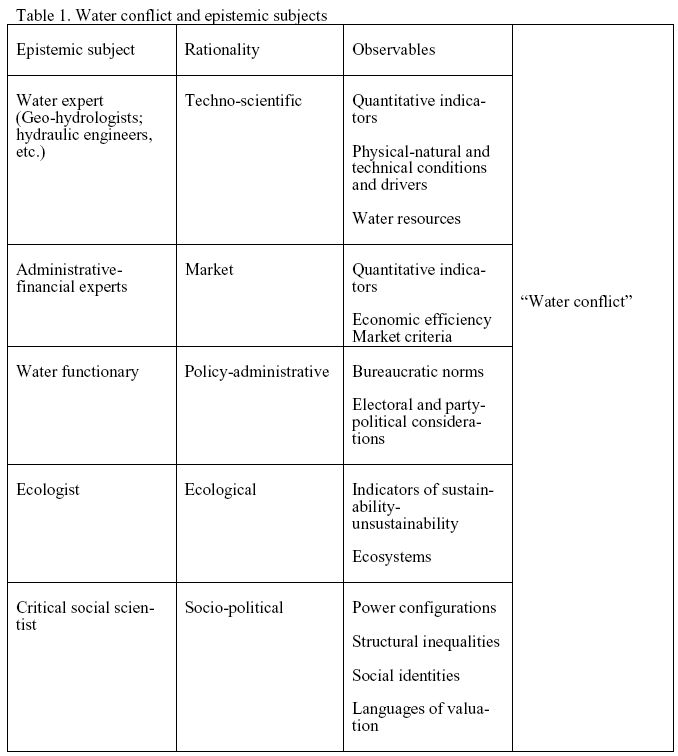
However, the development of interdisciplinary strategies for the production of knowledge across the techno- and the social sciences continues to be difficult and progress is slow. Among other aspects that require further consideration is the fact that knowledge about water is produced from a number of distinctive, often unconnected epistemic perspectives, and the resulting fragmentation of knowledge tends to become structural owing to entrenched disciplinary and institutional power configurations, a problem which is not limited to the field of water research (e.g., Knorr Cetina, 1999). For instance, in our studies on contemporary social conflicts over water in Mexico we identified a number of distinct epistemic subjects involved in water management activities who understand and explain water conflicts from very different, often unconnected perspectives (Castro, 1995; 2006). For the sake of the analysis we derived from the empirical research the existence of three epistemic subjects: the water expert, mainly water engineers and others directly involved in the techno-scientific aspects of water management, the water functionary, who are members of the bureaucratic and policy-institutional apparatuses in charge of water management activities, and the critical social scientist, referring broadly to the work of social scientists producing knowledge about water from a critical perspective such as contemporary political ecology. The evidence suggests that these different subjects construct their knowledge about water conflicts on the basis of different rationalities and epistemic structures, which underpin the identification of very different observables for the identification and explanation of "water conflicts" (on the concept of observable see Piaget, 1978: 43-6; 1977: 342-6.). Table 1, where we have added additional examples of epistemic subjects involved in water research, illustrates schematically the diverse approaches of these subjects to "water conflicts" .
For instance, in the early 1980s Mexican water experts elaborated a map of "conflicts over water in the main Mexican cities" to predict the occurrence of such events between 1980 and the year 2000 (SARH, 1981: 50). A close examination showed that they grounded their analysis on quantitative observables, such as the interactions between water availability, demand, supply, consumption, cost and population, urban and industrial growth over the period under analysis. They conceptualized urban water conflicts from a techno-scientific perspective and, therefore, in their analysis conflict would be the result of the lack of expected correspondence between quantitative variables, such as a geometrical increase of water demand in the arid areas of the country where water availability was already compromised in 1980. In contrast, for the "water functionary" , the notion of water conflicts places the emphasis on a different array of observables, which can also be illustrated from our research on Mexico. Besides the techno-scientific rationality (after all many water functionaries are techno-scientists by training) they are subject to policy-bureaucratic, and often also party-political, interests such as concerns about the impact of water conflicts on electoral prospects. Therefore, their observables are, for instance, the recurrent events of urban social protest over the poor quality of the water services or the civil disobedience of water users who have decided not to pay their bills in protest for a recent hike in the tariff. In general, the water functionary must deal with processes that fall outside the technical domain of the expert, such as "popular discontent" , "the social and economic characteristics of the population" that create conditions for water troubles, or the inherent contradictions between "the economic, social, psychological and environmental values of water" (SARH, 1981: 14). In turn, the critical social scientist is concerned with the task of making observable the intertwining between the social regularities and physical-natural processes that are at the heart of water conflicts. For instance, and remaining with the Mexican example, the socio-political rationality of this subject provides a framework for inquiring into the socio-economic and political mechanisms that underpin the exclusion of a large fraction of the population from access to safe and affordable water services, a major cause of water conflict in Mexico.
A similar scheme of analysis could be applied for the treatment of water conflicts in other areas of activity, such as the widespread struggles against "water privatization" or the opposition to large scale hydraulic works like dams and inter-basin water transfers. However, the scheme in Table 1 is only a simplification to cast light on the distinctive rationalities operating in water research and policy, which may help to better understand some of the key obstacles for interdisciplinary coordination in the study of water conflicts. It is important to clarify that the epistemic subjects represent bodies of knowledge and traditions of thought, not individuals or collective actors, who in practice may embody one or more epistemic cultures. We believe that the identification of the conceptual frameworks, rationalities, and observables operating in the field of water research, as we have attempted to sketch here, is an essential exercise to strengthen the foundations of meaningful interdisciplinary in this field.
4 CONCLUSIONS
There is increasing recognition that the "water crisis" is mainly a crisis of governance. Unfortunately, although the use of the concept of "governance" often assumes a shared understanding, in fact there exist underlying confrontations between rival theoretical bodies of knowledge and political and cultural traditions for which governance has entirely different meanings. Moreover, much of the mainstream debate on the topic has been aimed at depoliticising the processes under discussion and presenting them as mainly (or even merely) "technical" in nature, probably in the belief that depoliticising water management activities would provide opportunities for abating or at least controlling water uncertainty and conflict. An important aspect of this debate concerns the question of social participation in relation to problems of water uncertainty and risk, which is a central component of the process of democratic governance. How are the risks associated with water management communicated to the wider public? How do citizens participate in the process? What mechanisms are available for them to participate? How are the societal goals informing water policy identified? What ends and values are prioritized in these goals? What means are chosen to pursue those ends and values? What languages of valuation are chosen in the process? Who takes these decisions? Who are the actors that these decisions intend to benefit? What mechanisms of democratic control exist to monitor decision makers and implementors of water policy? These and other similar questions are at the heart of the process of democratic governance, and we know that this process is undergoing a severe crisis worldwide. Unsurprisingly, this crisis of water governance is being increasingly expressed in the form of inter-, and particularly, intra-national social and political conflicts over water, which present one of the most formidable challenges for the scientific community involved in water research and practice.
Our conclusion draws on the perspective of one of the epistemic subjects sketched above, the critical social scientist, which stems from a long-standing tradition in the social sciences concerned with developing the appropriate cognitive structures for making observable such structural regularities as cyclical social conflicts —whether in relation to water or not. However, the task of elaborating adequate explanations of the causes and consequences of water uncertainty and inequality requires the development of further interdisciplinary coordination between the intellectual domains of, for instance, water engineers, hydrologists, and social scientists, which to date has been a slow and relatively fruitless endeavour. The existing gap between the intellectual domains developed by techno-scientists and critical social scientists concerned with social inequality and struggle remains a major obstacle to achieve this goal. The persistence of this obstacle continues to hamper our full understanding of "water conflicts'', and consequently diminishes the chances we may have to avoid their negative consequences, which almost systematically affect the most vulnerable sectors of the population.
]]> In this connection, there is a need for adopting a critical perspective of the understanding of water governance as an instrument, a supposedly neutral policy tool, which aims at depoliticising what is essentially a political process. The idealized and instrumental approaches to water governance tend to neglect in their analysis, despite rhetorical recognition to the contrary, the existence of fundamental social divisions underpinning water insecurity, injustice, and inequality, which are major drivers of water conflict. Thus, a truly inter-disciplinary approach to the problem must strive to make observable those processes that create and reproduce the structural socio-economic and political inequalities that continue to preclude a large sector of the world's population not only from participating in the governance of water, but even from accessing essential volumes of safe water for daily survival. This kind of approach requires addressing "water conflicts" as an object of knowledge on its own right, which constitutes a crucial step towards transforming the unacceptable conditions characterizing the "water crisis" . Our work seeks to make a contribution towards this daunting venture by calling for efforts to develop higher levels of coordination between the different cognitive structures and epistemic cultures involved in the production of knowledge about water.
REFERENCES
[note: all the web pages cited in the references have been accessed in September 2006 ]
Allan, T. 2001. The Middle East Water Question. Hydropolitics and the Global Economy. London: I. B. Tauris & Co. [ Links ]
Altyev, T. 2006. Address of the Chairman of the Executive Committee of the International Fund on the Aral Sea (http://enrin.grida.no/aral/aralsea/english/obr/obr.htm). [ Links ]
Amin, A. 1997. Beyond Market and Hierarchy: Interactive Governance and Social Complexity. Cheltenham: Elgar. [ Links ]
Annan, K. 2002. UN Secretary General's Message for the World Water Day (http://www.unesco.org/water/water_celebrations/water_day_2002.shtml). [ Links ]
Arrojo Agudo, P. and F. J. Martínez Gil (Coords.). 1999. El Agua a Debate desde la Universidad. Hacia una Nueva Cultura del Agua. Zaragoza: Institución Fernando el Católico. [ Links ]
Asian Development Bank (ADB). 1995. Governance: sound development management. Manila: ADB. [ Links ]
Barraqué, B. and E. Vlachos (eds.). 2006. Urban Water Conflicts: an Analysis on the Origins and Nature of Water-related Unrest and Conflicts in the Urban Setting. Paris: UNESCO Working series SC-2006/WS/19 (2006). [ Links ]
Beck, U. 1992. Risk Society. Towards a New Modernity. London: Sage. [ Links ]
Beck, U. 1992. 1998. Politics of risk society. In: J. Franklin (ed.) The Politics of Risk Society. Cambridge and Oxford: Polity Press, pp. 9-22. [ Links ]
Bennett, V. 1995. The Politics of Water: Urban Protest, Gender, and Power in Monterrey, Mexico. Pittsburgh: University of Pittsburgh Press. [ Links ]
Berry, K. 1998. Race for water? Native Americans, Eurocentrism, and Western water policy. In: D. E. Camacho (ed.), Environmental Injustices, Political Struggles. Durham & London: Duke University Press. [ Links ]
BCFS - Boletín Ciudades para Un Futuro Más Sostenible. 2004. El Plan Hidrológico español: un estudio de caso (http://habitat.aq.upm.es/boletin/n27/lista.html). [ Links ]
Bouguerra, M. L. 2003. Les Batailles de l'Eau. Pour un Bien Commun de l'Humanité. Paris: Les Editions de l'Atelier. [ Links ]
Brook Cowen, P. J., and T. Cowen. 1998. Deregulated private water supply: a policy option for developing countries. Cato Journal 18 (1), pp. 21-41. [ Links ]
Brown, L. R. 2005. Outgrowing the Earth: The Food Security Challenge in an Age of Falling Water Tables and Rising Temperatures. New York and London: W. W. Norton & Co. [ Links ]
Bruinsma, J. 2003. World Agriculture: Towards 2015/2030. An FAO Perspective. London: Earthscan. [ Links ]
Camdessus, M. (Chair). 2003. Financing Water for All. Report of the World Panel on Financing Water Infrastructure. World Water Council, Global Water Partnership, (http://www.worldwatercouncil.org/download/CamdessusReport.pdf). [ Links ]
Castro, J. E. 1992. El Conflicto por el Agua en México. Los Casos de Tuxtla Gutiérrez, Chiapas y Ciudad Juárez, Chihuahua, 1986-1991, (unpublished thesis, Master in Social Sciences). Mexico City: Latin American Faculty of Social Sciences (FLACSO). [ Links ]
Castro, J. E. 1995. Decentralization and modernization in Mexico: the management of water services. Natural Resources Journal, Vol. 35, #3, pp., 1-27. [ Links ]
Castro, J. E. 2006. Water, Power, and Citizenship. Social Struggle in the Basin of Mexico. Houndmills, Basingstoke and New York: Palgrave-Macmillan. [ Links ]
Cohen, J. L. and A. Arato. 1994. Civil Society and Political Theory. Cambridge, Mass. and London: The Massachusetts Institute of Technology (MIT) Press. [ Links ]
Cosgrove, W. J. (Comp.) 2003. Water Security and Peace. A Synthesis of Studies Prepared under the PCCP–Water for Peace process (An UNESCO–Green Cross International Initiative). Technical Documents in Hydrology, PC-CP Series, # 29. Paris: UNESCO (http://unesdoc.unesco.org/images/0013/001333/133318e.pdf). [ Links ]
Crespo Flores, C., N. Laurie, and C. Ledo. 2003. Cochabamba case study. Research Project Report, in J. E. Castro (Coord.), PRINWASS Project, Oxford, University of Oxford (http://users.ox.ac.uk/~prinwass/). [ Links ]
Delanty, G. 2000. Citizenship in a Global Age. Society, Culture, Politics. Buckingham and Philadelphia: Open University Press. [ Links ]
Dryzek, J. 1997. The Politics of the Earth. Environmental Discourses. Oxford: Oxford University Press. [ Links ]
EUWATER. 2005. European Declaration for a New Water Culture. Saragossa: New Water Culture Foundation - EUWATER Network (http://www.unizar.es/fnca/euwater). [ Links ]
European Commission (EC). 2000. The European Community's Development Policy. Communication from the Commission to the Council and the European Parliament. (http://europa.eu.int/eur-lex/en/com/cnc/2000/com2000_0212en01.pdf). [ Links ]
European Commission (EC). 2002a. EU Water Initiative: Water for Life. Health, Livelihoods, Economic Development, Peace, and Security. Brussels (http://europa.eu.int/comm/research/water-initiative/index_en.html). [ Links ]
European Commission (EC). 2002b. Water Management in Developing Countries: Policy and Priorities for EU Development Cooperation. Communication from the Commission to the Council and the European Parliament (http://europa.eu.int/eur-lex/en/com/cnc/2002/com2002_0132en01.pdf). [ Links ]
Esman, M. J. 1991. Management Dimensions of Development: Perspectives and Strategies. West Hartford: Kumarian Press. [ Links ]
Food and Agriculture Organization (FAO). 2003. Review of World Water Resources by Country (aquastat)" , Rome: FAO (http://www.fao.org/DOCREP/005/Y4473E/Y4473E00.HTM). [ Links ]
Friends of the Earth. 2006. Projects – the Dead Sea (http://www.foeme.org/projects.php?ind=21). [ Links ]
Geertz, C. 1980. Negara. The Theatre State in Nineteenth-Century Bali. Princeton, NJ: Princeton Univer sity Press. [ Links ]
Gleick, P. H. 1993. Water and conflict: fresh water resources and international security. In: International Security, Vol. 18, #1, pp. 79-112. [ Links ]
Gleick, P. H. 2000. Water conflict chronology. Oakland: Pacific Institute for Studies in Development, Environment and Security. [ Links ]
Glick, T. F. 1970. Irrigation and Society in Medieval Valencia. Cambridge, Mass.: Harvard University Press. [ Links ]
Global Water Partnership (GWP). 2003. Effective Water Governance. Learning from the Dialogues. (http://www.gwpforum.org/gwp/library/Effective%20Water%20Governance.pdf), GWP. [ Links ]
Guha, R. and J. Martínez-Allier. 1997. Varieties of Environmentalism. Essays North and South. London: Earthscan. [ Links ]
Hanf, K. and A-I. Jansen (eds.). 1998. Governance and Environmental Quality: Environmental Politics, Policy and Administration in Western Europe. Harlow: Addison Wesley Longman. [ Links ]
Heinalt, H. P. Getimis, G. Kafkalis, R. Smith, and E. Swyngedouw (eds). 2002. Participatory Governance in Multi-level Context. Opladen: Leske & Budrich, pp. 107-131. [ Links ]
Held, D. 1995. Democracy and the Global Order: from the Modern State to Cosmopolitan Governance. Cambridge: Polity Press. [ Links ]
Hirst, P. 1994. Associative Democracy: New Forms of Economic and Social Governance. Cambridge: Polity Press. [ Links ]
Hundley, N. (Jr.). 1992. The Great Thirst. Californians and Water, 1770s-1990s. Berkeley, Los Angeles, and Oxford: University of California Press. [ Links ]
Kasperson, J. X., R. E. Kasperson, and B. L. Turner II (eds.). 1995. Regions at Risk. Comparisons of Threatened Environments. Tokyo, New York and Paris: United Nations University Press. [ Links ]
Kasperson, J. X., and R. E. Kasperson. 2001. Global Environmental Risk. Tokyo, New York and Paris: United Nations University Press and Earthscan. [ Links ]
Kaviraj, S. and S. Khilnani (eds.). 2001. Civil Society: History and Possibilities. Cambridge: Polity. [ Links ]
Knorr Cetina, K. 1999. Epistemic Cultures. How the Sciences Make Knowledge. Cambridge, Mass., and London: Harvard University Press. [ Links ]
Laurie, N., Radcliffe, S. and R. Andolina, R. 2002. The new excluded 'indigenous'?: The implications of multi-ethnic policies for water reform in Bolivia. In: R. Seider (ed.), Multiculturalsim in Latin America. Indigenous Rights, Diversity and Democracy. Houndmills, Basingstoke and New York: Palgrave-Macmillan, pp. 252-276. [ Links ]
Laurie, N. (ed.). 2006. Special Issue on "‘Pro-poor' water: past present and future scenarios" . In Geoforum, (in press). [ Links ]
Leach, E. R. 1959. Hydraulic society in Ceylon. In: Past and Present, pp. 2-26. [ Links ]
Leys, C. 2001. Market-Driven Politics. Neoliberal Democracy and the Public Interest. London: Verso. [ Links ]
Martínez-Alier, J. 2002. The Environmentalism of the Poor. A Study of Ecological Conflicts and Valuation. Cheltenham y Northampton: Edward Elgar. [ Links ]
McGranahan, G., P. Jacobi, J. Songsore, Ch. Surjadi, and M. Kjellén. 2001. The Citizens at Risk. From Urban Sanitation to Sustainable Cities. London: Earthscan. [ Links ]
Meyer, M. C. 1984. Water in the Hispanic Southwest. A Social and Legal History, 1550-1850. Tucson, Arizona: The University of Arizona Press. [ Links ]
Musset, A. 1991. De l'Eau Vive à l'Eau Morte. Enjeux Techniques et Culturels dans la Vallée de Mexico (XVIe-XIXe Siècles). Paris: Éditions Recherche sur les Civilisations. [ Links ]
Newbery, D. M. 1999. Privatization, Restructuring, and Regulation of Network Utilities. The Walras-Pareto Lectures. Cambridge, Mass. and London, The MIT Press. [ Links ]
Ohlsson, L. (ed.) 1992. Regional Case Studies of Water Conflicts. Göteborg: Peace and Development Research Institute (PADRIGU), University of Göteborg. [ Links ]
Ostrom, E. 1990. Governing the Commons: the Evolution of Institutions for Collective Action. Cambridge: Cambridge University Press. [ Links ]
Perló Cohen, M., and A. E. González Reynoso. 2005. ¿Guerra por el Agua en el Valle de México? Estudio sobre las Relaciones Hidráulicas entre el Distrito Federal y el Estado de México. Mexico City: National Autonomous University of Mexico, Autonomous Metropolitan University, and Friedrich Ebert Foundation. [ Links ]
Petrella, R. 2001. The Water Manifesto. Arguments for a World Water Contract. London: Zed Books. [ Links ]
Piaget, J. 1978. The Development of Thought. Equilibration of Cognitive Structures. Oxford: Basil Blackwell. [ Links ]
Piaget, J. 1977. The Grasp of Conciousness. London: Routledge and Kegan Paul. [ Links ]
Picciotto, R. 1997. Putting institutional economics to work: from participation to governance. In: Ch. K. Clague (ed.), Institutions and Economic Development: Growth and Governance in Less-developed and Post-socialist Countries. Baltimore and London: John Hopkins University Press. [ Links ]
Saleth, R. M., and A. Dinar. 1999. Evaluating water institutions and water sector performance. World Bank Technical Paper 447, Washington DC: World Bank. [ Links ]
Samson, P., and B. Charrier. 1997. International freshwater conflict. Issues and prevention strategies. Geneva: Green Cross International. [ Links ]
Santino, U. 1994. Il ruolo della mafia nel saccheggio del territorio. Palermo: Casa Europa, Centro Siciliano di Documentazione "Giuseppe Impastato" . [ Links ]
Santino, U. 2003. L'acqua rubata. Dalla mafia alle multinazionali. Palermo: Centro Siciliano di Documentazione "Giuseppe Impastato" (http://www.centroimpastato.it/publ/online/Acqua.php3). [ Links ]
Secretaría de Agricultura y Recursos Hidráulicos (SARH), Comisión del Plan Nacional Hidráulico. 1981. Plan Nacional Hidráulico. Mexico City: SARH. [ Links ]
Shiva, V. 1992. The Violence of the Green Revolution. Third World Agriculture, Ecology and Politics. Mapusa, Goa, India: The Other India Press. [ Links ]
Shiva, V. 2002. Water Wars. Privatization, Pollution, and Profit. Cambridge MA: South End Press. [ Links ]
Stiglitz, J. E. 2002. Globalization and its Discontents. London: Penguin. [ Links ]
Strang, V. 2004. The Meaning of Water. Oxford: Berg Publishers. [ Links ]
Streeck, W. and Ph. Schmitter. 1985. Private Interest Government, London: Sage. [ Links ]
Swyngedouw, E. A. 1999. Flows of Power: Nature, Society and the City. Oxford: Oxford University Press. [ Links ]
Swyngedouw, E. 2004, Social Power and the Urbanization of Water. Flows of Power. Oxford: Oxford University Press. [ Links ]
Swyngedouw, E. A., Maria Kaïka, and J. E. Castro. 2002. Urban water: a political-ecology perspective. In: Built Environment, Vol. 28, #2, pp. 124-137. [ Links ]
The Independent. 2006. "Armed forces are put on standby to tackle threat of wars over water" , London, 28 February 2006. [ Links ]
United Nations (UN). 1990. The New Delhi Statement: ‘Some for all rather that more for some'. Global Consultation on Safe Water and Sanitation for the 1990s. New Delhi, (10-14 September 1990): UNDP and the Government of India. [ Links ]
United Nations (UN). 1980. International Drinking Water Supply and Sanitation Decade: Report of the Secretary General. New York: UN. [ Links ]
United Nations (UN). 2000. Millennium Declaration. New York: UN (http://www.un.org/millennium/summit.htm). [ Links ]
United Nations (UN). 2002. Key Commitments, Targets and Timetables from the Johannesburg Plan of Implementation. World Summit on Sustainable Development, Johannesburg (http://www.johannesburgsummit.org/html/documents/summit_docs/2009_keyoutcomes_commitments.doc [ Links ]
United Nations Development Programme (UNDP). 1997. Governance for Sustainable Human Development, New York: UNDP (http://magnet.undp.org/policy/default.htm). [ Links ]
United Nations Development Programme (UNDP). 1998. Reconceptualizing Governance, New York: UNDP (http://magnet.undp.org/Docs/!UN98-21.PDF/Recon.htm). [ Links ]
United Nations Development Programme (UNDP). 2004. Water Governance for Poverty Reduction. Key Issues and the UNDP Response to Millennium Development Goals. New York: UNDP. [ Links ]
United Nations Development Programme (UNDP). 2006. Public-Private Partnerships for the Urban Environment (PPPUE). New York: UNDP (http://pppue.undp.org). [ Links ]
United Nations Environment Programme (UNEP), United Nations Children's Fund (UNICEF), and World Health Organization (WHO). 2002. Children in the New Millennium: Environmental Impact on Health (http://www.who.int/water_sanitation_health/hygiene/settings/millennium/en/index.html). [ Links ]
United Nations Educational, Scientific and Cultural Organization– UNESCO, World Water Assessment Programme. 2003. Water for People, Water for Life. The United Nations World Water Report, Paris and New York: UNESCO and Berghahn Books. [ Links ]
United Nations Educational, Scientific and Cultural Organization– UNESCO, World Water Assessment Programme. 2006. Water, a Shared Responsibility. The United Nations World Water Report 2, Paris and New York: UNESCO and Berghahn Books. [ Links ]
United Nations – Habitat. 2003. Water and Sanitation in the World's Cities: Local Action for Global Goals. London: Earthscan Publications Ltd. [ Links ]
United Nations Children's Fund (UNICEF). 2005. Water, Environment, and Sanitation (http://www.unicef.org/wes/). [ Links ]
van Ginkel, H. 2001. Discourse of the United Nations Under-Secretary General at the Stockholm Water Symposium, 13 August 2001. [ Links ] Quoted in the Financial Times, 14 August 2001, p. 6. [ Links ]
Van Steenbergen, B. 1994. The Condition of Citizenship. London: Sage. [ Links ]
Ward, C. 1997. Reflected in Water, A Crisis of Social Responsibility. London and Washington: Casell. [ Links ]
Webb, P. and M. Iskandarani. 1998. Water insecurity and the poor. Discussion Papers on Development Policy, Bonn: Center for Development Research. [ Links ]
Wittfogel, K. A. 1956 The hydraulic civilizations. In: W. L. Thomas (ed.), Man's Role in Changing the Face of the Earth, Chicago: The University of Chicago Press, pp. 152-164. [ Links ]
Wittfogel, K. A. 1959. Oriental Despotism. A Comparative Study of Total Power. 3rd reprinting, New Haven: Yale University Press. [ Links ]
World Bank. 2004. Water Resources Sector Strategy. Strategic Decisions for World Bank Engagement. Washington: The World Bank (http://www-wds.worldbank.org/external/default/WDSContentServer/IW3P/IB/2004/06/01/000090341_20040601150257/Rendered/PDF/28114.pdf). [ Links ]
World Health Organization (WHO). 2003a. The Right to Water. Geneva: WHO (http://www.who.int/water_sanitation_health/en/righttowater.pdf). [ Links ]
World Health Organization (WHO). 2003b. Water Supply, Sanitation and Hygiene Development. Geneva: WHO (http://www.who.int/water_sanitation_health/hygiene/en/). [ Links ]
World Health Organization (WHO). 2005. Health and the Millennium Development Goals. Geneva: OMS (http://www.who.int/mdg/publications/MDG_Report_08_2005.pdf). [ Links ]
World Health Organization – Regional Office for Europe (WHO-Europe). 2003. Dealing with uncertainty: how can the precautionary approach help protect the future of our children? In: Fourth Ministerial Conference on Environment and Health. Stockholm, 26-27 June 2003 (http://www.who.dk/document/eehc/2ndigoprepmeet_11.pdf). [ Links ]
World Bank. 2006. Public-Private Partnership in Infrastructure. Washington: The World Bank (http://web.worldbank.org/WBSITE/EXTERNAL/WBI/WBIPROGRAMS/PPPILP/0,,menuPK:461139~pagePK:64156143~piPK:64154155~theSitePK:461102,00.html). [ Links ]
World Water Council. 2004. Analysis of the 3rd World Water Forum, Marseille: WWF. [ Links ]
Worster, D. 1985. Rivers of Empire. Water, Aridity, and the Growth of the American West. New York-Oxford: Oxford University Press. [ Links ]
Yoffe, S., G. Fiske, M. Giordano, M. Giordano, K. Larson, K. Stahl, and A. T. Wolf. 2004. Geography of international water conflict and cooperation: data sets and applications. In: Water Resources Research, Vol. 40, #5, pp. 1-12. [ Links ]
Acronyms
ADB Asian Development Bank
CBI Council for Biotech Information
DNA Deoxyribonucleic acid
EC European Commission
EUWATER European Network for a New Water Culture
FAO Food and Agriculture Organization
GWP Global Water Partnership
MCMA Mexico City Metropolitan Area
]]> MDGs Millennium Development GoalsMSSRF M.S. Swaminathan Research Foundation
OECD-WPB Organization for Economic Co-operation and Development – Working Party on Biotechnology
SARH Secretariat of Agriculture and Hydraulic Resources (Mexico)
SEMARNAT Secretariat of Environment and Natural Resources (Mexico)
UNCED United Nations Conference on Environment and Development (The Earth Summit 1992)
UNDP United Nations Development Programme
UNEP United Nations Environment Programme
UNESCO United Nations Educational, Scientific, and Cultural Organization
UNICEF United Nations Children's Fund
]]> USAID United States Agency for International DevelopmentWCW World Commission on Water for the 21st Century
WHO World Health Organization
WWF World Water Forum
]]>