<?xml version="1.0" encoding="ISO-8859-1"?><article xmlns:mml="http://www.w3.org/1998/Math/MathML" xmlns:xlink="http://www.w3.org/1999/xlink" xmlns:xsi="http://www.w3.org/2001/XMLSchema-instance">
<front>
<journal-meta>
<journal-id>1414-753X</journal-id>
<journal-title><![CDATA[Ambiente & sociedade]]></journal-title>
<abbrev-journal-title><![CDATA[Ambient. soc.]]></abbrev-journal-title>
<issn>1414-753X</issn>
<publisher>
<publisher-name><![CDATA[ANPPAS]]></publisher-name>
</publisher>
</journal-meta>
<article-meta>
<article-id>S1414-753X2006000200003</article-id>
<title-group>
<article-title xml:lang="en"><![CDATA[Environmental issues, interdisciplinarity, social theory and intellectual production in Latin America]]></article-title>
<article-title xml:lang="pt"><![CDATA[Tópicos ambientais, interdisciplinaridade, teoria social e produção intelectual na América Latina]]></article-title>
</title-group>
<contrib-group>
<contrib contrib-type="author">
<name>
<surname><![CDATA[Ferreira]]></surname>
<given-names><![CDATA[Leila da Costa]]></given-names>
</name>
<xref ref-type="aff" rid="A01"/>
<xref ref-type="aff" rid="A02"/>
</contrib>
<contrib contrib-type="author">
<name>
<surname><![CDATA[Barbosa]]></surname>
<given-names><![CDATA[Sônia Regina Cal Seixas]]></given-names>
</name>
<xref ref-type="aff" rid="A02"/>
</contrib>
<contrib contrib-type="author">
<name>
<surname><![CDATA[Hoefel]]></surname>
<given-names><![CDATA[João Luiz de Moraes]]></given-names>
</name>
<xref ref-type="aff" rid="A03"/>
<xref ref-type="aff" rid="A04"/>
</contrib>
<contrib contrib-type="author">
<name>
<surname><![CDATA[Guimarães]]></surname>
<given-names><![CDATA[Roberto]]></given-names>
</name>
<xref ref-type="aff" rid="A05"/>
</contrib>
<contrib contrib-type="author">
<name>
<surname><![CDATA[Floriani]]></surname>
<given-names><![CDATA[Dimas]]></given-names>
</name>
</contrib>
<contrib contrib-type="author">
<name>
<surname><![CDATA[Tavolaro]]></surname>
<given-names><![CDATA[Sergio B. F.]]></given-names>
</name>
<xref ref-type="aff" rid="A06"/>
</contrib>
</contrib-group>
<aff id="A01">
<institution><![CDATA[,National Association for Graduate Studies Research in Environment and Society ]]></institution>
<addr-line><![CDATA[ ]]></addr-line>
</aff>
<aff id="A02">
<institution><![CDATA[,Center Environmental Studies NEPAM Program in Environment and Society]]></institution>
<addr-line><![CDATA[ ]]></addr-line>
</aff>
<aff id="A03">
<institution><![CDATA[,University São Francisco  ]]></institution>
<addr-line><![CDATA[ ]]></addr-line>
</aff>
<aff id="A04">
<institution><![CDATA[,UNICAMP NEPAM ]]></institution>
<addr-line><![CDATA[ ]]></addr-line>
</aff>
<aff id="A05">
<institution><![CDATA[,Social and Policy Analysis Section Division for Social Policy and Development UN Program in Environment and Society]]></institution>
<addr-line><![CDATA[ ]]></addr-line>
</aff>
<aff id="A06">
<institution><![CDATA[,Federal University of Uberlândia Sociology Department ]]></institution>
<addr-line><![CDATA[ ]]></addr-line>
</aff>
<pub-date pub-type="pub">
<day>00</day>
<month>00</month>
<year>2006</year>
</pub-date>
<pub-date pub-type="epub">
<day>00</day>
<month>00</month>
<year>2006</year>
</pub-date>
<volume>2</volume>
<numero>se</numero>
<fpage>0</fpage>
<lpage>0</lpage>
<copyright-statement/>
<copyright-year/>
<self-uri xlink:href="http://socialsciences.scielo.org/scielo.php?script=sci_arttext&amp;pid=S1414-753X2006000200003&amp;lng=en&amp;nrm=iso"></self-uri><self-uri xlink:href="http://socialsciences.scielo.org/scielo.php?script=sci_abstract&amp;pid=S1414-753X2006000200003&amp;lng=en&amp;nrm=iso"></self-uri><self-uri xlink:href="http://socialsciences.scielo.org/scielo.php?script=sci_pdf&amp;pid=S1414-753X2006000200003&amp;lng=en&amp;nrm=iso"></self-uri><abstract abstract-type="short" xml:lang="en"><p><![CDATA[While dealing with both interdisciplinarity and environment and society area as fields that harbor scientific contentions regarding ideas, practices, institutions and habitus (Bourdieu), this paper aims at providing an account of the multifaceted processes implied in the institutionalization of environmental concerns in Latin-American academia and research centers. The paper discusses the extent to which one can legitimately talk about "a Latin- American scientific specificity", supposedly resulting from peculiar theoretical approaches or even from particular socio-environmental features (such as widespread poverty and high rates of social inequality, along with unparalleled levels of biodiversity). Last but not least, the paper seeks to draw a sort of thematic map (via bibliographical review) as well as a consideration of the levels of scientific institutionalization of environmental issues in six different research centers located in Argentina, Chile, Mexico, Uruguay and Brazil.]]></p></abstract>
<abstract abstract-type="short" xml:lang="pt"><p><![CDATA[Ao tratar a interdisciplinaridade e a área de ambiente e sociedade enquanto campos que lidam com questões científicas relacionadas com idéias, práticas, instituições e habitus (Bourdieu), esse artigo pretende contribuir para a compreensão dos processos multifacetados implicados na institucionalização da questão ambiental na academia e centros de pesquisa latino-americanos. O texto discute em que medida pode-se legitimamente falar de uma "especificidade científica latino-americana", supostamente resultante de abordagens teóricas peculiares ou mesmo de situações sócio-ambientais particulares (como pobreza e altas taxas de desigualdade, junto a incomparáveis índices de biodiversidade). Por último, mas também importante, o texto pretende trazer um panorama temático (através da revisão bibliográfica) assim como apontar os níveis de institucionalização científica da área ambiental em seis centros de pesquisa localizados na Argentina, Chile, México, Uruguai e Brasil.]]></p></abstract>
<kwd-group>
<kwd lng="en"><![CDATA[Environmental sociology in Latin America]]></kwd>
<kwd lng="en"><![CDATA[social theory]]></kwd>
<kwd lng="en"><![CDATA[interdisciplinarity]]></kwd>
<kwd lng="pt"><![CDATA[Sociologia ambiental na América Latina]]></kwd>
<kwd lng="pt"><![CDATA[teoria social]]></kwd>
<kwd lng="pt"><![CDATA[interdisciplinaridade]]></kwd>
</kwd-group>
</article-meta>
</front><body><![CDATA[ <p><font face="Verdana, Arial, Helvetica, sans-serif" size="4"><B>Environmental    issues, interdisciplinarity, social theory and intellectual production in Latin    America </b></font></p>     <p>&nbsp;</p>     <p><font face="Verdana, Arial, Helvetica, sans-serif" size="3"><b>Tópicos ambientais,    interdisciplinaridade, teoria social e produção intelectual na América Latina</b></font></p>     <p>&nbsp;</p>     <p>&nbsp;</p>     <p><font face="Verdana, Arial, Helvetica, sans-serif" size="2"><B>Leila da Costa    Ferreira<sup>I</sup>; S&ocirc;nia Regina Cal Seixas Barbosa<sup>II</sup>; Jo&atilde;o    Luiz de Moraes Hoefel<sup>III</sup>; Roberto Guimar&atilde;es<sup>IV</sup>;    Dimas Floriani<sup>V</sup>; Sergio B. F. Tavolaro<sup>VI</sup></B> </font></p>     <p><font face="Verdana, Arial, Helvetica, sans-serif" size="2"><sup>I</sup>President    of the National Association for Graduate Studies and Research in Environment    and Society (Anppas) and Director of Center Environmental Studies/ NEPAM. Professor    of PhD Program in Environment and Society <a href="mailto:leilacf@unicamp.br">leilacf@unicamp.br</a>        <br>   <sup>II</sup>Professor of Ph Program in Environment and Society; <a href="mailto:srcal@unicamp.br">srcal@unicamp.br</a>    <br>   <sup>III</sup>Professor University S&atilde;o Francisco and Visiting Researcher    at NEPAM/UNICAMP. <a href="mailto:joaoluiz@saofrancisco.edu.br">joaoluiz@saofrancisco.edu.br</a>    <br>   <sup>IV</sup>Chief, Social and Policy Analysis Section/ Division for Social    Policy and Development UN/ Professor of the Program in Environment and Society    <a href="mailto:guimaraesr@un.org">guimaraesr@un.org</a>    ]]></body>
<body><![CDATA[<br>   <sup>V</sup>Professor PhD Program Environment and Development. <a href="mailto:dimas@casla.com.br">dimas@casla.com.br</a>    <br>   <sup>VI</sup>Sociology Department. Federal University of Uberl&acirc;ndia (MG),    <a href="mailto:sergiotavolaro@hotmail.com">sergiotavolaro@hotmail.com</a> </font></p>     <p><font face="Verdana, Arial, Helvetica, sans-serif" size="2">Replicated from    <b>Ambiente &amp; sociedade</b>, Campinas, v.9, n.2, p.9-24, July/Dec. 2006.</font>  </p> <B>     <p>&nbsp;</p>     <p>&nbsp;</p> <hr size="1" noshade>     <p><font face="Verdana, Arial, Helvetica, sans-serif" size="2">ABSTRACT </font></p> </B>      <p><font face="Verdana, Arial, Helvetica, sans-serif" size="2">While dealing with    both interdisciplinarity and environment and society area as fields that harbor    scientific contentions regarding ideas, practices, institutions and <i>habitus</i>    (Bourdieu), this paper aims at providing an account of the multifaceted processes    implied in the institutionalization of environmental concerns in Latin-American    academia and research centers. The paper discusses the extent to which one can    legitimately talk about “a Latin- American scientific specificity”, supposedly    resulting from peculiar theoretical approaches or even from particular socio-environmental    features (such as widespread poverty and high rates of social inequality, along    with unparalleled levels of biodiversity). Last but not least, the paper seeks    to draw a sort of thematic map (via bibliographical review) as well as a consideration    of the levels of scientific institutionalization of environmental issues in    six different research centers located in Argentina, Chile, Mexico, Uruguay    and Brazil. </font></p>     <p><font face="Verdana, Arial, Helvetica, sans-serif" size="2"><b>Keywords:</b>    Environmental sociology in Latin America; social theory; interdisciplinarity</font></p> <hr size="1" noshade>     <p><font face="Verdana, Arial, Helvetica, sans-serif" size="2"><b>RESUMO </b></font></p>     <p><font face="Verdana, Arial, Helvetica, sans-serif" size="2">Ao tratar a interdisciplinaridade    e a área de ambiente e sociedade enquanto campos que lidam com questões científicas    relacionadas com idéias, práticas, instituições e <i>habitus </i>(Bourdieu),    esse artigo pretende contribuir para a compreensão dos processos multifacetados    implicados na institucionalização da questão ambiental na academia e centros    de pesquisa latino-americanos. O texto discute em que medida pode-se legitimamente    falar de uma “especificidade científica latino-americana”, supostamente resultante    de abordagens teóricas peculiares ou mesmo de situações sócio-ambientais particulares    (como pobreza e altas taxas de desigualdade, junto a incomparáveis índices de    biodiversidade). Por último, mas também importante, o texto pretende trazer    um panorama temático (através da revisão bibliográfica) assim como apontar os    níveis de institucionalização científica da área ambiental em seis centros de    pesquisa localizados na Argentina, Chile, México, Uruguai e Brasil.</font></p>     ]]></body>
<body><![CDATA[<p><font face="Verdana, Arial, Helvetica, sans-serif" size="2"><b>Palavras-chave:    </b>Sociologia ambiental na América Latina; teoria social; interdisciplinaridade.</font></p> <hr size="1" noshade>     <p>&nbsp;</p>     <p>&nbsp;</p>     <p><font face="Verdana, Arial, Helvetica, sans-serif" size="3"><B>1. INTRODUCTION</B></font>  </p>     <p><font face="Verdana, Arial, Helvetica, sans-serif" size="2">One can safely    say that environmental sociology emerged as a field of research at the beginning    of the 1960s on the tide of movements of social contestation that brought to    the public scene the dramatic situation of natural resource degradation resulting    from the development of industrialism. </font></p>     <p><font face="Verdana, Arial, Helvetica, sans-serif" size="2">The increasing    popularity of environmentalism in the 1960s took sociologists by surprise, for    at that moment the social sciences did not dispose of both a theoretical body    and empirical tradition that could shed light on intricacies of the relation    between society and nature. It goes without saying that the founding fathers    of sociology (Durkheim, Marx and Weber) had approached the question in a seemingly    tangential manner; likewise, sociological works focusing solely on the matter    had been so insignificant that a consistent accumulation of knowledge turned    out to be impracticable, thus preventing the consolidation of a theoretical    field of environmental sociology. </font></p>     <p><font face="Verdana, Arial, Helvetica, sans-serif" size="2">Mainly during the    1960s, although in varying forms and national contexts, research groups of sociologists    began to highlight the relevance of the environmental problematic. That was    the time when environmental concerns found their way to the agenda of governments,    international organisms, social movements and business sectors all over the    world. </font></p>     <p><font face="Verdana, Arial, Helvetica, sans-serif" size="2">Ever since, environmental    sociology played a key role in inquiring into the myriad conflicts and actors    embroiled in contentious around nature, probing into their possible causes and    implications. </font></p>     <p><font face="Verdana, Arial, Helvetica, sans-serif" size="2">From the mid-1980s    onwards, while boosted by the renewed popularity of environmentalism around    the world, this type of research agenda had successfully contributed to the    theoretical reinvigoration of sociology. </font></p>     <p><font face="Verdana, Arial, Helvetica, sans-serif" size="2">This article aims    at discussing the relevance of interdisciplinarity in environmental studies    while paying close attention to the Latin American academic context. </font></p>     ]]></body>
<body><![CDATA[<p>&nbsp;</p>     <p><font face="Verdana, Arial, Helvetica, sans-serif" size="3"><B>2. ENVIRONMENT    AND SOCIETY: TOWARD INTERDISCIPLINARITY </B> </font></p>     <p><font face="Verdana, Arial, Helvetica, sans-serif" size="2">We are now faced    with the increasing appearance of specific groups of social scientists, united    around the investigation of the Environmental Issues. One can reflect on where    the opportunities for creative experimentation could be. Here, one can only    point out a few situations at very different points of intellectual production    in the area of the Environment and Society interface. </font></p>     <p><font face="Verdana, Arial, Helvetica, sans-serif" size="2">The discussion    of interdisciplinarity is the object of constant controversies, although a consensus    on it is never reached. What can be said about this is that, all in all, there    have been two ways of approaching this problem: the first of them strives to    bridge the gap between scientific disciplines with the intention of enlarging    the explanation of the disciplinary objects of knowledge, as in the case of    environmental sociology, where one seeks to theoretically interact in some converging    fields. The second vision regarding the interdisciplinary construction is restricted    to the field of thematic research, opposing the vision of progressive assimilations    among disciplines. This vision recognizes the disciplinary specificity but adopts    a type of deliberated collaboration of disciplinary knowledge on previously    defined themes (FLORIANI, 2004). </font></p>     <p><font face="Verdana, Arial, Helvetica, sans-serif" size="2">In this sense,    we can point out some hypotheses that orient intellectual reflection in the    area of environment and society in Latin Am&eacute;rica. In the first place,    all things indicate that the emphasis on this transversal area migrated from    the inglorious search for a preferential actor of social change in the economic    and environmental order to a generic question delineated around the preoccupations    with the human dimensions of environmental changes, independent of judgments    of their value. Presently, this question is broken down into other derivations    regarding the governability and the social and cultural or normative orientations    for the resolution of universally known problems, considered politically pertinent.    </font></p>     <p><font face="Verdana, Arial, Helvetica, sans-serif" size="2">Along this line,    discussions and reflections on the area's different branches center on objects    that interrelate in order to deal with problems such as normativity, institutionality    and the emergence of new academic institutions in the environmental area. In    second place, and not less important, is the fact that both the production in    the area in its period of formation (1960s) and later on, as well as the discussion    of interdisciplinarity, winds up influencing and being influenced by the contemporary    social theory. </font></p>     <p><font face="Verdana, Arial, Helvetica, sans-serif" size="2">There are authors,    Leis (2000), for example, who argue that, in the Brazilian case, the majority    of the time, we would not be developing theoretical perspectives in relation    to the theme, but responding to a rampant demand of civil society in relation    to the grave Brazilian environmental problems. </font></p>     <p><font face="Verdana, Arial, Helvetica, sans-serif" size="2">However, the theoretical    and methodological discussion developed by Ferreira (2006) seeks to show that,    in the Brazilian case, there are also sectors of the academic community influenced    by the lines of thought connected to reflexive modernization: the risk theory    (BECK, 1992) and ecological modernization (SPAARGAREN, BUTTEL &amp; MOL, 2000),    as well as the constructionist perspectives and the coevolution and social structuring    (YEARLEY, 1996; HANNIGAN, 2000, REDCLIFT, &amp; WOODGATE, 1997). </font></p>     <p><font face="Verdana, Arial, Helvetica, sans-serif" size="2">This discussion    also seeks to demonstrate that in the works of environmental sociology at the    international level, there is a materialistic Durkheimian focus, in other words,    realistic, expressed in the works of Catton and Dunlap (1998) and their influences    in the area of environment and society in Brazil. Furthermore, there are works    strongly influenced by the materialist Marxist focus, exemplified mainly in    the works of Schnaiberg (1980) and O'Connor (2003) and their influences in Brazil.    </font></p>     <p><font face="Verdana, Arial, Helvetica, sans-serif" size="2">It is also considered    that influences of interdisciplinarity exist in the work developed in the area.    If, on the one hand, since the decade of 1970, the environmental crisis revealed    the complex relations between biosphere and technosphere on a planetary scale,    in a type of "common future", on the other hand, first in the field of contemporary    science and technology, and then in the field of human sciences, the need to    treat the problems in an integrated manner began to be considered, that is,    beyond the disciplines that characterize modern science and technology. </font></p>     ]]></body>
<body><![CDATA[<p><font face="Verdana, Arial, Helvetica, sans-serif" size="2">Despite the insistence    of political and institutional society in maintaining universes such as environment    and society separated and juxtaposed, they must be thought together and the    socio-environmental knowledge already produced allows one to go beyond the question    of the impacts of technical progress on the natural and constructed environment    in order to face the themes that lead the biological and social sciences to    converge in search of a shared operational logic and of a transfrontier language.    </font></p>     <p><font face="Verdana, Arial, Helvetica, sans-serif" size="2">As occurs with    all theories, according to Floriani (2003), sociology is also harassed by theoretical-methodological    disputes, associated to different philosophical matrixes and epistemologies.    The author affirms that this also appears to be the case of environmental sociology.    Sociology, as a more than one-hundred-year-old theoretical body, had its birth    influenced by positivism, by marxism, by functional-structuralism, by phenomenology    and each one of the epistemological marks divided into other sub-species, that    is, in hybrid models. </font></p>     <p><font face="Verdana, Arial, Helvetica, sans-serif" size="2">According to this    same author, the area of environment and society can also be formulated from    these same matrixes, but what is perceived as innovative in the effort of some    authors and in their proposals is the reconstitution of the theoretical and    methodological trajectory of this area by means of a renewed dialog between    natural and social sciences. </font></p>     <p><font face="Verdana, Arial, Helvetica, sans-serif" size="2">Consolidation of    the studies in the area of Environment and Society in Latin Am&eacute;rica only    occurred in the 1980s and 1990s, when intellectual work was in full mutation.    The policy of post-graduation, however, had to be constructed upon an incomplete    and fragmented tradition. For this reason, the discussion of academic quality    is delicate among us. It is silent about determined aspects of our history.    The symbolic field was constructed upon institutional foundations since the    necessity of the financing organs establishes rational criteria for a better    distribution of resources. </font></p>     <p><font face="Verdana, Arial, Helvetica, sans-serif" size="2">In all areas, scientific    production, including the area of environment and society, is a complex process    that unfolds beyond that which habitually appears in the terms and practice    of the research project. It is also fitting to mention that the universities    and research centers are perhaps among the few places of present society where    this relative degree of liberty can express itself and, in the case of Latin    Am&eacute;rica, the area of environment and society could advance, not only    because of good ideas but also due to the development of research centers dedicated    to the area, the publishing of academic journals, and congresses, in short,    a set of practices that gave support to the research. </font></p>     <p>&nbsp;</p>     <p><font face="Verdana, Arial, Helvetica, sans-serif" size="3"><B>3. ENVIRONMENT    AND SOCIETY IN LATIN AMERICA</B> </font></p>     <p><font face="Verdana, Arial, Helvetica, sans-serif" size="2">At this point,    permit us to make a small digression regarding the term "sustainability" in    order to comprehend the area's different theoretical approaches. From the historical    point of view, the term "sustainability" was created for the purpose of remitting    us to the word "sustain", in order for that which is "sustained" to have conditions    for perennial permanence, recognizable and fulfilling the same functions indefinitely,    maintaining its stability over time. </font></p>     <p><font face="Verdana, Arial, Helvetica, sans-serif" size="2">Among the innumerous    concepts of sustainability that have been elaborated over the last few years,    what is intended, in short, is to encounter the mechanisms of interaction in    the human societies that occur in a harmonious relation with nature. </font></p>     <p><font face="Verdana, Arial, Helvetica, sans-serif" size="2">In the light of    recent data, definitely breaking with the hypothesis defending that the causes    of resource exhaustion fall exclusively upon populational growth, we are searching    for alternatives to production and consumption that respect the natural cycles    in their own temporalities. The acceleration of the bio-geo-ecological processes    in function of the speed at which human consumption increases represents non-sustainability    and, hence, the question resides in finding means to avoid the scarcity and    exhaustion of natural resources. </font></p>     ]]></body>
<body><![CDATA[<p><font face="Verdana, Arial, Helvetica, sans-serif" size="2">Anthropological    studies emphasize some human societies that live in extreme conditions of survival    and present elements that indicate the presence of basic sustainability criteria.    Shiva (1993) furnishes indications showing that these societies do not perceive    themselves as dissociated from nature, in a relation of exteriority, as occurs    in modern society. </font></p>     <p><font face="Verdana, Arial, Helvetica, sans-serif" size="2">Retreating to the    past, the same can be said in relation to the Greek pre-Socratic society, in    the IV century BC. Greek mythology is filled with references based on nature,    as is emphasized by MacCormick (1992) and, in the author's words, there is the    acceptance of natural forces and not the propensity to substitute them. This    propensity to substitute the natural norm by the human norm could lead to hybris,    which was the theoretical reference to disorder, instability, destructionism,    disharmony and disequilibration; the result of transposition of ecosystemic    limits which, in the worst case, cause the exhaustion of natural resources.    </font></p>     <p><font face="Verdana, Arial, Helvetica, sans-serif" size="2">Yearley (1996)    emphasizes that there is a distinction between ecological sustainability and    environmental sustainability: the first refers to the climax stage of a natural    ecosystem, where the flux of input and output of materials and energy remain    equivalent over a long period, configuring the system's maturity, spontaneously,    due to nature itself. The second, however, parting from the same principal,    involves human intervention through environment management, producing energetic    balances that are artificially equilibrated, counterbalancing the stocks of    energy and material that are utilized as raw material in the human productive    sphere. </font></p>     <p><font face="Verdana, Arial, Helvetica, sans-serif" size="2">At the same time,    Spaargaren, Mol, and Buttel (2000), discoursing on methodologies for environmental    accounting, identify the existence of two lines of thought regarding the delimitation    of natural resource exhaustion. One follows the pattern of weak sustainability,    in which it is believed that the absolute substitution of natural capital by    material capital is possible, where technology has perfect conditions to promote    the transformation process and the other, that follows the strong sustainability    pattern, in which the two forms of capital are not substitutable and, therefore,    economic growth would necessarily be conditioned to the constant maintenance    of natural capital stock. </font></p>     <p><font face="Verdana, Arial, Helvetica, sans-serif" size="2">A tone of very    pronounced technological optimism is perceived in the first case, since it considers    that there is a technological <I>quantum</I> at the disposition of the risk    society (BECK, 1992), sufficiently elevated to avoid the negative collateral    effects of human intervention in the biosphere, which, in the worst case, disobliges    the need for implementation of preventive policies. In any case, the authors    emphasize that these considerations show that the level of natural capital consumption    is an important indicator of sustainability, although the environment is still    incipiently valued by the market. In other words, the use, the exhaustion and    the degradation of natural resources are not inserted into the production and    consumption costs. </font></p>     <p><font face="Verdana, Arial, Helvetica, sans-serif" size="2">Operationally,    Guimar&atilde;es (2001) suggests that, in the first place, in a case of management    of renewable natural resources, two principals stand out as fundamental. On    the one hand, the utilization rates must be equivalent to the replacement rates.    On the other hand, the rates of effluent emissions must be equal to the assimilation    capacity of the ecosystems into which these effluents are discharged. Therefore,    the incapacity of maintaining these rates must be treated as capital consumption,    that is, non-sustainable. </font></p>     <p><font face="Verdana, Arial, Helvetica, sans-serif" size="2">In second place,    for the case of non-renewable resources, considering that the very character    of 'non-renewable' impedes an indefinably sustained utilization, the rhythm    of the utilization must be limited to the development or discovery of new substitutes.    </font></p>     <p><font face="Verdana, Arial, Helvetica, sans-serif" size="2">Therefore, the    author affirms that for renewable natural resources, the weak sustainability    pattern can be considered while, for the non-renewable natural resources, strong    sustainability is indicated. When focusing the panorama of resource scarcity,    an important distinction must still be made between two other concepts: there    is absolute scarcity, which refers to the actual exhaustion of resource stocks,    and there is relative scarcity, which refers to the non-sustainable patterns    of production and consumption that actuate as limiting factors of exhaustion.    </font></p>     <p><font face="Verdana, Arial, Helvetica, sans-serif" size="2">At this moment,    one must remember that Morrison (1995) and Cahn (1995) identified that both    the consumption patterns of poverty and of wealth contribute together to the    deterioration of the planet's support capacity. However, they emphasize that    the dominant propelling force of the exhaustion of natural resources is situated    in the consumption pattern of the highly industrialized countries. Consequently,    attention must be dislocated from the technological question as the understanding    of absolute scarcity and return to the political and sociological question to    face relative scarcity. </font></p>     <p><font face="Verdana, Arial, Helvetica, sans-serif" size="2">From this consideration,    we can see with greater clarity that the purely environmental dimension of sustainability    can be transcended and can involve some political-institutional parameters regarding    the social norms and criteria for appropriation of the natural capital. We can    then perceive that the sustainability referred to in the official ecological    discourse refers exclusively to environmental sustainability and does not incorporate    its various dimensions. </font></p>     ]]></body>
<body><![CDATA[<p><font face="Verdana, Arial, Helvetica, sans-serif" size="2">In this sense,    the idea of sustainability can be strongly associated with three other social    dimensions, already established in the political thought of the XX century:    democracy, equity and efficiency (FERREIRA &amp; VIOLA, 1997). </font></p>     <p><font face="Verdana, Arial, Helvetica, sans-serif" size="2">The question of    scale must also be taken into account. Can variables be considered for finer    scales and other variables for more global and regional scales? Should variables    that transit through various scales occur - which ones? How are they related?    In applied terms, how does the regional-global relation occur from the institutional    view point and from scientific knowledge? </font></p>     <p><font face="Verdana, Arial, Helvetica, sans-serif" size="2">In this way, for    reflection on intellectual production in the area of environment and society    in Latin America, it can be suggested that - on a continent having the largest    indices of biodiversity in the world and, at the same time, extremely high rates    of social inequality (UNITED NATIONS, 2006 ) and, mainly, a recent democracy,    still under construction - there should be specifics in this production and    the discussion itself on sustainability realized above is an element of clarification    of this process. </font></p>     <p><font face="Verdana, Arial, Helvetica, sans-serif" size="2">In this article,    a partial synthesis of the intellectual production of some Latin-American centers    in the area of environment and society will be presented. The centers analyzed    until the present moment are: Amazonian Institute for Investigations (<B>IMANI</B>),    subordinated to the National University of <B>Colombia</B>, Latin-American Center    for Social Ecology (<B>CLAES</B>), in Uruguay, The United Nations Program for    the Environment (<B>PNUMA</B>), in <B>Mexico</B>, Economic Commission for Latin    America and the Caribbean (<B>CEPAL</B>), in Chile and the collectaneas published    by the former group of Ecology, Politics and Society of the National Association    of Post-Graduation and Research in Social Sciences (<B>ANPOCS</B>), in <B>Brazil</B>.    </font></p>     <p><font face="Verdana, Arial, Helvetica, sans-serif" size="2">Taking into consideration    the accumulation of information and the extensive database gathered by now,    containing articles, research and books (also electronic files), the titles    considered most relevant within their respective research centers were selected    for this work. </font></p>     <p><font face="Verdana, Arial, Helvetica, sans-serif" size="2">Naturally, this    choice had to follow some criteria and, consequently, the authors and researchers    presented are those who possess more tradition and experience in the environmental    thematics and similar areas, representing their study nucleate and the principal    intellectual lines of socio-environmental thought in Latin America. </font></p>     <p><font face="Verdana, Arial, Helvetica, sans-serif" size="2">There are diverse    lines of socio-environmental thought and to give a brief panorama of these lines,    the classification in large groups, prepared by Herculano (2000) and Ferreira    (2006) are presented below: </font></p>     <p><font face="Verdana, Arial, Helvetica, sans-serif" size="2"> <font face="Symbol">&middot;</font>    Materialist Durkheimian focus, realist. For example: Catton and Dunlap; </font></p>     <p><font face="Verdana, Arial, Helvetica, sans-serif" size="2"><font face="Symbol">&middot;</font>    Materialist Marxist focus. For example: Schnaiberg and O'Connor; </font></p>     <p><font face="Verdana, Arial, Helvetica, sans-serif" size="2"> <font face="Symbol">&middot;</font>    Post-materialist focus. For example: Inglehart; </font></p>     ]]></body>
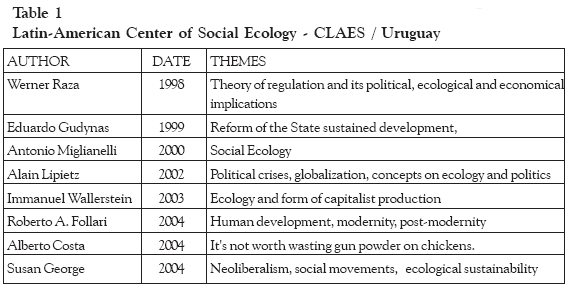
<body><![CDATA[<p><font face="Verdana, Arial, Helvetica, sans-serif" size="2"> <font face="Symbol">&middot;</font>    Constructivist or constructionist focus and co-evolution and social structuration.    For example: Hannigan, Yearley, Redclift and Woodgate. </font></p>     <p><font face="Verdana, Arial, Helvetica, sans-serif" size="2">In addition to    these large groups, the paradigm of Reflexive Modernization can also be emphasized    as an important line of thought in the interior of Environmental Sociology,    paradigm that subdivides itself between ecological modernization (Mol and Spaargaren)    and the concept of risk society (Beck). </font></p>     <p><font face="Verdana, Arial, Helvetica, sans-serif" size="2">Synthetically,    the different focuses mentioned can be grouped and contemplated by Environmental    Sociology and by the Contemporary Social Theory, although they are lines of    thought that interact and dialog among themselves and, in determined points,    work on the interface between Environmental Sociology and the Contemporary Social    Theory, given the interdisciplinary character of the environmental theme and    the hybrid models. </font></p>     <p><font face="Verdana, Arial, Helvetica, sans-serif" size="2">The Contemporary    Social Theory brings in its theoretical body the sociologists who contributed    to the diversification of Environmental Sociology and who worked with the question    of the high-modernity societies, such as Habermas (1987), Touraine (1997), Giddens    (1991), Beck (1986) and Castells (1999), among others. </font></p>     <p><font face="Verdana, Arial, Helvetica, sans-serif" size="2">Following these    main lines of thought, a first analysis with a classificatory bias of Latin-American    intellectual production was elaborated. </font></p>     <p>&nbsp;</p>     <p><font face="Verdana, Arial, Helvetica, sans-serif" size="3"><B>4. PRELIMINARY    ANALYSIS OF LATIN-AMERICAN INTELLECTUAL PRODUCTION</B> </font></p>     <p><font face="Verdana, Arial, Helvetica, sans-serif" size="2">In this part of    the work, results of a first classification of the intellectual production in    the Latin-American centers studied will be presented. In this way, the main    intellectual lines of socio-environmental thought in Latin America are shown    in the tables below. It is not our objective to make a closed classification    of each center, fitting them into one or another line of thought. The intension    is to point out which line of thought exercises greater influence and, in this    way, determine a certain concentration of the research around it. At this moment    of research, there is also no pretension of a comparative analysis among countries,    since the data surveyed at the moment have not been crossed. </font></p>     <p><a name="tab1"></a></p>     <p>&nbsp;</p>     ]]></body>
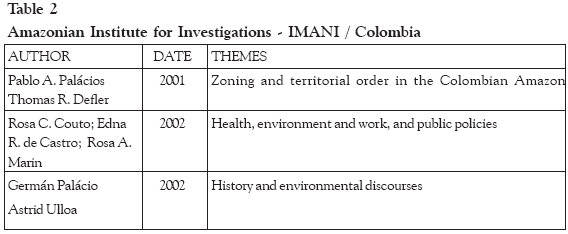
<body><![CDATA[<p align="center"><img src="/img/revistas/s_asoc/v2nse/a03tab01.gif"></p>     <p align="center">&nbsp;</p>     <p><font face="Verdana, Arial, Helvetica, sans-serif" size="2">Over the last years,    the CLAES has shown remarkable dynamism, mainly in its more practical regional    activities. The table below shows some authors who contributed to the analysis    of the environmental question at the CLAES. </font></p>     <p><a name="tab2"></a></p>     <p>&nbsp;</p>     <p align="center"><img src="/img/revistas/s_asoc/v2nse/a03tab02.gif"></p>     <p>&nbsp;</p>     <p><font face="Verdana, Arial, Helvetica, sans-serif" size="2">In the Works performed    at the CLAES, there is a predominance of the influences of the materialist marxist    approach as well as historic approaches. </font></p>     <p><font face="Verdana, Arial, Helvetica, sans-serif" size="2">By 2005, the IMANI    published approximately 40 scientific works since its creation. However, 9 works    were cited on the theme of environment and society and, of these, three titles    that relate more directly with the socio-environment interface were selected.    </font></p>     <p><font face="Verdana, Arial, Helvetica, sans-serif" size="2">In the themes dealt    with in the selected works below and in their analysis, it can be said that    the constructionist approach, coevolution and social structuring exercise a    strong influence on these works.</font></p>     ]]></body>
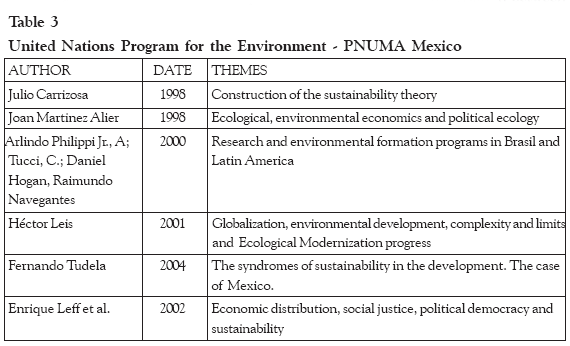
<body><![CDATA[<p><a name="tab3"></a></p>     <p>&nbsp;</p>     <p align="center"><img src="/img/revistas/s_asoc/v2nse/a03tab03.gif"></p>     <p align="center">&nbsp;</p> <B>      <p><font face="Symbol" size="2">&middot; </font><font face="Verdana, Arial, Helvetica, sans-serif" size="2">Environmental    Formation Network for Latin America and the Caribbean</font></p> </B>      <p><font face="Verdana, Arial, Helvetica, sans-serif" size="2">Within the United    Nations Program for the Environment (PNUMA), the production of the Environmental    Formation Network for Latin America and the Caribbean, with headquarters in    Mexico, is outstanding. The PNUMA is a Latin-American reference center, bringing    together important lines of research, making a great contribution and bringing    a pioneering spirit to the intellectual and political debate around the environmental    question. </font></p>     <p><font face="Verdana, Arial, Helvetica, sans-serif" size="2">It can be argued    that, in the case of the PNUMA, the diversity of the theoretical-methodological    influences in the selected works below calls attention, from the works that    already incorporate ecological modernization to those in which the pertinence    of interdisciplinarity is emphasized for the analysis of the relation between    Environment and Society. </font></p>     <p>&nbsp;</p>     <p align="center"><img src="/img/revistas/s_asoc/v2nse/a03tab04.gif"></p>     <p align="center">&nbsp;</p>     ]]></body>
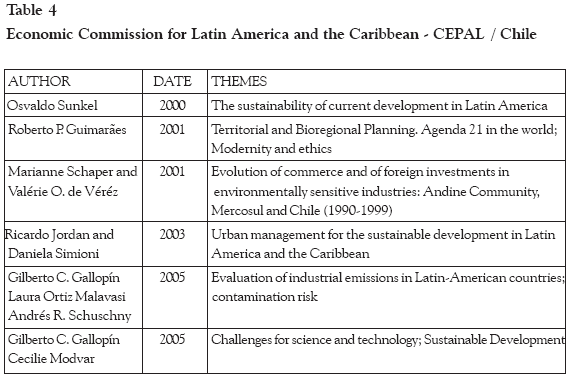
<body><![CDATA[<p><font face="Symbol" size="2">&middot;</font><font face="Verdana, Arial, Helvetica, sans-serif" size="2">    Division of Sustainable Development and Human Settlings - DDSAH </font></p>     <p><font face="Verdana, Arial, Helvetica, sans-serif" size="2">The DDSAH has presented    extensive publications on the environmental question, resulting in diverse studies    and in the development of the intellectual debate in the interior of the Commission    and in all of Latin America. In the table, some authors were selected due to    their contributions to the consolidation of the environmental question as an    important object of study for the CEPAL. </font></p>     <p><font face="Verdana, Arial, Helvetica, sans-serif" size="2">In the case of    the CEPAL, we can also observe the diversity of the theoretical-methodological    approaches, but here we emphasize the importance of hybrid and interdisciplinary    approaches for the study of the socio-ecological problematics. </font></p>     <p><a name="tab5"></a></p>     <p>&nbsp;</p>     <p align="center"><img src="/img/revistas/s_asoc/v2nse/a03tab05.gif"></p>     <p align="center">&nbsp;</p>     <p><font face="Verdana, Arial, Helvetica, sans-serif" size="2">Group for Ecology,    Politics and Society / Brazil (data up until 1996) </font></p>     <p><font face="Verdana, Arial, Helvetica, sans-serif" size="2">There are two moments    in Brazilian intellectual production that delineate the directions of the aggregation    of intellectual demands in the field of interactions between Environment and    Society in Brazil. In the first, a phase that may be considered inspired by    Buttel (1996) as formation, there are four collectanea that deserve attention    - Ecology and Politics in Brazil (1987), organized by Jos&eacute; Augusto P&aacute;dua,    Worldwide Economics and Politics (1991), organized by H&eacute;ctor Leis, Socio-Environmental    Dilemmas and Sustainable Development (1992), organized by Daniel Hogan and Paulo    Freire Vieira and Uncertainties of Sustainability in Globalization (1996), organized    by Leila Ferreira and Eduardo Viola, in addition to the pioneering work of Roberto    Guimar&atilde;es (1984; 1991, among others). </font></p>     <p><font face="Verdana, Arial, Helvetica, sans-serif" size="2">For a first analysis    of Brazil, we will utilize the collectaneas and the Guimar&atilde;es paper mentioned.    </font></p>     ]]></body>
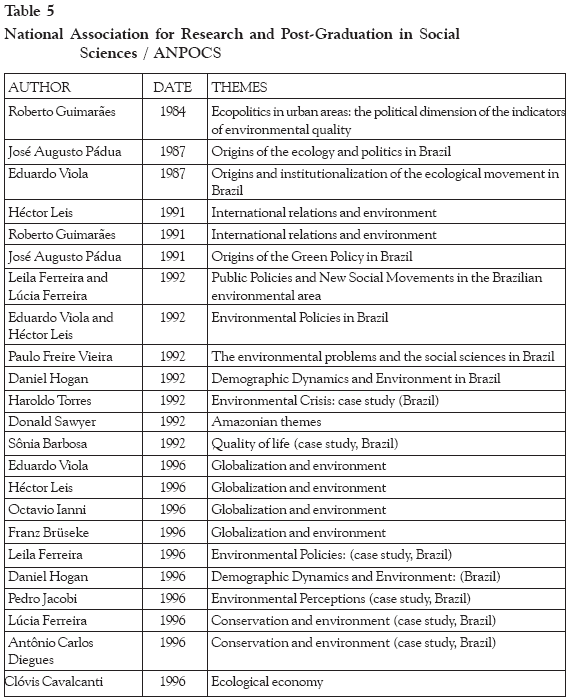
<body><![CDATA[<p><font face="Verdana, Arial, Helvetica, sans-serif" size="2">In the Brazilian    case, the diversity of theoretical-methodological influences can be clearly    observed, but what is interesting is that since the end of the 1980s, a significant    influence of constructionism can be seen and, in the decade of 1990, some works    were already inspired on reflexive modernization in its two branches, both ecological    modernization as well as those inspired by the risk society concept. Here you    can see the hybrid and interdisciplinary approaches for the study of the socio-ecological    problematics. </font></p>     <p>&nbsp;</p>     <p><font face="Verdana, Arial, Helvetica, sans-serif" size="3"><B>5. PRELIMINARY    FINAL CONSIDERATIONS</B> </font></p>     <p><font face="Verdana, Arial, Helvetica, sans-serif" size="2">The technical and    economic changes - with their social, cultural and political effects in our    time - passed as a hurricane over the institutions constructed at the beginning    of the century. Utopia and melancholy are two words, for example, that describe    the lost world of the end of the XX century (FERREIRA, 1997). </font></p>     <p><font face="Verdana, Arial, Helvetica, sans-serif" size="2">These concepts    can help clarify some fundamental questions relative to the loss of our old    ideals and, consequently, to better comprehend the elaboration of the mourning    of those who leashed themselves to utopic projects and became their orphans.    </font></p>     <p><font face="Verdana, Arial, Helvetica, sans-serif" size="2">In this perspective,    one of the most intriguing phenomena of this new century is that we are living    the apparent disappearance of the so-called "critical thought" from the sociological    scenario. It can be argued that, with extremely rare exceptions, the critical    "Latin-American" social thought had enormous difficulty in introducing new themes    in their analyses, due to various questions already introduced in the preceding    items. </font></p>     <p><font face="Verdana, Arial, Helvetica, sans-serif" size="2">However, the environmental    question (among other themes relevant to contemporary sociology) had, by its    specific (interdisciplinary, recent in the social thought; and complex) the    merit of placing before the social scientists in general conceptual and paradigmatic    "problems" that were, to say the least, instigating. </font></p>     <p><font face="Verdana, Arial, Helvetica, sans-serif" size="2">As can be observed    in the data previously presented, this also occurred on the level of the Latin-American    continent, as in the case of the environmental sociology and even the contemporary    social theory. </font></p>     <p><font face="Verdana, Arial, Helvetica, sans-serif" size="2">In addition to    the variety of themes treated, as can be observed in the tables previously presented,    there are various theoretical-methodological approaches in the diverse works    cited that must be mentioned. </font></p>     <p><font face="Verdana, Arial, Helvetica, sans-serif" size="2">Since the beginning    of the decade of 1980, in all of the analyzed centers, we can observe studies    firmly established in constructionist perspectives, by both the perspective    of ecological modernization, in its two branches and ecological modernization    and the risk society. </font></p>     ]]></body>
<body><![CDATA[<p><font face="Verdana, Arial, Helvetica, sans-serif" size="2">It should be emphasized    that the works mentioned previously also present materialist marxist approaches    and are, many times, still inspired by the approaches of political ecology.    It should be stressed that, in various centers, one can observe works that discuss    interdisciplinarity and utilize these approaches in their empiric perspectives.    </font></p>     <p><font face="Verdana, Arial, Helvetica, sans-serif" size="2">It is fitting at    this moment, still quite preliminary of the data obtained by the recent work,    to simply suggest some questions that should be discuss in the next steps of    the research: </font></p>     <blockquote>        <p><font face="Verdana, Arial, Helvetica, sans-serif" size="2">1)Recognize various      forms of knowledge and the practices that sustain them in order that they      be incorporated in a horizontal, non-relativist, argumentative relation that,      with other knowledge, constitutes a special position for this type of reflection:      it is an analysis that is constructed temporally, that refuses the control      of fragmentation and dispersion, that does not substitute. </font></p>       <p><font face="Verdana, Arial, Helvetica, sans-serif" size="2">2)The objects      of sociological reflection are already established, but are placed in another      epistemological field - the field of radically contemporary of the occurrences.      </font></p>       <p><font face="Verdana, Arial, Helvetica, sans-serif" size="2">3)What are the      specificities of the Latin-American production in the area of environment      and society as have been accompanied in the international debate? Not only      in terms of very diverse empirical contexts but, mainly, in its position as      the "field for scientific disputes". </font></p> </blockquote>     <p><font face="Verdana, Arial, Helvetica, sans-serif" size="2">There are still    various questions that the present work will have to face but just the data    presented previously show that the investigation will be worthwhile. </font></p>     <p><font face="Verdana, Arial, Helvetica, sans-serif" size="2">It is worth noting,    however, that even at the beginning of the first decade of the new century,    a significant change can be observed in the interests of this Latin-American    nucleus, more strongly aggregated around the field of reflections on the interface    between society and environment. </font></p>     <p><font face="Verdana, Arial, Helvetica, sans-serif" size="2">In the Brazilian    case, a good indicator of this divergence of emphasis can be found in the aggregation    of intellectual demands imposed on the National Association for Post-Graduation    and Research in Environment and Society. The program of its first three meetings    delineated the following themes for debates in the ambit of work groups and    round tables: international environmental regimes, human dimensions of biodiversity;    consumption and safety of food and energy, local dimensions of the environmental    changes, sustainable cities, environmental education in societies on the knowledge    and climatic changes, aside from the already traditional themes, such as interdisciplinarity,    demographic dynamics, environmental risk, environment policies, theory and environment.    </font></p>     <p><font face="Verdana, Arial, Helvetica, sans-serif" size="2">On the other hand,    one can observe that the intellectual production in Brazil was also strongly    influenced by the contemporary social theory (particularly by Beck, Giddens    and Habermas) and more recently by environmental sociology (in the constructionist    perspective as well as the reflexive modernity in its different branches), as    one can also observe in the articles published in the collectanea cited above.    </font></p>     ]]></body>
<body><![CDATA[<p><font face="Verdana, Arial, Helvetica, sans-serif" size="2">In addition, the    data obtained in the other Latin-American centers show us the theoretical-methodological    diversity utilized by the authors, aside from an organic bond with the socio-environmental    interface that characterizes this production. </font></p>     <p>&nbsp;</p>     <p><font face="Verdana, Arial, Helvetica, sans-serif" size="3"><B>BIBLIOGRAPHICAL    REFERENCES</B> </font></p>     <!-- ref --><p><font face="Verdana, Arial, Helvetica, sans-serif" size="2">BECK, U. <I>Risk    Society. Towards a New Modernity</I>. Sage Publications. London, 1992. </font><!-- ref --><p><font face="Verdana, Arial, Helvetica, sans-serif" size="2">BOURDIEU , P. <I>Economia    das trocas simb&oacute;licas</I>. Editora Perspectiva. S&atilde;o Paulo, 1980.    </font><!-- ref --><p> <font face="Verdana, Arial, Helvetica, sans-serif" size="2"><I>Sociologia.    Textos escolhidos</I>. Editora &Aacute;tica. S&atilde;o Paulo, 1983. </font><!-- ref --><p><font face="Verdana, Arial, Helvetica, sans-serif" size="2">BRUNDTLAND, H.    <I>Nosso Futuro Comum</I>. Editora da Funda&ccedil;&atilde;o Get&uacute;lio    Vargas. Rio de Janeiro, 1987. </font><!-- ref --><p><font face="Verdana, Arial, Helvetica, sans-serif" size="2">BUTTEL, F. New    directions in environmental sociology. <I>Annual Review Sociology</I>. 13:465-488,    1987. </font><!-- ref --><p><font face="Verdana, Arial, Helvetica, sans-serif" size="2">CAHN, M.A. <I>Environmental    deceptions. The tensions between liberalism and environmental policymaking in    the United States</I>. New York State University. New York, 1995. </font><!-- ref --><p><font face="Verdana, Arial, Helvetica, sans-serif" size="2">CATTON, W. and    DUNLAP, R. Environmental sociology: a new paradigm. <I>The American Sociologist</I>.    Vol.13. no.1. February. Washington, 1998. </font><!-- ref --><p><font face="Verdana, Arial, Helvetica, sans-serif" size="2">CASTELLS, M. <I>A    Era da Informa&ccedil;&atilde;o: Economia</I>, Sociedade e Cultura. Vol. 2.    Paz e Terra. S&atilde;o Paulo, 1999. </font><!-- ref --><p><font face="Verdana, Arial, Helvetica, sans-serif" size="2">GULBENKIAN COMMISSION    <I>Para Abrir as Ci&ecirc;ncias Sociais</I>. Editora Cortez. S&atilde;o Paulo,    1996. </font><!-- ref --><p><font face="Verdana, Arial, Helvetica, sans-serif" size="2">DURKHEIM, E. <I>Select    Writings</I>. Cambridge University Press. Cambridge, 1995. </font><!-- ref --><p><font face="Verdana, Arial, Helvetica, sans-serif" size="2">EHRLICH, P. <I>The    population bomb</I>. Riversity Press. Massachusetts, 1975. </font><!-- ref --><p><font face="Verdana, Arial, Helvetica, sans-serif" size="2">FERREIRA, Leila    da C. <I>Id&eacute;ias para uma sociologia da quest&atilde;o ambiental no Brasil</I>.    Editora Annablume. S&atilde;o Paulo, 2006. </font><!-- ref --><p><font face="Verdana, Arial, Helvetica, sans-serif" size="2"> (org) <I>A Sociologia    no Horizonte do s&eacute;culo XXI</I>. Boitempo Editorial. S&atilde;o Paulo,    1997. </font><!-- ref --><p><font face="Verdana, Arial, Helvetica, sans-serif" size="2">FERREIRA, Leila    da C. &amp; VIOLA, E. (orgs.) <I>Incertezas de Sustentabilidade na Globaliza&ccedil;&atilde;o</I>.    Campinas: Editora da UNICAMP, 1997. </font><!-- ref --><p><font face="Verdana, Arial, Helvetica, sans-serif" size="2">FERREIRA, L&uacute;cia    da C. "A import&acirc;ncia da interdisciplinaridade para a sociedade" in <I>A    interdisciplinaridade nas Ci&ecirc;ncias Ambientais</I>. PNUMA/MCT/PADCT-CIAMB.    Bras&iacute;lia, 2000. </font><!-- ref --><p><font face="Verdana, Arial, Helvetica, sans-serif" size="2">FLORIANI, D. <I>Conhecimento,    Meio Ambiente &amp; Globaliza&ccedil;&atilde;o</I>. Juru&aacute; Editora. Curitiba,    2004. </font><!-- ref --><p><font face="Verdana, Arial, Helvetica, sans-serif" size="2">GIDDENS, A. <I>As    Conseq&uuml;&ecirc;ncias da Modernidade.</I> S&atilde;o Paulo: Editora da Universidade    Estadual Paulista. S&atilde;o Paulo, 1991. </font><!-- ref --><p><font face="Verdana, Arial, Helvetica, sans-serif" size="2">GUIMAR&Atilde;ES,    R. "Ecopol&iacute;tica em &aacute;reas urbanas: a dimens&atilde;o pol&iacute;tica    dos indicadores de qualidade ambiental" In: SOUZA, A. (org.). <I>Debates Urbanos.    Qualidade de vida urbana</I>. Zahar Editora. S&atilde;o Paulo, 1984. </font><!-- ref --><p> <font face="Verdana, Arial, Helvetica, sans-serif" size="2"><I>The Ecopolitics    of Development in the Third World. Politics and Environment in Brazil</I>. Lynne    Rienner Publisher. Boulder&amp;London, 1991. </font><!-- ref --><p> <font face="Verdana, Arial, Helvetica, sans-serif" size="2">"A &Eacute;tica    da sustentabilidade e a formula&ccedil;&atilde;o de pol&iacute;ticas de desenvolvimento".    In: VIANA, G; SILVA, M; DINIZ, N. (org). <I>O desafio da sustentabilidade. Um    debate s&oacute;cio-ambiental no Brasil</I>. Editora Funda&ccedil;&atilde;o    Perseu Abramo. S&atilde;o Paulo, 2001. </font><!-- ref --><p><font face="Verdana, Arial, Helvetica, sans-serif" size="2">HABERMAS, J. <I>The    Theory of Communicative Action</I>. Vol. 2. Beacon Press. Boston, 1987. </font><!-- ref --><p><font face="Verdana, Arial, Helvetica, sans-serif" size="2">HANNIGAN, J. <I>Environmental    Sociology - a social constructionist perspective. </I>Routledge. London and    New York, 2000. </font><!-- ref --><p><font face="Verdana, Arial, Helvetica, sans-serif" size="2">HERCULANO, S. et    al.<I>Qualidade de Vida e Riscos Ambientais</I>. Eduff Editora. Niter&oacute;i.    Doctor in Environment and Society - UNICAMP. CAPES/ IFCH / NEPAM, 2000. </font><!-- ref --><p><font face="Verdana, Arial, Helvetica, sans-serif" size="2">LEIS, H. A P&Oacute;S-GRADUA&Ccedil;&Atilde;O    NO BRASIL NA &Aacute;REA DE AMBIENTE E SOCIEDADE. Work presented at the SBS,    2000. (mimeog.). </font><!-- ref --><p><font face="Verdana, Arial, Helvetica, sans-serif" size="2">MACCORMICK, J.    <I>Rumo ao para&iacute;so. A hist&oacute;ria do movimento ambientalista</I>.    Dumar&aacute;. Rio de Janeiro, 1992. </font><!-- ref --><p><font face="Verdana, Arial, Helvetica, sans-serif" size="2">MARX, K. <I>O Capital.    Cr&iacute;tica da Economia Pol&iacute;tica</I>. Vol. II. Civiliza&ccedil;&atilde;o    Brasileira. Rio de Janeiro, 1980. </font><!-- ref --><p><font face="Verdana, Arial, Helvetica, sans-serif" size="2">MORRISON, R. <I>Ecological    Democracy.</I> Southend Press. Boston, 1995. </font><!-- ref --><p><font face="Verdana, Arial, Helvetica, sans-serif" size="2">O'CONNOR, J. Desarrollo    desigual y combinado y crisis ecol&oacute;gica. <I>Ambiente &amp; Sociedade</I>.    Vol. VI, no. 2 Jul/Dec. Annablume Ed. S&atilde;o Paulo, 2003. </font><!-- ref --><p><font face="Verdana, Arial, Helvetica, sans-serif" size="2">ORTIZ, R. <I>As    Ci&ecirc;ncias Sociais e o Trabalho Intelectual</I>. Editora Olho D'&Aacute;gua.    S&atilde;o Paulo, 2003. </font><!-- ref --><p><font face="Verdana, Arial, Helvetica, sans-serif" size="2">PRIGOGINE, I. and    STENGERS, I.<I>A nova alian&ccedil;a</I>. Metamorfose da ci&ecirc;ncia. Editora    da UnB. Bras&iacute;lia, 1991. </font><!-- ref --><p><font face="Verdana, Arial, Helvetica, sans-serif" size="2">REDCLIFT, M. &amp;    WOODGATE, M. <I>The International Handbook of Environmental Sociology</I>. Edward    Elgar. Cheltenham, UK, 1997. </font><!-- ref --><p><font face="Verdana, Arial, Helvetica, sans-serif" size="2">SCHNNAIBERG, A.    <I>The Environment</I>. Oxford University Press. New York, 1980. </font><!-- ref --><p><font face="Verdana, Arial, Helvetica, sans-serif" size="2">SHIVA, V. "Farmers    rights, biodiversity and international treaties". <I>Economic and political    weekly</I>. April. p. 555-560, 1993. </font><!-- ref --><p><font face="Verdana, Arial, Helvetica, sans-serif" size="2">SPAARGAREN, G.,    MOL, A., BUTTEL, F. <I>Environment and Global Modernity</I>. Sage. Thousand    Oaks, New Delhi, 2000. </font><!-- ref --><p><font face="Verdana, Arial, Helvetica, sans-serif" size="2">TOURAINE, A. <I>Cr&iacute;tica    da Modernidade</I>. Rio de Janeiro: Vozes, 1997. </font><!-- ref --><p><font face="Verdana, Arial, Helvetica, sans-serif" size="2">UNITED NATIONS    <I>The Inequality Predicament</I>. Report on the World Social Situation. Department    of Economic and Social Affairs. United Nations Publications. New York, 2005.    </font><!-- ref --><p><font face="Verdana, Arial, Helvetica, sans-serif" size="2">YEARLEY, S. <I>Sociology,    Environmentalism and Globalization</I>. Sage. London, 1996. </font><!-- ref --><p><font face="Verdana, Arial, Helvetica, sans-serif" size="2">WEBER, M. <I>Ensaios    de Sociologia</I>. Zahar editors. Rio de Janeiro, 1982. </font><p>&nbsp;</p>     <p><font face="Verdana, Arial, Helvetica, sans-serif" size="2"><B>SITES CONSULTED</B>    </font></p>     <p><font face="Verdana, Arial, Helvetica, sans-serif" size="2"><a href="http://www.ambiental.net/claes" target="_blank">www.ambiental.net/claes</a>    - Latin American Center for Social Ecology - CLAES. 2004 e 2006. </font></p>     <p><font face="Verdana, Arial, Helvetica, sans-serif" size="2"><a href="http://www.eclac.org/dmaah" target="_blank">www.eclac.org/dmaah</a>    - Economic Commission for Latin American and the Caribbean - CEPAL. 2004 e 2006.    </font></p>     <p><font face="Verdana, Arial, Helvetica, sans-serif" size="2"><a href="http://www.rolac.unep.mx" target="_blank">www.rolac.unep.mx</a>    - United Nations Program for Environment - PNUMA. 2004 e 2006. </font></p>     <p><font face="Verdana, Arial, Helvetica, sans-serif" size="2"><a href="http://www.imani.unal.edu.co" target="_blank">www.imani.unal.edu.co</a>    - Amazonian Institute for Investigation - IMANI. 2004 e 2006. </font></p>     <p><font face="Verdana, Arial, Helvetica, sans-serif" size="2"><a href="http://www.rides.cl" target="_blank">www.rides.cl</a>    - Resources and Investigation for Sustainable Development - RIDES. 2004 e 2006.    </font></p>     <p>&nbsp;</p>     <p>&nbsp;</p>     ]]></body>
<body><![CDATA[<p><font face="Verdana, Arial, Helvetica, sans-serif" size="2"> Received in 10/2006.    Accepted in 12/06.</font></p>      ]]></body><back>
<ref-list>
<ref id="B1">
<nlm-citation citation-type="book">
<person-group person-group-type="author">
<name>
<surname><![CDATA[BECK]]></surname>
<given-names><![CDATA[U.]]></given-names>
</name>
</person-group>
<source><![CDATA[Risk Society. Towards a New Modernity]]></source>
<year>1992</year>
<publisher-loc><![CDATA[London ]]></publisher-loc>
<publisher-name><![CDATA[Sage Publications]]></publisher-name>
</nlm-citation>
</ref>
<ref id="B2">
<nlm-citation citation-type="book">
<person-group person-group-type="author">
<name>
<surname><![CDATA[BOURDIEU]]></surname>
<given-names><![CDATA[P.]]></given-names>
</name>
</person-group>
<source><![CDATA[Economia das trocas simbólicas]]></source>
<year>1980</year>
<publisher-loc><![CDATA[São Paulo ]]></publisher-loc>
<publisher-name><![CDATA[Editora Perspectiva]]></publisher-name>
</nlm-citation>
</ref>
<ref id="B3">
<nlm-citation citation-type="book">
<person-group person-group-type="author">
<name>
<surname><![CDATA[BOURDIEU]]></surname>
<given-names><![CDATA[P.]]></given-names>
</name>
</person-group>
<person-group person-group-type="editor">
<name>
</name>
</person-group>
<source><![CDATA[Sociologia. Textos escolhidos]]></source>
<year>1983</year>
<publisher-loc><![CDATA[São Paulo ]]></publisher-loc>
<publisher-name><![CDATA[Ática]]></publisher-name>
</nlm-citation>
</ref>
<ref id="B4">
<nlm-citation citation-type="book">
<person-group person-group-type="author">
<name>
<surname><![CDATA[BRUNDTLAND]]></surname>
<given-names><![CDATA[H.]]></given-names>
</name>
</person-group>
<source><![CDATA[Nosso Futuro Comum]]></source>
<year>1987</year>
<publisher-loc><![CDATA[Rio de Janeiro ]]></publisher-loc>
<publisher-name><![CDATA[Editora da Fundação Getúlio Vargas]]></publisher-name>
</nlm-citation>
</ref>
<ref id="B5">
<nlm-citation citation-type="journal">
<person-group person-group-type="author">
<name>
<surname><![CDATA[BUTTEL]]></surname>
<given-names><![CDATA[F.]]></given-names>
</name>
</person-group>
<article-title xml:lang="en"><![CDATA[New directions in environmental sociology]]></article-title>
<source><![CDATA[Annual Review Sociology]]></source>
<year>1987</year>
<volume>13</volume>
<page-range>465-488</page-range></nlm-citation>
</ref>
<ref id="B6">
<nlm-citation citation-type="journal">
<person-group person-group-type="author">
<name>
<surname><![CDATA[CAHN]]></surname>
<given-names><![CDATA[M.A.]]></given-names>
</name>
</person-group>
<article-title xml:lang="en"><![CDATA[Environmental deceptions. The tensions between liberalism and environmental policymaking in the United States]]></article-title>
<source><![CDATA[New York State University]]></source>
<year>1995</year>
<publisher-loc><![CDATA[New York ]]></publisher-loc>
</nlm-citation>
</ref>
<ref id="B7">
<nlm-citation citation-type="journal">
<person-group person-group-type="author">
<name>
<surname><![CDATA[CATTON]]></surname>
<given-names><![CDATA[W.]]></given-names>
</name>
<name>
<surname><![CDATA[DUNLAP]]></surname>
<given-names><![CDATA[R.]]></given-names>
</name>
</person-group>
<article-title xml:lang="en"><![CDATA[Environmental sociology: a new paradigm]]></article-title>
<source><![CDATA[The American Sociologist]]></source>
<year>1998</year>
<volume>13</volume>
<numero>1</numero>
<issue>1</issue>
<publisher-loc><![CDATA[Washington ]]></publisher-loc>
</nlm-citation>
</ref>
<ref id="B8">
<nlm-citation citation-type="book">
<person-group person-group-type="author">
<name>
<surname><![CDATA[CASTELLS]]></surname>
<given-names><![CDATA[M. A]]></given-names>
</name>
</person-group>
<source><![CDATA[Era da Informação: Economia, Sociedade e Cultura]]></source>
<year>1999</year>
<volume>2</volume>
<publisher-loc><![CDATA[São Paulo ]]></publisher-loc>
<publisher-name><![CDATA[Paz e Terra]]></publisher-name>
</nlm-citation>
</ref>
<ref id="B9">
<nlm-citation citation-type="book">
<collab>GULBENKIAN COMMISSION</collab>
<source><![CDATA[Para Abrir as Ciências Sociais]]></source>
<year>1996</year>
<publisher-loc><![CDATA[São Paulo ]]></publisher-loc>
<publisher-name><![CDATA[Cortez]]></publisher-name>
</nlm-citation>
</ref>
<ref id="B10">
<nlm-citation citation-type="book">
<person-group person-group-type="author">
<name>
<surname><![CDATA[DURKHEIM]]></surname>
<given-names><![CDATA[E.]]></given-names>
</name>
</person-group>
<source><![CDATA[Select Writings]]></source>
<year>1995</year>
<publisher-loc><![CDATA[Cambridge ]]></publisher-loc>
<publisher-name><![CDATA[Cambridge University Press]]></publisher-name>
</nlm-citation>
</ref>
<ref id="B11">
<nlm-citation citation-type="book">
<person-group person-group-type="author">
<name>
<surname><![CDATA[EHRLICH]]></surname>
<given-names><![CDATA[P.]]></given-names>
</name>
</person-group>
<source><![CDATA[The population bomb]]></source>
<year>1975</year>
<publisher-loc><![CDATA[Massachusetts ]]></publisher-loc>
<publisher-name><![CDATA[Riversity Press]]></publisher-name>
</nlm-citation>
</ref>
<ref id="B12">
<nlm-citation citation-type="book">
<person-group person-group-type="author">
<name>
<surname><![CDATA[FERREIRA]]></surname>
<given-names><![CDATA[Leila da C.]]></given-names>
</name>
</person-group>
<source><![CDATA[Idéias para uma sociologia da questão ambiental no Brasil]]></source>
<year>2006</year>
<publisher-loc><![CDATA[São Paulo ]]></publisher-loc>
<publisher-name><![CDATA[Annablume]]></publisher-name>
</nlm-citation>
</ref>
<ref id="B13">
<nlm-citation citation-type="book">
<person-group person-group-type="author">
<name>
<surname><![CDATA[FERREIRA]]></surname>
<given-names><![CDATA[Leila da C.]]></given-names>
</name>
</person-group>
<person-group person-group-type="editor">
<name>
</name>
</person-group>
<source><![CDATA[A Sociologia no Horizonte do século XXI]]></source>
<year>1997</year>
<publisher-loc><![CDATA[São Paulo ]]></publisher-loc>
<publisher-name><![CDATA[Boitempo Editorial]]></publisher-name>
</nlm-citation>
</ref>
<ref id="B14">
<nlm-citation citation-type="book">
<person-group person-group-type="author">
<name>
<surname><![CDATA[FERREIRA]]></surname>
<given-names><![CDATA[Leila da C.]]></given-names>
</name>
<name>
<surname><![CDATA[VIOLA]]></surname>
<given-names><![CDATA[E.]]></given-names>
</name>
</person-group>
<source><![CDATA[Incertezas de Sustentabilidade na Globalização]]></source>
<year>1997</year>
<publisher-loc><![CDATA[Campinas ]]></publisher-loc>
<publisher-name><![CDATA[Editora da UNICAMP]]></publisher-name>
</nlm-citation>
</ref>
<ref id="B15">
<nlm-citation citation-type="book">
<person-group person-group-type="author">
<name>
<surname><![CDATA[FERREIRA]]></surname>
<given-names><![CDATA[Lúcia da C.]]></given-names>
</name>
</person-group>
<article-title xml:lang="pt"><![CDATA[A importância da interdisciplinaridade para a sociedade]]></article-title>
<source><![CDATA[A interdisciplinaridade nas Ciências Ambientais]]></source>
<year>2000</year>
<publisher-loc><![CDATA[Brasília ]]></publisher-loc>
<publisher-name><![CDATA[PNUMAMCTPADCT-CIAMB]]></publisher-name>
</nlm-citation>
</ref>
<ref id="B16">
<nlm-citation citation-type="book">
<person-group person-group-type="author">
<name>
<surname><![CDATA[FLORIANI]]></surname>
<given-names><![CDATA[D.]]></given-names>
</name>
</person-group>
<source><![CDATA[Conhecimento, Meio Ambiente & Globalização]]></source>
<year>2004</year>
<publisher-loc><![CDATA[Curitiba ]]></publisher-loc>
<publisher-name><![CDATA[Juruá Editora]]></publisher-name>
</nlm-citation>
</ref>
<ref id="B17">
<nlm-citation citation-type="book">
<person-group person-group-type="author">
<name>
<surname><![CDATA[GIDDENS]]></surname>
<given-names><![CDATA[A.]]></given-names>
</name>
</person-group>
<source><![CDATA[As Conseqüências da Modernidade]]></source>
<year>1991</year>
<publisher-loc><![CDATA[São PauloSão Paulo ]]></publisher-loc>
<publisher-name><![CDATA[Editora da Universidade Estadual Paulista]]></publisher-name>
</nlm-citation>
</ref>
<ref id="B18">
<nlm-citation citation-type="book">
<person-group person-group-type="author">
<name>
<surname><![CDATA[GUIMARÃES]]></surname>
<given-names><![CDATA[R.]]></given-names>
</name>
</person-group>
<article-title xml:lang="pt"><![CDATA["Ecopolítica em áreas urbanas: a dimensão política dos indicadores de qualidade ambiental"]]></article-title>
<person-group person-group-type="editor">
<name>
<surname><![CDATA[SOUZA]]></surname>
<given-names><![CDATA[A.]]></given-names>
</name>
</person-group>
<source><![CDATA[Debates Urbanos. Qualidade de vida urbana]]></source>
<year>1984</year>
<publisher-loc><![CDATA[São Paulo ]]></publisher-loc>
<publisher-name><![CDATA[Zahar Editora]]></publisher-name>
</nlm-citation>
</ref>
<ref id="B19">
<nlm-citation citation-type="book">
<person-group person-group-type="author">
<name>
<surname><![CDATA[GUIMARÃES]]></surname>
<given-names><![CDATA[R.]]></given-names>
</name>
</person-group>
<person-group person-group-type="editor">
<name>
</name>
</person-group>
<source><![CDATA[The Ecopolitics of Development in the Third World: Politics and Environment in Brazil.]]></source>
<year>1991</year>
<publisher-loc><![CDATA[BoulderLondon ]]></publisher-loc>
<publisher-name><![CDATA[Lynne Rienner Publisher]]></publisher-name>
</nlm-citation>
</ref>
<ref id="B20">
<nlm-citation citation-type="book">
<person-group person-group-type="author">
<name>
<surname><![CDATA[GUIMARÃES]]></surname>
<given-names><![CDATA[R.]]></given-names>
</name>
</person-group>
<article-title xml:lang="pt"><![CDATA["A Ética da sustentabilidade e a formulação de políticas de desenvolvimento"]]></article-title>
<person-group person-group-type="editor">
<name>
<surname><![CDATA[VIANA]]></surname>
<given-names><![CDATA[G]]></given-names>
</name>
<name>
<surname><![CDATA[SILVA]]></surname>
<given-names><![CDATA[M]]></given-names>
</name>
<name>
<surname><![CDATA[DINIZ]]></surname>
<given-names><![CDATA[N.]]></given-names>
</name>
</person-group>
<source><![CDATA[O desafio da sustentabilidade. Um debate sócio-ambiental no Brasil]]></source>
<year>2001</year>
<publisher-loc><![CDATA[São Paulo ]]></publisher-loc>
<publisher-name><![CDATA[Editora Fundação Perseu Abramo]]></publisher-name>
</nlm-citation>
</ref>
<ref id="B21">
<nlm-citation citation-type="book">
<person-group person-group-type="author">
<name>
<surname><![CDATA[HABERMAS]]></surname>
<given-names><![CDATA[J]]></given-names>
</name>
</person-group>
<source><![CDATA[The Theory of Communicative Action]]></source>
<year>1987</year>
<volume>2</volume>
<publisher-loc><![CDATA[Boston ]]></publisher-loc>
<publisher-name><![CDATA[Beacon Press]]></publisher-name>
</nlm-citation>
</ref>
<ref id="B22">
<nlm-citation citation-type="book">
<person-group person-group-type="author">
<name>
<surname><![CDATA[HANNIGAN]]></surname>
<given-names><![CDATA[J]]></given-names>
</name>
</person-group>
<source><![CDATA[Environmental Sociology - a social constructionist perspective]]></source>
<year>2000</year>
<publisher-loc><![CDATA[LondonNew York ]]></publisher-loc>
<publisher-name><![CDATA[Routledge]]></publisher-name>
</nlm-citation>
</ref>
<ref id="B23">
<nlm-citation citation-type="book">
<person-group person-group-type="author">
<name>
<surname><![CDATA[HERCULANO]]></surname>
<given-names><![CDATA[S]]></given-names>
</name>
</person-group>
<source><![CDATA[Qualidade de Vida e Riscos Ambientais]]></source>
<year>2000</year>
<publisher-loc><![CDATA[Niterói ]]></publisher-loc>
<publisher-name><![CDATA[Eduff Editora]]></publisher-name>
</nlm-citation>
</ref>
<ref id="B24">
<nlm-citation citation-type="journal">
<person-group person-group-type="author">
<name>
<surname><![CDATA[LEIS]]></surname>
<given-names><![CDATA[H.]]></given-names>
</name>
</person-group>
<article-title xml:lang="pt"><![CDATA[A PÓS-GRADUAÇÃO NO BRASIL NA ÁREA DE AMBIENTE E SOCIEDADE]]></article-title>
<source><![CDATA[Work presented at the SBS]]></source>
<year>2000</year>
</nlm-citation>
</ref>
<ref id="B25">
<nlm-citation citation-type="book">
<person-group person-group-type="author">
<name>
<surname><![CDATA[MACCORMICK]]></surname>
<given-names><![CDATA[J.]]></given-names>
</name>
</person-group>
<source><![CDATA[Rumo ao paraíso. A história do movimento ambientalista]]></source>
<year>1992</year>
<publisher-loc><![CDATA[Rio de Janeiro ]]></publisher-loc>
<publisher-name><![CDATA[Dumará]]></publisher-name>
</nlm-citation>
</ref>
<ref id="B26">
<nlm-citation citation-type="book">
<person-group person-group-type="author">
<name>
<surname><![CDATA[MARX]]></surname>
<given-names><![CDATA[K.]]></given-names>
</name>
</person-group>
<source><![CDATA[O Capital. Crítica da Economia Política]]></source>
<year>1980</year>
<volume>II</volume>
<publisher-loc><![CDATA[Rio de Janeiro ]]></publisher-loc>
<publisher-name><![CDATA[Civilização Brasileira]]></publisher-name>
</nlm-citation>
</ref>
<ref id="B27">
<nlm-citation citation-type="book">
<person-group person-group-type="author">
<name>
<surname><![CDATA[MORRISON]]></surname>
<given-names><![CDATA[R.]]></given-names>
</name>
</person-group>
<source><![CDATA[Ecological Democracy]]></source>
<year>1995</year>
<publisher-loc><![CDATA[Boston ]]></publisher-loc>
<publisher-name><![CDATA[Southend Press]]></publisher-name>
</nlm-citation>
</ref>
<ref id="B28">
<nlm-citation citation-type="journal">
<person-group person-group-type="author">
<name>
<surname><![CDATA[O'CONNOR]]></surname>
<given-names><![CDATA[J.]]></given-names>
</name>
</person-group>
<article-title xml:lang="es"><![CDATA[Desarrollo desigual y combinado y crisis ecológica]]></article-title>
<source><![CDATA[Ambiente & Sociedade]]></source>
<year>2003</year>
<volume>VI</volume>
<numero>2</numero>
<issue>2</issue>
<publisher-loc><![CDATA[São Paulo ]]></publisher-loc>
<publisher-name><![CDATA[Annablume]]></publisher-name>
</nlm-citation>
</ref>
<ref id="B29">
<nlm-citation citation-type="book">
<person-group person-group-type="author">
<name>
<surname><![CDATA[ORTIZ]]></surname>
<given-names><![CDATA[R.]]></given-names>
</name>
</person-group>
<source><![CDATA[As Ciências Sociais e o Trabalho Intelectua]]></source>
<year>2003</year>
<publisher-loc><![CDATA[São Paulo ]]></publisher-loc>
<publisher-name><![CDATA[Editora Olho D'Água]]></publisher-name>
</nlm-citation>
</ref>
<ref id="B30">
<nlm-citation citation-type="book">
<person-group person-group-type="author">
<name>
<surname><![CDATA[PRIGOGINE]]></surname>
<given-names><![CDATA[I.]]></given-names>
</name>
<name>
<surname><![CDATA[STENGERS]]></surname>
<given-names><![CDATA[I]]></given-names>
</name>
</person-group>
<source><![CDATA[A nova aliança. Metamorfose da ciência]]></source>
<year>1991</year>
<publisher-loc><![CDATA[Brasília ]]></publisher-loc>
<publisher-name><![CDATA[Editora da UnB]]></publisher-name>
</nlm-citation>
</ref>
<ref id="B31">
<nlm-citation citation-type="book">
<person-group person-group-type="author">
<name>
<surname><![CDATA[REDCLIFT]]></surname>
<given-names><![CDATA[M.]]></given-names>
</name>
<name>
<surname><![CDATA[WOODGATE]]></surname>
<given-names><![CDATA[M.]]></given-names>
</name>
</person-group>
<source><![CDATA[The International Handbook of Environmental Sociology]]></source>
<year>1997</year>
<publisher-loc><![CDATA[Cheltenham ]]></publisher-loc>
<publisher-name><![CDATA[Edward Elgar]]></publisher-name>
</nlm-citation>
</ref>
<ref id="B32">
<nlm-citation citation-type="book">
<person-group person-group-type="author">
<name>
<surname><![CDATA[A]]></surname>
<given-names><![CDATA[SCHNNAIBERG]]></given-names>
</name>
</person-group>
<source><![CDATA[The Environment]]></source>
<year>1980</year>
<publisher-loc><![CDATA[New York ]]></publisher-loc>
<publisher-name><![CDATA[Oxford University Press]]></publisher-name>
</nlm-citation>
</ref>
<ref id="B33">
<nlm-citation citation-type="journal">
<person-group person-group-type="author">
<name>
<surname><![CDATA[SHIVA]]></surname>
<given-names><![CDATA[V]]></given-names>
</name>
</person-group>
<article-title xml:lang="en"><![CDATA["Farmers rights, biodiversity and international treaties"]]></article-title>
<source><![CDATA[Economic and political weekly]]></source>
<year>1993</year>
<page-range>555-560</page-range></nlm-citation>
</ref>
<ref id="B34">
<nlm-citation citation-type="book">
<person-group person-group-type="author">
<name>
<surname><![CDATA[SPAARGAREN]]></surname>
<given-names><![CDATA[G.]]></given-names>
</name>
<name>
<surname><![CDATA[MOL]]></surname>
<given-names><![CDATA[A.]]></given-names>
</name>
<name>
<surname><![CDATA[BUTTEL]]></surname>
<given-names><![CDATA[F.]]></given-names>
</name>
</person-group>
<source><![CDATA[Environment and Global Modernity]]></source>
<year>2000</year>
<publisher-loc><![CDATA[Thousand Oaks^eNew Delhi New Delhi]]></publisher-loc>
<publisher-name><![CDATA[Sage]]></publisher-name>
</nlm-citation>
</ref>
<ref id="B35">
<nlm-citation citation-type="book">
<person-group person-group-type="author">
<name>
<surname><![CDATA[TOURAINE]]></surname>
<given-names><![CDATA[A.]]></given-names>
</name>
</person-group>
<source><![CDATA[Crítica da Modernidade]]></source>
<year>1997</year>
<publisher-loc><![CDATA[Rio de Janeiro ]]></publisher-loc>
<publisher-name><![CDATA[Vozes]]></publisher-name>
</nlm-citation>
</ref>
<ref id="B36">
<nlm-citation citation-type="book">
<collab>UNITED NATIONS^dThe Inequality Predicament</collab>
<source><![CDATA[Report on the World Social Situation. Department of Economic and Social Affairs]]></source>
<year>2005</year>
<publisher-loc><![CDATA[New York ]]></publisher-loc>
<publisher-name><![CDATA[United Nations Publications]]></publisher-name>
</nlm-citation>
</ref>
<ref id="B37">
<nlm-citation citation-type="book">
<person-group person-group-type="author">
<name>
<surname><![CDATA[YEARLEY]]></surname>
<given-names><![CDATA[S.]]></given-names>
</name>
</person-group>
<source><![CDATA[Sociology, Environmentalism and Globalization]]></source>
<year>1996</year>
<publisher-loc><![CDATA[London ]]></publisher-loc>
<publisher-name><![CDATA[Sage]]></publisher-name>
</nlm-citation>
</ref>
<ref id="B38">
<nlm-citation citation-type="book">
<person-group person-group-type="author">
<name>
<surname><![CDATA[WEBER]]></surname>
<given-names><![CDATA[M.]]></given-names>
</name>
</person-group>
<source><![CDATA[Ensaios de Sociologia]]></source>
<year>1982</year>
<publisher-loc><![CDATA[Rio de Janeiro ]]></publisher-loc>
<publisher-name><![CDATA[Zahar editors]]></publisher-name>
</nlm-citation>
</ref>
</ref-list>
</back>
</article>