Multi-stakeholder platforms: integrating society in water resource management?
Arenas de stakeholders múltiplos: integrando a sociedade na gestão dos recursos hídricos?
Jeroen Warner*
Replicated from Ambiente & sociedade, Campinas, v.8, n.2, p.4-28, July/Dec. 2005.
]]>
ABSTRACT
Multi-Stakeholder Platforms are a currently popular concept in the international water world. It is however not a very well defined phenomenon. The present article unpacks the concept, proposes to see platforms as networks, and identifies two ´schools of thought´: social learning and negotiation. It attempts a preliminary typology of platforms encountered in real life, in which the Comités de Bacia in Brazil, for all their shortcomings, come out as a relatively influential type. In closing, the article then identifies reasons for non-participation, suggesting that it is an inevitable corollary of organised participation.
Keywords: multi-stakeholder platforms; integrated water resource management; participation; non-participation.
RESUMO
Arena de stakeholders múltiplos é um conceito estabelecido na área de recursos hídricos internacional. Contudo, é um fenômeno pouco definido. O presente artigo destrincha o conceito, propondo conceber as arenas como redes, e identifica duas "escolas de pensamento": aprendizagem social e negociação. O texto procura por uma tipologia preliminar das arenas identificadas na vida real, nas quais os Comitês de Bacias no Brasil, por todas suas peculiaridades, aparecem como um tipo significativo. Ao final, o artigo identifica as razões que explicam a não participação, sugerindo que esse é um corolário inevitável da participação organizada.
Palavras-chave: Arenas de stakeholders múltiplos; gestão integrada dos recursos hídricos; participação; não participação.
1. INTRODUCTION
]]> Multi-Stakeholder Platforms have come to the fore as a logical companion to Integrated Water Resource Management (IWRM). In the spirit of Mitchell (1990) we can see IWRM as a multi-layered systems approach to water management, integrating1. Relations between surface and groundwater, quantity and quality
2. Relations between water and land use (environment)
3. Relations between water and stakeholder interests
4. Relations between water-related institutions
While combining these four seems a perfectly logical way forward for a water sector in need of modernisation, they bring a surfeit of challenges, and require a radical change in the culture of water management. After all, IWRM, notoriously difficult to model, is not just the sum total of all the isolated facets of water management - it requires a totally different, de-compartmentalised institutional set-up. Boundaries between use, functions, disciplines, experts and lay people need to be torn down, while administrative boundaries must give way to unified management at catchment (or wetland) level. Much actual IWRM planning therefore remains at Level 2 (integrating land and water).
In the current policy discourse, however, the philosophy of involving multiple stakeholder groups in resource management seems unstoppable. The UNCED World Summit in Rio de Janeiro, 1992, kicked off the development by making express reference to the need for policymakers to consult nine ´major groups .1 This provided a spur for numerous Local Agenda 21 initiatives in Brazil and around the world. While water management did not yet feature so prominently in the Rio principles, dialogue and co-management increasingly found their way into the management of common-pool resources (CPRs) like coastal management, fisheries and forestry - that latter sector especially giving rise to a productive and critical literature on the topic of Multi-Stakeholder Platforms (e.g. EDWARDS & WOLLENBERG, 2002). In the water sector, too, Multi-Stakeholder Platforms (also known as Fora, Dialogues, Partnerships and Mesas de Concertación) as currently widely promoted as an institutional setting for participatory water management, attract considerable support base from almost all quarters - policymakers, donors, NGOs, water managers and water supply companies. International donors like Canadian IDRC and Dutch SNV promote local multi-stakeholder processes, and multilateral organisations (World Bank, Inter-American Development Bank) push for participation to forestall conflict over infra-structural projects - or to pick up the pieces after it (as a conditionality to secure further loans), in the case of Cochabamba´s ´water war´ of 2000 (WARNER, 2004).
Both IWRM and MSP are ways of managing increasing degrees of variety (diversity) and variability (dynamics) (s. KOOIMAN, 2000). This diversity of perceptions, the argument runs, is likely to bring a multitude of overlooked aspects to the table, which, in turn, is hoped to hold the key to more integrated and sustainable outcomes. Once people see the sense of involving multiple voices, it is felt, they will be broadly accepted as the way forward in dealing with the increasing complexity, diversity and dynamics of water management.
From a functionalist perspective, MSPs are perceived as problem-solving institutional innovations, to democratise water management, to manage conflict, even to make water management more efficient (see WARNER, forthcoming, for an inventory of these rationales). But what is actually going on, and how do we approach our research and analysis? What are we actually talking about? While obviously an increasingly popular pet, MSP as newly emerging social life form still requires proper determination. Setting out to study Multi-Stakeholder Platforms, we are not looking into a phenomenon with clear prior definitions. Like the elusive 'regimes', in vogue in the 1980s in the discipline of International Relations, they are not necessarily 'things out there', institutions with offices, bye-laws and secretariats, but inferred patterns of behaviour and interaction, singled out of a complex reality and labelled 'MSP' because having this class of constellations seems to add to our understanding of reality.
]]> The present article conceptualises and typifies the multitude of organisms that fall under the rubric of multi-stakeholder platforms. It starts by unpacking the concept of MSPs, and the degree of power sharing they facilitate. It provides a preliminary typology of MSPs in terms of degree of influence. The last section will discuss the issue of in- and (self-)exclusion of actors.
2. UNPACKING MSPS
The motives for studying a phenomenon like MSPs are multiple, and seem to be related to different actors' social agendas.
First, multi-stakeholder dialogue is a New Thing, a novelty that did not catch various researchers' eye - which is not to say that it had not existed before: impelled by necessity people start to interact with groups they didn't interact with before.
Second, these researchers are joined by those who pick the theme and catchphrase up. They look at existing and past cases and wonder if the label doesn't stick there, too. Aren't the venerable Dutch non-governmental water management boards, where farmers have come together for centuries to regulate the water levels a kind of MSPs? Aren't Zimbabwean Catchment Councils MSPs (MANZUNGU, 2001)? This approach broadens the appeal, but at the same time runs the risk of stretching the definition beyond its limits. MSP definitions tend to come from the prescriptive rather than descriptive end - the ideal-type MSP is imbued with a very positive value connotation. Because of characteristics attributed to them - diversity, democracy, learning - MSPs are deemed a Good Thing, a model to be strived after. This leads to conflicting definitions and classifications of what real (proper) MSPs are, an issue Warner and Verhallen (2005) have tried to tackle elsewhere.
Third, as the label starts capturing the imagination as an attractor in a value field, actors and institutions may start to attach the label to themselves or their initiatives, whether or not they actually conform to the analytical definition. As a topic becomes 'hot', it attracts all kinds of initiatives and research into everything Mullti-Stakeholder-related.
But what actually makes a multi-stakeholder platform? A widely accepted definition defines a platform as a 'decision-making body (voluntary or statutory) comprising different stakeholders who perceive the same resource management problem, realise their interdependence for solving it, and come together to agree on action strategies for solving the problem' (STEINS & EDWARDS, 1998). It is like a roundtable, where people are gathered with very different perspectives. When people come together in platforms, they have multi-stakeholder dialogues. A multi-stakeholder dialogue is not just a conversation, but an interactive approach to getting things done - 'a contrived situation in which a set of more or less interdependent stakeholders in a resource are identified and invited to meet and interact in a forum for conflict resolution, negotiation, social learning and collective decision-making towards concerted action' (RÖLING & WOODHILL, 2001).
The word 'Multi-Stakeholder Platforms' is a compound of three defining elements - multi, stakeholder and platform. Out of these three, 'stakeholder' itself is of recent vintage. In issues of corporate governance, it is increasingly realised that apart from the (often short-term) interests of shareholders, other interests such as employees, suppliers, the community and the environment should be taken into account if the company is to be legitimate and sustainable. Giddens (1998), head of the London School of Economics and one of the auctores intellectualis of New Labour, coined the 'stakeholder society' as a way nations should be governed. Society is thus represented as an enterprise, with all the risk-taking, profit and loss that involves, rather than a secure living environment.
Stakeholders, then, are individuals, groups or institutions that are concerned with, or have an interest in the water resources and their management. They include all those who affect and/or are affected by the policies, decisions, and actions of the system. That means not only direct water users but those affected by (waste)water management. They include those involved in water resource development, management and planning, including public-sector agencies, private-sector organisations and NGOs and external (such as donor) agencies.
]]> The 'multi' in MSP does not refer to 'multiple stakes' on the part of one person or group (although they may well be present - as well as single stakeholders wearing multiple hats), but to the diversity of identities of stakeholders. The 'multi' is contrasted with 'single-sector' forms of interaction such as practiced in Participatory Irrigation Management (PIM). PIM is nominally concerned with agriculture, not fisheries, industry, navigation, urban water uses - although PIM may indeed seek to represent different interests within agriculture - high-, mid- and lowland farmers, or smallholders and latifundistas, or allocate special voice to the traditionally disenfranchised such as landless or women.Perhaps because of this agricultural origin, stakeholders still tend to be solely defined in terms of economic identity groups (www.earthsummit2002.org/wausus/mtingrports/s9/s9.htm), while in cases of multi-ethnicity or multiple language identities or religions (Belgium, Canada, Canada, Lebanon) it would make sense to assign stakeholdership to cultural, religious or other identities where these identities are salient, in the tradition of 'consociationalism' , which tries to explain how democratic stability is possible in culturally segmented political systems. as a way of accommodating social conflict (LIJPHART, 1969).
One key driver for participation is the salience of the water issue. When the management challenge is immediate and urgent, such as flood risk in a threatened area, social pressure for all to participate will be high, especially where interdependence between social actors is obvious. In the Netherlands, to name one example where just over half the country is below sea level, even the non-participation of a single smallholder could upset the communal system for dike raising and maintenance. This power of obstruction made the voice of minorities a force to be reckoned with.
In terms of number, we obviously expect more than two interests to be represented to deserve the 'multi' prefix, but often there are more criteria. A very rough measure of the 'multi'-inclusiveness of MSPs is whether state, civil-society, and private-sector actors are represented. In terms of the vertical dimension, it also makes sense for different levels of government to be represented (e.g. local government and state government) as both impact on the catchment's management, at the strategic and operational level. In water management, the co-ordination between these groups often turns out disastrous (HILHORST, 2003; WARNER, HILHORST & WAALEWIJN, 2003), most recently evidenced in the response to the hurricane Katrina in New Orleans. However, if this means that three minority interests at three levels getting together equals an MSP, perhaps our thinking is on the wrong track. We have to look at actor relevance and roles within the network comprising MSPs as well. It depends on the local situation who the relevant stakeholders are. According to Paul Engel (pers. comm.), relevant actors are those that 'just won't go away'. That is a very pragmatic understanding of 'relevant' but, as we shall see, it obscures at least two categories: the dominant ones, who may feel they have nothing to gain from participation, and unaware actors, who do not know what there is to gain. In terms of relevance, Gavin and Pinder (2001) usefully identify primary and secondary stakeholders. Primary stakeholders are those who are ultimately affected, i.e. who expect to benefit from or be adversely affected by the intervention; secondary stakeholders: those with some intermediary role, bringing or testing knowledge or carrying mediation and facilitation skills. Note however that even with the best of intentions, it may not be possible for the facilitator to avoid power-play due to structural power differences making themselves fall within and/or outside the platform.
These differences point at a lack of a 'level playing the field', which is relevant for the third element in MSP, a 'platform', as a forum for negotiation, which suggests a raised and level surface. Raised, to be able to step out of sectoral issues and take a more broad overview of the issues, while the raised surface also connotes the conspicuous nature of MSPs, which act in the public space and are therefore open to public scrutiny. Level, in the sense that the stakeholders (ideally) have (or come to a situation of) equal rights and power balance (DEN HOND, 2003). The assumption of a level playing field is one of the most conspicuous flaws in MSP thinking given the obvious power gaps, or indeed politics, between the participating actors (HEMMATI, 2002).
If not directly given a seat by the facilitators or according to the bye-laws of the platform, non-represented interests may find their way through co-opting formally sanctioned identities where the platform's bye-laws provide strict barriers to (later) entry. For example, barriers to entry to the Dutch waterschappen (water management boards) are high - it would take a statutory change to allow a seat for a new stakeholder group - which forces environmental groups to co-opt one of the incumbent stakeholder groups. But barriers may be more subtle: as Warner & Simpungwe (2003) have noted on the basis of Simpungwe's experience with South African MSPs, platforms are unlikely to remain captivating to the rural poor when the meetings are held in urban block offices with lots of people in suits toting laptops, or when the local language is not understood. Physical and cultural accessibility of the participatory process is therefore graded.
A second meaning of 'platform' (a raised surface) is more appealing: it connotes the conspicuous nature of MSPs, which act in the public space and are therefore open to public scrutiny. This is however not always in conformity with reality. In developing policy, stakeholders may be sworn to secrecy to promote the confidentiality for actors to start exchanging information and making deals with each other. Not everyone respects that code, however - we found instances of leaked information, to stakeholder constituencies or to the press.
What's in a name? MSPs as networks
The name 'Multi-stakeholder platforms' has proved to be a mildly controversial one. The 'stakeholder' metaphor connotes that stakes can be actively raised or withdrawn, which many in society cannot. Some NGO speakers therefore would prefer other neologisms such as 'stakegainers' and 'stakelosers'. We will maintain the suggestion, implicit in the word, of getting or holding on to access to the actual water resource or service and shall assume that actors develop intentional strategies to do so. A stakeholder, then, is someone who has got something to lose (or win) with respect to a scarce resource.
We also gleaned from discussions with Indian researchers that platforms seem to have an unwelcome connotation in India, just like mesas de concertación, for historic reasons don't always have a good ring in Latin America. Röling himself is not much using the term he coined any more, preferring 'Multi-Stakeholder Processes'. Fortunately our focus is wide enough to allow for multi-stakeholder 'processes','partnerships', 'dialogues', 'fora', 'roundtables' and other such beasts. In fact, in the course of our research, we have become more and more convinced that what we are in fact researching are networks rather than actual platforms, which suggests physically fixed space with an organisational structure and secretariat.
]]> Platforms and networks are both metaphors. Platforms suggest a form of institutionalisation networks do not. Network management suggests shifting alliances, not necessarily tied to one place, or it could also be only a meeting of the stakeholders where the basin's polycentric management is being discussed (cf. SCHLAGER & BLOMQUIST, 1998). The Yakunchik platform in Ayacucho, Perú is more like a heterarchical 'phone circle', a group of people who are in touch with each other but do not actually have a secretariat and an office (see TYPE 1, below). Likewise the Indian Sabermati Forum (TYPE 3) rarely meets as a platform, but functions as a facilitating network.In this respect the term 'Network management' has its merits. Let us briefly look into the scholarship on the concept. A concept rising in the late 1990s (and made famous in the academic world by the hefty tomes published by MANUEL CASTELLS from 1996) ideally provides a middle ground between hierarchical order and heterarchical chaos, state and market, the rigidity of the 'one best way' and unmanageable freedom, monoculture and variety as complexity theory has it: the most stable point for navigation is the edge of chaos. The multi-stakeholder platform combines these elements as it allows for greater variety and flexibility than a pyramidal organisation. Horizontal meets vertical in a structured way, as seats are allocated to groups, but membership - entry and exit - is open.
In a network, problem-solving capacity is dispersed. Network management is suitable in a mixed-motive situation: where actors involved are facing both cooperative (interdependency) and confrontational stimuli. Network management in the conception of a group of Dutch public administration scholars (e.g. KICKERT, 1993) is seen as a form of coordination of strategies of actors with different goals with regard to a certain problem or policy measure within an existing framework of inter-organizational relations. Network management takes place in a context without clear goals, without clear management hierarchy and without clear decision procedures on which to rely. Thus network management can be considered a 'weak' form of steering or at least as a form of steering in which uncertainties are 'built in'.
Network management can be judged by the extent to which it enhances the conditions for 'favourable' interaction and the degree to which the network supports these processes. Based on the idea that networks are often characterized by co-operation and co-ordination problems caused by the lack of a dominant decision centre, network management is considered a success if it promotes cooperation between actors. In multi-stakeholder platforms, power is - ideally - dispersed in such a way that no actor dominates, and its management is not monopolised by a single actor. The degree of structure they possess can range from highly organised to a free-ranging social group, a kind of 'phone circle' as in 'Type 1'below.
3. NEGOTIATION OR SOCIAL LEARNING THROUGH DIALOGUE?
'Since dialogue is our only hope, it must work' (RÖLING & WOODHILL, 2001)
Having re-conceptualised platforms as networks, let us now turn to what MSPs are for. The writings on MSPs come from very different world views - one in which people change things by learning together (what I call 'cognitive school'), and one in which things only change by changing the power balance (the 'realist school'). In other words: while much of the literature concentrates on multi-stakeholder processes for social learning, others see them primarily as spaces for negotiation. These views are most clearly expressed in the view of cooperation and conflict.
As Glasbergen (1995) notes, networks are a logical outcome when both collaborative and cooperative pulls are encountered. Each of the schools of thought emphasises one of the extremes on this continuum. Aarts & van Woerkum (2000) contrast two types of negotiation - distributive and integrative negotiation. Distributive negotiation is antagonistic, interest-based, mainly concerns the cutting of the cake, actors keep their cards close to their chests. A conflict framework sees negotiations as zero-sum with winners and losers. A co-operation approach sees ´win-win´ outcomes. It stresses the interest representation aspect and the need to redress power differences (e.g. BOELENS, 2002). The approach is reflected in the MSP-as-alliance we shall encounter later as ´Type 5´.
Integrative negotiation, on the other hand, starts from a commonly perceived challenge, involves 'baking the cake together', and involves joint social learning. On the co-operation side, the cognitive school is interested in whether joint gains can be obtained through learning in the face of uncertainty, information gaps and low trust. Where, say, rich white farmers and poor black smallholders in South Africa are not talking to each other and both are wary of central government, gathering these interests round the table and negotiate common problems and getting them to put themselves in each other's shoes, a joint learning process may take place. This makes the democratic form reflected in MSPs 'deliberative' in nature rather than a simple majority vote (WARNER & SIMPUNGWE, 2003). Just like integrated management is a great leap forward from aspect management, learning together constitutes a great leap forward from one-way extension of (agricultural) practices.
]]> The ´cognitive´ strand, concerned with deliberation and learning, has been especially fruitful in the area of agricultural extension, where it was realised more and more that one-way communication was less and less acceptable to the targeted groups - they had views and knowledge too with which the training on offer was not necessarily compatible. This led to new models for two-way dialogue, soon expanded to a multi-directional (roundtable) model. The CIS group at Wageningen University benefited from soft-systems theory (CHECKLAND & HOLWELL, 1998) in dealing with the complexity that arises when you want to have multiple-way deliberation instead of one-way extension. Each stakeholder or stakeholder group can be expected to have different interests concerning the use and management of a natural resource, and different perceptions. However, due to the existing information gaps, rather than just bargaining on the basis of these interests, this school feels that, given the proper facilitative conditions, it may also be possible to get people to change their problem definitions. In a situation of complexity, actors are advised to leave their sectorial perspective behind to develop a shared perspective in a process of 'reframing' policy problems (GRAY, 1997). This requires skilful facilitation - if badly done, a reframing process can of course result in a totally expedient 'vision' with a high deal of equifinality (a condition in which different initial conditions lead to similar effects), without addressing the actual dilemmas. The important skill is to bring the dilemmas, the conflicts, out into the open and discuss about them. A good facilitator puts sufficient time into divergence before aiming for convergence. In fact, it may not be possible to converge and it may be necessary for all to accept a hard-won compromise. But that openness and responsiveness require a great deal of social trust, something that for example in Peru, as in many other locations elsewhere, is still developing. Thus, any 'repair' means a combination of conflict, negotiation and, where possible, consensus-seeking. The effect of multi-stakeholder participation, then, is not to depoliticise issues (quite the contrary), but to expand the legitimacy base beyond government, beyond 'the experts'.The 'cognitive school' of MSP, then, sees facilitated social learning as a helpful modality enabling new forms of governance. Our research however encountered serious problems with the cognitive approach.
Platforms can help a better spread of ideas (within the platform and inside-out). Communication may be a vehicle for information/knowledge exchange, knowledge building and dissemination. Free-riding, opportunism and double agendas however are obvious pitfalls. While there are known cases where the stakeholders themselves collect, manage and interpret the information, it is hard to predict and prove however that any joint learning (rather than individual learning, or learning at delegation level) happens as a result of participation. While no doubt people learn by doing, i.e. acquire new information and ways of thinking due to their participation, we find that the ´social´, mutual, collaborative aspect, is not necessarily happening. The critical condition here is not only the recognition of interdependence, but also the willingness of all that involves taking joint responsibility and learning their way into addressing the issue facing all. Negotiation that looked integrative may turn out to be distributive after all. For example, in the Nete basin (Flanders), where the Ministry for the Environment selected and invited 13 stakeholder categories to help develop a river vision, we found several actors listening in, but not really contributing. Some actors subscribed to the participation process as such, but also worked around the platform, for example mobilising the press.
MSP: no cure-all
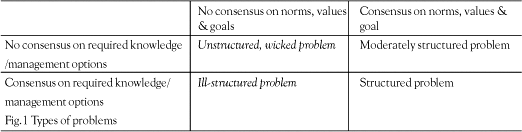
Clearly, MSPs are not suited to all types of problems and all kinds of policy contexts. While explicitly starting from diversity, MSPs tend to 'homogenise' the problem, looking for consensual solutions by providing a conducive space for mutual understanding. Where conflicts are totally antagonistic (see Table below), there is little hope for such a collaborative process. Likewise, in a habitat where diversity and debate are frowned upon, MSPs are unlikely to work. Legal, political or bureaucratic concerns can limit the space for utilising the result from negotiation and, where applicable, lessons learned. (LEEWIS & van den BAN, 2003). MSPs, then, are a recommended practice where the field is not dominated by a single actor and there is a basic willingness (eagerness) to communicate.
Much of the MSP literature is inspired by Habermas' (1984) ideas on communicative rationality, in which to strive for 'authentic speech situations' where everybody will speak their minds regardless of politics and institutions. The expectation is that through dialogue, perceptions and problem definitions will change and converge (PONCELET, 1998). An aversion to (party) politics and conflict informs this particular literature. For many, the lack of harmony, incompatibility and struggle inherent in politics and conflict continues to have a negative connotation. However, our research finds that MSPs tend to be also political and often conflictive in nature, both within the platform itself and between the platform and its broader environment, resulting from a diversity of needs, interests, perceptions and cultures in the dealing with water resources. Such diversity should not necessarily result in a violent confrontation, and therefore not necessarily be experienced as negative.
The Habermasian belief in communication as a means to overcome the limitations of institutions and political processes certainly has contributed to skepticism about MSPs - not everybody is a believer. In fairness, however, this school of thought has never claimed that stakeholder dialogues themselves will solve deep-rooted conflicts. Multi-stakeholder processes are not going to work where oppositions are fundamental. It is just not the right policy instrument for it.
Certain criteria need to be fulfilled to justify considering MSP processes at all - there have to be conflicting interests, the stakeholders have to feel interdependent and there have to be opportunities for constructive communication between the stakeholders (AARTS & van WOERKUM, 2000). The nature of a problem should be structured such that consensus on norms, values and goals as well as desired knowledge is feasible (Table 1).
If these preconditions are unlikely to be met via multi-stakeholder platforms, other negotiation and learning strategies or even confrontation, or deferring the problem may be more successful. In that sense, pace Röling, dialogue is not our only hope.
4. POWER SHARING?
The majority of platforms do not come together spontaneously. There may be a charismatic leader with good political access setting things in motion, but more usually there is an external facilitator (or facilitating organisation) who convenes and motivates the platform. A government agency (Ministry of Environment) or hired consultancy may be the facilitator when the state initiates the process, while in bottom-up processes, an NGO (WWF) or university will usually be the leader. The platforms supported by international governmental institutions such as IWMI, IDRC and EU may also be categorised into the latter group where the platform initiatives intend to empower local groups. Still, the distinction between bottom-up and top-down makes little practical sense in terms of results, since in all of the externally facilitated cases, a general dependency on the external facilitator is encountered for the continuation of the platform.
While we encountered 'bottom-up' platforms initiated by NGOs in Peru and South Africa, and private (water) companies in the UK now are experimenting with consumer fora, more often the initiator of a water forum is the public sector. As Bruns (2003) notes, a 'ladder of participation' - a popular tool to grade the level of public participation - in fact indicates the degrees to which governments share and delegate power to non-public actors.
Governments can be quite schizophrenic with respect to delegation of powers. On the one hand, they have gone a long way to privatise water services and decentralise management and operation, on the other hand, states prove conspicuously unwilling to forego significant control. Apart from their Weberian monopoly on the means of violence, governments have certain exclusive resources at their disposal such as sizeable budgets and personnel, special powers, access to the mass media and democratic legitimation. Access to these resources generally means that governments have considerable power in particular to define the strategic space of any other actor. For all the sea changes in public management in response to state overload and policy failures - the New Public Management, network management - states are not going to relinquish much of their power primacy. Moreover, new infra-structural projects have large sunk costs, so that allowing a process that may have the outcome the planners envisaged means a major project risk. Governments may therefore ´sit on´ river basin information, as did the Wallonian authorities (Verhallen, pers. comm.), or otherwise, intentionally or unintentionally, frustrate the process by burdening stakeholders with heaps of technical information. In the Altotieté basin, Nagy de Oliveira Campos (2004) found stakeholders had to tenaciously wade through a pile of inscrutable reports to retrieve the river data they needed.
Delegation should not be confused with offloading operational responsibilities. The Bangladesh Water Development Board (BWDB), for example, is now very happy to devolve responsibility for the operation and maintenance of neglected, at times decrepit flood management, irrigation and drainage infrastructure onto users themselves, who by taking charge of operation and maintenance are expected to develop a sense of ownership. However, the latter have no choice in the matter, or on the budget, which makes the transfer deeply unpopular.
In practice, we find a lack of mandate in all multi-stakeholder processes we have observed in the MSP-ICM project. Most participatory processes remain at the information and consultation stages, which in view of the much-used Arnstein's ladder rates as 'phony participation'. 'Meaningful participation' would require devolving mandates down to the lowest practicable level and giving people the right to say 'no' to interventions that make perfect sense technically, economically and environmentally.
Is the lack of meaningful mandate a problem? This is a relevant concern, since most multi-stakeholder platforms we encountered can be said to have been conceived as a sounding board rather than a policy-making body. They are like think tanks or focus groups (Type 2, below), providing policymakers with ideas and feedback from selected social groups. We found that the fact that MSPs do not generally share power to any significant degree in itself does not have to be a major problem while the participants are aware of the limited extent of their say. It appears many stakeholder groups do not necessarily wish to take responsibility of co-management of the resource, which they see primarily as a public task. They do however want to be heard and not left out of the process, and, as in the case of the Nete, are annoyed if they missed out on key information. In this sense, the arrangement can bring enough benefits to both initiators and consultants.
]]> How much power is actually gained by platforms? This section presents a typology of multi-stakeholder processes according to their degree of influence. Largely based on such PhD and MSP research as was feasible in the course of the MSP-ICM project, it is by no means representative of the global MSP scene - although it may be indicative as a heuristic.TYPE 1 - Social network
Multi-stakeholder processes do not necessarily solve problems, but they do help disputing parties to partly understand other stakeholders' views and interests. Those involved stress time and again the crucial importance of the process itself as a communication and visioning process, especially in low-trust societies such as post-violence, post-dictatorship, post-apartheid societies.
Although they may not solve conflict and problems, MSP can make life better, even as social events. Several Kat and Mtata 'rivrer forum twinning events' were co-organised by our project together with Rhodes University to stimulate mutual learning about the different experiences of a 'top-down' and a 'bottom-up' platform but also worked especially well as a social gathering where story-telling, discussion and singing and dancing alternated (SIMPUNGWE, 2003 on www.dow.wau.nl/msp).
Rather than actual platforms, which suggests physically fixed space with an organisational structure and secretariat, Multi-Stakeholder Platforms may in fact primarily be networks. In a network problem-solving capacity is dispersed (Glasbergen 1995). Platforms and networks are both metaphors. While platforms suggest a form of institutionalisation, network management (KICKERT, 1993) suggests shifting alliances, not necessarily tied to one place.
The 'Yakunchik' MSP in Ayacucho, Peru (ORÉ, 2004), for example, is currently more like a 'phone circle', a group of people who are in touch with each other but do not actually have a secretariat and an office at their disposal. Even if they now have little concrete action to show for, interviewees claim they greatly value the fact that the multi-stakeholder network exists at all.
TYPE 2 - Focus group
This is the type of MSP we encountered most frequently in the research project. MSP processes are especially found in planning and visioning processes, convoked by the government, where plans for the future may be at a less detailed stage, with a discrete number of sessions.
This participation process is extractive in the sense that at relatively low investment, the government has access to a socially embedded advisory body, where it can learn about the range of interests and positions involved, and what policy aspects are likely to generate fierce opposition. Stakeholders themselves get to hear first about new policies and can request more specific information or amenities.
The NGO-initiated processes are set up intending to bring about important changes, and in places they manage to make important changes. However, we see little empowerment and delegation of power taking place even in these cases.
]]> TYPE 3 - Service organisationAn MSP may seek to take advantage of the breadth of the network to generate external support, catering to a collective need. The dialogue on the Sabarmati basin in Gujarat, India (KUMAR et al. 1999) developed from the different relationships of agricultural and industrial stakeholder groups had with a facilitating NGO, VIKSAT. Joining these networks, this platform managed to find funds for, among others, water conservation facilities such as roof cisterns. The groups involved sometimes meet in a plenary, but more often bilaterally to work out shared issues or present a proposal for technical assistance. The Sabarmati MSP was supported by Canadian (IDRC) aid. Now that this programme has run out, the challenge is to keep the platform going.
TYPE 4 - Crisis management organisation
Devolving power to lower-level actors is hard enough for states delegating power to trans- and international actors proves out to be even harder. Sovereignty is sacrosanct both with respect to societal actors and other nations. Even commissions regulating international rivers shared by friendly states often co-operate as little as possible. In this context, the space for stakeholder involvement in trans-boundary stakeholder platforms seems an uphill battle. However, on special occasions a multi-stakeholder dialogue can be resorted to as a 'Track Two´ activity, and in so doing develop considerable momentum, tackling issues where normal negotiations fail. The Zwin Commission, a multi-stakeholder body comprising Dutch and Belgian governmental and non-governmental actors to manage an area of great natural beauty, is emblematic - like a may fly , which shows only once a year in spectacular swarms, it only showed in exceptional political weather conditions during its 70 year existence (SANTBERGEN, pers. comm.).
When the platform is used especially for occasional dispute settlement or negotiation processes, it can be expected to lie dormant for a long time and occasionally spring to life. Other trans-boundary MSPs similarly seem to be there to solve incidents and crises, not for permanent water management. National autonomies still prevail in day-to-day water management.
In Tiquipaya, Bolivia, an 'intervention MSP' was established to mediate between urban and rural users, suppliers and government actor over a controversial sanitation project which had led to violence and the resignation of the mayor (FAYSSE et al, 2005). Post-disaster co-ordination platforms as in Ica, Perú (Oré, 2004) can similarly be headed under this rubric
TYPE 5 - Action Alliance
A different, more radical type of multi-stakeholder alliance is found in response to unpopular interventions or policies. Here, negotiation is a possible outcome of an anti-intervention drive.
In India, non-violent resistance movements to the dams in the Narmada valley, Gujarat and Southern Maharashtra, and citizen initiatives on the Chalakudy River took place. In the dispute over the Tar Ohl dam, which the Maharashtra state government was pressed to build quickly, a social movement composed of low-case landless and smallholders, backed by progressive industrial leaders, organised mass sit-ins to coax the Maharashtra state government into a more co-operative response to civil protest - more co-operative, that is, than the initial ham-fisted police intervention. Interestingly, the alliance involved both groups that stood to gain from a new dam and those who stood to lose form resettlement. In so doing, the platform managed to co-opt rather than alienate the government, bringing social pressure to bear to negotiating amenities for resettled evacuees.
In each of those cases, the resource issue is the focus of much wider social struggles. Here, a multi- sectorial network forms to join forces against a common touchstone, initiated by government.
]]> TYPE 6 - River Basin OrganisationThe catchment level is emerging as the 'natural' unit for water management in Europe and elsewhere. Water resource management has long been a top-down concern of many states, and water authorities followed administrative boundaries. River basins criss-cross administrative boundaries, and now that hydrology rather than territorial administrative or cultural boundaries dictate the management scale, states are forced to work together.
Public participation in the management of river basin areas is explicitly stipulated in Article 14 of the European Water Framework Directive (EWFD; EUROPEAN UNION, 2000), which states that the general public should not only be informed, but also consulted in the formulation of management plans. However, there are indications that the understanding of participation in the Directive accepts public involvement being scaled back to consultation and information provision (type 2).
Like the EWFD, the Brazilian watershed-based water management model can be said to be fashioned after the French model (Agences de l'Eau), which allocates seats to key stakeholder groups at catchment level. The Brazilian water law gives great scope for participation - but taking that space is another matter while the playing field is far from level. In the Paraíba do Sul catchment, Mostertman (2005) found that it tends to be mainly the institutional stakeholders who exert influence on the process - quite similar to the French experience. While some basin committees give the impression of a sleepwalking existence, others, such as the Comitês das Bacias Hidrográficas dos Rios Piracicaba, Capivari e Jundiaí (www.comitepcj.sp.gov.br), are quite decisive. Still, the Brazilian experience is a recent and developing one, and a number of active NGOs and universities may well succeed in increasing the space for less powerful actors.
5. WHAT IF STAKEHOLDERS DO NOT PARTICIPATE?
A stake in water is, in itself, a pleonasm - at root, everyone has a stake in water, as no one can hope to live very long without any water intake. The new, post-Apartheid South African water law of 1998 therefore invites all to participate in decision-making over water resource management. Noble as this sounds, it is pretty much impracticable. Clearly, not everybody is going to participate in the all-inclusive agora democracy of the ancient Greek city-states - where, upon closer scrutiny, slaves, women and those without possession did not have the vote anyway. In modern days, convening stakeholders on a regular basis similarly involves the issue of selectivity, if on the basis of different criteria. An MSP is a controlled space in which specific topics are discussed with specific people. In practice, the stakeholders are not often self-selecting and self-motivated, they are often invited to participate by external facilitators or present themselves as an organised interest group. This gives considerable discretion to facilitators, who can design a 'box' defining who will discuss and how the problem is defined. If these facilitators are not totally scrupulous about stakeholder selection, this necessarily puts potentially interested, but unorganised parties at a disadvantage. Only by organising themselves and making a noise they can hope to be admitted in a second run. When we look for stakeholders, we should therefore expect selectively in and (self-) excluded groups. It is not just the MSP facilitator or board who decides who is in and out.
The assumption that opening a space for participation will mean enthusiastic involvement of stakeholders turns out to be invalid. A prevalent mistake concerns under- or overestimating people's abilities and a priori motivation to participate (WARNER & MOREYRA, 2004; also see COOKE & KOTHARI 2001). Where salience is obvious, as in dike maintenance in Holland in the Middle Ages, everyone's involvement is called for. But in creeping catastrophes such as drought or pollution, many may not be convinced of a platforms' direct 'relevance' to their needs.
It is important to understand that groups may well exclude themselves from the process, as they feel the benefits from participating do not justify the (opportunity) costs. It emerges from our case studies that not everyone wants to be integrated. The scale can be an impediment from making it interesting. In this sense, integration and participation seem to pull in opposite directions - people are motivated to participate in a clear, single-issue, close-to-the-bone area, while integrated management, because of the complexity of all the interrelationships, seems to invite centralisation. An example is the Altotieté watershed committee in the metropolitan region of Sao Paulo, which seeks to decentralise water management to bring it closer to the citizens. In this sense it is one of the very few truly metropolitan platforms in Brazil. But as Jacobi (2004) notes, this downscaling inevitably brings about fragmentation where an integrated metropolitan policy would be called for to combat the severe environmental problems the watershed is faced with.
If there are few wins to be had (Yakunchik platform, Perú) or project money runs out (Sabarmati platform, India), the platform is moribund. People are not apathetic, as has often been assumed in the past, but they can be frustrated into thinking that nothing ever changes even if they put time and effort into participation. Participation involves important economic and political opportunity costs to stakeholder groups, which may outweigh the benefits of co-operation. Actors may therefore think twice about joining the decision-making process. Especially where integration seems a euphemism for assimilation or co-optation, MSPs may not be popular with intended actor groups. They run the risk of being co-opted to the extent that they (are seen to have) become part of the technocratic elite, thus losing their legitimacy with a constituency that expects them to rally support against issues. We should therefore keep an eye out for the non-represented, both powerful and powerless groups. Do they really ignore the MSP? Do they interact informally with actors, or go around the platform to access those in power to get what they want? It may be more advantageous for some groups to wait on the sidelines until things get more interesting, or to drop out and work around the MSP, mobilising a constituency outside it.
]]> As a form of communicative governance - learning together - MSPs can indeed increase understanding and acceptance of new ideas and policies, intending to change people's minds about a controversial issue - 'participation' seems the magic word that will 'create' a support base for acceptance of new policies. After all, 'Effectiveness = Quality times Acceptance' is a rule of thumb in management literature (e.g. see www.gehealthcare.com/euen/services/performance-solutions /methodology.html). An example of an attempt to 'create a support base' for changes and interventions such as water pricing and new infrastructure is the Paraiba do Sul river basin committee (MOSTERTMAN, 2005). That the take-up of the process was moderate should not be surprising. Communication experts (such as AARTS & van WOERKUM, 2000) remind us that you cannot change people's attitudes and behaviour if they are fundamentally unhappy with the policy. You cannot 'sell' an unpopular plan unless there is something in it for everyone. If the starting point of the intervention or institutional change cannot be subject to discussion, strong opponents will question the legitimacy of the process itself (I call this 'second-order conflict', in contrast with 'first-order' conflict over the allocation of the water resource itself).Such observations should not be taken to imply that skeptical groups will not become active at all. Groups may feel that participating in platforms robs them of leverage. Once galvanised, radical environmental or identity groups can be expected not to participate so as to have their 'hands free' in staging extra-parliamentary protests outside the platform, or less visible ways of putting pressure on decision-makers. Such counter-hegemonic participation may not be what MSP initiators had in mind, but participation in a sociological sense it certainly is - as Norman Long (2001) has shown, participation is any action knowledgeable social actors undertake to alter their conditions of living, whether or not it fits the 'box' designed by initiators of participatory platforms. We have also come across groups that 'have their cake and eat it', that is, operating both inside and outside the participatory process.
Others bide their time and wait for the right moment to enter the fray. We found two cases in which farmers belatedly demanded a seat around the table when they became aware of the platform. In the Scheldt estuary, Flemish farmer organisations gained a seat on the estuary platform later in the process and seemed to benefit from 'preferential treatment' from other participants to get them up to speed with proceedings (VERHALLEN, pers. comm. 2005). In Perú, the well-organised farmer's union JUDRA gained observer status in the 'Yakunchik' platform in Ayacucho in 2002, sparking off a debate whether they should be incorporated in the platform or, conversely, whether the platform should be incorporated in their well-oiled lobby (ORÉ, 2004).
6. RESULTS NEEDED
Currently, deliberation is enthusiastically embraced in the water world. But is anyone listening? MSPs are a 'beast' to which almost mystical powers tend to be attributed, often appearing in policy tales, but as yet rarely spotted in broad daylight. Without a mandate, there is no obligation to do anything with the outcome of all the talk. Without an audience, MSPs are dialogues of the deaf. The Dialogue on Water, Food and Environment seems to have imploded, in part due to a sudden Dutch governmental decision to decimate funding. If that trend continues, MSPs as a new institutional species will join the ranks of the red herring, the paper tiger and the white elephant.
In that context, one the first amendments the MSP-ICM research team made to the working definition of Multi-Stakeholder Platforms was to include an action component, to avoid the danger of MSP turning into a talking shop. Management texts on innovation, such as Hamel (2000), suggest you need quick wins to carry the revolution though. For their participants not to lose interest, MSPs need to be clear about their goals and produce 'food on the table'. The saying can be taken quite literally for the poor - 'for the hungry man, the beauty of the beast is in the pot' (quoted in BINDRABAN, 2004).
REFERENCES
AARTS, N. & van WOERKUM, C. Communication in Nature Management Policy Making, In: RIENTJES, S. (Ed.), Communicating Nature Conservation. Tilburg: European Centre for Nature Conservation, 2000, p. 27-47.
BINDRABAN, P. 'Water voor voedsel of natuur, of voor beide? Mondiaal vraagstuk vergt fundamenteel technologische oplossingen', Spil 207-208, 2004, p. 5-8.
BOELENS, R. "Recipes and Resistance. Peasants' rights building and empowerment in the Licto irrigation system, Ecuador" (also in Spanish). In: BOELENS, R. & HOOGENDAM, P. (eds.) Water rights and Empowerment, 2002, p. 144-172.
BRUNS, B. Water Tenure Reform: Developing an Extended Ladder of Participation. Paper read at Politics of the Commons: Articulating Development and Strengthening Local Practices, at Chiang Mai, Thailand, 2003, July 11-14.
CASTELLS, M. The Rise of the Network Society, The Information Age: Economy, Society and Culture, Vol.1. Cambridge, MA; Oxford, UK: Blackwell, 1996.
CHECKLAND, P. & HOLWELL, S. Information, systems and information systems. Chichester: Wiley, 1998.
COOKE, B. & KOTHARI, U. Participation, The New Tyranny?,London: Zed Books, 2001.
EDMUNDS, D. & WOLLENBERG, E. Disadvantaged Groups in Multi-Stakeholder Negotiations, CIFOR report, 2002, http://www.cifor.cgiar.org/publications/pdf_files/Strategic_Negotiation_report.pdf
EUROPEAN UNION Directive 2000/60/EC of the European Parliament and of the Council of 23 October 2000 establishing a framework for Community action in the field of water policy, Official Journal L 327 , 22/12/2000 P. 0001 - 0073, BrusselsL European Commission.
FAYSSE, N.; COSSÍO, V., PAZ, B., QUIROZ, F., AMPUERO, R. 'Use of a methodology to support the design of a short-term Multi-Stakeholder platform: the case of a water and sanitation project in Tiquipaya (Bolivia), NEGOWAT research paper, 2005, http://www.negowat.org/outcomes.html
GAVIN, T. & PINDER, C. Impact Assessment and Project Management Cycle, EDIAIS website, IDPM, University of Manchester, U.K, 2001. www.enterprise-impact.org.uk/word-files/stakeholderanalysis.doc
GIDDENS, A. The Third Way. Oxford: Polity Press, 1998.
GLASBERGEN, P. Milieubeleid. Utrecht: VUGA, 1995.
GRAY, B. "Framing and Reframing of Intractable Environmental Disputes," In: LEWICKI, R., BIES, R. & SHEPPARD, B. (Eds.) Research on Negotiation in Organizations, 6, 1997, p. 171.
HABERMAS, J. The Theory of Communicative Action, Vol. 1. Reason and the rationalization of society. London: Heinemann, 1984.
HAMEL, G. Leading the Revolution. Harvard: Harvard Business School Press, 2000.
HEMMATI, M. Multi-Stakeholder Processes for Governance and Sustainability - Beyond Deadlock and Conflict, London: Earthscan, 2002.
HILHORST, D. Responding to disasters: diversity of bureaucrats, technocrats and local people. Journal of Mass Emergencies and Disasters, 21 (3), 2003, p. 37-55.
HOND, P. den Depending on the feeling of dependency. MSc thesis, Hydrology and Quantitative Water Management Group, Wagneingen University, 2003.
JACOBI, P. ´The Challenges of Multi-Stakeholder Management in the watersheds of Sao Paulo´. Conference Paper, ´The Politics of Multi-Stakeholder Platforms´, Wageningen University, 29 September - 1 October 2004.
KICKERT, W.J.M. 'Complexity, governance and dynamics: conceptual explorations of public network management'. In: KOOIMAN, J. (ed.), Modern Governance, London: SAGE, 1993, pp.191-204.
KOOIMAN, J. et al Creative Governance, Ashgate, Aldershot, 2000.
KUMAR, M. D.; CHOPDE, S. et al., 'Local Strategies for Water Supply and Conservation in the Sabarmati Basin', Gujarat, In: MOENCH, M.; CASPARI, E. & DIXIT, A. (eds.) Rethinking the Mosaic:Investigations into Local Water Management, Nepal Water Conservation Foundation and Institute for Social and Environmental Transition, Kathmandu, 1999.
LEEUWIS, C. & van den BAN, A. ´The management of Interactive Innovation´, In: LEEUWIS, C. & van den BAN, A. Communication for Rural Innovation. Rethinking Agricultural Extension. Oxford: Blackwell, 2004, p.247-274.
LIJPHART, A. 'Consociational democracy'. World Politics 21 (2): 1969, p. 207-225.
LONG, N. Development Sociology. Actor Perspectives. London: Routledge, 2001.
MANZUNGU, E More than a headcount: towards strategic stakeholder representation in river bnasin management in South Africa and Zimbabwe. Paper presented at the 2nd WARFSA/WaterNet Symposium: Integrated Water Resources Management: Theory, Practice, Cases; Cape Town, October 2001.
MITCHELL, B. (ed.) Integrated Water Management: International Experiences and Perspectives, London/New York: Belhaven Press, 1990.
MOREYRA, A. & Warner, J. (2004),'La gestion participativa de cuencas en la practica: el caso de la Comunidad de Usuarios del arroyo Trahunco, San Martin de los Andes, Patagonia, Argentina', In: WARNER, J. & MOREYRA, A. (eds.), Conflictos y Participacion. Uso Multiple del Agua'. Nordan, Montevideo, 2004, 151ff.
MOSTERTMAN, I. Paying for the commons: an investigation into a participatory decision-making process in implementing a bulk water pricing system in the Paraiba do Sul river basin, MSc thesis, Irirgation and Water Engineering group, Wageningen University, 2005.
NAGY OLIVEIRA CAMPOS, V. (2004), ´Gestión de recursos hídricos y participación de la sociedad civil organizada en la cuenca hidrográfica Alto Tietê´, In: WARNER, J. & MOREYRA, A. (eds.), Conflictos y Participacion. Uso Multiple del Agua'. Nordan, Montevideo, 2004, 151ff.
ORÉ, M.T. Yakunchik: Un mecanismo de con certación después de la violencia' In: WARNER, J. & MOREYRA, A. (eds.), Conflictos y Participacion. Uso Multiple del Agua'. Nordan, Montevideo, 2004, p. 121-139.
PONCELET, E. C. A Kiss Here and a Kiss There: Conflict and Non-Confrontation in a Multi-Stakeholder Environmental Partnership in Belgium Presented at "Crossing Boundaries," the seventh annual conference of the International Association for the Study of Common Property, Vancouver, British Columbia, Canada, 1998, June 10-14, http://www.indiana.edu/~iascp/abstracts474.html
RÖLING, N. & WOODHILL, J. 'From Paradigms to Practice: Foundations, Primciples and Elements for Dialogue on Water, Food and Environment'. Background document for the Workshop on National and Basin Dialogue Development Workshop, Bonn, December 1-2, 2001.
SCHLAGER, E. & BLOMQUIST, W. 'Local Communities, Policy Prescriptions, and Watershed Management in Arizona, California, and Colorado', Paper presented at the 2000 IASCP Conference Constituting the Commons: Crafting Sustainable Commons in the New Millennium, Bloomington, Indiana, 2000, USA
SCHREVEL, A. & TERWISSCHA VAN SCHELTINGA, C. 'International Conferences and Multilateral Agreements Related to Water, Food and Environment', Background Document to the Conference on Water for Food and Ecosystems, January 2005, www.fao.org/ag/wfe2005/docs FAONL_internconferences_final+annex.pdf
STEINS, N, A. & EDWARDS, V.M. "Platforms for Collective Action in Multiple-Use CPRs", Paper Presented at "Crossing Boundaries", the seventh annual conference of the International Association for the Study of Common Property, Vancouver, British Columbia, Canada, June 10-14, 1998. http://www.indiana.edu/~iascp/abstracts/612.html
UPHOFF, N. Learning from Gal Oya: Possibilities for Participatory Development and Post-Newtonian Social Science, Cornell University Press.
VANDERWAL, J. Scientific Knowledge, Lay Knowledge and Public Participation: Environmental Restoration of Hydropower Impacted Rivers, MSc thesis, SCARP, Canada. www.interchange.ubc.ca/plan/thesis/vanderwal , 1999.
Warner, J. & VERHALLEN, A. 'Multi-Stakeholder Platforms for Integrated Catchment Management: Towards a comparative typology, Towards a comparative typology' In: GÖSSLING, T.; JANSEN, R.J.G. & OERLEMANS, L.A.G. (eds.), Coalitions and Collisions, Wolf Legal Publishers, Nijmegen, 2005.
WARNER, J. ´Multi-Stakeholder Platforms: More Sustainable Participation?´ International Journal on Water Resources Development (forthcoming, expected 2006).
WARNER, J. 'Water, Wine, Vinegar, Blood. On politics, participation, violence and conflict over the hydrosocial contract (with special reference to the Water War of 2000 in Cochabamba)' in World Water Council, Proceedings of a seminar on 'Water and Politics', 26-27 February, 2004, Marseilles, Ch. 3, www.worldwatercouncil.org/download/proceedings_waterpol_pp.01-50.pdf
WARNER, J. & MOREYRA, A. (eds.), Conflictos y Participacion. Uso Multiple del Agua'. Nordan, Montevideo, 2004, 151ff.
WARNER, J.; HILHORST, D.& WAALEWIJN, P. Public Participation in Disaster-Prone Watersheds: A time for Multi-Stakeholder Platforms?, Disaster Sites, No. 6, Disaster Studies Group, Wageningen University, 2003.
WARNER, J.F. & SIMPUNGWE, E. Stakeholder participation in South Africa: Power to the people? Paper presented at the 2nd International Symposium on Integrated Water Resources Management (IWRM): Towards Sustainable Water Utilization in the 21st Century, ICWRS/IAHS, Stellenbosch, Western Cape, South Africa, 2003, p. 22-24.
Received in 09/2005 - Accepted in 11/2005
NOTE
]]> * Jeroen F. Warner co-ordinated the 'Multi-Stakeholder Platforms for Integrated Catchment Management' project (2001-2004) for the Irrigation and Water Engineering group at Wageningen University, Netherlands. The author gratefully acknowledges the financial support to the project from Dutch Partners for Water, which also made possible a collaborative research project for Dutch and Brazilian MSc students on the river Altotieté with PROCAM, Universidade de Sao Paulo in 2004.