Environmental social science and the distinction between resource use and industrial pollution: reflections on an international comparative study
Ciência social ambiental e a distinção entre uso de recursos e poluição industrial: reflexões sobre um estudo comparado internacional
Steven Yearley
Professor of Sociology and Senior Research Fellow, Stockholm Environment Institute. Department of Sociology of the University of York
Replicated from Ambiente & sociedade, Campinas, v.8, n.1, p.11-26, Jan./June 2005.
]]>
ABSTRACT
This article aims to discuss the definition of environmental issues and the validity of differentiating between industrial pollution problems and the use of natural resources. A comparative case study including countries of different political systems and socio-economic conditions provided us with data to reflect on this question.
Key words: natural resources; industrial pollution; environmental issues; change in values.
RESUMO
O interesse desse artigo é discutir a definição de problemas ambientais e a validade de se diferenciar questões envolvendo poluição industrial e uso de recursos naturais. Foi realizado um estudo comparativo envolvendo países com sistemas políticos e condiçãos socioeconômicas diferenciadas, que propicia material para se refletir sobre a validade de se diferenciar questões ambientais relacionadas a poluição e uso de recursos.
Palavras-chave: uso de recursos naturais, poluição industrial, problemas ambientais, mudança de valores.
]]> Since the period of environmental activism and policy debate that dates from around the end of the 1960s, the idea has been firmly entrenched that pollution and resource depletion are complementary sources of threat and anxiety. They are the pincers of environmental risk that threaten industrial society on either side. If pollution does not get us, resource depletion will. Such an idea was made explicit in the modelling commissioned for the 1972 Club of Rome report, for example, where the scenarios traded one form of threat for the other.1 Even if we did not imperil ourselves by running out of fossil fuels in the near future, the burning of the fuels would create so much pollution that we would choke ourselves to death. On this view, pollution and resource depletion are the export and import ledgers of society's transactions with the natural world. Grave and persistent problems with either aspect of the enterprise could prove disastrous.
In the years that followed, this distinction became a popular frame of reference for the discussion of environmental issues. Scholars writing in the fields of geography, environmental science and environmental policy reproduced the distinction and commonly organised their presentation of environmental issues around it.2 It was adopted by the policy community and by leading campaign organisations and pressure groups who in their publicity documents commonly stressed the two-fold nature of the threat using examples of industrial pollution and acid rain on the one hand and the decline of fossil fuel reserves on the other.
In many respects, the classification made good sense, especially as pollution problems managed to command centre stage for activists and policy-makers. Pollution problems were easier to identify, to take action on and to seek redress over, at least in the short term. Nonetheless the threat of resource depletion lurked in the background, with a nagging worry that it simply had to be the case that non-renewables (primarily energy resources) would before long become scarce. The fear was that, at high and increasing rates of usage, the scarcity might show itself only shortly before the resources finally were depleted. As Dobson notes, environmental campaigners were fond of the analogy with a plant that invades a pond; it doubles in size every day. It may take many months to cover the pond entirely but if you wait until the pond is half gone before taking action, you have only one day to act.3 In this climate of agreement there was felt to be no need to examine the actual analytical value of the distinction itself or the political consequences of continuing to take it for granted. But, as the potential significance of environmental threats to developing countries and to the global commons became more apparent and the focus for environmental problem-solving began to spread beyond the industrial world, the relevance of this distinction to the conceptualisation and analysis of environmental problems in the developing world or at the level of the globe as a whole remained to be established.
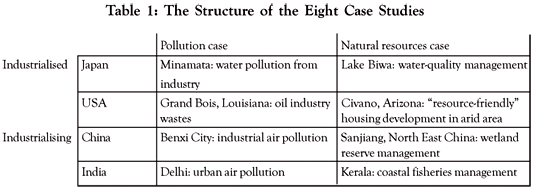
The conceptual analysis in this paper was stimulated by a project being undertaken by the Carnegie Council on Ethics and International Affairs (CCEIA)4 that marks one of the first systematic attempts to compare resource use and industrial pollution cases across countries with varying political systems, levels of social and economic development and complexes of cultural values. This commentary will accordingly adopt a two-fold approach. It will draw upon the case studies to make explicit cross-country comparisons regarding the politics of pollution on the one hand and the management of conflicts surrounding natural resource use. At the same time, the case-study material will be employed to examine the theoretical and practical validity of the resource use and industrial pollution categories themselves. In this manner it will shed light on the ways in which policy practitioners and scholars categorise and approach environmental problems. Table 1 summarises the cases and clarifies the logic of the CCEIA study. For each of four countries, two cases are identified: one representing a problem with pollution, the other a problem over natural resource conservation. The countries are further categorised into industrialising and industrialised societies.
I begin with a brief discussion of alternative ways that the literature has conceptualised and classified environmental problems. I then move on to discuss the features of the pollution cases presented, pointing to the diverse nature of the pollution problems and the need to look beyond the common classification as simply "pollution problems." I follow this with a comparable analysis of the resource use cases. In the final section I examine the question of value change in relation to the two types of environmental problem and take the opportunity to reflect again on the theoretical and practical validity of the distinction that underlies the industrial pollution/resource use classification.
]]> ALTERNATIVES TYPOLOGIES
The growth in scope and understanding of environmental problems and their societal impacts - in part a consequence of greater involvement of social scientists in addressing environmental problems and the consequent birth of the field of environmental studies - has meant that at the start of the twenty-first century the nature of the resource use and industrial pollution distinction looks less clear-cut than it did when it first rose to public prominence in the 1970s. For one thing there are environmental problems that seem to fit the distinction only poorly if at all; it is unclear, for example, whether fears over the release of genetically modified food crops or even genetically modified farmed fish should be regarded as a form of pollution anxiety or a disquiet about threats to a natural resource. Farmed salmon that escape captivity are, in a sense, a form of genetic pollution since they threaten to inter-breed with native fish and pollute the gene pool. However, they also have a direct impact on the salmon fishery when thought of as a resource base since their inter-breeding and competition with native fish will have an unpredictable effect on the natural resource. Second, the forms of pollution that attracted most attention early on were relatively simple and immediate in their effects: a noxious substance was emitted that directly impacted local people's health or livelihood. By contrast, with ozone-depleting substances and carbon dioxide emissions, concerns that rose to prominence beginning in the 1980s, we are not worried about the gases themselves being harmful. They do not contaminate the air we breathe; they change the nature of the atmosphere so that, respectively, more high-energy radiation is admitted and more heat energy stored. One could say they impact the atmosphere as a resource rather more than polluting the air we breathe in a commonsense manner. Accordingly, it is to some extent a mater of convention whether these problems are assigned to one category or the other.
Even more recent attempts to provide a single definition for "pollution" that encompasses the human dimensions of the issue have proved inadequate. For example, the British political scientist Weale has defined pollution as:
… the introduction into the environment of substances or emissions that either damage, or carry the risk of damaging, human health or well?being, the built environment or the natural environment. There is no implication in this definition that the substances involved stem purely from human sources ... The assumption is simply that emissions or substances introduced into the environment in quantities or concentrations greater than those that can be coped with by the cleansing and recycling capacity of nature constitute pollution.5
But here again the definition is insufficient since ideas such as "the risk of damaging" and "within the ability of natural cleansing capacity" fail to specify limits and are thus wide open to interpretation. Moreover, the definition tends to presuppose that the environment should not change. By this definition, oxygen was a pollutant, presumably until life adapted to an oxygen-rich atmosphere.
Besides "resource use" and "industrial pollution," there are other ordering devices for conceptualising environmental problems that take into account social context, causes, and impacts. One well-known distinction widely used in the environmental policy literature divides environmental issues into three categories on the basis of the ease with which policy actions can be taken.6 The first category refers to mass environmental problems associated with heavy industry, vehicles and power generation; an example would be sulphur dioxide emissions. Industrial societies produce millions of tonnes of this gas; and attempts to regulate it, while economically painful for many producers and their customers, are easy to codify in legislation and reasonably straightforward to implement and monitor. Varieties of fuel that are naturally low in contaminants can be used or regular fuels can be treated before use; alternatively, various technical fixes can be introduced to reduce the sulphur load carried by emissions. The second category refers to environmental effects that are more numerous and widely geographically dispersed, for example the myriad chemicals - solvents, cleaning fluids, lubricants, wood preservatives and so on - associated with particular industries or manufacturing processes. These problems are far more prevalent than the first kind and attempts to prove beyond doubt that these substances or processes are dangerous have often faced almost insurmountable difficulties. It is hard to isolate the substances and to figure out their individual effects, let alone any synergistic reactions into which they jointly entered. Industrial interests have fought tenacious rear-guard actions to hang on to favoured chemical compounds. The third category of problems is those that are supra-national, where the ability to regulate the problem is not located exclusively within a single country or political entity. Threats to world biodiversity or to the ozone layer fit this specification.
Policy analysts now typically argue that in retrospect the first kind of problem succumbed to control with misleading ease, leading to unattainable ambitions for environmental action with regard to the other forms of problem.7 With the identification of these new categories of problems, success in environmental policy making has become decidedly patchy. In this view of the emerging environmental problematic, industrial pollution/resource depletion may not be the key distinction at all. Different instances of pollution can be expected to follow contrasting paths if they represent differing positions on the three-tiered scale.
THE INDUSTRIAL POLLUTION CASES EXAMINED IN THE STUDIES
]]> The comparative design of the Carnegie study invites the reader to match the four pollution cases with each other in analysing the dynamics of environmental conflicts; to do so is to take for granted that the problems, qua pollution problems, are similar. However, the cases illustrate that industrial pollution is not a single kind of problem. The Benxi and Delhi cases concern air pollution, the Minamata case concerns water pollution, and the Grand Bois case concerns toxic waste. But the differences are not just among the forms of pollution (e.g., air, water, hazardous waste): there also significant differences in terms of the social impacts of pollution. As noted above, it is entirely possible to argue that there are important differences in policy and political implications between different forms of pollution. Accordingly, one key task is to assess the pollution problems presented in these case studies in terms of their social and physical impact. I highlight how the four pollution cases draw attention to the different social and political contexts in which environmental problems can come to attention - in which they are "constructed" as problems in the first place.The well-known Japanese case of methyl mercury poisoning in Minamata provides a very disturbing reminder of the shocking simplicity of some pollution problems: residents ate poisoned fish caused by a local pollutant, producing serious illness within the local population. The poisoning, a result of the release of untreated effluent into an enclosed bay, was brought about by a factory of the Chisso Company, a symbol of prosperity and hope for this small, close-knit Japanese city in the 1950s. This case represents the primitive logic of pollution, whereby the problem is visited on an area, region or community by industrial activities carried on within that area. This outcome is distinct from many other pollution cases, where pollution has nearly always been visited on the poor by the wealthy. From the outset of industrialisation, in Great Britain the westerly winds meant that affluent people tended to live at the western side of cities. Minamata, on the other hand, is a case where the reproduction of existing socio-economic inequalities in environmental terms was not universal; certain forms of pollution can smooth out these differences. The poisoned Minamata fish could affect rich and poor alike.
Though, in principle, it might have been easy to identify the pollutant and to halt its dispersion early on, given the vested interests of the Chisso Company and the government in keeping the plant running, it took decades before the company, government and society at large acknowledged the problem and found the company responsible. The local population suffered doubly. The people, notably the Minamata fishing families who most relied on a seafood-rich diet, bore the effects of mercury poisoning. They also suffered the stigma their fellow unaffected Minamata area residents attached to the ensuing illness itself both because of fear that the "strange disease" was contagious and because by complaining about the problem and demanding compensation from the Chisso corporation, the "patients," as they were known, were imperilling the economic security of the city and thus the livelihood of other Minamatans.
The United States has seen many cases of the Minamata sort, where polluter and victim are part of the same community, all across the industrial "rust belt," the old industrial area of the northeast. But the Grand Bois case used in the Carnegie study, in which Exxon disposed of its toxic oilfield waste cheaply in the near vicinity of this Houma and Cajun community, represents something slightly different: a form of environmental exploitation of the politically and economically disadvantaged. Though many in this community benefited from jobs in the oil industry, unlike in Minamata, the community suffered not from pollution produced by local industrial processes, but from the importation of waste materials resulting from other people's industrial employment elsewhere. In this sense, the Houma and Cajun had other people's environmental problems imposed on them. Thus, though they are both instances of relatively straightforward industrial pollution, subtle differences in the relationship between polluters and victims distinguish Minamata and Grand Bois. In Minamata, members of the local community faced a conflict of interest between the retention of a reputable industry and the danger of its industrial practices. In Grand Bois, a community is faced with the introduction of others' waste with relatively little local pay-off.
Here again the form of pollution also significantly shaped the manner in which people were affected and responded. Whereas Minamata represents the more classic case of a pollution industry denying that the industry is causing harm, in Grand Bois the community became the victim of a federal regulatory system that had seen fit to exempt oil-field waste from hazardous waste regulation; contaminated water from drilling could therefore be officially labelled simply as "brine" or "waste water." As the sociologist Freudenburg has observed, industry puts a lot of effort into constructing environmental issues as non-problematic.8 In this case, industry interests were served not through the laborious process of having to argue that exposure to oil field wastes was safe. Rather, the issue of the balance of proof was finessed by the legal definition of the substances being dumped. Furthermore, the play of environmental double standards is indicated by the fact that the disputed storage facility was used for the disposal of waste trucked in from Alabama; material that was too hazardous for people in nearby states was introduced into this part of Louisiana.
In Benxi and Delhi we see that a different form of pollution - air pollution - stemming from multiple sources combines with socio-economic and political circumstances to shape the political response. In the Benxi case, the problem was constructed as a prominent issue within China largely because of the international profile of the case. For rather circumstantial reasons, Benxi had become a pollution celebrity city in China, known as the city that was so shrouded in polluted air that it could not be seen 'from space' (that is, by satellite). In contrast to Minamata and Grand Bois, although there was widespread local acknowledgment that the air was bad, in their decision to take action Benxi local officials attended to the harm relatively independently of local people's experience. Their determination to take action was driven also by the ambition of local officials who were happy to see their position boosted by their involvement in an issue that was gaining in national importance and by the possibility of funding and recognition from Beijing. Despite the flurry of regulatory activity and the unprecedented influx of funds from Beijing, Benxi residents who have seen rising unemployment since the introduction of market reforms, questioned the priority placed on pollution remediation. Many were sceptical about the city's motives for the policy measures - some of which, like the greening of public spaces, they see as verging on arbitrary. That the largest and most significant state-owned enterprise, Benxi Iron and Steel, was given preferential treatment in the form of credit and other forms of assistance to modernise its equipment together with the indictment of the company's top management on bribery charges, and the massive layoffs from the company appear to have fuelled this sense. Accordingly the willingness of experts to recognise the problem does not win overwhelming public support for the official interpretation of the environmental problems since officials' actions are viewed as suspect and politically motivated.
Like Benxi, in Delhi the working class is cynical about what they perceive to be the misplaced priorities of city officials and influential environmental advocates. There is widespread frustration among the workers towards the Supreme Court decision to promote pollution control that benefits the wealthy and privileged few at the expense of the vulnerable working class. The study indicates that of all the sources of Delhi pollution, the removal of polluting industries was the first to be targeted because it fitted with the health concerns of the urban middle classes. Their interest was assisted by the campaigning zeal of legal advocates who opted to show the power of the courts to get things done by sidestepping the political process and legally impelling the relocation of industry. By forcing firms to relocate - which often resulted in closure - Delhi's environmental campaigners were in practice destroying the livelihood for many in the process of trying to clean the air. Ironically, the overall impact on the health and well-being of the population caused by these pollution-reduction measures together with the associated growth in unemployment appears to be relatively minor given that vehicular, not industrial, pollution is the major cause of Delhi's air pollution problems in the first place.
Collectively these cases in the Carnegie study indicate the complexity of the category of "industrial pollution." Though the study at one level is about the differential experience of pollution in a variety of policy-making and socio-economic cultures, it is clear that some of the differences between the cases arise from the different kinds of pollution being analysed. Just as there are differences of culture, there are differing forms of pollution: some pollution is more or less self-inflicted while other pollution is imposed. Some pollution is locally identified while in other cases the primary recognition of the pollution problem comes from outside. And these differences do not map in any straightforward way on to the level of industrial development of a particular country. For example, the forms of environmental exploitation noted in Louisiana can occur cross-nationally or within developing countries as well. Furthermore, the Delhi case emphasises that the definition of pollution and of the most important kinds of pollution can be subject to discordant interpretations within a single culture, notably in this case between middle-class and trades-union representatives. The case-study method serves well in detailing how the politics of pollution work out in particular contexts but variations within the category of 'pollution problems' mean that it is always a matter of skilled interpretative judgment to work out which aspects of the case arise from the policy culture and which from the characteristics of the pollution issue itself.
THE RESOURCE USE CASE STUDIES
]]> As argued above, the diverse forms of pollution seen in the pollution cases force us to consider the impact of this variable when comparing policy responses to the problem. By contrast, at first glance the resource use cases appear to allow more easy comparisons since they share a focus on water. Even so we see that the degree and nature of stakeholder dependence upon the resource and the focus of the controversy varies across the cases in ways that have an impact on the social and political dynamics.The effort to protect the wetlands in the Sanjiang Plain in north-eastern China is about water conceived in a rather holistic manner. The conflict here is not strictly about the conservation of the water resource, but about the wise use of a resource, a debate which ensued not on the ecological merits of wetlands protection or even as a struggle between stakeholders at the site. Instead, as in Benxi, the issue arose as a consequence of socio-economic and normative changes occurring beyond the region, both nationally and internationally. In the decades preceding the 1990s, in the national drive for food security, the integrity of the ecosystem was compromised in pursuit of agricultural development. As part of this effort and on the heels of the foray of "educated youths" sent to the region to "conquer nature" during the Cultural Revolution, peasant families were urged to relocate to the area. Furthermore the armed forces had taken a leading role in shaping the area in the interests of maintaining the border with the Russian Federation. Accordingly, resource protection came to compete with other political objectives. With the government's new emphasis on wetland protection, local farming and cultivation practices have come into conflict with the regulations and have created resentment. The managers buy official favour further up the political hierarchy by allowing high-ranking officials to hunt in the area contrary to all the rules. Furthermore, there is an important international dimension to the priority attached to the treatment of this location as it was one of only six Ramsar sites (an international conservation designation) in the country.
In the Sonoran Desert case, the controversy is not over whether to conserve water but how to conserve it, at what social and economic cost, and to whom. As the plans for the Civano development proceeded, resource conservation efforts became caught up with - some critics say, compromised by - other considerations. For instance, the large-scale gathering and use of rainwater, which was figured in to early housing designs precisely to equip the houses for use in an arid zone, was subsequently ruled out on health and sanitation grounds. In fact, some critics believe that the entire commitment to environmental objectives in the project was compromised by the move to adopt New Urbanism ideals of architectural and design-led community development that competed with the ecological ideals. Indeed, the developers deliberately excised environmental attributes from their promotional materials, reflecting the lower priority they expected potential buyers would place on these considerations.
The cases of Kerala in India and Lake Biwa in Japan bring to the fore another important dimension of resource use concerns: conflicts over who has the right to regulate and control a resource, in the Kerala case an in-shore fisheries resource and in the Lake Biwa, the water resource itself. In Kerala, traditional fishers along the shores fought to retain their way of life while finding ways to increase their productivity so as to generate a growing surplus of fish to take to market. At the same time they were threatened by the development of a trawler fishery further out to sea and by the arrival of international fishing boats. Rather than experiencing the growth of yields with the introduction of mechanisation, they faced declining catches, which they attributed to over-fishing by trawlers, to trawlers fishing out of season, and to the influence of factories and other land-based economic activities that polluted coastal waters.
In addition to the central struggle over control of the fisheries resource, fishers' representatives are sceptical about who controls the very discourse of environmentalism. In particular, they take issue with the way in which "international" environmental objectives have been introduced through such measures as Turtle Exclusion Devices (TEDs) on shrimping nets. International regulations favouring the use of TEDs carry the implication that there is only one acceptable way for turtles to be protected, a way that involved the adoption of US-sanctioned devices. Alternative strategies that might be less costly and more sensitive to local conditions, such as closing the fisheries on the days that are critical to turtle reproduction, were not permitted by international regulations. The international discourse of environmental protection has thus been regarded with suspicion and seen as a cover for the advancement of foreign commercial interests. The representatives argue that ways of calculating what counts as "environmental protection" and the "maintenance of the resource" were being taken out of the hands of the locals and defined in ways that are not in their interests.
At Lake Biwa, a growth of algal blooms alarmed lakeshore residents, and in response to the perceived threat to the water resource, the "anti-detergent" movement took off as a practical way for people to take control of the protection of resources in their own environment, even though this dealt with only one aspect of the lake's despoliation. The authors of the Carnegie study describe how the movement represents a turning point for Japan in terms of demands for greater public involvement in environmental decision making: the residents of the area began seriously to question the national government's invasive reach into local communities in the name of national development through often costly and inappropriate public works.
The varying types of resource conflicts represented by the case studies illustrate the complex character of water as a resource to be sustained. The common element of water invites reflection on the tendency to think of some resource issues solely in terms of conservation and depletion. Calculations of the world's remaining fuel resources, for example, are often couched only in terms of how much natural gas or oil is left. As the authors of the Louisiana case note, oil production involves large-scale pollution, but there is a temptation to abstract away from the messy business of winning oil from the land or ocean to the more clinical business of working out the number of million-barrels of oil remaining. By contrast, with water resources the intimate connection between the safeguarding of the resource by the regulation of use and the equally critical matter of protecting the quality of the resource against contamination and pollution hazards is clearer. Water is - in principle at least - a renewable resource and thus the quality of the reserve that is recharged is as important as the monitoring of the usage. Consequently the fact that these cases focus in large part on water means that the politics of resource protection are closely allied to the politics of pollution, again indicating the complications of the framing assumption about the separability of pollution and resources problems.
Thus in the Lake Biwa case, the lake resource was threatened with increased demand for water to feed a growing and affluent downstream population, and with a loss of water quality driven by an increase in residential, agricultural and industrial waste-water. Similarly, in the Sonoran Desert case beyond the well-founded concerns about water scarcity, the preservation of water quality is a significant issue in the region. Faced with a growing demand for water, city authorities had to choose between further depleting the aquifer source and piping in more water. Piped-in water was economically unattractive and not popular with consumers. At the same time, the reliability of the aquifer was especially tenuous because the less water that remained the harder it was to pump; worse still there was the fear that pollution from the (growing) city and surrounding areas would enter the aquifer and that the smaller the reserve the greater the impact of any contamination.
In this way these studies all indicate that resource use, even when it is of the same medium (water), is complex and multi-faceted, which complicates efforts to compare community responses. The politics of resource protection may be about the conservation and wise use of a resource in a steady state or about the protection of that resource from pollution in the wake of socio-economic changes. Yet while there are differences in the kinds of threats from which the water had to be protected, the study invites comparative analysis of the diversity of ways of exercising and disputing "control" over the resource. These variations in the character of the cases interact in complex ways with the cultural and political contexts in which the resources were being used, negotiated and protected.
]]> VALUES AND VALUE CHANGE IN THE CASES OF INDUSTRIAL POLLUTION AND OF RESOURCE USE
We now turn to the different dynamics of valuing the environment in the industrial pollution examples and in resource use examples. On the face of it, pollution would seem always to be a "bad," with little disagreement about the need to curtail or lessen it. By contrast, resources are "goods," where tensions derive from demands on the resource and the requirement to avoid over-using it. Value orientations might thus be expected to differ systematically across the two case types.
The case studies do not in fact clearly support this hypothesis for several reasons. First, the influences on policy decisions often extend well beyond the local actors; the cases show that, incentives to act on both types of problems may be primarily external and not principally driven by local people's values at all. For both Benxi and the Sanjiang Plain one key aspect in the initial identification of the need for environmental action was in response to external, international incentives and pressure and to the internal political appeal of acceding to international requests. The conditions were not wholly external; for example on the Sanjiang Plain, it was the attainment of food security that also allowed China to shift its priorities. Still, a leading consideration in both cases was related to China's desire to be acknowledged as an upstanding member of the international community. Equally, in the Louisiana case, the question turned centrally on the level of aggregation at which the bads were to be assessed; seen in the context of the American South, there might be some environmental benefit in concentrating the problem by dumping the waste in one repository area, whereas from the host community's point of view the bads appeared overwhelming
Second, as I have argued above, it is difficult to circumscribe resource use and industrial pollution as wholly distinct categories in the first place. In the Japanese, U.S., and Indian resource-depletion cases the resource had to be protected from nearby people's own polluting activities, from detergent and waste-water releases, from urban run-off and emissions into ground water, and from industrial emissions into the ocean respectively.
Third, it appears that people do 'value' the opportunity to pollute - to dispose of their waste products and so on - and that, within limits, pollution is not invariably viewed as a 'bad'. Indeed, in the Delhi pollution case the controversy turned on the correct identification of the principal pollutants and the attribution of 'badness' to them. The competing sides argued over whether the industrial pollutants or vehicular emissions were the real problem and the argument was made that tolerable levels of pollution from factories in practice allowed for the jobs that enabled the very survival of many of the city's poor.
A further important analytic possibility is the interpretation of the cases in terms of the post-materialism thesis - the idea that members of society generally attend to post-material values, such as landscape value and habitat protection, only once material needs have been met. According to this view, greater concern with environmental protection is anticipated in wealthier societies. Of late this idea has been criticised on the grounds that it makes environmental protection appear a "luxury" good whereas certain forms of environmental harm have an incontestably material content. In other words, in the context of the lives of citizens of developing countries certain environmental protection measures (such as the provision of clean water and the mitigation of air pollution) may be material rather than post-material benefits. They have a direct interest in environmental improvement.
The Carnegie case studies raise questions about the power of the post-materialism thesis. In the pollution cases, action is spurred by disclosures over the seriousness of the contamination, though whether that concern then develops into a general orientation in favour of environmental protection cannot be determined from these case studies. At the same time, we can see that the way in which crises or other triggering events, which characterise the pollution cases in particular (as with the contaminated fish in Minamata or Benxi's invisibility from space) seem to stimulate environment-related activism in these cases is subtly at odds with the generational changes anticipated by post-materialism theory.
Furthermore, the post-materialism thesis is often used to account for abstracted environmental concern, where people at the stage of post materialism manifest consideration for environments with which they have little or no direct connection. Yet in the Sanjiang case, for example, the only local actors who support the wetlands reserve are the employees of the Reserve bureau and sections of the People's Liberation Army who were detailed to protect them. Thus the response appears to be fully material. And in the Civano case, where we might expect to find post-material values, it is initially instrumental values unrelated to nature (such as a desire for community), amenities (such as feelings of space) and material interests (lower energy bills) that attracted homebuyers to the development. Only after they move in and see what is possible in terms of an environmentalist lifestyle do most of the residents more fully embrace the larger significance of their actions.
What we find, then, is that people assess environmental issues in a more complex manner than the single hierarchy of post-materialism would imply. The Carnegie studies make clear, albeit in different ways, that values are heavily dependent on local context; this weakens the reliability of more generalised value dispositions, such as those that might be picked up in surveys of post-material attitudes. For example, in the two China cases, local perceptions that wetland protection and pollution control involved corruption meant that the language of environmental values could easily be viewed with distrust. Thus, residents of Benxi and Fuyuan County similarly regarded official talk of environmental values as hollow because each believed that officials' devotion to environmental goals could be overridden by judicious bribes or other kinds of political favour; consequently while people may value the environment, the expression of environmental value by residents may be obscured by other considerations or expressed through those other considerations. Contextual interpretations of value were important in a different sense in the Minamata case where an innovative expression of value - the notion of "Bringing Together the Sea and the Mountains" - was developed as an explicit effort to restore trust between local people and the administrative authorities. Thus, the make-up of the value complexes that are critical to the outcome of local environmental problems are more nuanced and less uniform than the post-materialism thesis envisages. This observation coincides with a finding from a recent study of measures of "environmental concern," which found that respondents' answers formed along "four dimensions dealing with trust, responsibility, complexity, and economic trade-offs aspects of environmental problems and protection".10
RE-VISITING THE INDUSTRIAL POLLUTION/RESOURCE USE DISTINCTION
]]> The Carnegie studies do more than allow us to reflect on the industrial pollution/resource use divide since they provide comparative information about pollution and natural resource politics across four different contexts. However, an analysis of the distinction allows us to consider the implication of different forms of environmental problems for political action and outcomes. The four pollution cases differ in the form of pollution, in the social distribution of responsibility for the pollutants, and in the politics of the construction (or denial) of the pollution threat. In one sense these differences complicate comparisons across political and policy cultures. Seen another way, these differences allow the studies to elaborate how, in the shared context of political mobilisation to protect the environment, the value basis of the actions differs from one case to the other. It is unclear that a generalised opposition to environmental harm becomes an established value in each case, although this is most nearly the case in the Minamata example in part thanks to deliberate attempts to foster normative innovations through the process of moyanaoishi or social 'healing'.Similarly in the analysis of the resource use cases a key question is whether the value that is being introduced is in fact an environmental one. One could take an exclusively economic and resource management-led attitude towards water stocks, still wish to preserve them and even agree with environmentalists about leading policy measures without explicitly adopting the general values espoused by mainstream environmentalists. In Civano, for example, objectives related to community values - of neighbourliness and so on rank alongside (and occasionally trumped) environmental goals so that the majority values in the community could readily conform to certain environmental-protection orientations without themselves being explicitly environmentalist. This fact echoes a larger dilemma identified in the environmental philosophy literature where the question persistently arises: Is the institutionalisation of environmental protection goals sufficient to deliver environmental sustainability? In other words, the question persistently arises whether environmental reforms of the sorts currently in place and proposed will be sufficient to bring about the changes needed to maintain something like the natural environment we experience today. Most commentators appear to think not11 and these studies appear to support that position.
The studies therefore lead to further scepticism regarding the accepted distinction between resource use and industrial pollution. On the one hand, the categorisation tends to imply more homogeneity in each category than is justified either in theory or practice. Pollution problems may be relatively simple (with a single polluter emitting vast amounts of a demonstrably harmful substance) or complex (with multiple emitters or small amounts of substances whose harms are more contentious.) In a sense, the Delhi case represents the clash between these two paradigms of pollution. These different types of problem pose very different types of challenges to policy makers and activists and tend to be associated with different types of political activity. To classify them as the same phenomenon is thus only partially correct. At the same time, many resources are also subject to despoliation through pollution so that resource- and pollution-related anxieties may often be inseparable. The dichotomy can thus be practically misleading.
Accordingly, other approaches to the categorisation of environmental problems, such as the three-tiered classification introduced at the start of this chapter, may need to be considered as well. The adoption of that approach would lead us to view the Japanese and Chinese industrial pollution cases as similar - because they deal with the mass production of chemically straightforward pollutants - while the Indian case illustrates the complications arising from attempts to regulate multi-sourced and interacting pollutants. However, even this classification system breaks down because it is insufficiently attentive to the social and economic dimensions of environmental problems. The Louisiana oil industry case demonstrates that some environmental problems achieve resonance and local political character from the sense that someone else's waste is being imposed on a remote community. And the Delhi case reminds us that claims about the responsibility for pollution may be interpreted by local actors along class lines - as in this case - though also potentially in light of ethnic or other socio-political differences.
One final analytical insight from this study arises directly from this point. As noted above, demands for environmental protection are not in fact narrowly "environmental" as commonly understood. Some sociologists claim that modern environmental concern is not so much a concern about the external environment as an anxiety about a "humanised nature"; as Beck slightly gnomically puts it, "The ecological movement is not an environmental movement but a social, inward movement which utilises 'nature' as a parameter for certain questions".12 For Beck and Giddens, environmental anxieties are more a response to the creeping, unplanned and often unaccountable human intervention in the management of nature - from genetic engineering to climate change - than about concern for the environment per se. This plausible view is gaining in popularity, perhaps fuelled by the undoubted unease that has greeted the spread of genetically engineered crops and other examples of human domination over biological nature. What these studies show by contrast is the opposite: that worries about aspects of the natural environment often arise not from environmental concern but from something far more ordinary - the avoidance of the loss of economic opportunities and jobs or the manifest quality of life (as reflected in the availability of clean water). Concern with the protection of resources is barely at all a concern about the humanisation of nature more a part of figuring out how to get by in a fast-changing world.
REFERENCES
BECK, U. Ecological Politics in an Age of Risk, Cambridge: Polity, 1995. [ Links ]
BLUNDEN, J. & REDDISH, A. (eds) Energy, Resource and Environment, London: Hodder & Stoughton, 1991. [ Links ]
BRECHIN, S.R. & KEMPTON, W. 'Global Environmentalism: A challenge to the postmaterialism thesis?' Social Science Quarterly 75, 1994: 245-269 [ Links ]
DOBSON, A. Green Political Thought, London: Unwin Hyman, 1990. [ Links ]
FREUDENBURG, W. 'Social constructions and social constrictions: toward analyzing the social construction of "the naturalized" as well as "the natural"' In: SPAARGAREN, G., MOL, A.P. J. & BUTTEL, F.H. (eds) Environment and Global Modernity, London: Sage, 2000. [ Links ]
GIDDENS, A. Beyond Left and Right: The Future of Radical Politics, Cambridge: Polity, 1994. [ Links ]
GLASBERGEN, P. & CÖRVERS, R. 'Environmental problems in an international context' In: GLASBERGEN, P. & BLOWERS, A. (eds), Environmental Policy in an International Context: Perspectives on Environmental Problems, London: Arnold, 1995. [ Links ]
KRAFT, M.E. & VIG, N. 'Environmental policy from the 1970s to the twenty-first century' In: VIG, N. & KRAFT, M.E. (eds) Environmental Policy: New Directions for the Twenty-First Century, Washington, DC: CQ Press, 2003. [ Links ]
LUTZENHISER, L.; HARRIS, C.K. & OLSEN, M. "Energy, society, and environment" In: DUNLAP, R. & MICHELSON, W. (eds) Handbook of Environmental Sociology, Westport, CN: Greenwood Press, 2002. [ Links ]
MEADOWS, D. et. al., The Limits to Growth; a Report for the Club of Rome's Project on the Predicament of Mankind, New York: Universe Books, 1972. [ Links ]
WEALE, A. The New Politics of Pollution, Manchester: Manchester University Press, 1992. [ Links ]
YEARLEY, S. Sociology, Environmentalism, Globalization, London: Sage, 1996. [ Links ]
]]>
Received in 02/2005 - Accepted in 05/2005
NOTES
1. DONELLA H. MEADOWS et. al., The Limits to Growth; a Report for the Club of Rome's Project on the Predicament of Mankind (New York: Universe Books, 1972).
2. For example, JOHN BLUNDEN and ALAN REDDISH (eds) Energy, Resource and Environment (London: Hodder & Stoughton, 1991) and sociological surveys such as LOREN LUTZENHISER, CRAIG K. HARRIS and MARVIN E OLSEN "Energy, society, and environment" in RILEY E DUNLAP and WILLIAM MICHELSON (eds) Handbook of Environmental Sociology (Westport, CN: Greenwood Press, 2002) pp 222-271; it is also used as an organising arrangement in my own Sociology, Environmentalism, Globalization (London: Sage, 1996) chapter 2 (pp. 26-61).
3. See ANDREW DOBSON Green Political Thought (London: Unwin Hyman, 1990) p. 78.
4. The project is entitled: 'Understanding Values: a Comparative Study of Values in Environmental Policy Making in China, India, Japan and the Untied States'; see the outline at: http://www.cceia.org/media/712_envirmethod.pdf. This paper, a commentary on the studies that are due to appear in Dancing Cats and Factory Ships Copyright © 2005 (M E Sharpe, Armonk NY) is used here with permission of the Carnegie Council.
5. ALBERT WEALE, The New Politics of Pollution (Manchester: Manchester University Press, 1992) p. 3. ]]>
6. See, for example, MICHAEL E KRAFT and NORMAN J VIG 'Environmental policy from the 1970s to the twenty-first century' in NORMAN J VIG and MICHAEL E KRAFT (eds), Environmental Policy: New Directions for the Twenty-First Century (Washington, DC: CQ Press, 2003) pp. 24-25; similar views are expressed in PIETER GLASBERGEN and RON CÖRVERS 'Environmental problems in an international context' in PIETER GLABERGEN and ANDREW BLOWERS (eds), Environmental Policy in an International Context: Perspectives on Environmental Problems (London: Arnold, 1995) pp. 2-7.
7. KRAFT and VIG p. 25.
8. WILLIAM R. FREUDENBURG 'Social constructions and social constrictions: toward analyzing the social construction of "the naturalized" as well as "the natural"' in GERT SPAARGAREN, ARTHUR P. J. MOL and FRED H. BUTTEL (eds) Environment and Global Modernity (London: Sage, 2000) pp. 103-119.
9. See STEVEN R BRECHIN and WILLETT KEMPTON 1994 'Global Environmentalism: A challenge to the postmaterialism thesis?' Social Science Quarterly 75: 245-269
10. See the review of survey assessments of environmental concern by RILEY E DUNLAP and ROBERT EMMET JONES 'Environmental concern: conceptual and measurement issues' in RILEY E DUNLAP and WILLIAM MICHELSON (eds) Handbook of Environmental Sociology (Westport, CN: Greenwood Press, 2002) p. 504.
11. ANDREW DOBSON Green Political Thought (London: Unwin Hyman, 1990) pp. 35-36.
12. See ULRICH BECK Ecological Politics in an Age of Risk (Cambridge: Polity, 1995) p. 55; see also ANTHONY GIDDENS Beyond Left and Right: The Future of Radical Politics (Cambridge: Polity, 1994).