Scientific recognition in numbers: analysis of the profile of a vanguard from lattes curricula vitae
A consagração científica em números: análise do perfil de uma vanguarda pelos currículos lattes
La consagración científica en números: análisis del perfil de una vanguardia por los currículos lattes
Miguel Ângelo MontagnerI,i; Maria Inez MontagnerII; Eduardo Luiz HoehneIII
IUniversity of Brasília. Sociologist, PhD in Public Health, Department of Preventive and Social Medicine, School of Medical Sciences, State University of Campinas (DMPS/FCM/Unicamp). SQN 205 C apto 503, Brasília, DF. Brasil. 70843-030 <montagner@unb.br> ]]>
IIPhD in Public Health, Department of Preventive and Social Medicine, School of Medical Sciences, State University of Campinas (DMPS/FCM/Unicamp).
ABSTRACT
The objective was to analyze the possibilities and limitations of quantitative study on an institution and its professionals, taking into account the Lattes curriculum vitae platform. Through exploring this material, we sought to delineate the profile of professors of the UNICAMP School of Medical Sciences and to characterize their scientific production, main activities and academic profile. The methodology used was quantitative. Based on descriptive statistics, we outlined and analyzed the main characteristics these professors presented in their curricula vitae, which are stored in the database of the Lattes Platform. Next, using qualitative analysis based on the theories of Pierre Bourdieu, we emphasized the difficulties in achieving good descriptions of researchers' social and scientific paths based on the Lattes Platform. Thus, the Lattes system consists of a repository of finished scientific actions, comprising a linear, non-historical succession within official science.
Keywords: Sociology of science. Habitus. Bourdieu. Scientific production. Health human resource training. Research personnel.
RESUMO
O objetivo foi o de analisar as possibilidades e os limites do estudo quantitativo de uma instituição e dos profissionais que nela atuam, tomando como objeto os currículos da Plataforma Lattes. Explorando esse material, procuramos delinear um quadro dos professores plenos da Faculdade de Ciências Médicas da Unicamp, caracterizar sua produção científica, as principais atividades que exercem e seu perfil acadêmico. Nossa metodologia foi quantitativa. Desenhamos e analisamos, por meio de uma estatística descritiva, as principais características desses professores, presentes na base de dados da Plataforma Lattes que contém os seus currículos. Em seguida, por meio de uma análise qualitativa, baseada na teoria de Pierre Bourdieu, apontamos, como resultado, as dificuldades da Plataforma Lattes em bem descrever as trajetórias sociais e científicas dos pesquisadores, consistindo, assim, em um repositório de atos científicos acabados e que compõem uma sucessão a-histórica e linear da ciência oficial.
]]> Palavras-chave: Sociologia da ciência. Habitus. Bourdieu. Produção científica. Capacitação de recursos humanos em saúde. Pesquisadores.RESUMEN
El objetivo ha sido el de analizar las posibilidades y los límites del estudio cuantitativo de una institución y de los profesionales que actuan en ella tomando como objeto los currículos de la Plataforma Lattes. Al explorar este material tratamos de delinear un cuadro de los profesores plenos de la Facultad de Ciencias Médicas de la Universidad de Campinas, estado de São Paulo, Brasil, caracterizar su producción científica, las principales actividades que ejercen y su perfil académico. Nuestra metodología ha sido cuantitativa. Diseñamos y analizamos, por medio de una estadística descriptiva, las principales características de estos profesores presentes en la base de datos de la Plataforma Lattes que contiene sus currículos. Seguidamente, mediante un análisis cualitativo basado en la teoría de Pierre Bourdieu, señalamos como resultado las dificultades de la Plataforma Lattes en describir bien las trayectorias sociales y científicas de los investigadores, consistiendo así en un repositorio de actos científicos acabados y que componen una sucesión a-histórica y linear de la ciencia oficial.
Palabras clave: Sociología de la ciencia. Habitus. Bourdieu. Producción científica. Capacitación de recursos humanos en salud. Investigadores.
INTRODUCTION
When taking a specific institution as the object, we assume that in order more clearly understand the symbolic universe and social space in which the School of Medical Sciences (Faculdade de Ciências Medicas, FCM) of the State University of Campinas (UNICAMP) is inserted, epistemological acts are required that aim to consecrate this institution within the scientific field. As part of a comprehensive strategy for a PhD study (Montagner, MA, 2007) and a master's thesis (Montagner, MI, 2007) concerning the institution, we sought to translate into synthetic data the set of practical actions that compose the scientific work of intellectual specificity that actuates within this institution. At the same time, we critically analyze possible distortions and deviations implied by the 'productivist' concept of academic work.
This quantitative analysis is complemented by another in-depth qualitative analysis studying the social trajectories of the researchers, analysis of their biographies and the construction of a collective biography of the vanguards of the institution. This second analysis will be the object of another publication, given the extent and complexity of the work in toto (Montagner, MA, 2007). In that work, we hope to explore the in-depth relations of power and the strategies pursued by disputing groups within the institution. Thus, in this work, we sought to limit the analysis as it relates to the numerical data and the most clearly quantifiable indicators, while emphasizing the possibilities and limitations of this approach.
Increasingly, the Lattes Platform has become the alpha and omega of the objectivation of the scientific production of intellectuals in Brazil, presenting their 'relevant' activities and, above all, their literature production. The pair to the Carlos Chagas Platform, though even more complete and representative, since it embodies research coordinated by the scientist, the resources they manage, the groups they lead and activities they coordinate, the Lattes Platform constitutes an instrument of objectification of the scientific capital of a researcher, in that it contains part of their network of academic contacts and their symbolic capital. Through these elements, for better or for worse, the "performance" of a researcher is evaluated.
]]> Scientific capital can be understood in the light of Pierre Bourdieu's theory of science, used as a central theoretical framework of the research that inspired this work. In Bourdieusian theory, the field is a construct related to the finding that in modern societies, especially Western societies, certain social spaces differentiate into relatively autonomous microcosms, within which the rules, standards and operating modes are defined by the very agents inserted in them and who share symbolic universes differentiated from the rest of society. These agents accept the universe as legitimate and struggle to impose their own vision on this microcosm (Bourdieu & Wacquant, 1992).Thus, the scientific field maintains its own capital, based on the capacity to generate new knowledge and meanings; what we prefer to call epistemological power, a personal capacity for 'epistemological acts' as Bachelard defined them, acts that contrast and oppose the "epistemological obstacles" and that "correspond to the insights of scientific genius that contribute with unexpected advances to the course of scientific development" (Bachelard, 1977, p.183). It is through their accumulation that an intellectual constructs his or her reputation and prestige.
Despite the temporal power that exercises its might within the scientific field, the epistemological acts constitute the central element of valuation of intellectual work and, in this case, the practices recognized and valued form part of a social construct that recognizes, through certain standardized procedures, those that are most legitimate. Obviously, much of the scientific work was left out of the results presented here, particularly that relegated to the institutional backstage where many of the strategies and investments of the researchers are resolved; even so, the importance of this objectification is not lost.
Objectives
Our central question, based on Pierre Bourdieu's reinterpretation of the scientific world, according to the habitus that prevail in the world of scientists and intellectuals of the FCM, is what official scientific practices are generated in accordance with these habitus and how they are described in Lattes Platform. Do the activities objectivized in the curricula of this platform correspond pari passu to the concrete, daily activities of the researchers/professors and actually represent their praxis? We assume that science has always been an essentially practical activity that presupposes a specific habitus, the scientific, and centered our focus on the praxis of science, on the final products that are valued as most legitimate and representative of this practice. Pierre Bourdieu defines this habitus as:
"Scientific habitus is a made man-made rule, or rather, a scientific modus operandi that functions in a practical state according to the norms of science without having these norms as its origin: it is this kind of scientific game sense that makes you do what needs to be done at the right time, without the need to thematize on what has to be done, much less the rules that permit the generation of appropriate conduct." (Bourdieu, 1989, p.23)
As carriers of this habitus, intellectuals generate 'products' that should describe their daily activities and reflect how science is conducted in their scientific field. In our case, we studied the acts described in the indicators present in the Lattes Platform curricula. We sought to relate these data with the general results of the FCM's internal groups, as a way of questioning how this productivist model influences, for better or worse, the collective status of each research area.
]]> Materials and methods
As a working methodology, Bourdieu always used a diversified approach to the objects. His qualitative analyses were focused on explaining the actions characteristic of individuals of a particular group, in the different ways that expressions of the habitus were vested and on the power of social differentiation (relational) of these personal styles. His quantitative efforts always sought to rupture with a "spontaneous sociology", of "common sense" and frequently of "scientific common sense", and through this initial rupture, set out to achieve an innovative and relational sociology (Bourdieu et al., 1968).
Within this theoretical framework, we used a quantitative methodology and our efforts spun on this analytical axis. Using descriptive statistics, we designed and analyzed the main characteristics of these professors via the Lattes Platform curricula, as a way of objectivating indicators of the scientific consecration and official praxis of these intellectuals.
Information sources
Our main data source was the curricula available on the public access Lattes Platform of the National Council for Scientific and Technological Development (Conselho Nacional de Desenvolvimento Científico e Tecnológico, CNPq). Since 2002, it is compulsory for all researchers to maintain their curricula up-to-date. In addition, we used part of the global data of the research annuals maintained in the Research and Extension Information System (Sistema de Informação de Pesquisa e Extensão, SIPEX) at the University of Campinas (UNICAMP).
The Lattes Curriculum (Lattes CV System) is a product of the Lattes Platform, consisting of four systems. It is an Electronic Curricula System that records the life history and current history of the researchers inscribed and acts as a fundamental element in the analysis of their merit and competence. It contains 200,000 up-to-date curricula (Conselho Nacional de Desenvolvimento Científico e Tecnológico, 2008).
The curriculum is a form of currency, when it comes to gaining access to formal data by researchers for academic purposes; it is used by master's and doctoral students, researchers, professors, administrators and all institutions in the domain of higher education.
Its information is applied internally in numerous institutions, including the Coordination for the Advancement of Higher Education Personnel (Coordenação de Aperfeiçoamento de Pessoal de Nível Superior, Capes), the São Paulo Research Foundation (Fundação de Amparo à Pesquisa do Estado de São Paulo, FAPESP) and the CNPq, and is used to screen applicants for scholarships, auxiliary assistance, grants, research projects, consultancies, committee members and advisory groups, in addition to supporting more general data on and for research and postgraduate studies in Brazil.
In order to complement these data and understand the FCM indicators as a whole, we performed a partial analysis of a second database, the SIPEX (Research and Extension Information System), which is responsible for providing quantitative data to support the management of these areas at the UNICAMP. Developed in 1993, it supported the implementation of the institution's Quality Project and since then, it is responsible for the funding and development of the database that contains "activity reports of the professors, the organs of the UNICAMP and production of the annals of institutional research" (SIPEX, 2006).
These two sets of documents were hegemonically understood as a description of specific acts considered legitimate and symbolically legitimized by the scientific community. Similarly, the official and legitimate choice of the parameters of analysis of the scientific production seemed to be the CAPES model (Viacava & Ramos 1997), despite increased criticism and increasingly recurrent contestation of the same.
]]> Object of the researchThe FCM is a social organization inserted within the field of science and a social institution. Since its inception, sociology has been concerned with the study of institutions: for Durkheim and his school, "institutions are 'crystallized' ways of feeling and thinking, almost constant, socially coercive and distinctive in a given social group" (Boudon, Bourricaud, 1993, p.301). In this sense, an institution means a type of action, role, interaction or organization that has become widely accepted and appears to be a natural pattern of society. In this study, we worked with a more formal definition of Durkheim, linked to the formal and legal framework of society.
In the academic world, we chose postgraduate studies. The emphasis on postgraduate education is justified, since in this space of formation the future producers/reproducers of scientific knowledge are defined, particularly those relating to research practice itself and not only to professional practice.
The concept here is one of "intellectual craftsmanship", as proposed by Mills (1969), linked to a historical tradition and a modus operandi specific to each type of research, past and taught in postgraduate education through direct, continuous contact between the professors and students.
Postgraduate education is the place par excellence of the production and renewal of knowledge. CAPES data verify this statement: over the last three years, Brazil went from producing 1.5% of scientific knowledge worldwide in 2002 to 1.8% in 2005. According to CAPES, 85% of Brazilian scientific production comes from postgraduate studies and in 2003, medicine surpassed physics in the production of scientific articles (Coordenação de Aperfeiçoamento de Pessoal de Nível Superior, 2006).
Postgraduate Programs conform to the mode of recruitment, selection, attraction, scientific legitimacy and the formation of smaller groups, centered on the figure of certain great researchers, in short, in accordance with the reproduction of the status of the institution and the scientific field.
From the universe of 381 professionals of the institution involved in stricto sensu postgraduate studies, both master's and doctoral degrees, Assistant, Associate and Full Professors were considered to be the object, excluding visiting and adjunct professors; a total of 220 individuals. Resolution GR No. 130/99, of August 27th 1999, defines a professor as "one who consistently acts in the postgraduate program in all activities; i.e., tutoring, ministering courses and contributing to the concept of the course through their academic-scientific production" (Conselho Universitário, 1999).
This profile, imposed by the Quality Project, signified the victory and implementation of the viewpoint of professionals who favored research and the group that was primarily dedicated to academic achievement. The founding group of professors, closely linked to the model of the private practice doctor, had to make an effort to adapt or opted for part-time work at the institution.
Of these 220 professors, 21 were from the nursing course, leaving 199 from the medical school. We excluded those catalogued in more than one postgraduate program (total of 16), regarding their department of origin as the most important. In this case, the exclusion of nursing professors was based on the methodological choice to work with professors specifically linked to medicine, the majority of whom were involved in the postgraduate programs, because it is our understanding that nursing and medicine are two distinct careers, each with their own deontology and historical development, as recent studies like that by Santos and Faria (2008) have begun to elucidate more clearly. The very history of the founding of the FCM verifies the initial establishment of a School of Medicine and another of Nursing, a project that was amalgamated within the constitution of the UNICAMP following the founding of a School of Medical Sciences, responsible for administering both the medical and nursing schools (Faculdade de Ciências Médicas, 2008).
From the remaining total of 183 professors in 2005, 175 possessed a Lattes Curriculum, leading to the loss of eight professors during the quantitative analysis. Although undesirable, in some cases this loss corresponded to a transition between platforms (SIPEX-Lattes) within the UNICAMP, which up to that point were filled out alternatively, coupled with the failure by some individuals to maintain a complete curriculum, pure and simple.
]]> The FCM and research in BrazilAccording to Meis and Leta (1996), an increase in Brazilian research occurred from 1981 to 1993, both in the total number of publications and participation in the global volume of scientific literature, although only a third of Brazilian production is present in international journals. This growth trend continued and from 1993 to 2002, the percentage of Brazilian articles in world production rose from 0.75 to 1.55%, placing Brazil as 17th in the ranking of indexed scientific articles (Pivetta, 2004).
Recent data confirm the privileged position of the southeastern region (Pereira, 2005): UNICAMP is responsible for 11% of the national scientific production, behind the University of São Paulo (USP), with 26% and followed by the Federal University of Rio de Janeiro (UFRJ), with 9%. These are considered to be the most important Brazilian universities, using different criteria of an academic nature.
Quality Project or Procrustean bed
CAPES became an agency focused on evaluation from 1976 onward, when it created a program evaluation of postgraduate courses through consultants external to the programs. This process permitted improvement of the entire system, since a screening process for the creation of new programs and a means of evaluating the existing ones was founded (Fundação de Amparo à Pesquisa do Estado de São Paulo, 2006). This meant the penetration of a model of science focused on academic excellence within the universities, derived from the vision embraced by CAPES. Through the project PICDT (Programa Institucional de Capacitação Docente e Técnica), the Institutional Program for Teacher and Technical Training, CAPES funded the qualifications of faculty members and technicians of public institutions of higher education by granting scholarship quotas for the implementation of master's and doctoral courses within postgraduate courses that were well evaluated for their methodology.
Thus, through an agreement signed between UNICAMP and CAPES, a policy of academic excellence was implemented, denominated the "Quality Project". This management project, begun in 1991, was established and implemented effectively during the office of Dean Carlos Vogt, from 1990 to 1994. He officially sought to encourage improvement in quality and increased scientific production at the UNICAMP, through the qualification of undergraduate courses, diagnosed as neglected within the UNICAMP, which was directed mainly toward research, and the restructuring of teaching careers and specific management programs.
From 1995 to 2005, a significant increase in scientific output occurred, measured by published journal articles, according to the Annals of Research issued by the Research Sector of the Dean's Office at the UNICAMP (Pró-Reitoria de Pesquisa, 2005). The institutional objectives were addressed and achieved, only the qualitative results of this process remain to be qualified.
Presentation of the results
Based on data from the Lattes Curricula, we highlight the changes that occurred in the institution and the characteristics of the professionals who constructed their current vanguard position in the Brazilian scientific scenario. Initiating with the FCM and we then describe the profile of the typical researcher of this university.
Quality Project at the FCM
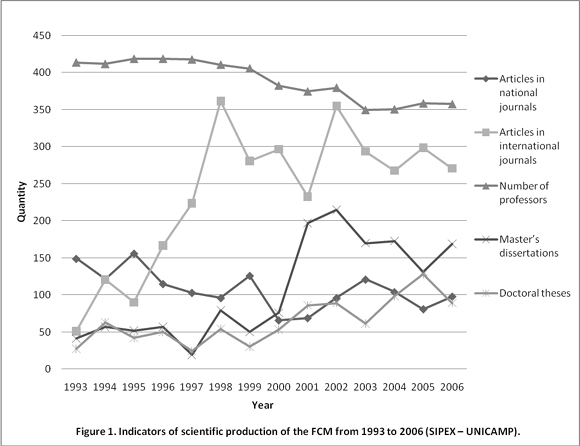
]]> Following the implementation of the Quality Project, an imperative to adapt occurred, accompanied by flagrant difficulties in the transition between the two models. The mechanisms included: requirement of higher academic titles among newly hired professors (PhD), the stipulation of deadlines to achieve the same in the case of professors who were already part of the institution, encouragement to participate in scientific events, and even the readjustment of the framework of teaching careers. This transition process favored groups who wanted to gain power within the institution, based on scientific legitimacy and accumulation of the corresponding capital; they were better prepared for research production, had social networks (social capital) abroad, and had invested in the means of obtaining research funding. These groups set the scene and began to share the original power, established since the founding of the FCM, with the local group that had been called to found the university, formed by traditional physicians and practitioners in the region. For this new period, the indicators of the FCM were as follows:
It is clear that a significant increase in publications occurred at the FCM, from 200 to 369 articles in the period, focusing on international ranking journals. At the end of the period, for every article published in a national journal roughly three were published in journals abroad. The number of professors dropped from 414 to 358, signifying a decrease of around 14.0% in the staff. The number of master's dissertations and doctoral theses grew progressively by almost 2.5-fold, from less than 100 papers to 258. The average was 170 theses per year, implying an average of 0.44 theses per professor (based on a mean of 389 professors) per year.
A mean of 0.88 articles published per professor was achieved, assuming the number of professors to be the mean of the institution (389) in the 14 years surveyed. In general, these rates grew consistently and continuously, except for publications in national journals, which fell over the same period.
Clearly, the process of change was irreversible within the university and the triumvirate teaching-research-extension gained the strength of a creed, a highly present ideology in the daily life of the university. Few argue, however, concerning the condition of the professors who are instituted and charged as administrators of the institution.
This process certainly accompanied the changing profile of universities throughout Brazil, but in the case of FCM, initially dedicated to the formation of private practice doctors for local demand, the process was longer and more painful, because it involved a significant change the type of professional required by the institution.
Profile of the researcher
The medical profession has shown a progressive and significant influx of women. This process should consistently alter the gender balance in the future, but thus far, a male majority remains in the FCM, 57.1% versus 42.9% of women.
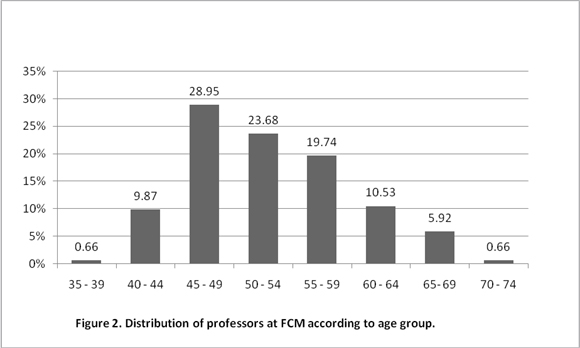
]]> The mean age of professors is 52.8 years-old, with a median of 52.5 years-old. The majority fall within the range of 45 to 49 years-old (28.9%), followed by 50 to 54 (23.7%). Thus, more than half are between 45 and 54 years of age, a proportion of approximately 52.6% of the total.
Concerning educational qualifications, the vast majority of professors are doctors (82.3%), followed by Biological Sciences graduates (6.9%), Pharmacy and Biochemistry (2.3%), Social Sciences (2.3%) and Pharmacy graduates (1.1%).
Complete data regarding the degree of absorption of medical graduates from UNICAMP within the university staff are unavailable, but there are strong indications that the profile of the private practice medical professional was subject to strong change in the formative period of the FCM. The idea of remaining at the UNICAMP, as a professor and researcher within a research career in basic areas, was not a majority trend in the early 1970s. Later, this type of career became more attractive due to changes in the profile of professionals, especially for doctors.
A significant proportion of professors of the institution (43.0%) graduated at the UNICAMP. Considering the UNICAMP in conjunction with the USP and USP Ribeirão Preto, this proportion rises to 61.1% of the teaching staff at the FCM. This trend of endogeneity is significant, though the task remains of comparing these rates with other universities to enrich our understanding of this dynamic.
Accompanying this trend of internal recruitment of graduates by the institution and their permanence among the staff, according to the Lattes Platform, some groups provided more professionals for the body of professors at UNICAMP. Two moments of greater significance were emphasized: the first, in 1976 and 1977, when strong rates occurred of 10.7% and 8.0%, respectively; the second period from 1981 to 1984, years in which the consecutive fixation rates of graduates were large (9.3%, 6.7%, 12.0% and 6.7%). Briefly, of those who remained within the institution, 18.7% graduated from the FCM in 1976 and 1977 and 34.7% during the period 1981 to 1984.
Thus, the endogenous composition of the body of professors is clear. Moreover, the value assigned to such recruitment pervaded the discourse of researchers for some time as a highly positive fact and only began to be relativized with a recent trend defending the idea that mobility and external experiences linked to other institutions promote scientific knowledge.
Half of the doctors of the institution claimed to have completed residency. Among these, the vast majority completed residency within the institution (66.7%) and, again, when the USP is included, the total rises to 83.3% of all medical professionals.
]]> A similar process was not observed in the case of specialization, where only 30.3% of professionals had studied one and among these, 15.4% had one specialization, 6.3% had two and 5.7% had three specializations. Only eight of the 53 specialists are not doctors.This situation is inverted when considering the proportion of master's degrees, completed by 59.4%. The majority (59.6%) completed their master's degree within the institution, and when the USP is included, the proportion reached 81.8% of this group. It is worth noting that, in this case, a significant increase has occurred in the number of professors who completed their master's degrees in institutions abroad, about 8.7% of the total.
All professors of the UNICAMP possess a doctoral degree. The consistency of those following from master's to doctoral studies at the same institution was very high, when the USP is included, practically identical proportions were observed, 81.8% and 80.6%, respectively.
It is evident that the institution or place where a doctorate is obtained, with all the scientific and social capital that it represents, is an essential and determining factor in fixation of the professional within the institution and likely determines the trajectory of that scientist. As we perceived from our analysis, 72.0% of professors earned doctoral degrees at the UNICAMP itself and 11.4% abroad. Adding the professionals who completed doctoral studies at USP (8.6%) and USP-RP (4.0%) to the 72% for the UNICAMP, this totals 84.6% of professors originating from these institutions.
On the other hand, postdoctoral studies do not seem to be such an important prerequisite, since only 36.6% of professors have completed such studies. Of this total, most were placed in the USA (37.5%) or UK (18.8%), confirming the bias for English-speaking countries, among which Canada could also be included (4.7%).
Concerning associate professorship (livre-docência), the scenario becomes more restrictive, with only 41.1% of professors attaining this title, mostly achieved within the UNICAMP itself (38.3%) and occasionally at the USP (2.3%). Of the total of 72 associate professors, 49 (68.1%) titles were obtained by men and 23 (31.9%) by women. The average age on achieving the title of associate professor is 45.1 years-old versus 37.5 years-old when completing doctoral studies.
Regarding full professors, as expected, they are a small minority, with only 13.7% of the FCM professionals belonging to this select group, achieved at a mean age of 58.5 years-old. This title remains unevenly distributed according to sex, 66.7% of full professors are men and 33.3% are women.
An analysis of power relations between men and women at the FCM, particularly highlighting the life histories and trajectories of women who became professors of the institution, can be more clearly understood in the work of Montagner (2007), in which sex and gender issues are discussed.
The remainder of the paper seeks to discuss and understand the results of this formation and these titles in terms of the work products, based on the numerical data.
Scientific production
]]> The mean number of published articles per researcher is 63.1, with a median of 44 articles and an index of 61.7 per capita. The average age of completion of a doctoral degree is around 37.5 years-old, thus scientific production increases between 45 and 54 years of age, as follows:
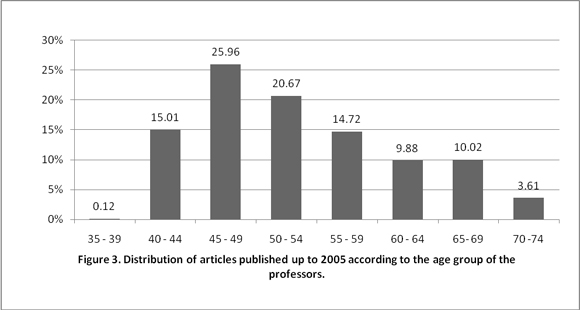
The greatest proportion of professors (15.5%) in relation to the number of published articles throughout their academic lives ranges from 40 to 49 articles, followed by the range of 20 to 29 published articles (12.8%), up to 2005. The ranges of zero to nine and 10 to 19 published articles both show a proportion of 10.8% of the professors. These numbers indicate that an ideal plateau occurs, at least for the FCM, corresponding to an age range of 40 to 49 years of age, roughly 10 years after the completion of doctoral studies, which is the most productive period of the professors. From 50 years of age onward, production decreases significantly and progressively by 4.1%, 6.8% and 6.1%.
In the case of FCM, the Quality Project was fully implemented in 1995 and incorporated new researchers with more advanced education and for whom hiring requirements were more demanding, all of whom possessed a profile oriented toward research. In addition, evaluation of the production of postgraduate professors intensified. Thus, it can be inferred that, by 2005, a greater abundance of scientific products were harvested by this new group of professors.
Distortions in scientific practices
Indices can also be compared globally, assuming that per capita production reveals the investment in time and scientific work by the professors of the institution. Thus, among all their scientific activities, some are highlighted. The indices were calculated by summing all the 'product' produced during the lives of all the professors and by type of production and dividing this total by the number of professors (n=175).
The data presented in Figure 4 reveal that the highest index per professor is full articles published in journals and the presentation of studies at events, followed by participation in events. Participation on an examining jury is far greater than both book publications and tutoring master's or doctoral degrees, as shown below:
]]>
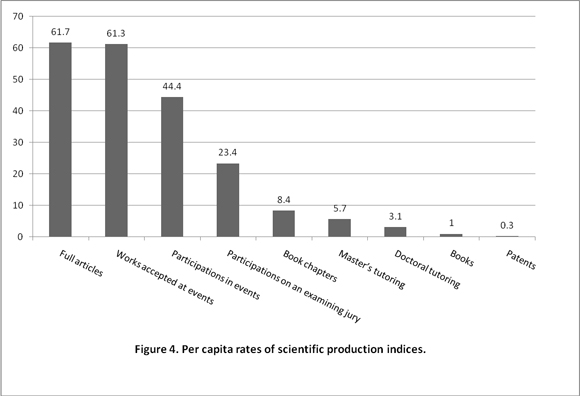
Thus the principal result of their production is the publication of "papers" and participation in events, such as conferences and seminars, in which they frequently present their scientific production. The remaining professorial activities are much rarer, including tutoring master's and doctoral degrees.
Our analysis revealed that the publication of scientific articles is hypostatized, particularly those published in international journals. If, in principle, international congresses fulfill the task of bringing researchers together from around the world, association with public access databases appears to be the main, if not the only, current means of sharing study data.
Following World War II, with the greater collectivization of research, joint signatures on scientific works increased significantly (Gingras, 2002).
Over the last few years, it has been reported that joint publication between tutors and tutees has accumulated value when considering the requirements of research support agencies and the models used to assess postgraduate courses.
Given this pressure, distortions occur, which some authors have indicated as a delicate issue.
One direct consequence of the overvaluation of publication has been the increase in the average number of authors per article for publications in medical journals [5,6]. Together with this increase, both the credits and liabilities have been diluted and have become obscure (Miller et al., 2004).
As Pontillo (2002) advocates, the scientific signature is a historical construct that demonstrates value as proof of authorship of the work, while also holding a symbolic value in the scientific field due to its power to validate and corroborate the weight of a particular work, regardless of the content of the intellectual production.
Since the beginnings of the Royal Society of England up to the present, the scientific signature only increases an intellectual's importance: based on the fundamentals of the logic of signatures as a symbolic "brand", an empire of scientometrics has been created led by the measurement of the index of citation, of authorship, in short, the entire apparatus of statistical knowledge concerning worldwide scientific productions (Heilbron, 2002). The apparatus initially created as indicators of specialized literature usage have progressively become the basis of a hierarchization of science and a tool of management and administration of the scientific field. Thus, the scientific signature has become a measuring instrument (Pontillo, 2002).
]]> On the other hand, praxis differs with regard to collective work. While in laboratorial, clinical or population research, it is possible to both divide the collective work into smaller portions and collectively assume authorship, the same practice poses serious problems in the humanities and related fields, as Bourdieu pointed out (Bourdieu & Delsaut, 2002).Some authors have even proposed more objective methods of codifying the authorship of collective works, while acknowledging the enormous difficulty in applying these criteria, particularly when the vanities of the researchers involved, their economic interests and the desire for academic recognition are in play (Petroianu, 2002).
What is envisioned by such measures is the prevention of abuses and distortions, like those highlighted by several authors (Miller et al., 2004; Montenegro, 1999), including: "guest" authorship and/or co-authorship, people whose names are included as authors in a work that did not participate in (between 17% and 33% of published articles); "pressured" authorship and/or co-authorship, which occurs when an individual responsible for a group demands the inclusion of their name in all works conducted by subordinates as part of "departmental tradition", a fairly common practice; and "ghost" authorship and/or co-authorship, which represents the non-inclusion of individuals who participated in important stages of the study (11% of articles published in six "peer-reviewed" journals).
According to our analysis, the average number of articles per professor is higher than the median of 44, around 63.1. This is because there are great and exceptional articulators in the institution, who comprise around 7.0% of the professors, with more than 160 published articles. This mass of publications indicates a peculiarity that will be analyzed in greater detail in future studies.
These are important issues and should be addressed collectively, through the discussion of universal criteria of authorship, together with some kind of official validation of same.
These distortions occur because there is no discussion or even the valorization of activities that form part of the regular practices of homo academicus, which are not considered when evaluating the curriculum of the researchers or of the institution as a whole, from a productivist perspective.
Final considerations
Much criticism have been leveled against the 'productivist' model, one based on the publication of articles in international journals valued by citation indicators whose paradigm is the Science Citation Index created by the Institute for Scientific Information (ISI). Areas like Public Health have created a movement that seeks the valorization of chapters and books as similarly relevant indicators of academic production (Luz, 2005).
In addition, the capacity of this model to significantly translate the quality of the work of a researcher and intellectual has been questioned. Whether their attributes can be summed up by their writing capacity and continuous and systematic publishing of concentrated and partial texts based on long, extensive and complex research, as presented linearly in Lattes.
Following this line of thinking, certain issues stand out. The first refers to the available databases. There is no doubt that the Lattes Platform is an unparalleled model in the academic world. It is public and permits universal access, while demonstrating unmatched clarity and effectiveness in disseminating information regarding intellectuals linked to Brazilian universities. Despite its unquestionable importance, it lacks complementation of the data from other activities relevant to scientific work that is not currently covered. One problem we uncovered concerns incorrect or incomplete filling out of the categories and the lack of standardization of those mentioned. Certain elements are universally understood, such as articles published in reviewed journals and the tutoring of theses. However, there is no standardization regarding information about books or articles. Filling out these data is often delegated to secretaries, students or trainees and some do not dominate the codification of these data, generating distortions in the totals. Even when performed by the researchers, a wide margin of doubt and questions exist concerning how to register and classify scientific output.
]]> The classification of books and articles, in turn, is not an obvious task. The Platform lacks of criteria and means of achieving minimum classification of the contents of books, a fact that is even more serious when considering new modalities of scientific communication, such as online journals and "e-books" (Marques Neto, 2005). If production and editing are facilitated by the availability of cheap, fast and universalized technical means, the assessment of content is impaired and poses problems. For Luz (2005), this is the time to "effectively evaluate the book product according to its quality and have some objective notion of its contribution, present or absent, to the area/field of insertion." This relatively new process of construction is underway and under debate, because, as the author points out, we still lack a "book culture" within these scientific areas in Brazil.Another unclear issue relates to the classification of national or international journals. Some time ago, an international magazine was determined according to the language and country of publication. However, over several decades, this pattern has undergone changes. Many Brazilian journals began pursuing and fulfilling the necessary requirements to be considered international, including: an editorial board with foreign researchers, the indexation of broader databases and other features, and some publish their texts in English. Concerning the classification of journals, the Lattes Platform does not consider nationality or internationality.
The point at issue is whether these "internationalized" journals are equal pari passu to those of international renown and whether the indices of dissemination and impact are the same. Do both represent penetration into the academic world of knowledge and the results of research produced in Brazil, or only equal rights, but not real rights?
Besides book chapters, other activities, including, consultancies, conferences and lectures in other postgraduate programs, are not properly informed.
The final consideration, but by no means the least, relates to something the shrewd and insightful reader will certainly have noticed: in this paper we present findings concerning the temporal trajectory of the researcher in their field, such as average time taken to achieve tenure, age stratified according to group, the period of most active publication with respect to the time of tenure and other information (Figures 2 and 3); however, the Lattes Platform provides no indication of the researchers' date of birth and the data would not have been presented if we had not accessed an external source that permitted our quantifications (UNICAMP, 2005). We have made a virtue of our need, in order to emphasize the importance of this information as a way of evaluating the researchers in their trajectories, in the act and while it happens. The number of publications, for example, only has qualitative significance when considering the effective actuation of the intellectual in their field and what institutional resources were available to them at the time. Otherwise, as affirmed by Merton, we run the well publicized tautological risk of uncritically accepting and valuing the consequences of the Matthew effect.
The limitations of the Lattes Platform have been verified with respect to the overall vision of the researchers and their activities, both scientific and those related to the management of temporal power (economic, social) within the institution. Nevertheless, it can be argued that curricula reflect, in part, the objective universe of the work of intellectuals, even though the model of science incorporated in the conformation of the platform is one that values a more positivist vision, based on numerical calculation and the quantification of items recognized as legitimate and appropriate.
We conclude with a statement by Bourdieu that has been on our minds: "every description that is limited to the general characteristics of a career makes the essential disappear; i.e., the differences" (1983, p.136) [author's emphasis]. Therefore, further analysis, of a more comprehensive nature, should be considered when discussing these indicators, but we believe that the data delineated certain important characteristics.
Acknowledgements
The authors are grateful for the support of the Decanato de Pesquisa e Pós-graduação of the University of Brasília.
]]>COLLABORATORS
Miguel Ângelo Montagner outlined the research, collected and tabulated the data, analyzed the results and drafted and revised the final manuscript. Maria Inez Montagner participated in the tabulation and analysis of the data and in drafting the article and the final text. Luiz Eduardo Hoehne participated in the quantitative analysis and the final review of the data in the article.
REFERENCES
BACHELARD, G. Epistemologia: trechos escolhidos. Rio de Janeiro: Zahar, 1977. [ Links ]
BOUDON, R.; BOURRICAUD, F. Dicionário crítico de sociologia. São Paulo: Ática, 1993. [ Links ]
BOURDIEU, P. O poder simbólico. Rio de Janeiro: Difel, 1989. [ Links ]
______. O campo científico. In: ORTIZ, R. (Org.). Pierre Bourdieu. São Paulo: Ática, 1983. p.123-55. [ Links ]
BOURDIEU, P.; DELSAUT, Y. Entretien sur l'esprit de la recherche. In: DELSAUT, Y.; RIVIÈRE, M.-C. (Orgs.). Bibliographie des travaux de Pierre Bourdieu. Pantin: Les temps des Cerises, 2002. p.176-239. [ Links ]
BOURDIEU, P.; PASSERON, J.-C.; CHAMBOREDON, J.-C. Le métier de sociologue. Paris: Mouton, 1968. [ Links ]
BOURDIEU, P.; WACQUANT, L. Réponses: pour une anthropologie réflexive. Paris: Seuil, 1992. [ Links ]
CONSELHO NACIONAL DE DESENVOLVIMENTO CIENTíFICO E TECNOLÓGICO. A Plataforma Lattes. Available at: <http://lattes.cnpq.br/conteudo/aplataforma.htm>. Accessed on: Jan 1st, 2008.
]]> CONSELHO UNIVERSITÁRIO. UNICAMP. Resolução GR nº 130/99. Available at: <http://www.pg.Unicamp.br/resolucoes/1999/RESOL13099.htm>. Accessed on: Jun 18th, 2009.COORDENAÇÃO DE APERFEIÇOAMENTO DE PESSOAL DE NÍVEL SUPERIOR. Produção científica brasileira cresce com a pós-graduação. Available at: <http://www.capes.gov.br/servicos/sala-de-imprensa/36-noticias/1423>. Accessed on: Apr 1st, 2006.
FACULDADE DE CIÊNCIAS MÉDICAS DA UNICAMP. Departamento de Enfermagem: Histórico. Available at:
<http://www.fcm.Unicamp.br/deptos/enfermagem/sobre.php>. Accessed on: Aug 10th, 2008.
FUNDAÇÃO DE AMPARO À PESQUISA DO ESTADO DE SãO PAULO. Suporte para crescer: balanço de 40 anos mostra papel estratégico da pós-graduação no país. Pesqu. Fapesp, v.119, p.24-6, 2006. [ Links ]
GINGRAS, Y. Les formes spécifiques de l'internationalité du champ scientifique. Actes Rech. Sci. Soc., v.141-142, p.31-45, 2002. [ Links ]
HEILBRON, J. La bibliométrie, genèse et usages. Actes Rech. Sci. Soc., v.141-2, p.78-9, 2002. [ Links ]
]]>LUZ, M.T. O futuro do livro na avaliação dos programas de pós-graduação: uma cultura do livro seria necessária? Interface - Comunic., Saude, Educ., v.9, n.18, p.631-6, 2005. [ Links ]
MARQUES NETO, J.C. O que fazer com os conteúdos? O livro do século XXI na avaliação acadêmica. Interface - Comunic., Saude, Educ., v.9, n.18, p.587-90, 2005. [ Links ]
MEIS, L.; LETA, J. O perfil da ciência brasileira. Rio de Janeiro: UFRJ, 1996. [ Links ]
MILLS, W.C. A imaginação sociológica. Rio de Janeiro: Zahar, 1969. [ Links ]
MONTAGNER, M.Â. A consagração das vanguardas: memória e biografia coletivas das práticas científicas na FCM da Unicamp. 2007. Tese (Doutorado) - Departamento de Medicina Preventiva e Social, Universidade Estadual de Campinas, Campinas. 2007. [ Links ]
]]>MONTAGNER, M. I. Mulheres e trajetórias na Faculdade de Ciências Médicas da Unicamp: vozes singulares e imagens coletivas. 2007. Dissertação (Mestrado) - Departamento de Medicina Preventiva e Social, Universidade Estadual de Campinas, Campinas, 2007. [ Links ]
MONTEIRO, R. et al. Critérios de autoria em trabalhos científicos: um assunto polêmico e delicado. Braz. J. Cardiovasc. Surg., v.19, n.4, p.3-8, 2004. [ Links ]
MONTENEGRO, M.R. Autoria e co-autoria: justificativa e desvios. J. Pneumol., v.25, n.3, p.159-62, 1999. [ Links ]
PEREIRA, D. No topo do ranking per capita, produção científica da Unicamp pode crescer mais. J. Unicamp, v.296, 8 a 14 de agosto, 2005. [ Links ]
PETROIANU, A. Autorship of a scientific work. Rev. Assoc. Med. Bras., v.48, n.1, p.60-5, 2002. [ Links ]
]]>PIVETTA, M. O salto quântico da ciência brasileira. Pesquisa FAPESP, n.100, junho, 2004. [ Links ]
PONTILLE, D. La signature scientifique: authentification et valeur marchande. Actes Rech. Sci. Soc., v.141-2, p.72-8, 2002. [ Links ]
PRÓ-REITORIA DE PESQUISA. Anuário de pesquisa. Available at: <http://www.Unicamp.br/anuario/2005/IntroducaoAnuario2005.html>. Accessed on: Sep 20th, 2006.
SANTOS, L.A.C.; FARIA, L. As ocupações supostamente subalternas: o exemplo da enfermagem brasileira. Saude Soc., v.17, n.2, p.35-44, 2008. [ Links ]
SIPEX. Anuários de pesquisa da Unicamp. Available at: <www.unicamp.br/sipex>. Accessed on: Sep 25th, 2006.
UNIVERSIDADE ESTADUAL DE CAMPINAS. D.G.R.H. Lista de docentes. 2005. Mimeogr. 2005. [ Links ]
]]>VIACAVA, F.; RAMOS, C.L. Difusão da produção científica dos cursos de pós-graduação em Saúde Coletiva. Cienc. Saude Colet., v.2, n.1/2, p.142-53, 1997. [ Links ]
i Address: SQN 205 C apto 503, Brasília, DF. Brasil. 70843-030
]]>