Legal, medical and lay understanding of embryos in Portugal: alignment with biology?*
A compreensão jurídica, médica e "leiga" do embrião em Portugal: um alinhamento com a biologia?
La comprensión jurídica, médica y "lega" del embrión en Portugal: ¿en línea con la biología?
Susana SilvaI,i; Helena MachadoII
IInstitute of Public Health - University of Porto, Department of Clinical Epidemiology, Predictive Medicine and Public Health, University of Porto Medical School. Alameda Prof. Hernâni Monteiro, 4200-319 Porto, Portugal. <susilva@med.up.pt> ]]>
IIDepartment of Sociology, Research Centre for the Social Sciences, University of Minho, Portugal Translated by David Eliff
ABSTRACT
This article provides a contribution to the debate about the processes of circulation of knowledge and meanings among experts and laymen regarding the status of human embryos in Portugal. It weighs up the expectations and concerns regarding the reliability, quality, safety and efficacy of medically assisted reproductive technologies. Individual interviews, aimed at exploring the complexities, similarities and differences among the views and values of jurists, doctors and couples involved in in vitro fertilization treatments, were the data source. This is a qualitative analysis on a case study. While jurists and doctors frame embryo status in biological, technical and/or legal terms, couples establish ontological relationships of moral, affective and social nature with embryos, which turns them into ethical beings, thus contrasting with the medical-legal biologization of the embryos.
Keywords: Status of human embryos. Legalization. Biologization. Moralization.
RESUMO
Pretende-se contribuir para o debate em torno dos processos de circulação de conhecimentos e sentidos entre especialistas e "leigos" no que concerne ao estatuto dos embriões humanos em Portugal. Reflete-se sobre as expectativas e preocupações manifestadas quanto à confiança, qualidade, segurança e eficácia das tecnologias médicas de reprodução assistida. O estudo assenta na realização de entrevistas individuais, com vistas a explorar as complexidades, similitudes e diferenças entre as visões e os valores de juristas, médicos e casais envolvidos em tratamentos de fertilização in vitro. Trata-se de uma análise qualitativa em um estudo de caso. Se os juristas e os médicos enquadram o estatuto dos embriões em categorias de índole biológica, técnica e/ou jurídico-legal, já os casais estabelecem com os mesmos diversas relações ontológicas de índole moral, afetiva e social, pelo que estes podem ser representados como seres éticos face à biologização médico-legal dos embriões.
Palavras-chave: Pesquisas com embriões. Legalização. Biologização. Moralização.
Se pretende contribuir para el debate en torno de los procesos de circulación de conocimientos y sentidos entre especialistas y "legos" en lo que concierne al estatuto de los embriones humanos en Portugal. Se reflexiona sobre las expectativas y preocupaciones manifestadas respecto a la confianza, calidad, seguridad y eficacia de las tecnologías médicas de reproducción asistida. El estudio se basa en la realización de entrevistas individuales con la intención de explorar las complejidades, similitudes y diferencias entre las visiones y los valores de juristas, médicos y parejas implicados en tratamientos de fertilización in vitro. Se trata de un análisis cualitativo en un estudio de caso. Si los juristas y los médicos encuadran el estatuto de los embriones en categorías de índole biológica, técnica y / o jurídico-legal, las parejas establecen con ellos diferentes relaciones ontológicas de índole moral, afectiva y social; por lo que pueden ser representadas como seres éticos frente a la consideración médico-legal de los embriones.
Palabras clave: Estatuto del embrión humano. Legalización. Biología. Moralización.
INTRODUCTION
This paper seeks to contribute to the debate on the processes of circulation of knowledge and meanings among doctors, jurists and lay people within various socioecological contexts of use of assisted reproductive technologies, based on analysis of accounts produced by these social actors regarding the status of human embryos. In particular, we consider the role of uncertainty and moral principles in the construction and social perception of the status of in vitro human embryos and their links to the sociocultural and political-ideological bases that underpin the trustworthiness of the scientific and legal institutions.
The biomedicalization of medically assisted reproduction has created a new technoscientific actor and collective identity, thus constituting an increasingly familiar entity of unparalleled postmodern character: in vitro embryos. In this manner, embryos are being transformed into an anonymous entity, becoming part of the shared commitment towards human, scientific and technological progress, especially considering the new lines of investigation using human embryos (Luna, 2007b; Svendsen, 2007). This is both a scientific and an ideological debate, since it involves discussions about the real possibilities of human tissue regeneration and reflections about the prerogative of using human embryos in research (Ramalho-Santos, 2003, p.159). Several ethical questions are also associated with these scientific premises, namely: the legitimacy of embryo destruction, the emergence of "scientific tourism", the potential merchandising of human tissue, and the manipulation of men and women as embryo sources (Haimes, Luce, 2006; Scully, Rehmann-Sutter, 2006).
Despite the uncertainties and ambiguities that have characterized the public debate around the definition, status, protection and fates of human embryos (Serrão, 2003; Luna, 2001; Nunes, Melo, 2001; Andrews, Elster, 2000; Mulkay, 1997; Salem, 1997), the tendency in this debate today is to move away from discourse centered around the image of the potential individual and unborn child (Mulkay, 1997) towards a focus on healthy children (Ettorre, 2002), with redefinition of the biological concept of the embryo (Findlay et al., 2007) and even elimination of this concept. Instead, the term human generative material or tissue has been proposed in its place, in order to align the law with biology (Johnson, 2006)1. The debate surrounding the legal, ethical and moral status of human embryos has posed new questions about the types of intimate citizenship (Plummer, 2001), scientific citizenship (Irwin, 2001) and biological citizenship (Rose, Novas, 2005) that are coming into existence within the context of fertility treatments.
Another possible discussion involves public scrutiny of expectations and fears surrounding the role of technology and science in society, an area that plays to some fundamental human concerns, such as birth, regeneration and quality (Luna, 2007b; Svendsen, 2007). The human embryo seems to be regarded as a "boundary object" that has been transformed into a hybrid of subject knowledge and intervention: a merger between biology and technology, and between laboratory and reproductive environments (Williams et al., 2008). This cyborg embryo exists within an increasingly complex network of actors and it symbolizes redirection of biomedicine and biotechnology towards the idiom of immortalization, regeneration and totipotency. This route leads to a post-molecular genetics view, which Sarah Franklin (2006) called transbiology and Charis Thompson (2005) termed a biomedical mode of reproduction. Consolidation of this new concept has led to transgression of borders, thereby placing this concept simultaneously and inseparably within the knowledge domains of life sciences, social sciences and humanities. This context sets up lay citizens as active participants in decision-making processes and in mobilization of medical technologies from their initial developments (Thompson, 2005; Ramalho-Santos, 2003; Webster, 2002).
]]> From another perspective, there is the question of the emergence of new parental duties and responsibilities towards the future (Luna, 2005; Strathern, 2005). This reflects one of the most interesting discontinuities enhanced by assisted reproductive technologies: extension of the space-time boundaries of life (Brown, Webster, 2004). The social ties between the embryos and their (expected) recipients should firstly be maintained through a preliminary agreement, which is supposedly signed in a free and informed manner. Informed consent thus emerges as an instrument that seems to symbolize the importance of the couple's free choice and autonomy (Andrews, Elster, 2000); potential availability of some type of relationship of kinship and reconfiguration of that relationship into a technical and scientific relationship (Salem, 1997); and processing of embryos into objects of knowledge and intervention outside the network of kinship and family (Mulkay, 1994b), thereby attempting to renegotiate the meaning of the concepts of child (Franklin, 2006) and person (Luna, 2007a, 2001).As part of this text, we have reviewed some of the abovementioned perspective guidelines. Thus, we have reflected on the senses and meanings conveyed in medical, legal and lay accounts on the status of human embryos, highlighting in particular the complexities and ambiguities that characterize these accounts, as well as their similarities and differences. We have sought here to show how the current policies for medically assisted reproduction embody a technical genetics and biopolicy project, particularly based on socialization of public understanding of science and technology, starting from the biologization and geneticization of social values. The emergence of new forms of citizenship, paradoxically privatized and reconfigured as forms of citizenship that are intimate and apolitical, may contribute towards dilution and individualization of social responsibilities with regard to management of risks and uncertainties associated with the social uses of human embryos. In turn, this may restrict some of the fundamental rights of citizens.
Firstly, we analyze the current Portuguese legal framework relating to social uses of human embryos, emphasizing the need to include lay views and experiences in regulating assisted reproductive technologies. Secondly, based on qualitative and interpretative analysis of testimonies given by jurists, doctors and couples with personal and/or professional experiences of medically assisted reproduction in Portugal, we attempt to produce a synthesis covering the main personal, cultural and ideological implications associated with legal, medical and lay understandings of human embryo status.
Regulations for social uses of human embryos in Portugal
The law governing assisted reproductive technologies in Portugal deals with two different categories of human embryos: (a) viable embryos involved in a parental project, which will be cryopreserved for future use in a new process of embryo transfer, within three years, by the woman who produced them or, if this option is not possible, for future donation to another couple with the consent of the original beneficiaries; (b) embryos without the possibility of inclusion in a parental project, which are destined for scientific research, provided that the beneficiaries to whom the embryos were destined have expressly granted informed consent (Article 25 and Article 9, items 4 and 5, of Law no. 32/2006). However, the main purpose of the informed consent forms used in Portuguese reproductive medicine centers is to register the couple's permission for embryos to be cryopreserved (including the more or less explicit recognition that surplus embryos will inevitably exist) and to confirm the couple's consent regarding the preferred destination for the embryos (implantation in the womb of the woman who produced them, for a new attempt at pregnancy). This may seem to be a strategy for eliminating the risks involved in cryopreservation of embryos and privatization of the responsibility for in vitro embryos (Silva, 2008).
The way in which Portuguese law regulates the social uses of human embryos shows two different rhetorical approaches: the allegation of present and future benefits to humanity and the possibility of its improvement; and the need to control embryo use. The Portuguese legal framework ensures that production of in vitro embryos can only take place in order to circumvent or overcome infertility or to prevent transmission of serious illnesses. Hence, it prohibits embryo creation through medically assisted reproduction that would have the deliberate aim of use in scientific research. Embryo experimentation requires permission from the Conselho Nacional de Procriação Medicamente Assistida [CNPMA; National Council for Medically Assisted Procreation] and should only be permitted if it "may reasonably be expected that this may lead to benefit for humanity," such as "prevention, diagnosis or treatment of embryos, improvement of MAP techniques, establishment of banks of stem cells for transplantation programs or other therapeutic purposes" (article 9 of law no. 32/2006).
Despite recognition of the need to protect the rights of citizens relating to scientific and technological development within the social uses of human embryos, the relative weighting of these elements in interrelationships still requires more specific regulations. The CNPMA's decisions regarding the legitimacy of research projects on human embryos and the criteria for considering property law in particular cases focus on contextualization of the listed standards and the moral meanings of experiments on human embryos (Svendsen, Koch, 2008) in Portugal.
In April 2008, the Sociedade Portuguesa de Células Estaminais e Terapia Celular [Portuguese Society for Stem Cells and Cell Therapy] launched a challenge to the Portuguese government, to legislate on scientific research involving stem cells (Machado, 2008). If the public debate is restricted merely to legal regulation of new medical technologies for assisted reproduction, it might imply that the issues concerning their legitimacy and moral acceptability and ethics have already been answered (Scully, Rehmann-Sutter, 2006). Scientific research on human embryos depends on the existence of couples who consent to donate their surplus embryos for this purpose. These couples' views and experiences do not appear in public debate, discourse relating to ethics or decision-making policy. There is an urgent need to develop new ways to regulate the social uses of human embryos, in order to incorporate the contributions of medicine and law in conjunction with various forms of public participation, and to mobilize the experience and knowledge of lay and local social actors who are involved in or exposed to their current and future implications (Haimes, Luce, 2006). This forms a path towards democratic biopolitics (Nunes, 2003).
It has been proposed that a new social movement within assisted reproductive technologies should be created, built on common experience: the attempt to conceive through these technologies, rather than being based on absence of biological children and/or a medical diagnosis. Experiences of personal contact with these technologies are an important factor behind the interest, knowledge and actions that are capable of providing collective mobilization. Public understanding of this social movement in terms of techno-sociality (Oudshoorn, 2004, p.353), rather than bio-sociality (Rabinow, 1991), can establish a mode of cognitive citizenship on a scientific and technological basis, but with the ability to incorporate heterogeneity of forms of knowledge and practices, and provide lay citizens with the means to express themselves in various public spaces, including in the deliberations and debates promoted by the CNPMA.
]]> Materials and methods
This study was approved by the Fundação para a Ciência e a Tecnologia [Foundation for Science and Technology] of the Ministério da Ciência, Tecnologia e Ensino Superior [Ministry of Science, Technology and Higher Education], Portugal, and complied with the ethical rules and guidelines contained in the code of ethics of the Associação Portuguesa de Sociologia [Portuguese Association of Sociology] and the International Sociological Association, and with the legal rules on personal data protection (law no. 67/98 of October 26).
Letters of presentation for this research project were sent to each of the target groups of this study (jurists, doctors and lay citizens), asking them to grant an interview. With regard to men and women who conceived or attempted to conceive through the use of assisted reproductive technologies, this letter was sent to a group of 20 colleagues and friends of the first author, asking them to spread the request to other people, using snowballing sampling logic. Regarding doctors, 19 letters were written to health professionals in charge of clinical centers for reproductive medicine in Portugal in October 2005. Another 13 letters were addressed to jurists selected by three experts in Health Law and Family Law in Portugal, from the list of all jurists who had published articles within the field of assisted reproductive technologies in this country. Recruitment of interviewees ended when no more new elements emerged in the predefined meta-themes (Guest, Bunce, Johnson, 2006).
Thirty-three semi-structured interviews were conducted, with a national sample, distributed as follows: (a) 15 interviews with men and women with at least one personal experience of treatments involving assisted reproductive technology; ten of these were individual interviews (nine women and one man) and five were with couples, carried out between July 2005 and February 2006; (b) nine interviews with doctors in charge of clinical units for reproductive medicine in Portugal (three female doctors and six male doctors), which took place between November 2005 and February 2006; (c) and nine interviews with jurists who had published articles on reproductive technologies (three women and six men), which took place between January and March 2007. The interviews took an average of sixty minutes and were held at the interviewees' homes or workplaces. All the interviews were recorded and fully transcribed. These were semi-structured interviews, for which the guidebook of open questions consisted of four parts: (a) description of the contingencies and (un)certainties associated with assisted reproductive technologies and its implementation; (b) interpretation of medical, legal and lay rhetorical strategies relating to the status of human embryos and their linkage and separation processes; (c) explanation of the main modes of supply, access and use of assisted reproductive technology in Portugal; and (d) perception of the impact of cryopreservation of human embryos in relation to the reconfiguration of rights and duties of citizenship.
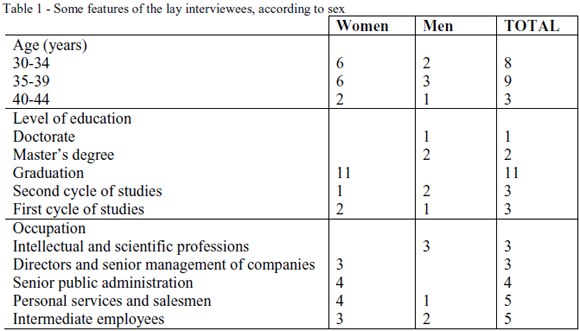
The lay participants were Portuguese, heterosexual and married. Their ages ranged from 30 to 43 years; the lower age limit corresponded to a woman of 30 years and the upper limit to a couple who were both 43 years old. The age groups most represented were individuals from 35 to 39 years (n = 9) and from 30 to 34 years (n = 8). Concerning education level, the levels most represented were university graduates (n = 11) and individuals who had completed the first cycle of studies (n = 3) and the second cycle of studies (n = 3), while there were also two men with a master's degree and one man with a doctoral degree. Five interviewees were intermediate employees, five individuals provided personal services or were salesmen, four were in senior public administration and three were directors or senior managers of companies. There were also three male experts from intellectual and scientific professions. The monthly income of the fifteen households was distributed as follows: two households had an income of between 1000 and 2000 euros per month; seven, between 2000 and 3000 euros, and six, more than 3000 euros.
The content analysis on the interviews, the interpretation of the results and the formulation of conclusions were based on a highly qualitative approach in which it was sought to link the substantive analysis to development theory (Becker, Bryman, 2004). The data gathered were systematically coded and summarized in relation to meta-topics, selecting the most illustrative terms of social relationships, practices and images among the subjects interviewed about the status of human embryos. This was a case study, and thus the findings are valid only within their specific context. The names listed in the transcript extracts do not correspond to those of the interviewees, in order to ensure their anonymity.
Results
]]> The legal discourseThe discourse produced by jurists who were interviewed about embryo status was a particularly useful way of illustrating how clear boundaries between the scientific and legal fields have become established, particularly from listing of one of the main features of the modern scientific paradigm: the distinction between nature and human beings (Santos, 2000, Salem, 1997), which seems to define the tenuous limits from which interventions from a legal perspective begin. After the initial surprise expressed by the jurists interviewed, when faced with the question "how would you define an embryo", their responses tended to allude to elements of a biological nature. These were then used as a justification for referring the responsibility for this definition to the scientific community (Mulkay, 1994a), while indicating that the task of the law was to oversee individuals' legal personality after "the birth is complete and the child is alive", as noted in the following extract from an interview:
How do I define an embryo? May I go to the dictionary? [...] From the scientific point of view? It is the beginning of a human being. [...] Now, from the legal point of view, the embryo is not the beginning of a human being. A person is only considered to be person after the birth is complete and the child is alive; only then does the person have a legal personality. (Interview with a female jurist)
The jurists interviewed believe that human embryos deserve the protection of the law, even though they do not have a legal personality. According to the opinions of these social actors, the law respects the dignity of human embryos by reaffirming the need to avoid the creation of surplus embryos and by stipulating the rules governing their fates, which favor destinations that involve a parental project.
The medical discourse
Like the jurists, the doctors interviewed also tended to establish a direct association between the definition of embryos and the definition of individuals and human life. In summary, the position of the vast majority of doctors interviewed, regarding the status of embryos is to treat them as an entity with a hypothetical potential for life, therefore deserving respect, but not in an absolute sense, since embryos are not "human individuals":
My understanding is that these embryos must be highly respected. They are biological material, human cells and, of course, already living beings. Now, a human being? The human being that I have before me consists of the elements of the couple. From this comes my understanding that the embryo should be respected, but in no way should we devalue the role of the person in relation to the embryo, that is, to favor these cells to the detriment of the couple. (Interview with a male doctor)
This interview quote illustrates the intention of subordinating the medical respect for embryos to the interests and rights of couples by establishing a difference between what are "human cells" or "living beings" (the embryos) and "human individuals" or "human beings" (the couple). This distinction is based mainly on references of biological nature, in particular the concepts of viable and unviable embryos, i.e. promotion of the idea that not all human embryos, either in vivo or in vitro, can develop to become human beings. Hence, unviable embryos also exist, and although they may grow to become human beings, their nature seems to prevent them from achieving that potential. The concept of viability is often combined with the concept of continuity of human life, in which individuals gradually emerge and, with this, valuation of their rights, as shown by the following extract from an interview:
]]>From the moment when there is fusion of genetic material, there is an embryo. [...] Now, the exact moment: this I cannot say. If you want to address another issue, which is the concept of life, these are things that, to me, are very clear. Life does not begin, life continues. [...] Of course, this value reaches its maximum when we are born, while it may be less while under development, and is still less while at the so-called pre-embryonic stage, even less at the stage of the fertilized egg, and surely even less when at the gamete stage. [...] In my opinion, this is the biological concept of continuity of life. (Interview with a male doctor)
The possibly complex and contradictory combination between the concepts of life, person and human embryo seemed to be resolved by the doctors who were interviewed through reconfiguration of scientific and technological developments as elements that symbolize the respect of medicine and technology, either for human embryos or for human life (in which the couples are included). A minority position had the opinion that cryopreservation of "fertilized oocytes" solves this problem, since they are not seen as embryos. The extract of that interview is presented below and summarizes the discourse of the majority of the doctors interviewed about this issue, using the images of cryopreservation of embryos, extension of in vitro culturing of embryos and development of medical knowledge within the context of induction of ovulation as the medical and technical procedures that prove doctors' concern for human embryos and human life, simultaneously:
My position is to freeze the ones [embryos] that are of good quality. [...] Therefore, the idea is, in accordance with the characteristics of the couple, the gametes, ova, etc.., to minimize the risk of having surplus embryos, but inevitably, at one time or another, there are more embryos. [...] But then, in a future attempt, [there is] a way of making transfers without having to go through [procedures] that are not a set of mild inconveniences but, rather, a set of considerable inconveniences and psychological, physical and economic burdens [the last of these relates to the price of medication]. (Interview with a male doctor)
According to the doctors interviewed, cryopreservation of embryos enables future realization of its potential for life and helps to mitigate the psychological, physical and economic costs borne by women and men who resort to assisted reproductive technology. This might happen because extending the in vitro culturing of human embryos until the fifth day favors greater accuracy of selection between viable and unviable embryos (since the latter will cease to evolve), thereby allowing better measurement of embryo quality. Finally, the depth of medical knowledge on the characteristics of the gametes, and in particular of the ova, and the procedures involved in stimulation of ovulation may contribute towards restricting the number of surplus and/or supernumerary embryos. The doctors interviewed also believed that the fate of in vitro human embryos that appear not to have the opportunity to be involved in a parental project should preferably be their use in favor of humanity and other couples, such as in training for biology professionals relating to pre-implantation genetic diagnosis:
We are training the staff to start the pre-implantation diagnosis and we are using the [embryos] [...] that have many more cells than they should. [...] Furthermore, only those that had been there for over five years and which were classified as abandoned were used, but there were just a few of them; incidentally, it would have been nice if there had been more. (Interview with a female doctor).
In finding a balance between technical and scientific perspectives and a humanistic perspective, the discourse of the doctors interviewed tended to emphasize some strategies for repairing the potential risk produced by medical and technical procedures relating to embryos, which seems to symbolize the assurance that humanism is present in all medical interventions and techniques (Carapinheiro, 1991).
The lay discourse
]]> The following interview extract refers to a couple who decided to inseminate only the number of oocytes equivalent to the number of embryos to be transferred to the woman's uterus. This quote illustrates in an exemplary way the complexity of views about human embryos and the possible tension between medical, legal and lay representatives in this field. The male interviewee referred to the "pressure" that he felt from the medical team, for him to envisage the existence of surplus embryos as a "normal" consequence of the application of techniques of medically assisted reproduction that seemed to have the main objective of increasing the likelihood of "success" by selecting the "best" embryos:We asked, and they [the doctors] said ‘Oh, we cannot deploy more than three, because of [the possibility of] twin pregnancies, which nowadays is not permitted, and so on'. And we said ‘Okay, so we don't want you to fertilize more than three.' Then there was a bit of pressure not to insist on this. [Interviewer: Pressure from whom?] From the doctors. [...] And then they respected that, but there was a small attempt to [put pressure on us by saying] ‘Ah, but seeing that you will stimulate, why not stimulate more, and then you will have more so that the best are chosen and the probability increases.' [...] Because there may well be informed people who in this patient-doctor relationship feel so diminished that, despite everything, they end up saying that the doctor is right. And we have got to comment on this: we feel that this kind of pressure is unbelievable. We understood it and our reading was that ‘he [the doctor] wanted to have greater success.' (Leandro, 36 years of age, with a PhD; the manager of a biotechnology company)
This description illustrates an alternative minority discourse that questions the design of the proposed clinical intervention by wanting to limit the number of oocytes inseminated, in order to avoid the existence of surplus embryos. In reviewing interviews conducted among men and women involved in using assisted reproductive technologies, we found another case of socialization of the process of clinical implementation of in vitro fertilization treatment (Webster, 2002, p.448), with the same objective: a couple in which the male partner was a doctoral student of economics who suggested to the female doctor accompanying this case that in vitro fertilization should be achieved without ovarian stimulation, in order to prevent production of surplus embryos. These proposed arrangements for participation in the design of strategies for medical intervention came from two men with high levels of education (a PhD and a PhD student) and appeared to require that the procedures should be appropriate for the interviewees' cultural values and social expectations.
However, the majority of lay interviewees agree with cryopreservation of embryos, preferably for later use by the woman who produced them, and see it as an inevitable necessity (Silva, 2008, p.530). The story of one of the female interviewees about her decision to cryopreserve surplus embryos shows how this option can be reconfigured as a solution that eliminates a "practical problem" (the existence of surplus embryos) and helps to postpone any kind of decision on fates other than their future use by the woman who originated them:
This was my intention [to cryopreserve surplus embryos]. I mean, at that time, we did not think much about it. [...] It is a matter to be decided later. But the idea was always this: if it worked, and if, one day, I wanted to have more children, I would have them there. But the following situation also crossed my mind: what if I had twins? Would I then want the other embryos or not? What if I did not want them? But I never tried to answer this question, because I was not thinking about it. (Ana, 37 years of age, graduate, civil engineer)
Couples' decisions regarding the fate of surplus embryos tend to be emotionally and morally challenging, and usually involve different cognitive states over a certain period of time. Their choices are mainly described as an inevitable consequence of the decision of not wanting to choose other possible destinations, either due to their beliefs about what should be done, or their representations regarding the relative value of biogenetic and/or social ties, in the relationship between parents and children (Remoaldo and Machado, 2008; Lacey, 2007). According to one of the female interviewees, who was the mother of a two-year-old child and was pregnant with twins, her perceptions about the fate of cryopreserved embryos had already undergone several metamorphoses over time, and the final decision had not yet been taken. Her discourse on the fate of cryopreserved embryos was built on a comparison between the alternatives available. The couple's future final decision was framed within the difficulties that she felt in having to take a personal position that could be interpreted as a refusal to have her own child, even if this might come as the only alternative in the face of unaffordable economic costs and difficulty in reorganizing the couple's lives if they were to have four children:
]]> The lay construction of human embryo status results from complex and heterogeneous social processes that are associated with multiple functions of senses and meanings relating to couples' decisions on the fate of surplus embryos. In accounts about the status and use of human embryos produced by couples who have used assisted reproductive technologies, their actions and decisions are framed within moral principles that set out what should be done. This indicates that a representation of these couples as ethical beings is constructed (Haimes, Whong-Barr, 2003).I am the one who says to my husband ‘then when the fourth [child] arrives' and he says I'm crazy [...], because there is no money, no finances, no management capacity. [...] I cannot say, but I wanted to say ‘I do not want' [to use the cryopreserved embryos]. [...] I think that I could not [donate]. Basically, it's a child of mine, isn't it? I think I would prefer to say ‘Look, I do not want them: either you destroy them or use them for research.' If I had been asked while I was having the treatment, maybe I would have said ‘No, throw them out'. (Custódia, 35 years of age, graduate, economist)
Ethical conduct in the light of medico-legal naturalization of human embryos
Whereas doctors and jurists fit the status of human embryos into categories of biological, technical and/or legal nature (Luna, 2007a), the potential parents establish different ontological relationships of an emotional, moral and social nature, with these embryos (Lacey, 2007; Svendsen, 2007; Parry, 2006; Mulkay, 1994a). In vitro human embryos do not seem to differ biologically from embryos generated through the process of conception without medical intervention, but they are located outside the female body during the initial phase of their existence, for manipulation, and it is precisely the degree of control that can be exerted on them that produces the legal, ethical, moral and social uncertainties (Mulkay, 1997).
The fusion between the embryonic body, technoscience and biomedicine is one of the most recent examples illustrating the ontological effort in insisting on a natural or biological world (Franklin, 2006), to which the law and medicine seem to be increasingly bound and subordinate. This ontological effort is reflected in the social images of human embryos, whose medical and legal status is more and more based on the idea that there is a distinction between nature and human beings. This is maintained through social representations of the objective, rational and disinterested status of technoscience and biomedicine. The latter may contribute towards ensuring that embryos are increasingly subjected to premature medicalization, in association with space-time extension of the frontiers of life.
In attempting to understand the increasing complexity of the scientific, technological, legal and civic tangle involving in vitro human embryos, the heterogeneities, uncertainties and contingencies associated with the emergence of new actors and groups are revealed. These new players and groups link human and non-human technologies and institutions and, under the aegis of biology, tend to obscure the social and family relationships involved in the production of human embryos.
Reproductive medicine units emerge as dynamic spaces with plurality of knowledge, practices and players. These are groupings of sociotechnical nature that can be reinvented in complex manners within different socioecological contexts of use, thereby reflecting the social relationships and heterogeneous networks that shape their construction. It will be possible to combine complexity with equity, provided that the representations and lay experiences, the inequalities in access to medicine and technology and the limitations, uncertainties and risks become central issues in bioethics and medical biolaw. Democratic governance in this respect should also imply designing sensitive interventions that are adapted to the needs and values of specific individuals and which resist privatization of healthcare, thereby ensuring its quality and safety.
Acknowledgements
To the jurists, doctors and women and men who we interviewed and who shared with us their views and experiences, our sincere thanks. We also thank Helena Lima and Filomena Louro (Scientific Editing Programme, University of Minho) for the translation of the Portuguese text into English; and the revision of David George Elliff. The authors thank the Foundation for Science and Technology (Portuguese Ministry of Science, Technology and Higher Education) for the financial support for this research, through a PhD fellowship (SFRH/BD/10396/2002) and a post-doctoral fellowship (SFRH/BPD/47020/2008).
]]> Authors' roles
Susana Silva: substantial contribution towards the design, execution, analysis and interpretation of data, manuscript drafting and critical review of the article. Helena Machado: participation in interpretation of data and critical review of the article.
REFERENCES
Andrews, L.B.; Elster, N. Regulating reproductive technologies. Journal of Legal Medicine, v.21, n.1, p.35-65, 2000.
Becker, S; Bryman, A. (Eds.). Understanding research for social policy and practice: themes, methods and approaches. Bristol: Policy Press, 2004. [ Links ]
BROWN, N.; WEBSTER, A. New medical technologies and society: reordering life. Cambridge: Polity Press, 2004. [ Links ]
Carapinheiro, G. Médicos e representações da medicina. Sociologia, Problemas e Práticas, n.9, p.27-41, 1991.
]]>Ettorre, E. Reproductive genetics, gender and the body. London: Routledge, 2002. [ Links ]
Findlay, J. K. et al. Human embryo: a biological definition. Human Reproduction, v.22, n.4, p.905-11, 2007.
Franklin, S. The cyborg embryo. Theory, Culture & Society, v.23, n.7-8, p.167-87, 2006.
Guest, G.; BUNCE, A.; JOHNSON, L. How many interviews are enough?: an experiment with data saturation and variability. Field Methods, v.18, n.1, p.59-82, 2006. [ Links ]
Haimes, E.; Luce, J. Studying potential donors' views on embryonic stem cell therapies and preimplantation genetic diagnosis. Human Fertility, v.9, n.2, p.67-71, 2006.
Haimes, E.; Whong-Barr, M. Competing perspectives on reasons for participation and non-participation in the North Cumbria Community Genetics Project. In: Knoppers, B.M. (Ed.). Populations and genetics: legal and socio-ethical perspectives. Leiden: Brill Academic Publishers, 2003. p.199-216. [ Links ]
Irwin, A. Constructing the scientific citizen: science and democracy in the biosciences. Public Understanding of Science, n.10, p.1-18, 2001.
]]> Johnson, M. Escaping the tyranny of the embryo? A new approach to ART regulation based on UK and Australian experiences. Human Reproduction, v.21, n.11, p.2756-65, 2006.Lacey, S. Decisions for the fate of frozen embryos: fresh insights into patients' thinking and their rationales for donating or discarding embryos. Human Reproduction, v.22, n.6, p.1751-58, 2007.
Luna, N. A personalização do embrião humano: da transcendência na biologia. MANA, v.13, n.2, p.411-40, 2007a. [ Links ]
______. Células-tronco: pesquisa básica em saúde, da ética à panacéia. Interface - Comunic., Saúde, Educ., v.11, n.23, p.587-604, 2007b.
______. Natureza humana criada em laboratório: biologização e genetização do parentesco nas novas tecnologias reprodutivas. Hist cienc. saude-Manguinhos, v.12, n.2, p.395-417, 2005. [ Links ]
LUNA, N. Pessoa e parentesco nas novas tecnologias reprodutivas. Rev. Estud. Fem., v.9, n.2, p.389-413, 2001. [ Links ]
Machado, A. Sociedade Portuguesa de Células Estaminais pede ao Governo para legislar sobre investigação nesta área. Público, 23/04/2008. Disponível em: <http://ww2.publico.clix.pt/print.aspx?id=1326783&idCanal=undefined>. Acesso em: 2 jan. 2009.
]]>Mulkay, M. The embryo research debate: science and the politics of reproduction. Cambridge: Cambridge University Press, 1997. [ Links ]
______. Science and family in the great embryo debate. Sociology, v.28, n.3, p.699-715, 1994a. [ Links ]
______. The triumph of the pre-embryo: interpretations of the human embryo in parliamentary debate over embryo research. Social Studies of Science, v.24, n.4, p.611-39, 1994b.
Nunes, J. A. From bioethics to biopolitics: new challenges, emerging responses. Oficina do CES, n. 193, 2003.
Nunes, R.; Melo, H. (Coords.). A ética e o direito no início da vida humana. Porto: Serviço de Bioética e Ética Médica da Faculdade de Medicina do Porto, 2001. [ Links ]
Oudshoorn, N. "Astronauts in the sperm world". The renegotiation of masculine identities in discourses on male contraceptives. Men and Masculinities, v.6, n. 4, p.349-67, 2004.
Parry, S. (Re)constructing embryos in Stem Cell Research: exploring the meaning of embryos for people involved in fertility treatments. Social Science and Medicine, v.62, n.10, p.2349-59, 2006.
]]> Plummer, K. The square of intimate citizenship: some preliminary proposals. Citizenship Studies, v.5, n.3, p.237-53, 2001.PORTUGAL. Lei n. 32/2006, de 26 de Julho. Diário da República, 1.ª série, n.143, p. 5245-50, 2006. [ Links ]
PORTUGAL. Lei n. 67/98, de 26 de Outubro. Diário da República, 1.ª série A, n. 247, p.5536-5546, 1998.
Rabinow, P. Artificialidade e ilustração. Da sociobiologia à bio-sociabilidade. Novos Estudos, n.31, p.79-93, 1991. [ Links ]
Ramalho-Santos, J. Sobre as fronteiras. In: Santos, B.S. (Org.). Conhecimento prudente para uma vida decente: um discurso sobre as ciências revisitado. Porto: Afrontamento, 2003. p.511-28. [ Links ]
REMOALDO, P.; MACHADO, H. O sofrimento oculto: causas, cenários e vivências da infertilidade. Porto: Afrontamento, 2008. [ Links ]
]]>Rose, N.; Novas, C. Biological citizenship. In: Ong, A.; Collier, S. (Eds.). Global assemblages: technology, politics and ethics as anthropological problems. Oxford: Blackwell Publishing, 2005. p.439-63. [ Links ]
Salem, T. As novas tecnologias reprodutivas: o estatuto do embrião e a noção de pessoa. MANA, v.3, n.1, p.75-94, 1997. [ Links ]
Santos, B. S. A crítica da razão indolente: contra o desperdício da experiência. Porto: Afrontamento, 2000. [ Links ]
Scully, J.L.; Rehmann-Sutter, C. Creating donors: the 2005 Swiss law on donation of 'spare' embryos to hESC research. Journal of Bioethical Inquiry, v.3, n.1/2, p.81-93, 2006.
Serrão, D. Livro Branco: uso de embriões humanos em investigação científica. Lisboa: Ministério da Ciência e do Ensino Superior, 2003. [ Links ]
Silva, S. Consentir incertezas: o consentimento informado e a (des)regulação das tecnologias de reprodução assistida. Cad. Saúde Pública, v.24, n.3, p. 525-34, 2008.
]]>Strathern, M. Kinship, law and the unexpected: relatives are always a surprise. Cambridge: Cambridge University Press, 2005. [ Links ]
Svendsen, M.N. Between reproductive and regenerative medicine: practising embryo donation and civil responsibility in Denmark. Body & Society, n.13, p.21-45, 2007.
Svendsen, M.N.; Koch, L. Unpacking the ‘spare embryo': facilitating stem cell research in a moral landscape. Social Studies of Science, v.38, n.1, p.93-110, 2008.
Thompson, C. The sacred and profane human embryo: a biomedical mode of (re)production. In: ______. Making parents: the ontological choreography of reproductive technologies. Cambridge: The MIT Press, 2005. p.245-76. [ Links ]
Webster, A. Innovative health technologies and the social: redefining Health, medicine and the body. Current Sociology, v.50, n.3, p.443-57, 2002.
Williams, C. et al. Human embryos as boundary objects? Some reflections on the biomedical worlds of embryonic stem cells and pre-implantation genetic diagnosis. New Genetics and Society, v.27, n.1, p.7-18, 2008.
]]> * This article is based on Silva (2008a).