Sanitizing, caring and civilizing: the medical discourse for schools in the state of Paraná (1920-1937)
Higienizar, cuidar e civilizar: o discurso médico para a escola paranaense (1920-1937)
Higiene, cuidar y civilizar: el discurso médico para la escuela paranaense (1920-1937)
Liliana Müller LaroccaI,i; Vera Regina Beltrão MarquesII
IDepartamento de Enfermagem, Universidade Federal do Paraná. Rua Padre Camargo, 120, Curitiba, PR, Brasil. 80.060-240. <larocca_m@terra.com.br> ]]>
IIPrograma de Pós-Graduação em Educação, Universidade Federal do ParanáTranslated by Carolina Silveira Muniz Ventura
Translation from Interface - Comunicação, Saúde, Educação, Botucatu, v.14, n.34, p. 647-660, Set. 2010.
ABSTRACT
Based on the investigation of medical discourses referring to school sanitation, this study addresses the spread of the Hygiene science in the State of Paraná, southern Brazil, between 1920 and 1937. Discourses to schools present in many sources, mainly periodicals, Archivos Paranaenses de Medicina and Revista Medica do Parana, pointed out the perception of medicine underpinned by Hygiene, in which doctors advocated a new social function: educators. By discussing intervention in schools and their users, doctors intended to "care for, protect and sanitize infancy", a task aiming to insert the territory of Paraná in the national process of hygienic and social sanitation. It is a historical research study, inspired by Norbert Elias' ideas of Civilizing Process. Thus, its purpose is to recognize civility proposals in the medical discourses created to the schools of the State of Paraná. Educational conceptions in the studied period evolved from knowledge, prescriptions and discourses on Hygiene science and its greatest advocates - the doctors.
Keywords: School health. Eugenics. History of medicine. Medical education.
RESUMO
Com base na investigação dos discursos médicos referentes à higienização da escola, este estudo problematiza a difusão da ciência Higiene na sociedade paranaense no período compreendido entre 1920 e 1937. Os discursos para a escola presentes em várias fontes, com destaque para Archivos Paranaenses de Medicina e Revista Medica do Paraná, emergiram a percepção de uma medicina na qual os médicos defendiam uma nova função social: a de educadores. Ao tematizarem sobre uma intervenção nas escolas e nos seus usuários, pretendiam "cuidar, proteger e higienizar a infância", tarefa assumida com vistas à inserção do território paranaense no processo de saneamento sanitário e social. Trata-se de uma pesquisa de caráter histórico, inspirada nas ideias de processo civilizador de Norbert Elias. Assim, propõe-se reconhecer propostas de civilidade contidas nos discursos médicos. As concepções de educação e as prescrições para a escola no período estudado, produzidas pela Ciência Higiene, são aqui apresentadas.
]]> Palavras-chave: Saúde escolar. Eugenia. História da medicina. Educação médica.RESUMEN
Con base en la investigación de los discursos médicos referentes a la higienización de la escuela, este estudio plantea el problema de la difusión de la ciencia Higiene en la sociedad paranaense en el periodo comprendido entre 1920 y 1937. Los discursos para la escuela presentes en varias fuentes destacándose los Archivos Paranaenses de Medicina y la Revista Médica del Paraná, estado de Brasil, hicieron emerger la percepción de una medicina en la cual los médicos defendían una nueva función social: la de educadores. Al plantear los temas sobre una intervención en las escuelas y en sus usuarios, pretendían "cuidar, proteger e higienizar la infancia", tarea asumida hacia la inserción del territorio paranaense en el proceso nacional de saneamiento sanitario y social. Se trata de una investigación de carácter histórico inspirada en las ideas de proceso civilizador de Norbert Elias. De este modo se propone reconocer propuestas de civilidad contenidas en los discursos médicos. Los conceptos de educación y las prescripciones para la escuela en el período estudiado producidas por la Ciencia Higiene son aquí presentadas.
Palabras clave: Salud escolar. Eugenia. Historia de la medicina. Medicina y educación.
INTRODUCTION
Since the 1750s, "taking care of oneself" was recommended by means of medical advices published in good conduct manuals that were impregnated with the illuminist ideal of use of human reason to promote social progress (Marques, 2003).
The concern about the hygiene of people and cities and its transformation into a set or norms and laws, with the aim of controlling diseases and improving life in society, was the result of a long historical route (Hochman, 1998). Hygiene as science and medical practice dates from the beginning of the 19th century. Understood as "the art of conserving life", it indicated directions to its utilization, either by those who affirmed the individual responsibilities in the process of becoming ill and dying or as a concept for those who boasted its social determination (Arouca, 1975).
Understood as a measure to reduce the waste of human resources caused by diseases, Hygiene was also a "scientific guide". As an academic discipline it stood out in Germany in the 1860s, supporting progress and social regeneration (Arouca, 1975). As science, it was institutionalized, produced practices and discourses, which echoed and found visibility in the action of the doctors in the State of Paraná (Southern Brazil).
]]> The concept of cleanness started to reflect the process of civilization of a society, gradually molding the bodily sensations. It refined behaviors and subtly triggered their polish; it promoted the growth of the private space, of self-ruling and individual care, actions that became more and more linked between the intimate and social dimensions. It is a history that perceived the weight of culture on the immediate sensations: from the courtier's use of a white cloth to rub and clean his face to the "rational" cleanness norms of the 17th century, in which the cleanliness criteria were dictated by the authors of books of good manners, until the advent of the bacteriological era, when knowledge started to move gradually towards hygiene and the medicalization of societies (Vigarello, 1996).In Brazil, the medical prescriptions entered into the 20th century impelled by the powers of the Hygiene Science, so as to summon adhesion to other types of knowledge. Little by little, they became "health rituals", with the purpose of boosting citizenship, in a crusade for health, education and civility (Rocha, 2003a). The school was a privileged locus of these prescriptions, the place where hygiene formatted proposals for the construction of educational models, teacher education, student inspection and organization of spaces and equipment, aiming to form new and sanitized citizens.
Viewed as a "vehicle for the harmonic formation of the body and spirit", the school received the mission to model the future citizens who were necessary to the construction of the Brazilian nation. The medicalization of infancy and the intervention in the possible degenerations would happen, according to the physicians, by means of prescriptions and campaigns in favor of hygiene education, enabling the transposition of the good habits acquired at school to the domestic life, thus promoting the medical and social sanitation of the country (Marques, 1994).
Some doctors in Paraná adhered to the civilizing and hygiene discourses, particularly at the beginning of the 20th century. Among the vehicles they utilized which enabled to listen to their clamors, we highlight the periodicals Archivos Paranaenses de Medicina1 (APM) and Revista Médica do Paraná (RMP)2, which circulated in the 1920s-1930s. By recognizing themselves as the spokespeople of hygiene, and working, according to its norms, in the contention of Paraná's scourges, as well as in the national regeneration, they orchestrated a bold crusade: the construction of a new sanitary order, aiming to bring civility to Paraná.
The process sanitation-education would result in civility, viewed as the codification of conduct norms, conditioning, training and acting over the self-control of drives, so as to submit individuals to modeling interventions (Elias, 1994, 1993). Moreover, civility was one of the components of the civilizing process, considered to be not only a set of technological or economic achievements, but, above all, a stage in the relationship among human beings.
The school was then chosen as the focus for the interventions in human relationships, developed by means of detailed medical prescriptions, with the purpose of controlling drives. This control was considered essential in the organization of social medicine, at the beginning of the 1900s, aiming to build civilized citizens.
It was a vibrant period of knowledge production and attempts to disseminate hygienic precepts to the teachers - the most indicated ones to transmit them to the little citizens who were being educated.
In fact, the teachers were in places where the doctors did not circulate; they had a territorial domain that the physicians lacked; therefore, they were potential civilizing agents and they needed to be summoned to the crusade. Building a State molded by health and education was the great challenge.
The mission of sanitizing - prescribing to the school
]]> According to Marques and Farias (forthcoming), the schoolchildren from Paraná, at the beginning of the 20th century, were stricken with many diseases: colds, verminosis, anemia, pediculosis, cases of "heredo lues" (syphilis), varicella, measles and scarlet fever. There was no room for doubts in this scenario: "without hygiene there would not be adequate health conditions, nor ‘productive school', and the students would hardly become moralized citizens useful to the state and the nation, because they lacked even physical vigor"3.The school was responsible for stanching the national degeneration. And, in this intent, educating teachers to work as sanitary educators had become indispensable. Studies conducted by Rocha (2003b, p.400) show that instruction, morality and health would form a tripod capable of supporting "[the action of the new health messengers, responsible for the sublime apostolate of taking to all the corners of the State the good news of the regeneration of the Brazilian race" (emphasis in the original text). Guiding infancy would make teachers become "Crusaders" able to lead children to the "health gospel" and to promote their conversion to the "religion of hygiene" (Rocha, 2003b, p.400).
This role would be part of the education of vigorous and virtuous citizens capable of the national enhancement, taking Brazil to the "vanguard of civilization" (Rocha, 2003b).
Discourses with eugenic emphases arrived at Paraná. In the 1920s, eugenic ideas circulated more densely in the medical publications of that State. Eugenics was the theme of an original work by Fontenelle (1923), published in the Archivos Paranaenses de Medicina: "[…] word that means ‘good generation' and scientific knowledge that contributes to the physical and mental improvement in the future generations and the need to restrict the propagation of ill, monstrous, degenerated and mentally deficient individuals" (p.107).
As race hygiene, eugenics discussed the national scourges, mainly: tuberculosis, consanguinity, alcoholism and sexually transmitted diseases. Civility and self-regulation, according to Paraná's doctors, would occur through many strategies, among which, developing the fertile field of the school space, as the child was considered a "moldable clay" capable of reproducing, in the family environment, the sanitizing prescriptions. It is important to consider: the sanitary reality of the children, families, schools and teachers acquired new contours in the 20th century.
To achieve this, the doctors of Paraná organized strategies. And the sanitary education of teachers by means of specific courses was the first step, as the school was chosen as the "primary headquarters" of the formation of hygienic habits", corroborating the relations between health-education and their respective representatives. The Archivos Paranaenses de Medicina (Redacção..., 1922, p.191-2) highlighted:
[…] the teaching of hygiene is so important that it well deserves the attention of the authorities of our state, making it more developed and in conditions of greater practical efficiency. What has been done up to now is not enough […].
Since the middle of the 19th century, European intellectuals and scientists, whose ideas echoed in Paraná, believed that the universe was ruled by mechanical, causal and evolutional laws, limiting individual freedom. It would be a situation in which the sum of the physical characteristics of a race would determine its relationship to the environment. The individuals' phenotype was considered "a mirror of the soul", especially regarding virtues and vices (Schwarcz, 1993). Therefore, it was necessary to recognize, in the children, vices and virtues, and to make interventions in the former and promote the latter - and the school was the ideal space for such action.
The establishment of a "modern" paradigm to the Brazilian health - fundamentally recognized as a set of actions capable of introducing hygienic and eugenic habits in the population and of restructuring the "national type" - guided the discourses produced in the medical-scientific societies in the first thirty years of the 20th century (Herschmann, Pereira, 1994). We recognize, in the construction of a national sanitary order, stages of a civilizing process, in which, according to Elias (1997), some social figurations can be analyzed in the perspective of coercions, in which, by distinct ways, the human beings are subject to interdependence relations within specific social dynamics. Such dynamics would be represented by changes in the relations between internal social coercions and individual self-coercions, a broadly recognized role of the medical-hygienic prescriptions of the beginning of the 20th century.
]]> The movement generated by Paraná's physicians to materialize the sanitary order produced strategies - discourses, prescriptions, occupations of spaces, election of supporting individuals - that acted over and suffered interferences of Paraná's urban social movement triggered by the social actors circulating in the local scenario.Our hypothesis was that, besides the participation of technicians from Paraná in scientific and professional events and societies, one of the determinant factors in the dissemination of the sanitary ideal in the State was the publication of local periodicals.
In the 1920s, an agreement celebrated with spheres of the federal government organized, in Paraná, a "new sanitary service": the Rural Prophylaxis Service (Relatório..., 1923).
Studies conducted by Fernandes (1988) showed that the disruption with the federal agreement, at the end of the 1920s, produced the incorporation of the Rural Prophylaxis Service into the Board of Sanitary Services of the State of Paraná, which can explain the interruption of the publication of the periodical.
The public health of the State of Paraná gradually entered the school space, an "extremely efficient" place to build a local sanitary order and to disseminate the hygienic ideals (Fernandes, 1988).
The sanitary education of Paraná's teachers
In this study, we consider that the publication of the studied periodicals is a link between Paraná's medicine and the school - a proposal to raise the awareness of the local teachers, because the journals intended, among other objectives, to expand the number of hygiene "messengers" in the state.
In 1920, a strategy to disseminate the possibility of national regeneration through education was, upon the request of the general teaching inspector Cezar Martinez, the Elementary Hygiene Course for teachers, which had the objective of "[…] preparing them not only to guide the education of their pupils, but also to form among the teachers a group of advertisers of the modern public hygiene" (Araujo, 1921, p.373).
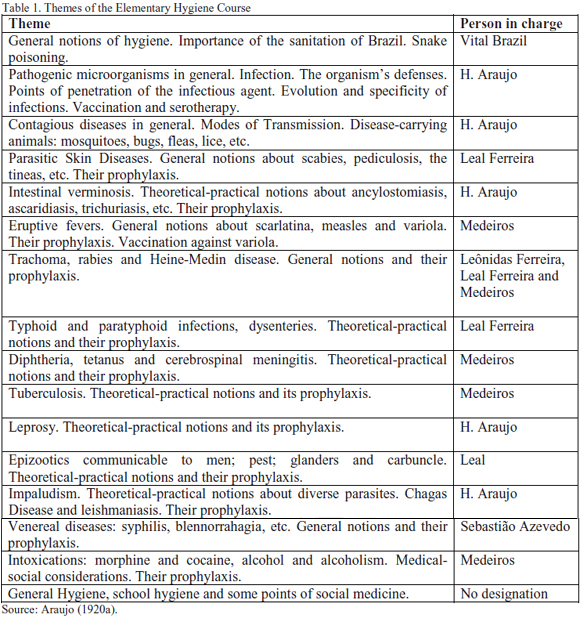
The two-month free course, divided into two parts, had conferences open to the public, with theoretical classes held at the "Gymnasio Paranaense". The approached themes are listed on Table 1.
]]>
To Marques and Farias (2007), when they mastered this knowledge, the teachers would be considered capable of performing surveillance and propagation of the hygiene ideal, a role that was theirs in the exemplary mission of educators.
Created by Law 2095 of March 31, 1921, the Medical Inspection Service at schools was based on São Paulo's experience, brought, not without reservations, to Paraná, by the General Teaching Inspector Prieto Martinez. One of the aims of the service was to visit schools, examining "in detail students and teachers" to understand the influence that school life had on children's lives (Marques, Farias, 2007).
Marques (1994) explains that, in teacher education, the close relation hygiene-education was highlighted in theses, congresses and conferences. However, the messengers needed to be tested and not always were they able to accompany the themes and classes, composed of what was considered, at the time, the best of the modern public health.
The program was complex and, we dare say, inadequate for the proposed objective. According to Pykosz (2007), it is possible to perceive, between the educational and sanitary scopes, a distance between what was prescribed and what effectively happened. Respect for the hygiene precepts and modern pedagogy was hindered by the structural and human conditions for its compliance.
In the State of Paraná, the official inclusion of the hygiene content to be developed with students included knowledge related to the main diseases that raged here, their prophylaxis and treatment, as well as first aid notions, which ended up exposing needs regarding the education of the local teachers to undertake that task (Pykosz, 2007).
]]> The teaching contents demonstrated concern about the health of body and mind, and also an old purpose: the formation of healthy habits to contribute to the organization of spaces and bodies capable of participating in the civilizing journey proposed by the medical intellectuality of the time (Pykosz, 2007).The report of the end of the Elementary Hygiene Course (1920) clarified:
[...] Of the 65 public school teachers enrolled in the course, only 28 teachers were submitted to the examination. A high percentage of them revealed great knowledge of the taught subject matter, and only one scored below what had been stipulated to earn the license. (Araujo, 1920b, p.266)
The director of the course, the doctor Souza Araujo, registered, in the text, his satisfaction with the result of the action, and emphasized that "a great pleiad of compatriot teachers revealed intelligence, perseverance and activity, causing the best impression on the assistants […]"(Araujo, 1920b, p.266). Great names of the Brazilian public health area wrote in the Archivos, giving to the sanitizing discourse credentials to highlight the missionary role of the doctors, their civilizing crusade, besides the indispensable role to be played by the local teachers in this "sanitizing battle".
According to the local intellectuals, Paraná's prosperity would not be achieved without a broad and deep interchange between doctors and the people. Thus, we consider that the teachers were "recruited soldiers" to battle along the children and their families, disseminating the civilizing wind brought by the Hygiene Science.
An assiduous partner of the Archivos Paranaenses de Medicina was the doctor Belisário Penna, who lectured on sanitary conscience during a visit to the city of Curitiba: "In any civilized country hygiene is no longer promoted without resort to propaganda and sanitary education […]"(Penna, 1921, p.73).
Some contributions to the national sanitation were highlighted by the campaign against the four universal scourges: alcoholism, syphilis, tuberculosis and consanguinity, which did not respect: "[…] climate, regions, or civilizations […]"(Penna, 1921, p.76-7).
To Penna, the combat against these ills would take place through a positive, experimental and biological science - hygiene - which, together with the application, by the teachers, of hygiene education at schools, would be able to develop in the children the control of desire. Such process would have a solid moral basis, with numerous duties, whose performance would avoid, to societies, the dangers that their non-observance caused to the human species:
]]> [...] it is this science that creates a biological morality, and indicates to us the prophylaxis and therapeutics to prevent and combat the terrible scourges that punish and destroy today's mankind: social selfishness, antialtruism, homicide, family dissolution, pessimism, Malthusianism, the social diseases (tuberculosis, syphilis), antipatriotism, international demoralization, suicide, and the voluntary, euphoriant and habitual intoxications (morphine, cocaine, hashish, ether, chloroform, tobacco, alcohol, etc.). (Penna, 1921, p.77)
In fact, hygiene education became, in the 1920s, a great ally of Paraná's doctors. The Archivos Paranaenses de Medicina started to publish a section called Hygiene Education, which would serve as a scientific subsidy for teachers to develop hygiene actions with the students.
[...] a section of ‘Hygiene Education' has been created, which has been publishing practical articles that have been distributed, through the Teaching Inspectorship, to the different Schools of the State […] when education begins at school, since kindergarten, the creation of good habits, which is gradually conducted among school populations, has a magnificent repercussion within the family. (Redacção..., 1922, p.192)
Believing in medicine and hygiene as civilizing weapons was fundamental to delimit a professional field to the doctors of Paraná, where there was no space for superstitions and quackeries:
In addition to everything we have indicated, it is of maximum, primordial importance the intense, persevering, continuous propaganda, through all means, everywhere, under any pretext, and the hygiene education of all individuals. It is indispensable to create in any possible way sanitary conscience, among the ruling classes, so that they know how legislate, and also among the dominated classes, so that they know how to obey without reluctance. (Propaganda ..., 1921, p.268)
What had been done in relation to the education of the teachers was considered by the local doctors as very little. In their opinion, the independence of the teaching of hygiene would give the opportunity, for the graduates of Escola Normal4, to acquire a larger sum of knowledge.
]]> The battle for the power of disseminating knowledge was great among the hygienists of the State of Paraná. The Rural Prophylaxis Service, linked to the federal sphere, and the state health and education programs disputed over important human resources - teachers and students - to disseminate ideals in a very privileged place: the school.[...] therefore, it is necessary to introduce, in the work, mainly the practical teaching of individual hygiene; the rest will gradually come, but the reform must come from above: - forming competent assistants, with a modern hygienic culture, capable of transmitting fundamental principles that will have to open a new path of progress to the greatness of our people. (Redacção..., 1922, p.192)
Twelve years after the beginning of the Rural Prophylaxis Service, in February 1932, the director of the Medical Inspection at Schools submitted an article to the Revista Medica do Paraná, in which he proposed the effective separation between the teaching of human biology and that of hygiene.
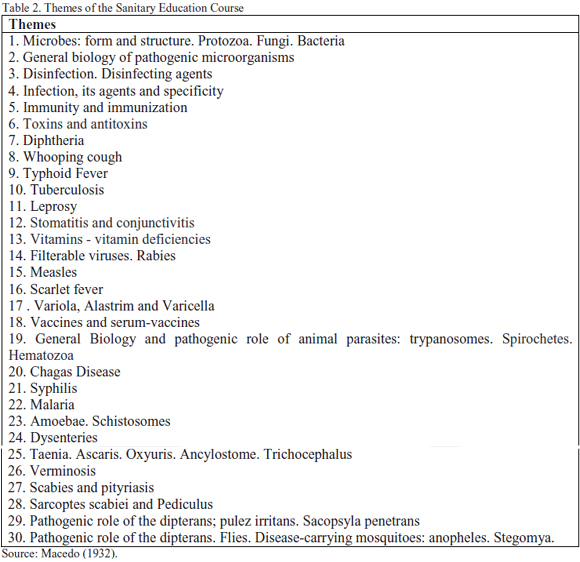
To achieve that, he presented a script for a course entitled Sanitary Education, in which the questions of school hygiene would require, from teachers, knowledge of several areas. Resuming the strategy of educating teachers, efficient collaborators in the formation of sanitary conscience, was indispensable. To fulfill this objective, the Medical Inspection at Paraná's Schools included, in its service programs, the Sanitary Education Course, destined to "teach students in the last year of Escola Normal necessary, although elementary, knowledge of hygiene and preventive medicine, and brief notions of transmissible diseases […]" (Macedo, 1932, p.123).
The course offered by the Medical Inspection at Schools did not intend, according to its organizers, to solve the problem "of the mental education of the teacher to perform her sublime educational mission, nor to substitute the chair in hygiene of the normal course" (Macedo, 1932, p.124). It was considered a rehearsal that aimed to provide them with concrete bases to understand the State's hygiene program, so as "[…] to include our teacher in the problems referring to healthy practices in the school environment and the consequent repercussion in the homes" (Macedo, 1932, p.125).
The Medical Inspection at Schools did not have, "for its mission", the necessary resources to spare "the collaboration intelligently developed in the school environment by the teacher. Without this assiduous and permanent collaboration, any and every effort of the school doctor will be negatively affected" (Macedo, 1932, p.125).
On Table 2, we reproduce the semiannual program, presented in 1931, of the Sanitary Education Course of the Medical Inspection at Paraná's Schools for the 5th year of Escola Normal. Composed of thirty items, the course could be considered a brief exposition of the Hygiene Science and the main factors for the diseases and mortality of Paraná's inhabitants.
[…] a little attention to the teaching and practical demonstrations of the doctors […] without tiresome details and technical terminology, accessible to any intelligence; it will open new horizons to the mentality of the future teachers regarding the evaluation of our sanitary realities and will contribute very much to the utilization of a valuable collaboration, perfectly imbued with their responsibilities in popular education, for the transformation of our hygiene habits. (Macedo, 1932, p.125)
In terms of contents, we have not noticed significant differences between the Elementary Hygiene Course (1920) and the Sanitary Education Course of the Medical Inspection at Paraná's Schools (1932). It is important to highlight, in the first course, a moralizing tone, perceptible through the themes "sanitation of Brazil", "general hygiene and school hygiene", which were not included in the 1932 course, but which would certainly be diluted in the discussions about syphilis. Perhaps, more important than the conceptual difference between the courses, was the distinction between their promoters: The Rural Prophylaxis Service (connected with the National Public Health Department) and the Service of Medical Inspection at Schools, in an attempt to, through the second one, value education and the local doctors.
In addition to the courses, the future teachers received the regular visit of Paraná's doctors at Escola Normal. Summoned to comply with the moral duty of engaging in the sanitation mission, they had contact, among others, with Milton Munhoz, professor of Hygiene of the School of Medicine of Paraná.
When he talked about health through education, in a lecture given at the Noble Hall of Escola Normal, as the closure of the Education Week, on November 25, 1933, Munhoz stated, to his public, that he was convinced that the hygiene-education partnership was the true path to fulfill the "most beautiful dreams of Social Medicine". He attributed relevance to the doctors' role, whose mission was to be
[...] the patron of health, advising the means to maintain it integral, teaching prevention measures and putting at everybody's reach the resources of defense against the common enemy that is the disease. The doctor is the worldly representative of the two divinities of the Greek mythology. Like Asclepius, astute, vigilant, he prudently cures, when he can, the sick organisms, and like Hygieia, in possession of the wisdom about normal and pathological phenomena, he transmits to those who are under his immediate guardianship the scientific truth of his time to the welfare of his fellowmen. (Munhoz, 1933, p.11)
To Munhoz and other doctors, theirs was also the role of raising the awareness, training and supervising the teachers' action in the support to the sanitation mission in Paraná. According to him, the doctor's interference should not be lesser in education, because he believed that the educator should work in partnership with the former, who would, in fact, be the technician capable of determining the physical and mental possibilities of the students, thus "[…] orienting, correcting and aiding the teacher's task" (Munhoz, 1933, p.12).
The science that was able to reduce the distance between pedagogy and medicine would be hygiene, because, by incorporating knowledge from other sciences, it enlarged enormously its range of action: "[…] The knowledge it mobilizes, its constant interference in all spheres of human activity, the daily need of it in all our acts, put it in a more advantageous position in relation to the very science from which it came […]"(Munhoz, 1933, p.13).
With powers to interfere in health, "[...] an essential factor for progress and, to the nation, one of the biggest reasons for its greatness", Hygiene would also be capable of producing social cooperation. The teachers' participation in the valuation of health, one of the great "goods granted to man", was neither a privilege nor a prize distributed by luck; rather, according to Munhoz, it was an objective that could be achieved through effort and intelligence. These would have, perhaps, one of their more important roles; after all, this author argues, "perennial health" and the disappearance of diseases were possible to be achieved through the application of hygiene precepts (Munhoz, 1933, p.12).
]]> Sanitary assistance, provided also by means of education, should extend its protection to all citizens. According to Munhoz, protection to society would be "[…] liable to measures, sometimes violent measures, but explainable and necessary" (Munhoz, 1933, p.12).The set of measures presented by the hygienists would enable, therefore, the continuous enhancement of a society that formulated itself, to the above-mentioned doctor, in a word: progress (Munhoz, 1933, p.13).
More than providing health, hygiene could put the deviants in conditions such that "their energy neither deviates nor falters, that their economic and social contribution is adequate" (Munhoz, 1933, p.14).
Presenting these ideas to the future teachers was part of a strategy of the doctors from Paraná: making them become co-participants in the construction of a national sanitary conscience, in which hygienic education would impose itself as an inseparable complement of general education, and, also, as the basis to form healthy citizens, capable of promoting progress and prosperity.
[...] we must educate not for the school, but for life, so that they become useful and productive elements […] From raw wax the educator must model, with the skill of an artist, the capable man. Education is not limited only to developing the mental faculties. It goes farther […].(Munhoz, 1933, p.12-3)
Under such perspective, health through education, according to Munhoz, needed rules not to be a utopian proposal. He then started to list some precepts which, once developed by the young teachers, would contribute to the success of the sanitation enterprise.
The first step would be to create, in the individuals, healthy habits:
]]> As an interlocutor of "good habits", we call Norbert Elias (1997), who understands habitus basically as a second nature, not taken in an essentialist way, fixed and static, but as a sum of modifications to the individual character moved by self-improvement. The hygienists advocated, for race regeneration, the development of the human capacity to self-improve, with the consequent acquisition of healthy habits.The formation of good habits, healthy habits, in the small child is the point of departure of education [...] empiricism advises us that it is not necessary to wait that reason awakes to begin education […] Hygienic education is based on the acquisition of habits which, slowly incorporated into psychological automatism, will later form sanitary conscience (emphasis in the original). The sooner it is started, the more real the results. The child passively registers the received impressions. (Munhoz, 1933, p.14-5)
The school, to some doctors from Paraná, was
[…] the cornerstone of hygienic education. Therefore, it must be prepared for its new mission. The building that houses it must be constructed according to sanitary engineering, the school material, adequate, the sanitary installations, sufficient and maintained rigorously clean […].(Munhoz, 1933, p.14-5).
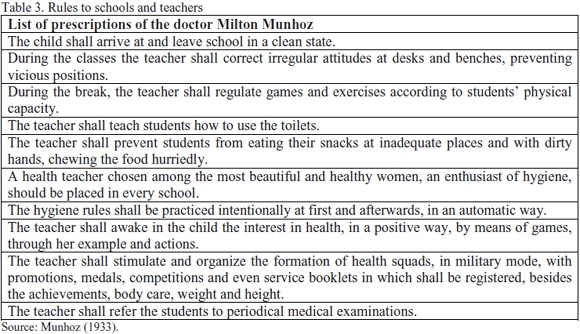
In this way, Munhoz presented, to the students of Escola Normal, prescriptions, described on Table 3.
]]> To comply with so many prescriptions, it was mandatory, initially, to instruct the teachers, because, to Munhoz, the educational task concerning hygiene would be the responsibility of the primary teachers. To him, trying any initiative without the previous education of a consolidated body of educators was incoherent.
All these involvements were meant to tackle two of the biggest national problems, according to the hygienist: education and hygiene.
Let us direct our attention to the schools, placing them in a position that is compatible with their noble mission, let us introduce in them hygienic education, efficient and profitable, let us embody this aspiration, which has not, until today, been able to be concretized as it should […] Let us work for the health of our people and thus we will have contributed to the happiness of Paraná and the greatness of Brazil. (Munhoz, 1933, p.18)
In 1937, the Revista Medica do Paraná published a theme that highlighted the ills of the rural area, referring to ignorance as the biggest of them. It proposed that the primary school should be strategically recognized as an Education Center: "[…] the schoolchildren are physically and spiritually healthier, and because of this, happier; the new ideas of progress and civilization are more easily disseminated by the means of communication […]"(Gonzaga, 1937, p.301-2).
However, progress alone did not guarantee a civilizing process:
It is known that the progress of a country is in direct ratio to the people's culture. Knowledge is the main capital of property. And instruction, in all its degrees, is the only key that opens the door to material, social, civic and professional progress. When teaching allied to hygiene has penetrated all popular masses from the most hidden rural regions, new and promising horizons will be unveiled to our nationality. (Gonzaga,1937, p.301-2)
The cabloco (countryman) has become reference in the recognition of the great problems related to the national progress, so that his redemption or the impediment of his emergence would be achieved by the application of the hygienist ideal, in which education and eugenics would be fundamental. However, only the apostolate of the teachers would not be capable of such a change:
]]> Instruction and hygiene constitute the two eugenizing forces that are capable of saving the child from the farm - our cabloco of tomorrow. The simple and rudimentary literacy is of no use without the complementary education: civic education, physical education, economic education, professional education, sanitary education, in short, transforming the unconscious and conscious. [...]. (Gonzaga, 1937, p.303)
The categorical imperative was to summon doctors to educate teachers in sanitary terms, because even after attending courses, there were criticisms, maybe due to the distance that existed between the courses that were taught and the daily pedagogical practice:
Unfortunately, among us, the teaching of hygiene at escolas normais leaves a lot to be desired […]
Primary school must be the first and greatest school of hygiene of a country […] it performs, with the teaching of hygiene, a new social function […] each school should be a temple of hygiene where children get used to practicing neatness rituals, hygiene being a civic religion […].(Gonzaga, 1937, p.303)
Then, some conclusions were presented that already configured the practice of some doctors at Paraná, according to the quotation: "Combating illiteracy is not enough; it is necessary to sanitize through education and sanitation […] The teaching of hygiene at Escolas Normais must be intensive, handling both urban and rural hygiene […](Gonzaga, 1937, p.304).
Final Remarks
At the end of the 19th century and beginning of the 20th century, the ideal of progress acquired, for Paraná's doctors, distinct meanings, but with the same prescriptions guiding their discourses: hygiene should be taught and learnt at school.
In that period, the organization of a medical order in the State of Paraná, centered on a model for the school based on the scientific rationality arising from the hygiene science, produced more than discourses; it started to make prescriptions to its users, even though the access to them was a complicating factor to the great majority of Paraná's inhabitants.
]]> Caring for, protecting and sanitizing infancy by means of the school was a task that was assumed aiming to include Paraná in the process of sanitary and social sanitation. According to its idealizers, once this process was disseminated, it would promote the improvement of our people, our race and the contention of the diseases that affected us.The construction of a local legitimacy and the desire of an identity forged the dissemination of a Europeanized ideal, in which doctors discoursed about the "extremely salutary climate" and about an idealized space for Paraná. Contradictorily, they lived with the non-"civilized" statistics of the population morbidity and mortality, with the organization and construction of hospitals and asylums, among other establishments to "combat diseases".
In their eagerness to transform this scenario, they elected the school and infancy to be sanitized and, thus, climb steps in the construction of a civilizing process. It is worth remembering that children molded by hygiene became important disseminators of sanitized habits, being also transformed in health agents, acting especially with their families.
Our intention was to give visibility to the science of hygiene in the movement of medicalization of Paraná's society, entering into spaces occupied by the hygienist rhetoric, in the daily interventions, in a civilization process that was considered the path to the national progress and redemption.
Following a set of positivistic ideas from the end of the 19th century, hygiene and education entered into the 20th century, consolidated in their role of disseminators of the scientific spirit, indispensable to social regeneration, although, in many moments, the social dimension was left aside in the discussions and the so-called sanitized ways of living that were proposed were not accessible to the poor populations. By considering themselves "intellectuals", the doctors from Paraná transformed themselves into agents of science dissemination and valued the potential of sanitation as a civilizing strategy.
As the central focus of the discursive practices of Paraná's doctors, hygiene and education were the framework of this study. The medical knowledge that was constructed was close to the pedagogical knowledge, frequently exposing contradictory aspects, but their basis was the sanitization of the school and its users. Stephanou (1999) compared this production of knowledge and prescriptions to a kaleidoscope, whose infinite view enables to unveil relations between sanitizing and sanitized subjects and the production of control and dependence procedures.
COLLABORATORS
Liliana Müller Larocca was responsible for the elaboration of the manuscript (based on a chapter of her doctoral dissertation). Vera Regina Beltrão Marques was responsible for the analysis of the theoretical framework, analysis of the sources and thematic discussions.
]]> REFERENCES
ARAUJO, H.C.S. Curso de hygiene elementar. APM, v.1, n.11, p.373, 1921. [ Links ]
______. Curso elementar de hygiene. APM, v.1, n.7, p.240-2, 1920a. [ Links ]
______. Curso de Hygiene elementar. APM, v.1, n.8, p.266, 1920b. [ Links ]
AROUCA, S. O dilema preventivista: contribuição para a compreensão e crítica da medicina preventiva. 1975. Tese (Doutorado em Medicina Social) - Faculdade de Ciências Médicas, Universidade Estadual de Campinas, Campinas. 1975. [ Links ]
ELIAS, N. Os alemães: a luta pelo poder e a evolução do habitus nos séculos XIX e XX. Rio de Janeiro: Jorge Zahar, 1997. [ Links ]
______. O processo civilizador: uma história dos costumes. Rio de Janeiro: Jorge Zahar, 1994. v.1. [ Links ]
______. O processo civilizador: formação do estado e civilização. Rio de Janeiro: Jorge Zahar, 1993. v.2. [ Links ]
FERNANDES, L. A Secretaria do Estado da Saúde do Paraná, suas origens e sua evolução no período de 1853-1983. Curitiba: Sesa/FSCMR, 1988. [ Links ]
FONTENELLE, J.P. A eugenia. APM, v.4, p.107-13, 1923. [ Links ]
GONZAGA, A.G. A escola primária: centro de educação sanitária. RMP, v.4, n.8, p.301-4, 1937. [ Links ]
HERSCHMANN, M.M.; PEREIRA, C.A.M. O imaginário moderno no Brasil. In: ______. (Orgs.). A invenção do Brasil moderno: medicina, educação e engenharia nos anos 20-30. Rio de Janeiro: Rocco, 1994. p.9-42. [ Links ]
HOCHMAN, G. A era do saneamento: as bases da política de saúde pública no Brasil. São Paulo: Hucitec, Anpocs, 1998. [ Links ]
MACEDO, J.P. O curso de educação sanitária da inspeção medica escolar do Paraná. RMP, v.1, n.3, p.122-7, 1932. [ Links ]
MARQUES, V.R.B. Instruir para fazer ciência e a medicina chegar ao povo no Setecentos. Rev. Port. Pedag., v.37, n.2, p.171-83, 2003. [ Links ]
______. A medicalização da raça: médicos, educadores e o discurso eugênico. Campinas: Unicamp, 1994. [ Links ]
MARQUES, V.R.B.; FARIAS, F.C.S.A. Eugenia e a doença dos escolares em terras paranaenses nos anos de 1920. In: MONTEIRO, Y.N. (Org.). História da saúde: as interfaces da interdisciplinaridade. São Paulo: Secretaria de Saúde de São Paulo, no prelo. [ Links ]
______. A inspeção médico-escolar no Paraná dos anos 1920: o apostolado de médicos e professores. In: DINIS, N.F.; BERTUCCI, L.M. (Orgs.). Múltiplas faces do educar: processos de aprendizagem, educação e saúde, formação docente. Curitiba: UFPR, 2007. p.125-36. [ Links ]
MUNHOZ, M. A saúde pela educação. RMP, v.3, n.1, p.11-8, 1933. [ Links ]
PENNA, B. O demônio da humanidade. APM, v.2, n.3, p.71-8, 1921. [ Links ]
PROPAGANDA hyginenica. APM, v.2, n.7/8, p.268, 1921. [ Links ]
PYKOSZ, L.C. A higiene nos grupos escolares curitibanos: fragmentos da história de uma disciplina escolar (1917-1932). 2007. Dissertação (Mestrado em Educação) - Setor de Educação, Universidade Federal do Paraná, Curitiba. 2007. [ Links ]
REDACÇÃO. Da necessidade do ensino da hygiene nas escolas. APM, v.3, n.5, p.191-3, 1922. [ Links ]
RELATÓRIO do Serviço de Saneamento e Prophylaxia no Paraná (1922). Curityba, 1923. [ Links ]
ROCHA, H.H.P. Higiene em imagens: os impressos e a propaganda de novos modos de viver. Rev. Port. Pedag., v.37, n.2, p.185-201, 2003a. [ Links ]
______. A higienização dos costumes: educação escolar e saúde no projeto do Instituto de Hygiene de São Paulo (1918-1925). Campinas: Mercado das Letras, 2003b. [ Links ]
SCHWARCZ, L.M. O espetáculo das raças: cientistas, instituições e questão racial no Brasil 1870-1930. São Paulo: Cia das Letras, 1993. [ Links ]
STEPHANOU, M. Tratar e educar: discursos médicos nas primeiras décadas do século XX. 1999. Tese (Doutorado) - Programa de Pós-Graduação em Educação, Universidade Federal do Rio Grande do Sul, Porto Alegre. 1999. v.1 e 2. [ Links ]
VIGARELLO, G. O limpo e o sujo: uma história da higiene corporal. São Paulo: Martins Fontes. 1996. [ Links ]
i Address: Rua Padre Camargo, 120, Curitiba, PR, Brasil. 80.060-240.