A proposta da Educação Permanente em Saúde na formação de cirurgiões-dentistas em DST/HIV/Aids
La propuesta de la Educación Permanente en Salud en la formación de cirujanos-dentistas en DST/HIV/Sid
Maria de Fátima NunesI,i; Cláudio Rodrigues LelesII; Márcio Florentino Pereira III; Renata Tolêdo AlvesIV
IDocente da Faculdade de Odontologia, Universidade Federal de Goiás, Goiânia, GO. <nunes.mariadefatima@gmail.com>
IIDocente da Faculdade de Odontologia, Universidade Federal de Goiás, Goiânia, GO ]]>
III Docente do Departamento de Saúde Coletiva, Universidade de Brasília
IVCirurgiã-dentista. Programa de Pós-Graduação em Saúde, Faculdade de Medicina,Universidade Federal de Juiz de Fora
Translated by Philip Sidney Pacheco Badiz
Translation from Interface - Comunicação, Saúde, Educação, Botucatu, v.12, n.25, p. 413 - 420, Abr./Jun. 2008.
ABSTRACT
The objective of this work is to report the experience of the "Project for the formation of dentists as facilitators of Permanent Education in Health in the area of STD/HIV/AIDS" developed in partnerships with the National Program of STD/AIDS, the Technical Area of Oral Health of the Ministry of Health, Public Universities and Municipal and State Secretaries of Health. The objective of the program was to capacitate dentists of the public health system in Brazilian states and cities to provide integral and humanized attendance for people living with HIV/AIDS. The methodology of choice for the form of teams of facilitators was Permanent Education in Health through semi-presential courses focusing on the problematization of local and professional realities. Thus, seeking to construct a process of education to modify and reorient the hegemonic dental practice, strengthening the process of attendance and management and the partnerships, guaranteeing the sustainability of the actions in the states and cities.
Keywords: HIV; Acquired Immunodeficiency Syndrome; Needs Assessment; Dentistry; Education Public Health Professional.
RESUMO
]]> Relata-se a experiência do "Projeto de formação de cirurgiões-dentistas como facilitadores em Educação Permanente em Saúde na área de DST/HIV/Aids", desenvolvido numa parceria do Programa Nacional de DST/Aids, Área Técnica de Saúde Bucal do Ministério da Saúde, universidades públicas, Secretarias Estaduais e Municipais de Saúde. O objetivo do projeto foi qualificar cirurgiões-dentistas da rede pública de saúde nos estados e municípios brasileiros para a atenção integral e humanizada às pessoas vivendo com HIV/Aids. A metodologia de escolha para a formação das equipes de facilitadores foi a Educação Permanente em Saúde por meio de cursos semi-presenciais com enfoque na problematização das realidades locais e profissionais. Buscou-se, assim, construir um processo de educação visando a modificar e a reorientar a prática odontológica hegemônica, fortalecendo os processos de atenção e de gestão e as parcerias, garantindo a sustentabilidade das ações nos estados e municípios.Palavras-chave: HIV. Síndrome da Imunodeficiência Adquirida. Determinação de necessidades de cuidados de saúde. Odontologia. Educação profissional em saúde pública.
RESUMEN
La propuesta de la Educación Permanente en Salud en la formación de cirujanos-dentistas en DST/HIV/Sida
Se relata la experiencia del "Proyecto de formación de cirujanos-dentistas como facilitadores en educación Permanente en Salud en el área de DST/HIV/Sida", desarrollado en una asociación con el Programa Nacional de DST/Sida, Área Técnica de Salud Bucal del Ministerio de la Salud, universidades públicas, Secretarías Estatales y Municipales de Salud de Brasil. El objeto del proyecto ha sido el de calificar a cirujanos-dentistas de la red pública de salud en los estados y municipios brasileños para la atención integral y humanizada a las personas que viven con HIV/Sida. La metodología escogida para la formación de los equipos de facilitadores ha sido la Educación Permanente en Salud por medio de cursos semi-presenciales enfocados en la problematización de las realidades locales y profesionales. Se buscó así construir un proceso de educación visando modificar y re-orientar la práctica odontológica hegemónica, fortaleciendo los procesos de atención y de gestión y las asociaciones, garantizando el sustentamiento de las acciones en los estados y municipios.
Palabras-clave: HIV. Sindrome de Inmunodeficiencia Adquirida. Evaluación de necesidades. Odontologia. Educación em salud pública profesional.
INTRODUCTION
Professions exist to satisfy a social need and dentistry is no exception. It operates in a social system, within which the profession and its institutions are continually readjusting according to changes in technology, professional points of view and the needs or demands of dental education. (Chaves, 1977, p. 368)
]]> The professional practices of dentists that work in public health services reflect the Flexnerian Model of formation of numerous teaching institutions in Brazil. Despite the continuous increase in the number of dental schools in the last few decades and the new curricular directives, few changes have been observed in the formation of their graduates.At the III National Conference on Oral Health (Brazil, 2005a, p.70), the problems related to surgeon-restorer model emerged again: "The expansion of Family Health teams made the limitations of the current profile of formation more evident, as a point of constriction in the implementation of the Brazilian Public Health System (SUS). The technical components of education during graduation and postgraduation in health are not generally oriented toward the health needs of the population, or for the use or creation of innovative assistance technologies".
As a possible solution to this problem regarding the professional profile present in the SUS, the Federal Constitution of 1988, Article no. 200, Clause III declares that it is for the administration of the SUS to oversee "the ordainment of the formation of human resources in the health area" (Brazil, 2003, p. 40). This attribution of the SUS in the formation of its workers was also cited at the VIII National Conference on Health (1986), in the Organic Law on Health of 1990 and in the IX, X and XI National Conferences on Health (Ceccim, Armani & Rocha, 2002). At the XII National Conference on Health, Permanent Education in Health began to be clearly proposed as the professional qualification policy. Humanization of the attendance of people living with STD/AIDS appears as a specific item inserted in the need for qualification of these professionals (Brazil, 2004, p.129-131).
From this perspective, Permanent Education in Health emerges as an investment strategy in professional qualification to surmount the deformations and deficiencies in the formation of health workers. The SUS "requires radically new professionals, in the sense that they assume postures and practices profoundly distinct from those currently established, especially in the field of basic care" (Capistrano Filho, 2000, p.8).
In 2003, the National Policy of Permanent Education in Health, proposed by the Ministry of Health as the education policy of the SUS, was approved by the National Health Council in combination with the Tripartite Inter-Administrations Commission.
Permanent Education in Health emerged as an important strategy for the transformation of the practices and organization of health services that should by constructed, prioritarily, from the problems that occur in the daily work routine so that a relevant plan of action and quality can be proposed. "Permanent Education in Health is learning on the job, where learning and teaching are incorporated into the daily routine of the organizations and the job" (Brazil, 2005b, p.12).
Permanent Education in Health is also in line with the new curricular directives for graduate courses in the health area, since it envisions the transformation of the attendance model, strengthening promotion and prevention, offering integral attendance and strengthening the autonomy of the subjects in the production of healthcare.
It also seeks the formation of critical professionals, capable of learning how to learn, of teamwork, of considering the social reality of those for whom they provide ethical, humane and quality attendance. The objective is not only to form good technicians, rather good professionals, capable of being creative in thought, feeling, will and action (Brazil, 2005b).
The strategy is that of significant learning, i.e., learning that makes sense to the individual. It provides the dialogue with the problems faced in reality and takes into consideration the knowledge and experiences that the individuals possess. In order for the learning to assume significance, the construction of knowledge passes through problematization. "Problematization means to reflect on certain situations, questioning facts, phenomena, ideas, understanding the processes and proposing solutions" (Brazil, 2005b, p. 8). While reflecting on the concrete situation of work, the proposed solutions become more real, viable and, above all, decentralized.
]]> THE FORMATION OF DENTAL SURGEONS AS FACILITATORS IN PERMANENT EDUCATION IN HEALTH IN THE AREA OF STD/HIV/AIDS
Through the project "The Formation of Dentists as Facilitators in Permanent Education in Health in STD/HIV/AIDS", the National Program of STD/AIDS (NP-STD/AIDS) in partnerships the Technical Area of Oral Health of the Ministry of Health, Public Universities and Municipal and State Secretaries of Health, conducted extension courses with dental surgeons throughout the country in 2005 and 2006. The objective of the project was the professional development of dentists in the public health system in Brazilian states and municipalities, through Permanent Education actions, seeking integral, humanized attendance for people living with HIV/AIDS.
The formation of facilitator groups in each state, with their respective projects for change by locoregional bases was the first step to emerge through the process of Permanent Education in Health, the experience of which is described in this work.
The second stage consisted in the development of proposals of intervention in each municipality and the third is the monitoring of these actions, with the support of advisors of the NP-STD/AIDS and monitors from each region. Both are in progress, presenting different stages between the states and municipalities cities, occasionally occurring concomitantly in certain locations.
For the realization of the initial stage of the project, nationwide semi-presential extension courses were proposed, with a study schedule of 136 hours. The selection of a group of facilitators and monitors for each state was also enabled. To define the objectives, methodology and instructional material, a series of workshops was held that established the conventions of the proposal with the state coordinators of STD/AIDS and oral health.
For the formation of dentists, the courses aimed for reflection regarding the process and formulation of the work of these professionals. It also aimed to increase their knowledge of and improve their behavior and attitudes toward HIV/AIDS and other sexually transmitted diseases, while generating transformations in the daily practice of the oral health team, particularly those that provide basic care in the SUS. The actions were considered locally, with the purpose of contextualizing the present reality and seeking improvement in the quality of attendance of the population and the users of the actions and services of oral health.
Other objectives of the course were: contextualize, approximate and dimension Permanent Education in Health as an education policy for the SUS; develop relationship competencies that assist the action of facilitators in the elaboration and implementation of the locoregional proposal of professional development; evaluate the knowledge and practices developed by dental professionals in their place of action; identify the needs and demands of dental services in attending STD/AIDS in the region; articulate the implantation of Permanent Education in Oral Health actions in the area of STD/AIDS with local managers; contribute to multiprofessional and multidisciplinary teamwork with dental professionals in the attendance of people living with HIV/AIDS; contribute to the qualification of basic care in oral health in the municipalities; and widen the discussion of legal and ethical questions and concerning vulnerability, discrimination, prejudice and fears in relation to attendance of STD/AIDS in the health sphere.
COURSE STRUCTURE
The formation course for dentists as facilitators of Permanent Education in Health in the area of STD/HIV/AIDS was structured in two presential meetings, interspersed with moments of tutored dispersion. The principal purpose of moments of dispersion was to assist the practices of Permanent Education in Health, using problems identified and agreed upon in each locoregion.
]]> The presential meetings facilitated discussions and successive approximations with the object of study, i.e., further knowledge regarding the practices of attendance in oral health for people living with HIV/AIDS in the work environment of the facilitator. Support for this problematization was established by the course learning units, which included the following basic contents: Permanent Education in Health; policy and the current situation of the AIDS epidemic, national policy for oral health; infection control; biosafety; bioethics; humanization; and buccal manifestations of AIDS. The entire structure of the course had and continues to maintain as its premise that "education should serve to fill the lacunae and transform professional practices and the very organization of the working environment. To achieve this, it is not enough to transmit new knowledge to professionals, since the accumulation of technical knowledge is only one aspect of the transformation of practices and not its central focus. The formation and development of workers also has to involve the personal aspects, values and ideas that each professional has regarding the SUS" (Brazil, 2005b, p. 13).
LOCOREGIONAL DIAGNOSIS
The formation course for dentists as facilitators of Permanent Education in Health in the area of STD/HIV/AIDS elected the locoregional diagnosis process as essential to problematizing and suggesting adequate solutions for the reality of each Brazilian state.
When proposing a new perspective concerning their place of work to the professionals, the course sought to make them feel part of the process and to embrace the desire for transformation and the perception that this was plausible.
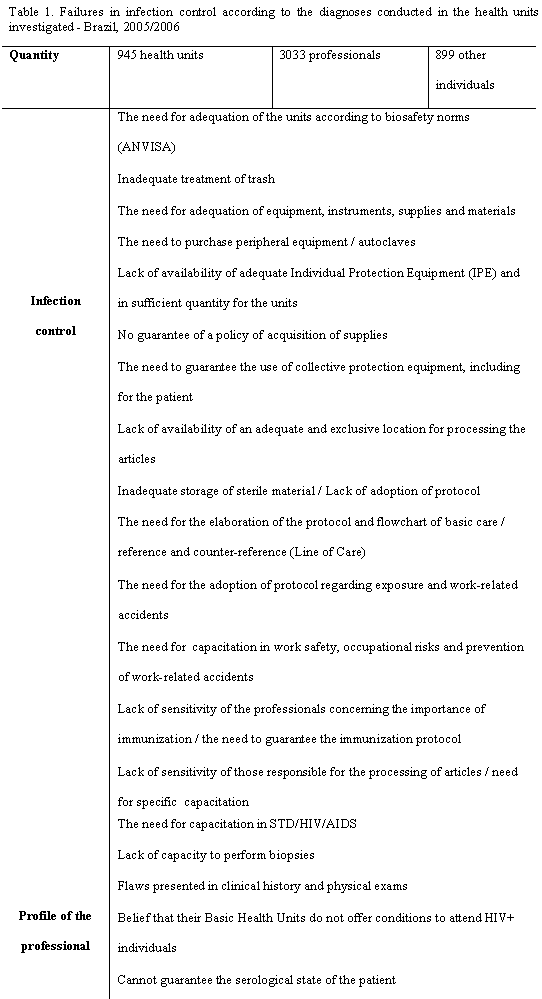
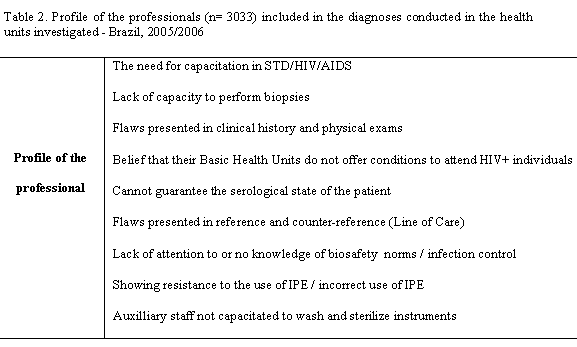
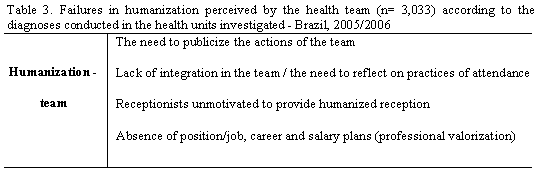
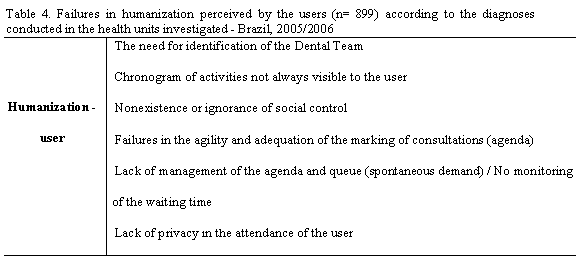
For locoregional diagnosis, the observation of certain primordial points was established: the profile of the professionals; humanization and bioethics; infection control and biosafety. As a result of the diagnoses performed, numerous problems were detected in all the aspects investigated, from structural questions in the work place to resistance and lack of knowledge on the part of professionals regarding the attendance required by people living with HVI/AIDS. Some of the problems highlighted in all states are presented in Tables 1, 2, 3 and 4.
]]>
]]>
Based on the diagnoses obtained, the Permanent Education in Oral Health Projects for STD/AIDS in each state were proposed, with several interventions suggested by the facilitators and tutors. "Within the proposal of Permanent Education in Health, the qualification of the team, the course contents and the technologies to be used must be determined based on observation of the problems that occur in the daily work routine and that need to be resolved, so that the services offered gain quality and the users are satisfied with the attendance provided" (Brazil, 2005b, p.13).
THE RESULTS ACHIEVED: ADVANCES AND DIFFICULTIES
Dentistry is long passed its artisanship and artistic ties and has been consolidated on scientific bases, seeking social action in the area of health. Quality, in professional terms, depends on competent actions, not only in indicating and performing skills and knowledge that respond to specific problems, but in rethinking the very role of the professional when faced with the problems of the social reality, in a movement of action and reflection. (Secco & Pereira, 2004, p.118)
The initial challenge of this project was the adoption of the reference of Permanent Education in Health as the formation strategy for the SUS, surmounting the traditional limits of the development of health actions and programs of a verticalized and centralized character. It was not an easy task to think of and construct a locoregionally based process with national objectives and organize, within basic care in oral health, a network of dental services in an integral and humanized manner that responded to the needs of people living with HIV/AIDS.
Considering that this process is still ongoing in the states and municipalities, the data and perceptions presented here are primarily the product of the first phase of the national structuration of the strategy proposed.
The strategy of constructing a national diagnosis of the problem, considering the needs and demands of locoregional services and the effective participation of the professionals and managers in the transformation of the practices and the reorganization of basic care in oral health proved to be innovative in the actions of the National Program of STD/AIDS and of Oral Health. However, it also revealed the fragility of the management of the policies involved, particularly for oral health, with difficulties of articulation between the areas of the development of the project in it state application stage, based on the work of local dentists facilitators.
The methodology of choice permitted the formation of a national network of three hundred and sixty-seven (367) facilitators and tutors, with forty-three (43) in the North Region, thirty-seven (37) in the Central-West, forty-eight (48) in the South, one hundred and four (104) in the Southwest and one hundred and thirty-five (135) in the Northeast Region.
]]> The performance of these professionals as facilitators of processes of change in attendance in oral health indicated all the transforming and strategic potential of Permanent Education in Health. From the passive, resistant and minimally compromised attitude of the dentist at the onset of the formation process, they went on to develop a more proactive and critical posture, with the emergence of new competencies and skills in communication, negotiation and agreement on proposals and solutions. There have been reports of change, principally in the work environment regarding infection control/biosafety and in questions related to the service structure, such as reforms in health units and the acquisition of equipment and materials.Adopting a strategy of education that responded to the demands and needs of management, attendance and social control proved to be correct and indicated difficulties concerning understanding this process not only as a theoretical reference, but also as a strategy for constructing intersectorial policies in health. The minimal of discussions and experiences in formation on the job, in teaching institutions and the services involved in the management of the project, demanded a series of workshops and reflections that deepened throughout the process involving debate, life experiences and the working together of the numerous actors involved. One of the points of innovation presented was the possibility of an action articulated and arranged by the National Program of STD/AIDS and the Technical Area of Oral Health of the Ministry of Health.
Another relevant aspect of the process was the teaching-service articulation with the construction of partnerships with state and federal public teaching institutions in the states and municipalities, in which the involvement of departments and specialists occurred in the process of elaboration and shared adequation of the didactic material and in the discussions that assisted in the diagnoses and in the elaboration, execution and monitoring of the process. Thus, in the State of Goiás, the university provided four (4) facilitators for formation as specialists in Dentistry in Collective Health.
The construction of this network could contribute to the sustainability of the actions developed and the achievement of the objectives proposed, which necessarily remits in the monitoring and evaluation of the results achieved in the ongoing process.
MONITORING
In any Project, accompaniment and evaluation are indispensable. Since the methodology that permeated the entire process favors and stimulates the sharing of knowledge and actions, this stage was also conducted this way. A group of ten assessors elaborated the monitoring instrument together with the National Program of STD/AIDS. Each of the ten assessors is responsible for a region or state, according to the complexity, size and distribution of the AIDS epidemic.
The objective of monitoring is to accompany the development of the others stages of the process, which are the actions developed in each region/state/municipality, since these are occurring in different ways and at different times according to local conditions.
FINAL CONSIDERATIONS
]]> If we are active actors in the scenes of formation and work (products and producers of the scenes, in the act), the events in scene make us different, affect us, modify us, producing disturbances in our ‘subjective being', maintaining us in permanent production. The permanent is the here-and-now, facing real problems, real people and real teams. (Ceccim, 2005, p.167)By taking the opposite direction of the hegemonic model of formation, the population, health professionals and instructors" have all gained. The active processes that proportion exchanges, that realize transformations, that lead to the purposeful development and conduct of dentists of the public health service and provide the attendance that people need, increases the autonomy of the subjects, creates responsibilities and commitments, demystifies beliefs and increases knowledge.
Realization, by professionals, of the diagnosis of their own work environment and facing their reality, can widen their viewpoint. The proposal of solutions in agreement with administration gain strength and are liable to be achieved. The discussion on fears and prejudices regarding what is real and what is the fruit of not knowing, demystifies and improves the relationship between dental surgeons and the users of dental actions and services who live with HIV/AIDS.
Since Permanent Education in Health is a process and not stagnant capacitation, the "project for the formation of dental surgeons as facilitators of Permanent Education in Health in the area of STD/HIV/AIDS" does not end like any other course for dental professionals. The new facilitator is a promoter of change.
The realization of this project sought to construct a process of education aimed at modifying and reorienting the hegemonic dental practice, strengthening the processes of attendance, of management and of partnerships, guaranteeing the sustainability of the actions in the states and cities.
In the future, it will be possible to evaluate more concretely, by means of monitoring, how effectively this reorientation in practice occurred in each state, what the real difficulties were and how these were resolved by the facilitators and tutors. It will also be possible to detect the facilitating elements of the process.
REFERENCES
BRASIL. Ministério da Saúde. III Conferência Nacional de Saúde Bucal, 29 de jul a 1 de ago, 2004, Brasília. Relatório Final. Brasília: Centro de Documentação do Ministério da Saúde, 2005a. [ Links ]
]]>______. Educação permanente entra na roda: pólos de educação permanente em saúde - conceitos e caminhos a percorrer. 2.ed. Brasília: Ministério da Saúde, 2005b. [ Links ]
______. Conselho Nacional de Saúde. XII Conferência Nacional de Saúde Bucal: conferência Sérgio Arouca, 7 a 11 de dez 2003. Relatório Final. Brasília: Ministério da Saúde, 2004. [ Links ]
______. Presidência da República. Constituição da República Federativa do Brasil, de 5 de outubro de 1988. Brasília, 2003. Disponível em: <http://www6.senado.gov.br/con1988/CON1988_05.10.1988/CON1988.pdf>. Acesso em: 30 ago. 2006. [ Links ]
CAPISTRANO FILHO, D. O cirurgião-dentista no programa de saúde da família. Rev. Bras. Odontol. Saúde Coletiva, v. 1, n. 2, p. 8, 2000. [ Links ]
CECCIM, R.B. Educação permanente em saúde: desafio ambicioso e necessário. Interface Comunic., Saúde, Educ., v. 9, n. 16, p. 161-77, 2005. [ Links ]
]]>CECCIM, R.B.; ARMANI, T.B.; ROCHA C.F. O que dizem a legislação e o controle social em saúde sobre a formação de recursos humanos e o papel dos gestores públicos, no Brasil. Cienc. Saúde Coletiva, v. 7, n. 2, p. 373-83, 2002. [ Links ]
CHAVES, M.M. Odontologia social. 3.ed. Rio de Janeiro: Artes Médicas, 1986. [ Links ]
SECCO, L.G.; PEREIRA, M.L.T. Formadores em odontologia: profissionalização docente e desafios político-estruturais. Cienc. Saúde Coletiva, v. 9, n. 1, p. 113-20, 2004. [ Links ]
i Address: Praça Universitária,Setor Universitário, Goiânia, GO. CEP:74.605-220
]]>