Para uma posição enunciativa no discurso pedagógico mediado por ambientes virtuais de aprendizagem
Para una posición enunciativa en el discurso pedagógico mediado por ambientes virtuales de aprendizaje
Regina Maria Varini MuttiI,i; Margarete AxtII
ILicentiate Degree in Literature. Department of Teaching and Curriculum, Faculty of Education and Postgraduate Program in Education, Federal University of Rio Grande do Sul. <reginamutti@terra.com.br>
IILicentiate Degree in Literature. Department of Specialized Studies, Faculty of Education and Postgraduate Program in Education and in Information Technology in Education, Federal University of Rio Grande do Sul
ABSTRACT
With a view towards a pedagogy for computer-based environments concerning distance learning and focusing on higher education, this study aimed to reveal the effects of implied meanings in the act of interpretation that idealized a synchronous and asynchronous communication tool called forchat. For discursive analysis, verbal formulations were taken from the corpus studied, which provided the themes for the sustaining principles within the dimensions of their purpose, format and use in virtual classrooms set up as learning communities. The results of the analysis highlight the uncloaking of the illusion of oneness, from the participants' immersion in the flow of the interaction, supported by another, non-capitalistic, space-time dimension for interactive exchanges. This dimension recognizes the subjects' heterogeneities and the meanings produced in the discursive order of the telematic writings.
Keywords: Educational technology. Distance learning. Higher education. Learning computer based environments and interaction. Forchat.
RESUMO
Tendo em vista uma pedagogia para ambientes informáticos na Educação a Distância, com foco privilegiado no ensino superior, este estudo se propõe a evidenciar efeitos de sentidos implicados no gesto de interpretação que idealizou uma ferramenta de comunicação (síncrona e assíncrona) - o forchat -, tomando, para análise discursiva, formulações verbais do corpus estudado que tematizam os princípios que a sustentam, nas dimensões de sua finalidade, formato e uso em classes virtuais, constituídas como comunidades de aprendizagem. Os resultados da análise destacam o desvelamento da ilusão do um, a partir da imersão dos participantes no fluxo da interação, suportado por uma outra dimensão espaço-temporal, não capitalística, para trocas interativas, e que reconhece as heterogeneidades dos sujeitos e dos sentidos produzidos, na ordem discursiva da escrita telemática.
Palavras-chave: Tecnologia educacional. Educação a distância. Educação superior. Ambientes virtuais de aprendizagem e interação. Forchat.
Teniendo en vista una pedagogía para ambientes informáticos en la Educación a Distancia, con foco privilegiado en la enseñanza superior, este estudio se propone evidenciar efectos de sentidos implicados en el gesto de interpretación que idealizó una herramienta de comunicación ("sincrona" y "asincrona") - forchat - tomando, para análisis discursivo, formulaciones verbales del corpus estudiado que establecen los temas de los principios que la sustentan en las dimensiones de su finalidad, formato y uso en clases virtuales constituidas como comunidades de aprendizaje. Los resultados del análisis destacan el desvelamiento de la ilusión del uno, a partir de la inmersión de los participantes en el flujo de la interacción, soportado por otra dimensión espacio-temporal, no capitalista, para cambios interactivos y que reconoce las heterogeneidades de los sujetos y de los sentidos producidos en el orden discursivo del escrito telemático.
Palabras-clave: Tecnología educacional. Educación a distância. Educación superior. Ambientes virtuales de aprendizaje y interacción. Forchat.
A DISCURSIVE ANALYSIS
As the understanding of Education regarding the production of subjectivities grows, new information and communication technologies begin to operate as devices of subjectivation. They influence the way subjects and meanings are constituted, given they emerged in an era currently designated as cyberculture. In the pedagogical discourse, we are aware that new technologies can represent diverse and contradictory positions. In the case under analysis, we assert a pedagogical position of agitation of the established forms of pedagogical constitution; and further assert the possibility of dynamizing the forms of relationships of the subjects with knowledge, such that the student and teacher are partners in the experience of producing knowledge, in which technology is essential (Axt, 2005).
Based on Deleuze, as cited by Fonseca (Axt et al., 2003a), we reinforce the notion that the production of subjectivities is related to devir and therefore, is not something essential; subjectivity is an effect, a product of the social time in which it is engendered. Since it is an effect of time, it is also an indicator of this time, in which the "outside" forges the "inside", like something folding back on itself. Thus, the "inside" of the fold, also the home of the thought, is the fruit of the inflexion of forces of the "outside", which folds to interlace with the "inside". In this sense, the production of the subject results from diverse confluences marked by dynamicity and complexity. In consonance, when we discuss the means of subjectivation in schooled education mediated by technology, we are situating ourselves "within" the flow that is also constituted by his "outside" It is within this strict sense that the subject is learned; the effect of meanings linked to a discursive position in which it, the subject, constitutes itself and is constituted.
Thus, we reaffirm that the understanding by the subject of the "interpretations as acts that arise as assumed positions and recognized as such, i.e., as effects of identification, assumed and not denied" (Pêcheux, 1990, p.57), is made possible only as effects of discursive meanings. Such effects result from the chosen analysis, in which we confer the articulated materiality and its relationship with the articulable.
By means of analysis of the discursive functioning, we seek to understand how the symbolic - when confronted with the political, since this is the basis of all discourse - speaks of its reality. The case under analysis is considered as object constituted in the discourse that constructs it and has marked its position in the area of educative telematics; in the words that conceive it, indicating interdiscursive positions - of reinforcement, of confrontation - in the impact in which it was produced. These identifications, as they are understood, are based on established meanings, that configure as "already there", but which emerge in diverse manners; they are not, nor could they be fully coincident, leaving ruptures from where meaning escapes. The analysis thus proposes, closely following Pêcheux (Mutti, 2005), the challenge of elucidating the heterogenous dimensions of the discourse. Based on the lacunas in the materiality of the articulated, we can permit inquiries that lead to the articulable and it is at this interface of articulated/articulable that it up to us, as analysts, to formulate an interpretation.
]]> Resuming: the materiality analyzed is verbal in nature, although the reality of the discursive object is not exhausted by the words that describe it… Notwithstanding, by describing its characteristics, highlighting its attributes and the properties of its constitution and use, it is assumed that the receiver forms for him/herself the "true-effect" of the discourse referent, whose nature is always symbolic and subjective. We work neither with the notion of message transmission, nor with the notion of full juxtaposition between language and referent, but rather with the concept of "effect of meanings" between speakers, according to Pêcheux (1999, 1990); and further, based on Authier-Revuz (1998), we consider that the relationship between words and things in language, as between speakers, is marked by noncoincidences.As Mutti (2004) describes, it is worth remembering that the position assumed by the group led by Pêcheux in the advent of information technology: according to Maldidier (2003), the arrival of information technology was viewed by this group regarding the possibility of causing "disorders", and that this (dis)order should be the subject of research. Recognizing the advent of this "proliferation" of meanings was a manifestation of political thinking. Dealing with this consists in "installing yourself in the very center of the flow, not to counter it, but rather to preserve the spaces of questioning, to undo the closure of meanings" (p.86). The author emphasizes that Pêcheux referred to it thus: "information technology can represent the most serious of threats […] unless we use it as a weapon to defend spaces not closed to meanings" (Maldidier, 2003, p.89).
Defend spaces not closed to meanings means opening the interaction between meanings, the participation of multiple and heterogenous meanings, making them "enter the flow", into the flow of the interaction, being in "the medium" of the interaction: Deleuze & Guattari (2000) suggested that the medium is "the place where things acquire velocity"; in other words, the medium is where meanings proliferate, opening to the multiplicity of intersections between series of meanings, undoing the closures (Axt, 2005). Following this train of thought, Axt & Elias (2003, p.260) emphasized that an interactional situation of learning is "living/experiencing multiple encounters between multiple thoughts… [is] entering ‘body and soul' into a real event", the latter coextensive to a series of transformations, which is coextensive to come to be, which is coextensive to language, to the meanings in language.
Before proceeding with the analysis of our case per se (a speech describing the principals that led to the construction of a long-distance communication tool and the pedagogical practice exercised within it), we propose an overview of the referent that provided the formulations in the presentation.
AN OVERVIEW OF THE REFERENT
The referent, the focus of a speech given by Axt (2005) and our discursive object of analysis, is a communication tool denominated forchat, created to favor pedagogical actions at a distance that propose intensive virtual dialogue between participants willing to discuss a theme, an author, a project or, even write an essay together. Activities such as these are proven to be consonant with the pedagogical devices that predispose their interaction and can even constitute conversational networks in the format of virtual communities, conceived with the proposal of favoring a high degree of dialogical interaction between their participants.
In-depth reading of Axt (2006) clarifies that the concept of dialogical interaction is sustained within Bakhtinian dialogism, in that all dialogical relations necessarily imply alterity and that all articulated expression (even when it is a delayed effect in relation to a previous expression) always corresponds to a prior active responsive attitude, ensuring a pragmatic-articulate and interactional context and the presupposition of language and the subjects of language in relation to each other. The amplitude of this context is always variable; one such dimension could include a real dialogue between two concrete speakers. Sooner or later, active and comprehensive listening leads to multifaceted replicas, plurals, that will integrate the dialogical flow, participating in its composition from a polyphonic perspective of multiple voices full of value, capable of maintaining a relationship of reciprocity with other voices of the discourse, defining a place of alterity and of affirming the other as another subject, another meaning, thus destabilizing the meaning of "oneness". One context that favors dialogical interaction is specifically that constituted by virtual learning communities, which, according to Axt (2004), being situated in cyberspace, can refuse to recognize capitalist divisions of space-time and conventional hierarchies, dismantling walls and inhabiting the plasticity of synchrony (which can be immediate) and distance (which can be relative) in which everyone can/must express themselves. The author considered that this approach could transform the nature and form of knowledge management, such that the ample possibility of expression, guaranteed in dialogue by listening, would in turn transform the economic nature of the teacher-student and student-student interaction. Ample expression will be able to produce a pathway towards a new form of managing the interaction itself, in which each individual can gauge and conquer the space-time required for their own expression (independent of the number of actors or demands that they face in their daily lives, or the symbolic capital that they possess), while achieving expression, in the same manner and through reciprocity, by guaranteeing the listening of the other, in radical opposition to the management-division of space-time of interactions in conventional classrooms.
Evidently, such pedagogical actions, sustained by a dynamic of intense collective participation, are not limited to the technological aspect. The methodological principals of this dynamic can be reinterpreted in other learning environments, in which the same measure of intensity of collective production is perhaps not as important. It is understood that the greatest potency of the desired effects depends on the penetration of the principals, at the same time methodological and technological, in the construction of the techno-active and discursive machinery of the device, creating a "positive derivative" of subjectivation in the production of collective agencements of speech and meanings. The specificity of this distance communication tool is that its constituting technological principals allow for penetration by the theoretical-conceptual and methodological perspective of a conversational-dialogical nature, encouraging collective production to achieve maximum potential.
The ForChat1 software is a communication tool that can be used by students and teachers of diverse teaching levels in any area of knowledge, whenever the objective is dialogical interaction (argumentative, narrative, expressive, contractual) of a conceptual-methodological or esthetic-fictional character, in which all the participants find themselves in the position of dialogue, through use of authorial writing. Its structure is based on a conceptual complex that seeks to favor access to the environment in the most intuitive manner, while simultaneously composing or fusing, in the same space, the functions of chat, forum and post board, maintaining the user immersed in the reading text at the same time that they dedicate themselves to producing their own text. Forchat: 1) bases its dynamic on the concept of a chat program, translating this in terms of velocity and integration in the synchronous encounters, supporting simultaneous access by large groups and storing and visualizing all the discussions in this synchronous mode, presenting the characteristics of an online forum; 2) uses the concept of an online forum to provide access for consultation to all the messages posted by the participants, synchronously or asynchronously, such that the contributions can be positioned to dialogue with everyone or one person in particular; preserves and provides online access to all the discussions in full, while allowing atemporal reading of and response to the same, respecting only the weekly system of organization currently in practice, with no hierarchical order (similar to an online post board) ; 3) takes from the concept of an online post board, the characteristic of an open nonhierarchical thematic network.
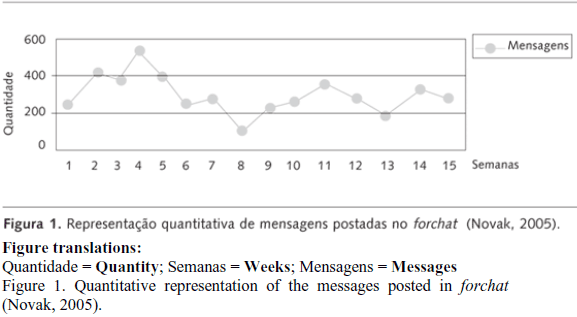
]]> Recently, this interactional dynamic was experienced in the specialization course, exploring a virtual learning environment developed according to another concept, with a very good index of usage (Axt et al., 2006), revealing that the proposed methodology is not exclusively limited to the referential tool. However, it was also possible to observe that the application for collective production did not achieve the same levels of use in terms of the dialogue intensity established in forchat (Axt et al., 2006). Another ongoing experiment involves the use of discussion lists as a conversational network, according to the methodological conception of forchat, with social psychology trainees (Lazzarotto, 2007).Novak (2005) researched the productivity generated inside forchat, performing a quantitative survey of the interactions between members of a postgraduate seminar involving 39 participants over a 15-week period. This study catalogued and classified the messages posted during the period from April 21st to August 3rd 2003, totaling 4,413 messages. The author concluded that volume of posted messages was spectacular, indicating the exponential number of 172,107 messages; Novak (2005) calculated that dividing the total number of messages over the period by the number of participants resulted in 111.97 messages, an average of 7.56 messages per week per participant, considering the dynamic of freedom regarding the number of postings and characters per post. According to Figure 1, the volume of weekly messages varied between approximately 200 and 400 messages.
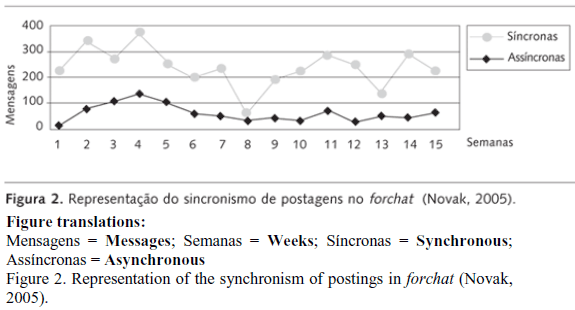
Novak (2005) also observed that the interactions remained constant; in week 8 of the seminar, an accentuated fall occurred in synchronous interactions due to problems with accessibility of the system at the time scheduled for this discipline. However, the reduction in synchronous interactions was compensated by a greater number of asynchronous interactions in this week. Figure 2 shows that over the evolution of the 15 weeks analyzed, the curve of asynchronous interactions closely follows the outline of the synchronous interactions, though at a lower level.
Forchat is characterized as a telematic environment, for use in Distance Learning disciplines willing to practice the shared construction of knowledge by written conversation and debate between the participants. Its architecture is extremely simple, like a blank sheet on which to write the letters, or an empty square waiting for its "habitués".
The initial screen of forchat shows a text box for the inclusion of messages. On the upper part of the screen, the menu permits each participant to choose an avatar, if they wish to; it also permits the user to define which week they want to be inserted into to accompany the debates and the number of messages of the week they wish to see on screen for each page actualization, given the processing time for actualizations.
When the dialogues are ongoing, after each intervention, the forchat screen indicates that it is possible to respond directly to the corresponding message content, using a supplementary text box situated right after the same. This situation signals that the user intends to interact with a specific speaker. This functions as a response to an existing message, as Novak (2005) clarifies. The second dialogue box, situated at the bottom of the page, consists of a standard box for sending any message. The pages available in the weekly debates are recorded, with access links to the respective pages and corresponding messages.
The dimension of the practice of forchat, considering its true use, has been the object of several studies; totaling roughly 10 academic works, including dissertations and theses, as well as a series of derived articles on which this reflection is developed. Certain thematic foci have been established: teacher training on the job; training in graduate teaching and trainee orientation; teacher training in postgraduation courses; outlines of evidence of constitutive heterogeneity; establishing conversation networks as a way of engaging children with learning difficulties in writing; establishing conversation networks as a way of engaging young monitors working in telecenters of Porto Alegre, RS, in writing, etc.2.
The central characteristic of the analysis presented in this article, however, is the discourse concerning forchat and its pedagogical possibilities and not the tool itself 3. For analytical purposes, discursive materiality was the starting point, following Mutti (2007), i.e., the linguistic formulations extracted from a speech given by Axt (2005), which highlights the "theoretical-conceptual machinery" that provides consistency to forchat, the techno-methodological principals from which it was engendered. The analysis considered lexical uses in their relation to the "designation gestures" that indicate the "assembly procedures" of the course of memory (Pêcheux, 1999, p.55), configuring a stated position assumed in the pedagogical discourse mediated by forchat. It should be emphasized that the memory of the various pedagogies in which forchat was effectively used and that conceptually sustain its methodological proposal in teaching practice also competed in the analytical interpretation4.
The guiding question in this discursive analysis was: what effects of meanings emerge from the description of the attributes of forchat and its form of use, characterizing a unique enunciative position?
ANALYSIS: EFFECTS OF MEANINGS
In this part of the article, we return to forchat as a discursively constructed object; to achieve this, following the theoretical-analytical of Discourse Analysis initiated by Michel Pêcheux (1990), we constituted a corpus for discursive analysis based on a speech by Axt (2005), in which the author highlights the techno-methodological principals and attributes of the tool, idealized at the connection of telematics and pedagogy.
]]> Using the discursive excerpts selected for analysis, we intend to show the way in which forchat was constituted as materiality, inscribed in the interdiscourse of new technologies for education.Availing itself of linguistic marks, analysis seeks to arrive at the order of the discourse, which, according to Orlandi (2001, p13), "is the dominion of the symbolic in relation to the historic reality (systematicity subject to equivocal), the necessary and contradictory articulation between structure and event". Thus, based on the theoretical-analytical referential adopted, it is assumed that the emergence of forchat as a discursive event is situated in a unique enunciative position in the pedagogical discourse mediated by virtual environments.
The analytical course, which began with the linguistic formulations extracted from the speech mentioned, is destined to reveal effects of meanings that are related to the symbolic gesture of interpretation that conceived the tool. The criterion used to define the excerpts was the presence of expressions that designated the techno-methodological specificity of the tool, converging on the definition of the position assumed by the author that formulate the pedagogical discourse mediated by forchat. Thus, it is assumed that the tool was constituted according to the pedagogical conception that was put into practice.
According to the discursive referential, it is understood that the signs are not transparent, rather opaque, such that it pertains to the analyst to place him/herself before this opacity to perform the analysis. It is also understood that a "stated position" corresponds to speaking place in the discourse, i.e., the discourse of educational information technology, more specifically, of distance learning mediated by virtual environments. This position is learned in the form of "effects of meanings", interpreted in the analysis, which are part of the thread of the discourse.
Next we present the discursive formulations highlighted and numbered from (1) to (18), extracted from the videoconference recorded and transcribed for the purposes of this research (Axt 2005), based on which we constituted the discursive excerpts for the present analysis; following the indication of the cited discursive formulations, we show the effects of meanings corresponding to the analyses performed. It should be emphasized that in Discourse Analysis, analysis is characterized as the production of meaning by the subject analyst and should be understood as our interpretation.
In a narrative that reveals the historical context, the lexical designations indicate the scientific academic environment or "research laboratory" where "forchat" was invented, which resulted in a "proposal" of an experiential discipline of "distance learning". The initial virtual platforms for teaching-learning with telematic support via the internet were beginning to appear in the Brazilian context at that time.
(1) Forchat was born in 2000 as the result of a research proposal in distance learning in the Laboratory and Studies in Language, Interaction and Cognition (Laboratório e Estudos em Linguagem, Interação e Cognição, LELIC) of the Faculty of Education of the Federal University of Rio Grande do Sul (FACED/UFRGS).
The technological environment should be the propeller of a new parameter for pedagogical dialogue, since the designation "laboratory" concurs with experiences in teaching; a new way of teaching together with new technology. This should overcome the limitations of certain conversation devices already used in the area of specialization. The discursive formation of the laboratory links studies concerning technology with studies concerning dialogue, aimed at promoting interactive practices mediated by telematics. The technology mediates "interaction", "language" and "cognition", articulating a theoretical perspective. As seen here:
(2) […] when forchat was being gestated, the discussions list was in clear expansion, while learning environments or platforms were rare. Among the functions of such environments were discussion forums, with relatively heavy architecture that were difficult to load when the online connection was basic telephone dial-up. The discussions were divided into subjects or topics, such that it was necessary to load the specific pages of topic A, or topic B, every time; moreover, messages were read on one page, but it was necessary to enter another page containing a writing form to send a reply or a new message. All these operations involving page loading burdened the operational system, making it slow and, occasionally, making interaction practically unviable.
This formulation highlights the specialized area from where the denomination "forchat" emerged, as a combination that alludes to discussion "forums" and "chats" from virtual conversations. In relation to the area of pedagogy, this was dedicated to a methodology that favored a special type of "interaction", supported by staging a debates forum, a form of virtual seminar, in a "conversation" environment, or chat. Hence, the double meaning that emerges from "forchat" ("made for chatting"). Assuming the dynamism of speaking encounters, the telematic support of this interaction could not be "slow", like other support systems were at the time.
]]> (3) This moment coincided with a moment in Brazil of affirming Distance Learning through Information Technology and the Internet and the consequent availability of resources for product development. Universities implemented institutional policies for Distance Learning in Higher Education, while agencies that supported research released funding directed at Information Technology in distance learning.Universities interpreted the governmental research policies; each university context attributed meaning to distance learning, exploiting the availability of resources. Thus, distinct disciplines of thinking and research practices appeared with this focus, characterizing differences between the groups that proposed the involvement of information technology in education. Theoretical interests, the history of each group, became factors in this diversity. Forchat was inserted in a tradition of educational research with an emphasis on active teaching and the construction of knowledge, while highlighting the "human sciences", in which language is favored:
(4) […] our research group at the LELIC proposed the development of products for distance learning, but with a tendency more typical of Human Science theories and methodologies. Thus, tools and environments for learning were born and forchat was among them.
The designation "tools" is important here, though it opposes the designation teaching "resource", which indicates another discursive position in the area of educational information technologies. As a product of investigation, forchat would thus be a "tool" (a word that comes from the area of technology) for the subject to accomplish learning, to produce knowledge non-traditionally, and not merely a "resource" to teach prepared knowledge.
(5) […] a series of six techno-methodological principals… provided sustenance for forchat.
Being a "techno-methodological" construct, forchat was programmed to function as a tool that allied the "technological" dimension with the "methodological" dimension, providing support to a distinct method of teaching and learning, one open to investigation. This tool should be primarily characterized by its operating facility:
(6) The "principal of simplicity". We required a simple tool that a child could handle. One that could be used alone for interaction and communication between the individuals of a group and could also be aggregated to other environments/platforms. For those who participated in a virtual community, the operational obstacles had to be minimized. At the time when it began to be used, 2001/2002, exiting the discussion list (accessible by e-mail) to enter the sites still represented a challenge for a course participant.
Note the use of numerous terms specific to the area in this formulation (environments, platforms, e-mail, sites, list) that could appear strange to the uninitiated. There are many who remain illiterate in computer technology, for diverse reasons, but one of these is "because it is difficult" to handle the program. Forchat was guided by the "principal of simplicity" concerning basic handling and file and platform linkage, recognizing that users usually give up participating when they can not overcome the "challenge" of surpassing the recognized "operational obstacles" in dealing with the software engine. Moreover, the "principal of simplicity" of the "system" of "connecting by dedicated telephone dial-up" was associated with being "lightweight", agile regarding the number of "page loads" and the "message writing form":
(7) The "principal of agility". The tool also should be lightweight, to be agile in the connection by dial-up/dedicated telephone line […] For the system, being lightweight, agile, meant reducing the number of pages loaded, among other things. In other words, why have a new page to load a message writing form? Why not imagine a forum page that imitated chat architecture… in which reading the messages and the writing form appeared on the same page?
As stated up to now, forchat was thought up "from within" the areas of knowledge involved, the technology and methodology of teaching and learning, representing a peculiar pedagogy. This pedagogy takes form more precisely when speaking about "freedom":
]]> (8) One principal appeared as central to the preservation of the rhythm of the conversation, the dynamism, the spontaneity of expression in distance learning: "freedom" in proposing the directions of the conversation, the debate, consequently inducing initiative by any of the participants to propose themes and debates around different themes, as long as the general objective of responding to a specific problem was preserved.While ready-to-use softwares grow in number, forchat stands off from this proposal of prepared and controlled teaching, rather it is presented as open, with no predetermined texts or exercises, to be peopled only by conversations, though still for use in teaching. The practices of traditional schooling do not normally excel in the use of "free" devices, since it tends to strongly avoid the dispersion of meanings and the destabilization of pedagogical relationships. In direct contrast, the forchat tool favors a practice of dialogue that elicits previously unthought-of modes of interaction. It is "free" to accept new ways of learning and teaching, which could emerge from diverse uncontrolled interactions. The interactive practice in forchat permits greater knowledge concerning interaction, especially concerning pedagogical interaction. Learning to interact virtually and learning about virtual interaction are effects of meanings that emerge from the proposal of forchat, valid for both students and teachers.
(9) At the same time, the tool needed to create a context of language favorable to the most spontaneous expression of ideas and a dynamic, live dialogue, achieving the fastest rhythm of enthusiastic presential conversations or heated debates, while minimizing the effects of loneliness/isolation provoked by the physical-spatial distance, i.e., the sensation of talking to/writing for no-one.
The "agility" referred to previously comes from direct conversation, which forchat intends to simulate in a non-presential conversation. The software engine, with its possible obstacles, must not inhibit the human debate that it is mediating at a distance. It is assumed, in some sense, that debate in direct communication, involving audible speeches, is more effective, spontaneous, dynamic, alive and heated than that achieved under conditions of writing. However, this comparison is not the only possible interpretation, since the virtual medium has different properties that are specific to it alone, that go beyond the relation of simulation indicated above. When raising the hypothesis of comparison between presential and virtual debate, a rupture appears through which a glimpse of other properties is permitted that would be outside of this comparison, but which raise other types of possibilities for interactivity.
That virtual conversation somehow simulates presential cannot be denied. The oral language, written language relationship is an important difference. Notwithstanding, within forchat, the realization of a conversation in writing conserves some of the properties of the oral condition, such as "rapidness", which in some sense, is maintained.
Responding and answering and exchanging turns immediately, characteristics of orality, are attributes transferred to the program format: "messages for reading and a form for writing appear on the same page" from the video. However, how much the environment of agile conversation influences the quality of participation in the virtual debate remains to be studied. For now, all we can say is that in studies already conducted that evaluated the experience, the reports indicate the achievement of learning and the construction of knowledge. In forchat, it is a fact that the subjects produce meanings in a discursive discipline through use of the written language, with telemetric support, at a distance, which opens multiple other possibilities of signification.
In the following formulation, the designation "immersed" deserves to be examined:
(10) This would resolve another problem as well! Participating presentially in a group meeting means being immersed in the context of the discussion, being together with everyone in the circle of conversation. In distance learning, loading another page with a form for responding, arguing, could mean loosing the thread of the conversation and the conversation looses its most heated rhythm. Thus, the "principal of immersion" was formulated in the text under construction. The result was a software engine of intense production, in which the text for reading and the form for writing were integrated into the same page.
"Being immersed in the context of the discussion", as proposed within forchat, assumes the meaning of entering into the flow; to participate it is necessary to dive into the virtual environment, being together with the other members inside it, being involving in the group. The direct oral presential condition is simulated to an extreme degree: the participant does not want to be "talking to no-one", does not want to be isolated, but in community. However, diving in does not effectively mean being "interested" in the whole course of the debate; that is not the question, because the ample interest of protagonists cannot actually be guaranteed by anyone, even in a presential group. If we were to compare the reality of numerous traditional presential classes with the participation and the virtual reality of forchat, we would have to agree that the latter demands greater participation, because "immersion" guarantees the formation of the group. When virtual presence is represented by the word, it is this that makes the subject a member of the group and in turn represents them. The subject is required to write, even to mark their presence, an act that is facilitated, because - and here the other "principal" of "freedom" is enacted - they are authorized to say whatever pleases them, even if this deviates from the focus. Thus "the immersion in the text under construction" generates a "software engine of intense production"; the participants are called to manifest themselves and they do, since the format itself facilitates that they read and write their commentaries: "the text for reading and the form for writing were integrated into the same page".
More than the demand of high quality participation in the issue under study, it is participation itself that is effectively solicited, which results in productivity associated with expansion of the text elaborated together. More than the relevance of what should be said, in contrast to what is expected as a answer from the student in presential classes, it is expected that they write what comes to mind. In this sense, the "collateral conversations" between students, which in presential teaching generally avoid the focus of the class, inside forchat they are not "collateral", but always central, since they are always "received", integrating the network with the all the other participations.
]]> One guarantee for the true onset of interactive exchanges via forchat is due to the fact that these occur in another space, another time, in the virtual dimension:(11) […] free expression, associated with the exercise of listening that promotes reception, both strengthened by a well-known effect of a virtual "duration" in space and time… changes the paradigm of social exchanges in the course environment.
(12) […] Expression, guaranteed (in the collective or dialogical interaction) by Listening, transforms the economic nature of the interaction: it could produce a pathway towards a new form of management-division of the same, in which each individual can gauge and conquer the space-time required for their own expression (independent of the number of actors or demands that they face in their daily lives, or the symbolic capital that they possess), concomitantly guaranteeing the listening of the other, in radical opposition to the management-division of space-time of interactions in conventional classroom.
The participations "last" in space and time, since they are written and remain recorded; thus the virtual space and time differ from the presential, amplifying the time that each discussion forum participant has available. It is as if the conversation could be stopped, awaiting reflection. This could be considered a specificity, derived from the sense of "freedom", capable of marking an important difference, characterizing the type of interaction promoted by forchat. The fact that it is written conversation favors the materialization of speech, which gains body; concomitantly, the time for thinking about the speech and the speaking can be suspended so that the participant only enters the conversation later, registering their pronouncement for the group, reiterating or even making amendments to their own pronouncements.
It is assumed that the peculiarities of this type of production can be the subject of research. A large quantity of written productivity is manifested, facilitating the process where all the participants become more visible and can be seen by what they write. As described, "immersion" means being present, contributing to the maintenance of the writing group, collaborating in a way that knowledge can emerge, circulate and be transformed, through the words released in forchat.
This extensive productivity in writing does not conceive the equivocal or non-coincidental as a problem, rather as a contingency of the condition of unrestricted manifestation, seen from a positive viewpoint:
(13) […] thus arises a new question: a conversation, a presential debate between a group of people inside a virtual community, although it maintains a clear tendency towards a common objective (the reason for being a community), according to custom, it is subject to thematic fluctuations, digressions, dispersions, variations; this can also lead to the formation of subgroups according to associations surrounding the thematic variations or from newly derived themes.
(14) The assurance that such initiatives will be recognized and valued by the group and the teacher as valid attempts to respond to a problem, or to problematize again, based on the general problem.
The attribute "freedom" appears to mean the free initiative to speak/talk, proposing themes and debates to be discussed within the group, while being guaranteed to be heard. The common horizon is the problematization pitched to the group to be debated. Interest is a presumed condition in the academic discourse in which forchat is inserted. It is assumed that academics would wish to participate in a qualified discussion and be responsible for maintaining it. It seems obvious that those who participate in a given course would be willing to participate in the educative practices of the same, although this willingness is not always manifest in traditional presential academic classes. In these, it is difficult to promote ample dialogue, since the appropriate time and space are lacking; whereas in forchat, with its distinct space and time, distinct reception, different visibility of the student, there is a greater possibility that participation occurs. Thus the following formulation touches on the teacher-student asymmetry in the pedagogical discourse, diminished within forchat:
(15) The "principal of deinstitutionalization of preinstructed positions" […] This is a point of expressive tension: how can the course dispense with the position of master? In truth, it does not concern dispensing with the POSITION of master, or the master himself; it concerns voiding this position, desubstantializing it, deinstitutionalizing it. And this position of master is an institution!
]]> The participants begin to construct themselves not as a group of students guided by the teacher, but as members of a "community" of studious individuals of a theme, in which the teacher does not direct the course of the discussion. From this perspective, almost as merely one more member of the group, the teacher exposes him/herself to not "knowing" how to respond to everything, rather to seeking knowledge, like the other members; it is necessary to shift from the place of one who "knows and controls" into the circulation of the group knowledge. The student also needs to renounce the crystallized meanings of a traditionally passive and individualistic place. Everyone is urged to "enter into the flow", to be "in the medium" of the interaction, to expose themselves to the "acceleration"; all are urged towards a new possibility of growing together, to "free expression" facilitated by the "receptive listening" presumed in this community.Indeed, the utopian sense of this proposition is viable in the more flexible conditions of time-space administration that each individual needs to mature their thinking and formulate their own discourse. It is possible to participate at any time you want to, during the week, returning to find the records of all the manifestations of the group members, which you can respond to immediately or later. A significant discontinuity is promoted by this expansion in the time-space of exchanges that provide support to the production of knowledge.
The position of the teacher is displaced and can be occupied by any group member that is willing to "teach", at some point in the discussion, without performing this role permanently.
(16) […] in distance learning, the possibilities of telematics are used to advantage, […] creating dislocations that favor the circulation of presumed knowledge for other positions.
It is known that it is not easy to abandon institutionally defined positions, legitimized by the wider society. However, inside forchat, this alteration becomes institutive of a discursive course in pedagogic practices, institutive of a form of subjectivation in the field of education, forming part of the group memory as an alternative. Using this practice, the fact that the students can also learn from each other is made evident, they do not only depend on the intervention of the teacher. Thus other type of teaching function legitimately begins to grow, one that diminishes the effect of the uniformity of meaning in language, different from more conventional practices that illusively work in the certainty of singularity that the word of the master would be invested with. In this sense, Pêcheux (1999) says that the pragmatic subject has a need for logical homogeneity, upon which the established parameters for living in society are nurtured; however, he indicated that this homogeneity is not reproduced without ambiguities: the subject, condemned to make sense of their existence, which is dynamic in nature, is not completely happy in their identification with meanings that are already there; these preconstructed meanings, at the same time as they reproduce themselves, transform themselves, moving themselves with each new utterance instigated by the subject, in the use of the language, determining that the meaning turns into something else.
Recognition of the heterogeneities does not make the production of meanings harder within the group, on the contrary, it feeds it. As seen here:
(17) The "principal of alterity". Briefly, thematic deregulation and explicit, recognized polysemy […] generates multiplicity, destabilizing closed conceptual systems that are accommodated: closure is ruptured by the piercing of the other, resulting in acceleration, proliferation and dispersion.
(18) The effects generated, the acceleration and proliferation of messages, themes and concepts: the multiplicity and dispersion of meanings; the conceptual destabilization, led to incisively and abruptly assumed positions regarding the existence of the other, the truth of alterity; the dynamic of interaction as it was produced, engendered a remarkable meeting with the heterogeneous, with the strange.
The participants of forchat, in certain disciplines, whether from the graduation or postgraduation stricto sensu courses, originate from different areas of formation and/or professional practice; this is one of the characteristics of groups formed for distance learning, united around a common objective, whether this is the study of an author, examination of a concept, debate on a given theme, the elaboration of a collective article. The different areas of formation from which the participants originate point towards stabilized discursive universes, where the effect of homogeneity had been acquired, which they needed to adhere to so as to construct their "identity".
For the heterogenous group, subjects constituted in distinct areas of knowledge convey the positions that they are concerned with, but such positions tend to open to comprehend problem-situations with representatives of different areas. Similarly, the differences between the roles of teacher and student or between the different levels of postgraduation and graduation revealed in the group were not totally erased.
]]> Recognition of the differences connected to the pedagogical work mediated by forchat deepens through the understanding of the theoretical dimension. Thus, certifying that heterogeneity is a constitutive condition of the subject; it concerns the truth of the non-one over the illusion of the one, according to Authier-Revuz (1998). At certain points the illusion of the one is ruptured, from within the very fabric of the collective text of forchat, with new questions arising as challenges. It appears that the proposal of forchat is to distinguish the truth of non-one in its heterogenous nature. The collective text, like a patchwork quilt, is formed by means of diverse tonalities and forms that unite: like a patch, each participation is at the same time divergent and convergent. The "illusion of one" impels the virtual community to thread its words, weaving in a common meaning, whose stability is not perennial, but transitory, because each time it remains open to new readings.
THE TITLE OF CONCLUSION
The difference represented by the discourse on forchat, and the pedagogical practice exercised within it, in the sphere of Distance Learning in relation to the traditional pedagogical discourse, appears clearly in the fact that, in this, the focus on curricular knowledge is normally characterized as a defined list of "things to know" (Pêcheux, 1990), the fruit of stabilized knowledge understood as prepared and finished, basically to be consumed in the same way, both by the teacher, who should "know" what to teach, and by the student, who should "learn". Without escaping from the necessary illusion of one, the practice of forchat appears to collaborate in the constitution of subjects that dare to think of knowledge in human sciences as a discursive construction of the subjects. If knowledge is thus understood, the pedagogy concerned with it will be different: learning and teaching are understood as an open process of production of discursive meanings, as referred to by Elias & Axt (2004).
The agitation provoked in the traditional sense of pedagogical discourse is manifest, from a much deeper perspective, in the shared experiences within forchat, since in these, there is a deliberate desire to not exercise control over the interpretation of the students who participate, making opinions, proposing their ideas, organizing their thinking through the written language. It is conceived that meanings escape the words and, in writing, this fact appears to become more evident, making it clearer that each subject has a particular story that springs from the singularity of their experience. We should reflect that this destabilizing agitation is instituted as an effect in devir, "in becoming", through the written conversation, in the process of an ongoing transformation in the virtual interaction mediated by forchat.
It is not our intent to affirm the non-existence of solidified interpretations that determine directions of meanings; indeed, we intend to affirm, as does Deleuze (1996), that these solidified lines, constituents of hardened relationships, continually coexist with lines of divergence, attributed to the processes of differentiation always in course and in which such interactions are forged and the meanings are expressed. These malleable lines of singularity do not always survive in direct confrontation with hard lines; however, they are capable of promoting ruptures in the established devices, opening to the multiplicity of meanings and corresponding stated positions.
According to our understanding, it appears that through the mediation of forchat and its forms of use, that a singular stated position in pedagogical discourse was instituted, managing forms of subjectivation the signify ruptures in the illusion of "one", which, without exiling this necessary illusion, create territories where identitary matrices can agitate in the interdiscourse, thus reinforcing in the participants, stated positions of singular interpretation in spaces not closed to meaning.
REFERENCES
AUTHIER-REVUZ, J. Palavras incertas: as não coincidências do dizer. Campinas: Ed. da Unicamp, 1998. [ Links ]
AXT, M. Comunidades virtuais de aprendizagem e interação dialógica: do corpo, do rosto e do olhar. Filosofia, v. 7, n. esp., p. 256-68, 2006. [ Links ]
______. Forchat: uma alternativa tecno-metodológica para a EAD. Video-conferência para o Workshop Modelos na EAD. Lisboa, 2005. [mimeogr. [ Links ]]
______. Comunidades virtuais de aprendizagem. Inform. Educ., v. 7, n. 1, p. 111-16, 2004. [ Links ]
AXT, M.; ELIAS, C.R. Autoria coletiva, ambientes virtuais e formação: quando a aprendizagem reverbera o acontecimento. In: MARASCHIN, C.; FREITAS, L.B.; CARVALHO, D.C. Psicologia e Educação: multiversos sentidos, olhares e experiências. Porto Alegre: UFRGS, 2003, p. 259-77. [ Links ]
AXT, M. et al. Interação dialógica: uma proposta teórico-metodológica em ambientes virtuais de aprendizagem. RENOTE - Rev. Novas Tecnol. Educ., v. 4, n. 1, 2006. Disponível em: <http://www.cinted.ufrgs.br/renote/jul2006/artigosrenote /a32_21197.pdf>. Acesso em: 18 abr. 2008. [ Links ]
______. Tecnologias digitais na educação: tendências. Educar Rev., n. esp., p. 237-64, 2003a. [ Links ]
______. Rede de desassossegos: problematizações acerca de uma experiência pedagógica no ensino superior na intersecção com ambientes virtuais. Contrapontos, v. 3, n. 2, p. 243-54, 2003b. [ Links ]
AXT, M.; KREUTZ, J.R. Sala de aula em rede: de quando a autoria se (des)dobra em in(ter)venção. In: FONSECA, T.M.G.; KIRST, P.G. Cartografias e devires: a construção do presente. Porto Alegre: UFRGS, 2003. p. 319-340. [ Links ]
DELEUZE, G. O mistério de Ariana. Trad. Edmundo Cordeiro. Lisboa: Vega, 1996. [ Links ]
DELEUZE, G.; GUATTARI, F. Mil platôs: capitalismo e esquizofrenia. Rio de Janeiro: Ed. 34, 2000. v. 1. [ Links ]
ELIAS, C.R. (Des)caminhos do aprender: uma perspectiva teórico-metodológica que aproxima aprendizagem e sentido/acontecimento. 2003. Tese (Doutorado) - Programa de Pós-Graduação em Educação, Universidade Federal do Rio Grande do Sul, Porto Alegre. 2003. [ Links ]
ELIAS, C.R.; AXT, M. Quando aprender é perder tempo... compondo relações entre linguagem, aprendizagem e sentido. Psicol. Soc., v. 16, n. 3, p. 17-28, 2004. [ Links ]
HARTMANN, F. A voz na escrita. 2007. Tese (Doutorado) Programa de Pós-Graduação em Educação, Universidade Federal do Rio Grande do Sul, Porto Alegre. 2007. [ Links ]
LAZZAROTTO, G.D.R. Juventude escrita: pragmáticas de uma psicologia que forma e se forma. 2007. Projeto de tese (Doutorado) - Programa de Pós-Graduação em Educação, Universidade Federal do Rio Grande do Sul, Porto Alegre. 2007. [ Links ]
MALDIDIER, D. A inquietação do discurso: (re)ler Michel Pêcheux hoje. Trad. Eni Orlandi. Campinas: Pontes, 2003. [ Links ]
MATTE, M.N. Autoria no ambiente virtual pedagógico. 2005. Tese (Doutorado) - Programa de Pós-Graduação em Educação, Universidade Federal do Rio Grande do Sul, Porto Alegre. 2005. [ Links ]
MUTTI, R.M.V. Memória no discurso pedagógico. In: INDURSKY, F.; FERREIRA, M.C.L. (Orgs.). Análise do discurso no Brasil: mapeando conceitos, confrontando limites. São Carlos: Claraluz, 2007. p. 265-76. [ Links ]
______. O primado do outro sobre o mesmo. In: INDURSKY, F.; FERREIRA, M. C. L. (Orgs.). Michel Pêcheux e a análise do discurso: uma relação de nunca acabar. São Carlos: Claraluz, 2005. p. 281-6. [ Links ]
______. Discurso pedagógico: efeitos de sentido de criatividade. In: ENCONTRO NACIONAL DA ANPOLL, 19., 2004, Maceió. Anais... Maceió: GT de Análise do Discurso, 2004. [mimeogr. [ Links ]]
NOVAK, S. O problema da interação na era da aprendizagem autônoma: pressupostos epistemológicos da Educação a Distância na perspectiva construtivista. 2005. Dissertação (Mestrado) Programa de Pós-Graduação em Educação, Universidade Federal do Rio Grande do Sul, Porto Alegre. 2005. [ Links ]
ORLANDI, E.P. Tralhas e troços: o flagrante urbano. In: ______. (Org.) Cidade atravessada: os sentidos públicos no espaço urbano. Campinas: Pontes, 2001. p. 9-24. [ Links ]
PÊCHEUX, M. O discurso: estrutura ou acontecimento. Trad. Eni Orlandi. Campinas: Pontes, 1990. [ Links ]
______. Papel da memória. In: ACHARD, P. Trad. José Horta Nunes. Papel da memória. Campinas: Pontes, 1999. p. 49-57. [ Links ]
]]> 1 Forchat was conceived by Margarete Axt and implemented by PROVIA/UFRGS/ CNPq Board Project grant-holders Tiago D. Sturmer, Fábio M. de Carvalho, Lucas Guimarães and Daniela P. Paiva, with the collaboration of postgraduate students. From a programming viewpoint, the ForChat software enables the exchange of information in the format of a discussion script, with all records available online. The software structure is based on the storage of messages in a MySQL database ordered by means of a page in PHP, for posterior exhibition in a browser (http://www.lelic.ufrgs.br/forchat).