Fontes teóricas sobre representações sociais: um perfil bibliométrico de textos citados em periódicos científicos nacionais da área de Saúde
Fuentes teóricas sobre representaciones sociales: un perfil bibliométrico de textos citados en revistas científicas brasileñas del área de salud
Guido Rummler
Titular Professor, State University of Feira de Santana - UEFS, Bahia, Health Department. rummler@uefs.br
Translated by Luisa Maria Larcher Caliri Juzzo ]]> Translation from Interface - Comunicação, Saúde, Educação, Botucatu, v.11, n.23, p. 637-646, Sept./Dec. 2007.
ABSTRACT
In activities leading to the formulation of policies and services, in either research or education, it can be seen that the processes of acquisition and utilization of empirical data are not always anchored in theoretical foundation. At the same time theoretical formulations appears as alienated from experience. On the other hand, a qualitative approach and an increasing adherence of researchers basing their methodology on the Social Representations Theory (SRT) seem to be more present in Health scientific publications. Through the analysis of citations applied to 45 reports of SRT-based empirical work, 69 bibliographical sources of that theory have been identified. This paper presents a list of such sources as a way to favoring the search by students or researchers concerned with the subject. Also, a bibliometrical profile was drawn of various aspects of those sources and of their recurrence within the group under analysis.
Key words: Qualitative research, Social Representations, Social Representations Theory, Health, bibliometrics.
RESUMO
Observa-se, em atividades que levam à formulação de políticas, serviços, pesquisa e educação, que nem sempre os processos de obtenção ou utilização de dados empíricos encontram-se ancorados em bases teóricas. Observam-se, também, informações teóricas desvinculadas da experiência empírica. Por outro lado, no âmbito da publicação científica em Saúde, nota-se a crescente presença da abordagem qualitativa e, também, a crescente adesão de pesquisadores que fundamentam sua metodologia na Teoria das Representações Sociais (TRS). No presente estudo, por meio de análise de citações relacionadas a 45 relatos de trabalhos empíricos embasados na TRS, foram identificadas 69 fontes bibliográficas dessa teoria. Formula-se uma listagem dessas fontes com o intuito de favorecer uma eventual busca por parte de estudantes ou pesquisadores interessados. Traça-se, também, um perfil bibliométrico referente a diversos aspectos das fontes identificadas e sua ocorrência no conjunto analisado.
Palavras-chave: Pesquisa qualitativa. Representações sociais. Teoria das Representações Sociais. Saúde. Bibliometria.
RESUMEN
]]> En las actividades que conducen a la formulación de las políticas, de los servicios, de la investigación y de la educación no siempre los procesos de adquisición o uso de datos empíricos están anclados en bases teóricas. Se observan también informaciones teóricas enajenadas de la experiencia empírica. Por otra parte, en el campo de las publicaciones científicas referentes a la salud, se nota la presencia creciente de metodologías de planteamiento cualitativo y también la creciente adherencia de investigadores que fundamentan su método en la Teoría de las Representaciones Sociales (TRS). Por medio de análisis de citaciones relacionadas a 45 relatos empíricos con embasamiento en la TRS, se identifican 69 fuentes bibliográficas de esta teoría. Este artículo presenta una lista de tales fuentes para favorecer su búsqueda por parte de estudiantes o investigadores interesados. También se traza un perfil bibliomático referente a diversos aspectos de las fuentes identificadas y de su ocurrencia en el conjunto analizado.Palabras clave: Investigación cualitativa. Representaciones sociales. Teoría de las Representaciones Sociales. Salud. Bibliometría.
Introduction
It can be applied to most of the areas of Health that deal with interface questions with Human and Social sciences what Carvalho (2003) writes in reference to his professional area, Nursing: we need the bases and methods of nomotetic sciences (sciences of nature and of scientific laws) as much as we need the requisites and rules of ideographic sciences (those which deal with representations of ideas and language analysis).
Quite possibly such a perception constitutes one of the supports of the transition of scientific research on Health from a quantitative methodological polarization to an approach of operating together with qualitative paradigms. Therefore, it is desirable and it seems feasible that, from the approximations between the respective methodologies, approaches can be combined that may permit us to achieve such levels of understanding as may be each time less fragmented concerning the actualities under study. However, we still have to deal with extreme aspects, such as those mentioned by Briceño-León (1995), according to whom, in the area of Social Sciences and Health, "there is a fundamental difference as to the way of assuming the object of study." There are some groups even in official areas "that perform minute tasks of data collection, but do not interpret them from a theoretical perspective", while on the other hand, "there are university groups more intimately concerned with theory but with no empirical research practice." Possible causes in reference to the first situation, that author adds, are that "the theory exists, but it is not taken into consideration, either because of the limitations of formal education or because of the urgency of some practical work" (p.36). Notwithstanding, it is through the approximation or link of profession/university activity that one can verify the production of knowledge generated by the application of methodological paradigms that are firmly based on theoretical assumptions. However, a third situation – as regrettable as the ones previously cited – is caused while conclusions of these works are not always taken into consideration in performance of practices.
Rummler and Spinola (2005), analysing a list of empirical works from the Health area dealing with qualitative data by conventional paradigms or by others of more recent development, verified that 12.8% of such research work focalize social representations (SR) with a basis upon the Theory of Social Representations (TSR).Such a proportion can be considered significant because the inauguration of that theory goes back to only four decades ago. In relation to that methodological way it is an opportune moment to mention that, according to Sá (1996), social representations (SR) denote both a set of phenomena and the concept that conglobate them as well as the theory constructed to explain them.
Several attempts to express an SR concept are to be found in the literature. Franco (2004) starts with the premise that SR "are mental elaborations socially constructed from the starting point of the dynamics established between the psychic activity of the subject and the object of knowledge. Relationship that exist in social practice and in the history of humanity and that is generalized through language" (p. 171). Or else, as it is expressed by Cardoso and Arruda (2003), the SR is defined as a form of knowledge of "common sense", which is directly related to the way in which people interpret knowledge socially transmitted. Minayo (2004), summarizing opinions of various authors, holds that "social representations as common sense, ideas, images, conception and view of the world that the social actors have of reality are an important subject for research within the Social Sciences (p.173). Also, the character of inter and transdisciplinarity, intrinsic to social representations, such as discussed by Spink (1993), situating them in the interface of the individual and the collective phenomena, justifies their diverse approaches and applications, and also regarding them articulations with Health areas, concerning various thematic fields, such as the ones identified in previous work (Rummler and Spinola:2005).
According to Arrudas (2002b), "La Psychanalyse, son image, son public", by Serge Moscovici, published in 1961, constitutes the seminal work containing the matrix of the Theory of Social Representations. As they were elaborated, understood explained and developed, from then on, the constituents of that theory certainly correspond to a literary production which is not only Moscovici, but of several other scholars besides the ones previously cited.
]]> The identification of which of those sources the empirical researchers have made use of to base their works, constitutes one of the aspects which are meant to be preliminarily verified in this work. The answer to this interrogation, presented in the form of a list in which the works are identified by their corresponding bibliographic reference can be a useful element to those occasionally interested in research work by TSR sources.In a second stage of this study, a bibliometric analysis is made referring to the set of sources so far identified. But it must be pointed out then that it is not our intention to ascribe to those sources or to their authors any connotations of order of value of their respective contributions whereas the sole intention here is to establish aspects related to chronology, number of sources, diversity of authors and how often researchers of Health areas have referred to those sources for the elaboration of recent empirical works.
Methodology
It is an exploratory, descriptive study, based on analysis of citations and bibliometric approach. It was developed with a basis on articles containing empirical research founded on the Theory of Social Representations, obtained by means of investigation in journals of the areas of Health Sciences. The procedures of greater relevance adopted for its execution were:
- identification in the list of national periodicals indexed by the Lilacs system (Bireme, 2003) of the titles referring to the areas belonging in Health Sciences, except medicine, in accordance with Capes (http://www.capes.gov.br/export/sites/capes/download/avaliacao/areasconhecimento.doc). The selection of periodicals of Collective Health was based on a study by Rummler and Spinola (2003) that indicates journals whose denominations refer to Medicine, Nutrition, Education etc, but also referring to Collective Health. The identification of periodicals covering the areas of Dentistry, Pharmacology, Nursing, Physiotherapy and Occupational Therapeutics and Physical Education was done with a basis on the indication of the title and/or editorial explicitness;
- search of fascicles edited between 2002 and 2004 from among the 76 titles selected either in libraries or by tentative inquiries directly addressed to the journals;
- examination of 258 fascicles of 48 journals which it was possible to gain access to and where 3.408 articles of empirical research were identified;
- identification of the articles of TSR-based research;
- identification of the origin sources of the citations of theoretical order about social representations that were used in those works;
]]> - registration of the bibliographic references of those sources in accordance with the normative standards of the Brazilian Association of Technical Norms -ABNT, in Portuguese (2002) with the basis upon the identifying elements included in the references presented by the articles under study;- quantification of those sources and their proportional distribution within the totality of the articles analysed; establishment of relationships between author/number of works and frequency of citations, as well as their chronological distribution regarding the time of publication.
The 45 articles based on the Theory of Social Representations existing in the universe investigated are to be found in the following periodicals:
Acta Paulista de Enfermagem, v. 16, n. 2 e 4, 2003; Cadernos de Saúde Pública, v. 19, Supl. 2, 2003; v. 20, n. 1, 2004; v. 20, n. 4, 2004; Cadernos de Saúde Coletiva, v. 10, n. 1 e 2, 2002; v. 11, n. 2, 2003; Ciência e Saúde Coletiva, v. 8, n. 3 e 4, 2003; v. 9, n. 1, 2 e 3, 2004; Cogitare Enfermagem, v. 6, n. 1, 2001; Escola Anna Nery Revista de Enfermagem, v. 7, n. 3, 2003; História, Ciências, Saúde – Manguinhos, v. 10, supl. 1, 2003; Interface, v. 7, n. 12, 2003; Paidéia, v. 11, n. 21, 2001; v. 12, n. 22, 2002; REME – Revista Mineira de Enfermagem, v. 6, n. 1/2, 2002; Revista Baiana de Enfermagem, v. 15, n. 1/2, 2002; Revista Brasileira de Epidemiologia, v. 6, n. 4, 2003; Revista Brasileira de Saúde Materno Infantil, v. 3, n. 3, 2003; Revista da Escola de Enfermagem da USP, v. 36, n. 2 e 4, 2002; v. 37, n. 2 e 4, 2003; Revista Enfermagem UERJ, v. 11, n. 2 e 3, 2003; Revista de Nutrição, v. 17, n. 1, 2004; Revista de Saúde Pública, v. 38, n. 3, 2004; Revista Latino-Americana de Enfermagem, v. 11, n. 3, 4, 5 e 6, 2003; Revista Paulista de Enfermagem, v. 22, n. 1, 2003.
Results
In the 45 empirical works traced in the Theory of Social Representations, 138 bibliographic references of theoretical texts on TSR were identified. Such references correspond to 69 texts by 49 authors. Each sourced is identified in Table 1 followed by the indication of the quantity of articles in which it is cited. Each source is entered only once in that table, even if the years of edition are different.
Table 1. :Reference texts of the Theory of Social Representations and the respective number of articles in which they were used.
| ]]> REFERENCE | n |
| ABRIC, Jean Claude. Prefácio. In: SÁ, C. P. Núcleo central das representações sociais. Petrópolis (RJ): Vozes, 1996. | 1 |
| ABRIC, Jean Claude. A abordagem estrutural das representações sociais. In: MOREIRA, A. S. P.; OLIVEIRA, D. C. (Orgs.). Estudos interdisciplinares de representação social. Goiânia: AB, 1998, 2000. | 6 |
| ABRIC, Jean Claude. L'approche structurele des représentations sociales: d'eveloppements récents. Psychologie & Societé, n. 4, p. 81-103, 2002. | 1 |
| ABRIC, Jean Claude. O estudo experimental das representações sociais. In: JODELET, Denise. (Org.). As Representações Sociais. Rio de Janeiro: EDUERJ, 2001. | 2 |
| ]]> ABRIC, Jean Claude. Pratiques sociales et représentations. Paris: Presses Universitaires de France, 1994, 1997. | 7 |
| ABRIC, Jean Claude. Coopération, compétition et représentations sociales. Cousset: DelVal, 1987. | 1 |
| AIELLO-VAISBERG, Tania Maria José. O uso de procedimentos projetivos na pesquisa de representações sociais: projeção e transicionalidade. São Paulo: Instituto de Psicologia da USP, 1995. (Mimeogr.) | 1 |
| ALVES, Paulo César; RABELO, Miriam Cristina. repensando os estudos sobre representações sociais e praticas em saúde/doença. In: ALVES, P.C.; RABELO, M.C. (Org.) Antropologia da saúde: traçando identidade e explorando fronteiras. Rio de Janeiro: Fiocruz/Relume Dumará, 1998. | 1 |
| ARRUDA, Angela. A mudança e representação social. Temas em psicologia. v.8, n.3, p. 241-247, 2000. | 1 |
| ]]> ARRUDA, Angela. Novos significados da saúde e as representações sociais. Cadernos de Saúde Coletiva, v. 10, n.2, p.215-227, 2002. | 1 |
| BREAKWELL, Glynis Marie; CANTER, David V. Empirical approaches to social representations. Oxford: Oxford University Press, 1993. | 1 |
| CLÉMENCE, Alain; LORENZI-CIOLDI, Fábio. (Org.). Représentations sociales et analyses de données. Grenoble: Presse Universitaire de Grenoble, 1992. | 1 |
| FARR, Robert M. Representações sociais: a teoria e sua história. In: GUARESCHI, Pedrinho; JOVCHELOVITCH, Sandra (Org.). Textos em representação social. Petrópolis: Vozes, 1994. | 1 |
| FLAMENT, Claude. Structure, dynamique et transformation des representations sociales. In: ABRIC, Jean Claude. Pratiques sociales et représentations. Paris: Presses Universitaires de France, 1994. | 1 |
| ]]> FLAMENT, Claude. Aspects périphériques des représentations sociales. In: GUIMELLI, Christian. (Org.). Structures et transformations des représentations sociales. Lausanne: Delachaux et Niestlé, 1994. | 1 |
| FLAMENT, Claude. Aspects péripheriques des représentations sociales. In: GUIMELLI, Christian. (Org.). Structures et transformations des représentations sociales. Neuchâtel: Delachaux et Niestlé, 1986. | 1 |
| FLAMENT, Claude. Estrutura e dinâmica das representações sociais. In: JODELET, Denise (Org.). As representações sociais. Rio de Janeiro: EDUERJ, 2001. | 1 |
| FLAMENT, Claude. L'analyse de similitude: une technique pour les recherches sur les représentations sociales. Cahier de Psychologie Cognitive, v. 1, n. 4, p. 375-95, 1981. | 2 |
| FLAMENT, Claude. L'analyse de similitude: une technique pour les recherches sur les représentations sociales. In: DOISE, W.; PALMONARI, A. (org.). L'etude des représentations sociales. Paris: Delachaux et Niestlé, 1986. | 3 |
| ]]> GUARESCHI, Pedrinho; JOVCHELOLOVITH, Sandra (orgs.). Textos em Representações Sociais. 2. ed. Petrópolis (RJ): Vozes, 1995. | 2 |
| GUIMELLI, Christian (Org.). Structures et transformations des représentations sociales. Neuchâtel: Delachaux et Niestlé, 1986. | 1 |
| HENRY, P.; MOSCOVICI, Serge. Problèmes de l'analyse de contenu. Langages, v. 2, n.11, p. 36-60, 1968. | 1 |
| HERZLICH, Claudine. A problemática da representação social e sua utilidade no campo da doença. Physis Rev Saúde Coletiva, v. 1, n.2, p. 23-36, 1991. | 3 |
| JODELET, Denise. Folies et representations sociales. Paris: PUF, 1989. | 1 |
| ]]> JODELET, Denise. La representación social: fenómenos, concepto y teoría. In: MOSCOVICI, Serge. (Org). Psicología Social II. Pensamiento y vida social. Psicologia Social y problemas sociales. Barcelona (Es): Paidós, 1986, 1998. | 2 |
| JODELET, Denise. Representação Social: fenômenos, conceitos e teoria. Rio de Janeiro (RJ): Fundação Getúlio Vargas, 1988. | 1 |
| JODELET, Denise. Representaciones sociales: contribución a un saber sociocultural sin fronteras. In: JODELET, Denise; GUERRERO TAPIA, Alfredo (Org.). Develando la cultura. Estudios en Representaciones sociales. México: UNAM, 2000. | 1 |
| JODELET, Denise. Representações sociais. Rio de Janeiro: EDUERJ, 2002. | 1 |
| JODELET, Denise. As representações sociais: um domínio em expansão. In: JODELET, Denise (Org.). As representações sociais. Rio de Janeiro, EDUERJ, 2001. | 7 |
| ]]> JODELET, Denise. Représentation sociale: phenomenos, concept e theorie. In: MOSCOVICI, Serge. (Org.) Psicologie Sociale. Paris: PUF, 1984. | 1 |
| JODELET, Denise. Représentations Sociales: un domaine en expansion. In: JODELET, Denise (Org.), Les Representations sociales. Paris: Puf, 1988. | 1 |
| JODELET, Denise. Representation Sociale: un domaine en expansion. In: MOSCOVICI, Serge. (Ed). Les Représentations Sociales. Paris: Presses Universitaires de France, 1989. | 2 |
| JODELET, Denise. (1989). Representação Social: fenômeno, conceito e teoria. In: MOSCOVICI, Serge. Psycologie Sociale. 2. ed. Paris: PUF, 1998. | 1 |
| JOVCHELOVITCH, Sandra; GUARESCHI, Pedrinho. Textos em representações sociais. Petrópolis (RJ): Vozes, 1994. | 1 |
| ]]> LANE, Silvia Tatiana Mourer. Linguagem, pensamento e representações sociais. In: LANE, Silvia Tatiana Mourer; CODO, Wanderley (Org). Psicologia social: o homem em movimento. 2. ed. São Paulo (SP): Brasiliense, 1985. | 1 |
| LANE, Silvia Tatiana Mourer. Usos e abusos do conceito de representação social. In: JOVCHELOVITCH, Sandra; GUARESCHI, Pedrinho (Org.) Textos em representações sociais. Petrópolis: Vozes, 1994. | 1 |
| LANE, Silvia Tatiana Mourer. Usos e abusos do conceito de representação social. In: SPINK, Mary Jane P. (Org.) O conhecimento no cotidiano: as representações sociais na perspectiva da psicologia social. São Paulo (SP): Brasiliense, 1993. | 1 |
| MADEIRA, Margot Campo de. Linguagem e representações sociais: quando a vivência se torna palavra. In: MADEIRA, Margot Campo de (Org.). Representações sociais e educação: algumas reflexões. Natal: EDUFRN, 1998. | 1 |
| MADEIRA, Margot Campo de. Representações sociais e educação: importância teórico-metodológica de uma relação. In: MOREIRA, Antonia Silva Paredes (Org.). Representações sociais: teoria e prática. João Pessoa: Universitária, 2001. | 1 |
| ]]> MINAYO, M. C. S. O conceito de representações sociais dentro da sociologia clássica. In: JOCHELOVITCH, Sandra; GUARESHI, Pedrinho (Org). Texto em representações sociais. Rio de Janeiro: Vozes, 1994. | 1 |
| MOLINER, Pascal. Images et représentations sociales. Grenoble (Fr): PUG. 1996. | 1 |
| MOLINER, Pascal. Les méthodes de répérage et d'identification du noyau des représentations sociales. In: GUIMELLI, Christian (Org.). Structures et transformations des représentations sociales. Lausanne: Delachaux et Niestlé, 1994. | 1 |
| MOSCOVICI, Serge. Notes towards a description of social representation in retrospect and prospect. European Journal of Social Psychology, n.18, p. 211-250, 1998. | 1 |
| MOSCOVICI, Serge. A representação social da psicanálise. Rio de Janeiro: Zahar, 1978. | 19 |
| ]]> MOSCOVICI, Serge. Das representações coletivas às representações sociais: elementos para uma história. In: JODELET, Denise (Org). As Representações Sociais. Rio de Janeiro: Ed. UERJ, 2001. | 2 |
| MOSCOVICI, Serge. On social representations. In: FORGAS, Joseph P. (Ed.) Social cognitions perspectives on everyday understanding. New York (DC): Academic Press, 1981. | 1 |
| MOSCOVICI, Serge. The history and actuality of social representations. In: FLICK, Uwe (Org.). The Psychology of the Social. Cambridge: University Press, 1999. | 1 |
| MOSCOVICI, Serge. The phenomenon of social representations. In: FARR, Robert M.; MOSCOVICI, Serge (Ed.). Social representations. Cambridge: University Press, 1984. | 3 |
| OLIVEIRA, Denise Cristina.; MARQUES, S. C.; GOMES, A. M. T.; TEIXEIRA, Maria Cristina Triguero Veloz; AMARAL, Mariana Almeida do. Análise das evocações livres: uma técnica de análise estrutural das representações sociais. In: PAREDES, Antonia Silva. Metodologia de estudo das representações sociais. João Pessoa e Lisboa: Editora UBPB/Portugal, 2003. | 1 |
| ]]> OLIVEIRA, Denise Cristina; SIQUEIRA, A. A. F.; ALVARENGA, Augusta Tereza de. As práticas sociais em saúde: uma releitura à luz das representações sociais. In: MOREIRA, Antonia Silva Paredes; OLIVEIRA, Denise Cristina (Org.). Estudos interdisciplinares de representação social. Goiânia: AB, 1998. | 1 |
| OLIVEIRA, Fátima O.; WERBA, Graziela Cucchiarelli. Representações sociais. In: STREY, Marlene Neves et al. Psicologia social contemporânea. Petrópolis, Rio de Janeiro: Vozes, 2002. | 1 |
| QUEIROZ, Marcos S. Representações sociais: uma perspectiva multidisciplinar em pesquisa qualitativa. In: BARATA, Rita Barradas; BRICEÑO-LÉON, Roberto (Orgs.) Doenças endêmicas. Abordagens sociais, culturais e comportamentais. Rio de Janeiro: Editora Fiocruz, 2000. | 1 |
| SÁ, Celso Pereira de. Núcleo central das representações sociais. Petrópolis: Vozes, 1996. | 9 |
| SÁ, Celso Pereira de. Representações sociais: o conceito e o estado atual da teoria; In: SPINK, Mary Jane P. (Ed). O conhecimento no cotidiano. São Paulo: Brasiliense, 1993, 1995. | 4 |
| ]]> SÁ, Celso Pereira de. A construção do objeto de pesquisa em Representações Sociais. Rio de Janeiro: EdUERJ, 1998. | 5 |
| SCHUTZ, Alfred. Fenomenologia e representações sociais. Rio de Janeiro: Zahar, 1979. | 1 |
| SOUZA FILHO, Edson Alves de. A análise de representações sociais. In: SPINK, Mary Jane P. (Org). O conhecimento no cotidiano. As representações sociais na perspectiva da psicologia social. São Paulo (SP): Editora Brasiliense, 1993. | 1 |
| SPINK, Mary Jane P. Desvendando as teorias implícitas: uma análise das representações sociais. In: DUVEEN, Gerard et al. Textos e representações sociais. Petrópolis: Vozes, 1997. | 1 |
| SPINK, M.J. O conhecimento no cotidiano: as representações sociais na perspectiva da psicologia social. São Paulo: Brasiliense, 1993a, 1995. | 4 |
| ]]> SPINK, Mary Jane P. O conceito de representação social na abordagem psicossocial. Cadernos de Saúde Pública, v.9, n.3, p. 300-308, 1993. | 1 |
| VAISBERG, Tania Maria José Aiello. O uso dos procedimentos projetivos na pesquisa de representações sociais: projeção e transicionalidade. [tese] São Paulo (SP): Instituto de Psicologia USP; 1995. | 1 |
| VERGÈS, Pierre. Approche du noyau central: propriété quantitatives et structurales. In: GUIMELLI, Christian (Org.). Structures et transformations des représentations sociales. Lausanne: Delachaux et Niestlé, 1994. | 1 |
| VERGÈS, Pierre. Ensemble de programmes permettant l'ánalyse des évocations: Mannuel versoin 2.00. Laboratoire Méditerranée en Sociologie, Aix-en-Provence. 2000. | 1 |
| VERGÈS, Pierre. EVOC - Ensemble des programmes permettant l'ánalyse des evocations: Mannuel d'utilysateur. Aix-en-Provence (Fr): LAMES-CNRS, 1999. | 2 |
| ]]> VERGÈS, Pierre. L'evocation de l'argent: une méthode pour la definitionn du noyau central d'une représentation. Bulletin de Psychologie, v. 45, p. 203-209, 1992. | 3 |
| VERGÈS, Pierre. Une possible methodologie pour lápproche des répresentations économiques. Communication-Information, v.6, n.23, p.375-398, 1984. | 1 |
| WAGNER, Wolfgang. Descrição, explicação e método na pesquisa das Representações Sociais. In: JOVCHELOVITCH, Sandra; GUARESCHI, Pedrinho (Org.). Textos em Representações Sociais. Petrópolis (RJ): Vozes, 1994. | 1 |
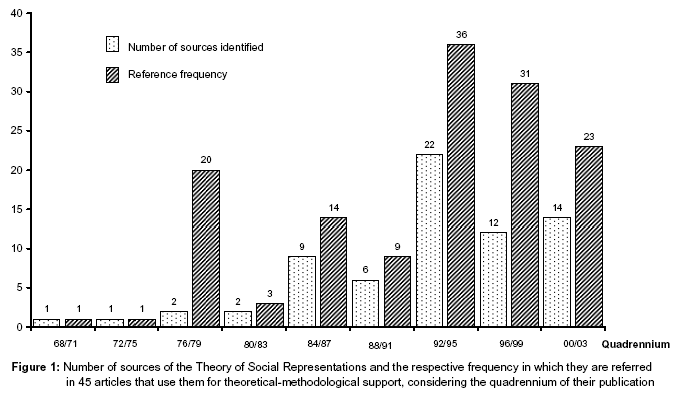
Otherwise, Figure 1 constitutes a representation of the distribution of the whole group of reference sources listed in relation to its period (quadrennial publication).Considering the nine quadrennium therein represented, a graphic context is verified in which four periods can be discerned.
The first one (1968-1975) corresponds to the publication of two of the texts on TSR cited (2,9% of those listed in this study); the second one (1976-1983) corresponds to the period of publication of four referenced texts(5,8% of the texts); the third period (1984- 1991) corresponds to the publication period of 15 texts cited (21,7% of the reference texts) and more recently (1992-2003) , the one that corresponds to the publication of 48 texts (70o% of those used as reference on TSR in the list of the articles analysed). So there is an evolution going on that is close to a geometrical progression concerning the number of texts used, in correspondence with those four chronological periods. In that same graphic one can verify that, for the two, texts of the first period, there is an incidence of. one reference for each one of them. The four texts of the second period had 23 references. For the 15 texts of the third period, 23 references were found, and, to the 48 texts from the fourth period corresponds a total of ninety references.
According to the order of frequency with which they were referenced, the following texts were identified in Table 1 as the ones most used: A representação social da psicanálise of Moscovici (1978), a source referenced in 42% of the articles; Núcleo central das representações sociais of Sá (1996), a text referenced in 20% of the articles; As representações sociais: um domínio em expansão of Jodelet (2001), referenced in 18% of the articles; Pratiques sociales et representations of Abric (1994, 1997), referenced in 16% of the articles; The A abordagem estrutural das representações sociais of Abric (1998,2000), referenced in 13% of the publications, and A construção do objeto de pesquisa em Representações Sociais of Sá: (1998), in 11 of the articles. The other texts, also included in Table 1, are cited in less than 10% of the articles.
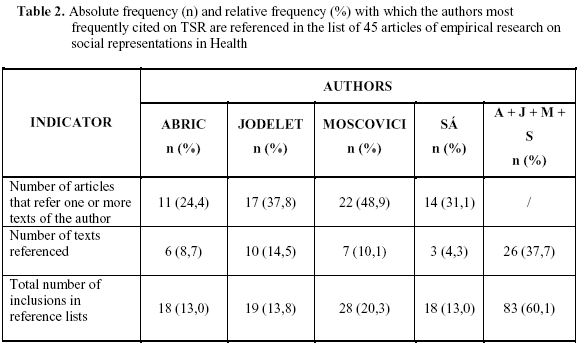
]]> Also, considering that 60% of the 138 references on TSR, computed in the 45 articles fall upon texts of four authors – a numerical comparison concerning their presence is pointed out in Table 2.
Still according to Table 2, by decreasing order of the frequencies pointed out, one can verify that, as to the number of articles that reference those authors, the following hierarchy is established: Moscovici- Jodelet – Sá – Abric; as to the number of texts referenced: Jodelet – Moscovici- Abric – Sá, and as to the number of times the author enters lists of references: Moscovici- Jodelet – Abric - Sá.
Considerations
The criterion of use of indexed periodicals with a view to locating articles based on TSR was established with the intention of using scientific publications which, besides the qualitative selection of the articles accepted for publication, can also correspond to the expectation of coherence concerning the areas that are credited as being of their coverage and specific interest. Although the Lilacs base may possibly be the one that indexes the largest number of Health Sciences, we must consider the possibility of this study not having encompassed each and every empirical work founded on TSR and published within the period herein examined. One reason for that was the occurrence of diverse causes that determined our failure to obtain several periodicals. Among such causes were the limitations of distribution and the editorial problems suffered even by those periodicals that have already been indexed.
On the other hand, the exclusion of periodicals of the subareas of Medicine, with the exception of those which are referred to Collective Health, is related to the small probability of the occurrence of articles founded on TSR, according to a previous evaluation carried out in a representative sample of the large number of such periodicals listed in the Lilacs base.
]]> In that context, the search for empirical works founded on TSR, comprehending a list of 46 national periodicals indexed in the Health area, provided the obtention of 45 research articles located in 19 of those periodicals. It must be pointed out that the ones of Nursing and Collective/Public Health were those which had the highest number of TSR-based publications. Besides, the presence of a majority of professional researchers linked to those fields, such as authors of works with social representations (SR) on Health, as evidenced by Rummler and Spínola (2005). This aspect may characterize the adherence to that methodology applied to scientific investigation concerning questions that articulate Health with Social Sciences.Otherwise, what has been stated above in relation to Nursing can be associated with what is observed by Marques et al. (2004) about the production of 72 works on SR (comprising master's dissertations and doctoral theses) between 1979 and 2000. With that exclusive fact, in just one Nursing research center, those authors illustrate the citation by Sá (1998) stating that the field of studies with SR has been in expansion since the decade of 1980 both in the social psychology area and the one of education , nursing and social service.
In reference to data pertinent to Collective Public Health publications, the studies can be related to the search of social representations as a possible route to answering what Smeke (1993, p.45) puts in relation to the fact that the description and analysis of experiences of articulation between health assistance agents and the population are fundamental to the definition of projects that may effectively find an answer from society, both in service qualification itself and in relation to its pedagogical aspect.
As to listing reference works, it is opportune to consider that the identification of texts on TSR through citation analysis does not necessarily eads to the constitution of the existing bibliography about it, because in that manner only literary impacts are revealed , which, on the other hand, adjusts to one of the objectives of this work.
The resulting list of the first stage of this work, having reached the identification of 69 sources, out of which there evolved theoretical assertions about social representations, such as the ones cited in the articles examined, can constitute a facilitating element for the search of those sources by whoever may be occasionally interested in them. It must be considered that the list of those sources includes books, or book chapters, or articles, regardless of the type of work discussed in them. Different editions or different translations of the same work were discriminated for the simple reason that they constitute diverse bibliographic entities, as well as because of the alternatives for their localization and access. The qualifying concept of theoretical source is considered in relation to the nature of the contents cited, because studies with an empirical approach founded on TSR cannot only relate their theoretical presuppositions but also have theorizations produced in them. Such aspect is proper to SR studies, which, according to Sá (1996), coordinate phenomena, concepts and theories.
As to the occurrence of citations of those sources in the articles herein analyzed, the general frame holds a picture in which, on one side, there is a convergence of search for fundamentation on the part of empirical researchers, directed to some works, and on the other side, some diversification in the way of using other reference sources.
The first aspect is evidenced by the fact that 12 of the 69 sources accumulate more than half the number of the totality of references. For diversification, there is the contribution of the fact that the majority of .the other sources is cited in only one article, such as it is pointed out in Table 1.On the other hand, it is possible that the evolution of the diversification, similarly to a geometric progression established by the succession of the chronological origin of the sources (periodicals) can picture the existence of a growing involvement of authors who contribute to the confirmation of that paradigm.
By reason of the existing relationship between the frequency of referencing and the number of texts to which such references correspond, and considering the date of their publication (Figure 1), the quadrennium 1976/1979 and 1996/1999 appear in a prominent position. Confronting those quadrennia with what is indicated in Table 1, one can verify that the prominent position of the former is to be attributed exclusively to one text - the one of Moscovici's, dated 1976. The prominent position of quadrennium 1996-1999 is due to the recurrence of three texts: Sá's, dated 1996, Abric's, published in 1998 and 2000, and another one by Sá, dated 1998. Also, a more recent publication, the recurrent text "As representações sociais: um domínio em expansão" by Jodelet (2001) occupies a prominent position among the works of quadrennium 2000/2003. Such aspects can be associated with what Arruda (2002b) and Pavarino (2004), based upon a text by Sá (1998), identifying within the TSR, the development of "complementary theoretical currents": the one by Jodelet, closer to Moscovici's original theory – denominated, according to Arruda (2002a, p. 223) "processual approach" precisely because of its emphasis on the constitute processes of Social Representations; the one by Jean Claude Abric, which emphasizes the cognitive-structural dimension of SR, better known as the Central Nucleus Theory. However, in the articles examined no citation was found whose text might bear the name of Wilhem Doise as its author, a fact which would represent recurrence to the nuclear source of a third current - that one of the Geneva School, which, according to Arruda (2002a, p. 223) has a "great concern for the psychological determinants of social representation and for the organizing principles contained in the Social Representations". These aspects are usually present in publications classified as belonging in Human Sciences or in Social Sciences, not included herein. On the other hand, the general profile of recurrence to a diversity of authors corresponds to a theoretical-methodological appropriation in compatibility with the respective thematic questions of their works, also comprehending the inclusion of texts reflecting on rather minute points, though they are at present less frequently cited. That profile, however, seems to draw a panorama of increasing adherence (both empirical and theoretical-literary) to what the TSR would represent for research on Health (borrowing an earlier cited title): a route in expansion.
Bibliographic References
]]>ARRUDA, A. Novos significados da Saúde e as Representações Sociais. Cadernos Saúde Coletiva, v.10, n.2, p.215-227, 2002a. [ Links ]
ARRUDA, A. Teoria das Representações Sociais e teorias de gênero. Cadernos de Pesquisa, n.117, p.127-147, 2002b. [ Links ]
ASSOCIAÇÃO BRASILEIRA DE NORMAS TÉCNICAS. NBR 6023: Informação e documentação-Referências-Elaboração.Rio de Janeiro, ago. 2002. [ Links ]
BIREME. Sistema Latino-Americano e do Caribe de Informação em Ciências da Saúde. BVS – Biblioteca Virtual em Saúde. Lilacs: periódicos indexados – lista por país. Disponível em: http://www.bireme.br/abd/P/listapais.htm. Acesso em: 16 jun. 2003. (Página posteriormente retirada ou reformulada em: http://bvsmodelo.bvsalud.org/site/lilacs/P/diretorio.htm) [ Links ]
BRICEÑO-LEÓN, R. Tendências da pesquisa em Ciências Sociais e Saúde na América Latina: uma perspectiva sociológica. In: CANESQUI, A. M. (org.) Ciências Sociais e Saúde. São Paulo: HUCITEC/ABRASCO, 1995. [ Links ]
CARDOSO, G.; ARRUDA, A. As representações sociais da soropositividade entre as mulheres e a adesão ao tratamento. Cadernos Saúde Coletiva, v.11, n.2, p.183-199, 2003. [ Links ]
CARVALHO, V. Acerca de las bases teóricas, filosóficas, epistemológicas de la investigación científica. El caso de la Enfermería. Revista Latino-Americana de Enfermagem, v.16, n.6, p.807-815, 2003. [ Links ]
FRANCO, M. L. P. B. Representações Sociais, ideologia e desenvolvimento da consciência. Cadernos de Pesquisa, v.34, n.121, p.169-186, 2004. [ Links ]
MARQUES, S. C.; OLIVEIRA, D. C. de; GOMES, A. M. T. AIDS e representações sociais: uma análise comparativa entre subgrupos de trabalhadores. Psicologia: Teoria e Prática, ed. Especial, p.91-104, 2004.. [ Links ]
MINAYO, M. C. S. O desafio do conhecimento. 8. ed. São Paulo: HUCITEC, 2004. [ Links ]
PAVARINO, R. N. Teoria das Representações Sociais. Pertinência para as pesquisas em comunicação de massa. Comunicação e Espaço Físico, v.7, n.1/2, p.128-141, 2004. [ Links ]
RUMMLER, G.; SPÍNOLA, A. W. Identificação e procedência de periódicos nacionais referentes à temática de saúde pública ou saúde coletiva, editados entre 1998 e 2003. Cadernos de Saúde Pública, v.20, n.4, p.1041-1049, 2004. [ Links ]
RUMMLER, G.; SPÍNOLA, A. W. Tendências temático-profissionais da pesquisa brasileira com representações sociais em Saúde. O Mundo da Saúde, v.29, n.2, p.129-134, 2005. [ Links ]
SÁ, C. P. Núcleo Central das Representações Sociais. Petrópolis, RJ: Vozes, 1996. [ Links ]
______. A construção do objeto de pesquisa em representações sociais. Rio de Janeiro: EDUERJ, 1998 [ Links ]
SMEKE, E. L. M. Descobrindo percursos para a pesquisa em saúde no trato com o movimento social. Cadernos de Saúde Pública, v.9, n.1, 1993. [ Links ]
SPINK, . J. O conceito de Representação Social na abordagem psicossocial. Cadernos de Saúde Pública, v.9, n.3, p.300-308, 1993. [ Links ] ]]>