Produção do cuidado e produção pedagógica: integração de cenários do sistema de saúde no Brasil
Producción del cuidado y producción pedagógica: integración de los marcos del sistema de salud en Brasil
Túlio Batista Franco
Psychologist; Phd in Collective Health; professor, Health Planning Department, Community Health Institute, Fluminense Federal University. Niterói, Rio de Janeiro, Brazil. <tuliofranco@uol.com.br>
Translated by Elaine Barros Moreira ]]> Translation from Interface - Comunicação, Saúde, Educação, Botucatu, v.11, n.23, p. 427-438, Sept./Dec. 2007.
ABSTRACT
Throughout Brazilian Public Health System's (Centralized Health System - SUS) construction history there has been a reasonable investment in the education for the sector. However, it has been frequently noticed by health professionals and managers the fact that this investment in educational programs has not converted into change of healthcare practices. Assuming that education can be used as a tool for changes in health, the text suggests that the pedagogical practices should be directed towards the production of individuals implied with the care production. Hence it proposes to work on a field of subjectivity in addition to cognition. This work reveals the management of the Brazilian public health system and its flows of permanent education, focusing "micromanagement" to think about the context on which they structuralize the diverse scenarios of care production, treating them as Pedagogical Production Units where it would be possible to develop entailed educational methodologies to a general idea of permanent education in health.
Keywords: Health Education, Permanent Education in Health, Health Management, Subjectivity.
RESUMO
Em toda a história de construção do Sistema Único de Saúde (SUS) há um razoável investimento na educação para o setor. No entanto, gestores e trabalhadores da saúde constatam que o investimento em programas educacionais não tem se convertido em mudança das práticas de cuidado. Partindo do pressuposto de que educação pode ser dispositivo de mudança, sugere-se que práticas pedagógicas direcionem a produção de sujeitos implicados com a produção do cuidado. Assim, propõe-se trabalhar, além da cognição, o campo das subjetivações. Este trabalho revela a gestão do SUS e seus fluxos de educação permanente, constituindo o foco da "microgestão" para pensar no contexto sobre o qual se estruturam os diversos cenários de produção do cuidado, tratando-os como unidades de produção pedagógica, onde seria possível desenvolver metodologias educacionais vinculadas a uma idéia geral de educação permanente em saúde.
Palavras-chave: Produção do cuidado. Educação permanente. Gestão da saúde. Subjetividade. Sistema de saúde.
RESUMEN
]]> En toda la historia de la construcción del sistema de salud brasileño hay una razonable inversión en educación para el sector. No obstante, gestores y trabajadores de salud constatan que la inversión en programas educacionales no se ha convertido en cambios de las prácticas de cuidado. Considerando que educación puede ser dispositivo para cambios, se sugiere que las prácticas pedagógicas se orienten hacia la producción de sujetos comprometidos con la producción del cuidado. Se propone pues trabajar, además de la cognición, el campo de las subjetividades. Este trabajo revela la gestión del sistema y sus flujos de educación permanente, constituyendo el foco de la "micro-gestión" para pensar en el contexto sobre el cual se estructuran los distintos marcos de producción del cuidado, tratándolos como Unidades de Producción Pedagógica donde sería posible desarrollar metodologías de educación vinculadas a una idea de educación permanente en salud.Palabras clave: Producción del cuidado. Educación permanente. Gestión de la salud. Subjetividad. Sistema de salud.
SUS' Management as a Varied Learning Scenario
Besides being defended as a trivial practice, health education has followed the development of the Brazilian Public Health System (SUS – Sistema Único de Saúde) whose acknowledgement is due to popularity and to the reformation statute in the healthcare assistance organization. Although large investments have been made in education since the Brazilian sanitary condition principles have been instituted—or even before the conception of SUS—, health managers and professionals involved in the fight for universality, equity and totality in care assistance currently confirm that the major efforts and resources applied in educational processes have not presented any results yet. That is what Ceccim and Ferla (2003, p.212) state:
it has been noticed in Brazil a recent investment in education processes posterior to graduation or insertion in positions in the Public Health System, but not the institution of a changing process that brings humanization, reception and responsibility towards health services' users and the development of projects for producing autonomy in caring and in life as objects of learning and construction of individual and collective work profiles.
Some questions are recurring. Despite all the efforts towards education, why the assistance practice keeps unchanged, structured in a hierarchical work process in which attendance is quick and professionals do not broaden their limited know-how, thus having problems to interact and adapt themselves into a multi-professional practice? Why the health service keeps on being a fragmentary, Taylorist-based work process in which the areas of knowledge are isolated one from another and team members hardly interact, especially due to the values and beliefs of an old assistance model (Flexnerian1) that has survived despite the appeals made in many educational strategies (qualification, appraisals/updates) directed for health professionals?
Some answers can be found in the structuring process of the Brazilian sanitary condition reformation. Educational policies then implemented have risen extremely normative management processes, whether due to a tradition of planning and organizing work processes impregnated by individual subjectivities and collective sociabilities, or due to the construction of SUS in a moment in which the leadership of "agent-groups" in the organizational environment was seen as something unexpected and unwanted—sometimes antagonistic—by the superior hierarchical spheres inside the organizations. Self-initiative, creation and inventiveness in work environment were seen as resistance movements that would question a desirable structural central directive. Such organizational environment unrealistically sets that the health system's superior hierarchical level replaces "knowledge", which must be passed on to the production level since it is not supposed to have the required experience to operate the processes. It is common sense that knowledge acquired from daily work activities is not recognized. The general idea of insufficiency, in which professionals become a group "subjected" to processes that were thought by a superior hierarchical sphere, has created educational proposals as the ones integrated to the idea of "continuing education", in which the continuous "knowledge transference" is necessary for providing education—supposedly to be lacking—for health services. Educational methodologies implemented by that approach have become true subjectivity-absorbing and creativity-blocking machines. Not recognizing a knowledge created by "inferior hierarchy" leads to the generation of heteronomous individuals (subjected to another's laws or rule), professionals submitted to a "dependency pedagogy".
However, thousands of professionals, managers and SUS' users are motivated by the valid and current trust in education as proposed to perform changes in the health services. This issue has presented an important paradox which "disturbs" the health sector educational policies: on one hand, many investments have been provided by the Ministry of Health, which make us believe in the wish for operating effective educational processes by transferring health technology to SUS' professionals; on the other hand, those educational programs have low impact in the health productive processes, that is, in the care production daily practice. Here this paradox is taken as our "analyst", that is, as "something that allow us to reveal, provoke and coerce the organizational structure" (Lourau, 1996, p. 284). It is imperative to advance in SUS' changing process in order to understand this paradox.
]]> Confirming that, innovative experiences of changes in health systems and services, which have as basis the work process reorganization2, have been demonstrating that the collective action of professionals in a new way of care production support a new way of signifying their healthcare activity. While they produce caring, they also adapt themselves into agents. Work, teaching and learning blend altogether in the health production scenarios as cognition and subjectivation processes, simultaneously expressing reality. We verified that, along with the care production line there is also a pedagogical production line in SUS' organizational structure.Care and pedagogical production lines include research activities, institution of innovative concepts and varied educational practices, and the collective/individual basis of caring practices operators—health service professionals and users. Everything is supported by many institutions that collaborate to the Brazilian public health system. The various social and political actors involved with the construction of SUS – who claim to be heirs of that ideal of social transformation which underlines the historic sanitary movement - produce many health educational proposals that imply education as a tool for producing individuals capable of promoting changes in the health services. Those proposals aim organizing the action, directing it toward changes in the organizational, technical-assistance and team relationship levels, as well as when receiving the users and taking responsibility for them. Raising changes is the guidance for pedagogical efforts that must be undertaken nowadays.
To start with, the first presupposition is the one of education not being an objective itself, which means, we always educate for a purpose. Thus, we understand the educational processes as devices, as this concept is stated by the institutionalist movement, in which a "device" is "an innovation-producer that develop events and outcomes, renew potentialities and generates a new radical" (Baremblitt, 2002, p. 135). The second one is education as an institution that operates with the human being, that is, that mobilizes individuals who have as constitutive elements a life history, a social-cultural origin, a knowledge acquired along their education and experiences in the healthcare activity, in short, all the complexity of living that generates subjectivity and sets a singular form into action. A third presupposition is that education and work are related. As in the healthcare activity, it is "real work in action" (Merhy, 1997, p. 71-112), since education professionals have a major autonomy of their own work process, thus making possible to have it completely available for their "users".
When we say that it is possible for education to operate in the teaching/learning relation as a tool, we suggest the pedagogical activity to set subjectivation processes associated to cognition ones. Educational processes are believed to contribute in the production of agents, here understood as collectives with capacity to intervene in reality with the objective of changing it. However, an important requirement for an agent's leading role is the ability of self-analysis, that is, "self-managed collectives get appropriated of knowledge about themselves, their necessities, desires, demands, problems, solutions and limits" (Baremblitt, 2002, p. 139). Groups that could "speak by themselves". It is in that scenario that the idea of reorganizing the work process and constituting a new way of health production, based on humanitarian principles and solidarity, becomes an objective to be constantly chased, the establishing process that states innovation as a potentiality. The health professional operates the cognitive dimension of being a professional endowed with technical ability to intervene on health problems. Besides, he also operates a subjective dimension of being for himself and for others, giving distinction for the caring activities, where others are always there as agents in the action of producing care.
We recognize the existence of two major dimensions in the educational area, as it was said before: cognition, which is stated by the capacity of transferring and producing technical knowledge in the health area, applied to its productive processes inside a specific work organization; and subjectivation, which must be considered as the capacity some pedagogies have on promoting changes in the subjectivity.
How subjectivation processes can be verified in daily practices of health services? For better understanding the question, let's imagine a professional performing an anamnesis, using a questionnaire prepared by the health establishment's directive board. He can perform the anamnesis shortly, having minor space for listening and speaking, centering his activity in the questionnaire previously structured. Instead, he can use it as a guide and interact with the user, allowing a common intermediate space of interchange. According to Merhy (2002, p. 51), that word means
what is produced in the relationship between agents, in their intersection space, which is a product that exist for both during an exchange, not outside the relationship in progress, in which the interlocutors appear as establishers of a quest for new processes, even if one in relation to the other.
Merhy says that an "interchange space" is set between professional and user, that is, the mutual relationship between them is also a space for common construction, in this case, in healthcare assistance. What makes the professional act one way or another is the subjectivity—structured according to the history of his life, his experiences, values acquired, which will determine a specific way of analyzing and intervening in healthcare activity. He benefits from his involvement with the object—the user's health problem. Subjectivity and involvement are not described in the teaching and learning guides, but are present throughout the whole assistance, pedagogical and health process.
We understand that the educational processes will only be effective if they, along with cognitive processes, also operate changes in the professional's subjectivities. Experiences like these have been being observed. For instance, the Health Care Integrated Residency Program (Residência Integrada em Saúde), implanted by Rio Grande do Sul State Department of Health in 2002 (Ceccim e Ferla, 2003, p.211-213) or, in the range of permanent education in health, the experience of Aracaju Municipal Department of Health, analyzed by Santos (2005, p. 104-122) and Santana (2005). Besides those "local" experiments, we can also mention the efforts done by the Health Education Management Department of the Brazilian Ministry of Health to launch a national educational and developmental policy for SUS during the 2003/2005 administration.
On Permanent Education in Health, Ceccim (2005, p.161) says:
]]> it carries the pedagogical definition for a educational process that sets the daily health work—or education—under analysis, which permeates itself through the concrete relationships that operate realities and makes possible the construction of collective spaces for reflection and evaluation of the meaning of acts done daily. While fighting for a constant update in the practices, according to the most recent theoretical, methodological, scientific and technological contributions available, the Permanent Education in Health inserts itself in the construction of relations and processes from the core of the teams' group work, implying the agents; to the organizational practices, implying the institution and/or the health sector; and to the interinstitutional and/or cross sector practices, implying the policies in which the health actions are inserted.Subjectivity is a social-historical production; therefore, it assumes a dynamic character. It is "the group of conditions that makes possible for the individual and/or collective spheres to be in position of emerging as existential self-referential territory, adjacent or related to the constraint of an subjective distinction" (Guattari, 1992, p. 19). It is structured in the core of a desire, which is formed in its primary processes, being its main element. The desire is also the energy that drives an action toward the world. The change in that core is called subjectivation process, which is capable of changing the intention under which some people behave in life. Subjectivity may—or be led to—suffer changing processes. In the healthcare activity, it may be structured according to the Flexnerian ideal of assistance and focus the entire professional's capability on dealing with health problems in physiological/anatomical body interventions. On the other hand, it may be formed from ideals and symbolical representations that understand that the health-disease process happens due to multiple phenomena, other than social, environmental, clinical or subjective factors, thus demarcating a different way of behavior concerning the individual in need of health care assistance. Dealing with subjectivity is extremely difficult. More difficult is to change it, which means, to create subjectivation processes capable of producing impact in the way each individual understands and acts at the socius. That is possible due to life experiences, in processes that expose people and also affect their way of thinking, being and interacting with reality. Something similar to the Pedagogy of the Exposure Factor, concept developed in the 3rd Phase of the Medical Teaching Evaluation Project, launched by the Brazilian Interinstitutional Committee of Medical Teaching Evaluation (Cinaem – Comissão Interinstitucional Nacional de Avaliação do Ensino Médico) and presented in "Preparando a Transformação da Educação Médica Brasileira" ('Preparing a Transformation in Brazilian Medical Education'), a report mentioned by Santos (2005, p. 106):
the exposure factors are objects – clippings of reality, ways of seeing and limiting a determinate field of life organization, with real existence, a particular nature and always under production, for which we can use of a group of knowledge and technologies that allow us to understand, signify and intervene.
For Santos (2005, p.106), one of the report's author, the implementation process of SUS in the city of Aracaju during his administration as Municipal Secretary of Health had the purpose of turning it a "space of social production of exposure factors". The author objectively presents health education processes centered in experiments and experiences of daily work, that is, a methodology that operates cognition and subjectivation processes, since it sets "collective assemblage of enunciation (...) along with socius, far from the individual, together to pre-verbal intensities, deriving rather from a logic of affections than of well-circumscribed groups" (Guattari, 1992, p. 1920).
For creating subjectivation processes, permanent education in health must involve the agents to their own work process, facing, according to Merhy (2005, p.174),
the challenge of thinking a new pedagogy—which benefits from all that has been related to the construction of self-determinate individuals, socially and historically committed to the construction of life and its defense, whether individual or collective—which realizes itself as connected to the intervention that sets the professional's ethical-political involvement to his action in the core of the pedagogical process, producing healthcare assistance, individually or collectively, by himself or in a team.
SUS' Management and its Permanent Health Education Flows
For its dimension, amplitude, social range and technological variety in the professional's practice, the Brazilian Public Health System appears in the area of health educational processes as a privileged place for teaching and learning, especially at the places of healthcare production - the "foundation" of SUS—,a place of creative action for professionals and users. Education "at" and "for" work is the presupposition of the Permanent Education in Health proposal. At SUS, the places of care production are also scenarios of pedagogical production since they concentrate the daily experiences, the creative meeting between professionals and users. As Deleuze says, quoting her readings of Nietzsche: "he offers a wicked pleasure..., the pleasure of saying simple things on behalf of oneself, talking about affections, intensities, experiences, experiments" (Deleuze, 1992, p. 15). At the Care Production Units, where meetings between professionals and users take place, phenomena not so related to cognition, more related to the fields of subjectivity assemblages, can be observed.
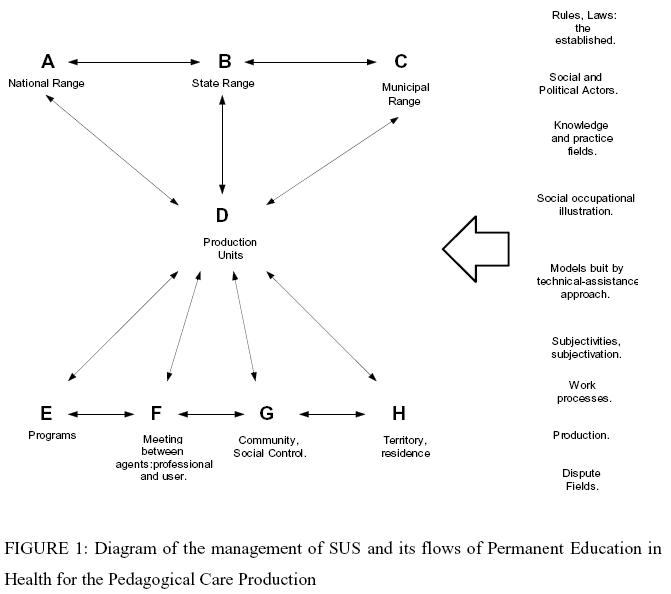
The network that constitutes SUS' management operates transversely, especially when operates through "integral care production lines" on which professionals and users try to meet the healthcare necessities. For better visualizing this network intercrossed by vectors that relate different places of production, we propose the following interpretative diagram:
]]>
This diagram was symmetrically drawn for didactic and demonstrative effects. In fact, it must be considered totally asymmetrically, for the positions of the scenarios change according to the dynamics of the events that affect them; the vectors that indicate the flows do not have the same frequency and may have different intensities. There is permanent tension among the scenarios, since they operate in a network and this tense relationship creates movements in the connective flows that assume a dynamic effect under this condition. These tensions and flows assemble elements of a specific production—social, political, technical and subjective—to health and educational policies, dependent of the action of agent/agent-groups in the micropolitics that operate in the same scenarios.
The diagram represents many places of management, spaces of micromanagement and care production inside SUS, establishing the connective flows of the network. The micromanagement is expressed in the regulation of the professionals' daily action, which is set by the standard of technical, ethical, political and subjective conduct socially produced, to be assumed face to the user and his health problem. The rule may be written as in a protocol or simply be expressed as a logic that crosses the work relationships. As the health work process depends on action, defining itself as self-managed, we infer that the micromanagement is a space where professionals manage themselves and their work process, setting self-managed health work practices or, on the other hand, suffering processes of absorption due to rules instituted on their work process. Among the professionals, there is a continuous flow of knowledge and action that are translated into exchange and practices in the micro-organizational environment, establishing high density relational scenarios.
In this structure, the management of SUS is organized as a governmental responsability, defined here by SUS' directive board and the Departments of Health, as well as spaces of local management, which set an intermediate management sphere of general government at SUS. Besides, there is a space not so explored yet concerning the micromanagement that strongly operates in determining the way of producing healthcare assistance. They are potentially self-managed scenarios, regarding the nature of health work as centered in "work in permanent action, a little similar to education work" (Merhy, 2002, p. 48). Thus, it grants the professional a high liberty of action in his work process. There are many themes that permeate the health production scenarios and create transversality, generating tensions on this network, turning the scenarios stronger in the sense of creation of interventional possibilities in health and education problems. At the same time, it is a field for disputing projects at the management intermediate level that generates processes of agreement among the many actors involved with health, under the management of that assistance apparatus, as well as of user's care assistance.
The general idea of treating education as a tool, contributes to understand its strategic function to change health practices, especially through the health technological transition (Franco, 2003, p.149-151). As ever, these positions are claimed by those who fight for a health service focused in the user's needs (Malta et al., 1998). An educational practice—as proposed here —is set in a libertarian perspective with the clear objective of performing changes in the agents and in SUS. The care production scenarios, regarded as pedagogical production ones, re-establish the health education and move it beyond the teaching/learning relationship, in the range of assemblages of cognition and subjectivity, with the purpose of creating agent-groups capable of assuming themselves the leading role—even deliberately—that has determined the development of the Brazilian Public Health System.
Conclusion
The subject addressed here— Care Production Units also functioning as Pedagogical Production Units —is associated to the idea of "pedagogy in action", constitutive of leaderships that set the "formation quadrilateral for the health sector: education, sectorial management, health assistance practices, and social control", suggested by Ceccim and Feuerwerker (2004, p.41-65). That is a guideline on which new beliefs for overcoming the obstacles to changes in healthcare are made, a principle that believes that the necessary changes indisputably go through the constitution of new agents/agent-groups and other subjectivities, awaken/summoned in the core of the health services.
]]> Another relevant aspect is considering work as the core for the pedagogical action when related to permanent education in health. That must be seen under the perspective that the productive action is twice as transforming, where the professional produce healthcare actions, changing reality, while also turning himself into an agent. "Subjectivity is produced by collective assemblages of enunciation", (Guattari and Rolnik, 1999, p. 31). Healthcare work activities produce statements throughout the whole process. Due to its relational nature, the dynamics of work action brings the possibility of changing the health area and, specially, the involvement of agents with the productive activity. That all brings on itself the potential for changes in professionals and users. The pedagogical production occurs pari passu to care production, being constitutive of the same cognition processes and of the development of new subjectivities.We identified the intrinsic characteristic between care and pedagogical production when referring to permanent education in health. That means they include each other, that the work is inside pedagogy and vice-versa, but they only have power to produce permanent education when they are together. The experimentation that makes possible the agents' commitment to the educational process only happens if work and education operate together, acting directly in the SUS' scenarios.
Changing processes in SUS, especially in the care production ways, must have as presupposition the permanent education of health professionals from the perspective of the work process reorganization. Permanent education is shown as an effective methodology to gather new knowledge to work teams and providing them the leading roles of health productive processes. All of that has as background the micropolitics of the work processes that act upon the various scenarios of SUS, whether more related to the management or assistance levels.
Bibliography
BAREMBLITT, G. Compêndio de análise institucional. Belo Horizonte: Instituto Félix Guattari, 2002. [ Links ]
BRASIL. Ministério da Saúde. Secretaria de Gestão do Trabalho e da Educação na Saúde. Departamento de Gestão da Educação na Saúde: Curso de Formação de Facilitadores em Educação Permanente em Saúde: unidade de aprendizagem - análise do contexto da gestão e das práticas de saúde. Rio de Janeiro: Brasil. Ministério da Saúde/Fiocruz, 2005. [ Links ]
CECCIM, RB. Educação permanente em saúde: desafio ambicioso e necessário. Interface – comunicação, saúde, educação (Botucatu), v.9, n.16, p.161-168, set./fev. 2005. [ Links ]
CECCIM, RB e FEUERWERKER, L. O quadrilátero da formação para a área da saúde: ensino, gestão, atenção e controle social. Physis – Revista de Saúde Coletiva (Rio de Janeiro), v.14, n.1, p.41-65, jan./jun. 2004. [ Links ]
CECCIM, RB e FERLA, AA. Residência integrada em saúde: uma resposta da formação e desenvolvimento profissional para a montagem do projeto de integralidade da atenção à saúde. In: PINHEIRO, R e MATTOS, R (Orgs.). Construção da integralidade: cotidiano, saberes e práticas em saúde. Rio de Janeiro: IMS-Uerj/Abrasco, 2003, p. 211-226. [ Links ]
DELEUZE, G. Conversações. São Paulo: Editora 34, 1992. [ Links ]
FRANCO, TB et al. (Orgs.). Acolher Chapecó: uma experiência de mudança do modelo tecnoassistencial com base no processo de trabalho. São Paulo: Hucitec, 2004. [ Links ]
FRANCO, TB. Processos de trabalho e transição tecnológica na saúde: um olhar a partir do sistema cartão nacional de saúde. 2003. Tese (Doutorado) – Faculdade de Ciências Médicas, Universidade Estadual de Campinas, Campinas (SP). [ Links ]
FRANCO, TB; BUENO, WS e MERHY, EE. O acolhimento e os processos de trabalho em saúde: o caso de Betim/MG. Cadernos de Saúde Pública (Rio de Janeiro), v. 15, n. 2, abr./jun. 1999. [ Links ]
GUATTARI, F. Caosmose. São Paulo: Editora 34, 1992. [ Links ]
GUATTARI, F e ROLNIK, S. Micropolítica: cartografias do desejo. Petrópolis: Vozes, 1999. [ Links ]
LOURAU, R. A análise institucional. Petrópolis: Vozes, 1996. [ Links ]
MALTA, DC et al.. Acolhimento: uma reconfiguração do processo de trabalho em saúde usuário-centrada. In: CAMPOS, CR; MALTA, DC; REIS, AT et al.. Sistema Único de Saúde em Belo Horizonte. São Paulo: Xamã, 1998. [ Links ]
MERHY, EE. Em busca do tempo perdido. In: MERHY, EE e ONOCKO, R (Orgs.). Agir em saúde: um desafio para o público. São Paulo: Hucitec, 1997. [ Links ]
MERHY, EE. O desafio que a educação permanente tem em si: a pedagogia da implicação. Interface – comunicação, saúde, educação (Botucatu), v. 9, n.16, p.172-174, set./fev. 2005. [ Links ]
MERHY, EE. Saúde: a cartografia do trabalho vivo. São Paulo: Hucitec, 2002. [ Links ]
NOGUEIRA, RP. Perspectivas da qualidade em saúde. Rio de Janeiro: Qualitymark Editora, 1994. [ Links ]
SANTANA, AD. Sobre o desafio de qualificar os trabalhadores de saúde: estudo do processo de construção da política de educação permanente do município de Aracajú – SE. 2005. Dissertação (Mestrado) – Instituto de Medicina Social, Universidade Estadual do Rio de Janeiro, Rio de Janeiro. [ Links ]
SANTOS, RC. Implantação e implementação do SUS em Aracajú a partir do modelo técnico assistencial Saúde Todo Dia. 2005. Tese (Doutorado) – Faculdade de Ciências Médicas, Universidade Estadual de Campinas, Campinas – São Paulo. [ Links ]
1 The Flexnerian model refers to a medical teaching approach implemented by the Flexner Report (USA – 1910). It proposed an education which would be based on "the necessity of linking teaching to investigation in the biomedical sciences field", thus resulting in a medical practice approach focused on the physiological/anatomical body whose main reference is the hospital (Nogueira, 1994, p.92-93).
2 On innovative experiences in health systems and services, you can consult: "Acolhimento: uma reconfiguração do processo de trabalho em saúde usuário-centrada" (Malta et al., 1998); "O acolhimento e os processos de trabalho em saúde: o caso de Betim/MG" (Franco, Bueno e Merhy, 1999) and "Acolher Chapecó: uma experiência de mudança do modelo tecnoassistencial com base no processo de trabalho" (Franco et al., 2004). Those are researchers on health production units' reception. See the bibliography of this study.