Perfil de cuidadores de idosos e percepção sobre saúde bucal
Perfil de los cuidadores de ancianos y percepción sobre la salud bucal
Nemre Adas SalibaI; Suzely Adas Saliba MoimazII; Jeidson Antônio Morais MarquesIII; Rosana Leal do PradoIV
IFull professor, Postgraduate Program of Social and Preventive Dentistry, Araçatuba Dental School, São Paulo State University
IIAdjunct Professor, Postgraduate Program of Social and Preventive Dentistry, Araçatuba Dental School, São Paulo State University ]]>
IIIPostgraduate Student (Doctorate Degree), Social and Preventive Dentistry, Araçatuba Dental School, São Paulo State University
IVPostgraduate Student (Master Degree), Social and Preventive Dentistry, Araçatuba Dental School, São Paulo State University
Translated by Luciana Reichert da Silva Assunção and Juliana Reichert Assunção Tonelli
Translation from Interface - Comunicação, Saúde, Educação, Botucatu, v.11, n.21, p. 39-50, Jan./Apr. 2007.
ABSTRACT
The aim of this study was to evaluate the profile and the oral health perception of elderly caregivers who in charge of giving assistance to three benefiting institutions in the city of Araçatuba, Brazil. A form was filled in by the interviewers according to the caregivers' answers. In relation to schooling level, 83.3% have a nurse aid's technician course and 16.7% don't present any type of technical formation. More than half of the interviewed caregivers (61.11%) reported that they started working for necessity, not for affinity. It was detected lack of oral health perception which showed that most of the caregivers need more knowledge of the most prevalent oral diseases. Most of them (55.56%) believe that tooth loosing is part of aging. According to the obtained results, it was proved that caregivers need more information about oral health related to elderly.
Keywords: Elderly – Caregivers – Oral Health.
O objetivo deste estudo foi avaliar o perfil e conhecimento sobre saúde bucal de profissionais cuidadores de idosos, que atuam em três asilos da cidade de Araçatuba. Foram entrevistados 18 cuidadores de três instituições, com o auxílio de um formulário, visando avaliar o grau de conhecimento destes quanto aos aspectos de saúde bucal. Em relação à formação escolar, 83,3% desses profissionais possuem curso técnico de auxiliar de enfermagem e 16,7% não apresentam qualquer tipo de formação técnica. Mais da metade dos entrevistados (61,11%) relatou ter iniciado o trabalho por necessidade, não por afinidade. Quanto ao conhecimento em saúde bucal, detectou-se carência de informações, sendo que a maior parte necessita de esclarecimento quanto aos problemas mais prevalentes que ocorrem na boca e muitos deles (55,56%) acreditam que a perda dos dentes faz parte do envelhecimento. Constatou-se que os cuidadores precisam ser informados sobre aspectos de saúde bucal voltados para idosos.
Palavras-chave: idoso. cuidadores. saúde bucal.
RESUMEN
El objetivo de este estudio fue evaluar el perfil y el conocimiento sobre la salud bucal de los dieciocho cuidadores de ancianos que actúan en tres instituciones de beneficencia de la ciudad de Araçatuba. Fueron entrevistados todos los cuidadores, con el auxilio de un formulario, para evaluar el grado de conocimiento de los mismos respecto a los aspectos de la salud bucal. En relación a la formación escolar, el 83,3% poseen curso técnico de auxiliar de enfermería. Más de la mitad (61,11%) relató haber iniciado el trabajo por necesidad. En lo que respecta al conocimiento sobre salud bucal, se detectó la carencia de informaciones, siendo que la mayor parte necesita de informaciones sobre los problemas predominantes que ocurren en la boca, y muchos de ellos (55,56%) creen que la pérdida de los dientes hace parte del envejecimiento. Se constató que los cuidadores necesitan ser instruidos sobre la salud bucal de los ancianos.
Palabras clave: anciano. cuidadores. salud bucal.
Introduction
As a result of the increase of life expectancy and of the reduction of mortality rate, the population's aging is a world phenomenon nowadays. According to data from Statistic and Geography Brazilian Institute, the Brazilian population with more than sixty years of age in 2000 was of 14.536.029 people, representing a numerical increase of 3.813.324 people in relation to 1991 (Brasil, 2005). From this perspective, in 2025, Brazil will be the 6th country of the world in terms of elderly population presenting more than 30 millions of habitants aged over 60 years (Caldas, 1998; Saliba et al., 1999).
]]> Taking into account this information, there is necessity of an adaptation from the health public politics, bearing in mind that, with the increase of the number of elderly people, new health necessities arise which depend on interventions with a high cost for a special care.Some terms are used to designate the elderly: "third age", "best age", "old age". The term "old" or "old man" was utilized in France in the XIX century to designate individuals who did not have possessions or for indigent persons. Those who had a certain social position and who could manage their own possessions took the benefits of respect and was denominated as "elderly" for the reason that the term "old" was associated with decadence and incapacity for work. Only with the French influence, the term "elderly" became to be used in officials documents in Brazil. Even though the term "elderly" had already existed in our vocabulary, this term was not used (Gonçalves, 2002).
The World Health Organization establishes that one country can be considered an aged country, when the elderly contingent exceeds 7% of the total of its population. Currently, Brazil has 8.2 millions people aged over 60 years (WHO, 2005) which represents 4.4% of its population (Brasil, 2005).
With the advance of age, sensible alterations appear in elderly person's life-style, such changes can come from health problems or even from the physiologic aging process. This process configures as an unequal, multiple and compromising process as well as the decadence of functions which characterizes the living organism according to its time of life (Caldas, 1998). In many cases, those changes may lead elderly to need someone to help them in activities which were easily developed before. From this necessity, the figure of elderly caregivers arises, and, in many cases, this figure is not properly noticed and, without the required ability, resulting in a tiring relationship to both: the persons who are being cared and to the caregivers themselves.
The expression "to take care" denotes a dynamic, thoughtful and reflected action; the term "to care" gives the connotation of responsibility and zeal. Therefore, the care process is the way in which care is given and it is also an interactive process which develops actions, attitudes and behaviors based on scientific knowledge, experience and intuition; having as the main tool the critical thought, being these actions and/or other attributes done for the person who is being cared, with the sense of promoting, maintaining and/or recuperating the human dignity. The term "to assist" seems to be a more passive action of observing, accompanying, favoring, helping and protecting. In fact, the assistance not necessary includes the "care" (Santos, 2001).
The word "to care" is an indirect transitive verb, implicating the existence of an agent subject and a passive object. The person who takes care, works for the interest of someone and worries about the person. Therefore, it is evident the necessity of attention to the provided care, so that this action do not become something automatic and also to lose sight of the fact that, in that place, the person who is being cared is a subject who has an existential dimension, and who is being affected by the attitudes of the caregiver (Caldas, 2000).
The elderly caregivers are persons who dedicate the task of caring for an elderly individual, and they can be a relative like a son, nephew, grandson, friend, the so-called "informal caregiver" or individuals who, although do not has the link with the elderly, are employed for this work, the "formal caregiver" (Gonçalves, 2002). The caregivers have assumed a usual profile as well as specific and complexes tasks, which need to be developed or accompanied by trained people, performing the assistance that is needed to maintain the well-being of the elderly.
Little is known about the profile of elderly caregivers, their necessities and about the professional profile. The urgency to structure a qualified multidisciplinary group with wide geriatric and gerontology knowledge is imminent in the search of better life quality for institutionalized elderly. With this conception in mind, the university can play its role as a transformer agent in elderly health quality by collaborating in forming these groups.
It is known that this part of population requires a special attention due to the affective, physical, mental and social conditions that elderly individuals live, most of the time, in a total social abandon (Almeida et al., 2004). Therefore, people who walk into this area of action, sometimes, submit themselves to stressful situations, not only physical, but also emotional. For this reason, it is of great importance to have a good technical formation grounded on, not only theoretical assumptions, but also on ethical and human aspects.
This study proposes aims at evaluating oral health knowledge of elderly caregivers who are in charge of giving assistance to three benefiting institutions in elderly care, in the city of Araçatuba, "Lar da Velhice", "Asilo São Vicente de Paula" and "Abrigo Ismael".
]]>Methodology
Eighteen elderly caregivers were interviewed from three institutions that are benefited from the University Extension Project promoted by the Department of Social and Pediatric Dentistry of São Paulo State University, Brazil. This program, entitled as "Health promotion in institutionalized elderly in the city of Araçatuba, São Paulo", aims at promoting, preventing and recuperating oral health of this interns.
According to the proposed methodology, it was opted for the directed interview by using for the information collect, a semi-structured form, with 44 open and closed questions. The variables for the study included: general data such as age, gender, level of schooling; knowledge about oral health as dental caries, plaque bacteria, periodontal disease; oral hygiene habits as use of fluoride and dental floss, realization of tooth brushing; routine of oral hygiene habits of the elderly: if the hygiene is performed, how it is performed and the importance of the hygiene. The caregivers' perception towards their own oral health and to elderly interns was also verified.
The interview was recorded and lasted about 10 minutes. All participants received a free and clarified consent. A pilot study was carried out for validation and for adequacy of the instrument of data collection. The modality of the semi-structured interview "at the some time that it values the presence of the investigator, it also offers all the possible perspectives for the informant to reach the necessary spontaneity and freedom, enriching the investigation ", maintains the conscious and active presence of the researcher and, at the same time, permits the relevance in the situation of the actor.
The interviews were carried out by one researcher. Each interviewed was approached in the local work place, between 8 a.m. and 8 p.m., during the months of September to October in the year of 2005. The obtained information was quantitatively analyzed, and based on the interviewed responses, a manual directed for elderly caregivers was elaborated containing information about oral health aiming at giving the caregivers the correct orientation on how to care for the elderly.
Results
The studied population presented a mean age of 37.4, being the minimum of 24 and the maximums of 60 years of age, with the predominance of female (77.8%).
In relation to schooling level, 5.55% did not conclude first degree, more than 60.0% concluded second degree, 83.3% had auxiliary nursery technical course and 16.7% did not present any type of technical scholar formation.
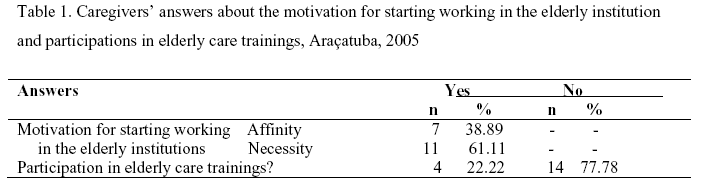
]]> The data referred to the perception and habits of institutionalized elderly caregivers are presented in Tables 1 to 3.The caregivers were interviewed about the existence of an oral hygiene process and there was unanimity in the answer that all geriatric patients performed an oral cleansing, but not all of them are able develop the hygiene on their own.
Discussion
The benefited population by the caregivers' work, the institutionalized elderly in this case, is always under physical, mental and social conditions, delicate in many cases, and sometimes characterizes a picture of social and affective abandon. For the professional who opts for working with this population, it is required social sensibility and a profile directed to human and ethical issues, besides the technical-scientific professional preparation (Almeida et al., 2004).
In the analysis of the results, what drew attention was the fact that one of the caregivers was a sixty-year-old woman, which means, an elderly taking care of another elderly.
According to the literature, the predominance of women as elderly caregivers has been constant. This can be explained by the fact that the society attributes the role of caring to women due to a cultural aspect (Nakatani et al., 2003).
The level of schooling is of extreme importance, since the lack of educational instruction can interfere directly or indirectly in the promotion of the elderly care. It is likely to bring a decrease in the quality of the service for the reason that the caregiver needs to observe diets, follow prescriptions and also handle medicines (Nakatani et al., 2003).
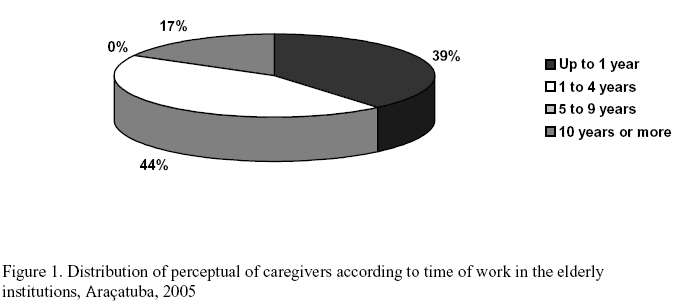
The caregivers work an average of 3.13 years in the institution. The caregiver who has less time of work has been working with elderly people for three months, and the most experienced one, for eleven years (Figure 1) and more than half of them (61.11%) reported that they started working in the area for financial necessity, not for affinity (Table 1). This is a worrying circumstance due to the fact that the search for this work activity without affinity can compromise the quality of assistance offered to the elderly, besides of increasing the risks of violence against the patient. It is also necessary to emphasize the need for stimulus from the caregivers to offer a better and more satisfactory performance and also to avoid the so-called "routine" in the performance of their activities. It is important that the caregiver do not forget that, in the other side, there is a human-being, in need of stimulus and feelings.
The caregiver's time of work must be cautiously evaluated, since the practiced activity can be quite tiring and the duty of taking a dependent adult into care implicates in risks of also turning into sickness and be equally dependent of another caregiver (Cerqueira, 2002).
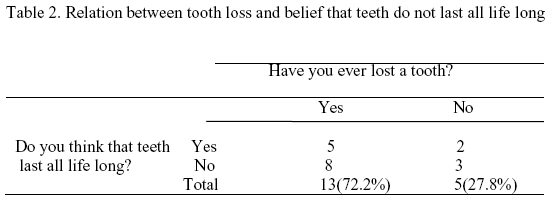
]]> The report of losing, at least, a dental element for necessity of extraction was present in 72.2% of the subjects interviewed (Table 2) and no one of them had their oral health classified as optimum. According to Mello and Padilha (2000), caregiver's perceptions and attitudes towards their own oral health influences in the care provided to the elderly. If the caregiver fails in the conservation of his/her own oral hygiene, the tendency is that he/she transfers the same actions to the patient that he is responsible for. In many cases, starting from this item, it is possible to determine the quality of the service provided to the elderly patient.
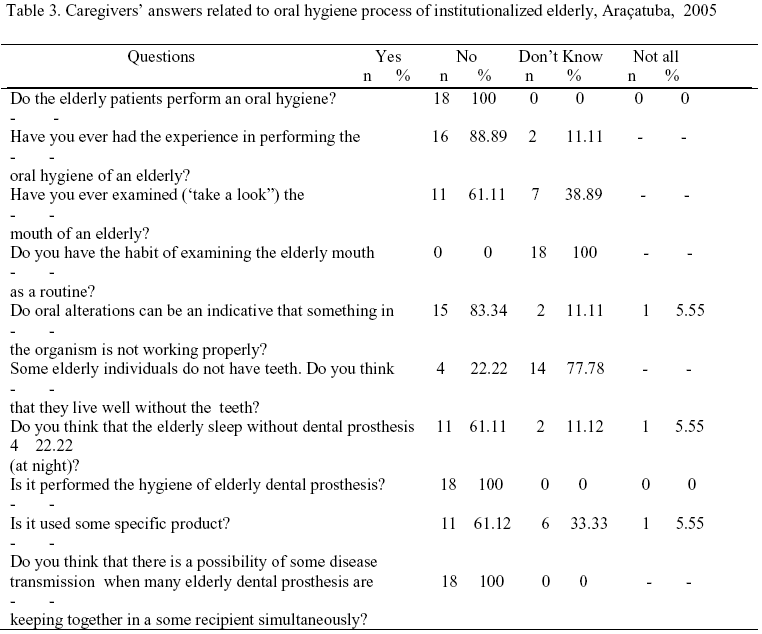
Although 83% of the caregivers believe that the oral alterations are an indicative that something is not working properly in the organism, none of them has the habit of examining the mouth of the elderly as a routine, and 38.89% of them had never gone through an oral exam (Table 3). Many are the alterations that come from aging. In a systemic level, we can list the cell loss, the weakness of the skeletal muscle system and the functional capacity decrease of many biochemical systems, which lead the elderly to a loss that can only be minimized if the caregiver is able to identify this process (Nakatani et al., 2003).
When the issue concerns oral alterations that come with aging, it is important to mention the diminishment of the gustative capacity that originates from a decrease in the number of gustative papillae (around 80% less than in the adult age). The teeth get a darker appearance, and in many cases can present dental erosion due to the usage of dentifrice containing abrasive agents. The periodontal tissues tends to get more fragile, suffering absorptions, and as a consequence, apical migration of the gum, exposing dental roots. The patient usually complains about "stinging ", "burning" or even about pain in the oral mucosa. This fact can be directly connected to the decrease of the flow of saliva (xerostomia) and is also inherent in aging process, which, can be accentuated by the usage of medicines. This discomfort can also be provoked by partial or total prosthesis, fractured teeth, ingestion of food with sharp edges and other factors (Brunetti, 2002).
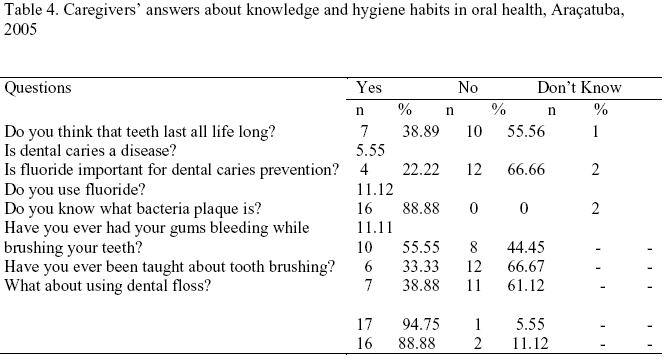
Regarding oral health knowledge, 66.6% of the caregivers believe that dental caries is not a disease, 22.2% alleged that it is a disease, 11.1% were not able to answer the question and 55.56% of the interviewed stated that the loss of teeth in third age is an inevitable process (Table 4).
Mello and Padilha (2000) report that caregivers, including dentists, tend to have little perspective in relation to longevity of the elderly and they also wonder about the importance of the maintenance of the teeth in the oral cavity. Attitudes similar to these can be characterized as an extreme negligence and can contribute to the deficiency in the oral and general health quality of the elderly, defining their mastication capacity, nutrition, phonetic and sociability process.
As for preventive methods of dental caries, 88.88% reported that the use of dental floss is especially important, although 44.4% of the interviewed said that they did not make use of it. Conversely, when they were questioned if they were taught how to brush the teeth, 94.44% gave a positive answer and 11.12% reported that they had never received orientations related to the use of the dental floss (Table 4).
]]> Despite of that great part of the caregivers believe that fluoride is important to prevent dental caries, almost half of them (44.4%) stated that they did not use it (Table 4). This data reflects the lack of knowledge in relation to the sources of fluoride, for example, the dentifrice and water system.Still concerning oral health knowledge, 66.67% stated that they did not know what bacteria plaque was, and when questioned if they had already had bleeding gums during oral hygiene process, 38.89% of the interviewed gave an affirmative answer.
This data demonstrate the lack of information in relation to oral health, especially from those individuals who care for dependent people, and most of the times, fragile patients, in situations that health knowledge is of extreme importance for longevity with life quality.
Pucca Junior (2000) highlights in his article that oral health is an inseparable and integrant part of general health and that it has been relegated to a complete forgetfulness, in the Brazilian case, when are discussed about the health conditions of the elderly. He still reports that the total teeth lost is accepted by society and by the dentists as something normal and natural with advance of the age, leading to a false conception of the aging process. It is important to emphasize that aging process by itself does not bring diseases.
Moimaz et al (2004) stated that, in Brazil, dental caries and periodontal diseases are priorities regarding oral health, reasoning that, besides the fact that they affected most part of the population, both present high levels of prevalence and incidence.
Elderly people can be classified into three distinct groups, according to their functional ability: independent – constituted by healthy elderly persons; partially dependents – elderly people who present partial physical and/or psychological disabilities and totally dependents – those who present total physical and/or psychological debilities (Guedes, 2001). According to these aspects, it should be permitted and also be stimulated to elderly individuals, who have capacity to perform their own oral hygiene, that they do it by themselves, because, in this way, they would be practicing their motor coordination and it also brings a positive self-image.
Great part of the interviewed caregivers (88.8%) had already performed the oral hygiene in the elderly at least once and 77.7% believe that edentulous elderly do not have a good quality of life.
The teeth loss implies in psychological questions, compromising both self-image and general health aspects. According to Moriguchi (1998), "the loose of teeth influence mastication, digestion, gustation, phonetic, esthetic aspect, predisposing geriatric diseases". Within this scenario, the opinion which is expressed by the majority of caregivers (77.78%) in relation to way of life of the edentulous elderly reflects the deleterious reality of this condition.
The caregivers reported in 61.11% of the answers that elderly patients use to sleep without their dental prosthesis, 11.12% do not remove the device to sleep, and, in 22.22% of the answers, mentioned that some of the elderly do remove it before sleeping and that others do not.
In the literature, there are divergences regarding using or not a dental prosthesis during the night. Saliba et al (2000), in the Manual of Conservation and Hygiene of Dental Prosthesis, state the necessity of removing the device for a minimum of 8 hours daily, in search of the recuperation and possibility of hygiene of the oral tissues. Jitomirski and Jitomirski (1997) report that if the elderly patients want to sleep without the dental prosthesis, they can do in this way. And exactly this practice was found in one of the elderly institutions, where almost the totality of the caregivers reported that the dental prosthesis is only removed if the geriatric patient wants to do it.
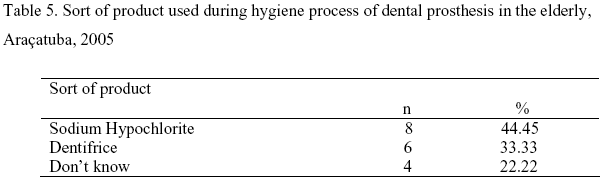
]]> In 100% of the answers, it was affirmed that the oral hygiene of the elderly patients' dental prosthesis is done; 61.11% reported that they use a specific product for cleaning (Table 3), in the majority of cases, hypochlorite (44.45%); 33.3% attested that they do not use a specific product apart from dentifrices.
This unanimity in relation to the importance of doing the hygiene of the elderly's dental prosthesis denotes that, even if it is not performed in a properly way, the hygiene is not neglected. The cleaning of total dental prosthesis should be done after meals with the utilization of a brush and a neutral soap. The usage of the dentifrice should be avoided for containing abrasive agents, and, consequently, it can erode the resin of the prosthesis. Once or two times a week, it should immerse the prosthesis in a solution containing 220 ml of water and a tea soup of 2% sodium hypochlorite during fifteen minutes (Saliba et al., 2001).
When it was asked about the possibility of diseases transmissions during the hygiene of dental prosthesis in the same recipient, simultaneously, it was unanimous the response that there is a possibility of contamination. This perception is of unequaled importance, considering a previous study of Saliba et al. (1999) that found out that 50% of elderly individuals from the three institutions as users of some type of dental prosthesis. In another study of Moimaz et al. (2004), in the city of Piacatu, São Paulo, from the total of the studied sample, 90% utilized a total prosthesis. Although the studied sample do not correspond to institutionalized elderly, it is important that a notion of hygiene of the dental prosthesis has been diffused. If this hygiene is performed in an inadequate way, keeping prosthesis from different persons in the same recipient, simultaneously, it disseminates a cross infection process.
Mello and Padilha (2000) remind that the majority of the elderly individuals is not able to maintain good levels of oral hygiene or of their prosthesis, and, in many cases, it is necessary the caregiver's help. Therefore, it is indispensable the knowledge about the correct process of hygiene of the prosthesis, because it configures a daily care which is fundamental for the maintenance of the elderly oral health.
It was also confirmed that, although 77.7% of the caregivers had already participated in elderly care trainings, most of them have never received any orientation about oral care in the third age (Table 1).
Conclusion
]]> The very own oral condition influences the sort of care provided to the elderly. Therefore, it is important to the caregivers to be motivated to take into consideration the oral health the care it deserves, and, so, they can prioritize the care to the elderly oral health.It was possible to verify that there is not an oral health supervision in the studied institutions, possibly for an equivocal priority attributed to health questions. The lack of information about oral health can be pointed as one of the responsible for the deficiency of actions in the care provided by elderly caregivers, being necessary to capacitate these professionals in the elderly care, once that prerequisites towards professional development during the hiring process are not required.
Therefore, it is important to point out that, caregivers, when properly trained, can reduce the discomfort filled by elderly individuals in the various cases reported above, and even to avoid the installation of serious diseases processes, promoting a better quality of life.
From this point of view, it is necessary the development of new researches in this knowledge area, for the reason that there are few publications in this area of actuation.
REFERENCES
ALMEIDA, M. E. L.; MOIMAZ, S. A. S.; GARBIN, C. A. S.; SALIBA, N. A. Um olhar sobre o idoso: estamos preparados? Rev. Fac. Odonto. Porto Alegre, v. 45, n. 1, p. 64-68, 2004. [ Links ]
BRASIL, Censo Populacional. Instituto Brasileiro de Geografia e Estatística. Disponível em: <http://www.ibge.gov.br>. Acesso em: 27 Set. 2005. [ Links ]
BRUNETTI, R.; BRUNETTI, F. L. Odontogeriatria: noções de interesse clínico. São Paulo: Artes Médicas, 2002. 418 p. [ Links ]
CALDAS, C. P. A dimensão existencial da pessoa idosa e seu cuidador. Textos Envelhecimento. Rio de Janeiro, v.3, n. 4, 2000. Disponível em: <http://www.unati.uerj.br/tse/uerj> Acesso em: 12 out. 2005. [ Links ]
CALDAS, C. P. A saúde do idoso: a arte de cuidar. Rio de Janeiro: Ed. UERJ, 1998. 212 p. [ Links ]
CERQUEIRA, A. T. A. R. Programa de apoio a cuidadores: uma ação terapêutica e preventiva na atenção à saúde dos idosos. Psicologia USP, São Paulo, v.13, n.1, 2002. Disponível em: <http://www.scielo.br/scielo.php> Acesso em: 09 out. 2005. [ Links ]
GONÇALVES, L. O. Cuidadores primários familiares dos idosos atendidos na Clínica Escola de Fisioterapia da Universidade do Vale do Itajaí – UNIVALI. 91p. Dissertação (Mestrado) – Universidade Federal de Santa Catarina. 2002. [ Links ]
GUEDES, J. S. Sorria toda vida, viva com saúde bucal, autocuidados e cuidadores. Secretaria da Saúde de São Paulo, janeiro de 2001. Disponível em: <www.saude.sp.gov.br>. Acesso em: 10 out. 2005. [ Links ]
JITOMIRSKI, F., JITOMIRSKI, S. O que os cuidadores de idosos precisam saber sobre saúde bucal. Curitiba, 1997. 20 p. [ Links ]
MELLO A. L. F.; PADILHA, D. M. P. Instituições geriátricas e negligência odontológica, Rev. Fac. Odontol. Porto Alegre, v.41, n.1 p. 44-48, jul. 2000. [ Links ]
MOIMAZ, S. A. S., GULINELLI, J. L., GARBIN, C. A. S., SPINELLI, E. B., SALIBA, O. Avaliação do programa de promoção de saúde bucal para pré-escolares. RPG Rev. Pós Grad. v. 11, n. 2, p. 182-8. 2004. [ Links ]
MOIMAZ, S. A. S.; SANTOS, C. L. V.; PIZZATTO, E.; GARBIN, C. A. S.; SALIBA, N. A. Perfil de utilização de Próteses Totais em idosos e avaliação da eficácia de sua higienização. Ciência Odontol. Bras. v. 7, n.3, p. 72-8. 2004. [ Links ]
MORIGUCHI, Y. Aspectos geriátricos no atendimento odontológico. Rev. Odont. Moderno. v. 19, n. 4, p.11-3. 1998. [ Links ]
NAKATANI, A. Y. K.; SOUTO, C. C. S.; PAULETTE, L. M.; MELO, T. S.; SOUZA, M. M. Perfil dos cuidadores informais de idosos com déficit de autocuidado atendidos pelo Programa de Saúde da Família. Revista Eletrônica de Enfermagem, v. 5 n. 1, 2003. Disponível em: <http:/www.fen.ufg.br/revista>. Acesso em 10 out 2005. [ Links ]
PUCCA JÚNIOR, G. A. A. Saúde Bucal do idoso, aspectos demográficos e epidemiológicos. Disponível em: <http://odontologia.com.br/artigos.asp>. Acesso em: 30 out. 2005. [ Links ]
SALIBA, C. A.; SALIBA, N. A.; MARCELINO, G.; MOIMAZ, S. A. S. Auto-avaliação de saúde na terceira idade. RGO, v. 47, n. 3, p. 127-130, 1999. [ Links ]
SALIBA, N. A., MOIMAZ, S. A. S., GARBIN, C. A. S., BRANDÃO, I. G., CASTILHO, A. P. Manual para Conservação e Higienização de Próteses Dentárias, FOA – Unesp/ Araçatuba/ SP. 2001. [ Links ]
SANTOS, S. S. C. Desenvolvimento Sustentável e Cuidado ao Idoso. Textos Envelhecimento, Rio de Janeiro, v. 3, n. 6, 2001. Disponível em: <http://www.unati.uerj.br/tse/uerj> Acesso em: 12 out. 2005. [ Links ]
WORLD HEALTH ORGANIZATION (WHO). Disponível em: <http://www.who.int>. Acesso em: 29 out. 2005. [ Links ]
 Correspondence address:
Nemre Adas Saliba
R. José Bonifácio, 1193. Vila Mendonça ]]>
Araçatuba- SP, Brazil. 16015-050
Tel: 55-18- 36363249 / 36363250. Fax: 55-18-36363332
e-mail: nemre@foa.unesp.br