
Desenvolvimento da relação de cooperação mediada por computador em ambiente de educação a distância
Desarrollo de la relación de cooperación mediada por el ordenador en ambiente de educación a distancia
Ivan Ferrer MaiaI,1; Carla Lopes RodriguezII; Flaminio de Oliveira RangelIII; José Armando ValenteIV
IUniversidade Estadual de Minas Gerais, UEMG, campus de Campanha; Fundação de Amparo à Pesquisa de Minas Gerais (FAPEMIG/MG); Departamento Multimeios, Instituto de Artes, Universidade de Campinas (IA/Unicamp). <ivan.fm2@terra.com.br>
IIDepartamento Multimeios IA/Unicamp; Tecnologia da Informação no Desenvolvimento da Internet Avançada - Aprendizado Eletrônico (TIDIA-AE /FAPESP/SP). <clrodriguez@terra.com.br> ]]>
IIIDepartamento Multimeios IA/Unicamp; Faculdade de Educação, Pontifícia Universidade Católica de São Paulo (FE/PUC-SP). <f.o.r@terra.com.br>
IVDepartamento Multimeios, IA/Unicamp; FE/PUC-SP. <jvalente@unicamp.br>
Translated by Sandro Palhão
Translation from Interface - Comunicação, Saúde, Educação, Botucatu, v.10, n.20, p. 427-441, July/Dec. 2006.
ABSTRACT
This article analyzes part of the results of a social research program developed along with neighborhood health agents of São Marcos and Santa Mônica in Campinas, state of São Paulo. It was a longitudinal study carried out over a period of a year and a half carried out throughout three phases: face-to-face, intermediary stage and pure distance work. In this article we solely discuss the activities during the face-to-face phase, whereby agents learnt how to use the computer and the TelEduc2 system. We opted to apply qualitative observation given that the main objective of this research was to identify Piaget's developmental stages within the context of the agents' capacity to understand tangible and intangible aspects of the technological universe. This relationship was possible when the subjects began to interact with basic elements of the computer and with TelEduc. After overcoming a state of anomia and understanding the tools that allowed a heteronomous attitude, agents used resources allowing them to enter a relationship of cooperation.
Key words: cooperative behavior. distance education. community developmental stages. computer user training. computer leteracy.
RESUMO
]]> O artigo contempla parte dos resultados de uma pesquisa-ação desenvolvida junto aos agentes de saúde dos bairros São Marcos e Santa Mônica, em Campinas-SP. Trata-se de pesquisa longitudinal, com duração de um ano e meio, envolvendo três fases: presencial, semipresencial e a distância. Aqui tratamos apenas das atividades ocorridas na fase presencial, nas quais os agentes começaram a aprender a utilizar o computador, e do TelEduc. Para tanto, optamos por uma observação qualitativa, já que o objetivo principal foi aferir os estágios de desenvolvimento de Piaget com a capacidade dos agentes em dominar as entidades tangíveis e intangíveis da informática (compreendem-se as entidades tangíveis como os elementos de hardware; e as entidades intangíveis, como os de software). Essa relação foi possível quando eles, de maneira presencial, começaram a interagir com os elementos básicos do computador e com o TelEduc. Após superarem a anomia e terem dominado as ferramentas que favoreceram posturas heterônomas, os agentes manipularam recursos que permitiram o começo de uma relação de cooperação.Palavras-chave: comportamento cooperativo; educação a distância. desenvolvimento da comunidade. capacitação de usuário de computador. conhecimentos em informática.
RESUMEN
Este artículo contempla parte de los resultados de una investigación-acción desarrollada juntamente con los agentes de salud de los barrios Sao Marcos y Santa Mônica, Campinas/ Sao Paulo. Fue una investigación longitudinal, con duración de un año y medio, que constó de tres fases: Presencial, semipresencial y a distancia. En este artículo tratamos solamente de las actividades ocurridas en la fase presencial, en la cual los agentes comenzaron a aprender a utilizar el ordenador y TelEduc. Optamos por una observación cualitativa, ya que el objetivo principal fue asociar las tres fases de desarrollo piagetianas -anomia, heteronomia y cooperación - con la capacidad de los agentes de dominar las propiedades tangibles e intangibles de la informática. Esta asociación fue posible cuando ellos empezaron a interactuar con los elementos básicos del ordenador y del TelEduc. Después de superar la anomia y de dominar las herramientas qué favorecieran actitudes heterónomas, los agentes manipularon recursos que permitieron el comienzo de una relación de cooperación.
Palvras clave: conducta cooperativa. educación a distancia. desarrollo de la comunidad. capacitación de usuário de computador. conocimientos en informática.
1. INTRODUCTION
This research is connected to the public program Healthy Community (Comunidade Saudável), which carries out activities for the promotion of quality of life in low income disadvantaged neighborhoods in Campinas. One of these is the Complex of Amarais (Complexo dos Amarais), a community located in Campinas, in the state of São Paulo, which has over 35 thousand inhabitants who live in the Santa Mônica, São Marcos, Barro Preto, Jardim Campineiro and Vila Esperança neighborhoods. The population, is formed mainly by slavers´ descendants of the slavery abolition and by immigrants from other Brazilian states (Lapa, 1996), who live on the outskirts of Amarais.
The community health agents are professionals who live and work in the neighborhood trying to promote an improvement in the life of the local population. When an agent find a critical case in the community it is important that s/he discuss it with other agents or professionals related to the health area. The lack of time available for meetings makes it difficult to exchange information and experiences. Thus, we felt that a Distance Education Environment (DEE) TelEduc could help these agents, as they would have the opportunity to cooperate with each other. However, the agents' lack of experience of how to use these technologies required that this learning process was initially carried out in a face-to-face situation, even though at certain moments there were some online activities. The agents were learning how to use the computers, as well as sophisticated software, in this case the TelEduc environment. This article deals with this phase in which they acquired the elementary concepts about how to use the computer and the DEE.
]]>2. OBJECTIVE
The main objective of the article is to verify whether the agents would overcome the anomy and heteronomy stages to reach the cooperative relationship, while understanding the tangible and intangible entities of the computer and of TelEduc. Considering that the DEE is being used in continuing education and that it offers the possibility of exchanging ideas and experiences, it is critical to the agent's training that they understand fundamental aspects of these technologies. Therefore, it is important to study knowledge construction in relation to the mastering of computer skills and the different stages in the process of building cooperation network in a DEE.
3. METHODOLOGY
We based our study on Thiollent's action research methodology (Thiollen, 2004) that presupposes a participative and investigative attitude of the subjects involved, and the democratization of educational and social experiences. We used qualitative observations, which consider participants subjectivity and socio-cultural aspects. The instruments used were: interviews; group discussions and activity reports; and registration of the activities performed with the computer and with the tools in TelEduc.
The research was developed over the course of a year and a half, and involved three phases: face-to-face, online and a mixture of face-to-face and online activities. In each phase a computer laboratory was installed, respectively in the following places: Action Research Interdisciplinary Laboratory (Laboratório Interdisciplinar de Pesquisa-Ação) - LIPA (UNICAMP), Espaço Esperança Community Center (Centro Comunitário Espaço Esperança) in the São Marcos neighborhood, and Health Centers (Centros de Saúde) in the São Marcos and Santa Mônica neighborhoods. In this paper we focus only on the activities that took place in the face-to-face phase (LIPA-UNICAMP), which took one semester, in which the agents began to learn how to use the computer and some of the TelEduc tools. The focus of our analysis is how the agents overcame the anomy and heteronomy stages while understanding the tangible and intangible computer entities, carrying out concrete and abstract operations, to a point where they were able to handle basic computer resources and the TelEduc communication tools.
Three community health agents of the São Marcos neighborhood participated in this phase, two women and one man. Only the male agent had a computer at home, but he mentioned that he had little experience with it. The two female agents had never had direct contact with computers. This lack of experience lead the three agents initially to develop simple activities such as turning the computer on and off, creating e-mails, elaborating texts, searching and copying information from the internet. After this initial phase, some of the TelEduc tools were gradually introduced and the agents were able to post items in the Portfolio and on the Mural, interact in the Chat Room, discuss issues in the Discussion Forum, etc. These activities were carried out in a face-to-face situation. At the end of this phase, the agents began to communicate online. They were able to talk to each other through TelEduc while sitting next to one another. Three Unicamp graduate students participated in this part of the study and are referred as researcher-educators. They met with the agents once a week and functioned as mediators for the agents' activities.
4. COOPERATIVE RELATIONSHIP
]]> In this section we discuss the concept of cooperation based on the theories of Piaget and Vygotsky.4.1. Cooperation concept
In order to have a cooperative relationship among people it is commonly accepted that cooperation must prevail over coercion. Coercion is understood in terms of authority, of regulations imposed and formed by the historical, social, political and economic conditions that prevent the individual from fulfilling their rights of autonomy in relation to the construction of knowledge. Piaget, defines cooperation as "(...) all social relations in which there is no intervention of any element of authority or prestige" (Piaget apud Montangero, J., & Maurice-Naville, 1998, p.120). In contrast to coercion, cooperation according to Piaget is a process that creates new realities, and cannot be seen as a simple exchange of information among individuals. Piaget also states that cooperation requires the individuals to mentally operate together. In order for cooperation to happen it is necessary that the individuals involved have knowledge and autonomy to act. And autonomy is gained in the relationship with another person (Rangel et al, 2003). The social relationship is the basis to germinate critical spirit. According to Vygotsky (apud Oliveira, 1992, p.33), learning awakens the development of internal processes that occur when the individual interacts with other people within a critical-historical context.
In conclusion, cooperation is a complex socio-cultural relationship that requires operations, joint activities or actions that are socially organized in order to reach proposals of common interest, reciprocal benefits and the development of more critical individuals. Cooperation only exists when based on collective morality, on mutual respect, on autonomy and inter-subjective responsibility. Cooperation cannot be mistaken by an inhibitory critical posture. On the contrary, it only makes sense within a social logic as an instrument for the awakening of the conscience and a possible way of overcoming social, economical and knowledge exclusion.
4.2. The Three developmental stages
In his studies about cooperation Piaget (1994) mentioned the development of three stages:
]]> The transition to the cooperative stage initiates awareness of the rules and the social relationship. There is a development of the intellect, which helps the child to get rid of false beliefs and to begin to realize her/his potential to modify the rules. Even though the participants in this research were adults, who already had a regulatory mark acquired in life, we considered that there is a parallel between the three stages and the attitudes adopted by the agents in the activities with the computer.- Anomy or sensorial-motor (24 to 30 months of age): the rule is not yet coercive. It is purely motor, supported unconsciously by interesting examples and not by complying to reality. In the anomy stage, there is an appeal for imagination, fantasy, mysticism with attitudes and beliefs that subsequent intellectual development will eliminate;
- Heteronomy or egocentric (around 2 to 8 years of age): the rule is considered sacred and intangible. It is originated by the adults, that is, its essence is external and any modification in the rules is considered by the child as a transgression. The sense of group organization begins to develop, but in an intuitive manner;
- Growing cooperation or autonomy (begins to appear around 7 or 8 years of age): the child considers the rule a law, created by mutual consent, in which respect is mandatory. The rules can be modified as long as there is consent. They articulate abstract thoughts and dominate intangible objects. Dialogue becomes a discussion with different points of view and distribution of collective responsibility.
5. ACTIONS AND RESULTS
As a result of the first face-to-face phase, the agents learned to manipulate the basic computational entities, such as turning the computer on and off, surfing on the internet, using e-mail, manipulating some of the TelEduc tools (Profile, Portfolio, Discussion Forums, Mural, Chat, e-mail, etc). These tools allowed the agents to come closer to the development of a relationship of cooperation, which at the end of this phase started to happen via online. We could identify the three stages Piaget observed, although they were neither stable, nor pure. In each activity, one became more evident than the other.
5.1. Anomy: the imaginary and the sensory-motor
The three agents, at the beginning of the first phase, presented behavior and attitudes towards the use of the hardware (tangible entities) and of basic software functions (intangible entities) that could be categorized as belonging to the anomy state based on sensory-motor and imaginary behaviors.
The agents had a "sensory-motor" relationship with the computer in which they felt that it was important to be able to handle the equipment. This sensory-motor issues and lack of basic knowledge about computers became clear, especially with the women, when the agents were placed in front of the computer and were presented with a sequence of actions – turning the computer on and off repeatedly. The female agents presented little skill with the mouse, difficulty in positioning the cursor and confusion with the concept of the tangible entities. For example, when the two female agents had to turn off the computer, they turned off the monitor, thinking they were shutting down the whole equipment. Another mistake occurred due to an ambiguity existing in the MS Windows interface. When they wanted to shut it down, they could not find the off button. They took time to realize that they should click on the start button presented on the initial screen of the software. Later on, the tool Agenda, available in the TelEduc environment, was also mistakenly interpreted. They related its utility to the same function of an agenda that is sold in a stationery store, for registering personal notes. In the TelEduc the Agenda tool is used to inform the activities that are going on and can be seen by all course participants.
The second reason for considering the agents in the anomy state was the imaginary. While in front of the computer, the agents could not interpret what they were seeing. In order to help them, we compared the Teleduc environment with their own houses and the health center, pointing out the existence of certain divisions according to their functions. We discussed that there was a correlation between Teleduc and the places where they live and work. This quick experience allowed us to identify the imaginary difficulties of the agents. They would not dare touching the computer because they thought that their lack of computer knowledge could lead them to "damage" it (value object). We noticed that there was a fear of making mistakes (fetishes). It was nothing more than a fantasy vision, a mystification of the computer that established a coercion relationship in which the computer seemed like an expensive object, too complex and that they could not have access to it. Even though Piaget affirmed that there is no coercion in the anomy stage, it was noticed that the agents were intimidated by the technology. Thus, in order to interpret this situation we looked for support in Vygotsky's "social-historic" theory (Vygotsky, 2000). The agents' coerced attitude, when in front of the computer, presented itself as a cultural expression of the social imbalance. To understand this fact it is necessary to go back to the brief historical aspects presented in the introduction, where we discussed the slavery heritage (it is not a coincidence that all three agents were African descendents) and the social and economical crises of the region.
These examples demonstrated that the agents had greater difficulties with the concepts of the intangible entities. For, as observed by Valente (1987) the adult participant in the computer activities initially operated the computer as concrete objects and only after grasped the intangible aspects of its abstract structure. Also we observed that the agents' attitude gradually changed, especially the women, who in the beginning were more afraid due to their lack of experience. However, the relationship between the two women and the male agent, who was more experienced in the use of the computer and some of its resources, could not be configured as one of cooperation, in the Piaget (1973) sense, since there was neither common operation nor reciprocity. Despite the effort of the male agent, an unbalanced, unilateral relationship was established. The women's lack of knowledge hindered the possibility of a relationship of cooperation. The women could not exchange what they did not possess.
5.2. Heteronomy: in search of a face
]]> Also in the first phase we could identified heteronomy stage. The agents searched for an identity and limited themselves to the rules, without transgressions. The concern was egocentric. Two activities are discussed here: the agents' enrollment in the TelEduc and the insertion of personal data in the Profile tool. Each agent, accompanied by a researcher-educator, sat in front of a computer. In order to use Teleduc it was necessary to register them in the TelEduc environment. A person needs to have an electronic address (e-mail), to which a password and defined login are sent automatically by the system, so s/he can have access to the environment. The agents had to carry out two registrations: one for the provider that allows the use of free webmail, since they did not yet have an e-mail address, and another for the TelEduc. For both it was necessary to fill out an electronic form and choose an access name, the login. In the case of registering in the webmail, the definition of a password was also necessary. The biggest problem occurred in the operations that required assimilation of the conceptions of intangible objects, especially in relation to the definition of passwords and logins such as forgetting characters. The same problems occurred in the TelEduc registration. Possible solutions were mediated by the researcher-educator such as, activating the Caps Lock key, creating passwords and logins which were easy to memorize, and suggesting taking notes of the information on paper.Despite the difficulties, the agents managed to create the e-mails and register them in the TelEduc, but did not discuss or face the problems together. None of them formulated any questions about the registration to the colleague. As they did not have any knowledge on the subject, they were centered on themselves, trying to solve the problems that appeared. Once they had completed the registration, they began to work with the Profile tool, adding personal data: schooling, place of work, hobbies, etc. Having to write down information about themselves made them think about their own current condition and the context, the place where they live, work, leisure, family, etc. A photograph of each one was added, which was taken while they filled out the Profile.
When the agents saw their photos in the computer, their reaction was euphoric. They called other people to show they were on the computer screen – now they were also "part of the virtual world". At that moment laughs were the universal language. We can say that this was the changing point, where they realized that they could dominate the machines, humanize them. Thus remembering Bergson, "Only men are laughable. If we laugh at an object or an animal, we take it as man and we humanize it" (Bergson apud Vygotsky, 2001, p.295). If the agents had seen the images alone without the enthusiasm of their colleagues, they might not have been so moved. However, the pleasure was essentially "egocentric" and not social
The Profile tool allowed for the agents to see themselves, to reveal themselves in the virtual world and to be recognized. But still, it was one way communication, with no dialog. What existed was information on the screen that the other subjects could access, without being able to comment on it, because the Profile tool does not allow a dialogue. In this stage, some TelEduc tools were better understood and handled. The agents managed to insert their "identities" into the computer, had an e-mails address, were able to create their profiles and began to dominate basic internet vocabulary. However they were not using these resources to communicate through the TelEduc. The communication among them was happening because they were in the same room.
5.3. Birth of cooperation: from dialogue to action
At the end of the first phase, after having dominated the resources that had favored heteronomy, the agents began to manipulate tools that allowed for social relationship, reaching a greater level of abstraction. They were able to use tools such as: Chat-room, Portfolio and Mural. For the first time the agents participated in an on-line Chat session. The three agents were in the same room, separated by a distance of approximately four meters and exchanged information freely through the Chat tool. Informal dialogue was predominant. The facial expressions were not the same as when filling out the electronic registration forms. They smiled and gazed attentively at the screen. The "good relationship" that existed in the face-to-face situation was extended to the TelEduc environment. We can see below, during a chat session how one of the agents talked in a very humorous manner with his colleague. The theme was transportation, a van (VW Kombi) that arrived to pick them up.
]]> (17:48:47) Agent 02 speaks to everybody: The Kombi has arrived (17:49:28) Agent 01 speaks to everybody: I already know! It's the wagon, right baby? (17:49:47) Agent 02 speaks to everybody: what a shame that we're leaving! (17:50:05) Agent 01 speaks to everybody: that's it, ain´t it?(17:50:07) Agent 02 speaks to everybody: you hillbilly (17:50:27) Agent 01 speaks to everybody: You betcha
Agent 01 "transforms" his words into a comic hick language. The good-mood, contradicting the rules of authority and imposed opinions, provided reciprocity in kindness. In the Chat they were having the same natural attitude as in their face-to-face communication, contrary to the coerced one at the beginning of the activities. The relaxed dialogue, without the authority and coercion, helped the relationship among the agents to become easier, minimized the individualistic manifestations and optimized the decentralization – from the heteronomy stage to the dialogue with one another. Issues about work were also Chat themes. Below, an agent informs her colleague about a meeting and her possible presence.
(17:41:11) Agent 02 answers to everybody: You know about the meeting, don't you? (17:41:26) Agent 01 speaks to Agent 02: not yet (17:42:05) Agent 02 is surprised with everybody: the coordinator didn't mention it to you, she spoke to me (17:42:42) Agent 01 speaks to Agent 02: I didn't see Maria today! (17:43:21) Agent 02 is surprised Agent 01: Then I think it will be next week (17:44:03) Agent 01 speaks to Agent 02: Hope so because then I'll be able to participate
There is a negotiation dialogue here: if the meeting were postponed for the following week, the agent would be able to participate. In the next example, there is a concern of the same agent about the organization of the working place.
(17:45:04) Agent 02 speaks to Agent 01: We need to organize those closets with the registered archives, because we have little space left. We must do it on Monday or Tuesday.
The agent reinforces the need for a team work, aiming at solving the question of lack of space in the closets where the archives of the population seen at the health center are kept. He requests the colleague's participation in the meeting, as well as to organize the closets.
In both examples the dialogue revolves around formal work issues. There is not a discussion about construction of ideas that transcends work and searches for social projects. The predominant action is communication. The agents exchange ideas, but did not make decisions. The following case is noteworthy. The agents searched, on the internet, for information of personal interest and made it available in the Portfolio tool. Later they accessed each other's Portfolio and commented them. The themes and links attached were addresses of sites about contagious diseases, child labor and Chinese gymnastics. We are going to discuss the latter theme.
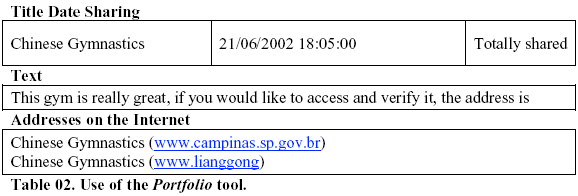
]]> The agent who searched for information on Chinese gymnastics was a voluntary teacher of Lian Gong. She used the Portfolio tool to disseminate information about the Lian Gong gym to everyone who had access to TelEduc and also was interested in reproducing the texts to be used in classes. Below, we can see how she made available the information in the Portfolio.
The agent transcends the search in order to find information about her formal work. There was an awareness of the use of the TelEduc to promote the social projects of the agent and of the community. The agents commented that, if the regions had computer laboratories, this would create the possibility of developing a communication network in the region. The agents also used the Mural to share information. The messages posted were about the dengue campaign, meetings and social activities. One of the agents accessed the TelEduc at home and used the Mural to support a colleague in disseminating information about the gym classes. This was a first example of an activity that took place using online facilities. Other online activities occurred in other phases of the research.
This announcement represented an affective support that encouraged the agent to strengthen the invitation for the Lian Gong classes to the users of the TelEduc environment.
]]> Table 4
The agents had used technology to promote the gymnastics classes. Their actions could be considered a legitimate cooperative relationship, despite the fact that if there was not a mutual involvement and collective decision making, that would promote new attitudes, that is, a "recontextualization" of reality, starting from "decontextualized" ideas (Valente and Prado, 2002, p.30).
Thus a tendency towards a cooperative relationship began to happen at the end of this third phase. The use of TelEduc was tied to the texts captured on the internet for the use of the community. This happened because the three agents had already acquired basic knowledge about how to handle the computer. The concern was no longer the sensory-motor, but the social use of the computer. An awareness process began to be drafted more intensely, thanks to the internal structure of the agents and their concern with the community, announcing an incipient cooperation.
5. DISCUSSION AND FINAL CONSIDERATIONS
The agents, who initially had no ability for handling the computer, were able to use tools for searching, storing and displaying the information and commenting on the contributions posted by the colleagues. With this, they articulated more complex operations in the domain of intangible entities and of tools that allowed the cooperative relationship.
In relation to the first stage (anomy), motor and psychological factors interfered with the cooperative relationship. In the beginning the agents when dealing with the computer seemed apprehensive and introspective. They were attached to the pre-concept or imaginative idea that the computer can only be handled by a social class that is prepared for that and they considered themselves below this possibility. We observed in the agents' attitude the weight of the coercion exerted by the unfavorable social conditions, such as a historical legacy and a political lack of concern. As mentioned by Piaget (1994), coercion is the opposite of cooperation. Among the cognitive aspects, the agents manipulated the computer freely, demonstrating an assimilation centered on concrete aspects of the equipment, that is, the focus of the actions was on the sensory-motor aspects.
The passage from the anomy to the heteronomy stage was mediated by the Profile tool, which enabled the agents to exchange their way they looked at themselves. With the photo on the interface, the agents were enchanted with their own image. This individual pleasure functioned as a bridge to bring them closer to the computer and to make possible other superior operational activities. The agents managed to interpret signs, operate intangible entities, perceive the dynamics of the system and understand that it is possible to modify things, especially after having inserted their personal data.
Better conditions for dialogue and abstract operation emerged with the Chat tool. The agents conducted a dialogue about themes related to the health center. There was exchange of ideas, but no decision making. While the Chat tool was used to exchange ideas, referring to formal work, the use of the Portfolio and of the Mural transcended the health center limits. With the Chinese gymnastics proposal, the action was not molded by the work obligation, but by the agent's own creative initiative, who used the TelEduc tools and internet resources for a construction of a collective activity. During the use of the communication tools, the agents articulated more complex operations, such as registering their own ideas and giving opinions on each other's comments. The relationship among the agents was established within the cognitive growth process, with respect to being able to understand the computer and the opportunities offered by the tools. The agents overcame the anomy and heteronomy stages as they dominated basic computer elements and the TelEduc tools. In this process, we noticed that the agents established more complex and abstract operations, to the point of handling tools that allowed socialization.
]]> It became clear that the TelEduc possesses tools that can support cooperative relationship. However, this relationship does not emerge from nowhere. It was necessary to create a favorable environment centered on the context of the agents. This was a situation that, allied to a conscious mediation by the researcher-educators, contributed towards forming an upward spiral of individual and social improvement. Thus, we consider that the cooperative relationship occurred when the agents began to overcome the historical inheritance of coercion and began to awaken their empowering senses, that is, when they felt capable of interacting with the technology and changing their own reality.
REFERENCES
LAPA, J. R. A. A cidade: os cantos e os antros. São Paulo: Edusp, 1996. [ Links ]
LÉVY, P. As tecnologias da inteligência: o futuro do pensamento na era da informática. Rio de Janeiro: Editora 34, 1993. [ Links ]
MONTANGERO, J.; MAURICE-NAVILLE, D. Piaget ou a inteligência em evolução: construtivismo em sala de aula. Porto Alegre: Artes Médicas Sul, 1998. [ Links ]
OLIVEIRA, M. K. Vygotsky e o processo de formação de conceitos. In: LA TAILLE, Y. D.; OLIVEIRA, M. K.; DANTAS, H. Piaget, Vygotsky, Wallon: teorias psicogenéticas em discussão. 16.ed. São Paulo: Summus, 1992. p.23-34. [ Links ]
PIAGET, J. Estudos sociológicos. Rio de Janeiro: Forense, 1973. [ Links ]
PIAGET, J. O juízo moral na criança. 2.ed. São Paulo: Martins Fontes, 1994. [ Links ]
RANGEL, F. O.; MAIA, I. F.; RODRIGUEZ, C. L. Investigações sobre o conceito de autonomia subjacente ao projeto Comunidade Saudável. In: CONGRESSO DA SOCIEDADE BRASILEIRA DE COMPUTAÇÃO, 23., WIE, 9., 2003, Campinas. Anais... Campinas: SBC, 2003, v.5, p.345-56. [ Links ]
RANGEL, H. A.; MARTINS, J. P. S. Campinas: no rumo das comunidades saudáveis. Campinas: IPES Editorial, 2004. [ Links ]
ROCHA, H. V. O ambiente TelEduc para educação a distância baseada na web: princípios, funcionalidades e perspectivas de desenvolvimento. In: MORAES, M. C. (Org.). Educação a distância: fundamentos e práticas. Campinas: Unicamp/NIED, 2002. p.197-212. [ Links ]
TEBEROSKY, A.; TOLCHINSKY. L. O desenvolvimento da interação. Porto Alegre. In: ______. Substratum: temas fundamentais em psicologia e educação. Porto Alegre: Artes Médicas Sul, 1997. p.9-14. [ Links ]
THIOLLENT, M. Metodologia da pesquisa-ação. 13.ed. São Paulo: Cortez, 2004. [ Links ]
VALENTE, A. B. Como o computador é dominado pelo adulto. São Paulo: NIED/UNICAMP, 1987. [ Links ]
VALENTE, J. A.; PRADO, M. E. A educação a distância possibilitando a formação do professor com base no ciclo da prática pedagógica. In: MORAES, M. C. (Org.). Educação a distância: fundamentos e práticas. Campinas. São Paulo, Unicamp/NIED, 2002. p.27-50. [ Links ]
VYGOTSKY, L. S. A formação social da mente. 6.ed. São Paulo: Martins Fontes, 2000. [ Links ]
VYGOTSKY, L. S. Psicologia da arte. São Paulo: Martins Fontes, 2001. [ Links ]
]]> 1 Rua Cônego Antônio Felipe, 252
