<?xml version="1.0" encoding="ISO-8859-1"?><article xmlns:mml="http://www.w3.org/1998/Math/MathML" xmlns:xlink="http://www.w3.org/1999/xlink" xmlns:xsi="http://www.w3.org/2001/XMLSchema-instance">
<front>
<journal-meta>
<journal-id>1414-3283</journal-id>
<journal-title><![CDATA[Interface - Comunicação, Saúde, Educação]]></journal-title>
<abbrev-journal-title><![CDATA[Interface (Botucatu)]]></abbrev-journal-title>
<issn>1414-3283</issn>
<publisher>
<publisher-name><![CDATA[UNESP]]></publisher-name>
</publisher>
</journal-meta>
<article-meta>
<article-id>S1414-32832007000100015</article-id>
<title-group>
<article-title xml:lang="en"><![CDATA[The Collective Subject that speaks]]></article-title>
<article-title xml:lang="pt"><![CDATA[O sujeito coletivo que fala]]></article-title>
<article-title xml:lang="es"><![CDATA[El sujeto colectivo que habla]]></article-title>
</title-group>
<contrib-group>
<contrib contrib-type="author">
<name>
<surname><![CDATA[Lefevre]]></surname>
<given-names><![CDATA[Fernando]]></given-names>
</name>
<xref ref-type="aff" rid="A01"/>
</contrib>
<contrib contrib-type="author">
<name>
<surname><![CDATA[Lefevre]]></surname>
<given-names><![CDATA[Ana Maria Cavalcanti]]></given-names>
</name>
<xref ref-type="aff" rid="A02"/>
</contrib>
<contrib contrib-type="author">
<name>
<surname><![CDATA[Polla]]></surname>
<given-names><![CDATA[Cauê Cardoso]]></given-names>
</name>
</contrib>
</contrib-group>
<aff id="A01">
<institution><![CDATA[,Universidade de São Paulo Faculdade de Saúde Pública ]]></institution>
<addr-line><![CDATA[ ]]></addr-line>
</aff>
<aff id="A02">
<institution><![CDATA[,Instituto de Pesquisa do Discurso do Sujeito Coletivo  ]]></institution>
<addr-line><![CDATA[ ]]></addr-line>
</aff>
<pub-date pub-type="pub">
<day>00</day>
<month>00</month>
<year>2007</year>
</pub-date>
<pub-date pub-type="epub">
<day>00</day>
<month>00</month>
<year>2007</year>
</pub-date>
<volume>3</volume>
<numero>se</numero>
<fpage>0</fpage>
<lpage>0</lpage>
<copyright-statement/>
<copyright-year/>
<self-uri xlink:href="http://socialsciences.scielo.org/scielo.php?script=sci_arttext&amp;pid=S1414-32832007000100015&amp;lng=en&amp;nrm=iso"></self-uri><self-uri xlink:href="http://socialsciences.scielo.org/scielo.php?script=sci_abstract&amp;pid=S1414-32832007000100015&amp;lng=en&amp;nrm=iso"></self-uri><self-uri xlink:href="http://socialsciences.scielo.org/scielo.php?script=sci_pdf&amp;pid=S1414-32832007000100015&amp;lng=en&amp;nrm=iso"></self-uri><abstract abstract-type="short" xml:lang="en"><p><![CDATA[This paper discusses the Discourse of the Collective Subject as a qualitative-quantitative proposal for opinion polling or research on social representations. The authors propose the presentation of collective opinion in research as an empirical variable of qualitative and quantitative nature. This is achieved by introducing a subject of discourse, who is individual and collective at the same time. This empowers the speaker to express him or herself directly, without the intervention of the researcher's meta-discourse and avoids converting opinion in a mere quantitative variable, mutilating its essentially discursive nature.]]></p></abstract>
<abstract abstract-type="short" xml:lang="pt"><p><![CDATA[Discute-se aqui o Discurso do Sujeito Coletivo como proposta qualiquantitativa para as pesquisas de opinião ou representação social. Propõe-se a apresentação, nas pesquisas, da opinião coletiva como uma variável empírica de natureza qualitativa e quantitativa capaz, pela interposição de um sujeito de discurso ao mesmo tempo individual e coletivo, de se exprimir, diretamente, sem a mediação do metadiscurso do pesquisador e sem a transmutação da opinião em variável quantitativa, com prejuízo de sua natureza essencialmente discursiva.]]></p></abstract>
<abstract abstract-type="short" xml:lang="es"><p><![CDATA[Se discute aquí el Discurso del Sujeto Colectivo como propuesta cualicuantitativa para las investigaciones de opinión o representación social. Se propone la presentación en las investigaciones de la opinión colectiva como una variable empírica de naturaleza cualitativa y cuantitativa capaz, por la interposición de un sujeto de discurso al mismo tiempo individual y colectivo, de expresarse, directamente, sin la mediación del metadiscurso del investigador y sin la transmutación de la opinión en variable cuantitativa, con perjuicio de su naturaleza esencialmente discursiva.]]></p></abstract>
<kwd-group>
<kwd lng="en"><![CDATA[discourse of the collective subject]]></kwd>
<kwd lng="en"><![CDATA[methodology]]></kwd>
<kwd lng="en"><![CDATA[qualitative research]]></kwd>
<kwd lng="en"><![CDATA[social representations]]></kwd>
<kwd lng="pt"><![CDATA[discurso do sujeito coletivo]]></kwd>
<kwd lng="pt"><![CDATA[metodologia]]></kwd>
<kwd lng="pt"><![CDATA[pesquisa qualitativa]]></kwd>
<kwd lng="pt"><![CDATA[representação social]]></kwd>
<kwd lng="es"><![CDATA[discurso del sujeto colectivo]]></kwd>
<kwd lng="es"><![CDATA[metodología]]></kwd>
<kwd lng="es"><![CDATA[investigación cualitativa]]></kwd>
<kwd lng="es"><![CDATA[representación social]]></kwd>
</kwd-group>
</article-meta>
</front><body><![CDATA[ <p><font face="verdana" size="4"><b>The Collective Subject that speaks</b></font></p>     <p>&nbsp;</p>     <p><font face="verdana" size="3"><b>O sujeito coletivo que fala</b></font></p>     <p>&nbsp;</p>     <p><font face="verdana" size="3"><b>El sujeto colectivo que habla</b></font></p>     <p></p>     <p>&nbsp;</p>     <p>&nbsp;</p>     <p><font face="verdana" size="2"><b>Fernando Lefevre<sup>I</sup>; Ana Maria Cavalcanti    Lefevre<sup>II</sup></b></font></p>     <p><font face="verdana" size="2"><sup>I</sup>Professor titular, Faculdade de Saúde    Pública, Universidade de São Paulo (USP). &lt;<a href="mailto:flefevre@usp.br">flefevre@usp.br</a>&gt;    ]]></body>
<body><![CDATA[<br>   <sup>II</sup>Instituto de Pesquisa do Discurso do Sujeito Coletivo. &lt;<a href="mailto:ana@ipdsc.com.br">ana@ipdsc.com.br</a>&gt;</font></p>     <p><font face="verdana" size="2">Translated by Cauê Cardoso  Polla    <br>   Translation from <a href="http://www.scielo.br/scielo.php?script=sci_arttext&pid=S1414-32832006000200017&lng=en&nrm=iso&tlng=pt" target="_blank"><b>Interface    - Comunicação, Saúde, Educação</b>, Botucatu, v.10, n.20, p. 517-524, July./Dec.    2006</a>.</font></p>     <p>&nbsp;</p>     <p>&nbsp;</p> <hr noshade size="1">     <p><font face="verdana" size="2"><b>ABSTRACT</b></font></p>     <p><font face="verdana" size="2">This paper discusses the Discourse of the Collective    Subject as a qualitative-quantitative proposal for opinion polling or research    on social representations. The authors propose the presentation of collective    opinion in research as an empirical variable of qualitative and quantitative    nature. This is achieved by introducing a subject of discourse, who is individual    and collective at the same time. This empowers the speaker to express him or    herself directly, without the intervention of the researcher's meta-discourse    and avoids converting opinion in a mere quantitative variable, mutilating its    essentially discursive nature.</font></p>     <p><font face="verdana" size="2"><b>Key-words:</b> discourse of the collective    subject; methodology; qualitative research; social representations.</font></p> <hr noshade size="1">     <p><font face="verdana" size="2"><b>RESUMO</b></font></p>     <p><font face="verdana" size="2">Discute-se aqui o Discurso do Sujeito Coletivo    como proposta qualiquantitativa para as pesquisas de opini&atilde;o ou representa&ccedil;&atilde;o    social. Prop&otilde;e-se a apresenta&ccedil;&atilde;o, nas pesquisas, da opini&atilde;o    coletiva como uma vari&aacute;vel emp&iacute;rica de natureza qualitativa e    quantitativa capaz, pela interposi&ccedil;&atilde;o de um sujeito de discurso    ao mesmo tempo individual e coletivo, de se exprimir, diretamente, sem a media&ccedil;&atilde;o    do metadiscurso do pesquisador e sem a transmuta&ccedil;&atilde;o da opini&atilde;o    em vari&aacute;vel quantitativa, com preju&iacute;zo de sua natureza essencialmente    discursiva.</font></p>     ]]></body>
<body><![CDATA[<p><font face="verdana" size="2"><b>Palavras-chave:</b> discurso do sujeito coletivo.    metodologia. pesquisa qualitativa. representa&ccedil;&atilde;o social.</font></p>     <p></p> <hr noshade size="1">     <p><font face="verdana" size="2"><b>RESUMEN</b></font></p>     <p><font face="verdana" size="2">Se discute aqu&iacute; el Discurso del Sujeto    Colectivo como propuesta cualicuantitativa para las investigaciones de opini&oacute;n    o representaci&oacute;n social. Se propone la presentaci&oacute;n en las investigaciones    de la opini&oacute;n colectiva como una variable emp&iacute;rica de naturaleza    cualitativa y cuantitativa capaz, por la interposici&oacute;n de un sujeto de    discurso al mismo tiempo individual y colectivo, de expresarse, directamente,    sin la mediaci&oacute;n del metadiscurso del investigador y sin la transmutaci&oacute;n    de la opini&oacute;n en variable cuantitativa, con perjuicio de su naturaleza    esencialmente discursiva.</font></p>     <p><font face="verdana" size="2"><b>Palabras clave:</b> discurso del sujeto colectivo.    metodolog&iacute;a. investigaci&oacute;n cualitativa. representaci&oacute;n    social.</font></p> <hr noshade size="1">     <p>&nbsp; </p>     <p>&nbsp;</p>     <p><font face="verdana" size="3"><b>Introduction</b></font></p>     <p><font face="verdana" size="2">This work aims at reflecting upon the possibilities    that are offered to express a collective opinion or thought empirically. Taking    into account the fact that collective opinion as an empirical fact is conveyed    only indirectly by the researcher's meta-discourse or by means of a given mathematical    formula (losing its immanently discursive form) one proposes as a truly expressive    alternative the Discourse of Collective Subject (DCS). </font></p>     <p><font face="verdana" size="2">The proposal of the Discourse of the Collective    Subject (Lefevre &amp; Lefevre, 2003), associated to the Qualiquantisoft software    (www.spi-net.com.br) is grounded mainly in the presuppositions of the Theory    of Social Representations (Jodelet, 1989). It lists and articulates a series    of operations on raw data constituted of statemens obtained through empirical    polling using open-ended questions, what results in <i>collective statements</i>    made up of different extracts of individual statements. Each collective statement    stands for a determined opinion or position and is written in the first person    singular aiming at producing in the receptor the effect of a collective opinion    expressed as an empirical fact through the "mouth" of a single subject of discourse.    </font></p>     ]]></body>
<body><![CDATA[<p><font face="verdana" size="2">The application of the DCS technique to a great    number of empirical researches in the field of public health and also in other    fields (DCSs's bank) has been showing its efficacy for the processing and expression    of collective opinions. </font></p>     <p><font face="verdana" size="2">The accumulated experience in using the DCS methodology    shows an increasing perfecting of the technique and its various applications.    Hence, in general, the most recent works present this methodology at its most.    </font></p>     <p><font face="verdana" size="2">In this sense we would like to highlight in what    regards academic works the following: Valverde (2006), on overweight, Medina    (2005) about internet forums dealing with urban violence and Akyiama (2006)    on phonoaudiologic intervention in deafness. </font></p>     <p><font face="verdana" size="2">In what regards non-academic works, it's worth    citing the work that evaluates the Post-Graduation Program of the National School    of Public Health (Rivera, 2005), representing an important application of the    methodology to institutional assessment. Another work is Levèfre et al.'s (2005)    which uses among other resources the discourses of preteens students allowing    the detailed description of the subjective representation of the day-to-day    relationship between parents and sons affected by the consume of cigarettes    by the parents. </font></p>     <p>&nbsp;</p>     <p><font face="verdana" size="3"><b>Stalemates for expression the collective thought.    </b></font></p>     <p><font face="verdana" size="2">The challenge faced by the DCS is the searching    for the self-expression of the collective thought or opinion, preserving its    double condition of being both qualitative and quantitative. In effect, if one    considers the framework of empirical research, thought seen as material, as    signifying matter, is a previously unknown result (for the empirical researcher),    i.e., is a discourse inductively obtained. This thought shows itself undoubtedly    as a qualitative variable, as a product to be qualified by the research <i>a    posteriori</i> as an <i>output</i>. Nevertheless, being this thought of <i>collective    </i>character it is also quantitative to the extent that it must express opinions    shared by a certain number of individuals that configures the researched collectivity.</font></p>     <p><font face="verdana" size="2">Given this scenario one of the challenges to    be defeated in order to allow the collective thought to express itself through    empirical research would be the constitution of a subject bearing this collective    discourse. </font></p>     <p><font face="verdana" size="2">However, how can one verbally express this collective    subject as a subject-that-speaks-directly by not using a mathematical expression    or a scientific "they say" (even "one says", impersonal subject)?</font></p>     <p><font face="verdana" size="2">Now, apparently such a collective subject cannot    speak if it is kept bound positivistically to the possibilities offered by the    language it speaks (the Portuguese one or others);  we will only have a precarious    way to access directly this collective subject which is the pronoun "we" – first    person plural. The "collective I" is not an alternative. </font></p>     ]]></body>
<body><![CDATA[<p><font face="verdana" size="2">Now, a collective subject as understood by us    in the Discourse of the Collective Subject is more than a "we" that express    only a very particular kind of collective subject that speaks; it is also not    <i>less </i>because one single subject can be a collective subject. </font></p>     <p><font face="verdana" size="2">In traditional opinion polling, the subject that    states his opinions (that who speaks: "<i>in my opinion…", "I think that…" or    "I believe that…") </i>is almost always a single subject, or at most a "we".    Thus, a collective subject would not find direct forms to express itself and    "henceforth" would come to be non-existent. To be more precise it wouldn't be    seen as a speaker susceptible only of being indirectly retaken as a "they" about    which one speaks or as an artificial non-linguistic subject such as "<i>30%    of the users of the healthcare unity think that…"</i>. </font></p>     <p><font face="verdana" size="2">On the other side, the common sense (and also    the common-sense-type-researcher) believes that the subject that states directly    his or her opinion  is only the single speaker of the "I" or a limited speaker    that speaks on behalf of the "we". These are seen as the only natural subjects    of the discourse which express opinions given that for this common sense a subject    that express his or her opinion is only speaking when there is "linguistic emission"    (or a transcription of it) of a single "mouth" (even when it is about "we",    it is only a single "mouth" that speaks). </font></p>     <p><font face="verdana" size="2">Hence, once that there is no collective "mouth",    a collectivity that express its opinions would not be able to speak directly,    would only be talked about (through the meta-linguistic "mouth"), or would be    reconstituted non-discursively, e.g., "<i>30% of Brazilian men think that…</i>".    </font></p>     <p><font face="verdana" size="2">This is the reason why one believes that empirically    there isn't such collective speech stating opinions.</font></p>     <p><font face="verdana" size="2">Now, this strict positivistic and "naturalistic"    behavior needs to be overcome – what is not an easy task –, assuming that scientific    and systematic treatment of the object "collective opinion" will require specific    methodological <i>constructions </i>that allows one to keep the necessary binding    with empirical reality. It is also necessary that the collective opinion can    be artificially rebuilt (given that in this case it can only be artificial)    as a qualitative object. </font></p>     <p><font face="verdana" size="2">Besides, an "I" or "We" subject is also a subject    of reconstituted opinion to the extent that one leaves aside the linguistic    and psychological illusion that the natural home of opinion is individual consciousness.    </font></p>     <p>&nbsp;</p>     <p><font face="verdana" size="3"><b>The proposal of the DCS </b></font></p>     <p><font face="verdana" size="2">The Discourse of the Collective Subject is an    explicit proposal for reconstituting an empirical collective being or entity,    stating his/her opinion as a subject of discourse spoken in the first person    singular.  </font></p>     ]]></body>
<body><![CDATA[<p><font face="verdana" size="2">What is the reason for making this choice? </font></p>     <p><font face="verdana" size="2">Because the <i>speaking </i>social (speaking    structure) or <i>spoken </i>social (structured structure) (Bourdieu, 1990) in    individuals, in the first person singular, is the natural working regimen of    opinions or social representations. In fact, opinions or social representations    are efficient, i.e., work, precisely because individuals believe that these    are their opinions, i.e., are generated in their brains. </font></p>     <p><font face="verdana" size="2">Thus, DCS as this apparently paradoxical subject    of discourse, once it is written in the first person singular though reporting    a collective thought, is sociologically possible. </font></p>     <p><font face="verdana" size="2">However, collectivity speaking in the first person    singular does not only illustrate the regular working regimen of social representation    but also is a resource to make feasible these very social representations as    collective facts regarding qualitative collectivities (of discourse) and quantitative    (of individuals). In fact, no one doubts that individuals share the same opinion(s),    but when these very individuals state their opinions individually they only    communicate a fraction of the content of a shared idea. </font></p>     <p><font face="verdana" size="2">One has been attempting to reconstitute a collective    subject in the DCS as a collective subject that is a collective person simultaneously    speaking as if it were an individual, i.e., as a "natural" subject of discourse    that conveys a representation of  amplified content. </font></p>     <p>&nbsp;</p>     <p><font face="verdana" size="3"><b>Two Examples of the DCS </b></font></p>     <p><font face="verdana" size="2"><b>First Example</b></font></p>     <p><font face="verdana" size="2">It is here presented a DCS elaborated as an exercise    by students (teenagers between 16 and 20 years old), during the course offered    by the School of Public Health of the University of São Paulo – <b>Projeto Bolsa    Trabalho</b>: formação de pesquisadores juniores. [Convênio] PMSP/Secretaria    do Trabalho/Unesco/Faculdade de Saúde Pública – USP, 2003. </font></p>     <p><font face="verdana" size="2">It was proposed as one of the didactic activities    of this course the realization of a research applying the DCS concerning the    neighborhood where these students lived in, named Casa Verde. This research    was carried out and its results were published in a specialized journal (Lefèvre    et al., 2004). Here are some excerpts: </font></p>     ]]></body>
<body><![CDATA[<p><font face="verdana" size="2"><b>Research: </b>the opinion of the dwellers    of Casa Verde about violence against children. </font></p>     <p><font face="verdana" size="2"><b>Question: </b>In your opinion, what makes     a parent  beat a child? </font></p>     <p><font face="verdana" size="2"><b>Category for the answer: </b>alcohol and drugs.    </font></p>     <p><font face="verdana" size="2"><b>Key-expressions of the answers:</b></font></p>     <blockquote>       <p><font face="verdana" size="2">Subject 5 - ...or if he takes any kind of drug,      even being alcoholism.</font></p>       <p><font face="verdana" size="2">Subject 9 - ...drug and alcohol. </font></p>       <p><font face="verdana" size="2">Subject 12 - ...alcoholism and drugs alter      parents  at home…</font></p>       <p><font face="verdana" size="2">Subject 14 - ...when he arrives drunk at home      or even high.  </font></p>       <p><font face="verdana" size="2">Subject 19 - ...drugs, if they are addicted      to.</font></p>       ]]></body>
<body><![CDATA[<p><font face="verdana" size="2">Subject 20 - …when a parent has problems with      alcohol and drugs. Then he becomes aggressive and beats his son… </font></p>       <p><font face="verdana" size="2">Subject 1 – Alcoholism, drugs... </font></p>       <p><font face="verdana" size="2">Subject 8 - ...father or mother that drinks      alcohol and take drugs…</font></p>       <p><font face="verdana" size="2">Subject 6 - …drinking alcohol, and also taking      drugs…</font></p> </blockquote>     <p><font face="verdana" size="2"><b>Discourse of the Collective Subject </b></font></p>     <blockquote>       <p><font face="verdana" size="2">It is alcoholism, drugs. </font></p>       <p><font face="verdana" size="2">When a father or a mother drinks alcohol or      is addicted to it, or takes drugs and arrives at home drunk or even high,      they become altered, becoming aggressive, beating their children. </font></p> </blockquote>     <p><font face="verdana" size="2">One needs to notice that the DCS was composed    in the first person singular, with key-expressions from statements of similar    meaning, drawn from nine distinct individuals. </font></p>     <p><font face="verdana" size="2">This collective person talks here as if it were    a single individual, i.e., as a "natural" subject of discourse who nonetheless    conveys a representation of various individuals, what allows the emergence of    a collective opinion both qualitative and quantitative: <i>qualitative </i>because    it is a discourse of amplified and diversified content, and <i>quantitative    </i>because nine subjects have contributed to the construction of this DCS.    </font></p>     ]]></body>
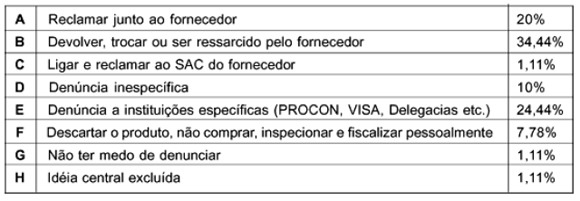
<body><![CDATA[<p><font face="verdana" size="2"><b>Second Example</b></font></p>     <p><font face="verdana" size="2">The research reported here (Seragi et al., 2005)    aimed at analyzing the current representation of some aspects of the Health    Surveillance system by the inhabitants of the city of Águas de Lindóia (Brazil)    in order to subsidize capacitating processes, education and development of technical    personnel, as well as providing material for communication and marketing plans    destined to bring closer services offered and the population.     </font></p>     <p><font face="verdana" size="2">The research was carried out in the city of Águas    de Lindóia</font></p>     <p><font face="verdana" size="2">To realize the interview a semistructured script    has been used. The sample was composed of sixty users of the three health care    unities of the city: Unidade Básica de Saúde Alexandre Gatoline in the neighborhood    Casas Populares; Unidade Básica de Saúde Bela Vista, in the neighborhood Bairro    Bela Vista; Pronto Atendimento Municipal, in downtown.  </font></p>     <p><font face="verdana" size="2">The research was made choosing at random in each    unity a user older than 18 years old, in each working shift (morning and afternoon),    totalizing six interviews a day during 10 days. The selected user was approached    in the waiting room with a question asking if he/she would like to participate    in the research. If the answer was positive he/she was then conducted to a private    room previously selected, where the interviewer informed him/her about the mechanism    and purpose of the research and fulfilled a form with information given by the    user. In the form, interviewees were named in sequence from ÁGUAS 01 up to ÁGUAS    60. Then, the Term of Agreement was read and the user asked to sign it in case    of agreement. After turning the voice recorder on, the interviewer began by    naming the interview according to the name of the form (interview: Águas <i>n</i>),    then asked the first question. </font></p>     <p><font face="verdana" size="2">We report here only some qualitative and quantitative    results of the question: a<i> person buys food and notices that it is rotten.    What could this person do?</i></font></p>     <p><font face="verdana" size="2">The synthesis of central ideas to this question    was as follows; the percentage of obtained answer is also given:</font></p>     <p>&nbsp;</p>     <p align=center><img src="/img/revistas/s_icse/v3nse/a15img01.gif"></p>     <p>&nbsp;</p>     ]]></body>
<body><![CDATA[<p><font face="verdana" size="2">A – To make a complaint to the supplier. 20%</font></p>     <p><font face="verdana" size="2">B – Give it back, change or be paid back by the    supplier. 34.44%</font></p>     <p><font face="verdana" size="2">C – Call and make a complaint to the Costumer    Service of the supplier. 1.11%</font></p>     <p><font face="verdana" size="2">D – Unspecified denounce. 10%</font></p>     <p><font face="verdana" size="2">E – To call specific institutions (PROCON, VISA,    Police Stations etc) and denounce the supplier.  24.44%</font></p>     <p><font face="verdana" size="2">F - To get rid of the product, do not buy, inspect     personally 7.78% </font></p>     <p><font face="verdana" size="2">G – To be not afraid to denounce 1.11%</font></p>     <p><font face="verdana" size="2">H – Central idea excluded 1.11%</font></p>     <p><font face="verdana" size="2">The DCS <b>B – "Give it back, change or be paid    back by the supplier" </b>was the most shared idea between the interviewees.    The resultant discourse is:</font></p>     <blockquote>       ]]></body>
<body><![CDATA[<p><font face="verdana" size="2">I think that he/she should go back to the supermarket      and give it back because it is an abuse against the consumer to sell rotten      things, and the supplier must be responsible for what it is selling: you are      not going to consume rotten food nor lose your money. </font></p>       <p><font face="verdana" size="2">The consumer must contact the owner of this      shop and dialogue with him, give the product back and try to reach an agreement      so that he/she takes the right measure because we want another product or      to be paid back. </font></p>       <p><font face="verdana" size="2">This has already happened with me, I went back      to the market, complained and asked for another product, because I've paid      for that. Why should I buy another rotten thing? Change, give it back and      take another one! </font></p> </blockquote>     <p>&nbsp;</p>     <p><font face="verdana" size="3"><b>Conclusion</b></font></p>     <p><font face="verdana" size="2"><b>The DCS and double representativity </b></font></p>     <p><font face="verdana" size="2">It can be highlighted that the novelty presented    by the DSC is the double representativity  - qualitative and quantitative –    of collective opinions that emerge from the research: representativity is qualitative    because in the researches using the DCS each distinct collective opinion is    presented under the form of a discourse that reconstitutes distinct contents    and arguments that matches the given opinion in the social scale; but representativity    is also quantitative because such discourse has, furthermore,  a numerical expression    (that indicates how many statements out of the total were necessary to compose    each DCS), this means, statistical reliability, considering societies as collectivities    of individuals. </font></p>     <p><font face="verdana" size="2"><b>Discoursive strata and infinite semiosis</b></font></p>     <p><font face="verdana" size="2">The social representations expressed by the DCS    need to be regarded in the perspective of percian semiotics (Peirce, 1975) as    successive strata of discourses seen as <i>interpretant</i> signs based in a    primary entity that we could call as <i>the thought of collectivity</i>. </font></p>     <p><font face="verdana" size="2">The Discourses of Collective Subject shapes a    panel of social representations under the form of discourses (as social empirical    researches based in a series of methodological procedures) which seek to recover    the collective thought in a less arbitrary way (Bourdieu &amp; Passeron, 1970),    in contrast with what has been happening in researches of this sort, be it qualitative    or quantitative. </font></p>     ]]></body>
<body><![CDATA[<p><font face="verdana" size="2">Evidently, the DCS does not intend to interpret    social representation as infinite semiosis, neither work as "the last word"    in what concerns these representations or its meanings and senses: it is only    an <i>interpretant sign </i>(Peirce, 1975) that seeks out to reconstruct representations    at a determinate level. </font></p>     <p><font face="verdana" size="2">Henceforth, DCSs <b>are not the social representations    themselves</b>, but only try to reconstitute a <b>stratum </b>out of them; upon    this stratum another stratum can be directly added, constituted by one or many    discourses or discursive formations or ideologies (Verón, 1980) in action in    the DCSs. </font></p>     <p><font face="verdana" size="2">The problem resides in defining the methodological    procedures that can guarantee rigor and the standardization for these procedures    in order to adequately recover this discursive stratum or <i>interpretant </i>sign.    </font></p>     <p>&nbsp;</p>     <p><font face="verdana" size="3"><b>References: </b></font></p>     <!-- ref --><p><font face="verdana" size="2">AKIYAMA, R. <b>Análise comparativa da intervenção    fonoaudiológica na surdez: com a família ou com os pais?</b> 2006. Dissertation    (Master Degree) - Programa de Pós-Graduação em Ciências: Fisiopatologia Experimental,    Faculdade de Medicina, Universidade de São Paulo, São Paulo.&nbsp;&nbsp;&nbsp;&nbsp;&nbsp;&nbsp;&nbsp;&nbsp;    </font><!-- ref --><p><font face="verdana" size="2">BANCO DE DSCs. Available at:  &lt;<a href="http://www.ipdsc.com.br" target="_blank">www.ipdsc.com.br</a>&gt;.    Access in: May 2006.&nbsp;&nbsp;&nbsp;&nbsp;&nbsp;&nbsp;&nbsp;&nbsp; </font><!-- ref --><p><font face="verdana" size="2">BOURDIEU, P.; PASSERON, J. C. <b>La réproduction:</b>    éléments pour une théorie du système d'enseignement. Paris: Minuit, 1970.&nbsp;&nbsp;&nbsp;&nbsp;&nbsp;&nbsp;&nbsp;&nbsp;    </font><!-- ref --><p><font face="verdana" size="2">BOURDIEU, P<b>. Coisas ditas.</b> São Paulo:    Brasiliense,1990.&nbsp;&nbsp;&nbsp;&nbsp;&nbsp;&nbsp;&nbsp;&nbsp; </font><!-- ref --><p><font face="verdana" size="2">FOUCAULT, M. <b>Microfísica do poder.</b> 17.ed.    Rio de Janeiro: Edições Graal, 1979.&nbsp;&nbsp;&nbsp;&nbsp;&nbsp;&nbsp;&nbsp;&nbsp;    </font><!-- ref --><p><font face="verdana" size="2">JODELET, D. Representations sociales: un domaine    en expansion. In: Jodelet, D. (Org.). <b>Répresentations sociales</b>. Paris,    PUF, 1989. p.31-61.&nbsp;&nbsp;&nbsp;&nbsp;&nbsp;&nbsp;&nbsp;&nbsp; </font><!-- ref --><p><font face="verdana" size="2">LEFEVRE, F.; LEFEVRE, A.M.C. <b>Depoimentos e    discursos</b>. Brasília: Liberlivro, 2005.  </font><!-- ref --><p><font face="verdana" size="2">LEFEVRE, F.; LEFEVRE, A. M. C<b>. O discurso    do sujeito coletivo:</b> um novo enfoque em pesquisa qualitativa. Caxias do    Sul: Educs, 2003. (Desdobramentos).&nbsp;&nbsp;&nbsp;&nbsp;&nbsp;&nbsp;&nbsp;&nbsp;    </font><!-- ref --><p><font face="verdana" size="2">LEFEVRE, F.; LEFEVRE, A. M. C.; FERNANDES, E.;    CAZZUNI, D. H.; MEDEIROS, I. Y.; OLIVEIRA, N. G. S. Uma experiência de formação    de pesquisadores juniores: discursos do sujeito coletivo sobre a violência contra    a criança. <b>Rev. Bras. Crescimento Desenvolv. Hum.</b>, v.14, n.1, p.76-89,    2004.&nbsp;&nbsp;&nbsp;&nbsp;&nbsp;&nbsp;&nbsp;&nbsp; </font><!-- ref --><p><font face="verdana" size="2">LEFEVRE, F.; PEREIRA, I. M. T. B.; LEFEVRE, A.    M. C.; STEWEN, G. T. M.; OLIVEIRA, N. G. S.; SUTOM, A. P. C.; MEDEIROS, I. Y.    Criança: fumante passivo sem opção. <b>Bol. Epidemiol. Paulista,</b> v.8, p.5,    2004.&nbsp;&nbsp;&nbsp;&nbsp;&nbsp;&nbsp;&nbsp;&nbsp; </font><!-- ref --><p><font face="verdana" size="2">MEDINA, A.G. <b>Fórum de discussão na web e violência    urbana:</b> estudo de caso por meio da análise do Discurso do Sujeito Coletivo.    2005. Dissertation (Master Degree) - Faculdade de Saúde Pública, Universidade    de São Paulo, São Paulo. </font><!-- ref --><p><font face="verdana" size="2">PEIRCE, C. S. <b>Semiótica e filosofia</b>. São    Paulo: Cultrix/Edusp, 1975. </font><!-- ref --><p><font face="verdana" size="2">RIVERA, F.J. U.; ARTMAN, E.; FREITAS, C. M. <b>Relatório    cenário da pós-graduação <i>strictu</i> sensu</b>. Rio de Janeiro: Escola Nacional    de Saúde Pública, 2005.&nbsp;&nbsp;&nbsp;&nbsp;&nbsp;&nbsp;&nbsp;&nbsp; </font><!-- ref --><p><font face="verdana" size="2">SOFTWARE QUALIQUANTISOFT. Availble at: &lt;<a href="http://www.spi-net.com.br" target="_blank">www.spi-net.com.br</a>&gt;.    Accessed in: October 2005.&nbsp;&nbsp;&nbsp;&nbsp;&nbsp;&nbsp;&nbsp;&nbsp; </font><!-- ref --><p><font face="verdana" size="2">VALVERDE, M. A. <b>Cognições e atitudes de mulheres    com excesso de peso e obesas: alimentação de controle de peso.</b> 2006. Thesis    (Doctorate) - Programa de Pós-Graduação Interunidades em Nutrição Humana Aplicada,    Universidade de São Paulo, São Paulo</font><!-- ref --><p><font face="verdana" size="2">VERÓN, E. <b>A produção do sentido</b>. São Paulo:    Cultrix/Edusp, 1980.</font> ]]></body><back>
<ref-list>
<ref id="B1">
<nlm-citation citation-type="">
<person-group person-group-type="author">
<name>
<surname><![CDATA[AKIYAMA]]></surname>
<given-names><![CDATA[R.]]></given-names>
</name>
</person-group>
<source><![CDATA[Análise comparativa da intervenção fonoaudiológica na surdez: com a família ou com os pais?]]></source>
<year>2006</year>
</nlm-citation>
</ref>
<ref id="B2">
<nlm-citation citation-type="">
<collab>BANCO DE DSCs</collab>
<source><![CDATA[]]></source>
<year></year>
</nlm-citation>
</ref>
<ref id="B3">
<nlm-citation citation-type="book">
<person-group person-group-type="author">
<name>
<surname><![CDATA[BOURDIEU]]></surname>
<given-names><![CDATA[P.]]></given-names>
</name>
<name>
<surname><![CDATA[PASSERON]]></surname>
<given-names><![CDATA[J. C.]]></given-names>
</name>
</person-group>
<source><![CDATA[La réproduction: éléments pour une théorie du système d'enseignement]]></source>
<year>1970</year>
<publisher-loc><![CDATA[Paris ]]></publisher-loc>
<publisher-name><![CDATA[Minuit]]></publisher-name>
</nlm-citation>
</ref>
<ref id="B4">
<nlm-citation citation-type="book">
<person-group person-group-type="author">
<name>
<surname><![CDATA[BOURDIEU]]></surname>
<given-names><![CDATA[P.]]></given-names>
</name>
</person-group>
<source><![CDATA[Coisas ditas]]></source>
<year>1990</year>
<publisher-loc><![CDATA[São Paulo ]]></publisher-loc>
<publisher-name><![CDATA[Brasiliense]]></publisher-name>
</nlm-citation>
</ref>
<ref id="B5">
<nlm-citation citation-type="book">
<person-group person-group-type="author">
<name>
<surname><![CDATA[FOUCAULT]]></surname>
<given-names><![CDATA[M.]]></given-names>
</name>
</person-group>
<source><![CDATA[Microfísica do poder]]></source>
<year>1979</year>
<edition>17</edition>
<publisher-loc><![CDATA[Rio de Janeiro ]]></publisher-loc>
<publisher-name><![CDATA[Edições Graal]]></publisher-name>
</nlm-citation>
</ref>
<ref id="B6">
<nlm-citation citation-type="book">
<person-group person-group-type="author">
<name>
<surname><![CDATA[JODELET]]></surname>
<given-names><![CDATA[D.]]></given-names>
</name>
</person-group>
<article-title xml:lang="fr"><![CDATA[Representations sociales: un domaine en expansion]]></article-title>
<person-group person-group-type="editor">
<name>
<surname><![CDATA[Jodelet]]></surname>
<given-names><![CDATA[D.]]></given-names>
</name>
</person-group>
<source><![CDATA[Répresentations sociales]]></source>
<year>1989</year>
<page-range>31-61</page-range><publisher-loc><![CDATA[Paris ]]></publisher-loc>
<publisher-name><![CDATA[PUF]]></publisher-name>
</nlm-citation>
</ref>
<ref id="B7">
<nlm-citation citation-type="book">
<person-group person-group-type="author">
<name>
<surname><![CDATA[LEFEVRE]]></surname>
<given-names><![CDATA[F.]]></given-names>
</name>
<name>
<surname><![CDATA[LEFEVRE]]></surname>
<given-names><![CDATA[A.M.C.]]></given-names>
</name>
</person-group>
<source><![CDATA[Depoimentos e discursos]]></source>
<year>2005</year>
<publisher-loc><![CDATA[Brasília ]]></publisher-loc>
<publisher-name><![CDATA[Liberlivro]]></publisher-name>
</nlm-citation>
</ref>
<ref id="B8">
<nlm-citation citation-type="book">
<person-group person-group-type="author">
<name>
<surname><![CDATA[LEFEVRE]]></surname>
<given-names><![CDATA[F.]]></given-names>
</name>
<name>
<surname><![CDATA[LEFEVRE]]></surname>
<given-names><![CDATA[A. M. C.]]></given-names>
</name>
</person-group>
<source><![CDATA[O discurso do sujeito coletivo: um novo enfoque em pesquisa qualitativa]]></source>
<year>2003</year>
<publisher-loc><![CDATA[Caxias do Sul ]]></publisher-loc>
<publisher-name><![CDATA[Educs]]></publisher-name>
</nlm-citation>
</ref>
<ref id="B9">
<nlm-citation citation-type="journal">
<person-group person-group-type="author">
<name>
<surname><![CDATA[LEFEVRE]]></surname>
<given-names><![CDATA[F.]]></given-names>
</name>
<name>
<surname><![CDATA[LEFEVRE]]></surname>
<given-names><![CDATA[A. M. C.]]></given-names>
</name>
<name>
<surname><![CDATA[FERNANDES]]></surname>
<given-names><![CDATA[E.]]></given-names>
</name>
<name>
<surname><![CDATA[CAZZUNI]]></surname>
<given-names><![CDATA[D. H.]]></given-names>
</name>
<name>
<surname><![CDATA[MEDEIROS]]></surname>
<given-names><![CDATA[I. Y.]]></given-names>
</name>
<name>
<surname><![CDATA[OLIVEIRA]]></surname>
<given-names><![CDATA[N. G. S.]]></given-names>
</name>
</person-group>
<article-title xml:lang="pt"><![CDATA[Uma experiência de formação de pesquisadores juniores: discursos do sujeito coletivo sobre a violência contra a criança]]></article-title>
<source><![CDATA[Rev. Bras. Crescimento Desenvolv. Hum.]]></source>
<year>2004</year>
<volume>14</volume>
<numero>1</numero>
<issue>1</issue>
<page-range>76-89</page-range></nlm-citation>
</ref>
<ref id="B10">
<nlm-citation citation-type="journal">
<person-group person-group-type="author">
<name>
<surname><![CDATA[LEFEVRE]]></surname>
<given-names><![CDATA[F.]]></given-names>
</name>
<name>
<surname><![CDATA[PEREIRA]]></surname>
<given-names><![CDATA[I. M. T. B.]]></given-names>
</name>
<name>
<surname><![CDATA[LEFEVRE]]></surname>
<given-names><![CDATA[A. M. C.]]></given-names>
</name>
<name>
<surname><![CDATA[STEWEN]]></surname>
<given-names><![CDATA[G. T. M.]]></given-names>
</name>
<name>
<surname><![CDATA[OLIVEIRA]]></surname>
<given-names><![CDATA[N. G. S.]]></given-names>
</name>
<name>
<surname><![CDATA[SUTOM]]></surname>
<given-names><![CDATA[A. P. C.]]></given-names>
</name>
<name>
<surname><![CDATA[MEDEIROS]]></surname>
<given-names><![CDATA[I. Y.]]></given-names>
</name>
</person-group>
<article-title xml:lang="pt"><![CDATA[Criança: fumante passivo sem opção]]></article-title>
<source><![CDATA[Bol. Epidemiol. Paulista]]></source>
<year>2004</year>
<volume>8</volume>
<page-range>5</page-range></nlm-citation>
</ref>
<ref id="B11">
<nlm-citation citation-type="">
<person-group person-group-type="author">
<name>
<surname><![CDATA[MEDINA]]></surname>
<given-names><![CDATA[A.G.]]></given-names>
</name>
</person-group>
<source><![CDATA[Fórum de discussão na web e violência urbana: estudo de caso por meio da análise do Discurso do Sujeito Coletivo]]></source>
<year>2005</year>
</nlm-citation>
</ref>
<ref id="B12">
<nlm-citation citation-type="book">
<person-group person-group-type="author">
<name>
<surname><![CDATA[PEIRCE]]></surname>
<given-names><![CDATA[C. S.]]></given-names>
</name>
</person-group>
<source><![CDATA[Semiótica e filosofia]]></source>
<year>1975</year>
<publisher-loc><![CDATA[São Paulo ]]></publisher-loc>
<publisher-name><![CDATA[CultrixEdusp]]></publisher-name>
</nlm-citation>
</ref>
<ref id="B13">
<nlm-citation citation-type="book">
<person-group person-group-type="author">
<name>
<surname><![CDATA[RIVERA]]></surname>
<given-names><![CDATA[F.J. U.]]></given-names>
</name>
<name>
<surname><![CDATA[ARTMAN]]></surname>
<given-names><![CDATA[E.]]></given-names>
</name>
<name>
<surname><![CDATA[FREITAS]]></surname>
<given-names><![CDATA[C. M.]]></given-names>
</name>
</person-group>
<source><![CDATA[Relatório cenário da pós-graduação strictu sensu]]></source>
<year>2005</year>
<publisher-loc><![CDATA[Rio de Janeiro ]]></publisher-loc>
<publisher-name><![CDATA[Escola Nacional de Saúde Pública]]></publisher-name>
</nlm-citation>
</ref>
<ref id="B14">
<nlm-citation citation-type="">
<collab>SOFTWARE QUALIQUANTISOFT</collab>
<source><![CDATA[]]></source>
<year></year>
</nlm-citation>
</ref>
<ref id="B15">
<nlm-citation citation-type="">
<person-group person-group-type="author">
<name>
<surname><![CDATA[VALVERDE]]></surname>
<given-names><![CDATA[M. A.]]></given-names>
</name>
</person-group>
<source><![CDATA[Cognições e atitudes de mulheres com excesso de peso e obesas: alimentação de controle de peso]]></source>
<year>2006</year>
</nlm-citation>
</ref>
<ref id="B16">
<nlm-citation citation-type="book">
<person-group person-group-type="author">
<name>
<surname><![CDATA[VERÓN]]></surname>
<given-names><![CDATA[E.]]></given-names>
</name>
</person-group>
<source><![CDATA[A produção do sentido]]></source>
<year>1980</year>
<publisher-loc><![CDATA[São Paulo ]]></publisher-loc>
<publisher-name><![CDATA[CultrixEdusp]]></publisher-name>
</nlm-citation>
</ref>
</ref-list>
</back>
</article>
