La formación de posgrado en Epidemiología: estrategias pedagógicas de una experiencia
A formação na pós-graduação em Epidemiologia: estratégias pedagógicas de uma experiência
Ana Cecilia AugsburgerI,1; Sandra Silvana GerleroII; Ernesto TaboadaIII
ICoordinator, Field Work Area, Specialty in Epidemiology degree, Faculty of Medical Sciences, National University of Rosario, Argentina. <augsburgerc@yahoo.com.ar>
IIDeputy Director, Specialty in Epidemiology degree, Faculty of Medical Sciences, National University of Rosario, Argentina. <sgerlero@enetemail.com.ar> ]]>
IIIDeputy Director, Specialty in Epidemiology degree, Faculty of Medical Sciences, National University of Rosario, Argentina. <carreradeepidemiología@asocmedrosario.com.ar>
Translated by Mariana Ruiz Echesortu
Translation from Interface - Comunicação, Saúde, Educação, Botucatu, v.11, n.21, p. 131-142, Jan./Apr. 2007.
ABSTRACT
The article describes and evaluates the experience of designing and implementing a graduate educational project aimed at training health professionals in the Epidemiology area. The teaching-learning experience, linked to the development of field-work in the formation of Epidemiology specialists, is analyzed with the purpose of deepening our reflections on the different teaching strategies adopted, and especially of valuing the innovation possibilities allowed by critical teaching. First, we deal with the social and health context within which the career in Epidemiology in the National University of Rosario (Argentina) is designed and implemented. Then, we look in detail at the possibilities for integrating educational practices and health interventions through the preparation of a curriculum plan. Finally, we examine the teaching strategy adopted. The paper concludes by identifying some of the challenges emerging from this educational evaluation.
Key words: health professional education. graduate course. Epidemiology. educational evaluation. pedagogical strategy.
RESUMEN
El artículo describe y analiza la experiencia de elaboración e implementación de un proyecto educativo destinado a formar profesionales de la salud en el área epidemiológica. Con el propósito de profundizar la reflexión en torno a las diferentes estrategias pedagógicas adoptadas y, en particular valorar las posibilidades de innovación que la pedagogía crítica permite, se analiza la experiencia de enseñanza-aprendizaje vinculada al desarrollo de trabajos de campo en la formación de especialistas en Epidemiología. En primer lugar se aborda el contexto socio-sanitario en el cual se diseña e implementa la carrera de Epidemiología en la Universidad Nacional de Rosario (Argentina). Luego se profundiza en las posibilidades de integración entre prácticas educativas e intervenciones sanitarias a través de la elaboración del plan curricular; para finalmente examinar la estrategia pedagógica adoptada. Se concluye identificando algunos de los desafíos que se presentan con base en la evaluación educativa realizada.
]]> Palabras clave: formación en salud. posgrado. Epidemiología. evaluación educativa. estrategia pedagógica.RESUMO
O artigo descreve e avalia a experiência de elaboração e implementação de um projeto educativo destinado a formar profissionais da saúde na área de Epidemiologia. Com o propósito de aprofundar a reflexão em torno das diferentes estratégias pedagógicas adotadas, em particular valorizar as possibilidades de inovação que a pedagogia crítica permite, analisa-se a experiência de ensino-aprendizagem vinculada ao desenvolvimento de trabalhos de campo na formação de especialistas em Epidemiologia.Em primeiro lugar aborda-se o contexto sócio-sanitário no qual se desenha e implementa a carreira de Epidemiologia na Universidade Nacional de Rosário (Argentina). Depois aprofundam-se as possibilidades de integração entre práticas educativas e intervenções sanitárias por meio da elaboração do plano curricular; para finalmente examinar a estratégia pedagógica adotada. Conclui-se identificando alguns dos desafios que se apresentam com base na avaliação educacional realizada.
Palavras-chave: formação profissional. saúde. pós-graduação. Epidemiologia. avaliação educacional. estratégia pedagógica.
Introduction
This paper, presented in the form of an essay, describes the experience of designing and implementing an educational project aimed at training health professionals in the Epidemiology area. The teaching-learning experiment, linked to the development of field work in the formation of Epidemiology specialists, is analyzed with the purpose of deepening our reflections on the different teaching strategies adopted, and especially of valuing the innovation possibilities allowed by critical teaching.
Taking into account the experience gained over eight years of work, we consider it profitable to make it public in order to submit this experience to critical analysis and contribute to promote the debate on different ways of teaching Epidemiology, within the framework of a regional context consisting of a significant scientific and technical development of the subject, an incipient inclusion in the academic area and a gradual, although still minimal, intervention in the planning and programming processes of health services.
Even though the scientific delimitation of Epidemiology object, that is, the study of the health-illness processes in human groups, places this subject as a structuring knowledge of the Public Health sector, it still keeps a secondary or supplementary position in the formation processes of health workers. The design and implementation of the Specialty in Epidemiology graduate career, dependent on the National University of Rosario, stem from this acknowledgment and intend to contribute to reverse such state of affairs according to a diagnosis of the situation in different spaces.
]]> The interdisciplinary nature the process of historical constitution of the subject is undergoing, involving knowledge related to biological sciences, exact sciences and social sciences (Torres & Czeresnia, 2003), added to the need of maintaining the communication between these various interdisciplinary fields, accounts for a significant potential when we have to contribute to the transformations of the health professional education and practices.
Design and implementation of the career of Epidemiology: the social and health context
The career of Specialty in Epidemiology, which dates back to 1997, is the result of a collaboration agreement among three institutions: the National University of Rosario, Rosario Town Hall and the Medical Association of Rosario, which has appointed the Health Institute "Juan Lazarte" as its implementing entity.
On the course of the decade previous to its initiation, the Health and Social Studies Centre (Centro de Estudios Sanitarios y Sociales, CESS) dependent on the Medical Association of Rosario, encouraged and developed different strategies for public health education aimed at generating local technical frameworks. Epidemiology, which represented a vacant area in the regional health development, was incorporated in the different educational activities organized. As a result of this process, and with the help of the CESS research development, a team was formed, consisting of people with diverse professional and disciplinary backgrounds. This team strategically takes over the task of planning and enabling a systematic health professional education in Epidemiology. Such education has to comply with the regulations in place within the scope of the National University of Rosario, which establishes the directives for the professional graduate education, recognizing three different academic careers: Doctorate degree, Master degree and Specialty degree, each of which has different ends, hierarchy for degree awarding and temporal commitment. On the basis of a collective work under the coordination of Dr. María del Carmen Troncoso, different curriculum design models were analysed until the academic plan was realized as a Specialty career. A crucial point in the debate is the questioning and interpellation of the deficiencies posed by a curriculum which is organized in terms of subjects (Saupe & Wendhausen, 2005). With the aim of going beyond a segmented perspective of knowledge, a curriculum plan was elaborated, supported by and based on the identification of problems, which, organised into areas, delimit particular health realities for their intervention.
Among the grounds stated at the moment of institutionalizing the teaching of Epidemiology at university level, the specific scientific and social context (characterized by a coordinated set of components related to the political and health reality) is linked to the scope of the professional education in the collective health sector, with its expression in the local setting. During the diagnosis, inadequacies in the health sector are identified in terms of availability of professionals capable of analyzing the complexities posed by the health-illness problems and the population's health care needs, as well as the negotiation process requirements to value the social efficacy of health care services' responses.
The contributions of strategic thinking to health, the changes in the role of the State in the face of critical economic and social situations throughout the country and the region, impact on the practice of Epidemiology, leading to a debate on its goal and role, and a redefinition of the profile of a competent professional, capable of performing accordingly in the complex health reality.
When contextualizing the social space, circumscribed as an area under the influence of the National University of Rosario, a region is defined, whose central aim is the development of the city of Rosario, inhabited by population groups with uneven social developments and heterogeneous epidemiological characteristics. Within this region there is a multi-faceted social space, in which urban areas and small rural areas coexist, and the interior of the city is having peripheral areas progressively added, inhabited by population groups which are mostly socially excluded. In order to provide answers to the health needs of this population group which, together with the population group in the areas known as "Big Rosario", exceeds 1.000.000 habitants, medical attention services with provincial and municipal jurisdiction, social health services and private care have specially been put in place. Initially, only the state sector had Epidemiology units or departments, while in the other sectors the areas devoted to its practice were scarce.
In the course of the last decade, Rosario township has undergone a political-administrative and management redistribution and decentralization process which has divided the city in six districts. During this process, the municipal state health secretariat has prioritized the development of the primary care strategy, the identification of the population health needs by promoting actions to reduce health inequalities, the search for the efficiency and efficacy of this sector resources, the improvement of the quality of health care and the education and training of professionals. The changes introduced in the public health sector, as well as the creation of new models for the organization of the health services in the private sector and social health services reflect the need to develop and systematize professionals' education in the Epidemiology area.
The role of education in Epidemiology is seen as a privileged step to enable other health practice approaches which, aimed at the study of the population problems of health-illness-intervention, will be encouraged through the inclusion of epidemiologists in the services work teams to cover not only a comprehensive health care but also the demographic dimension.
]]> Summing up, the multiplicity and diversity of the problems Epidemiology has to tackle as a consequence of the permanent changes in the epidemiological patterns, the new tendencies in the social policies, specially in health, and the transformations in the health system and in the type of health care services, reflect the need of a permanent education for workers and teams, supplying them with the adequate tools to approach the ever growing complexity of the social and health context.
The curriculum design as an integration tool between educational practices and health interventions
The vast theoretical and methodological development that Epidemiology currently gathers has highlighted the paradigmatic tensions it undergoes, in relation to the ways of legitimizing itself in its production of scientific knowledge, which are reflected by the multiple definitions with which we circumscribe its object of study. In this regard, and recognising the multiplicity of paradigms which render "sciences" a plural noun, we expect to contribute, at the institutional level, to the analysis of the health situation at local, regional and national levels, promoting a thematic approach of Epidemiology through the contextualization of health problems. If the object of study is restricted to the populations' health-illness processes, the social responses to those processes and the coordination between both fields, it is included in the so called critical Epidemiology, which compromises its core in the pursuit of the transformation of deficient health situations.
In order to tackle the complexity presented by the epidemiological science when applied to the resolution of specific problems of health-illness-intervention, the educational project is organized through a curriculum plan supported by an approach of multiple professions and subjects. The educational process pursues different types of goals: the first one is oriented towards achievements of a cognitive nature, which promote the transmission and acquisition of the most current conceptual and methodological developments in the epidemiologic area. The second objective is concerned with increasing the understanding and analysis of the local health reality, that is, establishing a strong bond between the conceptual tools provided by the subject and its applicability with reference to health situations in the local and regional context in which the career is applied. The third objective, which concludes the enumeration, considers a more instrumental dimension of the epidemiological science, stressing the value of the production of relevant scientific knowledge based on the possibility of transforming the local health reality (National University of Rosario, 1997).
The study plan is structured by two distinct axis: one, which is divided in three thematic areas, and the other one, which comprises field work. Each of the three thematic areas which structure the study plan has different starting points: the first one, health-illness problems, has as its core the study of morbidity-mortality patterns; the second one, populations, establishes as its focus the analysis of the health-illness profiles; and the third one, health services, takes into account the link between Epidemiology and evaluation, planning and health management. In turn, each of these areas is organized according to the development of three subjects which are under the supervision of experts on the specific topics dealt with in these subjects. These areas support the continuity of the plan as a whole, not only in the objectives formulation but also in the conceptual path, thus avoiding its fragmentation into isolated and unrelated subjects (Figure 1).
Field work projects, which constitute the second axis, cross the areas of the study plan specific content in a transverse manner, and display a correlated scheme which put them together in a final production of a unitary nature. The starting point for its development is the identification and elaboration of an epidemiological problem extracted from the local and regional health reality, using as input particular health analyses related to the needs and demands of the reference population.
Field work is oriented towards students' acquisition of the necessary skills that will enable them to design epidemiological research projects and analyse the difficulties inherent to its implementation, as well as to critically examine the objectives of knowledge production with a special emphasis on the possibilities of institutional transfer. Students should also analyse the viability and feasibility of developing this research work within the scheduled deadline.
The process concludes with the elaboration of a final project (thesis), which the professionals-students prepare individually about an epidemiological problem of their choice. The purpose is to apply the specific knowledge acquired in the graduate course to the research of a relevant epidemiological problem. It is understood that the systematic use, in practice, of the incorporated conceptual tools consolidates the objective of educating specialists, soundly trained, both in the theoretical aspects and in the management of the methods and techniques which constitute the epidemiological practice.
The instance of the evaluation of final projects, which involves experts, is considered as a way of reflecting on the quality of the scientific product and the social application of epidemiological knowledge.
]]>The teaching strategy: placing health practices in the centre of education
The whole curriculum development relies, as an institutional and educational referent, on the renewing capacity rendered by critical teaching to the teaching-learning processes. From this capacity, a series of principles are adopted, which redirect the teaching activity:
. a questioning about the daily activities in health practices as an organizer of knowledge
. a prioritization of objectives which facilitate the coordination between theory and practice
. a thematic development organized around the problems risen as a result of the understanding of reality
. a health context viewed as a mediator between contents and learning strategies
. conflict as an engine for social dynamics and a gateway to knowledge
. a centralization in student's activities and a receptive and expectant capacity on the part of the teacher
. a critical reflection about reality and group production as axis of the teaching process
]]> . problematization as a main didactical toolWhen adopting the notion of field work, we intend to place the student in a situation of analysis of the institutional and health reality in which he performs his work practice so as to extract from it critical knots which will allow the student the process of building up important epidemiological problems to be researched. The social space of health practices constitutes the raw material for educational work. Within this space an aspect is defined, which identifies a demographic health problem. Field work, as a process of production of knowledge, unlike classroom or laboratory space, represents an empiric reality which is tackled from theoretical assumptions that support the object of research (Minayo, 1992).
The health reality problematization process links the information and the appreciation derived from three spheres: the situation of local health, the responses to health systems and services, and the ways of organizing the professionals' work processes.
As Barata (1998) states, all knowledge is originated from a question about reality; it is in every day life dimension that problems are framed and solutions or responses to such problems found. Knowledge has its origin in practical problems about reality, and it is in this regard that all knowledge is built from human needs.
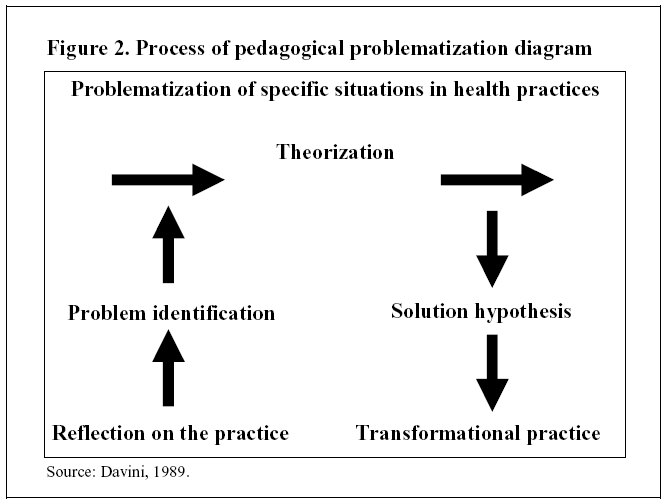
Field work, supported on a pedagogical perspective of problematization, takes as its axis the analysis of specific health problems linked to the population needs and demands. The didactical proposal is structured from the reflections on the professional experience developed in heath institutions, prioritizing the conceptual elaboration based on an objectivation of the practical dimensions. The selection of thematic concepts has, as a starting point, a focus on the situations of professional practice which represent the stimulus to trigger the teaching-learning processes (Davini, 1989) (see Figure 2).
In this way, the professionals-students start from a task which involves the selection of a thematic area of interest, which implies the search of the teaching-learning process through a motivated action of selection, identification and elaboration of a problematic situation perceived from each student's specific reality, and a reflection which allows a critical approximation of that reality.
Within the set of elements that make up a health situation, an epidemiological problem is identified and elaborated, linked to the daily professional practices. When working with problems framed collectively by subsets of students in interdisciplinary groups, we are forced to review the conceptual and appraisal schemes of each of the subjects in the graduate course in order to introduce new concepts and establish "coexistence agreements" based on the acknowledgment of the different health perspectives and its ways of production. (Ceccim, 2005).
It can be said that the instance of field work is, in the study plan, a special educational device, differentiated from the more familiar classroom environment. It is organized as a space which tightens the relation between the social and health reality and the educational process, which questions the health practices of those who participate in it and redefines the teacher-student relationship while it attempts to overcome the traditional subordination in favour of a greater autonomy of the professionals who are being educated.
Field work, in its organizational aspect, includes tasks managed by the students themselves, students-tutors coaching meetings and group workshops with the inclusion of the whole group of students and tutors, where the progress made by the groups is presented. The tutoring task is established as a "discussion group", which, as Pereira Figueiredo (2003) states, allows the communication between active interlocutors in a social relation of an egalitarian nature, in which the different experiences and knowledge presented by the students are valued. The classroom-workshop space of field work is managed as a context of social communication with multiple directions and dialogic communication for the production of collective knowledge.
Even when recognising the complexity and diversity of the elements that lead to the production of the students' learning, it is worth pointing out the central role they hold in each of these different spaces. The responsibility for this educational process results lies mostly on the students, depending on their behaviour in the teaching-learning processes, as well as on the possibilities of making use of, and increasing, autonomy. By combining students' higher education with their professional performance in the health sector, students are expected to act effectively in the construction of knowledge and the search for new knowledge, making full use of the curriculum layout, institutional resources, the experience gained and information collected in their working environments. In the face of this situation, tutors havr to select and optimize the possibilities and resources involved in the educational process, focusing their task not only on a certain command of a particular thematic content, but also on the creation of favourable learning conditions (Struchiner & Giannela, 2003).
]]> The pedagogic implementation of problematization and teaching by means of problems, together with the tutorial teaching activity represent a key aspect which allows a permanent evaluation and the search for new strategies for this process of professional graduate education. In this regard, the realization of the evaluation process related to the development of field work projects has enabled the teacher-tutor team 's critical reflection on the ways of implementing such educational instance in the four student cohorts, promoting the inclusion of modifications between the curriculum elaboration and the specific development during the accomplishment of field work.The different changes involved not only components related to the curricular objectives established during the acquisition of the different student cohorts but also specific aspects about the methods for the constitution of the students' work groups. In response to the design initially drawn in the curriculum plan, in the first cohort, field work projects used as a reference for the identification and selection of the topics dealt with, the specific areas in which the curriculum is organized, following the specific objectives of each of these areas. In this way, Field Work I consisted in the selection of one of the pathologies dealt with in the area "Patterns of morbidity-mortality of populations' illnesses" with the aim of developing a task that included the illness description and the elaboration of a morbility-mortality pattern in a definite space and time, identifying and using different sources of available data. Field Work II took, as a starting point, the recognition and selection of a specific population group, preferably linked to the students' professional practice space, with the purpose of performing an analysis of the elements involved in the health-illness process and taking into account their biological, social-economic and cultural dimensions. To conclude, Field Work III, is centred on the selection of a problem identified in a health service facility and its relationship with the planning, management or evaluation of such health institution, with the purpose of elaborating a proposal for the resolution of the problems posed from the epidemiologic approach.
In this first experience, each set of students was grouped according to disciplinary heterogeneity, and pertinent links to their professional practice areas or institutions.
The analysis of this experience has allowed viewing some limitations mainly related to the fragmentation produced between the three field work projects, given their subordination to specific areas, and their limitation to emphasize the perspective of the population and collective dimension of the problems dealt with.
This is the reason why, from the second cohort on, field work is reformulated by redesigning its objectives in order to follow a process of continuity in each of the field work projects, and strengthen the achievement of a final production of a unitary character. Throughout the period scheduled for the three work field projects, purpose is defined as the development of capabilities that allow the elaboration of an epidemiologic research project, considering the relevance of the problem chosen, as well as its viability and feasibility. Under this perspective, the activity is oriented towards the elaboration of a research design pertinent to the epidemiologic field, which covers different stages of the field work projects. The starting point is the selection of a predefined population in its social-spatial dimension so as to choose a topic of epidemiologic relevance and frame a problematic situation (Field Work I). In a second stage, the aim is the construction of the research problem, identifying backgrounds and theoretical referents of the object of study which has been elaborated, and defining the knowledge goals which guide the research process (Field Work II). In the last field work project, the purpose is to develop a proposal with a methodological approach, through the selection of methods, techniques and instruments related to the objectives already established, and also to develop the analysis plan. (Field work III).
Taking this sequential development into account, the final project (Thesis) might be focused on the implementation and development of an aspect, of an individual nature, of the epidemiological research process, produced in the course of the previous field work projects.
During the third and fourth cohort, a different approach is applied in the group composition design, trying to integrate the groups according to each student's heterogeneous areas of interest. In this respect, the starting point is a collective instance of work which, presented as a workshop, allows the identification of processes of health-illness-intervention of the population groups which are referents of the local and regional health context; and which are simultaneously linked to the areas of work inclusion. The emphasis placed on the method for the composition of the working groups has rendered the definition of the researched problematic situations visible from multiple and varied conceptions and levels of students' background knowledge.
So far, the experience gained by the team, together with the incorporation in the teachers-tutors group of new professionals graduated from such graduate course presents a suitable situation for critical reflection and a collective evaluation of this teaching-learning instance, oriented towards the continuous renovation of the pedagogical strategies in the education of specialists in the Epidemiology area.
Final comments: identification of some problems to be faced
]]> The evaluation that has been performed leads to the identification of four cores, which require a conceptual deepening and an operational methodology. The first core, clearly located in the disciplinary area, is concerned with the distinctive identification of epidemiologic problems in the broadest area of health problems. This core is supported on the question: "What is an epidemiological problem?" and is linked to the difficulties in achieving the transfer or decentralization of the problems defined in the students' health practices (health-illness problems, institutional interventions, organizations of health services, health politics) towards its elaboration from an epidemiologic perspective.The second core, of a methodological nature, leads to the differentiation between a field activity and a process of systematic research. Although we have to admit that any question about reality implies a research attitude, the production of knowledge requires a logical and continuous programming which differentiates it from other scientific practices.
Thus, it is sensible to wonder about the type of work which has to be most stimulated: Does the development of field work and the final project constitute the project and implementation of an epidemiological research?, Is it necessary to consider distinctive features between one and the other?, May they not be research projects of small size and complexity?, Is the difference between epidemiological research and field work established as from the existence of empirical material, or rather from the format required for either of them? This series of questions has to be debated in the light of the description of the professional profile which the Career proposes.
The third core circumscribes a problem of an educational, and at the same time, operational nature: how to achieve a greater level of coordination and continuity between the instance of field work and the elaboration of the final project. That is to say, how to optimize learning, the understanding of cognitive and technical resources and the provision of sources of information, attained during the curricular development of the three field work projects, to facilitate the drafting of the final project which will permit the final accreditation for the graduate course.
Finally, the fourth core puts under consideration a current and relevant topic, that is the role of scientific knowledge production. If the production of scientific knowledge has a public character, if the results achieved must be beneficial to the whole or part of the population, it is necessary to consider the elaboration of final projects that transcend the sole formal educational experience, in order to link itself to the local and regional health environments in a rather immediate way. This leads to the need of increasing the capability of educational rectorship in connexion with the ways of identifying and prioritizing the epidemiological problems chosen and their relation with the health situation diagnosis, so as to prioritize those problems that contribute more strongly to the improvement or transformation of the social groups health conditions.
Having posed these four cores that organize the debate, we have before us the task (not an easy one, in fact) of recreating the process of professional education of epidemiologists in a continuous way through a permanent communication between the educational institution where the postgraduate course is offered, the health institutions where the professionals come from and the needs and demands resulting from the health situation of the populations in the region.
Collaborators
The authors participated, equally, in all the stages of the elaboration of the article.
]]> References
Barata, R. Epidemiología y saber científico. Rev. Bras. Epidemiol., v.1, n.1, p.14-27, 1998. [ Links ]
Ceccim, R.B. Educação Permanente em Saúde: desafio ambicioso e necessário. Interface - Comunic., Saúde, Educ., v.9, n.6, p.161-77, 2005. [ Links ]
Davini, C. Bases metodológicas para la educación permanente del personal de salud. Argentina: Organización Panamericana de la Salud, 1989. [ Links ]
Minayo, M.C.S. El desafío del conocimiento. Argentina: Editorial Lugar, 2001. [ Links ]
Pereira Figueiredo, A.L. As tendências pedagógicas e a prática educativa nas Ciências da Saúde. Cad. Saúde Pública, v.19, n.5, p.1527-34, 2003. [ Links ]
Saupe, R.; Pereira Wendhausen, A. O mestrado profissionalizante como modelo preferencial para capacitação em Saúde da Família. Interface - Comunic., Saúde, Educ., v.9, n.18, p.621-30, 2005. [ Links ]
Struchiner, M; Giannela, T. Aprendizagem e prática docente na área da Saúde. Conceitos, paradigmas e inovaçoes. In: Conferencia de la Asociación Latinoamericana y del Caribe de Educación en la Salud Pública, 20., 2003, Brasília. Anais... Brasília, 2003. 1 CD-ROM. [ Links ]
Torres, C.H.D.A; Czeresnia, D. A institucionalizaçao da Epidemiologia como disciplina na Faculdade de Medicina da Universidade Federal do Rio de Janeiro. Hist., Ciênc., Saúde - Manguinhos, v.10, n.2, p.525-48, 2003. [ Links ]
Universidad Nacional de Rosario.Facultad de Ciencias Médicas. Res.C.S. nº 264/97. Plan de estudios de la Carrera de Especialización en Epidemiología. Argentina, 1997. [ Links ]
Fuente: Facultad de Ciencias Médicas, Universidad Nacional de Rosario, Res. C.S. n167 264/97, 1997. [ Links ]
Received on 10/05/06
Approved on 20/09/06
1 Pasaje 12 de octubre, 860, Rosario, Argentina.
]]>