Implementando as unidades educacionais do curso de enfermagem da Famema: relato de experiência
Implementando las unidades educacionales do curso de enfermería de Famema: un relato de experiencia
Kátia T. Alves RezendeI; Elisabete TakedaII; Elaine Morelato Vilela FragaIII; Luzmarina A Doreto BraccialliIV; Mara Quaglio ChirelliV; Maria Cristina Guimarães da CostaVI; Maria Cristina Martinez Capel LalunaVII; Maria Elizabeth S. Hernandes CorreaVIII; Sílvia Franco da Rocha TonhomIX
INurse, doctor in Health Public Nursing: docent of the disciplines Nursing in Collective Health and Administration Applied to Nursing of Nursing Course of FAMEMA E-mail: katia@famema.br
IINurse, doctor in Fundamental Nursing: docent of the discipline Clinical Nursing of FAMEMA ]]>
IIINurse, doctor in Fundamental Nursing: docent of the discipline Clinical Nursing of FAMEMA
IVNurse, doctoring in Nursing in Collective Health by EEUSP; docent of the disciplines Nursing in Collective Nursing and Administration Applied to Nursing of the Nursing Course of FAMEMA
VNurse, doctor in Nursing; docent of the disciplines Nursing in Collective Health and Administration Applied to Nursing of FAMEMA
VINurse, master in Nursing in Public Health; docent of the discipline Gynecology-Obstetrics of the Nursing Course at FAMEMA
VIINurse, doctor in Fundamental Nursing; docent of the disciplines Administration Applied to Nursing and Clinical Nursing of the Nursing Course of FAMEMA
VIIIDoctor, doctor in Public Health: docent of the disciplines of Epidemiology and Bio-Statistics of FAMEMA
IXNurse, doctor in Education: docent of the disciplines Nursing in Collective Health and Administration Applied to Nursing of the Nursing Course of FAMEMA
Translated by Eudnéya Neves
Translation from Interface - Comunicação, Saúde, Educação, Botucatu, v.10, n.20, p. 525-535, July/Dec. 2006.
]]>
ABSTRACT
The study aims at reporting the curriculum development along the four grades of the Nursing Course of Marília Medical School (FAMEMA) in 2003. The method used was the reflection about the pedagogical practice, from the documental analysis of the teaching-learning programs in each grade. The results show some points to be worked in the political-pedagogical project, such as: redefinition of the professors' and the nurse's roles from the health services; different understanding about the reference of the methodology of problematization and competence; professors' insecurity working with uncertainty in the teaching-learning process. It's also possible to identify changes that contributed to the implementation of the project, which are: the strengthening of the partnership between teaching and service; the relation between the medical and nursing courses; the use of the principles of the meaningful learning; introduction of the continuous education process, enabling the evaluation of the curriculum processes and strategies.
Key-words: nursing; education in nursing; curriculum.
RESUMO
O trabalho tem como objetivo relatar o desenvolvimento do currículo ao longo das quatro séries do curso de enfermagem da Faculdade de Medicina de Marília (Famema) no ano de 2003. Utilizou-se, como método, a reflexão sobre a prática pedagógica, com base na análise documental dos programas de ensino-aprendizagem de cada série. Nos resultados, verificam-se pontos a serem trabalhados no projeto político-pedagógico, como: redefinição dos papéis dos docentes e do enfermeiro dos serviços de saúde; diferentes entendimentos sobre os referenciais da metodologia da problematização e competência; insegurança dos professores em trabalhar com a incerteza no processo ensino-aprendizagem. Identificam-se, também, mudanças que contribuíram para a implementação do projeto, destacando: o fortalecimento da parceria ensino-serviço; a articulação entre os cursos de enfermagem e medicina; a utilização dos princípios da aprendizagem significativa; instituição do processo de educação permanente, permitindo a avaliação de processos e estratégias do currículo.
Palavras-chave: enfermagem. educação em enfermagem. currículo.
RESUMEN
El trabajo tiene como objetivo relatar el desarrollo del currículo a lo largo de las cuatro etapas del curso de enfermería de la Facultad de Medicina de Marília (Famema) en 2003. El método usado fue la reflexión sobre la práctica pedagógica, fundamentado en el análisis documental de los programas de instrucción-aprendizaje de cada etapa. Los resultados demuestran puntos que deben ser trabajados en el proyecto político-pedagógico, por ejemplo: redefinición de los papeles de los profesores y del enfermero de los servicios de salud; diversas comprensiones sobre los referenciales de la metodología de la problematización y de la capacidad; inseguridad del profesor en trabajar con incertidumbre en el proceso instrucción-aprendizaje. Se identifican también los cambios que contribuyeron a la implementación del proyecto, destacando: la consolidación de la alianza enseñanza-servicio; la articulación entre los cursos de enfermería y medicina; el uso de los principios del aprendizaje significativo; institución del proceso de educación permanente, permitiendo la evaluación de procesos y de las estrategias del currículo.
Palabras clave: enfermería. educación en enfermería. currículo.
The beginning of the changing of the process in the nurses graduation
The Brazilian nursing has been discussing the changes in the graduation of its work force since 1970's, at that time the Sanitary Reform movement was being organized, which gave great contribution to the reformation of the National Constitution related to the health chapter and its Organic Bill (BRAZIL, 1990). In the new Constitution (BRAZIL, 1988), it determines that the health sector must be organized through a Unique Health System (SUS), so that there is its implementation, one of the necessary strategies to the reorganization of the attention model, it must be the reformulation of the process of the professional graduation.
The Nursing Course of Faculdade de Medicina de Marília (FAMEMA), created in 1981, has been developing a curricular change process since 1993, when it started an implementation of UNI Project2 (A new initative in the education of the health professionals: union to the community) in the institution, financed by Kellogg Foundation (FOUNDATION, 1992). This change, according to Laluna (2002), passed through three phases: sensitization of the docents about the curriculum revision process; reconstruction of the teaching program in the problematical perspective and in the elaboration of the integrated curriculum.
During the first phase a program of pedagogical ability was performed, which was supported by various advisory staffs, among them the "Pedagogical ability for instructors/supervisors in health area", in which Problematical Methodology was emphasized, according to what was suggested by Diaz-Bordenave and Pereira (1991) and Freire (2003), because it is already being applied in the education of nursing professionals of intermediate level, by means of High Scale Project, proposed by Ministério da Saúde (BRAZIL,1997) as well as in the program of postgraduation in Public Health Nursing of Universidade Federal de Minas Gerais (UFMG). Those ones influenced our methodological choice, because of the intention to change the practices in health and nursing, answering the policy project of the sanitary reform.
During the second phase, after the performance of planning for construction of the strategies of the curriculum change, groups were installed for the development of the topics: the nurse profile, curriculum revision, assistant model and pedagogical ability. For this phase, we counted on advisory staffs of the Program of Development in Nursing (PRODEn) of UFMG, which helped with the construction of the teaching programs applying the Problematical Methodology, which made the students think about the need for the discussion of the philosophical reference. For this activity we counted on the participation of the Educational Group São Paulo Team that contributed for the construction of the understanding that the pedagogical change does not restrict to the alteration of the didactic strategies, but it is supported by a philosophical reference of the graduation process.
These processes determine the elaboration of the Policy Pedagogical Project (PPP) (FAMEMA, 1997), which was constituted during the third phase of the curriculum change. By means of the installation of groups of work formed by the docents of the Nursing Course3 and by professionals of services, we elaborated the PPP with the development of the course history, the philosophical, psychological and social cultural objectives, the nurse's profile, the educational objectives, the problematical methodology and the topic areas. The inclusion of these topic areas happened due to the structure of the minimum curriculum in effect from 1994 to 1997, established by "Ministério da Educação", as follows: human and biological bases of nursing; basis of nursing; nursing assistance; nursing administration; supervised training (BRAZIL, 1994). This document oriented the construction of the integrated curriculum with the elaboration of the explanatory web of the contents, the delimitation of the educational units and the expected performance in each one of them.
Considering the context of the process of implementation of PPP, the evaluations and researches that have been done (REZENDE, 1998; BRACCIALLI, 2000; CHIRELLI, 2002; VILELA, 2002; LALUNA, 2002) as well as the changes that have been happening, the present work aims to report the development of the curriculum during the four grades of the Nursing Course of FAMEMA in the year of 2003 appointing reflexions about the pedagogical practice.
The work presented is about an experience report which applied a documentary analysis of the teaching-learning programs from each series, referred to the year of 2003, with posterior reflection by the authors on the proposed and developed pedagogical practice. The analyses showed aspects that needed to be approached in order to reach the basis of PPP and changes which contribute for the implementation of the integrated curriculum and oriented by competence.
]]> During the present work we requested the manager group of the Nursing Course institutional authorization, so that the information about the organization of the curriculum could be made public.
Pedagogical structure of the grades of the nursing course of Famema in the year of 2003
The Nursing Course of FAMEMA developed considering the following guidelines: the nurse's performance in the management, assistance, education and investigation areas; interaction with the community and services; nursing assistants' participation as well as the docents' in the assistance process and the medicine and nursing students' integration.
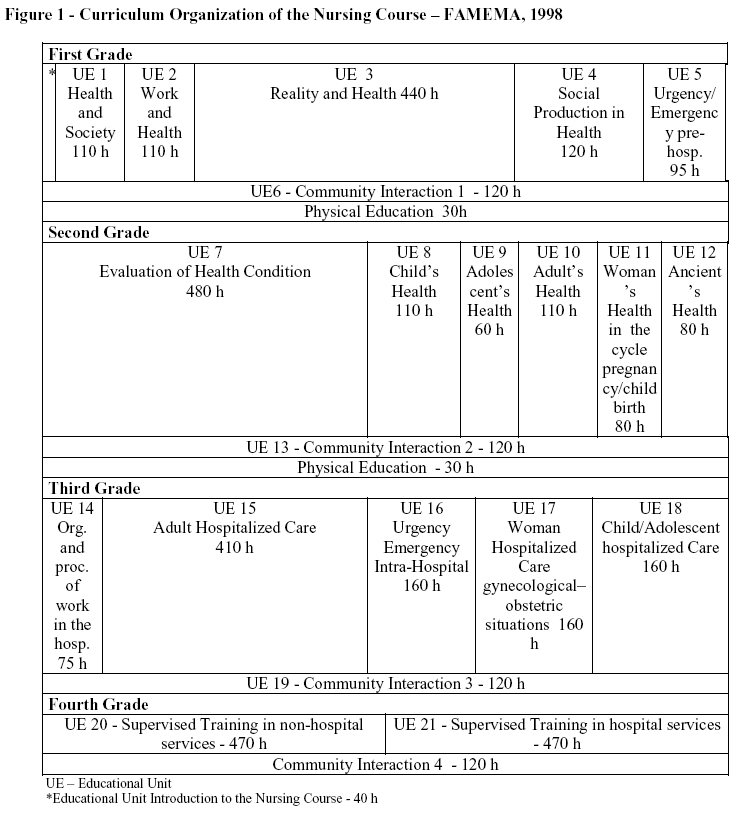
Since 1988 we have been implementing the new PPP, in a construction and reconstruction process of the educational units. The curriculum organization of the Nursing Course (Figure 1) is performed by means of Educational Units (UE) which are specific for nursing and an Educational Unit that integrates the Nursing and Medicine students, named Community Interaction (IC).
Davini (1994, p. 47) defines the educational unit as:
a dynamic pedagogical structure oriented by determined teaching-learning objectives, in relation to an articulated assemblage of contents and systematized by a didactic methodology. Each unit keeps a certain autonomy related to the others, but, at the same time, they are articulated with the others to aim the totality of the attribution areas and the professional profile.
The process of evaluation was constructed in the educational units and it is based on a dialogue conception which focuses the somatic and educational evaluation considering three axes: the students' performance evaluation, the teacher's evaluation and the educational unit.
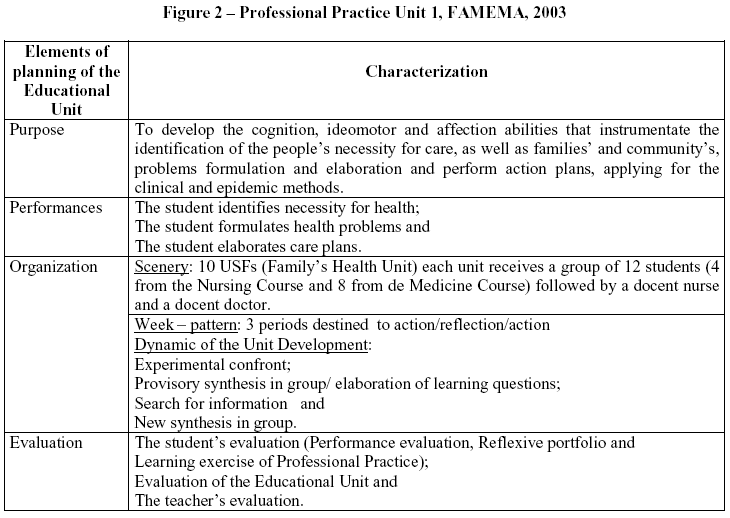
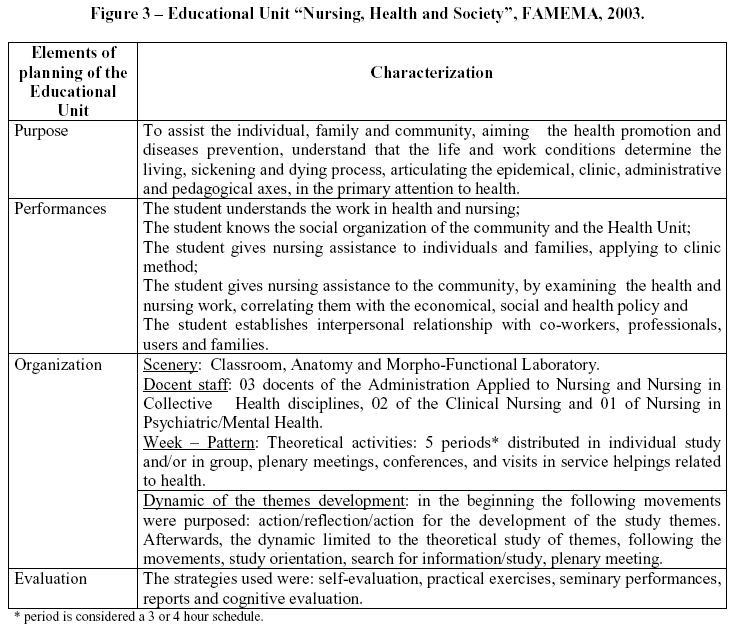
In 2003, a change in the unit of integration in the two first grade courses was made which was named Professional Practice Unit (UPP), which is described in figure 2 and the specific units of the Nursing Course were implemented in an articulated way, forming a unique UE – Nursing, Health and Society, it is presented in figure 3.
]]>Reflections about the development of the pedagogical practice in the first grade
In 2003 it was necessary to overcome the fragmentation that the units presented in the beginning; it is verified while comparing the figure 1 to figure 2. This way, the "old didactic units that formed the curriculum in each grade were articulated in educational units and will be presented in the subsequent grades.
Despite the effort to use teaching-learning strategies related to the professional practice, we identified the difficulty to articulate theory and practice, since the students were not inserted in the world of work, and therefore it committed the reflection of a certain practice which did exist so far. This fact made the curriculum emphasize the content once more. Furthermore, despite the various abilities that happened there was still some difficulty to implement the problematical methodology as it was proposed by Rego (1995) and Duarte (2000) ; and also it was due to a short time to perform the work in small groups; lack of the nursing teachers' articulation with the others from the basic and clinical disciplines.
Referring to Professional Practice Unit the following salient points were identified: interaction with the community: strengthening of the learning-service partnership; articulation between the nursing and medicine courses; the student's graduation from the reflexive practice; and some difficulties, as follows: to recognize that there was not distinction between the nursing and medicine students; to work in semi-structured situations; not to be sure of the moments of the pedagogical cycles; integration in the team of health units; lack of understanding about the elaboration of the reflexive portfolio and lack of articulation with the educational unit – "Nursing, Health and Society".
Reflections about the development of the pedagogical practice in the second grade
Since 1998 the second grade was constituted by the Educational Units 7,8,9,10,11,12, and 13 and, from 2003, all the UES, except for the last one, they were integrated to a unit named "Family Nursing Assistance at Primary Level of Attention to Health", in the perspective of integration of performances (Figure 4).
During the year of 2003, it was noted that there were advances, mainly related to the articulation between the teachers of the basic and clinical disciplines and continuation of the activities in the same scenery of professional practice of the first grade of the anterior year. Therefore, some difficulties were identified: the traditional model fulfillment, emphasizing the biological aspects and in the individual dimension; implementation of the problematical method (action – reflection – action); primacy of the content; performance of the integrated evaluation and in the theory-practice articulation.
]]> Reflections about the development of the pedagogical practice in the third grade
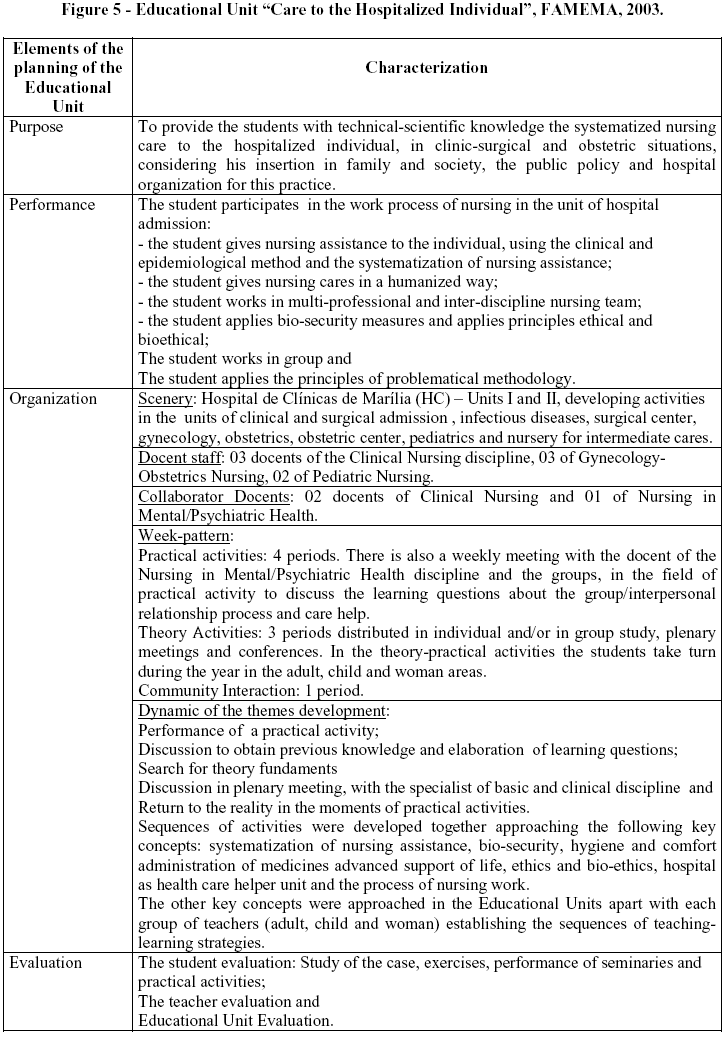
The reconstruction and the re-adaptation of the third grade came up with the interaction of the educational units 14, 15, 16, 17 and 18 in an unique unit – "Care with the hospitalized individual" (Figure 5). The grade characterized by the introduction of the students in the hospital unit to develop care to the hospitalized individual.
The process of change was permeated by conflicts related to the pedagogical reference and difficulties in the interpersonal relationship, because since then the docents worked in educational units separately. Furthermore, so far the nurses responsible for the hospital service in each one of the specialization were the same who responded by the didactic units. Due to the re-structuring of the grade, these professionals were responsible for the docent activity so it created a separation between the practical activities of the hospitalization units ant the students' activities. There were also difficulties to establish the outline of knowledge relating to the care of the hospitalized individual. To overcome these difficulties there was a supervision of a docent of the psychology discipline related to the docents' group work, as well as the institution of the permanent education process which permitted the process evaluation, revision of the concepts and strategies that reflected the presupposition of PPP of the Nursing Course.
Reflections about the development of the pedagogical practice in the fourth grade
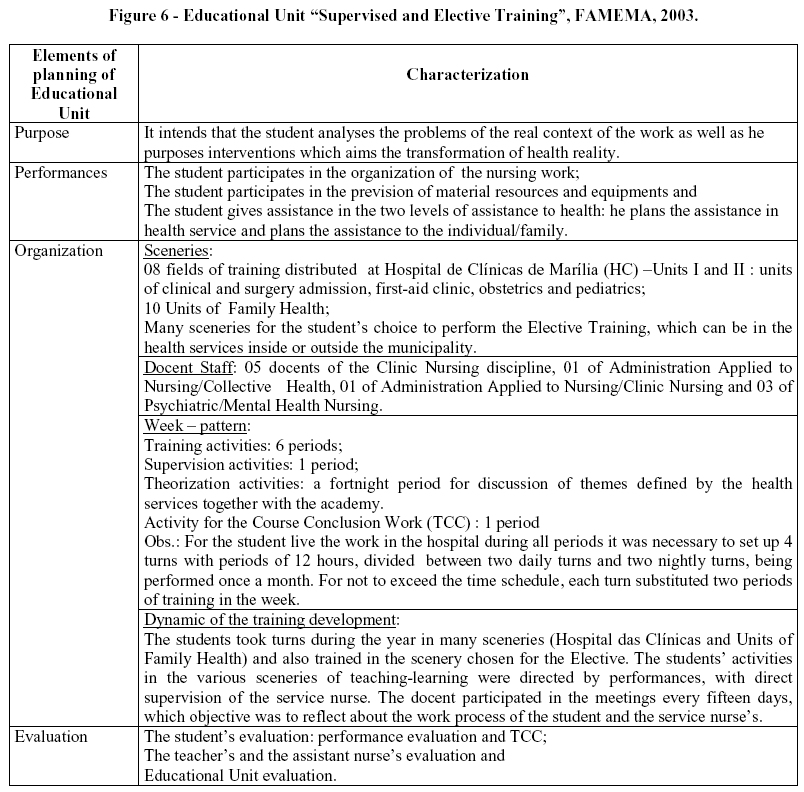
This series develops a teaching-learning process by means of the modality of the supervised training aiming the students' living in the world of work and the nurse's participation in the service in this process (Figure 6).
Since 2001 the schedule of Educational Unit Community Interaction 4 has been used for the Elective Training, which consists of the student's choice for the local where to perform, favoring the active participation in the curriculum construction, choosing and defining areas of interest, fragility and development of knowledge as well as abilities and attitudes.
During the development of the activities in the hospital area there was not participation of the nurses related to the services in the process of reconstruction of the grade, even though many attempts of teaching - service have been made. The decision of the nurses to participate in the process of supervision was made by the service managers.
In this scenery, only the student and sometimes the nursing team participated in the discussion to elaborate the planning in health together with the docent. However, in the basic health net, we can notice a major involvement of the team. In every meeting the field nurse, the docent and the student(s) organized themselves so that the supervision activity could be performed all together; however it was not always possible due to the professionals schedule incompatibility. There was difficulty to perform the students' supervision from the reflection about the practice, showing lack of clearness about the reference of health planning, the conception of supervised training, the docent's role as well as the health service nurse's , the students' performance and the evaluation in this curriculum logic.
However, the advancement is obvious when inserting the students in the sceneries of teaching-learning of the Family Health Unities. This fact consolidates the participation of the nurses of the basic attention unities in the process of graduation of the students and it strengthens the teaching-service partnership.
]]>Final considerations
The possibility to describe and analyze the grades that composes the Nursing Course in 2003 favored the recognition the change process that has been developing both in the graduation of these professionals and in the transformation which has been happening in this category (nursing), in the ambit of this institution it will surely contribute for a deeper reflection about the nursing practice in the Brazilian scenery.
In this reflection movement , we verified the points that need to be worked related to reach the fundaments of PPP as: disarticulation of theory and practice in the beginning of the course, mainly between the educational unit that substituted the didactic units and the educational unit of professional practice of first grade; redefinition of the docents' roles and the health service nurse in this new conception of curricular and pedagogical organization; different understanding about the reference of problematical methodology, health planning and supervised training; disintegration between the basis and clinical disciplines; lack of clearness of distinction between the performance of the medicine and nursing students; insecurity of the teachers to work with the uncertainty in the teaching – learning process, which made real in the scenery of professional practice; different conceptions about the competence reference, creating difficulties to work in a new logic of content outline (knowledge, abilities and attitudes).
On the other hand, we also identified changes that happened to contribute for the implementation of the integrated curriculum and oriented by competence, standing out: the strengthening of the teaching service partnership: the articulation between the nursing and medicine courses; the strengthening of the application of the principles of significant learning; institution of the permanent education process permitting the evaluation of the strategies and PPP processes.
At present, the experiments accumulated during the years of the PPP implementation have been enabling other changes in the pedagogical practice as well as the curriculum organization of the grades, which are centered in the PPP implementation in the second, third and fourth grades, evidencing the dynamic process of permanent reflection and reconstruction of this practice as it is proposed by Gadotti e Romão (1995).
References
BRASIL. Portaria nº 1721, de 15 de dezembro de 1994. Dispõe sobre currículo mínimo e duração do curso de Enfermagem. Diário Oficial da União, Brasília, DF, 16 dez. 1994. Seção I, n. 238, p. 19801-2. [ Links ]
BRASIL. MINISTÉRIO DA SAÚDE, 1997. Projeto de Formação de Pessoal de Nível Médio em Larga Escala: Acordo MEC/MPAS/MS/OPAS. Brasília: SMARH/Ministério da Saúde. [ Links ]
BRASIL. Constituição (1988). Da ordem social. In: ______. Constituição: República Federativa do Brasil. Brasília: Senado Federal, 1988. p. 131-137. [ Links ]
BRASIL. Lei n. 8080, de 19 de setembro de 1990. Dispõe sobre as condições para promoção, proteção e recuperação da saúde, a organização e o funcionamento dos serviços correspondentes, e dá outras providências. Diário Oficial da União, Brasília, DF, 10 set. 1990. Seção 1, p. 18055- 18059. [ Links ]
BRACCIALLI, L.A.D. Mulheres e aborto: as ambigüidades do discurso autorizado. São Paulo, 2000. 154f. Dissertação (Mestrado) - Escola de Enfermagem, Universidade de São Paulo. [ Links ]
CHIRELLI, M.Q. O processo de formação do enfermeiro crítico-reflexivo na visão dos alunos do Curso de Enfermagem da FAMEMA. Ribeirão Preto, 2001, 271f. Tese (Doutorado). Escola de Enfermagem de Ribeirão Preto, Universidade de São Paulo. [ Links ]
DAVINI, M.C. Currículo integrado. In: Brasil. Ministério da Saúde. Coordenação Geral de Desenvolvimento de Recursos Humanos para o SUS. Capacitação pedagógica para instrutor/supervisor - área da saúde. Brasília: Ministério da Saúde, 1994. [ Links ]
DIAZ-BORDENAVE, J.; PEREIRA, A.M. Estratégias de ensino-aprendizagem. 12ª ed. Petrópolis: Vozes, 1991. [ Links ]
DUARTE, N. Vygotsky e o "aprender a aprender" : crítica às apropriações neoliberais e pós-modernas da teoria vygotskiana. Campinas: Autores Associados, 2000. [ Links ]
FAMEMA. Currículo do Curso de Enfermagem da Faculdade de Medicina de Marília. Marília: Faculdade de Medicina de Marília. Curso de Enfermagem, 1997. [ Links ]
FREIRE, P. Educação e mudança. Rio de Janeiro: Paz e Terra, 2003. [ Links ]
FUNDAÇÃO MUNICIPAL DE ENSINO SUPERIOR DE MARÍLIA. Projeto UNI-Marilia. Marília, 1992. 2 v. [ Links ]
GADOTTI, M. Autonomia da escola: princípios e propostas. São Paulo: Cortez, 1995. [ Links ]
LALUNA, M.C.M.C. O planejamento como instrumental da gerência em enfermagem: construindo o desempenho do planejamento participativo no currículo integrado. 2002. 144 f. Dissertação (mestrado) - Escola de Enfermagem de Ribeirão Preto, Universidade de São Paulo. [ Links ]
REGO, T. C. Vygotsky: uma perspectiva histórico-cultural da educação. Petrópolis: Vozes, 1995 [ Links ]
REZENDE, K.T.A. O ensino de enfermagem no contexto UNI Marília: revelando os pressupostos ideológicos da prática docente. 1998. 117f. Dissertação (Mestrado) - Escola de Enfermagem, Universidade de São Paulo. [ Links ]
VILELA, E.M. Interdisciplinaridade no ensino de graduação em enfermagem: um estudo de caso. Ribeirão Preto, 2002. 199f. Tese (Doutorado). Escola de Enfermagem de Ribeirão Preto, Universidade de São Paulo. [ Links ]
1 This article is a product of the Group of Research in "Nursing Education".
2 The W.K. Kellogg financed and supported the projects of higher learning institutions in the health area, which intended to provoke changes in the model of attention to care and Education of the health professionals. Among the contemplated institutions in Brazil, FAMEMA is found.
3 Docents of the areas: basic (physiology, bio-chemistry, pharmacology, anatomy, pathology, parasitology, immunology, histology, genetics, micro-biology), clinic and collective health.