O mestrado profissionalizante como modelo preferencial para capacitação em Saúde da Família
La maestría profesionalizante como modelo preferencial para la capacitación en salud de la familia
Rosita SaupeI,1; Águeda Lenita Pereira WendhausenII
INurse, Teacher on the Masters Degree in Health and Management of Work at the University of Vale do Itajaí, UNIVALI/Itajaí, SC. <saupe@amja.org.br>; <saupe@univali.br>
IINurse, Coordinator of the Master's Degree in Health and Management of Work at UNIVALI/Itajaí, SC.<agueda@univali.br>; <aguejor@milnegocios.com.br>
ABSTRACT
This article presents the legal background relating to professional master's degrees proposals; it describes the paths followed after proposing and introducing a professional master's degree program in health, with specialization in family health; it argues for the correctness and suitability of this model for developing interdisciplinary skills in health professionals, within a perspective of consolidating health reforms and the Brazilian national health care system, through Family Health Program, its most innovative strategy. The proposal, which has been running since 2003, is based on the multi-dimensionality of the health-sickness process and on the model of Health Surveillance which includes three levels of integrated care. The interdisciplinary nature is the pedagogical principle of the course, in an attempt to find solidarity spaces through teaching and investigative activities or social intervention among the subjects of the process. Although we do not have an evaluation of the impact of the Course on the Care Model, there are some indicators of its acceptance, such as: an increasing number of candidates in the selection process; satisfaction among students and teachers; adherence to the practices required for the consolidation of the Brazilian National Healthcare System (SUS) in the students' course conclusion works, and the recent recommendation by CAPES.
Key words: education. human resources. family health. specialization. professional master's degree.
RESUMO
Apresentam-se os antecedentes legais relativos à proposta de mestrados profissionalizantes; descreve-se o percurso trilhado para a proposição e implantação de um programa de mestrado profissionalizante em saúde, com área de concentração em saúde da família; argumenta-se sobre a propriedade e adequação deste modelo para o desenvolvimento das competências interdisciplinares dos profissionais da saúde, na perspectiva de consolidação de reforma sanitária e do sistema único de saúde, por meio de sua estratégia mais inovadora, a saber, o Programa de Saúde da Família. A proposta, em execução desde 2003, fundamenta-se na multidimensionalidade do processo saúde-doença e no modelo da Vigilância da Saúde que prevê níveis de assistência integrados. A interdisciplinaridade é o princípio pedagógico do curso na busca de espaços solidários por meio de ações didáticas, investigativas ou de intervenção social entre os sujeitos do processo. Embora ainda não tenhamos avaliação do impacto do Curso no Modelo Assistencial, há alguns indicadores de sua aceitação tais como: o crescente número de candidatos ao processo seletivo; a satisfação de alunos e professores; a aderência dos trabalhos de conclusão às práticas requeridas para consolidação do SUS e a recente recomendação pela CAPES.
Palavras-chave: educação. recursos humanos. saúde da família. especialização. mestrado profissional.
Presenta los antecedentes legales relativos a la propuesta de maestrías profesionalizantes; describe el percurso recurrido para la proposición e implantación de un programa de maestría profesionalizante en salud, con área de concentración en salud de la familia; argumenta sobre la propiedad y adecuación de este modelo para el desarrollo de las competencias inrterdisciplinares de los profesionales de la salud, en la perspectiva de consolidación de reforma sanitaria y del sistema único de salud, a través de su estrategia más innovadora, a saber, el Programa de Salud de la Familia. La propuesta, en ejecución desde 2003, se fundamenta en la multidimensionalidad del proceso salud-enfermedad y en el modelo de la Vigilancia de la Salud que prevé niveles de asistencia integrados. La interdisciplinaridad es el principio pedagógico del curso en la búsqueda de espacios solidarios a través de acciones didácticas, investigativas o de intervención social entre los sujetos del proceso. A pesar de que aún no tengamos una evaluación del impacto del Curso en el Modelo Asistencial, hay algunos indicadores de su aceptación, tales como: el creciente número de candidatos en el proceso selectivo; la satisfacción de alumnos y profesores; la adherencia de los trabajos de conclusión a las prácticas requeridas para la consolidación del SUS y la reciente recomendación por la CAPES.
Palabras clave: educación. recursos humanos. salud de la familia. especialización. maestría profissionalizante.
Introduction
As members of the group that has been working in various stages of implementation of a Professional Masters Degree in Health, with Family Health as its area of concentration, at the University of Vale do Itajaí (UNIVALI), we would like to share this experience with the academic and professional community.
The stages to which we refer include the conception of the idea, in 2001; the formulation of the project, its legal formalization, reformulations and approval by the due collegiate bodies of the University, and the initial selection of 64 candidates, who competed for the first thirty places, during 2002; the implementation of the course and the conclusion of the first year, with the referral of the project for accreditation with the Coordenação de Aperfeiçoamento de Pessoal de Nível Superior (CAPES) and the State Education Council (CEE), as well as the approval of research projects included in public notices of the Fundação de Ciência e Tecnologia de Santa Catarina (FUNCITEC), in 2003. The interest in recording a real experiment which seeks to address historical and legal aspects, and the contribution of other authors, as well as recording its progress with its easy and difficult parts, lies in the expectation that by making our model public, and submitting it to criticism, it can be improved, contributing to similar initiatives.
Historical background
]]> The scientific and technological achievements at the start of the Twentieth Century put pressure on universities to seek ways of adapting their professional training to the new work demands. Considering that increasing the number of graduate courses, or the number of hours of existing courses, is not the ideal response to these pressures, higher education opted instead for vertical differentiation, i.e. post graduation (Oliveira, 1995).The introduction of post-graduate courses delineates two periods of higher education in Brazil in the 20th Century: The first period, up until the 1950s, is characterized by the graduation of professionals, and the second, at the start of the 1960s, by attempts to provide specialization and training in research, as a way of differentiating those concluding the courses, due to the large numbers of graduates, generating a demand for a qualification that could help them to win privileged positions in the work hierarchy (Oliveira, 1995; Sucupira, 1995). Another milestone in development of post graduate courses was Opinion 977, of the Federal Education Council (MEC, 1974).
The postgraduate courses which took place prior to Opinion 977 lacked unity, and were materialized in diverse and sometimes contradictory ways. Opinion 977 established the distinction between lato sensu and stricto sensu; the former modality refers to specialization courses, and the latter, to the levels of Master's Degree and PhD. In relation to the theme of this article, we find, in that legal document, mention of the professional Master's Degree (MEC, 1974).
The professional Master's Degree
The first CAPES regulation governing the creation of Professional Master's Degrees was Opinion 47 of 17 October 1995. However, this theme has been included in discussions on postgraduate stricto sensu courses in the country for a long time (Revista de Administração Contemporânea, 1997). This regulation was replaced by Regulation 080, of 16 December 1998, according to the CAPES (1998), in view of the need for, and relevance of the creation of Master's Degrees geared towards professional training. In the same document, the prerequisites and conditions were established, for their creation and accreditation.
Since then, this type of postgraduate course has been implemented in various institutions, generating, at the same time, many divergent opinions in relation to its acceptance, as well as restrictions to its recognition in the academic arena, and the consequent transmission of these attitudes to service sectors and professional areas. The document "CAPES - A necessidade de desenvolvimento da pós-graduação profissional e o ajustamento do sistema às características desse segmento", (Need for the development of the professional post-graduate and adjustment of the system to the characteristics of this segment), annex to the minutes of the 65th meeting of the Technical-Scientific Council, held on 4th and 5th February 2002 (CAPES, 2002) addresses this question in detail. Among the various aspects focused on in the document, we highlight:
- the statement that post graduate courses in Brazil should cover two focuses of training which are equally important for the development of the country - academic and professional;
- the revival of Opinion 977/65, which not only admits, but positively encourages the creation of courses with a professional orientation;
- the responsibility of the CAPES to adapt the way in which the evaluation of proposals and monitoring of professional courses is carried out, and to encourage dialog with the academic community, in order to overcome the resistances and concerns surrounding the role of the professional Master's Degree.
]]> In relation to assessment, the document affirms the inadequacy of using the same parameters, criteria and focuses as those used to analyze the productivity of programs focusing exclusively on scientific research and training for researchers, and demonstrates a need to establish specific criteria that ensure training of the same level and quality as that of the academic courses (CAPES, 2002).The main concerns of the academic community are listed and counter-argued in the document, this one concluding that in fact, what generates vehement reactions against the official recognition of the differentiation of our postgraduate courses, is the possibility that offering a new course profile could affect the career structure of higher education teachers which, in Brazil, is based on the principle that all those pursuing this career should be trained in academic research.
The counter arguments affirm that it is not the responsibility of the CAPES to define the qualifications and training required by the universities for admission to their teaching bodies; that even in more developed countries, only a fraction of higher education institutions are characterized as teaching and research institutions; that in Brazil the percentage of institutions whose activities and courses based on the idea of making this link effective is not large; and that furthermore, it is important to emphasize that the graduate curricular of higher education include disciplines and practices of an essentially professional nature (CAPES, 2002).
On this last point, the document asks the question: Should the teaching practice of the professional disciplines and/or the orientation of practices correlated with them, in graduate courses, only apply to academic researchers? Will not the professional who is trained in a professional postgraduate course, and who has excelled in their area of activity, have an important contribution to make in the training of students in areas linked to this practice? Is it not admissible that for the teaching practice of some of these disciplines, the institutions could establish, as a pre-requisite, a professional post graduate qualification? (CAPES, 2002)
The document concludes by establishing some guidelines on quality, composition of the teaching body, and the conception and structure of the courses, and also suggests that the evaluation committees include, besides academic consultants, other professionals – whether or not they are researchers – with recognized performance in the job market served by the course.
With the specific purpose of reflecting on the Professional Master's Degree in the area of Collective Health, the Fundação Oswaldo Cruz (FIOCRUZ), through its publication RADIS, in 2003, dedicated various issues to professional training. In its issue 07, for example, it focuses on "Pós-Graduação e o recente Mestrado Profissional" (Post graduation and the recent Professional Master's Degree) (Xavier, 2003). In the opinion of the interviewees - the managers of FIOCRUZ (Paulo Buss, President; Tânia Nunes, Vice-President of Teaching and Human Resources; Zulmira Hartz, General Coordenator of Postgraduate Studies) - the creation of the Professional Master's Degree is a positive step, in that the advances in the Sistema Único de Saúde and the increasing complexity of its Management Systems also demand a more advanced training. There are currently 150 thousand managers in the area of health, for whom it is not enough simply to use the working tools, but also to produce new technologies, through scientific production. In this sense, the lato sensu training in the area of collective health, which predominated from the 1970s until 2000, now needs to advance, seeking now to train professionals who are capable of transforming their work processes and their institutions, and at the same time, produce scientific knowledge,–which is characteristic of a stricto sensu form of training.
One of the favorable aspects for the success of this proposal in collective health is the fact that postgraduate courses in this area have traditionally been multidisciplinary; this help to resolve numerous problems in the construction of the Sistema Único de Saúde (Xavier, 2003) and, it should be added, in the production of the knowledge necessary for obtaining qualified advances.
The proposal of Univali
The conception process of the proposal formulated by UNIVALI is based on the premise that the University needs to look for more effective ways of integrating with society and with public policies, notably in the areas of health and education. In this sense, family health has constituted an aggregating concept, in terms of both social movements and interdisciplinary work, leading to the need to prepare professionals who are better equipped for this form of promoting a healthy and better quality life.
]]> In the area of health, we are going through a period in which it is necessary to consolidate the advances achieved by the Health Reform Movement. The changes in the healthcare model, through the reorganization of basic healthcare, is one of the most important aspects for guaranteeing the effectiveness of the principles recognized by the Sistema Único de Saúde (SUS). This is the proposal of the Family Health strategy, which brings a new work concept, in which the health professional committees him/herself in a mutually committed, democratic and participatory way, to the families they seek to assist, based on an interdisciplinary work in which knowledge is placed at the service of the community (Costa Neto, 2000).The professional required for this new practice is now being constructed, as traditional training views knowledge as something which is fragmented and hierarchical, resulting in a compartmentalized, technical-reparative practice, which alienates users, families and populations from participation in their own health and life process. Although there are initiatives for training professionals with this profile, at the level of graduation, internship and specialization, this intention, in general, has still not materialized in practice. The professionals who currently work in the health services are the fruit of a fragmented training, which lacks the complementary training that will enable them to practice under this new perspective (Costa Neto, 2000). We consider, then, that postgraduate studies, at Masters Degree level, are an important step, both for equipping and for experimentation and research into new forms of relationship between health professionals and their users, and among the professionals themselves.
Another factor which strengthens the proposal is the recent Regulation 198/GM/MS (Brazil, 2004). In this document, the Ministry of Health instituted the National Policy on Health Education as a strategy of the Sistema Único de Saúde, for the training and development of health workers. This policy supports actions which facilitate the change in the healthcare model, which includes training, from technical level through to postgraduate level, and the production of knowledge.
Thus, the decision to direct the project towards the creation a Master's Degree course in the area of Family Health, was based on various factors, including: The efforts of various institutions which were committed to the Health Reforms, and seeking to consolidate the SUS, particularly though the Family Health Program (FHP); the exchange of experiences with professionals practicing in the FHP, by means of training courses developed by the University Center, which expressed their need and interest in gaining qualifications and professional titles at a higher level; the consensus that existed in the area on the need to link efforts in health with those in education, as all the programs aimed at transforming the healthcare model must, necessarily, go through changes in terms of the profile of professionals and the collective awareness of communities; and the vocation of graduate courses in the area of health, of UNIVALI, which has been reorienting its curricula towards family health.
In relation to the qualification needs, both perceived and manifested, by professionals working in States most directly influenced by UNIVALI (Santa Catarina, Paraná and Rio Grande do Sul), a survey was also carried out, through a form which was distributed professionals in the area of health, at different events which took place in Florianópolis, Lages, Itajaí, Curitiba and Porto Alegre, in the second semester of 2001. Of the total, 168 forms were returned, confirming the interest in attending a Professional Master's Degree course with concentration in Family Health, in the terms proposed by UNIVALI.
UNIVALI is located in the Macro-Region of3 Vale do Itajaí (AMFRI - Associação dos Municípios da Foz do Rio Itajaí), which covers 11 municipal districts. In the area of healthcare, these come under the coordination of the 17th Regional Health Management, located in Itajaí. According to information gathered directly from the 17th Regional Health Management, there are 97 Basic Health Units currently operating, at which 764 professionals work (doctors, nurses, dental surgeons, nutritionists, psychologists, social workers, and speech therapists).
In Santa Catarina, according to information gathered directly from the 17th Health Region, in January 2004, the region had 1,106 qualified FHS teams, although the expected ceiling was 2,309. In relation to the introduction of the Family Health Strategy in the AMFRI, there are currently seventy Family Health Program (FHP) teams in the 11 municipal districts, and a further 107 teams are planned.
Data from the Relatório Final do Perfil dos Médicos e Enfermeiros do PSF no Brasil e do Ministério da Saúde (Final Report on the Profile of Doctors and Nurses of the FHS in Brazil and of the Ministry of Health) (Brazil, 2000), for the South Region, indicate that of the 374 FHS workers interviewed (doctors and nurses), 158 are doctors and 216 are nurses. The average age is 34 years, and they have between five and 14 years of formal education. Of the total number of professionals, 95% said they wanted to continue their professional development, 25% at masters or doctorate level. Approximately 40% had taken a specialization course, and none had a Master's Degree.
As we can see, the choice of Family Health as an area of concentration for the program is based on the interests and needs gathered, and in which we share. Meanwhile, the option for the Professional Master's Degree was the result of studies, to decide whether to implement an academic proposal of the traditional type, or to invest in this 'new' possibility, which is formally made available by the CAPES. We understood, when making this decision, and we continue to hold this view, that in order to serve the various factors which suggest Family Health as an area of concentration, as outlined above, the Professional modality would be more relevant.
From this perspective, this proposal was guided and dimensioned by the job market healthcare, in which the family is given special focus. The Program focuses on training graduates in health professions, preferably those engaged in activities related to family health, in its wider concept, i.e. that it affirms the indissociable link between the human being and a family. It is also important for these professionals to keep up with the times in which they live, demonstrating interest in furthering their training and accompanying the development of knowledge.
]]> Thus, based on these factors outlined, the proposalof the course was directed towards various health professionals – a spectrum which is widening every day – from a perspective of creating a new kind of professional, with the profile and competence to work as part of an interdisciplinary team, which assists and cares for families, regardless of where they practice. Based on this affirmation, some explanations are necessary.The multiprofessional vocation of the course is supported by a wider concept of health, as the result of different aspects which influence peoples' process of living, and which seeks to bring quality of life, rather than merely establish a dichotomy between health and sickness We also believe that the principle of integrality of healthcare requires multiple knowledge, of various areas.
Family healthcare, wherever the professional practices, involves all levels of healthcare, from that practiced in the home, through to healthcare involving complex technologies, such as Intensive Care Units. Despite its original identification with the Family Health Program, the course is geared towards developing general and specific competencies of human resources which contribute, in some way, to the transformation of the healthcare model. In this sense, our proposal is identified with the "Vigilância da Saúde" (Health Surveillance) model proposed by Teixeira et al. (1998). In this model, the health district covers the three levels of healthcare, and the FHP is not confined to Primary Healthcare, but also overlaps into the various levels of Secondary and Tertiary Healthcare, in the sense that the team becomes responsible for the user and his/her family, including in hospital healthcare. We believe, then, that this transformation must, by definition, take in the relationship between the health services and the professionals, at the various levels of operation, since the family can cross all these areas, depending on its needs. We believe that the more there is adherence to the philosophy of recognizing the family as the healthcare unit, the more humanization and resolvability can be offered by the health services.
Another important preliminary decision was the Interdisciplinary nature of the course. It obvious that any proposal for training human resources, which is focused on Family Health, needs to be multiprofessional in nature. But, it was the documents that regulate and guide the implementation of the FHP which formed the basis for the organization of a professional master's degree geared towards Interdisciplinarity as a central concept and pedagogical principle of the course.
... there is an urgent need to establish a new relationship between health professionals [...] which is different from the traditional biomedical model, enabling greater diversity of actions in an ongoing search for consensus. This relationship, which is based on interdisciplinarity and no longer on multidisciplinarity [...] requires an approach which questions the professional certainties, and encourages permanent horizontal communication among the team members.
(Costa Neto, 2000, p.9).
The decision for interdisciplinarity, as a pedagogical principal, does not mean denying the specializations and specific characteristics of each profession. Rather, it is in opposition to the concept that knowledge is processed in areas of knowledge which only look inwards, as though the theories could be constructed in private worlds, without any unifying policy that serves to underpin all the sciences, and in isolation from the historical-cultural processes and contexts.
Interdisciplinarity respects the territory of each field of knowledge, and distinguishes the aspects which unite, and differentiate them. This is the necessary condition for detecting areas in which possible connections can be established. Each specialty seeks to go beyond its area of training and competence, revealing its own limits and welcoming the contribution of other disciplines (Siqueira & Pereira, 1995).
Interdisciplinarity, placed as the pedagogical principle of the course, from a perspective of preserving the individual professional identities and searching for areas for joint efforts, has been our greatest challenge. It can be seen as a pedagogical principle, because it permeates all the actions carried out by subjects in the process, be they didactic, investigative, or related to social intervention. It has been constituted as a collective effort which seeks to incorporate the recommendations of the Report for the UNESCO of the Committee on Education for the 21st Century, with the understanding that the new health professional needs to be in a process of continual education, which includes learning to learn, learning to know, learning to do, learning to work in harmony with others, and above all, learning to be (Delors, 1998).
]]> To reach these goals, two general objectives were established. "training and qualifying health professionals for interdisciplinary work that is competent, critical, reflective and creative, with families, through technical and scientific improvement" and "extending the participation of the University in the development of social and political programs in the area of health". These resulted in the following specific objectives:- improving the technical and scientific training of health professionals, with emphasis on managerial, healthcare and caring competencies;
- giving professionals the necessary tools to build, implement, develop and evaluate healthcare, managerial or educational proposals, in a cooperative and interdisciplinary way;
- vitalizing the managerial and investigative process developed at municipal level;
- promoting a process of developing critical awareness among professionals and the community, in relation to the health System;
- encouraging the participation of professionals and the community in the redimensioning of public policies in health.
Once the pedagogical principle of interdisciplinarity, and the objectives of the course, had been established, it was deduced that the methodology to be given precedence for carrying out those objectives cannot be defined or delineated by any one, single method as this, in our understanding, would be in direct contradiction to the proposal. Thus, even recognizing the possible contributions of the traditional methods, such as expository classes, group work, and seminars, our intention is that the process of teaching and learning will be dynamic, rich in experimentation and implemented by means of innovative strategies. The investigation of professional practice, whether in healthcare itself, or its teaching, has generated multiple and successive studies in the area, outlining possible contributions for resolving day-to-day problems in health work.
In the course conclusion work, the possibility of interdisciplinary work is accentuated, in that each supervisor is responsible for a group of master's degree students, representing the various professions present in the course. The construction of projects, reports and technical and scientific projection resulting from it involves partnership, in which collective and individual moments take place. However, the most important aspect originates in the research problems, which should be based on the health reality, whether in the area of healthcare, its education, or its management, and the proposals resulting from the processes of research, intervention and training should be fed back into them. Carrying out course conclusion works to the practices required to consolidate the SUS permeated the discussions to define the objects of study. We were supported UNIVALI in this process, through funding for projects submitted in the annual public notice of the Integrated Post Graduate-Graduate Program (PIPG) which, as well providing grants and resources, promotes the construction of knowledge among students on the Masters degree and various graduate courses, under the supervision of the professor of post graduate studies.
The curricular matrix is organized in four modules. A module is understood as a set of disciplines studied during one academic semester. Modules 1 and 2 seek to develop the obligatory disciplines and Seminars, which are focused on the construction of the Final Work, which is carried out in teams, in an interdisciplinary way. Modules 3 and 4 focus on activities linked to the core topics and lines of research, as a prelude to the Final Work. The optional disciplines are predominantly developed within these modules. These are selected by the students themselves, with guidance from the supervisor, from a list of available options.
Another important experience offered by the course is the opportunity to develop projects where students can intervene in the reality, whether in education or healthcare itself. The practical teaching placement, which is already systematized by the CAPES, is obligatory for all its grant holders, and gives the master's degree students a didactic-pedagogical experience with graduate students, with guidance and supervision from an accredited teacher. Based on this opportunity, and within a perspective of greater adherence to the proposal of a professional course, we are creating the professional practical training period. In both cases, the student proposes a project with joint actions, working either as a graduate teacher or as health service professional, always within a perspective of acquiring experience, but also to contribute knowledge to the area selected for the practical training period.
]]> The joint action between the desire profile, the pedagogical principle established, the objectives to be achieved, the methodology and the strategies used to achieve them, as well as the proposed curricular matrix (which includes the disciplines, course conclusion work and practical training periods), is consolidated by the lines of research. Originally, the teachers were linked to the Núcleo de Pesquisas Interdisciplinares em Saúde (Interdisciplinary Research Center in Health) (NUPIS), at that time certified by UNIVALI and registered with the CNPq, which included the following lines of research: The Family in its Vital Cycle, Management of Health Services, and Promotion and Education in Health. Currently, following the new CNPq guidelines on the functioning of Research Groups, we are in a phase of reorganization.The line of research which focuses on the family in its vital cycle seeks to investigate the processes of living, health and sickness of the family, in its vital cycle; to evaluate, development test healthcare, management and educational proposals with families, groups and communities; to evaluate and develop models and technologies that facilitate the interdisciplinary work; to produce knowledge on the quality of life of healthy and sick people, in the different age groups, in groups, facilitate rural or urban communities; to contribute to improving the quality of life of people, whether in urban or rural areas; to organize a database which enables studies related to the various cultures of the group.
The line of research management of health services seeks to construct, implement and evaluate Health Programs based on the environmental, health and epidemiological risks; to investigate and analyze health policies at the different levels of complexity (federal, state and municipal); to develop and evaluate management practices based on various theoretical backgrounds; and to evaluate and implement administrative tools used in the management of health services.
In the line of research promotion and education in health, the objectives are to investigate the concepts/practice of health promotion in the health services; evaluate, develop and text experiences in the development of technologies to promote health and education for participation; evaluate practices of participation in health, whether institutionalized or otherwise, and their impact on the health services; and to build evaluation indicators of practices of promotion and participation in health.
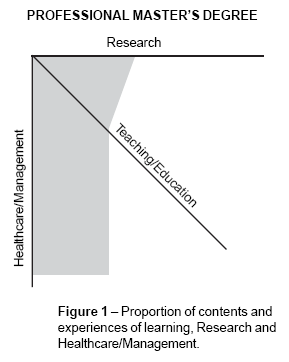
Like any post graduate modality, the Professional Master's Degree in Health needs to focus on the three main dimensions of training at this level, namely, knowledge, research and teaching. However, its professional vocation and conception, committed to the consolidation of the Sistema Único de Saúde and Family Health, are oriented towards an integral training, but directed towards the objectives which it seeks to obtain. Figure 1 illustrates the concept of the course from the perspective of the above-mentioned dimensions.
THE PROFESSIONAL MASTER'S DEGREE
Thus, we intend that for a PhD course, the main emphasis will fall on developing competencies for research and investigation – in this case, the shaded area will reach the outer limit of the horizontal arrow denominated RESEARCH; in the academic master's degrees there was a greater emphasis on teacher training, preparing for teaching at various levels, particularly graduation – the sloping arrow, relating to TEACHING/EDUCATION would be strengthened, while the area of learning contents and experiences included in the curricular matrix of a professional master's degree needs to be focused on skills and attitudes geared towards the 'praxis' of the professions it seeks to train - as the vertical arrow shows, denominated HEALTHCARE/MANAGEMENT. The grey area in the illustration shows the planned proportions of the Professional Master's Degree Program in Health - with Family Health as the Area of Concentration, and represents a summary of the proposal.
Conclusion: Preferential model
In the words of Delors (1998), education is a treasure waiting to be discovered. In our view, the Professional Master's Degree is this treasure, and it is being discovered as yet another alternative, in the offer of post graduate studies for permanent education, from a perspective of training professionals in the area of health, for the consolidation of the SUS.
Our thesis of considering the professional master's degree as a preferential model for training in family health, does not undermine the need for the other modalities, such as professional development, specialization and internship courses, or academic master's degrees, but is added to them as another alternative.
However, our preference for this type of master's degree relates mainly to its permanent character and the regular nature of its offer, enabling the continuity of projects that can transform the reality, as they become more successful and are improved; the valorization of the work force employed in the services; welcoming the opportunity to include the qualification of master's degree in the criteria for career promotion; the requirement for real time integration between academic study and health services; the incentive in the search for objects of study which originate in the world of work and to return there with constructed knowledge.
However, the challenges are significant. They start with a lack of knowledge in relation to this modality of post graduate course, which generates suspicion, both in the academic community and in the health services, which question whether this master's degree is valid. These courses suffer from a lack of financing, which prevents students from giving greater dedication to the programs - why are there no grants? The challenges also include the inexperience of the teaching body, in working with the professional master's degree, and the question is asked, what type of course conclusion work should be most encouraged (research, reports of experience, development of models, creation of technologies)? The search for answers, individually thought and collectively discussed, is being incorporated into the daily experience of those who are committed to the program.
The prospects, if measured by the level of satisfaction of those involved - teachers and students - are encouraging; if considered based on the growing number of applicants for the selection processes, they are very positive; if considered from a parameter of evaluation by CAPES, they are challenging, as the recommendation obtained in 2004 needs to be not only followed, but improved upon Regarding its impacts on the transformation of the healthcare model, it would be too early, and imprudent to make any affirmations or forecasts. But there is no doubt that micro-transformations in people, and the spaces in which they circulate, are evident, and enable us to affirm that our first steps are acting as multipliers in the defense of the Health Reform, and the programs to consolidate it.
]]> References
BRAZIL. Ministry of Health. Regulation 198/GM/MS, of 13 February 2004. Institutes the National Policy on Permanent Education in Health as a Strategy of the Sistema Único de Saúde for the training and development of workers for the sector, and other provisions. Brasília, 2004.
BRAZIL. Ministry of Health. Perfil dos médicos e enfermeiros do Programa de Saúde da Família no Brasil: relatório final. Brasília, 2000.
COORDENAÇÂO DE APERFEIÇOAMENTO DE PESSOAL DE NÍVEL SUPERIOR (CAPES). A necessidade de desenvolvimento da pós-graduação profissional e o ajustamento do sistema de avaliação às características desse segmento. Annex of the minutes of the 65th meeting of the Technical-Scientific Committe of CAPES. Brasília, 2002.
COORDENAÇÂO DE APERFEIÇOAMENTO DE PESSOAL DE NÍVEL SUPERIOR (CAPES). Regulation 080, of 16 December 1998. On recognition of professional master's degree programs, and ther measures. Brasília, 1998.
COSTA NETO, M.M. (Org.) A implantação de unidade de saúde da família. Brasília: Ministério da Saúde, Secretaria de Políticas de Saúde, Departamento de Atenção Básica, 2000.
DELORS, J. Educação: um tesouro a descobrir. São Paulo: Cortez; Brasília: MEC/UNESCO, 1998.
MINISTÉRIO DA EDUCAÇÃO E CULTURA. Conselho de Educação Superior. Opinion 977 (Documento nº44/1965). In: ____________. Enfermagem: legislação e assuntos correlatos. 3.ed. Rio de Janeiro: Ministério da Saúde/Fundação Serviços de Saúde Publica, 1974.
OLIVEIRA, F. B. (Org.) Pós-graduação: educação e mercado de trabalho. Campinas: Papirus, 1995.
REVISTA DE ADMINISTRAÇÃO CONTEMPORÂNEA. Mestrado profissional, n.1, p.145-52, 1997.
SIQUEIRA, H. S. G.; PEREIRA, M. A. A interdisciplinaridade como superação da fragmentação. Available on:< http://www.angelfire.com/sk/holgonsi/interdiscip3.html >. Accessed on: 30 ago. 2005.
SUCUPIRA, N. F. B. Prefacio. In: OLIVEIRA, F. B. (Org.) Pós-graduação: educação e mercado de trabalho. Campinas: Papirus, 1995. p.9-16. ]
TEIXEIRA, C. F; Paim, J.S.; VILASBÔAS, A. L. SUS modelos assistenciais e vigilância da saúde. IESUS, n.7, p.7-27, 1998.
XAVIER, C. Pós-graduação:pensamento e ação integrados para a consolidação do SUS. Radis Comunic. Saúde, n.7, p.10-5, 2003.
Received for publication on: 16/12/04. Approved for publication on: 12/08/05.
* We would like to thank Doctor Alan Índio Serrano for his contributions and suggested improvements to the text. ]]>
1 Rua Mediterrâneo, 172, ap. 401
Córrego Grande - Florianópolis, SC
88.037-610