Competência dos profissionais da saúde para o trabalho interdisciplinar
Competencia de los profesionales de la salud para el trabajo interdisciplinar
Rosita SaupeI,1; Luiz Roberto Agea CutoloII; Águeda Lenita Pereira WendhausenIII; Gladys Amélia Vélez BenitoIV
INurse, Project Coordinator; professor, Master's Degree Program in Health and Management of Work. <saupe@amja.org.br>
IIDoctor, project researcher; professor, Master's Degree Program in Health and Management of Work. <cutolo@univali.br> ]]>
IIINurse, project researcher; professor; coordinator, Master's Degree Program in Health and Management of Work. <agueda@univali.br>
IVNurse, project researcher; professor; Master's Degree Program in Health and Management of Work. <gladysv@terra.com>
Translated by Fiona Oliver Robson Singh and Cynthia Christine Ebert Philipps
Translation from Interface - Comunicação, Saúde, Educação, Botucatu, v.9, n.18, p.521-536, Sept./Dec. 2005.
ABSTRACT
Interdisciplinarity, as one of the key concepts for the consolidation of public policies in the area of health, was focused on the perspective of the professionals who are faced with the challenge of putting it into practice. Understanding interdisciplinarity as a competence resulting from a range of knowledge, skills and attitudes, it was organized in the form of a tree diagram. This diagram was initially submitted for evaluation by a group of twenty-one judges, and subsequently, by a sample of one hundred and forty-five health professionals. The results show a consistency between the researcher's proposal and the evaluation of the participating subjects, since on a scale of zero to ten, the final level of performance was over nine. The space provided for statements by the subjects resulted in the addition of important categories, enriching the study as a whole.
Key words: Interdisciplinarity, Competence-based education, Human Resources in Health.
RESUMO
]]> A interdisciplinaridade, como um dos conceitos nucleares para consolidação das políticas publicas na área da saúde, foi focalizada na perspectiva dos profissionais que estão com o desafio de concretizá-la na prática. Entendida como uma competência que resulta de um conjunto de conhecimentos, habilidades e atitudes, foi organizada na forma de diagrama hierárquico. Este foi inicialmente submetido à avaliação por um grupo de vinte e um juizes e posteriormente a uma amostra de cento e quarenta e cinco profissionais da saúde. Os resultados evidenciaram aderência entre a proposta dos pesquisadores e a avaliação dos sujeitos participantes, pois numa escala de zero a dez, o índice de desempenho final ficou acima de nove. O espaço aberto para depoimentos dos sujeitos resultou em importantes categorias a serem agregadas, enriquecendo a totalidade estudada.Palavras-chave: interdisciplinaridade. educação baseada em competências. recursos humanos em saúde.
RESUMEN
La interdisciplinaridad, con uno de los conceptos nucleares para la consolidación de las políticas públicas en el área de la salud, fue localizada en la perspectiva de los profesionales que están con el desafío de concretizarla en la práctica. Entendida como una competencia que resulta de un conjunto de conocimientos, habilidades y actitudes, fue organizada en la forma de diagrama jerárquico. Este fue, inicialmente, submetido a la evaluación por un grupo de veintiún jueces y posteriormente, a una muestra de ciento cuarenta y cinco profesionales de la salud. Los resultados evidenciaron un acuerdo entre la propuesta de los pesquisadores y la evaluación de los sujetos participantes, pues en una escala de cero a diez, el índice de desempeño final quedó por encima de nueve. El espacio abierto para depoimentos de los sujetos resultó en importantes categorías que serán agregadas, enriqueciendo la totalidad estudiada.
Palabras clave: interdisciplinaridad. educación embasada en competencias. recursos humanos en salud.
Introduction
The agenda of the area of health, today, which has mobilized joints efforts between the Ministry of Health (MS) and the Ministry of Education (ME), relates to the public policies focusing on the reorientation of the healthcare model, as recommended by the Health Reforms. The consolidation of the Sistema Único de Saúde (SUS) depends not only on the success of strategies like the Family Health Program (FHP) and the introduction of processes of Permanent Education (PE) by the MS, but also on the revitalization of the Pedagogical Projects (PP) of graduate courses, incorporating the premises of the Lei de Diretrizes e Bases da Educação Nacional (Brazilian Law on Education) (LDB), as established in the Diretrizes Curriculares (Curriculum Guidelines) (DC), with are attributions of the ME.
]]> It is urgent, therefore, to establish a new relationship between health professionals which [...] unlike the traditional biomedical model, enables greater diversity of actions and an ongoing search for consensus. This relationship, based on interdisciplinarity, and no longer on multidisciplinarity [...] requires an approach which questions the professional certainties and encourages permanent horizontal communication between the team members. (Costa Neto, 2000, p.9)
Thus, interdisciplinarity is one of various themes which need to be developed if they are to contribute to the agenda in the area of health, as we understand that the historical context at this turn of the century, characterized by the division of intellectual work, the fragmentation of knowledge and the excessive prevalence of specializations, demands a return to the former concept of interdisciplinarity which, throughout the past century, was suffocated by the rationality of the industrial revolution.
In the contemporary perspective in which this study is inserted, interdisciplinarity includes: Recognition of the growing complexity of the object of the health sciences and the consequent internal demand for a pluralistic outlook; the possibility of joint work, which respects the specific disciplinary bases, but seeks shared solutions to individuals' and institutions' problems; investment as a strategy for consolidating the integrality of the health actions.
Based on these observations, we decided to include interdisciplinary as one of the themes investigated in a project on competencies for consolidating the SUS/FHP. Its objective was to map, based on official documents, literature and expert opinion, the range of theoretical, practical, personal and interpersonal knowledge necessary for interdisciplinary work in health, and submit this for evaluation by professionals in the area, incorporating their contributions in the form of statements, in order to gain an understanding of the concept in its various dimensions.
Theoretical background
The theoretical background to this study was based on common elements that need to be developed in all graduate courses, emphasizing the competence to "work in association with other professionals in the area of health", i.e. in an interdisciplinary way (Almeida & Maranhão, 2003).
Interdisciplinarity has been an object of much discussion in the area of health sciences. Although the word has received systematic treatment, little has been done to categorize what is really meant by it. Japiassú (1976) observes that this neologism takes on wide and diverse meanings, with consequent understandings and uses. We believe that the polysemy evoked by interdisciplinarity can be understood, at least partially, when its meaning is seen from the specific object that is being investigated or confronted. For example, in a wider sense we can qualify Biochemistry as a product of the interdisciplinary relationship between Biology and Chemistry, giving rise to a new discipline. Some may suggest that Health Education is an area of knowledge which is organized in an interdisciplinary way, as it is based on the premises of Collective Health and Constructivist Education. These examples demonstrate the problem of the multifaceted nature of the category.
Although we recognize the two examples presented above as interdisciplinary possibilities, based on the way they intersect with one another, we will deal with with a categorization that is a little more pragmatic, in terms of practices involving different professions in the area of health, and their consequences for the daily work of the Basic Health Units. Thus, we define interdisciplinarity as a two-way relationship between different health professionals. Using the epistemological categories of Fleck (1986), we seek to qualify the professions as different Thought-collectives, each rooted in its own Style of Thinking, i.e. in a stylized perspective which permeates a range of rules for addressing and resolving problems, based on specific and differentiated training as an identified conceptual milestone. What we mean to say is that the doctor, the nurse, the dentist, the psychologist, or any other health professional, comprise different Thought-collectives, and as a result, they contribute with new facts for resolving common problems.
But what is interdisciplinarity? What is the difference between terms, which are often confused, such as interdisciplinarity, transdisciplinarity, multidisciplinarity, and pluridisciplinarity? We believe it is important to arrive at a clear definition of these concepts, which are often used interchangeably, or with different meanings. Rather than attempting to give a definitive definition, we opted to borrow the view of Japiassú (1976), with modifications.
]]> Multidisciplinarity indicates the practice of disciplines without any common objectives, and without any joint or cooperative action between them. In pluridisciplinarity there is a common core, and a relationship now emerges, with a certain degree of collaboration, but without any systematic structure; there is a hint, the beginnings of a two-way relationship between the disciplines. These two terms are often used synonymously, which is not necessarily wrong. What Japiassú (1976) calls pluridisciplinary, Rosenfield apud Perini et al (2001) call multidisciplinary, in other words, when a common problem is dealt with in a sequential or parallel way, by specific disciplines.Rosenfield apud Perini et al. (2001) defines interdisciplinarity as the possibility of a joint work in the search for solutions, while respecting the specific disciplinary bases. And finally, transdisciplinarity is defined as a collective work which shares "conceptual structures, building together, theories, concepts and approaches to deal with common problems" (Rosenfield apud Perini et al., 2001, p.103). In this case, the discipline in itself loses its meaning, and there are no longer precise distinctions between the disciplines .
In a pluridisciplinary relationship, a patient with an oral respirator may first be attended by a family doctor. Once diagnosed, the patient may be referred to an otorhinolaryngologist who, after determining the conditions of the patient's palate, will refer him to an odontologist or speech therapist. As we can see, each specialist carries out his work separately, without direct cooperation. In an interdisciplinary perspective, the approach to the problem is seen in a joint way, as is the search for creative solutions to resolve it.
But what is needed, for interdisciplinarity to become a natural and mutually cooperative way of working, which goes beyond personal arrogance and the need to exercise power over others, and a tradition which centralizes professionals, moving to the periphery of the process, the subject who has become sick, through a lack of knowledge or energy to care for himself, and requires attention, assistance, information? This was the central question of this study, and to answer it, we found in the Unesco Report of the International Commission on Education for the 21st Century (Delors, 1998), the basis for proposing a range of knowledge, as proposed in that document.
Methodology
The methodology selected to guide the collection and analysis of the data originated at the University of North Carolina, proposed at the start of the nineteen seventies, and introduced to Brazil around the middle of the same decade (Spínola & Pereira, 1976) is used to evaluate some programs (Saupe, 1979; Spínola & Pereira, 1977). It includes the following stages: Elaboration of a Tree Diagram; consultation of experts, known as the Jury Method; to determine the level of agreement among the judges; the construction and application of the instrument(s) to a population/sample which has an interest in the theme; and the performance evaluation. This process results in a quantitative evaluation which validates a theoretical proposal by a group of judges, and is also submitted to a wider population of people interested in the theme, incorporating their conceptual contributions, in the form of statements. In the presentation of the results, we followed this same sequence, detailing the methodological aspects and seeking to understand them.
The qualitative data were analyzed as follows: Initially, the statements, in the form of comments, explications, and suggestions, were transcribed and organized by professional category; next, as an initial approach to this systematized content, an exhaustive and repeated reading was carried out of the responses transcribed, in order to detect a possible classification. Despite our belief that it is difficult to compartmentalize competences into skills, attitudes and knowledge, owing to their intrinsic rationalities, we opted to maintain the description logic of the first phase of the research, by dividing them into three main blocks of categories. We then moved on to the categorization phase itself, underscoring words and expressions that could impart meanings in the analysis of the competencies. The third phase was the inferential analysis of the categories classified. As can be observed, some categories can be considered hybrid, crossing several categories, depending on their potential, such as attitude, skill and knowledge, which is in line with our view that these elements are self engendering (Bodgan & Biklen, 1994; Minayo, 1992; Triniños, 1987; Lüdke & André, 1986).
We also record that the project followed all the procedures necessary for their ethical approval, resulting in Opinion 381/2003 of the Ethics Committee of UNIVALI. The ethical dimension fulfilled all the necessary precautions, including the sign of a post-informed term of consent.
]]> Results
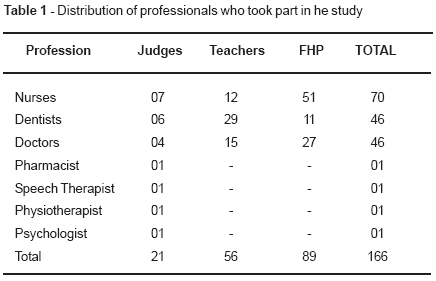
Those who took part in the study as evaluators, were a group of experts and a sample of health professionals, as shown in table 1. The number of judges consulted was defined by the researchers. As for the other professionals, we worked with a perspective of reaching the total study population which, having been located within the data collection period and informed about the project, freely consented to take part in the study.
The estimated population included 133 teaching staff, namely: 21 nurses; 67 doctors; and 45 dentists. As for the FHP workers, we observed that the professionals practicing in the territory covered by the research included: 66 doctors, the same number of nurses, and 12 dentists, making a total of 144 professionals. The sample percentage of teaching staff who agreed to take part in the study was 42%, and for the FHP professionals, 62%, resulting in a total representativity of 52% for the entire study sample. According to table 1, the most representative group among the teachers was the dentist, and in the FHP teams, the nurses were the most representative group.
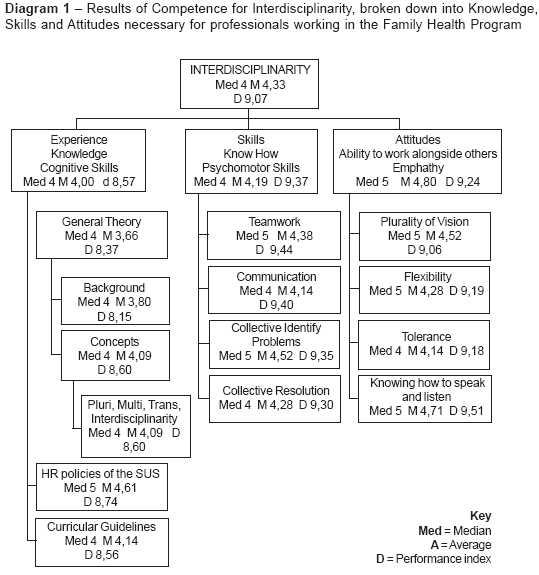
The Tree Diagram (DIAGRAM 1) follows the original model of the methodology, and represents the breakdown of competencies for interdisciplinarity, into their dimensions of knowledge, skills and attitudes. The sources used to define this matrix include the experience of the researchers involved, legal documents regulating this field of knowledge, and the literature. This stage can be considered as the contextualization of the phenomena, capturing the various perspectives of perception of the reality, in the case of interdisciplinarity as a necessary competence for work in family health.
]]>
This matrix was submitted for evaluation by a group of 21 (twenty one) invited judges, who attributed weights to each component (we used the terms: variable or attribute as synonyms) according to the relative importance of each category, compared with others at the same level. The importance was translated as a weight on a scale of 1 - less important to 5 - extremely important.
Next, the level of agreement among the judges was determined. This agreement is considered natural when the component is given the same weight by all the judges. In the case of this study, this agreement did not occur with any of the variables.
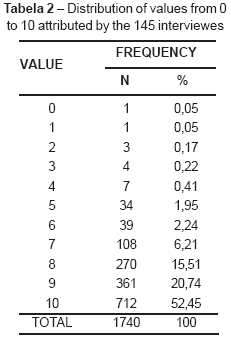
Thus, according to the methodology, the median was defined between the weights. However, in the process of analyzing and refining the differences of evaluation between the components, we also calculated the average. These data are included in diagram 1 and show the highly positive evaluation received by the proposal, since no variable had a median of less than 4, or an average of less than 3.66. The distribution of all the weights attributed by the judges, according to the attributes for each dimension of competence for interdisciplinarity, is presented in table 2.
Having completed the Tree Diagram (Diagram 1) with all its components itemized and the weights attributed, we moved on the construction of the instrument(s), focusing on the components of the last level presented in the diagram. The evaluation scale was adjusted to values of 0 – totally negative evaluation to 10 – totally positive evaluation. Open questions were also included, enabling individual contributions by the informants, and demonstrating common or unique aspects of their views. This instrument was applied individually to the 145 participants (nurses, doctors and dentists), consisting of 56 teachers and 89 FHP professionals.
]]> For the performance evaluation of each component, the following equations were applied:a) to measure the activities of the last level:

Until all the values in the scale had been included (which should correspond to the TOTAL number of respondents
Where: VeL0 = Value 0 of the LIKERT scale in question 1, and so on; and Nr0 = Number of responses 0 in question 1, and so on. The result is a Performance Index for the question, corresponding to a value between 0 and 10.
b) to measure the components of the other levels:

In other words, the performance of each component is equal to the sum of the indices resulting from the evaluation of activities at the last level, and multiplied by their weight; this result is divided by the sum of the weights.
In table 2 we present the distribution of values 0-10 in absolute numbers, before applying the equations, which already reveal the positive visibility received by the proposal. In other words, of the 1740 occurrences registered by the interviewees, we found a tendency for the number of responses to increase in frequency, as the values became more positive, reaching a percentage of 88.70 for the total number of responses concentrated in numbers 8, 9 and 10.
Next, the equations were applied. The values obtained for each component were converted to a Performance Measurement Scale (figure2), the 'region of failure' being considered that located between 0 (zero) and 4 (four), indicating the extreme fragility of the components at this level; scores between 4.1 (four point one) and 7 (seven) represent the 'undefined region' which attributes an intermediate performance variable; success is achieved when the variable reaches a level of over 7.1 (seven point one), showing that the objective for this category has been fully achieved.
]]> These results were also added to the Tree Diagram (Diagram 1) to complete the quantitative evaluation cycle. Thus, the representation of each component or variable evaluated was included, together with its description, and the corresponding weight and average, according to the evaluation of the 21 judges and its performance measurement, resulting from the application of the equations to the data gathered from the 145 professionals.
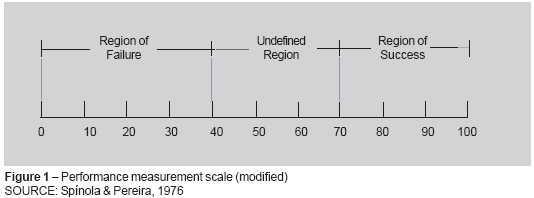
Diagram 1 was constructed from the top down, weighted by the judges in the same order, and evaluated by the professionals in the opposite direction, by means of a structured instrument, which focused only on the last levels. After submitting the whole thing to the planned statistical treatment, the result was an illustration with various possibilities of analysis.
The first conclusive evidence confirms that the form selected to address competencies for interdisciplinarity, in its dimensions of knowledge, skills and attitudes, was considered appropriate. It also shows that in order for the work to be materialized in the interdisciplinary model, it is necessary to master certain concepts, have the opportunity to put them into practice in the team work, and develop affirmative attitudes for embracing the other, and others.
Of the eighteen components selected to evaluate the competence for Interdisciplinarity, only two had averages lower than 4, both related to Knowledge. These were: 1. General Theory (3.66) and 2. Background (3.80).
We do not agree with the pragmatism shown, since although we agree that Interdisciplinarity is a concept which is only materialized in the reality of actions, like many others, it does not dispense with or annul the theoretical need for its comprehension. Without eliminating the subjectivity present and necessary for human acts, we need to overcome practices governed by intuition alone. On the other hand, the materialization of positive evaluations attributed to Attitudes is entirely in tune with the perspective of this study and with the historical times in which we are living.
After analyzing the competencies described, and assigning a scaled value, the interviewees had the opportunity to include skills, attitudes and knowledge other than those selected in the construction of the research tool. This open phase of the research enabled them to emphasize aspects which they considered relevant in the previous phase, as well as the description of aspects which they saw as lacking.
]]> The statements analyzed, as described in the methodology, and presented afterwards, refer to the 145 professionals, i.e. they do not include the judges, since their contributions are incorporated in Diagram 1. A total of 44 suggestions were recorded in the data collection tool, of these, 22 came from the teachers, and the same number from the 89 FHP professionals. No significant differences were detected between the two groups, in relation to the trend expressed in the concepts issued.The block of categories related to knowledge included: Partnerships, reforms to the system, correlated concepts, the role of each discipline, education, health, advantages/disadvantages, practical application, and the team.
The category knowledge of partnerships emerged as the need to know all the participants from all sectors, in order to develop a collective project. We can examine the correlation between interdisciplinarity and intersector relations, remembering that the second defines the first at institutional level. A knowledge of all the possible partners (NGOs, associations, institutions, etc) can optimize the execution of community intervention projects.
A knowledge of system reform and initiatives through public policies, and of the changes in the healthcare model, was considered important. It appears that knowledge of the principles that guide, in this case, the Health Reforms, can contribute in the execution of interdisciplinary practices; particularly from a perspective of Integrality, the axis of the reform which justifies team work.
Correlated concepts are understood here as a knowledge of terminologies marked by theoretical framework which help to clarify differences between multidisciplinarity, pluridisciplinarity, transdisciplinarity and interdisciplinarity. Although indecisive, it is suggested that understanding the confusions generated by the above-mentioned concepts can help in a epistemologically based reflective approach to the self-image of the team and its practices.
The category knowledge of the role of each discipline involves a need to know the specific aspects of the disciplines, i.e., knowing the other, by means of his specific competencies. The division of collective work occurs through learning the roles to be performed by the different participants involved in the zones of interface. This category also awakens recognition that a base of interdisciplinary relation presupposes the existence of disciplines with internal regulating mechanisms and conceptual systems that distinguish them.
The Education indicated here refers to basic knowledge of education for the practice of Health Education as an interdisciplinary project. Understanding education from a theoretical and operational perspective, therefore, was understood as one of the competences to be developed. This can be extrapolated to the difference that education seeks to make. It is valid, both for the critical reflection of traditional educational practices of Hygienist Education and the educational practices of Health Education.
The same question as that posed in the previous category (what education?) can be rephrased for the category health: what health? A knowledge of the concepts of health, based on a historical perspective and its justification in the different healthcare models, can constitute an important tool for an interdisciplinary practice. A practice of this scale immediately involves a concept of sickness-health, which means, specifically, that interdisciplinary practice engenders a concept of integrating health. As for the category education, we can say that Hygienist Education carries a hygienist and preventative concept, while Health Education presupposes a social concept.
Regarding practical application, basically, the professional refers, objectively, to the knowledge to answer the questions: Why work in an interdisciplinary way? Why do it? What are the objectives of interdisciplinarity? In other words, what does the category call itself? What is the practical application of an interdisciplinary work? It seems to us that this knowledge (which is previous) can act like fuel, giving logical and pragmatic meaning to interdisciplinarity.
Based on the previous category, knowledge can be divided into advantages and disadvantages of the interdisciplinary practice. Understanding its meaning opens up potential for its practice. Advantages such as possibility of solution, effectiveness, cooperative effort, co-responsibility, etc, mark out the ground for this field, obviating any eventual disadvantages of a cooperative nature.
]]> This can be extrapolated to the difference that education seeks to make. What was explained by the interviewer relates to intrinsic knowledge of the members of the team on their social relations. Knowing the other, understanding their cultural and social differences.The block of categories with skills includes: relating, being involved with the community, recognizing interdisciplinary situations, identifying problems, proposing solutions, and identifying difficulties.
The skill of relating is closely linked to certain attitudes. To put it another way, "relating" is based on an attitude of tolerance and respect; but it also presupposes the development of other correlated skills, such as communication. There can be no interdisciplinarity without relationship, relationship with communication, or communication without certain attitudes.
It needs to be emphasized, in the category involvement with the community, that the professionals interviewed included popular participation as an element of the interdisciplinary team. In other words, representing the community as a member of the team. This inclusive perspective brings an element that was not considered in the applied study. Despite the emphasis on popular participation as the democratic principle behind the SUS, our section of interdisciplinarity was restricted to the thought-collectives more directly related to the professional categories.
Interdisciplinarity is a dynamic practice which involves various processes. Not every action carried out within the Health Unit is interdisciplinary; they are not interdisciplinary the whole time, and they not always interdisciplinary among all the members of the team. There is room for disciplinary work when it is carried out within the specificity of my thought-collective. On the other hand, in certain circumstances, interdisciplinary work may be restricted to a common project with two thought-collectives, involving, for example, a doctor and a nurse. Sometimes the project requires the cooperative participation of all the members of the team. The capacity to recognize interdisciplinary situations constitutes another competence to be developed.
The ability to recognize problems legitimizes the description of the previous category. Interdisciplinary is justified based on the context of day-to-day practices of the health team, in tune with the material reality, i.e. inserted in the problem situations. These problems are the potential articulation centers, or zones of interface in the interdisciplinary relationship (borderline objects).
As a consequence of the previous category, the proposal of solutions should be the intermediate axis of the interdisciplinary undertaking. We say intermediate, because the terminal axis is the solution of the problems themselves. The end is justified by the improvement in individual and community health indicators
The ability to identify difficulties to interdisciplinary practice is essential for maintaining the stability of the team. The appropriation, though a critical reflection, of the difficulties found in the interdisciplinary projects, can provide an important tool for overcoming these difficulties, and providing internal growth. There are no prescriptive bases for interdisciplinary practice; it is in experience, in the successful and unsuccessful experiences of identifying difficulties, that the daily practice of the team is constructed.
The block of categories related to attitudes includes: respect for the discipline practiced by the other, respect for the other, tolerance, accepting suggestions, respect for limitations, respect for competencies, commitment to the system, listening, reflection, humility, change, respect for differences, ethics, authority and empathy.
As can be observed, the series of categories related to attitude was prevalent in this phase of our study. We did not find this strange, as we believe that attitude is the final aspect of the 'mother', or 'nourishing' competence, offering the conditions for the outworking of skills and knowledge. We insist that coherence between the three elements of competence makes them indelibly united and dialectically part of one another, but we recognize that the first condition for interdisciplinary practice is the attitudes of the members of the team.
]]> Respect for the discipline practiced by the other was understood as a lack of censure or attribution of value judgment to the other thought-collectives involved in the team work. Understanding the potentials and limitations of my discipline and other disciplines, without hierarchical judgment, recognizing the importance of the role of each one in the process of constructing interdisciplinary practice, is essential in work relations.This collective construction should not deny the individual, the attitude of respect for the other, but is based on the premise of subjectivity. In fact, collective interdisciplinarity can be understood as intersubjectivity, and as such, considers the other as unique.
Tolerating here does mean excusing, submitting or resigning, but rather, placing oneself beside the other and understanding that the other may be right, or better yet understanding and contextualizing the truth of the other, within the perspective or style of thought and thought-collective. It also means agreeing and negotiating in the search for consensus.
The category accepting suggestions is presented as a practical possibility for exercising tolerance. It means making my discourse permeable to the discourse of the other team member, and understanding that the theoretical-practical contributions of other thought-collectives constitute elements of a collective construction.
The reference made in this statement – respecting limitations – relates to the specific competences of each thought-collective. Understanding that the specific competencies of the doctor, the nurse, the dentist, are limited, yet these same limitations can become an underpinning for the interdisciplinary justification. The very condition for the complexity of the object of health-sickness stamps on each thought-collective an awareness of its limitations; on the other hand, it is precisely in this complexity that the possibility of working in a team emerges. Respecting limitations cannot be "limiting factors", but a springboard for cooperative work.
The allusion to respect for competencies, although it may, at first, appear to be very close to the category "respecting the discipline practiced by the other" has substantial differences. At this point in the discourse, the next scenario addressed is that of the practices and "acts". Respecting the competence of the other means not overstepping into the area of the "corporative act" of the other. We understand the historical moment in which this concern is addressed, when the corporations of health professionals are undergoing conservative movement in relation to their specific competencies, but interdisciplinary requires a certain corporative detachment, particularly when taking the principle of Integrality as the nuclear axis in the changes of the healthcare model.
The inclusion, by the interviewees, of the attitude of commitment to the system proved surprising. It is clear to us that the level of commitment to the changes in the healthcare model, which originated in the Health Reform Movement and consequently, with the principles and directives of the SUS, are fundamental in the execution of any work project in an FHP team.
A basic premise of communication, hearing, enables us to understand the opinions of others, question our own convictions, and learn.
An attitude of reflection, a critical, self-critical spirit, the ability to abstract from a concrete situation, are seen as attitudes to be developed in the interdisciplinary work. Non-commitment and alienation can be seen as consequences of the parceled division of the work (i.e. division into disciplines), but also as difficulties in the execution of the collective work (interdisciplinarity). Alienation is also related to a lack of commitment to the social reality and its indicators, which is incompatible with the principles of the Health Reform.
The attitude of humility is related to many of the other categories described above. Humility, here, recognizes limitations, recognizes that one can be wrong, and can receive help, which is not better or worse, but different.
]]> The attitude of change was attributed the meaning of being ready to learn, starting over, and accepting new challenges. Understanding the reality and feeling co-responsible in one's processes of transformation.Assuming an active role, which constructs the history of the reality and its processes. This attitude involves recognizing the determinations and appropriating the mechanism capable of modifying them.
Respect for differences means adhering to a human characteristic, which is the awareness of oneself within the heterogeneity. Historical subjects have biographies, are special and unique, and not, contradictorily, collective subjects. Each one constructs his own history based on the social perspective of his own context. Social class, family, training, and education within a specific thought-collective (in graduation) all bring marks that will have repercussions on our various social micro-environments. We go further, and extrapolate this category in relation to the perception of the community in which the work will be carried out. Interdisciplinary practices of community intervention are based on a deep respect for the culture of people, as well as their beliefs and values.
The health sciences have as individual and community objects, i.e. objects which are intrinsically subject to ethical mechanisms. The work environment also behaves like an ethical social relationship, and we are not speaking here of cooperative ethics, but of an ethic that is also based on the principle of integrality.
The reference to authority was interpreted here as leadership. Only interpreted, because as it is not a semi-structured interview, this question cannot be contextualized, it emerged only as a single word, without any surrounding expression or context. In any case, we understand that leadership is related much more to a skill than an attitude in itself. We believe that it is a skill that may, or may not, be permeated with certain attitudes. The exercise of authority and leadership should be, above all, agreed and democratic, and not authoritarian or hierarchical.
Empathy is the quality of placing oneself in the other's situation, feeling oneself to be in the circumstances experienced by the other. It is a form of compassion.
Besides these categories, which we consider to be directly related to the competence studied here – interdisciplinarity – the informants submitted other aspects, such as: teaching capacity, holistic vision, and practical activity.
In relation to teaching capacity, we understand that the context of training is important in the development of interdisciplinary practices of professionals. The importance was highlighted, of giving opportunity to interdisciplinary spaces, in graduate courses. For this to become reality, teachers who are aware of the issues involved need to become protagonists of these curricular practices. As a result, teachers who have had a traditionally disciplinary training require permanent education on interdisciplinarity.
We prefer to denominate holistic vision as integral vision (the principle of integrality), which emerged as a reference to the result addressed based on an interdisciplinary practice. We prefer to say that interdisciplinarity is one of the elements, or one of the ways of coming closer to a practice of Integral Health Care.
This construction of one of our interviewees is very widespread in our discourses, that interdisciplinarity cannot be just an epistemological abstraction, or just an objective to be achieved. It is built on a very concrete reality, i.e. in the scope of day-to-day practices, and the demands and needs.
]]>Final considerations
The study which gave rise to this article generated a quantity and variety of data, and its divulgation and sharing with the professional and scientific community has been in portions. In this article, we address one of the three main general competencies of health professionals, from a perspective of contribution to the consolidation of the SUS/FHP, which is, interdisciplinarity. The competencies studied were: education and participation in health, interdisciplinarity, and management. They are denominated general because they are shared by all the health professionals, and are considered cores for changing the healthcare model.
We believe the snapshot presented here has achieved its objectives. We also confirm that the methodology selected to respond to the above-mentioned objectives proved adequate, effectively linking the quantitative and qualitative data.
The synthesis represented by the tree diagram can be considered as a contribution for supporting managers and educators who are committed to training professionals and their process of permanent education.
References
ALMEIDA, M.; MARANHÃO, E. Diretrizes Curriculares Nacionais para os cursos universitários da area da Saúde. Londrina: Rede UNIDA, 2003. [ Links ]
BOGDAN, R. C.; BIKLEN, S. K. Investigação qualitativa em educação: uma introdução à teoria e aos métodos. Porto: Porto, 1994. [ Links ]
COSTA NETO, M. M. (Org.) A implantação da Unidade de Saúde da Família. Brasília: Ministério da Saúde, Secretaria de Políticas da Saúde, Departamento de Atenção Básica, 2000. [ Links ]
DELORS, J. Educação: um tesouro a descobrir. São Paulo/Brasília: Cortez/MEC/UNESCO, 1998. [ Links ]
FLECK, L. La gênesis y el dasarrollo de un hecho científico. Madrid: Alianza Editorial, 1986. [ Links ]
JAPIASSU, H. Interdisciplinaridade e patologia do saber. Rio de Janeiro: Imago, 1976. [ Links ]
LÜDKE, M.; ANDRÉ, M. E. D. A. Pesquisa em educação: abordagens qualitativas. São Paulo: EPU, 1986. [ Links ]
MINAYO, M. C. S. O desafio do conhecimento: pesquisa qualitativa em saúde. São Paulo/Rio de Janeiro: Hucitec/Abrasco, 1992. [ Links ]
PERINI, E.; PAIXÃO, H.H.; MODENA C. M.; RODRIGHES, R. N. O individuo e o coletivo: alguns desafios da epidemiologia e da medicina social. Interface - Comunic., Saúde, Educ., v.5, n.8, p.101-18, 2001. [ Links ]
SAUPE, R. R. Proposição de uma metodologia para avaliação de cursos de enfermagem. 1979. Dissertação (Mestrado) - Programa de Pós Graduação em Enfermagem, Universidade Federal de Santa Catarina, Florianópolis. [ Links ]
SPÍNOLA, M. R.; PEREIRA, E. M. Avaliação de programas: uma metodologia. Projeção, v.7, n.1, p.26-32, 1976. [ Links ]
SPÍNOLA, M. R.; PEREIRA, E. M. Avaliação do Programa Imposto de Renda -77. Projeção, v.19, Supl. Esp., p.1-11, 1977. [ Links ]
TRIVINÕS, A. N. S. Introdução à pesquisa em ciências sociais: a pesquisa qualitativa em educação. São Paulo: Atlas,1987. [ Links ]
Received for publication on: 31 August 2005. Received for publication on: 28 November 2005.
* Research result, according to the project submitted to the FAPESC (formerly the FUNCITEC), Bill 003/2003, approved and financed by the FUNCITEC/MINISTRY OF HEALTH/UNESCO FCTP no. 2186/039. Approved by the Ethics Committee of UNIVALI (no. 381/2003); linked to the Master's Degree Program in Health and Work Management; the research group in Health Education in Health and Management of Work; the line of research Training Human Resources in Health. We would like thank all those who took part: subjects of the research, grant holders, logistical support, colleagues and students of the Master's Degree Program in Health and Management of Work. The following institutions: FAPESC (formerly the FUNCITEC); Ministry of Health; 17th Health Region of Santa Catarina; UNIVALI.
1 Rua Mediterrâneo, 172, apto 401
Córrego Grande - Florianópolis, SC
88.037-610 .
intface@fmb.unesp.br