 Mailing address:
 Rua Visconde de Itaboraí 628, apartment 303, Amaralina.
Salvador, Bahia. ZIP CODE: 41900-000.
Telephone: (55) 71-3263-7433; 71-3240-1916; 71-9105-6834 ]]> E-mail: lirangel@ufba.br
Imagens e sentidos no discurso da mídia impressa acerca de uma epidemia de intoxicação ocupacional por benzeno
Imágenes y sentidos en el discurso de los medios impresos acerca de una epidemia de intoxicación ocupacional por benceno
Maria Ligia Rangel-S
Public Health Medical Doctor, Adjunct Professor - Instituto de Saúde Coletiva – ISC, Universidade Federal da Bahia -UFBA. M.D in Public Health
Translated by Cassandra Schally ]]> Translation from Interface - Comunicação, Saúde, Educação, Botucatu, v.10, n.19, p.77-92, Jan./June 2006.
ABSTRACT
The study analyses the construction of a certain public image, as built by four daily newspapers published in Salvador-Bahia-Brazil, for the different social actors involved in a public debate, during a benzene occupational intoxication epidemic, which affected workers from the Petrochemical Complex of Camaçari-Bahia-Brasil (COPEC), during the years of 1990 and 1991. This study uses references applied by the Symbolic Interactionism perspective, mainly coming from Erving Goffman, one of the most expressive sociologists in this research area, enabling the analysis of discourses contained in the newspapers by using the analytical categories: "voice", "footing" and "face" on 30% of the journalistic material published, during eighteen months. The analysis revealed the building of hesitating, conflicting and docile "faces", which occurred due to the dynamic variations in which the social actors were displayed and how they were put to operate in the text. The texts build up a variety of public images for petrochemical complex workers, for employers of COPEC and for governmental representatives.
Keywords: communication and health, journalism and health, discourse analysis.
RESUMO
Analisa-se a construção de imagens públicas realizada por quatro jornais de Salvador-Bahia-Brasil, para os diferentes atores sociais envolvidos no debate público, na vigência da epidemia de intoxicação ocupacional pelo benzeno, que afetou trabalhadores do Complexo Petroquímico de Camaçari-Bahia-Brasil (COPEC), durante os anos de 1990 e 1991. Recorre-se ao Interacionismo Simbólico, principalmente a Erving Goffman, um dos mais expressivos sociólogos dessa perspectiva de pesquisa, para a análise do discurso dos jornais, utilizando-se as categorias analíticas "vozes", "arranjo" e "face", em 30% do total de matérias jornalísticas publicadas ao longo de 18 meses. A análise revelou a construção de faces oscilantes, em conflito e dóceis, que decorrem das variações nas dinâmicas com que os atores são dispostos no texto e operam nas notícias. Estas conformam distintas imagens públicas para os trabalhadores petroquímicos, para os empregadores do COPEC e para os representantes governamentais, nos diferentes jornais.
Palavras-chave: comunicação. jornalismo. análise de discurso. acidentes de trabalho.
El estudio analiza la construcción de las imágenes públicas realizadas por cuatro periódicos de Salvador, Bahia, Brasil, para los diferentes actores sociales involucrados en el debate público, durante la vigencia da la epidemia de intoxicación ocupacional por benceno, que afectó a trabajadores del "Complexo Petroquímico de Camaçari-Bahia-Brasil (COPEC)", durante los años 1990 y 1991. Este estudio recurre al Interaccionismo Simbólico, principalmente a Erving Goffman -uno de los más destacados sociólogos de esta perspectiva de investigación-, para el análisis del discurso de los periódicos, utilizando las categorías analíticas: "voces", "arreglo" y "cara", en 30% del total de las notas periodísticas publicadas a lo largo de 18 meses. El análisis ha revelado la construcción de caras oscilantes, caras en conflicto y caras dóciles, que derivan de las variaciones de las dinámicas con que los actores son dispuestos en el texto y operan en las noticias. Ellas conforman imágenes públicas distintas para los trabajadores petroquímicos, para los empleadores del COPEC y para los representantes gubernamentales, en los diferentes periódicos.
Palabras clave: comunicación. periodismo. análisis del discurso. accidentes de trabajo.
1. Introduction
In the years of 1990 and 1991 there was a leukopenic (reduction of white blood cells in circulation) epidemic outbreak at the Petrochemical Complex of Camaçari (COPEC), in Bahia, resulting from occupational exposition of the workers to benzene utilized as raw material in six (6) of its industries. The death of one of the companies' medical doctors, followed by sickness and death of another worker were the facts that generated the news coverage. Actions taken by the Workers' Health Surveillance Organ, under State responsibility, led to a study which showed that among 7.356 of the examined workers, 850 were suspect of leukopenic condition and 216 were considered as benzenic cases (Miranda et. al.,1990; DRT, 1991). The environmental evaluation, done by Fundacentro/BA, registered significant benzene contamination levels. This product is used as raw material for the production of several compounds in the petrochemical industry. It is a cyclic aromatic hydro carbonate, liquid, volatile and highly inflammable (Azevedo, 1990), produced by the distillation of petroleum or as a secondary product of metallurgical coke and in iron and steel metallurgy (DRT/MTb, 1991). This substance causes several organic damages to humans, as a result of severe intoxication or from chronic intoxication, to which the name benzenism is given.
In face of the two reported deaths, four (4) of the local newspapers gave ample coverage to the facts related to the epidemic, producing a total of 217 articles in the period of eighteen months, of which 80 were from the Tribuna da Bahia (TB), 70 from the Jornal A Tarde (AT), 33 from the Jornal da Bahia (JB) and 34 from Jornal Correio da Bahia (CB).
These media present distinct propagation capacity: Jornal AT is the main press media in Salvador, with the largest numbers and distribution in the State, a journalistic enterprise supposedly independent, but know at large as politically attached to a hegemonic political group of local society. The Jornal TB, second biggest newspaper in circulation at that time, showing a critical positioning to local government, was widely known as an "opposition" newspaper. The Jornal CB, with a restricted audience and still trying to insert itself in the market, was owned by politicians whom have been governing the State for many decades. The Jornal JB, with an even more restricted audience, linked to the left wing group in the State, was in crisis at that time due to the political conjuncture, it adopted a popular profile while working to reach a specific market share, but it closed down a short time latter.
]]> The deaths, resulting from the occupational disease, took COPEC's labor health problem to the front pages of these newspapers. The epidemic also occurred in a context of high tension between employees and employers, due to political and economical uncertainties in the country in the 90's. The debate around intoxication risks, occurred amidst intense political struggle, especially involving the workers' syndicate. At the same time, much doubt was instilled in the public debate over the cause of death and the emerging diseases at the Petrochemical Complex. As part of the meanings produced by the newspapers for the epidemic event (Rangel-S, 2001; Rangel-S, 2003), this article analyses the discursive construction of public images in the journalistic texts, focusing on the main actors involved in the process of analysis and the management of epidemic risk, as they gained visibility in the discursive weavings of the four (4) newspapers. This study helps understand how press media, as it builds-up the news, operates and displays all social actors, in the political field of actions for heath risk control and creating, this way, specific public images for them. It may also be considered as an exemplary case of multiple journalistic coverage's, for the exact same fact, which allows for in-depth study and comparative analysis, due to the profusion of texts produced on a health subject such as this one - an epidemic.
2. Theoretical and Methodological Approach
This study uses references applied by the Symbolic Interactionism perspective, one of the main schools of thought in Sociology, which has as one of its characteristics, the inclusion of reflexibility in its action analysis. Many researches in the Communication area, which identify communication vehicles as social reality builders, have recurred to Erving Goffman's theories. Goffman is one of the most expressive Sociologists to acknowledge this research perspective and to base his studies, specifically in his Frame Analysis, on how people organize their experiences to give sense to their daily practice. Goffman considers that meaning is also built-in the operation dynamics of participants in interaction in such a way that, for an analysis, it is necessary to isolate some frames of reference to understand particular events. One must analyze the vulnerability of these frames, for a discursive act may mean a joke, a misunderstanding or even a performatic act, according to how the participants want to be seen within the interaction. Goffman also wants to understand the connection, under the circumstances, in which a participant may have several contracts in the interaction.
In this study, inspired in Goffman, we understand that the image of an actor is built and gains sense in the news scene, as may be apprehended from the discourses and while considering the text scheme, as pictures given their format by the journalist, for several of the individuals' action (Mouillaud, 1997). The analyses of these pictures (reference frames) allow an approximation to the drives that move the meanings offered to the public, as non-declared intentionality in the newspapers.
The study was based on a sample representing 30% of the published news. These were stratified by newspaper, selected with the use of aleatory numbers table, included all the period of news coverage and had the support of NUD*IST 4.0 software for qualitative analysis, a computer tool that helps organize work, the coding and data indexation, according to a code reference material elaborated by the researcher and oriented by the specific theoretic analysis frame. Use of the analytical categories voices (understanding this as the polyphonic character of the journalistic text) (Bakhtin, 1981), footing and face, both terms which are used by Goffman (1981) was them made. The term footing must be understood as a condition or arrangement under which something exists and operates. Goffman (1981) develops this notion applying it also to the journalistic texts, defining that the conditions or arrangements in which the individuals participate in the conversation, or are exposed in the texts, are outcomes of the line of thought, posture or projection of the self as assumed by them. According to the author, one must consider, for interpretation, any posture changes which occur (Goffman, 1981:128). In this case, the participants as sources of the news are partially arranged by their own intent, but also in conjunction with the intentions of the journalist. For the study of the line of thought, all citations were valued whether they brought, directly or indirectly, the actors into the news scene, which focused on the benzinism epidemic at the Complex, to identify how the voices were displayed in the text.
From this discursive position, the debate around the epidemic, what the actors said about themselves and about others was analyzed. Interaction among actors was valued, understanding the discourse as praxis – that is, searching for the practical sense in it. The journalists' work was also viewed, therefore, as an interaction of a co-author or co-interpreter of the facts. The personages with which the journalist weaved the narrative story about the events, were now conjugated in a frame of meanings (Mouillaud, 1997).The sources of information appear as authorized subjects (philosophical sense) who make up a polyphonic discourse, news' voices displayed in dialogic relation.
Spotlighted the voices, it was necessary to understand how they were related to the actions of the subjects in the text and how they reproduce the implicit intentionality in their social actions and, therefore, in their discourse. To do that, the actors' positions and movements in the text were analyzed, to find their effects, weaved as public images (Rangel-S, 2003).The analytical categories of footing and face were then used, to try to elucidate the ways in which the co-authors operate in the news, as framed in the journalistic text. From then on, trying to understand the meaning of the discourse while taking into consideration the understanding of the modes in which words were inter-twined, verbs were used by the subjects and positioning inside the text as well as whose actions could be seen through the act of speech (Goffman, 1981). The footing dynamic operates with the figure of the author (the one that speaks) – the newspaper, who is responsible for the words selection- ; the figure of the principal (the one spoken about) – object of the news, the person to whom one orients his speech; someone whose position is established by what is said and whose beliefs are spelled out (Goffman, 1981) - ; and the figure of the animator ( the one spoken to) – the source, the one that lends his voice and occupies the same level of analysis as the receptor (Goffman, 1981). Studying the footing allows us to analyze, throughout the text, the position in which a certain personage is placed: as author, as principal or as animator. This will help us to interpret the voices to which the newspaper confers higher visibility, since there is a selection process for the conditions of footing which defines to whom and to what visibility must go to. However, this is not sufficient to unveil the image that is built. It is still necessary to identify the subjects' action in the discourse.
For this, one must make use of the analytical category know as face, assuming as Goffman (1970) that the subjects' discourse build their own public self-image, or in other words, the way they would like to be seen by others. The negative face wants to have their actions unimpeded, while the positive face wants to have their action appreciated. The politeness strategy is meant to satisfy the other's desire, be it a positive or a negative face. From this interaction many discursive acts may threaten the face that shows itself. In this analysis it is important therefore to observe the ambiguity with which the subject is presented and the explicit or mitigated politeness which satisfies a negative face. In the case of positive politeness, the narrator's face may be the same one as the ones in the audience, or exaggerated or intensified; using marked individuals from the audience group (Brown & Levinson, 1987).
This article describes the operating dynamic of workers, employers and government as can be seen in the text, while being aware of the face desire of the newspapers as referring to those, when giving them voice and structuring their action. This is apprehended through the verbs and objects indexed to the voices in the news. Standing out, in the sentences, the subject, the verb referring to the action and its object, while considering the conflictive context in which the actions happen. The analysis results are presented bellow.
]]>3. Images of a benzene epidemic
3.1. Oscillating faces on an uncertain epidemic
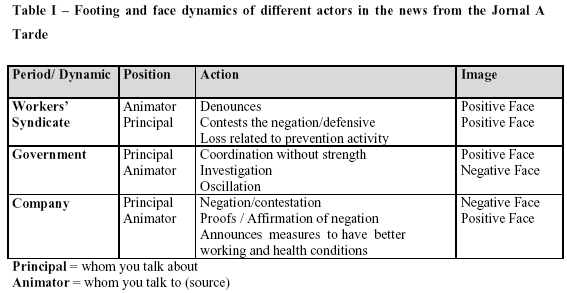
The analysis of news given by Jornal AT presents the ambiguity with which it built the actors faces. In Table I, the dynamics of the different actors in the journalistic text, within a time span, can be seen.
The initial news coverage on the epidemic (July 1990), has the workers Syndicate, Sindiquímica, occupy the preferential place as news' animator, denouncing the cases of leucopenia that are arising in a certain industry at the Petrochemical Complex, as well as governmental authorities neglect and the control over the occupational disease information. The government, at this time, presents itself without any stronghold to face the problem still under investigation, but with the capacity to coordinate a deal among the parts involved. The companies, on the other hand, question the causal relation of the occurred deaths with the occupational exposition to benzene. There are indications, in the following news, of a positive face for the Syndicate (Sindiquímica), and a negative face for the companies. – Polo (Petrochemical Complex) leads occupational disease ranking (Pólo, 1990); Doctor's death may take company to Court (Morte, 1990); Inspection evaluates employees' health at Nitrocarbono (Inspeção, 1990).
In this newspaper, the Syndicate (Sindiquímica) apparently has the support of the government as this one recognizes the benzene contamination situation as epidemic, according to the article Nitrocarbono's employees are under intoxication threat (Funcionários, 1990); and a meeting is called in order to "take urgent measures" and "come to a solution of this problem", contesting the environmental evaluation as presented by the company, which, in the voice selected by the newspaper, would be incoherent with the identified effects in the medically examined employees. Conflict became evident between company and government, favoring the negative face of the company which speaks from a defensive position.
The government, immediately afterwards, gains a positive face as it aligns itself in the position of animator, in the articles Contamination leads to obligatory general examination at the Polo (Machado, Varjão, Castor, 1990) and All employees at the Polo will undergo exams (Machado, Varjão, Castor, 1990a), which came to be an impossible action due to scarce resources in the State. The problem becomes "federal priority" and exams are determined for more than 30 thousand workers, alongside with several investigation and control measures. In sequence, the newspaper gives visibility to governmental oscillations and, in a certain way, makes efforts which on-and-off threaten and save the companies face. This is evident when, with the exams results, the newspaper states that the Health Minister at that time avoids "the formulation of statements which may lead to the configuration of direct alternatives about the intoxication of 73 employees" in the company. A complete re-evaluation and a deeper investigation were considered necessary in order to have a better definition of the whole picture (Machado, Varjão, Castor, 1990a).
While the Health Ministry ponders the criminal responsibility of the company, a new space for the company's face opens up at the Jornal AT, while at the same time it is being threatened by the other newspapers. The company, in the position of animator, affirms that an epidemic is not possible since "a rigorous control of benzene emission is done (…)" (Machado, Varjão, Castor, 1990a), even thou it admits the sporadic character of its environmental monitoring. The relationship death/exposition to benzene is refuted, this way by the company, with the allegation of lack of proofs and the lack of credibility of the laboratorial exams done. These exams are asked to be re-done in a clinic of their, and also of the Social Security Federal Organ, trust.
A tense dialogue between company and government may now be seen as the government threatens the company's face, by accusing the company of not having other explanations for the death/intoxication events. Government sides with the Syndicate (Sindiquímica), which re-enforces the negative face of the company, and considers the company's contestation as an absurd.
As the newspaper gives privileged visibility to the governmental oscillating position, it helps to sustain the argument built to maintain the uncertainty of a real epidemic (this one predominates in this newspaper) (Rangel-S, 2003).
]]> At other times voice alignments are presented, by Jornal AT, as mutating. This expresses, in a certain way, the tension and conflict that orbits the problem and the pretense journalists' neutrality. While he exempts himself of any interpretation, and as he shows actors alternately in the principal and animator position, this allows tension and conflict to emerge. An agreement between the government and the company takes place, in the sense that the later one announces control measures and the prior one draws back in its threat to interdict the company, as may be seen in the article Labor Ministry announces today decision about Nitrocarbono (Ministério, 1990a). This journal's preferred animator is still the government – the Regional Labor Organ (Delegacia Regional do Trabalho -DRT), and this one informs that the "formula" to be used in order to attend the workers must be: paralyze company's production so it may undergo maintenance work.Announcing that the company will not be interdicted, as expected by the public, saves the company's face. It now occupies preferentially the position of animator, and announces all the measures to be adopted to offer better working and health conditions for employees, even thou it still reaffirms that it "works under absolute safe conditions", and that benzene emission is quantitatively inferior to the legally established one.1. Even so, the company announces high investments with the importation of equipments for emission control of chemical products.
The Syndicate (Sindiquímica) now becomes the principal in the news, but this time to have its negative face revealed. The article Petrochemical workers cause transportation jam at the Complex – Maintenance paralyzes Nitrocarbono threatens the Syndicate's face while it points out the negative effects of this manifestation, which "provoked impressive car jam (…) 10 thousand workers had their access impeded to the Complex (…) ", and ended up stating "harming the opening of the XII Week on Labor Accident Prevention at the Petrochemical Complex in Camaçari (…)", ( Petroquímicos, 1990).
The government is now exposed with a negative face, as the journalist highlights the delay of the Regional Labor Organ (DRT) in the supervision work to be done by them, as he also reveals their technological and decision making deficiencies, and insinuates, at the same time, that the Syndicate presented questionable and incoherent behavior.
The newspaper's posture becomes quite clear in the article Nitrocarbono changes its posture (Nitrocarbono, 1991), in which the company now occupies the principal position, and has its face saved by the journal. This sample a redemptive attitude while stating that one of its executives had "made a positive balance of all the critique made to the company and even thanked the Syndicate for its positioning and help to increase consciousness on the need to reduce emissions" (Nitrocarbono, 1991, p.4).
Furthermore, the discursive strategy adopted by the newspaper to save the face of the company becomes explicit when the discursive line in its article suggests that benzene is the active subject: "Causing hundreds of cases, benzene (…) it is the target of a national campaign" (Campanha, 1991), and not the company, as announced by JB. Even though the Labor Syndicate sustains the negative face of the companies at the Complex, denouncing that the company dismissed workers and suspended salary complementation for those employees on leave for medical treatment. The newspaper places the Syndicate in a position to save the face of the company by adding the information that the Syndicate acknowledges the fact that the two companies, most criticized, were also the only ones to proceed with hematological monitoring (Sindicato, 1991).
One could visualized, in this newspaper, the company's face, the governmental face and the workers' face oscillate, from positive to negative, even though one could observe the tendency to save the company's face and to threaten the Syndicate's face. The government, also in oscillating position, at times sustains the face of workers, at times saves the face of the companies.
3.2. Faces in conflict in a real and horrifying epidemic
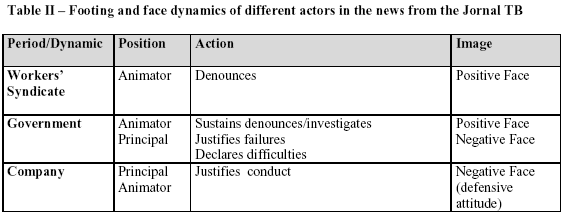
News analyzed from the Jornal JB, present an opposite posture to the one adopted by Jornal AT, and show a tendency to build a positive face for the Syndicate (Sindiquímica) and a negative face for the companies (Table II). Governmental voices show up in the text, preponderantly to give support to the several actors' images, the same way as it occurred at Jornal AT.
Workers hold the companies responsible, denouncing cases of leucopenia, revealing their fears and silencing about the disease, showing all the drama workers go through and calling for society mobilization (Cesat,1990; Interdição 1990, 1990a; Desequilíbrio, 1990; Debate, 1991). The companies, in defensive position, justify their assistance conduct and help clarify the disease, minimizing the toxic effects of benzene and of environmental contamination (Cesat, 1990; Pólo, 1990a; AL, 1990; Exame, 1990; Técnicos, 1991). The government in several articles (Familiares, 1990; DRT, 1990; 11 Operários, 1990; Cesat, 1990; Debate, 1991) informs about the risks and epidemic control, which had been denounced by the Syndicate (Sindiquímica); agrees with the suspicion of air contamination at the Petrochemical Complex; and announces an investigation on workers health (which would end up confirming the accusations made). From an animator position, the Regional Labor Organ (DRT) tries to save its own face which sometimes is threatened by the Jornal AT, as it admits that its can't adequately perform its supervisory task, for it is totally unstructured to deal with the "opponent to be supervised [and which] have a strong hold over financial powers and, not in very rare occasions, is able to evade fiscal charges…"(DRT, 1990).
]]> It is also possible to observe that the negative face of the company is built in the voice of the journalist (author), who declares that: the company was "paying for all the medical treatment of its employee (…), who acquired leukemia from exposition to benzene, a highly toxic product utilized in large scale in the company" (Familiares, 1990), suggesting that this was a confirmation that the worker had acquired the disease inside the company. And also interprets that "Certainly for this motive, the family of the operator working in the chemical process, avoids making any comments about his situation (…)." (Familiares, 1990, p.7), suggesting that they are afraid of losing the money paid by the company for his treatment, which is offered as good will from the company and not as his legal right.In this newspaper, the company's negative face is sustained by the Syndicate (Sindiquímica) while in the position of animator. The Labor Ministry Committee is also set as principal as they are the ones to decide what to do in relation to the interdiction recommended by the Regional Labor Organ (DRT) and the demissions threat by the company (Interdição, 1990). The companies provide many specialists to orient and establish an environmental control system, to elucidate on the "benzene evil" and inform the general public about leucopenia (Suspeita, 1990). At the same time, the newspaper opens up space for companies to save their face by announcing investments of US$ 2 million for pollution control and employees' health programs, but it also calls attention to the fact that the companies are involved in the benzene contamination question (Nitrocarbono, 1991). So, even with the company's argument to preserve their image, the investments made on environmental control are shown in this newspaper, only as a reaction to syndicate's pressure (Dia, 1991). The existing conflict between workers and the companies is clearly expressed in the Jornal TB. Tension is present in the threats and face saving of the actors. At times the companies and at others the workers align in the position of news animator, until an agreement comes as a solution.
3.3. Faces in conflict of a criminal epidemic
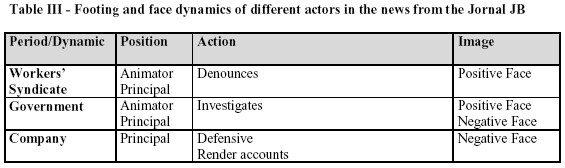
News analysis in the Jornal da Bahia, presents opponent strengths in conflict, and sustains the meaning of a criminal epidemic, and faces are shown predominantly in opposition (Table III). On one of the sides, the workers (called "hand laborers" in a diminishing way) struggle and denounce the criminal actions of the Petrochemical companies. On the other side, the "criminal" companies defend themselves. The emphasis given by the newspaper is in the building of a negative face for the company, which is sustained by the voice of the workers' syndicate (positive face) and the voice of the government. The workers denounce the demissions that are going on, the new cases of leucopenia and the sick workers life dramas (Ferreira, 1990; 4 Envenenados, 1991). They accuse the company of withholding information, divulge the national campaign to combat the abusive use of benzene (Peão, 1991; Peão, 1991a) and confront the employers (Peão, 1991b). The government representatives investigate the facts, explain the doctor's death report (Ferreira, 1990), disclose evaluation results, present medical doctors reports and the actions already taken (Nitrrocarbono, 1991a). The companies rarely show up in the journalistic texts, and when they do it is in a defensive position, to clarify the deceased doctors' working conditions (Ferreira, 1990). They also declare that they have no interest in maintaining at work the ones which are sick (No Pólo, 1991).
The Syndicate (Sindiquímica) and the Regional Labor Organ (DRT), both in the position of animators, in dialogue, sustain the negative face of the company responsible for the diseases, and for criminally withholding information from workers (Ferreira, 1990). The Regional Labor Organ (DRT) sustains a negative face for the company and a positive face for the Syndicate (Sindiquímica), admitting that the other worker, victim of leukemia, "even though did not directly work with benzene (…) might have been a victim of the same process which victimized the medical doctor (...)" (Ferreira, 1990). The negative face of the company is also sustained in the argument made by the Syndicate's biologist over the medical report from the INAMPS (Governmental Social Security and Heath Assistance Organ) by affirming "The clinical and laboratorial results of the patient is compatible with mielotoxic medullar lesion". Therefore the company is considered negligent and to be eluding the workers family with promises of possible treatment. The newspaper puts in evidence the conflict between the employers' declarations and the specialists reports (Ferreira, 1990).
The company seems embarrassed by the newspaper when this one publishes the Regional Labor Organ's notification determining the compulsory leave of 22 workers from the company (Lima, 1990). With the voices of the Syndicate and the Regional Labor Organ (DRT), the journalist (author) puts the company in a position of having to give explanations as to what measures have been taken by them. It also leads the government to propose or impose control measures or shows the government partaking to the company. For example, under the heading Polo throws sick workers out in the street in its front page and At the Polo, boss shows deplorable attitude with employees (No Pólo,1991), the newspaper informs the demission of 400 sick workers from one company within the period of one month, suggesting that the Social Security Organ (through its Medical Evaluation for Demission area) is co-responsible for these demissions. Emphasizing the negative face of the companies, the newspaper amplifies the assertion of criminal actions in other industries, metallurgic companies now, as their workers' Syndicate inform on leucopenia cases by exposition to ionizing radiation inside another company (Radiação, 1991). This company tries to defend itself and affirms that the equipment installed, possible originator of the disease, is one the community should be proud to have.
With the intent of embarrassing the companies, the newspaper declares that Nitrocarbono is guilty for the deaths and cases of leucopenia, reaffirming its negative face based on a Public Ministry (MP) environmental legal action against the company (Nitrocarbono, 1991a). Workers' positive face is built by the rhetoric title of the article Hand labor struggles against the evil of benzene (Peão, 1991), an article that helps divulgate the campaign against the abusive use of benzene and brings the theme into a national level debate. The journalist thus dislocates the focus from the news to the victim, the worker, in a market that stigmatizes the sick and the dismissed. Even though the working environment has not undergone any change, and the promises of governmental organs have not been accomplished, and the working market is unfavorable towards any syndicate struggle, the journalist sustains the positive face of the Syndicate (Sindiquímica). In its last news, published in 1991, it informs that it intends to move all possible judicial actions against the companies, demanding changes in the working environment (Peão, 1991b).
The newspaper, this way, builds the companies' criminal face. It is based on denouncements, made by an active syndicate, about the lack of assistance to the sick workers and to the ones that are dismissed. All of this happens in the turmoil and conflict between companies and workers.
3.4. Docile faces in a natural epidemic
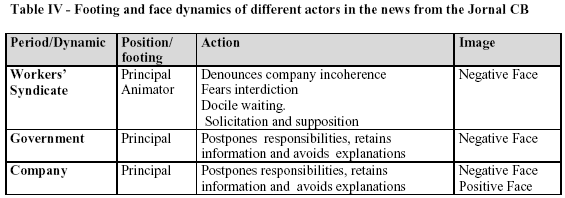
At the Jornal CB the companies initially find space for the construction of a positive face, while maintaining for workers and government the negative face (Table IV). Veracity of the epidemic is questioned (Ministério, 1990), with the argument that although this might be possible, due to the natural ware of the equipments, there is small possibility of it being an epidemic case (Rangel-S, 2003).
]]> The controversy established as to the parameters used, for case diagnosis and environmental evaluation, are arguments to minimize the problems' gravity. Even so, the companies are shown establishing compromises and making efforts to overcome the problem as well as investing financial resources for environment preservation (Nitrocarbono, 1991b). The existing conflict between workers and the companies is euphemized in this newspaper, generating the image of generous companies, on one hand and, of docile workers on the other.The workers, even though denouncing the existing companies incoherence and criticizing the government, are show in this journal with enhanced fragility: they fear intervention (Ministry, 1990), and patiently wait for a deal to assure working stability (Sindiquímica, 1990), and accepting spontaneous maintenance recess period (DRT, 1990a), as an alternative to governmental interdiction (Ministério, 1990). Even so, eventually the newspaper shows workers protesting, even if based on suppositions as the following one: "the workers would be with leucopenia provoked by benzene" (Operários, 1990). Such protest is directed indistinctly to company and government which are aligned as principal in the news and responsible for workers manifestation (as dealt in the article). This way, company and government postpone responsibility, hold back information and avoid any explanations, while the Syndicate (Sindiquímica) is placed in a docile and waiting position, presenting solicitations and suppositions, in order to obtain clarification on the causes of the contaminations.
The company tries to save its face, from threats received in direct speech (author), through a company paid article signed by its president (Nitrocarbono, 1990) defending itself from the newspaper stated accusations, and acknowledging that the company works with benzene, a product already well known for its risk potential. He re-affirms the practice of "adequate measures of environmental monitoring" and of being conscious of the possibility of emission of residues into the atmosphere which determine health risk. But also argues that this is relative, since the company undergoes "rigorous program of periodical exams", and questions information given by the Syndicate (Sindiquímica) and by the press. The company's president also informs that the company uses "highly specialize institutions" to re-evaluate their own exams, and says the company is open to dialog and is making all efforts for improvements and that it is "conscious of the importance of men and of the environment, harmoniously integrated for economical development" (Idem).
The journalist acknowledges the epidemic veracity, based on the Regional Labor Organ (DRT) report, by affirming that the company's equipments conditions caused the death of an employee (DRT, 1990a). The rejection on part of the company for a spontaneous maintenance recess, as well as its rejection of the laboratorial test results presented (the company choose the laboratory), as voiced by the Regional Labor Organ (DRT) and the Syndicate (Sindiquímica), are elements used to build its negative face. The newspaper, however, rebates this by publishing several articles to reveal an industry actively involved with the health and safety protection of its employees.
The newspaper also softens the company's face when the journalist (author) threatens the Federal Government and the Syndicate's positive face, announcing that these and the State Government haven't been able to define company's intervention, while this last one contested that the occurred deaths were due to benzene contamination. By introducing the idea of a certain mystery for the public organs decisions in relation to the company, the newspaper suggests that something cannot be said, maybe because it may put in danger one of the parts involved: or the company can't be held responsible, or the government isn't convinced of that ones responsibility or, still, this one may not have sufficient power to reinforce decided measures. The stage is set therefore for the possibility of the company to save its face. The journalist's voice (author) becomes, once again, less affirmative and uses a more suggestive tone, when he says that " the operating benzene unit is suspected to have caused the employees' death (…)" (Ministério, 1990). The company involved with the occurrences, apparently redeemed, presents a preventionist and humanitarian discourse and affirms it applies part of its budget with environmental control, saving its face from the threats of the Syndicate and the Jornal JB (Nitrocarbono, 1991b). The conflict around the epidemic is then neutralized with the idea of a natural epidemic, of which little is know about the related diseases, and so the company can't be held responsible and , in fact, it is making investments for environmental control.
4. Final Considerations
The Symbolic Interactionism resource, especially using the analytical categories of voices, footing and face, have allowed this study to evidence how rich a journalistic text may be in revealing social struggles as they were built throughout the period of evaluation and risk control of an epidemic.
The rich debate embedded in the texts, as narrated by journalists, tell us of the history and the experiences of many individuals in our local society and express the reality at a given time.
The newspapers, in the footing game of the different speeches of participants, built diverse images for the public subjects: workers' syndicate, employers and government. At the Jornal AT the building of faces oscillate, but there is a predominance to threaten the Syndicates' (Sindiquímica) face and strategies to save the company's face. At the Jornal TB there are images in conflict, for the newspaper sustains a positive face for the Syndicate (Sindiquímica) and builds a negative face for the company. At the Jornal JB there is a predominance of the negative face for the company, as it is held responsible for a criminal epidemic, while the Jornal CB makes moves to save the face of the company and build docile faces for the workers.
]]> The study shows that newspapers give visibility to social voices, building images with diversified meanings. Even though Jornal AT gives ample visibility to the voices of workers, it utilizes resources that minimize the content of their speeches. Presented as having active postures, the workers appear causing disorder and even damaging their own working category's interest. As a counterpart, the newspaper operates favoring the image of the Petrochemical Complex companies and weakening the role of Sanitary Heath authorities, emphasizing accusations of lack of interest of this organ in relation to workers' health. At Jornal JB, workers are presented as "hand labor" who struggle and courageously confront (positive face) the criminal actions of the companies (negative face), repeatedly broadcasted by the voices of workers and government. Jornal TB gave visibility to the voices of the three actors, emphasizing the Syndicate's (Sindiquímica) combative image towards safeguarding health conditions and its category's interest. It favored the negative faces of companies and government, both under the pressure of the workers, revealing the conflicts and the drama lived by these. Jornal CB gave larger visibility to the companies and allowed them to present a new face, by announcing measures for environmental control and the expressive investments they now had for safety and health.Analytical results, for faces, demonstrate that the media contributed towards the strengthening of some of the actors' public image, in detriment of others, and played an active part in the political struggle that took place at COPEC (Petrochemical Complex of Camaçari). This led to gains in better safety and health conditions for petrochemical workers. In this sense, this study also suggests that the plurality of communication media, covering the facts, was fundamental to take the debate to the general public, which then gained access to diversified ways for interpreting the epidemic, from the media itself as well as from all the actors which were sources of information. The existing differences may be explained by the social position of each one of the communication vehicles and their political and economical alliances, position from which they play their role of informing, according to the social group they are compromised with.
Bibliographic References
AZEVEDO, F.A. Breves Referências aos Aspectos Toxicológicos do Benzeno. Série Monografias FJS. Salvador. Fundação José Silveira, 1990. [ Links ]
BAKHTIN, M. Discourse in the Novel. In: The Dialogic Imagination, pp 259-300. University of Texas Press, 1981. [ Links ]
BRASIL Ministério do Trabalho. Acordo e Legislação sobre o Benzeno. São Paulo: FUNDACENTRO, 1996. [ Links ]
BROWN, P. & LEVINSON, S., Politeness: Some Universal in Language Usage. Cambridge: University Press, 1987. [ Links ]
DRT/MTb. Investigação de Benzenismo no Complexo Petroquímico de Camaçari (Ba): uma proposta de ação fiscalizadora. Salvador, 1991. [ Links ]
GOFFMAN, E. Ritual de la Interacción. Argentina: Editorial Tiempo Contemporaneo, 1970. [ Links ]
GOFFMAN, E. Footing. In E. Goffman (eds), Forms of Talk, pp. 124-159. Philadelphia: University of Pennsylvania Press, 1981. [ Links ]
MIRANDA, C. R.; DIAS, C. R. ; OLIVEIRA, L. C. C. ; PENA, P. Benzenismo no Complexo Petroquímico de Camaçari - BA. Revista Brasileira de Saúde Ocupacional. FUNDACENTRO, n0 89/90 - vol 24, 1990. [ Links ]
MOUILLAUD, M. Da forma ao sentido. In: MOUILLAUD, M. & PORTO, S. D. (org) O Jornal – da forma ao sentido, pp. 305-319. Brasília: Paralelo 15, 1997. [ Links ]
RANGEL-S., M. L. Epidemia, Narratividade e Produção de Sentidos na Mídia Impressa: o caso do benzenismo no COPEC, 1990-1991. Tese de Doutorado. Salvador, ISC/UFBA, 2001. [ Links ]
RANGEL-S, M. L. Epidemia e Mídia: sentidos construídos em narrativas jornalísticas. São Paulo, Saúde e Sociedade 12 (2): 5-17, jul-dez, 2003. [ Links ]
Newspapers Reference Citations
AL QUER RIGOR NA LEI DE E CONTROLE AMBIENTAL, ÍNDICE DE DOENÇA É ALTO. Tribuna da Bahia, Salvador, 22 de novembro de 1990. Caderno Cidade, p 3. [ Links ]
CAMPANHA CONTRA BENZENO VAI SER LANÇADA NA BAHIA. A Tarde, Salvador, 22 de junho de 1991. Caderno Geral, p 4. [ Links ]
CESAT INICIA EXAMES.Tribuna da Bahia, Salvador, 06 de novembro de 1990. Caderno Cidade, p 1. [ Links ]
DEBATE SOBRE BENZENO QUESTIONA OS MÉDICOS. Tribuna da Bahia, Salvador, 28 de setembro de 1991. Caderno Cidade, p 2. [ Links ]
DESEQUILÍBRIO ECOLÓGICO - CASOS DE CONTAMINAÇÃO CRESCEM NO PÓLO E ULTRAPASSAM OS LIMITES DE CAMAÇARI, NUMA SÉRIA AMEAÇA; SINDIQUÍMICA ACIONA CÂMARA. Tribuna da Bahia, Salvador, 08 de novembro de 1990. Caderno Cidade, p 1. [ Links ]
DIA DO MEIO AMBIENTE É LEMBRADO POR OPERÁRIOS. Tribuna da Bahia, Salvador, 04 de junho de 1991. Caderno Economia, p 6. [ Links ]
DRT NÃO TEM RECURSO PARA FISCALIZAR PÓLO; BENZENO ESPALHA EFEITO MORTÍFERO. Tribuna da Bahia, Salvador, 29 de setembro de 1990. Caderno Cidade, p 2. [ Links ]
DRT AMEAÇA INTERVIR NO PÓLO. Correio da Bahia, Salvador, 07 de novembro de 1990a. Caderno Aqui Salvador, p 1. [ Links ]
EXAME TENTA PROVAR CASO DE LEUCOPENIA. EMPRESA INSTALA PROGRAMA. Tribuna da Bahia, Salvador, 18 de dezembro de 1990. Caderno Cidade, p 1. [ Links ]
FAMILIARES NADA FALAM SOBREVÍTIMA NO POLO. . Tribuna da Bahia, Salvador, 24 de setembro de 1990. Caderno Cidade, p 7. [ Links ]
FERREIRA, E. Nitrocarbono: operário contrai leucemia e empresa sonega informação. Jornal da Bahia, Salvador, 25 de setembro de 1990. Caderno Geral, p 2. [ Links ]
FUNCIONÁRIOS DA NITROCARBONO SOB AMEAÇA DE INTOXICAÇÃO. Salvador, A Tarde, 27 de outubro de 1990. [ Links ]
INSPEÇÃO AVALIA A SAÚDE DOS EMPREGADOS DA NITROCARBONO. Salvador, A Tarde, 28 de julho de 1990. [ Links ]
INTERDIÇÃO NO PÓLO TERÁ DECISÃO HOJE. Tribuna da Bahia, Salvador, 12 de novembro de 1990. Caderno Manchete, p 1. [ Links ]
INTERDIÇÃO NA NITROCARBONO É DEFINIDA HOJE. . Tribuna da Bahia, Salvador, 12 de novembro de 1990a. Caderno Cidade, p 8. [ Links ]
LIMA, T. Caso Nitrocarbono: Reunião na DRT discute uso do benzeno. Determinou-se que os 22 empregados que podem estar contaminados pelo produto serão submetidos a estudo clínico rigoroso custeado pela Nitrocarbono. Jornal da Bahia, Salvador, 01 de novembro de 1990, Caderno Cidade, p 5. [ Links ]
MACHADO, S; VARJÃO, S; CASTOR, E. Contaminação obriga a exame geral no Pólo Salvador, A Tarde, 02 de novembro de 1990. Caderno Manchete, p.01. [ Links ]
MACHADO, S; VARJÃO, S; CASTOR, E. Todos os operários do pólo serão examinados. A Tarde, Salvador, 02 de novembro de 1990a. Caderno Geral, p 3. [ Links ]
MINISTÉRIO AVALIA A CONTAMINAÇÃO. Correio da Bahia, Salvador, 13 de novembro de 1990. Caderno Aqui Salvador, p 1. [ Links ]
MINISTÉRIO DO TRABALHO ANUNCIA HOJE DECISÃO SOBRE NITROCARBONO. A Tarde, Salvador, 13 de novembro de 1990a. Caderno Geral, p 3. [ Links ]
MORTE DE MÉDICO PODE LEVAR EMPRESA À JUSTIÇA; Salvador, A Tarde, 25 de julho de 1990. [ Links ]
NITROCARBONO MODIFICA POSTURA. A Tarde, Salvador, 05 de junho de 1991. Caderno Geral, p 4. [ Links ]
NITROCARBONO É CULPADA. Jornal da Bahia, Salvador, 06 de junho de 1991a. Caderno Cidade, p 5. [ Links ]
NITROCARBONO INVESTE CONTRA A POLUIÇÃO. Tribuna da Bahia, Salvador, 10 de janeiro de 1991. Caderno Cidade, p 2. [ Links ]
NITROCARBONO S.A - NOTA DE ESCLARECIMENTO AO PÚBLICO. Correio da Bahia, Salvador, 01 de novembro de 1990. Caderno Economia, p 9. [ Links ]
NITROCARBONO VAI ACABAR COM A EMISSÃO DE GASES. Correio da Bahia, Salvador, 05 de junho de 1991b. Caderno Aqui Salvador, p 2. [ Links ]
NO PÓLO, PATRÃO METE BRONCA NOS EMPREGADOS. Jornal da Bahia, Salvador, 04 de julho de 1991. Caderno Cidade, p 6. [ Links ]
Mailing address:
Rua Visconde de Itaboraí 628, apartment 303, Amaralina.
Salvador, Bahia. ZIP CODE: 41900-000.
Telephone: (55) 71-3263-7433; 71-3240-1916; 71-9105-6834 ]]>
E-mail: lirangel@ufba.br
1 Brazilian Legislation considered, at that time, that the limit of up to 8ppm for environmental benzene concentration was tolerable, as shown in Figure1, Attachment 11, NR 15, Legislation 3214/88, although numerous studies already showed chromosomal aberrations and carcinogeneticitity for people exposed to concentrations of 1 ppm (DRT, 1991). Legislation 14 dated Dec. 20th, 1995, alters the Attachment 13 , NR 15, Legislation 3214/78, creating new parameter for environmental evaluation – Technological Reference Value (VRT), determined at 1,0 ppm, which does not exclude the health risk as the previous LT (Brazil, 1996).
Attachment
]]>
]]>
 ]]>
]]>