
Table 1 - Click here to enlarge
Dinâmica do capital e sistemas locais de saúde: em busca de uma análise integradora do setor saúde.
Dinamica del capital y sistemas locales de salud: en búsqueda de un análisis integrador del sector salud
Maria de Fátima Siliansky de AndreazziI; Marco Antonio Ratzsch de AndreazziII; Diana Maul de CarvalhoIII
IDoutora em Saúde Coletiva; Profa. Adjunta do Departamento de Medicina Preventiva da Faculdade de Medicina da UFRJ. End: Rua Esteves Jr. 30, apto. 102. Rio de Janeiro, RJ. Tel: 25989282; e-mail: siliansky@nesc.ufrj.br
IIDoutorando de Saúde Coletiva da ENSP/FIOCRUZ; Pesquisador do Departamento de Indicadores Sociais do IBGE. Assessor Técnico da Secretaria Municipal de Saúde de Itaguaí/RJ. End: Rua Esteves Jr. 30, apto. 102. Rio de Janeiro, RJ. Tel: 22651154; e-mail: mandreazzi@terra.com.br ]]>
IIIDoutora em Saúde Coletiva; Profa. Associada do Departamento de Medicina Preventiva da Faculdade de Medicina da UFRJ. Tel: 25989282; e-mail: diana@cives.ufrj.br
Translated by Maria de Fátima Siliansky de Andreazzi, Marco Antonio Ratzsch de Andreazzi and Diana Maul de Carvalho
Translation from Interface - Comunicação, Saúde, Educação, Botucatu, v.10, n.19, p.43-58, Jan./June 2006.
ABSTRACT
The article presents a proposal of a methodology aimed to analyze the health care sector according to the dynamics of capital accumulation. That approach could be summed up to more traditional approaches founded in the Public Health field, based in a political perspective. The proposal departs from concepts and methods of Industrial Organization, already used for health care markets, in the European and Latin-American (CEPAL) contexts. We aggregated economic and historical variables to these approaches, which delimitate possibilities and impose constraints to the strategies of the local agents. The objective of the paper is to give methodological support to public managers at state and local level, whose role as the single commander in their territories is prescribed by the present health policy in Brazil. That includes all the fields related to private sector regulation in health: from planning the supply to quality control of providers.
KEY-WORDS: Health care; Regulation; Health Economics; Public-private mix; Markets in Health.
RESUMO
]]> O artigo apresenta uma proposta metodológica direcionada à análise dos determinantes da oferta de atenção à saúde a partir da dinâmica da acumulação de capital a ser agregada aos elementos de definição das políticas de saúde mais convencionalmente empregados na área da Saúde Coletiva. A análise está baseada nos conceitos e métodos da Economia Industrial, já testados para o setor saúde em trabalhos desenvolvidos no âmbito europeu e por pesquisadores da CEPAL, aos quais se propõe agregar variáveis do contexto geral que condicionam possibilidades e impõem limites as estratégias dos agentes locais e análises de corte histórico que permitam identificar rugosidades. Visa apoiar os gestores do SUS estaduais e municipais na sua atribuição de comando único do setor saúde sobre um determinado território, o que inclui o conjunto das possibilidades de regulação do setor privado – do planejamento da oferta ao controle de qualidade.PALAVRAS-CHAVES: Serviços de saúde; Regulação; Economia Política da Saúde; Relações público-privadas; Mercados de saúde.
RESUMEN
El artículo presenta una propuesta metodológica cuyo objetivo es analizar los determinantes de la oferta de atención a la salud a partir de la dinámica de acumulación del capital, a ser añadida a los elementos más tradicionales de evaluación de las políticas de salud utilizados en el campo de la Salud Publica. El análisis esta asentado en los conceptos y métodos de da Economía Industrial, probados para el sector salud en trabajos ya desarrollados en el ámbito europeo y de la CEPAL, a los cuales se propone agregar variables del contexto socio-económico-político general. Estas variables abren posibilidades e imponen límites a las estrategias de los agentes locales. Estudios históricos que permitan identificar rugosidades, de acuerdo con el planteamiento de Milton Santos, también son aportes importantes. El trabajo se propone apoyar los gestores del Sistema Único de Salud de niveles estadual y municipal en su rol de comando único de la salud de un territorio. Esto incluye el conjunto de las posibilidades de efectuar la regulación del sector salud: desde la planificación de la oferta hasta el control de la calidad de los proveedores.
PALAbRAS CLAVE: servicios de salud. economia de la salud. SUS (BR).
INTRODUCTION
Analysis of health services supply is a decisive component of health planning. With the implantation of the Unified National Health System, in Brazil, that stimulates an ample process of decentralization in the country, regional and local instances of government and Health Councils that include organized civil society members have been ever more engaged on the proposals and follow-up of Health Plans, in accordance with the guiding lines of the NOB-96 and the NOAS-01/02. One of the chief characteristics of the Brazilian health system is the interpenetration of public and private interests, both in the financing and the delivery of health services. However, it has been usual to analyze these instances separately. In general, the state and local health systems have restricted their control of the private sector to the proceedings financed through the public health funds to complement public health services supply, aiming at adequate coverage. This, in spite of the more inclusive responsibilities of the State that include the private health sector in its totality, as, for example, in the guarantee of the quality of services, the strategy of incorporation and dissemination of technologies and medicine and health materials consumption. The process of regulation of the so called supplemental health attention, that is, those proceedings provided through private health insurance has been assumed in Brazil by a specific federal regulation agency. This agency has acted mainly through direct action on the subjects of its regulation throughout the country, in contrast to all the legislation of the health sector that, after the 1988 Constitution, points to the integration between the federal, state and municipal levels and the reinforcement of municipalities as the main managing instance of the health services. This agency has assumed some actions that were widely discussed in the process of the Brazilian sanitary reform of the 1980s, as being more effective when developed at the local level, as is the case of quality control of health services delivery and the guarantee of universal access, through the development of loci of social control on the Health Councils.
In Brazil, little is known about the impacts of the growing private insurance as an alternative of financing for almost 25% of the total population (this can be as high as 50% in some metropolitan areas)on the Unified Health System. Some of the impacts have been known for a long time, such as the double militancy of health professionals deviating demand from and reducing working time at public institutions, or, providing a differentiated access to some high cost exams and procedures as hemodialysis, prothesis, among others. The frequent crossing-over between the public and private systems claims for politics and methodologies that consider the problem in an inclusive and integrated manner.
]]> This article proposes to contribute to the development of methodologies that allow a systemic understanding of the structure and dynamics of the health services, in a perspective that contemplates public policies not only as motor forces of its development, but also as what we will understand as the dynamics of the capital. This dynamics will be studied through the general structural trends of accumulation of the capitalist society, as well as through the more specific intra-sectorial processes of competition.It matters for the policy makers (the controllers of the health sector and the agents of the social control), to know the structure of the market and the nature of the competitive processes that occur among the producers of services and how it changes in time and the economic conditionings of such changes, as well as the more general social and political ones. That is, its dynamics. The decisions that are taken within the health sector, that conforms it and establishes the standards of practice and health consumption, that have impact on the health situation of the people, do not occur only in the public sphere, mediated by the State. It may not even occur mainly in this sphere. Although the dynamics of the markets of insurance and services should be taken in consideration by public managers, including at the local level, this is seldom done or not done at all, and, when attempted, is frequently based on empirical premises. Many areas that constitute the routine work of public health institutions lack the conceptual elements to establish their politics, in all the geographic and functional levels of the system as, for example, the sanitary monitoring, the delivery of healthcare and the development of human resources.
It is not enough to have the administrative description of the facilities with its respective institutional arrangements, and indicators of production, coverage and results. What is intended here is to develop an answering dimension of healthcare supply that can forge each configuration with its distinct results, with trends expected from the development of determinant variables and with the possibility of public regulation of these variables. Also, we aim to identify the market structures and dynamics that can be better adjusted, which implies in different public policies that favor one or another economic agent. And also, that evaluates where market elements should be valued and where it would be better if they were suppressed.
It has been noticed, since the 1990s, an increasing interest of international organizations, as the World Health Organization, in the development of public-private partnerships for the reach of health goals (RIDLEY, R.G. 2001). Many strategies have been presented by MILLS et alli (2002), and they conclude for the necessity of a better understanding of the behavior of the private providers in order to better influence them. Experiences in this direction have been promoted and evaluated for the control of transmissible diseases (NEWEL et alli, 2004) and, less frequently, of non-transmissible diseases (NISHTAR, 2004). This work aims to collaborate in the identification of areas of cooperation and areas of conflict in public-private relations, and, consequently, where the partnership strategies are possible and desirable and where they are only reached with a reasonable resignation of the public interest.
METHODOLOGICAL STRATEGY
Two approaches will be presented here. The first one is that of MOSSIAOLOS and THOMPSON (2002), from the European Observatory of Health Systems and the other by JORGE KATZ, in association with MUNOZ (1988) and MIRANDA (1994).
The first was adapted from the classic Industrial Economy model developed by Bain, in 1956: "Traditionally, the performance of the firms is influenced by its behavior, which in turn is determined for the structural characteristics of the market. Our model does not imply a necessarily causal relation between these three elements… but it examines its interactions" (MOSSAIOLOS and THOMPSON, 2002:22).
The authors introduce in this classical model a fourth element related to the rules where the others operate. Here we will examine the characteristics and variables, concerning the healthcare system, in each of these elements. Such understanding implies complementing the traditional analysis, said to be ‘static' (structure-performance-result) with another one, of a dynamic character. This last type is centered in the decision process of the agents. In this static-dynamic approach the existing relations between general laws and particularities are not of a mechanical determinism, making possible an action that overcomes the restrictions of the structure and modifies them (HAY and MORRIS, 1991).
Public Policy - the laws, norms and regulations that, in this specific case, include:
]]>- Existing systems of rights and healthcare coverage;
- Tax incentives to demand and supply;
- Operation norms related to the private services.
Structure –refers to the environment where the markets operate. Relevant variables are:
- Products;
- Number and type of the units of production;
- Barriers to entry in the market;
- Characteristics of the demand
]]> - Asymmetry of information, that means the degree in which the information is shared between the providers and costumers.
Behavior - It is analyzed in terms of the strategies of the agents. The authors point as important:
- Price-making;
- Development and differentiation of the products;
- Other competitive strategies (the existence of risk selection, for example).
Performance - the results in terms of covering, efficiency and profitability of the units of production. It also concerns with the most general characteristics of the health system, such as equity. The related variables are:
- Levels of covering;
- Prices;
]]> - Costs and profitability;- Interrelationships between the public and the private sector
- Equity.
KATZ and MUNOZ (1988) point out that, in the health sector, we can identify not only one, but three great markets, whose isolated functioning and relationship would determine the sector behavior: the market of medical services, hospital services and drugs. We could add two other markets, that of biomedical equipment and of private health insurance. Nonetheless, we cannot establish a rigid cutoff between what is public or private. The relative weight of each one being an endogenous resultant of the system; of the functioning of competition inside and between each of the markets and their interdependence.
According to this work, the morphology of the health markets would have as its general determinants:
- Conditions of entry of new suppliers;
- Nature of the technological change, if capital or labor-intensive, with a qualified workforce or not;
- Organization of the suppliers;
- State regulation of the market;
]]> - Process of capital accumulation
It is important to remember that we are dealing, simultaneously, with elements that belong to the social macrostructure, as the accumulation of capital, and to medium and micro-structures, such as the specific strategies of economic agents in a territory and/or particular market. Between these levels of analysis, necessary mediations exist. The main one would be, for POSSAS (1989), the competition, connector link between the specific dynamics of the individual capitals searching valuation and the most general trends of the accumulation of capital. At the present time, this trend is distinguished as financial globalization. Competition would be defined, in the classic-Marxist tradition, followed by this author, as the permanent dispute between producers/sellers for the survival in the market, more than for the largest possible profit. According to this author, Marx would understand competition… " as the reciprocal action that capitals exert between themselves when they confront in all contexts where the markets are present"… (POSSAS, 1989:56). In these contexts, is included the state power.
POSSAS (1989: 117-118), still, points that, … " the competition presents necessarily sectorial specificities – at the technological level and at the characteristics of the insertion of the product in the productive structure; and at the demand too"…" These appear as a process (competitive) of rupture of the" competitive structure" usually established through the introduction of technological innovations, products, new markets, or the centralization of existing capitals…
If in Marx, the competition would be located at the base of the process of accumulation of capital, more specifically on concentration and centralization processes (one of the laws of movement of capitalism),…" from there also its internal logic could be extracted -…" process of formation and dissolution/consolidation of comparative advantages and monopolistic positions"…(POSSAS, 1989: 71).
Possas, still, evaluates, from Shumpeter, that substantial changes in the forms of capitalist competition have occurred:
- Increasing concentration;
- Generalized growth of barriers of entry;
- Greater rigidity of prices and profit margins to the fall of the demand of oligopolistic sectors;
- New forms of organization of the units of capital;
]]> - New forms of competition - product differentiation, control and commercialization, innovations of processes and products;- New forms (financial) of valuation of the capital;
- …" new historical-structural dimensions derived from the concentration process and centralization of capitals, that when generating the big company as the new form of management of the private accumulation of capital, gave place at the same time to the relative autonomy of the financial capital, in one side, and to the economic interpenetration of the State, in another side"… (POSSAS, 1989:171).
Another mediation is situated in the field of politics. It is related to the political actors' strategies in using the State power in accordance with their interests, as well as in imposing their will, at the civil society level.
A third element to consider for the explanation of the healthcare supply configuration is its history, that is, how the changes in the health sector dynamics take place in time, aiming to identify the elements of continuity of a previous mode. A useful concept to understand the supply pattern in a considered territory is used by SANTOS (1986). It is about the concept of ‘rugosity'. According to the author, "rugosities" are the remaining portions or fixed space forms of a previous mode of production, that remain as a constructed space, in things settled in the created landscape. Thus, when a new mode of production replaces the one that is ending, it finds preexisting forms to which it must adapt itself to be able to be determinant. Among those, we can consider constructions, installations, transport and communication structures, and even human resources, besides the relations and flows of dependence and/or reference. Such factors would act as existing " rugosities" or pre-existing forms that would influence in the local materialization of the new processes of production.
ANALYSIS OF HEALTH SERVICES SUPPLY
The present proposal intends to establish parameters that indicate health sector dynamics characteristics, including capital accumulation. The objective is to carry out actual analysis of the healthcare supply and its determinants.
1. General context – The purpose is to identify the variables of the general context that put limits to the local dynamics. They are signals that point to expected behaviors of the economic agents and political actors. These signals counteract the existence of contrary strategies, either through competition or State policies. As it is not the focus of this work to look deeper into these signals of the economic and political environment, we point out, as illustration, those considered most relevant in the current conjuncture. Better details can be seen in ANDREAZZI (2002).
]]> a) The financial globalization - This would cause the shift of capitals from the productive to the financial sphere. This process is also fed with the public debt speculation in the secondary markets of values that is a frequent companion of the financial strangulation of the States (CHESNAIS, 1998). It has caused, in the context of globalization, a notable capital concentration, under the command of the central countries. The large companies, besides counting on a strong financial area - traditional banks or new financial institutions - are concentrated in the most strategic aspects of production - technology, product design - decentralizing its assembly and sales. This has produced a certain "vertical disintegration". DUPAS (1999) identifies that, in this new dynamics of the capitalist system, it would be more difficult to establish clear borders between industry, services in general and financial services. The financial product named "insurance' for example, also becomes supplied by great industrial corporations (in the origin).b) The increasing importance of the services as a space of accumulation of capital - this pressures the transformation of the earlier non profit sectors into profit ones. There is a consequent trend to contracting out many parts of the production process of public and private institutions, and to privatization
2. Specific context of the health sector- In the case of Brazil, the general context reverberates in the health sector, since, at least, the 1990s, through an important financial strangulation of the State and changes in the configuration of the public-private mix. The private health sector was the preferential customer of the State, in the 1960s and through the 1980s. After that, it starts to compete for the leadership of the health care sector dynamics through an expansion of the demand for private health insurance and of the private health expenses and the outside capital influx in the market of health services. Such trends are verified by the formation of investment funds for acquisition of health services with the participation of pension funds and mutual funds where international capital can also be identified.
3. Analysis of local cases - health services constitute an extremely differentiated sector. This imposes the need to identify different sub sectors (public and market) that will be the object of analysis. The technological change, that explains this differentiation, has been intense. Pari passu with the industrial changes in the production of pharmaceuticals and medical equipments that has occurred in the world since the 1950s, medical practice also has changed. It becomes evermore instrumental to the realization of the merchandises produced by the industrial sector. The delimitation, therefore, of the sector for analysis becomes the first step for the application of the proposed methodology. A useful partition would depart from the substitutive character of supplied products, making it possible to separate the medical and hospital market from the dental and nursing home care market, that constitute sectors with sufficiently specific technological characteristics and a unique history and norms of regulation. The so called alternative medicine would have a larger interchangeability with the official medicine, for in some situations, it functions, much more, with an additive character than a substitutive one. The common technical basis of medical and hospital services is the western orthodox medical science. The physician, as organizer of the demand, is a link between the various equipment combinations, specialized manpower and technology. This means that with the exception of some drugs market, there is no spontaneous demand for the remaining markets such as hospital, laboratory, images, and so on. FIGUERAS (1991) affirms that health is a multiproduct industry, subject to be analyzed as the aggregate or each one of the parts, according to the interest of the study. It is possible to foresee a sufficiently great interchangeability between public and private services. One reason for this is the ethics of the health professions that do not allow differentiations in the techniques of care between equally needed individuals, from a technical point of view. By definition, the ethically allowed differences are limited to installations and other items of ‘comfort' that do not imply differences in the specific content of health interventions.
It is reasonably consensual that the market of health services has some specific characteristics, as:
a) Asymmetry of information - the consumers would have very little information relative to the suppliers: … "patients could accept, or even demand, treatments that they would not buy if completely informed, but that are advantageous, financially, for the medical professionals… (MUSGROVE, 1999:84). Or, for the industry.
b) Existence of externalities - many health activities, as preventive care and treatment of infectious diseases, cause benefits that surpass the specific consumer. This makes it difficult, many times, that the individual consumer be willing to pay for them, in the level which would be efficient, as for example, in the case of immunizations campaigns (MUSGROVE, 1999).
c) Presence of the third payer – that is the case of social or private insurance, where the consumer would not have, in the point of use, the classic budgetary restrictions of the direct purchase. This could lead him to consume more services than would be necessary for his well-being.
d) Presence of uncountable not-profit institutions that makes it necessary to identify objectives different from profit for the suppliers of health services. The work of FELDSTEIN (1988) about the objectives of the not-profit hospitals in the United States, that were the great majority until the decade of 1980, is well known. According to his conclusions, it was not the hospital profit maximization that occurred. Instead, a maximization behavior of the intern physicians in respect to their individual incomes could be perceived. Also, the accomplishment of the strategic interests of other economic agents who were part of the Administration Trustees Board of these institutions - entrepreneurs, representatives of the industries related to health, financial capital, under the form of insuring or investing banks, was present. All were interested, for diverse reasons, in technology based competition for product differentiation/innovation, in this case, with consequent costs inflation.
e) As a consequence of the above characteristics, some degree of induction of demand by supply.
]]> How would the activity of services accumulate capital? In the Marxist tradition, services are independent branches of industry in which the production and consumption occur at the same time. The exchange value is determined, as with the remaining merchandises, by the value of the elements of production, increased with the plus-value, created by the plus-work of the employed workers. This value is transferred, as added value, to the product. For GADREY (1996), such definition is not so different from the classic tradition, which considers an issue as service when the production is immaterial (perishable in the same instant of the production). Besides the plus-value originated from the plus-work, the services capitalist can obtain:a) Commercial profits – in negotiating factors of production and in the selling of services, depending on the market structures.
b) Financial profits.
Taking these structural characteristics of the healthcare markets, the local analysis proposed would contemplate:
I. An historical analysis of the constitution of the services in question, public as private. It is interesting to associate their cycles of expansion and decline to the contexts of change in the local modes and relations of production. And, also, to the political changes that favored or made it difficult to implant measures destined to benefit specific social classes; or favored the ascension to the State power of groups of interests looking for the expansion of their capital. The sources of this study could be written documents as well as oral history.
II. Analysis of the regulation - Norms applicable to the processes and products of the health services that originate from federal, state and municipal regulators. It is important to verify how they can affect the local structure of the services and the behavior of the agents. Examples are:
- Sanitary Regulations;
- Tax laws, which can favor some institutional designs;
- Codes of Ethics and self-regulation;
]]> - Norms of auditing.
An example of a check-list to inquire the process of regulation is as follows:
III. Analysis of structural variables:
a) Public and private demand - The main source will be population studies, including, when possible, private health insurance coverage.
b) Public and private expenses – They could be obtained from the Budgetary Act and public and private Accounts. Another source is the payment by the state to contractors, linked to the existence of contracting-out in the public sector, as is the case in Brazil. It is desirable to separate private expenses through insurance from fee-for service expenses.
c) Nature of the products and of the technological changes - Some important variables are:
]]> - The production factors and the relative weight of each one of them in the final composition of the products.- The presence of economies of scope and scale that favor bigger and centralized structures. Analyzing the technical nature of the medical services, we could find economies of scale. For the acquisition and maintenance of most biomedical equipment, a reasonable scale of functioning is needed to have competitive costs and prices. The administrative costs, that represent management costs mainly, can present economies of great numbers, until a certain point, when the size of the firm enlarges the costs. Commercial costs, considering the ethical restrictions of medical propaganda (as in Brazil) would not be very important. The role of the economies of scale in the performance of the suppliers can be evaluated through the comparison of selected indicators of results from different health facilities according to their sizes.
d) The number and types of facilities/firms – Public, private for profit and non-profit. It is important to consider that, different from the industry, proximity services such as those that provide healthcare have distinct features that imply the need for definition of relevant market areas, as in demographic terms as geographical ones. For FELDSTEIN (1988), this depends, basically, on the distance the patient has to cover to reach the service. In this sense, it is possible to speak of oligopolies and, even of local monopolies (including "natural"). That favors capital accumulation through multiple plants in the case of health services. This can be seen by the number and profile of facilities and human resources. This variable unfolds in market concentration analyses, that is, the market-share of the firms which can be related to procedures and performance. The information sources can be public (Facilities and Health Professionals Surveys, for example, in Brazil, Medical-Sanitary Assistance Research of the Brazilian Institute of Geography and Statistics - IBGE; National File of Health Facilities and other indicators of the Datasus Data Base; Data from the State and Municipal Secretaries of Health) as well as private (Professional Councils Files; Hospital Associations). Variables include from the building facilities and equipment to human resources. Important for the analysis of the concentration of health services are the mergers and acquisitions and the participation of international capital, especially for investment and financial capital. This is being observed in the area with the largest concentration of private health insurance beneficiaries, São Paulo, and is particularly evident in the clinical pathology market.
e) Barriers to entry and exit – That refers to the advantages secured by the already established firms over the newcomers. In the case of health services, it is fair to assume that the presence of increasing returns of scale of the investments, and the ever-rising capital requisites for the establishment of hospital facilities and even of ambulatory care of higher cost, impose restrictions on entry conditions. As a rule, one can observe:
- Absolute cost advantages of already established companies: through knowledge, access to financing and to other production factors.
- Existence of patents, franchising or other specific regulations.
- Advantages from consumer preferences – trademark.
- Relevant economy of scale – requiring significant capital for entry.
- Large minimum size relative to the demand, tending, in local markets, to the natural monopoly (situation in which the size of possible demand does not allow for the existence of more than one production unit with efficiency), which can be considered as a structural market characteristic.
]]> - Vertical integration (kind of diversification of the company or organization in which it expands within the chain of supply of production factors – the production itself – commercialization).
Requirements of a certain scale for entry have been reduced by the dissemination of contracting-out of whole sectors of health establishments. Equipment franchising by the goods industry has been a way to ease the fulfillment of the requirements of capital for entry. This industry, keeps the services provider chained to the exclusive use of his supplies, as a means of its own market fulfillment, which is a classical monopolist practice (KAHN 1988).
We also point out in this model, an aspect that we call financial. It refers to the presence of articulation mechanisms to the financial accumulation processes that have favored those providers or the institutional-juridical forms more integrated to this circuit, such as the integration with financial groups that allows for advantages in the access to capital and to credit.
IV Behavioral variables analysis – The purpose is to check the development and competition strategies of the agents, be they explicit in official documents, or perceived through the general mechanisms of management and differentiation of product. Relevant examples are:
a) Mechanisms of payment to professionals and services accredited to private health insurance;
b) Patterns of investment;
c) Types of political organization of producers and decision mechanisms;
d) Vertical integration, that is, the ways through which one of the components of the system seeks direct control over his supply market or the commercialization of the product. In the case of the health services, the degree of contracting-out of public services and the existence of medical companies with their own health care facilities are examples.
The relative importance of each strategy for the agents should be the subject of specific studies including:
]]> 1. The identification of the principal agents – public administrators with decision power; owners and managers of the most important companies.2. Identification of documents where may be found: the objectives and work plans of these agents.
3. Interviews to try to identify: a) their vision on their own strong and weak aspects, and those of their competitors; b) their perspective of development on short and middle run; c) their stand facing the regulations; d) how they plan to comply with the structural factors of the sector; e) how they reacted to changes in the local production relations and the strategies of their competitors, their suppliers and financial agents.
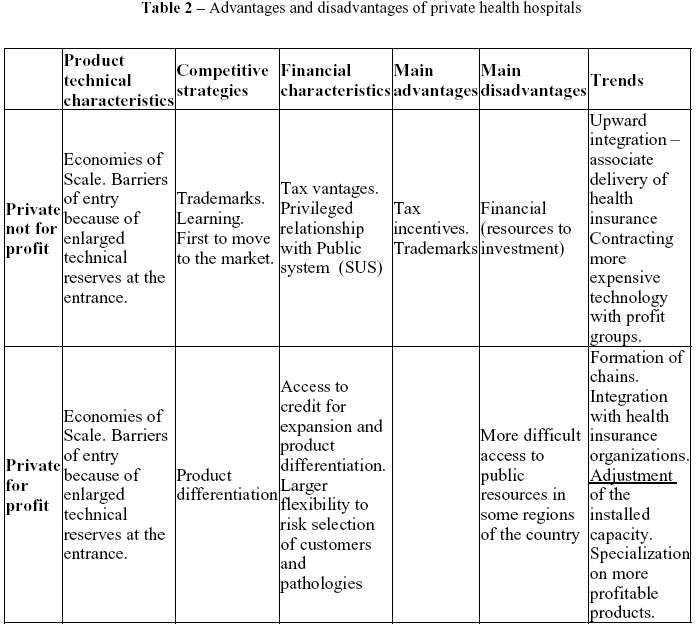
As an illustration, we present a Table from ANDREAZZI (2002) on which, based on structural and competitive characteristics of private hospitals in the 1990s in Brazil, the competitive advantages and disadvantages of each relevant juridical profile are analyzed:
V Analysis of performance variable – Performance variables represent a combination of traditional health services evaluation variables, referring to efficiency, efficacy and effectivity, aggregated to the results as to the functioning of the market: prices, costs, profit, coverage, equity, quality.
The most important challenge is to be able to associate these results with the elements: regulation, structure and conduct.
]]> The following diagram intends to be of help in this association exercise to make possible the next step – action. Participative planning techniques can be useful to build the association hypotheses.
From this exercise may emerge the identification of critical areas to be the object of government actions.
CONCLUSIONS
Recent works published in Brazil about our pattern of public-private articulation in the health services have converged to point out the consolidation of the single command of the local health authority over his territory. Included in the local scope definition are the technical feasibility and the economic scale that may eventually refer it to a state unit (NISIS, 2005). This includes quality control of the private services, be it financed by the Unified Health System (SUS) or by complementary sources (ANDREAZZI et alli, 2004). Besides keeping the more traditional functions of contracting private health services providers to complement the public health services (MATOS e POMPEU, 2003). We have pointed out that it is necessary to consider the vectors of the sector dynamics to assure the single command of the health sector in a given territory. We identified the private sector as highly heterogeneous, being formed by various sub-sectors, each with its own dynamics and articulation with other sectors and with variable capital densities. These characteristics place the producers in distinct classes and class fractions in the society, considering their role in the production, and having conflicting and even antagonist interests. Market structures are essential elements that inform the public administrators on the possibilities and difficulties of the regulatory actions. The rising presence of economies of scale in the process of production of health services and the fact that they constitute proximity services expand the chances of the existence of oligopolies or even local monopolies. This concentration generates structures with more power to impose prices and conducts and to exert greater pressure on the State. The global and national dynamics of capital accumulation is related to the dynamics of local health services market amplifying some possibilities and diminishing others. Today, "financialization" of capital favors the economic agents with easier access to capital and changes the objectives of the health care providers, who see the possibility of financial gains with their activity pressing the health care costs to society.
The comprehension, by the health managers, of this dynamics with its specificities due to local historical developments, in synergy with the social control instances, such as the methodology here presented proposes, can produce more effective actions, such as: regulatory reforms with the introduction of new rules; identification of oligopolies or monopolies refractory to public regulation, making it adequate to evaluate their incorporation by the public sector; identification of areas where the buying of services is possible, and of those where it is not to be recommended; changes in payment and introduction of monetary and non-monetary incentives; identification of areas where it is possible to further the collaboration between the public and private sectors; establishment of a hierarchy of health care providers as to the control system based on the quality risk of the products offered, starting with the competitive strategies that were identified.
This process demands an effort in capacitating and technical assistance to the health managers, opening a field for regular and effective collaboration between teaching and research institutions and those responsible for the health policies and programs in the area of economic studies of the organization of the health sector.
]]>BIBLIOGRAPHIC REFERENCES
ANDREAZZI,MFS et alli Mercado de Saúde Suplementar: amplitudes e limites na arena da regulação. In: MONTONE, J. e WERNECK C. AJ 2003 Supplemental Health Forum Technical Support Documents. Regulação e Saúde, vol. 3, Tome 1. Rio de Janeiro: Agência Nacional de Saúde Suplementar, 2004. p. 121-146. [ Links ]
ANDREAZZI, M.F.S. Teias e Tramas. Relações público-privadas no setor saúde brasileiro nos anos 90. 2002. Tese ( Doutorado) – Social Medicine Institute. UERJ, Rio de Janeiro. [ Links ]
CHESNAIS, F. A Mundialização Financeira: gênese, custos e riscos. Rio de Janeiro. Xamã, 1998. [ Links ]
DUPAS, G. Economia Global e Exclusão Social. Pobreza, Emprego, Estado e o Futuro do Capitalismo. São Paulo, Paz e Terra, 1999. [ Links ]
FELDSTEIN, P.J. Health Care Economics .New York, Delmar Publishers Inc. 1988 [ Links ]
FIGUERAS, A. J. Análisis del Mercado de la Salud (El caso argentino. La Plata: Económica, 37(1,2): 3-2, 1991. [ Links ]
HAY D and MORRIS DJ. Economics and Organization. Theory and Evidence. Cambridge: Oxford University Press; 1991. [ Links ]
KAHN, E. Indroduction: The Rationale of Regulation and the Proper Role of Economics. In: KAHN, E. The Economics of Regulation. Principles and Institutions. Vol. I. Cambridge, London, MIT Press, 1988. p. 1-19. [ Links ]
KATZ, J. E. e MUNOZ, A. Organización del Sector Salud: puja distributiva y equidad. Buenos Aires, CEPAL, 1988. [ Links ]
KATZ, J. E. e MIRANDA, R., E. Mercados de Salud: morfología, comportamiento y regulación. Revista de la CEPAL, vol. 54, p. 7-25, diciembre 1994 [ Links ]
MATOS, C.A. e POMPEU, J.C. Onde estão os contratos? Análise da relação entre os prestadores privados de serviços de saúde e o SUS. Ciênc. saúde coletiva, 2003, vol.8, no. 2, p.629-643. [ Links ]
MILLS, A., BRUGHA, R., HANSON, K. and MCPAKE, B. What can be done about the private sector in low-income countries? Bull World Health Organ. 80, n. 4, p.325-330, 2002. [ Links ]
MOSSIALOS, E. and THOMSON, S.M.S. Voluntary Health Insurance in the European Union: a critical assessment. Int. J. Health Serv, 32, n. 1, p.19-68, 2002. [ Links ]
MUSGROVE, P. Uma base conceitual para os papéis público e privado em saúde. In ANDREAZZI, M.F.S. e TURA, L.F.R. Financiamento e gestão do setor saúde: novos modelos. Rio de Janeiro, Editora Escola Anna Néry, 1999, p. 63-103. [ Links ]
NEWELL, J. N; PANDE, S. B; BARAL, S. C; BAM, D. S; MALLA, P. Control of tuberculosis in an urban setting in Nepal: public-private partnership. Bull World Health Organ;.vol. 82, n.2, p.:92-8, Feb 2004. [ Links ]
NISHTAR, S. The National Action Plan for the Prevention and Control of Non-communicable Diseases and Health Promotion in Pakistan--Prelude and finale. J Pak Med Assoc, vol. .54, n. 12 Suppl 3, p. :S1-8 Dec 2004. [ Links ]
NISIS – Núcleo de Investigação em Serviços e Sistemas de Saúde. Desafios para a Equidade em Saúde na Região Metropolitana de São Paulo In HEIMANN, L.S., IBÁÑEZ, L.C. e BARBOZA, R. (Org.) O público e o privado na saúde. São Paulo: Ed. HUCITEC /OPAS/ IDRC, 2005, p. 173-242. [ Links ]
POSSAS, M. Dinâmica e concorrência capitalista: uma interpretação a partir de Marx. São Paulo: Ed. HUCITEC, 1989. [ Links ]
RIDLEY, R.G. A role for public-private partnerships in controlling neglected diseases? Bull World Health Organ; 79, n.8, p 771-771, 2001. [ Links ]
SANTOS, M. Por Uma Geografia Nova, 3ª edição. São Paulo: HUCITEC, 1986. [ Links ]
Anexes
Table 1 - Click here to enlarge
 ]]>
]]>

Table 3 - Click here to enlarge