William Santos de Assis; Myriam Oliveira; Fábio Halmenschlager
Translated by Celina de Castro Frade
Translation from Estudos Sociedade e Agricultura, Rio de Janeiro, vol. 16 no. 2, p. 228-261, Outubro 2008.
ABSTRACT
This paper discusses the ongoing territorial dynamics and projects in the southeast region of Pará and also offers insights for regional development. In this region, governmental policies have been the main incentive for the current territorial dynamics but they were unable to boost the multiple functions of the family farm farming. In the case of the territorial development policies under analysis, one reason why this multi-functionality is be considered with incentives is due to its sector-biased policy application with an unequal involvement of the institutions related to the family farm or even due to the ignorance of other regional sectors and these policies' actors
]]> Key words: territorial dynamics - multi-functionality - family farm- public policies.
1. Introduction
The creation of the territory of Amazon agrarian frontiers has been historically characterized by complex processes of space occupation and environment exploration. This complexity, mainly related to the existence of a wide social diversity and a heterogeneous environment, both often submitted to pressing transformation processes, turn these agrarian frontier areas into extremely instigating spaces in terms of territorial dynamics. One of the most well-known of these agrarian frontier areas in eastern Amazon is the southeast mid-region of Pará. There, the family farm represents more than half of the occupied territory and is currently one of the main regional actors, particularly after land reform and the supportive policies of the family farm implemented by the federal government. However, in spite of the relevance in the region, this category has still been facing several constraints on its consolidation process making it difficult the fulfillment of certain functions attributed to it. How to maintain a social and cultural identity or to preserve the resources and the rural landscape, for instance, in a space where a relative instability of maintaining the ways of living and a quick changes give the pacing of dynamics?
Moreover, this instability is more relevance when considering the presence of multiple interests particularly in relation to the ownership and handling of natural resources and means of production, which gives room for a constant dispute over the consolidation of different collective projects.
This article discusses the current dynamics and territorial projects developing in the agrarian frontier of southeastern Pará with reference to the region of Marabá in the state of Pará. For the sake of adequacy and convention, all abbreviations and/or acronyms are presented as shortened and are purposefully inconsistent with the English full word or phrase they refer to.
2. Some features of the region of Marabá
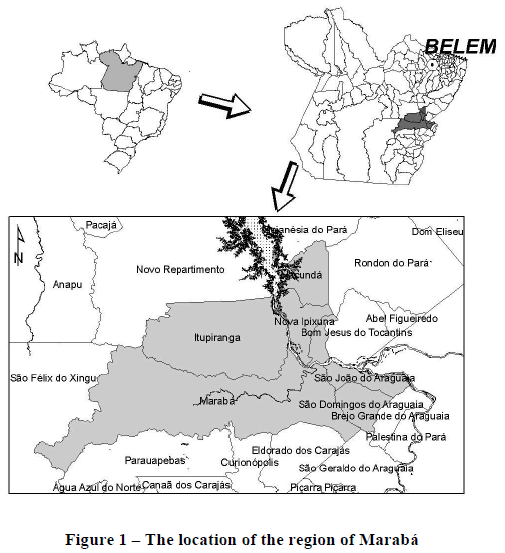
The region of Marabá includes a set of municipalities - Marabá, Itupiranga, Nova Ipixuna, Jacundá, São João do Araguaia and São Domingos do Araguaia- and has its name and constitution defined in terms of the sphere of action of Tocantins Socio-Agronomic Laboratory- Lasat1 (Figure 1). Even being an internal denomination, it is legitimate among local actors and its spatial delimitation is related to the territorial dynamics which happens in this part of the state. This region practically coincides with the delimitations proposed by the Territorial Development Secretariat (SDT, ) for the southeast territory of Pará.2
]]>
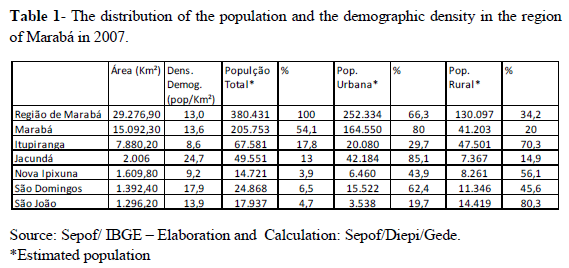
This region comprises an area of 29,276km2 and has a population of about 380,400 inhabitants. The most relevant reference in the area is the municipality of Marabá, located 500km far from Belém, which concentrates more than 50% of the total regional population; its privileged location along the banks of the Tocantins River and next to important roads (PA-150, Transamazônica and Belém-Brasília) confers it a strategic position. The demographic density is low and most of the population is concentrated in the urban areas though there are municipalities, such as Itupiranga and São João, where the rural population is quite high. (Table 1). In 2000, this region presented an average 0.657 rate of human development, which has increased substantially since 1991 when it was around 0.559.
One of the greatest specificities of the region is being part of an agrarian frontier area here defined as a new area which goes through movements of incorporating national economy and society and transforming itself into a new regional space whose biophysical and socioeconomic features created are hardly reversible (MONBEIG, 1966 apud ALBALADEJO; TULLET, 1996). As well as the other Amazon frontiers, the southeast agrarian frontier of Pará comprises a vast extension (still in a process of westbound expansion) and has a quite fast pacing transformation giving it new features.
]]> This dynamism in the process of space transformation and the wide diversity of the local society are just the most remarkable features of the region of Marabá.Although only recently has it got a bigger projection, it has been long since this area in the region of Marabá stands out in the national scenario. Between the end of the 19th century and mid-20th century, the region became well-known for being one of the main suppliers of extractive products, such as caucho (latex-producer tree), Brazil nuts, animal fur, diamonds and rock crystals for the internal market and mainly for the external market. The economic cycles established by the exploration of these products were important in the process of occupation and in the formation of the region's social and agrarian structure. From the Brazil nut cycle on, the longest and the most important one,3 for example, the local oligarchy was consolidated and the large landed estates were constituted which for years characterized this area and which, later on, worked as the center of the many conflicts which occurred there (EMMI, 1999).
Even having had some dynamics in the regional occupation during the economic cycles, it was only after the mid-60s that this process really started to grow reaching its climax in the following two decades. In the 60s, under an economic-political context in which the State's main goal was to "incorporate" Amazon to the national space and to promote its economic growth, the military government started to operate strongly in the region through developmental policies and important institutional and territorial strategies creating a quite active scenario of changes in local dynamics.
One of the main consequences of these government's actions was the intense migratory flow to the region between the 70s and the 80s. In this process, not only farmers in particular went there in search of job but also large and mid size companies and great cattle breeders aiming at land appropriation and exploration of the local natural resources. This diversity of actors with different appropriation interests and exploration of natural resources resulted in open disputes and the beginning of serious conflicts in the region, mainly land conflicts.
Not only did the context of disputing the land affect the regional land situation but it was also determinant of the establishment of a pattern of natural resource exploration based on the transformation of forest areas in cultivated pasture. Moreover, it was responsible for the beginning of the farmers' organizational process which resulted in the emergency of a strong social movement from the mid-80s and early 90s, causing the family farm to be one of its main regional actors nowadays.
The adoption of this form of natural resource exploration based on cattle breeding and pasture formation was largely predominant in the region at least until the mid-90s.Throughout this period, the adoption of the "frontier strategy" predominated among family farmers. The strategy included basically a process of transformation of forest areas into pastures followed by land sale and purchase of some other cheaper one in more distant places and, in general, with woods to restart the exploration process in better investment conditions. On the whole, this process was associated with an important process of cattle breeding and agrarian concentration (DE REYNAL et al. 1995; DE REYNAL, 1999).
This configuration process of the regional space, though mostly determined by the dynamics related to cattle, has been going through some important changes in recent years. The new paths followed by the family farm are related not only to the capacity that the own famers and their organizations have for influencing the territorial dynamics but also with the new perspectives opened by the changes which have been happening in the regional context since the mid-90s. These changes are directly related to the implementation of public policies by the federal government turned to the environment protection and mainly to support to the family farm, notably land reform and the consolidation of family farm's programs.
These policies have been crucial to the regional dynamics as far as they have caused significant changes in the existing infrastructure (roads, energy, improvement and trade structures etc.); in productive aspects; in the access to services such as education, technical assistance and social welfare; in the quality of life, particularly housing conditions; in the distribution of regional territory with the increase of the occupied area by the family farm and in the configuration of the organizational structure of the regional family farm. Moreover, the more rigid legislation on environmental protection implemented by the environmental entities and the government's attempts to entail the environmental policies of the agrarian and credit policies have contributed for the family farm to create new social and productive alternatives and to raise a lot of discussion in the region.4
These initiatives the government has been trying to develop in the region in the past years are marked by the use of territorial approaches and the sustainable development motto. This is the case, for example, of the creation of the Citizenship Territory in southeast Pará, which area range coincides a lot with the region of Marabá, where it is expected supportive actions for the productive activity, access to rights and institutional consolidation aiming at income generation and social inclusion. The insight into this territory policy helps also to stimulate the debate about the sustainability of the exploration forms adopted by the different local actors.
Along with discussing sustainability through the diversification of the productive systems and the incentive for alternative practices of management and exploration of the natural resource, the discussion about rural education in the region has been increasing. This discussion assumes that the process of transformation of the regional dynamics goes through a different formation turned to the search of alternatives for the rural problems. It is therefore in this scenario of strong movements of changes that the current territorial dynamics are being established in the region of Marabá.
]]>3. The territorial dynamics 5
The territorial dynamics can be analyzed according to the factors which structure the territory and are related to the spatial and socioeconomic dynamics.
3.1. Spatial dynamics
The main conditions of the special dynamics present in the region of Marabá are: the landscape composition, the territory distribution, the access networks and the presence of a regional pole.
The landscape composition
The landscape of the region of Marabá shows different configurations between the closest areas to the center of the municipality of Marabá and the roads and the farther western areas in the municipalities of Marabá and Itupiranga: while in the former the pastures predominate and forests are scarce, in the latter the pastures share space with still large forest areas.
These configurations result from different processes of occupation and exploration developed in the region from 19th century. The most effective occupation by the national society first occurred where Brazil nut trees, diamond mines and rock crystal were concentrated. Later on, from the 60s, this very same space became a target for the intense implementation of the integration policies in Amazon intensifying greatly its process of occupation since these governmental actions were responsible for attracting a great number of migrants to the region, among other actions.
In a context of high agrarian instability, the precarious conditions of the socioeconomic environment, the incentive for large capital and the lack of family farm support, cattle breeding rapidly established itself as one of the main economic activities of the region. As from it, the logic of the exploration of natural environment based on the replacement of the forest by cultivated pastures has reached such proportion so as to imprint an extremely rapid pacing on landscape transformation. Moreover, the strong wood exploration established in the region helped the process of the forest removal.
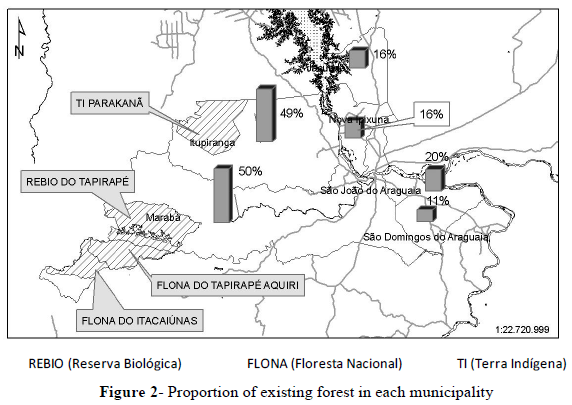
Due to this, the proportion of existing forest in this area is currently very low and there are municipalities with critical levels of deforested areas. The landscape is basically formed by pastures, being most of them highly competitive in terms of foraging and invading species mostly due to the kinds of management adopted. Besides the lack of woods and weeds, the presence of significant erosive processes and river stilts, also resulted from inadequate handling of the exploration and use of the soil, has provided unfavorable conditions for maintaining agrarian and breeding activities. Therefore, in these areas the technical choices adopted seek to overcome some of these difficulties with the use of external products (mainly herbicides, chemical fertilizers and mechanization) and the construction of structures, such as dams for breeding, for example, as a way to guarantee the maintenance of the activities.
]]> In the other part, farther from the road axes and the main region's rivers, the increase in occupation occurred later: fewer Brazil nut trees, more irregular estates and the precariousness (if not lack of) accessible roads postponed the integration of this area in the process already installed in the region a long time ago. The relative isolation started to be broken around the 90s when the area became the destination of migrant families and many others coming from former occupation areas in the own region or from other nearby municipalities in search of woods to implement plantations since its former reserves were in general converted into pastures. Differently from the other part, the process of occupation process happened under a changing regional context due to the policies of land reform and credit. That was important for the family to have access to agrarian regularization and resources for investments more quickly.Even in different conditions, the cattle breeding dynamics also established in this area as the most important form of exploration of natural environment being the main responsible for similar or even higher rates than the registered ones in the former areas (ESCADA, 2004; NASCIMENTO et al., 2007; BRITTO et al., 2007). Credit has influenced it since it provided the faster introduction or enlargement of the cattle in the family farms; however, it is also worth pointing out the possibilities of diversification of the productive system (mainly by encouraging permanent crops and other types of breeding). Nowadays, it is in this part of the region where most of the forest areas are concentrated and the protected areas are more present (Figure 2).
Besides the similarities between these most western areas of the region and the former occupation areas as far as the dynamics of the transformation of the transformation is concerned, the fact that there are more interested farmers in other productive activities, an evident effort to diversify the productive systems- practice quite encouraged and reinforced by local mediators- and the growing concern with the environmental issue, shows that the outcomes of the evolution of these production systems will not be the same as the ones in the former areas.
The territory distribution
The territory distribution in the region of Marabá region has been, and still is, going through great changes throughout its occupation. The concentration of land started in the cycle of Brazil nut in Pará, particularly from the appropriation of Brazil nut areas by the local oligarchy (EMMI, 1999). The agriculture structure formed during this period – reinforced later with the incentive policies for great agrarian projects and the consolidation of cattle farms- served as the basis for the development of all the process of conflictive dispute of the region as from the 70s, involving several social actors, such as the local oligarchy, wood cutters, farmers, Indians, extractivists producers and agriculturists.
Due to this historical process of territory distribution, since the end of the 19th century, non-family farm (employable and capitalist) has owned most of the land in this area. Just to give an idea, in 1996, about 58% of the available agriculture area was controlled by non-family farms in spite of the family farm's accounting for around 95% of the agrarian establishments in the region at that time (DE REYNAL, 1999).
]]> This picture started to change effectively from the mid-90s with the increase of pressure of the social movements and the regional family farms' representations by the implementation of land reform, which main consequence was the rapid expansion of rural settlements in the regions (OLIVEIRA et al., 2004). Nowadays, the mid-region of southeast Pará, where the region of Marabá is situated, is one of the most important areas under the policy of land reform because it has the largest number of settlements in the country, that is, 481 settlements created until early 2008.In spite of most settlements had only been constituted out of processes of regularization of already occupied areas, there was also an important process of farm expropriation. The incorporation of these areas, added to the areas which are still in conflict situation and the holding areas, confers the family farm the occupation of over half of this territory.6
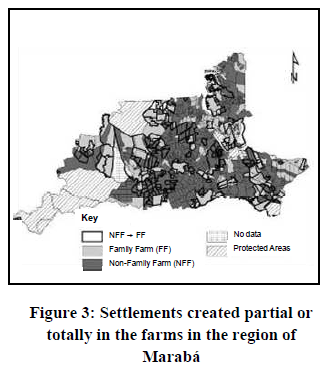
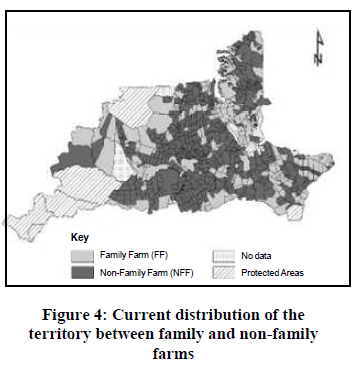
These changes in the agrarian structure of the region of Marabá have created several kinds of family relations with the land. Now, besides the holders (assisted by colonization projects or replaced because of the dam), leaseholders (living in leasing areas not accredited by Incra) and the campers, there are also the settlers. Broadly speaking, we can say that there are the beneficiaries of the policy of land reform and those who are out of it though occupying an important area of the territory area (OLIVEIRA et al., 2004).
There are also areas in the region ascribed mainly to the protected areas, mostly seated in the most western part: according to PDTRS (2006), about 15.7% of Marabá area is occupied by conservation units while Indian land comprises 18.1% of Itupiranga and 1.1% of São Domingos areas.
Access networks and the presence of a regional pole
]]> Not only is Marabá the main urban center of the region but of all mid-region southeast Pará as well. The status of the most important city in the region is not recent and was still formed in the period of the extractivist economies when it rapidly became the main site of regional polarization due to the abundance of its reserves of natural resource butmainly due to its privileged geographical position for the flow of the commercial extractivist products. So, a whole infrastructure was soon being established in order to assist the growing population (VELHO, 1982).
Nowadays, Marabá stands out as the main important financial and development center of job offers, health services, education and other public services 7 besides having an important industrial district and some several large companies linked to agriculture sector. In the industrial district, some outstanding activities include wood and tile industry, and, in the agrarian sector, milk, meat and fruit improvement and commercialization companies (such as Bertin, recently established in Marabá). Marabá also concentrates part of the market of agrarian products commercialized in free urban markets or in recent experiences of exclusive street markets for selling the family farms' products.
Besides the presence of this regional pole, the transport network distribution and the conditions of access influence configuration of the regional space. After the construction of the great road axes (Belém-Brasília, Transamazônica, PA-150, PA-070, BR-163), which plan cuts across municipalities as Jacundá, Nova Ipixuna, São Domingos and São João and the whereabouts of the centers of Marabá and Itupiranga, the transport network of the eastern part of the region developed more rapidly. This faster development of access conditions influenced in the increase of the space's exploration in the region and nowadays it provides urban centers and markets with better conditions of access, a different situation from the most inner areas of Marabá and Itupiranga municipalities where accesses are more difficult.
3.2. The socioeconomic dynamics
In the region of Marabá, the changes which occurred from the mid-90s were crucial for the transformations in the local socioeconomic dynamics. Among the main elements of these current socioeconomics dynamics, we can point out the changes in the pattern of the region's migration, in the diversity of the social movement linked to family farms, in technical service and also in the farmers' productive basis linked to the credit policy.
The pattern of regional migration
During its occupation, one of the main features of the region was the great migratory movement from the 70s which not only resulted in a population explosion but also in the increase of the urban centers, particularly in Marabá.
However, from the 90s on, not only the pacing but also this pattern of migratory process has taken new features in the regional dynamics. Some studies conducted in western Amazon, such as Hurtienne (2001), Oliveira et al. (2001) and Becker (2006), showed a decrease in the migratory pacing and changes of the pattern of the interregional migration in a more intraregional one. This kind of change is related, among other factors, to the increase in the possibilities of access to land and land regularization, the improvement of the regional infrastructure, the offer of service available mostly by the policies of settlement and also of the possibilities of access to the financing of productive activities through the credit policy. These elements have apparently encouraged the farmers' families to extend their permanence in the same area.
]]> The new social organizational picture linked to the regional family farmIn the past years, the organizational structure of the family farm has been going through important changes in its configuration so as to be nowadays characterized by the presence of different representative entities of the farmers oriented by distinct political projects.
Not to mention the restoring and strengthening of the Rural Workers Unions' (STRs, ) in the region in the 80s, this process of changes in the farmers' social organization began in the late 90s with the implementation of the southeast regional Fetagri– created to coordinate and follow the actions of the syndicated farmers, soon transformed into the STRs' main reference and with the establishment of the MST in the region (VEIGA et al., 2007). Moreover, the labor union movement was also influenced by the implementation of credit policies (PRONAF and, formerly, FNO-special and Procera): the requirements of these policies to grant credit only by means of a local association encouraged the spread of associations in the region. Regardless of having being created with the focus on credit, the expressive increase in the number of farmers' associations resulted in a change in the internal structure of the regional labor union movement as they started to play the role of the unity basis of this movement (OLIVEIRA et al., 2004).
The increase in the creation of associations was still the start for the process of emergence of other organizational structures (ASSIS, 2007). As there were several associations formed independently of the labor union movement (including some under the local politicians' influence) and therefore without a legitimate regional representative, Association Centers were created in various municipalities from 1998 and, later on in 2001, the Federation of the Center Offices of the Associations of Small Rural Producers in the State of Pará (Fecap, ) was created acting basically in the southeast mid-region. For two years, this new farmers' organizational entity has already become the local representative Federation of the Family Farm Workers (Fetraf) and has been gradually increasing its scope of action in the region to the detriment of a loss of power in southeast-regional Fetagri.
This diversity of representative structures linked to the family farm has influenced the regional dynamics in different aspects. In the productive area, for example, apart from Fetagri, Fetraf and MST adopting the discourse of diversification as fundamental to guarantee the social reproduction of the families, the three movements assume different principles and strategies to implement this discourse in practice. Likewise, the forms of political insertion of these entities and their articulations with the different spheres of public power (regional, state and federal) also reflect in the actions brought to a close in the region and in the role each one of them plays in the regional context.
Changes in structure of the technical support and the farmers' productive bases
Besides the impact on structure of the regional organizational structure, the credit policy also caused other important institutional changes, such as the emergence of companies of technical support8 directly responsible for the technical support of the credit projects in the areas of land reform. Nowadays, the performance of these companies is vital to encourage the process of diversification of the farmers' productive activities (somehow facilitated recently through the relative flexibility of the productive credit packages) and to spread the sustainability discourse of the systems of family production based on these diversification principles. This has had an effect on the farmers' productive strategies since it opens new perspectives on the evolution of the family famers not necessarily related to the only possible way of cattle breeding.
In the region, this incentive for the diversification of the production systems is also manifested in the initiatives of the consolidation of the structure of improvement and commercialization of regional family farms' products based on cooperatives. Thus, in 2003 Fecat was created to articulate municipal cooperatives of improvement and commercialization for regional and national markets. Nowadays, the relevance of Fecat and its connection with the social movement somehow influenced on the orientation of the area of scope of some policies implemented in the region, as is the case, for example, of the delimitation of the SDT territory.
4. The collective projects and territories
]]> The condition of the agrarian frontier of the region of Marabá has peculiarities which make it difficult to specify collective projects in many of their features, particularly the geographic limits, considering the municipalities as a scale unit.Another implication of the feature of the agrarian frontier is the need of the relativization of the multi-functionality concept of agriculture (or else, its adaptation/adequacy). In the scope of functions of the "families' socioeconomic reproduction" and "food safety", it is possible to analyze the local reality using the concept; however, in the factors of "maintenance of the social and cultural tissue" and the "preservation of natural resources and rural landscape", it is necessary to relativize its application. This is explained as both the social tissue and the rural landscape are very indefinite and rapidly changing and, in the case of the landscape, as there are no data to support that this landscape we envision will be necessarily stable. The issue of the application of the multi-functionality concept will be retrieved in the final comments of this paper.
In spite of such difficulties, three collective projects, strongly bound to one another, have been identified as they gather most of the institutions with focus on the family farm with active action in relation to public policies, either in the proposition and discussion or even in opposition to the State's action. In the projects, the municipality of Marabá takes part as a pole in the following:
The first two projects will be briefly described next though Southeast Territory of Pará will be more thoroughly analyzed in the next section as it is the object of this article.
Regional Education Forum of South Country and Southeast of Pará
The search for education alternatives more adequate to the family farmers in the region of Marabá emerges with the strengthening and organization of the labor union movement and comes into effect in a first experience finished in 1977 with the creation of the Family Farm School in the municipality of Marabá. The pedagogic project, strongly based on the pedagogy of alternation and systemic approach, aims at providing the farmers' children with the possibility of staying in the country with adequate education.
]]> The experience gathered several institutions which, added to others, created the Regional Education Forum of South Country and Southeast of Pará in 2002.This Forum became the regional expression of the national and state movement, proposer and claimer of specific public policies for the education of the rural population. Nowadays the main actions of the Forum are: holding conferences to collect demands and proposals to build the Education Plan of the State of Pará; implementation of a graduation course Bachelor in Rural Education and participation in the process of designing the pedagogic plan of the Federal Agro technical School of Marabá. The Forum comprises the Federal University of Pará (UFPA, ), the Landless Workers' Moviment (MST), the Federation of Agriculture Workers, southeast regional office of Pará (Fetagri-southeast, ), Agrarian Foundation of Tocantins Araguaia (Fata, )/Family Farm School (EFA, ), Cooperative of Service Rendering (Copserviços, ), Socioagronomic Laboratory of do Tocantins (Lasat, ), Rural Land Commission (CPT, ), Union of the Public Education Workers of the State of Pará-Marabá (Sintepp/Marabá, ) and Municipal Secretariat of Education of Parauapebas (Semed/Parauapebas, ).The discussion group about the Forest District of Carajás
This group emerged out of the federal government's effort to, through Brazilian Forest Service (SFB/MMA, ), the implementation of the Forest District of Carajás (DFC, ). The region, called Carajás Pole, comprises part of the states of Pará, Maranhão and Tocantins and concentrates 14 steel plants within 150 kilometers. These industries consume from 12 to 14 million cubic meters of firewood to produce coal (MMA, 20080), being most of this demand provided by coal illegally extracted from the areas of the settlement project in the region. According to the governmental discourse, the creation of the District would solve part of these problems.
The perception shared by the institutions which comprise the group is that the DFC policy, the way it was conceived and conducted the effort to its implementation, would benefit the pig iron sector in the region to the detriment of the family farm since it would integrate the farmers (by way of advance payment) into a chain of coal production arisen out of the culture of exotic species, such as the eucalypt. Therefore, the policy places the pig iron industries in the role of main agents of the regional development and somehow legalizes a practice of the family farmers' subordination, fully contradicting the main assumption guiding the actions of the institutions which comprise the group and which assigns the family farmers the role of the "engine" of the regional development.
The groups' aims are to discuss and intensify the iron ore-steel issue in the region and the proposals of productive alternatives which, though considering the forest issue both in the maintenance of forest remains and in the recovery of deforest areas, are not necessarily linked to the chain of coal or wood production. The members of the Group include CPT, Lasat, UFPA, MST, the Dam Affected Movement (MAB, ), the Small Farmers Movement (MPA, ), Paraense Society for the Defense of the Human Rights (SDDH, ), Copserviços, Center of Education Research and Syndical and Popular Advice (Cepasp, ), Missionary Indian Council (Cimi, ) and Fata.
4.1. The collective project chosen for analysis: the Southeast Territory of Pará
The Southeast Territory of Pará was the region chosen as it shows interesting features for analysis: it has strong ties with the family farm; its geographical limits are more easily identifiable; it is known as the booster of the regional development, in particular the family farm; it has bonds with the structures of local improvement and commercialization and strong ties with the public policies.
4.1.1. The process of creation of the Southeast Territory of Pará
In to its current configuration, the Southeast Territory of Pará originates from the territorial policy of the Secretariat of Territorial Development (SDT, ) of the Land Development Ministry (MDA, ). In September 2004, there was a meeting held by the SDT/MDA when the principles of the territorial policy were reported. The definition of the municipalities which would be part of the Southeast Territory of Pará had the following criteria: i) first, select a reduced number of municipalities to build the inter-institutional dialogue; ii) include the municipalities directly involved in the "horticulture pole", which is the main strategy in the productive field of the labor union movement (OLIVEIRA, 2005, apud MICHELOTTI et al., 2006). In the following regional meetings, it was decided that the territory would comprise the following municipalities: Marabá, Itupiranga, Nova Ipixuna, São João do Araguaia, São Domingos do Araguaia, Eldorado dos Carajás and Parauapebas. This configuration considered the municipalities which take part of the Federation of the Cooperatives and Associations of Araguaia Tocantins (Fecat, ), a federation of cooperatives seated in Marabá and which improves and commercialize the fruit production of seven cooperatives located in these municipalities.
Fecat had its origins in the Program of Formation, Research and Development called Agroenvironmental Center of Tocantins (CAT, ). This program began in 1988 as a result of the association between the Federal University of Pará and the Land Foundation of Tocantins Araguaia (Fata), created by the Rural Workers' Unions (STRs, ) from Marabá, Jacundá (which the municipality of Nova Ipixuna was set apart from), São João do Araguaia (which the municipality of São Domingos do Araguaia was set apart from) and Itupiranga. Among the projects developed by the partnership, there was a test-action of the commercialization of rice which gave origin to the Farmer's Cooperative of Araguaia Tocantins (Coocat, ). Years later and after the restructuring of its composition and the redirection of the on horticulture, this Cooperative gave origin to Fecat.
]]> This was also the period of strengthening and organization of the farmers' representative institutions, mainly Fetagri Regional Office Southeast of Pará,which Fata is nowadays organically linked to.So, CAT is one of the first collective projects in the region and has acted over a territory built by the STR emergent dynamics of the organization of the municipalities in the region. The support of international resources encouraged the implementation of an infrastructure which enabled several catalyzing actions of Fetagri organization in the region (nowadays it comprises 17 municipalities)9.
For the geographical configuration of the Southeast Territory of Pará, it was considered neither the territory built by the organizational dynamics of the other farmers' representative entities of the region (Fetraf and MST) nor the Fetagri's specific one.
What happened was an interpretation of the SDT territorial policy as a sectorial policy and an incentive for production since the municipalities involved are precisely right the ones which comprised the network of cooperatives of fruit improvement and commercialization. This interpretation is favored by the supportive feature to the productive structures of the projects so far financed by city halls with resources from Pronaf Infrastructure. The fact that the resources from the Program of Sustainable Development of the Rural Territories (PDTRS)10 are exiguous concurred for the small number of municipalities selected as well.
All the process of creation of the Territory was practically dominated by Fetagri which, at that moment, was the farmers' representative organization with the most influence on the regional public policies thanks to its history of organization in the region and to its capacity to gather other regional institutions of research and advice. The influence of Fetagri increased with the advent of the Labor Party in the federal government since it was the strongest organization linked to this party.
The great influence of Fetagri at the time of the creation enabled the unbalance of power and decision making which would influence all the following configuration of the Territory both in relation to the geographical scope and the management of resources management and projects arisen out of it.
4.1.2. The features of the Southeast Territory of Pará
The mechanism of discussion and deliberation of the Territory is the Commission of Installment of Territorial Actions (Ciat) and is nowadays comprised by: Incra, Agency of Commercialization of the South and Southeast of Pará (Arcasu), CPT, Fecat, UFPA, Emater, MST, Fetraf, Fetagri, Ibama, Association of the Municipalities of Araguaia e Tocantins (Amat), Secretariat of Agriculture of the State of Pará (Sagri) and the CMDRSs of the seven municipalities included. There is a directive nucleus responsible for the course of the most common activities comprised by the six first institutions, and the Increased Collegiate, the utmost deliberative body, includes the other organizations and the CMDRSs.
The territorial projects11 have two large areas of application: one referred to the structuring of rural development and education and the other referred to the productive infrastructure, such as the building of a milk cooling platform, purchase of a cool chamber, equipments for fruit improvement and a cool truck. In this second area of application there are the projects with larger budgets.
In all the interviews conducted, it is clear the demand for a mechanism of discussion and deliberation about the several public policies with focus on the development of the family farm in the region. The demand is often qualified. The direction is for the need of room for decision space, the division of resources and projects and actions constituent of these public policies but above all room for decision of the public policy itself, which outline would come out of the expression and discussion of the several references to the regional development, the role of the family farm in this development and the resulting strategies. This would lead to the possibility of a new development model of family farm which, if not consensual, at least better articulated among the farmers' representative institutions.
]]> All the interviewees' discourse is unanimous as to the productive diversification as the utmost need for the development of the family farm in the region. However, the strategies to reach this goal do not seem very clear, it is only possible to discern some nuances. In relation to the three farmers' representative institutions of the region, it is possible to see the following differences: Fetraf and Fetagri show more flexibility as to the possible diversifying parts of the productive systems accepting, for example, the introduction of exotic species, such as eucalyptus; on the other hand, Fetagri has a clear strategy based on horticulture, dairy cattle and small animals which has been getting stronger because Emater is linked to this entity. On the other hand, MST rejects the introduction of exotic cultures and strongly incorporates the agroecological principles in its discourse. The productive system defended by the MST leaders, based on the incorporation of forest as productive element by means of the implementation of agro forest systems, has difficulty in its own strategy of settlement: the option for claiming areas with better access and next to the roads and cities makes most of the families be settled in areas with little forestation, which makes it difficult the effectiveness of the ideal of the proposed productive system.In spite of the wide range of the formally participating Ciat's institutions, the effect participation is reduced to three representative organizations and the following institutions: Incra, UFPA, CPT, Emater, Arcasu and Fecat. This configuration allows Fetagri to have more power since, were it not for UFPA and Incra, the other ones have strong ties with this federation. This fact is notably claimed, mainly by the Fetraf representative, as one of the obstacles in the operation of the mechanism as a convergence point and the restoration of the region's several public policies.
Other factors have contributed to make the effectiveness of this mechanism difficult, as claimed by the interviewees:
Pronaf is one of the public policies with the most impact in the development of the regional family farm. This is not only related to the amount of resources applied (according PDTRS (2006), about R$16 million are invested annually in the region) but also to the greatest inducer or even booster of the technical innovations in the productive systems, highly influencing the landscape changes.
The discussion of Pronaf A is held pro forma by the State Executive Group of Labor Reform Policies (Gera, ) in the region represented by Incra. Incra only checks some bureaucratic requirements for granting credit to the settler, such as the existence of the Settlement Development Plan (PDA, ) document, the applicant's documental regularity and the inexistence of disputes with Incra. In the case of the PDA, what is required is not only checking its existence or not but rather making the proposed activities coherent to the activities pointed out as the most appropriate at the time of the execution of the planning. Even being a credit by product, the inclusion of other criteria, such as the evaluation of the diversifying potential of the proposed activity in relation to others pre-existing in the productive system, would allow an incentive action in the whole system, that is, in the family unit as a whole. Other Pronaf lines of credit (C, D and E) do not even go through any participative mechanism of discussion and deliberation.
]]> Ates and Pronaf, as two policies strongly tied and with the potential for influencing the productive dynamics of the regional family farm and, therefore, to enable an articulated project of this agriculture, if went through Ciat's mechanism, could at least increase Ciat's relevance for the farmers' representative institutions, create the conditions for the Southeast Territory of Pará fulfill its target it was created for and from which demand the regional actors linked to the family farm.The territorial dynamics translated in the landscape transformation referred to in the first part of this paper are highly influenced by these two public policies: Ates and Pronaf. If, on the one hand, the supportive resources of these two policies in the last decade contributed to the increase in cattle breeding, on the other hand it enlarged the possibilities of technical innovation for the introduction of innovative activities, such as breeding of small animals and horticulture, or even the elaboration of cattle breeding-related projects so as to solve technical problems and confer greater sustainability to the activity.
However, the decision about the orientation of these resources has been taken in accordance with the representation of the own development of each farmers' representative institution in the region, which is mediated by the perception of the opportunities offered by public policies and also restrained by their mechanisms and the modus operandi of the banking system which provides for to financial resources. The non-operation of a local mechanism of discussing public policies restrains the expression and negotiation of these several representations and therefore the possibility to build a much more articulated development project for the family farm.
5. Final remarks
Agriculture multi-functionality is not a discourse present in the participants' speech of the analyzed project. More frequent is the discourse of productive diversification, as one of the requirements for the development of the family farm in the region. This is the result of the dynamics of the agrarian frontier whose main goal is to build systems which first allow the families' reproduction and permanence in the newly-conquered areas. Considering the functions previously identified (CARNEIRO; MALUF, 2003), the aspect of the families' socio-economical reproduction turns out to be appraised to the detriment of other dimensions of the agriculture multi-functionality. The dimension of the preservation of natural resources and rural landscape is more strongly considered since the forest is seen as an obstacle in the production and, therefore, the first task is to remove it in order to give room to allegedly more viable activities.
These farmers' representation regarding natural resources has its roots both in cultural traces from their homeland and in an effective evaluation of the producible viability of land use in relation to the possibilities of the families' commercialization and food safety and the productive orientation of public policies.
The analyzed project, due to its process of creation, its territorial range and the imbalance of internal power, does not allow, in the current configuration, the increase in multiple functions of agriculture in the regional development to be consolidated in all its implications.
Moreover, it is sound the discussion about the meaning of these functions in a region as Marabá. As far as the discussion about the function of landscape maintenance is concerned, it is suitable to ask what the most environmentally sustainable landscape in Amazon is. The assumption of the productive diversification claimed by many interviewees is that the closer the productive system to natural diversity is, the more sustainable it would be. However, the incorporation of the forest as an effective productive element still faces some obstacles on several levels making the establishment of these systems very difficult to become more sustainable. The families are left with the transformation of the forest production areas in more simple elements which provide for the family survival, such as the annual activities (corn, rice, manioc etc) which guarantee the family's food or in pastures for cattle breeding which presents a lot of market advantages in relation to other activities.
Some of the projects financed by the Southeast Territory of Pará aim at reinforcing the structures which increase other activities' advantages, such as financing milk cooling tanks and fruit commercialization and processing. However, the exiguous resources and the difficulties presented in this paper turn the initiatives incipient in face of the needs.
]]>References
ALBALADEJO, C.; TULET, J-C. Les fronts pionniers de l'Amazonie brésilienne: des terrains pour une analyse des relations société-territoire. In: Les Fronts Pionniers de l'Amazonie brésilienne: la formation de nouveaux territories. ALBALADEJO, Cristophe e TULET, Jean-Christian (coords.). Paris, França: L'Harmattan. 1996. (Collection Recherches et Documents – Amériques Latines).
ASSIS, W. S. de. A construção da representação dos trabalhadores rurais no sudeste paraense. Universidade Federal Rural do Rio de Janeiro, Instituto de Ciências Humanas e Sociais, 2007. Tese de Doutorado.
ATLAS DE DESENVOLVIMENTO, 2003.
BECKER, B. K. Amazônia. Rio de Janeiro: Ática. 1990.
]]>__________. Amazônia e a política ambiental brasileira. In: SANTOS, M.; BECKER, B. et al.. Território, territórios: ensaios sobre o ordenamento territorial. 2. ed. Rio de Janeiro: DP&A, 2006. (Espaço, território e paisagem). PPGEO/UFF.
__________. Revisão das políticas de ocupação da Amazônia: é possível identificar modelos para projetar cenários? Parcerias Estratégicas, Santa Maria, n. 12, setembro de 2001. Disponível em: <http://coralx.ufsm.br/mundogeo/geopolitica/arquivos/becker_amazonia.pdf>. Acesso em: 27/06/2007.
BRITTO, G.; MOREIRA, L. F. C.; BATISTA, M. G. et al.. Diagnóstico do Projeto de Assentamento Rancharia, Itupiranga/Pará. MAFDS/UFPAEmbrapa, Belém, 2007 (Trabalho final da disciplina Análise e Diagnóstico dos Sistemas Agrários).
CARNEIRO, M. J.; MALUF, Renato S. (orgs.). Para além da produção – multifuncionalidade e agricultura familiar. Rio de Janeiro/ Brasília: Mauad-Nead, 2003.
DE REYNAL, V. Agricultures en front pionnier amazonienne, région de Marabá (Pará, Brésil). INA-PG, Paris, 1999. Tese de Doutorado.
]]>DE REYNAL, V.; MUCHAGATA, M. G.; TOPALL, O. Agriculturas familiares e desenvolvimento em frente pioneira amazônica. LASAT-CAT/
GRET/UAG. Paris: Nouvelle Imprimerie Laballery, 1995. Ed. Bilingue.
DETER. Proposta de acompanhamento do plano territorial de ações integradas-PTAI do programa Territórios da Cidadania. MDS, Brasília, 2008.
DE SARTRE, X. A. Agriculture familiale en front pionnier amazonien: la sédentarisation en question. Natures Sciences Societés. Elsevier, Paris, n. 11, 2003.
DUVERNOY, I. Diagnostic de la pérennisation de l'activité agricole dans la frontiére agraire de Misiones (Argentine): une methode de généralisation spatiale. INRA-SAD, Toulohandling, França, 1994. Tese de Doutorado.
ESCADA, I. Desflorestamento em assentamentos no leste do Pará nos períodos de 1997-2000. Projeto Geoma/MCT. (No prelo).
FOWERAKER, J. A luta pela terra: a economia política da fronteira pioneira no Brasil de 1930 aos dias atuais. Traduzido por Maria Júlia Goldwasser. Rio de Janeiro: Zahar, 1982.
HURTIENNE, T. Agricultura familiar e desenvolvimento rural sustentável na Amazônia. In: COELHO, M. C. N. et al.. Estado e políticas públicas na Amazônia: gestão do desenvolvimento rural. Belém: Cejup: UFPA-NAEA, 2001.
MELLO, J. L. B. de. A fronteira dos desencontros. In: MARTINS, José de Souza. Fronteira: a degradação do outro nos confins do humano. Revista Sociologias-Resenhas, Porto Alegre. Ano 3. n. 5. jan./jun. 2001.
MICHELOTTI, F.; ALVES, L. N.; ALVES, A. M. N. et al. Diagnóstico socioeconômico e ambiental da agricultura familiar & Plano Territorial de Desenvolvimento Rural Sustentável do Sudeste do Pará. Marabá, Lasat-MDS/SDT, 2006.
MICHELOTTI, F.; RIBEIRO, B. M. F.; FLORENCIO, S. R. A Resistência Camponesa na Construção do Território do Sudeste Paraense (1995-2004). In: MONTEIRO, Dion Márcio Carvaló; MONTEIRO, Maurílio de Abreu. (org.). Desafios na Amazônia: uma nova Assistência Técnica e Extensão Rural. Belém-PA: NAEA / UFPA, 2006.
MMA – Ministério do Meio Ambiente [on-line] Disponível em:<www.mma.gov.br/index.php?ido=conteudo.monta&idEstrutura=95&idMenu=4881>. Acesso em 12/01/2008.
NASCIMENTO, H. F. do; MACEDO, M. R. A.; SILVA, M. C. V. da. et al.Diagnóstico do Projeto de Assentamento Pensão da Onça, Itupiranga, Pará.
MAFDS/UFPA-Embrapa, Belém, 2007 (Trabalho final da disciplina Análise e Diagnóstico dos Sistemas Agrários).
OLIVEIRA, A. U. Integrar para não entregar: políticas públicas e Amazônia. 2. ed. Campinas: Papirus: 1991 (Série Educando).
OLIVEIRA, M. C. C. de; VEIGA, I.; MASTOP-LIMA, L. N.; TAVARES, F.B. Políticas de apoio à agricultura familiar e evolução do sistema agrário no sudeste do Pará. In: ENCONTRO DA SOCIEDADE BRASILEIRA DE SISTEMAS DE PRODUÇÃO, 6., 2004, Aracaju. Anais. Aracaju: SBSP/Embrapa Tabuleiros Costeiros, 2004.
OLIVEIRA, M. C. C. de; DE REYNAL, V. Projeto Zone Atelier.Environnement et développement en front pionnier amazonien: etude de sites et analyse de Marabá, Lasat/NEAF/UFPA, 2003. (Relatório Técnico de Pesquisa).
OLIVEIRA, M. C. C. de; SILVA, W. R. da; ASSIS, W. S. de. Estudo sobre processo de migração de agricultores familiares na área rural da região de Marabá. Marabá: Lasat. 2001.
SAWYER, D. A fronteira inacabada: industrialização da agricultura brasileira e debilitação da fronteira amazônica. In: Migrações internas na Amazônia: contribuições teóricas e metodológicas. ARAGÓN, Luís E. Aragón e MOUGEOT, Luc J. A. (orgs.). Belém: UFPA-NAEA- CNPq. Cadernos do NAEA n. 8, 1986.
SEPOF – Secretaria de Estado de Planejamento, Orçamento e Finanças [on-line]. Disponível em: http://www.sepof.pa.gov.br/municipio.html#. Acesso em 07/11/2007.
VEIGA, I.; OLIVEIRA, M. C. de; BENTES, F. Políticas públicas e dinâmicas locais da agricultura familiar no sul e sudeste do Pará. In: TONNEAU, J. P. & SABOURIN, E. (orgs.). Agricultura Familiar: interação entre políticas públicas e dinâmicas locais: ensinamentos a partir de casos. Porto Alegre: UFRGS, 2007.
VELHO, O. G. Frentes de expansão e estrutura agrária: estudo do processo de penetração numa área da Transamazônica. 2. ed. Rio de Janeiro: Zahar, 1981.
Notes
1 The Lasat is constituted of a group of research-development linked to the Nucleus of Agrarian Sciences and Rural Development (Neaf) from Pará Federal University.
2 The citizenship territory of Southeastern Pará comprises the municipalities of Marabá, Itupiranga, Nova Ipixuna, São João do Araguaia, São Domingos do Araguaia, Eldorado dos Carajás and Parauapebas.
3 This importance came particularly from the existence of the so-called Brazil nut Polygon" in this area.
4 Some government's actions in this direction are: changes in the size of Ibama's Legal Reserve, the obligation of authorization for the execution of forest burns, Ibama's requirements concerning the environmental licensing for the creation of new settlements, the need of the farmers' assertion to the Term of Adjustment of Behavior as a condition of access to credit and the attempt to create the Forest District to guarantee the offer of vegetal coal for the ghandlingiras in the area. ]]>
5 Some information and analyzes in this section are based on field surveys conducted under the scope of the doctorate research (ongoing).
6 According to Incra/SR-27 (2006) data, only the settlements correspond to 34% of the area of the region of Marabá (around 998,700 acres) involving over 15,600 families; moreover, according to CPT (2005) quoted by Michelotti et al. (2006), there are more than 3,970 families occupying 39 farm areas awaiting Incra regularization.
7 In Marabá, there are important structures installed, such as the Regional Hospital, the head office of the Regional Education Unit (URE), the campi of the federal and state universities, the head office of Incra/SR-27 Superintendency, Ibama regional office and several regional representations of federal and state organizations.
8 These renderers started to structure themselves from the federal program directed for the creation of a "new technical assistance". Many of them were created based on the groups formed at the time of the Lumiar Program.
9 Marabá, Itupiranga, Eldorado dos Carajás, Curionópolis, Parauapebas, Canaã dos Carajás, São Domingos do Araguaia, São João do Araguaia, Brejo Grande do Araguaia, Palestina do Pará, São Geraldo do Araguaia, Piçarra, Bom Jesus do Tocantins, Abel Figueiredo, Rondon do Pará, Nova Ipixuna e Jacundá.
10 Program which replaced Pronaf Infrastructure.
11 Many are not made permanent yet due to bureaucratic problems. ASSIS, William Santos de; Myriam Oliveira; Fábio Halmenschlager. Dinâmicas territoriais e as complexidades das áreas de fronteira agrária na Amazônia oriental. Estudos Sociedade e Agricultura, abril 2008, vol. 16 no. 2, p. 228-261. ISSN 1413-0580.