– Ratio between the marketshare of Brazilian exports i and the participation of Brazil's overall food exports in total global imports
Nilson de Paula*; Lívia Tiemi Bastos**
Translated by Bruno Mafra Ney Reinhardt
Translation from Estudos Sociedade e Agricultura, Rio de Janeiro, vol. 17 no. 2, p. 304-331, Novembro 2009.
ABSTRACT
This paper analyzes the insertion of Brazilian agribusiness in the world market, with a focus on food products, given the prevailing conditions of international competition. Although some activities reveal a more salient trend toward higher levels of added value and product differentiation, the exports of unprocessed or bulk commodities have become more important. Empirical evidence reveals a discrepancy between the Brazilian food business's pattern in international trade relations and internationally prevailing trends. As a result, the fact that Brazilian agribusiness has become highly complex and that some activities have evolved towards sophistication and product differentiation, especially in recent years, has not resulted in competitive advantages other than those stemming from natural resources and agricultural innovations.
]]> Key words: Agribusiness, food production, agriculture, international trade.RESUMO
Este trabalho procura analisar a inserção do agronegócio brasileiro nos mercados mundiais, com ênfase nos produtos alimentares, tendo em vista as condições de concorrência predominantes. Embora alguns segmentos do agronegócio venham revelando uma tendência mais acentuada de agregação de valor e diferenciação de produtos, observa-se uma maior capacidade de inserção nos mercados mundiais naquelas atividades produtoras de commodities, com grau inferior de processamento. As evidências empíricas analisadas neste artigo revelam uma discrepância entre o padrão de inserção do agronegócio brasileiro nos mercados mundiais e as tendências predominantes internacionalmente. O fato de o agronegócio alimentar brasileiro ter se tornado altamente complexo e diferenciado não se projetou, em especial nos últimos anos, nas relações de comércio exterior, através de vantagens competitivas não lastreadas apenas em recursos naturais e inovações agropecuárias.
Palavras-chave: agronegócio, produção agroalimentar, agricultura, mercados mundiais.
Introduction
Recent developments in the international food market have been marked by multiple tendencies in its different realms of activity. This has been particularly evident from the perspective of technological innovations related to the rural and industrial processing spheres. Although the global commodities market is still relevant, transactions involving processed products have progressively gained momentum, while prompting relationships typical of intra-industrial commerce. One could affirm that the global agribusiness market reflects structural characteristics of each country's productive chains, and particularly the tone set by technology innovation processes taking place in each sector of the productive stage. Hence, in face of the growing influence of manufactured products vis-à-vis commodities, more attention should be paid to the competitive power of the industrial share of food supply, in terms of the nature of processes of product differentiation and technical innovation. The greater the importance of commodities in the exports agenda (and, consequently, in the agribusiness competitiveness), the more germane become classical determinants of comparative advantages derived from factor productivity and endowment.
The starting point of this analysis is agribusiness's significant weight in the Brazilian economy; it generates around one third of the GNP and almost 40% of jobs and total exports. Even though it participates in global markets as a modern competitive set of activities, Brazilian agribusiness should not be seen as a homogeneous aggregate responding to a single economic and technological dynamics. In these terms, the competitive power of agribusiness, taken as a whole, derives from technological transformations in the rural sphere during the last 40 years which have built upon favorable natural conditions. The transformative waves that succeeded this period increasingly led this set of activities toward an industrial logic in which large processing companies have played a leading role. However, this phenomenon has not been dynamic enough to approximate Brazilian agribusiness to the global tendencies of our times: more complex agro-alimentary exports and the greater added value of processed products.
This article is structured in three sections. Firstly, it discusses dominant trends in global trade, in which processed products have become increasingly relevant. Secondly, it presents an analytical framework focused on the relationship between technological innovation and international commerce. After pointing out the main global trends and their determinant factors, we will discuss the insertion of Brazilian agribusiness in the global markets and its new competitive challenges. Finally, we will lay out some of this analysis's conclusions.
]]>Patterns in the international food market
Agribusiness' pattern of international trade has shown an increasing weight of processed products, thus displacing its determinants progressively away from their rural basis and towards the industrial sector. Gaining market share internationally comes to depend heavily, first, on the capacity to break new ground in technological innovation (product differentiation), and second, on the degree of articulation among different industrial sectors in face of the globalization of consumption patterns. Consequently, not only has the competitiveness of the agro-industrial systems shifted from their rural roots towards the industrial sector, but also international trade has become emphatically intra-industrial.
Predictions made by Ray Goldberg regarding income breakdown from global agribusiness indicate that agriculture and stockbreeding production will reduce its participation from 32% in 1950 to 10% in 2028, while the processing and distribution industry will increase its share from 50% to 81% during the same period (VALOR ECONÔMICO, 2006: B11). This estimate confirms the pattern evolution of international agribusiness trade, characterized during the last decades by a growth of processed products more robust than that of homogenous agricultural products. Between 1981 and 2000, the former increased in value by an annual rate of 6%, compared to the latter's 3.3% rate (FAO, 2005). In the same vein, Henderson et al. (1998) identified more expressive growth of processed products than commodities1 in the international arena, thus indicating the emergence of an intra-industrial trend in the foods market. These data allow us to conclude that formulations based on the endowment factors paradigm, defined by the model H-O-S and typically used to explain the commodities market, are unable to account for the current trends in the agribusiness market as a whole.
Moreover, while the progressive "decommoditization" of food trade has been much more evident in developed countries2 and their similar industrial structures, less developed countries still remain attached to the dominance of commodities in their exports. Even though this tendency has not been fully globalized yet, being restricted so far to developed and recently industrialized countries (TRAILL, 1996), the global consumption of homogenous products or those with a low degree of processing has progressively decreased. The interpretation of this trend must be based not only in consumer behavior, preferences, life styles and income level, but also on variables pertaining to production such as technological innovation, formation and internationalization of productive chains, and so forth. "The task of moving food from farm to table has become more complex, involving diverse local, national, and global agents and networks." (REGMI and GEHLHAR, 2005: 5).
Although consumption of processed products in developed economies still accounts for the greatest share of the global food market,3 an important shift has generated demand for more sophisticated products, generally attached to services and conveniences. This trend has also been present in developing countries, especially due to general increases in income which have spurred an evident growth in the fast-food and semi-prepared meals market. Despite differences between national patterns of food consumption, the share of higher-value products has reached almost 80% of the global agribusiness market.
The different market strategies adopted by companies remain greatly relevant (particularly the EMNs), as they have a formative impact on demand. But also the projection of productive chains beyond national boundaries has been of critical importance, as it overcomes international technology and market disparities. In other words, the more concentrated the market structure becomes, the more intense is the standardization of the patterns of production and consumption of food products. "Since the 1970s, corporate concentration has also accelerated in the downstream sectors of the agro-food system, especially as a result of a string of major takeovers, mergers and leveraged buy-outs. As a result, much of the international trade in food and agricultural products now lies in the hands of a small number of very large multinational corporations" (WARD and ALMAS, 1997: 614).
In this context, the dominance of large agribusiness companies operates firstly by means of a shift towards the productive basis of commodities, thus installing new productive capacity in production and processing regions. Secondly, demand for industrial processing in importing countries has led these companies to explore consumption markets through direct investment (IDE), particularly where demand tends to match that of developed countries. The easy transfer and adaptation of technology in the processing sphere allows companies to increase sales by means of IDE strategies, considering the mobility of capital and technology available in the markets. That is how companies investing abroad strategically adjust their processing and packing activities to the preferences of local consumers and demands by retail agents. The IDE initiatives represent, therefore, the best alternative to explore markets from within, substituting exports particularly in countries whose consumption market are large enough to absorb branch units of the foods industry's major investors (REGMI et al., 2005).
The closer relation between industrial processing and local markets renders evident the complementarity between international trade of industrialized products and IDE, grounded on the companies' global strategies and the gradual convergence of national consumption patterns. However, considering the negative effect of high income concentration in the population targeted by the food industry, the disparity between less developed and industrialized countries in terms of their consumption market tends to be considerable. The more concentrated the income, the more limited is the demand for diversified products and, therefore, fewer the initiatives for products differentiation by the food industry. In other words, once consumption gets closer to the internationally dominant patterns, the appeal of transferring productive and distributive networks to the local market becomes more compelling and, as a result, competition with local companies is intensified (PAULA, 2001). In sum, the limits to the standardization of consumption posed by the distance between local market and global pattern delay innovation and restrict the competitive environment to the national food industry. The local conditions of consumption may then diverge from global tendencies and inhibit the dynamism of agro-food companies.
Consequently, the chief challenges to the processing (especially food) industry are in the need to combine gains of scale with product differentiation in order to accumulate value and reach the most segmented markets. These challenges increase with the domestic markets' level of openness to imports and foreign capital (PAULA, 2000).
]]>Technological innovation in agribusiness and the international market
The coordination between agribusiness and industrial and commercial activities has been a leading concern of economic analyses of the rural milieu. Based on this assumption, various concepts have overcome a compartmentalized vision of the economy according to which its distinct components are aggregated by a single dynamics. Despite the differences between the pioneer formulations about agribusiness proposed by Davis and Goldberg (1957) and the subsequent concepts of agro-industrial complex and agro-industrial system, which derive from distinct theoretical frameworks, economic analysis has shared a keen awareness about the loss of importance of agriculture that accompanies the dominance of industrial and commercial activities (GRAZIANO DA SILVA, 1996). Hence, the most relevant aspect for the purposes of this analysis is the perception that agriculture and stockbreeding activities articulate in an aggregate whose links to the industry are increasingly important. Keeping that in mind, and acknowledging some of its limitations, we will deploy here the concept of agribusiness in order to identify a regional aggregate while simultaneously stressing its structural (particularly technological) transformations.
The structural complexity of agribusiness implies that its relations to markets are determined by distinct productive dynamics, which vary according to the product and productive chains, economic agents, and especially technological innovation. The performance of agribusiness in the international arena is associated firstly to the logics of comparative advantages in terms of factors endowment, which explains exports of agricultural commodities. Nonetheless, attention must be also paid to the greater weight biotechnological innovations are assuming in rural areas. Even though natural conditions remain an essential factor, farming and stockbreeding activities have been increasingly characterized as deeply technological and knowledge-based. On the other hand, agribusiness' industrial segments are involved in a trade pattern in which internal and external economies, technology and product differentiation become crucial factors accounting for trends in exports. In sum, the innovation process is fundamentally different in each case, defining obstacles to exports according to the weight of each determinant.
To a great extent, agribusiness' competitiveness is conditioned by mechanisms of technology generation and transfer, varying according to the degree of convergence between the productive structures of each activity and global trends. Consequently, each country's insertion in the global market is directly affected by their level of local technological development, in which the management structure, the institutional infrastructure of technology innovation and diffusion, and the level of internationalization of productive chains play a leading role (HUMPHREY; SCHMITZ, 2000).
Chemical, physical and biological innovations, synthesized during the so-called process of industrialization of agriculture which increased its efficiency in a global scale during the twentieth century,4 have leveraged the capacity of the pioneering countries in terms of the development and adoption of high production technologies. From the mid-60's, the dissemination of a technological paradigm marked by high-yield intermediate goods to developing countries has internationalized the agro-food system and created new competitors in the global markets. As a consequence, the projection of new agricultural-export economies into the global market has been based on particular commodities, the ingredients of an international model of production and consumption that has orbited around the United States.5
Technological innovations in agro-industrial activities reflect existing material and commercial differences and, therefore, requirements for competitiveness. In rural areas, the innovation process is constrained by the dependent character of this productive activity vis-à-vis advances in the industrial sector, and by rural producers' capacity to explore efficiently abundant natural resources. Following Pavitts' (1984) axioms, agriculture and stockbreeding activities are dependent on providers of external innovation, whose products are appropriated by the acquisition of intermediate goods inputs and equipments, and according to price and cost levels. The industrial food processing sector, on its turn, shows a hybrid dynamics of technological change. Large companies at the forefront of oligopolistic competition enjoy greater autonomy when it comes to developing new products and processes. In parallel, a large number of companies behave according to a logic similar to that of agriculture, that is, as receivers and users of innovation, thus contributing only marginally to eventual innovative changes. Possas et al. (1994) stress that the particular conditions of agriculture and other fragile activities end up limiting innovation and, to some extent, reducing gains related to the scale and diversification of activities.
The relationship between innovation and international trade in agribusiness is crossed by two main trends. On the one hand, there is the intensification of already existing competitive advantages, through increases in productivity and more intensive exploitation of abundant natural resources. Although diversified products may emerge from the biotechnological paradigm, innovations incorporated to commodity production tend to be standardized, with a direct impact on the level of production and productivity in the field. In this case, innovation is promoted by companies that provide intermediate goods and equipments, planning and technical assistance, and government institutions working on the generation, adaptation and diffusion of technologies (POSSAS et al., 1994). One may conclude that even though agriculture and stockbreeding activities may become technology and knowledge-intensive, their effects tend to reinforce a pattern of competitiveness with low potential for multiplication due to the rural nature of these productive activities.
On the other hand, the industrial sector of agribusiness, which processes agriculture and stockbreeding products, introduces variables exploring market opportunities related to new processes and products that extrapolate the mere leveraging of comparative advantages. From this perspective, the relationship between the innovative process in agribusiness and international trade becomes more dynamic and subject to challenges related to the global agro-food system and to an increasingly internationalized consumption pattern. As a result, strategies for value accumulation and product differentiation gain more relevance, as they rely more heavily on the industrial processing structure and, as an extension, on the productive rural basis and providers of intermediate goods for agriculture and stockbreeding.
Consequently, one is led to assume that the projection of agribusiness onto the international market by means of value-adding strategies presupposes an industrial sector able to implement innovation processes, particularly those related to product differentiation. These data support Archibugi and Mitchie's (1998) interpretation, which argues that a better performance in the international market is determined by technological competencies related to cost reduction and product quality, resulting in greater appeal to local and foreign consumers and the formation of temporary monopolies engaged in the creation of new products.
]]> But as established by evolutionary authors (FURTADO, 2006), the competitiveness of exports is dependent on the inter-relations between producers and users of technology. It thus varies according to the degree of sophistication of products and the complexity of the productive structure. A direct relationship is therefore established between the performance of exports and technological advancement, or between the domestic market of means and techniques of production and the level of competitiveness in the international arena, positively influenced by the approximation between users and producers of technology. These interrelationships, which are formed within domestic markets, derive to a large extent from global strategies by multinational companies interested in seizing local opportunities, either by means of IDE or by shaping internationalized productive chains which empower local competencies.The growing importance of processed foods in global markets indicates the emergence of a competitive environment for agribusiness, where an industrial logic of product differentiation becomes dominant. Conversely, the greater the importance of commodities or little processed products to a country's agro-industrial exports, the less dynamic is agribusiness, and the more relevant are innovations centered on agriculture and stockbreeding production. Based on this evaluation, we now turn to an analysis of the performance of Brazilian food agribusiness' chief activities in the international market.
Food agribusiness and recent trends in the global market
The insertion of Brazilian agribusiness6 in global markets began to intensify in the early 1970's, when the United States lost relative space in the main import markets of Europe, Soviet Union and Asia, particularly Japan.7 This shift in supply has been enabled by the very reproduction of the American production model, by means of the internationalization of technologies involved in the transformative wave of the Green Revolution. In Friedmann's (1993) terms, there was a replication of the American agro-food productive model, not only within agricultural, but also when building up the agro-industrial processing structure. Brazilian agribusiness has projected itself internationally as supplier of chief commodities in the world agro-food system centered on the consumption of animal protein.
This trend, made possible by a dense innovative process and an aggressive stimulus policy, enabled a meaningful increase in productivity and the construction of a robust agro-industrial park. The formation of Brazilian agribusiness unfolds in tune with the evolution of global markets, not only because it engages in the trade of modern commodities in lieu of traditional crops, but also because it builds an articulated network between agriculture and stockbreeding and the means of production and processing industries. This dynamics promoted a new configuration of the Brazilian agribusiness both in terms of its spatial dimensions and the composition of its activities. Soybean has come to the fore as an ingredient for a dynamic agriculture based on larger properties, and where technological transformation has found greater resonance. From this perspective, the actual rural basis of Brazilian agribusiness emerges as already modern and highly integrated to global markets, especially due to historical advantages and technological advances in the fields and in the processing industry (FERRAZ; KUPFER e HAGUENAUER, 1997). This has had a determinant weight on the country's balance of trade.
The aforementioned quick achievement of a competitive position in the global market entailed the formation of a complex food processing industry, which goes beyond the typically small companies historically connected to local markets. At a steady pace, and as part of a context of persistent capital concentration, large national companies have emerged, and multinational corporations were attracted. Hence, the food industry's increasing complexity coupled with a dynamic and competitive rural basis, thus strengthening the industrial elements of Brazilian agribusiness, characterized by a significant presence of the globalized agro-food industry (MARTINELLI, 1999).
But has this dynamism been able to go beyond increases in productivity and scale, and evolve toward a higher differentiation of industrial products and added value? How could business initiatives related to the sophistication of products alter the profile of Brazilian agribusiness' exports? Or, to which extent has the industrial segment of agribusiness evolved internationally, if considered from the point of view of a commercial pattern that encompasses processing?
One of the main qualities of Brazilian agribusiness is its high export performance, made evident by an expressive growth in external sales in recent years, which reached 40% of total exports between 2000 and 2006. During this period, this performance generated a 140% export growth, against 59% of the 1990 to 2000 period (MAPA, 2008). Besides favorable conditions in currency, this trend has been pushed by the evolution of international prices and, fundamentally, by an increase in productivity along different stages of agro-industrial production. Regarding its composition, the agribusiness performance in global markets has been influenced by the lively dynamism of some activities, particularly soybeans, meat and the sugarcane-biofuels complex,8 whose accumulated evolution during the period from 2000 to 2006 was, respectively, 122%, 341% and 530%.
Nonetheless, this spectacular evolution hides distinct trends if we take value adding into account; in this respect, Brazilian agribusiness exports seem to depart from international tendencies. Whereas the weight of processed agricultural products in exports reduced from 47% in 1990-1991 to 40% in 2001-2002, that of imports increased from 29% to 32% (VALOR ECONÔMICO, 2004: A14). Generally, the participation of agricultural products in global exports rates has decreased faster than in Brazil. Whereas in the triennium 1979/81 these products represented 44% of Brazilian and 12% of global exports, in 2002 these numbers decreased to 28% e 7%, respectively. These data might indicate that Brazilian agribusiness has been able to affirm itself in the global market through products of declining value. Additionally, even agriculture and stockbreeding-related commodities can be seen as progressively more technology intensive, even though they are still conditioned by comparative advantages linked to natural factors. Differently, industrial processing retains an innovative dynamics in terms of both products and processes, and is able to accumulate value and generate competitive advantages according to the industry's profile and its capacity to explore new markets.
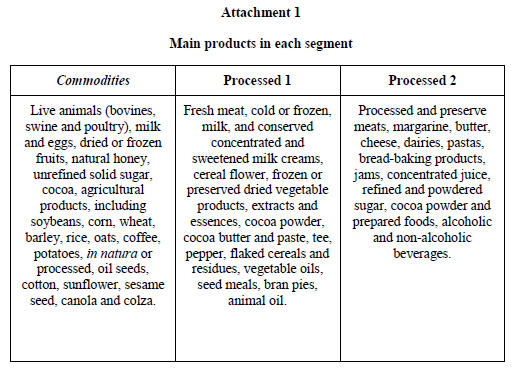
]]> Keeping this particular segmentation of agribusiness in mind, its insertion in the global market will be heretofore analyzed in variance to the level of product transformation, which will be used as a proxy to capture the technological dynamism underlying the whole process. We will presume then, that processed products contain more added value, therefore being considered as more sophisticated from an industrial point of view. In other words, the more developed the agribusiness industrial sector, the greater the weight of innovations stemming from the industry's competitive strategies. Conversely, the more determinant the rural segment, the greater the relevance of those sectors from which agriculture extracts its competitive advantages. Based on the TradeCan database, elaborated by Cepal/World Bank, it was possible to classify food exports into three different segments, according to the level of added value, namely, commodities (unprocessed), processed 1 (products with lower degree of processing) and processed 2 (products with higher degree of processing).9 This typology allows us to discern three ways of accessing markets and their respective patterns of competitiveness, assuming that the degree of product transformation and value adding would be coeval with the existing innovative dynamism. In this sense, unprocessed commodities are embedded in technological trajectories specific to agriculture which are widely disseminated in terms of natural comparative advantages. Exports with a low degree of processing, on their turn, are determined by economies of low scale and insufficient product and process innovation, instances that receive merely superficial contributions from the participant companies. Finally, the route followed by industrialized products toward global markets is determined by an industrial structure able to differentiate products and add value, thus achieving a higher degree of autonomy because of their more aggressive competitive strategies, especially when it comes to new products.Brazilian agro-food exports have shown a high degree of diversification regarding the products and their industries. Taking as baseline the framework we have adopted so far, processed food products (processed 2) had, during the long period between 1985 and 2004, a major participation in the value of food agribusiness exports.10 However, the behavior of exporting sectors must be also seen from the context of international trends. In order to do that, we will use the level of specialization as a gauge to capture the articulation between the profile of Brazilian exports and those of the rest of the world, thus applying it to the three main productive segments of Brazil's food agribusiness.
– Ratio between the marketshare of Brazilian exports i and the participation of Brazil's overall food exports in total global imports
Even though this set of activities has recently shown a high level of competitiveness, this trend has unfolded more emphatically with regards to commodities and low-processing products, in accordance with their participation in the global market. Moreover, the degree of specialization indicates that, from the perspective of the weight food agribusiness exports have in total exports, low added-value products have figured prominently. This tendency has been particularly evident after 1995, when the Brazilian economy started its programs of macroeconomic stabilization (Graph 1). It should be noted that, after a decade of decline, the market share of commodities regained breath, while that of processed foods started sloping down. This revealed a propensity to specialization in products of low or zero processing, whose participation evolves positively vis-à-vis the totality of alimentary products. This tendency was reinforced during the period between 1998 and 2004, when a strong currency devaluation pumped exports of homogenous products, reversing their previous positions. Conversely, whereas the food agribusiness as a whole regained the competitiveness of the 1980's, gains generated by higher-value products have decreased.
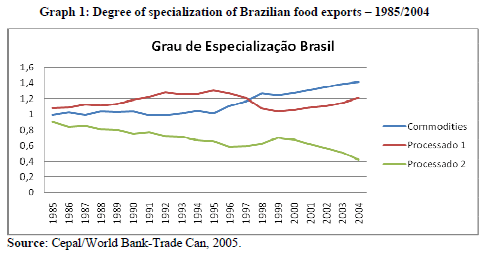
This measure allows us to relate the insertion of each of the three productive trends with the performance of the food agribusiness. Values over 1 indicate that a particular segment has gained preeminence on the totality of the food agro-industry, thus presenting a growth in its market-share that is larger than total activities. On the one hand, Brazilian food agribusiness presents a strong specialization in homogenous products, identified by the rise of both commodities and other products with low degree of processing. On the other hand, industrialized products (processed 2), although showing a light increase until 1999, maintained a level of specialization lower than 1 during the entire period, with significant loss in subsequent years. This means that, whereas global markets have evolved towards more sophisticated products (as previously indicated), the competitiveness of Brazilian agribusiness stabilized on a divergent path from the year 2000 on.
In addition to the tendency observed in the period taken as a whole, macro-economic factors such as tax and currency policies, and the behavior of the imports market have had great influence on the performance of agribusiness' exports. Domestically, a key event has been the Kandir Law, enacted in 1996, which makes agricultural exports tax-free. By the same token, the currency devaluation in 1999 has had a direct impact on the exports of homogenous products, whose capacity to react to price fluctuations has increased. One should add to that list the strategy of importing countries, such as China, to prioritize the acquisition of unprocessed raw materials, as well as the increase in the international commodities price since 2000.
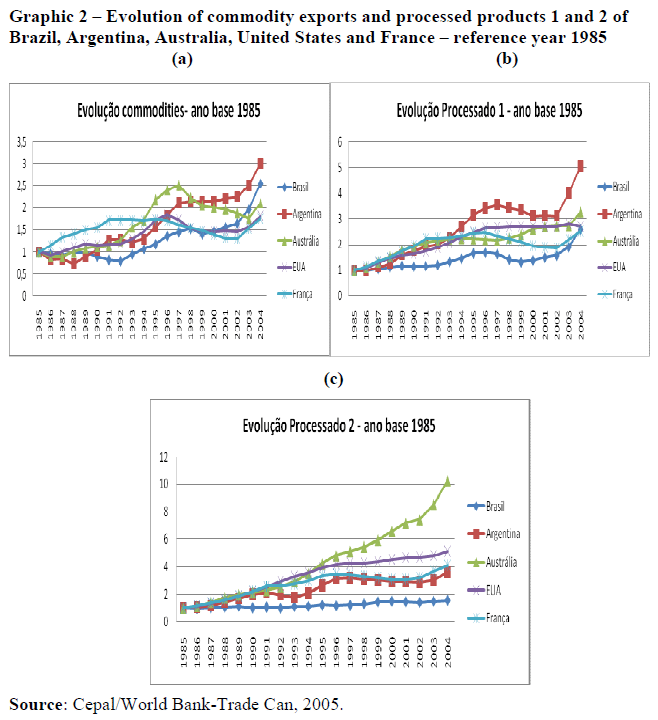
]]> Despite the specificity of each productive segment in terms of the plurality of agents they involve and their price-formation mechanism (pricing), the insertion of Brazilian agribusiness in global markets is ultimately determined by typically homogenous products. In this sense, according to the abovementioned tendencies, the degree of innovation invested in product differentiation (processed 2) has not been enough to contribute to the rise of competitiveness standards up to the level of the industrialized food products segment, which has grown robust internationally. In other words, the industrial dynamism of the Brazilian food agribusiness did not translate into a quality shift in the country's commercial relationships with the rest of the world, to the extent that the complexity of the Brazilian food industry has not been able to expand internationally and has remained restricted to its domestic market.These trends in the Brazilian food agribusiness become even more evident if contrasted with those found internationally among other great exporters of food products. As shown in Graph 2, in recent years countries presented distinct export trajectories. It is revealing that most Brazilian exports reach the lower levels of the chart as products become more sophisticated. A reverse tendency is found in the other countries analyzed, namely Australia, United States and France, whose processed food exports have grown more vigorously than those of other countries and other product trends. The case of Argentina should also be mentioned since, similarly to Brazil, it has had an outstanding performance when it comes to homogenous products, including commodities and little-processed products.
The importance of products with a higher degree of processing is directly linked to the development stage of the food industry and, consequently, to the country's competitiveness. In this sense, the performance of the agri-food industry relies not only on strategies proposed by the companies but also on industrial and technological development policies that attempt to take advantage of export opportunities, strengthening the productive chains and keeping quality control systems attuned to the signs emitted by major consuming markets.
The evolution presented in Graph 2 can be also observed in terms of the degree of specialization. In order to do that, and aiming at a comparison, we will consider only the cases of Argentina and Australia, both emerging countries with economic structures similar to Brazil's (Graph 3). Nonetheless, the establishment of the food agribusiness in these countries reveals very distinctive tendencies and export patterns. Firstly, presenting greater evolution, Argentina is characterized by a vigorous performance in products of low or zero processing and a weak performance in industrialized food exports. Moreover, even though the powerful push on commodities between 1994 and 2002 placed its economy in a situation very akin to Brazil's, Argentina's competitiveness is still higher in terms of products with some level of processing (processed 1). Conversely, Australia is characterized by an extremely diverse tendency, not only because of its expressive evolution in the market share of processed foods, but also because of its high degree of specialization within this segment of products.
In fact, the tendencies presented here are not only the outcome of each country's competitive conditions in each of the segments approached, but also the consequence of strategies adopted in response to the different markets in which agribusiness has been established. The performance of agro-food exports in the case of Brazil and Argentina reveals their capacity of providing timely responses to attractive market conditions, enabling opportunities in areas in which their comparative advantages had already been established. Moreover, commercial strategies have progressively turned their attention to the commodities market, whose prices have been highly profitable in recent years. Conversely, the case of Australia is typical of strategies centered on the construction of competitive advantages resulting from technological and agro-industrial development, whose impact on exports occurs mostly among industrialized products.
Final considerations
This article looked at the evolution of Brazilian agribusiness in light of processes of technological innovation and the ruling tendencies in international trade. To this end, this set of activities was grouped in three segments according to the level of processing, tracing the innovative dynamics as it operates in specific markets. The nature of innovation embedded in the food agribusiness shows distinct technological trajectories, in terms of each productive segment, their resources structure and their degree of autonomy in generating new products and processes.
Current tendencies affecting the global food market have shown the strong dominance of processed products as compared to commodities. This indicates, therefore, that the determinants of competitiveness tend to be situated much more in the industrial sphere than in the agricultural basis. An empirical analysis led us to conclude that the evolution of Brazilian agribusiness has proceeded, to a certain extent, in dissonance with global tendencies. Clearly, even under relatively unfavorable currency conditions, Brazilian exports have shown a considerable level of specialization in products with null or low level of industrial processing. This suggests the great significance of innovative processes related to the rural basis, if compared to those related to industrial processing.
Conversely, the food industry, while embracing some product differentiation, remains strongly attached to the domestic market, both in national and local terms. To a certain degree, this condition acts as a strong determinant of the processing industry's growth towards a higher product diversification and sophistication. The possibility that this industry will respond positively to the problem of adding value to exports depends, to some extent, on the characteristics of the local market, whose consumption patterns may differ from those of developed economies. To which extent this lack of coordination between the profile of domestic demand and that of international markets influences the trade pattern is a topic that remains to be explored. Finally, it is necessary to analyze the behavior of agribusiness exports from the point of view of the innovative strategies adopted by companies in the multiple segments of the processing industry of agriculture and stockbreeding products.
]]>Bibliography
ARCHIBUGI, D. e MICHIE, J. Trade, Growth and Technical change, Cambridge: University Press, Cambridge, 1998.
CEPAL, WORLD BANK, TradeCan. Comércio Global crescerá 7,5%; produto agrícola processado é destaque, 2005. Valor Econômico, 17/18/19.09.2004, pg. A14.
DAVIS, J. H. e GOLDBERG, R. A. A Concept of Agribusiness, Harvard University, 1957.
FERRAZ, J. C.; KUPFER, D. e HAGUENAUER, L. Made in Brazil: desafios competitivos para a indústria. Rio de Janeiro: Campus, 1997.
]]>FRIEDMANN, H. The political economy of food: a global crisis. New Left Review, N. 197, 1993.
FURTADO, A. Difusão tecnológica: um debate superado?. In: PELAEZ, V. e SZMRECÁNYI, T. Economia da inovação tecnológica. São Paulo: Hucitec, 2006.
GRAZIANO DA SILVA, José. A nova dinâmica da agricultura brasileira. Campinas: Unicamp, 1996.
HENDERSON, D, R. et al., International commerce in processed foods: patterns and curiosities. In: Global markets for processed foods: theoretical and practical issues, PICK, D. H; HENDERSON, D. R.; KINSEY, J. e SELDON, I. (eds.). Westview Press, 1998
HUMPHREY, J.; SCHMITZ, H. Governance and upgrading: linking industrial cluster and global value chain research. Working Paper, n. 120, novembro de 2000.
MAPA (Ministério da Agricultura, Pecuária e Abastecimento), Intercâmbio Comercial do Agronegócio, 2008.
MARTINELLI, O. A globalização e a indústria alimentar: um estudo a partir das grandes empresas. São Paulo: Fapesp, 1999.
MINISTÉRIO DA AGRICULTURA. Agronegócio Brasileiro: uma oportunidade de investimentos. Disponível em: <http://www.agricultura.gov.br.> Acesso em: 20 abril. 2006.
PAULA, N. Challenges to the Brazilian agrofood industry in the global market. Revista de Economia, v. 27, n.1 (25), UFPR, 2001.
PAULA, N. Structural change in Food Industry: trends towards concentration. CMDE/UFPR. Revista da Sober, n. 1, 2000.
PAVITT, K. Sectoral patterns pf technical change: towards a taxonomy and a theory. Revista Brasileira de Inovação, v. 2, n. 2, jul./ dez., 2003.
POSSAS, M. An evolutionary approach to technological innovation in agriculture: some preliminary remarks. Cadernos de Ciência & Tecnologia. Brasília, v. 11, n.1/3, 1994.
REGMI, A.; GEHLHAR, M.; J. WAINIO; T. VOLLRATH, P.; JOHNSTON, N. KATHURIA Market access for high-value foods. In: Agricultural Economic Report n. 840, United States Department of Agriculture, fevereiro de 2005. www.ers.usda.gov.
REGMI, A.; GEHLHAR, M. (eds.) New directions in food market. In: Agricultural Information Bulletin, n. 794, United States Department of Agriculture, fevereiro de 2005. www.ers.usda.gov. .
SUNDING e ZILBERMAN, The agricultural innovation process: research and technology adoption in a changing agricultural sector. Versão preliminar (mimeo), 2000.
TRAILL, B. Globalisation in the food Industry. Discussion paper, n. 26. In: Structural change in the European food industry, University of Reading, 1996.
TUBIANCA, L. World trade in agricultural products: from global regulation to market fragmentation. In: GOODMAN, D. E e REDCLIFT, M. R. International farm crisis, Londres: Macmillan, 1989.
VALOR ECONÔMICO, Rio de Janeiro, 25.09.2006, pg. B11.
_______________.17/18/19.09.2004, p. A14.
WARD, N.; ALMAS, R. Explaining change in the international agrofood system. In: Review of International Political Economy n. 4: 4, 611-20, Summer 1997.
]]> * Nilson de Paula and is a professor in the Economics Department at the Federal University of Paraná/Brazil