Lógica familiar e lógica coletiva nos assentamentos de reforma agrária: o caso do município de Unaí
Eric Sabourin; Marcelo Nascimento de Oliveira; José Humberto Valadares Xavier*
Traslated by Leticia Maria Costa da Nobrega Cesarino
Translation from Estudos Sociedade e Agricultura, Rio de Janeiro, v.15, n.1, p. 5-44, 2007.
The public policy of agrarian reform in Brazil still gives priority to collective organization of the settlement, of the services and even of the agricultural production. This collective logic is promoted and institutionalized both by the State and the agrarian reform movements. Paradoxically, the settlement is based on the concession of individual land plots to a public formed mostly by former wage-earners, in the context of the promotion of family-based economic enterprises. This paper analyzes the origins and consequences of the interaction between these logics, focusing the case of land reform settlements of the municipality of Unaí, in the state of Minas Gerais. There is a tension between the individual interest of "the new land-owner", the logic of the family and the collective logic dependent on the modalities of public policy. The obligation of familiar or communitarian solidarity is fed by the precariousness of the settlement process and by the unifying ideology and human values. The results in Unaí teach us that: a) the budgets and the instruments of public policy for agrarian reform are not adapted or suitable, and may become contradictory and lead to conflicts; b) in spite of such conditions and institutional environment, tools and methods for social construction of partnerships allow for a synergy between individual, familiar and collective logics; c) at the local level, the educational effort is indispensable in order to strengthen the dignity and identity of the settlers, but it will be efficient only on medium or long term.
Key words: Land reform, rural settlements, public policies, collective logic, family agriculture, Brazil.
RESUMO
A política pública de reforma agrária no Brasil continua dando prioridade a formas de organização coletiva do assentamento, dos serviços e até da produção agrícola. Essa lógica coletiva está promovida e institucionalizada tanto pelo Estado quanto pelos movimentos pró-reforma agrária. Paradoxalmente, o assentamento se traduz pela concessão de lotes individuais a um público composto em sua maioria de ex-assalariados, no marco de uma política de promoção de empreendimentos econômicos de natureza familiar. Este trabalho examina as raízes e conseqüências da interação entre essas lógicas a partir do exemplo de assentamentos do município de Unaí. Per-manece a tensão entre o interesse individual do "recém-proprietário", as lógicas famili-ares e as práticas coletivas dependentes das modalidades de política pública. A obriga-ção de solidariedade familiar ou comunitária é alimentada pela precariedade do pro-cesso de assentamento e pelo caráter unificador da ideologia ou dos valores humanos. Os resultados em Unaí mostram três ensinamentos: a) os pressupostos e instrumentos das políticas públicas de reforma agrária revelam-se pouco adaptados, quando não contraditórios e geradores de conflitos; b) apesar dessas condições negativas e de um ambiente institucional pouco favorável, métodos e instrumentos de construção social da parceria permitem uma complementaridade entre as lógicas individuais, familiares e coletivas; c) um esforço de educação in loco é indispensável para fortalecer e subsidiar a dignidade e a identidade dos assentados, mas revela-se eficiente a médio ou longo prazo.
Palavras-chaves: reforma agrária, assentamento, políticas públicas, lógica coletiva, agricultura familiar, Brasil.
Introduction
Land reform public policy in Brazil assigns priority to collective forms of organizing settlements, services, and even agricultural production. Such collective logics is being furthered and institutionalized, as a result of the National Institute for Colonization and Land Reform actions (INCRA) and the Landless Workers Movement discourse (MST - the main social organization of candidates to, and beneficiaries of, land reform). Paradoxically, settlements are set up by granting individual land lots to a public made up mostly of former salaried employees, following a general policy of fostering family-based economic units (National Program for Strengthening Family Agriculture - PRONAF) (MDA, 2003). This study purports to analyze and explain interactions at play among these various individual, family, and collective logics (Thévenot, 2006), as well as their rooting and consequences for settlement management. An inquiry into the status of settlements within the municipality of Unai (Minas Gerais State) shows how the assumptions and tools adopted by land reform public policies are ill-adapted, if not contradictory and generative of further conflicts. As a consequence, and notwithstanding the unfavorable institutional environment, a consortium of public institutions and farmer organizations has conducted, since 2003 and within the Unai Project, 1 experiments with methods and instruments of rural development based on mutual respect and partnership. The tools and processes tried in Unai settlements show outcomes, however limited, in terms of learning and support to the organization, production, and its economic valorization. This is a three-part paper. First, the context is introduced, as well as practices and consequences of public policy and social movements intervention in the land reform area in Unai. The second part presents the methods for producing and scaling up innovation through partnership experimented within the Unai Project, as well as the outcomes obtained in terms of organization of the settled families. Part three discusses improvements and constraints as well as lessons which can be drawn from these case studies.
]]>Context and public policies in the Unai land reform area
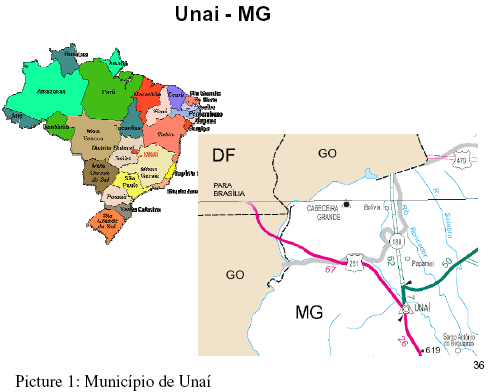
The municipality of Unai is located in the Brazilian Midwest region (Picture 1), where the savannah-like Cerrados ecosystem prevails. It has an area of 8,463 km2 for a population of 70 thousand people. It is the main agricultural, cattle raising and agro-industry pole in Northwestern Minas Gerais State, 165 kilometers from the federal capital, Brasilia. The municipality is Brazil's top beans producer (42,000 ha in 2002), and the leading soybean (55,000 ha) and milk producer in Minas Gerais (IBGE, 2002).
Land reform stakeholders and project implementation
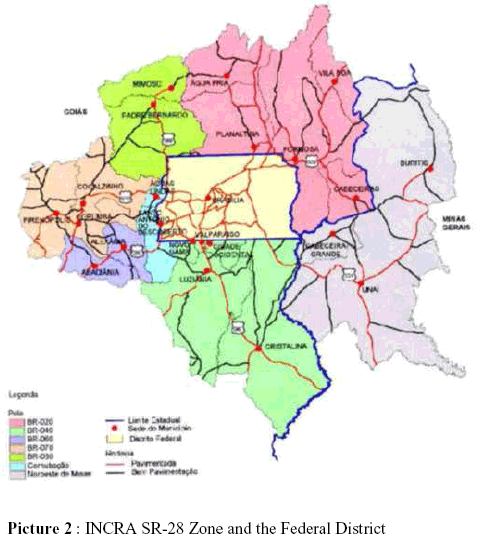
Unaí has the largest quantity of land reform settlements (23) and landless campsites (5) in the region. These figures indicate the inequality of access to land and to income. Unai has three thousand family farm units, of which 1,600 are beneficiaries of land reform and occupy an average 15 to 20 ha per family. In INCRA's 28 Regional Superintendencies (SR-28) there are 107 settlments in 15 municipalities, amounting to 6,000 families for 320,000 ha (Picture 2).
]]>
Rural institutions interfacing with government
The landowner sector's main institution is the Rural Union, affiliated to Brazil's National Confederation of Agriculture and Cattle Raising (CNA) and local manager of SENAR (National Rural Education Service). There are three agricultural cooperatives run by major producers: two of grains (soy, bean) and one milk cooperative which collects around 200 thousand daily liters and includes entrepreneurs, large land owners farmers (fazendeiros) and family farmers (including from land reform areas).
Salaried and camped landless workers, as well as those already settled and a portion of small family farmers, are represented by the Rural Workers Union (STR), which is affiliated to the National Confederation of Workers in Agriculture (CONTAG). The Landless Workers Movement (MST) operates only in three settlements and three campsites its presence in the municipality is therefore limited.
The Family Agriculture Workers Federation (FETRAF) competes with CONTAG in the constitution of intermunicipal union poles in Brazil's Midwest. The former is not represented in Unai, but it actively participates through follow-up courses for settled farmers and their children, who are taught by the Unai Agricultural School, INCRA, UnB (University of Brasília) and Embrapa Cerrados.
Main demands by organizations of settled families involve assistance for securing access to infra-structure (roads, energy, water) and to agricultural credit.
Secondarily, there are requests for personalized technical assistance through de-centralized educational and training activities (opportunities for enabling & qualification, in order to reduce decision-making asymmetry). Finally, there are demands for institutional spaces where public infra-structures can be negotiated (councils and fora) and where new public policy tools can be co-produced. However, social movements are also parochial and prefer to obtain infra-structure for their own municipalities rather than for their neighbors.
]]> Ministry of Agrarian Development's production support policy
The policy for supporting rural development fostered by the Brazilian Ministry of Agrarian Development (MDA) revolves around two axes: land reform as a strategy for generating productive occupations in rural areas, and credit as a tool for sponsoring such occupations throught the PRONAF Program. Land reform policy is heavily centered on family settlements, usually as a reaction to pressure by social movements, especially CONTAG and MST. Running in parallel, there is a strong pressure by these movements for access to credit for investment and production costs.
At the state level, the Minas Gerais Land Institute (ITER) acts chiefly through policies for consolidating settlements already in place.
One of the main problems with such policy is no doubt the disarticulation between processes of family settling, obtaining production-support credit, and providing access to good technical assistance, so that families may lead their own development.
Such disarticulation has many consequences. Amongst them are settled families' high rates of evasion and defaulting financial agencies, and their continued status as workforce available to work in neighboring large properties (fazendas).
As a possible response to such problems, MDA has created the Program for Technical, Social and Environmental Advising and Assistance (ATES). Through this program, non-governmental and governmental institutions, as well as cooperatives of technicians, may qualify to provide technical assistance to land reform settlements in Brazil.
Likewise, territoriality is approached through public policy coordinated by MDA's Territorial Development Secretariat (SDT). It provides a space for debating, planning, devising and executing actions aimed at constructing the territorial plan for sustainable rural development. Since Unai is geographically located in two overlapping territories, it chose to participate in the Aguas Emendadas Territory, comprising the Federal District, seven municipalities in Goiás State, and three in Minas Gerais State. It is estimated that such territory includes 17 thousand smallholders.
In sum, although there is a large group of settlements and landless campsites in Unai, such collective has not yet been able to articulate itself towards enhacing its frail position in the councils, nor to put policies at the service of the sector's interests.
Effect of land reform policies and interaction with local organizations
]]> Tension between family and collective logicsIn the settlements, there has always been tension between the "recent owner's" individual interest, family logics looming large during installation, and collective practices fostered by public policies or by pro-land reform social movements (Sabourin et al, 2005). Settled families should organize collectively ever since the campsite phase, during settlement implementation, throughout the provisional phase of installation, in order to get help, credit for housing and food aid (basic-need grocery packages), as well as during the production phase (solidary collateral guaranteeing agricultural credit, etc.). Settled families' main tensions and complaints against the different levels of government relate to the implementation of infra-structure (housing, topography and land parceling, environmental and land titling regularization, roads and bridges, water and electric power, schools, warehouses). Access to these elements is mediated by the collective, that is, the settlement's producers association. According to the majority of State technicians working in the region, settled families' associations are to a great extent responsible for delays, or are not appropriately accredited nor duly qualified. For smallholders, responsability lies in the federal government and the system of fund transfer through state or municipal governments, which can block the process for political reasons or for not holding required legal conditions for receiving funds from the Union. Therefore, there is a first contradiction for the settled individual who has always been dependent or subaltern to his father, patron, or chief, and who dreams of being at last autonomous, but nonetheless comes to depend on new tutelage: the unionist movement, INCRA, financial and technical assistance agencies, city administration, the association (Martins, 2003, 2004).
Excessively collective procedures even make the community association, which was supposed to naturally reproduce the solidarity experienced during the camping phase, act as a new intermediary, an external power, an obligation, rather than being the expression of the settled families' union. A second contradiction thus appears between the collective's forceful omnipresence and the new landowner's individual feelings and aspirations. If he is the son of a smallholder, as is the case of a fair portion of Unai settled individuals, he has inherited from his parents the peasant's individualistic spirit towards his property, family patrimony, and personalized labor (Wanderley, 1996; Mendras, 1976). If he is a former agricultural worker (another frequent situation in Unai), he tends, whether consciously or not, to reproduce the only farming productive model he ever knew, the cattle raising fazenda system: buying cattle, waiting for its offspring, or outsourcing it altogether. If he is a former salaried employee in civil construction, industry or trade, he dreams of following in the footsteps of his former employer and setting up his own individual enterprise (Sabourin, 2006a).
Tensions and their consequences
INCRA's first intervention for making a settlement official is to establish the producers' association. Secondly, during the developing & operation stage, various services are also transfered to the collectives, such as access to technical and social assistance (ATES). In the view of both the social movements and public services, the supply of inputs, and the processing and trade of products demand creation of a cooperative or a proper association of producers. The community association is regarded as limited to social infra-structure access and management and to cultural activities. Thus, as a result of tutelage's collectivist ideology, settled families are encouraged to implement other, specialized cooperative or associative productive structures. Such was the case of PA Rural Minas Settlement, where a production and services cooperative and a milk producers' association were created in addition to the community association. Settlements of Brejinho and Paraiso created several associations or groups for acquiring or managing collective milk vats.
In practice, bureaucratic rules demand that federal funds can only reach associations through the mediation of state or municipal government. These, on their turn, delay or many times compromise the liberation of such funds, imposing to the associations a supplementary political and administrative intermediary. When there is political or personal rivalry between the municipal administration and the social movements, funds remain blocked. This can lead to the creation of a cooperative or a second association of producers supported by one or the other conflicting parties, thus dividing the settled families. Such procedures and practices nourish conflicts, which can engender even physical confrontation among the groups, especially when financial benefits are at stake. For most of the beneficiaries who do not have personal capital, access to PRONAF or to credit for land reimbursement ("Crédito Fundiário" Program) is guaranteed by a system of solidary surety bond, working as a collective constraint but which, in practice, shows low efficacy for the creditor bank. In the event of incapacity to reimburse, the farmer can be forced to lease his land, return his lot, or be excluded from the settlement by the surety group, either by the association or, more rarely, by INCRA. This prevents the bank or the State from collecting the loan. Therefore, official banks demand from the State a reimbursement insurance linked to PRONAF credit, in order to assure that they will always retrieve the capital invested without effort, without the costs of supplementary transaction, even when the project was inadequate and in the absence of technical assistance. Such system considerably increases PRONAF credit costs (Abramovay and Piketty, 2005), and makes banks accept or promote, for the sake of facility, inappropriate projects. Even if rules were rigorously applied, both theoretically and legally, the bank could still turn against the colleagues who signed the surety bond and thus similarly arrive at their exclusion. Since companies accredited before the bank and settlements underwriting the projects earn at least 2% of the loan‘s total amount (1.5% for the project and 0.5% for technical assistance for PRONAF Credit, and even 10% in case of credit for land reform infra-structure), they naturally tend to overestimate the project and raise its figures, so as to earn as much as possible at the farmers' expense. MDA acknowledges this flaw in the system, since it is easy to accredit any private or public company for ATES but there are few follow-up and control activities. But it is even more difficult to disqualify a fraudulent company or one which does not fulfill ATES' requirements.
A public model reproduced by the private sector and civil society
Other federal public funds (Banco do Brasil Foundation, Ministry of Social Development, Zero Hunger - Fome Zero Program) or private sector funds (churches, foundations and NGOs), usually aimed at purchasing sunk-cost equipment (irrigation, rice-peeling machines, milk cooling tanks), are accessible to settled families only through a collective project. In the case of expensive equipment or adapted to colletive usage (milk tank, tractors and agricultural machinery), the collective option has some logic. Nonetheless, agriculture and cattle raising productive projects assembling the totality of farmers in one settlement have not worked well in the region. In the best scenario, they may work in a small group of volunteer farmers united by friendship. The collective share of rice and cassava in the Jiboia Settlment comprises six acquainted families, with little expressive productive results; however, the collective project has in fact succeeded in obtaining funds for a rice-peeling machine.
]]> Collective cropping projects (rice, gardens, cassava, flour) – which are a community tradition in certain areas in Brazil, but not in this one – and even collective animal raising (hens, laying hens, goats) were funded and failed, in addition to generating conflict between the partners. Two associations benefited with funds from the Zero Hunger (Fome Zero) Program / MDS aimed at food security and the enhancement of family nutrition. The projects were designed to strenghthen practices of self consumption through distribution of small animals (rustic-breeds laying poultry) to every family, together with adapted technical training (breeding, hygiene and nutrition). In practice, the presidents of the two settlement's associations were contacted by local agencies intermediating the Ministry of Social Development's program (the city administration and an NGO) for devising the project. Each association received a thousand laying hens for around 30 families, ratio food for the first month, and a metal mesh screen for building a collective chicken coop.Concerned with the commercialization of such a high quantity of eggs, farmers believed in the intermediaries' promises that they would find buyers or purchase the egg production for city school lunch. In practice, no technical qualification or commercial support was forthcoming and a large number of eggs had to be donated or just allowed to rotten in place. Salvaged hens were shared among the families. In one of the associations, due to lack of information, hens did not get appropriate food, therefore jeopardizing their egg production. The best hens were recovered by one of the settled farmers, who set up a private project for supplying alone the market which had been previously identified by the settlement. He was the former manager of the expropriated farm, who had also received the best piece of land in the settlement. In the other association, food was lacking and families had to contribute with their own resources for paying the association's debts. Technical support was not provided as prescribed in the contract, and the city administration did not purchase the eggs. Nonetheless, in the following year, the same kind of project was offered, and it was still able to find volunteers willing to engage into collective raising (this time, goats and pork).
The first experience yielded only losses, but families expect the second one to be better. Since it was a sunk cost experience, they think they have nothing to loose.2
SENAR's action, through the Patron's Rural Union or milk cooperative for technical qualification & enabling of settled individuals, experiences the same collective bias. In the SENAR system, in order to organize a course of professional or technical capacity-building in a settlement, at least 15 participants are required. This requirement diminishes the chances for small settlements, or works only for young males or women, who have more spare time. In training for productive or economic activities (apiculture, poultry raising, handicraft, etc.), such bias has negative economic effects. A collective training of 15 people in the same settlement or municipality hinders any economic solution if all 15 intend to legitimately sell in the local market the same honey, the same cassava flour, the same buriti tree fiber or fabric handicraft. Conversely, when it comes to bolstering its own interests, the cooperative easily forgets collective and solidary principles. It receives public funding for training farmers for free. In practice, it demands that they pay for transportation, if not for food, and charge an enrollment fee for more sophisticated courses (e.g., insemination). It offers free capacitation and qualification only to those affiliated, who pay a R$600.00 quota - a monetary amount impossible for most recently settled families or small cattle raisers.
As for the social movements, ideological biases (Marxist catechism) loom large. MST insists in creating production cooperatives in the projects it sponsors or in the settlements where it is majority. After a decade of failures, especially in Northeast Brazil, the integral production cooperative (of a kolkhoz kind) was replaced by the service cooperative, better adapted to peasant reality, but where management problems remain. The new peasant project of autonomy, life quality and production claimed by MST since it adhered to the Via Campesina (Stédile, 2003; MST, 2004; Carvalho, 2005) often contradicts the recruitment of settled families in collectivist structures which overshadow or intermingle with the individuals' and families' efforts. A peasant farmer values his work or that of his family in the family's land, that is, he defends the honor and reputation of his family name : he values the quality of their fruits and the beauty of their animals, as well as the amount of milk or banana produced. Collective systems for producing vegetables and animals, and even mixing milk from several cattle raisers (of diverse qualities) in a same cooling tank, are practices which deny the acknowledgement (and the payment) for the quality of a well-done work. Many times, these elements are the main source of pride for the poor farmer, since they are the only differential signs of identity and dignity which he is capable of offering.
It is necessary to acknowledge that MST has implemented an educational system ranging from basic literacy to higher education, passing through schooling and permanent training. Nonetheless, technical training remains this device's most fragile Achiles heel link. Such technical training should be provided by Movement-created technical assistance cooperatives, which have INCRA's support on the same basis as technical assistance provided by public bodies (EMATER). This comprises providing a technician, a vehicle and a computer to assist 100 settled families. According to the farmers supposedly assisted by such cooperatives in Unai and Minas Gerais settlements, training is overall ideological, and technical support is rare (Martins, 2003; Mello, 2006). It is impossible to generalize. As all organizations that recruit partly on an ideological basis, such cooperatives associate good quality personnel with militants who are ill-prepared. In certain instances, as in Boa União, they received INCRA funds but never delivered technical assistance, and ended up being expelled by the farmers' association (Sabourin, 2006a).
Besides such collectivist biases, in most cases settled families are successively instrumentalized and deceived by the State, by INCRA, by technical assistance consultants, by local bank managers, if not by the very leaders of the movements or their technical cooperatives. Therefore, this assistentialist system of public funds transfer to the farmers' collectives ends up harnessing private interests: consulting firms, farmers who sell old cows at the price of a selected animal. Consequences for the smallholders are economic failure, permanent default in bank or credit systems, as well as disillusionments generating frustration, distrust, if not conflicts among the own settlers. It was in such a context of uncertainty (Callon et al, 2001) and poor governance (Matus, 1987) that the Unai project was born and operates.
The Unai Project: an attempt at research-action-training in an arduous environment
A progressive methodological construction
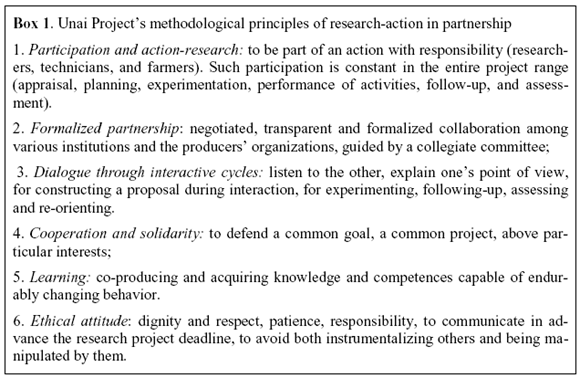
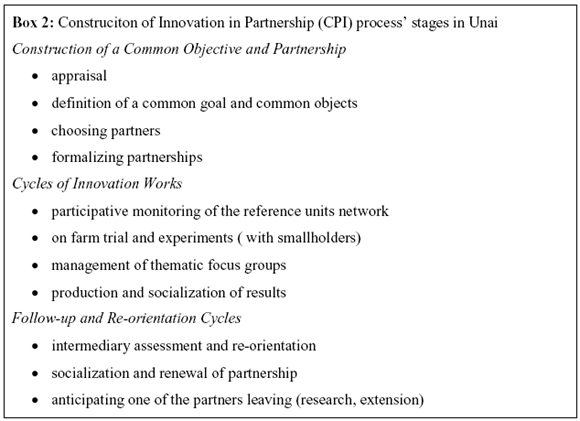
]]> Under such conditions, the project's challenge was to - together with the settled farmers, technicians and their institutions - search for alternative production techniques, organizational alternatives, as well as to collaborate for empowering smallholders, both at the individual and collective levels.Therefore, a participative approach inspired in Research & Development in Farming Systems (Billaz and Dufumier, 1979; Mazoyer 1987) and in Action Research (A-R) (Thiollent, 1999; Liu, 1992, Morin, 2004) based on principles and attitudes (Box 1), rather than in methodological prescriptions, was adopted and progressively adapted. Recently, an attempt was made of systematizing such an approach in order to foster more formal collaborations and partnerships among settled families, their representative organizations, and public services. Early experiences targeted technical, institutional and social innovation devices, through the Construction of Innovation in Partnership (CIP) (Triomphe and Sabourin, 2005, Box 2).
]]> The methodological axis of Unai Project's several components – research, education / training and development action – can be summed up in three lines:
• participative strategic planning for supporting the organization;
• construction of technical (productive, commercial) and social innovation in partnership;
• experimenting new models of rural education and technical training.
Applying research-action to the construction of innovation in partnership
Research approach in Unai follows the Research-Development (R&D) focus on four complementary lines of action (Xavier et al, 2004):
• supporting the organization of settlements for fostering agriculture;
• using a network of farm units as reference for supporting the productive process;
]]> • management of natural resources and soil fertility through direct planting;• supporting smallholders' insertion in markets and the economic value of products.
Construction of Innovation in Partnership's process deploys the following actions:
• participative monitoring of a network of reference units and regular restitution of results;
• management of thematic interest and focus groups, and of farm experimentation;
• workshops, methodological and technical training and planning (PEP) sessions.
The social construction of innovation assembles a series of innitiatives and experiments organized around groups of smallholders and technicians called Thematic Interest Groups, since they include those interested in working one same theme (Gastal et al, 2003). Technicians, researchers and farmers jointly deploy internal and external resources (including research centers and universities) for carrying out processes of experimentation and divulgation of innovations adapted to local demands and situations.
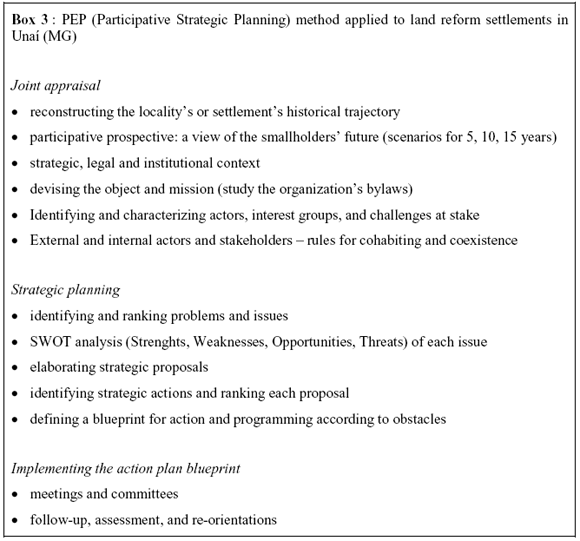
In sum, A-R methodology comprises several cyclical and interactive stages. The first is elaboration of a rapid, dialogue-based appraisal allowing smallholders to identify problems they face and the potentials for supporting a development process. In order to do so, data gathered are treated and returned to them through meetings and restitution sessions. After restitution, Participative Strategic Planning (PEP, Box 3) begins, allowing settled families to identify, prioritize, establish, follow up, and assess the proposals and actions necessary to construct their development process. Such actions are buttressed by specific works at the level of production, organization, and market insertion. Information produced are called references3, and are used for the benefit of other settlements, thus amplifying the process' scale.
]]>
This requires a notion of capacity-building understood as a process, grounded in sensibilization, self-diagnosis, implementation, management and control, allied to the process of constructing innovation in partnership.
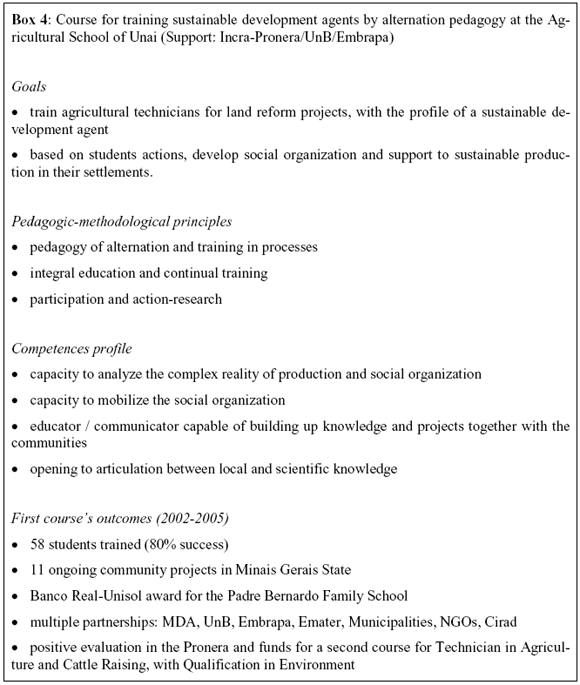
Such an approach's early steps took place precisely in the field of formal education, through a course for training local development agents, set up specifically by UnB, Embrapa and Unai's Agricultural School for settled smallholders and their children in the settlements within SR 28 Superitendency (Picture 2). This technical course was carried out between 2003 and 2006, alternating with field activities in the settlements (pedagogy of alternation, see Box 4,).
Early outcomes and improvements
]]> Preliminary outcomes obtained through this approach were positive and encouraging: farmers from the three settlements where the methodology was tested were able to progress to the productive level. Milk production and quality improved with practices of hygiene and forage intensification. Adoption of direct planting and other practices secured the corn harvest, controlling weeds and reducing dependency on rented tractors. But the chief progress occurred in organization, around associations (strategic planning) and interest groups, particularly for milk vats management, processing or commercialization of Cerrado native fruits, and direct planting experimentation.
What changed with the focus on building-up partnerships?
First, the attitude of researchers, technicians and trainees toward approaching and dealing with smallholders and their families, with patience, respect, visiting their plots and animals, listening to their demands and valuing their knowledge and practice. This generated an environment of mutual trust, tolerance, openness to a qualified socio-technical dialogue, conducive to setting up project-tailored experiments, with pace, rhythm and conditions specifically designed to each settlement or to each kind of smallholder.
Secondly, forms of approaching family and collective aspects have evolved: researchers tried to break up assistentialist, paternalistic, and evidently dominating practices which made farmers increasingly dependent, led to immediate demands without searching for an internal solution, and also to the smallholders' self-devaluation.
By being taken into account, heard, supported and trained by the researchers, farmers were also held accountable and supervised at the family and productive unit levels, as well as at the collective level (interest groups, association, or cooperative).
Support to family production dynamics (not only individual, as is the case of an enterpreneur farmer) revitalized self-consumption practices, valued participation and the work of women and youngsters (through capacitation and diversification activities), and paved the way to building up in smallholders a new perspective on the need and limits of common services through collectives, associations or cooperatives.
The association of organization dynamics, co-construction of innovation, and educational actions was vital for strenghthening family capacities (Box 4). Training of youngsters has reinforced the association's hand for negotiating the price of milk with the cooperative, the price of supplies with agricultural stores, or the settlement proposals in municipal and territorial councils. Recently-trained young technicians (settled families' childrens) animated interest groups, and, together with their colleagues, created a cooperative for providing technical assistance to other settlements in the region .
However, such outcomes must be weighed against two factors: a) they were achieved thanks to the concentration of research efforts and human resources in order to test alternatives, produce and make systematic references in only three settlements followed for three years; b) there is a certain difficulty in keeping at arm's length researchers who get involved, and who induce or take on roles of smallholders or of technical assistance.
]]> Discussion, limits and lessons
Elements for analyzing tensions between the actors' logics
Improvements and contradictions of participative planning
In the three settlements where PEP was applied, improvements were found in programming priority activities, decision-making, networking, formulating projects, and identifying sources of support and resources. There was a process of training participants for institutional learning (of rules) and social learning (learn by doing). But there are also difficulties with implementing decisions, securing continuity, sharing information and resources, overcoming the old demons of relationship and power conflicts between leaders and groups. Researchers take pains to make farmers accountable. They cannot sanction the associations' failures, and do not intervene because they do not want to jeopardize outcomes which are needed for their studies or short-term projects.
Indeed, in order to achieve outcomes within useful deadlines set up by programming and financing demands, and to be able to mobilize the smallholders and other partners, researchers had sometimes to induce decisions or actions on behalf of other partners. This is common and legitimate in an action-research process, where the researcher takes on the role of an actor in the process, but it has to be assessed at some arm's length distancing. It shows the lack of a contractual relation and formalization of partnership which would better specify each part's role and responsibility, the means or entities suitable for control, guidance and arbitration.
Solidarity, reciprocity, and collective identity
Researchers' attitudes, proposals, but also demands made smallholders ascribe importance to values associated with practices and conducts. This was shown in the restoration and valorization of relationships of solidarity and reciprocity toward researchers and among the farmers, thus strenghthening collective identity. However, it is not easy to break up with the negative and subaltern identity imposed by tutelage and society in order to create a positive identity. Running in parallel with a long social and political construction of the feeling of dependence, of an identity of someone assisted, the landless feels powerless and incompetent, a feeling which remains when he is settled and which is fostered and nourished by the stigma manifested by the rest of society.
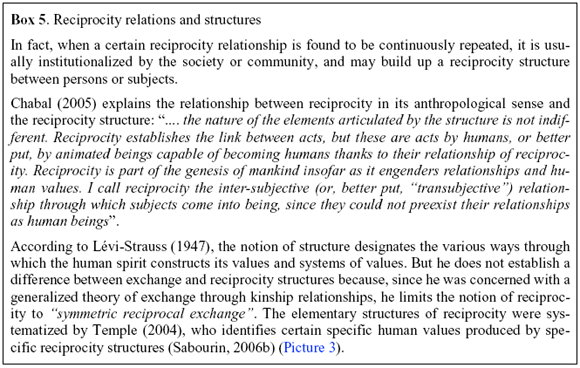
Indeed, in settled communities, there is a tradition, or at least a need, for family or social solidarity which is different from collective practices and structures induced or imposed from the outside. Such tradition relies on relations of reciprocity.4 Such mutual obligation emerges as a response to the precarious conditions experienced during the camping & installation process. Such solidarity is built up through the extension of kinship and proximity relations (Rocha et al, 2004). It explains the success of land reform projects uniting beneficiaries from the same region or neighboring communities and who hold kinship ties. When land lots are made available during composition of settlements or in the event of waivers, it is common that a beneficiary calls a member of his family or a member from his region's movement who is in the land plot waiting list. The same kind of solidarity and reciprocity occurs between people and families who have shared an experience of collective organization during the sometimes long-lasting phase of struggle for land or precarious camping. Reciprocity through mutual help and hospitality is then reinforced by a process of collective or social learning (Ostrom, 1998).
On the other hand, it is hard to dissociate ethical improvements and the construction of identities from ideological consideration and beliefs: religion and political opinion in the case of smallholders; belief in universal science and its politically correct participative methods in the case of researchers.
]]> Forms of solidarity operate around the unifying character of ideology or human values shared through religion or the mystique of social movements, in particular the politico-religious mystique of unions and MST. Religion is, frequently, the last factor of reciprocity and collective identity, coming to the foreground only when other values collapse or become the subject of confrontations (Sabourin, 2005). Mello's (2006) study of Rio Grande do Sul settlements shows that religion is one of the main factors of social cohesion and, consequently, of lower abandonment rates by land reform beneficiaries. He notes that the Evangelical Church has become the main movement competing with MST in terms of settlement organization. In Unaí's Jibóia Settlement, (divided into two groups) the Catholic religion is the only factor of unity and proximity. This informal group organized by women was even able, without external help, to gather funds and build a chapel within a few months, whereas the community association could not even get organized in order to finish reparing the meeting room's ceiling. Researchers have unsucessfully proposed to apply the women's method of raising funds and organizing collective work through mutual help and reciprocity practices (organizing games, "bingos" of products and small animals, selling free-range chicken , mutual help workshops and so forth).Indeed, reciprocity in production, which unfolds at the level of the real and allows for securing and reproducing material, mutual or collective installments, differs from symbolic reciprocity – in this case, Catholic religion. It is not possible to jump automatically from one level to the other, since they are structures controlled by values of a different nature. In the case of symbolic reciprocity, the structure is ruled by the binding word of religion, by a value of obedience to an included third party of divine nature. In the case of mutual help, it is the group's material well-being, controlled and reproduced by the values of friendship and alliance, which is this included third party (Temple, 2004).
The same kind of mechanism is found in the politico-religious mystique mobilized by social movements through chants, games, and mutual motivation exercises. The sharing of a mystique creates a feeling of collective identity, and the word of union allows for the mobilization of great collective events of land or public building occupations, pilgrimages and rallies. But it is still the realm of a reciprocity structure centralized by the redistribution of a binding word engendering obedience to the word of God or to his representative, or yet to the movement's leader.
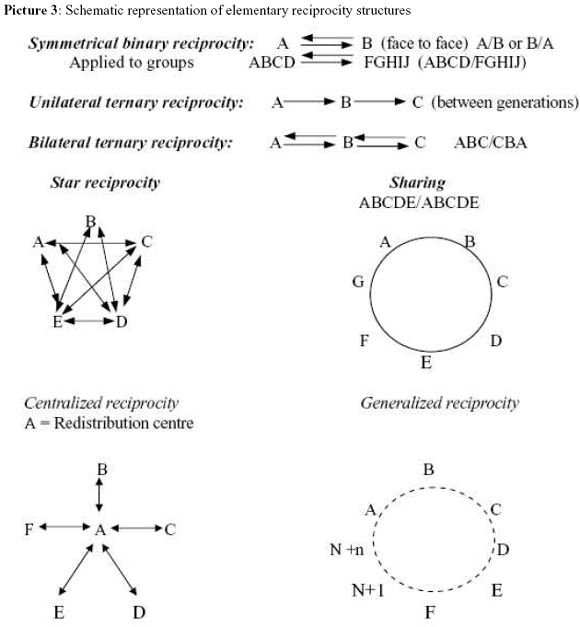
In fact, in the case of small groups of new owners in a settlement, mystique and religion no longer work toward building up reciprocity structures in production such as mutual help or collective efforts (Sabourin, 2006c). The institutionalization and reproduction of such practices rely on proximity, kinship, bilateral reciprocity relationships (friendship, compadrio5) or the need / capacity to share a resource or a piece of equipment through a ternary reciprocity relationship (Picture 3). However, in order for this to happen there should be a recognizing of the other, an opening of the circle to the entire set of families in the settlement, rather than a partition or the closing in small clans. Such situations generate but feelings of resentment, hate, jealousy, frustration and, therefore, hopelessness and incompetence. This is the exact opposite of collective identity's positive feelings: conquest of the land and means for autonomous production, and restoration of dignity and citizenship, which are usually present in the reciprocity relationships engaged during the stage of struggle for land and collective learning.
Difference between the stages of struggle for land and settlment
Several land reform observers (Martins, 2003, 2004) and even Unai unionist movements call into question the tremendous difference between the stages of camping and settlement in terms of the collective and organizational dynamics occurring in the same groups. Smallholder dependency on tutelage and burgeoning frustrations due to the interested intermediaries and assistentialist conceptions of land reform policies contribute to collapsing the landless' feeling of identity, dignity and the solidarian practices built up during the struggle for land (Touraine, 1993). Such practices are even able to replace clans, through a process of social, political, and mediatic (a prejudiced press dominated by conservative political and economic groups, as well as sensationalist television) construction of a negative collective identity. Such negative "landless" identity is being nourished and reinforced by the stigma made manifest in the rest of society. The term landless is an index, because it sticks to the face and to the skin. It is often used pejoratively. It is extended to those who have already got access to land, or worse, to their children in municipal schools. That is why the loss of legitimacy or just of sympathy vis-à-vis public opinion is important for the movements as well as for the future of land reform. And this, besides the change in electoral deadlines as has been seen during President Lula's federal administration, is not being able to change the situation, or does so only to a low degree. There is something which is not being well identified nor analyzed by MST leaders, and which an understanding of settled families is able to explain. They do not share MST's ideology neither all its values, they ignore its project for society and of a socialist revolution (and even the meaning of socialism), but they remain faithful militants of the Movement which granted them access to land. There is a feeling of reciprocity toward the Movement related to access to property, the sharing of human dignity in family production which paves the way for economic and social autonomy. Therefore, respect and solidarity shown by most settled individuals towards MST have to do more with gratitude, with a feeling of being obliged in a reciprocity relationship, than with an ideological adhesion or any commitment to collectivist or socialist structures of production.
]]> But even if the settled subject is, in essence, a plural being in a heterogeneous and artificial social environment made up of uprooted and displaced individuals, he does not appear as a modern individual simultaneously or successively bearing various "engagement regimes" in the sense of Thévenot (2006). He and the members of his family are, foremost, traversed by social contradictions overwhelming his capacity for consciousness and looming larger than the scale of his settlement or municipality. But he is, at the same time, the hero of resistance, and heir to these systematic contradictions between the logics of the collective, community or family, as well as the exchange logics of an individualistic or collectivist tendency.For Silveira (2005), in a study of land reform projects in Rio Grande do Sul State, "the invisible subject of land reform returns in a new peasant project associating family, work and land". Family organization and values can perfectly coexist with a political imaginary symbolically constructed around the struggle for land and survival. An analysis of settled individuals' discourses show the reverse of an introspection caused by resignated renouncement. For them, it is fundamental to build up a positive image of themselves, the symbolic epical hero who overcomes obstacles with faith, hope, and bravery. It is therefore around such values and relationships mobilizing and reproducing them that it is possible to reconstruct a positive identity and structures of social cohesion, capable of empowering the new farmers for responding to the challenges faced at the individual, family, collective and institutional levels.
Unai Project's methodological lessons
The instruments typically shown to be more effective for achieving the appropriation and valuing of infra-structure and technical or financial support by settled smallholders or family farmers are those related to persons (including women and youngsters) and to their goals, practices and technical knowledge. There are three categories of intervention in terms of social learning and training competences through action configured along those lines. These are: rural education, social construction of innovation, and support to organization.
Rural education (Molina, 2002) is experiencing renewal in Brazil due, to a great extent, to land reform efforts carrying out a series of educational programs in rural areas, funded by the National Program of Education for Land Reform (PRONERA) and the Ministry of Agricultural Development's Family Agriculture Secretariat (SAF). The experience of schools managed by smallholders, Rural Family Houses (CFR) and Agricultural Family Schools (EFAs) paved the way, by fostering a pedagogy of alternation (between study and work in agricultural exploration) based on the study of reality and follow-up of students during practical traineeship stages.
Organizational support cannot be limited to management rules (even if this kind of information is needed); it should contemplate the building of competences and the upholding of values allowing people to live together, work together, and make decisions and act together. Among these instruments, several innovative experiences are being developed in Brazil within land reform projects, as well as in rural and peasant communities.
The common-thread characteristic to these actions is that they depart from a family's concrete problems, and value the collective knowledge of smallholders and their communities. They also make smallholders more accountable in their decisions and in the management of collective and institutional devices implemented towards this end (Mormont, 1996, Sabourin et al, 2005).
Social construction of innovation assembles a series of innitiatives by groups of farmers and technicians (from NGOs or producers' organizations) who jointly mobilize external resources (including research centers and the university) for carrying out processes of experimentation and diffusion of innovations adapted to local circumstances. The social construction of partnership's mechanisms allow for a complementarity between the logics and actions of an individual, family, collective and public nature. The methodological approach is of a research-action-training kind, and is founded upon (verbal or written) negotiated and contractual partnership between the actors involved (Box 1). It makes possible to start breaking down attitudes tied to forms of alienation derived from the logic of capitalist exchange (private interest, opportunism, competition for profit and private accumulation). Such attitudes, pervasive in the routines and customs attributed to national tradition or regional values, have to do with the alienation proper to asymmetric reciprocity structures: corporativist, assistentialist, paternalistic and clientelistic relationships.
]]> Conclusions
Unai Project's early socio-technical or socio-political outcomes point toward three kinds of lessons: a) the assumptions and instruments of land reform public policies and of pro-land reform social movements have shown to be ill-adapted, if not contradictory and generative of inter-institutional tensions and conflicts between settled families and their organizations; b) the social construction of partnership's methods and instruments allow for complementarity structuring of the individual, family and collective logics; c) a specific effort for in loco education is indispensable for strenghthening and buttressing the settled collective and individual's dignity and identity.
Notwithstanding the human and institutional conflicts which are unavoidable in condition such as those found in Unai settlements, adapted support modalities may contribute to restoring smallholders' organization and positive collective identity. Such methods and instruments bear several characteristics shown to be particularly well-adapted and suitable to the situation of land reform beneficiaries.
Those initiatives seek to instill in the actors values and competences of accountability and autonomy, so they can break up traditional schemes of dependency, assistance, sponsoring and paternalism sustained by successive forms of tutelage in rural areas.
These focuses considered the peasants' resources, practices, archives and knowledge and thus contributed to reinforcing and nourishing the restoration of their individual and collective dignity and identity, preparing them for taking on the stewardship of their own development process.
Actions are always territorialized and localized, drawing upon local resources, population and knowledge.
Indeed, actions are carried out on a local scale, that of the municipality or small region, as closest as possible to experiences in the lives and works of smallholders and their families. They unfold from the conditions, resources, characteristics and attributes of their land, their territory. This does not exclude an opening to others through study, visits or invitations made to people from other regions. The notion of territory and territorial dimension of development provides an opportunity for aggregating views and resources in order to make up a larger project, priorizing actions and infra-structures which do not correspond to or cannot be chosen nor implemented at a local level.
Finally, smallholders' reports on the experiences in Unai and similar projects show that it is not enough to have infra-structures and technologies, if local actors do not have the consciousness or willingness to value them, or do not have competence to use them. Therefore, education and capacity-building for all, at all levels and moments, are paramount. But it is not enough to educate and train only in order to transfer technologies, recipes or even theoretical knowledge without the practice of technical and social experimentation, which is the sole guarantor of true learning. Lastly, it is not enough to have (theoretical, practical or institutional) learning without respect and the transmission of universal ethical and human values such as friendship, tolerance, trust, responsibility, or justice. These were precisely the features and words used by settled individuals to describe the profile of a good technician, a good researcher, or a good politician. These are also the values and words that students and teachers at Unai Agricultural School spontaneously voiced in assessing their learning and lessons from this great Alternation Course partnership.
Bibliographic References
]]>Abramovay R.; Piketty, M. G., Politique de crédit du programme d'appui à l'agriculture familiale (Pronaf) Résultats et limites de l'expérience brésilienne dans les années 1990, Cahiers Agriculture, n° 14, v.1, 2005. [ Links ]
Billaz, R.; Dufumier, M. La Recherche Développement en agriculture PUF/ACCT, Paris, 1979. [ Links ]
Callon, M.; Lascoumes, P.; Barthe, Y., Agir dans un monde incertain: essai sur la démocratie technique. Paris: Seuil, 2001. [ Links ]
Carvalho H. M. de. O campesinato no século XXI. Possibilidades e condicionantes do desenvolvimento do campesinato no Brasil, São Paulo, Editora Vozes, 2005. [ Links ]
Chabal M., Les structures élémentaires de réciprocité. Conférence in Cauris 2005 http://afrique.cauris.free.fr/conferences.html Accès le 20/09/2005. [ Links ]
Gastal M. L.; Xavier, J. H.V.; Zoby, J. L. F.; Rocha, F. E. de C.; Silva, M. A. da; Ribeiro, C. F. D. de A.; Couto, P. H. M. Diagnóstico de Três Assentamentos de reforma agrária em Unaí-MG. Planaltina: Embrapa- Cpac, 2003. Boletim de P&D. [ Links ]
IBGE. Dados do censo populacional 2002, www.ibge.br, acesso em 30/05/2005. [ Links ]
Levi-Strauss C. Les structures élémentaires de la parenté, XXVII. "Les cycles de la réciprocité" La Haye, Mouton, [1947] 1967. [ Links ]
Liu M., Présentation de la Recherche-Action, définition déroulement et résultats; Vers une épistémologie de la Recherche-Action. In Revue internationale de systémique, v. 6, n. 4, Paris, 1992. [ Links ]
Martins, J de S. O sujeito oculto: ordem e transgressão na reforma agrária. Porto Alegre: UFRGS, 2003a. [ Links ]
Martins, J de S. Travessias: estudo de caso sobre a vivência da reforma agrária nos assentamentos. Porto Alegre: UFRGS, 2003b. [ Links ]
Martins, J. de S. Reforma agrária – o impossível dialogo, São Paulo: EDUSP, 2004. [ Links ]
Matus C. Planificación en sistemas de baja gobernabilidad. In: Seminario Internacional de Economía Campesina y pobreza rural/sous la direction de Jorge Bustamente R. Bogotá: Fondo de Desarrollo Rural Integrado, 1987. [ Links ]
Mauss M, Essai sur le Don. In: Sociologie et Antropologie, Paris, PUF, 7ème édition, [1924] 1950, réédition 1989. [ Links ]
Mazoyer M. Dynamique des systèmes agraires, rapport de synthèse du colloque sur la dynamique des systèmes agraires. Paris : MRT, 1987. [ Links ]
Mello P. F. Evasão e Rotatividade em Assentamentos Rurais do Rio Grande do Sul. Dissertação de Mestrado - Universidade Federal do Rio Grande do Sul, 2006. [ Links ]
Mendras, H. Les sociétés paysannes. Eléments pour une théorie de la paysannerie. Paris: Armand Colin, 1976. [ Links ]
Ministério de Desenvolvimento Agrário/Conselho Nacional de Desenvolvimento Rural Sustentável Referências para um desenvolvimento territorial sustentável, Brasília, MDA-SDT-CONDRAF, 2003. [ Links ]
Molina M. C. Desafios para os educadores e as educadoras do Campo In: Educação do campo Identidades e políticas públicas . Brasília: ANCA, 2002 [ Links ]
Morin, E. A Pesquisa-Ação Integral e Sistêmica: Uma Antropopedagogia Renovada. Rio de Janeiro: DP&A, 2004. [ Links ]
Mormont M. Agriculture et environnement: pour une sociologie des dispositifs. Economie Rurale, Paris, v. 236, 1996. [ Links ]
MST. A organicidade e o planejamento. Texto interno do Movimento Nacional dos Trabalhadores Rurais Sem Terra, Encontro Estadual da Paraíba, abril de 2004. [ Links ]
Ostrom E. A behavioral approach to the rational-choise theory of collective action, American Political Science Review, 1998. [ Links ]
Rocha, F. E. de C.; Padilha, G. C. Agricultura familiar: dinâmica de grupo aplicada às organizações de produtores rurais. Planaltina, DF: Embrapa Cerrados, 2004. [ Links ]
Sabourin, E. Organização dos agricultores e produção de valores humanos. In: VII Congresso da Sociedade Brasileira de Sociologia, Belo Horizonte, junho 2005. [ Links ]
Sabourin, E. Diagnostico dos dispositivos coletivos dos agricultores familiares nos assentamentos do Município de Unaí, Brasília, UnB, CNPq, Cirad, Embrapa. 2006a. [ Links ]
Sabourin, E. Práticas sociais, políticas públicas e valores humanos. In: A diversidade agricultura familiar. Sérgio Schneider (org.) Porto Alegre, UFRGS, Estudos Rurais, 2006b. [ Links ]
Sabourin, E. A ajuda mútua, entre intercâmbio e reciprocidade. In I° Encontro da Rede Rural, Niterói, UFF, julho de 2006. [ Links ]
Sabourin, E.; Duque, G. ; Diniz, P. C. O. ; Oliveira, M. S. L. ; Florentino, G. L. Reconnaissance publique des acteurs collectifs de l'agriculture familiale au Nordeste. Cahiers Agricultures, v. 14, n. 1, 2005. [ Links ]
Silveira, D. S. da. Narrativa histórica, etnografia e reforma agrária em um assentamento rural. MS de antropologia, Porto Alegre, UFRGS-IFCH, 2005. [ Links ]
Stédile, J. P.(org). A questão agrária hoje. Porto Alegre: UFRGS, 2003. [ Links ]
Temple D. Teoria de la Reciprocidad. Tomo I: La reciprocidad y el nacimiento de los valores humanos; Tomo II : La economía de reciprocidad, PADEP-GTZ , La Paz, Bolívia, 2004. [ Links ]
Thévenot L. L'action au pluriel. Sociologie des régimes de l'engagement. Paris, La Découverte, Politique et Société, 2006. [ Links ]
Thiollent M. A metodologia da Pesquisa-Ação, São Paulo, Cortez, 1999. [ Links ]
Touraine A. Production de la société. Paris, Seuil, 1993. [ Links ]
Triomphe, B.; Sabourin, E. Construção da Inovação em Parceria Oficina CIP, Brasília 12-14/12/2005, Cirad, Embrapa UnB, ed Cirad Monptellier, 2006, (CD Rom). [ Links ]
Xavier, J. H. V.; Santos, C. E. S.; Zoby, J. L. F.; Silva, F. A. M. da; Oliveira, M. N. de. Adaptação e utilização de dispositivo metodológico participativo para apoiar o desenvolvimento sustentável de assentamentos de reforma agrária. Planaltina, Embrapa/CPAC, 2004. [ Links ]
Wanderley, M. N. de B. Raízes históricas do campesinato brasileiro In: XX Encontro Anual da Associação Nacional de Pós-Graduação em Ciências Sociais (ANPOCS), Caxambu, 1996. [ Links ]
]]> This communication was presented in the Working Group "Land Reform and Rural Settlements" at the VII Latin-American Congress of Rural Sociology, Alasru, Quito (Ecuador), 2006.
]]> 5 Translator's note: Compadrio is a kin-like relationship between parents and their children's godparents, (relatives or friends who are chosen to preside over the children's Catholic christening). ]]>