Políticas públicas, redes de segurança alimentar e agricultura familiar: elementos para construção de indicadores de eficácia
Luiz Manoel de Moraes Camargo Almeida; Luiz Fernando Paulillo; Sônia Maria P. P. Bergamasco; Vera Lúcia Silveira Botta Ferrante
Translated by Jeffrey Hoff
Translation from Estudos Sociedade e Agricultura, Rio de Janeiro, v.14, n.2, p. 205-235, Oct. 2006.
This work presents a methodology for investigating the performance of public politics regarding food security networks formed in Brazilian municipalities aimed at increasing income and employment in familiar farming. These programs need to further develop the methodologies used for studying their efficiency so that they can reach a new stage in the improvement and use of management tools thereby achieving beteer results of social inclusion and/or food security. This paper constitutes a first effort to bring together indicators for the evaluation of the efficiency of public politicies.
Keywords: food security, familiar farming, public politicies.
RESUMO
O presente trabalho apresenta uma metodologia de investigação das eficácias das políticas públicas voltadas para redes de segurança alimentar que foram formadas nos municípios brasileiros em torno do principal objetivo de elevar as condições de renda e de emprego na agricultura familiar. Esses programas necessitam aprofundar as metodologias de investigação de suas eficácias para que, a partir daí, possam entrar em uma nova etapa de aperfeiçoamento e utilização de ferramentas de gestão e, conse-qüentemente, de resultados de inclusão social e/ou segurança alimentar. Assim, este artigo constitui um primeiro esforço de reunir indicadores de avaliações das eficácias dessas políticas públicas.
Palavras-chave: segurança alimentar, agricultura familiar, política pública.
Introduction
This study is based on the premise that it is necessary to advance towards a new development phase in food security policies in Brazil. This can occur through the initiation of evaluations of the applicability, effectiveness and governance of public policies of this nature in the municipalities. Much of the effectiveness of a local food security program can be investigated in terms of the existing institutional and organizational impediments (such as norms or guidelines that impede the adaptation of a local actor – whether a municipality, secretariat, farmers association or cooperative, resident association etc., the operating procedures of people in bureaucratic positions strategic to the functioning of the program or demands of certain public contract guidelines etc.) to the operation and consolidation of existing social networks.
]]> These difficulties can stem from different actions, either internal or external. In the case of institutional and organizational problems for agricultural regions (in particular for farm families and rural workers) important examples can be a lack of investments and public credits that allow farmers to invest in infrastructure (such as housing construction, seed and raw material purchases, assembly of processing units etc.), limited technical and human knowledge of the production agents given a certain type of cultivation or a given production process for raw materials, difficult relations between the settlers1 and the local public and private actors, low levels of education and organization in rural areas, the low level of information among farmers about the procedures that should be adopted to participate in public bids and other types of sales in government programs for the purchase of foods, the relationship of the settlers and the symbolic value of the products in the local commercialization channels, among others.It is essential to construct effective indicators of these types of policies to increase the efficiency of the public policies, and principally, to improve the living conditions of rural families who are potential beneficiaries of local food security programs (not only economically, but also in social, educational, political, environmental and cultural terms). To do so, it is important to establish, as a first step, the causes of the different types of difficulties encountered by administrators of these food security programs, because they can be used to prepare strategies to mitigate management problems by improving local public food security policies.
For this reason, this study will present a methodology for the study of the effectiveness of public policies aimed at food security networks that were formed in Brazilian cities with the principal goal of elevating the income and employment conditions of family farmers (on small farms and rural settlements etc.). This makes it essential to propose and discuss the methodological forms that can support the construction of models for supervision and effectiveness of these public policies aimed at local food security networks. This paper will emphasize indicators for accompanying those policies that involve and can improve the income and employment conditions of small family farmers and farmworkers in Brazil. The food security programs created most recently in the country and that directly involve family farming include: a) family agribusiness, b) integrated management of school meal programs that involve the federal government food purchasing program for school meals (PAA), c) low cost farmers markets and d) community gardens.
The evolution of food security programs in Brazil and the importance of local institutional standards
At the end of the 20th century, the commercial opening, the fragmentation of the State, the complexity of civil society and the predominance of economic policies aimed at monetary stabilization increased social inequalities and broadened the distance between the world's nourished and undernourished peoples. A strong indication of this distance is, on one hand, the growing sophistication of the eating habits of the nourished (guaranteed by the greater supply and quality of products from the large agribusiness chains) and on the other hand, the precarious supply or lack of food for hundreds of millions of people.
During the 1990's, public policies for intervention and distribution that sought to achieve food security in Brazil – based on centralized coordination and decisions made from top down – began to encounter signs of depletion because of the great difficulty of serving, in an intensive and constant manner, the needy population in increasingly complex locations (degraded and semi-abandoned urban areas, others with difficult access, distant rural zones with complex logistics, productive regions with a high degree of exclusion etc).
In the current decade, Brazil has experienced the implementation of public food security policies considered to be alternative at the various government levels (federal, state and municipal). The first years of the 21st century were notable because the broad concept of food security finally began to sustain the agenda of public policies aimed at reducing hunger among the poorest population and by increasing the actions of solidarity for people in situations of marginalization in the country (including working people such as rural workers, family farmers etc.). Since 1997, when the World Food Summit (a United Nations forum with country representatives) was finally able to reach a consensus on a broad concept of food security to support public policies applicable to a great diversity of countries (from the developed to the underdeveloped), some programs began to be executed in Brazil. Sine then, the efforts of various governments in Brazil (local, state and federal) produced the enactment of various food security policies (Paulillo; Pessanha, 2002).
Food security policies should consider production, distribution, access and consumption of foods; and should also be linked to fundamental factors: 1) health, 2) hygiene, 3) the environment, 4) authenticity and 5) solidarity. All of these factors are socially constructed and shared in policy networks that focus on the functionality and adaptation of an equitable food standard for the poorly nourished population.
The category of health involves the nutritional and pharmaceutical dimensions linked to the composition of foods – the protein, fiber and cholesterol content, etc.. For this reason, the nutritional education of the needy population is essential. The second category is that of food hygiene and security and the absence of toxic or noxious elements. These notions are inseparably linked to the need for information, guarantees and controls for the conditions of production and distribution, and of the packaging norms. Thus, the certification of food products appears to be a crucial issue.
]]> The third category is ecological–organic, which corresponds to the production of foods without toxic risks and the demand for respect for the environment. Food concerns should place importance both on food quality as well as on the form of producing it and the ecology is a factor of increasing importance in the living habits of the population. So much so that in the developed countries, there are important consumer movements in support of environmental preservation.The fourth category is authenticity, which refers to the natural and traditional values of food production and concern for the importance of the origin of the products and for the specification of the agricultural and agroindustrial production processes (from the use of land to the form of processing). It involves ideals about knowing how to produce food. The fifth category is that of solidarity, in which moral and ideological values encourage the participation of the well nourished population in humanitarian actions in the process of consumption, through the purchase of socially correct products instead of others. In these products, the price to be paid is higher because it gives priority to farm production and the processing of foods from rural settlements, from small properties and to ecologically correct products, which do not involve child labor etc. There are many examples such as the international Fair Trade movement, the institutional municipal markets, and family produced agroindustrial products, which are increasingly being used by social actors dedicated to the value of solidarity of food security policies in the capitalist world.
Thus, a policy in the area of local or regional food security should include four integrated spheres of action and areas of interventions: production, distribution, access and food consumption. The first dimension refers to the production of foods in rural and urban areas, such as rural settlements, small properties - most of which have family farms - and urban gardens (community or school run). In this aspect, there is a need for intervention that seeks to develop the capacity of family farms and urban communities to work in associations on a municipal or regional level, for training courses for farmers and rural workers and the establishment of added value through the agroindustrialization of family farming. The second category includes supplementary or emergency food distribution programs to specific groups, such as schools, hospitals, charitable institutions, penitentiaries etc. The third dimension is related to access to foods, including actions in the field of supply and sales. The fourth dimension, consumption, encompasses nutritional education, education for sustainable consumption and the organization and training of consumers and other productive and public actors involved in the policy. These latter categories require thematic interventions in the realm of technologies for food management and institutional supply that seek the consolidation of protection and cooperation networks of local and regional actors, which encompass actions such as the inclusion of foods from family farmers in school meals, training courses for school cooks and members of rural and municipal food councils, food banks, urban harvest, solidarity supply centers, municipal inspection services, programs for acquisition of foods, popular restaurants and programs for training in management technologies for family farming (Paulillo; Almeida, 2005).
The institutional standards and the norms and the social values special to each location indicate a capacity for establishment of social development agendas of a relatively endogenous character, as long as the restructuring processes do not have a narrowly economic character, but involve decisions of a political nature and the development of the local social capital.
In this sense, the contribution of the endogenist theory is to identify the currently decisive production factors that are determinant within the region and not in an exogenous form, as previously understood. Thus, it was concluded that regions with these factors, or those strategically aimed at developing them internally, would have better conditions to achieve accelerated and balanced development. Two dimensions can be identified in endogenous regional development. The first is economic, in which the local business society uses its capacity for organization in the most appropriate method possible (considering the regional productive factors). The second is socio-cultural, in which the local values and institutions serve as a basis for local or regional development.
This trend is marked by studies about institutional networks "that allow cooperative actions – which include, evidently, the conquest of public goods such as education, healthcare, information – capable of enriching the social fabric of a certain location" (Abramovay, 2003: 84). This is beginning to be discussed in scholarly works focusing on excluded local actors and still needs to be deepened.
Research routes for the analysis of the development of local food security networks
For research and analysis, it is important to consider the notion of public policies such as the system of action and knowledge (Muller, 1994). For this definition, an attempt can be made to define those agents and organizations that interact regularly, in a determined period, to implement public actions and to influence the formation and enactment of measures and decisions that should come from government.
Participant observation, a technique derived from Anthropology, as well as the assemblage of field diaries (Whitaker, 2002) are valuable tools for collection of data and analysis of concrete situations.
]]> The participative character promotes broad interaction between the researchers and the actors involved and there is great variation in the degrees of involvement of the actors. The concept of actor is understood here as "any group of people who have a certain ability for conscious collective action in a given social context" (idem).Participative research is based on the realization of seminars and interviews (with open or semi-structured questionnaires), with the participation of social, economic and political agents in an organizational field, which are configured as the best spaces to debate and prove the hypotheses formulated during the research. Thus, the development of projects for the evaluation of local public food security policies (and the networks formed) should be supported by qualitative and quantitative analyses of the data from the field research to be conducted. One example of the use of quantitative data that can be developed is the investigation of food security levels of families living in urban and rural areas in the municipalities selected, to later accompany the evolution of these results, based on the implementation of the food security programs in each location.
The classification of the levels of populational food security, based on the investigation of urban and rural families, can be based on four levels: 1) food security (when there is no problem of access to food in qualitative or quantitative terms and there is no concern that there will be a food shortage; 2) low-level insecurity (when there is a concern of a possible food shortage in the near future and when domestic arrangements are needed so that the foods last longer; 3) moderate insecurity (when there is a commitment to food quality, seeking to maintain the needed quality. At this level of insecurity, there is the beginning of a reduction in the quantity of foods among adults); and 4) severe insecurity (when there is a restricted quantity of foods, leading to hunger among adults and children).
An instrument for the collection of information should be developed by means of structured and semi-structured questionnaires. A good example of the information collection tool is that currently used by the "Rede Alimenta" [Nourish Network] at the University of Campinas (Unicamp). Concomitantly, other qualitative research techniques are used: such as the participative diagnostic dynamic, which is already widely used by some of the official and non-governmental agencies involved with the urban and rural populations in general.
Participative diagnoses allied to the field diary technique would increase an analysis' capacity for penetration of the tensions generated by the mobilization of forces by field agents and in the search for resources of power in the regional and local spaces.
To complement these techniques, secondary data should be collected, as well as that available in official data bases, and that obtained by working with information contained in the minutes of the municipal councils (rural, education and healthcare) in the municipal budgets and other official local documents. This would provide a vision of the administrative behavior of the public agents, as well as the materialization (or not) of the proposals and projects of the distinct political forums in which the rural food security problem is discussed. This helps to identify routes for the formulation of local food security networks for cooperation and protection that aim at social inclusion.
Whenever necessary, to assist the handling and analysis of data, statements should be taken from the agents that stand out in the research. This provides greater clarity about the objectives and strategies of each set of agents that the investigation seeks to accompany. The participation of the important actors in each location would contribute to the construction of the principal indicators that would guide the assemblage of the questionnaires and that will be delineated from the program to be evaluated in each municipality studied.
Research Steps
1. Conduct qualitative and quantitative evaluation procedures to investigate the levels of food security of families living in urban and rural areas of the selected municipalities and later accompany the evolution of these results, based on the implementation of the food security programs in each location. This can begin with the validation of the methodology and of the information collection tool of the "Nourish Network" at Unicamp, by means of which it is possible to classify the population in four levels: 1)food security; 2) low-level insecurity; 3) moderate insecurity, and 4) severe insecurity as mentioned above.
]]> 2. Construct indicators for the evaluation of effectiveness and applicability of the local food security policies in the municipalities selected and, based on that, show the differences in the food security policies that involve family farming;3. Evaluate the food security programs in the municipalities selected based on the indicators selected and consolidated, showing the effectiveness of the programs mentioned;
4. Show the management practices and the differences in governance used by the food security programs in the municipalities selected and the existing organizational difficulties, to propose improvement actions so that each would be as efficient as possible in the realization of its task;
5. Discuss the consequences of the implementation of the food security policies on the lifestyles of the populations studied;
6. Analyze the possibilities for the food security policies to change eating habits and commercial production practices, for sales and consumption of foods.
Principal indicators for the evaluation of food security policies that form local networks for inclusion of family farming
It is known that the structural profile of a municipality can be defined beyond a classification in terms of population, The definition of this profile should consider the location's insertion in development projects and its management focus. In relation to the professional sectors and that portion of the population that participate in the food security policies executed in each municipality, it is important to emphasize the form that they can adapt. The administrative sectors and the target public are submit to complex and hard to understand institutional filters (such as rules, norms, financial limits set by federal and state governments for public policies with these goals, demands and control procedures and cultural conventions concerning nutrition that influence the preferences of the target public including children, the elderly, pregnant women etc.). These filters come from a wide variety of fields (economic, political, technological, social and cultural).
The food security policies highlighted in this text are those developed locally (and that are distinguished by some operational factor), although there is a horizontal or standardized institutional range for the municipalities to follow and to which they should adapt. Generally, these frameworks are presented and regulated by the federal government, as is the case of the Program for the Acquisition of Food for School Meals (PAA) or of any other legal procedure for the purchase of foods for local school meals, used by a municipal government, although under the same rules and norms valid throughout the country. It is in this institutional horizontality, on a more aggregated level, that the work is initially supported to develop a set of indicators for accompanying the effectiveness of food security policies. The indicators that will be suggested also have a certain flexibility that allows registering differences among the localities, and thus, better precision for the evaluation of policy management and the development of respective management in the institutionalized networks.
The initiatives of rural agribusiness constitute local food security networks considered in a broad manner and are indicated as one of the alternatives to reverse unfavorable social and economic situations in rural regions. They stimulate the direct and indirect creation of new jobs and income for family farmers and promote their social and economic reinclusion within this current economic model.
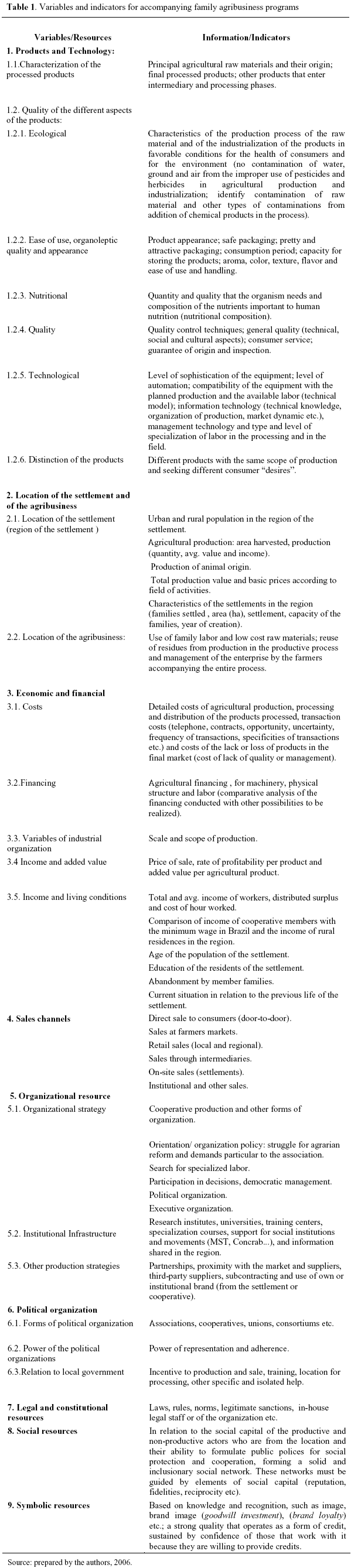
]]> In São Paulo State alone, 3,112 Agricultural Production Units (UPAs) were identified that undertake industrial activities in accord with the research sample realized (IEA, 2006). The estimates indicate that the annual value of production of rural industry in São Paulo in 2001 was R$ 26.295.020,79, with milk pasteurization and wood processing activities being those that contributed most to this result, accounting for approximately 31% and 27%, respectively. The rest are highlighted by the manufacturing of cheeses, yogurt, butter, cream and doce de leite (21%) and the confection of sweets, jams, jellies, canned vegetables, breads, pastries and cookies (15%) (IEA 2006).Agribusinesses use products that originate from family farming and generate channels of commercialization on local and regional levels, constituting local networks in which the individual and collective actors seek a set of resources in many spheres (economic, political, legal, technological, organizational, social and symbolic). Therefore, both on the local and regional sphere, there is a large number of actors (individuals, local, regional and state collectives etc.), that will interact with each other according to their ability to wield power. The different actors can be represented by the traditional settlers or family farmers, by the forms of organization (unions, associations, cooperatives), by the production structure and the locations of added value (sales channels, agribusinesses), by the consumer market, by government agents and others. In this sense, the decisions concerning value added to farm production go beyond the economic sphere and are defined in the realm of the political and social capital found among the different local actors, although the results of the referred to aggregate can be measured by means of economic parameters. Table 1 shows the principal variables and their indicators that should be analyzed in projects to accompany public policies related to family agribusinesses.
Other programs for inclusion of foods produced by family farmers are being implemented in many regions of Brazil, whether by initiative of the federal government (through the Food Acquisition Program) or by state initiatives (with sectoral programs for productive chains with a high degree of marginalization of rural farmers) and municipal (with policies constructed locally for the purchase of regional products that have high rates of supply in these areas). These programs consider all the factors of food security that were indicated above and justify the considerable difference existing between the food security programs (that can even encompass the first four factors indicated – health, hygiene, environment and authenticity) and food security (that adds solidarity to the first four factors, as a fundamental goal).
There are many municipalities that have already adopted policies of this type. Some interesting examples can be mentioned, such as the inclusion of pasteurized natural orange juice in school meals at Bebedouro (SP), pork at Xanxerê (SC), fish in Santos (SP), milk in São Carlos (SP) and vegetables in Catanduva (SP) etc.
The types of food purchased for nursery and elementary school meals reveal an important component of the school food management process in each municipality. Regardless of the origin of the resources (whether from the federal government food purchase program, or from financial resources provided by a municipal or state government) the presence of this type of program shows that the municipality is dedicated to practicing food security in a broad manner. Thus, an evaluation of the management process of municipal school meals should consider these practices, which can be synthesized in objective questions such as: 1) Does the municipal government makes purchases from farmers in the region or municipality? 2) When do farmers sell during the year and at what price? 3) Do they use the federal PAA? How many farmers were benefited in the year? 4) Do they purchase foods from community or school gardens? What is the estimated amount? 5) Do they acquire foods from the municipal bakery and the estimated cost of these products? 6) Is there a continuous municipal government program for the purchase of food from family farmers?
The questions mentioned are useful to begin to show that there are interesting indicators for the evaluation of the effectiveness and the applicability of school meal management in many municipalities (as should be demonstrated throughout this paper). The indication of the level of effectiveness of a public food security policy will be useful not only for the knowledge and transparency needed for the use of financial, legal and organizational resources utilized, but mainly as an element to guide the new steps in these programs (which can reach an evaluation of their continuation). It is for this reason that these and other programs should be studied in Brazilian municipalities (as should be the management of school meals and the purchase of products from family farmers for school meals, the school and community gardens, the low-cost farmers markets for family farmers and popular restaurants).
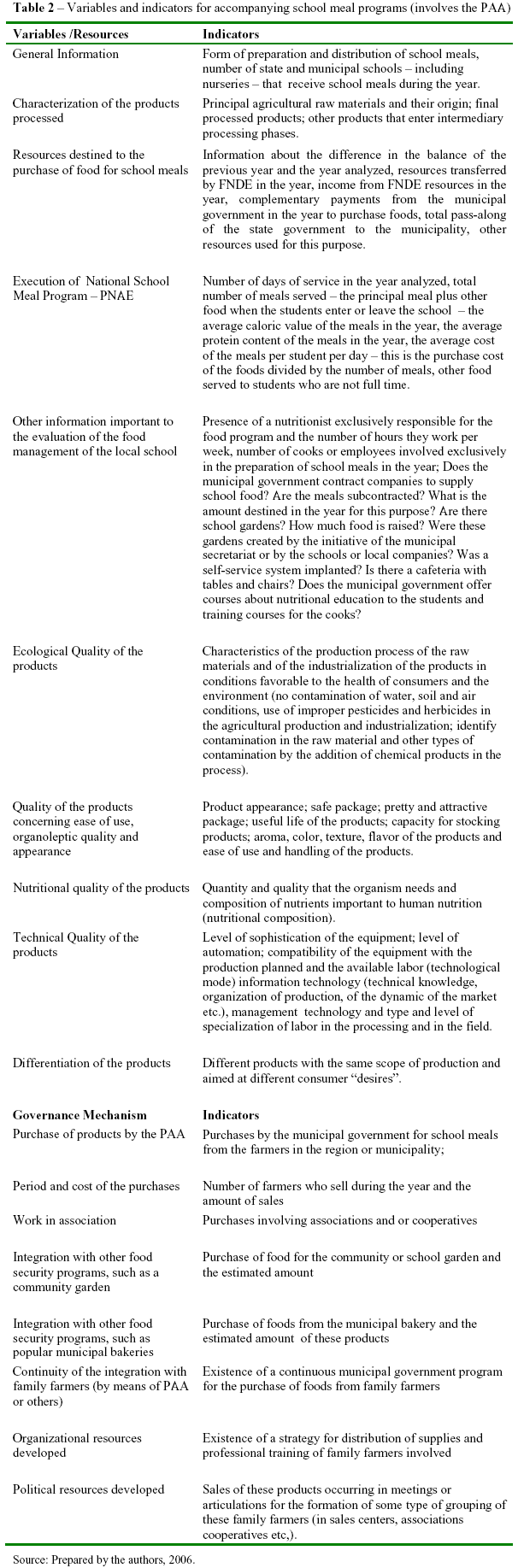
The evaluation indicators of school meal management must involve five more modules, in addition to the module for verification of quantity and quality of the resources aimed at local family farming. The other five modules are: a) general data of the national school meal program in the municipality (should contain information about the type of administration, the type of preparation and distribution of school meals, the number of state and municipal schools – including nursery schools – that receive food from the municipality in the year and the number of students that receive school meals during the year); b) resources destined for the purchase of foods for school meals (involving information about the difference in the balance of the previous year with the year analyzed, resources transferred by FNDE in the year, income from the resources from FNDE in the year, complementary food purchases by the municipality in the year, total amount passed on by the state government to the municipality, other resources used for this purpose); c) execution of the National School Meal Program (PNAE), (number of days attended in the year analyzed, total number of meals served – the principal meal plus other food provided when the student arrives or leaves – the average calorie content of the meals in the year, average protein content of the meals, the average cost of the meals per student per day – which is the spending for purchasing food divided by the number of meals, other food served to students who are not full-time); d) operation and functionality of the School Food Council (involving information about the number of meetings held by the council in the year analyzed, form of choice of civil society representatives, details about the report of the CAE in relation to the accounts presented in the year analyzed, level of participation of the CAE in the school food program – from very active to barely active); e) a final module containing other important information for the evaluation of the school meal management model of a municipality – or that is, beyond the evaluation of the school meal purchasing process that was not previously presented. The information includes: Is there is a nutritionist exclusively responsible for the school meal program? How many hours does she work? How many cooks or employees are involved exclusively in school food preparation in the year? Does the municipality contract companies to supply the school meals? Are the meals contracted to third parties? and How much is spent in the year to do so? Is there a school garden? How much food is raised? Are these vegetables raised by the initiative of the municipal secretariat or by the schools themselves and local companies? Was a self-service system implanted? Is there is a cafeteria with tables and chairs? Does the municipal government offer courses about food education to the students and training courses for the cooks?
Table 2 below shows the principal indicators that should be used for the evaluation of school meal management in each location (whether by means of the federal purchase program or through another form of purchase – in this case guided more specifically local management).
Note that the management of the school meal program in any municipality can be evaluated based on very objective criteria, which should serve to show the effectiveness and the applicability of a fundamental food security policy for the future of a local society, because it involves the children and adolescents who are studying. Quantitative indicators can be combined with qualitative ones, concerning the formation of school gardens, the fight against the subcontracting of industrialized meals, the purchase of regional foods produced by local farmers etc. Thus, the limits of the local food security policies should begin to be discovered by this extensive evaluation of the school meal program, food security actions (that is contemplating the issues of health, food hygiene, the authenticity of products and respect for the environment) and of food safety (considering solidarity for marginalized actors, as in the cases of family farmers and farmworkers).
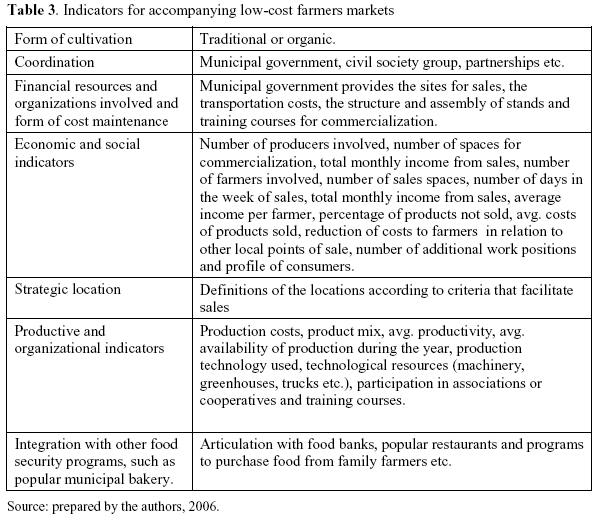
The low cost farmers markets are alternative programs for family farmers created by the municipalities that seek to provide incentives to production for self-consumption and the consequent generation of surpluses for the local market that help lead toward sustainability. They are aimed at direct retail sales of fruits and vegetables, canned and jarred products, sweets, dairy products and those from cottage industries, rural crafts and other types of food. By this means, family farmers have conquered greater space on the political agenda, and are an innovative initiative in municipalities from the point of view of public management (Duval and Ferrante, 2006).
]]> As part of this initiative, the municipal governments provide transportation for the farmers and their products, stands for exposition and aprons for characterization. The income of the farmers from direct sales varies from R$ 400,00 - R$ 1.000,00 per month. The accompaniment of these initiatives has demonstrated that through agriculture for self-consumption one can envision a possible development alternative, although one that is still restricted to a small group of farmers who are better organized and thus able to meet the demand of municipal programs (nearly 30 farmers per municipality). The possibility for expansion, and possible increased income and involvement of more families, can be strategy for many of them. As a complement, these products can reach cities more cheaply and with less pesticides and herbicides. Issues such as the place of the family farmer on the political agendas of the municipalities and the generation of regional and local development or even agriculture with regenerative practices, contrast those of the economic dependence of small farmers in relation to the large ones, the conventional model of agricultural production and the fact hat nearly all of the food supply in the municipality is from crops from other states.The objectives of the program for local low-cost farmers markets are to: a) facilitate the flow of agricultural production of family farmers and the rural settlements; b) stimulate the diversification of municipal agricultural production; c) promote the financial self-sustainability of family farming, by improving the farmers' socio-economic condition and stimulating the creation of new rural employment; d) provide incentives to work and organization in associations; e) increase and diversify the production of fruit and vegetable farmers in the region and in the rural settlements; f) benefit the consumer, by means of sales of products at more accessible prices, considering the possibility of sales without intermediaries. and g) serve as a tool for the municipal food supply and food security policy.
The community gardens have various options for location, involvement of the adult population and the schools, cultivation method (organic or traditional), form of organization (by the municipal government or delivered to a neighborhood community) and partnerships (with churches, non-governmental organizations) etc.
These gardens are being created in most of the municipalities that have already enacted other food security policies (such as food banks, purchases of food from local family farmers for school meals etc.). The difficulty of meeting the maintenance costs of community gardens is one of the growing concerns that the municipal governments confront. In addition to maintenance, another intriguing point is the capacity of these gardens to maintain suitable food supply and distribution systems that wind up focusing around them.
There are community gardens that are maintained and administered by a municipal government and others that are administered by a civil society association. Another important issue for administration is the process of choosing the site, because there is unused land, (often former garbage dumps) that are controlled by municipal governments and there are also incentive programs for the owners of vacant land in urban areas to cede them for the development of gardens (which can be conducted by social entities that work with needy people, public school students, work groups etc.). One important factor is that these gardens can have an educational component for public school students and for the population in general, through the development of training courses that teach people to plant trees and plants in their neighborhoods. Finally, it is important to emphasize that in many municipalities community gardens are stimulated by municipal laws. The creation of a law with incentives can help the municipal government regulate and encourage the community gardens in public and private lots, in right-of-ways of the local electrical company and in municipal schools, as a way to generate work and income. The technical projects of planning and constructing the gardens must be inspected by the environmental agency and by the department of works (or by any other municipal technical agency that has this responsibility). In the same form, the technical evaluations should be periodic and executed by the municipal department responsible for inspection. Finally, it should be emphasized that there are already many organic gardens operating in advanced form, as in the municipalities of Lavras (MG), Curitiba (PR) and São Carlos (SP).
This type of initiative in the realm of local food security programs has been well accepted in the municipalities where they have been implemented. This may be because they address supply problems (through regular production, low prices etc.) or because of the education about food and production they offer children in the local public schools and needy adults and youth in the neighborhoods in which the gardens are organized. Their fast implementation is another benefit.
]]> Final considerations
This text is based on the idea that it is necessary to construct consistent methods for the evaluation of the application, effectiveness and governance of local public food security policies. Only in this way will it be possible to advance this line of social development in Brazil. It is essential to propose and discuss methodological forms that support the construction of models for accompanying and assuring the effectiveness of public policies aimed at local food security networks. This article is a first effort to combine indicators for the evaluation of the effectiveness of these public policies that involve family farming.
The importance of the social inclusion of family farmers in the municipalities has been emphasized, because their products are aimed at direct sale to consumers in farmers markets and other urban spaces, for local projects such as school meals and charity organizations. This stimulates the generation of income and local and regional development. The practice of self-consumption agriculture is characterized by environmental and food concerns for many of the families, and can also be related to issues such as social and cultural reproduction and relations of solidarity within communities. These program may also provide income sources for farmers involved in the municipal programs.
The municipal programs, in turn, can give priority to the needs and preferences of families as the principal generators of their development. From production that previously served for their own consumption and that for other families within the settlements, the surplus can go beyond this realm, to serve as material both for direct sale and in the market (at farmers markets, supermarkets, farm stands, restaurants etc.), as well as for use in local projects. They are productions that, in addition to having a role in the family budget for the farmer and generating sociability and cooperation in the community, can establish the social inclusion of this rural population in the municipality. In this way, the municipality comes to produce more of the food that it consumes and spend less time and money on highway transport for its shipping, and a role of local power is exercised in the presentation of alternatives for sustainable local and regional development (Duval and Ferrante, 2006).
The programs are also designed to provide benefits to the urban population through lower cost foods (through direct sales) and through food security in school meals. It has been possible at least to associate them to the development of traditional crops. They also identify municipal government with new policy concepts for the creation of projects for the use of agricultural spaces on the settlements and for traditional small farmers.
Bibliographic References
Abramovay, Ricardo (2001). Conselhos além dos limites. Estudos Avançados. Instituto de Estudos Avançados, set./dez., 2001, p. 121-140. [ Links ]
Abramovay, Ricardo. O capital social dos territórios: repensando o desenvolvimento rural. Comunicação apresentada no IV Encontro da Sociedade Brasileira de Economia Política: UFRS, julho de 1999. [ Links ]
Abramovay, Ricardo. O futuro das regiões rurais. Porto Alegre: Editora da UFRGS, 2003. [ Links ]
Belik, W. Políticas de seguridad alimentaria para las áreas urbanas. In: Belik W. (org.) Políticas de seguridad alimentaria y nutrición em Amercia Latina . São Paulo: Hucitec, 2004. p. 283-318. [ Links ]
Instituto de Economia Agrícola São Paulo, www.iea.sp.gov.br, acessado em 2006 [ Links ]
Duval, H. C; Ferrante, V. L. S. B. Assentamentos rurais na agenda política: considerações sobre dois programas municipais em Araraquara-SP. In: Reforma agrária e desenvolvimento: desafios e rumos da política de assentametos rurais, 2006, Araraquara-SP. Anais do Simpósio da Reforma Agrária e Desenvolvimento: Desafios e Rumos da Política de Assentametos Rurais, 2006. [ Links ]
Maluf, R. (org.) Abastecimento e segurança alimentar: os limites da liberalização. Campinas; IE/Unicamp, 2000. 234 p. [ Links ]
Müller, G. São Paulo – o núcleo do padrão agrário moderno. In: Stédile, J. P. (org.) A questão agrária hoje. 2ª ed. Porto Alegre: Editora da UFRGS, 1994, p. 221-37. [ Links ]
Paulillo, L. F. Almeida, L. M. Redes de segurança alimentar e agricultura familiar: a merenda escolar como instrumento de desenvolvimento local. Cadernos de Debate, Campinas-SP, v. XI, n. 1, p. 45-67, 2005. [ Links ]
Paulillo, L. F.; Pessanha, L. Segurança alimentar, políticas públicas e regionalização: In. Paulillo, L. F. et. al. Reestruturação agroindustrial, políticas públicas e segurança alimentar regional. São Carlos: Edufscar, 2002. [ Links ]
Whitaker, D. C. A . Sociologia Rural: questões metodológicas emergentes. São Paulo: Letras à Margem, 2002. [ Links ]
]]> 1 Settlers are indivuals or families placed in groups on land disappropriated by the federal government to be used for small farmers. The locations are called settlements and involve numerous families. ]]>