A racionalização da vida rural
Arilson Favareto
Arilson Favareto is a sociologist, Doctor in Environmental Science from USP, and a lecturer at the ABC Federal University (arilson@uol.com.br)
Translated by David Rodgers
Translation from Estudos Sociedade e Agricultura, Rio de Janeiro, v.14, n.1, p.9-48, Apr. 2006.
]]>
ABSTRACT
The article seeks to establish the conceptual distinction between territorial and traditional approaches to rural development in the social sciences. Based on the emergence of what has come to be known as "the new rurality," there has been a shift in social content and in the quality of the relationship among its three fundamental defining dimensions: rural-urban relations, proximity to nature, and interpersonal ties. The more important implications of this change are, on the one hand, erosion of the agrarian paradigm that sustained the dominant perspectives of rurality throughout the entire past century and, on the other, an intensification of a long and heterogeneous process of rationalization of rural life.
Key words: Rationalization, rural development, rural sociology, agrarian question.
RESUMO
O artigo procura estabelecer a diferença conceitual trazida com a abordagem territorial do desenvolvimento rural em relação às abordagens tradicionais de apreensão deste mesmo objeto nas ciências sociais. Na base da emergência do que se convencionou chamar por "nova ruralidade" há um deslizamento no conteúdo social e na qualidade da articulação das suas três dimensões definidoras fundamentais: as relações rural-urbano, a proximidade com a natureza, e os laços interpessoais. Os significados maiores desta mudança são, de um lado, a erosão do paradigma agrário que sustentou as visões predominantes sobre o rural ao longo de todo o último século, e, de outro, a intensificação de um longo e heterogêneo processo de racionalização da vida rural.
Palavras-chave: Racionalização, desenvolvimento rural, sociologia rural, questão agrária.
Introduction1
]]> Between the medieval saying that "the air of the cities makes people free" (Weber 2000), and the recent observation that, for the majority of Europeans today, "the rural world is more associated with freedom than the cities" (Hervieu & Viard 1996), there is clearly something of a turnabout. The changes effected by the development of rural areas, a process that has grown more intense over the last thirty years, represent the beginning of a new moment in its long evolution. While the extensive transition to capitalism brought with it the "end of the tyranny of distance and agriculture," as Paul Bairoch put it (1992), the current period seems to complete this long-term movement and begin a new anchoring of rurality. In Favareto (2006), I investigated the dense body of work already produced on rural development, focusing my analysis on historical and cognitive aspects. This survey revealed how contemporary social processes integrate the urban and rural worlds, rather than irreconcilably opposing them, a trend clearly demonstrated by current demographic changes (with the attraction to the rural world of the middle class, retired and independent professionals), economic transformations (with the increase in non-agricultural income and the diversification of rural economies), and institutional innovations (with the growing regulation of the rural world due to its importance as a landscape and a source of natural resources). The main objective of the present article is to return to the theoretical aspects, with the primary purpose of delimiting an approach consonant with the social makeup of the contemporary rural world. If the paradigm based on the agrarian vision of rurality is losing its explanatory power, what kind of approach can more accurately capture the outlines of today's reality?Leaving aside authors and approaches that confer no specific explanatory status to the rural world, the contemporary literature has highlighted three fundamental theoretical implications emerging from the new rurality. Firstly, it effectively involves a new historical moment: in other words, we can observe a change in the quality of the fundamental empirical instances defining rurality and the ways in which they are interconnected. Here the most notable feature is the shift from the structuring role of agrarian processes to intersectorial and regional – or, in other terms, territorial – processes. Driving this shift is a new environmental rooting of rurality, with repercussions for the economy of these territories, for the demographical profile and local social stratification, and for the institutions that regulate the use of natural resources and the behaviour of agents. This dimension has been highlighted in the work of Marcel Jollivet (1998) and very well formulated in recent articles by José Eli da Veiga (2005a, 2005b). Secondly, this central feature of the new rurality is obviously not a homogenous process: in the real world, we can quickly encounter situations where agrarian conflicts, in their most traditional sense, are still vividly present, very often in brutal fashion. This multifaceted character, where the integration with dynamic markets, new social practices and new forms of using rural spaces coexists with situations of pronounced economic stagnation and social degradation, highlight the multiple ways in which rurality can be constructed: in effect, we can observe a potentially highly diverse composition of identities and conflicts whose meaning is always dependent on political and cultural heritage and forms of incorporation in the surrounding economy and society. With different nuances, this approach is present in authors such as Marsden (1998, 1999), Mormont (2000) and Jean (1997) and in an extensive literature astutely discussed in Wanderley (2000). The third aspect to highlight is that both the new direction assumed by rural phenomena and their unequal and heterogenic manifestations can only be comprehended adequately by adopting an approach that relates these processes to concrete agents – that is, social practices derived from the agency of social subjects. This option contrasts with the clearly dominant tendency to analyze development processes exclusively from the viewpoint of the mainstream debate. In the European literature, this is a concern present in the studies by Ray (2000, 2002), for example, and has been increasingly emphasized in the recent works of Abramovay (2005).
Each of the three dimensions briefly highlighted here can undoubtedly be deepened and extended. This is what I looked to undertake in Favareto (2006): to show an emergent direction to the processes of rural development, situated within their long-term historical evolution, to demonstrate their heterogeneity and the reasons for diversity, and to stress the embeddednessof dependence on set paths and institutional change. In the present article, I intend to present an idea that allows us, as a corollary, to approach the different aspects to which each of these dimensions refers. The central argument – and this is obviously an idea of Weberian inspiration – is that a prominent feature of contemporary rurality is the process of an increasing disenchantment and rationalization of rural life. The following pages set about to show that this idea, as well as allowing us to highlight an extremely important, yet little emphasized aspect in the literature on the theme, also represents a dépassement of the classical paradigm for explaining rural development, based on a overwhelmingly agrarian and traditionalist approach.
The first section provides an overview of existing social theory on rural development. The intention is to establish a dialogue with the aspects more usually invoked by these social theories in order to explain the phenomena of rural development. My aim is to show the gaps between some of the premises present in these theories, or in later interpretations and developments, and the changes that have become more sharply felt over the last thirty or forty years. Taking almost the opposite direction, the second section highlights the validity of the other explanatory model provided by classical theories: the rationalization that increasingly guides both the quotidian-ethical conduct of the set of agents and the shaping of the informal and formal institutions that regulate the social relations typical to these spaces.
In sum, the article proposes a fresh approach that allows us to apprehend three dimensions of the new condition assumed by the object under study. This includes a historical dimension, since, as Weber has taught us, the process of rationalization represents a very long-term trajectory, one accompanying the evolution of rurality itself. It also includes a morphological dimension, insofar as forms of rational action contain an instrumental rationality, derived from the match between means and ends, and that in general informs commonplace conceptions of the issue, but also involves forms of substantive rationality – that is, those forms related to values. This distinction will be important when it comes to understanding the diversity of situations present in the different manifestations of rurality in the contemporary world and in the different ways in which distinct social groups are positioned within each of these situations. And finally, it includes a conceptual dimension, anchored in a robust social theory that provides support to the approach, based on the thinking of the great German sociologist.
Critique of the agrarian vision of rural territories
The study of the relationship between the cities and the rural world was present even before the institutionalization of the social sciences and its various branches of knowledge.2 However the foundations to the approaches that became consolidated in the social sciences, including in this area, were better systematized in the work of two of the great classic authors: Marx and Weber. Abramovay (1992) begins his book by highlighting precisely the impossibility of finding any agrarian issue explicitly formulated in the work of Karl Marx. True, there are various passages in his most important texts dedicated to the political conditions of the peasantry, such as The Eighteenth Brumaire of Louis Bonaparte, or the particularities involved in land income, such as Capital and Theories of Surplus Value. Likewise, the theme of the relation between urban and rural areas appears in certain sections of Pre-Capitalist Economic Formations or The German Ideology, although discussed in terms of social and spatial division of work typical to the emergence of capitalism. However, it is impossible to find in Marx's writings any concepts or theoretical formulations that help explain either the specificity involved in family production and the place that it occupies in capitalist development, or the different spatial manifestations of rural development.
Works by the already cited Abramovay, as well as Malagodi (1993) and Hegedus (1986), among others, look to show how the peasantry and the agrarian question do not occupy a 'place,' properly speaking, in Marx's theoretical schema. Moreover, they highlight the existence of a kind of logical impossibility in ontologically and epistemologically understanding this social form of production within his cognitive frameworks. This is because, for Marx, the capital-labour opposition acquires a founding status in the dialectics of capitalist development, which, with its progressive and encompassing nature, ends up subsuming all other, supposedly earlier, forms. This dynamic, as well as the logical and theoretical problems it brings with it, is examined with a great deal of clarity and skill by these authors – indeed to the extent that it makes reproducing their arguments here an almost impossible task. Suffice to point out that, despite this absence, or this merely subsidiary place in Marxist theoretical schemas, an abundant rhetoric and a broad repertoire of scientific and political writings were built around the specificity of capitalist development in agriculture and the economic and class interconnections that lie at its origin.3
One of the first approaches was based on the work of two key Marxist theorists: Lenin and Kautsky. In terms of our central theme, we can highlight Lenin's The Agrarian Program of the Russian Socialist Democracy and, especially, The Development of Capitalism in Russia, and Kautsky's most famous text, The Agrarian Question. In Kautsky's work, the emphasis is on demonstrating that the progress of productive forces means that agricultural smallholdings are unable to incorporate technological, organizational and economic innovations on equal terms with the means exerted by capitalist production. Consequently, integration with industry is reserved to capitalists, while peasants are left to face increasing subordination until their social reproduction becomes unviable. In Lenin's work, meanwhile, we find an attempt to classify the heterogeneity of the farming sectors during his lifetime. However, these differences primarily served to separate out the kinds of establishments that could evolve towards capitalism from those that would be forced to live in increasingly proletariat-like conditions, initially through an increasing dependence on the sale of manual labour, albeit preserving some ownership of land, and definitively through the complete loss of autonomy and its total reduction to the proletariat condition of relying exclusively on its labour power. These ideas became materialized in the concepts of 'social differentiation,' in Lenin, and the 'industrialization of agriculture,' in Kautsky.
]]> What is shared by both authors is the general idea that agriculture and the rural world should be seen as elements within capitalist development. Part of the fragility of these theses resides in the fact that they relate much more to the political clashes and dilemmas that had to be theoretically formulated during the period rather than with economic and sociological analyses per se. Moreover, economic analysis was dominated by an economic and sector-based emphasis. Another problem lies in the historical limits of these same theories. What neither these authors, nor their main source of inspiration, Karl Marx, could have foreseen was that the reality of the advanced capitalist countries, without mentioning, therefore, globally peripheral formations, would provide a massive historical disproof of their theses. Family forms of production not only went on to contradict the inevitability of their transformation into a proletariat, they also took root as the predominant form in most of the main capitalist countries.4The full integration of farming with industry meant neither the artificialization of all stages of the productive process, nor any evident incapacity on the part of family forms to incorporate technical progress. Although they involve social forms of production, these conceptions had repercussions on the spatial manifestations of capitalist development. As the classic texts lack the possibility of understanding the specificity of the forms that would later become predominant, obviously neither do they link these forms to territorial processes. All the analyses derived from them therefore go astray either by exaggerating the encompassing nature of the dynamics emanating from the industrial and urban universe, as the privileged locus of exchanges and the localization of companies from secondary and tertiary sectors, or by analyzing the rural world as a space with its own characteristics, but whose logic is always reactive or dependent on the dominant pole. In the social sciences, this perspective primarily assumes the form of various theories based on a kind of continuum between the urban and the rural. According to this idea, rather than any substantive difference, there is an incomplete, partial and watered-down extension of the urban and the industrial to the rural, agricultural and agrarian. In the same way as the peasantry, the distinctive feature of the rural world in this approach is precisely its 'non-place.'
A second approach is formed by those studies that look to proceed precisely from this lacuna and to construct an explanatory model founded on the specificity of peasant forms and the distinctive features of rurality. On peasant economies, the principal names are without doubt Alexander Chayanov and Jerzy Tepicht. The type of question tackled by these authors was different from the one that had motivated the theories of Lenin and Kautsky since the context of their works was different. Chayanov and Tepicht were already confronted by the need to interpret the conditions enabling the permanence of the peasantry as part of the development of productive forces, rather than despite or against them. Likewise, in the various theories that deal with peasant societies, the issue is to explain a system of social oppositions where this figure occupies a key role, thereby complexifying the polarization between workers and capitalists.
While the development of the former approach led to the development of theories of the continuum, in this case, the claim of rural specificity prompted the emergence of various theories that went on to emphasize the dichotomy between rural and urban. Even so, here too history worked to undermine the bases of these theoretical constructs. Firstly, by weakening the conditions enabling peasant autonomy, so well depicted in Abramovay (1992). Secondly, and by extension, by imploding the foundations of agrarian society.
In Weber, meanwhile, the part of his theory usually invoked in analyzing the phenomenon of urbanization is that dedicated to the question of sociability. And indeed in his thought there is a general course in the movement of the real that can expressed by the ideas of a 'rationalization of the world' and 'autonomization of spheres.' The problem here is the very use of sociability to speak of a general movement involving society as a whole. The complexity can be measured by the fact that Gabriel Cohn's explanatory introduction to the Brazilian edition of Economy and Society, entitled "Apropos Economy and Society: some conceptual and translational problems," warns that the term 'society' – Gesellschaft – does not occupy a central place in Weber's terminology, where it is usually replaced by an expression that more properly designates the interindividual relations constituting society rather than this network of relations as a pre-given fact. Indeed, the expression in question – Vergesellschaftung – could be translated as 'socialization,' but this solution was abandoned in the Brazilian translation since it could have lead to mistaken interpretations of certain passages and also since there was a desire to highlight the aspect of social relationship and, hence, action typical to Weberian analysis. The solution found was to adopt the term 'associative relation,' with the aim of underlining that there is no pre-determined meaning whatsoever in the social action of individuals, in their socialization: rather, it takes place on very specific bases, permeated by the immediate social circumstances and by the social meaning attributed by the individuals themselves in their actions (Weber 2000).
Things become more nebulous when we take into account that Weber's Vergesellschaftung forms a pair with Vergemeinschaftung, 'community relation.' The community-society opposition is, then, reproduced under new terms. But this opposition – and this seems to be the point emphasized by the solution adopted by Cohn – does not obliterate the fact that, in Weber, despite the general movement of the real towards greater rationalization, the meaning of action is always given in the perception and representation of the agents, although it is not exhausted in the latter insofar as it is mediated by the immediate circumstances.
At issue, then, is neither opposing an external objectivity to the social action of agents, nor restricting the explanation of terms to the interaction between them. Instead, the aim is to understand the fabric in which social action is composed, where the ideas channel interests that shape the meaning of social action. It is also in this sense that the recourse to the typology of cities provides the necessary leeway for conceiving different types of cities and, therefore, different relations with the rural worlds surrounding them. The criteria adopted for the definition of cities in Weber therefore allows room for two approaches: the Gemenschaft-Gesellschaft opposition, but also the relational approach. Clearly, what came to be instituted was the community-society opposition, even more so since rural sociology emerges with the pressure to comprehend the phenomena related to the destructuration of rural communities by the advance of the process of industrialization and capitalist development (Martins 1986a, 1986b).
In actual fact, the community-society opposition has an earlier origin, in Tonnies, who formalized an idea of rurality with its own characteristics, derived from the condition of isolation:5 the situations correlated with the condition of rurality are identified in shared knowledge, cohesion, continuity, emotivity and tradition. The urban, inversely, corresponds to situations such as impersonalness, mobility, rationalism and innovation. This in part explains the natural dialogue established between rural sociology and anthropology, rather than economics or geography. This conception was subsequently institutionalized with Sorokin's classic text (cf. Sorokin, Zimmerman & Galpin 1986).
In the continuum approach, on the other hand, the opposition between the two poles was replaced by a gradation that, strictly speaking, proved to be a different form of the same dichotomy: one pole is taken as active and dominant, while the other is taken as passive, subject to the social processes emanating from the other extreme and left to merely adapt or react.
Thus, the 1920s and 30s were the setting for the institutionalization of rural studies as a specific branch of sociology, while the following years saw further refinements and developments of the perspectives initially adopted. In the case of both the United States and France, for example, the beginnings of the new discipline were marked by a robust adherence to the general frameworks of classical sociology with definitions clearly supported by the dichotomous perspective. Later on, in the case of American sociology, the analyses began to be influenced decisively by the environment generated with the peak in agricultural modernization, where the rural world lost importance to farming and the agrarian structure (Friedland 1982). In France, for its part, the perspectives marked by the influence of the classics were followed by approaches that, equally influenced by the changes in the post-war environment, began to focus their analysis on the contradictions between 'peasant society' (cf. Mendras 1976) and the effects of modernizations, until developing in the 1970s into the theme involving the so-called 'urbanization of the rural world.'6
]]> This evolution, however, should not give the impression that, since the classics, there has been a linear and unnuanced submission to the anticipated end of the rural world or to the irreversible historical subordination of the rural to the urban. Although this aspect is not crystal clear in sociology, in French historiography and German economic history we can identify names such as Braudel, Schmoller and Ropke who always emphasized the interdependences between the two spaces. In the work of these authors, this interdependence emerges not from the analysis of the causes of development, except perhaps for Braudel, but from the identification of the deleterious effects of the latter on the cities, such as proletarianization, and of the need to find ways of assuaging it. The new opening announced by these authors resides in the different possible modalities of integrating rural spaces. In these cases, the approach involved is somewhat closer to the traditional view of the continuum, but with a touch of foresight concerning what would happen in the post-war period with the role reserved to family units and to what some called the interiorization of development.This broad and rich set of works unfortunately became overshadowed by the impact of other writers such as Lefebvre, who took an opposite line, preferring to see in the movement of the real the complete triumph of urbanization. According to this French philosopher and sociologist, whose research was originally devoted to rural studies, the transition to the last quarter of the 20th century represented the emergence of urban society, the successor to industrial society: the urban revolution. For Lefebvre (1970/2002), the urban revolution covered the set of transformations that contemporary society went through in passing from a period dominated by questions relating to growth and industrialization to another era where the urban problematic decisively prevails, a period in which the search for the modalities specific to urban society come into the foreground.7
What changes, then, in terms of empirical instances and the conceptual interconnections between theories of development and the 'new rurality,' in which the territorial approach is one of the richest expressions? It should be apparent by now that the configurations of rurality under contemporary capitalism are still yet to assume any clear pattern or relative degree of homogeneity, such as found in the period that spanned from the post-war years to the crisis in productivism. The parameters of this situation are determined by four orders of factors: a) the metamorphoses undergone by rural spaces with a uniformization between the economic and symbolic goods markets typical of the rural and urban universes and the social processes underlying this (shortening of the distances between rural and urban, rural amenities as an object of urban consumption, access to equipment once typical to the urban world for populations situated in rural areas, and so on); b) the changes in the regulatory framework that impinge on rural areas, involving the reform of agricultural policies, the growing regulation of environmental factors, and the attempt to find new equilibria between the regulatory powers and instruments between different geographical levels; c) the new demographic and economic dynamics of rural spaces, with an emphasis on the multiplicity of agents that make up this new reality and the like diversification and differentiation of productive activities in rural spaces; d) the increasing valorization of rural amenities as the main comparative advantage of these territories (Favareto 2006).
The brief survey undertaken in this section primarily serves to show that, in the classical roots of social theory, the possibilities for comprehending rural phenomena were consolidated above all on the basis of two theoretical trends. One, economic in approach, where the structures determining rural development are founded on the agrarian nature of these societies. The other, cultural in approach, where tradition and the community-society opposition acquire a foundational status in these processes. As I demonstrated in Favareto (2006), the social bases of these two broad approaches were undermined with the changes introduced into rural life over the last few decades, diminishing their explanatory potential. But – and this is a crucial point to underline – this critique of the agrarian view of rural territories does not mean a rejection of the classic texts when it comes to explaining phenomena related to the rural world, but rather the abandonment of a paradigm that found a particular cognitive base in these presuppositions. By turning to other elements contained in their theories, the thinking of Marx and Weber can indeed be used to analyze rural development. From a Marxist viewpoint, it is possible to employ dialectics to explain, on the basis of concrete cases, the influences, conflicts and complementarities between the rural and urban. From a Weberian viewpoint, the idea of rationalization, absolutely central in his work, can likewise provide a powerful and innovative approach. This is what I aim to delineate in the next section.
The rationalization of rural life
Before anything else, and to avoid mistaken interpretations, we need to comprehend precisely what the concept of rationalization means. In general, the idea of rationalization suggests an instrumental logic that merely works to match means with objectives. However, Weber's typology is much more complex. According to him, social action may be: a) rational in relation to ends, when it is determined by expectations concerning the behaviour of other people or objects from the outside world and when these expectations function as conditions for achieving rationally evaluated and pursued ends; b) rational in relation to values, when it is motivated by the conscious belief in the value, whether this value is ethical, aesthetic, religious or any other kind specific to a certain conduct, irrespective of success; c) affective, when it is especially emotive, founded on affects and feelings; d) traditional, when determined by a deep-rooted custom (Weber 2000). In the same text, he also highlights the fact that social action is only very rarely guided exclusively by one of these types (Weber's italics). Far from comprising an exhaustive classification, the question is one of pure types, constructed for research purposes, which serve as analytic reference points making it possible to determine how close or distant these types are from the reality under study.
There is no logical impossibility – in fact, there is a real probability – that the types appear together in combination. Nothing therefore prevents the social action of individuals or social groups from being motivated by a rational action related to ends, values and even tradition at one and the same time. But likewise, nothing prevents one of these types from being predominant. This is the point I wish to highlight here, that rationalization is advancing in all areas of rural life, generally under the opposite sign, as a place of tradition in contrast to the modernity usually represented by the urban world.
In actuality, the current moment represents the most recent stage of a long process of disenchantment and rationalization that began in the remotest periods of human social life. Pierucci (2003) reconstructs the entire trajectory of the concept of disenchantment in Weber and underlines the fundamental landmarks. There is no space to repeat his work here. For our purposes, it suffices to highlight the correspondences between the evolution of rural spaces and this process of disenchantment and rationalization.8
Until the Neolithic Revolution and the formation of the first human settlements it is impossible to speak of any distinction between town and country, and, at this point in time, the enchantment of daily life is almost total. The advent of agriculture allowed the introduction of a first rupture, represented by the possibility of manipulating nature, the world and the enchanted at another level than that of nomadism and the greater subjection to natural conditions inherent to the latter. This gradually allowed humans to enhance their being in the world with corresponding impacts in terms of the social action of individuals.
]]> The long stage in the evolution of rurality, which spans from the birth of the urban phenomenon to industrialization, and which Bairoch designated as a period marked by the "tyranny of distance and agriculture," in actual fact includes a slow movement of rationalization, which can be schematically outlined in a few sentence. The prophecy of ancient Judaism, which prohibited any form of adoration and magical means, associated with Hellenic thought, established a new and even deeper rupture, constituting a kind of nodal point of disenchantment of the world and, as a corresponding dimension, the ethicalization and moralization of social life. The relation with the natural world deepened the earlier inversion of primordial humanity – from an animal among others, man came to see himself as a differentiated being who received the earth from God the father for him to prosper, people and cultivate. The world is seen as God's creation, the dwelling place of man. As such, it is simultaneously subject to the designs of humans, since they are the children of the lord of the universe and this was the condition in which it was given to them. However, it is also sacred since it was conceived by this god as his most valuable gift. It is no longer magic, since the power no longer emanates from things, such as the spirits of the forests. Following the Enlightenment, the change of behaviour in relation to nature is complete. Nature is increasingly seen and taken as a sphere to be dominated and placed in the service of human existential needs, with everything that technology and the disenchantment of the world, rather than magic and the sacred, permit.The subsequent association between science and the productive process completes this long-term movement. At the level of ideas, its corresponding dimension appears in the association between rationality in relation to ends, which allows the material interests of humans to be met, and a rationality in relation to values, in which the ideal interests of salvation are reconciled with the former through an ethics compatible with the 'spirit' of capitalism. Just as towns and cities were the bearers of the religious ideas that disenchanted the ancient and medieval world, they are, even today, the place par excellence in which such ideas and interests can be found in elective affinities.
The new stage of rural development also contains a new moment in this long process of rationalization of rural life. This moment itself includes three prominent features. In terms of the forms of conducting quotidian life, the extension of rationalization to all domains of rural life is completed, eclipsing not only the enchanted forms of relation with nature but also even tradition, in the case of associative relations. In terms of the relation between society and nature, there is neither an intensification of the opposition taken to its limits in the previous stage, nor a re-enchantment of the natural world or re-traditionalization. Rather, the opposite occurs: we find a search to reduce the asymmetry between society and environment, whose clearest expression is found in the growing valorization of natural resources and the attempts to contain global environmental problems. Finally, in terms of the rural-urban relationship, the cities and urban spaces lose their prerogative of being in elective affinities with the possibilities of enabling life to be ever more rationally conducted.
This new content of the rationalization of rural life in the contemporary world has its bases, at the material level, in the rise of interests compatible with environmental conservation actions, whether through the losses incurred with the destruction of natural resources that affect so many companies, countries and regions, or through the introduction of economic and intellectual specialities relating to these efforts, or the exploration of these natural amenities as a business potential or as a material comfort. At the level of ideal interests, the motivation comes from the attempt to combine westernization and everything that it implies with the ethical premises present in the rhetoric of sustainable development and which are in no sense natural to the former: the conservation of nature, social cohesion and improvement in the material possibilities of persons, the opportunity for a re-encounter with the past and with nature that the rural world very often provides.
Stated in this form, the process of rationalization reveals its more positive aspect. But just as Weber used the metaphor of the iron cage to refer to the future of humanity faced with the expansion of rationality in all aspects of life, here too there is a murky side. This double face of rationalization can only be glimpsed by showing precisely how it occurs in social life and through what means. It can be seen, for example, in the forms encountered by specific social groups to advance their prospects of social reproduction through day-to-day life, or in the translation of these ideas into formal and informal rules.
The disenchantment of rural worlds (or rationalization and quotidian life)
The prevalent image of rural worlds and their populations contains a close correspondence with a certain enchantment of the world. This began in the pagan rites of Antiquity, with the festivals and offerings to the gods of the earth and fertility. Some of these practices metamorphosized or continued over time, no longer in the form of magical ideas, but as permanences inscribed in tradition. As we have seen above, even these commonplace forms of traditionalism express a strong idea of disenchantment and rationalization, which may appear paradoxical to the eyes of common sense. What happens, as Weber shows, is that these practices relocate the meaning of the world from supernatural powers and powers immanent to things to the forms through which humans guide their actions. Even the blessings attributed to the saints, who send the rain or ensure good harvests, gradually ceased to be presented as the result of magical actions – for example, from powers released or mobilized through the sacrifice of a symbolically important animal or the equivalent – and become understood instead as the result of forms of penitence and merit derived from the forms of conduct that these populations adopt so as to be worthy of these extraordinary and unearthly wills. Hence, even where mediated by religiosity, the action of individuals maintains a relation of causality between the ethical-rational way of conducting life and the results expected from this. In sum, even accessing the extraordinary requires inscribing the practices capable of achieving this aim in the intramundane dimension.
More than disenchantment, quotidian rural life is also nowadays increasingly exposed to social meanings that reinforce the movement towards greater rationalization of the world. In an earlier work, in a section dedicated to analyzing the new stage of rurality (Favareto 2006), I stressed the need to analyze the reality of advanced capitalist countries, since it was there that urbanization developed the furthest. Likewise, in analyzing now rationalization, it may perhaps be more productive to turn to examples of poorer and more vulnerable regions, since, inversely, it is there that tradition proves to be the most present.
Magalhães (2005) demonstrates this movement of disenchantment and rationalization in a very clear way in a study of the finances of traditional sertaneja (outback) families in Bahia. He starts with examples taken from 19th century literature to 21st century cinema to show how local people retain a self-image of resignation and conformity to their social conditions and submission to the forces of nature. The novel O Quinze, by Raquel de Queiroz, portrays the scourge caused by the region's droughts, providing a deep insight into the psychological traits of a people under pressure from both historical and natural forces and who find themselves compelled to accept their fate. In Os Sertões, Euclides da Cunha depicts a sertanejo who, despite his physical strength, is dominated by superstitions and beliefs conserved by long-term isolation, which make him credulous, mystic and apprehensive. Magalhães also notes that, in more recent times, in the film by Walter Salles, Abril despedaçado, adapted from the book by Ismail Kadaré, the image of the incessant rotating of the bolandeira, a mill wheel powered by a team of oxen, represents this immutable destiny, the complete enrooting of the family in the land and climate, a prisoner of traditions.
This is the type of population that Magalhães looked to study in order to try to comprehend how they managed to escape the shackles of financial dependence, generated by the deeply embedded bonds of control and domination typical of these places. His starting point is the action of grassroots ecclesiastical communities and rural workers unions from the 1970s onwards, seen as decisive in terms of promoting a process of cultural change and the formation of a dense network of social relationships new to the context at the time. The 'Bible circles,' collective celebrations and religious festivals comprised the first and most elementary experiences of constructing a new social cohesion in the region. The popular religious practices were organized by lay people, community leaders, who, in addition to the religious mission, promoted discussions on the local reality, the problems faced by farmers, the importance of organizations and the surveying and coordination of demands and needs. It was this religious work that gave rise to the first community associations and the oppositions to the local unions which, at the time, reproduced the traditional relationships. This was, then, the gateway to a long process of rationalization of the life of sertanejo people. It was also a fundamental condition in terms of enabling the formation of organizations that demand full economic rationality, cooperation and a social project simultaneously: the loan cooperatives.
]]> It is at the very least curious to note how, once again repeating what Pierucci (2003) has described in relation to the long trajectory involved in the disenchantment of the world, religion constituted the vector for this process. But, obviously, this is not immanent to religious virtues. Magalhães demonstrates how this action encountered a favourable historical environment combining in equal measure: a growing modernization of local economic life, with everything corresponding to this in terms of the introduction of financial calculations and impersonality; the growing access to technologies such as meteorology, which served at least to share the explanations of natural world phenomena with religion; and the existence of conflicts and relations of domination, whose, metabolization and resolution by these populations could only be realized in the area of religion or politics. The fissures opened up by these processes enabled the mediation of the Catholic left, which to a certain extent helped in comprehending the processes and guiding them in a particular direction.Other studies and research projects that also inquire into the conditions underlying the social reproduction of rural populations allow us to see both the liberating aspects, but also the destructuration of an entire material and symbolic universe. This is particularly visible in those situations involving the dimensions of generation and gender.
The analysis made by Abramovay et al. (2003) of the dilemmas surrounding family property and assets among smallholder farmers in the South of Brazil is extremely elucidating. What the authors observed, in analyzing the situation and the prospects of children of farmers from certain regions of the country, is that the present period involves the end of a specific and very ancient pattern of succession, the minorato. Over various generation, a tradition emerged of allowing the farming establishment to be inherited by the youngest son. This convention simultaneously allowed the family to marry off their younger daughters, to allocate part of the production towards purchasing lots of land for the older sons as the latter began to start their own families, and although this left the youngest son tied to the property, this ensured he had somewhere to live, but also allowed him to look after his parents in their old age.
This pattern is imploding for a series of reasons. At the root of all of them is a change in the demographic patterns of rural regions. The daughters of farmers are those most likely to leave these spaces. It is very common for them to move to study or work in urban centres relatively close by, due to the lack of space in the logic of property transmission within the family. As a result, these women become immersed in other social circuits and augment their cultural capital. In this new environment, it is common for them to end up going against their family's preference in terms of marriage arrangements, in general marrying or cohabiting with people no longer linked to farming activities.
These new possibilities offered by the urban centres – access to education, to infrastructure and even a more diversified and promising matrimonial market – also seduce young men. Indeed, in general, it becomes difficult to return to the toil of rural work after experiencing the various comforts and excitements which in these poorer regions are still more common in urban settings. This is so much the case that the exodus continues there despite the fact that the level of urbanization has yet to allow local populations to gain access to basic social infrastructures and opportunities without the need to migrate. Inversely, in those regions where the coexistence of rural and urban spaces enables a high degree of mobility between the two poles, we see not only an diminishing of the rural exodus but also a strong populational attraction.
An undeniable feature in both situations is that the skills now demanded for the management and good performance of rural farm properties are no longer confined to the bodies of knowledge transmitted from father to son. The new economic dynamics that condition agricultural work or others activities carried out on rural properties impose a higher level of demands in terms of managerial skills, the ability to identify and succeed in specific markets, and the conversion of products and cultures. All these aspects presume a greater technical knowledge of traditional rural work.9
Likewise, the research conducted by Heather et al. (2005) on women in Alberta has shown the conflicts inherent to these changes and the greater interconnections between actions previously more directly determined by tradition and now exposed to the forces emanating from the integration of the urban and rural work markets, and between family and social expectations. The women interviewed report that the restructuration had affected their decisions over the form in which they organized themselves in relation to both professional work, and unrecognized and unpaid domestic work. They spoke of the burden of the double expectation now weighing on them and the need they feel to try to meet both, which very often leads to health problems and psychological dilemmas.
In all these cases, we encounter situations where the ways in which rural populations conduct daily life are undergoing shifts in their forms of social embedding, moving from a situation previously rooted in tradition and in ties with the agrarian world to the present-day integration of spheres, accompanying the growing disenchantment and rationalization. The content of these forms of rationalization of quotidian life is not given beforehand; rather, it is established with the meaning of the social action for the agents, importing both its constituted cognitive structure and the field of possibilities and interactions in which this structure appears, a field determined by the mutual influences between the environment, social structures and institutions.
From total regulation, to sector-based regulation, to territorial regulation (or rationalization and institutions)
While daily life shows how rationalization penetrates into the most individual areas of social relations, institutions enable us to perceive how the quotidian is expressed in properly societal forms. Here it is worth stressing that a very ancient type of rationalization is involved. Even in the most traditional populations, it is very easy to encounter rules that govern forms of appropriating and using natural resources. This began early on with the definition of property rights in the very emergence of agriculture and acquired its clearest outlines in recent modernity, when not only the use of land is subject to heavy regulation, but also the volume, quality, destination and production processes in agricultural and livestock breeding. The size and extent of the forms of regulation of rural space can be measured by the fact that the largest part of the European Union budget is allocated to cover expenses related to agricultural policy and that, among the innovations introduced in more recent years, is the promotion of the dynamization of rural economies, which includes most of the most fertile efforts. In this case, the novelty is not so much the existence of these institutions as the weight and direction that they have acquired over the more recent period.
]]> Built in large part under the auspices of the productivist model and, therefore, directed towards this end, the forms of regulating rural space have increasingly shifted from an commitment to sector-based aspects that involve agricultural production to a territorial commitment (Coulomb 1991). In Europe, the reform of the CAP is the clearest example. There the criteria that translated into guarantees and stimuli for agricultural producers are being very slowly and at great pains replaced by mechanisms that help enforce the preservation of landscapes, greater care over the risks of water and soil contamination, and a valorization of not directly mercantile aspects. This has greatly strengthened the policy instruments that previously existed and that already operated in the spatial dimension, such as the regional and territorial administration policies. The data collected by Veiga (2005b) on Italy is impressive. Firstly, 11% of the country's land surface makes up part of the system of conservation units, including parks, reserves and protected areas. Secondly, something like 15% of national territory is covered by the Nature Program 2000 system of incentives, which anticipates the inclusion of this area in a system of Special Conservation Zones. The extent to which regulation of natural spaces has grown apace can be measured in the subtitle to a provocative book by Bertrand Hervieu – Le retour à la nature: au fond de la forêt... l'État. That is, even there, where the natural world seems to be far from the interference of institutions, it is impossible to escape their rules and conventions.Latin America displays a similar trend, despite the historical and structural differences. Even with all its limitations, in Brazil a third of family farmers already have access to financing systems. Although the transition in rural development policies from the sector-based approach to the territorial approach is still timid, the overall framework of environmental laws is far from negligible. Ehlers (2004) demonstrated clearly how the possibilities for dynamizing and conserving rural areas cannot be comprehended without referring to the institutions that regulate the behaviour of agents in relation to natural resources. More recently, the introduction of new legislation for the economic exploration of forests has tended to signalize a new route where the interference of institutions will certainly grow even further.
Who are the agents of the new rurality? (or rationalization and social structures)
The affirmation of rural space as a relevant object of study for the social sciences involves the delineation of its meaning as a social sphere of the contemporary world. This concept, central in Weberian sociology and very similar to the concept of field in Bourdieu, contains at its logical core the claim that the unity in question – in this case, rural space – represents a relatively autonomous sphere of the social world: relatively in the sense that there are mutual influences with other spheres and autonomous because it is governed by specific 'rules' that determine its structure and dynamic. These rules express the idea of rationalization that governs this sphere, and this content, in turn, is indissociable both from the comprehension that social agents have of the values and forms of ethico-rational conduct within this space, and from the social rationalization expressed in the formation of formal and informal institutions.
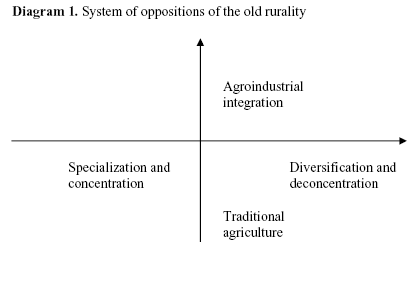
The shift of meaning that is occurring in the three dimensions defining rurality – the relation with nature, the relations of shared knowledge and the links with the system of cities – makes it necessary to understand in theoretical terms what is changing in the interconnections between social structures, institutions and environmental concerns in the new era. In the previous sections of this text, I have looked to show how the idea of the rationalization of rural life allows us to refer to the various dimensions implicit here, in particular those given greater emphasis in the contemporary literature: the need for a long-term approach, the importance of understanding the heterogeneity and unequal manifestation of the new direction in the processes of rural development, and the inevitability of adopting an approach that privileges not only interactions, but also the structures and conflicts inherent to them. But if the movement of the rationalization of rural life and the new empirical contents of the new rurality are not linear, what determines the differentiation? Is it possible to render the outlines at least schematically? The diagrams that follow are intended to illustrate a system of operations typical to the 'new rurality.' Their agents can be identified, on the basis of concrete analyses of objective situations, by their position in this structure.
Diagram 1 refers to the system of oppositions in the old rurality and contains two axes. In the X axis, the rural territories varied their position depending on the greater or lesser degree of integration with the agroindustrial systems. This axis allows us to identify the intensity of the erosion in the conditions of autonomy of rural communities, which for a long time used to be referred to generically in the literature as "the penetration of capitalist relations in the rural world." It was this growing integration with urban and industrial society which was discussed by classic studies such as those of Antonio Cândido (1964) and Maria Isaura Pereira de Queiroz (1979). In the Y axis, the position varies according to the level of concentration and specialization of these territories. On one hand, this oppositions refers to the distribution of key political figures, skills or forms of capital, depending on the theoretical approach in question, and on the other hand, in combined form, to the greater possibility of generating the institutions needed for economic dynamization accompanied by greater social cohesion.
]]> Diagram 2, meanwhile, refers to the system of oppositions found in the new rurality. In the X axis, the rural territories start to vary their position depending on the greater or lesser uptake of new forms of social utilization of natural resources. In this axis, the opposition shifts from the degree of integration of the rural area to a new kind of integration dictated by the new form of environmental embedding of rurality and its corresponding effects on social structures and institutions. In the Y axis, the variation of positions remains dependent on the degree of concentration and specialization of these territories, since in the new rurality, too, the processes of development partly obey the same rules as other spheres and are linked to the deconcentration and diversification of the social fabrics and the local ecosystems.
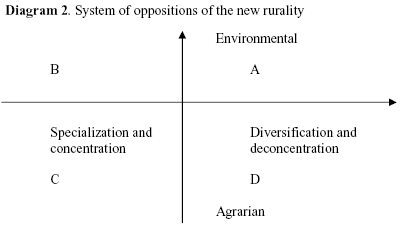
Overall, the four quadrants that emerge from this diagram can be defined in accordance with their meanings in terms of environmental concerns, social structures and institutions.
Situation A – More diversified and deconcentrated environmental rurality and social structures
A determined pattern of urbanization associated with the territory's morphological features, involving the environment and social stratification, favoured the creation of a form of social use of natural resources where the search for conservation could develop alongside forms of dynamizing social life. The diversified local economy is keyed to a high level of economic integration and territorial cohesion. Landscape, culture and economy interconnect in such a way that economic dynamization is associated with good social indicators and positive performance in terms of environmental indicators. Something similar to this pattern occurs in regions such as the Vale do Itajaí, in Santa Catarina.
Situation B – More specialized and concentrated environmental rurality and social structures
Although the territory's morphological features, in environmental terms, favour conservation, the characteristics of social stratification work against the creation of institutions capable of lessening the fractures between social groups caused by their social position. Conservation finds itself in conflict with the possibilities for dynamizing local life. The pattern of urbanization is still incipient or did not take place in a direction where there was no valorization of the rural world. This is the typical case of certain areas of Amazonia, where the presence of forest coexists with the advance of industrialized agriculture. The local social structures do not present any dynamism or a pattern of interaction sufficient to deal with the expansion of primary activities, resulting in a loss of biodiversity and a depletion of natural resources such as land and water. There is a high degree of conflict between institutions, which strongly affects the local populations.
]]> Situation C – More specialized and concentrated sector-based rurality and social structuresThe territory's morphological features in environmental and social terms engender a relation of exploration with the rural world with restricted possibilities for conservation and a higher risk of tearing the social fabrics, despite the potential economic dynamization with the primary sector and processing sector. Regions experiencing a strong dynamism dependent on farming activity fit into this type. Here the wealth generated established a relation between the territory's pole municipality, where all the resources are concentrated, and the others, meaning there is no expansion of wealth to the overall set of social groups. The possibilities for environmental conservation are restricted to the minimum demanded by law, as in the case of preserving isolated tracts of forest, gallery forest and hill top vegetation. Local biodiversity is strongly compromised or threatened by the vigour of the commercial agricultural activities. In the cases of more dynamic regions, such as some areas inland of São Paulo State, the pattern of urbanization offers reasonable, but concentrated, infrastructure and services. In other, less dynamic areas, the sector-based specialization and hardening of social structures still lead to a pattern where precarious living conditions prevail, the case of the cacao plantation regions of Bahia or the Pernambuco Atlantic Rainforest Region.
Situation D – More diversified and deconcentrated sector-based rurality and social structures
These are situations where, although the territory's morphological features are not as promising in terms of natural resources, the existing social structures may favour a process of change and the creation of new institutions. However, the forms of economic domination impede or block this innovation. There are fissures between the sectors and the environment, and between the social groups. One example of this type of territory is the west of Santa Catarina. A concentration of large agroindustrial companies lives alongside a social structure based on a sizeable sector of family farmers. The region presents a reasonably active economic dynamic, but with poorer social and inequality indicators and various environmental problems related to soils and water. The possibilities for the reproduction of local social groups still depend heavily on extralocal links, encouraging the loss of valuable human resources. This ends up hindering the potential opened by the local social configuration of greater interactions or the creation of new institutions capable of changing the direction taken by territorial development.
The emerging nature of the new rurality will mean that, using the schematic representation again, the lower part of the X axis dislocates, lessening its quantitative importance, and that in its place a new opposition emerges. This pulverizing of agrarian societies, expressed both in the movement indicated in the passage from diagram 1 to diagram 2 and their corresponding fields of opposition, only acquires the contours of inevitability in the frameworks of the agrarian paradigm. There, it involves the dilution of a social world, with all this means in terms of tragedy and creation: tragic because they become prisoners of the system of oppositions typical to their time; creative because the new system of oppositions opens up possibilities not clearly inscribed previously.
For capitalism, the pure type appeared when the practical-technical rationality enabled by the evolution of the cognitive and material conditions of the period combined with the practical-ethical rationality of Protestant culture, leading to the explosion of an enormous number of possibilities, both in the creation of institutions in harmony with this new moment, and in the introduction of changes in the forms of ethical-quotidian conduction of life (Pierucci 2003). Likewise, it is perhaps no exaggeration to say that the historical possibility of the occurrence of a pure type such as the situation A indicated in this diagram, represents an equal content in terms of the attempts to resolve the dimensions present in the rhetoric of sustainable development. In other words, if, to use Veiga's terms (2005a), the 21st century utopia consists of this anxiety to improve the human and natural condition through economic dynamization, with an expansion of the possibilities for people and with environmental conservation, we must above all recognize that particular territorial configurations have succeeded in achieving this aim. This occurred where the urban and rural areas established integrated and co-determined, rather than competitive and irreconcilable, forms of development. Furthermore, this possibility was not the exclusive result of the unilateral or exogenous introduction of any norm or sanction; instead, it involved the evolution of historically determined configurations, whose trajectory included a process of increasing rationalization, allowing the constitution, in these simultaneously ecological, historical and rational terms, of the social structures and institutions needed for this evolution.
In the new rurality, capable of being comprehended through a territorial approach, it is no longer possible to identify a predominant social actor or group, as in the former rurality. The intersectoriality marking local economies and the growing heterogenization of their populations demands a comprehensive and in-depth recognition of the dynamics and agents making them up. And this is only possible through the analysis of the evolution of this territorial configuration, of the forms of rationalization to which it corresponds and the social positions of its agents, as I have attempted to sketch out in this article.10
Conclusion
A striking feature of the new rurality is the growing process of rationalization of rural life. One of the primary domains where this is expressed comprises the forms of ethical conduct in day-to-day life, increasingly based on rational action, whether in relation to ends or in relation to values, and less on traditional action or magical forms of relating to the world. Another domain is formed by the institutions, understood as means for rationalizing conflicts and interests, and their materialization in formal and formal commitments and social rules. In both cases, rurality acquires a new meaning, since it becomes a place where an ever more rationally conducted life is possible and where the social contents that inform the cognitive structures and spaces of this interaction no longer follow the signs of isolation and agrarian roots, but instead follow a greater proximity between the rural and urban settings, between nature and society.
]]> Like every sphere of the social world that undergoes processes of rationalization, the rural world also presents rules and agents specific to it. One outcome of this new condition of rural development is the current conflictual tension that arises from three disjunctions relating to institutions, social structures and the environment: a) the fact that there is an overlapping of configurations of agents and interests – some more closely linked to the factors determined by environmental aspects, others by the economic aspects, others still by the political or cultural aspects –, while in the 'old rurality' there was a main agent: the farmer or farming companies; b) an incoherence, or at the very least frictions, between institutions, while in the earlier stage the conflict at the base of institutions concerned, above all, the use of land through the right to the economic exploration of primary activities; c) a contradiction between the social forms of rationalization, one of whose most extreme manifestations is commercialization, and the social use of resources that are not directly commercial, such as nature.
Bibliography
Abramovay, Ricardo. Paradigmas do capitalismo agrário em questão. São Paulo: Hucitec, 1992. [ Links ]
Abramovay, Ricardo. Representatividade e inovação. Paper apresentado no Seminário Nacional de Desenvolvimento Rural Sustentável. CNDRS, Brasilia, 2005. [ Links ]
Abramovay, Ricardo et al. Sucessão hereditária e reprodução social da agricultura familiar. Agricultura em São Paulo, 50(1): 11-24. São Paulo, 2003. [ Links ]
Aymard, Maurice. Autour des Annales – la ville selon Braudel. In: Sachs, Ignacy (ed). Quelles villes pour quel developpement. Paris: Seuil, 1992. [ Links ]
Backhaus, Jurgen G. & Meijer, Gerrit. City and country – lessons from European economic thought. American Journal of Economics and Sociology, Vol. 60, n. 1. January/2001. [ Links ]
Bairoch, Paul. Cinq milénaires de croissance urbaine. In: Sachs, Ignacy (ed). Quelles villes pour quel devellopement. Paris: Seuil, 1992. [ Links ]
Bourdieu, Pierre. Le bal des célibataires – crise de la société paysanne en Béarn. Paris: Éditions du Seuil, 2002. [ Links ]
Candido, Antonio. Os parceiros do Rio Bonito. São Paulo: José Olympio, 1964. [ Links ]
Champagne, Patrick. L'héritage refusé – la crise de la reproduction sociale de la paysannerie française – 1950-2000. Paris: Éditions du Seuil, 2002. [ Links ]
Champagne, Patrick & Christin, Olivier. Mouvements d'une pensée – Pierre Bourdieu. Paris: Bordas, 2004. [ Links ]
Correa, Edelmira P. & Sumpsi, José Maria (eds.). Políticas, instrumentos y experiencias de desarrollo rural en America Latina y la Unión Europea. Madri: AECI/Fodepal, 2001. [ Links ]
Duby, Georges. L'urbanisation dans l'histoire. In: Études Rurales, n. 49-50, Janvier-Juin. 1973, p. 10-14. [ Links ]
Ehlers, Eduardo. Determinantes da recuperação da Mata Atlântica no Estado de São Paulo. Ph.D. thesis, Procam/USP, 2004. [ Links ]
Favareto, Arilson. Paradigmas do desenvolvimento rural em questão – do agrário ao territorial. Ph.D. thesis, Procam/USP, 2006. [ Links ]
Friedland, William H. Agriculture and rurality – beginning the "final separation"? Rural sociology, 67 (3), 2002, p. 350-371. [ Links ]
Heather, Barbara et al. Women's gendered identities and the restructuring of rural Alberta. Sociologia Ruralis 45 (1-2), 2005, p. 86-97. [ Links ]
Hegedus, Andras. A questão agrária. In: Hobsbawm, Eric. História do Marxismo, vol. 6. São Paulo: Paz e Terra, 1986. [ Links ]
Hervieu, Bertrand & Viard, Jean. Au bonheur des campagnes. Paris: Éditions de l'Aube, 2001. [ Links ]
Jean, Bruno. Territoires d'avenir – pour une sociologie de la ruralité. PUQ, 1997. [ Links ]
Jollivet, M. A "vocação atual" da sociologia rural. Estudos Sociedade e Agricultura. n. 11, Oct., 1998, p. 5-25. [ Links ]
Lefebvre, Henri. A revolução urbana. Belo Horizonte: Ed. da UFMG, 2002. [ Links ]
Magalhães, Reginaldo. Economia, natureza e cultura: uma visão histórica e interdisciplinar dos sertanejos, dos mercados e das organizações no sertão da Bahia. Master's dissertation, Procam/USP, 2005. [ Links ]
Malagodi, Edgard. Formas e limites do capitalismo agrário – uma leitura crítica de Smith, Ricardo e Marx. Thesis presented to PUC-SP, 1993. [ Links ]
Marsden, Terry. New rural territories: regulating the differentiated rural spaces. Journal of Rural Studies, vol. 14, n. 1, 1998, p. 107-117. [ Links ]
Marsden, Terry. Rural Futures: the Consumption Countryside and its Regulation". Sociologia Ruralis, vol. 39, no. 4, Oct. 1999, p. 501-526. [ Links ]
Martins, José de Souza. As idéias-unidade da sociologia. In: Martins, J. S. (ed.). Introdução crítica à sociologia rural. 2a. ed. São Paulo: Hucitec, 1986. [ Links ]
__________. Conservadorismo e sociologia. In: Martins, J. S. (ed.). Introdução crítica à sociologia rural. 2a. ed. São Paulo: Hucitec, 1986b. [ Links ]
Mendras, Henri. Societés paysannes. Paris: Armand Colin, 1976. [ Links ]
Mormont, Marc. À la recherche des especificités rurales. Photocopy, 2000. [ Links ]
Navarro, Zander. Desenvolvimento rural no Brasil – os limites do passado e os caminhos do futuro. Estudos Avançados – Dossiê Desenvolvimento Rural, vol. 15, n. 43, Sep./Dec., 2001. [ Links ]
Pierucci, Antônio Flávio. O desencantamento do mundo – todos os passos do conceito em Max Weber. São Paulo: Editora 34, 2003. [ Links ]
Ponting, Cliv. Uma história verde do mundo. Rio de Janeiro: Civilização Brasileira, 1995. [ Links ]
Queiroz, Maria Isaura P. Do rural e do urbano no Brasil. In: Szmrecsány, Tamás & Queda, Oriowaldo (eds.). Vida rural e mudança social. São Paulo: Ed. Nacional, 1979. [ Links ]
Ray, Christopher. The EU Leader Programme – rural development laboratory. Sociologia Ruralis, vol. 40, n. 2, April/2000. [ Links ]
Ray, Christopher. A mode of production for fragile rural economies: the territorial accumulation of forms of capital. – Guest Editorial – Journal of Rural Studies, vol. 18 (2002), p. 225-231. [ Links ]
Sorokin, P.; Zimmerman, C.; Galpin, C. Diferenças fundamentais entre o mundo rural e o urbano. In: Martins, J. S. (ed.). Introdução crítica à sociologia rural. São Paulo: Hucitec. 1986. [ Links ]
Thomas, Keith. O homem e o mundo natural – mudanças de atitude em relação às plantas e aos animais. São Paulo: Cia. das Letras, 2001. [ Links ]
Veiga, José Eli. O desenvolvimento agrícola – uma visão histórica. São Paulo: Hucitec, 1991. [ Links ]
Veiga, José Eli. Destinos da ruralidade no processo de globalização. Estudos Avançados, n. 51, May-Aug. 2004, p. 51-67. [ Links ]
Veiga, José Eli. Destinos da ruralidade – um 'zoom' sobre a Itália. Paperpresented at XXIX Encontro Nacional da Anpocs, Caxambu-MG, Oct./2005a. [ Links ]
Veiga, José Eli. Desenvolvimento sustentável – o desafio do século XXI. Rio de Janeiro: Garamond, 2005b. [ Links ]
Wanderley, Maria de Nazareth B. A emergência de uma nova ruralidade nas sociedades modernas avançadas; o "rural" como espaço singular e ator coletivo. Estudos Sociedade e Agricultura, n. 15, Oct. 2000, p. 87-145. [ Links ]
Weber, Max. A ética protestante e o "espírito" do capitalismo. São Paulo: Cia. das Letras, 2004. [ Links ]
Weber, Max. Economia e sociedade. Brasília: Ed. UnB. 2 vol., 2000. [ Links ]
1 This article is a modified version of the fifth chapter of the author's doctoral thesis (Favareto 2006), completed at the Postgraduate Program in Environmental Science of the University of São Paulo. ]]>
2 In the 19th century, it is precisely the relation between these two poles in the Russian context that provides the launching point for Storch's Theory of Civilization: while cities are identified as centres of culture in terms of entrepreneurism, learning and technological knowledge, the key to development lies in bringing the countryside closer to the cities, using natural routes such as rivers towards this end (Backhaus & Meijer 2001), an idea that clearly reflects a situation where the need to integrate spaces is present at the same as the period's winds of change are bringing obvious signs of industrialization and growing urbanization.
3 The well-known passage from Theories of Surplus Value is fully self-explanatory on this point: "...economic development distributes functions among different persons; and the handicraftsman or peasant who produces with his own means of production will either be gradually transformed into a small capitalist who also exploits the labour of others, or will suffer the loss of his means of production [...] and be transformed into a wage-labourer." If there is one exception in Marx's work providing specific treatment of the peasant issue, this is found in the text written jointly with Engels, The Peasant Question in France and Germany. However, this is more of a political text than a detailed analysis of the concrete historical situation of this social group in each of the two countries. A close reading of the text reveals the source of the conclusions on the future possibilities for peasants of the logical system built around the capital-labour opposition. Cf. Abramovay 1992.
4 Abramovay (1992) recounts historical examples in the US, Great Britain and the European Community. The explication of the historical reasons for why this occurred in this fashion is a central issue in Veiga's book (1991).
5 It is worth remembering that, in the case of Tonnies' thinking, the more serious problem concerns the applications subsequently made of it. In this author's work, the community-society opposition, although structured around polarizing criteria, evolves into a typology whose theoretical logic is very close to the Weberian resource of ideal types.
6 See in particular the special volume of Études Rurales edited by Georges Duby (1973).
7 For a more detailed critique of Lefebvre's thinking on the triumph of urban civilization, see Veiga (2004).
8 This periodization of the long-term process of disenchantment and rationalization of rural life, expressed in the following three paragraphs, summarizes elements provided by some of the key works on rationalization, rural life and relations between society and nature. See especially Pierucci (2003), Bairoch (1992), Ponting (1995) and Thomas (2001).
9 On this topic, Bourdieu (2002) and Champagne (2002) provide analyses of phenomena in France very similar to those seen in the South of Brazil. These books have the suggestive titles of Le bal des celibataires and L'heritage refusé.
10 For an explanation of the complementarity between the notion of field and long-term dynamics, see Champagne & Christin (2004).