Verónica Pérez
Degree in Political Science, Faculty of Social Sciences, Universidad de la República
Translated by Rafael Piñeiro
Translation from Revista Uruguaya de Ciencia Política, Montevideo, n.15, p.57-81, 2006.
ABSTRACT
]]> On the assumption that culture matters, this paper explores the behavior of some cultural hypotheses, at the supply and demand levels, as explanations of women under-representation in public office, trying to point out the methodological precautions needed when gender analyses are carried out. The article lies on a theoretical perspective which claims the main causes of the low feminine presence in politics are related to structural factors for which there would be, however, political "solutions".Key words: Culture – Politics - Women
Introduction
Historically Uruguay has been a relatively egalitarian country. However, in the XXI century, an unbalance is still to be resolved: women in elected and appointed office are (and were) very few compared to other countries in Latin America and in the world.
In Parliament, after 2004 election, women represent 11.1% of the total members of the House of Representatives and 9.7% of the Senate. This means, if not a backward movement, at least a period of stagnation in the "natural" process of growth of the amount of women in this organ, which started in 1985. According to data from the World Parliamentary Network (2006), with these percentages, not only is Uruguay placed under the average number of women in Parliament worldwide (16.8% in lower or single houses) but it is also under the majority of the countries in the continent: taking the lower houses as a reference, out of 19 Latin American countries, Uruguay is in place 15, and three of them (Cuba, Costa Rica and Argentina) are within the first 10 places in the worldwide ranking 1.
Additionally, the presence of women has been almost none at the executive level: no women in elective posts and, in 20 years of colorado and blanco2 governments (1985-2005) there were only two women appointed for ministries3
Scholars mention three groups of factors that can explain the low presence of women in political posts: socio- structural, institutional and cultural (Inglehart and Norris 2003; Norris 1997a, 1997b, and 2004). Notwithstanding, the latest production on the theory of cultural modernization (Inglehart, Norris and Welzel, 2002; Inglehart and Norris, 2000 and 2003) shows, empirically, that culture is a key factor when trying to explain the access of women to political posts. Traditional attitudes are generally highlighted as one of the main barriers to the entry of women to public office. The hegemonic values in every society determine the distribution of rights, rewards and power for men and women within different spheres, among them the public one. The cultural explanations claim that wherever traditional attitudes prevail, women will be limited by society regarding the opportunities they may have, and they will also be limited by themselves. The predominance of these attitudes may influence directly on the preparation and decision of women to be candidates (supply-side explantions), as well as the criteria used by the party gatekeepers, the media and even voters when it comes to evaluating a candidate (demand-side explanations) (Inglehart, Norris and Welzel 2002:3-4).
Without ignoring the multi-causality and complexity that any social phenomenon implies, this paper seeks to analyze the third group of factors, trying to verify the validity of some of the cultural hypotheses for the Uruguayan case.
]]>1. Factors associated with supply-side explanations
Are women not so close to politics as men?
From the perspective of supply we could establish the hypothesis that the low rate of feminine presence in political posts in Uruguay is due to women not being interested in politics as much as men are, and/or being away from public affairs.
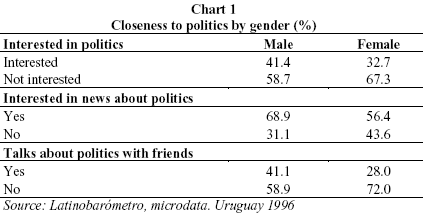
As a means to assess the differences between political attitudes and behaviors that could be affected by gender and its consequences regarding egalitarian participation of men and women in politics, three variables from Latinobarómetro were selected. (microdata Uruguay 1996) These variables can be considered indicators of how close to political issues people are: "interested in politics", "interested in news about politics" and "talks about politics with friends" 4(see Chart 1).
As shown in Chart 1, there are relevant differences between men and women in the three variables. Men are more interested in politics, claim to pay attention to the news about politics and talk about it with friends more frequently5. But, should it be inferred that being a man implies being more involved in politics and as a consequence having a greater tendency to participate actively in public issues? Is gender the most important variable to look at when it comes to establishing how close to politics a person is?
]]> Education, particularly higher education, is a variable that theory considers relevant to evaluate the possibilities of becoming interested in public issues and participating actively. It is said that education motivates people to be candidates, as educated citizens are more likely to follow the news in the media, to have more information about government and to feel politically effective (Johnson 2001: 81).Chart 2 shows the relationship between the variables mentioned above and the educational level6. As it is shown, the differences between men and women disappear in the row where people with higher educational levels are; which means there is no statistical significance7.
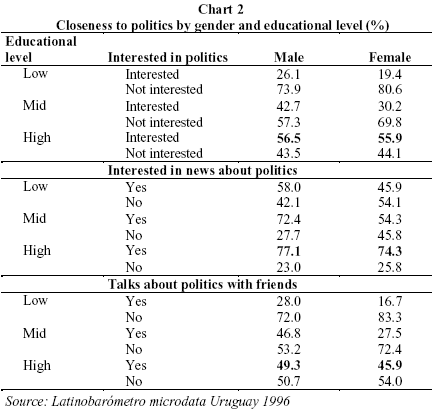
These data show that the educational level is more important than gender when it comes to explaining how involved in politics people are8. In other words, being a man or a woman does not make a difference regarding this variable – which is probably connected with different socialization rules. However, comparing gender and educational level, the variable that weighs more when explaining how close to politics we are is the latter rather than the former. Moreover, within the range of population more likely to take part in politics (the most educated) there are almost no differences between men and women.
Even so, we have to bear in mind that people who are interested in politics in the same way, may not have the same will to become political candidates. Regarding this point, it is generally said that women are less ambitious as a result of a socialization process in which ambition is a positive feature for men but a negative one for women. Besides, social acceptance for women is less connected with professional or political success than it is for men (Uriarte, 1997:68). Therefore, it can be stated that the greater the interest in politics and the exposure to political issues, the more possibilities for a person to get involved in politics and to become a candidate. But this may not necessarily be so when a gender cleavage is considered. Though women may be equally interested in politics to men, they could reject the possibility of being candidates if they thought that the costs of a political career are higher than the benefits. Here we also need to evaluate collateral factors, as free time to devote to political recruitment, which has to be especially considered when analyzing the case of women.
Consequences of the distribution of roles in the private sphere on the composition of the public sphere.
Having free time is a relevant aspect when we analyze the number of women in politics because it may have an indirect influence on it. This aspect is related to who is in charge of the house chores. That is, if women are in charge of those activities – apart from the time they devote to their job – then, the time left for activism will be less. And, given that a political career not only implies having certain qualities, but also investing a great amount of time in party activities, it is reasonable to conclude that women could have some disadvantages in this aspect.
]]> Some recent data illustrate this point for the Uruguayan case. As an example, in 2001, a survey carried out among women living in Montevideo and its surroundings, showed that most of the housework was done by them (see Chart 3)9.
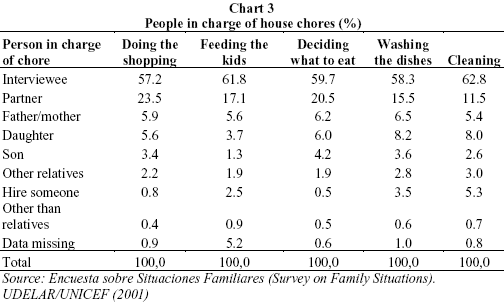
The survey also allows us to observe that daughters, more frequently than sons, are in charge of the housework, which indicates that, from this perspective, the roles of gender seem to be reproduced.
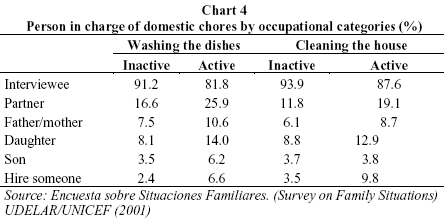
It is important to observe that, when this information is controlled by occupational categories, domestic chores are still done by women in greater proportion (see Chart 4).
2. Factors associated with demand-side explanations
Up to this point, the attention was centered in two factors that influence on supply; now, we should have a look at the other side of the scale: ¿are women required in political activities?
The electorate
How can we identify, at the electorate level, attitudes that interfere with or favor the entry of women to politics? Surveys are a suitable tool to measure attitudes, however, when the researcher faces this kind of data, he may encounter at least two difficulties: the first one is inherent to the object of study and refers to the difficulty of measuring controversial topics like this one through a survey. The second is a practical one and refers to the difficulties of finding comparative data that include Uruguay.
Previous works have used some surveys to sustain that Uruguayans have an egalitarian discourse regarding the presence of women in political posts10. Despite this, the data used had some problems which question that statement. One of the surveys quoted was published by the consultancy firm Cifra in August 1999. There it was asked: "Nowadays there are very few women in Parliament and other public positions. Do you think it would be better to have more women in politics?" The majority (70%) replied "it would be better to have more women".
What do these data tell us about the phenomenon being measured? One of the dilemmas of Positivist research, which supports research through surveys, consists of knowing whether what we want to measure is, in fact, what has actually been measured. Or, in other words, those who investigate by means of surveys wonder if the interviewee’s answers reflect "reality". This problem is revealed with strength when the manifestations of certain attitudes are at stake, for example, discrimination. Given that in modern democracies discrimination is a socially negative value, it is highly likely that, when facing straightforward questions, interviewees tend to adjust to "socially desirable answers", producing some kind of self-control and therefore, reducing the expression of any discriminatory contents that may actually exist. In fact, what operates is the mechanism of "public opinion as social control": people, afraid of being isolated from the opinions they consider prevailing, modify their discourse, adapting it to "the opinion of the majority".
Apart from this, the question quoted also has other problems, regarding its wording, which can bias the answers even more: the expression "very few" is filled with value contents, as a result, it can lead the interviewees to answer that "it would be better to have more women"11.
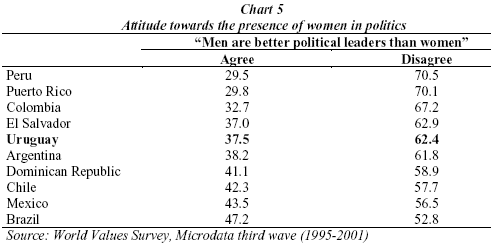
Even if we could claim that Uruguayans have relatively egalitarian attitudes towards women getting involved in politics, it gives rise to the problem of whether that agreement is sufficiently extended in the population. In order to have an opinion about this, it is necessary to compare the Uruguayans’ opinion with that of other populations, different either in space and/or time. Chart 5 shows the position of Uruguay compared to the rest of the Latin-American countries in a question from the World Values Survey which aims at measuring attitudes towards the presence of women in politics. As it is shown, the Uruguayans are less egalitarian than the people from Peru, Puerto Rico or Colombia.
]]>
The political system
Many times, political parties are considered one of the main filters to the access of women to public office. The literature on the subject points out that, occasionally, the gatekeepers have conservative attitudes when evaluating a candidate. The gatekeepers will look for individuals who maximize their possibilities of winning. As many times these people have limited information about the voters’ preferences, it is likely that they choose people with similar characteristics to those who were successful candidates in the past, that is to say, middle aged men, that belong to the major ethnic group and preferably professionals. Thus, if the gatekeepers think that women attract less votes, quite apart from the fact that this may be true or not, they will tend to push them aside from the lists of candidates (Norris, 2004).
Besides, if the caucuses considered that effective political equality between men and women is not a value to be promoted, political parties could have no incentives to voluntarily take steps or consider punishments against sexual discrimination. Considering these tendencies, the opportunities for women to become candidates– and to reach public office– are reduced.
The barriers at the level of the political system will be tracked in three ways: considering the efforts made to adopt rules that ensure political equality between men and women, determining the places that women have occupied in the ballot papers from different parties and exploring the conceptions of gender equality among the political staff.
Rules to ensure equality in political participation of men and women.
Even though Uruguay was one of the first Latin American countries that guaranteed political citizenship to women, nowadays it lags behind concerning the adoption of certain steps that assure effective equality between men and women in politics.
The process that led to the extension of suffrage to women in Uruguay extended over the first three decades of the XX century and was full of difficulties. Including some contradictions where there was influence of factors connected with batllismo’s reforming ideology and others connected with political opportunities. After some legal and constitutional trials during the first two decades of the XX century, the law that allowed feminine suffrage was passed on December 16, 1932. In this way, Uruguay was the first country in Latin America to establish political citizenship for women with no restrictions12.
]]> Uruguayan women voted for the first time in 1938 and in 1942 there were women in parliament for the first time. Despite the first steps seemed promising, the participation of women in public office was meager along the XX century. Until the government that preceded dictatorship, women in the House of Representatives – considering both incumbents and substitutes13 – were less than 4% of its members (Sapriza and Villamil 1984:71). After redemocratization there were no women holding possitions in parliament. Though, since 1989 there was a process of growth that was stopped by 2004 election, when there were 14 women elected between the two Houses, one less than in the previous mandate (see graph below).
Evolución mujeres en el Parlamento = Evolution of positions held by women in Parliament
A factor to be highlighted in the growth of feminine representation in parliaments in many countries has been the adoption of some kind of gender quota (Peschard 2003). Quotas, which are an example of the so called affirmative action regulations, have been increasingly implemented since the 90s in many Latin American countries. Uruguay is one of the countries in the continent where quotas have not been legally implemented and where its voluntary use in parties is an exception.
Quotas are one of the most common affirmative action regulations to increase the representation of an under represented group in a relatively short period of time. These quotas establish minimum or maximum levels of representation per group. From a philosophical perspective, this kind of measures imply going from the concept of "equal opportunities" to that of "equal results". It is stated that the existence of formal rights – in this case, those inherent to political citizenship – do not assure that women gain political influence. This argument is based on the idea that equality is a goal that cannot be achieved by means of formal equal treatment, as, if barriers exist, it is necessary to introduce compensatory regulations to reach equality in results (Dahlerup: 2003, 162-163). Notwithstanding, the effectiveness of the quota depends on a series of factors: the characteristics of the electoral system (the size of the electoral district and the format of lists), the level established by the quota (minimum percentage, established in the regulation, for the presence of women in the lists), the incentives for its implementation (the establishment of penalties if the regulation is not complied with) as well as the parties’ and leaders’ will to oversee the enforcement of the rule, when the quotas are fixed voluntarily (Norris 2004: cap. 8, 7).
Beyond quantitative results, the use of this mechanism generates a strong symbolic impact. It represents a compromise – that goes beyond discourse – with the need to take action in favor of gender equality in politics. And, even though that compromise can be considered stronger if the mechanism is voluntarily acquired by parties – because it would reflect the leaders’ will to adopt measures to include more women in public office – as it is stated by Moreira and Johnson (2003: 20-21) it is accepted that in democratic countries the laws that are passed are the reflection of some degree of political consensus, and therefore social, on the topics issued.
In Latin America, Argentina was the first country to establish quotas by law, in 1991. The so called "Ley de Cupos", made compulsory the fact that the party lists at the national level presented a minimum of 30% of women. This rule became constitutional in 1994. This example was followed by the establishment of quotas between 20% and 40% in Costa Rica (1996), Ecuador, Perú, República Dominicana, Bolivia, Panama, Paraguay and Brazil (1997) and Mexico (2002). Besides, in many of those countries, the parties with greater amount of votes have voluntarily set these mechanisms in their statutes. That is the case of Partido Justicialista and Unión Cívica Radical in Argentina, Partido de Liberación Nacional and Partido de Unidad Socialcristiana (both major parties) in Costa Rica, or Partido Revolucionario Institucional (PRI) and Partido de la Revolución Democrática (PRD) in Mexico14.
In Uruguay, there was only a group within FA (Partido Socialista) that included the quota in its statutes in 1993. This was not imitated by the other left- wing sectors, neither by Partido Nacional or Partido Colorado.
At the nacional level, a bill that established the rule of quotas was analysed in the House of Representatives in 200315. The initiative stated that any list of candidates that took part in an election, whether it was national, district or party primaries, could not have more than two thirds of members of the same sex. But when the law was voted item by item, the articles that set the principle of quota did not obtain the necessary votes to be passed. The only article that was passed and sent to the Senate stated:
"Declárese de interés general la participación equitativa de ambos sexos en los órganos de dirección permanente de los partidos políticos".16
]]> This article can be included within discourse strategies; in fact, it does not modify the present situation, as it does not take any specific action.Women in the electoral supply
Another indicator of the barriers to the entry of women that may exist inside parties is given by the places that men and women have in the ballot paper – it should not be ignored that that is also related to the factors that influence on the supply side, as analyzed before.
Then, how do we assess the places women occupy in the party lists? It is necessary to have in mind that a person’s place in the electoral supply is neither good nor bad by itself, but it is related to the characteristics of the electoral system and the party system, factors to be taken into account for the analysis.
In Uruguay, seats are assigned through proportional representation. The Senate is chosen in a single national electoral district of 30 members and the House of Representatives – despite the final calculations are done on a national basis – is chosen in 19 multi-member constituencies of variable size, according to the size of the population, where not less than two representatives can be chosen in each constituency. In view of the concentration of population in the south of the country, the only large district in the House of Representatives is Montevideo17 (44 and 42 seats in 1999 and 2004, respectively). Canelones is a middle – size district (14 seats in 1999 and 2004) whereas the rest are small, between two and four seats18 19 are elected. Besides, from 1985 to 1999, a system of three parties was consolidated in Uruguay: Frente Amplio (FA), on the left and centre-left wing, has registered its greatest vote in the capital city and adjacent urban areas; the traditional parties (Partido Colorado and Partido Nacional, PC and PN, respectively) on the centre-right and right wing, with voters in the hinterland (especially PN); and some other fourth party, smaller than the others, with a centre or centre – left profile, which always had less than 10% of votes. This panorama changed in 2004 given the abrupt reduction in votes for PC, taking, again, the shape of a system of two effective parties.
Considering these characteristics, in the districts where two or three seats are distributed, it is practically impossible that one party gets them all. Even in 1994 and 1999 it was difficult for one party to obtain more than one. Besides, the possibility of registering multiple ballot papers that compete against each other for seats within the same party label makes it necessary for a candidate to be the first in a list with electoral weight so as to get elected in a small district. And, to be elected in a large or middle – size district, a candidate must be in the first places. That is to say, in small districts competition becomes a single-candidate competition inside each party. Therefore, when analyzing the presence of women in the electoral supply in small districts, it is only relevant to see who is in the first place, as the others will be irrelevant.
The literature on this topic states that, when competition is single-member, the opportunities for women to be candidates with real possibilities of being elected are diminished: the party leaders could consider that women at the top of the lists are "a greater risk" and, consequently, prefer men (Norris, 2004). In addition, party structures, composed mainly by men, may consider that those who have the right to "be first" are those who came first, and as politics has traditionally been a masculine arena, the most prominent places on the lists could be preserved for them.
As it is shown in Chart 6, in small districts, the women who headed the lists were few compared to the total electoral supply for that position: 7% and 9% in 1999 and 2004 respectively, in parties with possibilities of winning seats in those districts20.
]]>
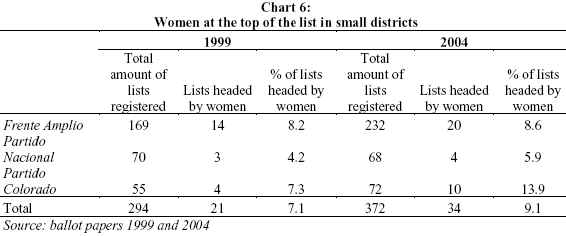
In 1999 Frente Amplio was the party that registered more percentage of ballot papers with women at the top of the list in small districts. However, none of them was elected (the left wing had not had women representatives in the hinterland until 2004), which contrasts with the situation of the traditional parties: three out of four lists headed by women in Partido Colorado were winners and one of three lists in the same condition obtained one seat for Partido Nacional. This suggests that the women who headed lists in Frente Amplio were, in greater measure than their equals in the other parties, in lists with meager electoral weight in the districts where Frente Amplio gained seats.
Which factors could explain that greater masculine tilt of the elected candidacies in the left wing in those districts in 1999? One characteristic shared by the four women elected in Partido Colorado and Partido Nacional was that all of them had some family ties with relevant political figures inside their party. That factor was recognized by them as a facilitating variable in the access to candidacies (Johnson 2001:90-92). On the other hand, the three women from Partido Colorado also had experience of party recruitment and/or had had positions in the party structure at the local level. Hence, even if this might have had some influence, family ties as a route to politics have also worked out in Uruguay for men, so the relevance of this variable in the case of women is not clear.
Another explanatory factor could be found in the dynamics that competitive scenarios have acquired for the parties and the lists of candidates in the districts mentioned above. Whereas the left wing historically registered its lowest percentage of votes in those districts, the leadership of Frente Amplio – following what was stated before – could consider having women who head lists as a greater risk when there are possibilities of disputing a seat with the traditional parties. In fact, in 2004 election, when the left wing perceived its consolidation as the first party and strengthened its growth in the hinterland, it was the first time for many women to head winning lists. What is more, two of them belonged to the most voted fraction during the last election, Movimiento de Participación Popular. This was, at the same time, the fraction that registered more lists headed by women in small districts (five in total). But we also have to consider the case of PC in 2004, as it was the party with the greatest percentage of lists headed by women, despite the fact that it was expected that its amount of votes would plummet. How is this explained? We could suggest the hypothesis that the possibilities for women to become candidates in relevant places are directly related to the competitive capacities of a party. In other words, if competitiveness is low (a party or fraction expects to get few positions, or it is small and doesn’t expect to get any representation) the possibilities for women to be candidates in outstanding places will tend to rise, the opposite will take place if competitiveness is high.
In larger districts, two indicators are used to account for women’s position in the electoral supply: percentage of women in first places on ballot papers, as a general description, and the relative placement that refers to the place in supply and the electoral weight of the list.
In Canelones, as it is a middle –size district, the first four places were considered21. As it is observed in Chart 7, in 1999 as in 2004 the left wing party was the second with the highest percentage of candidates in these places (behind NE22 in 1999 and PC en 2004).
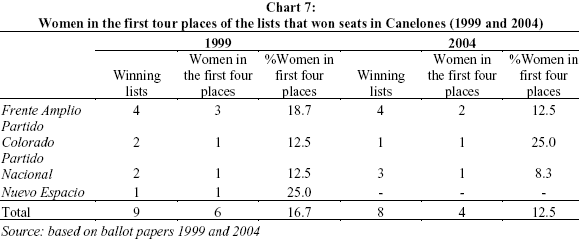
The first 4 places of a list can be classified as "winning places" (it is sure that they will get a seat), "disputed places" (there is some chance to get a seat) and "fillers" (there is no chance of getting a seat)23. According to this, women candidates from Frente Amplio were never in winning places but in those that could be seen as disputed or fillers24. In the traditional parties in 1999, women were assigned winning places25 but in 2004 the party situation had worsened, as the candidate from PN occupied a disputed place (and she was not elected)26 whereas the one from PC was a filler27.
In Montevideo, as it is a big constituency, the first 10 places on the ballot papers were considered, criterion that was also used for the Senate. In 1999, except for NE, FA was the party with more women candidates in the first 10 places in their winning ballot papers, whereas in 2004 it was second, below PN (see Chart 8).
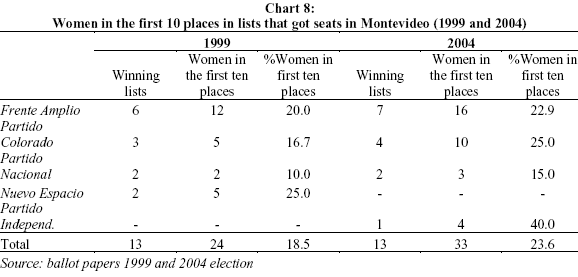
If one pays attention to specific places, it can be seen that the places of the women candidates from Frente Amplio were, generally speaking, better than those of their peers from traditional parties. In 1999, 33% of the places held by the left-wing women candidates were winning places, 17% were disputed and 50% were fillers. In Partido Nacional only one of the women candidates was in a disputed place and the others were fillers, while in Partido Colorado one candidate was in a winning place and the other in a disputed one. In 2004, 25% of the places held by the left wing candidates were winning places, 12.5% were disputed and 62.5% were fillers. In Partido Nacional only 10% of the places women had were winners and the rest were fillers, as well as all the places of the candidates from Partido Colorado and Partido Independiente.
To finish, it is in the Senate where differences between the left wing and traditional parties are more evident. Except for NE in 1999, Frente Amplio was the party with more percentage of women in total in its winning lists, both in 1999 and 2004.
]]>
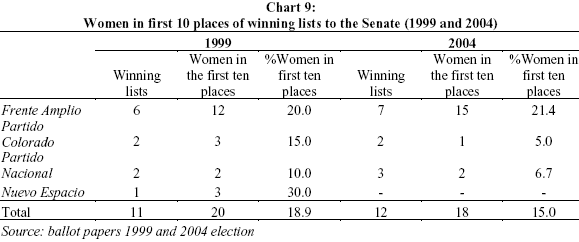
Again here, the positions of the feminine candidates from Frente Amplio were better than those of the other parties: in 1999, 8.3% of those places were winning positions, 16.6% were disputed and 75% fillers. In that same year, one of the candidates from Partido Nacional was in a winning place (the fourth place on the list of Herrerismo28) and the other one in a filler place. Besides, in 2004 Frente Amplio was the only party with women in disputed places, whereas all the places given to candidates from traditional parties were fillers.
These differences between parties regarding the position of women in the electoral offer concerning the Senate are relevant due to the symbolic value implied in being a member of it. Despite both Houses having almost the same powers (both have equal duties in the process of elaborating law and the members of both Houses have exactly the same parliamentary privileges) being a member of the Senate has traditionally given more prestige to a person’s political career. Besides, generally, one becomes Representative first and then aspires to become Senator. Thus, the access to the Senate may have more filters and that can, at the same time, be a disadvantage for those new groups that try to have some space in politics, in this case women. In connection with this point, FA appears to be the most flexible party regarding the presence of women as it is the party with more women in the Senate: since 1994 it has had elected women to the Senate without a break. Meanwhile, PC has not had any and PN only one for the period 2000-2005 and none for the current one (2005-2010), in spite of the increase in its vote share in the last election. Besides, in PC none of the women representatives that were reelected has been a member of the lists with chances to win or substitutes in relevant places.
Perspectives regarding equality between men and women in politics.
How can we identify explicit attitudes in the political elite? Particularly those that – beyond the signs provided by the previous analysis –may be influencing the access of women to public office. One way to do it is through surveys that aim at measuring this kind of attitudes29. Yet, some authors may criticize the validity of this kind of measurements by stating reasons as the ones mentioned above: it is highly unlikely that the people who discriminate will admit it in a questionnaire. Even the indirect questions may not be effective when asked to people with education and experience in politics (Uriarte 1997: 64). However, a well-thought questionnaire can be a very useful tool that can even be combined with another kind of methodological strategy so that it contextualizes and controls the answers to the survey. As this exceeds the limits of this work, this last section will be devoted to explore, among the representatives of parties in parliament, conceptions that reveal they are subject to more traditional or modern values regarding gender relationships.
As a way to approach this topic, we present a summary of an analysis about the contents of the parliamentary debates on some issues dealt within the period 2000-2005. This way of exploring, apart from adapting to the scope of this work, presents two advantages: first, it is done using the Session Logs, a record that is easy to access. Second, considering the difficulties of measurement implied in this kind of phenomena, this way of collecting data allows us to obtain the information in an "almost natural" environment. That is, free of the biases that could be introduced by the researcher or other agents involved in the collection.
As said before, this was an exploratory analysis. It did not aim at quantifying, as the sampling is arbitrary, which means the expressions used are the ones considered relevant to the research because they illustrate the different conceptions that could, eventually, shape a more or less favorable "atmosphere" to the participation of women in politics. Also, the analysis was restricted to the topics dealt within parliament, so it was not possible to introduce any kind of stimulus. Last but not least, parliamentarians do not represent the whole party leadership and some of the most important leaders of the parties are not present in Parliament. However, we do find the leaders of the fractions and many of the middlemen with support in the party structures and they may well have influence when it comes to shaping candidacies.
After a first selection, the debates used were the ones connected with the bills about "Reproducción humana asistida" (RA)30, "Salud Reproductiva" (SR)31, "Normas para la promoción de la lactancia materna" (LM)32 and "Participación política, normas relativas a la igualdad de ambos sexos" (PP)33.34 The expressions found in the debate were classified so as to identify the roles given to men and women in the different spheres of society; conceptions of family; relevance given to equal participation of men and women in politics, and, convenience of the adoption of regulations tending to ensure equality between sexes in public office.
As a general conclusion, it is possible to state that left wing parliamentarians are the ones who show more modern values and the representatives of traditional parties are those who have more conservative views. For example, about the distribution of roles, in the speeches of representatives from Partido Colorado and Partido Nacional, the feminine image was mostly associated to biological and social reproduction, highlighting their importance in bringing up children:
]]>"La misión fundamental de la mujer es la maternidad. Hagámosla responsable a través de la educación y la información". (Representative Vener Carboni, Partido Colorado; S.R. 26/11/02)
"Por algo, en términos casi sin excepciones, la naturaleza ha determinado que la mujer es infértil después de los cuarenta y pocos años más. (…) sin lugar a dudas a partir de los cuarenta es cuando en la mujer comienza la infertilidad ¿Por qué existe ese don de la naturaleza? Por algo será. El hombre no es infértil a esa edad, en cambio la mujer sí, pues es ella la que dirige la creatividad del ser, y luego además es parte sustancial en su educación". (Senator García Costa, Partido Nacional; R. A. 17/06/03)
That is to say, according to this parliamentarian, women can not have children from certain age onwards because they are the ones in charge of bringing them up and they would not be able to do that if they were old. The traditional sexual division of work, according to which, women are in charge of duties connected with taking care of the children and men are in charge of producing goods, is not questioned and it is accepted as natural.
The legislators from traditional parties also expressed conceptions that tend to favour traditional models of family:
"No comparto la posibilidad de que, si mañana se legislara sobre el alquiler de vientres, pueda un hombre alquilarlo y ser padre. (...) No estoy de acuerdo con que la sociedad se organice sobre esas bases. (...) A la familia (...) hay que auspiciarla. A veces el destino hace que la familia quede guacha, pero no me parece razonable usar métodos legales o artificiales para promover familias monoparentales" (Senator Atchugarry, Partido Colorado; R.A 18/6/2002).
"...tampoco podemos salir a explicar a la opinión pública que el Senado aprobó una ley por la cual es posible que un integrante de una pareja lésbica conciba un hijo que será hijo de ambas" (Senator García Costa, Partido Nacional, R.A 18/6/2002).
It was also frequent among the legislators from the traditional parties to use images that referred to forms of feminine subordination, to the man or siblings:
]]> "Entendemos que el padre debe tener parte en este proceso, tanto el concubino como (...) el que integra una familia legalmente constituida, o sea el marido. Nos resulta chocante que la mujer se maneje sola y que el padre no tenga ni arte ni parte" (Representative Bergstein, Partido Colorado; S.R. 3/12/02)"Seguimos pensando en legislar ocupándonos exclusivamente de la mujer. Quiero (...) que esta ley piense primero en el niño (...) porque no son la pareja ni la mujer el punto central, sino que lo que importa es el niño y la familia eventual a la que va ingresar". (Senator García Costa, Partido Nacional; R.A 18/6/2002)
In contrast with this, the legislators from Frente Amplio expressed more modern conceptions, sometimes emphasizing the values of freedom and autonomy, as well as different perspectives from the traditional division of work in the private sphere:
"...En condiciones sociales determinadas la mujer puede verse impulsada (...) a decidir la interrupción de su embarazo, quizás porque no siente que pueda sobreponerse a las circunstancias de la procreación; porque no se siente con seguridades, con fuerzas, con apoyos, con solidaridades sociales; (...) porque no se encuentra en un estado psicológico que la lleve a asumir su maternidad. (...) Por tanto este tema también debe ser enfocado desde el punto de vista de la libertad y de la mujer a decidir" (Representative Conde, Frente Amplio; S.R. 10/12/02).
"...reconozco en el proyecto un sesgo hacia la protección de los derechos de la mujer que indudablemente es la que toma la decisión. (...) La mujer es la que está en la posición más vulnerable, porque, (...) es la que suele ser abandonada o la que tiene después la responsabilidad más directa en la educación o la crianza. Pero aún no siendo así, (...) es la mujer la que pasa por el embarazo, la que corre el riesgo del parto, de la cesárea o de las posibles secuelas. (...) Y en esta concepción general (...) si hay un desnivel, es la mujer la que tiene el derecho a los mayores niveles de decisión" (Representative Charlone; S.R. 10/12/02).
In connection with equality in political participation, no legislator stated explicitly that women should not take part in politics; however, a Representative from Partido Colorado was surprised to realize the bill that established the quota had been signed only by women, expressing doubts regarding their capacities as politically autonomous subjects, capable of taking decisions and support them independently:
"Además, me llama profundamente la atención que este proyecto de ley esté firmado por cinco legisladoras, y sin ningún hombre que las pueda avalar" (Representative Dicancro, Partido Colorado; P.P, 12/8/03).35
The main reason for the negative vote regarding quotas among the representatives from the traditional parties, was that they trust the liberal democratic principle, according to which, political equality is sufficiently guaranteed by universal suffrage and by the possibility that every citizen has to run a candidacy. In this perspective, quotas are only a distortion or even a way to discriminate people:
]]>"...no habla bien de la capacidad de la mujer. Sabemos que la mujer no necesita de la cuotificación para llegar... " (Representative Hebert Fülgraff, Partido Nacional; P.P. 12/8/03)
"...este tema disminuye y denigra (...) a la mujer que realmente tiene capacidades y merecimiento para que, más allá de distinciones de sexo, sólo por sus cualidades como persona, pueda ocupar cualquier cargo dentro de esa sociedad". (Representative Ronald País, Partido Colorado; P.P. 12/8/03)
Within the left, even though one could think there is a more favorable environment to the implementation of such measures – and so it was said by many of its legislators during the debate – there were also opinions against it. But in this occasion, the argument was based on a different point of view: the inability to overcome any kind of inequality if socioeconomic and class inequality had not been overcome first.
"...analizamos los problemas de la sociedad que nos rodea, reconociendo la discriminación que se ejerce sobre la mujer, la que más duele, la que nos parece la número uno en una escalera de discriminaciones que hay que ir eliminando y superando en una sociedad organizada y democrática, es la económica. (...) cualquier cosa que hagamos en materia de discriminación, si no hemos eliminado la discriminación económica, probablemente tenga pocos resultados concretos" (Representative Topolansky, Frente Amplio; P.P 9/7/03).
This argument is close to the classical way of thinking in the left wing, which stated that any possibility of change was subject to the socioeconomic conditions, rather than human intentions. Then, from this point of view, the issues connected with sexual oppression are not so interesting as to be dealt with in the political sphere.
Conclusions
After redemocratization in Latin America, and its so called consolidation in the 90s, the academic debate is no longer centered in whether there is democracy but in the kind of participation. The debate moves its core from quantity to quality of the democracy. It seems obvious that the incorporation of half of the citizenship (women) to public office is a topic that is closely connected with this last aspect.
]]> The deficit in feminine representation in the public sphere shows us a specific problem of the Uruguayan democracy in comparison to others in Latin America. Despite the multiple factors that influence this phenomenon, in this article, some cultural hypotheses relating supply and demand were explored. This based on the supposition that culture matters.Regarding what motivates people to get involved in politics, in Uruguay gender is not the most relevant variable; there are others, such as education, that are stronger. Moreover, among the most educated people, who would have a greater tendency to take part in politics, there are no significant differences between men and women. However, this does not mean there is the same disposition to run a candidacy. Other cultural aspects, as being in charge of the housework, act as a barrier to feminine political recruitment.
In connection with the political system, Uruguay falls behind the Latin American (and worldwide) tendency in the adoption of regulations that aim at reaching an equilibrium between sexes in the composition of the main representative and governmental organisms. And, even when the left wing appears to favor feminine political recruitment, this was not translated to the development of a strong group of parliamentary women; neither were specific mechanisms of affirmative action extensively applied.
These findings and confirmations indicate that culture is relevant to explain the political participation of women. Can we, then, expect a change in values that favors the incorporation of women to politics? The theories about socialization suggest that people acquire basic values in their early childhood, which then remain relatively stable during adulthood. In this sense, the changes produced in the XX century have affected the educational experiences of the youngest generations in ways that differ from the eldest generations. Socially assigned roles have been affected by such events as mass access of women to higher education and to employment, as well as the changes in sexual behavior, the family and the entry of women to public life. It can be expected that those factors affect the values regarding the feminine role (Inglehart and Norris, 2003). But it is necessary to bear in mind that cultural change is slow, it needs generational shift to take place. How slow this process can be, was shown in Uruguay since the new composition of Parliament in February 2005. That is why, in the short term, only political action is capable of modifying the way public offices are constituted. This will be partially possible when the elite admit that equality in the integration of the polities is a value to promote, aiming at the construction of more egalitarian societies.
References
Aguirre, Rosario (2001). "La sub-representación de las mujeres en la política: un desafío para el siglo XXI"; en Mallo, Susana y Miguel Serna (Comp.), Seducción y desilusión: la política latinoamericana contemporánea, Ediciones de la Banda Oriental, Montevideo, pp.241- 252. [ Links ]
Brison, Valerie (1992). Feminist Political Theory; Macmillan, London. [ Links ]
]]>Dahlerup, Drude (2003). "El uso de las cuotas para incrementar la representación política de la mujer" en International Idea, La aplicación de las cuotas: experiencias latinoamericanas; International Idea, Estocolmo, www.idea.int [ Links ]
Errandonea, Alfredo (1990). "El papel lógico de las magnitudes en las relaciones en el análisis multivariado de la asociación con parciales y marginales" en Revista de Ciencia Sociales Nº 4 (pp. 43- 49). Departamento de Sociología, Montevideo. [ Links ]
Filardo, Verónica (2003). "El análisis de Paul Lazarsfeld en las clases de Alfredo Errandonea" en Revista de Ciencia Sociales, Año XVI, Nº 21. pp. 57-68. Departamento de Sociología, Montevideo. [ Links ]
García Ferrando, Miguel (1986). "La encuesta"; en García Ferrando, Miguel, Jesús Ibáñez y Miguel Alvira, El análisis de la Realidad Social: Métodos y Técnicas de Investigación. pp. 141-168. Alianza, Madrid. [ Links ]
Inglehart, Ronald y Pippa Norris (2000). "Cultural Barriers to Women’s Leadership: A Worldwide Comparision". Paper presentado en el Congreso Mundial de IPSA, Quebec, agosto de 2000, www.pippanorris.com [ Links ]
Inglehart, Ronald y Pippa Norris (2003). Rising Tide. Gender Equality and Cultural Change Around the World; Cambrige University Press, Cambridge, www.pippanorris.com [ Links ]
Inglehart, Ronald, Pippa Norris y Christian Welzel (2002). "Gender Equality and Democracy", en www.worldvaluessurvey/library/index.htm [ Links ]
Johnson, Niké (2001). "¿Democracia a medias? La representación de la mujer en cargos políticos electivos en Uruguay, 1984-1994"; en Revista Uruguaya de Ciencia Política Nº12, FCU-ICP, Montevideo. [ Links ]
Lovenduski, Joni y Pippa Norris (2001). "Westminster Women: The Politics of Presence". Paper presentado en el Seminario de WAPPP, Octubre de 2001, en www.pippanorris.com [ Links ]
Moreira, Constanza y Niki Jonson (2003). Democracia, Género y Equidad: Aportes para el Debate sobre los Mecanismos de Acción Afirmativa. FESUR, Montevideo. [ Links ]
Moreira, Constanza (2001). "¿Democracia restringida? Límites culturales e institucionales a la participación de la mujer en política (1985- 2000)"; en Mallo, Susana y Miguel Serna (Comp), Seducción y desilusión: la política latinoamericana contemporánea, Ediciones de la Banda Oriental; Montevideo, pp. 187- 208. [ Links ]
Noelle-Neumann, Elisabeth (1995). "La espiral del silencio. Opinión pública: nuestra piel social"; Paidós, Barcelona. [ Links ]
Norris, Pippa. (1997a). "Las mujeres políticas: ¿un nuevo estilo de liderazgo? (1996), en Uriarte, Edurne y Aranxta Elizindo, Mujeres en Política, Ariel, Madrid. [ Links ]
Norris, Pippa (1997b). "Procesos de reclutamiento legislativo: una perspectiva comparada", en Uriarte, Edurne y Aranxta Elizindo, Mujeres en Política, Ariel, Madrid. [ Links ]
Norris, Pippa (2004). Electoral Engineering: Voting Rules and Political Behavior; Cambridge University Press, Cambridge, www.pippanorris.com [ Links ]
Peschard, Jacqueline (2003). "El sistema de cuotas en América Latina. Panorama general", en International Idea, La aplicación de las cuotas: experiencias latinoamericanas; International Idea, Estocolmo, www.idea.int [ Links ]
Rodríguez Villamil, Silvia y Sapriza, Graciela (1984). Mujer, Estado y Política en el Uruguay del siglo XX. Ediciones de la Banda Oriental, Montevideo. [ Links ]
Tula, María Inés (2001). "Mujer y Política: un comentario sobre la ley de cupos en la Argentina"; en Mallo, Susana y Miguel Serna (Comp.), Seducción y desilusión: la política latinoamericana contemporánea, Ediciones de la Banda Oriental; Montevideo, pp. 209- 220. [ Links ]
UDELAR/ UNICEF (2001). Encuesta sobre Situaciones Familiares y Desempeños Sociales de las mujeres en Montevideo y el Área Metropolitana, Sistematización de Resultados, Montevideo. [ Links ]
Uriarte, Edurne (1997). "Las mujeres en las elites políticas", en Uriarte, Edurne y Aranxta Elizondo, Mujeres en política; Ariel, Madrid, pp. 53- 75. [ Links ]
Web pages used
Consultora Cifra: www.cifra.com.uy
Corte Electoral: www.corteelectoral.gub.uy
Encuesta Mundial de Valores: www.worldvaluessurvey
Idea International: www.idea.int.com
Poder Legislativo: www.parlamento.gub.uy
]]> Interparlamentary Union: www.ipu.org
Artículo recibido el 18 de junio de 2006 y aceptado para su publicación el 12 de setiembre de 2006
1 The only countries below Uruguay are Paraguay (10%), Brazil (8.6%), Guatemala (8.2%) and Haití (2.4%). Mexico is not included here as the results of the last three elections are not in the ranking yet. In spite of that, this country was above Uruguay before the last election.
2 Two of the main political parties in Uruguay
3 Adela Reta was Minister of Education in 1985-1990 and Analía Piñeyrúa was Minister of Labour and Social Security during 1995-2000. Notwithstanding, with the left wing in government, it is the first time a Cabinet has three women: two in "feminine" posts (María Julia Muñoz in Public Health and Marina Arismendi in Desarrollo Social –Social Development Ministry, a recently created Ministry in charge of social issues such as poverty and marginalization-) and one in a traditionally masculine position (Azucena Berrutti as Chief of Staff) which, as a matter of fact, is a novelty.
4 Due to space reasons these variables were recoded into dummy variables. ]]>
5 X2 significant at 95%. The strength of the association (Phi) is significant to the whole population, being its values 0.088, 0.126 and 0.135 for interested in politics, interested in news and talks about politics with friends, respectively.
6 "High" includes people with complete or incomplete university studies.
7 Now X2 is not significant to confidence interval 95%.
8 From a more analytical perspective, the role of each variable can be observed by means of a basic analysis using partial and marginal associations as the one used by Lazarsfeld. If these variables are modeled, it can be seen that the strongest relations are between the indicators of closeness to politics and the educational level, not gender. Gender acts as a control variable, whereas the educational level is the main independent variable. In terms of Lazarsfeld’s model, the articulation of coefficients of association indicates that the three cases are similar to cases of "specification", which means that the control variable (gender) is acting on the original relation, it intervenes in it but it does not determine it.
9 The women interviewed could mention more than one person responsible for each chore. To calculate the frequency distribution the total mentions for each participant were considered.
10 See Aguirre 2001: 246- 247 and Moreira 2001: 197.
11 A subsequent survey carried out by the same firm, where a more neutral question was asked, concluded that 57% of those polled sustained that "there should be more women".
12 It had been done with restrictions before by Ecuador (1929) and Chile (1931).
13 In Uruguay, each Representative is chosen along with 3 substitutes.
14 Venezuela passed the quota in 1998, but the law was repealed after being declared unconstitutional. However, in 2005 the Consejo Nacional Electoral (electoral office) approved the solution of 50 and 50 for elected positions. ]]>
15 This is the third bill to create quotes that is presented in Parliament but the first to be discussed in the Houses.
15 It is of general interest the equal participation of both sexes in the organs of conduction of political parties.
17 The capital city of Uruguay
18 Nohlen (1995: 65) classifies districts in: small (2-5 seats), middle-size (6-10 seats) and large (more than 10 seats). Despite the fact that Canelones gets more than 10 seats, it was considered as a middle-size district, as it is understood that it cannot be analyzed with the same logic as Montevideo or the Senate.
19 The districts to the House of Representatives coincide with the territorial-adminsitrative division of the country (departamentos). The small districts (17) coincide with the departamentos in the hinterland, except for Canelones which is a middle-size district.
20 The ballot papers presented by the parties in the country 1999 and 2004 election were analyzed. For the first election 387 out of a total of 425 ballot papers were considered (among the missing ones are the ones that belong to Maldonado). Given the fact that the ballot papers here represent 91% of the actually presented, it is inferred that the ones that were not analyzed do not affect the statements made here. In 2004 election there was access to all the 504 ballot papers presented.
21 Due to space reasons and to simplify the análisis from no won it will only be done with winning lists.
22 Nuevo Espacio (NE) is another political party in Uruguay.
23 The disputed places are the last places on a list that get a seat and the first that does not. Winning places and fillers are assigned by process of elimination.
24 In 1999 women were in the third place in lists 90, 2121 (get two seats) and 609 (gets one seat). In 2004 women were in the third and fourth place in list 90 y 2121 respectively. List 90 obtained one seat and 2121, two. ]]>
25 In PN the first place in list 400 (party label of Partido Nacional) and in PC the first place in the list of Foro Batllista. Both got two seats.
26 Second in list 400 that only wins one seat.
27 Fourth in the list of Foro Batllista (party label of Partido Colorado) that wins two seats.
28 One of the party labels inside Partido Nacional
29 See, for example, Norris (2000) as well as Lovenduski and Norris (2001).
30 Senate: 18/06/02, 02/07/02, 17/06/03, 01/07/03 and 02/07/03.
31 House of Representatives: 13/11/02, 26/11/02, 27/11/02, 03/12/02, 10/12/02. Senate: 13/04/04, 14/04/04, and 04/05/04.
32 House of Representatives: 17/07/03
33 House of Representatives: 08/07/03, 09/07/03, and 12/08/2003.
34 RA= Assisted Human Reproduction; SR= Reproductive Health; LM= Regulations to promote lactation; PP= Political participation, rules related to gender equality. ]]>
35 This lack of legitimacy in women leadership squares with what a woman Representative said when she made a speech in Parliament: "My speech was listened to because it was supported by a man, not because it was mine. I had to work hard to make my word worthy because of what I say" (Quoted by Johnson 2001:80).