Pedro Narbondo
Ph.D. in Political Science from Universidad Complutense de Madrid. Professor and Researcher from Instituto de Ciencia Política, Facultad de Ciencias Sociales, Universidad de la República, Uruguay
Translated by Rafael Piñeiro
Translation from Revista Uruguaya de Ciencia Política, Montevideo, n.15, p.151-172, 2006.
ABSTRACT
]]> In the last few years Basic Universalism has become one of the main topics in the agenda of the Inter-American Development Bank (IDB) concerning social rights in South America. It is stated that Basic Universalism (BU) allows for a better allocation of social public expenditure by first focusing it on the universalization of basic social services of good quality, and then moving towards complete universalization.Key words: Basic Universalism, Social Policies
Introduction
In the last few years Basic Universalism (BU) has become one of the main issues in the agenda of the Inter-American Development Bank concerning social rights in Latin America1.
BU is presented as a strategy that seeks to assign the whole social public expenditure to finance exclusively free (or subsidized) access to social services–health, education, pensions - withdrawing it from financing non basic general social services.2 According to those who support BU, it is a realistic strategy (Filgueira et. al. 2005:2) that would allow for a better use of social public expenditure, especially in poor or developing countries. In fact, it is stated that, taking into account the financial difficulties of those states, the best way to maximize the efficiency of the social public expenditure is by concentrating it in financing free (or subsidized) social benefits of high quantity and quality, for all citizens or residents, independently from their income or purchasing power.
To reach this concentration of social public expenditure, the use of BU requires stopping financing free (or subsidized) non basic social services. This, according to those behind the initiative, is not detrimental but it benefits the lowest income stratum. Firstly, because, even though that stratum has the right to have free non basic social services, in fact, they do not have any possibility of making those rights effective, as a result of socio-cultural restrictions. Secondly, because if funds for non basic social services are withdrawn from public expenditure, their concentration to increase the quantity and quality of basic social services is allowed. Those social services are actually used by the poorest people, so, overcoming restrictions depends mostly on them. Thirdly, because it is not the ultimate objective but a stage in a process that will develop gradually and progressively towards the universalization of the right to have free access also to non basic social services.
In this work I claim that the establishment and implementation of BU do not lead to the universalization of basic social services in greater quantity and quality, nor to the progressive expansion of the universalization of all social services. On the contrary, I think its application generates a tendency towards the mercantilization of services in both levels, basic and non basic, and to the reduction in quantity and quality of the free basic social benefits. This will lead to the reproduction in the access to both basic and non basic social benefits, of inequalities in income, produced by the labor and financial markets.
]]> My argument is basically theoretical, centered in the foundation that is deduced from the specific principles of BU. Independently from different financial or social situations in different countries or historical periods, understanding the rationale that derives from the inherent and constitutive principles of the sociopolitical strategies involved in the creation of institutions is key, so as not to generate false expectations regarding results or effects that are logically incompatible with those principles.Next, I will state the effects of the mercantilization of non basic services that BU generates, with the consequent inequality in access for the different income strata. I also claim that BU generates a tendency towards the reduction in quantity and quality of free basic services and the mercantilization of those basic social services that have higher levels of quality and quantity.
To state those reasons, I first have to explain the components, the courses of action and supports that BU generates. First of all, BU destroys one of the most important agents –specialists working in free non basic services- in the supporting coalitions of complete universalism of social services. Secondly, the pro BU coalition is formed together with an internal tension between an anti - market pole – which is stronger in the electoral period – and a pro-market pole – which is stronger in the inter-electoral period, when the implementation of public policies is decided.
After that, I analize the effects of BU on basic social services. Then, I point at some comparative examples of costs and efficiency of market oriented social service systems, "residual" as the Health Care system in USA or universal, as the one in UK. I do not aim at drawing definite conclusions with those examples, but I intend to present some data from concrete experiences that are relevant to reflect upon categorical statements referring to cost reductions and increase in efficiency generated by strategies that aim at installing a market logic in social services. Last, I state some points to reflect about, regarding the possibilities of forming and strengthening a coalition to support of de- mercantilization of all social services.
1. Stratification in the access to non basic services generated by Basic Universalism
Universal rights to the access to social services means that all citizens, no matter their contribution to finance or purchasing power, have free (or subsidized) access, financed by public expenditure, to the same quantity and quality of benefits.
The social-democrat welfare system, according to Esping-Andersen’s typology (1993), tends to the universalization of social rights by means of public financial support, free access or subsidized prices to the possible and socially requested provision of general social security benefits. This implies a de-mercantilization of those benefits, which limits the reproduction of the inequalities in access generated by the labor and financial market. All the citizens and residents, being poor or rich, have the right to have free (or subsidised) access to the greatest quantity and quality of social security benefits.
The systems of liberal or residual welfare, give free benefits that do not represent the full range of technically possible and socially desirable benefits for those who prove to have an income below a certain level. Those who earn a salary above that level do not have the right to have free benefits and they have to buy them at the market price. The richest people pay higher taxes to finance free social benefits and considering that neither them, nor the middle-low class have access to them, a lack of interest regarding the quality of those services will be generated. Also, they will be interested in reducing free basic services in quantity and quality, so as to reduce costs in terms of public expenditure. This way, the poorest strata have the right to have free benefits of low quality and quantity. Above the level of income that guarantees access to free benefits, the other strata buy benefits in greater quality and quantity in the proportion allowed by their income in the labor and finance markets.
Regarding non basic social services, everybody –both poor and rich- have to buy them at market prices. This way, the inequality in income generated in labour and financial markets is reproduced in the access to general social benefits. Both, in social services covered by residual rights, and the rest. (Huber 2006:4-5; Esping-Andersen 1993:53, 2000:103-106.)
]]> BU is different from the system of residual welfare because it gives all the citizens the right to have free (or subsidized) access to social benefits, independently from their purchasing power. However, this right of all citizens does not include, as does the social-democrat welfare system, all the technically possible and socially desirable social benefits, but only part of them."Como se verá, el UB promueve que la cobertura sea universal, con servicios de calidad homogénea y suficiente. Sin embargo, lo propone para un conjunto limitado de prestaciones básicas, que incluye entre ellas las prestaciones esenciales de derecho universal, conjunto que variará con las posibilidades y definiciones propias de cada país" ( Filgueira et al. 2005:2)
"El UB ofrecerá un conjunto limitado de prestaciones en materia de servicios y productos así como en los montos de renta…" (Filgueira et al. 2005:12, 13, 20).
The raison d’être of this limitation is to concentrate social public expenditure in basic social services to maximize its quality. (Filgueira et. al. 2005:2,11)
"La propuesta consiste en revisar los dogmas y revertir tendencias. En primer lugar ¿por qué no insistir en acciones de cobertura universal? Si el argumento es sólo por restricciones financieras se pueden concentrar las acciones en prestaciones esenciales seleccionadas según criterios explícitos, siendo uno de ellos que las prestaciones seleccionadas afecten estructuralmente la estructura de activos y oportunidades y otro de ellos la viabilidad, que constituyan verdaderos pisos de protección que irán fortaleciéndose a medida que la sostenibilidad de la estrategia se robustezca" (Filgueira et. al. 2005:11)
However, this implies, as a necessary contrast, that public expenditure will be restricted, neither to expand nor to move away from financing benefits above that basic level (Filgueira et. al. 2005: 13, 21).
"Su renuncia (del Universalismo Básico) más evidente está en que no procura garantizar la igualdad de todas las prestaciones y de sus resultados en el aquí y ahora, aunque contribuya, dada su arquitectura distributiva a moderar en el presente los abrumadores niveles de desigualdad que azotan a la región Universalismo Básico, orden político, capacidad institucional y orden económico" (Filgueira et al. 2005:13).
]]> "Las universidades públicas deben ser pagas (con becas y créditos blandos para sectores de medios y bajos ingresos) la parte que dicho pago libere del subsidio estatal debe ser redirigido a la educación media, preescolar y primaria" (Filgueira et al. 2005:21).
Therefore, basic universalization, in contrast, leads to mercantilization or re-mercantilization of social services above the basic ones. In order to concentrate public expenditure in basic benefits it is necessary that higher social services are not financed by this expenditure. This means that, in order to have access to non basic social services, it is necessary to pay them at market prices. The quantity and quality of those benefits above the basic ones each individual can have access to, depend on his income from the labor and financial markets. Every individual gains access to a greater quantity and quality of social services above the basic ones, depending on what their income allows them to buy at market prices. Thus, with regard to the access to social benefits above the basic ones, BU reproduces –as the system of residual social rights – the inequality in income distribution the labor and financial market produce. The social stratification generated by the market is reproduced in social services. The strata with lowest income gain access to the same basic use as those with middle or high income, but above that level, use is progressively differentiated depending on each person’s income. Hence, from the point of view of stratification in the access to non basic social services, the effects of BU are the same as those of a system of residual welfare.
BU does not simply reproduce market stratification regarding non basic social services. If we analyze the way the coalition that supports BU acts, we will see it leads to the reproduction of market stratification also in universal basic services.
2. Pro BU coalition dynamics and reproduction of market stratification in universal basic services
Those in favor of BU argue that, even though it implies accepting the mercantilization or re-mercantilization of those social benefits that are not defined as basic, it does not mean to definitely freeze that process. They claim that universal access to basic social services determines that those strata of highest income and power feel interested and committed with the quantity of free benefits they also have the right to use, quite the opposite to what happens in a system of residual welfare. Therefore, on the contrary to what happens with the coalition that supports the system of residual welfare, where the strata with the highest income lobbies for reducing the quantity and quality of free services because they do not have the right to gain access to them and because they are the ones who pay more taxes. In the pro BU coalition, the strata with the highest income support the progressive maximization in quantity and quality of the free services, because they have the right to gain access to them. In this way, it is sought to strengthen a coalition that supports a system of free benefits of high quantity and quality, by means of incorporating those strata with higher income.
]]> However, I think the design and implementation process of BU generate incentives and conditions of power distribution that weaken the agents that support complete universalization of social rights in social services and strengthen the pro market sectors, which could support BU as it limits social expenditure in basic services but oppose to the expansion of rights in general social services."Se trata de una propuesta realista que entiende las limitaciones de nuestra región. Pero es a la vez desafiante pues al propender por servicios básicos de calidad para todos, ello seguramente jalonará, con el tiempo, cambios importantes en los recursos públicos destinados a los sectores sociales. Así, sobre las prestaciones básicas iniciales se irá construyendo una protección social de mayor alcance a medida que se vaya fortaleciendo la atención y respaldo social por servicios sociales de calidad" (Filgueira et al. 2005:2).
"Luego, a medida que estas prestaciones se consoliden, se irán ampliando los umbrales de calidad básica para cada prestación, así como el conjunto de prestaciones a ser universalizadas" (Filgueira et al. 2005:12).
"Allí donde el Estado define su estrategia de cobertura universal la prestación debe ser de calidad tal que genere una coalición amplia de usuarios y beneficiarios. Tal es en definitiva la clave para potenciar mecanismos correctivos y de defensa de la calidad por la "voz" y no por la "salida" al sector privado" (Filgueira et al. 2005:12).
The disappearance of specialists in free basic social services as social and political agents
Due to its intrinsic characteristics, the implementation of basic universalism leads to the disappearance of the specialists in those free social services defined as non basic. By means of concentrating public expenditure on basic services, this is withdrawn from non basic ones. Hence, it is withdrawn from the payment of the salaries of those civil servants who are specialists in non basic social services. Those people have no job in the de-mercantilized sector, as it disappears at the non basic level and they become dependent on non basic service providers to get a job. This means that in order to have access to those services one has to pay the price set by the market. This way, in non basic social services, BU produces the disappearance of the sociopolitical actor constituted by direct providers of those free services.
Obviously, specialists in non basic services do not disappear. Once mercantilization or re-mercantilization of this kind of services takes place, as an inherent feature of BU, those specialists’ job opportunities and income depend on increasing the part of the resources that society assigns to purchasing non basic services in the market. Thus, mercantilization inherent to BU produces two simultaneous effects: it makes direct providers of free non basic services disappear and it puts them in the group of agents interested in increasing the resources destined to pay social services at market price.
The internal tension of the pro basic universalism coalition
The intrinsic characteristics of BU determine that the coalition that supports it will be created together with an internal tension between an non-market pole which aims at progressively increasing public expenditure to raise the quality and quantity of the free social services and a pole that supports the greatest reduction as possible, in quantity and quality, of the free social services with the objective of reducing public expenditure as much as possible. This pole also seeks to increase the role of the market in the provision of social services. This tension will be resolved according to the relative power of each pole. The former is the most powerful in the electoral stage. But the latter is the most powerful in the inter-electoral stage, where public policies are decided and actually implemented. (Dahl 1989: chapter 5).
The non-market pole in the pro- Basic Universalism coalition
The non-market pole is composed, in the first place, by those sectors that, owing to their income, do not have purchasing power of the basic social services at market prices. The greater the quantity and quality of free social services, the more these strata will benefit.
It is also composed of those sectors that can afford social services at market prices but cannot pay non basic services at market prices. And, on account of their income, in a progressive tax system, they pay fewer taxes than the cost of basic services at market prices. The greater the quantity and quality of the free social services, the fewer will be the proportion of their income they will have to devote to basic social expenses. Therefore, they will have a bigger proportion of income they will be able to use to buy non basic social services at market prices.
Finally, those professionals, technicians and administratives who are in charge of supplying those services directly, are also interested in maximizing the budget destined for free basic services, as their income, working conditions and the customers’ satisfaction depend on that.
]]> The pro market pole in the pro Basic Universalism coalitionAll the social, economic and cultural sectors I will describe next can be interested in Basic Universalism as, at present, its implementation reduces, or at least it does not raise, social public expenditure, focusing it in basic services and withdrawing it from those defined as social non basic services and, therefore, reducing or containing tax pressure and de-mercantilized spheres.
At the same time they support BU, for the same reasons they seek for the quality and quantity of free social services to be as limited and reduced as possible. In this way public expenditure in free social services and tax pressure are reduced and the market controlled sphere is expanded. This reduction in quantity and quality of free basic social services does not affect those sectors with purchasing power, it even benefits them. For those sectors that can pay the market price and pay progressively higher taxes it is more profitable to buy basic services at market prices than it is to pay taxes. By paying taxes, appart from paying for what they use, they pay extra to subsidize those who cannot afford the market prices. Consequently, those sectors’ interests are to reduce the quantity and quality of free services and, therefore, to reduce public spending and the taxes they pay. To this group we have to add those companies (profit oriented or not) which sell basic and non basic services market prices. The rationale of BU tends to the mercantilization o re mercantilization of the access to non basic social services. We have already seen that as public spending is focused on basic services, it is withdrawn from the non basic ones. As those are still socially demanded, it will be necessary to create agencies or businesses that provide them at market prices. Besides, we have to take into account the fact that also basic services can be sold at market prices, offering more services and better quality than those that are for free, for those who can pay for them.
"Ello tampoco implica que diversos actores privados no puedan ofrecer servicios y calidades adicionales. Sin embargo, estos servicios privados deben ser adquiridos en forma voluntaria y no deben ser subsidiados. Necesariamente debe conservarse el principio que una parte del servicio deba ser similar para todos y garantizado por el estado. A modo de ejemplo puede pensarse en la pensión básica a la vejez, en la educación primaria sujeta a estándares de calidad, o en la atención básica de salud en materia de vacunación" (Filgueira et al. 2005:14)
This means, for example, that in education, those who can pay extra to get not-subsidized services above the basic ones will be able to send their kids to schools that provide the same education but hiring better teachers, better buildings, better and more pedagogical means: more computers per student, audiovisual means, more complete libraries, complementary activities such as field trips, outings, less students per classroom, etc. This supply of better education is diversified in baskets with different prices which costumers can access according to their purchasing power. This makes room for clients from the different strata (higher and lower) who can get a better quality basket of services by paying more accessible prices. This basket will be somehow more limited than the one the higher strata can afford, but it will be progressively better than the free one, as it will depend on the individuals’ income and their purchasing power at market prices.
At the same time, the more ample and the better the quality of the basic services, the more clients and/or profitability the businesses that sell these services will lose. As they are not subsidized by public expenditure, which allows supplying the services at prices below those set in the market, they will have to increase prices to the market price level. And, if their prices are higher than those of the financially supported agencies, either they will lose their clients or they will have to increase the quality of their products, which implies a raise in costs and therefore in prices (Laville 2005:10,14). This will inevitably lead to a reduction in the number of clients who can pay for the service provided. Thus, the agencies that supply social services at market prices will lobby to reduce, or at least not to increase, the quantity and quality of the free basic services.
In this pole that aims at reducing the quantity and quality of the free services, we can also find those high-level professionals and technicians who work in the companies that sell services at market prices. Given that they charge the market price for their services, they have the possibility of paying market salaries to those professionals working in their production and supply (teachers, researchers, doctors, nurses, specialists in the management of social services, etc). The higher the income of those businesses, and the more ample the market and competition in social services are, the greater the need of professionals and technicians will be, and also their salaries. Hence, those professionals will be interested in expanding the market of social services and, at the same time, reducing public spending on free social services as much as possible.
Also, the companies that invest in the market of private goods and services are part of the coalition against the expansion of social public expenditure, as the raise in taxes implied in rising public spending on free social services is detrimental to their profitability possibilities and expectations.
In this coalition we also find the civil servants who are in charge of hiring, granting concessions or authorization for companies (private profit oriented or not, or public companies not subsidized by public spending that sell their services at market price), controlling and regulating the markets of social services sold at market prices. The regulatory agencies have the advantage, from the point of view of public spending reduction, of being less costly, compared to those agencies that render services (Dunleavy 1991:183). Their budget is restricted to the costs of administration, hiring, authorization, control, regulation of markets of social services and paying salaries of the employees. Part of those employees has to be highly specialized in knowing the services they are in charge of. But the amount of those employees is fairly less than that of those needed to provide services directly. This makes it possible to pay high salaries to the employees in regulatory agencies with public expenditure, and at the same time to reduce public spending compared to what would be spent if it were necessary to pay the salaries of highly specialized employees to provide services directly (Dunleavy 1991:184). Besides, as long as there is a market of social services, there will be demand for specialized employees from the private sector. Therefore, the more important the market of social services is, the greater the possibilities of the employees at regulatory agencies to negotiate high salaries with the State. This one will accept because it needs the services of qualified people. We also have to add that the more important the market of social services is, the greater will be the importance and power of the State and of the regulatory agencies and their employees. Thus, those civil servants acting from the interior of the State and wielding authority backed by the control of legitimate violence, are added to the pole of the pro BU coalition that seeks to maximize the mercantilization of social services and, therefore, to reduce the quantity and quality of free social services as much as possible.
]]> This tendency to concentrate the duties of hiring regulation and control is extended to the whole State by means of the currently dominating paradigm of the New Public Management. (Narbondo, 2003:74-79; Narbondo and Ramos, 2001; Cunill Grau, 1999:104). In all its areas of responsibility, the State is concentrated in the functions of hiring and regulation, and direct providing of essential public functions (police, Chief of Staff and judiciary), leaving for the market and to the civil society the greatest amount possible of direct services (including state agencies within the logic of non subsidized market prices, as, for example, public universities with no subsidies, paid by their clients, except in the case of scholarships (Filgueira et al. 2005:12). Hence, those specialized civil servants who are interested in handing over to the market public services and focusing public spending on those essential functions of the State are becoming more and more important in the state and in the agencies that hire, control, and regulate the market of public or private goods and services.Trend outcome of the balance of forces between the pro market pole and non-market pole inside the BU coalition in the inter-electoral stage
The effective implementation of public policies is decided in the inter-electoral stage. In the electoral stage the citizens’ vote decides who will hold representative government offices and the broad orientations of the policies that they prefer. In this stage the determining factor is eventually the number of voters. However, specific public policies, including budget and its distribution are decided and made during the government period, that is, during the inter-electoral stage. In this stage, the citizens’ vote is not the determining power (it will be so in the next elections), but the determining power is the ability to exert pressure on the government through "voice" and "exit" and/or other forms of factual power of the different actors.
Given the inner balance of forces which the BU generates in its support coalition during the inter electoral stage, it is highly likely that the idea of limiting public expenditure triumphs inside it, even to the point of limiting the budget destined to free or subsidized basic services.
This favors all sectors that pay more taxes than the benefits they get. I am referring to investors in general, as the less taxes they pay, the greater their profitability. Market agencies that provide basic and non-basic services would benefit from a reduction of the quality and quality of free services that would expand their sphere of activity. Non-basic specialists who within the BU framework can only work in public or private market agencies would also benefit. Basic service specialists (differentiated from the free ones by the quality and quantity of services at market prices) would also benefit because, as the market sphere expands, the demand for their qualifications will raise and also will their job opportunities and the level of their income.
To sum up, these sectors are the most powerful in the inter-electoral stage for two reasons. First, because their intellectual capacity and specialization in strategic points of economy and culture mean they have an enormous influence in the definition of what is and is not possible. Second, because government action depends, quite frequently, on their decisions whether to invest or not, and whether they put their significant abilities to the service of the realization of public policies.
Facing them, the non-market group will act to stop the reduction of the budget destined to improve the quality and quantity of social services, and if possible increase it. This group is that of the direct providers of these state-financed services. It has power in the inter-electoral stage because a series of basic services destined to the majority of the population like medical assistance, education, depend on its actions.
Now, the existence of a basic services market affects the ability to lobby of the lower income sectors. They, because of their inability to pay market prices for non-basic services, can only access them when they are free. Their ability to lobby is low if compared to the middle and high income sectors, who, as has already been said, do not use basic services because they prefer and can pay for better quality ones. What is more, the ability to lobby of the free basic service providers is weak and even counter-productive regarding mid-income sectors that use free services. If free services degrade – and the mobilization of its providers is in itself a form of deterioration that if frequent becomes significant – the middle income strata have the possibility to "exit" by paying for basic services in a market which offers differentiated products. These products vary according to the "plus" they offer compared to free services. (And that "plus" could simply be stability and continuity of services for the absence of a strong, mobilized union) These products’ prices decrease as the extra benefits decrease, in a way as to be accessible to the middle and middle- low-income sectors. Thus, the inter-electoral power of the basic service providers is weakened because their pressure can mainly be exerted in detriment of the lower income sectors who, because of their lack of purchasing power, cannot take an "exit" towards the cheap basic services market. At the same time they have lesser "voice" and inter electoral de facto power to make the government and the rest of society aware of their unsatisfied needs.
Besides, the BU weakens the power of basic service providers, as it isolates them, separating them from their natural non-market ally, the group of free non-basic service providers, who have disappeared as such since the end of their "free of cost" status and now are working in public or private market agencies.
Now, this isolation is not a necessary or unavoidable social phenomenon that must simply be accepted, but the result of a specific institutional construction of the BU which concentrates public financing in free basic services and withholds from the general social services that are defined as non-basic
]]> Political parties and their combination with the pro BU coalition in the inter-electoral stageIn the electoral period, political parties need to catch the vote of the whole citizenship. Considering that free social services benefit a great number of citizens, it is electorally profitable to propose the universalization of social services.
In addition to the electoral stage there is also the inter-electoral stage; this is, the period of government. In this stage what counts is not the citizens’ vote, but the capacity to lobby of individuals, groups and group coalitions via the intellectual and material power resources that they control (Dahl 1989, chapter V). And the pro market pole of the pro BU coalition has a great capacity to influence government in the inter-electoral stage. The government needs the trust and support of private investors, of high-ranking public servants and the mid and high level income strata. Investors are relevant because their decisions are determining for the well-being of the economy and State financing. High ranking public servants and high and mid level income strata are important because of the level of their qualifications, the significance of the public or private agencies that depend on them and their skills and because of their capacity of "voice".
In order to rally support from these groups, the ruling party has to accept their demands, which, as we have already noted, imply the reduction of public social expenditure through the concentration of budget in basic services, these reduced in quantity and quality.
The flip side of these sectors’ allegiance may be the lack of trust and support from the mid, mid-low and low-income strata who expect and need better and larger social protection. This might have negative consequences for the ruling party in the following elections because those strata have a considerable electoral weight. However, this problem is one that would arise later on and there is always the possibility of winning over these groups again with a good electoral campaign in which the discourse of a future and progressive extension of the quantity and quality of free social services is retaken. If the ruling party does not win over its electors, there will be democratic alternation and the party that was in government will recover the values of universalization of social services in its opposition discourse. Regarding the inter- electoral stage, that is, when social public policies are decided and actually implemented, the ruling party can compensate the relative loss of support of its disappointed electors with the support of the powerful and influencing pro market pole in the pro UB coalition
Reproduction of market generated stratification in the access to quality basic social services
As long as the reduction of quality and quantity of free social services becomes a reality as a result of the balance of forces in the inter-electoral stage, the tendency to "exit" free social services becomes stronger.
First, because the services are progressively moving away from the required quality standards.
Second, the reduction in quality and quantity of free services means that their cost is also reduced. Therefore, companies (both profit oriented and not) who provide social services at market prices can give better service than the free ones at a low cost, barely higher than the cost of free services. Then, market prices of basic social services progressively superior to free services become accessible to the mid and mid-low income strata. They will pay for them and will obtain basic services proportionally superior to those provided freely according to the level of income that they get in the market.
Conversely, low and very low income sectors will have to make do with low quality basic services because they cannot afford to pay market prices for better quality, superior to that of the free services.
]]> Thus, BU reproduces the income distribution inequality generated by the market, not only in the access to non-basic social services, as pointed out before, but also in basic social services. Lower income sectors will receive limited and low quality free social services. The others will get better quality social basic services according to the market price that their income allows them to afford.
3. Reduction of public expenditure and efficiency increase
One of the pro BU arguments claims that BU is a strategy to build universal social services which ends up being less expensive than total universalism, and therefore achievable in countries with strong budget restrictions regarding social services. From the public expenditure standpoint, this seems quite evident a case for BU, because it concentrates expenditure in basic services and withdraws from non-basic services. However, if we look at total expenditure in social services, in my opinion, there is serious doubt about the cost reductions that these strategies allegedly bring about.
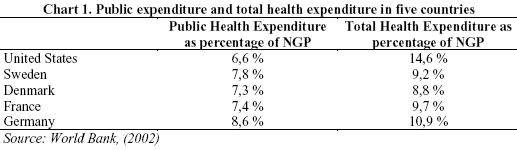
What matters as the cost that society and national economy have to pay is not only public expenditure but total private and public expenditure in general social services: education, health, retirement pensions. BU concentrates expenditures in basic social services, but this does not mean that the society’s expenditure in non-basic social services just disappears. This expenditure will simply take place in the market. Even though the quality and quantity of basic services may lower, social expenditure would not necessarily be reduced. Public expenditure will go down, but as we have already pointed out, a good share of mid and low income sectors will increase their expenditure in basic services because they will start buying those in the market to get better quality and quantity. An example that a reduction in public expenditure in social services does not necessarily mean a reduction in the countries’ total expenditure is the case of United States. The U.S., with a "residual" health care system, has less public expenditure in health care but a greater total expenditure in that area than countries with totally universal public health care systems.
The question remains whether a market rationale generates more efficiency in general social services than social rights rationale. Evidently, the answer is controversial. However, some experiences in developed countries at least cast serious doubt on the efficiency of the market in health care systems.
"Efficiency" is not lowering costs but obtaining the same or better results with the same cost or at a lower cost. In the case of public health care systems the goals are to maximize the quality of health care assistance for all citizens and permanent residents, and to generate more equality in the access to services.
]]> The Unites States have a residual welfare system and, therefore a strong market component in health care systems. Its total health care expenditure according to the World Bank (WB) is 14,6% of NGP, but forty five million inhabitants do not have health care insurance and according to World Health Organization. The United States are in the 37th place in the world’s health care systems ranking."The US ranks 37th in a World Health Organization examination of the world's health care systems. Americans also live fewer years than people in other countries, and have higher infant mortality levels (more babies under the age of one die per year). And according to the Institute of Medicine, 18,000 die each year from having a lack of health insurance. And we've got 45 million people without health insurance, and the most expensive health care system and prescription drugs." (Single Payers 2006)
A different example of the introduction of the market logic in public services, but with similar consequences is the United Kingdom during Thatcher government. Hospitals, even though they continued being mainly public, became independent from central state conduction via contractual relationships. They had to compete among each other to get users in order to receive the State’s payment for the corresponding capitas. After that experience, the results were greater social inequality and lesser efficacy because of the lack of coordination and system coherence, without this translating into a reduction of expenditure. For that reason the Blair government eliminated the market and the competition logic from the United Kingdom’s NHS and re-installed the logic of cooperation and resource distribution according to needs expressed and defined in a dialogue process between the central health care system authorities, direct service providers, users and citizens.
"The NHS in Scotland has a proud record of achievement, both as a distinctive service serving Scotland's needs, and as an integral part of the wider NHS across the UK. But over many years, much of the cohesion and the traditional values of the NHS have been eroded. Standards across Scotland are too variable. Too much inequity exists. A 'postcode lottery of care' has been allowed to develop.
The internal market fragmented the NHS. It undermined the principle of a National Health Service. It drained money away from direct patient care. The emphasis on activity and efficiency savings took the focus away from standards, quality and service improvement. Since 1997 much has been done to sweep away the divisiveness and inefficiency of the internal market and to build an NHS based on collaboration not competition." (Scottish Executive:1-2)"Existing financial systems in the NHS are complex. Many of the measures, targets and systems derive from the internal market and are inappropriate for a patient-focused, partnership-based NHS. The NHS needs to be able to plan better over the longer term." (Scottish Executive, 2006:9)
Pending is the matter of economic viability not now for consolidated social service systems, but for those under construction. In this matter the sponsors of BU claim that, especially in poor or developing countries, the only viable way to maximize social public expenditure is to concentrate it in basic services.
I do not consider it so. It is possible that such policy lowers public expenditure or at least contains it, but it does not necessarily lower the social expenditure that the country and individuals pay. Even so, although total social expenditure might be reduced, I do not believe, for the reasons already stated, that a BU strategy will bring about better quantity and quality of free basic services and foster the tendency to a progressive, gradual extension towards non-basic services. Exactly the opposite will happen instead.
]]> Without doubt, the changes in the labor market question the possibility to finance a universal welfare system based on taxes imposed on salaries. Considering that: salary mass is reduced compared to the wealth of the nations (even poor nations); and income inequality among individuals or social strata is not reduced but increases with the accelerated development of work productivity generated by new technologies, especially in the production of material goods. It is possible and necessary to finance the expansion of social public expenditure through the progressive taxation of all sources of income, not only salaries but also other income sources3. Latin America is the world’s region with the greatest social inequality. Uruguay is the country, or one of the countries with less inequality in the continent. Even though it has a great concentration of income in minority social groups it did not have and still does not have a tax system which taxes higher other income sources. This provides an important margin –through a tax reform raising and generalizing progressive income tax– to finance universal social services by distributing the concentrated resources of rich minority sectors.
4. Final Considerations
The option for the pro market logic of BU is not the result of some inevitable social trend to which one is forced to yield if being realistic, nor is the result of an unbiased choice based on cost and efficiency calculations. The application of a BU strategy is a political choice, which depends on the interests of economic, cultural and political actors and the balance of power among them.
In this regard, BU does not only support but it strengthens the power of the pro market pole within its supporting coalition. Considering that this pole is the most powerful in the inter-electoral stage, BU implementation will tend to minimize free social services, in order to reduce the fiscal costs and to expand the role of the market in providing basic and non basic social services. This increases the power of the pro market pole because it increases the quantity and size of companies providing social services at market prices and, with that, it also increases the number of specialists working for them as well as the number of users who depend on these specialists and these companies. Thus, implementing BU does not tend to strengthen the universalist pole of its support coalition but, on the contrary, it strengthens the inter-electoral power of the pro market pole.
Now, despite the great power of the sectors who favor a pro market strategy in social services (and in the public sector in general) there is no determinism, neither political nor economic that defines some inescapable political or economic need to yield to the pro market rationale of BU
We have already pointed out the strength of the pro market sectors, especially and above all in the inter-electoral stage. They are strong in the electoral stage because, those citizens (voters) whose income does not allow them to pay for all general social services at market prices and who pay less taxes than what they would have to pay for these services at market prices, are very numerous.
Besides, professionals and technicians who need general social services to be for free to put to work their specializations, are quantitatively important even if they are less in number than the users or potential users. And their number tends to grow with the development of a service society. Having an important "voice", agenda-making skills and collective organization capability, their support is very important in the electoral campaign.
Therefore, political parties have interest in generating campaign manifestos that include important chapters in social rights. Specially left wing or progressist parties which, despite having a tendency towards catch all discourses, also tend to differentiate according to their specific electorate. Among them are the lower income sectors, workers in general who try to limit the mercantilization of the work force and those who work in free services.
The question remains whether the party that won elections with a program of social rights universalisation has the ability to comply, faced by the pressure of pro market lobby groups in the inter electoral stage.
]]> We have already pointed out the strength of these groups. The line of lesser resistance for the government is to yield to their demands of reduction or limitation of public expenditures with the subsequent restrictions to carry out ambitious universalization of social rights policies. But every governing party, besides their interest to achieve political stability, also wants to keep and strengthen their electoral base to renew its victory in next and upcoming elections. From this perspective, the left wing or progressist parties will have an interest in fulfilling their electoral promises because their specific electoral base are lower income sectors who need the most and pay the least for universal social rights and also professional groups who work in public, non market, environments.This is the left wing’s interest first and foremost to satisfy and consolidate their electorate’s support. But even as important as the consolidation of an electorate is that an effective institutional transformation contributes to change the balance of forces in the inter electoral stage because it weakens the power of the pro market groups, taking away from them the control of social services and reinforcing the non-market coalition expanding the number and diversity of actors and strengthening their factual power.
To consolidate and strengthen the inter electoral power of the non-market coalition in general social services it is necessary a policy of effective implementation of free (or subsidized) services, not only in basic services as BU proposes, but also in non basic services. This allows keeping and strengthening the support of basic and non basic provider specialists who have great qualifications and "voice", collective organization skills and ability to implement public policies. Also in alliance with the low income sectors who do not have the purchasing power to buy -at market prices- all their general social services and who pay individually fewer taxes than they would have to pay for these services in the market. (Niskanen, 1976:58). Moreover, the power of the non-market coalition is reinforced. As all services are universalized, the financial and technical resources under control of those specialists who work in basic and non-basic free service providers increase as well. The group of low income social sectors who use these services in all the possible and socially demanded services expand, thus expanding the number of people interested in keeping and raising the quality and quantity of such services.
Paul Pierson shows that, in countries where the universalization of the right to free services encompasses the whole citizenship and also services, the pro market pressures are stopped by a broad, powerful non-market coalition, by the strength of public service institutions and providers and by the interest of almost the whole citizenship who depend, low and high income together, on these free universal services.
It is also necessary to keep and consolidate the support of the lower social stratum for which free services are not enough to guarantee effective access to social care. Regarding this subject, the sponsors of BU claim that in order to continue financing free non basic services with public expenditure will not bring about the support of lower income sectors, since these groups are in fact not able –due to lack of culture, insufficient and bad previous education, economic difficulties to have free time, marginality, etc.- to make effective use of what, in theory, is given to them by social rights to non basic services.
Consequently, they propose that, in order to consolidate support for universalisation of social rights in lower income strata, it is necessary to focus public expenditure in allowing the poorest sectors to share with the richer classes basic services with the standards, quantity and quality demanded by the latter as a means of lifting the restrictions that the poor have in their access to non basic services.
It has already been pointed out that, with this strategy, not only non-basic services are handed over to the market, but also the balance of strengths inside the pro BU coalition generates a tendency towards a shift to the market also in quality basic services and the reduction in the quantity and quality of free basic services.
As a result, lower income sectors will continue to have the same actual restrictions to their access to non basic services –lack of culture, inadequate previous education, social marginality, etc.- aggravated by the fact that they have to pay for non basic services at market prices. For low strata, and also for mid and mid-low strata it is a fact that free non-basic services are not the only condition for access, but nevertheless, a necessary condition for their access to them. If they cannot or have difficulties to pay for basic services at market prices, they certainly can not pay for non basic services which are much more expensive. Accordingly, a strategy to solve their problems to make effective use of their rights to access non basic social services and thus to consolidate their support to total universalism does not imply the elimination –no matter how temporary – of those rights.
The strategy to move towards a social-democratic welfare system that effectively incorporates lower and mid low sectors in the use of non basic services does not include eliminating or limiting free access to them, but it is necessary to consolidate and expand them, together with the implementation of targeted policies aimed at lifting specific restrictions: cultural needs, social marginality, chronic unemployment, gender discrimination, race or nationality bias, etc. As these targeted policies succeed in lifting restrictions and eliminating actual difficulties in the lower sectors they would be able to fully benefit from non-basic services which they have the right to use.
With such policies the support to the pro total universalism coalitions is consolidated and strengthened. By complementing free universal access to all general social services with focused policies aimed to overcome specific social, economic and cultural limitations it is possible to have real possibilities to close the gap in quantity and quality of access between the rich and the poor.
]]> But, in addition to this, it strengthens and consolidates the support coalition of a progressive tax system and universal free or subsidized access to social services. As government effectively implements free or subsidized access to all general social services and not only the basic ones, as proposed by BU, financed by a progressive income tax, the inter electoral power of the non-market coalition grows. The power of the government, i.e. the representatives of the whole citizenship, is incremented since the government directly controls both funding and service providing which are determining for the existence of the whole society and economic development. The power of the specialized workers in all services is augmented too, because they grow in number and because they depend on public institutions with important budgets that tend to social needs that are vital for social integration, economic development and political stability. Finally, the number of low, middle and middle-high income citizens who support the government and this policy grows since the government is providing free (or subsidized) access to all general social services and in order to finance them they have to pay less taxes than they would have to pay for those services in the market.In this way, the effective implementation of a general social services policy with free access to all services -and not only the basic ones as proposed by BU- financed by a progressive income tax can maintain and consolidate support for the coalition who voted the ruling party during the government term and the following elections and, at the same time, strengthen and develop the coalition’s power in the inter electoral stage.
On the other hand, a BU strategy contributes to form a coalition with internal tensions between an non-market and a pro- market pole; its implementation tends to weaken and isolate the former and strengthen the power of the latter. Hence, it does not seem as an adequate strategy in order to move towards a gradual universalization of the right to free (or subsidized) access of all general social services. On the contrary, it seems as a strategy that pushes (independently of the will of its sponsors) towards increasing the market influence in areas where there had already been progress in universalization of social rights to basic and non-basic services and towards a de facto residualization of social services legitimated by a Universalist discourse.
References
Cunill Grau, Nuria (1999). "Mercantilization, neo-clientelismo o reconstrucción de la Administración Pública", en Nueva Sociedad. Nº 120. Caracas, pp. 101-118. [ Links ]
Dahl, Robert (1989). Un prefacio a la teoría democrática. Amorrortu, Madrid. [ Links ]
Dunleavy, Patrick (1991). Democracy, Bureaucracy and Public Choice. London Harvester Wheatsheaf. [ Links ]
Esping-Andersen, Gosta (1993). Los tres mundos del Estado de Bienestar, Editorial Alfons el Magnànim, Valencia. [ Links ]
Esping-Andersen, Gosta (2000). Fundamentos sociales de las economías post-industriales. Ariel, Barcelona. [ Links ]
Filgueira, Fernando, C. G. Molina, Jorge Papadópulos y Federico Tobar. 2005. "Universalismo Básico. Una alternativa posible y necesaria para mejorar las condiciones de vida en América Latina" disponible en http://www.ciesu.edu.uy [ Links ]
Huber, Evelyne (2006). "Universalismo básico y el futuro de la seguridad social en la región", CD con las ponencias del Curso de Gerencia Social, las políticas públicas.com gestión del riesgo social: alternativas y desafíos, INDES, BID, CIESU, Montevideo, 29 y 30 de marzo de 2006. [ Links ]
Laville, Jean Louis (2005). Sociologie des . Sociétés en changement. Editions Érés, Saint-Agne. [ Links ]
Narbondo, Pedro y Conrado Ramos (2001). "Reforma administrativa y capacidad de conducción estatal", en Calame, Pierre y André Talmant, Con el estado en el corazón. Ediciones Trilce, Montevideo, pp. 125-167. [ Links ]
Narbondo, Pedro (2003). "Nuevo paradigma de la gestión pública: ¿transformación técnica o transformación política del Estado", en Ramos, Conrado, La reconstrucción gerencial del Estado. Enfoques políticos sobre la "nueva gestión pública". Banda Oriental, Montevideo. [ Links ]
Niskanen, William (1976). Cara y cruz de la Burocracia. Espasa Calpe, Madrid. [ Links ]
Scottish Executive (2006). "Our National Health: A plan for action, a plan for change", disponible en http://www.scotland.gov.uk/library3/health/onh-05.asp. [ Links ]
Single Payers (2006), "Answers and Fact About Helth Care for All", disponible en http://www.grahamazon.com/sp/other.php [ Links ]
World Bank (2002). HNP Comparative Data. Summary Profile. Disponible en http://devdata.worldbank.org/hnpstats/cd3.asp [ Links ]
]]>
1 The Social Development Unit from IDB organized a Seminar on "Basic Universalism: a new proposal for social policies in Latin America", that took place in Washington from 5th to 7th October, 2005. On 29th and 30th March, 2006, IDB together with INDES and CIESU organized in Montevideo the "Course on Social Management, public policies as management of social risk: alternatives and challenges", its core was Basic Universalism.
2 By "general social services" it is meant those services given to all citizens for free (or subsidised), that are financed through public expenditure. At present, it is there is high social acceptance (though not necessarily unanimous) that everybody needs education, health care, and, from certain age onwards, they need to stop working and to receive a pension. Those needs do not depend on the socio-cultural situation or financial position. Whether one is rich or poor, individuals and society consider it is necessary to have access to those services.
3 In this I agree with Filgueira et al. (2005.)