Melina Ayres de la Barrera
B.A. in Social Communications, Universidad Católica del Uruguay. Master in Journalism, Universidad Federal de Santa Catarina, Brazil. Researcher and journalist, E-mail: melina.ayres@yahoo.com
Translated by Daniel González Arias
Translation from Cuadernos del claeh, 2.ª serie, año 32, n. º 98, 2009/1.
ABSTRACT
]]> Soap operas are increasingly inserted in a concrete social reality. The representations constructed by soap operas are associated with daily life and social with the context in which they are immersed. This article discusses the narrow boundary between fiction and reality in soap operas, and the intent to educate throughout current real issues. With this purpose this study selected two soap operas written by Manoel Carlos and produced by Brazilian Red Globo: Mujeres Apasionadas (2003) and Páginas de la Vida (2006).Key Words: soap operas, entertainment, social impact, social merchandising.
In a random night, we turn on the TV with the intention of watching an episode of a soap opera but what we see is not fiction: we face the birth of a girl, which in a soap opera means a royal birth. This happened in 2006´s Brazilian soap opera Páginas de la Vida,1 written by Manoel Carlos, produced and broadcasted by TV Globo, Brazil. This fact leads us to think: is this really a soap opera?
This article aims to discuss the thin line between fiction and reality in soap operas, and the intention of educating throughout topics from present real life. With this purpose we selected two soap operas written by Manoel Carlos and produced by Rede Globo: Mujeres Apasionadas2 (2003) and Páginas de la Vida (2006).
The choice of these products is based on the fact that this type of soap operas, represent every day authentic stories. The importance of soap operas in these cases is given by the concept of returning to the simplicity of the stories rarely in a way rarely tackled in the news field. Through the issues addressed in these fictions and their ordinary people characters, the audience is able to identify themselves with private family world, where relationships are privileged. All Manoel Carlos soap deal with these issues, but in Mujeres Apasionadas and Páginas de la Vida these topics are exacerbated to the point that reality and fiction are often confused.
Soap operas' plots express a fictional reality that is inserted into a concrete social reality. The representations built by the soap operas are associated with the daily life and social contexts in which they are immersed. The images transmitted are highly related to society values and beliefs.
Theorical Perspective
]]> To analyze the close relationship between fiction, reality and education through soap operas, one must review a number of topics; the agenda is one of them.The media daily sets a series of issues taken from real life events, and offers an agenda to the audience. This agenda is taken up and reconstructed by the audience. It is assumed that, in the long term, the media contributes to build an image of reality. Several authors have studied this issue, including Roberts, who understands that "the influence of the media is postulated because, in the long term, it helps us to structure the image of social reality, to organize new elements of these images, to build new views and beliefs ".
One of the approaches to theses long-term effects is the agenda setting hypothesis. Shaw says:
The hypothesis of agenda-setting does not state that the media seeks to persuade. When describing external reality, the media presents a list about all those topics on which to discuss and have an opinion. The fundamental statement of the agenda-setting hypothesis is that the media alters the compression that people have about social reality.
The media takes issues from reality and offers the public a list of topics that should be taken into account for discussion. Diferent media have different effects. Wolf argues that "television [...] reflects real daily behaviors as its source of its communicative activity [...]. Television reproduces everyday situations, representing them and transforming them into moments to set as examples [...] in real daily".
It is worth mentioning that this article will take a look at the agenda built by the soap operas Mujeres Apasionadas and Páginas de la Vida, not at the agenda set by the audience.
The concept of gender is also very important for the analysis, since it implies, for the emitter, different models of writing, and for the receiver, an orientation for reading. Gender does not involve only one form of emission, in the context of communication, the audience is active and critical, gender, therefore, is a contract negotiated by both. According to Todorov, the concept of gender implies "different categories in which plays can be sorted according its common features of form and content".
According to Nora Mazziotti,
]]> Nobody in the industry intends to do neither a thriller with no persecution, nor a comedy with no jokes, neither a soap opera, with no romance [...]. And audiences know it. You are asked to respond to gender rules. [...] But even the rigidity of the rules can be broken, incorporating topics that originally come from other genders. Something increasingly happening in our time. [...] The soap opera is a good example of how to change rules, make adaptations, parodies and continue to have a soap opera.
Soap operas are classified within the group of fictional genres. According to Rosario Sánchez3, this genre allows the creation of a universe that does not correspond with reality. As this is an explicit feature, the receiver does not perceive it as a deceive, but as a product of imagination. The reading contract of a fiction involves that the receiver will face a product which is a fantasy. Anyway, it should not be forgotten that, frequently, fiction is based on real life events; that is the reason why it has become a highly effective tool to transmit knowledge and experiences to the public.
This genre gathers some characteristics that make the contact between fiction and reality easier. In both, Mujeres Apasionadas and Páginas de la Vida, the line between reality and fiction was very flexible. The narrow link was observed not only through the inclusion of real topics but also in the characterization of the characters. Through them, cultural references were transmitted, either by their religion, sexual preference, outfits, habits, and so on.
Another important concept for this analysis is present time, events that calls the attention of ordinary people at any given time. Taking present time into account, both Mujeres Apasionadas and Páginas de la Vida can be categorized as soap operas that address current issues. Both take place in urban settings and both are contemporary. They deal with simple facts and show everyday life events, everyday situations, even the banal ones.
Soap operas show current events through three aspects: first, by introducing themes that have great social interest; second, through "verbal references" alluding to contemporary events; third, their stories reflect the preferences of the audience4.
In both, Mujeres Apasionadas and Páginas de la Vida, Manoel Carlos exacerbated these features to the point that he finished writing as the episodes were being shot. On the one hand, these features of its soap operas have good reception among the audience. Both soap operas were very successful in terms of rating. On the other hand, the actors and actresses, who are not used to having access to the script in such short notice, complain about this way of working to the point that one of the performers of Páginas de la Vida quit his job because he could not stand working under such pressure5.
The soap opera as a tool for education. The social merchandising
From the very beginning, soap operas have been one of the most watched genres. According to Nora Mazziotti: "several countries have records on its impact, which speak not only of its commercial importance but also about its cultural and social significance". This is a phenomenon that goes beyond social classes. Moreover, the audience feels a very strong bond with soap operas.
The audience can easily relate to the characters' miseries, perhaps that is the reason why they can adopt a new behavior in a natural way, without feeling they are doing something far away from their realities. Therefore, experts in public health and communication try to insert messages of healthy lifestyles in tears, betrayal and impossible love stories6.
Miguel Sabido, 'officially' started this process, and because of that he is considered a pioneer in terms entertaining with social benefits.
]]> "I tried to make commercial television to have a social benefit through soap operas, a product that is inside the houses of those who most need to learn and improve their lives. And I proved that this could be accomplished without having the rating dropping"7.Red Globo's soap operas have been including social merchandising for many years. An annual report prepared by this company revealed that in 2002, there were a total of 1138 scenes in soap operas related to social issues. The issues addressed had to do with alcoholism, sexual health, organ donation, the use of condoms and environmental issues, among others. If this insertion had been commercial merchandising, the company would have raised between $ 35 and R 40 million.
Manoel Carlos, Benedito Ruy Barbosa and Gloria Perez are some of the Brazilian authors who joined this purpose. "Fiction has been a good ally in times of clarifying important issues for society. As one of the most comprehensive fictional genres, soap operas should be aware of this", says Manoel Carlos8.
Manoel Carlos' Mujeres apasionadas introduced a campaign aimed at making the audience more sensitive and respectful about elderly population in Brazil. The approach to this issue moved beyond the scope of soap operas and landed in the Brazilian Congress, where the creation of the "Estatuto do Idoso", a bill which had been in stand by for five years, was promoted. After the incorporation of this topic in the fiction field, this document gained importance in the special sessions of the House of Representatives and the Senate.
Among other topics addressed, soap operas also included domestic violence issues with the purpose of encouraging the reporting of these cases. Moreover, a common but not frequently tackled situation was rescued: the situation of women who are madly in love in a pathological way.
Páginas de la Vida addressed the story of a child with Down syndrome. Through Clara, the author showed the difficulties, challenges and happiness experienced by the family of a child with disabilities. It should be stressed that the actress who represented Clara, Joana Mocarzel, 7, actually has Down syndrome, which was a challenge for her, for her real family and for the entire production crew. Undoubtedly, the choice of this girl as the leading actress was essential to achieve the intended realism
This soap opera also went through other issues such as alcoholism, bulimia, and the best ways to treat those who suffer from those diseases; racism and male homosexuality were addressed too, among other topics. This approach was very profitable for the soap opera, and its performers, and gave its author a tribute made by the Brazilian Senate.
The inclusion of these issues not only generated high ratings in the fiction field of Red Globo, it also gave the enterprise international recognition. In 2001, Globo received the top social responsibility prize in the world, the Business in the Community Awards of Excellence9.
The analysis
]]> Taking into account the assumptions outlined earlier, the analysis was based on the plot of soap operas. The methodology applied to observe the relationship between fiction, reality and intention of educating, was the one developed by the author of "Nosotras, vosotras y ellas: el receptor y la construcción de agenda", in which the issues tackled in the soap opera Mujeres Apasionadas were analyzed. In order to compare both results, this article took the outcomes of such research, applying the same methodology to the soap opera Páginas de la Vida.The methodology presented in "Nosotras, vosotras y ellas: el receptor y la construcción de agenda" involves analyzing the text in several stages. First, publications concerning these productions were reviewed. Then, all the episodes of both soap operas were watched to identify the different topics addressed. Once all the issues were reviewed, they were classified according to the criterion of importance in the plot. Finally, the charts with the results were made. The methodology, strategies and tools applied show the agenda generated by these productions.
The chart was intended to be a simple way of showing the movements of the topics in the stories, considering the importance of each one of them at certain moments. This was awarded four levels of importance:
0. Not addressed: the issue is not addressed in the episode.
1. Mentioned: one of the characters refers to the issue, he/she remembers it, but does not go beyond a particular memory or comment.
2. Significant: the issue is addressed by several characters; it is tackled in some scenes.
3. Very important: not only the issue is addressed, but also its approach receives a considerable time. Taking into account that an episode lasts for about 45 minutes, a considerable time is defined as four or more minutes.
In order to achieve an overview of the approach of the issues, it was necessary to group the episodes every two weeks. This means that daily events were given a score in each chapter. The score that was more repeated in two weeks, was the one awarded to the group of episodes. It is relevant to make that clear, because it frequently happens that, for example, a given issue has a level 0 on the chart. However, this does not mean that within fifteen days, the issue was not present, it means it did not appear in most of the episodes. In this way, the charts that assess the level of importance given to each topic in a period of fifteen days is defined. The only exception in this grouping was the last episode, which was found ten days away from the last group of episodes. This has to do with the great importance of the latest episode of a soap opera, all the story concludes in that finale, therefore its inclusion was considered very appropriate.
It should be noted that, although the analysis was based on charts and somehow, it quantified the content of soap operas, it did not seek to obtain absolute values. The objective was to observe trends and relations among the topics.
]]> Twenty-two issues were analyzed in the script of Mujeres Apasionadas, seven of them had to do with social merchandising Forty-three topics were tackled in Páginas de la Vida, and ten of them had to do with social merchandising. This situation shows that the latter soap opera had a greater number of issues, but finally the social merchandising approach was reduced. In percentages, 32% of the issues scheduled to be addressed in Mujeres Apasionadas were related to social merchandising, meanwhile 23% of the topics reviewed in Páginas de la Vida had an educational purpose. However, despite this slight decline, there still is a high level of inclusion of these topics, which demonstrates the intention of both soap operas to encourage viewers to think about these thigs. However, it should be considered that, although in many cases, soap operas looked forward to promoting the reflex of these social issues, the main purpose was to entertain.The graphs allowed us to clearly visualize the soap operas' agendas. It was found that although there was a thematic hierarchy, this was not rigid. We observed that one of the techniques used by Manoel Carlos is the intercalary of stories. Thus, although some issues were secondary, each one of them was highlighted at some moment10. Another fact that reaffirmed the flexibility of the the ranking was the lack of a relationship between the level of appearances (how many times a topic was addressed in the narrative) of the various issues and their hierarchy.
Two ways of addressing the topics were distinguished: one for social merchandising and another one for those who had no teaching purposes. Most of the social merchandising issues were introduced in the plot as secondary topics, nonetheless, they were always pat of the ongoing basis, showing ups and downs in the development of the plot. They were concealed by others, but at some point they became relevant and reached a high level of importance to later return to their original place: the background. This kind of approach lead one to think that, first, the author tried to maintain the momentum of the story making the audience to always expect something, second, the fact that a topic generated controversy and then disappeared from the plot, could have been a strategy aimed at having the audience digesting these issues without rejecting them. It is considered through this way of including the issues, that the author tried to put the topic on the table for discussion, to teach or reaffirm something that was already know by the audience, but without going too deep.
In the case of Mujeres Apasionadas, it should be point out that, in spite of the fact that the approach to the topics of social merchandising was recognized as "not incisive", the issues with educational purposes presented a level of importance 3. This scenario re-emphasizes the real interest in providing education.
In Páginas de la Vida, this aspect is not repeated, since both, social merchandising issues, and purely fictional topics have practically the same amount of level 3. Another important aspect in this soap opera is that the issue of Down syndrome is the center of the story, from the beginning till end. This is the only topic that breaks the perceived regularity in the approach of the two types of issues (social merchandising and educational nonprofit issues), mentioned above.
Regarding those issues without educational purposes, the topic that stands out the most has to do with love stories, a classic for this fiction genre. These stories acted as a trigger and were the basis for the discussion of issues that went beyond relationships. The stories of Claudio and Edwiges, and of Heloise and Sergio were clear examples of this in the soap opera Mujeres Apasionadas. The former discussed love between people from different social classes and the issue of virginity. The latter presented the problem of extreme jealousy. In Páginas de la Vida, the stories of Fernanda and Leo, and Lavinia and Diogo stand out. The first couple represents passionate love between young people and teenage pregnancy. The second couple discussed chastity and the love between a man and a nun.
To illustrate the ways of addressing these types of topics, this article selected two very different themes for each soap opera. However, it should be noted that the study analyzed all the issues tackled in both soap operas.
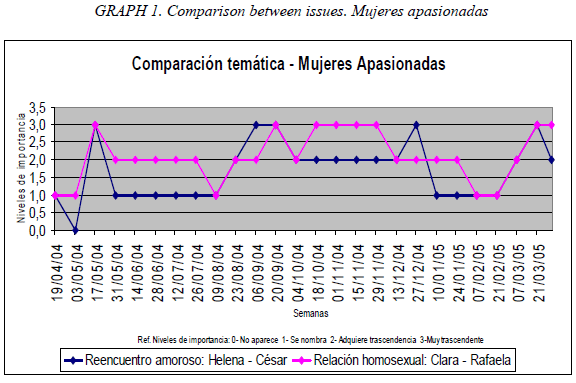
In Mujeres Apasionadas, on the one hand, there is the love story experienced by the characters of Helena and César, and on the other, the homosexual relationship between two teenage girls, Clara and Rafaela, a secondary theme in the plot. Even though they had a different exposure, both stories were presented in the soap opera.
The love story can be classified as an entertainment issue. Initially, this topic was presented as a central axis in the soap opera, but it was then relegated to the background, since it barely reached level 3, concentrating on levels 1 and 2 instead and dropping to level 0 for a two-week period. In this sense, this topic was always present but with limited importance.
The homosexual relationship can be classified within the group of topics of social merchandising. In the first instance, this issue was presented as of secondary importance; however this did not seem so evident if the levels of importance that it acquired as the story went by are analyzed. The first thing to point out is that this topic was present all along the whole development of the soap opera. In the first weeks, it reached the level 1of importance, then, it went up till level 3, and after that it dropped to level 2, remaining in that position for several months. Immediately after that, it climbed to level 3 and it remained between the two highest levels of importance in most of the rest of the development of the soap opera.
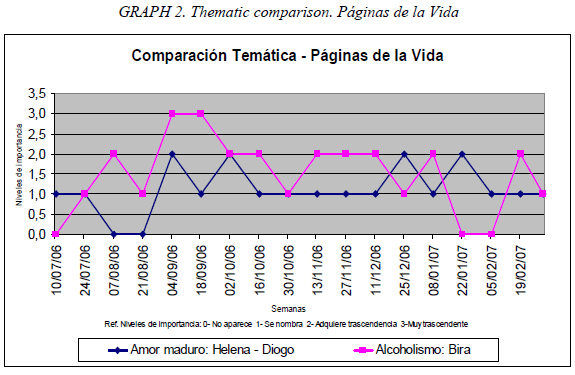
In Páginas de la Vida, the topics selected were the love reunion between Helena –the main role of the soap opera- and Diogo, and the story of Bira, a secondary character.
Helen and Diogo's love reunion can be classified as a topic only for entertainment. Helena is the main character of the plot, but the center of her story is not her relationship with Diogo, but the challenge she faces when raising her down syndrome adopted daughter, Clara. For this reason, the issue, despite being experienced by the main character, was always in the background, mostly reaching the level 1 and on four occasions the level 2. Here again it is confirmed entertainment issues function as serve as support for addressing topics of social merchandising
The social merchandising topic chosen had to do with Bira's story. This character becomes alcoholic when his wife cheats on him, and asks him for a divorce. From that moment on, a character that seemed absolutely secondary, starts gaining more relevance. Graph 2 clearly illustrates this point: within the first weeks, as Bira and his wife are together and he later learns about her infidelity, the level of importance of this topic keeps on climbing till reaching level 3, in which it remains for two weeks to finally drop to level 2, in which it stays for almost all the development of the soap opera. The only moment when it gets to level 0 refers to the period when the carácter is in rehab, therefore, not seen on screem.
]]> Some approaches
One of the main features of these two productions was the overabundance of scheduled topics. First of all, it should be taken into consideration the incorporation of new issues tackled: twenty-two in Mujeres Apasionadas and forty-three in Páginas de la Vida: the number of themes in the former almost doubled the number of themes in the latter.
Secondly, it must be highlighted the wide range of themes addressed: from childhood premonition to breast cancer, and from street violence to sexual liberation in Mujeres Apasionadas; and from the ambition to spiritual matters such as after death appearances, and from the Down syndrome to racism in Páginas de la Vida.
The approach of this multiplicity of topics can be understood in two ways: first, there is a greater chance of the audience relating to any of those topics, and secondly, this kind of approaches can lead to a more superficial treatment of each issue, resulting in a lower impact.
Through he charts, it was seen that the approach to the issues was quite particular: at some point in the story, all of them become important. When some were with a high level of importance, others remained at lower levels, then, when they climbed up, the others went into the background, and vice versa. This constant rise and fall of the stories not only allowed a wide range of proposals, but also gave impetus to the story.
As a matter of fact, this variety of stories was favored by the movement of the issues in the plot. By movement we understand the way in which these issues were developed, how they were introduced into the story, how they gain or lost importance, and how they were removed from the story. The approach of this multiplicity of topics can be understood in two ways: first, there is a greater chance of the audience relating to any of those topics, and secondly, this kind of approaches can lead to a more superficial treatment of each issue, resulting in a lower impact.
By analyzing the text of the soap opera, it was found that the selection of topics for the plot was deliberate and intentional. In the specific case of social merchandising, the intent to encourage the public to think it was widely perceived. There was a high level of inclusion of these kinds of topics. In Mujeres Apasionadas, seven out of twenty of the most important issues had a pedagogical objective. In Páginas de la Vidas, ten out of forty-three were social merchandising topics. In this sense, more general topics were incorporated, but there were at less representative decrease in the incorporation of social merchandising issues. Some question remains: will this way of dong soap operas continue? Will social merchandising approach continue to grow?
This work allowed us to identify the issues addressed in both productions. Within the social merchandising topics, we found street violence, homosexuality (female homosexuality in Mujeres Apasiona0ads and male homosexuality in Páginas de la Vida) and alcoholism (In Mujeres Apasionadas, alcoholism was tackled through a woman, Santana, and in Páginas de la Vida, through a man, Bira).
Among the non-educational issues, mysticism or supernatural events stand out (in Mujeres Apasionadas, Saleth, a six-year old girl has premonitions: she feels that of her mother will die, and when that actually happens, she constantly sees her mother's spirit. In Páginas de la Vida, Fernanda, Clara and Francisco's mother, dies when giving birth, and appears on several occasions to help her children, who can see or feel her presence). There were also love stories between cousins (in Mujeres Apasionadas: Luciana and Diogo, in Páginas de la Vida: Marina and Rafael) and undoubtedly, there were the classic love stories, reunions, Cinderella stories, young love, jealousy or lack of them, and extramarital relationships.
Finally, when facing the question: "soap operas, to entertain or to educate?", it is believed that soap operas are a tool to entertain and educate. Entertainment and education do not exclude each other. The educational potential of this type of productions must be highlighted. As mass products, soap operas make a powerful tool; it reaches every home, regardless of gender or social class, with a tempting proposal of entertainment. However, what at first glance looks just like fun, also reaches the person in an educational way, without him/her even noticing it. Nobody sits in front of a TV to learn through a soap opera, as they do, for example, through the news or some documentary. Therefore, soap operas give educational messages in disguised, so that the viewer often learns, almost unconsciously. This is the intention of social merchandising: "to introduce relevant social issues in a hidden way from the viewer, and to teach the audience about them"11.
]]> The essential characteristics of both of the products studied: its: its proximity to the viewer's daily life, treatment of real and current topics, the emphasis on female issues, etc., contributed to their educational status.When observing this type of approaches in soap operas, the following question is unavoidable: "What happens with the public?" An investigation conducted by the same author of this very article, about Mujeres Apasionadas12, contrasted the agenda built by the referred soap opera with the agenda developed by a group of Uruguayan women. The result was surprising: the viewers recognized the agenda proposed by the soap opera, but at the same time, they built an agenda of their own. They somehow rescued the proposed made by the fiction production, but reformulated it into a new one following their own taste and discretion. Beyond the fiction plot involved in this redefinition, the psychological factor and the personal experiences played an important role. Regarding the speeches, it was observed that in many cases, these viewers were highly critical of some issues, however, they accepted the approaches chosen, under the consideration that they were typical of soap operas. This research found that not only the viewers accepts, takes and discusses the issues addressed by soap operas, but often change their way of thinking and acting through them.
From this observation, it can be said that soap operas are a product that actively participates in the viewer's reality. They have an invaluable educational quality: their message goes beyond the precise time of reception and they impact in various spheres of the viewer's life. Consequently, soap operas should be appreciated as an excellent tool for transmitting values, knowledge and experiences, and for encouraging thoughtful reflection.
Bibliography and sources
Alencar, Mauro: A Hollywood brasileira, Río de Janeiro: Senac Rio, 2.ª edición, 2004. [ Links ]
Andaló, Paula: «Lágrimas, amores, traiciones... y mensajes de salud», en Revista Perspectivas de Salud, vol. 8, n.º 1, Organización Panamericana de la Salud, 2003. ‹www.paho.org›. [ Links ]
Ayres, Melina; María Noel García: «Nosotras, vosotras y ellas: el receptor y la construcción de agenda». Tesis presentada como requisito para la conclusión de la Licenciatura en Comunicación Social, Montevideo: Universidad Católica del Uruguay, 2006. [ Links ]
— «Telenovela, merchandising social y audiencia: una triple conjunción a discutir», trabajo presentado en VIII Congreso alaic, GT Telenovelas y Ficción Seriada, Porto Alegre, 2006. [ Links ]
Cerqueira, Sofia: «O ficcionista da realidade», en Revista Veja online, Editora Abril, 5 de julio de 2006. [ Links ]
Cimino, James: «Autor de Páginas da Vida diz ter compromisso com a realidade», en Folha Online, San Pablo: Grupo Folha, 2 de junio de 2006. [ Links ]
Colombo, Furio, Televisión: La realidad como espectáculo Barcelona: Gilli, 1976. [ Links ]
Mazziotti, Nora: La industria de la telenovela. La producción de ficción en América latina, Buenos Aires: Paidós, 1996. [ Links ]
— «Creer, llorar, reír», en Revista Chasqui, n.º 46, Quito: quipus-ciespal, julio de 1993. [ Links ]
Mendonça, Martha: «Usina de polêmicas», en Revista Época, n.º 279, Ed. Globo, 22 de setiembre de 2003, p. 104. [ Links ]
— «A arte ajuda a vida», en Revista Época, n.º 268, Ed. Globo, 7 de julio de 2003, p. 102. [ Links ]
Ortiz, Renato: A moderna tradição brasileira. Cultura brasileira e Indústria Cultural, San Pablo: Brasiliense, 2001. [ Links ]
Rogar, Silvia: «Escrevo sobre o que conheço», en Revista Veja, n.º 1810, Ed. Abril, 9 de julio 2003, p. 75. [ Links ]
Rojas, José: «De la oralidad a la telenovela», en Revista Chasqui, n.º 53, Quito: quipus-ciespal, marzo 1996. [ Links ]
Sánchez Vilela, Rosario: Sueños cotidianos. Telenovela y oralidad. Montevideo: Santillana, 2000. [ Links ]
Todorov, Tzvetam: Los géneros del discurso, Caracas: Monte Ávila, 1996. [ Links ]
Vasallo, María I.: Vivendo com a Telenovela, San Pablo: Summus, 2002. [ Links ]
Vilches, Lorenzo: La televisión. Los efectos del bien y del mal, Barcelona: Paidós, 1993. [ Links ]
Wolf, Mauro: La investigación de la comunicación de masas: crítica y perspectivas, Barcelona: Paidós, 1987. [ Links ]
— Los efectos sociales de los media, Barcelona: Paidós, 1994. [ Links ]
Web sites
‹www.globouniversidade.globo.com›
]]> ‹www.observatorio.ultimosegundo.ig.com.br›
1 Pages of Life
2 Passionate Women ]]>
3 Rosario Sánchez Vilela: Sueños cotidianos. Telenovela y oralidad, Montevideo: Santillana, 2000, p. 22.
4 Conceptos retomados de R. Sánchez Vilela, Sueños cotidianos..., o. cit., p. 24.
5 Información disponible en ‹www.folha.uol.com.br› (ago. 2005).
6 Información disponible en ‹www.paho.org› (set. 2005).
7 Información disponible en ‹www.ops-oms.org› (set. 2005).
8 Información disponible en ‹www.observatorio.ultimosegundo.ig.com.br› (set. 2005).
9 Ibídem.
10 Ibídem, p. 74.
11 Rosario Sánchez Vilela, Sueños cotidianos..., o. cit., p. 24.
12 Melina Ayres, María Noel García: «Nosotras, vosotras y ellas...», o. cit.