Translated by Cristina Cafferatta
Translation from Cuadernos Del CLAEH, nº 94-95, pp. 121-141, 2007.
ABSTRACT
Trade policy is currently a hot topic in Uruguay. In January 2007 the Uruguayan left-wing government signed a Trade and Investment Facilitation Agreement (TIFA) with the United States. This rapprochement responds both to the aggressive bilateral strategy pursued by the US in the hemisphere since the stalling of Free Trade Area of the Americas (FTAA) negotiations, and to Uruguay's increasing discontent with the performance of the South American Common Market (MERCOSUR). Whether the TIFA will lead to a free trade agreement (FTA) is yet to unfold. This essay explores the politics of trade underpinning the negotiation of a bilateral FTA between Uruguay and the US. Drawing from the interplay of systemic-, state-, and society-centred approaches to trade policy-making, this essay argues that doubts regarding the net gains for Uruguay, combined with the threat of being excluded from the subregional project, and the lack of consensus within the Uruguayan state-society complex, render the negotiation of a bilateral FTA unfeasible in the short term. The central explanatory variable to the understanding of trade policy-making in Uruguay is placed on the institutional constraints imposed by Uruguay's full-membership to MERCOSUR.
Introduction
In January 2007 Uruguay and the United States (US) signed a Trade and Investment Facilitation Agreement (TIFA). To date3, a Joint Commission and a work plan were established to further trade and trade related aspects between both countries. Whether this act is a prelude of a more comprehensive bilateral free trade agreement (FTA) between Uruguay and the US is yet to be seen. There are supportive and disruptive systemic, state and social forces both favouring and constraining the negotiations of a bilateral FTA between Uruguay and the US. With multilateral and hemispheric trade negotiations having stalled, and a MERCOSUR that is no longer meeting Uruguay's expectations, US willingness to sign a bilateral FTA with Uruguay is an increasingly appealing option for the latter. Trade policy is under scrutiny.
But what is at stake in trade policy? In the short term, trade creates winners and losers4 inside and outside borders (Cohen et al., 2003) as it leads to the allocation of production in the most efficient sectors at the expense of those which are not competitive (Schott 2005). In addition to its distributive effects, trade policy has an impact over fiscal revenues, consumption, and production as well as jobs (Newell and Tussie 2006). Moreover, the scope of international trade regulation has been broadening since the last decades, whereby more sectors and themes, now permeate national legislations (Woolcock, 2002). Trade policy thus has a direct impact over people, and consequently, it is a highly politicized and sensible area. (Spero, 1985; Hocking, 1999). In a broader sense, trade policy is the 'end product of governmental decisions that need to reconcile economic and political substance while seeking to advance governments' domestic and foreign concerns' (Cohen et al., 2003).
The aim of this paper is to unravel the politics of international trade which are embedded in the negotiations of a bilateral FTA between Uruguay and the US. It seeks to identify constraints and opportunities at stake in the prospects of a bilateral free trade agreement negotiation. This essay argues that due to the division among economic interest groups and social forces, doubts of the Uruguayan state actors regarding the net economic gains and the potential political costs of signing a FTA with the United States both at domestic and regional levels render the signature of the bilateral FTA unfeasible in the short term. From these explanatory variables, the institutional constraints that Uruguay holds as a full member of MERCOSUR, play a fundamental role in the making of the Uruguayan trade policy.
The paper is structured as follows. First it reviews the different theoretical approaches to trade policy-making. In this way, this paper tackles the study of the empirical case of Uruguayan trade policy by analyzing the interplay of the systemic, state-, and society-centred approaches to trade policy-making in order to understand the ideas, interests and pressures at stake in its definition. The second section delves the Uruguayan-US relationship from a systemic-centred approach with the purpose of setting up the Uruguayan trade policy in the frame of the US trade strategy of "aggressive" bilateralism in the hemisphere and its impact at the sub regional level. The third section discusses the possible effects of a bilateral FTA between Uruguay and the US. Therefore, it explores the potential agenda items as well as both countries' motivations, and, therefore, the opportunities and threats at stake for Uruguay in the face of a negotiation. The fourth section unfolds the politics of trade at the subregional and domestic levels that is constraining the negotiation of the bilateral FTA. The last section presents some concluding remarks.
Unravelling trade policy-making: a critical review of the literature
There are the two major theoretical bodies which try to explain trade policy-making from different disciplines: economics and political science. From economics, the public choice model, conceives of individuals and firms as organized into interest groups which are motivated by economic self-interest, and thus claim for particular policies (for instance, protection or elimination of tariffs). On the other hand, government officials are seen as the suppliers of these policies (Trebilcock and Howse, 1995). According to the public choice model, the interests of producers tend to prevail over those of consumers'. This is to be explained because consumers' interests are more diffuse due to a question of capacity and mobilization costs (Downs, 1957, and Olson, 1965, in Trebilcock and House, 1995). In their role as consumers, individuals, tend to be less motivated to organize collectively and to pressure against protectionism. This is because trade liberalization has the characteristic of a public good whereby price reduction arising from free trade benefits everybody, and nobody can be excluded from this benefit. For that reason, the individuals tend to behave like free-riders since they consider that they will ultimately benefit without having to lobby for liberalization policies. In this way, the prevalent behavior will be not to organize collectively (Baldwin, 1996). However, the more concentrated the interests in trade policy are, that is to say, the higher the interest at stake is and the less the members of the concerned interest group are (for instance, an industrial sector or agricultural producers), the easier it will be to organize collectively. This is because collective organization helps to overcome information and transaction costs, and thus enables to pressure for certain trade policies. So too, government officials acting by personal economic interests, seek to satisfy the individuals or firms demands to assure their (re)election (Trebilcock and Howse, 1995).
]]> Nevertheless, the public choice model presents limitations to explain certain decisions in trade policy-making, such as the use of trade policy with ampler aims concerning foreign policy. In addition, it does not acknowledge the role that institutions and ideology play in trade policy-making (Baldwin, 1996). For instance, Kau and Ruin (1982) posit that some individuals are inclined to sacrifice their personal economic interests for questions of an ethical nature (an example of this would be the current trend of fair trade promoted by civil society members of developed countries). Likewise, the approach of public choice seems not to capture the complexity of interests at stake in the politics of trade, as it solely distinguishes between final consumers who support liberalization, and producers who claim for protection. This is a simplification that does not take into consideration, among other things, the fact that the imports can also be inputs for other industries, nor that exporting companies can fear a possible retaliation in their products if tariffs are to be erected (Odell, 1987).On the other hand, from the field of political science, it is possible to distinguish three main approaches which seek to explain trade policy-making: system–centred, society-centred and state- centred approaches (Porter, 2005; Baldwin, 1996).
The systemic approach envisages trade policy-making as the result of the interaction among states, and as a function of their relative power in the world order (Ikenberry, 1988). Some authors assert that the systemic level is the first analytical cut, essential for any effective comparative analysis. This is so as it enables to understand the problems, pressures and external challenges common to the states, imposed by the structure of the global political economy. Consequently, it allows for an appreciation of the particular national answers to the international structure (Keohane, 1984). There are several systemic accounts of trade policy-making, being the most salient - yet not the least criticized - the hegemonic stability theory (HST). HST maintains that there must be an hegemonic state willing to bear the costs of keeping an open and free international trade system (Lake, 1993). On the other hand, Phillips (2004, p. 185) analyzes the politics of trade in the Americas as the resultant 'not only of the diverse commercial interests and strategies developed by the region, but also like the result of several superposed levels into which the trade agreements are articulated in the region'. According to this perspective, to study the politics of trade it is necessary to understand the interplay between the different levels in which trade policy is formulated: the bilateral, the subregional, the hemispheric and the multilateral levels (Phillips, 2005a). However, the systemic approach is not sufficient to explain trade policy of a particular state because it is centred in the restrictions that the system places to the states. Thus, it is necessary to open the domestic politics black box to unfold the interests pressing on trade policy decision-making (Ikenberry et al., 1988).
The society-centred approach is based on pluralist theory which explains trade policy-making as a function of the struggle for interests and lobbying capacity of social and political actors organized in interest groups around a particular issue (Truman, 1951; Dahl, 1963; Lowi 1969; Lindblom, 1977, on Baldwin, 1996). It is based, like the public choice approach, in the actors' rational calculations. For this approach, state institutions do not play an important role in trade policy-making, because they just represent the political arena where the struggle for interests and the decision-making take place. For Ikenberry et al. (1988) this approach focuses on the demand side and not on the supply side of trade policy. Also, it lacks of theoretical rigor and predictive capacity because it cannot measure the group power independently whereby the resulting trade policy can only be explained ex- post.
Explanations of trade policy-making focused on the state aim at correcting these deficiencies. They emphasize that governmental officials and institutions can exert an important role in the formation of interests of the interest groups (Lake, 1988). Within this approach, the institutional current conceives of the state as a set of norms and institutional arrangements that tend to last in time. The survival of institutions over interests and coalitions, gives the former a degree of influence in trade policy-making. Moreover, ideas which underlie trade policies have ramifications in time since they are embodied in institutional and legal structures that are going to restrict the decision takers in the future (Goldstein, 1993). For the historical-institutional current within this approach, 'once a country or a region has begun a path (institutions or policies), the reversion costs are very high. There will be other points of choice, but the entrenchments of certain institutional agreements obstruct the simple reversion of the initial election' (Levi, 1997, p. 28, cited in Pollack, 2004: 140). Ikenberry (1988) posits that although a new institutional scenario can represent benefits for a majority of groups and individuals, costs associated with change and uncertainty operate as incentives in favor of status quo. In short, this current suggests that policies which were previously adopted and embodied in institutions and norms tend to prevail in time as their modification can be very expensive for any rational actor (Milner and Keohane, 1996). A second current conceives of the state as an actor and highlights the role of high government officials in the promotion of a set of independent interests based upon the protection of national interests (Krasner, 1984). For this current, the state is located in the junction of domestic and international economic policies. Therefore, government officials are legitimately enabled to redefine domestic subjects as foreign policy, and thus have greater incidence in policy formulation. Consequently, government officials and institutions have freedom for 'activating and reformulating the social groups' game and to influence the characteristics of their preferences or to ignore them altogether' (Ikenberry, 1988:. 220).
However, it is possible to assess that most of the literature on trade policy-making has been developed from studying the case of US trade policy. A generalization of the approaches to American trade policy-making cannot sufficiently account for the role of ideology in trade policy-making. In particular, they do not allow explaining the resistance to American hegemony and to the neoliberal globalisation discourse in several countries' trade policy-making.
In an attempt to overcome this shortcomings, Baldwin (1996: 168) posits that a frame for analysis which integrates both disciplinary perspectives (economics and political science) should view trade policy-making as the final product of the nature of existent domestic and international institutions, prevalent economic and political ideologies, economic and political domestic and external conditions, and the economic and political effects of that policy. In this way, Baldwin takes the interaction of the variables centred in the system, the state and the society, thus combining them with the rational calculation of public choice approach, and moreover, introducing the ideological aspect onto the equation. On the one hand, Baldwin does not indicate the relative importance of each variable. On the other hand, the author maintains that in order to determine which results are more likely under different conditions, a detailed empirical, institutional and historical analysis of relevant cases and events must be conducted (Baldwin, 1988: 2). Moreover, Ikenberry (1988) supports that the most useful approach is one that studies the interaction among the systemic, the state and the societal levels. This interaction is time-bound and, therefore, the theories of trade policy-making must be placed in their historic-institutional frame, so as to understand the policy results.
In the sections to follow the empirical case of the Uruguayan trade policy is analyzed through the study of the interaction among the systemic, societal and state levels in order to understand the ideas, interests and pressures at stake in its definition and to weight up the relationship among the variables at play.
US Hegemony, subregional contestation and domestic coping strategies
]]> At the outset it is necessary to contextualize trade policy in order to understand both the asymmetries of power among countries, as well as the interplay between the different levels in which trade policy is articulated. The Free Trade Area of the Americas (FTAA) negotiations, officially launched in 1994 constituted an integral part of the US major strategy to regionalize multilateralism to compensate from her hegemony decline at the global level (Phillips, 2005a). Through the negotiation of an agreement among thirty-four countries, the US sought to set up a regime of economic governance composed by processes and rules of trade and investment that advance US interests in the region (Phillips, 2005b). In 2003, FTAA negotiations began to stall. This obeyed principally to South American Common Market's (MERCOSUR) resistance to include trade services liberalization, (such as telecommunications services), stricter norms for the protection of the intellectual property rights as well as government procurements in the negotiation package. At the same time, the US rejected to negotiate agricultural subsidies, and commercial defence at the hemispheric level but only at the multilateral level. Consequently, the US prompted a series of FTAs5 with Latin American and Caribbean (LAC) countries on a bilateral level.US bilateralism in the Americas is framed in a three dimensional strategy that involves sequential negotiations at the multilateral, regional and sub regional levels aimed at fostering the new trade agenda as well as US economic growth (Schott 2004). By means of promoting a 'competitive liberalization', the US enforce other countries to open up in either level. Due to the stagnation of both the multilateral Doha Round of trade liberalization and the FTAA negotiations, bilateralism has become US' most "aggressive"6 strategy. This is so because it prompts the negotiation of agreements with stricter requirements than those set up in the WTO, the so-called WTO plus and TRIPS7 plus, in asymmetric conditions of power favourable to the US. Moreover, FTAs are broader foreign policy instruments by which the US pursues political, and security goals (Schott, 2004).
MERCOSUR was thus, progressively viewed as an alternative project to the FTAA (Roett, 1999). Towards the end of the FTAA co-presidency of Brazil and the US, further polarization brought about an alignment of those who opposed FTAA, namely MERCOSUR plus Venezuela, against those who still wanted to close a deal, which ultimately led to a halt in the hemispheric negotiations in November 2005. Venezuela and more recently Bolivia and Ecuador,8 refusing to engage in bilateral talks with the US, realigned themselves along MERCOSUR in what seems to be a shift in the block's direction towards an ideological like-minded and developmental counter-hegemonic project. These Andean countries led by Chávez have appealed to reform MERCOSUR and to put and end to its neoliberal roots (Wall Street Journal, 19.1.2007).
However, tensions within the bloc have been increasing since the Brazilian exchange rate crisis in 1999. This was possibly due to 'contrasting visions of regionalism between the member countries of the MERCOSUR, to the extent that there has not been a solid underlying ideational or normative foundation for the regional governance project' (Phillips 2003:220). Due to its geographical location and its history, Uruguay is closely linked to the sub-region. The option for regional integration was taken in 1991 when Uruguay, together with Paraguay, joined the original Argentinean-Brazilian bilateral initiative which ultimately led to the creation of MERCOSUR. However, Uruguay's expectations of gaining economy of scale by regional trade liberalization fell short due to the crises that affected the region and the continuous barriers to trade within the bloc. The increasing Uruguayan trade deficit with the major MERCOSUR countries led to a rapprochement9 with the US. This rapprochement took place in 2004 with the signing of a Bilateral Investment Treaty (BIT). With hemispheric negotiations stalled, block bargaining is no longer an incentive for Uruguay and rather turns to be perceived as an obstacle for its successful international insertion. Two distinctive visions of MERCOSUR as a regional governance project are confronted (Carranza, 2004). On the one hand, Uruguay as a small economy favours a scheme of open regionalism that allows her to gain scale economy and thus to use MERCOSUR as a platform for international insertion. . On the other hand, Brazil and Argentina, less dependent on external markets (Phillips, 2004), seem to be fostering a more developmental model as a collective means to counter-balance globalization (Tussie, 2006b), with a strong bilateral component between the bigger partners. A recent MERCOSUR-scepticism has been gaining momentum among Uruguayan governmental authorities, the media and the society. This perception has been reinforced by the ongoing conflict with Argentina over the establishment of two paper mills in the Uruguayan margin of the River Uruguay, in which MERCOSUR and its institutions played a marginal role together with Brazilian "neutral" stand at the issue. (Linn, en Búsqueda, 10.8.2006). Seeking to revise its trade policy in order to diversify export markets, and thus reduce Uruguay's dependency on the regional market,. Uruguay resumed bilateral talks with the US in 2005. Nevertheless, this rapprochement led to a highly contested debate within the Uruguayan society
The effect of trade policy: drivers, contents, opportunities and constraints for Uruguay
Although an analysis of the viability and convenience of signing a bilateral FTA for Uruguay is beyond the scope of this essay, the purpose of this section is to unfold the drivers as well as the possible contents of an eventual FTA between Uruguay and the US. In so doing, it will be possible to weight some of the economic effects at stake in such trade policy option for Uruguay. Three preliminary assumptions need to be set out. First, opportunities defined as the potential gains of the parties at a negotiation of a bilateral FTA will depend on the scope and nature of the negotiation agenda. Secondly, as bilateral negotiations are made on a reciprocal basis, opportunities for one country may be considered constraints for the other country in the short term, if we are to consider the distributive effects of trade. Thirdly, opportunities are closely related to the drivers underpinning the negotiation of a FTA for each country. Drivers other than economic are difficult to measure but may have a significant political weight in the negotiations. It is now the turn to assess the drivers behind the negotiation of an FTA for both parties.
Drivers
It is worth reminding that Uruguay's drivers, translated into general aims in signing a bilateral FTA with the US, are mainly two. On the one hand, Uruguay seeks to diversify export markets and thus reduce dependency on the subregional market, which has been stagnated since the crises (INTAL, 2006) .On the other hand, Uruguay pursues a better positioning within MERCOSUR. By signing a bilateral FTA with the US, Uruguay envisages a solution to the issue of asymmetries between member parties in the block. This will be discussed further in the next section.
]]> Uruguayan drivers are chiefly economic. By way of negotiating a bilateral treaty Uruguay aims at increasing market access for Uruguayan competitive products either by liberalising trade, consolidating preferences or augmenting quotas.10 These competitive products were identified by the Chamber of Industries as being the following: beef and ovine meat, diary products, textiles (wool), honey, and software (Bartesaghi, I. and Perez, S.2006). Currently, the US represents 23% of the total exports of Uruguay. 80% of the Uruguayan exports to the US are composed by two products: meat6 and fuel (Instituto Uruguay XXI). There is a strong driver on Uruguayan exporters to 'level the playing field' with third countries which already signed a bilateral FTA with the US, especially for textiles (JCTI 2006). However, increased market access gains are also transitional as market access is realised in a hub-and-spoke modality, the hub being the US and Uruguay along with other countries, the spokes (Wannacot and Wannacot, 1995). This modality transforms preferences given to the 'spokes' by the US into transitional benefits. This is because the benefits of preferences can disolve rapidly over time as new FTAs proliferate and margins of preference are eroded (Hilaire, A. and Yang, Y.2003). Moreover, Uruguay aims at benefitting from an enhanced business climate that would attract foreign direct investments from the US onto the country.When analysing drivers for the US at stake in a bilateral FTA with Uruguay, a first remark is self-revealing: motivations are not chiefly economic in nature. Uruguay represents an insignificant proportion of US exports. Nevertheless, there are some economic opportunities for US in the opening up of Uruguayan service sector; in obtaining 'unprecedented access' to government procurements (Export.gov 2006), and in strengthening US interests in intellectual property rights. US drivers are predominantly strategic and geopolitical. As previously stated, US seeks to foster the new trade agenda by signing WTO plus and TRIP plus FTAs. Thus, a FTA with Uruguay will not have as much economic value per se, but will constitute a stepping stone towards 'bilateralising multilateralism' favourable to the US (Phillips 2005a). Likewise, a bilateral FTA with Uruguay is part of the broader interests of US foreign policy. The underlying US goal with the signing of a bilateral FTA with Uruguay is to break up MERCOSUR's unity. On the one hand, following US 'competitive liberalisation' strategy (Bergsten 1996, 2002) a bilateral FTA with Uruguay would operate as a mechanism for enhancing Brazilian incentives to engage in negotiations with the US (Phillips 2003). Signing a bilateral FTA with Brazil should be US's ultimate goal (Schott 2004). On the other hand, signing a FTA with Uruguay and thus provoking the weakening of MERCOSUR, aims at undermining Venezuela's counter-hegemonic project.11 Finally, and linked to this point, is US interest of praising modern left-wing governments like Brazil, Uruguay and Chile in Latin America (Baxter , US Embassy in Uruguay 2006), as opposed to radical neo-populist governments that have been gaining momentum in the region. For US conservatives, the latter move to the left is anti-American and will ultimately endanger US interests in the sub-continent (Roett 2006).
On the potential contents
Drawing from bilateral FTAs recently signed by the US, the negotiation agenda will possibly include: trade liberalisation in goods and services (including financial services and telecommunications services), rules of origin, national treatment, sanitary and phytosanitary measures, technical barriers to trade, commercial defence, government procurement, E-commerce, competition policy, monopolies and state owned companies, transitory entry permit to business people, intellectual property rights, transparency, dispute settlement mechanism, labour and environmental standards4 (Instituto Cuesta Duarte, 2006). Such an agenda reflects the asymmetric bargaining power of the parties. For instance, trade in services (telecommunications, finance services), government procurement and particularly, intellectual property rights were termed 'sensible sectors' by the Uruguayan Interministerial Commission of Foreign Trade (Búsqueda, 3.8.06). A specific mention at the TIFA that agriculture is to be negotiated at the multilateral forum confirms that a key issue for Uruguay, the elimination of US subsidies to agriculture, has been left outside the negotiation table.
Opportunities and constraints for Uruguay
It is possible to assert that opportunities for Uruguay will only be fully seized if they are to outweigh costs of liberalizing trade with the US. At present, no Global Trade Analysis Project (GTAP) has been conducted to measure economic effects or global benefits for Uruguay . At least, these studies were not made available to the wider public. Nevertheless, an evaluation of the benefits of signing a bilateral FTA with the US has been developed by the Chamber of Industries. It is based on the study of secondary literature and interviews to Uruguayan economic sectors. The report concludes that it would be overall benefitial for Uruguay to sign a FTA with the US. Another study was conducted by The Cuesta Duarte Institute of the National Labour Union. Although not an evaluation in itself, the document presents a very useful analysis of the perils and challenges involved in such a negotiation.
Additionally, the risks involving the signing of a bilateral FTA with the US in the face of the new American political landscape should be calculated as costs for Uruguay. In the recent mid term elections in the US, Democrats won majority in Congress. This may lead to a refusal of the Congress to issue a new trade promotion authority (TPA), the bargaining mandate for the North American Executive to negotiate FTA. Without the TPA, incentives for third parties to commit themselves to reform sensible sectors by signing a FTA with the United States decrease. This is so, due to the political risks of having to renegotiate the treaty in the face of possible amendments required by the US Congress (Schott, 2005). In case that the bargaining mandate would be extended to the US Executive committee in July 2007, labour and environmental standards12 will be integral part of it. A possible FTA with Uruguay will be regarded with discontent by Democrat Congress, thus U.S. trade negotiators are to press even harder on Uruguay to include high environmental and labour standards to overcome uncertainties over Congress ratification13 (Evenett and Meier 2006).
Furthermore, opportunities for Uruguay should also be evaluated having in mind the European Union's possible reaction in the face of a bilateral TFA Uruguay-US.14 Finally and most importantly, it is necessary to evaluate the economic and political costs of a possible marginalization of Uruguay from MERCOSUR. The next section unfolds the politics of trade at the sub-regional and domestic levels that are constraining the negotiation of the bilateral FTA.
]]>Constraints at the institutional level: MERCOSUR or FTA?
In 1991, Uruguay made a trade policy option when joining MERCOSUR together with Argentina, Brazil and Paraguay. This trade policy option was undertaken based on the idea that regional integration was the best insertion strategy to the global political economy. MERCOSUR added to the new wave of open regionalism agreements (Estevadeordal et al., 2000) which pursued through intra-regional trade liberalization an improved integration of their members in the world economy as well as a strengthened voice and bargaining power in multilateral negotiating fora. Open regionalism was to promote preferential liberalization among its members without erecting higher external tariffs to the ones existing before the regional agreement. During the 1990s MERCOSUR became a very dynamic region. Intraregional trade increased from 9% to 25% from 1990 to 1998 (ECLAC, 2006). Uruguay benefited from this throughout the 1990s. During that period Uruguayan exports to MERCOSUR grew both in quantity and quality. In 1998, exports to MERCOSUR represented 55% of Uruguayan total exports. . Qualitative-wise, Uruguayan products exported to MERCOSUR retained a higher technological component. Uruguay also benefited from inflow of foreign direct investment (FDI) associated to its membership in MERCOSUR (Giordano, P. and Quevedo, F. 2006). Since 1999, a series of financial and economic crises affecting the major partners widely spread across the region, and Uruguay became severely affected. Despite prevailing flaws and inconsistencies, the sub regional project is still considered to be strategic for Uruguay. To date, MERCOSUR represents 25% of Uruguayan total exports (Brecha 8.12.06).
In October 2006, on a document entitled 'Uruguay and the MERCOSUR', Uruguay presented a diagnostic of the critical status of the subregional project to the Common Market Group (CMG), the executive organ of MERCOSUR. Alongside this diagnostic, Uruguay proposed several measures to address structural asymmetries within the bloc, and so did Paraguay. In Uruguay's view the asymmetries of 'smallness' is to be resolved with a double strategy. First, it is crucial to eliminate remaining barriers to trade within the bloc in order to grant full access to the smaller countries to the subregional market (Vaillant in Brecha, 1.9.06). Secondly, asymmetries would be balanced by allowing smaller countries a waiver to decision nº 32. This would allow them to negotiate FTAs with third parties on a bilateral basis. The document further argues that the MERCOSUR decision 32/00 which specifies that external negotiations have to be conducted collectively, had been part of the so-called 'Re-launching of the MERCOSUR' program in 2000. Consequently, as many of the targets contained in the program were not accomplished, Uruguay claims that it is unfair to expect members to follow this one particular rule. Uruguay sustains that the country's exports to MERCOSUR only represent 5% of total MERCOSUR imports, so that the economic impact of trade diversion from a bilateral FTA won't affect major partners (Astori in Brecha, 10.8.06). This position rests on the argument that technical solutions could be found in order not to harm the custom's union. This would be possible considering that there will be a transition period until the consolidation of the customs' union when Venezuela finally joins MERCOSUR as a full member (electronic communication with Ignacio Bartesaghi,15 2007). If this line of argument is correct, it then renders the approval of a waiver as a matter of political will (Peña, 2006).
However, to date, Brazil and Argentina have rejected the signing of a comprehensive bilateral FTA between Uruguay and the US. They claim that a FTA negotiated on a bilateral basis would necessarily harm the heart of MERCOSUR, that is the custom's union. Conversely, they rendered Uruguayan trade policy in antagonistic terms, so that if Uruguay is to sign a FTA with the US, then Uruguay would loose its full member status (Brecha, 13.1.2006). With Venezuela's recent incorporation to MERCOSUR, and Bolivia and Ecuador knocking at the block's door, all of which hold strong anti-US positions, the prospects of this situation to be modified in the near future is difficult to conceive.
All things considered, it is possible to assess that Uruguay is tied up institutionally to the regional integration project. This institutional constraint limits Uruguay's autonomy in trade policy making. From a historical-institutional perspective, MERCOSUR is to be conceived as an institutional structure and a set of norms which resulted from the idea of the four member countries that the best strategy to handle the challenges imposed by globalization was that of regional integration. Based on this idea, these countries adopted a concerted trade policy, embodied in the institutional structure and the set of norms and regulations of MERCOSUR. These, in turn, survive the pressure of coalitions and interests. In view of the rejection of MERCOSUR's major partners to look for an institutional solution to Uruguay's requirement, it is possible to affirm that the Uruguayan authorities perceive the threat of being excluded from the block too costly16 in exchange for greater access to the US market. Although there are divergent positions within the Uruguayan Executive regarding what MERCOSUR is and ought to be for Uruguay, not even the most critical of these positions considers seriously that Uruguay should leave the block.
Opening the black-box of Uruguay's domestic politics: ideas, interests and pressures
For the first time in 174 years of independence Uruguay elected a left-wing government in 2004. The 'Encuentro Progresista/Frente Amplio' had stressed in its political platform in 2003 that MERCOSUR had a central role to play in Uruguay's development strategy. Additionally, it explicitly rejected any bilateral FTA with the US in the frame of the FTAA negotiations. However, at present there are contested visions within the ruling party of the path Uruguay needs to follow in foreign trade policy. On the one hand, in line with the ruling party's program, Reinaldo Gargano, Uruguay's Foreign Affairs Minister firmly promotes the idea of regional integration, and MERCOSUR as Uruguay's natural geopolitical destiny.17 Gargano opposes the idea of signing a bilateral FTA at the cost of breaking up the unity in MERCOSUR, thus weakening Latin American integration15. Gargano has been progressively marginalized in his role of responsible for foreign policy making (Fernández, 2007). This became apparent when President Vazquez held direct consultations regarding trade policy making with other government officials of his political trust.18 Moreover, Gargano's role was further undermined when the President created an ad hoc Interministerial Foreign Trade Commission to study the best international insertion strategy for Uruguay. On the other hand, Danilo Astori, Minister of Economy, increasingly gained a leading role in the design of Uruguayan foreign policy making. Astori aims at shifting Uruguayan foreign trade strategy to one that resembles the Chilean 'global trader' strategy.19 In addition, Astori envisages MERCOSUR as an open regionalism project, which would serve as a platform for the integration of Uruguay to the global political economy (Brecha, 24.8.06). Astori further argues that Uruguay needs to achieve 'a balanced strategy which keeps Uruguay linked to the region, whilst opening doors beyond the region' (Búsqueda, 12.1.06, my translation). Consequently, Astori holds that Uruguay should sign a series of bilateral FTAs. In his view, this strategy is compatible with Uruguay's full membership to MERCOSUR. Moreover, Astori17 argues that this would constitute a fundamental way to address the asymmetries of smaller countries that 'have to carry the burden of the unequal benefits and costs of protection within the bloc' (Búsqueda, 10.8.06, my translation).
Political parties of the opposition favor a FTA with US but were critical of the government's way of conducting the process (Brecha, 15.05.06). They hold more skeptical views of MERCOSUR, which vary from the notion that Uruguay has to leave MERCOSUR to the need of exploring different bilateral agreements from within MERCOSUR (Botinelli, 2007).
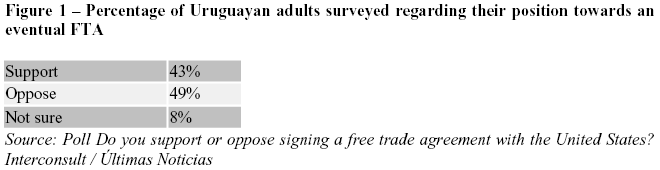
]]> There are supportive and disruptive social forces of the negotiations of a bilateral FTA with the US. On the one hand, economic actors seem to be divided, into those who fear that a FTA will affect their interests (pharma industry, metallurgy and small farmers), and those who expect gains from an increased market access to the major world economic power (agro-export sector, wool industry). A joint declaration of the main Uruguayan producer associations (ARU et al. 2006) was issued in April 2005 favoring the signing of a bilateral agreement between Uruguay and the US. On the other side, defying the free rider argument posed by rational choice theory, in an open letter published in the media, members from the academic community as well as journalists, activists and politicians, expressed their concern about the prospects of signing a FTA. They emphasized the need of a transparent debate on Uruguayan trade policy. They also stressed that Uruguay should stand by MERCOSUR as it constitutes 'its principal path towards economic development (understood as capacity and knowledge value added to goods and services), towards social justice and democratic political stability' (La Diaria, 22.09.06, my translation). Additionally, active members of the Uruguayan civil society as the national labor union (PIT-CNT), the national students' union (FEUU), the Federation of Housing Cooperatives (FUCVAM), and the Uruguayan Association of Pensioners (ONAPJU) launched a campaign against the bilateral FTA, termed 'Campaign in Defense of National Sovereignty' (Brecha, 8.9.06). Finally, public opinion, as showed below, is strongly divided.
In the light of the above, it is possible to assert that the absence of a political consensus over the best international integration strategy for Uruguay, and the fear of a possible breaking up of the ruling party's unity as well as of possibly disappointing frenteamplistas voters, weakened the Uruguayan Executive's position. This resulted in the rejection of the signing of a FTA in the terms and conditions unilaterally imposed by the US.20 However, the door was left open,to further negotiations as a TIFA was finally signed in January 2007.
Conclusions
The present paper has analyzed the politics of trade underpinning the negotiations of an eventual FTA between Uruguay and the US looking at the interplay of variables centred on the international system, the society and the state governing Uruguayan trade policy making.
From a systemic-centred approach to trade policy making it was possible to understand the main drivers behind Uruguay's rapprochement to the US: diversify export markets, obtain preferential access to US market and improve its position within MERCOSUR. Furthermore, it was possible to assess that asymmetries of relative power between Uruguay and the US have implications in the agenda definition of an eventual bilateral agreement, undermining Uruguay's position. The asymmetric relationship became apparent when Uruguay rejected the signing of a FTA within US terms and conditions, when faced with the impossibility to re-negotiate them. When analyzing the potential effects of a bilateral FTA, it is possible to observe doubts about the net gains of increased access to the US market, the strengthening of business climate and enhanced investment attraction for Uruguay when weighted against the cost of compensating Uruguayan loser sectors, a possible EU reaction and US Congress' plausible delay in ratifying an eventual bilateral FTA, and most importantly, the political and economic costs of leaving MERCOSUR.
When analyzing Uruguayan trade policy as the result of the struggle of societal interests, and the government's discretional margin in decision making, it is possible to suggest that given interest groups' parity in lobby capacity both in favor and against the signing of a bilateral FTA, the mobilization of social forces against the FTA, turned the balance in favor of the status quo. Although the pluralist theory suggests the difficulty in measuring groups' power, it is possible to deduce that ideological affinity between certain social groups and state actors plays an important role in trade policy making. Thus, in the Uruguayan case, the mobilization of social forces found a special echo in the left wing government, which would not want to pay the high political cost of disappointing its electorate who voted the Frente Amplio/Encuentro Progresista for its historical anti-imperialist, and pro-integrationist stand.
]]> However, from a state-centred approach, it is possible to argue that despite Uruguayan state actors have the power to influence or disregard the social movements' opinions, the costs linked to changing the path, and the uncertainty attached to leaving the regional integration project work in favor of the status quo. At least, they enabled what could be considered as the buying of time through the signing of a TIFA, waiting for a more favorable political climate in MERCOSUR. Uruguay agreed to a joint trade policy with Argentina, Brazil and Paraguay in 1991, embodied in the institutional structure and norms of MERCOSUR which currently constrains the reformulation of its trade policy.To sum up, this study has shown that from the interaction of the system-centred, societal- centred and state-centred variables, it is possible to conclude that in the face of divided interest groups and social forces, the doubts of the Uruguayan state actors regarding net economic gains and political costs of signing a FTA with the US, emphasized by the institutional constraints of being a full member of MERCOSUR turn the signing of a bilateral FTA unfeasible in the short term.
Bibliography
Abelando, V. 2006, 'Una histórica Encrucijada' in Semanario Brecha, 1083, 24.8.06. [ Links ]
Asociación Rural del Uruguay, Cámara de Industrias del Uruguay, Cámara Mercantil de Productos del País, Cámara Nacional de Comercio y de Servicios del Uruguay 2006, Posición Conjunta Respecto a la Conveniencia para el Uruguay de Negociar Acuerdos Comerciales con Países de Extrazona, 26.04.06, Montevideo. [ Links ]
Astori, D. in Búsqueda, p. 1, 12.1.06. [ Links ]
Astori, D. in Búsqueda, p. 5, 10.8.06. [ Links ]
Baldwin, R. (ed.) 1988, 'Introduction' in 'Trade Policy Issues and Empirical Analysis', The University of Chicago Press, Chicago, pp. 1-8. [ Links ]
Baldwin, R. 1996, 'The Political Economy of Trade Policy: Integrating the Perspectives of Economists and Political Scientists' in The Political Economy of Trade Policy. Papers in Honor of Jagdish Bhagwati edited by Feenstra et al., The MIT Press, London. [ Links ]
Bartesaghi, I. and Pérez, S. 2006, Análisis de los Eventuales Impactos para la Industria Derivados de la Firma de un TLC con Estados Unidos, Cámara de Industrias del Uruguay, Montevideo. [ Links ]
Bergsten, F. 2002, A Renaissance for U.S. Trade Policy?, Foreign Affairs, [Online], 81, pp. 86; 98. [ Links ]
Bergsten, F. 1996, Globalizing Free Trade, Foreign Affairs, [Online], 75, pp. 105; 120. [ Links ]
Bergsten, F. 1997, Open Regionalism, Working Paper 97-3, Institute for International Economics, http://www.iie.com/publications/wp/wp.cfm?researchid=152 , accessed on 24.3.07. [ Links ]
Bottinelli, O. 2007, Uruguay se encuentra enfrentado a una disyuntiva histórica: definir su inserción internacional, 12.01.07, http://www.factum.edu.uy/ [ Links ]
Brecha, 2006, 1067, 5.5.06. [ Links ]
Búsqueda, 2006, p. 1, 3.8.06. [ Links ]
Cesin, N., 2006, Con el Canciller Reinaldo Gargano: "Ya lo dijo el presidente: el Programa del Frente es una Biblia" in Brecha, 1051, 13.1.06. [ Links ]
Cohen, S., Blecker, R. and Whitney, P. 2003, Fundamentals of U.S. Foreign Trade Policy, Westview Press, Oxford. [ Links ]
Economic Commission for Latin America and the Caribbean (ECLAC) 2006, Latin America and the Caribbean in the World Economy 2005-2006, United Nations, Chile. [ Links ]
Embassy of the United States of America – Montevideo, El Embajador designado Frank Baxter comparece ante la Comisión del Senado, 30.9.06, in http://montevideo.usembassy.gov/usaweb/paginas/2006/06-337bES.shtml accessed on 31.10.06. [ Links ]
Estevadeordal, A.; Goto, J. and Saez, R. 2000, The New Regionalism in the Americas: The Case of MERCOSUR, INTAL, Inter-American Development Bank, http://www.iadb.org/intal/detalle_publicacion.asp?idioma_pub=eng&tid=7&idioma=esp&pid=46&cid=234 accessed on 10.1.07. [ Links ]
Evenett, S. and Meier, M. 2006, The U.S. Congressional Elections in 2006: What implications for U.S. Trade Policy?, Swiss Institute for International Economics and Applied Economic Research, University of St Gallen, Switzerland. [ Links ]
Export.gov , http://www.export.gov/fta/complete/Peru/ accessed on 10.1.07. [ Links ]
Feinberg, R. 2003, The Political Economy of United States' Free Trade Agreements, Blackwell Publishing Ltd, Malden, MA. [ Links ]
Fernández Luzuriaga, W. 2007, 'Primeros pasos de la política exterior progresista' en La Onda Digital, 328, http://www.laondadigital.com/laonda/LaOnda/328/A1.htm#_edn3, accessed on 10.2.07 [ Links ]
Garnaut, R. 2002, An Australia-United States free trade agreement, Australian Journal of International Affairs, [Online], vol. 56, 1, pp. 14.12.06. [ Links ]
Giordano, P. and Quevedo, F. 2006, Apertura e inserción internacional en la estrategia de desarrollo de Uruguay, Inter-American Development Bank, http://www.iadb.org/intal/aplicaciones/uploads/publicaciones/e_INTALITD_DD_43_2006_Giordano_Quevedo.pdf, accessed on 20.1.07. [ Links ]
Goldstein, J. 1993, 'Ideas, Interests and American Trade Policy', Cornell University Press, Ithaca. [ Links ]
Hilaire, A. and Yang, Y. 2003, The United States and the New Regionalism/Bilateralism, IMF Working Paper WP/03/206, International Monetary Fund, http://www.imf.org/external/pubs/ft/wp/2003/wp03206.pdf, accessed on 10.1.07. [ Links ]
Hocking, B. 1999, 'Introduction: Trade politics: environments, agendas and process' in 'Trade Politics: International, Domestic and Regional Perspectives', edited by Brian Hocking and Steven Mc Guire, Routlege, London and New York, pp. 1-20. [ Links ]
Hurrell, A. 2001, The Politics of Regional Integration in MERCOSUR en Regional Integration in Latin America and the Caribbean: The Political Economy of Open Regionalism, ed. B. V, Institute of Latin American Studies, London, pp. 194-211. [ Links ]
Ikenberry, J, Lake, D. and Mastanduno, M. 1988, The State and American Foreign Economic Policy, Fourth edition edn, World Peace Foundation and the Massachusetts Institute of Technology, New York. [ Links ]
Instituto Cuesta Duarte 2006, Anexo I. Acuerdo de Libre Comercio, PIT-CNT, Montevideo. [ Links ]
Johnson, S. 2006, What a Chávez Win Means in Venezuela and for U.S. Policy, The Heritage Foundation, Washington D.C. http://www.heritage.org/Research/LatinAmerica/wm1284.cfm, accessed on 10.1.07. [ Links ]
Joint Commission on Trade and Investment Uruguay-United States 2006, Evaluation of Bilateral Relations, Washington D.C., February 2006. [ Links ]
Keohane, R. 1984, After Hegemony: Cooperation or Discord in World Political Economy, Princeton University Press, Princeton. [ Links ]
Robert Keohane and Helen Milner (1996), "Internationalization and Domestic Politics", in Keohane and Milner (eds.), Internationalization and Domestic Politics, New York: Cambridge University Press, pp. 3-24. [ Links ]
Lake, D. 1993, Leadership, hegemony, and the international economy: Naked emperor or tattered monarch with potential? International Studies Quarterly, 37:459-89. [ Links ]
La Diaria, Ante la Eventual Firma de un Tratado de Libre Comercio con los Estados Unidos, 22.09.06 in http://www.choike.org/nuevo/informes/4647.html, accessed on 10.1.07. [ Links ]
Linn, T. 'Ante un cúmulo de desafíos internacionales' in Búsqueda, 10.08.06, p. 6. [ Links ]
MERCOSUR/CMC/DEC. No 32/00 2000. [ Links ]
MERCOSUR/LXV/GMC/DI No. 16/06, Uruguay y el MERCOSUR, Reunión de Coordinadores Nacionales, Brasilia, 24.10.06. [ Links ]
Mittleman, J. 2000, The Globalization Syndrome: Transformation and Resistance, Princeton University Press, Princeton. [ Links ]
Moon, B. 2000, Dilemmas of International Trade, Second Edition, Westview Press, Oxford. [ Links ]
Newell, P. and Tussie, D. 2006, Civil Society in Trade Policy-making in Latin America: Reflections and Lessons, Institute for Development Studies, Brighton. [ Links ]
Odell, J. 1990, Understanding international trade policies: An emerging synthesis. World Politics, 43:139-67. [ Links ]
Papa, G. 2006, Rumbo Norte. El desenganche, in Semanario Brecha, 1068, 12.5.06. [ Links ]
Payne, A. 1996, 'The United States and the Enterprise for the Americas' in Regionalism and World Order, ed. Gamble, A. and Payne, A.(eds.), MacMillan Press Ltd, London, pp. 93-119. [ Links ]
Peña, F. 2006, El sueño de un acuerdo de libre comercio propio? El Cronista, 23.08.06, Buenos Aires. [ Links ]
Phillips, N. 2005a, The New Politics of Trade in The Americas in The Politics of Trade, Kelly, D. y Grant, W.(eds.), Palgrave MacMillan, New York. [ Links ]
Phillips, N. 2005b, US Power and the Politics of Economic Governance in the Americas, Latin American Politics and Society, [Online], 47:4, pp. 1; 25. [ Links ]
Phillips, N. 2004, 'The rise and fall of open regionalism? Comparative reflections on regional governance in the Southern Cone of Latin America' in Asian Regional Governance. Crisis and Change, Jayasuriya, K. (ed.), RoutledgeCurzon, London. [ Links ]
Philips, N. 2003, Hemispheric integration and subregionalism in the Americas, International Affairs, vol. 79, 2, pp. 327-349. [ Links ]
Pollack, M. 2004, 'The New Institutionalisms and European Integration' en European Integration Theory, Wiener, A. and Diez, T., Oxford University Press, Oxford, pp.137-156. [ Links ]
Roett, R. (ed.). 1999, MERCOSUR: Regional Integration, World Markets, Lynne Rienner Publishers, Inc., Boulder. [ Links ]
Roett, R. 2006, United States-Latin American Relations: The Current State of Play, Nueva Sociedad, [Online], 206. [ Links ]
Schott, J. 2004, Free Trade Agreements: US Strategies and Priorities, Institute for International Economics, Washington, DC. [ Links ]
Taylor, I. 2005, Africa and the Emerging New Trade Geography: The India-Brazil-South Africa Dialogue Forum and its Implications for Global Governance, The Centre for International Politics Working Paper Series, [Online], 7. [ Links ]
Trebilcock, M. y Howse, R. 1995, The Regulation of International Trade, Routledge, New York. [ Links ]
Tussie, D. 2006a, Regionalism Adrift: The End of Collective Action?, First draft for discussion. [ Links ]
Tussie, D. 2006b, Responding to Globalization in the Americas: The Political Economy of Hemispheric Integration, LSE, 1st June 2006, First Draft for Comments. [ Links ]
USTR, 2006, Roundtable Discussion with Rob Portman, USTR, Document Library, Transcripts, 2006, January, 20.01.06, http://www.ustr.gov. [ Links ]
Vaillant, M. 2006, Las paradojas de la construcción de la Unión Aduanera del Sur, 1.9.06 edn, Montevideo. [ Links ]
Wonnacott, P. and Wonnacott, R. 1995, Liberalization in the Western Hemisphere: New Challenges in the Design of a Free Trade Agreement, North American Journal of Economic & Finances, [Online], vol. 6, 2, pp. 10.12.06. [ Links ]
Werner, F. 2006, El PIT-CNT ante los cambios de rumbo del gobierno. No soy yo, sos vos in Brecha, 1085, 8.9.06. [ Links ]
Woolcock, S. 2002, The Changing Nature of Trade Diplomacy, Paper for the BISA Panel on Economic Diplomacy in the 21st Century, LSE and King's College, London. [ Links ]
1 The author holds a BA in International Relations, Universidad de la Republica, Uruguay; a Postgraduate Diploma in Integration and MERCOSUR, Instituto Universitario CLAEH, Uruguay; and is currently a Master student in International Political Economy, Warwick University, United Kingdom, for which was granted a scholarship from the Konrad Adenauer Foundation. ]]>
2 I would like to especially thank Matias McLarens from the Uruguayan newspaper Brecha (Uruguay) for his dedication and his readiness to gather all the articles published by Brecha since 2005 without which I would not have been able to solve this fascinating puzzle. Also to Erika van Rompaey, Analía Meo and Javier García-Fronti, who helped me with their patient reading, and their constructive feedback throughout the creative process. All mistakes and omissions are of my own responsibility.
3 This article was finished on 15 February 2007.
4 According to the comparative advantage theory, in the long term, resources' relocation to those sectors whose factor is more abundant and efficient will lead to general welfare (see for example Krugman and Obstfeld, 2005). The problem with this theory is that in practice, many developing countries do not necessarily count on the resources to compensate the losers of trade liberalization.
5 To date, the US have signed bilateral FTAs with the following LAC countries: Chile (12.11.2002, ratified in 2003), cafta + Dominican Republic (28.5.2004, the chapter concerning environmental standards had to be renegotiated and was ratified in 2006), Peru (12.4.2006, ratification is pending), Colombia (22.11.2006, ratification is pending ), and Panamá (19.12.2006).
6 Ambassador Rob Portman explained to the press: 'I talked about our FTA strategy earlier and it's pretty aggressive. I will say that we are tough. We are tough customers in the sense that we demand the most comprehensive agreements in the world and the agreements that require the most market opening of any country' (Roundtable with Rob Portman, USTR, January 20th 2006).
7 TRIPS stands for trade-related aspects of intellectual property rights, a multilateral agreement negotiated in the Uruguay Round of GATT/WTO.
8 Venezuela signed as a full member of MERCOSUR on 4th July 2006. Brazil and Paraguay parliamentary ratifications are still pending. Bolivia has declared its intention to join MERCOSUR at the XXXI Summit of Chief of State and Government of MERCOSUR in 2006 and a MERCOSUR commission was established in January 2007 to study mechanism for its integration to the pact. Correa, President of Ecuador, has approached MERCOSUR to join the pact as full member since elected in November 2006 (Clarin 28.11.06).
9 The rapprochement first took place in 2002 with President Jorge Batlle's visit to President Bush with the purpose of increasing trade relationships, investments, as well as financial assistance to tackle the economic crisis affecting Uruguay in those days.
10 Currently Uruguay is trading with the US 7,3% of its exports through the General Preferences System (GPS) unilaterally granted by the US (JCTI 2006).
11 In recent declarations to the Congress, the US Trade Representative, Susan Schwab, begged for approval of Colombia and Panama's FTAs to be speed up for 'geopolitical reasons' as these countries were 'neighbours of Venezuela' (MercoPress, 14.02.07). Further, The Heritage Foundation, an influential Republican think tank, advised that US should negotiate a 'pact with Uruguay' to 'deter Venezuelan President Chavez from destabilising adventures in Latin America' (Johnson 2006). Chavez represents a dangerous adversary and is enhancing the 'axis of evil' with its visits to Moscow and Beijing (Roett, 2006). ]]>
12 Democrats have persistently resisted the signing of FTAs because they tend to'race to the bottom' labor and environmental standards which in turn lower the general standard of living in both the U.S. and third countries (IPS 2.2.07).
13 The bilateral FTA signed between Colombia and the US on November 22nd 2006 has not yet been ratified despite Colombia lobby efforts in US Congress.
14 It is likely that the EU will resent any further delay in the consolidation of the custom's union. The EU has been emphasising the need to negotiate a strategic interregional association with MERCOSUR as a whole (electronic communication with Ignacio Bartesaghi).
15 Ignacio Bartesaghi works in the Department of Economic Studies of the Chamber of Industry of Uruguay. He was one of the co-authors of the report produced by the Chamber to assess the feasibility of a bilateral FTA between Uruguay and the US. His answers to my questionnaire are the product of his personal reflections and do not necessarily reflect the view of the Chamber.
16 Although an assessment of the cost of leaving MERCOSUR is beyond the scope of this essay, at first it can be argued that these might well be 'increased commercial disputes, marginalisation of the regional energy and infrastructure projects, and the inability to take part in any new or more concrete "relaunching" of MERCOSUR' (Papa in BRECHA 12.5.06, my translation).
17 Gargano's position was backed by the Communist and Socialist parties as well as sectors of the left without parliamentary representation (Brecha, 5.5.2006).
18 Among them Jorge Lepra, Ministry of Industry who had a leading role in bilateral dialogue between Uruguay and US as well as Gonzalo Fernández, secretary of the Presidency, and main Uruguayan TIFA negotiator.
19 Astori s position was supported by the vice-president, the Minister of Industry, the Minister of Tourism and Senator Rafael Michelini (Brecha, 5.5.2006).
20 US was expecting Uruguay to negotiate a FTA on the same terms and conditions to the one signed between US and Peru. This implied that the signature of a FTA had to be performed before July 31st, 2007, when the TPA was due.