
Nicolas Bentancur*
Translated by Lucía Colombino
Translation from Cuadernos Del CLAEH, nº 93, pp. 9-25, 2006.
ABSTRACT
Paying special attention to national experience, this article compares, from a politological perspective, the results achieved by the students of Argentina, Chile and Uruguay in pisa evaluation tests administered in 2002 and 2003. During the last decade, these countries made significant changes in their educational systems, associated to a wider tendency that included most Latin American countries. These changes were different in each country: mercantile in the Chile, decentralising in Argentina and traditionally statist in Uruguayan. ]]> The relationships among the different strategies adopted and the educational results achieved in terms of quality (learning levels) and equity (social distribution of same) are hypothesised.
Key words: Uruguay, Argentina, Chile, education reform, educational system.
RESUMEN
Prestando especial atención a la experiencia nacional, y desde una perspectiva politológica, en el artículo se comparan los rendimientos obtenidos por los estudiantes de Argentina, Chile y Uruguay en las pruebas de evaluación PISA aplicadas en los años 2001 y 2003. Estos países realizaron en la década pasada transformaciones de envergadura en sus sistemas educativos, asociadas a una tendencia más amplia que comprendió a la mayor parte de América Latina, pero en cada uno de ellos dio lugar a reformas de distinto cuño (mercantilista en el caso chileno, descentralizador en el argentino y estatista tradicional en el uruguayo). Se hipotetiza sobre la posible vinculación entre las distintas estrategias adoptadas y los resultados educativos en términos de calidad (nivel de los aprendizajes) y equidad (distribución social de estos).
Palabras clave: Uruguay, Argentina, Chile, reforma educativa, sistema educativo.
1. Introduction
In the 1990s, the educational systems of Latin America were the object of complex operations to recompose their structures and modes of operation. Since the sectoral policies were similar from country to country, this process was seen as a new generation of education reforms. In general, these changes aimed to achieve improvements in the quality and equity of the systems, in their management and funding. Uruguay was not an exception to this movement, although certain special characteristics deserve a specific analysis. In view of the time elapsed since the beginning of these transformations, it is relevant to inquire to what extent these changes to institutional designs are achieving those stated objectives of quality and equity in education.
To that end, the following pages are a brief analysis of the 1995-2000 education reform in Uruguay, with a comparative perspective in relation to the more general framework of the rest of Latin American and, specifically, to the other Southern Cone countries: Argentina and Chile. Section 2 describes the main structural traits of the Uruguayan educational system, followed by a description of the basic architecture of the reforms in Latin America and the region, and a study of the Uruguayan reforms within this context (section 3). Subsequently we analyse the results of the PISA learning assessment surveys in Argentina, Chile and Uruguay, and conclude with some thoughts on the links between institutional reform and educational results.
]]>2. Outline of the history, current structure and government of the Uruguayan educational system
2.1. In the period between national independence in 1825 and the last quarter of the 19th Century, in a context of great political and social instability, public education was barely able to make a few isolated and discontinuous attempts to promote primary schooling. Despite the creation of the Instituto de Instrucción Pública in 1847, these efforts never became widespread. The situation changed after 1877 with the approval of the Ley de Educación Común promoted by José Pedro Varela, which is the essence of the Uruguayan educational system. Its main objectives were citizen formation and workforce training, as a response to the demands generated by immigration and the incipient economic modernisation. Some of its main characteristics were compulsory and free primary education and — partially, in principle — laicism, which led to opposition from conservative sectors and from the Catholic Church which until then had been the most important provider of this service.1 The system was created with a very strong centralised directorship in the hands of a Dirección General de Instrucción Pública with nation-wide authority and under the leadership of a national inspector. Varela himself was appointed to this post. However, the lawmakers discarded other measures for decentralisation, such as the establishment of school districts, which Varela had suggested Enrolment in primary education increased substantially in the years immediately after the act, partly due to these policies and also as a consequence of increased social mobility and popular demand for education. This process continued over the following decades, so that by the 1960s Uruguay was close to achieving universal primary education. The core of the system was the early creation — at the beginning of the 19th Century — of a highly recognised normal school for teachers, combined with a system of competitive examinations for positions and an institutional career ladder.
Secondary education, on the other hand, was conceived as the preparation of the offspring of wealthy families for university entrance, to the point that it reported directly to the Universidad de la República, the only public university in the country (as of this writing) and located in Montevideo. This situation began to change in 1912, with the opening of a high school in each provincial capital, and with the creation of an autonomous body with authority over public education that removed high schools from the orbit of the University starting in 1935. As had happened with primary education decades earlier, secondary education now attracted the new middle class. Enrolment was multiplied by four between 1931 and 1955. Although its role was less prominent than that of public education, the private sector also increased its offering of secondary schools, and in 1950 it recruited 15% of all students.2 Teacher training lagged behind this growth in enrolment: the Instituto de Profesores Artigas only opened in 1951 with a limited number of students. It substituted the former practice of providing high school teachers with on-the-job training. Even so, the practice of direct appointment to teaching positions was not abandoned.
2.2. Currently the public education system — not counting the university — consists of four levels: preprimary education (preschool, for children ages 4 to 5), primary education (ages 6 to 11), lower secondary education ("basic common cycle", ages 12 to 14), and upper secondary education ("baccalaureate", ages 15 to 17). The secondary education requirements may also be met by attending technical schools. School attendance is compulsory from preschool age 5 to the completion of the lower secondary cycle, which makes a total of 10 years of compulsory schooling. Teacher training continues to be centred in normal schools and is provided in specialised institutions.
In 2000, the gross schooling rate was 84% in preschool, 107% in primary school, 89% in the lower cycle of secondary education and 61% in the second cycle of secondary education. These last two figures drop dramatically if the net rates of approximately 55% and 30% are considered.3
2.3. The National Constitution only establishes two indications regarding the institutional organisation of the government of education: public education shall be governed by one or more Autonomous Directive Councils and there shall be a mechanism — as yet unspecified— for the coordination of education. The rest of the organisation remains to be established by law. There are three public bodies with authority over pre-university education: the Administración Nacional de la Enseñanza Pública (ANEP), the Comisión Coordinadora de la Educación and the Ministry of Education and Culture.
The first, which is an autonomous body, is the most important. This institution is peculiar to Uruguay, since in other countries its functions are generally vested in federal or provincial ministries of education. It is also the most complex body since it is composed of a Central Directive Council (CODICEN) with general government powers and three Deconcentrated Councils (Primary, Secondary and Technical Professional) with authority over those three subsystems. The selection of the members of CODICEN is essentially political since they are appointed upon proposal by the Executive Power and with the consent of the Senate. On the other hand, the authority to appoint the members of the Deconcentrated Councils lies in CODICEN, so it is possible that more technical and professional criteria will be used for selection to these positions. It is worth mentioning that due to certain ambiguities in the legislation and to the incidence of political factors, in the last twenty years there have been changes in the real balance of power and distribution of authorities between the central and the deconcentrated councils and cases of more or less centralisation/ decentralisation have been apparent.
In turn, and according to the applicable legislation, the Coordinating Comisión for Education (composed of representatives from ANEP, the Universidad de la República, the Ministry of Education, the National Comisión for Physical Education and the private schools) has important duties and powers: to plan the general guidelines for educational policy and to coordinate public education by issuing recommendations to the entities. The efforts made for some time to provide this coordinating commission with a leading role were met by a zealous defence both by ANEP and by the public university of their institutional autonomies, and they ended in failure. It has therefore remained an institution with a minor role in the definition of policies.
Finally, the Ministry of Education and Culture is significantly lacking in authority when compared to its regional counterparts, except for some specific areas such as private education at the early childhood and university levels. Nonetheless, it is endowed with two potentially important legal mechanisms: the management of international relations (especially those associated to funding from foreign sources) and its aforementioned representation in the Coordinating Council. Furthermore, the fact that it is part of the Executive Power and its public visibility — with all that this implies — are potentially a political asset which has been underused in the past two decades.
]]> Our primary diagnosis therefore is that the government of the educational system can be defined as fragmented — although hierarchical —, functionally centralised and under state monopoly.
3. The Uruguayan Education Reform in the Context of Latin America and the Southern Cone
3.1. The 1990s saw the formulation and implementation of educational policies that sought to achieve reform in the entire subcontinent. In order to provide alternatives to inadequate education systems, and in line with a larger movement to transform public management and social policies, the different States undertook a series of new strategies for education. These strategies, which varied in terms of their focus and details, were mainly in the fields of management and funding of the education system, organisation of curricula and evaluation.
The moving forces behind this impulse were multiple and of different nature, as is usually the case for such significant changes. Among them, it is important to mention the multinational agencies, particularly the World Bank and the Inter-American Development Bank, which elaborated diagnoses, recommended polices and later financed their implementation. 4 On the other hand, the political parties that came to power in the different countries expressed their particular — and differing — views of the education system and the role of the State in decision-making in their plans for education. The technical experts —"symbolic analysts"— in charge of managing the reforms often imposed a slant derived from their own ideology, their field of study or simply from their personal diagnoses and solutions, on the their work object. Finally, each process was filtered and constrained by the historical legacies and itineraries of each national system. The result of this conglomerate of actors and rationalities was a mosaic of policies that show regional regularities but, when examined in detail, also display local nuances and characteristics.
In general, the most widespread characteristics of the educational policies of the past decade were: institutional reform (decentralisation, autonomous school management and pedagogy); the construction of national systems for the evaluation of learning; the focalisation of compensatory programmes in the institutions and student populations with lower socioeconomic level; curriculum changes in secondary education; attention to the working conditions of the teachers; increased funding for primary and secondary education (and in some countries the establishment of new modes of funding with quasi-vouchers); and the increased relations between the education system and private enterprises and foundations.5
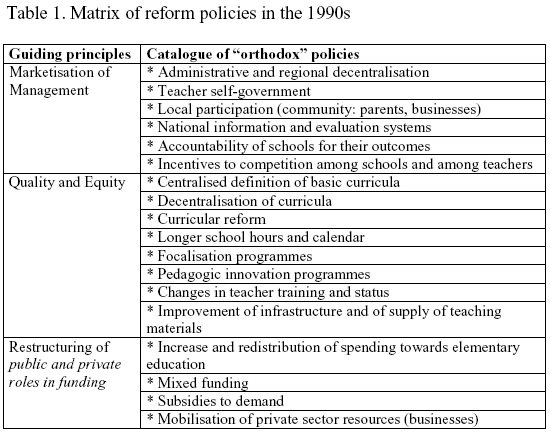
In an effort to understand the fundamental logic of these movements, Braslavsky organised them around three "stellar concepts": quality, equity and efficiency, to which it is possible to add "participation". According to this author, these concepts became guidelines and objectives for the reforms.6 It is our opinion, however, that the political nature of the process is best interpreted by identifying three guiding principles: the improvement of management through the marketisation of its processes, the search for higher levels of quality and equity and the restructuring of public and private roles in funding. The following table shows the relationships between these principles and a set of policy issues that may be qualified as orthodox. This expression refers both to the origin of these proposals within multilateral funding agencies — which make a direct application of their economy-oriented perspectives to the different policies — and to their widespread application and prestige in all the region, to the point of becoming the dominating paradigm for the reforms of the educational systems.
From a politological point of view, this categorisation attempts to take into account several important attributes:
a) Most of the reforms involve a double movement. On one hand, a centripetal movement, which tends to strengthen the policy-making groups by means of the definition of common curricular contents and to build unique monitoring and evaluation systems. On the other hand, a centrifugal one, by means of the decentralisation of administration (to improve management) and of curricula (to improve the quality of education); the support for projects coming from the schools and the accountability of educational institutions. Thus, the general tendencies observed in the reform of public management, consisting in the strengthening of the central authorities' strategic objectives and the delegation of execution authority to subordinate units are followed.7
]]> b) The two moments of the reform cycle conform to the two generations of the state reform. The first has structural characteristics (privatisation, decentralisation) while the second places an emphasis on institutional constructions (evaluation, special programmes, compensatory policies, etc.).8c) Attention is given to the least favoured population in terms of social and cultural capital by means of programmes of positive discrimination. These are also consistent with the emerging paradigm of social policies.9
d) The introduction of business principles into public management, such as the competition for scarce resources (quasi-markets), the creation of incentives for institutions and teachers and the subsidy of demand.10
e) Public and private responsibilities in the support of education are discussed anew, with a change in direction (from higher education to the lower levels) and an expansion of the role of private citizens (families, enterprises).11
Needless to say, this ideal catalogue was not implemented in the different countries with the same intensity or using the same institutions. The next section is a discussion of the Uruguayan case.
3.2 The aims and systemic vocation of the educational policies formulated and implemented in Uruguay between 1995 and 2000 have allowed them to be considered an "education reform". It came to be known as "the Rama reform. This was because sociologist Germán Rama played a double and decisive role in the origin and development of these changes: first, as technical expert in ECLAC's Montevideo office which made a diagnosis of the situation of Uruguayan education in the first five years of the 1990s; later, from 1995 to 2000, as head of the national education administration (National Director of Education of ANEP). With strong support from the coalition of centre-right parties which was in power at the time, and especially from the President Julio M. Sanguinetti; with funds available from the IADB and the World Bank, and overcoming opposition both from political sectors and from the teachers' unions, in five years he promoted a series of significant changes in the structure and operation of the national education system.
Some of the key measures taken were: the extension of preschool education; the opening of full-time public schools in deprived areas; the establishment of a system of learning assessment; the creation of a new teacher training system based on a different model to coexist with the traditional one; curricular reform of the lower cycle of secondary education and several improvements in building infrastructure and teaching materials. On the other hand, no changes were made to the traditional centralised management and decision-making system or to the funding of education that continued to be based on public funds and subsidies to public supply.
The following table shows the policies dominant in Latin America in the past decade, as detailed in Table 1, and the extent of their application in Uruguay.
]]>
Should we conclude, therefore, that the policies implemented in Uruguay make it a deviant case with respect to the Latin American trend?
Some analysts have underlined that the Uruguayan reform in fact shared most of the policy lines of the most recent wave of reforms: the design of national frameworks, emphasis on quality and equity, compensatory policies; opportunities for continuing education for teachers; strengthening of educational management, construction of information and evaluation systems.12 Nonetheless, the Uruguayan experience has been considered heterodox within the regional scene13 due to its important differences with mainstream reforms, and especially due to the survival of the logic of traditional public administration. A comparison with the Chilean and Argentinian reforms may be useful for this discussion. The three countries are relatively similar in a series of macro social and economic variables (the level of population development), national history, system of education, the political ideas of the rulers in the previous decade, the gross product per capita, etc.). Nonetheless, they have applied different matrices of educational policies. The Chilean case is exemplary within this generation of reforms because of its radical and early (since the 1980s) implementation of strategies of privatisation and decentralisation and, during the 1990s, of re-regulation and compensatory second-generation policies. Thus, during the first period, the schools were transferred to municipal authorities and a subsidy of demand system similar to vouchers was applied. Later, during the democratic governments by the Concertación coalition in the 1990s, a system for the assessment of learning outcomes — the "900 Escuelas" Programme, of a focalised nature — and national curricular frameworks were established. In Argentina, on the other hand, although the transfer of schools and teacher training centres to the provincial authorities starting in 1992 was a very relevant structural change, the public and private rendering of the service remained separate and the "educator state" preserved its traditional role. At the same time, and during the course of the decade, the basic common contents of the curricula were defined, a national system of assessment and national compensatory (Plan Social Educativo) and teacher training (Programa Federal de Formación Docente) programmes were established, and the primary and secondary cycles of education were restructured with the birth of General Basic Education and the Polimodal system for ages 15 to 17.
In a preliminary manner, it is possible to assert that compared to these two examples the Uruguayan case has unique characteristics. Although it shares two of the principles which guided the reforms — changes in management, and, most importantly, policies aimed at achieving better quality and equity — there is a clear difference with the Chilean and, to a lesser degree, with the Argentinian process, in the restructuring of the public and private roles in the educational system. In Uruguay, the educator state not only survives but also is stronger due to an extension of its aims; the decision-making process becomes even more centralised, both regionally and functionally; the division between the public and private spheres remains untouched. It is possible to say that the "Rama reform" has appropriated several issues and solutions from the regional agenda, with which it shares the atmosphere of its time, but giving new shape to its political and systemic rationality.
4. Educational quality and equity in the Southern Cone countries
]]> 4.1. In the sociology of education it is usual to identify three large groups of elements that are associated with school performance and with as many theoretical tendencies. The first and most widespread way of thinking links learning to social — especially cultural and economic — aspects of the students' families. The second tendency underlines the importance of the school as an analytic unit, and looks at its surroundings, structure, administration and organisational climate. Finally, the most important current debate — and one which is also of particular interest for our politological point of view — looks at the institutional design of the educational systems. Among other aspects, it takes into consideration the government of the system, its funding, leadership and choice of centres. It is quite apparent that the reforms developed for the region during the past decade fit the aforementioned description. This theoretical approach assumes that the different configurations of those dimensions can have an effective impact on educational performance. 14With this assumption, the different profiles of the reforms applied in Argentina, Chile and Uruguay make a primary analysis of the results achieved by each country for the main educational aims — quality and equity — particularly suggestive. A reliable mechanism for such a comparison is now available for the first time: the PISA15 international programme performs assessments of knowledge and skills in reading, mathematics and science on 15-year-old students of public and private schools. The tests were administered in Argentina and Chile in 2001 and in Uruguay in 2003. It is also possible to use the results from other countries as a broader reference.
4.2. First, we must mention the rates of coverage at that level in the three countries, as compared to the average in OECD member countries.
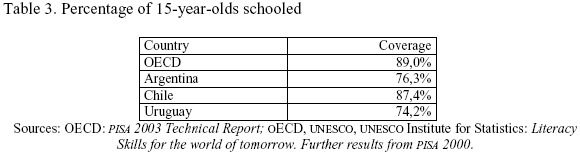
Chile shows a very high level of coverage, which places it close to the average of the OECD countries. Precisely, the increase in enrolment at the secondary level is one of the main achievements of the Chilean educational policies. Argentina and Uruguay are substantially below those figures, with similar rates.
4.3 The scores achieved in each of the key subject areas (reading, mathematics and science) allow us to rank the countries compared to the OECD member states and to other states that became partners for the purpose of the international assessment.
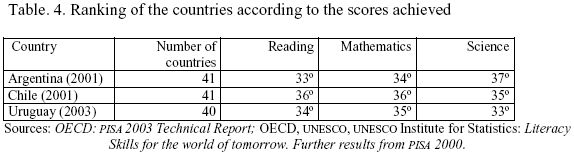
These discouraging figures are a confirmation of all the analyses that indicate that Latin America is falling behind in education in the international context. 16 This tendency is also valid for the Southern Cone countries, which are considered to have a high degree of human development and to be the regional leaders in this aspect.
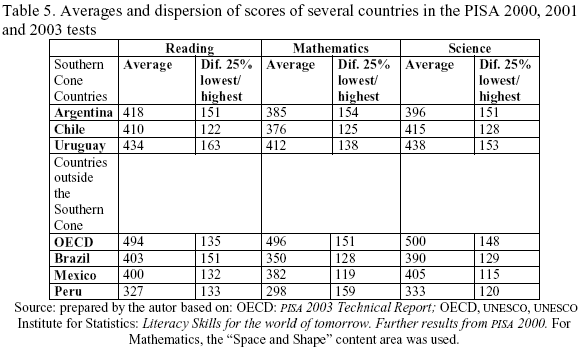
4.4 Following are the scores achieved in the three countries under analysis and using others as a comparative reference, with respect to the three subject areas assessed by the PISA tests.
These figures deserve some thoughts. First, considering the three Southern Cone countries jointly, student performance in all areas is well below the OECD countries' average, slightly above that of Brazil and Mexico, and well above that of Peru. Second, comparing the three countries and despite similarities, Uruguay has the best results in all subject areas, followed by Argentina in reading and mathematics and Chile in science. Finally, Chile is — by far — the country with the smallest gap between the performances of the students with scores in the lowest and highest quartile.
4.5. PISA establishes six levels of reading proficiency according to the scores attained. Level 1 (from 335 to 407 score points) means that students have attained the minimum knowledge and skills. Therefore, below those scores the level of performance is inadequate. 17 Levels 2 to 5 show increasingly better standards of performance. The data about the student population in the lower levels provides important information about the quality of education.
]]>
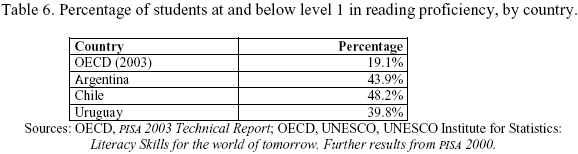
The previous table shows the great difference between the performance of the students in OECD countries and those of the Southern Cone. Among the latter, four to five students out of ten only have minimum or simply insufficient reading skills. In comparative terms — once again— the figures for Uruguay are slightly better than the Argentinian ones and clearly superior to the Chilean ones.
4.6. Finally, following are some data on the relationship between cultural capital and socio-economic status on one hand, and reading proficiency on the other. The 2000-2001 PISA assessment applied the International Socio-Economic Index of Occupational Status (ISEI), which considers the educational level of the parents and their occupations, ranked by quartiles.
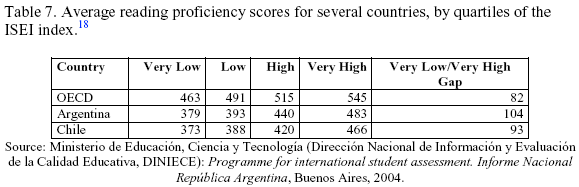
Student scores in the more developed countries are higher for all the socio-cultural segments than for the corresponding ones in Argentina and Chile. Furthermore, the performance gap between the least and most favoured groups is smaller. The Chilean results appear as more equitable than the Argentinian ones, in a way that is consistent with the data shown in Table 5.
]]> 5. Conclusions: Educational policies, learning and social equity
It is not possible to propose a relationship between the policies implemented in Argentina, Chile and Uruguay during the 1990's and the aforementioned educational results, without making important safeguards.
In the first place, as we have stated, the factors associated with learning are of different nature, which makes it impossible say that the policies implemented have linear effects on the situation in terms of quality and equity. Second, although these policies have been in place for several years, it is a well-known fact that policies for the transformation of education show their effects after a considerable delay and that it is sometimes not easy to identify the moment of their maturity in order to evaluate them. Third, we do not yet have a large enough series of learning measurements to be able to identify the situation before and after the implementation of the policies. This would enable us to suggest that the difference between two moments is a consequence of the application of those policies.
Despite these limitations, and until future studies are completed, we can make some hypotheses to derive lessons from the national experience, and to invite further analysis of these topics:
]]>a. None of the different political reform strategies carried out in the three countries — which we can summarise as a statism and decentralisation in Argentina; marketisation in Chile and traditional statism in Uruguay — have sufficed to this date to take the learning outcomes of 15-year-old students evaluated in the PISA tests to an internationally acceptable level, or to produce a relatively homogeneous social distribution of knowledge. Since neither orthodox nor heterodox solutions have been able to solve the malaise of education, it becomes necessary to make new diagnoses and suggest alternative remedies which may be able to transcend the rigid boundaries of former discussions.
b. Chile shows a high coverage rate, close to that of the developed countries and superior to that of the other cases we have examined, and this is an important achievement. Furthermore, Chile's comparatively favourable results in terms of grade repetition and educational backwardness — that are not analysed in this paper — run parallel to the coverage rate. Clearly, this experience deserves to be studied.
c. These three national cases show homogeneous results in terms of the quality of the learning outcomes, although there are a few contradictory details. The students in a more traditional system like the Uruguayan one (centralised, hierarchical, bureaucratic, with scarce participation) , which according to the assumptions of this generation of reforms would not be the most appropriate for achieving superior standards, nonetheless consistently attain slightly better scores than their Argentinian or Chilean peers. This suggests the importance of reconsidering the government's strategies of structural reform in the government and funding of the system, and of thinking more openly about the need for more limited changes in management and in the development of policies with more classical management schemes.
d. If we consider the distribution of knowledge, the evidence collected also challenges some of the theoretical assumptions. After a reform to promote privatisation —, of the type usually associated with greater inequality — the Chilean system showed smaller gaps in the PISA tests between the performance of the best and the worst students, and even between the one corresponding to students of different social strata. This observation, although provisional and limited, is particularly remarkable if we consider that Chile has the most unequal distribution of income in the continent, together with Brazil. Is it possible, then, that if a marketised education system is inserted into a segmented society it can achieve fairly acceptable levels of equity? Is the relative levelling an indication of the success of the compensatory programmes that have been systematically applied for years? In any case, these observations point to the need for further study.
e. Finally, we would like to point out that the decision-makers and actors of the educational system are showing clear signs of weariness due to the unfulfilled promises of reform. The general conditions of a society tend to have negative repercussions on educational processes, which normally surpass those of debatable personal actions. The impact of these general conditions leads us to question the ability and relevance of educational policies as such to produce significant changes in the quality and equity of teaching. Nonetheless, important comparative evidence points to the repercussions of sectoral policies implemented with ample social and political consensus and continued over time. Furthermore, it points to the specific impact of particular measures. Even within the limits imposed by social and economic conditions — especially in underdeveloped countries — the role of politics and policies in education is inexcusable.
6. Bibliography
Bentancur, Nicolás: «Las políticas universitarias en América Latina en los años noventa: del Estado proveedor al Estado gerente», in Pensamiento Universitario, n.° 9, Buenos Aires, Universidad Nacional de Quilmes, 2001. [ Links ]
Banco Interamericano de Desarrollo (BID) y Oficina de Planeamiento Presupuesto (OPP): El sistema educativo uruguayo: estudio de diagnóstico y propuesta de políticas públicas para el sector, Montevideo, BID/OPP, 2000. [ Links ]
Bralich, Jorge: Una historia de la educación en el Uruguay. Del Padre Astete a las computadoras, Montevideo, Fundación de Cultura Universitaria (FCU), 1996. [ Links ]
Braslavsky, Cecilia: Rehaciendo escuelas. Hacia un nuevo paradigma en la educación latinoamericana, Buenos Aires, Santillana, 1999. [ Links ]
Chubb John E. y Terry Moe: «Politics, markets, and the organization of schools», inn The American Political Science Review, vol. 82, n.º 4, Washington, D.C., The American Political Science Association (APSA), 1988. [ Links ]
De Armas, Gustavo y Adolfo Garcé: «Política y conocimiento especializado: la reforma educativa en Uruguay (1995-1999)», in: Revista Uruguaya de Ciencia Política, n.º 14, Banda Oriental - Instituto de Ciencia Política (FCS-UDELAR), 2004. [ Links ]
Franco, Rolando: «La educación y el papel del Estado en los paradigmas de la política social de América Latina», in: Pensamiento educativo, vol. 17, Santiago de Chile, Facultad de Educación, Pontificia Universidad Católica de Chile, 1995. [ Links ]
Gajardo, Marcela: Reformas educativas en América Latina: Balance de una década, Santiago de Chile, PREAL, 1999. [ Links ]
Ministerio de Educación (Departamento de Estudios y Estadísticas): Factores que explican los resultados de Chile en pisa, Santiago de Chile, MINEDUC, 2003. [ Links ]
Hood, Christopher: «A public management for all seasons?», in Public Administration, vol. 69, n.º 1, Londres, 1991. [ Links ]
Lane, Jan-Erik: The public sector. Concepts, models and approaches, Londres, Sage, 1995. [ Links ]
Lanzaro, Jorge: La reforma educativa en Uruguay (1995-2000): virtudes y problemas de una iniciativa heterodoxa, Santiago de Chile, Serie Políticas Sociales, CEPAL, División de Desarrollo Social, 2004. [ Links ]
Mancebo, María Ester: «La larga marcha de una reforma exitosa: de la formulación a la implementación de políticas educativas», in: María Ester Mancebo; Pedro Narbondo y Conrado Ramos (comps.): Uruguay: la reforma del Estado y las políticas públicas en la democracia restaurada, Montevideo, Banda Oriental-Instituto de Ciencia Política (FCS, UDELAR), 2002. [ Links ]
Ministerio de Educación, Ciencia y Tecnología (Dirección Nacional de Información y Evaluación de la Calidad Educativa, DINIECE): Programme for international student assessment. Informe Nacional República Argentina, Buenos Aires, junio de 2004. [ Links ]
Naím, Moisés: «Latin America: the second stage of reform», in Journal of Democracy, vol. 5, n.º 4, Baltimore, The Johns Hopkins University Press, 1994. [ Links ]
Osborne, David y Ted Gaebler: Un nuevo modelo de gobierno. Cómo transforma el espíritu empresarial al sector público, México, D.F., Gernika, 1994. [ Links ]
Oszlak, Oscar: «De menor a mejor. El desafío de la segunda reforma del Estado», en Nueva Sociedad, n.º 160, Caracas, Friedrich Ebert Stiftung, 1999. [ Links ]
Programa de Promoción de la Reforma Educativa en América Latina y el Caribe (PREAL): Quedándonos atrás. Un informe del progreso educativo en América Latina, Santiago de Chile, PREAL, 2001. [ Links ]
Administración Nacional de Educación Pública (ANEP): Primer Informe Nacional pisa 2003, Montevideo, ANEP, 2004. [ Links ]
Wolff, Laurence, Pablo González y J. C. Navarro: Educación privada y política pública en América Latina, Santiago de Chile, PREAL-BID, 2002. [ Links ]
* Ph.D. candidate in Social Sciences (Universidad de Buenos Aires). B.A. and M.A. in Political Science (Universidad de la República, Montevideo). Full time faculty member and researcher at the Instituto de Ciencia Política (Facultad de Cienciaas Sociales, Universidad de la República). nicobent@cpolit.edu.uy.
1 The Act changed the provisions of the Bill prepared by Varela and made Catholic religious education compulsory, but then reduced it to only fifteen minutes per day. Years later, in 1909, it was eliminated by the law on religious education in public schools.
2 Jorge Bralich: Una historia de la educación en el Uruguay. Del Padre Astete a las computadoras, Montevideo, Fundación de Cultura Universitaria (FCU), 1996, pp. 108-109.
3 The Inter-American Development Bank (IADB) and the Oficina de Planeamiento Presupuesto (OPP): El sistema educativo uruguayo: estudio de diagnóstico y propuesta de políticas públicas para el sector, Montevideo, bid/opp, 2000, pp. 10-11.
4 Among the main documents were Priorities and strategies for education (World Bank, 1995); Educational change in Latin America and the Caribbean (World Bank, 999); and Reforma de la educación primaria y secundaria en América Latina y el Caribe (IADB, 2000).
5 Marcela Gajardo: Reformas educativas en América Latina: Balance de una década, Santiago de Chile, preal, 1999. ]]>
6 Ibídem, p. 41.
7 Jan-Erik Lane: The public sector. Concepts, models and approaches, London, Sage, 1995; Christopher Hood: «A public management for all seasons?», Public Administration, volume 69, number 1, London, 1991.
8 Oscar Oszlak: «De menor a mejor. El desafío de la segunda reforma del Estado», in Nueva Sociedad, n.º 160, Caracas, Friedrich Ebert Stiftung, 1999; Moisés Naím: «Latin America: the second stage of reform», Journal of Democracy, volume 5, number 4, Baltimore, The Johns Hopkins University Press, 1994.
9 Rolando Franco: «La educación y el papel del Estado en los paradigmas de la política social de América Latina», in: Pensamiento educativo, volumen 17, Santiago de Chile, Facultad de Educación (Pontificia Universidad Católica de Chile), 1995.
10 David Osborne y Ted Gaebler: Un nuevo modelo de gobierno. Cómo transforma el espíritu empresarial al sector público, México, d.f., Gernika, 1994.
11 Lawrence Wolff, Pablo González y J. C. Navarro: Educación privada y política pública en América Latina, Santiago de Chile, preal-bid, 2002; Nicolás Bentancur: «Las políticas universitarias en América Latina en los años noventa: del Estado proveedor al Estado gerente», in Pensamiento Universitario, n.° 9, Buenos Aires, Universidad Nacional de Quilmes, 2001.
12 María Ester Mancebo: «La larga marcha de una reforma exitosa: de la formulación a la implementación de políticas educativas», in: María Ester Mancebo; Pedro Narbondo y Conrado Ramos (comps.): Uruguay: la reforma del Estado y las políticas públicas en la democracia restaurada, Montevideo, Banda Oriental-Instituto de Ciencia Política (FCS, Udelar), 2002, p. 155.
13 Gustavo De Armas y Adolfo Garcé: «Política y conocimiento especializado: la reforma educativa en Uruguay (1995-1999)», in: Revista Uruguaya de Ciencia Política, n.º 14, Banda Oriental - Instituto de Ciencia Política (FCS, Udelar), 2004; Jorge Lanzaro: La reforma educativa en Uruguay (1995-2000): virtudes y problemas de una iniciativa heterodoxa, Santiago de Chile, serie Políticas Sociales, División de Desarrollo Social, cepal, 2004.
14 John E. Chubb y Terry Moe: «Politics, markets, and the organization of schools», The American Political Science Review, vol. 82, n.º 4, Washington, d.c., The American Political Science Association (apsa), 1988.
15 OECD's Programme for International Student Assessment, which also has partner countries. ]]>
16 Programa de Promoción de la Reforma Educativa en América Latina y el Caribe (PREAL): Quedándonos atrás. Un informe del progreso educativo en América Latina, Santiago de Chile, PREAL, 2001.
17 Level 1 is defined as follows: "The student is able to locate one or more independent pieces of explicitly stated information typically meeting a single criterion; recognise the main theme or author's purpose in a text about a familiar topic; make a simple connection between information in the text and common, everyday knowledge. Typically, the information required is prominent and there is little or no competing information. The students are given explicit directions to consider relevant factors in the task and in the text."
18 This information is not available for Uruguay.