Fabiana Hernández Abreu*
Translated by Cristina Cafferata
Translation from Cuadernos Del CLAEH, Montevideo, n.92, 2006.
ABSTRACT
]]> This article includes the results of a study on social inequalities in health area. In the Paediatric Hospital Pereira Rossell, a place was defined to analyze health sociological aspects in a context of social inequality. This place, to which we gave the name of corridor situation, included every relationship that users of this public health service had with different interlocutors in any of the different corridors, before their real access to the health service. The outcomes and empirical material provided by this study derived in the need of deepening the discussion on users-staff's relationship in corridor situation. Based on certain theoretic and empirical data, this article tries to discuss about the dynamic of relationship, the ways of communication and the handling of time that the Institution makes. This discuss will result in a final analysis on the existent relationship among these elements, the public character of the Institution and the weigh that bureaucratic processes in corridor situation have on those who have to use this service.Key words: public health, poverty, health sociology, communication, Uruguay.
Introduction
This article is the result of a study on social inequalities in the health scope, made by the author within the framework of the workshop "Sociology of the Health" (2002-2004) in the Sociology Degree of the University of the Republic.
The study, "The health of the poor", had as primary objectives the exploration and the analysis of a social space barely investigated in the field of the Sociology of Health.
In the "Pereira Rossell" Children Hospital, in Montevideo, a place was defined to analyze health sociological aspects in a context of social inequality. This place, to which we gave the name of corridor situation, comprised the relationship that users of this public health service had with different interlocutors in any of the different corridors, prior to get in touch with the health service.
As from the bibliographical revision, it was found that most of the studies on health sociology on social inequalities were focused on the relationship doctor-patient. The perception that, before the consultation, people had to stay in a place implying social relationships which had influence on the good service development, derived in the necessity to analyze the inequalities determined by the social stratification structure and to transfer the approach of the doctor-patient's relationship in medical consultation, to user-health personnel's relationship in corridor situation.
The few antecedents of analysis1 on this object of study lead to exploratory and descriptive research objectives on this sociological problem. So it started with the ethnographic description of the relations observed in different corridor situations, in order to study the role that patient's social condition played on the relations that he had with his interlocutors, and how these relations affected the service quality in terms of human treatment, transmission of information and its possible effects on patient's health2.
]]> The results and the empirical material that the study provided derived in the necessity of deepening the discussion on certain aspects of user-health personnel's relationship in corridor situation. Therefore, based on defined theoretical and empirical data (detailed in the following chapter), this article tries to discuss about the relationship dynamics, communication ways developed and time management that the institution makes.The discussion of these subjects, which we considered social aspects not directly affected by institutional economic or budgetary factors, will result in a final analysis of the real relation among these factors, the public character of the institution, and the weight that the bureaucratic processes of corridor situation have on those who have to use its services.
Study Contextualization
A brief presentation of theoretical and empirical data that sustain the raised discussion, is made next. Most of the empirical material on which this work is based, comes from the study on social inequalities in the health area already mentioned.
The construction of the object of study
The Pediatric Hospital Pereira Rossell is composed of two sectors: the women's one and the pediatric one. This last sector, on which this research is based, [... ] has the special characteristic of being the only hospital for children in Uruguay. Although there are other hospitals where children are attended, it is the only one exclusively for children's attention, and, in addition, it is the reference hospital for all the country. This gives it a very special significance within the health system. Being a reference hospital, places it in the following situation: on one hand it is a third level attention hospital - what is not solved there, it is not solved anywhere in the country -. On the other hand, due to the characteristics of the public health subsystem, this hospital is also in charge of other levels of medical attention, up to the primary one. For many reasons, -place of living, public transport to get to it, etc.-, people ask for medical attention in this hospital when in fact they should address to a primary health center. To get an appointment at primary health centers is another problem. For example, personnel at health centers do not work at weekends, and at weekdays they work until noon or early afternoon. Few first level attention centers count on emergency room. So this Hospital has not only to deal with those cases requiring specialized staff and equipment, but also with the banal pathology that should have to be seen or solved in another level of attention. (Interview to a qualified informant).
The corridor situation
To ask for appointments for exams and doctor's consultation for a boy, user of the Pereira Rossell Pediatric Hospital, was the cause for the approach to the hospital reality.
The researcher, who does not use public health services, experienced a different situation from the one she would have experienced in the private health service: it was difficult to find the sectors to which to address to, many administrative offices were closed and the signs did not inform consulting hours but they announced "information is not given", or requested: "do not knock and wait to be assisted". Finally she left without having coordinated the examinations, and having dedicated to this task much more time than the expected one. Meanwhile, she observed that people who were there had to wait long hours, queuing while they waited to be attended. The researcher realized (through conversations and complaints she listened to) that many people left without having received any kind of service. In most of the cases the personnel neither treated nor informed users properly.
]]> Nevertheless, what called the researcher's attention was not the health personnel's attitude, or the kind of service they gave to them, but the users' passive, resigned, patient attitude.In the phonoaudiology sector (where examinations should be coordinated) nobody attended users, and there were no signs with consulting hours. So, the researcher asked the people waiting there, "At what time are people attended here?" The answer was: "Sometimes they are attended in the morning, but other times after noon". The researcher asked again "Are you waiting for phonoaudiology consultation?", and they answered affirmatively. As she did not have time to wait, she went to the information desk to find out the consulting hours, but there was nobody there. So she addressed to the security guard -who is at the hospital main entrance- and asked him where she could find out consulting hours. The guard answered that he did not know and that there was not a place for it. The researcher, with very little patience, talked back to him: "how can it be that it is no way to find out consulting hours?" And the guard answered: "welcome to the world".
From this "welcome" started the need to know this world, to research on the social relationships existing there, the role that users' social conditions played on those relationships, and the perceptions and meaning that guided their behaviors.
It must be considered that poor patients attend this hospital. The Uruguayan Constitution says (art. 44), "[... ] the State will provide free means of prevention and assistance only to very poor people or those lacking of enough resources" (OPS, 2002, p. 15). In order to make use of the Public Health system, the corresponding ministry grants four types of assistance membership cards, commonly known as "poor membership card". These are: 1. Free attendance membership card for those whose incomes are not higher than two and a half national minimum wages, and they are not charged for any of the services they receive. 2. Assistance membership card that has two categories: those who have to pay 30% of the rate and those who have to pay 60%, depending on their income's level; 3. Mother-child membership card, for pregnant and until six months after childbirth, and for children under one year, who receive free attention; and 4. Membership card for life assistance, granted to retired people over 65 years and to those under 65 who are unable to work.
It shouldn't be forgotten that the term "public hospital" does not only refers to the kind of people who are seen there, but also to the conditions in which the institution must work, that is to say, the shortage of economic resources for material acquisition and the payment of wages. These factors deeply affect the service quality. Nevertheless, there are components in the user-health personnel relationship that, without being directly determined by budgetary problems, affect the service quality that users receive and, finally, it affects their health.
At the Pereira Rossell Pediatric Hospital was found a social place where to analyze the health sociological aspects that we called "corridor situation". This social space takes place in the waiting rooms, queues and administrative offices; there the users interact with the health personnel; doctors, nurses, civil servants, social workers, security guards and others, to be admitted to a determined health service.
So, the need to observe this social space and to analyze the relationship between users' social condition and the health service quality, the relationship they have with their interlocutors and the meaning of their behaviors emerged.
The users go along a corridor situation before reaching medical attention. The social relations within it can affect users' health conditions. To be properly guided to the sector where they will be attended; to get or not the required attention on time and finally to get a right diagnosis and medical attention, do not only depend on the economic and infrastructure health system factors, but also on the social relations that involve ethical values, social prejudices and valuations of the other.
Antecedents of the sociological analysis in the field of health: the relationship doctor-patient
Many studies and theories support that good health distribution follows the social stratification line. They affirm that the higher the social class is, the more the tendency is to enjoy good physical and mental health, to be in touch with superior medical care systems, and to have a long life (Helsin, 1997: 519).
]]> Health sociology offers several studies on the inequalities in the health scope which are determined by the social stratification structure. Most of them focus their analysis upon the consulting area; in the doctor-patient relationship. It is considered that this is a social relationship in which the doctor and patient's social class and values as well as language, determine the relationship in itself. As well as Fernández and Mitjavila affirm (1998), the doctor-patient relationship is asymmetric and supposes a certain social distance between them. This asymmetry has consequences on the diagnosis process and therapeutic action. According to these authors, the main aspect of the doctor-patient relationship is the transmission of information and medical knowledge; they say that the greater the social distance between doctor and patient is, the more incomplete the transmission of information will be. They also affirm that in this relationship, the doctor attributes to his patient a certain social value which influences on the diagnosis and the therapeutic answers that he will give to him.Boltanski (1975) finds in what he calls the medical capacity a determinant of the social inequality in the doctor-patient relationship, closely related to the transmission of information and medical knowledge before mentioned. The medical capacity, according to this author, refers to people's capacity to understand, identify and express the messages that their bodies transmit to them, and this capacity is greater in the upper classes regarding the popular ones. The power to express their sensations verbally implies a linguistic capacity and, therefore, that the patient is in touch with and learns about medical taxonomies, as well as their capacity to handle and memorize them. The study concludes that the minor the social distance between patient and doctor is, the minor the linguistic distance is and the greater the communication between them. Therefore, doctor's treatment quality towards the patient will improve. Boltanski finds that, unlike the superior classes, the popular class members' perception about medical consultation refer to: too fast medical examinations, insufficient doctor's explanations and the usage of incomprehensible words.
The research proposed to transfer the doctor-patient relationship analysis towards a previous scope, which covered a wider space and diversity of actors. The study of this corridor situation implied to consider the user- health personnel relationship in all situations previous to the effective medical attention: queues, administrative offices, waiting rooms i.e., where the user usually interacts with doctors, nurses, civil servants, security guards and other users.
The background of corridor situation analysis came from the anthropology, in Sonnia Romero's work, "Mothers and children in the Old City" (2003), an ethnographic study that also serves as an empirical reference to this monograph, and to which we will refer to afterwards.
Conceptual frame
Bourdieu and the theory of the fields
Bourdieu divides the social reality in several fields or objective structures independent from conscience and individuals' will. The individuals or agents relate to and participate in those fields from their habitus, or schemes of perception, thought and action which direct their experiences. These are, as well, constituents of the objective structures, and tend to conserve them or to transform them. In this way, he analyzes the social aspect from a dialectic between the objective aspects (social institutions and structures) and the subjective ones (the agents). It surpasses the historical dichotomy of social sciences between individual and structure. This recurrent relation between field and habitus finishes with the supremacy of the structure on the individual and viceversa.
[... ] the analysis of objective structures – of different fields- is inseparable from the analysis of the genesis in the core of biological individuals of mental structures, that are on one side product of social structures incorporation as well as of the analysis of the genesis of structures in themselves: the social space, the groups which are distributed there, are the product of historical fights (in which the agents commit themselves based on their position in the social space and on the mental structures through which that is apprehended) (Bourdieu, 1988: 26).
Habitus is acquired during people's life trajectories, as a result of interpretation and significance of several processes in previous social situations. It is inscribed in people's bodies in a way of practical (common) sense which determined practices "[... ] practical sense like a sense of game, of a particular social game3, historically defined, which is acquired from childhood by taking part in social activities, [... ]" (Bourdieu, 1988:70)
]]> The relation between field and habitus takes place in social spaces, in which some kind of capital is at stake, and in which, from their social positions, people interact with the purpose of obtaining them. These positions imply hierarchies (power degrees) that are structured in agreement with different productive conditions of habitus (or conditions of existence) and the global volume of their capital, that is the sum of economic, cultural and social capitals.My work consisted of saying that people are situated in a social space, that they are not from anywhere, that is to say interchangeable, as it is sustained by those who deny the "social classes" existence. Therefore, according to the position they occupy in such complex space, the logic of their practices can be understood and it determined, among other things, how they will classify others and how they will classify themselves, and if necessary, how they consider themselves as members of a "class" (Bourdieu, 1988: 58).
The theory of the fields and the formulae deriving from it -[(habitus) (capital) ] + l field = practice-, provided the necessary elements for the corridor situation analysis (like social space), and allowed us to understand the relations that took place there, the different participants' (users and health personnel) conditions and the logic that directed their practices.
The corridor situation and the class condition
In the health field - mainly the public service one -, the study defined a certain social space: the corridor situation in children' public hospital. It implied to consider a user population quite homogenous, which is determined by its class condition. To try to understand their passivity (like practice or behavior) perceived in the first approach, entailed the necessity to get a class habitus like a practice generating principle.
So it is necessary to go back to the unifying and practice generating principle, that is to say to the class habitus like an incorporated way of class condition and of the conditions that it imposes; therefore, it is necessary to construct the objective class like a set of agents who are in homogenous existence conditions, and who impose homogenous requirements and produce homogenous disposition systems, appropriated to generate similar practices, and they also have a set of common characteristic, objective properties, sometimes legally guaranteed (like having possessions or powers) incorporated, like class habitus (and, specially, the systems of classified schemes (Bourdieu, 1998: 99-100).
The study about "The health of the poor" meant an effort to understand those categories of perception and appreciation which are produced by the agents' existent (or class) conditions and which determine their behaviors in the corridor situation. These behaviors are the results of their positions in the social space (social value and power) and of their existent conditions (class habitus). At the same time they reproduce the health system structures (field) in which they participate.
The relation user-health personnel: "welfare habitus" 4 and class "habitus"
]]> The anthropological studies that Sonnia Romero Gorski made on the Child-Mother Center5 (CMC) located in the Old City6 contributed to the investigation by describing situations developed in a place that had very similar characteristics to the corridor situation one. These descriptions support our initial perceptions on the positions that public health service users have and their relations with health personnel.The theoretical references also made us to suggest that frequent cultural conflicts may have brought into in that CMC space: [... ] it may coexist the differences among languages, attitudes and representations of a variety of social actors (immersed in different socio-economic contingencies). [... ] It is important to remember that we have already identified health professionals within hegemonic cultural positions and the population who is attended in public health services in subordinated positions (Romero, 2003: 89).
Here we must insist on an objective fact: people, before being attended by the doctor, must face and solve their relationships with the Institution according to its terms and norms and through the staff in charge of it. In addition they must show the card (officially typified like "poor" card)7, that ratifies their subordinated social position to the others, and they must justify personal data in successive exhibitions to civil servants, nurses, social workers or others [... ] the unequal or asymmetric relations were in this way established in the different previous contacts before the consultation itself (Romero, 2003:104).
Romero creates the welfare habitus category to define the logic that moves health personnel behaviors. The health personnel, during their trajectory in the hospital, acquire certain hospital culture (set of values, norms and practices). In this way, they receive a certain symbolic capital that apart form conditioning their practices and distinguish them from users, gives them the capacity to reproduce that culture. Following the logic of asymmetric relations, this category was used in the study to oppose it to user class habitus.
Erving Goffman has a vision of the social reality very closed to Bourdieu's theoretical perspective. Both authors consider the social life study starting from individual's interactions in social situations. These interactions are guided by disposition systems or interpretation frames acquired by repeated interactions, which provide the individual with a practical sense of the situation. In addition, Goffman, as well as Bourdieu, imagines the interaction in social situations like a process in which the individuals, based on their capitals and positions, negotiate the definition of the situation.
Like Bourdieu, Goffman offers, in his total institutions study, a more specific glance on similar (although non equal) social institutions to the one considered in the study, giving an interpretation frame of the structures that govern the interactions which take place there.
Goffman finds in the study of individuals' interactions, framed in social institutions, two acting groups who are related between them by keeping certain degrees of oppositions and agreements.
A social institution is any place surrounded by barriers established for being perceived, in which a determined type of activity is developed in a regular way [... ] Within the social institution walls we found a group of "performers" who cooperates to show the audience a certain definition of the situation.
]]> [….]A tacit agreement between the "performers" and the audience is settled down, to act as if a determined degree of opposition and agreement exists between both groups (Goffman, 1997: 254).
Regarding this investigation, those who Goffman refers to as "performers" were the different members of the health personnel, whereas the audience was conformed by the users. All these based in the assumption that the health personnel has the power to show users a certain definition of the situation, due to its hegemonic position in the field [ (capital) ( assistance habitus)].
In summary, in the space of the corridor situation, the relationship between users and health personnel was analyzed, opposing their habitus (assistance habitus opposite to class habitus), and assuming the power asymmetries in such relationship.
The position of the observer in the field
The observer's position was not external; she located in the field with different habitus from those of the users' and health personnel's ones. This implied that the observation and understanding of the object of study relied on the observer's position in the social space, that is to say, on her point of view.
Sociology must include "a sociology" of the social world perception, that is to say a sociology of the construction of the world visions that also contribute to the construction of that world. But since we have constructed the social space, we know that these points of view, as the word itself says, are views from a certain point, that is to say from a position in the social space [... ] [ and therefore ] the vision that each agent has of the space depends on its position in that space (Bourdieu,1988: 133).
We must explicit that the research results, empirical reference of this article, were product of an agent's interpretation situated in a determined position in the space. Position from which the object of study was perceived and built up
]]> The Dynamics of User-Health Personnel RelationshipThe sociologist cannot ignore that his own point of view is to be a point of view about a point of view. It cannot re-produce the corresponding one to his object and to constitute it as such when relocates it in the social space, but from that very singular point of view (and, in a certain sense, very privileged), where one should locate to be able to catch (mentally) all the possible points of view. And only insofar as he is able to make himself objective, he can at the same time that he remains in the social world to which he is inexorably assigned to, transfer himself with the thought to the place where his object is placed (which also is, at a certain extend, an alter ego) and thus catch his point of view, that is to say, to understand that if we were in his place, we would undoubtedly be like him and think like him (Bourdieu, 1999: 543)
The users-health personnel relationship is characterized by the fact that one of the parts offers the service that the other part looks for it. The health service is the capital at stake in the field of corridor situation. The attitudes and behaviors that performers of both teams develop in their interactions, from their habitus and capital structures, are the ones determining the dynamics of these relations.
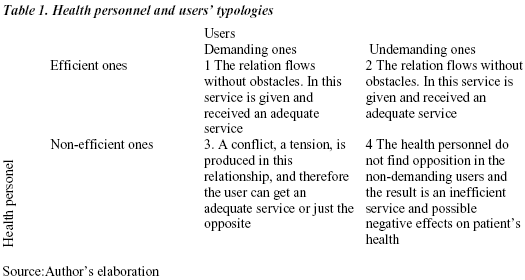
The field notes illustrate the way in which the dynamics of these relations were perceived. With the purpose of analyzing it, typologies within both group – health personnel and users – were constructed, in accordance with their behaviors. The construction of these typologies has the intention to include, as from their observation, as many situations as possible of both groups' relationships.
Within the health personnel group, there were two groups of people. On one hand, those who keep a closed relationship with the users, that is to say, who have visual contact with their interlocutors, who carry out the necessary actions to fulfill the user's consultation or demand; in the case of the doctors, those who receive and greet their patients. On the other hand, members of the health personnel who do not have visual contact with the user and who do not devote the necessary time or give sufficient information to users, were considered. So it was distinguished between those who give a proper treatment to their interlocutors and those who did not. With the only purpose of naming them, the first group was called efficient and the second one inefficient according to the capacity to offer an adequate health service.
Regarding the users' group, two different forms of behavior were also found there. On one hand, those users who if they do not receive the required attention, claim and face their interlocutors. And on the other hand those who accept any type of treatment without showing opposition. In the same way, the first group was called demanding and the second one non-demanding, according to the capacity to demand an adequate health service.
The dynamic shows different ways in which different types of individuals, of both equipments, are combined. From these combinations different types of situations arise. The effects that these situations have on health service quality (capital at stake in the field) are considered here.
From the picture arises that the determining factor in the relationship between both teams is the power that health personnel has on the situation. This power, this capacity to define the situation, is determined by the possession of a global capital which is greater than the users' one.
Although within the health personnel group (doctors, nurses, civil servants, guards, etc) it is possible to find different class habitus and diverse capital structures- and, in some cases, it is possible that habitus and capital structure are very similar to the users' ones-, the determining factor that locates health personnel in a hegemonic position (and enlarges its global capital) is the fact that in the relations field, where the public health service is the capital at stake, they have the power to give it, they are the ones who represent the institution.
The public character of the health service emphasizes the distance between both groups and the power grade of health personnel, when users' class condition is explicit, and therefore, the lack of alternatives to the service they receive.
In quadrant 4, this power, which is not resisted, produces negative effects on the quality of health service and on patients' health. Let us consider the following note of field.
Field Note 1
A woman, with a girl who is about two years old, approaches the admission office. The researcher hears that she says to the employee there: "there is no number for doctor's consultation at the policlinics". The employee looks at the girl and the woman says to him: "She has fever".
He takes his time before answer her, and then he does the emergency order for her ... ]
The researcher approaches the woman and asks her: "What happened? Didn't he want to admit her?" The woman gestures in disagreement and snorts: "There is such a person here !!" . She comments what happened to the researcher: She went to the policlinicwhere not many patients are attended, because the doctor goes there once in a while. She also tells her that after telling the civil servant at the admission entrance that the girl had fever and vomits, he decided to admit her. The girl is two years old and from Friday [it was Monday] she is running 39º of fever.
If the mother had not exerted pressure on the civil servant (if she had been non-demanding) she would have gone away with her daughter with fever, and nobody would have seen her. But the woman indeed exerted pressure and got the emergency pass. So, what it is in quadrant 3, happened. Anyway, the civil servant who acceded to give the emergency pass to the girl couldn't have done it based on the power granted to him by his position. In this case, it is very feasible that there would have been negative effects on the girl's health state.
]]> Quadrants 1 and 2 describe equal situations that reaffirm the determining condition of power, to give users the service they look for, since in the case of the efficient health personnel, the fact that users are or not demanding does not change either the situation or the service quality that comes from interaction.In most of the observations made, users' class habitus show behaviors of acceptance of health personnel supremacy. In this way, a legitimate imposition of the situation definition takes place, which at the same time, ensures the reproduction of this social order.
Anyway, the handling of certain ethical criteria by the health personnel, and the total users' conscience of their rights, would contribute to a higher quality service that would allow to improve the situations in quadrants 3 and 4.
Ways of Communication
The communication
Whereas the definition of communication varies according to the theoretical frame of reference used and by the focus made on certain aspects of the total process, all of them include five fundamental factors: a) a starter; b) a recipient; c) a way or vehicle; d) a message; and e)an effect. Thus, in its more general form, communication denotes a process in which a starter emits or sends a message via any vehicle to any recipient and an effect takes place. Most of the definitions also include the interaction idea in which the starter is simultaneously or successively a recipient and the recipient simultaneously or successively is the starter [... ]. Communication always implies some kind of differential effect in the recipient's behavior, and, in some definitions, in the starter's behavior. Unless some differential effect in the recipient's behavior happens, communication has not take place (Hartley, 1968).
In this sense, communication implies the transference of messages between two units. The message shares an emitter/speaker and a receiver, a codification and a decoding, a channel and means in which it leans for his transmission.
From this definition it is possible to think that all interaction implies a communicative process. For the purposes of this study, the communication and the dynamics of the relationship are constituent elements of the same relation. Therefore, to analyze the development of the relationship in the communication ways between users-health personnel implies to consider the field structure, field in which they take place, i.e. the different places in the space and the asymmetries of power determined by the differences between global capitals. When the emitter is the institution through the health personnel members (when they speak, they write or they gesture), the communication has the intention to inform the users on a certain state of things, an order, a certain definition of the world. But, as in the communication process the recipient can be transformed into emitter and answer the message with another message, the user can accept or question the order of things presented by the health personnel.
In order to present the users a social order with positions and determined rule games, the institution use some way of communication which will be analyzed and shown next.
The power to name
]]> Field note 2[... ] the researcher observes that a quite thin blond adolescent (of approximately sixteen year of age),humbly dressed, and with a baby in arms left the lift at "admission" floor. The baby can't be seen because of the blanket and driftwood size that covers him. Behind her a high very-well dressed-made up woman also left the lift, and told the girl: "Mother, wait me where we were today", in a way that it sounds to the researcher authoritarian but not despotic. The girl nodded and turned left, to the corridor where the phonoaudiology consulting room is. The woman goes to the corridor overlooking the central hall.
Field note 3
[... ] While the researcher waits to carry out the interview, she observes that civil servants call "Father" and "Mother" to people who are queuing up. They say, for example:" Father, this way". Finally the father waits in the queue and they send him to consulting room Nº 3 next to the administrative office.
This way of naming the users is a practice of the heath personnel members determined by their assistance habitus. This type of practice is seen here as a form to exert a symbolic power, which Bourdieu calls the power to make things with words.
To address to a person resorting to one of his more specific characteristics, like the one of being mother or father, implies the imposition of a role. This is the role that counts on in that specific field. That is to say, for the health personnel, adult people who attend to the children hospital are mainly fathers and mothers. In this case, the institution message presents an order of things and, at the same time, it produces an effect on the recipient's behavior: the necessity to act in agreement with the way they are named. In spite of all these people are also sirs and madams, workers, unemployed people, young people, etcetera, during the corridor situation, they are all what this word means, by which they are denoted: fathers and mothers who will have to fulfill what is socially expected from those roles.
In the situation described in picture 1, the power relationship between the girl and the woman (probably a social worker) it is still more evident than in picture 2. From the description arises that the girl and the woman knew each other from quite a long time: "Mother, wait me where we were today". That today has to do with a close past (some hours or minutes ago). It also arises that there are no other interlocutors. It is suspected here that the woman had time to ask the adolescent the name, but she did not do it. In this case, the form used by the woman to call her emphasizes only one of the girl's aspects; she did not treat her as a whole and depersonalizes her.
In the case of the civil employees at the administrative office, they interact during a few seconds with several users, this unable them to address each user by its name. Nevertheless, in other administrative offices or in queues of other social institutions, these people would be called sir or madam, terms that are less specific and imply less discipline.
]]> The health personnel has the power to name and, therefore, to define the situation, to define the rules and the roles of the games to the users. This form to exert symbolic power is determined by the possession of a greater degree of symbolic capital (and social) and by the acquisition of welfare habitus internalized in the trajectory of life within the hospital. The exercise of this symbolic power implies the imposition of meanings like genuine, smoothing the asymmetric relations that are the base of that power.The institution is the one in charge of the diffusion of that welfare culture and of the capacity to exert symbolic power. The use of the language is a fundamental tool at the time of defining a situation like rightful. The power to make things with words refers to the power that words have to impose a determined vision of social order, that is to say, a certain correlation of forces (positions and hierarchies). In the institutions' power of naming people is based the effectiveness of its action, therefore the institution names, grants titles and investitures; on one hand doctors, nurses, and so on, on the other one fathers and mothers.
This pre-conscientious practice, developed from the health personnel's practical sense, is tacitly accepted by those users with a certain trajectory in the public health services. To be called "father and mother" is an ordinary fact.
This relation, between the practice to name and the practice to accept the name given, is interpreted here like the reproduction of the system, that consolidates the position structure: the hegemonic positions of those who have the power to name and the subordinate positions of those who accept the accumulation of orders (mandates) that represents that nomination, recognizing in the institution and in those representing it, the authority to define a certain social order.
The signs
The use of signs is a way of communication that health personnel develop in its relationship with the users. In most cases the signs are used to prevent health personnel from having "unnecessary" interactions.
This type of posters is characterized by the use of the word NO.

After observing people's reaction to these posters it can be concluded that users do not read them in most of the cases, and anyhow, information is requested in the admission sector and queues are formed although the signs say there are not numbers. In this sense, the communication ways are little effective, they do not solve the user's needs of information and they do not prevent health personnel from "unnecessary" interactions.
There are other types of signs, in which a "task" is imposed to the user. These signs transmit to the user certain game rules that must be obeyed.
]]>
Another type of posters is a kind of order, request or reminder. The tone used here is less authoritarian.

Finally there are signs without informative purposes, which are useful to help users' stay at the hospital avoiding unnecessary delays and inquiries.

It is important to point out that this last type of signs are very scarcely seen in the universe of hospital signs and that informative signs on consulting hours are practically inexistent.
This way of communication, in most of the cases, hinders the communication reciprocity and the differential effect resulting in those readers' behavior is passivity and doubt. Before a sign whose message is "do not insist, information is not given", the reader is called not to act (not to request information) or, in any case, to ask himself: where is the information given?
The distribution of these kinds of signs in which it is remarkable the little presence of informative signs, shows the non-informative function of the signs used. As far as the communication in itself, the posters do not fulfill their objective; they transmit a message to the recipient that produces an effect in its behavior. Nevertheless, as far as the service quality, specifically regarding the transmission of information, this type of communication is not effective. It is characterized by being vertical and unilateral, and if observed, it is perceived as one of the most arbitrary power forms in the relationship user-health personnel.
Finally, it is necessary to consider that illiterate people attend to this hospital, therefore, in these cases, text signs are useless.
Field note 4
]]>The researcher goes back to the bench where she was observing the queue for admission. In the bench in front of her there are two children, a girl of ten and a boy of four years, approximately [... ] In a while, the children's mother approaches the researcher and says to her "Excuse me, could you tell me what it says here?, which day do I have to come?", and she shows the researcher a pass for cardiac consultation. The researcher circles with a pencil the date 8/8/2003 and she says to her: "You have to come here on August 8", then she points to the hour in the same way and says to her " at 8 in the morning patients are attended" and, indicating the number to her, she tells her: "and you have number 8".
Field note 5
Time 9.25. The researcher goes back Direction room. A couple in their forties gets to the administrative office. An approximately thirty year old man approaches them and says to the man : "Hey man, what does it say there?", "Pediatric Hospital Direction", he answers to him. "O.k., thanks", he answers, and joins in the queue.
Textual communication is restricted only to those whose cultural capital gives them capacity to decode the message. The use of signs leaves out of communication a certain number of addressees, who do not receive the message and are not affected in their behavior. In such case, there is not any kind of communication.
The excessive use of text signs indicates the lack of institutional adaptation to the change processes that are taking place in the whole country. The changes that have happened in the last thirty years; the economic and social crisis have deeply affected the social weave; the poorest sectors' possibility to get in touch with health services, education and housing has been restricted. A public institution that takes care of these sectors' sanitary needs must consider, at the time of establishing communication ways, the possibility that illiterate people attend to the hospital.
How communication works during a conflict
On Friday 1º of August it was foreseen a direct observation in the Admission sector, because that day numbers for specialists consultation would be given. Many users have been waiting to get them, for at least one month. Workers' strike generated users' displeasure. From this situation it was possible to observe the relationship health personnel - users, in terms of opposition and conflict.
The decision of civil servants' strike (we distinguished them of the rest of the health personnel members as only administrative employees were on strike) was of great significance here. It was a very important day for some users, because in some cases they had been waiting for it for more than two months, and many of the cases were of extreme importance or urgency cases. This increased the displeasure among many of the users, making them claim and complain.
]]> The collective attitude taken here by the civil employees comes into direct conflict with the users, who are the only ones damaged by the taken measures. The power exerted by the civil servants on the users is shown in the day chosen to take this action. This action does not agree with the demands presented that day by the civil employees (the validity of the demands is out of question here) which in general terms were about salary increase and provision of resources (medicines and other articles) which allowed them to offer a better service to the user. The preoccupation declared by them regarding the service quality, did not agree with their decision of starting an indefinite strike as from August 1st.The strike makes difficult users- health personnel's face to face relationships, except for emergency cases. When there are conflicts, signs are the communication way.
Field note 6
Admission: Four equal signs, besides the previously mentioned ones

While the researcher was registering in her notebook the sign, a woman with a girl approaches her, asking if numbers were given. The researcher answered negatively, adding that the administrative personnel were on strike. The woman begins to tell her case to her. She was there because of her daughter's operation. She had been there on July 1st, and was told to come back on August 1st. The researcher advises her to ask in the administrative office. The woman goes there and when comes back tells the researcher that the employee's answer to her question was: When the strike is over I will answer you". And she makes a disagreement gesture.
Field note 7
Tax office: A sign in the administrative office

There are three women in this sector making questions to the employee. She does not want to answer. So one of the women shouts to her "You have to answer because this is your job and you are paid for it" and she repeats "You must serve us".
During the conflict, the function of the signs is just to inform that there will not be any interaction between both parts. The NO sings are the communication way used in the conflict: unilateral and asymmetric. This makes the field structure more rigid and increases the distance between the positions.
As from this practice developed by the civil employees, it is interpreted that they are aware of their position of supremacy, in the corridor situation field, and exert the power that it confers to them. But, mainly, it is interpreted that from these actions, civil employees show their distance to the users group and the low social value that they give to them.
Time Management
The wait
The different corridor situations observed are crossed by the waiting situation. As it is described in the field notes, the wait can last hours, days or months.
Hours
The wait average, according to the information gotten is of approximately eight hours. Nevertheless, in many cases the waiting time is more than the average.
Interviews
]]> - From what time have you been here?- One morning I say: "today I came for two reasons". So it is so good.
- A whole day, It depends on the reasons for coming.
- All day. (He laughs)
- Twelve, twelve hours
- All day, all day.
- Well, we came at daybreak and at least until noon we will be here. So we practically lose the morning here.
]]> - Phew a, many hours.- More or less?
- Six hours, more or less.
- An hour and a half and sometimes two hours.
- Four or five hours.
- Ah, the hospital takes you... Whatever the reason is, you should calculate at least six or eight hours.
Days
Waiting days refer to the user's need to spend the night in the hospital
Field note 8
]]> The two mentioned ladies go on talking and in a moment they refer to the numbers that are being given for doctors' consultations. They say that there are times in which they are given numbers to be seen by the doctor in two months. One of them says: "Yes, one day I came at night and there were at least sixty people before me". The researcher asks them, "Do you come at nine p.m. yesterday?". "Of course", the women answered and they commented to her that they are going to sleep in the banks of Admission because they are waited on at 7 p.m. the following day
Months
The patients' wait for months has to do with the possibilities of getting numbers to be attended by specialists.
Field note 9
While the researcher is writing down the texts in the signs, she observes that there is a woman in one of the administrative offices. A woman says to the civil servant: "I came last month to ask for a date to see the psychologist, and the sign there said that numbers for specialists would be given as from July 1st, today is July 2nd and the sign says as from August 1st. [... ]. The woman's doesn't insist nor does she addresses the civil servant with anxiety or complaint. But she says to the civil servant in a very polite and quite way: "Do I come just on August 1st ?" .The researcher does not listen very well the civil servant's answer, but according to what the woman seems to repeat, only two or three numbers are left for the following day.
Field note 10
-[... ] I have come for seven months, and they have made me go and come back one day after other, and …. Look that, my baby had a date set to be operated on her eye and it is being more complicated to me because she is …let's say more... more...more... cross-eyed, isn't she? And it is a very serious case, then, look, with this... I do not know until when we are going to go on with this...
The waiting period and its implications
]]> The extensive waiting periods registered raise the discussion of at least three elements of this reality: the high cost of opportunity that implies the waiting period in the hospital, the direct effect of the wait on patient's health, and the user's attitude as they wait to be attended.The opportunity cost
By opportunity costit is understood here all the things that have left undone due to the wait. The time that users have to wait in the hospital can mean for them the loss of the working day or of a possible job opportunity. As a result, a day at the hospital for these people, who are taking care of their children's health, can mean a reduction in their incomes and that the worsening of their life conditions.
On the other hand, the opportunitycost also refers to the rest of activities that have to do with individual's social reproduction like for example feeding, sleeping and recreation. The amount of time spent in the hospital causes that this becomes practically a daily activity. Thus, the users acquire a certain way of living within the hospital and internalize its cultural models. "All institution absorbs part of its members' time and interests and it gives in a certain way an own world to them; summarizing, it has absorbent tendencies" (Goffman, 1988: 17).
The management of time that the institution does, which is seen from the extensive amount of time that users live in the hospital, derives in a users-institution type of relationship with similar characteristics to what Goffman calls total institutions. Without reaching the frame of a total institution, since it does not suppose a total break with the life outside its walls (like jails or mental sickness establishments), the hospital appears like a space in which there is an authority that coordinates the activities; where the users develop its activities with a great number of other users, who receive the same treatment, and where these activities are strictly programmed and imposed from above, by means of a system of formal norms, and a body of civil servants. All these are characteristic of total institutions (Goffman, 1988: 19-20). The more spaces of users' extra hospital life are absorbed by the institution, the more closer we are to think it in terms of total institution.
Effects on the state of health
In many cases the waiting time has direct influence on children's health
Field note 11
]]> The infantile diarrhea can cause serious consequences if it is not treated on time. Other extreme cases, like cardiac diseases, which need fast diagnoses, follow up and, in some cases surgeon, can worsen due to the time users have to wait due to administrative aspects (such as to obtain an appointment for the cardiologist, in the next two months).A woman with a sleepy baby in arms complains, crying, before the Direction office. She has been waiting three hours at "the emergency room" for her baby to be attended, who has diarrhea and vomits. He was not and he was derived to policlinics. There they said to her that if the doctor had time, he would see the baby -with luck- at 3 p.m. It was 11 a.m.
The users' attitude
Because the Pereira Rossell Hospital is the only reference children hospital (third level of attention) in all the country, it does not exist an users' alternative for their wait –"[... ] what it is not solved there, is not solved in any other place" (interview to qualified informant). That lack of alternatives can be related to the form in which users face up their waiting hours and months. Most of them have an attitude of resignation.
To wait is something natural for them in fact: "when you come to a public institution, you know that you have to wait", "I am still here, but I know that I have to wait ". Wait at the Pereira ("a public institution") is an evident incorporated fact in users' habitus (of class) who makes them resign and not complaint; and tacitly assume their subordinate position.
This users' practice is preconscious to such extent that they do not relate the time they have to wait with the quality of the health attention that they receive. Eleven out of eighteen interviewed people had a positive opinion of the hospital attention. Nevertheless, the majority said that during their stay in the hospital they dedicate between six and twelve hours to wait. The quality attention process dissociates here: on one hand, bureaucratic instances, and on the other, medical attention. It is possible to think, from the users' answers, that they evaluate the quality of attention in terms of medical attention; being the bureaucratic instances understood like inevitable processes in their ways towards it.
The hours and months that users have to wait reflect, on one hand, inefficiency in the system operation (it does not correspond to analyze it here), and on the other, a very low valuation of users' time (which is considerably high in the private health systems). The ways in which health personnel manage the time have to do with structural and organizational conditions, and not with considerations regarding users' time. The user, "who does not pay by the services that he receives", must accept the times that are imposed to him.
The Public Character of the Institution and the Weight of Bureaucracy
The public character of the institution
The public character of the health service puts into consideration two important aspects: on one hand, the social condition of the patient, and on the other, the shortage of resources for the institution to work, as a result of a bad distribution in the health expenses8.
According to the form in which the social security system in the country is structured, it is possible to assume that people who attend the public health system are those with insufficient resources; the very poor or unemployed ones or informal workers. In Uruguay, the formal workers (affiliated to a social security system) join a mutual system -a group of medical institutions, which are financed by a mixed system (worker-company). Therefore, the character of public institution is closely related to the patient social condition.
]]> As well, the patient's class condition is associated to his lack of alternatives regarding the health service that he receives. The fact that the Pereira Rossell Hospital is the only reference children hospital in the country intensifies this situation. The lack of alternatives has a strong incidence on the users' passive and resigned attitudes before the long wait, the lack of information and the authoritarian treatment that they receive from health personnel.The shortage of resources derives in the hospital's incapacity to respond to the population's needs that it takes care of. This resulted in overpopulation at the facilities, shortage of materials and medicines, and also the possibility that some members of the personnel disagree with their work conditions. In this scene, the hospital authorities must articulate in the best possible way the available resources.
The bureaucracy weight
The bureaucracy weight in the corridor situation, understood like a social space that takes place in waiting rooms, queues and administrative offices; where the users interact with the health personnel to get in touch with determined health service, is, by definition, closely related to the bureaucracy concept. It could be said that this social space embraces all the bureaucratic process previous to medical attention.
In weberians terms, bureaucracy implies the rationalization of collective activities through a specific work division, where the authority is distributed in a hierarchic way (Karp, Yoels, 1986: 195). Agreeing with this Weberian idea of bureaucracy, Coe defines the hospital bureaucratic organization like "[... ] a hierarchic disposition of jobs and positions for the rational coordination of jobs that leads to the accomplishment of the group objectives" (Coe, 1973: 308).
Weber, as well as Coe and all those who have studied the bureaucratic phenomenon, has been interested in the problems that incarnate this type of organizations. The complication of the procedures, and people's dehumanization and isolation are some of them.
For Crozier the bureaucracy, in the common and popular use of the word,
[... ] evokes slowness, routine, the complication in the procedures, the non adaptation of "the bureaucratic" organisms to the exigencies that would have to satisfy and the consequent frustrations in the people who compose them, and in those who must use their services and suffer them (Crozier, 1974, p. 12)
In this definition Crozier includes a new actor: the user who uses and suffers the vices of bureaucratic organizations. However, while other studies (Coe and Crozier) focused their attention on the negative effects of the bureaucracy on those that composes it, this proposal of analysis, however, focuses on those who must make use of its services
]]> Worried about the advance of the bureaucratic phenomenon in the modern industrial society, and therefore of its negative effects on individuals, Weber as well as Crozier foresaw non hopeful future. But Crozier adds a new element to the discussion: the advance of the bureaucracy in the public scope as well as in the private one.[... ] since the great private organizations have been undergoing the influence of the public bureaucratic model, that the bureaucratization of the private sector seems to acquire a similar extension to the state administration, and that people frustration derives indifferently from one or another type of organization (Crozier, 1974: 13).
Regarding the discussion on social aspects of health quality attention in a health public institution, once the State of well-being and the industrial society have practically disappeared, the question arises on the existence of a parallelism in the advance of bureaucracy between public and private health organizations.
The discussion developed throughout this article reached the following conclusions:
]]> Private health organizations have not evolved in the same way than the public ones, but it does not mean that they do not organize themselves in a bureaucratic way. Let us take the case of the private health organizations (without considering the system of mixed financing). From TV advertisements of enterprises like Medicina Personalizada (Personalized Medicine) and Summun, it is deduced that these follow a marketing logic, where the patient is also a client. They give a high value to his time, he pays for the health service that he receives and, therefore, he has health service alternatives. So, health private organizations try to reduce drastically the negative effects of bureaucratic processes. They develop mechanisms to resist bureaucracy vices; they apply to new forms to organize the time, they try patients respectfully and look for personalized ways of communication.· Public and private health organizations have evolved in different ways.
· The public or private condition of the organization shows the class condition of the population who use that services.
· That class condition determines the alternatives that patients have regarding health services. And it also influences the logic of the relationships between the institutional representatives and those who use the service.
· The different logics of relationship (user-health personnel) derive in different levels of people's frustrations
On the contrary, the empirical evidence allows us to affirm that, in public health institutions, patient-user in his relationship with the institution through different corridor situations, undergoes the negative effects of the existent bureaucracy incarnated in what this work calls social factors of user- health personnel relationship. As a result, these negative aspects of the hospital bureaucratic organization affect the service quality that the patient receives. The public organization, in contrast with the private one, does not follow a marketing logic; it offers a service in which the public institution is organized according to the resources it counts on and not to people's needs.
The aim of the State of well-being is shown in the health scope, like in others, in the polarization of the society: those with sufficient purchasing power evade the disadvantages of bureaucratic processes and pay for their status as clients; and those whose resources shortage determines their possibilities, accept the given conditions: long wait, non informative communication and authoritarian treatment.
Finally, it would be possible to affirm that for the Uruguayan case, the change from an industrial society to a post-industrial one implies a process in health services segmentation and, as a result, that dark prognosis regarding the bureaucratic weight: it is restricted to a certain population sector : the poorest one.
Final reflections
Once discussed and demonstrated those social aspects (attitudes, behaviors, decision making) that affect the attention quality and that have to do with previous processes before effective medical attention, it is possible to rethink the need of certain organization and communication mechanisms developed by the institution to be able to reduce the weight of bureaucratic processes on users.
Regarding the relationship dynamics, it is necessary a change in the behavior and attitude logic of the members of both teams. This change of logic requires that health personnel's conscience of their supremacy contributes to the development of emphatic relations with those who receive their services. In this way, instead of distinguishing themselves from the other, they will be able to approach sufficiently to them as to get and understand their necessities, and thus to be more efficient in their work On the other hand, for the users, the change of attitude supposes the total conscience of their rights, which implies to value their demands, their times and the necessity to be treated with respect.
Once the mentality changes are reached, the institution will see the need to think and raise new communication and forms of handling the time, since the approach to users' reality cannot be through impersonal communication ways. And finally, once articulated new communication ways and understood users' real9 needs, all the ways of organizing the time will consider the users' time.
]]> Bibliography
Arias, Adrián, Marcelo Morales, Infantilización de la pobreza, ¿pobrerización de la infancia?, Montevideo, Konrad Adenauer Stiftung - Organización San Vicente «Obra Padre Cacho», 2002. [ Links ]
Babbie, Earl, The Practice of Social Reseach, Belmont, Wadsworth, 1995. [ Links ]
Banco Mundial, Entender la pobreza. Disponible en ‹www.worldbank.org›. [ Links ]
Barran, José Pedro, Medicina y sociedad en el Uruguay del Novecientos, tomo 2 «La ortopedia de los pobres», Montevideo, Banda Oriental, 1993. [ Links ]
Boltanski, Luc, Los usos sociales del cuerpo. «La capacidad médica», Buenos Aires, Periferia, 1975. [ Links ]
Bourdieu, Pierre, Cosas dichas, Buenos Aires, Gedisa, 1988. [ Links ]
_______. La distinción, criterio y bases sociales del gusto, Buenos Aires, Taurus, 1998. [ Links ]
_______. La miseria del mundo, Buenos Aires, Fondo de Cultura Económica, 1999. [ Links ]
Coe, Rodney, Sociología de la medicina, Madrid, Alianza, 1973. [ Links ]
Crozier, Michel, El fenómeno burocrático, tomo I, Buenos Aires, Amorrortu, 1974. [ Links ]
Fernández, José, Miriam Mitjavila, «Factores sociales, salud y enfermedad», en Hugo Dibarboure, Juan C. Macedo (eds.), Introducción a la medicina familiar, Montevideo, Departamento de Publicaciones de la Universidad de la República, 1998. [ Links ]
Fondo de Población de las Naciones Unidas, El estado de la población mundial 2002. Población, pobreza y oportunidades. Disponible en ‹www.unfpa.org›. [ Links ]
Foucault, Michel, «La crisis de la medicina o de la antimedicina», conferencia dictada en el Curso de Medicina Social del Instituto de Medicina Social, Centro Biomédico de la Universidad Estatal de Río de Janeiro, 1974. [ Links ]
Goffman, Erving, Internados, ensayos sobre la situación social de los enfermos mentales, Buenos Aires, Amorrortu, 1988. [ Links ]
_______. La presentación de la persona en la vida cotidiana, Buenos Aires, Amorrortu, 1997. [ Links ]
Hartley, Eugene, Dictionary of Social Sciences, Londres, Gould y Kolb, 1968. [ Links ]
Henslin, James, Sociology: Down to earth aprroach. Massachuetts, Allyn and Bacon, 1997. [ Links ]
Karp, D., W. Yoels, Sociology and Everyday Life, Illinois, F. E. Peacock, 1986. [ Links ]
Kaztman, R., P. Gerstenfeld, «Áreas duras y áreas blandas en el desarrollo social», en Revista de la cepal, n.° 41, agosto de 1990. [ Links ]
Organización Panamericana de la Salud, Perfil del sistema de salud de Uruguay, Programa de Organización y Gestión de Sistemas y Servicios de Salud, División de Desarrollo de Sistemas y Servicios de Salud, ops, 2.ª ed., mayo de 2002. Disponible en ‹www.paho.org›. [ Links ]
Programa de las Naciones Unidas para el Desarrollo, Uruguay, Desarrollo humano en Uruguay, 2001, Montevideo, pnud, 2001. Disponible en ‹www.undp.org.uy›. [ Links ]
Robertson, Ian. Sociology. Nueva York, Worth, 1987. [ Links ]
Romero, Sonnia, Madres e hijos en la Ciudad Vieja, Montevideo, Nordan-Comunidad, 2003. [ Links ]
Sepúlveda, Jaime, Relación entre pobreza y salud, en IDRC/CRDI: ciid-Montevideo, 1998. Disponible en ‹www.idrc.ca/lacro›. [ Links ]
Valles, Miguel, Técnicas cualitativas de investigación social, Madrid, Síntesis, 1997. [ Links ]
* Sociologist - Republic University. Master in Political Sciences, researcher at the Local Development Program in The Latin American Center of Human Economy.
1 See Sonia Romero, "Mothers and children in the old city", Montevideo, Nordan-Comunidad, 2003.
2 According to the WHO "the health is a complete state of physical, mental and social wellbeing, and not just the absence of illnesses or ailments.
3 Bourdieu refers to social game from the following conception. " We can talk about "game" to refer to a group of people that take part in a regulated activity, an activity that without being necessarily the result of rule obedience, responds to some regular patterns.
4 Welfare habitus: Romero created such category to define the logic of health personnel's behaviour.
5 The CMI, as a specialized service of the Maciel Hospital, played a key role at the end of the 80's and beginning of the 90's, when the number of needy family which settled in the old city increased. (Romero, 2003: 83).
6 A neighbourhood in Montevideo. ]]>
7 Here Romero refers to the "poor man card".
8 UNDP, Human development in Uruguay , Montevideo, UNPD, 2001. The document affirms that, although in Uruguay the cost by person in health is approximately 35% greater to the average of the rest of Latin American countries, their indicators in health matter present inferior values to those of Costa Rica and Chile, countries with high human development. It also affirms that Uruguay is in a position of important disadvantage, if the distribution or equality in beneficiaries' access to the health system is measured.
9 I refer here to the users' needs felt and expressed, and not to that considered by the institutional representatives, from its superior positions.
Methodology Notes
Frame
The methodological frame which guided the research is referred here, as a way to illustrate the process through which it was possible to accede the empirical material in which the work is sustained.
Type of design
Due to the little previous knowledge of the object of study it was necessary to select an emergent research design that allowed the generation of an action plan at the time of entering into the field. The flexibility and opening degree that this type of design offers made it possible that certain design decisions, like the sampling and the inclusion of a complementary collecting information technique, were made after the beginning of the field work.
]]> Strategic methodologyThe purposes of the study were to observe and to describe individual's behaviors (corporal and verbal), that allowed to research on those subjective aspects (meanings) that oriented them. In order to get to this type of information it was essential to participate in the moment and place in which the activities/ facts take place. For such reason the selected methodological strategy was the field research (Babbie, 1995: 280) with an ethnographic approach.
What characterizes the field research is the way in which the social reality to research is observed: i.e. in the place and precise moment that it happens. This implies the researcher presence and participation in the field. The decision to give to the observation an ethnographic approach had to do with how the researcher position was conceived in the field. The ethnographic description is understood here as a way to report on the reality, which is not independent from the individual who observes it, but it emerges from the description that the observer makes from his experience.
Techniques and tools for observation
The data collector technique derived from the methodological strategy: participant observation. This is defined as the way to get into a group's social and cultural reality by research's participation in the collective object of study.
The intention, in this case, was to take part in the pediatric Pereira Rossell hospital users group, to get empathically (as Bourdieu says: to transfer oneself with the thought to the place where the object is placed and thus to have its point of view) his situation in the field of the corridor situation relationships.
So, in order to analyze and be part of the analyzed situations, it was necessary to make use of that social space. Thus, the researcher asked for information at the administrative offices, queued, waited in waiting rooms and talked with users.
In some conversations she revealed her identity and the reasons of her presence, in others she did not do it completely and in others she stayed there as a user. This variability in her behavior had to do with confidence degree reached with her interlocutors and to the different spaces where such conversations took place. For example, in the emergency waiting room, her presence produced a kind of distortion in the place when she waited there without a child. In this case to carry on a conversation, she had to introduce herself.
The data collector tool was based on taking notes in a field notebook. The notes were sometimes taken during the observation processes and others after them. The observation guideline consisted of the description of people, space structures, activities and conversations; and it was wide enough to allow a deep and detailed registration of all the events that contributed to the analysis of the following aspects:
]]> o the relationship dynamics that users have with their interlocutors (health personnel and other users);o the perception schemes and meanings that guide their behaviors.
o the behavior incidence or practices in the transformation or reproduction of the public health system attention.
After finished the approaching process to the field, and set the pretest, it was come to the conclusion that it was necessary to include the interview technique, as it would allow to register some data that could not always be possible to do from participant observation. These data had to do with users' opinions, average of hours that they usually stay at the hospital, reasons for attendance, etcetera. The interviews were done to a series of users, following a guideline of a brief and semi structured interview.
Analysis units
The analysis units were the individuals who acted and interacted in the corridor situation field: users and health personnel.
It is necessary to emphasize that, although the final users of these services were children, those who carried on the actions (in the corridor situation) in order that these children got into the health service, were the adults related to them. Therefore, the interest here was on registering adult behaviors. The observation was based on the assumption that the adults' attitudes and behaviors in their interaction with the health personnel had a direct influence on the health attention that children received.
Sampling
The space character of the object of study determined the need of selecting analysis units, through a sampling of corridor situations; i.e. fields where to find analysis units.
As the research had to be developed in three months and for this job it was counted on one person, it was necessary to make a sampling instead of considering all corridor situations of the pediatric hospital. It was believed that as many of the situations were similar; to cover all of them could have taken to a fast saturation of the information. Therefore it was preferred to analyze in depth a small number of spaces.
]]> The following hospital sectors were selected to make a qualitative sampling:- The waiting room of the pediatric hospital direction. During approaching process to the field, the researcher participated in this space and found out that any case reached the direction office. Those situations that were not considered by the hospital norms, for example, conflicts or failures in the system, were canalized through this office. So it was an adequate place for the observation and registration of different situations
- Emergency waiting room. It was selected at first, because it was understood that it was a scope where the corridor situation had a greater intensity degree, due to the risks at stake by the urgency of the cases that were seen there. After the pretest and the interview with the described informant, it was found out that all the cases that had not been seen at a first level of attention went to the emergency room. This confirmed the necessity to select it like observation space.
- Queues and Admission Sector. Typical corridor situation space as it is there where the users get their numbers for medical consultation.
- "Policlinics". Before approaching the field work, this space was chosen due to the great attendance there. But once it was seen the impossibility to measure it, it was taken into consideration the classification offered by the described informant: general policlinics services and specialist ones (classification done according to the preoccupation and anxiety degree that the consultation implies). Finally the following "policlinics" were selected at random: Phonoaudiology, Genetic Endocrinology (together with Alergias and Urology, that shares the same waiting room), Cardiology and Neuropediatríc, as the field work was developed.
Criteria of validity
The rigor of the obtained information was sustained in the effort of a continuous systematization of the observation, in a permanent contrast between the observations and the data given by the qualified informants and hospital authorities, and mainly by the permanent control of the observer's point of view. This point of view always kept "[... ] the separation between ‘the voice of the person' and the voice of science [... ]" (Bourdieu, 1999: 543), at the time that in her description she gave the reader the possibility "[... ] of locating himself in a social space point from which [ the object ] directs its view towards that space, i.e.; the place in which his world vision becomes evident, necessary, taken for granted" (Bourdieu, 1999: 542).
Results of the study
The systematic observation of the interactions and analysis of both member teams' different behavior regarding attitudes, gestures and speeches in their relationship derived in the following results.
- In the scope of corridor situations, the users have, in power terms, asymmetric relations with health personnel. The determining factor of this asymmetry is that the health personnel have the power to give the health service, i.e.; the capital at stake in this relationship field.
]]> - The health personnel's behaviors and attitudes towards their relationship with the users are understood like practices through which they define the situation (the game rules) and hold their hegemonic positions. These practices are expressed by long waits imposed to the user, different ways of communication used: verbal, by gestures and textual, and the decision making that directly affects the service (for example, unexpected strike).- The characteristic of being a public service makes explicit the user class condition: a poor. On the other hand, it determines the way the system is organized: based on the same system, that is to say, on its structure and necessities (shortage of resources), and not based on the users' necessities.
- the passive, resigned and natural attitudes that most of the users express before health personnel's practices are determined by their class condition and the lack of alternatives that their condition imposes to them. The users' practices do not question system and, this way, they collaborate with its reproduction.
- the observation of the corridor situation relationship has allowed to understand in general terms, those behaviors which are the majority, but it has also allowed to get minority behaviors of certain actors of both groups who question the way in which the system works, and who also improve the attention quality. The existence of these actors make possible to think about a system transformation.
]]>