Subsidios electorales y financiamiento de campañas en el Uruguay
Kevin Casas-Zamora1
St. Antony's College, University of Oxford
Translated by María Cristina Cafferatta
Translation from Cuadernos Del CLAEH, Montevideo, n.86-87, p.117-154, año 28. 2003.
]]>
RESUMEN
El artículo hace una reconstrucción del costo de las elecciones, la composición del gasto electoral, las prácticas de financiamiento de campañas y el papel del subsidio electoral estatal en Uruguay. El análisis vincula las modalidades del financiamiento electoral en el país a factores institucionales y sociales consistentemente obviados por la literatura de financiamiento político. Muestra las diferencias entre los partidos históricos uruguayos y sus rivales de izquierda en cuanto a su dependencia del subsidio estatal, así como muchos otros aspectos de sus prácticas de financiamiento. Se examinan detalladamente los procedimientos de recaudación de contribuciones políticas privadas en el país. Finalmente, se sugiere la decisiva importancia del sistema de pago por voto para la protección de la igualdad electoral y el pluralismo político en Uruguay.
Descriptores: Uruguay,Financiamiento,Campaña Electoral, Partidos Políticos
I. Introduction
If the funding of campaigns is far from transparent in most countries, it is a decidedly arcane matter in Uruguay. In spite of several legislative attempts to regulate them, the fundraising activities of the Uruguayan parties remain bereft of any external control. The features and amounts of the long-standing electoral subsidy scheme, which dates as far back as 1928, are the only publicly known traits of Uruguay's political finance system. It is not surprising, thus, that the topic has failed to spawn any academic literature or even extensive journalistic coverage.2
This chapter attempts to piece together the available information on the funding of Uruguayan elections, including that derived from numerous interviews with politicians, party officials, and political donors. I will show that campaign finance practices and the effects of electoral subsidies in Uruguay are decisively shaped by wider institutional, historical and social realities, consistently overlooked in political finance discussions. I will suggest that Uruguay's system of Double Simultaneous Voting (DSV) and, in particular, the fragmentation of its party system, raise significantly the cost of elections and limit the proportional weight of State funding on campaign finances. I will also suggest that specific features of Uruguay's electoral legislation have a direct bearing on the structure of campaign expenditure, making it considerably media-oriented. Moreover, the analysis will show the ostensible differences that separate the country's right-of-centre traditional parties, Colorado Party (CP) and National Party (NP), from their left-leaning rivals, the Broad Front (BF), when it comes to reliance on State funding and many other aspects of their campaign finance practices. Finally, the chapter will give an overview of private fundraising mores in Uruguay, signalled by the dominance of domestic business donations collected within a small social circle.
While the chapter provides an account of campaign finance practices in Uruguay, occasional reference will be made throughout the text to the experience of other countries, notably Costa Rica, a small Latin American democracy with which Uruguay shares striking similarities.3 This comparison will place the Uruguayan case in a wider context while throwing light on crucial empirical issues.
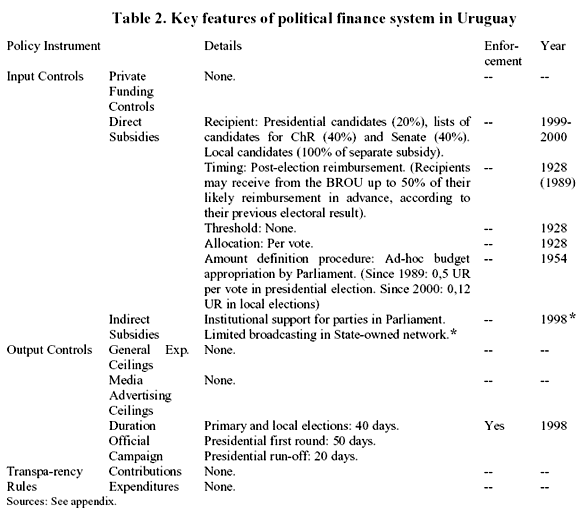
]]> The complexity of its party and electoral systems stands in contrast to the relative simplicity of Uruguay's political finance rules. In Uruguay, one of the most liberal regulatory systems of political funds has coexisted with a long-term participation by the State in providing the parties with resources for their electoral activities. As with many other reforms in Uruguay, it was José Batlle y Ordóñez who put forward the idea of State subsidies to parties in 1924.4 Batlle's proposal was adopted four years later, albeit in a somewhat oblique way. Instead of establishing a generic party subsidy, lawmakers introduced a limited post-electoral reimbursement scheme, whereby the Electoral Court (EC) would refund parties for the printing of their ballots or lists.5 The EC would previously fix the price of each printed list and refund parties at a rate of twenty ballots per vote received.6 Voted as part of a wider electoral reform, the article that created the scheme received very little discussion in both legislative chambers and no press coverage at all.7 The world's first direct State funding scheme for parties came about in the quietest possible way.Albeit as a limited addition to the extensive forms of public support already available to parties through patronage, the direct subsidy became entrenched in the system. In 1954, the Assembly did away with the mention of printed lists, choosing instead to fix a global subsidy amount and formally turning the scheme into what it had long been in practice, i.e. a general subvention fund. Moreover, it restricted the fund's operation to the forthcoming election, thus introducing a peculiarity into the Uruguayan subsidy system: its ad-hoc nature. Henceforth, the subvention would be renewed by a legislative act before each election.
The periodical revalidation of the subsidy meant that with every election new changes were introduced to the scheme, not least in the size of the budget appropriation. Since 1989, the subsidy's value has been fixed as a proportion of a Unidad Reajustable (UR) per vote. During the 1999-2000 election cycle, it amounted to US$20.5 m or US$8.5 per registered voter.8 This sum is subject by law to a precise intra-party distribution between presidential candidates, parliamentary lists, and local aspirants. Moreover, each recipient is granted the right to claim before the State-owned Banco de la República (BROU) a pre-election interest-free advance of up to 50% of his likely reimbursement, calculated according to his previous electoral result. The 1996 electoral reform brought about the introduction of a separate, smaller subvention for local elections. Meanwhile, presidential primaries, also introduced by the reform, remain uncovered by the subsidy scheme.
Besides the peculiar evolution of direct State subsidies for parties, little can be said about other elements of the Uruguayan political finance system. The parties' private sources of income, as well as their expenditures, remain unregulated. Parties, sectors and candidates are allowed to spend unrestrictedly during electoral campaigns. Since 1998, however, the duration of the latter has been limited.9 Finally, no financial transparency rules have been imposed on parties or campaign structures. Subsidy recipients in Uruguay need not submit financial reports to the electoral, judicial, parliamentary or administrative authorities.10
With the exception of its direct subsidy scheme and limited forms of indirect public support to parties, Uruguay's political finance system stands as close as any to a laissez-faire approach to political money. Table 1 sums up its main features.
III. Campaign expenditure: Amounts and items
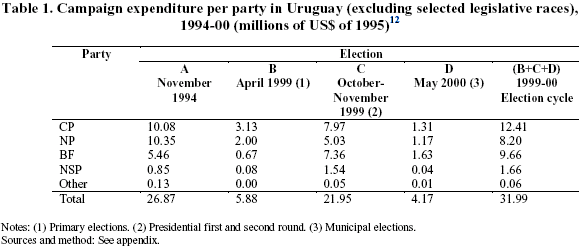
]]> Estimating the cost of Uruguayan elections is difficult and uncertain. The lack of reporting procedures and the extreme decentralisation of electoral structures fostered by DSV complicate enormously the task of keeping track of electoral expenditure throughout the country. Before the onset of the long 1999-2000 election cycle, the only academic work on Uruguayan political finance estimated the total cost of the country's elections at US$30 million, a sum that the author conceded to be merely a "possible indication".11Though based on pure guesswork this figure may be closer to the mark than its author probably expected. Indeed, a more thorough reconstruction of electoral expenditure based upon extensive interviews, the parties' disbursements on television advertising and the invaluable set of figures released by the NSP yields roughly similar results, shown in Table 2.
My estimation shows a relatively subdued increase of 19% in electoral expenditure between 1994 and 1999-2000. The introduction in 1996 of open internal elections and the presidential ballotage, as well as the separation of national and local elections, seem not to have caused an exponential growth of electoral spending but largely its reallocation between the different moments of the election cycle.
However, if changes in total expenditure were relatively limited, alterations to its distribution between parties clearly were not. The fall of more than one fifth in the expenses of the NP stands in sharp contrast with increases for the CP (23%) and, above all, for both parties in the Left (77% for the BF and 95% for the NSP). These changes were largely a reflection of the perceived chances of electoral success for each party in the October 1999 election. Indeed, in the wake of a highly conflictive dispute for the presidential candidacy, opinion polls consistently indicated that the NP was on course to a heavy electoral defeat in the presidential first round. The same surveys suggested that the BF would win the first round handily and therefore reap the largest share of the proportional public subsidy.13 This expectation explains the disappearance in 1999 of the sizeable spending gap between both traditional parties and the BF in 1994.
The Uruguayan experience suggests that electoral prognoses decisively influence spending levels in two distinct ways: first, by affecting the willingness of instrumentally-motivated donors to contribute to each party; second, and most important, by allowing political actors to estimate their post-electoral subvention. As confirmed by politicians across the spectrum, the calculation of the latter remains a crucial element in the definition of the parties' and internal sectors' campaign budgets, particularly amongst groups with limited possibilities of attracting private donations.14 This mechanism makes overall expenditure levels very sensitive to changes in the availability of State funding, a phenomenon also observed in Costa Rica.
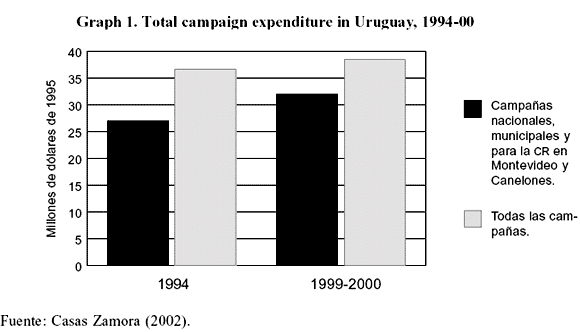
The figures in Table 2 require extensive qualification, however. Due to great limitations in the available information, they only cover elections that make extensive use of national TV networks. This includes nation-wide campaigns, such as presidential, primary and Senate races, as well as races for the ChR in the urban conglomerate formed by the neighbouring departments of Montevideo and Canelones.15 The table thus excludes ChR races in the Uruguayan hinterland, on which very little is known.16 Based on informed estimates of the average expenses incurred by a competitive list of candidates to the ChR, conservatively calculated at US$50,000 for 1994 and US$60,000 for 199917, I have produced a rough approximation of the cost of local legislative races in all the departments of the Uruguayan interior. Since I discriminated between "competitive" and "non-competitive" lists, and included only the former in the estimate (178 in 1994, and 104 in 1999), my results should be taken as a bottom line that underestimates significantly the real cost of campaigns in the country's interior.18 My procedure suggests that these races added at least US$9.65 million to the cost of Uruguayan elections in 1994 and nearly US$7 million five years later.
]]> As shown in Graph 1, this estimate moves the likely total cost of all Uruguayan elections much closer to US$40 million, flattening in the process the differences between the 1994 and 1999-2000 election cycles.
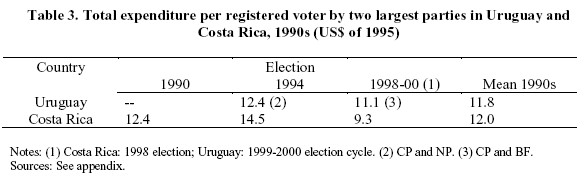
Once all elections are included in the calculation, campaign expenditure in Uruguay stands at US$15.9 per registered voter and election cycle. At this point a comparison with Costa Rica is useful. Campaign expenditure in Costa Rica amounted to US$12.6 per voter and cycle during the 1990s, i.e. 26% less than in Uruguay. While Costa Rica's centralised party structures, bred by its closed list PR electoral system, may explain part of the difference, it is the country's two-party system19 that appears to hold the key to the spending gap between both countries. Table 3 shows that in the absence of a third major party, campaign disbursements per voter in Uruguay during the 1990s would have been virtually identical to those in Costa Rica. If, as argued by Sartori, the structure of the party system mediates decisively the effects of electoral formulas20, it also seems to play a crucial role in shaping the consequences of political finance rules.
]]> How is the money spent in Uruguayan campaigns? Despite the introduction of free advertising slots for parties in the national TV networks during the 1999-2000 election cycle, television advertising consumes the single largest proportion of electoral disbursements in Uruguay. However, TV outlays vary across the multiple levels of the heterogeneous campaign structures in Uruguay and coexist with equally heavy disbursements on other forms of advertising.
Graph 2 summarises the only publicly available account of the allocation of expenditures by a national political party or sector in Uruguay during the last two campaigns.
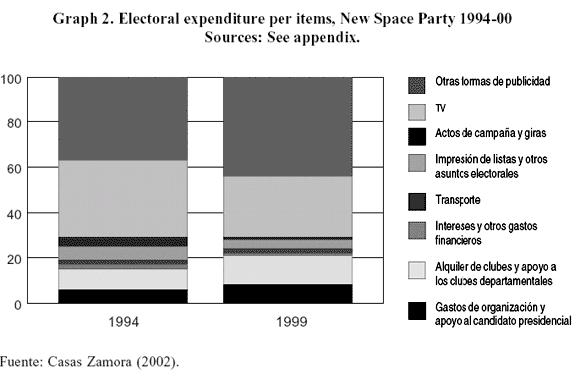
The graph shows that in the NSP's case, the purchase of TV advertising slots amounted to 35.2% of total expenditure in 1994 and 26.7% five years later. Although the NSP is largely a Montevideo-based organisation, these figures are, in all likelihood, a good proxy to the expenditure patterns of most other political sectors in their national and metropolitan (i.e. in the Montevideo metropolitan area) campaigns. Important caveats should be stressed, however. The proportion of TV advertising is probably much lower in campaigns in the interior of Uruguay (which are largely excluded from the NSP's numbers), whose presence on television relies, if at all, on local stations with advertising fares well below those of national networks. The same applies to political sectors in the far Left, whose electoral efforts are largely based on traditional canvassing techniques executed by disciplined activists, rather than media advertising.21 On the other hand, by all accounts, television outlays go up markedly in the case of the presidential campaign in all the major parties, where they probably exceed 50% of all disbursements. Largely relieved from the organisational efforts carried out at the local level by the parties' internal sectors and their lists, presidential campaigns can afford a more intensive presence in the mass media.22 Taking into account these qualifications, and using the NSP's figures as an approximation, my calculations suggest that advertising in national television networks by all parties amounted to US$8.2 million throughout 1994, only to climb to US$10.3 million in 1999.23
If not overwhelming, as commonly assumed, the reliance of Uruguayan campaigns on television is, nonetheless, significant. This is not surprising given the extraordinary penetration of television in Uruguay, which at 531 sets per 1000 people, boasts the same TV density as Sweden.24 The relevance of TV advertising in Uruguayan campaigns is, however, less striking than the importance of advertising in general. One of the most remarkable features of Graph 2 is the very high proportion of publicity outlays in the NSP's total electoral disbursements: above 70% in both election cycles. These numbers coincide with evidence on the spending behaviour of some political sectors of the BF, which during their campaign for the May 2000 municipal elections consistently allocated over 70% of their budget to media expenses.25 The purchasing of TV advertising slots is, thus, merely a part, and often a surprisingly limited one, of a broader picture in which media production costs, radio publicity, leaflets, campaign billboards and, to a much lesser degree, publications on the written press, also feature prominently.26
The dominance of publicity outlays in Uruguay serves to highlight the other noticeable feature of Graph 2: the low proportion of organisational expenses, i.e. those of campaign management, logistical support for the presidential candidate, rental of party branches, and financial transfers to the NSP's departmental branches outside Montevideo. These disbursements comprised 15.3% and 21.7% of the NSP's total spending in 1994 and 1999, respectively, a much lower proportion than that absorbed by comparable items in major Costa Rican parties (40-50%). Particularly striking are the very limited resources allocated to salaries (1.3% in 1999) and rental of party branches (4.5% on average in 1994-99), that comprise the largest share of organisational outlays in Costa Rica.
These differences have deep roots in the Uruguayan political tradition as much as in various institutional incentives. Although rigorous evidence is hard to come by, the legendary level of politicisation of the Uruguayan population probably translates itself into an uncommonly high willingness to engage in unpaid party activities, relieving parties from otherwise weighty expenses. If extended campaign activism traces its roots to early forms of popular mobilisation activated by the numerous caudillos in both traditional parties27, the adoption of DSV added a strong incentive to it. The multiplication of party lists and fierce intra-party competition allowed by the new system mobilised a large number of political activists with a direct or indirect stake in the election. This incentive would be reinforced by the patronage structures put in place by the traditional parties in the first half of the Twentieth Century. The citizens' active engagement in the campaign was often the counterpart of a bargain that entailed, at the other end, the parties' delivery of particularistic benefits to their followers.28
]]> Widespread voluntary participation survived the demise of traditional clientelism and the 1973-84 authoritarian interlude and, indeed, reached extraordinarily high levels during the campaigns leading to the 1984 and 1989 elections.29 Though lower than during the democratic transition's heyday, voluntary activism remains at relatively high levels: nearly one sixth of the electorate claimed to have carried out voluntary tasks during the 1999 campaign.30 This proportion was significantly higher amongst self-described centre-left (20%) and left (27%) voters, a phenomenon that goes a long way towards explaining the NSP's and BF's very low salary expenses. The latter, in particular, relies almost entirely on voluntary campaign workers.31As with organisational outlays, so with other logistical items, such as transport costs. As opposed to Costa Rican parties, Uruguayan parties do not develop large-scale operations in order to mobilise their voters on the election day. The approximately US$25,000 spent by the CP's presidential campaign on hiring 300 taxi-cabs to transport voters to the polls in October 1999, is a mere 3% of the budget allocated to the same purpose by Costa Rica's National Liberation Party (NLP) in the February 1998 election.32 While sheer confidence in Uruguay's intense civic engagement may help to explain this difference, basic institutional traits are probably more relevant. In particular, Uruguay's mandatory suffrage, backed, unlike in Costa Rica, with effective fines, makes sure that citizens turn out to vote, even when faced with obstacles to do so.33
The past paragraphs suggest that the importance of advertising outlays in Uruguay is not haphazard. Their weight is connected to, and probably the natural consequence of, the very limited non-advertising demands faced by Uruguayan parties. The irrelevance of their organisational and logistical requirements allows Uruguayan parties to liberate resources that are largely allocated to advertising campaigns. The structure of electoral expenditure in Uruguay appears to be more the reflection of the wider institutional framework than of clear-cut inexorable trends towards higher TV expenses.
IV. Campaign income: Sources and practices
So far, this chapter has given an estimate of the cost of Uruguayan election campaigns, analysed the spending structure of the latter, and established the relationship of both with the country's institutional make-up. What follows is a reconstruction of the fundraising practices of Uruguayan parties, largely based on extensive interviews to first-hand participants and their occasional public remarks on the topic. The analysis will begin by looking into the financial relevance of Uruguay's subvention system.
1. State funding and its relative weight
Amongst electoral subsidies, the Uruguayan scheme is the most lavish in Latin America and, indeed, one of the most generous in the world. The US$8.5 per voter distributed during the 1999-2000 election cycle are far above the electoral subventions allotted in the late 1990s in other Latin American countries such as Costa Rica (US$5.6), Panama (US$3.7), Bolivia (US$3.1), Mexico (US$2.4), Nicaragua (US$2.0), Honduras (US$1.1) and Ecuador (US$0.1).34 Yet, this generosity does not translate automatically into an overwhelming financial relevance for the recipient parties.
Table 4 shows the proportion of campaign expenses covered by the Uruguayan subsidy over the last two election cycles.
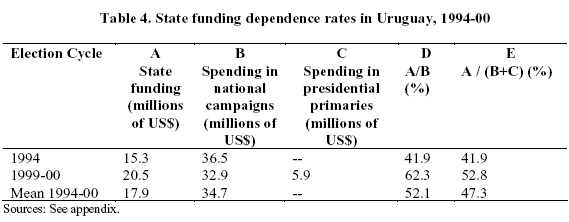
Subsidy dependence in national campaigns stood at just above 40% of total campaign spending in 1994, and climbed up sharply to 62.3% during the 1999-2000 election cycle. The hike in the latter reflects a significant increase in the subvention as much as a contraction in the private sources available to presidential campaigns, partially dried up in the course of the non-subsidised primary campaign of early 1999. Once the cost of party primaries is incorporated, the subsidy's relative weight drops 10 points to about 53% of total campaign expenditure in 1999-2000. At 47.3%, the average subsidy dependence rate of both election cycles stands well below the mean rate in Costa Rica for the period 1986-1998 (54.2%). Despite its remarkable lavishness, Uruguay's election subsidy has covered an inferior proportion of campaign expenses than the more modest Costa Rican subvention.
Systemic rates of dependence only tell a limited part of the story, however. In fact reliance on State funds differs dramatically across Uruguayan parties (see Table 5).
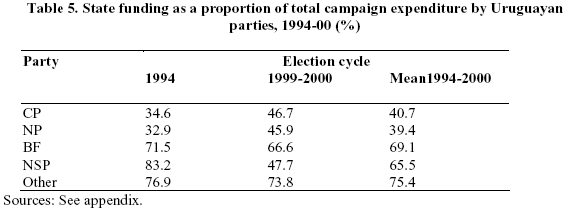
To an extent unknown in Western Europe -where the parties' income structures are similar, even across ideological families35- the Uruguayan experience lives up to the pre-conception that left-wing parties are more heavily dependent on public subsidies than their conservative opponents. The average proportion of State funds in the expenses incurred by the left-leaning BF and NSP in the last two election cycles is not just very significant in itself: it is also between 25 and 30 points higher than the average for the CP and the NP. While traditional parties continue to rely heavily on private donations, the public subsidy is the Left's veritable financial cornerstone. Despite the near doubling in the BF's campaign expenses between 1994 and 1999-200036, public funds still covered two thirds of the party's outlays during the latest election cycle, with a combination of small donations, post-election debts and accumulated financial surpluses accounting for the rest. Moreover, this proportion climbs to practically 90% in the national and metropolitan campaigns of the party and its internal fractions, and to well above 100% in the case of some sectors.37 A word of caution should be stressed. Reliance on "official" party subsidies underestimates, however, the support that both traditional parties receive from the State. Although the heyday of their patronage structures is long gone, the CP and the NP continue to benefit from public resources that, in many ways, ease their financial burdens. Particularly noteworthy is the political cycle followed by TV advertising by Uruguay's government agencies, timed to support in an obvious way the campaign of the ruling party in 1999.38
]]> This caveat notwithstanding, the main point remains: the collection of private funding sources remains crucial in Uruguayan election campaigns, particularly for the CP and the NP. Let us look at the processes whereby non-public sources of campaign funding are collected in Uruguay.2. Fundraising processes: Mechanics and implications
The largest share of funds in Uruguayan campaigns is obtained through a time-honed set of procedures defined by the dominance of business interests and the prevalence of social networks.
Committees, social networks and candidates
On December 5, 1942 Dr. Ricardo Butler and Dr. Abalcazar García, members of the NP, submitted before the national authorities of their party a detailed report of their fundraising activities. Messrs. Butler and García were part of one of the several fundraising teams assembled by the party's Finance Commission in the run up to the November 1942 general election.39 Months before, the team had received from the Commission a stack of "party bonds"40 and a mandate to "sell them amongst their numerous and valuable connections".41 Their report provides a list of collected donations and a detailed account of their communications and meetings with approximately 20 prospective patrons. Amongst the latter there were several cattle ranchers and industrial firms -including some that, to the team's dismay, flatly refused to make political contributions in general- , two donors that had contributed to smaller lists within the party, one who claimed to have already given money to the NP as well as other parties, and one who was a candidate in the lists of arch-rival CP. The militancy of the latter was not, apparently, a self-evident obstacle to the team's approach: the report observes, with resignation, that after several visits, "we have the conviction that he does not want (to contribute to the NP) and will not do so. It is not possible to put more pressure on him".42 This memorandum and a broader list of bond purchasers prepared by the party's Finance Commission immediately after the election, report 196 contributions for a total of 49,200 Uruguayan pesos (US$374,838 of 1995). Less than one sixth of the donations amounted to 500 pesos or more (>US$3,809), including three of 3,000 pesos (US$22,854), the largest in the group. Only 11 were corporate donations, most of them very small. Luis Alberto de Herrera, the party's undisputed leader at the time, features in the list with a contribution of 2,000 pesos (US$15,236).43
It is difficult to know how comprehensive or representative these pieces of historical information are. They reveal, however, the remarkable longevity of some defining traits of political fundraising procedures in Uruguay, particularly in both traditional parties. The first of such features concerns the make-up and activities of fundraising committees. To this day, a few months before the start of the campaign every national political sector appoints a Finance Commission of between 15 and 20 members, largely comprised, as 60 years ago, of businessmen with "numerous and valuable connections".44
Social prestige and trustworthiness are vital features in the profile of Uruguayan fundraisers. A NP politician noted that finance commissions are formed "by people who are very prestigious in our medium, very well known in the business world, so that whoever contributes is reassured by their presence and their signature on the party bond".45 The group is usually chaired by someone from the innermost circle of the sector's presidential candidate or leader.46
As in 1942, the workings of the committee cast a wide net. Fundraisers approach scores of entrepreneurs and business executives, starting with those that have supported the sector or its candidate in previous electoral ventures and then stretching the quest well beyond the party's boundaries.47 The key to the process is familiarity. One of the committee's first and crucial tasks is, in fact, deciding who talks to whom: a friend or acquaintance invariably contacts potential donors.48
In the vast majority of cases, the contributor agrees to meet a member of the committee, doles out a cheque of a few thousand dollars, and receives, in return, a numbered party bond or official receipt.49 The transaction is usually smooth and gentlemanly, devoid of coercive language and overt indications of the size of the expected contribution.50 Fundraising visits are indeed laden with subtle codes. High-ranking politicians occasionally attend meetings with potentially large donors, ostensibly as a sign of respect towards them but also as a hint of the committee's financial expectations.51 In a few cases, after an initial interview with fundraisers, large contributors request an audience with the presidential candidate or, more commonly, her visit to the donor's firm or factory, during which a long list of anxieties are invariably communicated.52
This time-honed method of fundraising is merely one of the tools employed by finance committees, albeit the most important one by far. Alternative methods of money collection -such as the organisation of fundraising breakfasts, dinners and raffles- remain, in general, remarkably under-used in Uruguay, except at lower levels of competition, where low-fare fundraising activities have become a common occurrence.53 The relative weakness of such alternative methods is not alien to the intense intra-party competition for private funds. As we will soon see, the internal race multiplies the requests from all quarters on potentially large contributors, thus limiting the chances of financial success for any fundraising event. Moreover, the country's deep-rooted tradition of un-conspicuous wealth possession and the entrenched habit of Uruguayan donors of contributing to more than one party, concur to create strong negative incentives for public giving. "In Uruguay nobody wants to be seen when he gives", remarked former president Lacalle.54
]]> Decentralisation an fragmentation of the contributionThe tasks of fundraising committees are replicated at all levels of electoral competition. In fact, weakened by DSV, central party organs have traditionally remained at the margins of electoral fundraising in Uruguay. As noted by donors and politicians alike, the quest for private funds is largely spearheaded by the parties' national fractions and their numerous ChR lists, locked in a struggle for resources that mirrors their competition for votes.55
The implications of fundraising decentralisation for the effectiveness of political finance controls are obvious and will be examined below. Less evident, however, are its consequences on the size and fragmentation of private contributions. Just as the competition between hundreds of party lists stimulates widespread political activism, it appears to mobilise a comparatively high number of donors. Eight percent of Uruguay's voting age population claimed to have contributed money to parties or candidates during 1999, more than four times the comparable rate for Canada and only slightly lower than that of the U.S., probably the most broadly based system of political contribution in the world.56
Such a high participation figure translates into an average contribution of US$60.57 Yet, this average is misleading. Participation rates are considerably higher amongst self-described leftist sympathisers, which probably comprise a significant proportion of donors in Uruguay, albeit with very small amounts.58 On the contrary, traditional parties attract, in all likelihood, a smaller number of larger donors, some of them remarkably generous. Although far from common, contributions of US$50,000 and even US$100,000 to CP and NP presidential aspirants are not unheard of.59 Donations of US$5,000-10,000 are considered average at the presidential level in both traditional parties, while rather exceptional at lower levels of competition.60
Large or not, the important thing about private contributions in Uruguay is that in a different political environment they would probably be larger. Indeed, Uruguay's electoral rules and party system generate powerful incentives towards the fragmentation of contributions and their scattering throughout the political system. In Uruguay, political donors -particularly the largest amongst them- are expected to lend their support simultaneously to several fractions and parties.61 If Butler and García's report shows that the practice of multiple giving was already present in 1942, the recent case of Igor Svetogorsky provides a neat example of its endurance. In 1996, Svetogorsky, head of a holding linked to the Uruguayan State through several purveyance contracts, was accused of alleged high-level bribing and influence peddling by a journalistic investigation.62 In the course of the inconclusive political and legal wrangle that ensued it became clear that Svetogorsky was, at least, a very generous and open-minded political donor. His known contributions during the 1994 campaign had amounted to US$110,000, widely distributed across parties, sectors and competition levels: US$50,000 and US$30,000 went, respectively, to the presidential candidacies of Juan A. Ramírez and Alberto Volonté in the NP; US$10,000 to the Lista 15 of CP's presidential aspirant Jorge Batlle; US$3,000 and US$7,000 to two Senate and ChR lists supportive of one of Batlle's internal rivals, Jorge Pacheco; and, finally, US$10,000 to the campaign of the NSP and its presidential standard-bearer, Rafael Michelini. While his connections and munificence may have been atypical amongst businessmen, Svetogorsky's unselective contributing habits certainly were not. A young entrepreneur told the author:
"The norm is contributing to all the sectors, unless the entrepreneur has a very direct involvement with one of them. To begin with, it's not convenient to be in bad terms with one of the parties. Of course, one may decide not to contribute to any of them or to give a little bit to all of them, but the latter option is friendlier".63
The pervasive use of this practice is related to core institutional features of Uruguay's political system. As was mentioned above, DSV nurtures an intense struggle for funds between multiple political actors, which compels them to look for donations well beyond the boundaries of their own constituency. As the 1942 example already evinces, Uruguayan fundraisers - with the partial exception of the BF's - pay only limited attention to the political affiliation of their prospective patrons. The relentless pressure over prospective donors creates, to use the term of our previously quoted young entrepreneur, a less friendly atmosphere for those who systematically refuse to collaborate.
Any tacit compulsion merely compounds, however, the effect of a crucial institutional incentive: the share of power enjoyed by any given party or national fraction in Uruguay is probably too small to secure any major pay-off for instrumentally motivated donors. In a fragmented party system, with highly fractionalised parties and a multiplicity of relevant actors, the diversification of political contributions is a highly rational strategy. As Svetogorsky's example so clearly shows, Uruguay's acute power diffusion forces donors to split oversized contributions into smaller parcels distributed at all political levels. Faced with a basic resource allocation dilemma, Uruguayan donors have chosen to sacrifice the intensity of their influence over any given political actor, in order to enlarge the scope of their pressure across the political system. Moreover, if the fragmentation of the party system limits the decision power enjoyed by any single actor, the country's secular political mores dictate, at the same time, that no fraction within the traditional parties is ever deprived of political power. The colonisation of the State apparatus by both parties and their sectors - which survives, if subdued, to this day - and the long tradition of power co-participation between them, turn even potential electoral losers into future power brokers, worthy of financial support. "Even if a candidate can't win - remarked a business leader- he is, almost always, an influential person whom you can call and who can lend you a hand to unfetter a file or procedure at any public institution".64
No matter how entrenched multiple-giving behaviour may be, the last election cycle put its limits to test. The break-up of the electoral process into several stages and, particularly, the introduction of presidential primaries increased enormously the burden of fundraisers and donors. The sheer cost of lending support across the board twice - at the primary stage and again during the national campaign-, made business donors highly reluctant to contribute to the April 1999 primaries, a pattern also observed in Costa Rica.65
Domestic business and the case of television networks
]]> That the reluctance of businesspeople to fund primary races has become a source of concern for politicians is a reflection of business' pivotal involvement in all other campaigns. In spite of Uruguay's relatively broad base of political contributors, the overwhelming majority of non-public resources in Uruguayan campaigns come from large domestic entrepreneurs and firms. The extent to which Uruguayan politicians -notably those in traditional parties- regard visits to wealthy entrepreneurs as the nearly exclusive source of non-public funds is indeed conspicuous. A former CP senator remarked that "there are no resources from party members. Therefore, what happens? The fundraising commissions of the sectors and the party go and tour the firms, and the entrepreneurs give money".66 "When a time of extraordinary expenses comes -confirmed a colleague from rival NP- we all have to go out and tour the big firms and factories".67 Such inevitability is equally accepted by those at the receiving end of the request. As an important construction entrepreneur put it, matter-of-factly, "in this country, the call asking for political contributions is something that you assume from the moment you own a business".68Despite the institutionalisation of these links, they amount, in practice, to what a business leader called "a very primitive system," devoid of sectorial co-ordination.69 Uruguayan entrepreneurs regard the i dea of pooling their contributions to maximise sectorial impact as "absurd" and "unthinkable".70 The familiarity between fundraisers and donors, the status of contributions as a taboo topic amongst entrepreneurs, and the political fault-lines that have secularly criss-crossed business interests in Uruguay -a trait as old as the existence of the CP and the NP-,71 concur to create a system entirely defined by individual exchanges.
While the system involves the vast majority of the country's entrep reneurial elite -from large industrialists to cattle ranchers and big traders- the intense participation of specific business groups is well known. The most remarkable and controversial example is that of private television stations. The latter have oste nsible incentives to make political donations. Through the National Direction of Communications, the government controls the authorisation of new TV frequencies and the revocation of those in place for reasons as vague as the perturbation of public tranquillity and the harming of the prestige of the Republic.72 In effect, however, the interaction between politicians in both traditional parties and the owners of Uruguay's main television networks has evolved into a complex web of mutual dependence, with crucial implications for political finance.
Closely connected to both parties from the outset, the family-cont rolled groups that own the country's three private TV networks have come to operate, with the acquiescence of public authorities, as a powerful business cartel. The groups' early domination over national airwaves merely preceded their control -sanctioned by government decisions- over emerging sectors of the TV market, notably regional channels and cable networks. By the 1990s, the three groups, acting as an oligopoly under the guise of various joint ventures, had consolidated a virtual stranglehold over the Uruguayan TV market.73
If the channels' successful lobb y ing against the development of the State-owned television network, SODRE, had long evinced their capacity to extract concessions from the poli tical authorities, by the 1990s the situation had reached an extraordinary blatancy. The government 's 1994 controversial decision to turn Montevideo's cable TV market into a closed shop jointly controlled by the three private networks74 was followed six years later by the Sanguinetti's Administration order to ban the importing of satellite TV de-coders, unless done by the existing cable operators.75 In the meantime, the 1997-98 attempt to legisl ate the TV channels' obligation to allocate free broadcasting time to parties in the run-up to the elections -an effort originally endowed with cross-party support- was thwarted in the Senate when the National Association of Uruguayan Broadcasters (ANDEBU), a media lobby, made known to lawmakers its intense displeasure with the bill.76 With the BF's opposition, the bill was subsequently limited to the State-owned channel in exchange for the private networks' voluntary commitment to allocate a number of free TV and radio slots to parties represented in Congress.77 "Formidable! -exclaimed on the occasion a left-wing deputy- Never have I seen any of the corporations that have passed by this house to twist the Senate's arm with such effect".78
Arm-twisting is, however, a partial explanation. In fact, the relationship of channel owners with traditional parties features sticks and carrots in roughly similar doses. Foremost amongst the latter is the TV networks' practice of charging wildly different advertising fares to the various parties and sectors, granting some of them heavy discounts over the official rates. In doing so, TV stations become de facto large political contributors, armed with an unmatched ability to bias the electoral playing field. Former president Julio M. Sanguinetti framed the issue with admirable clarity:
"In Uruguay, a donor who gives US$50,000 or US$60,000 to a campaign is a big donor, a really big donor. Yet US$50,000 in terms of television advertising is very little, almost nothing. What this tells us is that the television fare is, ultimately, the biggest sponsor. Here lies one of the most decisive factors in campaign funding. I would say that the number one factor".79
In the absence of any regulation, the networks' discretion to charge the parties is as complete as the opacity with which such discretion is exercised. While no political actor ever pays the official fares, the discounts reaped by certain CP and NP fractions may reach 95% of the latter.80These remarkable rebates are compounded by the networks' frequent practice of condoning the campaign debts accumulated by the sectors.81
Such munificence is hardly ever extended to the Left. While an important television executive claimed that his channel made no difference between the parties' central campaigns, he admitted that at the level of their internal fractions -which carry out their own independent negotiations- network executives normally grant a better treatment to those sectors "closer to their hearts".82 And the heart, in this case, beats in the right. Before and after their second-round defeat in 1999, BF officials complained bitterly about the TV networks' blatant discrimination against the Left, visible in the unfair pricing and programming of advertising as much as in the lopsided coverage offered by news programmes.83Their complaints were not unfounded. The advantage of the CP's presidential candidate Jorge Batlle over his left-wing rival, Tabaré Vázquez, in terms of TV presence during the run-off campaign was indeed sizeable: 65.2% to 34.8% in advertising, and, more significantly, 59.7% to 40.3% in news coverage.84 An advertis ing executive with a long experience in handling media campaigns for both the CP and the BF noted:
"The mass-media normally give away a certain number of slots to the parties... Television owners... are far more benevolent and open-handed with these slots in the case of the traditional political groupings... and particularly in the case of the Partido Colorado, that has been the party of government since well before I remember. The Partido Colorado receives the largest benefits in kind from the mass media..."85
]]> Remaining at an arm's length from the country's entrepreneurial elite, and treated with relative harsh ness by media owners, where, then, does the Left turn to in its quest for non-public resources?The Left and its peculiarities
"Al Frente lo financia el pueblo" (The BF is financed by the people). Thus said one of the foundational cries of the left-wing alliance in 1971, meant to describe its policy of tapping a large number of members and sympathisers for minimal donations. If "popular contributions" ever were the financial backbone of the BF's electoral efforts, they are certainly not now.86 While the policy maintains much of its original significance between elections, during the electoral season the BF and its sectors also engage in special campaigns to attract large private donations.
However, they do so in a much more limited and discriminating way than their traditional adversaries, and with far less success. With few exceptions, such campaigns are geared towards high-earning donors who already contribute to the BF on a regular basis or have a well-known identification with it. "Ninety-five percent of our contributors, I would say, are people with some kind of historic link to the party, even in the case of successful professionals or entrepreneurs," noted a Socialist financial official.87Their contributions are, in most cases, an extraordinary membership fee levied during the electoral campaign and, as such, tend to be rather low. Donations obtained through this mechanism by the BF and its sectors are normally in the US$500-5000 range, and only exceptionally above the latter sum.88
The irrelevance of private donations in the BF's campaign coffers is the result of ideological choice, as much as it is of the BF's acute lack of fundraising know-how and troubled relationship with Uruguay's business community.89 The alliance's largely successful decade at the head of the Montevideo mayoralty and its increasingly strong electoral position have made some business donors more willing to extend their liberality to the BF's central campaign and even some of its moderate sectors.90 Yet, they have hardly generated a change of heart: even in cases of multiple giving, left-wing groups tend to be rewarded with much smaller figures than their conservative rivals. Moreover, business' limited involvement has not been balanced by the financial participation of trade unions, which, while ideologically close to the BF, have doggedly clung to their age-old formal autonomy from political actors, and enjoy no organic links -financial or otherwise- with the leftist alliance. Amidst Uruguay's low unionisation rates and the unions' chronic economic feebleness, labour's financial contribution to the BF is, by all accounts, non-existent.91
As shown previously in this chapter, rather than "financed by the people," the BF is simply funded by the State.
The overwhelming dominance of public resources in the BF's election coffers is, however, a relatively new phenomenon for key sectors in the alliance. The experience of the Uruguayan Communist Party (UCP) suggests that the notion of "popular contribution" may have been a mystification from the outset, and that other non-public resources were probably crucial for the BF up until the early 1990s. A former UCP Secretary of Finance, now distanced from the organisation, provided the author with a detailed account of the party's financial life during the Cold War, which started by throwing into question the financial relevance of mass contributions:
"Once every year, approximately, there was a financial campaign where raffles and bonds were sold, and special collaborations raised... This financial campaign was... more important for its contribution to the party's organisation and agitation, than for its concrete results..."92
Mass contributions were, in fact, dwarfed by two largely concealed funding sources. The first, the UCP's business ventures, constituted a complex operation that spanned several countries: from various commercial firms in Uruguay, to tour operators linked with Cuba, to minority shares in West European firms set up by the Soviet Union to commercialise products from the Socialist bloc, notably diamonds and precious woods from Angola. These ventures were a well-kept secret. Due to legal and political reasons, chiefly hiding from the rank-and-file the fact that the party was reproducing its income through the workings of the capitalist system, they were never registered under the UCP's name. These activities were complemented, and in many cases nurtured, by external subsidies:
"The other source of funding, which is very difficult to prove, but one which I can attest to from direct personal experience, was the concrete money -not through firms and corporations- that arrived from the Soviet Union... (N)one of that money was ever registered anywhere... there were no formal reports, no receipts, nothing. All this constituted a money merry-go-round, where you could never know how much money would get lost in each hand. And something would get lost. Moreover, since it was money sent from the USSR, it was also linked to the Soviets' own merry-go-round". Such an account is consistent with information released by the Russian authorities in 1992. According to the latter, between 1969 and 1990, the Soviet government's official aid to the UCP amounted to slightly above US$5 million, including US$350,000 as late as 1990.93
]]> Ironically, the system collapsed as the UCP was finally consolidating its dominant position within the BF. While the demise of the USSR spelled the end of external funding in the early 1990s, the internal fissures precipitated by the international crisis translated into acrimonious disputes over the UCP's firms. Most of the latter simply accrued to their legal owners, leaving the party empty-handed. Today, the UCP is a relatively minor sector within the BF, and, unlike yesterday, its funding mores are only of limited relevance to the alliance's financial situation.Foreign sources
The Soviet subsidies channelled to the UCP are hardly the only known instance of financial participation by outsiders in Uruguay's electoral campaigns. Born as a "buffer" state between Argentina and Brazil, Uruguay's political and economic life has been inextricably linked to both since the days of the Independence. This closeness generates numerous manifestations of electoral support across borders.
The phenomenon has benefited the Left as much as traditional parties. As recently as November 1999, it was reported that the leftist Partido dos Trabalhadores (PT) and Partido Socialista Brasileiro (PSB) in the Brazilian border state of Rio Grande do Sul were collaborating with the BF in the mobilisation of thousands of voters with double nationality.94 Such collaboration was not a novelty. Back in the transitional election of 1984, the leftist governors of the states of Rio de Janeiro and São Paulo allegedly offered free transportation to Uruguayan immigrants willing to return home and cast their votes for the BF.95 This was a remarkable change of fate. In the previous election campaign, held in the ideologically charged days of 1971, the BF had bitterly denounced the Brazilian military authorities for printing large amounts of anti-Communist propaganda and having it smuggled into Uruguay.96
While the days of the National Security Doctrine are gone, Uruguay's traditional parties continue to benefit, nonetheless, from the nervousness of conservative interests across the border. Both parties regularly collect campaign contributions from business in Argentina and, to a much lesser extent, Brazil. "Economic groups and banks from Argentina," noted the campaign manager of one of the leading candidates in 1994, "collaborate strongly with the Uruguayan parties. And it's reasonable that they do so, for all of them have business here or, at least, the expectation of investing in Uruguay in the short or medium term".97 Investment opportunities may or may not be part of the explanation, but the preoccupation for the stability of Uruguay's financial system -endowed with some of the world's strictest bank secrecy rules and long seen as Argentina's safety box- certainly is. Recent figures suggest that in September 2001 Argentines owned approximately US$8.8 billion in bank deposits and real estate investment across the River Plate.98 Uruguay's political stability is crucial to Argentina's business interests.
The substantial participation of the latter contrasts sharply with the rather subdued involvement of other foreign business interests. It was not always thus. In 1971, when U.S. firms were deeply implicated in the funding of conservative political movements in Chile, Uruguay's left-wing press repeatedly denounced the participation of multinationals in the funding of both traditional parties, in some cases exhibiting the documents to prove it.99 Two decades later, however, the situation had probably changed, due to the easing of the ideological atmosphere as much as to the enactment of the 1977 Foreign Corrupt Practices Act, which banned U.S. multinationals from making political donations abroad. Indeed, ahead of the 1994 election, Uruguayan subsidiaries of U.S.-based multinationals jointly and publicly stated that they would not contribute to parties or political sectors.100
If their statement merits some scepticism, it is yet to be refuted by any evidence to the contrary.101 More importantly, it is consistent with the recent experience of Costa Rica, where foreign firms have been dismissed as a limited source of political funding, in spite of the far greater dynamism of foreign investment.102 Today, with the possible exception of the controversial South Korea-based Unification Church,103 multinational consortia are, in all likelihood, restricted funding sources for Uruguayan parties.
And the same holds true for Germany's international political foundations. While the role of the liberal Friedrich Naumann Foundation -linked during the crucial transition years to the late NP leader Wilson Ferreira- may have raised a few eyebrows during the 1980s, the truth is that German foundations have remained on the margins of the electoral efforts of Uruguayan parties. Bound by a restrictive legislation in their home country, which prevents them from making direct financial contributions to any party, even the Naumann Foundation's support of Ferreira was carefully channelled through the Centre for the Study of Democracy in Uruguay (CELADU), a research institute linked to his political sector Adelante con Fe.104 This behaviour was not restricted to the Naumann Foundation, nor has it changed significantly since the days of the transition. Today, the foundations' role largely consists of shoring up with ever-smaller grants the activities of the frail education endeavours set up by the parties, mostly during the non-electoral season.105
Motives and retributions
The involvement of domestic business interests in funding campaigns is, conversely, very real. The Uruguayan case provides a good example of the combination of motives that drive most business donors. The large difference in the weight of private contributions in the finances of traditional parties, on the one hand, and the BF, on the other; the widely different treatment granted to both by TV channels; and the limited impact that the BF's electoral success has had on both phenomena, suggest that for most private donors in Uruguay the decision to contribute is laden with ideological considerations. "In the first place, you contribute because you believe in the convenience of certain ideas for the country," sentenced a prominent entrepreneur.106 Believe they may, but many private businessmen also, and perhaps fundamentally, fear the inconvenience of certain ideas and contribute accordingly. The phrase "I'll put money on this candidate because I do not want the other one to be elected" describes just as plausibly the basic rationale of most business donors in Uruguay.107
]]> This is, however, merely the first stage of their decision. Beyond the ideological choice between Left and Right, instrumental motivations rule. As shown above, the pervasive habit of contributing across parties, sectors and competition levels, embodies a fine instrumental calculation framed by the prevailing institutional rules. This calculation is only rarely geared towards securing an appointment in the future administration. In a country where political elites have long enjoyed a significant degree of autonomy and political careers are still patiently constructed through party ranks, demands for political appointments -from top legislative candidacies to directorial posts in State firms- stand a slim chance of succeeding.108 This rule may admit exceptions, nonetheless, at the local level, where age-old clientelistic practices remain unabated. Ultimately, as a former presidential candidate sharply put it: "The businessperson does not demand posts. The businessperson requires influence".109Influence may come in many different shapes, from very abstract to very concrete. The most common of them is a rather abstract one: the influence to be heard in case of necessity. Asked about her objectives whenever she made a political contribution, a construction entrepreneur fired a concise reply: "To be known by them!"110 Another businessperson clarified the purpose of this introduction rite: "The entrepreneur collaborates so that she doesn't get hurt, so that in case of any problem they remember her as someone who collaborated. I think that the exception is she who contributes with a concrete deal or benefit in mind".111
In the business world problems arise and phone calls arrive. As shown by the following remarks from Gonzalo Aguirre, a former vice-president, sooner or later the abstract turns into the specific:
"It once happened to me, when I was Vice-President of the Republic, that I received a phone call from a firm that had collaborated with the fundraising campaign of my Senate list... The firm had important liabilities with the tax authority, had an immediate deadline on an important sum, and was asking for an extension. I arranged the extension and they got it. It is not immoral, but neither is it the most convenient practice".112
The specific quid-pro-quo is hardly ever articulated expressly; it is merely understood. The moment of contribution indeed calls for considerable delicacy on the part of the donor, generally unarmed with credible coercive devices and uncertain about the recipient's reaction. A NP senator noted that an explicit demand in return for a donation entails the "risk that one can simply break off the meeting, say no, and be offended. (Donors) don't want to provoke such an awkward situation... That would shut them a door".113 Some things are better left unsaid.
Yet, unsaid does not mean unfathomed. Donors and fundraisers in Uruguay seem well aware of the contours of their implicit covenant. Rather than specific policy outcomes, always subject to the whims of decision-makers and the vagaries of political circumstance, the typical business donor knows to be purchasing lesser goods: a special right of petition before the politician and a favourable environment for his request. At the same time, as Gonzalo Aguirre's example clearly shows, politicians understand that receiving such requests and acting upon them is part of their job.114 At the highest level, the bargain includes the politician's implicit commitment to appoint campaign fundraisers in key positions of the administration, where the donors' generosity might be remembered and their petitions warmly looked upon. Such expectation operates as a powerful enticement to contribute. Not surprisingly, the directing board of BROU -the State-owned bank that up to this day controls a large share of credit in Uruguay- has been a traditional province of campaign fundraisers.115
The closer a party, sector or politician is to power, the clearer this agreement becomes. And in post-transition Uruguay no politician has been closer to power than former president Sanguinetti. He has, indeed, shown a remarkable eagerness to fulfil his side of the fundraising bargain. In 1985 and 1995, in the early days of his two administrations, businessmen Julio Kneit and Salomón Noachas -two of Sanguinetti's key fundraisers- were appointed at the top of the State-owned Mortgage Bank of Uruguay (BHU).116 By allocating credit to a myriad housing projects all over Uruguay, the BHU is a nodal point in the activities of the country's construction firms, believed to be -as elsewhere- significant political donors.117 Equally conspicuous was the case of Osvaldo Risi, another important fundraiser in Sanguinetti's second presidential bid in 1994.118 Risi, twice given low-profile posts in the Presidential House, became notorious in the course of a journalistic probe into an alleged high-level bribery scam in 1999. The probe, and the legislative investigation that followed, failed to implicate Risi in any wrongdoing. Nonetheless, they made clear that, contrary to what his obscurity suggested, Risi was an important figure in the President's entourage, and had been in close contact with a variety of public authorities and private firms -including Svetogorsky's- involved in public bidding processes. Whatever the outcome of their phone calls, bidding firms had, at the very least, a friendly ear in the Presidential House.
Friendliness is, in fact, the key word, beyond and above access. In the small, egalitarian "city-state" of Montevideo, access to politicians is generally swift and uncomplicated, as businesspeople and politicians were keen to note and the author fortunate to experience. "Ours is such a small country," remarked former president Lacalle, "that I would receive any important person who calls me, as surely would any political leader ... It is not like in other parts of the world, where (a contribution) opens a door. It doesn't open any door, just as no door is closed if you don't contribute".119 Yet, plain access does not bring good will; contributions do. Good will can be a decisive business advantage, desired as much as feared by most entrepreneurs. The value of such an edge and the lack of transparency of the fundraising process concur to create a co-ordination failure that subtly forces most businesspeople to contribute. The owner of a large construction firm observed:
"One contributes with all because it's always been like that, and also because one doesn't want to be the only one in the sector who doesn't contribute. And that you never know. Nobody knows if the other contributes, but if they came knocking on my door there's no reason to suppose that they haven't knocked on the others' doors".120
Either to secure a business advantage for the donor or, as in this case, to prevent someone else's from arising, campaign donations display the features of an insurance policy of sorts. The benefits of this policy may or may not become tangible, and, in any case, only reach the donor personally. Opposed to any form of contribution co-ordination and forced to split their money across the party system, the vast majority of Uruguay's campaign donors, with the glaring exception of television networks, realistically pay for political help rather than policy decisions, for a resource rather than a result. In the exchange between donors and politicians the currency is complex and contingent.
]]> The issue of controlYet, dangers abound, more so given the weakness of fundraising controls in Uruguay. As noted above, neither domestic campaign donations, nor international contributions, nor expenses, are subject to any kind of regulation or disclosure requirement in Uruguay.
Such a void is compounded by the virtual absence of control mechanisms within the parties. Sectors in both traditional parties and the BF operate with complete financial autonomy, unencumbered by any obligation to submit their accounts to party authorities.121 In turn, lists are only rarely accountable to their own political sector. The internal competition for resources is, thus, not merely unrelenting, but untrammelled. Only the NSP partially deviates from this pattern. In 1997, in the wake of the disclosure of Svetogorsky's donations to the party, the NSP enacted a Code of Ethics to regulate its fundraising procedures. The Code calls for ceilings on anonymous donations (currently >US$190), institutional approval of large contributions (>US$12,500), and an outright ban on corporate funding.122
The NSP's experience suggests an important point. As so many traits of Uruguay's political finance system, the feebleness of legal and party controls over fundraising activities is largely endogenous to the country's electoral system. It is hardly accidental that alone amongst Uruguayan parties the NSP has turned political finance transparency into part of its platform and practice. Small and endowed with a far higher level of centralisation than any of its rivals, it is, arguably, the only party capable of enforcing a measure of regulation over its finances. On the contrary, long conditioned by the centrifugal influence of DSV and counting their internal lists in the hundreds, the three major parties -and the national electoral authority- would find it very difficult to impose and enforce a unified set of fundraising practices.
In lieu of the latter, only self-control remains. Limited forms of it are indeed exercised. Fundraising committees at all levels make an effort to document every contribution through the handing over of receipts or party "bonds" to donors, a practice which can be traced back to the 1920s.123 Contribution bonds are, however, merely an instrument of internal control, a mechanism of accountability for fundraisers geared at reassuring donors and political authorities that contributions will reach the coffers of the party, sector or list.124 Moreover, they are routinely given to donors who wish to remain anonymous. Party bonds notwithstanding, the contributions' origin may remain undisclosed even to the sector's political leaders.
Ultimately, the probity of Uruguay's campaign finance practices has come to rely on the willingness of fundraisers to protect the reputation of their political bosses -to which they are invariably very close- and their own business name. In Uruguay's close-knit business community, evidence of ghastly fundraising practices or campaign finance mismanagement would probably spell disaster for any fundraiser in her regular business activities.125 Yet, the effectiveness and sustainability of reputation-based checks is open to serious questions when coupled with a conspicuous lack of political, journalistic and academic interest in probing the topic.126 Amidst such indifference, the increased fundraising pressure entailed by the post-1996 electoral rules may pose the ultimate test to Uruguay's laissez-faire approach to private campaign donations.
V. Conclusion
This chapter has shown the myriad ways in which campaign finance practices and the effects of State funding rules in Uruguay are moulded by the institutional, historical, social and political context in which they operate.
We have seen how the internal fractionalisation of political parties -nurtured by the electoral system- and, above all, the greater fragmentation of the party system push electoral costs in Uruguay well above their level in Costa Rica, a very similar country. Contrary to expectations, these costs seem to have suffered only a moderate increase as a result of the 1996 electoral reform. Rather than by soaring expenses, Uruguay's last election cycle was characterised by a visible redistribution of spending across electoral stages and political parties. Moreover, we have seen how the heavy dominance of advertising outlays in the parties' budgets is largely the reflection of an institutional framework that eases considerably their organisational and logistic costs. The preceding pages have also demonstrated that despite its remarkable generosity, Uruguay's State funding system covers, overall, a less-than-overwhelming proportion of campaign disbursements. This assertion conceals, however, a central finding of this chapter: the striking variation of the subsidy's impact across parties. Indeed, while the official subvention represents a somewhat limited income source for both traditional parties it is, on the contrary, vital for the Left. Excluded from unofficial forms of State electoral support, deprived of once-important international funding sources, kept at an arm's length by the business community, and endowed with scant financial help from trade unions, the BF has come to depend almost entirely on public funds. The most important effect of Uruguay's State funding system is, arguably, providing a left-wing alliance with a fighting chance against two traditional rivals heavily favoured by business donors. Limited as its overall effect may be, the public subvention system is, nonetheless, a crucial instrument for the protection of electoral equality and pluralism in Uruguay.
]]> Compared to its pivotal consequences for electoral equality, the effects of the subvention on the prevention of corruption appear more limited and uncertain. It should be enough to recall that the parties that have secularly monopolised political power in Uruguay are precisely those that rely least on electoral subsidies. As the chapter's final section showed, the financial life of both traditional parties during the election season is defined by a relentless multi-layered competition for business donations, that is yet to be regulated by the law or the parties. This struggle for private funds is less affected by the presence of State funding than by other institutional devices, notably DSV. By dispersing power between numerous political sectors and nurturing an intense financial race between them, DSV encourages the less-than-discriminating behaviour of fundraisers and donors that has come to define campaign fundraising in Uruguay. The chapter has shown how, outside the Left, party and sector boundaries are of little consequence when it comes to raising and contributing campaign money. More importantly, we have also seen how this institutional set up tends to fragment and spread private donations thinner across the political system. Above and beyond State funding, it is the fragmentation of contributions, the lack of co-ordination between donors, and the crucial role of trust and reputation in fundraising processes within Uruguay's business elite, that provides real -albeit far from ideal- counterweights to the country's overly liberal approach to private campaign donations. Dangerous as it is, the slope of Uruguayan campaign finance is less slippery than it seems.Indeed, with the exception of the deeply disturbing relation between traditional parties and television networks, exchanges between donors and politicians in Uruguay seem infused with remarkable subtlety and contingency. They seem underpinned by the widespread understanding that while campaign donations open the door to favourable political treatment, they fall short of guaranteeing desired outcomes. Even in the most conspicuous of such exchanges, campaign donations appear to be merely one element in a complex matrix that includes other, frequently more powerful, pressures upon decision-makers, ranging from pre-existing personal links with contributors to outright bribing. The Uruguayan case suggests that while the power of private campaign donations to subvert political equality is beyond doubt, their ability to pervert the public interest is more debatable.
Finally, by featuring a reduced business elite as the overwhelming source of non-public campaign funds, the Uruguayan case confirms the Costa Rican experience and raises an important normative issue. Both countries are small, democratically conscious societies, endowed with stable parties, large middle classes and high levels of political mobilisation. Yet, they have ostensibly failed -even in the case of the Uruguayan Left- to generate mechanisms of party affiliation or popular contribution capable of bearing a significant part of the cost of campaigns. This is hardly the effect of public funding availability: non-subsidised elections in both countries -presidential primaries, for example- seem, if anything, particularly impervious to forms of popular fundraising. To paraphrase the famous song, if alternative sources of non-public funding can't make it here, they surely can't make it anywhere in Latin America. If these two cases are anything to go by, the absence of State funding for parties in the region would simply translate into a much heavier financial reliance on large business interests, legitimate or worse. The idea that public funding inhibits the use of alternative, more democratic sources of campaign funds exudes an unmistakably West European scent. Whatever normative objections may seem reasonable elsewhere, some kind of State subvention for political parties looks as a democratic necessity in Latin American countries.
References
Abdala, Washington [25/4/00] (Deputy [CP]), interview, Montevideo. [ Links ]
Achard, Diego [17/5/00] (former personal secretary of Wilson Ferreira), interview, Montevideo. [ Links ]
Advertising executive [10/5/00], interview, Montevideo. [ Links ]
Aguirre, Gonzalo [9/6/00] (former vice-president of the Republic and presidential pre-candidate [NP]), interview, Montevideo. [ Links ]
Ahumada, Alexis [16/6/00] (financial manager [BF]), interview, Montevideo. [ Links ]
Andreoli, Selva [13/6/00] (advertising advisor to the BF), interview, Montevideo. [ Links ]
Ardaya, Gloria & Verdesoto, Luis (1998), "Financiación de los partidos políticos y las campañas electorales en Ecuador"; in Del Castillo, Pilar & Zovatto, Daniel, eds., La Financiación de la Política en Iberoamérica; San José, IIDH-CAPEL. [ Links ]
Asociación Uruguaya de Agencias de Publicidad [AUDAP] (various years), official television advertising fares. [ Links ]
Astori, Danilo [1/6/00] (Senator [BF]), interview, Montevideo. [ Links ]
Banco Central del Uruguay [BCU], various documents from Department of Economic Research. [ Links ]
"Banco Hipotecario del Uruguay: Historia y galería de presidentes". Downloaded from Internet: www.bhu.com.uy/documentos/historia.htm. [ Links ]
Baráibar, Carlos [17/4/00] (Deputy [BF]), interview, Montevideo. [ Links ]
Barandiarán, Gabriel [25/4/00] (former deputy and secretary of finance [NSP]), interview, Montevideo. [ Links ]
Batlle, José Luis [2/6/00] (Senator and Secretary General [CP]), interview, Montevideo. [ Links ]
Bayardi, José [4/5/00] (Deputy [BF), interview, Montevideo. [ Links ]
Benecke, Dieter [4/7/00] (representative, Konrad Adenauer Foundation), interview, Montevideo. [ Links ]
Blixen, Samuel (1998), "Rev. Moon's Uruguayan money-laundry", The Consortium for Independent Journalism. Downloaded from Internet: http://www.consortiumnews.com/1990s/consor16.html [ Links ]
Buquet, Daniel (1997), "Reforma política y gobernabilidad democrática en Uruguay: La reforma constitucional de 1996," Revista Uruguaya de Ciencia Política, No.10. [ Links ]
]]>Businessperson No.1 [15/5/00], interview, Montevideo. [ Links ]
Businessperson No.2 [2/6/00], interview, Montevideo. [ Links ]
Businessperson No.3 [24/5/00], interview, Montevideo. [ Links ]
Businessperson No.4 [5/7/00], interview, Montevideo. [ Links ]
Caetano, Gerardo & Rilla, José, eds. (1990), Los Partidos Uruguayos y su Historia (I): El Siglo XIX; Montevideo, ICP-FCU. [ Links ]
]]>Cámara de Representantes del Uruguay [CRU] (various years), Diario de Sesiones (DS). [ Links ]
--- (1989), Elecciones del 25 de Noviembre de 1984; Montevideo, Cámara de Representantes. [ Links ]
--- (1994), Elecciones del 26 de Noviembre de 1989; Montevideo, Cámara de Representantes. [ Links ]
--- (1999), Elecciones del 27 de Noviembre de 1994; Montevideo, Cámara de Representantes. [ Links ]
--- Carpeta No.3231/98. [ Links ]
]]>Cámara de Senadores del Uruguay [CSU] (various years), Diario de Sesiones (DS). [ Links ]
--- Carpeta No.943/97. [ Links ]
--- Repartido No.2299/98 [ Links ]
Carlevaro, Marcela [14-16/6/00] (administrative assistant for South America, Friedrich Naumann Foundation), interview, Montevideo. [ Links ]
Casas-Zamora, Kevin (forthcoming), Paying for Democracy in Latin America: Political Finance and State Funding for Parties in Costa Rica and Uruguay; Oxford University, D.Phil Thesis. [ Links ]
Castro, Oscar [18/5/00](President of the Financial Commission [BF]), interview, Montevideo. [ Links ]
Cataldi, Alfonso [5/6/00] (Secretary on Legal Matters [EC]), interview, Montevideo. [ Links ]
Comisión Económica para América Latina y el Caribe [CEPAL] (1999), "Indicators of Economic and Social Development in Latin America and the Caribbean". Downloaded from Internet: http://www.cepal.org/publicaciones/estadísticas/6/icg2006/parte1anu99.pdf [ Links ]
--- (2002), Anuario Estadístico de América Latina y el Caribe; Santiago, CEPAL. [ Links ]
Constitución de la República Oriental del Uruguay (1997); Montevideo, Cámara de Senadores. [ Links ]
Contraloría General de la República, Costa Rica [CGR], Departamento de Estudios Especiales, Informe No.95-98. [ Links ]
]]>Corte Electoral del Uruguay [EC] (1989), Leyes de Elecciones; Montevideo. [ Links ]
--- (1999), Leyes de Elecciones; Montevideo. [ Links ]
--- (2000), Resultados electorales, Actos Eleccionarios 31/10/1999, 28/11/1999 y 14/5/2000. Loose documents from the Electoral Archive. [ Links ]
Cribari, Pedro et al., eds. (1999), Uruguay después del Balotaje: El Impacto de la Reforma y el Nuevo Escenario Político; Montevideo, Cauce Editorial. [ Links ]
Da Silva, Sebastián [29/6/00] (Deputy and campaign manager of Lista 903 [NP]), interview, Montevideo. [ Links ]
]]>De Cuadro, Artigas [13/6/00] (former president of the Rural Federation), interview, Montevideo. [ Links ]
El Día [ED] (Montevideo), various years [ Links ]
El Eco [ECO] (Montevideo), various years. [ Links ]
El Observador [EO] (Montevideo), various years. [ Links ]
El País [EP] (Montevideo), various years. [ Links ]
El Popular [ELP] (Montevideo), various years. [ Links ]
Este Diario [ESTD] (Montevideo), various years. [ Links ]
BF media advisor [27/4/00], interview, Montevideo. [ Links ]
Fiallos, Mariano (1998), "Financiación de los partidos políticos y las campañas electorales en Nicaragua"; in Del Castillo, Pilar & Zovatto, Daniel, eds., La Financiación de la Política en Iberoamérica; San José, IIDH-CAPEL. [ Links ]
Flores-Silva, Manuel [14/4/00] (former senator [CP]), interview, Montevideo. [ Links ]
Gandini, Jorge [12/4/00] (former deputy and senator [NP]), interview, Montevideo. [ Links ]
García-Rubio, Carlos (1994), Lo que el Cable nos Dejó: Televisión para Abonados, Comunicación y Democracia en el Uruguay; Montevideo, Ediciones de la Pluma. [ Links ]
Guidobono, Alberto (1986), "La clase política uruguaya y el sistema electoral"; in Franco, Rolando, ed., El Sistema Electoral Uruguayo: Peculiaridades y Perspectivas; Montevideo, Fundación Hans Seidel. Volume II. [ Links ]
Heber, Luis Alberto [26/5/00] (Senator [NP]), interview, Montevideo. [ Links ]
IBOPE (1999), media advertising reports. [ Links ]
Instituto Nacional de Estadística del Uruguay [INE] (2000), "Principales Indicadores". Downloaded from Internet: http://www.ine.gub.uy/principal.htm [ Links ]
International IDEA (1997), Voter Turnout from 1945 to 1997: A Global Report on Political Participation; Stockholm, International IDEA. [ Links ]
International Labour Organisation [ILO] (1997), World Labour Report 1997-98; Geneva, ILO. [ Links ]
La Mañana [LM] (Montevideo), various years. [ Links ]
La República [LR] (Montevideo), various years. [ Links ]
Lacalle, Luis Alberto [4/7/00] (former president of the Republic [NP]), interview, Montevideo. [ Links ]
]]>Lamorte, Aldo [31/5/00] (former mayoral candidate and member of National Junta of Unión Católica Party), interview, Montevideo. [ Links ]
Lassús, César [14/6/00] (commercial manager, Channel 12), interview, Montevideo. [ Links ]
Lijphart, Arend (1994), Electoral Systems and Party Systems; Oxford, Oxford University Press. [ Links ]
Lorenzo, Fernando [3/4/00] (campaign manager [NSP]), interview, Montevideo. [ Links ]
Macedo, Nelson [9/6/00] (campaign manager and member of Political Board [BF]), interview, Montevideo. [ Links ]
]]>Mainwaring, Scott & Scully, Timothy (1995), "Introduction: Party systems in Latin America"; in Maiwaring, Scott & Scully, Timothy, eds., Building Democratic Institutions:: Party Systems in Latin America; Stanford, Stanford University Press. [ Links ]
Martin, Beate [6/6/00] (representative, Friedrich Ebert Foundarion), interview, Montevideo. [ Links ]
Mayorga, René (1998), "El financiamiento de los partidos políticos en Bolivia"; in Del Castillo, Pilar & Zovatto, Daniel, eds., La Financiación de la Política en Iberoamérica; San José, IIDH-CAPEL. [ Links ]
Mediciones & Mercado (various years), media advertising reports. [ Links ]
Michelini, Felipe [11/5/00] (Deputy [NSP]), interview, Montevideo. [ Links ]
]]>Michelini, Rafael [10/5/00] (Senator and former presidential candidate [NSP]), interview, Montevideo. [ Links ]
Mieres, Pablo (1997), "La reforma constitucional de 1996 en Uruguay y sus posibles efectos sobre los partidos y el sistema de partidos," Cuadernos del CLAEH, No.80. [ Links ]
--- [20/3/00] (Deputy [NSP]), interview, Montevideo. [ Links ]
Millán, Hermes [26/5/00] (former National Secretary of Finance, 1990-92 [UCP]), interview, Montevideo. [ Links ]
Molina, Guillermo & Suyapa, Maritza, (1998), "Financiación de los partidos políticos y las campañas electorales en Honduras"; in Del Castillo, Pilar & Zovatto, Daniel, eds., La Financiación de la Política en Iberoamérica; San José, IIDH-CAPEL. [ Links ]
]]>Montenegro, Maximiliano (2002), "Fuga de capitales en Argentina". Downloaded from Internet: http://www.globalizacion.org/argentina/ArgentinaFugaCapitales.htm [ Links ]
Nassmacher, Karl-Heinz (1989), "Structure and impact of public subsidies to political parties in Europe: the examples of Austria, Italy, Sweden and West Germany", in: Alexander, Herbert, ed., Comparative Political Finance in the 1980s; Cambridge, Cambridge University Press. [ Links ]
Nunes, José [4/10/00] (Secretary of Propaganda and former National Secretary of Finance [BF]), interview, Montevideo. [ Links ]
Pacheco, Miguel [20/1/00] (former pre-campaign financial director [NLP]), interview, San José (Costa Rica). [ Links ]
Pallares, Laura & Stolovich. Luis (1991), Medios Masivos de Comunicación en el Uruguay: Tecnología, Poder y Crisis; Montevideo, Centro Uruguay Independiente. [ Links ]
Partido del Nuevo Espacio [NSP] (1994), Informe de Egresos Campaña 1994. [ Links ]
--- (1995), Resumen Campaña Financiera 1995. [ Links ]
--- (1997), Código de Conducta y Normas de Transparencia; Montevideo. [ Links ]
--- (1999a), Estado de Resultados del Partido (Campaña Elecciones 1999). [ Links ]
--- (1999b), Presupuesto de Campaña (Junio-Octubre de 1999). [ Links ]
--- (1999c), Rendición de Cuentas, Lista 99000 de Montevideo. [ Links ]
Partido Nacional [NP] (various years), Archivo del Honorable Directorio (AHD) [ Links ]
Penino, Nelson [20/6/00] (Vice-President of Uruguay's Chamber of Industry), telephone conversation with the author. [ Links ]
Radiccioni, José [23/5/00] (member of finance commissions 1971, 1989, 1994 and 1999 campaigns [NP]), interview, Montevideo. [ Links ]
Rama, Germán (1971), El Club Político; Montevideo, Arca Editorial. [ Links ]
--- (1987), La Democracia en Uruguay: Una Perspectiva de Interpretación; Montevideo, Arca Editorial. [ Links ]
]]>Ramírez, Juan Andrés [28/6/00] (former presidential pre-candidate and candidate [NP]), interview, Montevideo. [ Links ]
Real de Azúa, Carlos (1984), Uruguay: ¿Una Sociedad Amortiguadora?; Montevideo, CIESU-Ediciones de la Banda Oriental. [ Links ]
Revista Posdata [POS] (Montevideo), various years. [ Links ]
Revista Tres [TRES] (Montevideo), various years. [ Links ]
Rial, Juan (1998), "Financiación de partidos políticos en Uruguay"; in Del Castillo, Pilar & Zovatto, Daniel, eds., La Financiación de la Política en Iberoamérica; San José, IIDH-CAPEL. [ Links ]
]]>Risi, Osvaldo [19/6/00] (former member of financial committee [CP]), telephone conversation with the author. [ Links ]
Rodríguez-Camusso, Francisco [28/4/00] (former senator and deputy [NP and BF]), interview, Montevideo. [ Links ]
Sanguinetti, Julio María [12/4/00] (former president of the Republic [CP]), interview, Montevideo. [ Links ]
Sartori, Giovanni (1986), "The influence of electoral laws: Faulty laws or faulty method?"; in Lijphart, Arend & Grofman, Bernard, eds., Electoral Laws and their Political Consequences; New York, Agathon Press. [ Links ]
--- (1992), Partidos y Sistemas de Partidos; Madrid, Alianza Editorial. Second Edition. [ Links ]
]]>--- (1997), Comparative Constitutional Engineering: An Inquiry into Structures, Incentives and Outcomes; Basingstoke, Macmillan Press. [ Links ]
Semanario Brecha [BRE] (Montevideo), various years. [ Links ]
Semanario Búsqueda [BUS] (Montevideo), various years. [ Links ]
Semanario Crónicas [CRO] (Montevideo), various years. [ Links ]
Semanario Demos [DEMOS] (Montevideo), various years. [ Links ]
]]>Semanario Opinión [OPI] (Montevideo), various years. [ Links ]
Semanario Prensa de los Viernes [PV] (Montevideo), various years. [ Links ]
Smith, Bradley A. (2001), Unfree Speech: The Folly of Campaign Finance Reform; Princeton, Princeton University Press. [ Links ]
Sotelo-Rico, Mariana (1999), "La longevidad de los partidos tradicionales uruguayos desde una perspectiva comparada"; in González, Luis Eduardo et al., Los Partidos Políticos Uruguayos en Tiempos de Cambio; Montevideo, FCU. [ Links ]
Stanbury, William T. (1993), "Financing federal politics in Canada in an era of reform"; in: Gunlicks, Arthur, ed., Campaign and Party Finance in North America and Western Europe; Boulder, Westview Press. [ Links ]
]]>"The Moonies have landed", The Economist, November 7, 1998. [ Links ]
Tribunal Supremo de Elecciones, Costa Rica [TSE] (various years), Cómputo de Votos y Declaratorias de Elección; San José, TSE. [ Links ]
Ultimas Noticias [UN] (Montevideo), various years. [ Links ]
United Nations Development Program [UNDP] (2001), "Human Development Report 2001, Statistical Annex". Downloaded from Internet: http://www.undp.org/hdr2001/back.pdf [ Links ]
Urruty, Carlos [23/2/00] (President of the Electoral Court), interview, Montevideo. [ Links ]
Vaillant, Víctor [28/4/00] (former deputy and presidential pre-candidate [CP]), interview, Montevideo. [ Links ]
Valdés, Eduardo (1998), "Finaciación de los partidos políticos y las campañas electorales en la República de Panamá"; in Del Castillo, Pilar & Zovatto, Daniel, eds., La Financiación de la Política en Iberoamérica; San José, IIDH-CAPEL. [ Links ]
Valdez, Martín [10/4/00] (former president of the Directorate's Central Commission of Finance [NP]), interview, Montevideo. [ Links ]
Vertiente Artiguista [VA] (2000), Presupuesto tentativo elecciones de Mayo 2000. [ Links ]
Visillac, Michel [23/5/00] (advertising advisor to the BF), interview, Montevideo. [ Links ]
Woldenberg, José; Becerra, Ricardo & Salazar, Pedro (1998), "El modelo de financiación de los partidos políticos en México"; in Del Castillo, Pilar & Zovatto, Daniel, eds., La Financiación de la Política en Iberoamérica; San José, IIDH-CAPEL. [ Links ]
World Bank (2001), World Development Indicators. Downloaded from Internet: http://www.worldbank.org/data/wd2001/pdfs/tab5_10.pdf [ Links ]
--- (2002), World Development Indicators. Downloaded from Internet http://www.worldbank.org/data/wdi2002/tables/table1-1.pdf [ Links ]
Xavier, Mónica [1/6/00] (Senator, member of the campaign management team [BF]), interview, Montevideo. [ Links ]
1 The author wishes to acknowledge the comments made to a previous draft of this text by Simone Bunse, Alan Angell and Laurence Whitehead. The responsibility for the content is, of course, solely mine.
2 The one academic work on Uruguayan political finance is Rial (1998). Beyond occasional and specific newspaper notes, which have become more common in the last five years, only three press reports offer a general overview of the topic: "Pasando el sombrero," EO, 22/10/1994; "El millonario carnaval electoral," EO, 7/3/1999; and "En Uruguay hay una absoluta libertad," TRES, 9/4/1999.
3 Both countries are presidential democracies with high levels of political mobilisation and the most institutionalised party systems in Latin America (Mainwaring & Scully [1995], Table 1.6). Uruguay has 2.4 m. registered voters, a GNP per capita of US$8880 and boasts a Human Development Index (HDI) of 0.828. Costa Rica, in turn, has 2.3 m register voters, a GNP per capita of US$7980 and a HDI of 0.821. Both countries have the most equitable income distributions in Latin America. Figures from TSE (2002), CE (2000), WB (2002), UNDP (2001) and CEPAL (1999). All references in the text to the Costa Rican case come from Casas-Zamora (forthcoming), unless otherwise indicated. ]]>
4 See his editorials in ED, 26/10/1924, 30/10/1924, 7/11/1924, 9/11/1924, and 13/11/1924.
5 In Uruguay, suffrage is exercised by inserting a printed ballot with the number and symbol of one list in an envelope provided by the EC.
6 Law nº 8312 of 17/10/1928, article 30.
7 Not even legislative committees discussed the article. Proceedings in the Senate committee only indicate that it was the product of a "political agreement". In the ChR only 4 deputies in 70 voted against it. CRU, DS 328, pp.414, 514. Only the NPleaning daily El País mentioned the new subsidy, without further comment. EP, 14/10/1928.
8 This includes the subsidy for the presidential/legislative election of October 1999 (US$16.3 m.), as well as the subvention for the May 2000 local elections (US$4.2 m.).
9 The limits are 40 days for primary and local elections, 50 days for the presidential first round, and 20 days for the presidential run-off. Law nº 17045 of 14/12/1998.
10 Urruty [23/2/00]; Cataldi [5/6/00].
11 Rial (1998), pp.553-554.
12 Throughout the chapter all figures denominated in US$, refer to US$ of 1995 unless otherwise indicated. Conversion made using deflators and exchange rates from BCU and INE.
13 Three weeks before the first round, voting preferences were: Lacalle 22%, Jorge Batlle (CP) 27%, Tabaré Vázquez (BF) 35% (EO, 9/10/99). The actual result was 22.3%, 33.8% and 40.1%, respectively. The NP's showing in 1999 was the worst in its history. ]]>
14 Baráibar [17/4/00], Lamorte [31/5/00], F.Michelini [11/5/00], Vaillant [28/4/00].
15 These are the races covered by the set of figures released by the NE, upon which much of the calculating procedure is based. In 1999, 58 out of 99 ChR members were elected in the departments of Montevideo and Canelones.
16 There is another qualification. Table 2 assumes that expenditures in municipal elections on both cycles were equivalent to the State subsidy allocated for them. Though a useful bottom line, this figure, almost certainly, underestimates the parties' actual disbursements.
17 The 1999 figure was suggested separately by Heber [26/5/00] and De Cuadro [13/6/00]. For 1994, I have decided to use the lower end of Heber's range (US$50,000-70,000), which is consistent with other estimates given in LR, 24/7/94 (US$50,000-200,000), and CRO, 19/7/96 (US$25,000-100,000). The rationale behind the lower 1994 figure is related to the elimination by the 1996 reform of the so-called "electoral cooperatives" for the ChR, i.e. vote accumulation agreements between lists of candidates. This change generated a consolidation of the electoral market in fewer, wealthier lists for the 1999 election (Guerrini, in Cribari et al. [1999], p.108). For details see appendix.
18 On the definition of "competitive" and "non-competitive" lists see appendix. "Noncompetitive" lists are assumed to have spent well below the average.
19 Note that Costa Rica's two-party system held solid until 2002. After the February 2002 election the country moved to a multi-party setting, with three major actors and a minor one, not unlike the one prevailing in Uruguay.
20 See Sartori (1986).
21 The obvious case is the Popular Participation Movement (PPM), a BF sector with roots in the Tupamaro guerrilla of the 1960s, which reaped nearly 122,000 votes in 1999. Its use of the TV was minimal: 53 advertisements throughout 1999, and none in 1994 (Mediciones y Mercado [1999], Ahumada [16/6/00], CRO,19/7/96).
22 Andreoli [13/6/00], Gandini [12/4/00], Heber [26/5/00], Ramírez [28/6/00].
23 My estimation coincides neatly with that made by Lassús [14/6/00], who estimated the parties' total TV expenditure in the three private TV networks during 1999 at US$10 million. The fourth network included in my figure is the State-owned channel, which absorbs a small proportion of advertising. ]]>
24 World Bank (2001), 1999 figures. 98% of households in Uruguay have a TV set. On average, there is 1.8 TV set per Uruguayan household. (García-Rubio [1994], p.78).
25 Castro [18/5/00], Astori [1/6/00], VA [2000].
26 Andreoli [13/6/00], Castro [18/5/00], Lorenzo [3/4/00], R.Michelini [10/5/00], Mieres [20/3/00], Nunes [10/4/00], Visillac [23/5/00]; EO, 22/10/94; EO, 7/3/99; DEMOS, 19/9/94; LR, 24/7/94.
27 See Caetano & Rilla (1990).
28 See the classic study by Rama (1971).
29 Aguirre [9/6/00]. According to a survey, 43% of the electorate claimed to have participated in party rallies and meetings and 19% engaged in voluntary campaign work in 1989 (EO, 18/12/99).
30 EO, 18/12/99.
31 Ahumada [16/6/00], Baráibar [17/4/00], Castro [18/5/00], Gandini [12/4/00], Nunes [10/4/00].
32 EO, 20/10/99; CGR, Departamento de Estudios Especiales, Informe nº 95-98; Pacheco [20/1/00].
33 See Constitución de la ROU (art. 77.2); Law nº 16107 of 20/1/1989 (arts.4-20) as reformed by Law nº 17113 of 9/6/1999; Law nº 16083 of 18/10/1989 (arts.5-6). In 1999, the unjustified failure to vote carried a fine equivalent to US$16. ]]>
34 It must be noted that parties in Panama, Mexico and Ecuador also receive annual subsidies, which in the Mexican case, in particular, are sizeable. The subsidy figures have been taken, respectively, from TSE (1998); Valdés (1998), p.421; Mayorga (1998), pp.42-43; Woldenberg et al. (1998), pp.340; Fiallos (1998), p.384; Molina & Suyapa (1998), p.319; Ardaya & Verdesoto (1998), pp.196-197. Voting age population for all countries taken from International IDEA (1997).
35 Casas-Zamora (forthcoming); Nassmacher (1989), pp.252-254.
36 According to my estimation, the BF's total electoral expenses amounted to US$6.6 million in 1994 and US$12.4 million in 1999-2000.
37 My estimate coincides with the remarks of virtually every BF officer I interviewed: Ahumada [16/6/00], Astori [1/6/00], Baráibar [17/4/00], Castro [18/5/00], Macedo [9/6/00], Nunes [10/4/00], Xavier [1/6/00].
38 In 1999, nearly 50% of the TV advertising time purchased by the State's seven largest firms and autonomous institutions was aired in the three months prior to the ballotage. In the case of the Mortgage Bank of Uruguay, by far the largest government advertiser during the 1999 campaign, the proportion climbed to 75%. Figures from IBOPE (1999).
39 The available information suggests the existence of at least 6 fundraising teams of between 2 and 4 members each (NP, AHD 1942, doc. A906).
40 The term "party bond" denotes a plain money receipt.
41 NP, AHD 1942, doc. A195.
42 NP, AHD 1942, doc. A925.
43 All figures from NP, AHD 1942, doc. A925, A987-989. ]]>
44 Abdala [25/4/00], Aguirre [9/6/00], Batlle [2/6/00], Heber [26/5/00], Radiccioni [23/5/00], Ramírez [28/6/00]; EO, 22/10/94.
45 Heber [26/5/00].
46 Batlle [2/6/00], Ramírez [28/6/00]; EO, 22/10/94.
47 Ramírez [28/6/00]; EO, 22/10/94.
48 Baráibar [17/4/00], Businessperson nº 3 [24/5/00], Businessperson nº 4 [5/7/00], Da Silva [29/6/00].
49 Businessperson nº 1 [15/5/00], Businessperson nº 3 [24/5/00]; BUS, 15/4/93;EO, 22/10/94; EO, 7/3/99.
50 Businessperson nº 3 [24/5/00]. Also Businessperson nº 4 [5/7/00].
51 Abdala [25/4/00], Businessperson nº 3 [24/5/00].
52 Aguirre [9/6/00], Da Silva [29/6/00], Ramírez [28/6/00], Businessperson nº 1 [15/5/00]; EO, 22/10/94.
53 Abdala [25/4/00], Gandini [12/4/00], Heber [26/5/00], Businessperson nº 4 [5/7/00]. According to one of its members, the BF's central financial committee did not organise a single fundraising dinner throughout the 1999-2000 campaign (Macedo [9/6/00]). ]]>
54 Lacalle[4/7/00].
55 Batlle [2/6/00], Gandini [12/4/00], Heber [26/5/00], Penino [20/6/00], Valdez [10/4/00], Businessperson nº 3 [24/5/00], Businessperson nº 4 [5/7/00]. See also: OPI, 19/7/96. See also LR, 9-10/7/96; LM, 10/7/96; UN, 10/7/96.
56 EO, 18/12/99; Stanbury (1993), p.82; Smith (2001), p.46.
57 Figure calculated deducting direct State funds (US$16.3 m.) from total expenditure in April and October-November 1999 (US$27.8 m), divided by 8% of Uruguay's registered voters in 1999 (192,000 voters).
58 Contribution rates for Left and Centre-Left sympathisers are 16% and 14%, respectively. Rates are 5%, 4% and 2% for Centre, Centre-Right and Right partisans (EO, 18/12/99). Left and Centre-Left sympathisers comprise approximately 25% of the voters (Cribari et al. [1999], p.85).
59 Abdala [25/4/00], Aguirre [9/6/00], Flores-Silva [14/4/00], Gandini [12/4/00], Lacalle [4/7/00], Radiccioni [23/5/00], Ramírez [28/6/00], Sanguinetti [12/4/00], Vaillant [28/4/00].
60 Batlle [2/6/00], Gandini [12/4/00], Heber [26/5/00].
61 Abdala [25/4/00]. Also Aguirre [9/6/00], Lacalle [4/7/00], Macedo [9/6/00], Radiccioni [23/5/00], Ramírez [28/6/00], Rodríguez-Camusso [28/4/00], Sanguinetti [12/4/00]; EO, 22/10/94.
62 On Svetogorsky's case see the following sources, from which the figures quoted in the text are taken: ESTD, 21/6/96; POS, 23/6/96; BUS, 27/6/96; LR, 2-3/7/96; EO, 3/7/96.
63 Businessperson nº 4 [5/7/00]. Also De Cuadro [13/6/00], Businessperson nº 1 [15/5/00], Businessperson nº 3 [24/5/00]; EO, 7/3/99. ]]>
64 De Cuadro [13/6/00].
65 Aguirre [9/6/00], Lacalle [4/7/00], Radiccioni [23/5/00], Ramírez [28/6/00], Businessperson nº 1 [15/5/00], Businessperson nº 3 [24/5/00].
66 Flores-Silva [14/4/00].
67 D.Ortiz in LR, 24/10/89.
68 Businessperson nº 1 [15/5/00].
69 De Cuadro [13/6/00]. Also Lacalle [4/7/00], Radiccioni [23/5/00], Businessperson nº 1 [15/5/00], Businessperson nº 2 [2/6/00], Businessperson nº 3 [24/5/00]; BUS, 27/6/96.
70 Businessperson nº 3 [24/5/00], Businessperson nº 1 [15/5/00].
71 Real de Azúa (1984), pp.29, 91.
72 Pallares & Stolovich (1991), pp.117-123.
73 See Pallares & Stolovich (1991) and García-Rubio (1994) for a detailed account of this process. ]]>
74 García-Rubio (1994), pp.155-174.
75 Later in 2000, the new Batlle Administration repealed this decree. At the same time, however, it issued a parallel one reducing drastically the taxes paid by cable firms. See EO, 31/5/00; POS, 30/6/00.
76 CSU, Carpeta nº 943/97, pp.4-6 and Repartido nº 2299/98. See also BUS, 24/12/97; EO, 26/2/98; EP, 22/10/98.
77 Law nº 17045 of 14/12/1998; EO, 19/11/98; CSU, Carpeta nº 943/97, Repartido nº 2299/98, p.5-6.
78 J.Mujica, in CRU, DS 18/11/98, p.63.
79 Sanguinetti [12/4/00].
80 Just for negotiating an advertising package, any client gets a 50% discount over the official price. Discounts of between 11% and 16% are generally available on top of it if the service is paid in cash (Andreoli [13/6/00], BF media advisor [27/4/00]). However, the calculation made by the head of an advertising agency closely linked to the campaign of the current president, J.Batlle, goes well beyond those figures: "The channels charge you for 100 slots. For those 100 slots you get another 100 as a bonus in non-peak periods. And those 100 that you are charged for you pay at the price of 10" (Advertising executive [10/5/00]).
81 Flores Silva [14/4/00]. The personal assistant to the late NP leader, Wilson Ferreira, told the author that after the 1984 election he toured all the TV networks to honour the debts incurred by Ferreira's sector, Adelante con Fe, during the campaign. The channels told him that the debt had been forgiven. At the time, Ferreira, prevented from running in 1984 by the outgoing military government, was seen as a shoo-in for the 1989 election (Achard [17/5/00]).
82 Lassús [14/6/00].
83 Andreoli [13/6/00], Macedo [9/6/00], BF media advisor [27/4/00]; EO, 24/11/99; BUS, 9/12/99. Incidentally, in 1999 the BF got none of the TV channels' traditional post-election generosity. Its debts with TV stations were pointedly collected (Lassús [14/6/00]; EO, 10/8/00). ]]>
84 EO, 24/11/99.
85 Visillac [23/5/00].
86 Baráibar [17/4/00], Castro [18/5/00], Macedo [9/6/00], Nunes [10/4/00].
87 Nunes [10/4/00]. Also Castro [18/5/00], Macedo [9/6/00], Xavier [1/6/00]; BUS, 15/4/93 and 27/6/96.
88 Astori [1/6/00], Macedo [9/6/00], Nunes [10/4/00]; BUS, 27/6/96.
89 Baráibar [17/4/00], Businessperson nº 1 [15/5/00], Businessperson nº 4 [5/7/00].
90 Bayardi [4/5/00], Macedo [9/6/00]; EO, 22/10/94. See above note 67.
91 Baráibar [17/4/00], Macedo [9/6/00], Nunes [10/4/00]. In 1993, Uruguay's trade unions covered 11.6% of the non-agricultural labour force. This figure was below the Costa Rican one (13.1%) and the average for Latin America (14.7%). See ILO (1997). On the autonomy of trade unions see Rama (1987), pp.97-99.
92 Millán [26/5/00]. The following paragraphs are largely based on the account of his experience up until his resignation to the party in 1992. The author tried repeatedly and unsuccessfully to interview Senator Marina Arismendi, the UCP's current Secretary General.
93 EP, 14/3/99. ]]>
94 EP, 6/11/99.
95 EP, 8/11/84.
96 ELP, 17/9/71. See also ELP, 29/9/71.
97 Quoted in EO, 22/10/94. Also Lacalle [4/7/00], Ramírez [28/6/00].
98 Montenegro (2002).
99 ELP, 28/10/71; ECO, 17-18/11/71.
100 BUS, 19/5/94 and 27/6/96.
101 This includes the conspicuous lack of mention of multinationals in the course of this investigation. With the exception of Vaillant [28/4/00], who singled out tobacco multinationals as important political contributors, no other interviewee, from any sector, mentioned multinational corporations as a relevant political finance source in Uruguay. Vaillant's remarks were not supported by any other source.
102 In the period 1993-2000, foreign direct investment averaged US$414.5 million per year in Costa Rica as opposed to US$165.8 million in Uruguay (CEPAL [2002], table 283).
103 The Unification Church, popularly known as the "Moon sect", is a religious movement founded in 1954 by Rev. Sun Myung Moon. Long the object of acute controversy, the sect owns a vast business conglomerate in several countries, including a bank, a luxury hotel, two newspapers and vast tracts of land in Uruguay. There, the sect has been suspected of money-laundry activities and of courting rightwing politicians, such as Deputy Oscar Magurno. The latter, linked to the sect in a variety of ventures, was the CP's candidate to the mayoralty of Montevideo in the May 2000 election. It is widely believed that the Moon sect bankrolled Magurno's campaign. See The Economist, 7/11/98; Blixen (1998); BRE, 5/5/00. ]]>
104 Achard [17/5/00], Carlevaro [14-16/6/00].
105 Benecke [4/7/00], Carlevaro [14-16/6/00], Martin [6/6/00].
106 Businessperson nº 2 [2/6/00].
107 Gandini [12/4/00].
108 Radiccioni [23/5/00], Gandini [12/4/00].
109 Ramírez [28/6/00].
110 Businessperson nº 1 [15/5/00].
111 Businessperson nº 2 [2/6/00]. Also De Cuadro [13/6/00], Businessperson nº 3 [24/5/00].
112 Aguirre [9/6/00].
113 Heber [26/5/00]. ]]>
114 See also BUS, 15/4/93.
115 Achard [17/5/00], Flores-Silva [14/4/00].
116 Flores-Silva [14/4/00]; EO, 22/10/94; www.bhu.com.uy/documentos/historia.htm.
117 BRE, 28/5/99.
118 The following account is based on POS, 8-15-22/1/99; CRU, Carpeta nº 3231/98, pp.126-145, pp.223-242. Risi refused to be interviewed by the author. In a short telephone conversation [19/6/00] he denied ever having had a significant participation in the fundraising activities of his sector, Sanguinetti's Foro Batllista. All other evidence points to the contrary.
119 Lacalle [4/7/00]. Also Businessperson nº 3 [2/6/00].
120 Businessperson nº 1 [15/5/00].
121 Abdala [25/4/00], Aguirre [9/6/00], Ahumada [16/6/00], Astori [1/6/00], Batlle [2/6/00], Castro [18/5/00], Gandini [12/4/00], Macedo [9/6/00], Nunes [10/4/00], Radiccioni [23/5/00]; LR, 9-10/7/96; LM, 10/7/96; LM, 16/7/96; UN, 10/7/96; OPI, 19/7/96.
122 NE (1997); F.Michelini [11/5/00], R.Michelini [10/5/00].
123 Businessperson nº 1 [15/5/00], Businessperson nº 2 [2/6/00], Businessperson nº 3 [24/5/00]; BUS, 15/4/93; EO, 22/10/94; EO, 7/3/99. On the longevity of the practice, see, for instance, ED, 28/10/28 and 31/10/28; NP, AHD 1942, doc. A906, A924-925, A936-937. ]]>
124 EO, 22/10/94.
125 EO, 22/10/94.
126 See note 2. Not a single Congressional probe on political finance has taken place in Uruguay, though recent allegations about the involvement of smugglers in the financing of campaigns may well soon lead to one. See EO, 9/7/02; LR, 28/6/02 and 8-9/7/02.