<?xml version="1.0" encoding="ISO-8859-1"?><article xmlns:mml="http://www.w3.org/1998/Math/MathML" xmlns:xlink="http://www.w3.org/1999/xlink" xmlns:xsi="http://www.w3.org/2001/XMLSchema-instance">
<front>
<journal-meta>
<journal-id>0717-7194</journal-id>
<journal-title><![CDATA[Historia (Santiago)]]></journal-title>
<abbrev-journal-title><![CDATA[Historia (Santiago)]]></abbrev-journal-title>
<issn>0717-7194</issn>
<publisher>
<publisher-name><![CDATA[Instituto de Historia de la Pontificia Universidad Católica de Chile]]></publisher-name>
</publisher>
</journal-meta>
<article-meta>
<article-id>S0717-71942008000100001</article-id>
<title-group>
<article-title xml:lang="en"><![CDATA[Europen rabbits in Chile: the history of a biological invasion]]></article-title>
</title-group>
<contrib-group>
<contrib contrib-type="author">
<name>
<surname><![CDATA[Camus]]></surname>
<given-names><![CDATA[Pablo]]></given-names>
</name>
<xref ref-type="aff" rid="A01"/>
</contrib>
<contrib contrib-type="author">
<name>
<surname><![CDATA[Castro]]></surname>
<given-names><![CDATA[Sergio]]></given-names>
</name>
<xref ref-type="aff" rid="A02"/>
</contrib>
<contrib contrib-type="author">
<name>
<surname><![CDATA[Jaksic]]></surname>
<given-names><![CDATA[Fabián]]></given-names>
</name>
<xref ref-type="aff" rid="A03"/>
</contrib>
<contrib contrib-type="author">
<name>
<surname><![CDATA[Labarca Cortés]]></surname>
<given-names><![CDATA[Cristina]]></given-names>
</name>
</contrib>
</contrib-group>
<aff id="A01">
<institution><![CDATA[,Centro de Estudios Avanzados en Ecología y Biodiversidad  ]]></institution>
<addr-line><![CDATA[ ]]></addr-line>
</aff>
<aff id="A02">
<institution><![CDATA[,Universidad de Santiago de Chile Facultad de Química y Biología Centro de Estudios Avanzados en Ecología y Biodiversidad]]></institution>
<addr-line><![CDATA[ ]]></addr-line>
</aff>
<aff id="A03">
<institution><![CDATA[,Pontificia Universidad Católica de Chile Centro de Estudios Avanzados en Ecología y Biodiversidad Departamento de Ecología]]></institution>
<addr-line><![CDATA[ ]]></addr-line>
</aff>
<pub-date pub-type="pub">
<day>00</day>
<month>00</month>
<year>2008</year>
</pub-date>
<pub-date pub-type="epub">
<day>00</day>
<month>00</month>
<year>2008</year>
</pub-date>
<volume>4</volume>
<numero>se</numero>
<fpage>0</fpage>
<lpage>0</lpage>
<copyright-statement/>
<copyright-year/>
<self-uri xlink:href="http://socialsciences.scielo.org/scielo.php?script=sci_arttext&amp;pid=S0717-71942008000100001&amp;lng=en&amp;nrm=iso"></self-uri><self-uri xlink:href="http://socialsciences.scielo.org/scielo.php?script=sci_abstract&amp;pid=S0717-71942008000100001&amp;lng=en&amp;nrm=iso"></self-uri><self-uri xlink:href="http://socialsciences.scielo.org/scielo.php?script=sci_pdf&amp;pid=S0717-71942008000100001&amp;lng=en&amp;nrm=iso"></self-uri><abstract abstract-type="short" xml:lang="en"><p><![CDATA[This work analyses the relationship between human beings and their environment taking into consideration the adjustment and eventual invasion of rabbits in Chile. It argues that in the long run, human actions have unsuspected effects upon the environment. In fact rabbits were seen initially as an opportunity for economic development because of the exploitation of their meat and skin. Later, rabbits became a plague in different areas of Central Chile, Tierra del Fuego and Juan Fernández islands, which was difficult to control. Over the years rabbits became unwelcome guests in Chile.]]></p></abstract>
<abstract abstract-type="short" xml:lang="es"><p><![CDATA[Este trabajo analiza las relaciones entre los seres humanos y su ambiente, a partir de la historia de la aclimatación y posterior invasión de conejos en Chile, consta­tando que, en el largo plazo, las acciones humanas tienen efectos e impactos insos­pechados sobre el medio natural. En efecto, si bien inicialmente los conejos fueron vistos como una oportunidad de desarrollo económico a partir del aprovechamien­to de su piel y su carne, pronto esta especie se convirtió en una plaga difícil de controlar en diversas regiones del país, como Chile central, Tierra del Fuego e islas Juan Fernández. Así, con el paso del tiempo, el conejo se ha terminado por transformar en nuestro país en un verdadero "convidado de piedra".]]></p></abstract>
<kwd-group>
<kwd lng="en"><![CDATA[Environmental History]]></kwd>
<kwd lng="en"><![CDATA[biological invasions]]></kwd>
<kwd lng="en"><![CDATA[European rabbit]]></kwd>
<kwd lng="en"><![CDATA[ecology and environment]]></kwd>
<kwd lng="es"><![CDATA[Historia ambiental]]></kwd>
<kwd lng="es"><![CDATA[invasiones biológicas]]></kwd>
<kwd lng="es"><![CDATA[conejo europeo]]></kwd>
<kwd lng="es"><![CDATA[ecolo­gía y medio ambiente]]></kwd>
</kwd-group>
</article-meta>
</front><body><![CDATA[ <p><font face="Verdana, Arial, Helvetica, sans-serif" size="4"><b>Europen rabbits    in Chile: the history of a biological invasion</b></font></p>     <p>&nbsp;</p>     <p>&nbsp;</p>     <p><font face="Verdana, Arial, Helvetica, sans-serif" size="2"><b>Pablo Camus<sup>I</sup>;    Sergio Castro<sup>II</sup>; Fabi&aacute;n Jaksic<sup>III</sup></b></font></p>     <p><font face="Verdana, Arial, Helvetica, sans-serif" size="2"><sup>I</sup>Centro    de Estudios Avanzados en Ecología y Biodiversidad (CASEB)<b>. </b>email: <a href="mailto:pcamusg@uc.cl">pcamusg@uc.cl</a>    <br>   <SUP>II</sup>Departamento de Biología, Facultad de Química y Biología; Universidad    de Santiago de Chile. Centro de Estudios Avanzados en Ecología y Biodiversidad    (CASEB). email: <a href="mailto:scastro@usach.cl">scastro@usach.cl </a>    <br>   <sup>III</sup>Departamento de Ecología, Pontificia Universidad Católica de Chile.    Centro de Estudios Avanzados en Ecología y Biodiversidad (CASEB). email: <a href="mailto:fjaksic@bio.puc.cl">fjaksic@bio.puc.cl</a></font></p>     <p><font face="Verdana, Arial, Helvetica, sans-serif" size="2">Translated by Cristina    Labarca Cort&eacute;s    <br>   Translation from <a href="http://www.scielo.cl/scielo.php?script=sci_arttext&pid=S0717-71942008000200001&lng=en&nrm=iso" target="_blank">Historia    (Santiago), Santiago, v.41, n.2, p. 79-98, julio-diciembre. 2008</a>.</font></p>     <p>&nbsp;</p>     ]]></body>
<body><![CDATA[<p>&nbsp;</p> <hr size="1" noshade>     <p><b><font face="Verdana, Arial, Helvetica, sans-serif" size="2">ABSTRACT</font></b></p>     <p><font face="Verdana, Arial, Helvetica, sans-serif" size="2">This work analyses    the relationship between human beings and their environment taking into consideration    the adjustment and eventual invasion of rabbits in Chile. It argues that in    the long run, human actions have unsuspected effects upon the environment. In    fact rabbits were seen initially as an opportunity for economic development    because of the exploitation of their meat and skin. Later, rabbits became a    plague in different areas of Central Chile, Tierra del Fuego and Juan Fernández    islands, which was difficult to control. Over the years rabbits became unwelcome    guests in Chile. </font></p>     <p><font face="Verdana, Arial, Helvetica, sans-serif" size="2"><b>Key words:</b>    Environmental History, biological invasions, European rabbit, ecology and environment.    </font></p> <hr size="1" noshade>     <p><font face="Verdana, Arial, Helvetica, sans-serif" size="2"><b>RESUMEN</b></font></p>     <p><font face="Verdana, Arial, Helvetica, sans-serif" size="2">Este trabajo analiza    las relaciones entre los seres humanos y su ambiente, a partir de la historia    de la aclimatación y posterior invasión de conejos en Chile, consta­tando que,    en el largo plazo, las acciones humanas tienen efectos e impactos insos­pechados    sobre el medio natural. En efecto, si bien inicialmente los conejos fueron vistos    como una oportunidad de desarrollo económico a partir del aprovechamien­to de    su piel y su carne, pronto esta especie se convirtió en una plaga difícil de    controlar en diversas regiones del país, como Chile central, Tierra del Fuego    e islas Juan Fernández. Así, con el paso del tiempo, el conejo se ha terminado    por transformar en nuestro país en un verdadero "convidado de piedra". </font></p>     <p><font face="Verdana, Arial, Helvetica, sans-serif" size="2"><b>Palabras clave:</b>    Historia ambiental, invasiones biológicas, conejo europeo, ecolo­gía y medio    ambiente. </font></p> <hr size="1" noshade>     <p>&nbsp;</p>     <p>&nbsp;</p>     <p><font face="Verdana, Arial, Helvetica, sans-serif" size="3"><b>INTRODUCTION<a href="#n1"><sup>1</sup></a><a name="t1"></a></b></font></p>     ]]></body>
<body><![CDATA[<p><font face="Verdana, Arial, Helvetica, sans-serif" size="2">Globalization has    caused modifications not only in cultural and economical patterns around the    globe, but also in the biological heritage of the countries involved<a href="#n1"><sup>2</sup></a><a name="t2"></a>.    The increment in commercial connection and transport between remote regions    of the planet has favored an unprecedented exchange of flora, fauna and microorganisms<a href="#n3"><sup>3</sup></a><a name="t3"></a>.    In many occasions, the introduction of species is done intentionally, as in    those with economical and productive importance. However, in other situations,    this introduction is involuntary and in many cases undesired, as is the case    with weeds or plagues. </font></p>     <p><font face="Verdana, Arial, Helvetica, sans-serif" size="2">The invading species    have awoken a renewed and growing interest in our society<a href="#n4"><sup>4</sup></a><a name="t4"></a>.    On one side, they admittedly affect the natural (biological) heritage of the    recipient geopolitical units, due to the fact that they can alter the existence    of native species, and in some cases cause extinction. On the other, the invading    species negatively affect the productive areas, as they can behave as weeds    or plagues to crops. Finally, the arrival of new species can imply effects to    human health, introducing pathogens or deleterious substances.</font></p>     <p><font face="Verdana, Arial, Helvetica, sans-serif" size="2">Though the biological    dimension of these<i> invasions </i>is beginning to be understood from the point    of view of ecological theory, its human dimension is clearly less studied<a href="#n5"><sup>5</sup></a><a name="t5"></a>.    This is particularly true if one considers that global connectivity (i.e. globalization)    is sustained by relationships between specific geopolitical units (i.e. countries),    and that these have been profoundly modified in the last 500 years. In this    way, the study of the human dimension of biological invasions constitutes an    aspect that helps to understand how the introduction of species has been supported    historically, socially and politically, and what lessons are to be learned from    these experiences to apply in the future, because new events of this sort will    probably occur again. </font></p>     <p><font face="Verdana, Arial, Helvetica, sans-serif" size="2">In continental    Chile, the introduction of invading species began early on. The commercial exchange    between the native peoples probably contributed to the expansion of numerous    species and crops (quinua, pepper, camelids, etc.). However, the Spanish colonization    changed this dynamic in quality and quantity, by introducing species from a    far away continent, with very remote evolutionary and bio geographical links    to local biota<a href="#n6"><sup>6</sup></a><a name="t6"></a>.</font></p>     <p><font face="Verdana, Arial, Helvetica, sans-serif" size="2">With the founding    of the Republic there was an active stimulation of commercial liberalization    and internal stockbreeding, forestry and farming, and it was possible to introduce    new breeding and crops. As a result of this, Chile has 24 species of vertebrates    and 800 species of invading plants with a largely unknown history, in terms    of the social and biological context of their introduction in the country. </font></p>     <p><font face="Verdana, Arial, Helvetica, sans-serif" size="2">The European rabbit    (<i>Oryctolagus cuniculus L.</i>) has an important place among the invading    fauna of Chile<a href="#n7"><sup>7</sup></a><a name="t7"></a>. As an introduced    species &#150; apparently with commercial purposes &#150; the breeding of rabbits in central    Chile led to their escape or liberation in natural environments. With the new    status of wild species, they not only managed to expand their geographical distribution,    but also reached considerable amounts of population, to the point of causing    economical damage to forestry and farming and becoming, in the process, a plague    species: an uninvited guest<a href="#n8"><sup>8</sup></a><a name="t8"></a>.    Nowadays the presence of European rabbits in Chile can be seen not only in the    central area of the territory, but also in the archipelago of Jan Fernández,    Tierra del Fuego and part of Chilean-Argentinean Patagonia. </font></p>     <p><font face="Verdana, Arial, Helvetica, sans-serif" size="2">In this article    we look through and analyze the available historical antecedents that demonstrate    the introduction of rabbits in Chile. Specifically, we intend to cover two aspects    of this issue: on one hand, reconstruct the history of this invasion, focusing    on the available documentary evidence; on the other, analyze the political and    social context that triggered the introduction and savaging of one of the most    worrying species for Chilean forestry and farming. With these antecedents, we    will try to reach some relevant lessons about the introduction of species in    Chile and the need for a virtuous dialogue between scientific investigation    and policy making, which have accompanied and will accompany the multilateral    connection of our country in the face of globalization. </font></p>     <p>&nbsp;</p>     <p><font face="Verdana, Arial, Helvetica, sans-serif" size="3"><b>THE EUROPEAN    RABBIT</b></font></p>     <p><font face="Verdana, Arial, Helvetica, sans-serif" size="2">The European rabbit    is a native species of the Iberia peninsula. Its distribution was originally    restricted by glaciations that affected the European continent. This determined    the apparition of two subspecies: <i>O</i>. <i>cuniculus cuniculus</i> and <i>O</i>.    <i>cuniculus algirus</i><a href="#n9"><sup>9</sup></a><a name="t9"></a>.  The    first subspecies is distributed in the northeast region of the peninsula and    southeast France, while the second is located in southwest Spain and Portugal.    The great fertility of this species, as well as its important supply of skins    and food, probably motivated its introduction in different regions of the world    (i.e. Asia, Africa, New Zealand and America), including numerous oceanic islands.    So, in this last case, rabbits were a resource that provided food to the first    oceanic travelers from the 15<sup>th</sup> and 16<sup>th</sup> centuries onward.    In many of these places, rabbits ended up becoming a wild, unwanted species.    This is the case of Australia, where there were no rabbits until the sailing    boat <i>Lightning</i> brought two dozens of them in 1859, ordered by the landowner    Thomas Austin, who did not wish to be deprived of the traditional rabbit hunt.    The rabbits liberated by Austin had no natural predators, so they multiplied    with abysmal speed. In a few years they became millions and occupied the Australian    continent progressively with nothing to stop them. Foxes were imported from    England as a palliative, buy they preferred to depredate the native marsupial    fauna and almost exterminated it. Later on, a wire fence of 11000 kilometers    was placed all along the country, with no result. In ten years Australia exported    700 millions rabbit skins and 160 million frozen rabbits.  All the measures    to eliminate rabbits were useless, until in 1950 scientists started to inject    rabbits with the virus<i> mixoma. </i>Mosquitoes transmitted the disease, until    the propagation of <i>mixoma</i> had reached its maximum point in 1951<a href="#n10"><sup>10</sup></a><a name="t10"></a>.</font></p>     ]]></body>
<body><![CDATA[<p><font face="Verdana, Arial, Helvetica, sans-serif" size="2">In practically    all countries where rabbits were introduced, they have been successful colonizers    and have shown to be potentially destructive of ecosystems, crops and livestock.    That is why the rabbit has become one of the classic examples that are used    to characterize the impact caused by biological invasions. At the same time,    paradoxically, in many countries the rabbit has been introduced deliberately    with the aim to practice hunting, obtain meat and skins, and even to be adopted    as family pets. In Europe and other continents, the rabbit has been the object    of arguments and rivalries for centuries between the "tenants" and the "great    proprietors" who disputed the hunting rights of their game. Consequently the    juridical status of the rabbit was the object of long deliberations, private    prosecutions and legislations. In the second half of the 20<sup>th</sup> century,    scientific investigation programs have established costly laboratories for medical    experimentation and control of the species, under the protection of national    governments. In short, the rabbit is a species of economic importance, that    adapts effectively and quickly, and at the same time a certain and successful    colonizer<a href="#n11"><sup>11</sup></a><a name="t11"></a>.</font></p>     <p><font face="Verdana, Arial, Helvetica, sans-serif" size="2">Monique Monnerot,    Jean-Denis Vigne, Christophe Biju-Duval, Didier Casane, Cécile Callou, Florence    Mougel, Ramon C. Soriguer, Nicole Dennebouy y Jean-Claude Mounolou, "Rabbit    and man: genetic and historic approach", in <i>Genetics Selection Evolution</i>,    Nº 26, Supl. 1, París, 1994. </font></p>     <p>&nbsp;</p>     <p><font face="Verdana, Arial, Helvetica, sans-serif" size="3"><b>ORIGINS OF THE    RABBIT IN CHILE </b></font></p>     <p><font face="Verdana, Arial, Helvetica, sans-serif" size="2">In 1892, Lataste    pointed out that he first specimens of <i>O. cuniculus</i> were imported to    Chile in 1884. They were supposedly freed on an island in the lake of Cauquenes    (in what is now the 6<sup>th</sup> region), from which they expanded along the    territory of central Chile. Despite the fact that Lataste's version was vastly    accepted, the recent exam of available historical evidence suggests a different    interpretation. In fact, after investigating in the first chronicles and other    sources, like the acts of the municipal council, accounts of travelers and the    impressions of different actors that describe the elements of the natural environment    in Chile, we can say that the first one to show the presence of rabbits in the    country was Juan Ignacio Molina, more than a century before Lataste. In this    way, historical records indicate that there were rabbits in Chile before the    time conventionally accepted in existing literature. In any case, some questions    remain that the consulted texts don't answer. For example, when were rabbits    introduced? And when did they become naturalized? </font></p>     <p><font face="Verdana, Arial, Helvetica, sans-serif" size="2">As was pointed    out, the first references to the presence of rabbits in Chile, although indirectly,    were written by the Jesuit Juan Ignacio Molina, who on describing the guinea    pig pointed out that, despite all its semblance with rabbits, it "flees from    their company and these animals have never been seen in relation or together"<a href="#n12"><sup>12</sup></a><a name="t12"></a>.    In his <i>Essay about natural history of Chile,</i> Molina states that both    the guinea pigs and the rabbits "are very afraid of cats and moles, who are    their enemies and predators"<a href="#n13"><sup>13</sup></a><a name="t13"></a>.    At the same time, when he refers to<b> </b>viscachas, Molina points out that    "those peoples &#91;peasants&#93; prefer the meat of this animal that is white and very    tender, to that of rabbits and hares"<a href="#n14"><sup>14</sup></a><a name="t14"></a>.    Considering that Molina was expelled in 1768 at the age of 28, these observations    indicate that towards the middle of the 18<sup>th</sup> century rabbits had    already been introduced in Chile, because the author mentions them to compare    their habits in national context and to clarify and represent his descriptions    of guinea pigs and viscachas to European readers, for whom his oeuvre about    Chile's natural history is meant. </font></p>     <p><font face="Verdana, Arial, Helvetica, sans-serif" size="2">However, at least    until the mid 19th century, rabbits were not seen as an invading species or    a problem in Chile. This was deemed so by Claudio Gay, who pointed out that    this species was "unfortunately little abundant in relation to the numerous    services its meat offers as food and its hairs as felt for hats"<a href="#n15"><sup>15</sup></a><a name="t15"></a>.    In his treaty of Zoology, Claudio Gay indicated that the rabbit that lived in    Chile was "of a grey hue mixed with amber in wild state, with reddish blond    in the nape of the neck; its throat and stomach are whitish. The ears almost    as long as the head. The tail not as long as the thigh and brown op top; but    in domesticity the colors vary a lot". This shows us that in his perception    there were wild or savage rabbits in Chile before the mid 19<sup>th</sup> century,    but not in the required abundance for a Frenchman accustomed to them, to be    perceived as a plague. Consequently, Gay points out that in Chile "it would    doubtless be useful to try to propagate them in the wild, especially in the    large regions next to the mountain ranges where the lands are not being farmed    yet, because they would offer a much tastier and healthier meat than that of    domestic rabbits, a large quantity of furs, that the art of hat industry employs    so frequently and to so much advantage"<a href="#n16"><sup>16</sup></a><a name="t16"></a>.</font></p>     <p><font face="Verdana, Arial, Helvetica, sans-serif" size="2">We have, in any    case, more news of the existence of rabbits in the mid 19th century and also    the first signs of its potential as environmental plague, thanks to the references    we have about a rabbit farm established before 1849. Nathan Miers remembers    this, when he points out that that year Manuel Ruiz Tagle told him that "in    his estate La Calera he had a rabbit farm of about four blocks<b>, </b>with    many rabbits. After inquiring about it, I deduce that after his death, his heirs    did not take care of the rabbits, and it is likely, according to the explanation    I was given, that as they were locked up inside walls of lime and bricks, receiving    no food, most of them perished. Some must have escaped. Because somebody told    me a few days ago that one can see rabbits in territories next to Calera"<a href="#n17"><sup>17</sup></a><a name="t17"></a>.</font></p>     <p><font face="Verdana, Arial, Helvetica, sans-serif" size="2">In short, from    the statements of Juan Ignacio Molina, Claudio Gay and Nathan Miers one can    deduce that, as opposed to what Fernand Lataste stated originally, there were    rabbits in Chile before 1884. Although these were probably kept locked up, to    use their meat and skins, it is not clear if the populations of wild rabbits    in the central territory of Chile consisted of freed animals or of those that    had escaped from breeding. On the other hand, with the evidence at hand it is    not possible to determine if the introduction of rabbits in the country was    done once or in more opportunities, or if their escapes or liberations took    place in more than one occasion. Truth is, at the end of the 19<sup>th</sup>    century, rabbits were already being bred in captivity, and there were also wild    rabbits in central Chile. </font></p>     <p>&nbsp;</p>     ]]></body>
<body><![CDATA[<p><font face="Verdana, Arial, Helvetica, sans-serif" size="3"><b>ADJUSTMENT OF    THE RABBIT IN CHILE </b></font></p>     <p><font face="Verdana, Arial, Helvetica, sans-serif" size="2">Towards the last    third of the 19th century an interesting controversy began about the adjustment    of the rabbit in Chile and the benefits that the breeding of this species could    have in the development of national economy, especially for the groups with    less resources. For some it was a highly profitable species, that, for its capacity    to multiply quickly, would provide meat and fur abundantly and at low cost for    consumption for the families of the countryside; while for others, like Rodulfo    A. Philippi, it was a species that could cause enormous damage to agriculture    if it escaped from its cages, just as had happened in other regions of the world.    In any case, most authors stressed the importance of closing the them firmly,    so these animals would not be able to attain freedom. </font></p>     <p><font face="Verdana, Arial, Helvetica, sans-serif" size="2">That is how in    1870 the <i>Boletín de la Sociedad Nacional de Agricultura (Bulletin of the    Nacional Society of Agriculture)</i> published an article called "Breeding of    Rabbits", that emphasized the importance of the rabbit in the fields, noting    that up until then this vertebrate played "a secondary role in our farmyards",    but that in other latitudes it was acknowledged for "its white meat, clean and    of an always agreeable taste, it doesn't cloy and can be stewed in thousand    different ways.  But it is not the exquisiteness of its taste that makes us    enhance it in this brief study we dedicate to it; it is an even superior consideration    that touches the domestic economy of the poor: it is the importance it has for    peasant families". Consequently, the article concluded "recommending to our    landowner its diffusion among peasants". In any case it stated that the rabbit    farm had to be "constructed with a material that prevents the fleeing of the    rabbit, who is skillful and hard-working in making large caves where he hides    first and through which he attains freedom at last"<a href="#n18"><sup>18</sup></a><a name="t18"></a>.    </font></p>     <p><font face="Verdana, Arial, Helvetica, sans-serif" size="2">In that period    Santos Tornero also encouraged the presence of rabbits in Chile. In 1875 he    emphasized the benefits of the breeding of this species, while pointing out    that it was useful "when the domestic breed is multiplied in appropriate conditions.    Its assistance is not costly, and besides of the products, it gives an excellent    meat, its skin and hair have a high price and as it is suitable to be bred by    poor families, they are a great resource for domestic economy "<a href="#n19"><sup>19</sup></a><a name="t19"></a>.     However, at the same time, he warned about how "damaging rabbits can be when    in freedom"<a href="#n20"><sup>20</sup></a><a name="t20"></a>. </font></p>     <p><font face="Verdana, Arial, Helvetica, sans-serif" size="2">That same year,    the <i>Boletín de la Sociedad Nacional de Agricultura</i> published again an    article about the breeding of rabbits "to manifest the great utility farmers    in other countries obtain from this field that is highly neglected in the Republic",    in which he pointed out that "as for the rabbit hutches in open air it is important    to bear in mind that the larger the extension, the more they will prosper. Each    rabbit hutch must be closed from each side with securely shut walls of about    ten feet high and with deep enough foundations so the rabbits can not pass underneath    &#91;…&#93;. Hopefully one of our compatriots who are in Europe will go to Flanders    to acquire some pairs of these pretty and profitable animals"<a href="#n20"><sup>21</sup></a><a name="t21"></a>.    This text can be interpreted as a preoccupation with the possible invasion of    rabbits, given their already known fecundity, or as a concern for the loss of    productivity of rabbit farms after the escape of some animals. </font></p>     <p><font face="Verdana, Arial, Helvetica, sans-serif" size="2">Ten years later,    the naturalist Rodulfo Amando Philippi thought that, according to his observations,    "rabbits have not become wild for the reason of happiness, though some Frenchmen    have tried to place them in one or another farmyard to have the pleasure to    hunt them and to eat their meat, highly esteemed in France. The large damage    they do was soon to be seen and they have been exterminated before they could    become savage. The Englishmen, great rabbit hunters, have transported them to    Australia, where they have multiplied in some places in such excess that it    became a plague; in such a way that the settlers  do not know how to get rid    of these animals, that threaten to devastate the whole plantation"<a href="#n22"><sup>22</sup></a><a name="t22"></a>.    It is interesting to analyze this comment of Rodulfo Philippi; since it is the    first reference we have about the rabbit plague in Australia, a topic that will    be more than recurrent to explain the harm by rabbits in the documentation available    in the following decades. On the other hand, it points out some actions undertaken    to exterminate them before they became savage, and, speculating, we think that    in some way it questions the statements of the Frenchman Claudio Gay we have    already referred to, about the convenience of freeing rabbit into wild life.    </font></p>     <p><font face="Verdana, Arial, Helvetica, sans-serif" size="2">For his part, René    Le Feuvre, director of Quinta Normal de Agricultura, stated that the breeding    of rabbits was convenient "especially for the poor of the countryside; both    because it allows them to vary their alimentation and because it can be done    in a very economic matter having children &#150; who normally have very little to    do &#150; pick up the herbs and weeds that these animals feed on"<a href="#n23"><sup>23</sup></a><sup></sup><a name="t23"></a>.    Consequent with Le Feuvre's lessons, who was the director of the most important    center of agricultural experimentation in the country, in 1900 the Escuela Práctica    de Agricultura de Chillán (Practical School of Agriculture of Chillán) informed    that in its establishment rabbits "have multiplied enough to form a good basis    for their exploitation on a bigger scale"<a href="#n24"><sup>24</sup></a><a name="t24"></a>.</font></p>     <p><font face="Verdana, Arial, Helvetica, sans-serif" size="2">On the other hand,    Nathan Miers, a frequent collaborator for the <i>Boletín de la Sociedad Nacional    de Agricultura</i> feared the effects of propagation of rabbits in Chile, due    to their amazing fertility. So, on discussing the visions that praised the economical    virtues of rabbits, he pointed out that: </font></p>     <blockquote>        <p><font face="Verdana, Arial, Helvetica, sans-serif" size="2">"Last year I      made the following observations regarding a pair of rabbits I had: the male      was white and the female black. She bore eight little ones on October 26th;      seven on November 27<sup>th</sup>, and nine on January 2nd. So, in 68 days      one pair multiplied to 27. If we calculate that the first pair procreate during      seven months of the year; and that their offspring only from six months onwards,      one can establish that in a year we could count on 570. This estimation is      not fantastic, it is in fact still very limited, when one considers that the      natural state of pure freedom and enough food is always more favorable for      procreation than the artificial state of confinement"<a href="#n25"><sup>25</sup></a><a name="t25"></a>.      </font></p> </blockquote>     ]]></body>
<body><![CDATA[<p><font face="Verdana, Arial, Helvetica, sans-serif" size="2">Later on, in 1900,    Miers warned again in the <i>Bulletin of the National Society of Agriculture</i>    about the "astonishing fertility of the rabbit". In this opportunity he pointed    out that this fact had to be known, because it was stressed in all the "little    treaties" used about the breeding of rabbits. He also cited the case about New    Wales in South Australia, about which he wrote "anyone can measure the extent    of what the invasion of rabbits can become with the data supplied by Mr.  F.    A. Coghlan, a government statistician, in his work <i>La riqueza y el progreso    de Nueva Gales del Sur (Wealth and progress in New South Wales)</i>"<a href="#n26"><sup>26</sup></a><a name="t26"></a>.    In this way, Miers pointed out that the exposed arguments were enough, in his    opinion, to "know what to expect when throwing the rabbits to the fields"<a href="#n27"><sup>27</sup></a><a name="t27"></a>.    </font></p>     <p><font face="Verdana, Arial, Helvetica, sans-serif" size="2">Also warning about    the dangers of the spreading of the rabbit, in 1912 Luis Castillo wrote that    </font></p>     <blockquote>        <p><font face="Verdana, Arial, Helvetica, sans-serif" size="2">"in Chile, especially      in the central zone, which is similar to the original habitat of the rabbit,      this rodent has found a suitable ground to undermine and an abundance of living      fences to protect itself from the prosecution it is subject to for the damages      it causes. It finds itself so well here, so much to its taste that it multiplies      prodigiously invading the farming lands with astonishing speed, for which      it relies on the valuable resource of the blackberry bush, an invading plant      that serves as an inviolable den, only violable by fire"<a href="#n28"><sup>28</sup></a><a name="t28"></a>.      </font></p> </blockquote>     <p><font face="Verdana, Arial, Helvetica, sans-serif" size="2">Likewise, Castillo    pointed out that </font></p>     <blockquote>        <p><font face="Verdana, Arial, Helvetica, sans-serif" size="2">"like many other      organic beings adjusted to places outside of their country of origin, rabbits      have found conditions in other regions of the earth that are so suitable to      prosper that they have acquired a degree of rusticity completely unforeseen      by their importers. This has also happened in Chile with the apple tree and      the dolphin-fish, the goat's rue and blackberries, three calamities. In Chile      those plants, like the dolphin-fish, have found in the weather, the quality      of the soil and the lack of all those natural agents that in one way or another      hinder their propagation and spreading, such favorable conditions for their      rusticity that from useful beings they have turned into damaging ones"<a href="#n29"><sup>29</sup></a><a name="t29"></a>.      </font></p> </blockquote>     <p><font face="Verdana, Arial, Helvetica, sans-serif" size="2">In another article,    Castillo points out that "the rabbit and blackberry have not only found an easy    adjustment in Chile but they have also become wild in an unforeseen manner,    to the point of becoming highly damaging to agriculture"<a href="#n30"><sup>30</sup></a><a name="t30"></a>.    </font></p>     <p><font face="Verdana, Arial, Helvetica, sans-serif" size="2">The next year,    the <i>Bulletin of the National Society of Agriculture </i>pointed out, in an    article about plagues and problems of agriculture, that</font></p>     <blockquote>        ]]></body>
<body><![CDATA[<p><font face="Verdana, Arial, Helvetica, sans-serif" size="2">"in the fields      next to the coast of the provinces of Santiago, Colchagua and O'Higgins there      is a large amount of wild rabbits of unknown origin, since while some maintain      that they were freed on purpose for sports and hunting, others say they descend      from rabbits that have escaped from the cages they were held in. The plague      has already passed south of the Maipo and reached the lake of Aculeo. For      now the best solution is to hunt them in any way and as they are appreciated      for their meat, they will be chased more every day. It is convenient to destroy      the spots of blackberry bushes with fire, which is where it pleases them most      to hide. The most practical means is the use of special lasso's made with      thin wire, which are placed in the areas most trafficked by rabbits. When      they pass, they put their heads in the lasso and are strangled. In this way,      large quantities of rabbits are hunted every day"<a href="#n31"><sup>31</sup></a><a name="t31"></a>.      </font></p> </blockquote>     <p><font face="Verdana, Arial, Helvetica, sans-serif" size="2">Despite the danger    of rabbits as an invading species, the economic benefits expected from the exploitation    of their skins and meat made them to be considered as an opportunity for the    country's development, especially for the proprietors of smaller agricultural    lands. In fact, especially from the 1920's onwards, there is a persistent campaign    in the available documentation to introduce the breeding of rabbits as a good    alternative of economic development. In 1921, for example, Carlos Echeverría    published a manual for rabbit breeding in which he stated that </font></p>     <blockquote>        <p><font face="Verdana, Arial, Helvetica, sans-serif" size="2"> "the rabbit      industry is one of the few that could easily and in the short term become      a real source of wealth for our country and nowadays it is more appropriate      for development as it doesn't require a large investment and it would strongly      contribute to solve many items in the supply of meat for food… the unemployed      or those disabled to do forced labor, women that live in the countryside and      rural villages can easily take care of one or two domestic rabbits and provide      themselves a very nutritious food at a lower price".</font></p> </blockquote>     <p><font face="Verdana, Arial, Helvetica, sans-serif" size="2"> In any case, Echeverría    warned that</font></p>     <blockquote>        <p><font face="Verdana, Arial, Helvetica, sans-serif" size="2">"Most of the      rabbits sold in our markets are those that live in freedom and that some people      have freed to propagate and then use for hunting, without thinking of the      large damage they cause to our agriculture, rending the crops useless and      undermining the fields and even the houses when they build their warrens"<a href="#n32"><sup>32</sup></a><a name="t32"></a>.</font></p> </blockquote>     <p><font face="Verdana, Arial, Helvetica, sans-serif" size="2">In march 1928,    the National Society of Agriculture published an article called "The breeding    of the rabbit", that stressed that "between the small agricultural industries,    one of the most lucrative is perhaps the breeding of rabbits, both for their    fine and delicate meat, as for their skins, that has more commercial importance    each day"<a href="#n33"><sup>33</sup></a><a name="t33"></a>. A few months later,    in June 1928, the Bulletin of the Society published "Advice for the production    of skins", where it said that "the furrier industry has reached such perfection    that it transforms the fur of the prolific rabbits in luxurious coats of ermine,    badger, beaver and other imitations that because of their elegance and economy    have become generally adopted in female fashion". Because of this, the article    considered that "with good reason the Ministry is preoccupied with boosting    this very simple exploitation, typical of modest homes and capable of providing    notable utilities". Finally, it emphasized that</font></p>     <blockquote>        <p><font face="Verdana, Arial, Helvetica, sans-serif" size="2"> "rabbit fur      has triumphed now and there is no need to disguise it under other names to      receive the appraisal it deserves. Our ladies will not have to consider the      confections with these furs as less, since the most recent fashion, in the      countries that impose fashion, are in favor of them and even royalty accepts      to wear furs of this origin"<a href="#n34"><sup>34</sup></a><a name="t34"></a>.      </font></p> </blockquote>     ]]></body>
<body><![CDATA[<p><font face="Verdana, Arial, Helvetica, sans-serif" size="2">The Bulletin of    that month also stressed "the exhibition of rabbits in the shop windows of <i>Gath    y Chaves</i>" and the pamphlet that was handed out there about the possible    benefits of the breeding of rabbits to obtain their skins.  The editors of the    Bulletin stated as well that these initiatives of the Department of Lands and    Colonization, within the Ministry of Public Works, were proof of the interest    to promote the birth of the lucrative furrier industry. Consequently, they exclaimed:    "Let's congratulate ourselves that the hour has come to take into account one    resource of the country that until now had not been taken seriously". However,    they warned that it was not enough "to have the small industry that is easily    established in farms or plots of land close to cities, but it is necessary to    go towards the industrialization of large scale exploitations, established with    help from the State, at least regarding to the delivery of certain portions    of territory that could be used exclusively to this end". They also stated that    the government should eliminate custom taxes for the living specimens introduced    in the country, and taking the example of the United States and Canada, grant    the lease of islands along the Chilean coast, where there are large quantities    of completely abandoned islands that have no use for the treasury nor the national    economy and that would offer a splendid land for all kinds of breeding for furrier    purposes"<a href="#n35"><sup>35</sup></a><a name="t35"></a>.</font></p>     <p><font face="Verdana, Arial, Helvetica, sans-serif" size="2">The next month,    July 1928, the director of the Department of Lands and Colonization sent "a    note to the president of the National Society of Agriculture inviting him to    cooperate on the campaign that department had set out to embark on to intensify    the exploitation of furrier animals, especially in the field of rabbit breeding".    In the note, he attests the good quality of the Chilean furs that are exported    and that, "despite the deficient conditions in which they are prepared, they    are esteemed of the best quality abroad". Besides, he added that "our hat factories    have an annual demand of rabbit hair valued at two million pesos, raw material    they currently have to import"<a href="#n36"><sup>36</sup></a><a name="t36"></a>.    In response to the request of the Department of Lands and Colonization, the    president of the National Society of Agriculture stated that "his institution    had always tried to encourage in our lands all those small exploitations and    inspired on those purposes has never neglected to publish any useful information    about this matter in its bulletin. Lately our publication has created a special    section about rabbit breeding"<a href="#n37"><sup>37</sup></a><a name="t37"></a>.    </font></p>     <p><font face="Verdana, Arial, Helvetica, sans-serif" size="2">Indeed, from then    onwards, a series of publications followed, both in the <i>Bulletin of the National    Society of Agriculture</i> as in pamphlets, official documents, articles and    books, that stated the need to implement rabbit breeding<b> </b>as a possibility    of development of small scale agricultural industries. For example, between    April 1928 and September 1929, the <i>Bulletin of the National Society of Agriculture</i>    published: "Precepts of hygiene and diet for rabbits", "Rabbits for fur production",    "Exploitation of the angora rabbit", "Lucrative exploitation of the angora rabbit",    "Depilation of the angora", "The castorex rabbit", "Castorex robust and rustic",    "Coccidiosis in rabbits" and "Catarrhs in rabbits".  In this same context, the    <i>Magazine of Stockbreeding and Veterinary Agriculture</i> published an article    called "The breeding of rabbits and their reproduction", that stated that "it    is a known fact that in Chile the breeding of rabbits has reached considerable    development lately"<a href="#n38"><sup>38</sup></a><a name="t38"></a>. </font></p>     <p><font face="Verdana, Arial, Helvetica, sans-serif" size="2">Therefore, it is    not surprising that given the fertility of rabbits, soon new preoccupations,    warnings and also some measures to control the growth of this species population    in the country soon came up. In sum, in the last decades of the 19<sup>th</sup>    century and first decades of the 20<sup>th</sup>, a debate began about the benefits    or harms of the adjustment of the rabbit and the establishment of rabbit breeding,    especially as a business opportunity for the small landowners. </font></p>     <p><font face="Verdana, Arial, Helvetica, sans-serif" size="2">The rabbit was    valued for its quick multiplication, easy breeding and the benefits obtained    by the exploitation of skins and meat. However, many saw a danger in the rabbit,    because the chances that some would escape and form wild colonies were very    high. In fact, the promoters of rabbit breeding report this when they differentiate    wild rabbits from the bred ones. The first categorical warnings about damages    by rabbits are from Philip­pi, in 1885, Miers, in 1900, and Castillo, in 1912,    who already sees the first signs of a rabbit plague in central Chile. This is    how, together with the development of rabbit breeding promoted by government    institutions like the Department of Lands and Colonization and guild organizations    like the National Society of Agriculture, at the end of the 1920s the existence    of a rabbit plague was more and more evident in Chile. </font></p>     <p>&nbsp;</p>     <p><font face="Verdana, Arial, Helvetica, sans-serif" size="3"><b>RABBITS IN CENTRAL    CHILE </b></font></p>     <p><font face="Verdana, Arial, Helvetica, sans-serif" size="2">At the end of the    1920s there were rabbits all over the central valley. In 1929, for example,    Camacho recognized as </font></p>     <blockquote>        <p><font face="Verdana, Arial, Helvetica, sans-serif" size="2">"an undeniable      fact that we have established the rabbit plague in some parts of the country,      causing important damage in plantations, sown fields and grasslands.  &#91;…&#93;      According to information I have, this plague keeps spreading and possibly      in a not far away future it may be necessary to take measures to stop the      invading area from growing and to control the situation in the already invaded      areas"<a href="#n39"><sup>39</sup></a><a name="t39"></a>. </font></p> </blockquote>     ]]></body>
<body><![CDATA[<p><font face="Verdana, Arial, Helvetica, sans-serif" size="2">On the other hand,    during the parliamentary discussion on the Law of Hunting of 1929, an article    was included to allow the President of the Republic to authorize the hunting    of detrimental or harmful animals without the warrant referred to in article    2, at any moment, even during close season. Likewise, recognizing the plague    characteristics rabbits were having in Chile in those years, the honorable García    Henríquez pointed out in the Chamber of Deputies that the project taxed "the    hunting of the rabbit, while in other countries people are being paid to hunt    them". It was alarming that "editorials in <i>La Nación</i> and <i>El Mercurio</i>    have asked for a hit to the rabbits that constitute a plague. However, those    who kill them are charged here"<a href="#n40"><sup>40</sup></a><a name="t40"></a>.    In turn, senator Yrarrázaval pointed out the need to encourage the rabbit hunt,    not only reducing taxes for exportation proposed by the project, but "instead    establishing a disposition according to which a bonus will be paid for the export    of rabbit skins as this animal has expanded considerably and has become a plague    in rural fields, like the region of Melipilla"<a href="#n41"><sup>41</sup></a><a name="t41"></a>.</font></p>     <p><font face="Verdana, Arial, Helvetica, sans-serif" size="2">In 1930, Ismael    Vicuña, Chilean consul in Bremen, sent a note to the Ministry of International    Relations and Commerce in which he "delivered important antecedents about the    way that could be used in our country to attack the large rabbit invasion that    is causing such considerable damage to agriculture". To this end, he made "a    study of the systems used in Germany to combat wild rabbits that have become    a plague to agriculture"<a href="#n42"><sup>42</sup></a><a name="t42"></a>.    According to Vicuña, in Chile there was "a grave danger to agriculture due to    the damages caused by rabbits, and the worst thing is that farmers have had    to agree that it is indispensable to stop hunting foxes, the animals that eat    rabbits. But one has to keep present that they are mortal enemies of lambs and    fowls". At the same time, Vicuña sent models of rabbit traps to the National    Society of Agriculture, with their prizes and also other catalogues with appliances    to use carbon sulfide gas, with the prices of appliances and gas. Finally, he    justified the extent of his report "in the understanding that I state a matter    that will serve farmers, who are alarmed with the immense damages they receive    from rabbits"<a href="#n43"><sup>43</sup></a><a name="t43"></a>. </font></p>     <p><font face="Verdana, Arial, Helvetica, sans-serif" size="2">The plague was    acknowledged on March 8th 1932 in the official note Nº 300 by the General Board    of Fishing and Hunting, and asked the Minister of Public Works to postpone for    five years the prohibition to hunt different fox species, some of them native    species, to control the rabbit population<a href="#n44"><sup>44</sup></a><a name="t44"></a>.     A few months later, on June 23 1932, decree Nº 1.046 was enacted which caused    numerous complaints by the farmers of the central zone, because they considered    that it authorized the hunting of foxes under certain conditions, which would    cause "a grave danger for agriculture. &#91;…&#93; The extinction or reduction of that    species would neutralize one of the most efficient natural means to put an end    to the rabbit and hare plague that invade the fields with grave harm to national    economy". Besides, they considered that, even if in decree 1.046 there were    norms to compensate the effects of the partial opening of the fox hunt, for    example commerce and export of fox skins with the obligation to export at the    same time large quantities of rabbit and hare skins, "this compensation does    not respond to the magnitude of the damages that could occur"<a href="#n45"><sup>45</sup></a><a name="t45"></a>.    In fact, the Agricultural Society of Chile had stated ten years before, on July    13th, the need to maintain absolute close season on fox hunt, reasoning that    "the simple fact that the fox is a powerful enemy of one of the most harmful    plagues that is taking effect on our agriculture, would suffice to try to protect    its existence by all means possible"<a href="#n46"><sup>46</sup></a><a name="t46"></a>.</font></p>     <p><font face="Verdana, Arial, Helvetica, sans-serif" size="2">In these circumstances,    the Department of Fishing and Hunting of the Ministry of Public Works chose    to revoke decree Nº 1.046, maintaining "in full rigor the precepts of law Nº    4.601, about the close season of the hunting of foxes and other protected animals"<a href="#n47"><sup>47</sup></a><a name="t47"></a>.    A few days later, the Ministry of Public Works approved decree Nº 1.253, with    which it deferred "for three years from the first of December of the current    year onwards, the prohibition established in letter b) of the second article    of law 4.601"<a href="#n48"><sup>48</sup></a><a name="t48"></a>.</font></p>     <p><font face="Verdana, Arial, Helvetica, sans-serif" size="2">However, in 1934    the rabbit plague did not cease in the central valley. That year Carlos Reed    published a pamphlet called <i>Let us make the most of the meat and skin of    the wild rabbit and contribute to national well being</i>, in which he pointed    out that</font></p>     <blockquote>        <p><font face="Verdana, Arial, Helvetica, sans-serif" size="2"> "in the last      20 years the wild rabbit has multiplied extraordinarily in the countryside      of Chile, and is already reaching the south &#91;…&#93; agriculture laments the large      damages this rodent causes to crops &#91;…&#93; I ascribe an extraordinary power to      the adjustment of wild rabbits in the fields of Chile, from the point of view      of our people &#91;…&#93; previously, farmers did not eat meat &#91;…&#93; now, with the multiplication      of rabbits, meat is part of the farmers' daily diet and also of that of city      dwellers"<a href="#n49"><sup>49</sup></a><a name="t49"></a>.</font></p> </blockquote>     <p><font face="Verdana, Arial, Helvetica, sans-serif" size="2">Reed had been able    to ascertain that "more than one hundred thousand dead rabbits, hunted with    traps or dogs, reach the city of Santiago, usually during the winter months,    to be sold in different markets. As I found out, in only one day in 1933, more    than five thousand dead rabbits were brought to Santiago". That is why "rabbit    meat is sold cheaply in Santiago".  Then he recommended a series of rabbit recipes,    to conclude that</font></p>     <blockquote>        <p><font face="Verdana, Arial, Helvetica, sans-serif" size="2"> "the Chilean      people would do a patriotic deed if they would consume more rabbit meat and      tried to replace with it, to a certain degree, that of cows, lambs and chickens      &#91;…&#93; that its consumption increase in all the homes of Chile and with this      the rabbit plague would diminish in the country and the population would be      better nourished, there will be less consumption of imported cow's meat and      besides the properly tried rabbit skins could be better used by the national      furrier industry and also as an important export item"<a href="#n50"><sup>50</sup></a><a name="t50"></a>.       </font></p> </blockquote>     ]]></body>
<body><![CDATA[<p><font face="Verdana, Arial, Helvetica, sans-serif" size="2">On June 8th 1934,    furrier workers of Santiago requested formally to allow the hunting of foxes    in the north zone, from June 15th to August 31, and of foxes, coypu and Southern    river otters in the south zone, from August first to 31<sup>st</sup> , allowing    its export until September 31<sup>st</sup>, claiming that</font></p>     <blockquote>        <p><font face="Verdana, Arial, Helvetica, sans-serif" size="2"> "it would contribute      strongly to awaken interest among rabbit and hare hunters, saving agriculture      from this plague and at the same time releasing numerous fox, coypus and Southern      river otters' skins kept by landowners and foremen of country estates. One      can understand that rabbit and hare hunters will hunt foxes and other harmful      animal species when they cross their path. So it is no wonder a large quantity      of skins have accumulated, and their value must be properly used, with a manifest      benefit for the treasury, since commerce and export of them signify a considerable      income of taxes and customs duties, and their use in the country would boost      the national furrier industry. Besides, we have seen that the law of close      season and prohibition, which has lasted four years, have not exterminated      the rabbit and hare plague, and perhaps, on the contrary, have increased them.      Because when the hunting of foxes, coypus, etc was allowed, almost 4 million      rabbit and hare skins were exported annually, but since the law of prohibition      came into force, the export of rabbit and hares has been almost inexistent.      There is no proof more eloquent to show that the killing of rabbits is boosted      when there is a release of skins as well. Therefore, if rabbit and hare hunters      are allowed to release the skins of foxes and coypus, etc that fall into their      hands the rabbit and hare plague will be exterminated in rural areas &#91;…&#93; in      this manner, clandestine hunting would be avoided, as well as the illegal      export of these skins, which occurs despite the surveillance in customs, benefiting      criminals who use smugglers to do this, evading the payment of custom taxes"<a href="#n51"><sup>51</sup></a><a name="t51"></a>.      </font></p> </blockquote>     <p><font face="Verdana, Arial, Helvetica, sans-serif" size="2">Some days later,    the fur merchants and exporters from Talca requested the Ministry of Public    Works to open up the hunting of coypus, Southern river otters and foxes. They    argued the economic benefit to the country of jobs and income by taxes and customs    this economic activity would generate. Besides, during the six years of close    season, these species had been largely conserved, as was the objective of the    Law Nº 4601 about hunting, from June 18<sup>th</sup> 1929. At the same time,    they stated that "allowing the hunting of those animals will be an effective    aid to many homes of our farmers stricken by the crisis, since hunters will    be able to obtain  good profits for the high prizes they receive for these animals    skins"<a href="#n52"><sup>52</sup></a><a name="t52"></a>. </font></p>     <p><font face="Verdana, Arial, Helvetica, sans-serif" size="2">Regarding this,    Luis Lagos, general director of the Office of Woods, Fishing and Hunting, stated    that the hunting law responded to the need to</font></p>     <blockquote>        <p><font face="Verdana, Arial, Helvetica, sans-serif" size="2">"protect these      animals from the persistent persecution they are subject to and avoid the      extinction of those species that conveniently propagated could become a great      economic wealth for the country; and concerning the foxes, they are an element      of natural defense from the rabbit and hare invasion in the center and south      of our territory. The close season established by the law and subsequent decrees      has been maintained to this day with slight exceptions. This has caused that      every year, fur merchants have recurred to your honorable ministry, asking      for the temporary suspension of it in this season, that is to say in winter,      the time in which the animals in question reach their highest value in terms      of the quality of their skin. Regarding this, and if there are no hare and      rabbit plagues to combat in the provinces of Coquimbo and Atacama, and the      fox really constitutes a danger for the offspring of sheep and goats and even      for the chinchilla, the species most in danger of extinction, this Office      is of the opinion that there would be no inconvenient to give this permission      until August 31st, prior to the inscription of the hunters and payment of      corresponding license in the regions they come from &#91;...&#93; as for the hunting      of foxes in the area from the Aconcagua provinces to the south, and despite      what the solicitants state that the hunting of this animal would serve as      a stimulus to simultaneously beat the rodents (hares and rabbits) that invade      the fields, I consider this matter worthy of a larger study, and to solve      it, it would be necessary to consult the Ministry of Agriculture first"<a href="#n53"><sup>53</sup></a><a name="t53"></a>.      </font></p> </blockquote>     <p><font face="Verdana, Arial, Helvetica, sans-serif" size="2">The report of the    Service of Vegetal Health of the Ministry of Agriculture picked up the point    of view of the director of Fishing and Hunting when he stated that: </font></p>     <blockquote>        <p><font face="Verdana, Arial, Helvetica, sans-serif" size="2"> "the fox was      a valuable element for the natural defense against the invasion of hares and      rabbits in the agricultural lands of the center en south of our territory.      Rabbits and hares are a plague from the province of Aconcagua to Cautín, so      from this point of view everything done to preserve foxes will only benefit      our agriculture.  I don't believe the damages these animals may cause have      to be taken into account, as they do not match the harm done by the rodents;      besides farmers can easily take precautions to avoid the damage foxes can      do. My opinion regarding foxes is therefore that from the province of Aconcagua      to Cautín, hunting them must be prohibited, making the close season more strict,      as to avoid all clandestine commerce of fox skins. I take the liberty to imply      that all skins stored in the country estates, of animals hunted during the      close season that are awaiting permit for export and sale, must be confiscated.      If this precaution is not taken, the close seasons will be completely useless      because the foremen and other employees of the estates keep on hunting foxes      and store the skins until their sale is allowed. As for the provinces of Coquimbo      and Atacama and south of Cautín where the rabbit problem is practically inexistent,      I see no inconvenient to give the requested authorization"<a href="#n54"><sup>54</sup></a><a name="t54"></a>.      </font></p> </blockquote>     ]]></body>
<body><![CDATA[<p><font face="Verdana, Arial, Helvetica, sans-serif" size="2">In confirmation    of this, the Inspection of Provincial Services of the Ministry of Agriculture    pointed out that foxes caused considerable damages to the breeding of sheep    and goats and that "the plague of those rodents does not exist", therefore it    would be convenient to enact a law to "exempt the provinces of Atacama and Coquimbo    of the general enforcement of Law Nº 4.601, that prohibits the hunting of foxes"<a href="#n55"><sup>55</sup></a><a name="t55"></a>.     In this context, decree 2.436 from August 11th 1934 excluded the provinces    of Coquimbo and Atacama from the close season and established the prohibition    to "capture foxes in the provinces from Aconcagua to Cautín"<a href="#n56"><sup>56</sup></a><a name="t56"></a>.    We know as well that on August 17<sup>th</sup> 1942, the General Office of Fishing    and Hunting gathered diverse information that confirmed the assertions by private    individuals who pointed out that in the area between the Mapocho and Maipo rivers    a rodent plague had developed and produced considerable damage. Consequently,    on August 21<sup>st</sup> 1942 the decree 1.745 established the complete close    season for the hunting of foxes during five years in the area affected by the    rodent plague<a href="#n57"><sup>57</sup></a><a name="t57"></a>. </font></p>     <p><font face="Verdana, Arial, Helvetica, sans-serif" size="2">One year later,    July 9th 1943, some proprietors from the Maule province stated that "the prohibition    of the fox hunt had brought about an abundance of that damaging animal in the    Maule province, causing real havoc among the herds of the region. The damages    produced among sheep by the fox plague had reached such proportions that farmers    were justly alarmed, and some of them even put an end to the breeding of these    animals out of fear of greater losses". Considering "the exposed matter, and    attending the greater interests of national industry, we would like to ask that    you kindly authorize the precautionary measures that are needed, with the precedent    that the main motive to prohibit the fox hunt has disappeared with the considerable    increment in the hunting of hares and rabbits, given the high prize these animals    furs have reached"<a href="#n58"><sup>58</sup></a><a name="t58"></a>. In that    sense, on July 31<sup>st</sup> 1943, the general director of the Office of Fishing    and Hunting pointed out that the decree Nº 2.436 had effectively given the expected    results. Ten years later, the Office of Fishing and Hunting of the Ministry    of Public Works stated that </font></p>     <blockquote>        <p><font face="Verdana, Arial, Helvetica, sans-serif" size="2"> "foxes multiplied      in such abundance, that, while it's true the rabbit plague has been reduced,      the foxes don't find enough food, so they have launched themselves on the      hunting of sheep, as affirmed by the report of the Ministry of Agriculture.      The time has therefore come to free the fox hunt, as established by the Law      of Hunting in its first article, maintaining only the total close season established      for five years by decree 1.745 of August 21<sup>st</sup>  1942, in the small      area between the Mapocho and Maipo rivers"<a href="#n59"><sup>59</sup></a><a name="t59"></a>.      </font></p> </blockquote>     <p><font face="Verdana, Arial, Helvetica, sans-serif" size="2">Given these antecedents,    the Ministry of Public Works dictated decree Nº 618 on August  16<sup>th</sup>     1943, that derogated decree Nº 2.436, but maintaining "the ordinary close season    considered by the first article of the law of hunting and extraordinary close    season established by decree Nº 1.745, of August 21st 1942, for the area between    the Maipo and Mapocho rivers"<a href="#n60"><sup>60</sup></a><a name="t60"></a>.    This shows us that rabbits were still considered a plague for agriculture in    the current metropolitan area of Santiago.</font></p>     <p><font face="Verdana, Arial, Helvetica, sans-serif" size="2">However, Carlos    Schneider made a different diagnosis for the Biobío region, when he pointed    out that while the first rabbits had adjusted to Concepción around 1907 and    caused damage towards 1909, later on they had completely disappeared, "perhaps    controlled by some carnivore or bird of prey, and reappeared in the last years    as a really serious plague"<a href="#n61"><sup>61</sup></a><a name="t61"></a>,    contradicting, in that sense, the statements of the Department of Fishing and    Hunting of the Ministry of Public Works. </font></p>     <p><font face="Verdana, Arial, Helvetica, sans-serif" size="2">Despite the evidence    of the developments concerning rabbits in central Chile, on June 26th 1940,    the Office of Fishing and Hunting presented a project to CORFO to inhabit the    austral islands with rabbits, hares and goats, and then release silver, blue,    grey and red foxes and so as to form "an inexhaustible source of wealth from    animals of fine furs"<a href="#n62"><sup>62</sup></a><a name="t62"></a>. In    March 1943, <i>Fishing and Hunting</i> magazine published an article called    "Six ineluctable points in hunting and fishing of Chile", which insisted on    the project of including the innumerable austral islands to national economy,    populating them with hares, rabbits and goats, and then after some years, after    those animals had multiplied, free</font></p>     <blockquote>        <p><font face="Verdana, Arial, Helvetica, sans-serif" size="2"> "silver, blue      and grey foxes and other fine furred animals, one species on every island,      where they would find the necessary food for their sustenance, in hares, rabbits      and goats. Once these furrier animals have multiplied, man could begin to      hunt. From the first day on, he would find animals from which he could obtain      valuable furs and immediate earnings"<a href="#n63"><sup>63</sup></a><a name="t63"></a>.      </font></p> </blockquote>     <p><font face="Verdana, Arial, Helvetica, sans-serif" size="2">On the other hand,    Rafael Housse pointed out that the Patagonian Fox fed on "small mammals that    are incapable of resisting them: all the species of rats, hares, and rabbits    of any age, viscacha rats, goats, lambs, pudus and sometimes domestic cats".    According to Housse, the possible damages the Patagonian Fox could cause on    the domestic animals he devours:</font></p>     ]]></body>
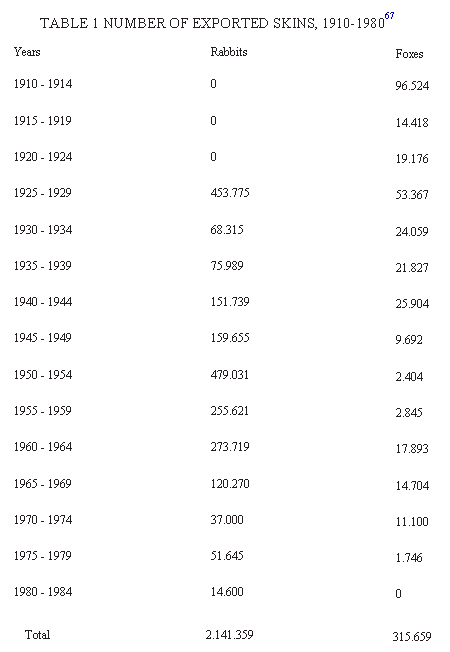
<body><![CDATA[<blockquote>        <p><font face="Verdana, Arial, Helvetica, sans-serif" size="2">"are really not      that bad, because this species ordinarily lives in isolated and wild places,      not frequented by small cattle, far away from human homes. These damages are      very inferior to the benefits the Patagonian Fox gives to man for the enormous      amount of hares and rabbits, both litter and adults, he destroys, preserving      the fields from havoc. Experience shows this is so: where inconsiderate people      have diminished or exterminated Patagonian foxes, there were so many rabbits      and hares that they rendered the sowing useless and put an end to the crops.      This happened in the basin of the Claro River, east of Molina, from 1928 to      1930. Mountain dwellers killed the Patagonian foxes because they coveted the      commercial value of the furs, and as a result of this aberration rabbits multiplied      in such a way that they invaded the mountainsides and gullies of the mountain      range and overtook the central valley, becoming an uncontrollable fatal plague"<a href="#n64"><sup>64</sup></a><a name="t64"></a>.      </font></p> </blockquote>     <p><font face="Verdana, Arial, Helvetica, sans-serif" size="2">Never Bonino and    Reinaldo Gader point out that rabbits were first seen in Argentina between 1945    and 1950, in the province of Neuquén, specifically in the town of Andacollo.    The authors state that these rabbits "came almost certainly from Chile, since    on the same latitude at the Chilean side there were populations of this species,    and in that area there are many passages across the mountain range of an altitude    that is no impediment for the advance of rabbits"<a href="#n65"><sup>65</sup></a>.<a name="t65"></a>    For his part, John Keever Greer observed mammals in the province of Malleco    between 1960 and 1962 and estimated that the rabbit was located "all along the    province of Malleco, except in the high parts of the Andes"<a href="#n66"><sup>66</sup></a><a name="t66"></a>.    </font></p>     <p><font face="Verdana, Arial, Helvetica, sans-serif" size="2">On the other hand,    statistics on rabbit and fox skins exported by Chile show us that the number    of fox furs sent abroad effectively decreased, which is proof of a smaller hunting,    a result of the restrictions imposed by the hunting law of 1929. However, the    number of exported rabbit skins increased notably, at least until the 1960s,    with a maximum of 479.031 skins exported from 1950­ to 1954. In this sense,    the numbers indicate that there would be no direct correlation between the increment    in the fox population and the reduction in the rabbit population, because despite    the decrease in the fox skins export, the export of rabbit skins increased.    According to the antecedents available towards 1960, this would respond to two    factors indicated in this work. On one hand, the mentioned boosting of rabbit    breeding<b> </b>for that period, and on the other the expansion of the presence    of the wild rabbit in central Chile. </font></p>     <p><font face="Verdana, Arial, Helvetica, sans-serif" size="2">Surprising about    this story is that, approximately thirty years later Jaksic and Yáñez calculated    for the first time the impact of rabbits in the diet of Chilean foxes, with    an analysis of droppings and stomachs of carnivores and regurgitations of birds    of prey, and they concluded that rabbits constituted a minority fraction of    the preys hunted by the most common predators in the country. As an explanation    of this phenomenon, they stated that Chilean predators were not efficient in    the hunting of rabbits, because they had not developed the "adaptations of conduct    needed to hunt a recently introduced species, as is the rabbit. In any case,    whatever the explanation, it is apparent that predators had no important role    in the abundance of rabbits in Chile"<a href="#n68"><sup>68</sup></a><a name="t68"></a>.    With this, they annihilated many years of public policies in the matter and    posed a new challenge: how to control the rabbit plague? What to do to avoid    damages to agriculture? </font></p>     <p><font face="Verdana, Arial, Helvetica, sans-serif" size="2">From another point    of view, we can only state that despite this fallacious and repeated analogical    reasoning, that gave the same role Spanish foxes had in controlling the rabbit    population of Spain to the intrinsic capacity of Chilean foxes to control the    plague of that species - which was exotic to this country &#150; the national fox    species were possibly protected by State institutions. This at least allowed    diminishing the extinction process they were in before the law of fishing and    hunting of 1929. In fact, as we can see from the demands of the hunters of the    central valley, with this law there was a series of restrictions to the export    of fox skins, which diminished considerable as can be seen in <a href="#tab1">Table    1</a>. So, the myth that Chilean foxes were voracious rabbit eaters was built    based on suppositions and not on a scientific platform with quantified data    about the effective diet of these predators. In any case, fortunately this supposition    and myth allowed a fiercer application of a group of laws that regulated the    hunting of foxes and other species in the country and that tried to prevent    or hinder the export of their skins because of the supposed ecological role    they fulfilled.  </font></p>     <p><a name="t67"></a><a name="tab1"></a></p>     <p>&nbsp;</p>     <p align="center"><img src="/img/revistas/s_rh/v4nse/tab01.gif" usemap="#Map2Map" border="0">    <map name="Map2Map">      <area shape="rect" coords="383,5,399,23" href="#n67">   </map> </p>     <p>&nbsp;</p>     ]]></body>
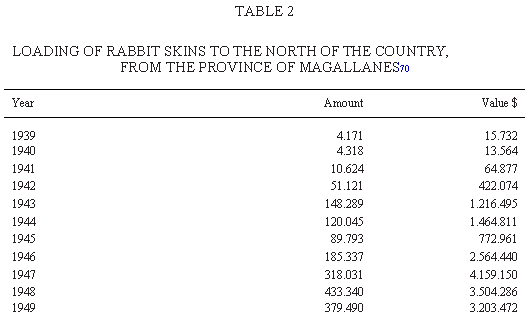
<body><![CDATA[<p><font face="Verdana, Arial, Helvetica, sans-serif" size="3"><b>RABBITS IN TIERRA    DEL FUEGO </b></font></p>     <p><font face="Verdana, Arial, Helvetica, sans-serif" size="2">Another rabbit    plague known in Chile occurred in the region of Magallanes, in Tierra del Fuego.    Pedro Arentsen points out that the first rabbits were freed towards 1874 on    Isla Grande of Tierra del Fuego by protestant missionaries that settled on the    Argentinean part of the island, in front of the Beagle canal. Supposedly, these    first specimens had multiplied freely in a completely wild life, but after a    little while they were decimated by a very harsh winter, with strong frosts    and snowfall. In 1913, rabbits were again liberated in the Chilean sector of    Baquedano and a little later in the proximities of Porvenir, but due to the    harsh winters none of these attempts prospered, luckily for the local livestock    of the time. The plague of 1950 came from two pairs of rabbits of European origin    freed in the surroundings of Porvenir around 1936, or perhaps two or three years    before.  These rabbits had "multiplied swiftly and no special importance was    given to this, since both farmers and workers saw the increment of their population    as a new source of wealth for the province"<a href="#n69"><sup>69</sup></a><a name="t69"></a>.    </font></p>     <p><font face="Verdana, Arial, Helvetica, sans-serif" size="2">As can be seen    on <a href="#tab2">Table 2</a>, together with the rabbit plague in the fields    of Tierra del Fuego, the commerce of this species grew from 1942 onwards, producing    generous earning, especially for those involved in the commerce of skins. However,    Arentsen pointed out</font></p>     <p><a name="tab2"></a><a name="t70"></a></p>     <p>&nbsp;</p>     <p align="center"><img src="/img/revistas/s_rh/v4nse/tab02.gif" usemap="#Map" border="0">    <map name="Map">      <area shape="rect" coords="399,64,413,74" href="#n70">   </map></p>     <p>&nbsp;</p>     <blockquote>        <p><font face="Verdana, Arial, Helvetica, sans-serif" size="2"> "much has been      said and written about the convenience of taking measures aiming to project      the free multiplication of rabbits arguing the benefits this rodent contributes      to a country's economy, both for its meat as for the skins that are a source      of work, for hunters and the development of industries these areas exploit      &#91;...&#93; These apparent benefits for a country are indisputably relative in comparison      with the enormous damages rabbits cause"<a href="#n71"><sup>71</sup></a><a name="t71"></a>.      </font></p> </blockquote>     <p><font face="Verdana, Arial, Helvetica, sans-serif" size="2">Since the beginning    of 1947, the rabbit plague in the province started to seriously worry the directive    of the Union of Small Farmers of Magallanes. They adressed the Ministry of Agriculture    for the first time "presenting the seriousness of this plague and the immediate    threat it already is for the livestock of Magallanes"<a href="#n72"><sup>72</sup></a><a name="t72"></a>.    H. B. de Bruyne was one of the first private persons who warned farmers and    the authorities of the real economic scope of this terrible plague, when he    commented in <i>La Prensa Austral</i> of June 19<sup>th</sup> 1948 an article    called "A warning to Chile" written by Jorge Mulgrue published in the magazine    <i>Imperial Review.</i></font></p>     ]]></body>
<body><![CDATA[<p><font face="Verdana, Arial, Helvetica, sans-serif" size="2">In this article    Mulgrue stated that: </font></p>     <blockquote>        <p><font face="Verdana, Arial, Helvetica, sans-serif" size="2">"the rabbit does      not only consume the superficial vegetation used for grazing, but he also      eats the heart of the plant, so it dies, turning green fields into wastelands.      Besides, the rabbit does not eat any plant; it feeds only on the best grasses      of each region, leaving weeds that end up extirpating the usable grass rabbits      didn't eat. On the other hand, rabbit droppings poison and kill the pasturelands,      and transform the devastated lands in dry soil that, lacking trees to evaporate      humidity, can give way to disastrous droughts. The lack of vegetation caused      by these rodents and the inevitable drought that comes with it lead to the      erosion of the territory, so that in a short time the lands full of rabbits      become patches of loose sand. It is necessary to seriously draw attention      on what this can signify in a region of strong winds, like Chilean Patagonia.      The food needed for one sheep is only enough for 16 rabbits. If we consider      that a pair of rabbits, with a normal number of kindling &#150; at least four per      year &#150; become millions after one year, we will  see that the danger of not      having enough grasslands for sheep can become a sad reality in a relatively      short time"<a href="#n73"><sup>73</sup></a><a name="t73"></a>. </font></p> </blockquote>     <p><font face="Verdana, Arial, Helvetica, sans-serif" size="2">For his part, Manuel    Chaparro, president of the Union of Small Stockbreeders of Magallanes, stated    that if "this malady continues, the pasture capacity of Tierra del Fuego will    be over in five or ten years up to the roots, giving way to the erosion of the    soil that will make a great dessert of the whole province"<a href="#n74"><sup>74</sup></a><a name="t74"></a>.    Likewise, he pointed out that Carlos Strauss, of renowned experience in zoological    matters, had expressed that "the rabbit plague originates in an imbalance produced    in nature by the uncontrolled hunting of fine furred animals &#91;…&#93; he said we    have to move towards a protection of our fauna as a way to avoid the disappearance    of the species that feed on rabbits and prevent a disproportionate increment    of the species"<a href="#n75"><sup>75</sup></a><a name="t75"></a>. Following    the same lead, another author pointed out that</font></p>     <blockquote>        <p><font face="Verdana, Arial, Helvetica, sans-serif" size="2">"since many years      and because of the relentless, uncontrolled hunting and the free trade of      skins, feathers, furs of foxes, Andes skunks, lesser Grisons, Andean mountain      cats and Pampas cats, eagles, red-backed hawk, etc, these species have disappeared      and others have multiplied excessively. This is the case of rabbits who have      an astonishing reproduction, and consequently this leads to an imbalance in      nature, causing the rabbit plague that is cutting down all the fields destined      to the breeding of sheep"<a href="#n76"><sup>76</sup></a><a name="t76"></a>.      </font></p> </blockquote>     <p><font face="Verdana, Arial, Helvetica, sans-serif" size="2">With these arguments,    the Union of Small Stockbreeders of Magallanes agreed to "negotiate with official    organisms the enactment of a decree to consider the close season of Andean skunks,    grey foxes, wild cats, Andean mountain cats and Pampas cats, species that have    run out in the province and that could contribute to the extermination of rabbits"<a href="#n77"><sup>77</sup></a><a name="t77"></a>.    </font></p>     <p><font face="Verdana, Arial, Helvetica, sans-serif" size="2">In Santiago, through    the official letter Nº 255, of May 24<sup>th</sup> 1950, the Ministry of Agriculture,    through the National Commission of Protection of Wildlife, requested the Ministry    of Economy to attend "a suggestion of the Local Committee of Magallanes to enact    a decree to prohibit, for a period not shorter than five years, the hunting    and commerce of skins, hairs and feathers of various animal species that are    enemies of the rabbit"<a href="#n78"><sup>78</sup></a><a name="t78"></a>. The    minister of Economy referred the letter to the Department of Fishing and Hunting.    On June 6<sup>th</sup> 1950, Exequiel Rodríguez, the director of that department,    requested the minister of Public Works a decree to prohibit the hunting of all    the species that were enemies of rabbits, aiming to "combat the plague of those    animals, that are causing such serious damage to the livestock in the regions    of Magallanes and Aysén due to the biological imbalance caused by the uncontrolled    persecution, especially of foxes and Andean mountain cats". At the same time,    to combat the rabbit plague he recommended to use their frozen meat in the cold    stores of that area, sending it to the central zone, which would considerably    increase the hunting of that species. He also entrusted the representative of    the Stockbreeders Association of Magallanes to acquire foxes to free in Tierra    del Fuego in the area between Concepción and Puerto Montt with the funds for    that campaign<a href="#n79"><sup>79</sup></a><a name="t79"></a>. </font></p>     <p><font face="Verdana, Arial, Helvetica, sans-serif" size="2">Accepting the request    of the Union of Small Stockbreeders of Magallanes and the technical report of    the Department of Fishing and Hunting on June 23rd 1950, the minister of Economy    considered the rabbit plague had caused important damages to the livestock of    that area and that the hunting and extermination of some enemy species of the    rabbit caused the increment in the number of them. Consequently, he agreed to    prohibit for five years "the hunting and commerce of skins, hairs and feathers    or eggs of the following species considered as enemies of the fox, in the provinces    of Aysén and Magallanes: eagle, red-backed hawk, Rhea, Common Kestrel, Patagonian    fox, Andean skunk, Andean mountain cat, kodkod, guanaco, lesser Grison, Harris's    hawk"<a href="#n80"><sup>80</sup></a><a name="t80"></a>. Likewise, on August    7<sup>th</sup> 1952, the Ministry of Agriculture dictated Supreme Decree Nº    811 that declared the rabbit a plague for agriculture in Magallanes, forced    to combat, and on August 24th the Decreto Supremo N º 1.379, that established    the use of wire medals as an effective means<a href="#n81"><sup>81</sup></a><a name="t81"></a>.    </font></p>     <p><font face="Verdana, Arial, Helvetica, sans-serif" size="2">In December 1953    the biological combat of the rabbit began with the use of the virus of a disease    that had proven to be specific of rabbits: myxomatosis. A campaign was planned    to inject the virus in 100.000 rabbits towards 1954. Then all the isolated focus    that might remain would be exterminated with all kinds of elements, like fats,    poisons, gasses, dogs, predators, fire guns, etc.<a href="#n82"><sup>82</sup></a><a name="t82"></a>.    To this end, in 1954 the Department of Stockbreeding and Animal Health of  Magallanes,    under the direction of the veterinary Elías Sabat, began an energetic campaign    against the rabbit plague. Vaccination brigades of the virus myxomatosis, radio    programs dedicated to the disastrous plague and the support of Carlos Aracena,    director of the newspaper <i>La Prensa Austral</i><a href="#n83"><sup>83</sup></a><a name="t83"></a>.    In any case, Sabat expressed his apprehensions and doubts about the process,    warning that the myxomatosis:</font></p>     ]]></body>
<body><![CDATA[<blockquote>        <p><font face="Verdana, Arial, Helvetica, sans-serif" size="2">"was not an infallible      panacea since there were studies by bacteriologists and immunologists that      proved that the animals could develop a pretty notable resistance to the virus      and once we come to that state of things we must recur to all possible means      like dogs, fire arms, poisons, etc and establish the natural equilibrium of      the island with the predators that attack rabbits and the acts of men to obtain      an effective control of the plague. In current circumstances it seems imperatively      necessary to place screens to defend the eradicated fields and continue the      fight in smaller areas, making the infestation and mortality of rabbits more      effective"<a href="#n84"><sup>84</sup></a><a name="t84"></a>. </font></p> </blockquote>     <p><font face="Verdana, Arial, Helvetica, sans-serif" size="2">Arentsen thought    the same. He had been able to </font></p>     <blockquote>        <p><font face="Verdana, Arial, Helvetica, sans-serif" size="2">"observe while      covering the fields of the farm "Sarita" of the stockbreeding society Gente      Grande where epizootia had practically swept away numerous rodents in a few      months, that many specimens kept on quietly living in the area of the disease,      surrounded by animals that were sick or had died of myxomatosis. These observations      make one think that the rabbits of Tierra del Fuego are already starting an      immunization process"<a href="#n85"><sup>85</sup></a><a name="t85"></a>.</font></p> </blockquote>     <p><font face="Verdana, Arial, Helvetica, sans-serif" size="2">In April 1954,    there was a public forum in the region to analyze the situation of the rabbit    plague that threatened to "put an end in the short term to the fertile fields    on the Isla Grande of Tierra del Fuego"<a href="#n86"><sup>86</sup></a><a name="t86"></a>.    Concerning this, Otway Falkiner, sheep breeder of Australia, vigorously pointed    out: "I would advise to all who sees rabbits in his fields or neighborhood to    chase them strenuously and to destroy them with no mercy"<a href="#n87"><sup>87</sup></a><a name="t87"></a>.</font></p>     <p><font face="Verdana, Arial, Helvetica, sans-serif" size="2">On the other hand,    Marco Davisón, director of the Union of Small Stockbreeders of Magallanes, remembered    that the rabbit had arrived some years ago and it was only owing to "the adventurous    spirit and  liking to exotic sports" of one man, that </font></p>     <blockquote>        <p><font face="Verdana, Arial, Helvetica, sans-serif" size="2"> "looking for      the distraction of easy and abundant hunting, it occurred to him to bring      some pairs of rabbits to this region, freeing them in the fields. Now we find      ourselves in front of the scary fact that they can be estimated in millions,      that is to say, 10 rabbits for each sheep. Next year there will already be      20 rabbits for each sheep and from then on between 20 and 40, so if we don't      immediately take charge of the matter we can predict that Tierra del Fuego      will soon look like a billiards ball"<a href="#n88"><sup>88</sup></a><a name="t88"></a>.      </font></p> </blockquote>     <p><font face="Verdana, Arial, Helvetica, sans-serif" size="2">The situation was    considered to be extremely serious by the stockbreeders of Tierra del Fuego.    Rabbits had affected the fields, that showed "clear signs of erosion, in some    cases, and though this erosion is just beginning, they will be definitively    eroded if things go on in this manner" On the other hand, the rabbit had also    affected the sheep population, since</font></p>     ]]></body>
<body><![CDATA[<blockquote>        <p><font face="Verdana, Arial, Helvetica, sans-serif" size="2"> "in the biological      struggle between sheep and rabbits, the latter always wins, because he has      a large list of advantages, like his great proliferation, rusticity, health      and even vivacity. In this manner he has affected the sheep population, decreasing      their number, production, zootechnical quality in 20, 30, 40 and more percent,      according to the case".</font></p> </blockquote>     <p><font face="Verdana, Arial, Helvetica, sans-serif" size="2">Besides, it had    affected cattle farming, decreasing all farm work: shearing, branding, herding,    freezing, embarking, etc. He concluded that "the damage caused by the rabbit    plague is hard to establish and what is worse: it is difficult to repair. In    1935 there were no rabbits on the island, in less than 20 years things have    reached such extremes, that cattle farming is about to disappear "<a href="#n89"><sup>89</sup></a><a name="t89"></a>.    Among the factors that favored the development of the plague were the hunting    habits. The rabbit furs with commercial value were those of winter, so between    May and September many were interested in hunting rabbits; their skins moved    large amounts of money. From October onwards and during the summer, their skins    ceased to have the commercial value they had during winter and therefore no    one was interested in hunting them, so the plague grew fast<a href="#n90"><sup>90</sup></a><a name="t90"></a>.    The situation was more desperate each time, because all measures were ineffective.    Between 1953 and 1954 the wool production of the region had diminished to 1.898.593    kilos, the slaughtering of animals from one season to another had diminished    to 112.003 animals and the decrease in kilos of meat was 1.947.776 kilos of    frozen meat<a href="#n91"><sup>91</sup></a><a name="t91"></a>. </font></p>     <p><font face="Verdana, Arial, Helvetica, sans-serif" size="2">However, from 1955    onwards, the rabbit plague abated in Magallanes and from then on ceased to be    a problem for local stockbreeders. With the passing of time and from a scientific    viewpoint, Jaksic and Yáñez state that the introduction of the myxomatosis virus    was the most effective agent in the biological control of rabbits in Tierra    del Fuego<a href="#n92"><sup>92</sup></a><a name="t92"></a>. However, there    is a dissident opinion by Ojeda, González and Araya, who estimated that the    myxomatosis did not achieve eradication, as rabbits developed a genetic resistance    and recovered their population density and became a plague again<a href="#n93"><sup>93</sup></a><a name="t93"></a>.    All in all, according to Jaksic's personal observations, this is not so, and    that is why myxomatosis persists as the most effective means of rabbit control    in Tierra del Fuego. </font></p>     <p>&nbsp;</p>     <p><font face="Verdana, Arial, Helvetica, sans-serif" size="3"><b>RABBITS IN JUAN    FERNÁNDEZ </b></font></p>     <p><font face="Verdana, Arial, Helvetica, sans-serif" size="2">The 9.290 hectares    of the archipelago of Juan Fernández were declared national parks in 1935, under    the administrative protection of the Corporación Nacional Forestal (National    Forest Corporation, CONAF). In 1977, the archipelago was declared World Biosphere    Reserve by UNESCO, acknowledging in this manner this valuable ecosystem that    is characterized by the high degree of endemic qualities of its vegetable species.    Through it is protected and under the administration of CONAF, Francisco Sáiz    and Patricio Ojeda point out that the island of Robinson Crusoe "has received    the most implausible introductions of species, many of which have become serious    plagues and have profoundly transformed the environment of the island, like    domestic livestock, blueberries, maqui berry<b>, </b>trun, thrush, goat, coatis,    rabbits, etc."<a href="#n94"><sup>94</sup></a><a name="t94"></a>. Among these    invasions in the island, Sáiz and Ojeda emphasized rabbits, which helped significantly    in the deteriorating actions of the livestock, as well as other factors like    the construction of roads, felling of trees and the introduction of other animal    and vegetable species.</font></p>     <p><font face="Verdana, Arial, Helvetica, sans-serif" size="2">The available data    indicate that the European rabbit (<i>Oryctolagus cu­niculus</i>), was introduced    in the island of Robinson Crusoe in the decade between 1930 and 1940, more exactly    in 1935<a href="#n95"><sup>95</sup></a><a name="t95"></a> or 1936<a href="#n96"><sup>96</sup></a><a name="t96"></a>,    with the aim to breed this species in captivity and use it as a dietary supplement    for the local population. </font></p>     <p><font face="Verdana, Arial, Helvetica, sans-serif" size="2">However, some specimens    escaped and their distribution expanded through the islands of Robinson Crusoe    and Santa Clara<a href="#n97"><sup>97</sup></a><a name="t97"></a>. Towards 1970    the situation did not seem serious yet. At least it seemed that way from the    observations made in the beginning of 1970 by Daniel Torres and Anelio Aguayo    who stated that: </font></p>     <blockquote>        ]]></body>
<body><![CDATA[<p><font face="Verdana, Arial, Helvetica, sans-serif" size="2"> "this <i>lagomorpha</i>      devastates the vegetation that covers the grounds of some places of Robin­son      Crusoe, like "Puerto Inglés", "Puerto Francés", "Villagra" and "Plazoleta      del Yunque". In Alejandro Selkirk the islanders assure they have seen some      of them some years ago. We are trying to ascertain the possible presence of      these animals covering the larger part of the island, and have found none      of them. On the other hand, we confirmed the presence of domestic cats in      wild state, so we consider it difficult to find rabbits now. However, Mann      assures to have seen some specimens close to the "Quebrada de las Casas";      these were animals recently introduced by the islanders to use for hunting.      Currently there is a large rabbit population in the island of Santa Clara      that is controlled naturally by the "nuco" (Asio flammeus suinda)"<a href="#n98"><sup>98</sup></a><a name="t98"></a>.      </font></p> </blockquote>     <p><font face="Verdana, Arial, Helvetica, sans-serif" size="2">However, five years    later, in 1975, Guillermo Mann's perception was radically different when the    stated that the rabbit: </font></p>     <blockquote>        <p><font face="Verdana, Arial, Helvetica, sans-serif" size="2">"is currently      represented by many thousands of specimens in the island of Robinson Crusoe.      Because of its continuum growth, it represents one of the most serious problems      for the biological equilibrium of this island, because it largely contributes      to the continuum decrease of the herbal stratum and the consequent increment      of erosion. Besides, it contributes to the extermination of diverse native      vegetable species and even endemic ones. The intense hunting of the islanders      does not seem to cause a significant decrease of their population"<a href="#n99"><sup>99</sup></a><a name="t99"></a>.</font></p> </blockquote>     <p><font face="Verdana, Arial, Helvetica, sans-serif" size="2">In turn, in 1976,    the <i>Plan of Management National Park Juan Fernández </i>indicated that the    rabbit "is forming large populations that contribute significantly to the detriment    of the vegetation cover on the islands of  Robinson Crusoe and  Santa Clara    and in a smaller amount on Alejandro Selkirk"<a href="#n100"><sup>100</sup></a><a name="t100"></a>.    In any case, at the end of the 1970s, the situation was each time more unsustainable.    In 1981, Guillermo Mann pointed out that </font></p>     <blockquote>        <p><font face="Verdana, Arial, Helvetica, sans-serif" size="2">"in the islands      of Santa Clara and Robinson Crusoe, their population is very large, approximately      7.000 specimens on average and fluctuates greatly from year to year, and represents      important plagues when it reaches their maximum population number. In the      competition with livestock over the vegetation cover and because of the construction      of tunnels that constantly collapse under the feet of livestock, they facilitate      the erosion of the soil; their destructive action is boosted"<a href="#n101"><sup>101</sup></a><a name="t101"></a>.</font></p> </blockquote>     <p><font face="Verdana, Arial, Helvetica, sans-serif" size="2">Progressively,    rabbits started to compete for food with the sheep on the island of Santa Clara,    so the islanders requested the intervention of the authorities to solve the    problem. In this framework, the National Forest Corporation (CONAF) summoned    the scientific community to do a study to evaluate the scope of the problem    and propose an integral plan for its control<a href="#n102"><sup>102</sup></a><a name="t102"></a>.    As a result of this study, during 1982 CONAF received the document "Proposal    of a method for integrated control of rabbits in the archipelago of Juan Fernández"    written by an interdisciplinary team of the Universidad Católica de Valpa­raíso.    The proposal was partially implemented during the period 1983-1985 through a    program of permanent hunting with traps and lasso's. For this the project included    the hiring of an experienced hunter who became a valuable element, capacitating    various generations of hunters, who remained on the island until his death in    2002. </font></p>     <p><font face="Verdana, Arial, Helvetica, sans-serif" size="2">Evaluations towards    the end of the 1980s showed a clear recovery of the herbal stratum in areas    where the rabbits had diminished and a permanence or decrease in those areas    where rabbits had increased in number. While in global terms one could not affirm    that there was a decrease in density of rabbits, it was possible to state that    there was an important decrease in size and weight. The larger specimens, who    have a bigger reproduction rate, disappeared. Consequently, the rabbit population    has in fact been hit by the hunting it has been subject to", which, according    to Sáiz and Ojeda, attested the effectiveness of hunting as a means to control    the rabbit population, with no need to introduce myxomatosis, "if the method    is applied in a rigorous and intense manner on the whole island for a proper    lapse of time"<a href="#n103"><sup>103</sup></a><a name="t103"></a>. </font></p>     <p><font face="Verdana, Arial, Helvetica, sans-serif" size="2">However, one decade    later, in December 1997, a project financed by the Kingdom of the Netherlands    was approved that included the control of the rabbit plague, among other things.    This is how, from 1998 onwards, the Program of Rabbit Control was initiated    in the islands Robinson Crusoe and Santa Clara. A little later, in 2002, an    integrated system of rabbit control was put into practice to eradicate this    animal from the island of Santa Clara that considered all those methods of control    used in the world, with legally and ecologically accepted characteristics<a href="#n104"><sup>104</sup></a><a name="t104"></a>.    In that period CONAF paid the hunters of Juan Fernández 500 pesos for every    rabbit tail brought to their offices, as the rabbit plague severely damaged    the native species of the islands, destroying saplings and tender sprouts<a href="#n105"><sup>105</sup></a><a name="t105"></a>.</font></p>     ]]></body>
<body><![CDATA[<p><font face="Verdana, Arial, Helvetica, sans-serif" size="2">In 2005, CONAF    looked for financiering of the Global Environment Facility of the United Nations    to do the investigation for 1,6 million dollars, to establish stocks to conserve    the native endangered flora and fauna of the island and eradicate the animals    the threatened local biodiversity. As explained by the director of CONAF of    the fifth region, Mario Gálvez, the first part of the initiative consisted in    doing an evaluation of the state of conservation of the terrestrial and marine    species and ecosystems of the archipelago. On the other hand, the idea was to    propose a model to eradicate these species, capturing them at a higher rate    than their ability to reproduce <a href="#n106"><sup>106</sup></a><a name="t106"></a>.    In October 2005, Aarón Caviedes and Guillermo Araya pointed out the importance    of this Project, because the archipelago housed a high percentage of endemic    species that made the place one of the richest in biodiversity of the planet.    One of the main preoccupations was the presence of the rabbit, which had even    reached the highest parts of the islands, that is to say the parts that were    best conserved. In that sense the forest ranger of the CONAF Guillermo Araya    pointed out that "in places that are hard to reach like El Yunque, droppings    have been found, an indicator of their presence"<a href="#n107"><sup>107</sup></a>.<a name="t107"></a>    </font></p>     <p><font face="Verdana, Arial, Helvetica, sans-serif" size="2">After more than    seventy years since their introduction, rabbits still devastate the archipelago    and cause serious damage to the ecosystems of the islands, with their various    ranges of endemic species. Evidently, hunting has proven to be insufficient    as a means to control the rabbits in the islands of Juan Fer­nández. </font></p>     <p>&nbsp;</p>     <p><font face="Verdana, Arial, Helvetica, sans-serif" size="3"><b>RABBITS IN FOREST    PLANTATIONS </b></font></p>     <p><font face="Verdana, Arial, Helvetica, sans-serif" size="2">In 1968, an investigation    by experts of the Universidad de Chile on the basis of an inquest to associations    and clubs of the Fishing and Hunting Federation stated that rabbits had extended    from Coquimbo to the south, except in the provinces of Osorno, Chiloé and Aysén.    The authors warned that this expansion had grave characteristics because of    the high rate of births and high biotic potential of the species. The invaded    areas had to endure a large overpopulation of rabbits, with grave consequences    for livestock farming and agriculture. The phenomenon of the rabbit plague in    Chile had been particularly notorious in the provinces of Magallanes and Malleco,    even causing an increment of erosion<a href="#n108"><sup>108</sup></a><a name="t108"></a>.</font></p>     <p><font face="Verdana, Arial, Helvetica, sans-serif" size="2">In this context,    the forest industry was also complicated by the presence of rabbits. Specifically    by the alimentary habits of this species, that is in the habit of eating the    tip of growth of pines, which hampers the vertical development of the tree and    produces a stocky growth, because of the sideward sprouting of leaf buds. Rabbits    could damage up to 100% of plantations, and replanting, besides the cost of    new investments, meant a loss in State bonus and a year delay in the final exploitation    of the affected stand<a href="#n109"><sup>109</sup></a><a name="t109"></a>.    In this sense, Jaksic and Fuentes pointed out that "rabbits are fearsome in    forest plantations, and their negative effect on pine plantations are more than    known"<a href="#n110"><sup>110</sup></a><a name="t110"></a>.</font></p>     <p><font face="Verdana, Arial, Helvetica, sans-serif" size="2">In 1974, CONAF    published the bulletin "The wild rabbit in Chile" that stated that the </font></p>     <blockquote>        <p><font face="Verdana, Arial, Helvetica, sans-serif" size="2">"enormous damage      caused by the wild rabbit in reforestation has been one of the main causes      to dedicate resources and efforts by the National Forest Corporation to study      and apply advanced techniques of rational control of this animal &#91;...&#93; after      fifty or more years the wild rabbit is occupying practically all environments      where in one way or another he has been able y to come and acclimatize, except      some regions in the high Andes, north area of the province of Magallanes and      province of Aysén"<a href="#n111"><sup>111</sup></a><a name="t111"></a>. </font></p> </blockquote>     <p><font face="Verdana, Arial, Helvetica, sans-serif" size="2">According to the    antecedents they had, they pointed out that the wild rabbit had the most presence    between the provinces of Los Andes, to the north, and Malleco to the south,    and supposed that "the north limit is the valley of Limarí. It is not known    if this is an ecological or merely physical border". </font></p>     ]]></body>
<body><![CDATA[<p><font face="Verdana, Arial, Helvetica, sans-serif" size="2">According to the    authors of the study, the most adequate method of eradication in continental    Chile consisted in the application of sodium<i> mo­nofluoracetato 1.080</i>,    "despite its high danger for men and domestic animals"<a href="#n112"><sup>112</sup></a><a name="t112"></a>.    </font></p>     <p><font face="Verdana, Arial, Helvetica, sans-serif" size="2">Given this, in    February 1977 <i>El Celarauco</i> magazine of the company Celulosa Arauco pointed    out that "one of the most implacable enemies is the feared wild rabbit, capable    of destroying up to 100% of a Monterey Pine plantation". Further on it stated    that "it is estimated that the stable population exceeds five millions and that    in some periods of the year surpasses 30 million specimens &#91;...&#93; in the affected    areas there can be between 4 to 15 rabbits per hectare"<a href="#n113"><sup>113</sup></a><a name="t113"></a>.</font></p>     <p><font face="Verdana, Arial, Helvetica, sans-serif" size="2">To control the    rabbits, compound 1.080 was used; a powerful toxin that could exterminate 90%    of the rabbits but that, at the same time could kill a man at a low concentration.    The massive treatment against rabbits was initiated by CONAF at the beginning    of the 1960s. In 1975 this service passed "to private companies founded that    same year. Currently there are two of them: TECFA Ltda. (society of the technical    management of fauna) and EXCO (rabbit exploitation). In the last season they    treated thirty thousand hectare"<a href="#n114"><sup>114</sup></a><a name="t114"></a>.     </font></p>     <p><font face="Verdana, Arial, Helvetica, sans-serif" size="2">The resolution    of November 25<sup>th</sup> 1982 of the <i>Servicio Agrícola Ganadero</i> (Agricultural    Stockbreeding Service) had to consider these risks.  It prohibited the import,    manufacturing and use of <i>Sodium monofluoracetato 1.080, </i>considering it    a "pesticide of high toxicity to man" and that remained "in the bodies of the    animals that have ingested it without diminishing toxicity so that it can cause    poisoning both of people and useful animals. This situation is very serious    because there are no antidotes for the treatment of those that are poisoned"<a href="#n115"><sup>115</sup></a><a name="t115"></a>.    Cruz and Rivera, of the <i>Grupo de Investigaciones Agrarias</i> (Group of Agrarian    Investigations) agreed with this diagnosis. They pointed out that "the pesticides    of high toxicity that were used to eliminate wild rabbits also affect farmers,    their domestic animals and game"<a href="#n116"><sup>116</sup></a><a name="t116"></a>.    For Aarón Caviedes and Antonio Lara using poisons to kill rabbits was another    of the negative impacts of forest plantations, because it led to the death of    birds and wild mammals. There was also an ecological impact, because the poisons    caused a serious decrease of the fauna, especially of carnivores that regulate    the herbivore populations, which caused "an alteration of the natural equilibrium    that facilitates the increment of rabbits"<a href="#n117"><sup>117</sup></a><a name="t117"></a>.</font></p>     <p><font face="Verdana, Arial, Helvetica, sans-serif" size="2">Despite the warnings    of the environmental impact of the use of this poison, Jaime Rodríguez, professor    of Ecology and Wild Fauna of the Universidad de Chile, specified that years    after the resolution of the Agricultural Stockbreeding Service, compound 1.080    was still being used, since "because of the lack of substitute products in the    market, this resolution was extended for a year. This has happened every year    until now (1988)"<a href="#n118"><sup>118</sup></a><a name="t118"></a>. As an    alternative of rabbit control, Rodríguez rejected introducing the <i>myxoma    </i>virus<i>,</i> because of the risk of infection to farm rabbits and also    the methods of capture and depredation because they had been inefficient in    Chile.  </font></p>     <p><font face="Verdana, Arial, Helvetica, sans-serif" size="2">As for the chemical    methods, he pointed out that diverse control tests of <i>Lagomorpha</i><b> </b>in    forest plantations, with second generation anticoagulants had given very good    results, even better than sodium monofluoracetato 1.080. According to his tests,    he recommended using blocks with kerosene and brodifacoum, also known as klerat,    as they were well accepted among rabbits and hares and were efficient in damage    control and of small risk, both for men and beneficial animals, as there was    an antidote and it is only lethal in high doses<a href="#n119"><sup>119</sup></a><a name="t119"></a>.    </font></p>     <p><font face="Verdana, Arial, Helvetica, sans-serif" size="2">In 2002, Ovalle,    Ojeda and Skewes pointed out that Tagasaste<b> </b>(<i>Chamaecyti­sus proliferus    palmensis</i>) was introduced in Chile in 1988 by the Instituto de Investigaciones    Agropecuarias (INIA, Institute of Agricultural Investigations) as part of a    project to search and select shrubs and fodder trees that contribute to the    betterment of stockbreeding production in dry areas. However, "one of the most    important limitations in the establishment of tagasaste is the damage caused    by rabbits and hares in the period between plantation and the first year of    the plant's life"<a href="#n120"><sup>120</sup></a><a name="t120"></a>. This    shows us that in the 21st century rabbits are still a plague in central Chile,    and a problem for forestry and men, and the difficulties to control their excessive    population growth persist. </font></p>     <p>&nbsp;</p>     <p><font face="Verdana, Arial, Helvetica, sans-serif" size="3"><b>CONCLUSIONS    </b></font></p>     <p><font face="Verdana, Arial, Helvetica, sans-serif" size="2">The European rabbit    was introduced in Chile on an uncertain date. The first references about the    existence of rabbits in the country are from the mid 18<sup>th</sup> century    and were registered by father Molina to describe to Europeans some Chilean species    like guinea pigs and viscachas. In the 19<sup>th</sup> century, several authors    refer to the existence of rabbits and rabbit hutches in central Chile. Some    recommend the breeding of this animal for its economic benefits, while others    warn about the dangers the adjustment of this species could mean to agriculture.    It is not possible to ascertain if it was intentional or casual that rabbits    became wild. Did they escape from the rabbit farms or were they intentionally    liberated to the fields to hunt them and obtain meat and skins? The written    sources have left no signs about these questions. </font></p>     ]]></body>
<body><![CDATA[<p><font face="Verdana, Arial, Helvetica, sans-serif" size="2">Truth is, at the    beginning of the 20<sup>th</sup> century, many observers began to warn about    the dangers of the "rabbit in the wild". It is possible to suppose that many    rabbit hutches were not built under strict security norms, and that this was    especially noticeable in the second half of the 1920s. </font></p>     <p><font face="Verdana, Arial, Helvetica, sans-serif" size="2">Since then, the    presence of the rabbit as a plague is described, sometimes dramatically, in    central Chile, Tierra el Fuego and the archipelago</font></p>     <p><font face="Verdana, Arial, Helvetica, sans-serif" size="2">Juan Fernández.    Given this situation, the State responded formulating public policies that have    tried to stop the rabbit plague. In the 1930s, the hunting of foxes was banned,    which permitted the protection of that species and dismantling of the national    furrier industry. However, it was discovered decades later that Chilean foxes    only fed sporadically on rabbits, since they are better adapted to depredate    other native animals. This shows us that this policy was based on mistaken suppositions    and could not have had results. Later on, the forestry industry had to recur    to a powerful and dangerous poison that has no antidote in case of human poisoning.    So the difficulties to control this invading species in central Chile persist.    </font></p>     <p><font face="Verdana, Arial, Helvetica, sans-serif" size="2">Currently there    is evidence that the problem of the "rabbit in the wild" has not been definitely    resolved in central Chile. In the case of Tierra del Fuego, after a widespread    alarm that included the arrival of hunters, traps, poisons and depredators,    the State successfully implemented the introduction of the <i>myxoma </i>virus<i>,</i>    at the time widely acknowledged worldwide for its efficiency to control the    excessive growth of the rabbit population. On the archipelago of Juan Fernández,    after years of international financing and national efforts, rabbits remain    a species difficult to control.</font></p>     <p>&nbsp;</p>     <p>&nbsp;</p>     <p><font face="Verdana, Arial, Helvetica, sans-serif" size="2">Fecha de recepción:    octubre 2007    <br>   Fecha de aceptación: abril 2008</font></p>     <p>&nbsp;</p>     <p>&nbsp;</p>     ]]></body>
<body><![CDATA[<p><font face="Verdana, Arial, Helvetica, sans-serif" size="2"><a name="n1"></a><a href="#t1"><sup>1</sup></a>    We thank Rodrigo Torres for the recompiling of antecedents for this work.    <!-- ref --><br>   <a name="n2"></a><a href="#t2"><sup>2</sup></a> Peter M. Vitousek, Carla M.    D'Antonio, Lloyd L. Loope y Randy Westbrooks, "Biological invasions as global    environmental change", in <i>American Scientist</i>, Vol. 84, Nº 5, Washington,    1996.    <!-- ref --><br>   <a name="n3"></a><a href="#t3"><sup>3</sup></a> Richard N. Mack, Daniel Simberloff,    Mark Lonsdale, Harry Evans, Michael Clout and Fakhri A. Bazzaz, "Biotic invasions:    causes, epidemiology, global consequences, and control", en <i>Ecological Applications</i>,    Vol. 10, Nº 3, Washington, 2000.    <!-- ref --><br>   <a name="n4"></a><a href="#t4"><sup>4</sup></a> D. Pimentel, L. Lach, R. Zuniga    and D. Morrison, <i>Environmental and economic costs associated with non-indigenous    species in the United States</i>, Ithaca, NY, College of Agriculture and Life    Scien­ces, Cornell University, 1999.    <!-- ref --><br>   <a name="n5"></a><a href="#t5"><sup>5</sup></a> J.A. McNeely, <i>The great reshuffling:    how alien species help feed the global economy</i>, Gland, Suiza, IUCN, 2001.    <!-- ref --><br>   <a name="n6"></a><a href="#t6"><sup>6</sup></a> Sergio A. Castro, Javier A.    Figueroa, Mélica Muñoz-Schick and F.M. Jaksic, "Minimum residen­ce time, biogeographical    origin, and life cycle as determinants of the geographical extent of naturali­zed    plants in continental Chile", in <i>Diversity &amp; Distributions</i>, Vol.    11, Nº 3, Stellenbosch, South Africa, 2005.    <!-- ref --><br>   <a name="n7"></a><a href="#t7"><sup>7</sup></a> Fabián M. Jaksic, "Vertebrate    invaders and their ecological impacts in Chile", in <i>Biodiversity &amp; Conservation</i>,    Vol. 7, Nº 11, Springer, Netherlands, 1998.     <!-- ref --><br>   <a name="n8"></a><a href="#t8"><sup>8</sup></a> Fabián M. Jaksic and Eduardo    Fuentes, "El conejo español: ¿un convidado de piedra?", in E. Fuentes y S. Prenafeta    (eds.), <i>Ecología del paisaje en Chile central: estudios sobre sus espacios    montañosos</i>, Santiago, Ediciones Universidad Católica, 1988.     <!-- ref --><br>   <a name="n9"></a><a href="#t9"><sup>9</sup></a> Christophe Biju-Duval, Hajer    Ennafaa, Nicole Dennebouy, Monique Monnerot, Françoise Mignotte, Ramon C. Soriguer,    Amel El Gaaïed, Ali El Hili y Jean-Claude Mounolou, "Mitochondrial DNA evolution    in lagomorphs: origin of systematic heteroplasmy and organization of diversity    in European rabbits", en <i>Journal of Molecular Evolution</i>, Vol. 33, Nº    1, New York, 1991.     <!-- ref --><br>   <a name="n10"></a><a href="#t10"><sup>10</sup></a> J. Voigt, <i>La destrucción    de equilibrio biológico</i>, Madrid, Alianza, 1987, 146-150.     <!-- ref --><br>   <a name="n11"></a><a href="#t11"><sup>11</sup></a> H. Thompson y C. King (eds),    <i>The European Rabitt. The history and biology of a sucessful colonizer</i>,    Oxford, Oxford Science Publications, 2004.     <!-- ref --><br>   <a name="n12"></a><a href="#t12"><sup>12</sup></a> Juan Ignacio Molina, <i>Compendio    de la historia civil del Reyno de Chile</i>, Madrid, Imprenta de Sancha, 1788-1795,    tomo I, LXXXVIII, 348.     <!-- ref --><br>   <a name="n13"></a><a href="#t13"><sup>13</sup></a> Juan Ignacio Molina, <i>Ensayo    sobre la historia natural de Chile, </i>Santiago, Ediciones Maule, 1987, 288.        <br>   <a name="n14"4></a><a href="#t14"><sup>14</sup></a> Molina, <i>Compendio...</i>,    <i>op. cit.</i>, tomo I, LXXXVIII, 289.     <!-- ref --><br>   <a name="n15"></a><a href="#t15"><sup>15</sup></a> Claudio Gay, <i>Agricultura    Chilena</i>, Santiago, ICIRA, 1973, 477.     <!-- ref --><br>   <a name="n16"></a><a href="#t16"><sup>16</sup></a> Claudio Gay, <i>Historia    física y política de Chile</i>.<i> Zoología</i>, tomo I, Santiago, Museo de    Histo­ria Natural de Santiago, 1847, 126.     <!-- ref --><br>   <a name="n17"></a><a href="#t17"><sup>17</sup></a> Nathan Miers, "Invasión de    los conejos", in <i>Boletín de la Sociedad Nacional de Agricultura</i>, Vol.    XXI, Nº 22, Santiago, May 28<sup>th</sup> 1900, 453 y 454.     <!-- ref --><br>   <a name="n18"></a><a href="#t18"><sup>18</sup></a> "Cría del conejo", in <i>Boletín    de la Sociedad Nacional de Agricultura</i>, Vol. I, Nº 1, Santiago, 1870, 168.        <!-- ref --><br>   <a name="n19"></a><a href="#t19"><sup>19</sup></a> Santos Tornero, <i>De la    cría y propagación de animales domésticos</i>, Valparaíso, Librería del Mercurio,    1875, 175.     <br>   <a name="n20"></a><a href="#t20"><sup>20</sup></a> <i>Idem</i>.     ]]></body>
<body><![CDATA[<!-- ref --><br>   <a name="n21"></a><a href="#t21"><sup>21</sup></a> "Cría del conejo", in <i>Boletín    de la Sociedad Nacional de Agricultura</i>, Vol. VI, Nº 13, Santiago, 1875,    346.     <!-- ref --><br>   <a name="n22"></a><a href="#t22"><sup>22</sup></a> Rodulfo Philippi, "Sobre    los animales introducidos en Chile desde su conquista por los espa­ñoles", in    <i>Anales de la Universidad de Chile</i>, LXVIII, Santiago, junio de 1885, 323    and 324.     <!-- ref --><br>   <a name="n23"></a><a href="#t23"><sup>23</sup></a> René Le Feuvre, <i>Lecciones    teórico-prácticas de Agricultura y Zootecnia: dadas a los alumnos de la Escuela    Normal de Preceptores</i>, Valparaíso, Imprenta Excelsior, 1885, 345.     <!-- ref --><br>   <a name="n24"></a><a href="#t24"><sup>24</sup></a> <i>Memoria del Ministerio    de Industria y Obras Públicas</i>, Santiago, 1900, 18.     <!-- ref --><br>   <a name="n25"></a><a href="#t25"><sup>25</sup></a> <i>Boletín de la Sociedad    Nacional de Agricultura</i>, Vol. XXIV, Nº 15, Santiago, August 5 1893, 445.        <br>   <a name="n26"></a><a href="#t26"><sup>26</sup></a> Miers, "Invasión de los conejos",    <i>op. cit.</i>, 453-454.     <br>   <a name="n27"></a><a href="#t27"><sup>27</sup></a> <i>Idem</i>.     <!-- ref --><br>   <a name="n28"></a><a href="#t28"><sup>28</sup></a> Luis Castillo, "El conejo    en libertad", in <i>Boletín de bosques, pesca y caza</i>, Vol. I, Nº 4, Santiago,    October 1912, 253.     <br>   <a name="n29"></a><a href="#t29"><sup>29</sup></a> <i>Ibid.</i>, 261.     <!-- ref --><br>   <a name="n30"></a><a href="#t30"><sup>30</sup></a> Luis Castillo, "Migraciones    observadas en la fauna y flora de Chile", in <i>Boletín de bosques, pesca y    caza</i>, Vol. II, Nº 4, Santiago, October 1913, 251.     <!-- ref --><br>   <a name="n31"></a><a href="#t31"><sup>31</sup></a> "Cartilla práctica sobre    las enfermedades de árboles y cultivos, causadas por insectos y anima­les. Remedios",    in <i>Boletín de la Sociedad Nacional de Agricultura</i>, Vol. XLV, Nº 9, Santiago,    September 15<sup>th</sup> 1914, 528.     <!-- ref --><br>   <a name="n32"></a><a href="#t32"><sup>32</sup></a> Carlos Echeverría,<i> Conejos    y conejeras</i>. <i>Lecciones prácticas sobre los medios de manejar esta industria</i>,    1921, 2-4.     <!-- ref --><br>   <a name="n33"></a><a href="#t33"><sup>33</sup></a> "La cría del conejo", in    <i>Boletín de la Sociedad Nacional de Agricultura</i>, Vol. LX, Nº 3, Santiago,    March 1928, 172.     <!-- ref --><br>   <a name="n34"></a><a href="#t34"><sup>34</sup></a> "Consejos para la producción    de piel", in <i>Boletín de la Sociedad Nacional de Agricultura</i>, Vol. LX,    Nº 6, Santiago, June 1928, 381 and 382.     <!-- ref --><br>   <a name="n35"></a><a href="#t35"><sup>35</sup></a> "Medida indispensable que    el Gobierno debe adoptar a favor de la industria peletera nacio­nal", in <i>Boletín    de la Sociedad Nacional de Agricultura</i>, Vol. LX, Nº 6, Santiago, June 1928,    385.     <!-- ref --><br>   <a name="n36"></a><a href="#t36"><sup>36</sup></a> "Cunicultura. La explotación    del conejo de Angora", <i>Boletín de la Sociedad Nacional de Agricultura</i>,    Vol. LX, Nº 7, Santiago, July 1928, 457.     <br>   <a name="n37"></a><a href="#t37"><sup>37</sup></a> <i>Idem</i>.     <!-- ref --><br>   <a name="n38"></a><a href="#t38"><sup>38</sup></a> "La cría de conejos y su    reproducción", in <i>Revista de Ganadería y Agricultura Veterinaria</i>, Año    V, Nº 53, Santiago, 1930, 692.     <!-- ref --><br>   <a name="n39"></a><a href="#t39"><sup>39</sup></a> C. Camacho, "El conejo Silvestre",    en <i>Boletín del Departamento de Agricultura</i>, Año I, Nº 10/ 12, Santiago,    October/December 1929, 3.     <!-- ref --><br>   <a name="n40"></a><a href="#t40"><sup>40</sup></a> Chile. Congreso Nacional,    Cámara de Diputados, <i>Diario de Sesiones. Publicación Oficial de la Cámara    de Diputados</i>, 41ª sesión ordinaria September 10th  1928, 1.246.     <!-- ref --><br>   <a name="n41"></a><a href="#t41"><sup>41</sup></a> Chile. Congreso Nacional.    Senado, <i>Sesiones de la Cámara de Senadores</i>, February 7 1929, 2.748.     <!-- ref --><br>   <a name="n42"></a><a href="#t42"><sup>42</sup></a> "Animales dañinos. Procedimientos    para exterminar la plaga de los conejos", in Boletín de la Sociedad Nacional    de Agricultura, Vol. LXII, Nº 4, Santiago, April 1930, 198.     <br>   <a name="n43"></a><a href="#t43"><sup>43</sup></a> <i>Ibid.</i>, 202.     <!-- ref --><br>   <a name="n44"></a><a href="#t44"><sup>44</sup></a> AN.FMF, Vol. 653. Expediente    Decreto Nº 1.253, June 30 1932.     <br>   <a name="n45"></a><a href="#t45"><sup>45</sup></a> <i>Ibid., </i>Vol. 654. Decreto    Nº 1.205, July 21th 1932.     <br>   <a name="n46"></a><a href="#t46"><sup>46</sup></a> <i>Ibid., </i>Vol. 653. Expediente    Decreto Nº 1.253, July 30 1932.     <br>   <a name="n47"></a><a href="#t47"><sup>47</sup></a> <i>Ibid., </i>Vol. 654. Decreto    Nº 1.205, July 21 1932.     <br>   <a name="n48"></a><a href="#t48"><sup>48</sup></a> <i>Ibid., </i>Vol. 653. Expediente    Decreto Nº 1.253, July 30 1932.     <!-- ref --><br>   <a name="n49"></a><a href="#t49"><sup>49</sup></a> Carlos Reed, <i>Aprovechemos    la carne y la piel del conejo silvestre y con esto contribuiremos al bienestar    nacional</i>, Santiago, Imprenta y Litografía La Ilustración, 1934, 3<i>. </i>    <br>   <a name="n50"></a><a href="#t50"><sup>50</sup></a> <i>Ibid</i>., 36.     ]]></body>
<body><![CDATA[<br>   <a name="n51"></a><a href="#t51"><sup>51</sup></a> AN.FMF, Vol 885. Expediente    Decreto Ley Nº 2.436 of August 11th 1934.     <br>   <a name="n52"></a><a href="#t52"><sup>52</sup></a> <i>Idem. </i>    <br>   <a name="n53"></a><a href="#t53"><sup>53</sup></a><i>Idem.    <br>   </i><sup><a name="n54"></a><a href="#t54">54</a></sup><i>Idem.    <br>   </i><a name="n55"></a><a href="#t55"><sup>55</sup></a> <i>Idem</i>.    <br>   <a name="n56"></a><a href="#t56"><sup>56</sup></a> <i>Idem</i>.    <br>   <a name="n57"></a><a href="#t57"><sup>57</sup></a> <i>Ibid., </i>Vol. 1968.    Decreto Ley 1.745, August 21 1934.    <br>   <a name="n58"></a><a href="#t58"><sup>58</sup></a> <i>Ibid.,</i> Vol. 15. Expediente    Decreto Ley Nº 618, August 16 1943.    <br>   <a name="n59"></a><a href="#t59"><sup>59</sup></a> <i>Idem.</i>     <br>   <a name="n61"></a><a href="#t60"><sup>60</sup></a> <i>Idem.    ]]></body>
<body><![CDATA[<!-- ref --><br>   </i><sup><a name="n60"></a><a href="#t61">61</a></sup> Carlos Schneider, "Catálogo    de los mamíferos de la provincia de Concepción", in <i>Boletín de la Sociedad    de Biología de Concepción</i>, tomo XXI, Concepción, 1946, 76.     <!-- ref --><br>   <a name="n62"></a><a href="#t62"><sup>62</sup></a> AN.FMF, Vol. 1976. "Repoblación    de las islas australes".     <!-- ref --><br>   <a name="n63"></a><a href="#t63"><sup>63</sup></a> "Detengamos el exterminio    de nuestras especies", in <i>Pesca y Caza</i>, Año II, Nº 2, Santiago, March    1943, 28.     <!-- ref --><br>   <a name="n64"></a><a href="#t64"><sup>64</sup></a> Rafael Housse, <i>Animales    Salvajes de Chile en su clasificación moderna</i>, Santiago, Universi­dad de    Chile. 1953, 150-153.     <!-- ref --><br>   <a name="n65"></a><a href="#t65"><sup>65</sup></a> Never Bonino y Reinaldo Gader,    "Expansión del conejo silvestre europeo (<i>Oryctolagus cuni­culus L.</i>) en    la República Argentina y perspectivas futuras", en <i>Anales del Museo de Historia    Natural de Valparaíso</i>, Nº 18, Valparaíso, 1987, 157.     <!-- ref --><br>   <a name="n66"></a><a href="#t66"><sup>66</sup></a> John Keever Greer, <i>Mamíferos    de la provincia de Malleco</i>, Angol, Museo Dillman S. Bullock, 68 y 69.     <!-- ref --><br>   <a name="n67"></a><a href="#t67"><sup>67</sup></a> José A. Iriarte y Fabián    M. Jaksic, "The fur trade in Chile: an overview of seventy years of export data    (1910-1984)", in <i>Biological Conservation</i>, Vol. 38, Barking, 1986, 247.        <!-- ref --><br>   <a name="n68"></a><a href="#t68"><sup>68</sup></a> Fabián M. Jaksic y José Yáñez,    "¿Quién controla las poblaciones de conejos introducidos?", in <i>Medio Ambiente</i>,    Nº 4, Valdivia, 1980, 43.     <!-- ref --><br>   <a name="n69"></a><a href="#t69"><sup>69</sup></a> Pedro Arentsen, "Control    Biológico del Conejo", in <i>Boletín Ganadero</i>, Nº 43, Punta Arenas, 1954,    4.     <!-- ref --><br>   <a name="n70"></a><a href="#t70"><sup>70</sup></a> "Exterminación total de la    plaga de conejos", in <i>Boletín Ganadero</i>, Año I, Nº 8, Punta Arenas, September    1950, 3.     <br>   <a name="n71"></a><a href="#t71"><sup>71</sup></a> Arentsen, <i>op. cit</i>.,    8.     <!-- ref --><br>   <a name="n72"></a><a href="#t72"><sup>72</sup></a> Daniel Claro, "Instituciones    ganaderas aúnan sus esfuerzos para extirpar la plaga de conejos en la región",    in <i>Boletín Ganadero</i>, Año I, Nº 3, Punta Arenas, January 1950, 24.     <!-- ref --><br>   <a name="n73"></a><a href="#t73"><sup>73</sup></a> Jorge Mulgrue, "Una advertencia    a Chile", in <i>La Prensa Austral</i>, Punta Arenas, June 19 1948.     <!-- ref --><br>   <a name="n74"></a><a href="#t74"><sup>74</sup></a> "Plaga de Conejos invade    Tierra del Fuego", en <i>Boletín Ganadero</i>, Año I, Nº 5, Punta Arenas, April    1950, 2.     <br>   <a name="n75"></a><a href="#t75"><sup>75</sup></a> <i>Idem</i>.     <!-- ref --><br>   <a name="n76"></a><a href="#t76"><sup>76</sup></a> "Campaña nacional contra    plaga de conejos", en <i>Boletín Ganadero</i>, Año I, Nº 7, Punta Are­nas, July    1950, 21.     <!-- ref --><br>   <a name="n77"></a><a href="#t77"><sup>77</sup></a> "Labor Directiva", en <i>Boletín    Ganadero</i>, Año I, Nº 6, Punta Arenas, May 1950, 23.    <!-- ref --><br>   <a name="n78"></a><a href="#t78"><sup>78</sup></a> AN.FMF, Vol. 280, Expediente    Law Decree Nº 757, July 13 1950.     <br>   <a name="n79"></a><a href="#t79"><sup>79</sup></a> <i>Idem.    <br>   </i><a name="n80"></a><a href="#t80"><sup>80</sup></a> <i>Ibid., </i>June 23    1950.    ]]></body>
<body><![CDATA[<br>   <a name="n81"></a><a href="#t81"><sup>81</sup></a> Arentsen, <i>op. cit.</i>,    6.    <br>   <a name="n82"></a><a href="#t82"><sup>82</sup></a> <i>Ibid</i>., 22.     <!-- ref --><br>   <a name="n83"></a><a href="#t83"><sup>83</sup></a> "Campaña enérgica contra    la plaga de conejos", in <i>Boletín Ganadero</i>, Año IV, Nº 44, Punta Arenas,    December 1954, 10.     <!-- ref --><br>   <a name="n84"></a><a href="#t84"><sup>84</sup></a> Elías Sabat, "La mixomatosis    no es una panacea infalible", in <i>Boletín Ganadero</i>, Nº 45, Punta Arenas,    1955, 23.     <br>   <a name="n85"></a><a href="#t85"><sup>85</sup></a> Arentsen, <i>op. cit., </i>14.        <!-- ref --><br>   <a name="n86"></a><a href="#t86"><sup>86</sup></a> "Foro público contra la plaga    del conejo", in <i>Boletín Ganadero</i>, Año IV, Nº 40, Punta Arenas, April    1954, 8.     <!-- ref --><br>   <a name="n87"></a><a href="#t87"><sup>87</sup></a> "Opiniones de Mr. Falkiner    y un llamado de atención sobre la plaga de conejos", in<i> Boletín Ganadero</i>,    Año IV, Nº 40, Punta Arenas, April 1954, 25.     <br>   <a name="n88"></a><a href="#t88"><sup>88</sup></a> <i>Ibid.</i>, 26.     <!-- ref --><br>   <a name="n89"></a><a href="#t89"><sup>89</sup></a> "Interesante exposición sobre    la plaga de conejos", in <i>Boletín Ganadero</i>, Año IV, Nº 41, Punta Arenas,    April 1954, 5.     <br>   <a name="n90"></a><a href="#t90"><sup>90</sup></a> <i>Idem</i>.     ]]></body>
<body><![CDATA[<br>   <a name="n91"></a><a href="#t91"><sup>91</sup></a> "Campaña enérgica contra    la plaga del conejo", <i>op. cit.</i>, 11.     <!-- ref --><br>   <a name="n92"></a><a href="#t92"><sup>92</sup></a> Fabián M. Jaksic and José    Yáñez, "Rabbit and fox introductios in Tierra del Fuego: History and assessement    of the attemps at biological control of the rabbit infestation", en <i>Biological    Conservation</i>, Vol. 26, Barking, 1983, 374.     <!-- ref --><br>   <a name="n93"></a><a href="#t93"><sup>93</sup></a> CONAF, "El conejo silvestre    en Chile", in <i>Boletín Técnico</i> Nº 8, Santiago, 1973.     <!-- ref --><br>   <a name="n94"></a><a href="#t94"><sup>94</sup></a> Francisco Sáiz y Patricio    Ojeda, "<i>Oryctolagus cuniculus L</i>. in Juan Fernández. Problema y control",    en <i>Anales del Museo de Historia Natural de Valparaíso</i>, Valparaíso, Vol.    19, 1988, 91.     <!-- ref --><br>   <a name="n95"></a><a href="#t95"><sup>95</sup></a> Walter Kahler, "La isla Juan    Fernández", in <i>En Viaje</i>, Nº 238, Santiago, 1953, 15.     <!-- ref --><br>   <a name="n96"></a><a href="#t96"><sup>96</sup></a> Maura Brescia, <i>Mares de    leyenda</i>, Santiago, s/l, 1979, 95.     <!-- ref --><br>   <a name="n97"></a><a href="#t97"><sup>97</sup></a> Patricio Ojeda, Hernán González    and Guillermo Araya, "Erradicación del conejo europeo (<i>Oryc­tolagus cuniculus    Linnaeus</i>, 1758) desde la Isla Santa Clara, Archipiélago de Juan Fernández",    <i>Infor­me Técnico</i> N°48, CONAF, December 2003.     <!-- ref --><br>   <a name="n98"></a><a href="#t98"><sup>98</sup></a> D. Torres and A. Aguayo,    "Algunas observaciones sobre la fauna del archipiélago de Juan Fernández", en    <i>Boletín de la Universidad de Chile</i>, Nº 112, Santiago, June 1971, 34.        <!-- ref --><br>   <a name="n99"></a><a href="#t99"><sup>99</sup></a> Guillermo Mann, "Observaciones    sobre el estado actual de algunos representantes de flora y fauna en el Parque    Nacional Juan Fernández", in <i>Boletín del Museo Nacional de Historia Natural</i>,    Nº 34, Santiago, 1975, 211.     <!-- ref --><br>   <a name="n100"></a><a href="#t100"><sup>100</sup></a> CONAF, <i>Plan de Manejo    Parque Nacional Juan Fernández</i>, CONAF, 1976.     <!-- ref --><br>   <a name="n101"></a><a href="#t101"><sup>101</sup></a> Guillermo Mann, "Análisis    del Plan de Manejo y situación actual del Parque Nacional Juan Fernández", Informe    CONAF, 1981, 34.     <br>   <a name="n102"></a><a href="#t102"><sup>102</sup></a> Sáiz y Ojeda, <i>op. cit.</i>,    91.     <br>   <a name="n103"></a><a href="#t103"><sup>103</sup></a> <i>Idem</i>.     <br>   <a name="n104"></a><a href="#t104"><sup>104</sup></a> Ojeda, González y Araya,    <i>op. cit</i>.     <!-- ref --><br>   <a name="n105"></a><a href="#t105"><sup>105</sup></a> E. Bellido, "Plagas devoran    Juan Fernández. Animales y vegetales exóticos amenazan equili­brio ecológico    del archipiélago"<i>, </i>en <i>La Nación</i>, Santiago, June 4 2004.     <!-- ref --><br>   <a name="n106"></a><a href="#t106"><sup>106</sup></a> "Controlarán especies    dañinas de archipiélago Juan Fernández", in <i>La Tercera</i>, Santiago, July    8 de 2005. En sección noticias de web CONAF.     <!-- ref --><br>   <a name="n107"></a><a href="#t107"><sup>107</sup></a> "Inician estudio para    salvar biodiversidad del archipiélago de Juan Fernández", in <i>La Nación</i>,    Santiago, October 23 2005.     <!-- ref --><br>   <a name="n108"></a><a href="#t108"><sup>108</sup></a> Jaime Péafur <i>et al.</i>,    "Estudio preliminar de mamíferos silvestres chilenos: su distribución, valor    económico e importancia zoonótica", in <i>Revista de la Sociedad de Medicina    Veterinaria de Chile</i>, Vol. 18, Santiago, January-December 1968, 6.     <!-- ref --><br>   <a name="n109"></a><a href="#t109"><sup>109</sup></a> Jaime Rodríguez, "Alternativas    de control de lagomorfos en plantaciones forestales", en <i>Cien­cia e Investigación    Forestal</i>, Nº 4, August 1988.     <br>   <a name="n110"></a><a href="#t110"><sup>110</sup></a> Jaksic y Fuentes, <i>op.    cit.</i>, 94.     ]]></body>
<body><![CDATA[<br>   <a name="n111"></a><a href="#t111"><sup>111</sup></a> CONAF, "El conejo silvestre    en Chile", <i>op. cit.</i>, 1.     <br>   <a name="n112"></a><a href="#t112"><sup>112</sup></a> <i>Ibid</i>., 3.     <!-- ref --><br>   <a name="n113"></a><a href="#t113"><sup>113</sup></a> "Se le acabó la suerte    al conejo: Se le acusa de destructor de plantas de pino", in <i>El Celarau­co</i>,    Año IV, Nº 29, Arauco, February 1977, 8.     <br>   <a name="n114"></a><a href="#t114"><sup>114</sup></a> <i>Idem</i>.     <!-- ref --><br>   <a name="n115"></a><a href="#t115"><sup>115</sup></a> Servicio Agrícola Ganadero,    "Prohíbe la importación, fabricación y uso del Monofluoracetato de Sodio 1.080",    Santiago, November 25 1982.     <!-- ref --><br>   <a name="n116"></a><a href="#t116"><sup>116</sup></a> María Elena Cruz and Rigoberto    Rivera, <i>Cambios ecológicos y de poblamiento en el sector forestal chileno</i>,    Santiago, GIA, 1983.     <!-- ref --><br>   <a name="n117"></a><a href="#t117"><sup>117</sup></a> Aarón Caviedes and Antonio    Lara, <i>La destrucción de bosque nativo para ser reemplazado por plantaciones    de pino insigne: evaluación y proposiciones</i>, Santiago, CODEFF, 1983.     <!-- ref --><br>   <a name="n118"></a><a href="#t118"><sup>118</sup></a> J. Rodríguez, "Alternativas    de control de lagomorfos en plantaciones forestales", en <i>Ciencia e Investigación    Forestal</i>, Nº 4, Santiago, August 1988.     <br>   <a name="n119"></a><a href="#t119"><sup>119</sup></a> <i>Idem</i>.     <!-- ref --><br>   <a name="n120"></a><a href="#t120"><sup>120</sup></a> C. Ovalle, F. Ojeda and    O. Skewes, "Evaluación de distintos métodos de prevención de daño causado por    lagomorfos en plantaciones de tagasaste (<i>Chamaecytisus proliferus ssp. palmensis</i>)",    en <i>Agricultura Técnica</i>, Vol. 62, Nº 3, Santiago, julio 2002, 396.</font> ]]></body><back>
<ref-list>
<ref id="B1">
<nlm-citation citation-type="journal">
<person-group person-group-type="author">
<name>
<surname><![CDATA[Vitousek]]></surname>
<given-names><![CDATA[Peter M.]]></given-names>
</name>
<name>
<surname><![CDATA[D'Antonio]]></surname>
<given-names><![CDATA[Carla M.]]></given-names>
</name>
<name>
<surname><![CDATA[Loope]]></surname>
<given-names><![CDATA[Lloyd L.]]></given-names>
</name>
<name>
<surname><![CDATA[Westbrooks]]></surname>
<given-names><![CDATA[Randy]]></given-names>
</name>
</person-group>
<article-title xml:lang="en"><![CDATA[Biological invasions as global environmental change]]></article-title>
<source><![CDATA[American Scientist]]></source>
<year>1996</year>
<volume>84</volume>
<numero>5</numero>
<issue>5</issue>
<publisher-loc><![CDATA[Washington ]]></publisher-loc>
</nlm-citation>
</ref>
<ref id="B2">
<nlm-citation citation-type="journal">
<person-group person-group-type="author">
<name>
<surname><![CDATA[Mack]]></surname>
<given-names><![CDATA[Richard N.]]></given-names>
</name>
<name>
<surname><![CDATA[Simberloff]]></surname>
<given-names><![CDATA[Daniel]]></given-names>
</name>
<name>
<surname><![CDATA[Lonsdale]]></surname>
<given-names><![CDATA[Mark]]></given-names>
</name>
<name>
<surname><![CDATA[Evans]]></surname>
<given-names><![CDATA[Harry]]></given-names>
</name>
<name>
<surname><![CDATA[Clout]]></surname>
<given-names><![CDATA[Michael]]></given-names>
</name>
<name>
<surname><![CDATA[Bazzaz]]></surname>
<given-names><![CDATA[Fakhri A.]]></given-names>
</name>
</person-group>
<article-title xml:lang="en"><![CDATA[Biotic invasions: causes, epidemiology, global consequences, and control]]></article-title>
<source><![CDATA[Ecological Applications]]></source>
<year>2000</year>
<volume>10</volume>
<numero>3</numero>
<issue>3</issue>
<publisher-loc><![CDATA[Washington ]]></publisher-loc>
</nlm-citation>
</ref>
<ref id="B3">
<nlm-citation citation-type="book">
<person-group person-group-type="author">
<name>
<surname><![CDATA[Pimentel]]></surname>
<given-names><![CDATA[D.]]></given-names>
</name>
<name>
<surname><![CDATA[Lach]]></surname>
<given-names><![CDATA[L.]]></given-names>
</name>
<name>
<surname><![CDATA[Zuniga]]></surname>
<given-names><![CDATA[R.]]></given-names>
</name>
<name>
<surname><![CDATA[Morrison]]></surname>
<given-names><![CDATA[D.]]></given-names>
</name>
</person-group>
<source><![CDATA[Environmental and economic costs associated with non-indigenous species in the United States]]></source>
<year>1999</year>
<publisher-loc><![CDATA[Ithaca^eNY NY]]></publisher-loc>
<publisher-name><![CDATA[College of Agriculture and Life Scien­ces, Cornell University]]></publisher-name>
</nlm-citation>
</ref>
<ref id="B4">
<nlm-citation citation-type="book">
<person-group person-group-type="author">
<name>
<surname><![CDATA[McNeely]]></surname>
<given-names><![CDATA[J.A.]]></given-names>
</name>
</person-group>
<source><![CDATA[The great reshuffling: how alien species help feed the global economy]]></source>
<year>2001</year>
<publisher-loc><![CDATA[Gland ]]></publisher-loc>
<publisher-name><![CDATA[IUCN]]></publisher-name>
</nlm-citation>
</ref>
<ref id="B5">
<nlm-citation citation-type="journal">
<person-group person-group-type="author">
<name>
<surname><![CDATA[Castro]]></surname>
<given-names><![CDATA[Sergio A.]]></given-names>
</name>
<name>
<surname><![CDATA[Figueroa]]></surname>
<given-names><![CDATA[Javier A.]]></given-names>
</name>
<name>
<surname><![CDATA[Muñoz-Schick]]></surname>
<given-names><![CDATA[Mélica]]></given-names>
</name>
<name>
<surname><![CDATA[Jaksic]]></surname>
<given-names><![CDATA[F.M.]]></given-names>
</name>
</person-group>
<article-title xml:lang="en"><![CDATA[Minimum residen­ce time, biogeographical origin, and life cycle as determinants of the geographical extent of naturali­zed plants in continental Chile]]></article-title>
<source><![CDATA[Diversity & Distributions]]></source>
<year>2005</year>
<volume>11</volume>
<numero>3</numero>
<issue>3</issue>
<publisher-loc><![CDATA[Stellenbosch ]]></publisher-loc>
</nlm-citation>
</ref>
<ref id="B6">
<nlm-citation citation-type="journal">
<person-group person-group-type="author">
<name>
<surname><![CDATA[Jaksic]]></surname>
<given-names><![CDATA[Fabián M.]]></given-names>
</name>
</person-group>
<article-title xml:lang="en"><![CDATA[Vertebrate invaders and their ecological impacts in Chile]]></article-title>
<source><![CDATA[Biodiversity & Conservation]]></source>
<year>1998</year>
<volume>7</volume>
<numero>11</numero>
<issue>11</issue>
<publisher-name><![CDATA[Springer]]></publisher-name>
</nlm-citation>
</ref>
<ref id="B7">
<nlm-citation citation-type="book">
<person-group person-group-type="author">
<name>
<surname><![CDATA[Jaksic]]></surname>
<given-names><![CDATA[Fabián M.]]></given-names>
</name>
<name>
<surname><![CDATA[Fuentes]]></surname>
<given-names><![CDATA[Eduardo]]></given-names>
</name>
</person-group>
<article-title xml:lang="es"><![CDATA[El conejo español: ¿un convidado de piedra?]]></article-title>
<person-group person-group-type="editor">
<name>
<surname><![CDATA[Fuentes]]></surname>
<given-names><![CDATA[E.]]></given-names>
</name>
<name>
<surname><![CDATA[Prenafeta]]></surname>
<given-names><![CDATA[S.]]></given-names>
</name>
</person-group>
<source><![CDATA[Ecología del paisaje en Chile central: estudios sobre sus espacios montañosos]]></source>
<year>1988</year>
<publisher-loc><![CDATA[Santiago ]]></publisher-loc>
<publisher-name><![CDATA[Ediciones Universidad Católica]]></publisher-name>
</nlm-citation>
</ref>
<ref id="B8">
<nlm-citation citation-type="journal">
<person-group person-group-type="author">
<name>
<surname><![CDATA[Biju-Duval]]></surname>
<given-names><![CDATA[Christophe]]></given-names>
</name>
<name>
<surname><![CDATA[Ennafaa]]></surname>
<given-names><![CDATA[Hajer]]></given-names>
</name>
<name>
<surname><![CDATA[Dennebouy]]></surname>
<given-names><![CDATA[Nicole]]></given-names>
</name>
<name>
<surname><![CDATA[Monnerot]]></surname>
<given-names><![CDATA[Monique]]></given-names>
</name>
<name>
<surname><![CDATA[Mignotte]]></surname>
<given-names><![CDATA[Françoise]]></given-names>
</name>
<name>
<surname><![CDATA[Soriguer]]></surname>
<given-names><![CDATA[Ramon C.]]></given-names>
</name>
<name>
<surname><![CDATA[El Gaaïed]]></surname>
<given-names><![CDATA[Amel]]></given-names>
</name>
<name>
<surname><![CDATA[El Hili]]></surname>
<given-names><![CDATA[Ali]]></given-names>
</name>
<name>
<surname><![CDATA[Mounolou]]></surname>
<given-names><![CDATA[Jean-Claude]]></given-names>
</name>
</person-group>
<article-title xml:lang="en"><![CDATA[Mitochondrial DNA evolution in lagomorphs: origin of systematic heteroplasmy and organization of diversity in European rabbits]]></article-title>
<source><![CDATA[Journal of Molecular Evolution]]></source>
<year>1991</year>
<volume>33</volume>
<numero>1</numero>
<issue>1</issue>
<publisher-loc><![CDATA[New York ]]></publisher-loc>
</nlm-citation>
</ref>
<ref id="B9">
<nlm-citation citation-type="book">
<person-group person-group-type="author">
<name>
<surname><![CDATA[Voigt]]></surname>
<given-names><![CDATA[J.]]></given-names>
</name>
</person-group>
<source><![CDATA[La destrucción de equilibrio biológico]]></source>
<year>1987</year>
<page-range>146-150</page-range><publisher-loc><![CDATA[Madrid ]]></publisher-loc>
<publisher-name><![CDATA[Alianza]]></publisher-name>
</nlm-citation>
</ref>
<ref id="B10">
<nlm-citation citation-type="book">
<person-group person-group-type="author">
<name>
<surname><![CDATA[Thompson]]></surname>
<given-names><![CDATA[H.]]></given-names>
</name>
<name>
<surname><![CDATA[King]]></surname>
<given-names><![CDATA[C.]]></given-names>
</name>
</person-group>
<source><![CDATA[The European Rabitt. The history and biology of a sucessful colonizer]]></source>
<year>2004</year>
<publisher-loc><![CDATA[Oxford ]]></publisher-loc>
<publisher-name><![CDATA[Oxford Science Publications]]></publisher-name>
</nlm-citation>
</ref>
<ref id="B11">
<nlm-citation citation-type="book">
<person-group person-group-type="author">
<name>
<surname><![CDATA[Molina]]></surname>
<given-names><![CDATA[Juan Ignacio]]></given-names>
</name>
</person-group>
<source><![CDATA[Compendio de la historia civil del Reyno de Chile]]></source>
<year>1788</year>
<month>-1</month>
<day>79</day>
<volume>I</volume>
<page-range>348</page-range><publisher-loc><![CDATA[Madrid ]]></publisher-loc>
<publisher-name><![CDATA[Imprenta de Sancha]]></publisher-name>
</nlm-citation>
</ref>
<ref id="B12">
<nlm-citation citation-type="book">
<person-group person-group-type="author">
<name>
<surname><![CDATA[Molina]]></surname>
<given-names><![CDATA[Juan Ignacio]]></given-names>
</name>
</person-group>
<source><![CDATA[Ensayo sobre la historia natural de Chile]]></source>
<year>1987</year>
<page-range>288</page-range><publisher-loc><![CDATA[Santiago ]]></publisher-loc>
<publisher-name><![CDATA[Ediciones Maule]]></publisher-name>
</nlm-citation>
</ref>
<ref id="B13">
<nlm-citation citation-type="book">
<person-group person-group-type="author">
<name>
<surname><![CDATA[Gay]]></surname>
<given-names><![CDATA[Claudio]]></given-names>
</name>
</person-group>
<source><![CDATA[Agricultura Chilena]]></source>
<year>1973</year>
<page-range>477</page-range><publisher-loc><![CDATA[Santiago ]]></publisher-loc>
<publisher-name><![CDATA[ICIRA]]></publisher-name>
</nlm-citation>
</ref>
<ref id="B14">
<nlm-citation citation-type="book">
<person-group person-group-type="author">
<name>
<surname><![CDATA[Gay]]></surname>
<given-names><![CDATA[Claudio]]></given-names>
</name>
</person-group>
<source><![CDATA[Historia física y política de Chile]]></source>
<year>1847</year>
<page-range>126</page-range><publisher-name><![CDATA[Museo de Histo­ria Natural de Santiago]]></publisher-name>
</nlm-citation>
</ref>
<ref id="B15">
<nlm-citation citation-type="journal">
<person-group person-group-type="author">
<name>
<surname><![CDATA[Miers]]></surname>
<given-names><![CDATA[Nathan]]></given-names>
</name>
</person-group>
<article-title xml:lang="es"><![CDATA[Invasión de los conejos]]></article-title>
<source><![CDATA[Boletín de la Sociedad Nacional de Agricultura]]></source>
<year>May </year>
<month>28</month>
<day>th</day>
<volume>XXI</volume>
<numero>22</numero>
<issue>22</issue>
<page-range>453 y 454</page-range><publisher-loc><![CDATA[Santiago ]]></publisher-loc>
</nlm-citation>
</ref>
<ref id="B16">
<nlm-citation citation-type="journal">
<article-title xml:lang="es"><![CDATA[Cría del conejo]]></article-title>
<source><![CDATA[Boletín de la Sociedad Nacional de Agricultura]]></source>
<year>1870</year>
<volume>I</volume>
<numero>1</numero>
<issue>1</issue>
<page-range>168</page-range><publisher-loc><![CDATA[Santiago ]]></publisher-loc>
</nlm-citation>
</ref>
<ref id="B17">
<nlm-citation citation-type="book">
<person-group person-group-type="author">
<name>
<surname><![CDATA[Tornero]]></surname>
<given-names><![CDATA[Santos]]></given-names>
</name>
</person-group>
<source><![CDATA[De la cría y propagación de animales domésticos]]></source>
<year>1875</year>
<page-range>175</page-range><publisher-loc><![CDATA[Valparaíso ]]></publisher-loc>
<publisher-name><![CDATA[Librería del Mercurio]]></publisher-name>
</nlm-citation>
</ref>
<ref id="B18">
<nlm-citation citation-type="journal">
<article-title xml:lang="es"><![CDATA[Cría del conejo]]></article-title>
<source><![CDATA[Boletín de la Sociedad Nacional de Agricultura]]></source>
<year>1875</year>
<volume>VI</volume>
<numero>13</numero>
<issue>13</issue>
<page-range>346</page-range><publisher-loc><![CDATA[Santiago ]]></publisher-loc>
</nlm-citation>
</ref>
<ref id="B19">
<nlm-citation citation-type="">
<person-group person-group-type="author">
<name>
<surname><![CDATA[Philippi]]></surname>
</name>
</person-group>
<article-title xml:lang="es"><![CDATA[Sobre los animales introducidos en Chile desde su conquista por los españoles]]></article-title>
<source><![CDATA[Anales de la Universidad de Chile]]></source>
<year>juni</year>
<month>o </month>
<day>de</day>
<volume>LXVIII</volume>
<page-range>323 and 324</page-range><publisher-loc><![CDATA[Santiago ]]></publisher-loc>
</nlm-citation>
</ref>
<ref id="B20">
<nlm-citation citation-type="book">
<person-group person-group-type="author">
<name>
<surname><![CDATA[Le Feuvre]]></surname>
<given-names><![CDATA[René]]></given-names>
</name>
</person-group>
<source><![CDATA[Lecciones teórico-prácticas de Agricultura y Zootecnia: dadas a los alumnos de la Escuela Normal de Preceptores]]></source>
<year>1885</year>
<page-range>345</page-range><publisher-loc><![CDATA[Valparaíso ]]></publisher-loc>
<publisher-name><![CDATA[Imprenta Excelsior]]></publisher-name>
</nlm-citation>
</ref>
<ref id="B21">
<nlm-citation citation-type="">
<source><![CDATA[Memoria del Ministerio de Industria y Obras Públicas]]></source>
<year>1900</year>
<page-range>18</page-range><publisher-loc><![CDATA[Santiago ]]></publisher-loc>
</nlm-citation>
</ref>
<ref id="B22">
<nlm-citation citation-type="journal">
<source><![CDATA[Boletín de la Sociedad Nacional de Agricultura]]></source>
<year>Augu</year>
<month>st</month>
<day> 5</day>
<volume>XXIV</volume>
<numero>15</numero>
<issue>15</issue>
<publisher-loc><![CDATA[Santiago ]]></publisher-loc>
</nlm-citation>
</ref>
<ref id="B23">
<nlm-citation citation-type="journal">
<person-group person-group-type="author">
<name>
<surname><![CDATA[Castillo]]></surname>
<given-names><![CDATA[Luis]]></given-names>
</name>
</person-group>
<article-title xml:lang="es"><![CDATA[El conejo en libertad]]></article-title>
<source><![CDATA[Boletín de bosques, pesca y caza]]></source>
<year>Octo</year>
<month>be</month>
<day>r </day>
<volume>I</volume>
<numero>4</numero>
<issue>4</issue>
<page-range>253</page-range><publisher-loc><![CDATA[Santiago ]]></publisher-loc>
</nlm-citation>
</ref>
<ref id="B24">
<nlm-citation citation-type="journal">
<person-group person-group-type="author">
<name>
<surname><![CDATA[Castillo]]></surname>
<given-names><![CDATA[Luis]]></given-names>
</name>
</person-group>
<article-title xml:lang="es"><![CDATA[Migraciones observadas en la fauna y flora de Chile]]></article-title>
<source><![CDATA[Boletín de bosques, pesca y caza]]></source>
<year>Octo</year>
<month>be</month>
<day>r </day>
<volume>II</volume>
<numero>4</numero>
<issue>4</issue>
<page-range>251</page-range><publisher-loc><![CDATA[Santiago ]]></publisher-loc>
</nlm-citation>
</ref>
<ref id="B25">
<nlm-citation citation-type="journal">
<article-title xml:lang="es"><![CDATA[Cartilla práctica sobre las enfermedades de árboles y cultivos, causadas por insectos y anima­les. Remedios]]></article-title>
<source><![CDATA[Boletín de la Sociedad Nacional de Agricultura]]></source>
<year>Sept</year>
<month>em</month>
<day>be</day>
<volume>XLV</volume>
<numero>9</numero>
<issue>9</issue>
<publisher-loc><![CDATA[Santiago ]]></publisher-loc>
</nlm-citation>
</ref>
<ref id="B26">
<nlm-citation citation-type="">
<person-group person-group-type="author">
<name>
<surname><![CDATA[Echeverría]]></surname>
<given-names><![CDATA[Carlos]]></given-names>
</name>
</person-group>
<source><![CDATA[Conejos y conejeras: Lecciones prácticas sobre los medios de manejar esta industria]]></source>
<year>1921</year>
<page-range>2-4</page-range></nlm-citation>
</ref>
<ref id="B27">
<nlm-citation citation-type="journal">
<article-title xml:lang="es"><![CDATA[La cría del conejo]]></article-title>
<source><![CDATA[Boletín de la Sociedad Nacional de Agricultura]]></source>
<year>Marc</year>
<month>h </month>
<day>19</day>
<volume>LX</volume>
<numero>3</numero>
<issue>3</issue>
<page-range>172</page-range><publisher-loc><![CDATA[Santiago ]]></publisher-loc>
</nlm-citation>
</ref>
<ref id="B28">
<nlm-citation citation-type="journal">
<article-title xml:lang="es"><![CDATA[Consejos para la producción de piel]]></article-title>
<source><![CDATA[Boletín de la Sociedad Nacional de Agricultura]]></source>
<year>June</year>
<month> 1</month>
<day>92</day>
<volume>LX</volume>
<numero>6</numero>
<issue>6</issue>
<page-range>381 and 382</page-range><publisher-loc><![CDATA[Santiago ]]></publisher-loc>
</nlm-citation>
</ref>
<ref id="B29">
<nlm-citation citation-type="journal">
<article-title xml:lang="es"><![CDATA[Medida indispensable que el Gobierno debe adoptar a favor de la industria peletera nacio­nal]]></article-title>
<source><![CDATA[Boletín de la Sociedad Nacional de Agricultura]]></source>
<year>June</year>
<month> 1</month>
<day>92</day>
<volume>LX</volume>
<numero>6</numero>
<issue>6</issue>
<page-range>385</page-range><publisher-loc><![CDATA[Santiago ]]></publisher-loc>
</nlm-citation>
</ref>
<ref id="B30">
<nlm-citation citation-type="journal">
<article-title xml:lang="es"><![CDATA[Cunicultura. La explotación del conejo de Angora]]></article-title>
<source><![CDATA[Boletín de la Sociedad Nacional de Agricultura]]></source>
<year>July</year>
<month> 1</month>
<day>92</day>
<volume>LX</volume>
<numero>7</numero>
<issue>7</issue>
<page-range>457</page-range><publisher-loc><![CDATA[Santiago ]]></publisher-loc>
</nlm-citation>
</ref>
<ref id="B31">
<nlm-citation citation-type="journal">
<article-title xml:lang="es"><![CDATA[La cría de conejos y su reproducción]]></article-title>
<source><![CDATA[Revista de Ganadería y Agricultura Veterinaria]]></source>
<year>1930</year>
<volume>V</volume>
<numero>53</numero>
<issue>53</issue>
<page-range>692</page-range><publisher-loc><![CDATA[Santiago ]]></publisher-loc>
</nlm-citation>
</ref>
<ref id="B32">
<nlm-citation citation-type="journal">
<person-group person-group-type="author">
<name>
<surname><![CDATA[Camacho]]></surname>
<given-names><![CDATA[C.]]></given-names>
</name>
</person-group>
<article-title xml:lang="es"><![CDATA[El conejo Silvestre]]></article-title>
<source><![CDATA[Boletín del Departamento de Agricultura]]></source>
<year>Octo</year>
<month>be</month>
<day>r/</day>
<volume>I</volume>
<numero>10/ 12</numero>
<issue>10/ 12</issue>
<page-range>3</page-range><publisher-loc><![CDATA[Santiago ]]></publisher-loc>
</nlm-citation>
</ref>
<ref id="B33">
<nlm-citation citation-type="journal">
<collab>Chile^dCongreso Nacional, Cámara de Diputados</collab>
<source><![CDATA[Diario de Sesiones. Publicación Oficial de la Cámara de Diputados]]></source>
<year>Sept</year>
<month>em</month>
<day>be</day>
<page-range>1.246</page-range></nlm-citation>
</ref>
<ref id="B34">
<nlm-citation citation-type="">
<collab>Chile^dCongreso Nacional. Senado</collab>
<source><![CDATA[Sesiones de la Cámara de Senadores]]></source>
<year>Febr</year>
<month>ua</month>
<day>ry</day>
<page-range>2.748</page-range></nlm-citation>
</ref>
<ref id="B35">
<nlm-citation citation-type="journal">
<article-title xml:lang="es"><![CDATA[Animales dañinos: Procedimientos para exterminar la plaga de los conejos]]></article-title>
<source><![CDATA[Boletín de la Sociedad Nacional de Agricultura]]></source>
<year>Apri</year>
<month>l </month>
<day>19</day>
<volume>LXII</volume>
<numero>4</numero>
<issue>4</issue>
<page-range>198</page-range><publisher-loc><![CDATA[Santiago ]]></publisher-loc>
</nlm-citation>
</ref>
<ref id="B36">
<nlm-citation citation-type="">
<source><![CDATA[Expediente Decreto Nº 1.253]]></source>
<year>June</year>
<month> 3</month>
<day>0 </day>
</nlm-citation>
</ref>
<ref id="B37">
<nlm-citation citation-type="book">
<person-group person-group-type="author">
<name>
<surname><![CDATA[Reed]]></surname>
<given-names><![CDATA[Carlos]]></given-names>
</name>
</person-group>
<source><![CDATA[Aprovechemos la carne y la piel del conejo silvestre y con esto contribuiremos al bienestar nacional]]></source>
<year>1934</year>
<page-range>3</page-range><publisher-loc><![CDATA[Santiago ]]></publisher-loc>
<publisher-name><![CDATA[Imprenta y Litografía La Ilustración]]></publisher-name>
</nlm-citation>
</ref>
<ref id="B38">
<nlm-citation citation-type="journal">
<person-group person-group-type="author">
<name>
<surname><![CDATA[Schneider]]></surname>
<given-names><![CDATA[Carlos]]></given-names>
</name>
</person-group>
<article-title xml:lang="es"><![CDATA[Catálogo de los mamíferos de la provincia de Concepción]]></article-title>
<source><![CDATA[Boletín de la Sociedad de Biología de Concepción]]></source>
<year>1946</year>
<volume>XXI</volume>
<page-range>76</page-range><publisher-loc><![CDATA[Concepción ]]></publisher-loc>
</nlm-citation>
</ref>
<ref id="B39">
<nlm-citation citation-type="">
<source><![CDATA[Repoblación de las islas australes]]></source>
<year></year>
</nlm-citation>
</ref>
<ref id="B40">
<nlm-citation citation-type="journal">
<article-title xml:lang="es"><![CDATA[Detengamos el exterminio de nuestras especies]]></article-title>
<source><![CDATA[Pesca y Caza]]></source>
<year>Marc</year>
<month>h </month>
<day>19</day>
<volume>II</volume>
<numero>2</numero>
<issue>2</issue>
<page-range>28</page-range><publisher-loc><![CDATA[Santiago ]]></publisher-loc>
</nlm-citation>
</ref>
<ref id="B41">
<nlm-citation citation-type="book">
<person-group person-group-type="author">
<name>
<surname><![CDATA[Housse]]></surname>
<given-names><![CDATA[Rafael]]></given-names>
</name>
</person-group>
<source><![CDATA[Animales Salvajes de Chile en su clasificación moderna]]></source>
<year>1953</year>
<page-range>150-153</page-range><publisher-loc><![CDATA[Santiago ]]></publisher-loc>
<publisher-name><![CDATA[Universi­dad de Chile]]></publisher-name>
</nlm-citation>
</ref>
<ref id="B42">
<nlm-citation citation-type="journal">
<person-group person-group-type="author">
<name>
<surname><![CDATA[Bonino]]></surname>
<given-names><![CDATA[Never]]></given-names>
</name>
<name>
<surname><![CDATA[Gader]]></surname>
<given-names><![CDATA[Reinaldo]]></given-names>
</name>
</person-group>
<article-title xml:lang="es"><![CDATA[Expansión del conejo silvestre europeo (Oryctolagus cuni­culus L.) en la República Argentina y perspectivas futuras]]></article-title>
<source><![CDATA[Anales del Museo de Historia Natural de Valparaíso]]></source>
<year>1987</year>
<numero>18</numero>
<issue>18</issue>
<page-range>157</page-range><publisher-loc><![CDATA[Valparaíso ]]></publisher-loc>
</nlm-citation>
</ref>
<ref id="B43">
<nlm-citation citation-type="book">
<person-group person-group-type="author">
<name>
<surname><![CDATA[Greer]]></surname>
<given-names><![CDATA[John Keever]]></given-names>
</name>
</person-group>
<source><![CDATA[Mamíferos de la provincia de Malleco]]></source>
<year></year>
<page-range>68 y 69</page-range><publisher-loc><![CDATA[Angol ]]></publisher-loc>
<publisher-name><![CDATA[Museo Dillman S. Bullock]]></publisher-name>
</nlm-citation>
</ref>
<ref id="B44">
<nlm-citation citation-type="journal">
<person-group person-group-type="author">
<name>
<surname><![CDATA[Iriarte]]></surname>
<given-names><![CDATA[José A.]]></given-names>
</name>
<name>
<surname><![CDATA[Jaksic]]></surname>
<given-names><![CDATA[Fabián M.]]></given-names>
</name>
</person-group>
<article-title xml:lang="en"><![CDATA[The fur trade in Chile: an overview of seventy years of export data (1910-1984)]]></article-title>
<source><![CDATA[Biological Conservation]]></source>
<year>1986</year>
<volume>38</volume>
<page-range>247</page-range><publisher-loc><![CDATA[Barking ]]></publisher-loc>
</nlm-citation>
</ref>
<ref id="B45">
<nlm-citation citation-type="journal">
<person-group person-group-type="author">
<name>
<surname><![CDATA[Jaksic]]></surname>
<given-names><![CDATA[Fabián M.]]></given-names>
</name>
<name>
<surname><![CDATA[Yáñez]]></surname>
<given-names><![CDATA[José]]></given-names>
</name>
</person-group>
<article-title xml:lang="es"><![CDATA[¿Quién controla las poblaciones de conejos introducidos?]]></article-title>
<source><![CDATA[Medio Ambiente]]></source>
<year>1980</year>
<numero>4</numero>
<issue>4</issue>
<page-range>43</page-range><publisher-loc><![CDATA[Valdivia ]]></publisher-loc>
</nlm-citation>
</ref>
<ref id="B46">
<nlm-citation citation-type="journal">
<person-group person-group-type="author">
<name>
<surname><![CDATA[Arentsen]]></surname>
<given-names><![CDATA[Pedro]]></given-names>
</name>
</person-group>
<article-title xml:lang="es"><![CDATA[Control Biológico del Conejo]]></article-title>
<source><![CDATA[Boletín Ganadero]]></source>
<year>1954</year>
<numero>43</numero>
<issue>43</issue>
<page-range>4</page-range><publisher-loc><![CDATA[Punta Arenas ]]></publisher-loc>
</nlm-citation>
</ref>
<ref id="B47">
<nlm-citation citation-type="journal">
<article-title xml:lang="es"><![CDATA[Exterminación total de la plaga de conejos]]></article-title>
<source><![CDATA[Boletín Ganadero]]></source>
<year>Sept</year>
<month>em</month>
<day>be</day>
<volume>I</volume>
<numero>8</numero>
<issue>8</issue>
<page-range>3</page-range><publisher-loc><![CDATA[Punta Arenas ]]></publisher-loc>
</nlm-citation>
</ref>
<ref id="B48">
<nlm-citation citation-type="journal">
<person-group person-group-type="author">
<name>
<surname><![CDATA[Claro]]></surname>
<given-names><![CDATA[Daniel]]></given-names>
</name>
</person-group>
<article-title xml:lang="es"><![CDATA[Instituciones ganaderas aúnan sus esfuerzos para extirpar la plaga de conejos en la región]]></article-title>
<source><![CDATA[Boletín Ganadero]]></source>
<year>Janu</year>
<month>ar</month>
<day>y </day>
<volume>I</volume>
<numero>3</numero>
<issue>3</issue>
<page-range>24</page-range><publisher-loc><![CDATA[Punta Arenas ]]></publisher-loc>
</nlm-citation>
</ref>
<ref id="B49">
<nlm-citation citation-type="">
<person-group person-group-type="author">
<name>
<surname><![CDATA[Mulgrue]]></surname>
<given-names><![CDATA[Jorge]]></given-names>
</name>
</person-group>
<article-title xml:lang="es"><![CDATA[Una advertencia a Chile]]></article-title>
<source><![CDATA[La Prensa Austral]]></source>
<year>June</year>
<month> 1</month>
<day>9 </day>
<publisher-loc><![CDATA[Punta Arenas ]]></publisher-loc>
</nlm-citation>
</ref>
<ref id="B50">
<nlm-citation citation-type="journal">
<article-title xml:lang="es"><![CDATA[Plaga de Conejos invade Tierra del Fuego]]></article-title>
<source><![CDATA[Boletín Ganadero]]></source>
<year>Apri</year>
<month>l </month>
<day>19</day>
<volume>I</volume>
<numero>5</numero>
<issue>5</issue>
<page-range>2</page-range><publisher-loc><![CDATA[Punta Arenas ]]></publisher-loc>
</nlm-citation>
</ref>
<ref id="B51">
<nlm-citation citation-type="journal">
<article-title xml:lang="es"><![CDATA[Campaña nacional contra plaga de conejos]]></article-title>
<source><![CDATA[Boletín Ganadero]]></source>
<year>July</year>
<month> 1</month>
<day>95</day>
<volume>I</volume>
<numero>7</numero>
<issue>7</issue>
<page-range>21</page-range><publisher-loc><![CDATA[Punta Are­nas ]]></publisher-loc>
</nlm-citation>
</ref>
<ref id="B52">
<nlm-citation citation-type="journal">
<article-title xml:lang="es"><![CDATA[Labor Directiva]]></article-title>
<source><![CDATA[Boletín Ganadero]]></source>
<year>May </year>
<month>19</month>
<day>50</day>
<volume>I</volume>
<numero>6</numero>
<issue>6</issue>
<page-range>23</page-range><publisher-loc><![CDATA[Punta Arenas ]]></publisher-loc>
</nlm-citation>
</ref>
<ref id="B53">
<nlm-citation citation-type="">
<source><![CDATA[Expediente Law Decree Nº 757]]></source>
<year>July</year>
<month> 1</month>
<day>3 </day>
</nlm-citation>
</ref>
<ref id="B54">
<nlm-citation citation-type="journal">
<article-title xml:lang="es"><![CDATA[Campaña enérgica contra la plaga de conejos]]></article-title>
<source><![CDATA[Boletín Ganadero]]></source>
<year>Dece</year>
<month>mb</month>
<day>er</day>
<volume>IV</volume>
<numero>44</numero>
<issue>44</issue>
<page-range>10</page-range><publisher-loc><![CDATA[Punta Arenas ]]></publisher-loc>
</nlm-citation>
</ref>
<ref id="B55">
<nlm-citation citation-type="journal">
<person-group person-group-type="author">
<name>
<surname><![CDATA[Sabat]]></surname>
<given-names><![CDATA[Elías]]></given-names>
</name>
</person-group>
<article-title xml:lang="es"><![CDATA[La mixomatosis no es una panacea infalible]]></article-title>
<source><![CDATA[Boletín Ganadero]]></source>
<year>1955</year>
<volume>45</volume>
<page-range>23</page-range><publisher-loc><![CDATA[Punta Arenas ]]></publisher-loc>
</nlm-citation>
</ref>
<ref id="B56">
<nlm-citation citation-type="journal">
<article-title xml:lang="es"><![CDATA[Foro público contra la plaga del conejo]]></article-title>
<source><![CDATA[Boletín Ganadero]]></source>
<year>Apri</year>
<month>l </month>
<day>19</day>
<volume>IV</volume>
<numero>40</numero>
<issue>40</issue>
<page-range>8</page-range><publisher-loc><![CDATA[Punta Arenas ]]></publisher-loc>
</nlm-citation>
</ref>
<ref id="B57">
<nlm-citation citation-type="journal">
<article-title xml:lang="es"><![CDATA[Opiniones de Mr. Falkiner y un llamado de atención sobre la plaga de conejos]]></article-title>
<source><![CDATA[Boletín Ganadero]]></source>
<year>Apri</year>
<month>l </month>
<day>19</day>
<volume>IV</volume>
<numero>40</numero>
<issue>40</issue>
<page-range>25</page-range><publisher-loc><![CDATA[Punta Arenas ]]></publisher-loc>
</nlm-citation>
</ref>
<ref id="B58">
<nlm-citation citation-type="journal">
<article-title xml:lang="es"><![CDATA[Interesante exposición sobre la plaga de conejos]]></article-title>
<source><![CDATA[Boletín Ganadero]]></source>
<year>Apri</year>
<month>l </month>
<day>19</day>
<volume>IV</volume>
<numero>41</numero>
<issue>41</issue>
<page-range>5</page-range><publisher-loc><![CDATA[Punta Arenas ]]></publisher-loc>
</nlm-citation>
</ref>
<ref id="B59">
<nlm-citation citation-type="journal">
<person-group person-group-type="author">
<name>
<surname><![CDATA[Jaksic]]></surname>
<given-names><![CDATA[Fabián M.]]></given-names>
</name>
<name>
<surname><![CDATA[Yáñez]]></surname>
<given-names><![CDATA[José]]></given-names>
</name>
</person-group>
<article-title xml:lang="en"><![CDATA[Rabbit and fox introductios in Tierra del Fuego: History and assessement of the attemps at biological control of the rabbit infestation]]></article-title>
<source><![CDATA[Biological Conservation]]></source>
<year>1983</year>
<volume>26</volume>
<page-range>374</page-range><publisher-loc><![CDATA[Barking ]]></publisher-loc>
</nlm-citation>
</ref>
<ref id="B60">
<nlm-citation citation-type="journal">
<collab>CONAF</collab>
<article-title xml:lang="es"><![CDATA[El conejo silvestre en Chile]]></article-title>
<source><![CDATA[Boletín Técnico]]></source>
<year>1973</year>
<numero>8</numero>
<issue>8</issue>
<publisher-loc><![CDATA[Santiago ]]></publisher-loc>
</nlm-citation>
</ref>
<ref id="B61">
<nlm-citation citation-type="journal">
<person-group person-group-type="author">
<name>
<surname><![CDATA[Sáiz]]></surname>
<given-names><![CDATA[Francisco]]></given-names>
</name>
<name>
<surname><![CDATA[Ojeda]]></surname>
<given-names><![CDATA[Patricio]]></given-names>
</name>
</person-group>
<article-title xml:lang="es"><![CDATA[Oryctolagus cuniculus L. in Juan Fernández. Problema y control]]></article-title>
<source><![CDATA[Anales del Museo de Historia Natural de Valparaíso]]></source>
<year>1988</year>
<volume>19</volume>
<page-range>91</page-range><publisher-loc><![CDATA[Valparaíso ]]></publisher-loc>
</nlm-citation>
</ref>
<ref id="B62">
<nlm-citation citation-type="journal">
<person-group person-group-type="author">
<name>
<surname><![CDATA[Kahler]]></surname>
<given-names><![CDATA[Walter]]></given-names>
</name>
</person-group>
<article-title xml:lang="es"><![CDATA[La isla Juan Fernández]]></article-title>
<source><![CDATA[En Viaje]]></source>
<year>1953</year>
<numero>238</numero>
<issue>238</issue>
<page-range>15</page-range><publisher-loc><![CDATA[Santiago ]]></publisher-loc>
</nlm-citation>
</ref>
<ref id="B63">
<nlm-citation citation-type="">
<person-group person-group-type="author">
<name>
<surname><![CDATA[Brescia]]></surname>
<given-names><![CDATA[Maura]]></given-names>
</name>
</person-group>
<source><![CDATA[Mares de leyenda]]></source>
<year>1979</year>
<page-range>95</page-range><publisher-loc><![CDATA[Santiago ]]></publisher-loc>
</nlm-citation>
</ref>
<ref id="B64">
<nlm-citation citation-type="journal">
<person-group person-group-type="author">
<name>
<surname><![CDATA[Ojeda]]></surname>
<given-names><![CDATA[Patricio]]></given-names>
</name>
<name>
<surname><![CDATA[González]]></surname>
<given-names><![CDATA[Hernán]]></given-names>
</name>
<name>
<surname><![CDATA[Araya]]></surname>
<given-names><![CDATA[Guillermo]]></given-names>
</name>
</person-group>
<article-title xml:lang="es"><![CDATA[Erradicación del conejo europeo (Oryc­tolagus cuniculus Linnaeus, 1758) desde la Isla Santa Clara, Archipiélago de Juan Fernández]]></article-title>
<source><![CDATA[Infor­me Técnico]]></source>
<year>Dece</year>
<month>mb</month>
<day>er</day>
<volume>48</volume>
<publisher-name><![CDATA[CONAF]]></publisher-name>
</nlm-citation>
</ref>
<ref id="B65">
<nlm-citation citation-type="journal">
<person-group person-group-type="author">
<name>
<surname><![CDATA[Torres]]></surname>
<given-names><![CDATA[D.]]></given-names>
</name>
<name>
<surname><![CDATA[Aguayo]]></surname>
<given-names><![CDATA[A.]]></given-names>
</name>
</person-group>
<article-title xml:lang="es"><![CDATA[Algunas observaciones sobre la fauna del archipiélago de Juan Fernández]]></article-title>
<source><![CDATA[Boletín de la Universidad de Chile]]></source>
<year>June</year>
<month> 1</month>
<day>97</day>
<numero>112</numero>
<issue>112</issue>
<page-range>34</page-range><publisher-loc><![CDATA[Santiago ]]></publisher-loc>
</nlm-citation>
</ref>
<ref id="B66">
<nlm-citation citation-type="journal">
<person-group person-group-type="author">
<name>
<surname><![CDATA[Mann]]></surname>
<given-names><![CDATA[Guillermo]]></given-names>
</name>
</person-group>
<article-title xml:lang="es"><![CDATA[Observaciones sobre el estado actual de algunos representantes de flora y fauna en el Parque Nacional Juan Fernández]]></article-title>
<source><![CDATA[Boletín del Museo Nacional de Historia Natural]]></source>
<year>1975</year>
<volume>34</volume>
<page-range>211</page-range><publisher-loc><![CDATA[Santiago ]]></publisher-loc>
</nlm-citation>
</ref>
<ref id="B67">
<nlm-citation citation-type="book">
<collab>CONAF</collab>
<source><![CDATA[Plan de Manejo Parque Nacional Juan Fernández]]></source>
<year>1976</year>
<publisher-name><![CDATA[CONAF]]></publisher-name>
</nlm-citation>
</ref>
<ref id="B68">
<nlm-citation citation-type="">
<person-group person-group-type="author">
<name>
<surname><![CDATA[Mann]]></surname>
<given-names><![CDATA[Guillermo]]></given-names>
</name>
</person-group>
<source><![CDATA[Análisis del Plan de Manejo y situación actual del Parque Nacional Juan Fernández]]></source>
<year>1981</year>
<page-range>34</page-range></nlm-citation>
</ref>
<ref id="B69">
<nlm-citation citation-type="journal">
<person-group person-group-type="author">
<name>
<surname><![CDATA[Bellido]]></surname>
<given-names><![CDATA[E.]]></given-names>
</name>
</person-group>
<article-title xml:lang="es"><![CDATA[Plagas devoran Juan Fernández: Animales y vegetales exóticos amenazan equili­brio ecológico del archipiélago]]></article-title>
<source><![CDATA[La Nación]]></source>
<year>June</year>
<month> 4</month>
<day> 2</day>
<publisher-loc><![CDATA[Santiago ]]></publisher-loc>
</nlm-citation>
</ref>
<ref id="B70">
<nlm-citation citation-type="">
<article-title xml:lang="es"><![CDATA[Controlarán especies dañinas de archipiélago Juan Fernández]]></article-title>
<source><![CDATA[La Tercera]]></source>
<year>July</year>
<month> 8</month>
<day> d</day>
<publisher-loc><![CDATA[Santiago ]]></publisher-loc>
</nlm-citation>
</ref>
<ref id="B71">
<nlm-citation citation-type="journal">
<article-title xml:lang="es"><![CDATA[Inician estudio para salvar biodiversidad del archipiélago de Juan Fernández]]></article-title>
<source><![CDATA[La Nación]]></source>
<year>Octo</year>
<month>be</month>
<day>r </day>
<publisher-loc><![CDATA[Santiago ]]></publisher-loc>
</nlm-citation>
</ref>
<ref id="B72">
<nlm-citation citation-type="journal">
<person-group person-group-type="author">
<name>
<surname><![CDATA[Péafur]]></surname>
<given-names><![CDATA[Jaime]]></given-names>
</name>
</person-group>
<article-title xml:lang="es"><![CDATA[Estudio preliminar de mamíferos silvestres chilenos: su distribución, valor económico e importancia zoonótica]]></article-title>
<source><![CDATA[Revista de la Sociedad de Medicina Veterinaria de Chile]]></source>
<year>Janu</year>
<month>ar</month>
<day>y-</day>
<volume>18</volume>
<page-range>6</page-range><publisher-loc><![CDATA[Santiago ]]></publisher-loc>
</nlm-citation>
</ref>
<ref id="B73">
<nlm-citation citation-type="journal">
<person-group person-group-type="author">
<name>
<surname><![CDATA[Rodríguez]]></surname>
<given-names><![CDATA[Jaime]]></given-names>
</name>
</person-group>
<article-title xml:lang="es"><![CDATA[Alternativas de control de lagomorfos en plantaciones forestales]]></article-title>
<source><![CDATA[Cien­cia e Investigación Forestal]]></source>
<year>Augu</year>
<month>st</month>
<day> 1</day>
<numero>4</numero>
<issue>4</issue>
</nlm-citation>
</ref>
<ref id="B74">
<nlm-citation citation-type="journal">
<article-title xml:lang="es"><![CDATA[Se le acabó la suerte al conejo: Se le acusa de destructor de plantas de pino]]></article-title>
<source><![CDATA[El Celarau­co]]></source>
<year>Febr</year>
<month>ua</month>
<day>ry</day>
<volume>IV</volume>
<numero>29</numero>
<issue>29</issue>
<page-range>8</page-range><publisher-name><![CDATA[Arauco]]></publisher-name>
</nlm-citation>
</ref>
<ref id="B75">
<nlm-citation citation-type="">
<collab>Servicio Agrícola Ganadero</collab>
<source><![CDATA[Prohíbe la importación, fabricación y uso del Monofluoracetato de Sodio 1.080]]></source>
<year>Nove</year>
<month>mb</month>
<day>er</day>
<publisher-loc><![CDATA[Santiago ]]></publisher-loc>
</nlm-citation>
</ref>
<ref id="B76">
<nlm-citation citation-type="book">
<person-group person-group-type="author">
<name>
<surname><![CDATA[Cruz]]></surname>
<given-names><![CDATA[María Elena]]></given-names>
</name>
<name>
<surname><![CDATA[Rivera]]></surname>
<given-names><![CDATA[Rigoberto]]></given-names>
</name>
</person-group>
<source><![CDATA[Cambios ecológicos y de poblamiento en el sector forestal chileno]]></source>
<year>1983</year>
<publisher-loc><![CDATA[Santiago ]]></publisher-loc>
<publisher-name><![CDATA[GIA]]></publisher-name>
</nlm-citation>
</ref>
<ref id="B77">
<nlm-citation citation-type="book">
<person-group person-group-type="author">
<name>
<surname><![CDATA[Caviedes]]></surname>
<given-names><![CDATA[Aarón]]></given-names>
</name>
<name>
<surname><![CDATA[Lara]]></surname>
<given-names><![CDATA[Antonio]]></given-names>
</name>
</person-group>
<source><![CDATA[La destrucción de bosque nativo para ser reemplazado por plantaciones de pino insigne: evaluación y proposiciones]]></source>
<year>1983</year>
<publisher-loc><![CDATA[Santiago ]]></publisher-loc>
<publisher-name><![CDATA[CODEFF]]></publisher-name>
</nlm-citation>
</ref>
<ref id="B78">
<nlm-citation citation-type="journal">
<person-group person-group-type="author">
<name>
<surname><![CDATA[Rodríguez]]></surname>
<given-names><![CDATA[J.]]></given-names>
</name>
</person-group>
<article-title xml:lang="es"><![CDATA[Alternativas de control de lagomorfos en plantaciones forestales]]></article-title>
<source><![CDATA[Ciencia e Investigación Forestal]]></source>
<year>Augu</year>
<month>st</month>
<day> 1</day>
<numero>4</numero>
<issue>4</issue>
<publisher-loc><![CDATA[Santiago ]]></publisher-loc>
</nlm-citation>
</ref>
<ref id="B79">
<nlm-citation citation-type="journal">
<person-group person-group-type="author">
<name>
<surname><![CDATA[Ovalle]]></surname>
<given-names><![CDATA[C.]]></given-names>
</name>
<name>
<surname><![CDATA[Ojeda]]></surname>
<given-names><![CDATA[F.]]></given-names>
</name>
<name>
<surname><![CDATA[Skewes]]></surname>
<given-names><![CDATA[O.]]></given-names>
</name>
</person-group>
<article-title xml:lang="es"><![CDATA[Evaluación de distintos métodos de prevención de daño causado por lagomorfos en plantaciones de tagasaste (Chamaecytisus proliferus ssp. palmensis)]]></article-title>
<source><![CDATA[Agricultura Técnica]]></source>
<year>juli</year>
<month>o </month>
<day>20</day>
<volume>62</volume>
<numero>3</numero>
<issue>3</issue>
<page-range>396</page-range><publisher-loc><![CDATA[Santiago ]]></publisher-loc>
</nlm-citation>
</ref>
</ref-list>
</back>
</article>