<?xml version="1.0" encoding="ISO-8859-1"?><article xmlns:mml="http://www.w3.org/1998/Math/MathML" xmlns:xlink="http://www.w3.org/1999/xlink" xmlns:xsi="http://www.w3.org/2001/XMLSchema-instance">
<front>
<journal-meta>
<journal-id>0121-5051</journal-id>
<journal-title><![CDATA[Innovar : Revista de Ciencias Administrativas y Sociales]]></journal-title>
<abbrev-journal-title><![CDATA[Innovar]]></abbrev-journal-title>
<issn>0121-5051</issn>
<publisher>
<publisher-name><![CDATA[Escuela de Administración de Empresas y Contaduría Pública, Facultad de Ciencias Económicas, Universidad Nacional de Colombia]]></publisher-name>
</publisher>
</journal-meta>
<article-meta>
<article-id>S0121-50512008000100001</article-id>
<title-group>
<article-title xml:lang="en"><![CDATA[A turnover perception model of the general working population in the Mexican cross-border assembly (maquiladora) industry]]></article-title>
<article-title xml:lang="es"><![CDATA[Un modelo de percepción de la rotación laboral en la población de trabajadores de la industria maquiladora mexicana]]></article-title>
<article-title xml:lang="fr"><![CDATA[Un modèle de perception du turnover parmi les travailleurs de l?industrie maquiladora au Mexique]]></article-title>
<article-title xml:lang="pt"><![CDATA[Um modelo de percepção da rotativida de no trabalho na população comum de trabalhadores da indústria maquiadora Mexicana]]></article-title>
</title-group>
<contrib-group>
<contrib contrib-type="author">
<name>
<surname><![CDATA[García Rivera]]></surname>
<given-names><![CDATA[Blanca Rosa]]></given-names>
</name>
<xref ref-type="aff" rid="A01"/>
</contrib>
<contrib contrib-type="author">
<name>
<surname><![CDATA[Rivas Tovar]]></surname>
<given-names><![CDATA[Luis Arturo]]></given-names>
</name>
<xref ref-type="aff" rid="A02"/>
</contrib>
</contrib-group>
<aff id="A01">
<institution><![CDATA[,Universidad Autónoma de Baja California  ]]></institution>
<addr-line><![CDATA[ ]]></addr-line>
</aff>
<aff id="A02">
<institution><![CDATA[,IPN  ]]></institution>
<addr-line><![CDATA[ ]]></addr-line>
<country>México</country>
</aff>
<pub-date pub-type="pub">
<day>00</day>
<month>00</month>
<year>2008</year>
</pub-date>
<pub-date pub-type="epub">
<day>00</day>
<month>00</month>
<year>2008</year>
</pub-date>
<volume>1</volume>
<numero>se</numero>
<fpage>0</fpage>
<lpage>0</lpage>
<copyright-statement/>
<copyright-year/>
<self-uri xlink:href="http://socialsciences.scielo.org/scielo.php?script=sci_arttext&amp;pid=S0121-50512008000100001&amp;lng=en&amp;nrm=iso"></self-uri><self-uri xlink:href="http://socialsciences.scielo.org/scielo.php?script=sci_abstract&amp;pid=S0121-50512008000100001&amp;lng=en&amp;nrm=iso"></self-uri><self-uri xlink:href="http://socialsciences.scielo.org/scielo.php?script=sci_pdf&amp;pid=S0121-50512008000100001&amp;lng=en&amp;nrm=iso"></self-uri><abstract abstract-type="short" xml:lang="en"><p><![CDATA[In this study, we analyze the correlation between employee turnover vs. employee profile and employee perceptions to motivation, leadership, opportunities, remuneration, adaptability and equity. The purpose of this study was to determine if the variables have a significant influence in the employee?s intention to leave the company. A 57-question questionnaire with Likert-type scale was used for collecting data in this study which was applied in 16 assembly companies in Ensenada, Baja California, Mexico. Data were collected to a total of 857 employees of 16 different companies in Ensenada. The research revealed a significant influence between the variables of job perception and leadership style with employee turnover. The main findings in this research reveal that turnover as perceived by the employees is directly related to fairness (equity) in the application of leadership, adaptability and relations. Even thought employee profile had a negative correlation, age and gender have a significant influence in turnover. Further subjects for future research exist as well.]]></p></abstract>
<abstract abstract-type="short" xml:lang="es"><p><![CDATA[En este estudio, analizamos la correlación entre la rotación laboral versus el perfil del empleado y sus percepciones sobre relaciones, liderazgo, oportunidades, remuneración, adaptabilidad y equidad. El propósito de este estudio fue determinar si estas variables representaban una influencia significativa sobre la intención del empleado de abandonar la empresa. El instrumento empleado en la recolección de información fue un cuestionario de 57 preguntas con escala tipo Likert. La información se obtuvo de un total de 857 empleados entrevistados en 16 diferentes compañías de Ensenada, México. La investigación reveló que las variables de percepción sobre el trabajo y sobre el ejercicio del liderazgo tienen una influencia significativa en la rotación laboral. Los principales hallazgos de esta investigación revelaron que los trabajadores perciben la rotación como un resultado directo de la justicia (equidad) en el ejercicio del liderazgo, la adaptabilidad y las relaciones. A pesar de que el perfil del empleado arrojó una correlación negativa, la edad y el sexo tuvieron un impacto significativo en la rotación. El estudio sugiere otros aspectos para futuras investigaciones.]]></p></abstract>
<abstract abstract-type="short" xml:lang="fr"><p><![CDATA[Nous analysons dans cette étude la corrélation entre le turnover, d?une part, et le profil de l?employé et ses perceptions sur les relations, le leadership, les opportunités, la rémunération, l?adaptabilité et l?équité, d?autre part. L?objet de l?étude est de déterminer si ces variables ont une influence significative sur l?intention de l?employé de quitter l?entreprise. Nous avons utilisé comme outil pour la collecte de l?information un questionnaire comportant 57 questions à échelle type Likert, lequel a été proposé à une population de 857 employés appartenant à 16 entreprises différentes d?Ensenada, Mexique. La recherche a révélé que les variables de perception sur le travail et sur l?exercice du leadership ont une influence significative sur le turnover. En particulier, la recherche a révélé que les travailleurs perçoivent le turnover comme un résultat direct de la justice (équité) dans l?exercice du leadership, l?adaptabilité et les relations. La corrélation à partir du profil de l?employé a été négative, mais l?âge et le sexe ont eu un impact significatif sur le turnover. L?étude suggère d?autres aspects pour des recherches futures.]]></p></abstract>
<abstract abstract-type="short" xml:lang="pt"><p><![CDATA[Neste estudo, analisamos a correlação entre a rotatividade no trabalho versus o perfil do empregado e suas percepções sobre relações, liderança, oportunidades, remuneração, adaptabilidade e eqüidade. O propósito deste estudo foi determinar se estas variáveis representavam uma influência significativa sobre a intenção do empregado de abandonar a empresa. O instrumento empregado na coleta de informação foi um questionário de 57 perguntas com escala tipo Likert. A informação foi obtida de um total de 857 empregados, entrevistados em 16 diferentes companhias de Ensenada, México. A investigação revelou que as variáveis sobre o trabalho e sobre o exercício da liderança, têm uma influência significativa na rotatividade no trabalho. As principais descobertas desta investigação revelaram que os trabalhadores pensam na rotatividade como um resultado direto da justiça (eqüidade) no exercício da liderança, da adaptabilidade e das relações. Apesar de que o perfil do empregado emitiu uma correlação negativa, a idade e o sexo tiveram um impacto significativo na rotatividade. O estudo sugere outros aspectos para futuras investigações.]]></p></abstract>
<kwd-group>
<kwd lng="en"><![CDATA[job turnover]]></kwd>
<kwd lng="en"><![CDATA[the city of Ensenada]]></kwd>
<kwd lng="en"><![CDATA[Mexico]]></kwd>
<kwd lng="en"><![CDATA[employee turnover model]]></kwd>
<kwd lng="en"><![CDATA[cross-border assembly industry]]></kwd>
<kwd lng="es"><![CDATA[rotación laboral]]></kwd>
<kwd lng="es"><![CDATA[Ensenada]]></kwd>
<kwd lng="es"><![CDATA[México]]></kwd>
<kwd lng="es"><![CDATA[modelo de rotación laboral]]></kwd>
<kwd lng="es"><![CDATA[industria maquiladora]]></kwd>
<kwd lng="en"><![CDATA[turnover]]></kwd>
<kwd lng="fr"><![CDATA[Ensenada]]></kwd>
<kwd lng="fr"><![CDATA[Mexique]]></kwd>
<kwd lng="fr"><![CDATA[modèle de turnover]]></kwd>
<kwd lng="fr"><![CDATA[entreprises maquiladoras]]></kwd>
<kwd lng="pt"><![CDATA[rotatividade no trabalho]]></kwd>
<kwd lng="pt"><![CDATA[Ensenada]]></kwd>
<kwd lng="pt"><![CDATA[México]]></kwd>
<kwd lng="pt"><![CDATA[modelo de rotatividade no trabalho]]></kwd>
<kwd lng="pt"><![CDATA[indústria maquiadora]]></kwd>
</kwd-group>
</article-meta>
</front><body><![CDATA[ <p><font face="Verdana, Arial, Helvetica, sans-serif" size="4"><b>A turnover perception    model of the general working population in the Mexican cross-border assembly    (maquiladora) industry</b></font></p>     <p>&nbsp; </p>     <p><font face="Verdana, Arial, Helvetica, sans-serif" size="3"><b>Un modelo de    percepci&oacute;n de la rotaci&oacute;n laboral en la poblaci&oacute;n    de trabajadores de la industria maquiladora mexicana </b></font></p>     <p>&nbsp;</p>     <p><font face="Verdana, Arial, Helvetica, sans-serif" size="3"><b>Un mod&egrave;le    de perception du turnover parmi les travailleurs de l'industrie maquiladora    au Mexique </b></font></p>     <p>&nbsp; </p>     <p><font face="Verdana, Arial, Helvetica, sans-serif" size="3"><b>Um modelo de    percep&ccedil;&atilde;o da rotativida de no trabalho na popula&ccedil;&atilde;o    comum de trabalhadores da ind&uacute;stria maquiador a Mexicana </b> </font></p>     <p>&nbsp;</p>     <p>&nbsp;</p>     <p><font face="Verdana, Arial, Helvetica, sans-serif" size="2"><b>Blanca Rosa    Garc&iacute;a RiveraI; Luis Arturo Rivas TovarII</b></font></p>     ]]></body>
<body><![CDATA[<p><font face="Verdana, Arial, Helvetica, sans-serif" size="2"><sup>I</sup>Doctora    en Ciencias de la Administraci&oacute;n del Instituto Polit&eacute;cnico Nacional.    Profesora de tiempo completo en la Universidad Aut&oacute;noma de Baja California,    Facultad de Ingenier&iacute;a. Correo electr&oacute;nico <a href="mailto:blanca_garcia@uabc.mx">blanca_garcia@uabc.mx</a>    <br>   <sup>II</sup>Doctor en Ciencias Administrativas del IPN de M&eacute;xico, y    candidato a Doctor en Estudios Europeos del Instituto de Estudios Europeos.    Instituto Universitario Ortega y Gasset, Espa&ntilde;a. Catedr&aacute;tico de    ESCA- STO del IPN M&eacute;xico y profesor visitante de la Universidad Polit&eacute;cnica    de Madrid. Investigador Nacional Nivel 1. Correo electr&oacute;nico <a href="mailto:larivast@ipn.mx">larivast@ipn.mx</a>,    <a href="larivas33@hotmail.com">larivas33@hotmail.com</a></font></p>     <p><font face="Verdana, Arial, Helvetica, sans-serif" size="2">Replicated from    <b>Innovar</b>, Gogot&aacute;, vol.17 n.29, p.107-114, Jan./June 2007.</font></p>     <p>&nbsp;</p>     <p>&nbsp;</p> <hr noshade size="1">     <p><font face="Verdana, Arial, Helvetica, sans-serif" size="2"><b>ABSTRACT</b></font></p>     <p><font face="Verdana, Arial, Helvetica, sans-serif" size="2">In this study,    we analyze the correlation between employee turnover vs. employee profile and    employee perceptions to motivation, leadership, opportunities, remuneration,    adaptability and equity. The purpose of this study was to determine if the variables    have a significant influence in the employee's intention to leave the company.    A 57-question questionnaire with Likert-type scale was used for collecting data    in this study which was applied in 16 assembly companies in Ensenada, Baja California,    Mexico. Data were collected to a total of 857 employees of 16 different companies    in Ensenada. The research revealed a significant influence between the variables    of job perception and leadership style with employee turnover. The main findings    in this research reveal that turnover as perceived by the employees is directly    related to fairness (equity) in the application of leadership, adaptability    and relations. Even thought employee profile had a negative correlation, age    and gender have a significant influence in turnover. Further subjects for future    research exist as well.</font></p>     <p><font face="Verdana, Arial, Helvetica, sans-serif" size="2"><b> Key words:    </b>job turnover, the city of Ensenada, Mexico, employee turnover model, cross-border    assembly industry (in this case, foreign assembly-plant industry outside the    USA)</font></p> <hr noshade size="1">     <p><font face="Verdana, Arial, Helvetica, sans-serif" size="2"><b>RESUMEN</b></font></p>     <p><font face="Verdana, Arial, Helvetica, sans-serif" size="2">En este estudio,    analizamos la correlaci&oacute;n entre la rotaci&oacute;n laboral versus el    perfil del empleado y sus percepciones sobre relaciones, liderazgo, oportunidades,    remuneraci&oacute;n, adaptabilidad y equidad. El prop&oacute;sito de este estudio    fue determinar si estas variables representaban una influencia significativa    sobre la intenci&oacute;n del empleado de abandonar la empresa. El instrumento    empleado en la recolecci&oacute;n de informaci&oacute;n fue un cuestionario    de 57 preguntas con escala tipo Likert. La informaci&oacute;n se obtuvo de un    total de 857 empleados entrevistados en 16 diferentes compa&ntilde;&iacute;as    de Ensenada, M&eacute;xico. La investigaci&oacute;n revel&oacute; que las variables    de percepci&oacute;n sobre el trabajo y sobre el ejercicio del liderazgo tienen    una influencia significativa en la rotaci&oacute;n laboral. Los principales    hallazgos de esta investigaci&oacute;n revelaron que los trabajadores perciben    la rotaci&oacute;n como un resultado directo de la justicia (equidad) en el    ejercicio del liderazgo, la adaptabilidad y las relaciones. A pesar de que el    perfil del empleado arroj&oacute; una correlaci&oacute;n negativa, la edad y    el sexo tuvieron un impacto significativo en la rotaci&oacute;n. El estudio    sugiere otros aspectos para futuras investigaciones.</font></p>     ]]></body>
<body><![CDATA[<p><font face="Verdana, Arial, Helvetica, sans-serif" size="2"><b>Palabras clave:    </b>rotaci&oacute;n laboral, Ensenada, M&eacute;xico, modelo de rotaci&oacute;n    laboral, industria maquiladora.</font></p> <hr noshade size="1">     <p><font face="Verdana, Arial, Helvetica, sans-serif" size="2"><b>R&Eacute;SUM&Eacute;</b></font></p>     <p><font face="Verdana, Arial, Helvetica, sans-serif" size="2">Nous analysons    dans cette &eacute;tude la corr&eacute;lation entre le turnover, d'une part,    et le profil de l'employ&eacute; et ses perceptions sur les relations, le leadership,    les opportunit&eacute;s, la r&eacute;mun&eacute;ration, l'adaptabilit&eacute;    et l'&eacute;quit&eacute;, d'autre part. L'objet de l'&eacute;tude est de d&eacute;terminer    si ces variables ont une influence significative sur l'intention de l'employ&eacute;    de quitter l'entreprise. Nous avons utilis&eacute; comme outil pour la collecte    de l'information un questionnaire comportant 57 questions &agrave; &eacute;chelle    type Likert, lequel a &eacute;t&eacute; propos&eacute; &agrave; une population    de 857 employ&eacute;s appartenant &agrave; 16 entreprises diff&eacute;rentes    d'Ensenada, Mexique. La recherche a r&eacute;v&eacute;l&eacute; que les variables    de perception sur le travail et sur l'exercice du leadership ont une influence    significative sur le turnover. En particulier, la recherche a r&eacute;v&eacute;l&eacute;    que les travailleurs per&ccedil;oivent le turnover comme un r&eacute;sultat    direct de la justice (&eacute;quit&eacute;) dans l'exercice du leadership, l'adaptabilit&eacute;    et les relations. La corr&eacute;lation &agrave; partir du profil de l'employ&eacute;    a &eacute;t&eacute; n&eacute;gative, mais l'&acirc;ge et le sexe ont eu un impact    significatif sur le turnover. L'&eacute;tude sugg&egrave;re d'autres aspects    pour des recherches futures.</font></p>     <p><font face="Verdana, Arial, Helvetica, sans-serif" size="2"><b>Mots cl&eacute;:    </b>turnover ; Ensenada, Mexique ; mod&egrave;le de turnover ; entreprises maquiladoras.</font></p> <hr noshade size="1">     <p><font face="Verdana, Arial, Helvetica, sans-serif" size="2"><b>RESUMO</b></font></p>     <p><font face="Verdana, Arial, Helvetica, sans-serif" size="2">Neste estudo, analisamos    a correla&ccedil;&atilde;o entre a rotatividade no trabalho versus o perfil    do empregado e suas percep&ccedil;&otilde;es sobre rela&ccedil;&otilde;es, lideran&ccedil;a,    oportunidades, remunera&ccedil;&atilde;o, adaptabilidade e eq&uuml;idade. O    prop&oacute;sito deste estudo foi determinar se estas vari&aacute;veis representavam    uma influ&ecirc;ncia significativa sobre a inten&ccedil;&atilde;o do empregado    de abandonar a empresa. O instrumento empregado na coleta de informa&ccedil;&atilde;o    foi um question&aacute;rio de 57 perguntas com escala tipo Likert. A informa&ccedil;&atilde;o    foi obtida de um total de 857 empregados, entrevistados em 16 diferentes companhias    de Ensenada, M&eacute;xico. A investiga&ccedil;&atilde;o revelou que as vari&aacute;veis    sobre o trabalho e sobre o exerc&iacute;cio da lideran&ccedil;a, t&ecirc;m uma    influ&ecirc;ncia significativa na rotatividade no trabalho. As principais descobertas    desta investiga&ccedil;&atilde;o revelaram que os trabalhadores pensam na rotatividade    como um resultado direto da justi&ccedil;a (eq&uuml;idade) no exerc&iacute;cio    da lideran&ccedil;a, da adaptabilidade e das rela&ccedil;&otilde;es. Apesar    de que o perfil do empregado emitiu uma correla&ccedil;&atilde;o negativa, a    idade e o sexo tiveram um impacto significativo na rotatividade. O estudo sugere    outros aspectos para futuras investiga&ccedil;&otilde;es.</font></p>     <p><font face="Verdana, Arial, Helvetica, sans-serif" size="2"><b>Palavras chave:    </b>rotatividade no trabalho, Ensenada, M&eacute;xico, modelo de rotatividade    no trabalho, ind&uacute;stria maquiadora. </font></p> <hr noshade size="1">     <p>&nbsp;</p>     <p>&nbsp;</p>     <p><font face="Verdana, Arial, Helvetica, sans-serif" size="3"><b>Introduction</b></font></p>     ]]></body>
<body><![CDATA[<p><font face="Verdana, Arial, Helvetica, sans-serif" size="2"> Little research    is available regarding turnover and human resource management in the maquiladora    (crossborder assembly) industry. Academic researchers have not analysed this    problem from the workers' point of view. Various models designed to analyse    human resource management have been developed for explaining reasons behind    turnover. These models have been widely accepted in the USA but applying them    in other countries is under speculation (March &amp; Simon, 1958).</font></p>     <p><font face="Verdana, Arial, Helvetica, sans-serif" size="2"> There is no appropriate    turnover model for maquiladora countries outside the USA and its absence is    clearly manifested by the lack of knowledge in applying a suitable turnover    model. Arrioja (1993) partially proved that these foreign models could be used    in maquiladora countries, even though, his research was very limited and more    than 10 years have passed since he validated his hypothesis. Other modern researchers,    such as Pe&ntilde;a (2000), have stated that conditions in the maquiladora industry    are different, which has led to the emergence of new hypotheses refuting the    old ones.</font></p>     <p><font face="Verdana, Arial, Helvetica, sans-serif" size="2"> English, Williams    &amp; Ibarreche (1989) found that Mexican workers perceive personal and working    conditions in a very different way than US workers do. McEvoy &amp; Cascio (1985)    have mentioned more than 1,000 publications on turnover and Rosse (1991) has    mentioned 2,000 articles concerning turnover.</font></p>     <p><font face="Verdana, Arial, Helvetica, sans-serif" size="2"> Arrioja states    that up to the middle of the 1960s, most research found regarding turnover was    bivariated, emphasising the relationship between job satisfaction and turnover    (Rosse, 1991). Porter and Steers' (1974) article reviews previous research and    classifies factors related to turnover. Porter has mentioned the organisational    factors regarding job setting, job content and personal matters as being the    main causes for turnover (Arrioja, 1993). Other researchers like English, Williams    &amp; Ibarreche (1989, p. 89) have found a strong relationship between personality    variables and job continuation and point out that Mexican workers perceive personal    variables and job ambience in a very different way to US workers (Carrillo &amp;    Santib&aacute;&ntilde;ez, 2001).</font></p>     <p><font face="Verdana, Arial, Helvetica, sans-serif" size="2"> English, Williams    &amp; Ibarreche (1989, p. 72) mention that even though turnover rates are high,    maquiladora companies have done very little about it as their jobs are simple    and there is no lack of available labour. Rodr&iacute;guez (1988) has also pointed    out that turnover does not affect these companies' productivity due to the abundant    labour available searching for jobs (Carrillo &amp; Santib&aacute;&ntilde;ez,    2000). </font></p>     <p><font face="Verdana, Arial, Helvetica, sans-serif" size="2">Carrillo &amp;    Santib&aacute;&ntilde;ez (2001) have emphasised the need for managing turnover    in the maquiladora sector due to the multiple factors contributing towards an    individual's decision to leave a particular job and to the major problem to    which it lead. For them, the problem of turnover is practically impossible to    resolve without affecting the plants' location and goes beyond the possibilities    of managerial policy. Ahr &amp; Ahr (2000) have mentioned that since March &amp;    Simon's findings, researchers have focused on finding out how job availability    and job dissatisfaction interact to affect turnover behaviour. Ahr &amp; Ahr    have pointed out that, in certain circumstances, the availability of different    job opportunities stimulates job dissatisfaction in workers by creating expectations    which are not met in the present job.</font></p>     <p><font face="Verdana, Arial, Helvetica, sans-serif" size="2"> Researchers have    also mentioned that some findings concerning turnover have shown that employees    who leave their jobs without having a new job to go to may suggest that job    dissatisfaction is more important than job availability in determining whether    an employee will leave his/her job. Ahr &amp; Ahr have also mentioned important    research findings about why an employee stays in an organisation. According    to them, some employees stay due to loyalty to the company (normative commitment)    while others stay due to the fact that the cost of leaving their actual job    is higher than what they are willing to pay (continuity commitment). Those employees    presenting attitudes and habits which are more desirable to management tend    to be the ones who stay because they want to do so (affective commitment) (Ahr    &amp; Ahr, 2000, pp. 33-35).</font></p>     <p><font face="Verdana, Arial, Helvetica, sans-serif" size="2"> Regarding organisational    practices, these represent a potential threat to efficiency and organisational    effectiveness in the maquiladora industry for Kacmar, Bozeman, Carlson &amp;    Anthony (1999) due to the centralisation of power characterising this kind of    company. The degree of centralisation is very high in the maquiladora industry    due to the fact that most top executives having the decision-taking responsibility    in their hands are foreigners.</font></p>     <p><font face="Verdana, Arial, Helvetica, sans-serif" size="2">When organisational    practice affects decision-making, the resulting decisions can be unfavourable    if a single person takes such decisions, which is unlikely when more objective    and functional decision-making is resorted to (Kacmar et al.).</font></p>     <p><font face="Verdana, Arial, Helvetica, sans-serif" size="2"> Such moderating    influence determines the degree to which an individual perceives organisational    practices as being an opportunity or a threat. When perception of these is high    and understanding is low, then organisational practices are generally seen as    a threat, which can cause negative feedback such as anxiety and a greater turnover    index. Also, when perception of these is high and understanding is also high,    organisational practices will be perceived as being an opportunity and the reactions    will be less negative. How a worker perceives applying organisational practices    is influenced by personal factors and the surroundings, which also affect an    individual's reaction towards the organisation which causes resentment, anxiety    or commitment and satisfaction. According to Kacmar, the perception of organisational    practices is affected by activities such as favouritism, suppression of organisation    competition and manipulation of internal policy, according to how an individual    perceives them (Kacmar et al.).</font></p>     ]]></body>
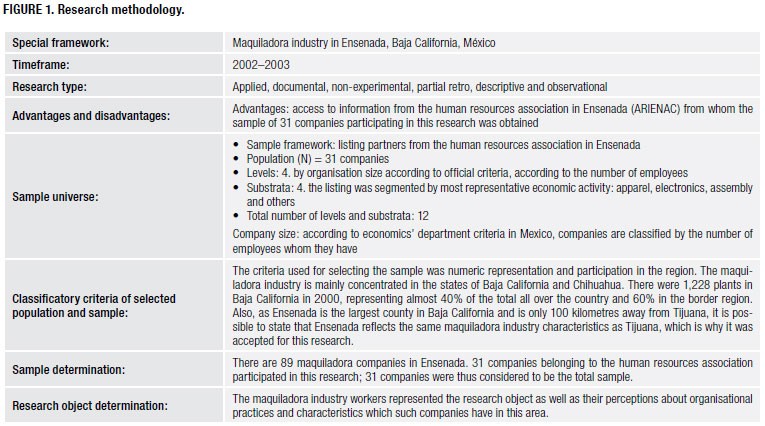
<body><![CDATA[<p><font face="Verdana, Arial, Helvetica, sans-serif" size="2"> Workers in a particular    plant in the maquiladora industry do not perceive organisational policy as being    just and its application as being impartial, which is why interchange between    supervisors and workers does not invite respect where an individual may become    involved in organisational decision-making and perceive that opportunities,    forms of remuneration and relationships occur in an atmosphere of impartiality.</font></p>     <p><font face="Verdana, Arial, Helvetica, sans-serif" size="2"> Some research    has been done on the assembly plant industry approaching several problems such    as managerial aspects, labour, recruitment, training, wages and benefits. Nevertheless,    research is needed which analyses the effects of external organisational and    demographic factors on managing human resources in the assembly plant industry    since this is related to efficiency, effectiveness and quality. A lack of knowledge    of Mexican culture, its labour, its laws and the prevailing business atmosphere    could disturb the advantages of low cost labour when additional expense is required    on recruitment, selection and training, as well as in lost productivity whenever    an experienced worker leaves the company (Cascio, 1991).</font></p>     <p><font face="Verdana, Arial, Helvetica, sans-serif" size="2"> The voluntary    exit of a worker from a company is understood as personnel turnover. Turnover    in the assembly plant industry says much about assembly plant workers' voluntary    need for change to go to another economic sector or to engage in non-economic    activities (Carrillo &amp; Santib&aacute;&ntilde;ez, 2001).</font></p>     <p><font face="Verdana, Arial, Helvetica, sans-serif" size="2"> Job satisfaction    plays a very important role in a worker's decision to remain in an organisation    for Cotton and Tuttle, whereas tasks and work contentment are of greater importance    for Porter and Steers.</font></p>     <p>&nbsp;</p>     <p><font face="Verdana, Arial, Helvetica, sans-serif" size="3"><b> Methods</b></font></p>     <p><font face="Verdana, Arial, Helvetica, sans-serif" size="2"><b> Sample characteristics</b></font></p>     <p><font face="Verdana, Arial, Helvetica, sans-serif" size="2"> The data used    in the present study was collected as part of PhD research focusing on turnover.    The questionnaire was applied to 857 employees from 16 different companies in    the maquiladora industry in Ensenada. The correlative quantitative study analysed    the relationship between employee turnover and employee profile and employee    perceptions of leadership, opportunities, adaptability, remuneration and equity.    This study was aimed at determining whether the variables had a significant    influence on employees' intention to quit. A 57-question questionnaire with    Likert- type scale was used for collecting data in this study. Study participants    were employed at the 16 different companies as general workers, performing different    activities such as assembly, manufacturing or manual jobs assigned by the plant    manager. An employee survey was used for collecting information on key study    variables, relationships and demographics. Employees were asked to fill out    the questionnaire anonymously to protect their jobs from supervisor retaliation    if their answers were negative towards a particular supervisor's performance.    The general manager gave consent for the survey to be filled out during the    employees' working hours. 1,200 surveys were distributed and 887 were returned;    30 of these surveys could not be used owing to either the employees' missing    answers or confused replies.</font></p>     <p><font face="Verdana, Arial, Helvetica, sans-serif" size="2"> There were no    differences between usable and unusable survey groups regarding tenure, gender,    race or education. Human resource personnel helped to apply the survey. 45%    of the 857 respondents were men, average age being 21.43. 54.5% were locals    from Ensenada.</font></p>     <p><font face="Verdana, Arial, Helvetica, sans-serif" size="2"> The following    methodology was used for this research:</font></p>     ]]></body>
<body><![CDATA[<p>&nbsp;</p>     <p align="center"><font face="Verdana, Arial, Helvetica, sans-serif" size="2"><a href="/img/revistas/s_inn/v1nse/a01fig01.jpg">Figure    1</a> </font></p>     <p>&nbsp;</p>     <p><font face="Verdana, Arial, Helvetica, sans-serif" size="3"><b>Measurements</b></font></p>     <p><font face="Verdana, Arial, Helvetica, sans-serif" size="2"> Predictor <i>variables</i>.    Two survey formats were used: (1) Likert-type scales ranging from 1, "strongly    disagree" to 10 "strongly agree" and (2) demographic questions. Employees self-reported    data on all variables except for organisation characteristics for which human    resource personnel provided data.</font></p>     <p><font face="Verdana, Arial, Helvetica, sans-serif" size="2"> Control <i>variables</i>.    Organisational characteristics and demographics were controlled as both have    been found to correlate with turnover (Griffeth et al., 2000). Gender was coded    as "male" 0 and "female" 1.</font></p>     <p><font face="Verdana, Arial, Helvetica, sans-serif" size="2"> The questionnaire    with Likert-type scale was the measuring instrument used and applied to the    16 companies which participated from the 31 companies in the sample.</font></p>     <p>&nbsp;</p>     <p><font face="Verdana, Arial, Helvetica, sans-serif" size="3"><b> Control variables</b></font></p>     <p> <font face="Verdana, Arial, Helvetica, sans-serif" size="2"><i>Relationships</i>.    Good relationships are shown when there are positive interactions with companions    and a low turnover rate (Cotton &amp; Tuttle, 1986). The degree of support which    a new employee receives (or does not receive) from experienced workers is associated    with his commitment towards the organisation (Allen &amp; Meyer, 1990). Employee    perception of socialisation is positively related to his/her commitment to an    organisation (Ashford, Lee &amp; Bobko, 1989).</font></p>     ]]></body>
<body><![CDATA[<p> <font face="Verdana, Arial, Helvetica, sans-serif" size="2"><i>Equity</i>.    Perceiving fairness is a critical prerequisite for employee satisfaction and    organisational commitment. </font></p>     <p><font face="Verdana, Arial, Helvetica, sans-serif" size="2">The category of    fairness represents the general importance placed on perceiving justice applied    in the work that employees have and the recognition that they give to it as    far as how money, opportunities, relationships, adaptability and leadership    are handled there.</font></p>     <p><font face="Verdana, Arial, Helvetica, sans-serif" size="2"> The perception    of fairness regarding organisational policies and employee treatment promote    organisational commitment to a greater degree than personal entrance (Folger    &amp; Konovsky, 1989).</font></p>     <p> <font face="Verdana, Arial, Helvetica, sans-serif" size="2"><i>Adaptability</i>.    In an atmosphere where change is the only constant, employees and organisations    must be flexible, adaptable and able to tolerate differences; they must be able    to tolerate ambiguity and uncertainty. An employee must be able to successfully    accept differences and handle reactions to change. It is good for an organisation    that these abilities are fomented between its employees. Stress in the job predicts    turnover (Hom &amp; Griffeth, 1995).</font></p>     <p><font face="Verdana, Arial, Helvetica, sans-serif" size="2"> Employee ability    to control role conflict (for example, husband, father, employee) is important    to be able to successfully perform her/his tasks (Hom &amp; Griffeth, 1995).</font></p>     <p><font face="Verdana, Arial, Helvetica, sans-serif" size="2"> A realistic image    of the job reduces turnover when it reflects the negative and positive features    of the job and allows the candidate to adapt to the position (McEvoy &amp; Cascio,    1985).</font></p>     <p><font face="Verdana, Arial, Helvetica, sans-serif" size="2"> Differences with    heterogeneous groups at work make an employee quit faster. (O'Reilly, Cadwell    &amp; Barnett, 1989). Demographic variability at the job speeds up turnover    (Jackson, et al. 1991).</font></p>     <p><font face="Verdana, Arial, Helvetica, sans-serif" size="2"><i> Leadership</i>.    Good organisations are distinguished for having outstanding leaders in the higher    positions. Leaders bring their personal vision and their values to an organisation,    which promote and support behaviour and performance standards and lead activities.</font></p>     <p><font face="Verdana, Arial, Helvetica, sans-serif" size="2"> Employees who    perceive interdependence with their superiors and subordinates (leader-member    exchange) reinforce affective commitment to the organisation and extend the    position's importance (Dansereau, Graen &amp; Haga, 1975).</font></p>     <p><font face="Verdana, Arial, Helvetica, sans-serif" size="2"> Poor leader-member    exchange promotes turnover (Graen &amp; Scandura, 1986). Leaders who express    consideration for their employees promote affective commitment to an organisation.</font></p>     ]]></body>
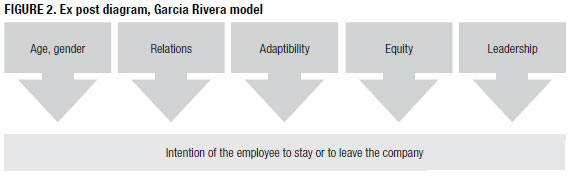
<body><![CDATA[<p><font face="Verdana, Arial, Helvetica, sans-serif" size="2"><i> Age</i>. Carrillo    &amp; Santib&aacute;&ntilde;ez have stated that age is a conditioning variable    for turnover. There is more tendency to leave a job at a younger age (Graen    &amp; Scandura, 1986).</font></p>     <p><font face="Verdana, Arial, Helvetica, sans-serif" size="2"><i> Gender</i>.    Research by Pe&ntilde;a in Chihuahua's maquiladora industry found that immigrant    women stayed longer in their jobs than men (Pe&ntilde;a, 1994).(<a href="#f2">Figure    2</a>) </font></p>     <p><a name="f2"></a></p>     <p>&nbsp;</p>     <p align="center"><img src="/img/revistas/s_inn/v1nse/a01fig02.jpg"></p>     <p>&nbsp;</p>     <p><font face="Verdana, Arial, Helvetica, sans-serif" size="3"><b> Analysis</b></font></p>     <p><font face="Verdana, Arial, Helvetica, sans-serif" size="2"> Data was analysed    using the SPSS program with Pearson correlations. The methods described by Carrillo    &amp; Santib&aacute;&ntilde;ez (2000) in their turnover research were used for    the variable regarding intention to quit the job.</font></p>     <p>&nbsp;</p>     <p><font face="Verdana, Arial, Helvetica, sans-serif" size="3"><b>Results</b></font></p>     ]]></body>
<body><![CDATA[<p><font face="Verdana, Arial, Helvetica, sans-serif" size="2"> Findings about    employee demographics were as follows:</font></p> <ol>       <p>        <li><font face="Verdana, Arial, Helvetica, sans-serif" size="2"> Most employees      working in the maquiladora industry were young (ranging from 18 to 35 years      old).</font></li>          <p>        <li><font face="Verdana, Arial, Helvetica, sans-serif" size="2"> Regarding educational      level, most workers had studied until the 9th grade.</font></li>          <p>        <li><font face="Verdana, Arial, Helvetica, sans-serif" size="2"> The group that      presented high-turnover represented 49.7% of the sample and the low-turnover      group represented 41.7% (8.6% non-responders). Average seniority was 18 months      in the job.</font></li>          <p>        <li><font face="Verdana, Arial, Helvetica, sans-serif" size="2"> Employees who      stayed longer than 18 months in the job were older than 26 and younger than      35 years old.</font></li>          <p>        ]]></body>
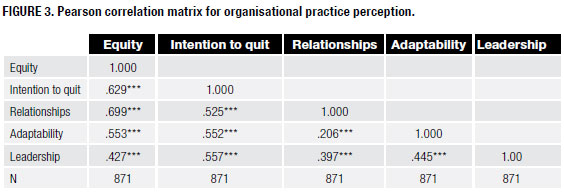
<body><![CDATA[<li><font face="Verdana, Arial, Helvetica, sans-serif" size="2"> Married women      represented most of the low-turnover employees.</font></li>          <p>        <li><font face="Verdana, Arial, Helvetica, sans-serif" size="2"> Women born      in Ensenada who worked in mediumsized assembly companies (30 to 100 employees)      represented most of the low-turnover employees.</font></li>          <p>        <li><font face="Verdana, Arial, Helvetica, sans-serif" size="2"> Employees who      work for large companies with more than 500 employees in electronic activities      represented the greatest high-turnover group.</font></li>        </ol>     <p><font face="Verdana, Arial, Helvetica, sans-serif" size="2"> Regarding organisational    practice, the Pearson correlations obtained for such research are shown in <a href="#f3">Figure    3</a> below.</font></p>     <p><a name="f3">&nbsp;</a></p>     <p>&nbsp;</p>     <p align="center"><img src="/img/revistas/s_inn/v1nse/a01fig03.jpg"></p>     ]]></body>
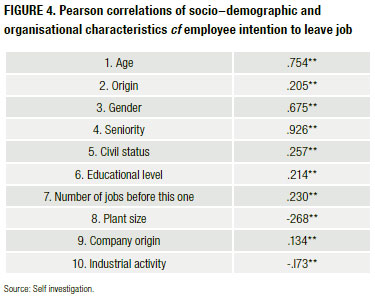
<body><![CDATA[<p>&nbsp; </p>     <p><font face="Verdana, Arial, Helvetica, sans-serif" size="2">This study's main    finding indicated that turnover as perceived by employees was related to fairness    in applying leadership to adaptability, good relationships and the employees'    demographic profile, particularly with age/gender.(<a href="#f4">Figure 4</a>)</font></p>     <p><a name="f4"></a> </p>     <p>&nbsp;</p>     <p align="center"><img src="/img/revistas/s_inn/v1nse/a01fig04.jpg"></p>     <p>&nbsp;</p>     <p><font face="Verdana, Arial, Helvetica, sans-serif" size="3"><b>Discussion</b></font></p>     <p><font face="Verdana, Arial, Helvetica, sans-serif" size="2"> Turnover literature    has been dominated by research on how work attitudes (especially job satisfaction)    lead to turnover. Although this line of research has contributed much to the    literature, there has been increased interest in the role that less traditional    variables (e.g. adaptability) play in job quitting. The present study represents    an initial attempt to determine whether relational variables (specifically,    employee profile, organisation characteristics, perceived leadership, adaptability,    equity, remuneration and opportunities) can contribute towards this.</font></p>     <p><font face="Verdana, Arial, Helvetica, sans-serif" size="2"> Both opportunities    and adaptability were significantly related to turnover in this study and their    effects went above and beyond the effects of salary remuneration perception.    It shows clearly that how individuals perceive these variables affect their    leaving or staying in the organisation.</font></p>     <p>&nbsp;</p>     ]]></body>
<body><![CDATA[<p><font face="Verdana, Arial, Helvetica, sans-serif" size="3"><b> Research limitations</b></font></p>     <p><font face="Verdana, Arial, Helvetica, sans-serif" size="2"> When applying    the questionnaire it was observed that the results of perception could have    biased the result since it was detected that worker feared retaliation from    the organisation in many cases when responding to the questionnaire (although    the responses were anonymous and there were boxes for so replying). It was also    observed that many workers copied their companions' answers, or answered as    a group without analysing what they replied at great length. Another problem    lay in the fact that many companies refused to apply the questionnaire for fear    of creating false expectations in their workers or for fear of creating a tense    organisational climate. The greatest problem observed was that the only large    company which allowed the questionnaire to be applied returned more than 400    answered questionnaires, its information prevailing over the rest of the sample    where the questionnaire was applied.</font></p>     <p>&nbsp;</p>     <p><font face="Verdana, Arial, Helvetica, sans-serif" size="3"><b>References</b></font></p>     <!-- ref --><p><font face="Verdana, Arial, Helvetica, sans-serif" size="2">Ahr, P. R. &amp;    Ahr, T. B. (2000). <i>Overturn Turnover</i>. Missouri: Causeway Publishing Company.    </font></p>     <!-- ref --><p><font face="Verdana, Arial, Helvetica, sans-serif" size="2"> Allen, N. &amp;    Meyer, J. (1990). Organizational socialization tactics: A longitudinal analysis    of links of newcomers' commitment and role orientation. <i>Academy of Management    Journal</i>, <i>33</i> (4), 847-858.    </font></p>     <!-- ref --><p><font face="Verdana, Arial, Helvetica, sans-serif" size="2"> Arrioja, R. (1993).    <i>The North American Free Trade Agreement and its implications for human resources    management.</i> Thesis (Ph. D.), Colorado, University of Colorado.    </font></p>     ]]></body>
<body><![CDATA[<!-- ref --><p><font face="Verdana, Arial, Helvetica, sans-serif" size="2"> Ashford, S., Lee,    C. &amp; Bobko, P. (1989). Content, causes and consequences of job insecurity:    A theory-based measure and substantive test. <i>Academy of Management Journal</i>,    <i>32</i> (4), 803-829.    </font></p>     <!-- ref --><p><font face="Verdana, Arial, Helvetica, sans-serif" size="2"> Carrillo, J. &amp;    Santib&aacute;&ntilde;ez, J. (2001). <i>Rotaci&oacute;n de personal en las maquiladoras</i>    (2nd. Ed.). M&eacute;xico: El Colegio de la Frontera Norte.    </font></p>     <!-- ref --><p><font face="Verdana, Arial, Helvetica, sans-serif" size="2"> Cascio, W. F.    (1991). <i>Costing human resources</i> (3rd Ed.). New York: McGraw-Hill.    </font></p>     <!-- ref --><p><font face="Verdana, Arial, Helvetica, sans-serif" size="2"> Cotton, J. L.    &amp; Tuttle, J. M. (1986). Employee turnover: A meta-analysis and review with    implications for research. <i>Academy of Management Review</i>, <i>11</i> (1),    55-70.    </font></p>     <!-- ref --><p><font face="Verdana, Arial, Helvetica, sans-serif" size="2"> Dansereau, F.,    Graen, G., &amp; Haga, W. (1975). A vertical dyad linkage approach to leadership    within formal organizations: A longitudinal investigation of the role making    process. In <i>Organizational Behavior of Human Performance</i>, 13, 46-48.    </font></p>     ]]></body>
<body><![CDATA[<!-- ref --><p><font face="Verdana, Arial, Helvetica, sans-serif" size="2"> English, W., Williams,    S., &amp; Ibarreche, S. (1989) Employee Tumover in the Maquiladoras. <i>Journal    of Borderlands Studies</i>, <i>4</i>, 70-99.    </font></p>     <!-- ref --><p><font face="Verdana, Arial, Helvetica, sans-serif" size="2"> Folger, R. &amp;    Konovsky, M. (1989). Effects of procedural and distributive justice on reactions    to pay raise decisions. <i>Academy of Management Journal</i>, <i>32</i> (1),    115-130.    </font></p>     <!-- ref --><p><font face="Verdana, Arial, Helvetica, sans-serif" size="2"> Graen, G. &amp;    Scandura, T. (1986). A theory of dyadic career reality. In: G. Ferris and K.    Rowland (Eds.), <i>Research in Personnel and Human Resources Management</i>    (No. 4). Greenwich (CT): JAI Press.    </font></p>     <!-- ref --><p><font face="Verdana, Arial, Helvetica, sans-serif" size="2"> Griffeth, R. W.,    Hom, P. W., &amp; Gaertner, S. (2000). A meta-analysis of antecedents and correlates    of employee turnover: Update, moderator tests, and research implications for    the next Millennium. <i>Journal of Management</i>, <i>26</i> (3), 463-488.    </font></p>     <!-- ref --><p><font face="Verdana, Arial, Helvetica, sans-serif" size="2"> Hom, P. &amp;    Griffeth, R. (1995). <i>Employee turnover</i>. Ohio: SouthWestern College Publishing.    </font></p>     ]]></body>
<body><![CDATA[<!-- ref --><p><font face="Verdana, Arial, Helvetica, sans-serif" size="2"> Jackson, S. E.,    Brett, J. F., Sessa, V. I., Cooper, D. M., Julin, J. A., &amp; Peyronnin, K.    (1991, October). Some differences make a difference: individual dissimilarity    and group heterogeneity as correlates of recruitment, promotions and turnover.    <i>Journal of Applied Psychology</i>, <i>76</i> (5), 675-689.    </font></p>     <!-- ref --><p><font face="Verdana, Arial, Helvetica, sans-serif" size="2"> Kacmar, K. M.,    Bozeman, D. P., Carlson D. S., &amp; Anthony, W. P. (1999, March). An examination    of the perceptions of organizational politics model: Replication and extension.    <i>Human Relations</i>, <i>52</i> (3), 383-416.    </font></p>     <!-- ref --><p><font face="Verdana, Arial, Helvetica, sans-serif" size="2"> Konovsky, M. &amp;    Cropanzano, R. (1991). Perceived fairness of employee drug testing as a predictor    of employee attitudes and job performance. <i>Journal of Applied Psychology</i>,    <i>76</i>, 698-707.    </font></p>     <!-- ref --><p><font face="Verdana, Arial, Helvetica, sans-serif" size="2"> Lingard, H. (2003).    The impact of individual and job characteristics on ‘burnout' among civil engineers    in Australia and the implications for employee turnover. <i>Construction Management    of Economics</i>, <i>21</i> (1), 69-80.    </font></p>     <!-- ref --><p><font face="Verdana, Arial, Helvetica, sans-serif" size="2"> March, J. &amp;    Simon, H. (1958). <i>Organizations</i>. New York: Wiley.    </font></p>     ]]></body>
<body><![CDATA[<!-- ref --><p><font face="Verdana, Arial, Helvetica, sans-serif" size="2"> McEvoy, G. &amp;    Cascio, W. (1985, May). Strategies for reducing employees' turnover: A metaanalysis.    <i>Journal of Applied Psychology</i>, <i>70</i> (2), 342-353.    </font></p>     <!-- ref --><p><font face="Verdana, Arial, Helvetica, sans-serif" size="2"> O'Reilly, C.,    Caldwell, D., &amp; Barnett, W. (1989). Work group demography, social integration    and turnover. <i>Administrative Science Quarterly</i>, <i>34</i>, 21-37.    </font></p>     <!-- ref --><p><font face="Verdana, Arial, Helvetica, sans-serif" size="2"> Pe&ntilde;a, L.    (1994).<i> Employee turnover and length of stay in the maquiladora industry    of Chihuahua, Mexico</i>. Unpublished dissertation to the Harvard Graduate School    of Education.    </font></p>     <!-- ref --><p><font face="Verdana, Arial, Helvetica, sans-serif" size="2"> Pe&ntilde;a, L.    (2000, July). Retaining a Mexican labor force. <i>Journal of Business Ethics</i>,    <i>26</i> (2), 123-131.    </font></p>     <!-- ref --><p><font face="Verdana, Arial, Helvetica, sans-serif" size="2"> Porter, L. W.,    Steers, R. M., Mowday, R. T., &amp; Boulian, P. V. (1974, October). Organizational    commitment, job satisfaction and turnover among psychiatric technicians. <i>Journal    of Applied Psychology</i>, <i>59</i> (5), 603-609.    </font></p>     ]]></body>
<body><![CDATA[<!-- ref --><p><font face="Verdana, Arial, Helvetica, sans-serif" size="2"> Rodr&iacute;guez,    N. M. (1988). Transcending bureaucracy: Feminist politics. <i>Gender and Society</i>,    <i>2</i>, 214-227.    </font></p>     <!-- ref --><p><font face="Verdana, Arial, Helvetica, sans-serif" size="2"> Rosse, J. (1991).    Understanding employee withdrawal from work. In: J. Jones, B. Steffy and D.    Bray (Eds.), <i>Applying Psychology in Business: The Handbook for Managers and    Human Resource Professionals</i> (pp. 668-682). Lexington, MA: Lexington Books</font><!-- ref --><p><font face="Verdana, Arial, Helvetica, sans-serif" size="2"> Sheridan, J. &amp;    Abelson, M. (1983). Cusp catastrophe model of employee turnover. <i>Academy    of Management Journal</i>, <i>26</i>, 418-436.    </font></p>     <!-- ref --><p><font face="Verdana, Arial, Helvetica, sans-serif" size="2"> Weisberg, J. &amp;    Kirschenbaum, A. (1991, December). Employee turnover intentions: implications    from a national sample. <i>The International Journal of Human Resource Management</i>,    <i>2</i> (3), 359-375.</font><!-- ref --><p><font face="Verdana, Arial, Helvetica, sans-serif" size="2"> Westaby, J. D.    (2003). The integrative reason model and employee turnover: New links in behavioral    intention models. <i>Academy of Management Best Paper Proceedings, OB</i>, G1-G6.</font> ]]></body><back>
<ref-list>
<ref id="B1">
<nlm-citation citation-type="book">
<person-group person-group-type="author">
<name>
<surname><![CDATA[Ahr]]></surname>
<given-names><![CDATA[P. R.]]></given-names>
</name>
<name>
<surname><![CDATA[Ahr]]></surname>
<given-names><![CDATA[T. B.]]></given-names>
</name>
</person-group>
<source><![CDATA[/Overturn Turnover/]]></source>
<year>2000</year>
<publisher-loc><![CDATA[Missouri ]]></publisher-loc>
<publisher-name><![CDATA[Causeway Publishing Company]]></publisher-name>
</nlm-citation>
</ref>
<ref id="B2">
<nlm-citation citation-type="journal">
<person-group person-group-type="author">
<name>
<surname><![CDATA[Allen]]></surname>
<given-names><![CDATA[N]]></given-names>
</name>
<name>
<surname><![CDATA[Meyer]]></surname>
<given-names><![CDATA[J]]></given-names>
</name>
</person-group>
<article-title xml:lang="en"><![CDATA[Organizational socialization tactics: A longitudinal analysis of links of newcomers? commitment and role orientation]]></article-title>
<source><![CDATA[/Academy of Management Journal/]]></source>
<year>1990</year>
<volume>/33/</volume>
<numero>4</numero>
<issue>4</issue>
<page-range>847-858</page-range></nlm-citation>
</ref>
<ref id="B3">
<nlm-citation citation-type="">
<person-group person-group-type="author">
<name>
<surname><![CDATA[Arrioja]]></surname>
<given-names><![CDATA[R]]></given-names>
</name>
</person-group>
<source><![CDATA[/The North American Free Trade Agreement and its implications for human resources management/]]></source>
<year>1993</year>
</nlm-citation>
</ref>
<ref id="B4">
<nlm-citation citation-type="journal">
<person-group person-group-type="author">
<name>
<surname><![CDATA[Ashford]]></surname>
<given-names><![CDATA[S]]></given-names>
</name>
<name>
<surname><![CDATA[Lee]]></surname>
<given-names><![CDATA[C]]></given-names>
</name>
<name>
<surname><![CDATA[Bobko]]></surname>
<given-names><![CDATA[P]]></given-names>
</name>
</person-group>
<article-title xml:lang="en"><![CDATA[Content, causes and consequences of job insecurity: A theory-based measure and substantive test]]></article-title>
<source><![CDATA[/Academy of Management Journal/]]></source>
<year>1989</year>
<volume>/32/</volume>
<numero>4</numero>
<issue>4</issue>
<page-range>803-829</page-range></nlm-citation>
</ref>
<ref id="B5">
<nlm-citation citation-type="book">
<person-group person-group-type="author">
<name>
<surname><![CDATA[Carrillo]]></surname>
<given-names><![CDATA[J]]></given-names>
</name>
<name>
<surname><![CDATA[Santibáñez]]></surname>
<given-names><![CDATA[J]]></given-names>
</name>
</person-group>
<source><![CDATA[/Rotación de personal en las maquiladoras/]]></source>
<year>2001</year>
<edition>2nd</edition>
<publisher-loc><![CDATA[México ]]></publisher-loc>
<publisher-name><![CDATA[El Colegio de la Frontera]]></publisher-name>
</nlm-citation>
</ref>
<ref id="B6">
<nlm-citation citation-type="book">
<person-group person-group-type="author">
<name>
<surname><![CDATA[Cascio]]></surname>
<given-names><![CDATA[W. F.]]></given-names>
</name>
</person-group>
<source><![CDATA[/Costing human resources/]]></source>
<year>1991</year>
<edition>3rd</edition>
<publisher-loc><![CDATA[New York ]]></publisher-loc>
<publisher-name><![CDATA[McGraw-Hill]]></publisher-name>
</nlm-citation>
</ref>
<ref id="B7">
<nlm-citation citation-type="journal">
<person-group person-group-type="author">
<name>
<surname><![CDATA[Cotton]]></surname>
<given-names><![CDATA[J. L.]]></given-names>
</name>
<name>
<surname><![CDATA[Tuttle]]></surname>
<given-names><![CDATA[J. M.]]></given-names>
</name>
</person-group>
<article-title xml:lang="en"><![CDATA[Employee turnover: A meta-analysis and review with implications for research]]></article-title>
<source><![CDATA[/Academy of Management Review/]]></source>
<year>1986</year>
<volume>/11/</volume>
<numero>1</numero>
<issue>1</issue>
<page-range>55-70</page-range></nlm-citation>
</ref>
<ref id="B8">
<nlm-citation citation-type="journal">
<person-group person-group-type="author">
<name>
<surname><![CDATA[Dansereau]]></surname>
<given-names><![CDATA[F]]></given-names>
</name>
<name>
<surname><![CDATA[Graen]]></surname>
<given-names><![CDATA[G]]></given-names>
</name>
<name>
<surname><![CDATA[Haga]]></surname>
<given-names><![CDATA[W]]></given-names>
</name>
</person-group>
<article-title xml:lang="en"><![CDATA[A vertical dyad linkage approach to leadership within formal organizations: A longitudinal investigation of the role making process]]></article-title>
<source><![CDATA[/Organizational Behavior of Human Performance/]]></source>
<year>1975</year>
<volume>13</volume>
<page-range>46-48</page-range></nlm-citation>
</ref>
<ref id="B9">
<nlm-citation citation-type="journal">
<person-group person-group-type="author">
<name>
<surname><![CDATA[English]]></surname>
<given-names><![CDATA[W]]></given-names>
</name>
<name>
<surname><![CDATA[Williams]]></surname>
<given-names><![CDATA[S]]></given-names>
</name>
<name>
<surname><![CDATA[Ibarreche]]></surname>
<given-names><![CDATA[S]]></given-names>
</name>
</person-group>
<article-title xml:lang="en"><![CDATA[Employee Tumover in the Maquiladoras]]></article-title>
<source><![CDATA[/Journal of Borderlands Studies/]]></source>
<year>1989</year>
<volume>/4/</volume>
<page-range>70-99</page-range></nlm-citation>
</ref>
<ref id="B10">
<nlm-citation citation-type="journal">
<person-group person-group-type="author">
<name>
<surname><![CDATA[Folger]]></surname>
<given-names><![CDATA[R]]></given-names>
</name>
<name>
<surname><![CDATA[Konovsky]]></surname>
<given-names><![CDATA[M]]></given-names>
</name>
</person-group>
<article-title xml:lang="en"><![CDATA[Effects of procedural and distributive justice on reactions to pay raise decisions]]></article-title>
<source><![CDATA[/Academy of Management Journal/]]></source>
<year>1989</year>
<volume>/32/</volume>
<numero>1</numero>
<issue>1</issue>
<page-range>115-130</page-range></nlm-citation>
</ref>
<ref id="B11">
<nlm-citation citation-type="book">
<person-group person-group-type="author">
<name>
<surname><![CDATA[Graen]]></surname>
<given-names><![CDATA[G]]></given-names>
</name>
<name>
<surname><![CDATA[Scandura]]></surname>
<given-names><![CDATA[T]]></given-names>
</name>
</person-group>
<article-title xml:lang="en"><![CDATA[A theory of dyadic career reality]]></article-title>
<person-group person-group-type="editor">
<name>
<surname><![CDATA[Ferris]]></surname>
<given-names><![CDATA[G]]></given-names>
</name>
<name>
<surname><![CDATA[Rowland]]></surname>
<given-names><![CDATA[K]]></given-names>
</name>
</person-group>
<source><![CDATA[/Research in Personnel and Human Resources Management/]]></source>
<year>1986</year>
<edition>4</edition>
<publisher-loc><![CDATA[Greenwich^eCT CT]]></publisher-loc>
<publisher-name><![CDATA[JAI Press]]></publisher-name>
</nlm-citation>
</ref>
<ref id="B12">
<nlm-citation citation-type="journal">
<person-group person-group-type="author">
<name>
<surname><![CDATA[Griffeth]]></surname>
<given-names><![CDATA[R. W.]]></given-names>
</name>
<name>
<surname><![CDATA[Hom]]></surname>
<given-names><![CDATA[P. W.]]></given-names>
</name>
<name>
<surname><![CDATA[Gaertner]]></surname>
<given-names><![CDATA[S]]></given-names>
</name>
</person-group>
<article-title xml:lang="en"><![CDATA[A meta-analysis of antecedents and correlates of employee turnover: Update, moderator tests, and research implications for the next Millennium]]></article-title>
<source><![CDATA[/Journal of Management/]]></source>
<year>2000</year>
<volume>/26/</volume>
<numero>3</numero>
<issue>3</issue>
<page-range>463-488</page-range></nlm-citation>
</ref>
<ref id="B13">
<nlm-citation citation-type="book">
<person-group person-group-type="author">
<name>
<surname><![CDATA[Hom]]></surname>
<given-names><![CDATA[P]]></given-names>
</name>
<name>
<surname><![CDATA[Griffeth]]></surname>
<given-names><![CDATA[R]]></given-names>
</name>
</person-group>
<source><![CDATA[/Employee turnover/]]></source>
<year>1995</year>
<publisher-loc><![CDATA[Ohio ]]></publisher-loc>
<publisher-name><![CDATA[SouthWestern College Publishing]]></publisher-name>
</nlm-citation>
</ref>
<ref id="B14">
<nlm-citation citation-type="journal">
<person-group person-group-type="author">
<name>
<surname><![CDATA[Jackson]]></surname>
<given-names><![CDATA[S. E.]]></given-names>
</name>
<name>
<surname><![CDATA[Brett]]></surname>
<given-names><![CDATA[J. F]]></given-names>
</name>
<name>
<surname><![CDATA[Sessa]]></surname>
<given-names><![CDATA[V. I.]]></given-names>
</name>
<name>
<surname><![CDATA[Cooper]]></surname>
<given-names><![CDATA[D. M]]></given-names>
</name>
<name>
<surname><![CDATA[Julin]]></surname>
<given-names><![CDATA[J. A]]></given-names>
</name>
<name>
<surname><![CDATA[Peyronnin]]></surname>
<given-names><![CDATA[K]]></given-names>
</name>
</person-group>
<article-title xml:lang="en"><![CDATA[Some differences make a difference: individual dissimilarity and group heterogeneity as correlates of recruitment, promotions and turnover]]></article-title>
<source><![CDATA[/Journal of Applied Psychology/]]></source>
<year>1991</year>
<month>, </month>
<day>Oc</day>
<volume>/76/</volume>
<numero>5</numero>
<issue>5</issue>
<page-range>675-689</page-range></nlm-citation>
</ref>
<ref id="B15">
<nlm-citation citation-type="journal">
<person-group person-group-type="author">
<name>
<surname><![CDATA[Kacmar]]></surname>
<given-names><![CDATA[K. M.]]></given-names>
</name>
<name>
<surname><![CDATA[Bozeman]]></surname>
<given-names><![CDATA[D. P.]]></given-names>
</name>
<name>
<surname><![CDATA[Carlson]]></surname>
<given-names><![CDATA[D. S.]]></given-names>
</name>
<name>
<surname><![CDATA[Anthony]]></surname>
<given-names><![CDATA[W. P.]]></given-names>
</name>
</person-group>
<article-title xml:lang="en"><![CDATA[An examination of the perceptions of organizational politics model: Replication and extension]]></article-title>
<source><![CDATA[/Human Relations/]]></source>
<year>1999</year>
<month>, </month>
<day>Ma</day>
<volume>/52/</volume>
<numero>3</numero>
<issue>3</issue>
<page-range>383-416</page-range></nlm-citation>
</ref>
<ref id="B16">
<nlm-citation citation-type="journal">
<person-group person-group-type="author">
<name>
<surname><![CDATA[Konovsky]]></surname>
<given-names><![CDATA[M]]></given-names>
</name>
<name>
<surname><![CDATA[Cropanzano]]></surname>
<given-names><![CDATA[R]]></given-names>
</name>
</person-group>
<article-title xml:lang="en"><![CDATA[Perceived fairness of employee drug testing as a predictor of employee attitudes and job performance]]></article-title>
<source><![CDATA[/Journal of Applied Psychology/]]></source>
<year>1991</year>
<volume>/76/</volume>
<page-range>698-707</page-range></nlm-citation>
</ref>
<ref id="B17">
<nlm-citation citation-type="journal">
<person-group person-group-type="author">
<name>
<surname><![CDATA[Lingard]]></surname>
<given-names><![CDATA[H]]></given-names>
</name>
</person-group>
<article-title xml:lang="en"><![CDATA[impact of individual and job characteristics on ?burnout? among civil engineers in Australia and the implications for employee turnover]]></article-title>
<source><![CDATA[/Construction Management of Economics/]]></source>
<year>2003</year>
<volume>/21/</volume>
<numero>1</numero>
<issue>1</issue>
<page-range>69-80</page-range></nlm-citation>
</ref>
<ref id="B18">
<nlm-citation citation-type="book">
<person-group person-group-type="author">
<name>
<surname><![CDATA[March]]></surname>
<given-names><![CDATA[J]]></given-names>
</name>
<name>
<surname><![CDATA[Simon]]></surname>
<given-names><![CDATA[H]]></given-names>
</name>
</person-group>
<source><![CDATA[/Organizations/]]></source>
<year>1958</year>
<publisher-loc><![CDATA[New York ]]></publisher-loc>
<publisher-name><![CDATA[Wiley]]></publisher-name>
</nlm-citation>
</ref>
<ref id="B19">
<nlm-citation citation-type="journal">
<person-group person-group-type="author">
<name>
<surname><![CDATA[McEvoy]]></surname>
<given-names><![CDATA[G]]></given-names>
</name>
<name>
<surname><![CDATA[Cascio]]></surname>
<given-names><![CDATA[W]]></given-names>
</name>
</person-group>
<article-title xml:lang="en"><![CDATA[Strategies for reducing employees? turnover: A metaanalysis]]></article-title>
<source><![CDATA[/Journal of Applied Psychology/]]></source>
<year>1985</year>
<month>, </month>
<day>Ma</day>
<volume>/70/</volume>
<numero>2</numero>
<issue>2</issue>
<page-range>342-353</page-range></nlm-citation>
</ref>
<ref id="B20">
<nlm-citation citation-type="journal">
<person-group person-group-type="author">
<name>
<surname><![CDATA[O?Reilly]]></surname>
<given-names><![CDATA[C]]></given-names>
</name>
<name>
<surname><![CDATA[Caldwell]]></surname>
<given-names><![CDATA[D]]></given-names>
</name>
<name>
<surname><![CDATA[Barnett]]></surname>
<given-names><![CDATA[W]]></given-names>
</name>
</person-group>
<article-title xml:lang="en"><![CDATA[Work group demography, social integration and turnover]]></article-title>
<source><![CDATA[/Administrative Science Quarterly/]]></source>
<year>1989</year>
<volume>/34/</volume>
<page-range>21-37</page-range></nlm-citation>
</ref>
<ref id="B21">
<nlm-citation citation-type="confpro">
<person-group person-group-type="author">
<name>
<surname><![CDATA[Peña]]></surname>
<given-names><![CDATA[L]]></given-names>
</name>
</person-group>
<source><![CDATA[]]></source>
<year>1994</year>
<conf-name><![CDATA[ /Employee turnover and length of stay in the maquiladora industry of Chihuahua, Mexico/]]></conf-name>
<conf-loc> </conf-loc>
</nlm-citation>
</ref>
<ref id="B22">
<nlm-citation citation-type="journal">
<person-group person-group-type="author">
<name>
<surname><![CDATA[Peña]]></surname>
<given-names><![CDATA[L]]></given-names>
</name>
</person-group>
<article-title xml:lang="en"><![CDATA[Retaining a Mexican labor force]]></article-title>
<source><![CDATA[/Journal of Business Ethics/]]></source>
<year>2000</year>
<month>, </month>
<day>Ju</day>
<volume>/26/</volume>
<numero>2</numero>
<issue>2</issue>
<page-range>123-131</page-range></nlm-citation>
</ref>
<ref id="B23">
<nlm-citation citation-type="journal">
<person-group person-group-type="author">
<name>
<surname><![CDATA[Porter]]></surname>
<given-names><![CDATA[L. W.]]></given-names>
</name>
<name>
<surname><![CDATA[Steers]]></surname>
<given-names><![CDATA[R. M.]]></given-names>
</name>
<name>
<surname><![CDATA[Mowday]]></surname>
<given-names><![CDATA[R. T.]]></given-names>
</name>
<name>
<surname><![CDATA[Boulian]]></surname>
<given-names><![CDATA[P. V.]]></given-names>
</name>
</person-group>
<article-title xml:lang="en"><![CDATA[Organizational commitment, job satisfaction and turnover among psychiatric technicians]]></article-title>
<source><![CDATA[/Journal of Applied Psychology/]]></source>
<year>1974</year>
<month>, </month>
<day>Oc</day>
<volume>/59/</volume>
<numero>5</numero>
<issue>5</issue>
<page-range>603-609</page-range></nlm-citation>
</ref>
<ref id="B24">
<nlm-citation citation-type="journal">
<person-group person-group-type="author">
<name>
<surname><![CDATA[Rodríguez]]></surname>
<given-names><![CDATA[N. M.]]></given-names>
</name>
</person-group>
<article-title xml:lang="en"><![CDATA[Transcending bureaucracy: Feminist politics]]></article-title>
<source><![CDATA[/Gender and Society/]]></source>
<year>1988</year>
<volume>/2/</volume>
<page-range>214-227</page-range></nlm-citation>
</ref>
<ref id="B25">
<nlm-citation citation-type="book">
<person-group person-group-type="author">
<name>
<surname><![CDATA[Rosse]]></surname>
<given-names><![CDATA[J]]></given-names>
</name>
</person-group>
<article-title xml:lang="en"><![CDATA[Understanding employee withdrawal from work]]></article-title>
<person-group person-group-type="editor">
<name>
<surname><![CDATA[Jones]]></surname>
<given-names><![CDATA[J]]></given-names>
</name>
<name>
<surname><![CDATA[Steffy]]></surname>
<given-names><![CDATA[B]]></given-names>
</name>
<name>
<surname><![CDATA[Bray]]></surname>
<given-names><![CDATA[D]]></given-names>
</name>
</person-group>
<source><![CDATA[/Applying Psychology in Business/: /The Handbook for Managers and Human Resource Professionals/]]></source>
<year>1991</year>
<page-range>668-682</page-range><publisher-loc><![CDATA[Lexington^eMA MA]]></publisher-loc>
<publisher-name><![CDATA[Lexington Books]]></publisher-name>
</nlm-citation>
</ref>
<ref id="B26">
<nlm-citation citation-type="journal">
<person-group person-group-type="author">
<name>
<surname><![CDATA[Sheridan]]></surname>
<given-names><![CDATA[J]]></given-names>
</name>
<name>
<surname><![CDATA[Abelson]]></surname>
<given-names><![CDATA[M]]></given-names>
</name>
</person-group>
<article-title xml:lang="en"><![CDATA[Cusp catastrophe model of employee turnover]]></article-title>
<source><![CDATA[/Academy of Management Journal/]]></source>
<year>1983</year>
<volume>/26/</volume>
<page-range>418-436</page-range></nlm-citation>
</ref>
<ref id="B27">
<nlm-citation citation-type="">
<person-group person-group-type="author">
<name>
<surname><![CDATA[Weisberg]]></surname>
<given-names><![CDATA[J]]></given-names>
</name>
<name>
<surname><![CDATA[Kirschenbaum]]></surname>
<given-names><![CDATA[A]]></given-names>
</name>
</person-group>
<article-title xml:lang="en"><![CDATA[Employee turnover intentions: implications from a national sample]]></article-title>
<source><![CDATA[]]></source>
<year>1991</year>
<month>, </month>
<day>De</day>
</nlm-citation>
</ref>
<ref id="B28">
<nlm-citation citation-type="journal">
<person-group person-group-type="author">
<name>
<surname><![CDATA[Westaby]]></surname>
<given-names><![CDATA[J. D.]]></given-names>
</name>
</person-group>
<article-title xml:lang="en"><![CDATA[The integrative reason model and employee turnover: New links in behavioral intention models]]></article-title>
<source><![CDATA[/Academy of Management Best Paper Proceedings/]]></source>
<year>2003</year>
</nlm-citation>
</ref>
</ref-list>
</back>
</article>