The colour of the bones: scientific narratives and cultural appropriations of 'Luzia', a prehistoric skull from Brazil*
A cor dos ossos: narrativas científicas e apropriações culturais sobre "Luzia", um crânio pré-histórico do Brasil
Verlan Valle Gaspar NetoI; Ricardo Ventura SantosII
IMA in anthropology from the Postgraduate Program in Anthropology of Fluminense Federal University, where he is currently pursuing his PhD. E-mail: verlan02@yahoo.com.br
IIAssociate professor at the Department of Anthropology, National Museum/UFRJ and full researcher at the Escola Nacional de Saúde Pública, Fundação Oswaldo Cruz [National School of Public Health, Oswaldo Cruz Foundation]. E-mail: santos@ensp.fiocruz.br
Translated by David Rodgers ]]>
Translation from Mana, Rio de Janeiro, v. 15, n. 2, p. 449-480, out. 2009.
ABSTRACT
Over the last decade the skull of a woman excavated in Lagoa Santa, Minas Gerais, has turned into a scientific and cultural icon in Brazil. Luzia is taken to be one of the earliest human bone remains from the Americas, dating from approximately 11,500 years ago. In this work the authors analyze discourses and representations about and surrounding this prehistoric find. Situated between the domains of nature and culture, the specimen was transubstantiated into an individual possessing her own personal characteristics, while simultaneously being inserted into the debates on the biological and cultural ancestry of the Brazilian people. The work also explores the sociocultural appropriations of Luzia, prompting questions about the scientific disputes surrounding the primacies and temporalities involved in the occupation of the American continent and representations of prehistory, as well as the interfaces between race, science and society in contemporary Brazil.
Key-words Anthropology of Science, Palaeoanthropology, Science and the Media, Identities, Colour/Race, Brazil
RESUMO
Na última década, o crânio de uma mulher escavado em Lagoa Santa, Minas Gerais, tornou-se um ícone científico e cultural no Brasil. Luzia é tida como um dos mais antigos remanescentes ósseos humanos das Américas, com aproximadamente 11.500 anos. Neste trabalho são analisados discursos e representações sobre e em torno desta peça pré-histórica. Situado entre os domínios da natureza e da cultura, o espécime foi transubstanciado em um indivíduo dotado de características pessoais próprias, além de relacionado aos debates sobre a ancestralidade biológica e cultural do povo brasileiro. O trabalho também explora as apropriações socioculturais sobre Luzia, que envolvem questões relativas a disputas científicas sobre primazias e temporalidades de ocupação do continente americano; representações da pré-história; bem como as interfaces entre raça, ciência e sociedade no Brasil contemporâneo.
Palavras-chave: Antropologia da Ciência, Paleoantropologia, Ciência e Mídia, Identidades, Cor/Raça, Brasil
]]>
Introduction
They reconstructed Brazil's oldest woman and it wasn't Pitanguy who did the work.†Luzia, the first Brazilian: the reconstruction of a 11,500-year old face revolutionizes theories of the occupation of the American continent.
(Outdoor billboard displayed in major Brazilian cities, August 1999)
'Luzia' is the name given to the figure associated with the facial reconstruction of a prehistoric skull, thousands of years old, excavated in the Lagoa Santa region of the Brazilian State of Minas Gerais in the 1970s. In 1999 and 2000 the skull acquired celebrity status as the media celebrated it as one of the most important discoveries in the scientific field. Since then it has turned into a kind of scientific and cultural icon in Brazil. Unearthed at the back of a cave, the skull had remained 'forgotten' in a drawer of one of the storage rooms at Rio de Janeiro's National Museum until being 'rescued' and identified as one of the oldest records of the human presence in the Americas. The impact of the discovery and the interpretations based on this prehistoric specimen, which was claimed to have a distant ancestry in Africa, has been such that, in the words of bioanthropologist Walter Neves and geographer Luís Piló (2008:13-14), "[...] Brazilian prehistory acquired its own icon, as important as the Neanderthal in Germany, Cro-Magnon man in France, and Lucy in Ethiopia...", to which they added: "these fossils [...] were transformed into valuable mediators between the scientific world and the lay public [...]".
In 1998, the bioanthropologist Walter Neves presented in a scientific event in the USA the results of a craniometric analysis of a set of very ancient human skulls originating from diverse regions of South America. He took the opportunity to propose a new theory for occupation of the American continent. Neves claimed that this event had occurred during a much earlier period than previously supposed and that, furthermore, it had been undertaken by a group of humans with 'negroid' features, distinct from the 'mongoloid' features found among present-day indigenous peoples. Years later, as part of this discussion, Luzia's skull became an emblem of Neves's proposals and rapidly transformed by the press into a scientific-cultural icon. Luzia, with an estimated age of 11,500 years, had her face reconstructed by specialists from the United Kingdom in 1999. The story was picked up by the media and led to the global divulgation of a woman's face, supposedly with strong 'African' features, in newspapers, magazines, television programs and the internet. Based on her physical appearance, the media reports in Brazil discussed not only the new theory of the peopling of the Americas, but also – and principally – the country's 'racial' and cultural past, including the use of imagery evoking an 'ethnic/racial race' to occupy the American continent. For part of the national media, science had identified – just when the country was commemorating the 500-year anniversary of its 'discovery' – the possibly primordial character of black/African ancestry in the occupation of the territory making up today's Brazil.
Our aim in this article is to critically analyze the meanings, discourses and representations constructed around Luzia. The specimen was transubstantiated by various channels, especially the media, into an individual with her own characteristics, and inserted into the debates on the biological and cultural ancestry of Brazilians. We  explore the sociocultural appropriations of Luzia, which involve questions relating to scientific disputes on primacies and temporalities in the human occupation of the American continent, representations of prehistory, and the interfaces between race, science and society in contemporary Brazil.1
The 'scientific' birth of Luzia
]]> Currently a professor of the Department of Genetics and Evolutionary Biology at the University of São Paulo (USP), Walter Neves is a biologist by training who, studying at USP in the 1980s, became interested in the area of human evolution (palaeoanthropology), something uncommon in Brazil, where there is an absence of fossils representative of the human evolutionary trajectory.2 Pursuing this interest, he completed a Ph.D. thesis on USP's genetics program on the prehistoric peopling of Brazil's southern coast based on the bioarchaeological analysis of skeletal remains recovered from sambaquis (shellmounds), archaeological sites common on the country's southeastern and southern coastline. After his doctorate, his interests diversified as Neves undertook work on human ecology in Amazonia, the bioarchaeology of pre-Colombian populations in the Andean region of Atacama and the prehistoric human occupation of the American continent, a topic including his studies of Luzia and other very ancient skeletal remains from the Americas.The first work from the series of articles written by Neves over the last two decades on the early peopling of the Americas was published in the journal Ciência & Cultura  of the Brazilian Society for the Advancement of Science (SBPC) in 1989. This work, prior to the 'scientific discovery' of Luzia (which occurred in 1999) and co-authored with the Argentine bioanthropologist Hector Pucciarelli, was based on the analysis of craniometric measurements taken from a sample of skulls from various regions of South America (Neves & Pucciarelli 1989). To a certain extent, the general lines of the theoretical proposal of Neves and collaborators are already established in this first article. Its main premises are that the entry of the first migrants to the American continent took place between 14-15,000 years ago via the Bering Strait in the extreme north of the Americas, and that the morphology of the oldest skeletons (with ages estimated above 8,000 years) is different from that of the more recent (less than 5,000 years) and of contemporary indigenous populations. The proposal's main point of innovation, called the 'Two Main Biological Components Model' (Neves & Piló 2008:153-155), is the hypothesis that the Americas were occupied by two waves of biologically distinct populations and, even more relevantly, there was a population contingent prior to the ancestors of today's indigenous peoples.
Analyzing the set of work produced by Neves and collaborators over the last two decades, based on the original proposal made in 1989, we can note a striking consistency in the line of argument with dozens of publications expanding and refining the model, in general, and the incorporation of new archaeological material (for example, specimens from North America in the more recent studies, while the first publications centred on material from South America). Given that palaeoanthropology is an area of knowledge that, as well as internationalized, enjoys considerable public and scientific visibility (published for instance in the prestigious American journal Science and the British Nature), it is worth mentioning that Neves recently published an article in the equally renowned US periodical Proceedings of the National Academy of Sciences, in which he summarizes his theoretical proposal, using a wide range of archaeological material (Neves & Hubbe 2005).
It is not our intention here to conduct an in-depth review of the arguments and results of the research by Neves and collaborators, but to provide the elements needed to comprehend the sociocultural receptions of these ideas, as explored later in this paper. Albeit in highly summarized form, it is important for us to understand the hypothesized migratory process undertaken by the wave of humans said to have preceded the ancestors of today's indigenous peoples – or, in other words, the population to which Luzia is claimed to have belonged (Neves & Piló 2008:155). The premise is that modern Homo sapiens left Africa, from where the species originated, around 40,000 years ago with one of the migratory waves spreading through the southern Asia in an eastward direction until reaching southeast Asia. From there, one group of these sapiens headed towards the Australo-Melanesian region (the ancestors of the Australian aborigines) while another migrated northwards, passing through the territory of modern-day China before finally crossing the Bering Strait and reaching the Americas.
This process of peopling the diverse regions of the world by the first waves of modern sapiens is thought to have occurred between 40,000 and 15,000 years ago. This leads to the suggestion of Neves and collaborators that the morphology of Luzia (technically identified as Lapa Vermelha IV Hominid 1) (Neves et al. 1999) and other human representatives from the period (also referred to as Paleoamericans, in other words, the human populations that first spread into the American continent) is similar to the morphology of specimens of the same date found in Australia, Melanesia and Africa. Neves refers to the morphology of 'undifferentiated sapiens,' by which he means that these Paleoamericans formed part of a human population stock anterior to the emergence of today's populations with their particular physical characteristics (such as the Asians, for example): put otherwise, these sapiens are claimed to date from an era prior to the morphological differentiation that generated the modern population stocks that present characteristics usually referred to as 'racial.'3
What methodological procedures did Neves and collaborators use to support their theoretical propositions? Taking the history of the sciences as its backdrop, this question allows us to reflect on the interfaces between theories, methods, typology and 'race' in the trajectory of physical/biological anthropology with implications for the current discussions surrounding Luzia. The analyses of Neves and collaborators are based on collecting dozens of cranial measurements (craniometry): in other words, they use a methodological toolbox whose genealogy can be traced back directly to the golden phase of physical anthropology in the second half of the 19th century, especially in Germany and France, whose typological-racialized framework was primarily intended to describe human biological variability (Gould 2003, Sá et al. 2008, Santos 1996, Spencer 1997, Stocking 1968, 1988).4
Although the measurements derive from this historical framework, some of the premises and procedures of the quantitative analysis used in the study of Luzia are connected to later theoretical ruptures, principally from the second half of the 20th century. In this sense, while in the era of Paul Broca – the famous French physician and physical anthropologist, founder of the Anthropological Society of Paris (1859) and inventor of many of the procedures and instruments used to perform cranial measurements – it was believed that cranial dimensions were stable markers of 'racial' affiliation (Gould 2003, Santos 1996, Sá et al. 2008, Stocking 1968, 1988), today the accepted understanding is that they derive from a combined influence of the individual's biological inheritance and the environment. Although the exact value may alter according to the variable under analysis, the inheritability of cranial morphology is now considered to be around 50%, with the additional influence of environmental conditions (Neves & Piló 2008:141). Today, therefore, rather than being considered a 'definitive' marker of biology-race, the cranial structure is seen to be partially determined by genetics (hence its use in studies of biological affinities between populations) but not exclusively so.
There have also been major alterations in the procedures adopted for analyzing craniometric data over the last few decades, with important implications for perceiving differences between human populations. Until around the 1950s-60s, craniometric data were interpreted as isolated measurements or, at best, as indices combining two or more measurements. A classic example is the relation between skull length and breadth, generating the classificatory schema of dolichocephaly, mesocephaly and brachycephaly.5 From the 1970s onward, physical anthropology increasingly used so-called 'multivariate methods' involving statistical procedures that conjointly and simultaneously take into consideration dozens and sometimes even hundreds of variables.6
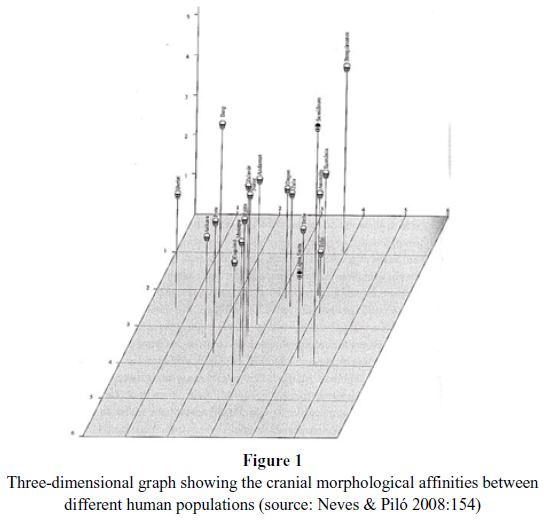
Although the concepts of dolichocephaly and brachycephaly are visually palpable (in the sense of imaginable), multivariate analyses locate individuals and groups in a statistical-mathematical space. What primarily matters in this space is the position of individuals in relation to others. This can be shown in Figure 1, which is a graph generated by multivariate analyses based on craniometric data (Neves & Piló 2008:154). Each of the samples (which appear as 'pinheads') is located in a three-dimensional space, those closest to each other also being more morphologically akin. What is worth emphasizing here is that, based on multivariate analyses, analysis works with the simultaneous and complex involvement of a large number of variables, whose interpretation involves a high degree of abstraction.
]]>
Hence while some of the methodological procedures used in the analyses of the skull of Luzia and other Paleo-Indians investigated by Neves and collaborators were born in the golden phase of an essentialist 19th century physical anthropology, the interpretations derived from this work seem to distance themselves from a racialized framework of human biological variability. On this point, examining more closely the works published by Neves and collaborators, we can observe that Luzia and other specimens are situated as belonging to human stocks that are temporally situated at a moment prior to the emergence of the morphobiological characteristics commonly attributed to 'racial groups.'
Luzia: from skull to 'person'
Luzia was a short woman, just 1.50 metres in height [...], a little over 20 years of age. Without any physical residence, she wandered through the region that is now Confins International Airport, on the outskirts of Belo Horizonte, accompanied by around a dozen kin [...]. Most of the time she made do with the fruits of twisted bushes, a few palm coconuts, tubers and leaves... On special occasions she would share with her companions a piece of meat from some animal they had succeeded in hunting [...]. She may have been the victim of an accident, or an animal attack [...]. The body was deposited in a cave [...]. Over a hundred centuries later, the oldest Brazilian is emerging from the depths of an archaeological site to the intense attention of the scientific world. (Teich 1999:80)
In its edition of August 25th 1999, from which the above excerpt is taken, the weekly magazine Veja stamped the following headline on its front cover: 'Luzia', The First Brazilian. The aim was to call the public's attention to a crucial moment in the evolution of Brazilian science, highlighting the revolutionary nature of the latest discoveries of palaeoanthropology and archaeology in terms of theories of how the prehistoric American continent came to be occupied. The text was accompanied by images of the facial reconstruction made from the archaeological specimen, novel at the time for Brazilians, including an illustration on the front cover showing three superimposed layers: part of the skull, 3D computer modelling and the anatomical surface moulded from clay (Figure 2).
]]>
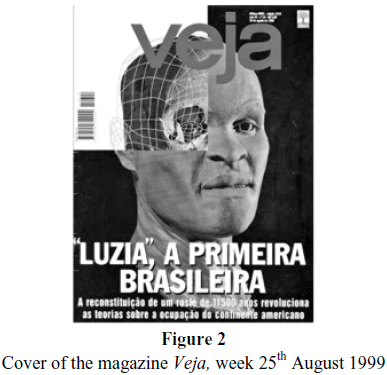
As well as flesh and bone, skull and face, the text and the images of the Veja report combined proximity and distance. Luzia is located as a remote ancestor, close in space and distant in time, but at the same time almost intimate with the readers, or more specifically, with each individual Brazilian. From bone fragments a spatiotemporally located person was 'born,' someone about whom we are told where and how she lived, with whom she wandered, what she ate and even how she came to die. Hence we are given information on a 'person' with a known name, sex, age, face and address. 'Someone' with a biography, inserted in a social, geographic and even historic environment, even identified as a Brazilian, despite the fact that Brazil, at that prehistoric moment,7 did not exist as a nation [paraphrasing the title of a book on the history and indigenous ethnology of South America, by the anthropologist Carlos Fausto (2000), Luzia antes do Brasil, or Luzia before Brazil].
The reconstruction of Luzia's face took place amid the large repercussion that the works of Neves and collaborators had on the specialized international press, in particular in the second half of the 1990s. It was in this context that the BBC in London, looking to make a documentary on the prehistoric occupation of the Americas,8 funded a craniofacial reconstruction of the specimen in 1998, undertaken by Richard Neave of the University of Manchester in England. Luzia's skull was mapped using computerized tomography in Brazil and the images sent to Manchester. There a replica of the skull was produced in resin over which the face was reconstructed using red-brown modelling clay. This reconstruction generated a face suggesting a visual similarity between Luzia and the appearance of populations of African origin.
Facial reconstructions based on skulls, as in the case of Luzia, involve a large dose of subjectivity. As Salles et al. emphasize (2006), reconstruction is likely to achieve a greater degree of precision where the external features are more directly linked to the bone structure. For example, in terms of the reconstruction in question, the general format of Luzia's head, determined directly by the cranial bones, is certainly closer to reality than other features such as the lips and ears. In the words of the same authors (2006:176), "some critiques of the techniques used in facial reconstruction concern the lack of any perfect fit between the soft parts of the face and the underlying bone [...] the absence of criteria to define subtle details such as the eyes, nose and mouth, which do not have any direct correspondence with the underlying bone structure." Commenting specifically on the reconstruction of Luzia, Salles et al. argue that:
[...] details like the ears, the anterior portion of the nose, the lips, the shape and colour of the eyes or the colour of the skin were chosen for the model based on the most well-known patterns for contemporary living populations that have a similar type of cranial and facial bone structure [...] These highly imprecise morphological details [...], combined with the artistic finish, gave Luzia a very specific facial expression. Scientifically highly questionable assumptions are therefore involved, admitted as problematic by the specialists themselves, including Richard Neave. Made for scientific popularization rather than research, this physiognomic image undoubtedly helped fix a stereotype that, although highly debatable, became a proven fact for the general public [...] (2006:182, our italics).
The 'personification' of specimens like Luzia, whether through facial reconstructions or through the attribution of names, is part of a relatively common tradition in studies of human evolution (palaeoanthropology) (Landau 1991). In an area of scientific knowledge where careers and new theories are frequently linked to and promoted by the discovery of specific fossils, practically every important fossil has, along with its scientific name, a 'nickname' associated with it.9 Consultation of just about any book of paleoanthropology reveals how the nicknaming of fossils is a common practice in the field.
As Michel Foucault reminds us in The Order of Things (2005), naming goes far beyond giving a label to something or someone: the name allows the thing to exist. In his analysis of the history of taxonomy in classical antiquity, which he argues enabled the ordering and establishment of hierarchical systemizations between beings and things, Foucault shows us how a connection can be made between the cosmological order and the order of discourse through representations in which "language transforms the sequence of perceptions into a table, and cuts up the continuum of beings into a pattern of characters. Where there is discourse, representations are laid out and juxtaposed" (2005:338-339).
]]> Hence the transition of these palaeoanthropological remains from a state of 'pure bone' to one of 'flesh and bone' (at least in the imagination, taking the present as our reference point), undoubtedly animated by immaterial attributes, is associated to some extent with the act of naming practiced by the scientists. In the specific case of the Lagoa Santa findings, variations occur according to the level with which we are dealing. Hence names like Lapa Vermelha Hominid IV, in the scientific domain, or Luzia, intended for the general public, were responsible for amplifying and facilitating the debates on the palaeoanthropological material of Minas Gerais beyond the more specialized academic circles. At the level of wider society, the name Luzia came to evoke 'someone' who had a 'face' and an identity.The idea of a person with a face and name turned Luzia into a personality capable of becoming immersed in the everyday life of Brazilian culture and society. As well as the distant biological kinship with the modern population of Brazil (some reports referred to Luzia as the 'mother of all Brazilians'), she was rapidly inserted into contemporary genealogical networks. Examples of this manifestation of nationality combined with a genealogical appropriation of the prehistoric past can be found in various media reports.
In a small news story from September 1st 1999, accompanied by a photo of Luzia's face, the newspaper Jornal do Brasil published the following text: "Discovery: Luzia, the 11,500-year old Brazilian unearthed in Minas Gerais (photo), and the great-great-great-grandmother of the great-great-grandmother of the soccer player Odvan are the same person"! (1999:10).10 In another item published in the magazine Bundas [Buttocks] (September 1999:41), also containing a photograph of Luzia's face, the writer and cartoonist Ziraldo joked that she was the ultimate ancestor of another soccer player, the latter being the reincarnation of the former, given the physical similarity between them:
Luzia, the founding mother of the Brazilian people [...] has been dying and reincarnating among us for more than 11,000 years. Until reaching the present, walking onto the pitch and sticking four goals [...] past Argentina [...], Luzia ended up – after hundreds of reincarnations – reborn as [the soccer player] Rivaldo. The face of one, the expression of the other.11
At another level, this time related to the 'toughness' of the daily life of the Brazilian, Luzia was transformed into the image of the citizen captured (and immobilized) by the web of state bureaucracy. The episode occurred during shipment of the facial reconstruction from England to Brazil. Rather than being classified as a scientific specimen, for which the customs process would be quicker, the reconstruction was taken to be a work of art, creating a series of additional problems before the item could be released in Rio de Janeiro and shown to the public. As a result of this episode, at the end of August and start of September 1999, the image of Luzia's face was emblazoned on the front cover of the country's main newspapers.
The reactions varied somewhat in tone. Wanderley de Souza, Secretary of Science and Technology of Rio de Janeiro at the time, in a short item published in the Jornal do Brasil on November 23rd 1999 (p. 9), entitled "Luzia and the Brazilian scientist," cites the saga of the moulded head stuck in the corridors of the customs agency as an example of the difficulties of doing science in Brazil. He adds the following comment: "Luzia discovered that the Brazilian scientific community has suffered for many years trying to continue to do science," as if she, in the capacity of a person and a Brazilian, had been able to 'experience for herself' the obstacles of Brazilian state bureaucracy.
Months earlier, the journalist Fritz Utzeri had published in the same newspaper, Jornal do Brasil, on September 1st 1999 (p.11) a text on the difficulties Luzia had confronted with Brazilian bureaucracy, but in a more humorous tone. In the piece, written as a dialogue between a customs officer and Luzia, the latter is questioned about her motives for coming to the country. During the conversation, Luzia expresses her 'irritation' at the treatment received from her supposed interlocutor:
]]> The circumstances describe above, dating from 1999, document the initial stages of the transformation of Luzia into a 'person' or, more than this, a 'Brazilian.' The archaeological specimen turned into 'someone' who could play on a soccer  pitch or be a hostage of Brazil's state bureaucracy. In the following years, which marked the commemorations (and also questionings) of the five centuries of the 'discovery' of Brazil, the cultural appropriations of Luzia proliferated.Me? A work of art? You've been drinking, you can't be right in the head. Have you looked at me? Do I look like a work of art? I'm the past, the living proof of anthropology. If I hadn't come here around 25,000 years ago, braving the seas, glaciers, mountains and forests, you probably wouldn't even be here... If I hadn't come, there wouldn't have been any Indians, nobody to greet [the Portuguese navigator] Cabral... They wouldn't have been any miscegenation, Ceci, Peri, Tupi, Guarani and guaraná, nothing! Why are you getting ready to commemorate Cabral's arrival with huge celebrations, while I, who arrived here much earlier, am barred and have to pay to return to my own country? It can't be right!
Appropriations in four times
Based on discussions at a seminar on questions related to the peopling of the Americas, held in Rio de Janeiro in August 1999, a news report was published that, not without a certain dose of sexism, cited the prehistoric setting in question:
Yesterday specialists in linguistics, genetics and anthropology met at the Federal University of Rio de Janeiro to discuss ways of isolating DNA from very ancient fossils. "It's difficult because the level of degradation is very high," says genetics professor Pedro Cabello. With the genetic code, we can know the size, colour and height of Luzia. Like all women, Luzia is a source of mystery for men – who, it seems, will never give up trying to discover all their secrets (Cabral 1999:26).
The entry on the scene of a skull, whose facial reconstruction revealed a semblance to a woman with 'negroid' features,12 as announced by the scientists, possessing an ancestrality supposedly preceding that attributed to indigenous peoples and 'coming' from Africa, occurred at a moment – in 2000 – involving discussion on 'our 500 year-old discovery.' In an interview to the popular science magazine Galileu, published in its August 2000 edition, and discussing the role of Luzia, the anthropologist Luiz Fernando Dias Duarte, then director of Rio de Janeiro's National Museum, seemed to summarize the expectations of that moment: "The various ages attributed to Brazil must be analyzed from different aspects. But a temporal idea of the nation is important to cultivating the Brazilian imaginary" (Galileu, August 2000:76-81).
As we shall see below, the analysis of a set of material extracted from the media and textbooks shows that Luzia was absorbed by the sociopolitical and cultural context of Brazil at the turn of this century, becoming closely associated with the national imaginary concerning the biological, ethnic and cultural past of the Brazilian people.13
The first example comes from the pages of the textbook História: Pré-História — Caderno 1 [History: Prehistory – Workbook 1] (2007), designed for primary-level education. Presenting students with the peopling of the Americas, the book juxtaposes three images for comparison: the faces of Luzia, Christopher Columbus and Pedro Álvares Cabral (2007:67) (Figure 3). On the following page we find a small questionnaire (pre-completed since this is a teacher's copy) asking the student to reply to a few questions. As can be seen in the quote below, looking to teach about origins, the text emphasizes the phenotype of the depicted figures:
]]> 2. What physical similarities between Columbus and Cabral can be observed in these portraits? From which continent did the two navigators come? Both are white. Both originated from Europe. // 3. Based on the observation of Luzia's portrait, would you say that she had the same origin as the Indians of Brazil or as the inhabitants of some regions of Africa and Oceania? Given the physical features (broad nose, round eyes, prominent chin and lips, perhaps the darker skin colouring), Luzia probably had the same origin as some inhabitants of Sub-Saharan Africa and the aborigines of Oceania. The Indians of Brazil are physically similar to the Asians: almond-shaped eyes, bronze-coloured skin, smooth and dark hair, small average height, like the Eskimos, the peoples of North America.
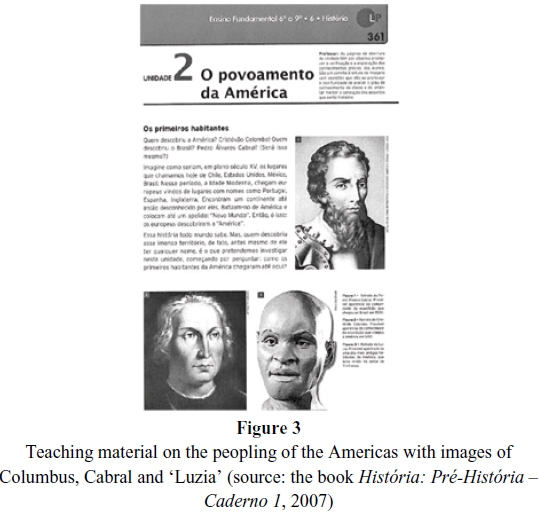
Hence although the reply to one of the questions suggest that all belong to the human species, the answers to the other two questions are based on the evaluation of morphological-racial features. It is worth highlighting the reference to the 'darker skin colouring' in Luzia's case. Even though, as mentioned earlier, the 'colour' of the facial reconstruction of Luzia had no scientific basis, in the textbook it becomes a 'reality,' a visible fact able to be transmitted to students.
The second example also comes from a school textbook, Bolando Aula [Planning Classes], a publication by Gruhbas – Projetos Educacionais e Culturais [Educational and Cultural Projects],14 in partnership with the Ministry of Education (MEC). In an edition specifically focused on racial questions (no. 85, May 2008), there is a section entitled "Diversity: racial questions in Portuguese language, history and biology classes." The content – which looks to provide background material for the teachers of these subjects to show students that the history of black people is not just about slavery and that much of the Brazilian vocabulary has been influenced by African languages – is also intended to ensure that the history of humanity is read in the light of evolutionary biology, taking into consideration the latest discoveries in the areas of archaeology and palaeoanthropology on the peopling of the Americas.
The overall aim is to enable students to discover that from the historical and biological viewpoint (thanks to DNA analyses), the birthplace of humanity is located in Africa and that the 'first Brazilian' (Luzia) was an African. As well as the effort (important, it should be added) to critically revise some of the correlated ideas that have led to a hierarchical view of the black or African contribution to the composition of the country's identity over its process of historical formation, along with the contributions of other ethnic-cultural groups marginalized by the European colonizers, there are various aspects that call attention in the material. For example, we read:
]]> Once again, as in various other publications cited here, the racial dimension is invoked to lend support to the intended objectives. Even more emphatically, in the section dedicated to "Classes on Human Biology and History" (2008:3), it is presumed that palaeoanthropological and biological discoveries will undermine "the arguments for the supposed superiority of the whites."In Classes on Human Biology and History: Teachers can seek out information on Africa as the birthplace of Humanity. The origin of humanity is known to have been in Africa. The DNA of the contemporary human group is more similar to the earliest primates, the Bushmen of South Africa and Botswana, belonging to the Khoisan linguistic group. Also according to a theory that asserts that Homo sapiens emerged in Africa before heading to other parts of the globe, the process of colonizing America can be traced back to an African woman, a thesis different to the one argued by the more traditionalist line of archaeology, impregnated by the North American vision. The first human beings left Africa and headed to Southeast Asia. Some 40,000 years ago, part of this population migrated to Australia and another part to northeast Asia. So are we all be descendants of the African people?! It is a revelation that will undoubtedly undermine the arguments for the supposed superiority of the whites. (Our italics.)
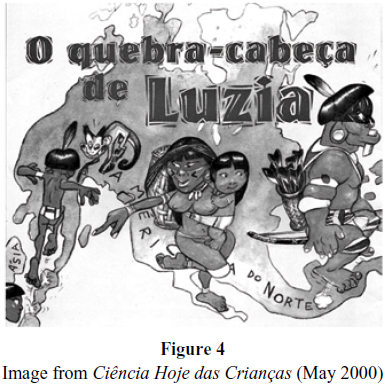
The third example concerns the May 2000 edition of the magazine Ciência Hoje das Crianças [Science Today for Children], a publication by the SBPC (Brazilian Society for the Advancement of Science ) intended to popularize science among a young readership, which included the feature "The Luzia Puzzle" (2000:22-25). In the image at the start of the item (Figure 4), Luzia is depicted as a black 'Wilma.'15 The picture transmits the idea of a black or African ancestry (or both) about to be replaced by a new wave of migration, this time shown as a population morphologically proximate to today's indigenous populations. While Luzia appears with dark shining ebony-like skin and curly hair (in other words, almost Nilotic), the indigenous people appear with a red complexion and straight hair. Another significant element in this image is the 'culturalization' of the depicted populations, presented with stereotypical clothing, artefacts and adornments.
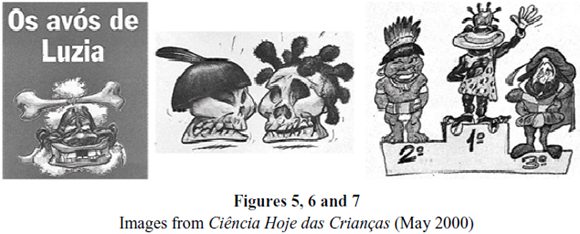
Various other symbolically rich images appear in the magazine item. One of them is a small picture of the supposed immediate ancestors of Luzia (her grandmother or grandfather) (Figure 5), displaying the same racialized features, while on the same page we find two skulls representing indigenous and black people confronting each other (Figure 6). In this case, both skulls are covered in hair that, very clearly, refers directly to the popular conception that all black people have curly hair and all indigenous people straight hair. Another scene that draws attention is that of a podium on which the three formative 'races' of Brazil are shown standing on different levels, with first place occupied by 'black African,' second place by the 'Indian' and third and last place by the 'white European' (Figure 7). The illustration appears to suggest the supremacy of one 'race' over the other. The facial expressions of the finalists of this 'ethnic race,' so to speak, also help transmit this idea: the 'black' winner shows an air of contentment shared to a degree by the indigenous runner-up (they are the winners of a race), while the white man has an expression of desolation.
The fourth and last example we wish to explore comes from a text posted on an internet blog, the Blog da Cidinha. Posted under the title 'Os Filhos de Luzia' on November 26th 2007, Cidinha da Silva, the author, recalls Luzia as the 'mother of all men,' the 'queen of all lands.' In her vision, Luzia can and should be seen as a 'black Eve,' the founding mother of all peoples, ethnic groups and cultures. "In the times when the Dead Sea was still sick, we were all children of Luzia. A fertile and giving mother, the origin of the peopling of all the worlds, undertaken by prodigious and courageous children who crossed deserts, rivers of crocodiles and waterfalls, unknown seas." In the author's vision, later, following the dispersion of humans around the globe, this 'first ancestor' and 'supreme queen,' who had 'authority over the world,' due to a set of historical and political factors ended up being abandoned by some of her 'children' and, subsequently, rejected by them. "How many children she had, Luzia never knew. But she knows that today she misses many of them [...] Some of her greedier children rejected Luzia, left their own lands and invaded the lands of their mother, and carved them up."
On the other hand, those that remained with her (and here it is important to interpret Luzia as both a woman and a continent, Africa) were torn from her breast and taken as slaves to new lands. There followed a deliberate effort to erect a barrier to memory, ostracizing the fact that all humans were children of one black woman. Luzia was erased from the collective memory of her children by some of them themselves. "They circled the tree of forgetting seven times to force them to erase Luzia and her teachings from their memory, turning them into slaves and inflicting them with forced labour, thousands of punishments and millions of atrocities." But time passed and, without any idea how or why, Luzia was rescued. This rescue showed people that, beyond their phenotypical features, they were all the fruit of the same trunk, Luzia, the unquestionable proof of which had been revealed by archaeological excavations and by the analysis of the genetic material of her children alive and mixed today:
Later they rescued the old and abandoned Luzia from ostracism, reclaimed the forgotten ancestry, asked for everyone's DNA and studied the results; they concluded that all and sundry were mixed, that someone who appears green in the face, is actually red in their DNA. Those who seem to have blue bodies, are actually lilac in their DNA. But what about the persecution of the greens? Everyone knows that they are hunted down by the system, isn't that right? If they take out their DNA exam and show it to the police, proving that their genetic material is red, will the system protect them? Guarantee the greens their survival, protecting them from extermination? These are the questions that won't keep quiet and only genetic material capable of providing safe-conduct can offer the response.
As can be noted, Cidinha's text, like the other examples, inserts the scientific proposals concerning the peopling of the Americas within the framework of the public debate on Brazilian identity as a result of a complex process of biological and cultural mixing. In a way, they show us that the belief in science as a founder of truths can act as a prop for all kinds of different claims. In the specific case of Cidinha's text, a double claim emerges. The author wants Luzia's errant children to recognize her and Africa as the wombs from which they were born and that, for this reason, they celebrate the historical and genetic siblinghood that makes all of them 'black' in their essence.
Taken as a whole, we can see, therefore, that the above examples – through their varying contexts – identify Luzia as an important common point for a re-reading of the recent and remote history of Brazil. What, then, is the sociohistorical and political background to all these different appropriations?
Bones, race, history and nation
Eric Hobsbawm begins the Introduction to his famous co-edited work The Invention of Tradition (1983) by pointing out that nothing seems more ancient and linked to immemorial times than the pageantry surrounding the public ceremonial manifestations of the British monarchy. Yet, he adds, contrary to what might be imagined, this ceremonial apparatus originated in relatively recent times, more precisely in the period between the 19th and 20th centuries. The author cites this as an example of an 'invented tradition,' that is,
]]>[…] a set of practices, normally governed by overtly or tacitly accepted rules and of a ritual or symbolic nature, which seek to inculcate certain values and norms of behaviour by repetition, which automatically implies continuity with the past. In fact, where possible, they normally attempt to establish continuity with a suitable historic past (1983:1).
Hobsbawm argues that the perspective of the 'invention of tradition' is particularly relevant in analyses of a relatively recent historical innovation, namely the concept of the 'nation' and associated phenomena (nationalism, the nation state, national symbols and historical narrative) (1983:13).
The perspective of the 'invention of tradition,' although not directly applicable to the discussion of Luzia, provides analytic elements that are useful to our analyses in this work. One of the central points for Hobsbawm, which resonates with our case study, is that the "sanction of perpetuity" is closely associated with rituals and symbolic complexes, which include objects (ibid:2).
Taking as a backdrop the analytic reference point outlined above, we can ask: what is Luzia if not an archaeological specimen that, after a series of transformations, including its 'personalization' (along racial lines) comes to link the present to a remote past? The skull and, soon after, the face of Luzia can be read as powerful symbols that reinvent the traditional view of the primordial period of human occupation of the American continent, as well as the origins of the Brazilian people, creating a powerful 'continuity with the past,' in Hobsbawm's terms.
Based on the 'symbolic complex,' which locates Luzia at its centre, new narratives emerge about the past, narratives that produce roots and ramifications in the present with multiple manifestations. A young prehistoric woman, who lived in the rock shelters of Lagoa Santa, transforms into an 'omnipresent' being in both time and space, circulating in various contexts of the past history and daily life of Brazilian society. As we were able to see in the initial image of the report from Ciência Hoje das Crianças, Luzia and her kin are depicted as the 'effective' owners of the Brazilian territory during its earliest period, while they also later observe the arrival of the 'Indians' and subsequently become the 'winners' of an ethnic-racial race, in this case represented by a podium (Figure 7); for Fritz Utzeri, Luzia is recalled crossing seas, glaciers, mountains and forests on the way to the New World, and later barred from entering the American continent on her return from 'acquiring a face' in England; for Vanderlei de Souza, she is interrogated by the oppressive Brazilian bureaucracy, coming to symbolize the hardships of doing science in the third world; for Ziraldo, after successive reincarnations, she thrashes the Argentinians in a soccer game; in a school textbook, she becomes part of a gallery of portraits of discoverers of the New World, until then supposedly white-European only, thereby undermining the 'white hegemony,' according to the message intended to be passed on to the children; for Cidinha, Luzia may be found as much in the hold of a slave ship as in the various metaphors of the word trunk, whether that of humanity's phylogeny traced through its shared DNA ('the trunk of humanity') or that of the atrocities perpetrated on slaves with an instrument of torture ('whipped tied to the trunk').
While Luzia appears in multiple forms, there seems to be a common element found across the diversity of manifestations of her 'symbolic complex': a reflexive framework impregnated with racialization. She presents herself (or is presented) as one of the elements of the racial triad making up the Brazilian people or, according to the formulation of Roberto DaMatta (1984), one of the characters from the 'fable of the three races.'
On this point it is worth examining the elements associated with the racialization of Luzia, including earlier factors. In fact in many media reports Luzia is described as an ancestral woman coming from the 'black race (and culture),' immediately connecting her to the African continent. Even before her facial reconstruction came to light, in the April 5th 1998 edition of the Folha de São Paulo newspaper, the following headline was stamped on the front cover: "Brazil's first woman was an African." In the digital version of the same date the following title appeared: "The first Brazilian was not an Indian." Published in the 'Caderno Mais' supplement under another title alluding to the 'Africanness' of Luzia ("Luzia: The First Woman of Brazil was African," p. 4), the article reported not only the impact of Walter Neves's work at the 67th Annual Meeting of the American Association of Physical Anthropologists in the US, but also explored the supposed black-African characteristics of the Lagoa Santa fossil. The magazine Superinteressante, for its part, in its September 1999 edition, presented a small news item in which it reported that Luzia was a black woman who had left Africa.
Analyzing in detail the material presented here, we noted that there was a profound distance between what the specialists said about the morphological idiosyncrasies of the skull properly speaking and the final result of the reconstruction process that generated Luzia's face and the content extracted by journalists. In fact Walter Neves himself has explained numerous times that the final result of Richard Neave's work cannot be taken as representative of any ethnic or racial expression of Luzia in particular, and of the other skulls found in Lagoa Santa in general.
A report published in the electronic journal Observatório da Imprensa [Media Observatory], on August 2nd 2001, explored an important aspect of the news stories on the origin of modern humans. Irrespective of whether the 'Out of Africa' theory is correct or not, the journalists had been attributing an extreme importance to the colour of our human ancestors. Did being African mean they were black? Asked about the issue, Walter Neves noted the absence of any necessary correlation between skin colour and geographic origin:
]]>The bioanthropologist Walter Neves emphasizes that, as they spread across the planet, the humans that left Africa adapted to various environments. It is not known whether they were black or whether the colour emerged later. It is likely that they were black because Africa was tropical at the time and hot climates favour an increase in the amounts of melanin (the pigment responsible for skin colouration), which has not been noted in regions with cold climates. "If this 'Out of Africa' hypothesis is correct, all of us, in some form, are African. This does not mean that we are black," the USP bioanthropologist points out. The studies reveal that the humans who arrived in the Americas may also have descended from the same group that left Africa 45,000 years ago.
In this passage it can be seen that Neves takes the category 'African' in a geographic sense (in biology, geography is an extremely important element in the studies of the dispersion of any living species, human or otherwise), at the same time as he rejects any immediate link between this fact and the skin colour of the ancestors of modern humans. When questioned on another occasion about Luzia's colour and its relation to the shape of the skull (Scientific American, August 2003 edition), the USP biological anthropologist was categorical: "Hence, for the same reason as molecular biology, the analysis of cranial morphology also suggests the absence of anything that we could call distinct races within the human species" (2003:28). The same point is also made in another two interviews. In the September 6th 2003 edition of the newspaper O Globo, Neves gave the following opinion regarding the fact that Luzia was not morphologically similar to contemporary indigenous peoples and the colour of her skin:
The Lagoa Santa sites have already 75 reasonably well preserved skulls that show a morphology similar to Luzia's, but we do not have the least idea what the colour of the skin of this people was – stresses Neves. We managed to show that these skulls possess a morphology that today corresponds to that of Africans and Australians, but we know that they came from Asia. The modern relations between cranial morphology and skin colour are not necessarily equal to those at the time (2003:11).
In the January 2005 edition of the journal Pesquisa, meanwhile, he once again insists on the non-correlation between morphology, skin colour and racial features supposedly visible on the reconstructed face of Luzia. Similarly three anthropologists from the National Museum – Ricardo Ventura Santos, Cláudiaz Rodrigues and Hilton Pereira da Silva – in texts published in the magazines Rio Artes (2000) and AMOR Cultural (2001), emphasized the half-scientific/half-artistic nature of the reconstruction of the famous Lagoa Santa skull (2000:8 and 2001:22, respectively):
It is important to stress that Luzia's face represents an artistic view based on scientific data of how the oldest 'Brazilian' known today might have been. The research continues and the methods of facial reconstruction available today will certainly be improved in the future. Anatomical aspects of Luzia that were not preserved, such the lips, ears, eyebrows, hair and skin colour, for example, had to be reconstructed via the vision of the artist/sculptor, based on what is known about contemporary groups whose bone structure is similar. Since these characteristics are highly variable and there is little or no relation to the bones, the final aspect of the face could have been altered considerably.
Our interpretation is that the reconstruction of the face played an especially prominent role in disseminating a racialized view of Luzia. Just as the skull's 'baptism' with a relatively common proper name (a nickname) contributed to the creation of an entire personalized back-history, the construction of a personality (whose aspects were discussed in the second section of this article), so the facial reconstruction elicited a swathe of sociocultural appropriations of the palaeoanthropological specimen, most of the time based on its supposed phenotypical traits, which, for their part, were directly related to a set of equally presumed ethnic-cultural and racial attributes.
Whatever elements helped pave the way for the strong racialization of Luzia, there seem to be some important specific elements in terms of her participation in the dynamic of race relations in contemporary Brazil. We argue that Luzia is a symbol that appears less associated with the idea of miscegenation than with the persistence of differences between the Brazilian population's 'racial stocks,' a fact explained by the political dynamics of the country in the first decade of the 21st century.
]]> A large body of work in history, sociology and anthropology has shown that the concept of 'race' and its derivatives were central to the construction of the nation and the view of Brazilian nationality (Maio & Santos 1996, Schwarcz 1993, 2001). Calling attention to the temporal depth of this process, the anthropologist Lilia Schwarcz recalls that in the first half of the 19th century the German naturalist Von Martius wrote that the Brazilian trajectory was like three affluents (the three 'races') that joined together to form a larger river, namely the Brazilian nation. In the cultural appropriations surrounding Luzia, there sometimes appears the idea of a mixture (as in Ziraldo's comment on Luzia "dying and reincarnating among us for more than 11,000 years"), but images more associated with racial segmentation tend to prevail. The idea of a podium with each of the races on one level, which can be seen in the pages of Ciência Hoje das Crianças (Figure 7), is radically different from affluents of a river that later combine.To apprehend the reach of the cultural appropriations surrounding Luzia we need to have a clear idea of the contemporary political setting in Brazil, in which 'race' emerges as a fundamental element in the debates on the present social situation and on the future of the country. Over the course of this decade, the concept of 'race' has animated innumerable debates, with implications such as the implementation of racially-targeted public policies in the country in areas as diverse as education, healthcare and land ownership (see, among others, Fry et al. 2007, Magnoli 2009, De Paula & Heringer 2009, Telles 2003). Two of the examples that we cited in the previous section, referring to the appropriations of Luzia in textbooks for primary-level pupils, are closely linked to the racially-based historical revisionism under way in Brazil. The maximum legal expression of this stance, one which has generated continual discussions, principally in the areas of education and culture, is Federal Law no. 10.639, approved in 2003 by the previous President of the Republic.
This law, known as an alteration to the Education Guidelines and Frameworks Act (Federal Law no. 9.394, of 1996), stipulates, in a general form, the compulsory teaching of Afro-Brazilian history and culture in all primary and secondary education establishments in the country (Brazil 2003). According to the law, the course must include "the study of the History of Africa and Africans, the struggle of black people in Brazil, Brazilian black culture and black people in the formation of national society, recuperating the contribution of black people in social, economic and political areas pertaining to the History of Brazil" (Article 26-A, § 1) (Maggie 2008, Trajano-Filho 2007). Not surprisingly, therefore, in some educational publications, both formal and informal, Luzia has received a certain prominence, emerging as a symbol of the supposed 'African ancestry' of Brazil to be absorbed by new generations of Brazilians during their educational training.
Luzia, with her antiquity and the phenotypical characteristics with which her face was reconstructed, appeared to the media as an unparalleled opportunity not only for the critical revision of the historical-cultural processes that unfold in contemporary Brazil, but also a chance to rearrange certain political structures with an eye to the future. A symbolic instrument for the critique and discussion of various aspects of Brazilian social life, the country's most famous prehistoric skull enabled, in one form or another, the construction of interpretative bridges capable of linking the past to the present, the present to the future and, more seriously, nature and culture from what remains a racial perspective.
Conclusion: Luzia is not alone
As can be observed in our analyses over the course of this text, the political implications potentially associated with the emergence of a distant but direct ancestor of Brazilians, possessing physical characteristics that distance the specimen from two of the three ethnic/cultural groups taken as the pillars of our civilization, precisely at a crucial moment of revisiting our historical past, did not pass unnoticed by the media outlets, which was disseminated to other spheres (such as the production of school textbooks). In their attempt to approach the lay public, journalists attributed Luzia with an importance beyond her material (and central) role within a specific scientific debate, seeing in the facial reconstruction of the skull the concomitant materalization of a biography and an ethnic-national history. A biographic materialization because, once her face was reconstructed, Luzia passed from the condition of 'pure bone' to that of a being made from 'flesh and bone,' an entity possessing personal attributes. And also a bearer of an ethnic-cultural history, because various of her attributes, like her antiquity, gender, geographical origin, morphological shape and so forth are related in one way or another to questions that always formed part of the debates on our national identity as marked by a high coefficient of racial, ethnic and cultural miscegenation.
One of the central aims of this article was to comprehend the Luzia phenomenon within the current socio-historico-cultural context of Brazilian society. While immersing our analysis in the local-national contextualization is important, it is worth reflecting on what our case study means by taking more distant scenarios as a reference point. Indeed it is possible to identity other 'Luzias' in other parts of the world, that is, other situations in which skulls or other remains excavated by archaeologists and studied by physical anthropologists become the central figures in sometimes heated disputes over sociocultural and historical re-readings, in general taking specific national contexts as their background.
A particularly striking parallel for Luzia comes from the other end of the American continent. This figure from North America is called, following the naming tradition mentioned earlier, 'Kennewick Man' (Burke et al. 2008, Downey 2000, Thomas 2000). The skull (a facial reconstruction of which also ended up featuring on the cover of a weekly magazine, in this case Time) was found partially buried on the shores of a small river in Washington state, USA, in 1996. Like Luzia too, what aroused attention during the analyses made following its discovery was the antiquity of the specimen associated with a morphology (considered 'caucasoid') that, in the opinion of various specialists, differed significantly from the morphology of Amerindians. As in the case of the Lagoa Santa skull, the appropriations made of Kennewick Man varied considerably.
Without entering into much detail on the skull's complex history, we can note that indigenous peoples from the region in which it was discovered made a request to the US government for the remains to be 'repatriated,' in line with the repatriation act in force in the United States, with the intention of burying the remains ceremonially in accordance with the indigenous tradition. At the same time, though, the supposed 'caucasoid' features of the archaeological find led to the 'Asatru Folk Assembly,' an organization located in California, following an ancient European (Norse) religion, to request possession of the material, believing it to be connected to waves of migrations of Europeans that had reached the American continent prior to the arrival of Columbus at the end of the 15th century. Adding further complexity to this scenario of ethnic-racial disputes, scientists went to court to request access to the material for research purposes, arguing that Kennewick Man was so old that it was not linked to any contemporary ethnic groups (see the detailed account in Burke et al. 2008:26-37). The archaeologist David Hurst Thomas, whose book on the question has a title indicating just how heated the debate over the skull became (Skull Wars: Kennewick Man, Archaeology, and the Battle for Native American Identity), presents in his foreword an image that encapsulates the disputes perfectly: a skeleton being pulled in various directions, each of these illustrated by one of the parties involved (social movements, researchers, legislators, etc.) (Figure 8). Thomas writes:
]]>The multicultural tug-of-war over Kennewick Man raises deep questions about how we can make the past serve the diverse purposes of the present, Indian as well as white. It also challenges us to define when ancient bones stop being tribal and become simply human. (2000:xxvi)
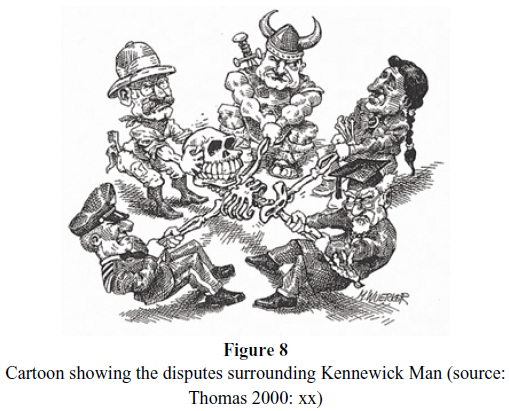
Luzia and Kennewick Man share various points in common: both were 'discovered' by science in the 1990s, they have similar chronological ages (around 10,000 years) and both were appropriated through symbolic complexes along racial lines in debates on history and national identity. However, at least to date, the appropriations surrounding Luzia have not reached the same level of polarization seen in the USA in relation to Kennewick Man.
As Stephen Jay Gould (1981) reminds us in his magisterial study The Mismeasure of Man, which deals with the history of research into the biology of the humans species (based on analyses of skulls, brains, bodies and so on) and biological determinism: "Facts are not pure and unsullied bits of information; culture also influences what we see and how we see it" (1981:22). Closer to ourselves, the journalist Marcelo Leite touches on the heart of the matter on the dust jacket to Neves & Piló's book: "Why not Luzia? Every country needs popular icons to support the construction of its own identity, for good or ill." It remains for us to await the future developments: after 10,000 years of 'anonymity' (first in a cave and later 'forgotten' in a museum drawer, as the popular version goes) of a fragmented skull (at first 'pure and unsullied' of meanings), but which underwent an intense racializations/culturalization, a 'person' was (re)born who, through an image already cited in this paper, continues to be 'reincarnated' in the various appropriations acquired in the complex and intricate sociocultural and political dynamic of contemporary Brazil.
Bibliography
]]> BRACE, Loring; SEGUCHI, Noriko & BRACE, Mary L. 2008. "Exploring the Kennewick connection". In: H. Burke; C. Smith; D. Lippert; J. Watkins & L. Zimmermam (eds.), Kennewick man: perspectives on the ancient one. Walnut Creek: Left Coast Press. pp. 153-168.BRAZIL. Federal Law no. 9394, of 20 December 1996. Establishes the guidelines and frameworks for national education. Available at http://www.planalto.gov.br/ccivil_03/LEIS/l9394.htm. Accessed on 30 September 2009.
___. Federal Law no. 10.639, of 9 January 2003. Establishes the guidelines and frameworks for national education, including in the official national curriculum the compulsory component 'Afro-Brazilian History and Culture' and other measures. Available at http://www.planalto.gov.br/ccivil_03/Leis/2003/L10.639.htm. Accessed on 30 September 2009.
BURKE, Heather; SMITH, Claire; LIPPERT, Dorothy; WATKINS, Joe & ZIMMERMAN, Larry (eds.). 2008. Kennewick man: perspectives on the ancient one. Walnut Creek: Left Coast Press.
CABRAL, Luciana. 1999. "'Luzia' é barrada pela burocracia". Jornal do Brasil, 31 August 1999.
DAMATTA, Roberto. 1984. Relativizando: uma introdução à antropologia social. Petrópolis: Vozes. [ Links ]
DE PAULA, Marilene & HERINGER, Rosana (eds.). 2009. Caminhos convergentes: Estado e sociedade na superação das desigualdades raciais no Brasil. Rio de Janeiro: Act!Onaid.
DOWNEY, Roger 2000. Riddle of the bones: politics, science, race and the story of Kennewick man. New York: Copernicus. [ Links ]
]]>FAUSTO, Carlos. 2005 [2000]. Os índios antes do Brasil. Rio de Janeiro: Jorge Zahar Editor. [ Links ]
FOUCAULT, Michel. 2005 [1966]. The Order of Things. London: Routledge.
FRY, Peter; MAGGIE, Yvonne; MAIO, Marcos Chor; MONTEIRO, Simone & SANTOS, Ricardo Ventura (eds.). 2007. Divisões perigosas: políticas raciais no Brasil contemporâneo. Rio de Janeiro: Civilização Brasileira.
GONZALÉS-JOSÉ, Rolando; BORTOLINI, Maria Cátira; SANTOS, Fabrício R. & BONATTO, Sandro 2008. "The peopling of America: craniofacial shape variation on the continental scale and its interpretation from an interdisciplinary view". American Journal of Physical Anthropology, 137:175-187. [ Links ]
GOULD, Stephan Jay. 1981. The Mismeasure of Man. New York: W.W. Norton & Co.
HOBSBAWM, Eric. 1983. "Introduction: inventing traditions". In: E. J. Hobsbawm & T. Ranger (eds.), The Invention of Tradition. Cambridge: Cambridge University Press. pp. 1-14.
KOWALSKI, Charles J. 1972. "A commentary on the use of multivariate statistical methods in anthropometric research". American Journal of Physical Anthropology, 36:119-131. [ Links ]
]]>LANDAU, Misia. 1991. Narratives of human evolution. New Haven: Yale University Press. [ Links ]
MAGGIE, Yvonne. 2008. "Pela igualdade". Estudos Feministas, 16:897-912. [ Links ]
MAGNOLI, Demetrio. 2009. Uma gota de sangue: história do pensamento racial. São Paulo: Editora Contexto. [ Links ]
MAIO, Marcos Chor & SANTOS, Ricardo Ventura (eds.). 1996. Raça, ciência e sociedade. Rio de Janeiro: Editora Fiocruz & CCBB.
NEVES, Walter & PUCCIARELLI, Hector. 1989. "Extra-continental biological relationships of early South American human remains: a multivariate analysis". Ciência e Cultura (SBPC), 41:566-575. [ Links ]
___. ; POWELL, Joseph F. & OZOLINS, Erik G. 1999. "Extra-continental morphological affinities of Lapa Vermelha IV, Hominid I: A multivariate analysis with progressive numbers of variables". Homo, 50:263-282. [ Links ]
___. & HUBBE, Mark. 2005. "Cranial morphology of early Americans from Lagoa Santa, Brazil: implications for the settlement of the New World". PNAS – Proceedings of the National Academy of Sciences of the United States of America, 102(51):18309-18314. [ Links ]
NEVES, Walter & PILÓ, Luís. 2008. O povo de Luzia: em busca dos primeiros americanos. São Paulo: Globo. [ Links ]
PROUS, André. 1992. Arqueologia brasileira. Brasília: Editora de Brasília. [ Links ]
SÁ, Guilherme J. S.; SANTOS, Ricardo Ventura.; RODRIGUES-CARVALHO, Claudia & SILVA, Elizabeth C. 2008. "Crânios, corpos e medidas: a constituição do acervo de instrumentos antropométricos do Museu Nacional na passagem do século XIX para o XX". História, Ciências, Saúde-Manguinhos, 15:197-208. [ Links ]
SALLES, Adilson D.; SOUZA, Sheila Maria & BRAZ, Valéria S. 2006. "Reconstruindo faces: revendo a história". In: H. P. Silva & C. Rodrigues-Carvalho (eds.), Nossa origem: o povoamento das Américas: visões multidisciplinares. Rio de Janeiro: Vieira & Lent. pp. 171-185.
]]> SANTOS, Ricardo Ventura. 1996. "Da morfologia às moleculas, de raça à população: trajetórias conceituais em antropologia física no século XX". In: M. C. Maio & R.V. Santos (eds.), Raça, ciência e sociedade. Rio de Janeiro: Editora FIOCRUZ. pp. 125-140.SANTOS, Ricardo Ventura & MAIO, Marcos Chor. 2005. "Antropologia, raça e os dilemas das identidades na era da genômica". História, Ciências, Saúde — Manguinhos, 12(2):447-468. [ Links ]
SCHWARCZ, Lilia Moritz. 1993. O espetáculo das raças: cientistas, instituições e questão racial no Brasil, 1870-1930. São Paulo: Companhia das Letras. [ Links ]
___. 2001. Racismo no Brasil. São Paulo: PubliFolha. [ Links ]
SILVA, Hilton P. 2009. Resenha de "O Povo de Luzia, em busca dos primeiros americanos", de W. A. Neves e Luís B. Piló. Amazônica, 1(2):568-574. [ Links ]
SPENCER, Frank. 1997. History of physical anthropology: an encyclopedia. New York: Garland Publishing Inc. [ Links ]
STOCKING, George W. 1968. Race, culture, and evolution. New York: Free Press. [ Links ]
___. (ed.). 1988. Bones, bodies, behavior: essays in behavioral anthropology. Madison: University of Wisconsin Press.
TEICH, Daniel Hessel. 1999. "A primeira brasileira". Veja, 34:80-87. [ Links ]
TELLES, Edward. 2003. Racismo à brasileira: uma nova perspectiva sociológica. Rio de Janeiro: Relume Dumará [ Links ].
THOMAS, David H. 2000. Skull wars: Kennewick Man, archaeology, and the battle for native american identity. New York: Basic Books. [ Links ]
]]> TRAJANO-FILHO, Wilson. 2007. "História da África — para quê?". In: P. Fry; Y. Maggie; M. C. Maio; S. Monteiro & R.V. Santos (eds.), Divisões perigosas: políticas raciais no Brasil contemporâneo. Rio de Janeiro: Civilização Brasileira. pp. 49-56.
Notes
* This work was originally presented at the Workgroup 'Ethnographing the Making of Science," during the 33rd Annual Meeting of ANPOCS, Caxambu, 2009. We thank in particular Daniela Knauth, Ednalva Neves and Paula Machado for their comments on the occasion. We also thank Gláucia Oliveira da Silva, Hilton Pereira da Silva, João Luiz Bastos, Sheila Mendonça de Souza and João Dal Poz Neto for reading and commenting on an earlier version of this text.
†TN: The billboard text refers to Ivo Pitanguy, a renowned Brazilian plastic surgeon.
1 The analyses conducted in this article are based on a set of approximately 100 items, especially material published in mainstream newspapers and magazines, as well as in textbooks, collected over the years by one of the authors (Ricardo Ventura Santos), a member of the academic staff of the Biological Anthropology sector of the National Museum, where Luzia's skull is stored. In analyzing this material, we do not presume that it is representative of all the appropriations made of the specimen. TV and radio reports on Luzia are not examined in this work. Rather than provide a 'systematic and totalizing' survey, our interest here is in exploring some of the directions that these appropriations took, in particular those along the lines of nationality, history and racial belonging.
2 Most of the human evolutionary process, begun approximately 5-6 million years ago, occurred on the African continent. The arrival of Homo sapiens on the American continent occurred very recently, in the last 15-20,000 years, and hence during a fairly late phase of the long and complex evolutionary trajectory of our species.
3 Recent criticisms of the model proposed by Neves can be found for example in Brace et al. (2008) and Gonzalés-José et al. (2008).
4 The application by eugenic science of the typological methodological premises developed by physical anthropology during its golden period can be seen in the documentary Homo Sapiens 1900 (1998), by Peter Cohen.
5 Dolichocephalic skulls have a greater length than width (longer heads), mesocephalic skulls show similar dimensions in terms of length and width, while brachycephalic skulls have a larger width than length (rounded heads). ]]>
Received on 12 October 2009
Approved on 10 November 2009