<?xml version="1.0" encoding="ISO-8859-1"?><article xmlns:mml="http://www.w3.org/1998/Math/MathML" xmlns:xlink="http://www.w3.org/1999/xlink" xmlns:xsi="http://www.w3.org/2001/XMLSchema-instance">
<front>
<journal-meta>
<journal-id>0104-9313</journal-id>
<journal-title><![CDATA[Mana]]></journal-title>
<abbrev-journal-title><![CDATA[Mana]]></abbrev-journal-title>
<issn>0104-9313</issn>
<publisher>
<publisher-name><![CDATA[Programa de Pós-Graduação em Antropologia Social - PPGAS-Museu Nacional, da Universidade Federal do Rio de Janeiro - UFRJ]]></publisher-name>
</publisher>
</journal-meta>
<article-meta>
<article-id>S0104-93132007000100001</article-id>
<title-group>
<article-title xml:lang="en"><![CDATA[Music in the indigenous societies of lowland South America: the state of the art]]></article-title>
<article-title xml:lang="pt"><![CDATA[Música nas sociedades indígenas das terras baixas da América do Sul: estado da arte]]></article-title>
</title-group>
<contrib-group>
<contrib contrib-type="author">
<name>
<surname><![CDATA[Bastos]]></surname>
<given-names><![CDATA[Rafael José de Menezes]]></given-names>
</name>
<xref ref-type="aff" rid="A01"/>
</contrib>
<contrib contrib-type="author">
<name>
<surname><![CDATA[Rodgers]]></surname>
<given-names><![CDATA[David Allan]]></given-names>
</name>
</contrib>
</contrib-group>
<aff id="A01">
<institution><![CDATA[,Federal University of Santa Catarina Department of Anthropology ]]></institution>
<addr-line><![CDATA[ ]]></addr-line>
</aff>
<pub-date pub-type="pub">
<day>00</day>
<month>00</month>
<year>2007</year>
</pub-date>
<pub-date pub-type="epub">
<day>00</day>
<month>00</month>
<year>2007</year>
</pub-date>
<volume>3</volume>
<numero>se</numero>
<fpage>0</fpage>
<lpage>0</lpage>
<copyright-statement/>
<copyright-year/>
<self-uri xlink:href="http://socialsciences.scielo.org/scielo.php?script=sci_arttext&amp;pid=S0104-93132007000100001&amp;lng=en&amp;nrm=iso"></self-uri><self-uri xlink:href="http://socialsciences.scielo.org/scielo.php?script=sci_abstract&amp;pid=S0104-93132007000100001&amp;lng=en&amp;nrm=iso"></self-uri><self-uri xlink:href="http://socialsciences.scielo.org/scielo.php?script=sci_pdf&amp;pid=S0104-93132007000100001&amp;lng=en&amp;nrm=iso"></self-uri><abstract abstract-type="short" xml:lang="en"><p><![CDATA[The last thirty years have seen a remarkable growth in the ethnomusicology of the South American lowlands. The region has emerged from relative obscurity - a state in which it languished for decades, despite possessing some of the world's oldest descriptions of 'primitive' music - through the publication of a wide variety of texts on the musical production of its indigenous peoples, along with various attempts at regional and sub-regional comparison. This ethnomusicological output - much of it originating in Brazil from the early 1990s onwards - has been complimented by monographs and regional comparative studies from anthropologists specialized in other areas, whose work has frequently highlighted the importance of music (typically in connection with other art forms, cosmology, shamanism and philosophy) for a clearer understanding of the region. The resulting panorama is promising. However it also requires analysis, a fundamental element in determining paths for future research. Divided into two parts, the article approaches this endeavour by focusing on written production, making secondary use of phonographic, videographic and other documental forms. The first part of the text surveys the literature produced on the region's music over the period. In the second part, I reflect on the main features of indigenous music to emerge from the literature and propose a number of working hypotheses for future investigations.]]></p></abstract>
<abstract abstract-type="short" xml:lang="pt"><p><![CDATA[Durante os últimos trinta anos, a etnomusicologia das terras baixas da América do Sul experimentou um forte crescimento. O fato está contribuindo para que a região venha a deixar de ser, definitivamente, uma das mais desconhecidas do planeta quanto às suas músicas, embora detentora de algumas das descrições mais antigas do mundo sobre música "primitiva". Um número importante de monografias e outros tipos de textos foram produzidos no período sobre a etnomusicologia da área, especialmente no Brasil e a partir de 1990, assim como tentativas de comparação regionais e sub-regionais. Também uma quantidade significativa de monografias e estudos comparativos sobre a região, feitos durante o período por antropólogos com outras especializações que não a etnomusicológica, apontou para a música - em conexão típica com as demais artes, a cosmologia, o xamanismo e a filosofia - como um domínio cujo conhecimento é estratégico para a compreensão da região. O quadro resultante desses esforços é promissor e está necessitando de análise, tarefa fundamental na direção da projeção de novas pesquisas. Este texto, dividido em duas partes, aproxima tal tarefa, centrando-se na produção escrita. Somente de passagem ele leva em conta as produções fonográfica, videográfica e similares. Na primeira parte do texto, levanto a literatura produzida no período sobre a música na região, assim como suas características. Na segunda, com base na literatura reconhecida, reflito sobre as principais marcas da música, e lanço hipóteses de trabalho para investigações futuras.]]></p></abstract>
<kwd-group>
<kwd lng="en"><![CDATA[South American lowlands]]></kwd>
<kwd lng="en"><![CDATA[Music and ritual]]></kwd>
<kwd lng="en"><![CDATA[Cosmology and philosophy]]></kwd>
<kwd lng="en"><![CDATA[Indigenous ethnomusicology]]></kwd>
<kwd lng="pt"><![CDATA[Terras baixas da América do Sul]]></kwd>
<kwd lng="pt"><![CDATA[Música e ritual]]></kwd>
<kwd lng="pt"><![CDATA[Cosmologia e filosofia]]></kwd>
<kwd lng="pt"><![CDATA[Etnomusicologia indígena]]></kwd>
</kwd-group>
</article-meta>
</front><body><![CDATA[ <p><font face="verdana" size="4"><b>Music in the indigenous societies of lowland    South America: the state of the art<a name="_ftnref1"></a><a href="#_ftn1"><sup>*</sup></a></b></font></p>     <p>&nbsp;</p>     <p><font face="verdana" size="3"><b>M&uacute;sica nas sociedades ind&iacute;genas    das terras baixas da Am&eacute;rica do Sul: estado da arte</b></font></p>     <p>&nbsp;</p>     <p>&nbsp;</p>     <p><font face="verdana" size="2"><b>Rafael José de Menezes Bastos</b></font></p>     <p><font face="verdana" size="2">Professor of the Department of Anthropology of    the Federal University of Santa Catarina. E-mail: <a href="mailto:rafael.bastos@pesquisador.cnpq.br">rafael.bastos@pesquisador.cnpq.br</a>    or <a href="mailto:rafael@cfh.ufsc.br">Rafael@cfh.ufsc.br</a></font></p>     <p><font face="verdana" size="2">Translated by David Allan Rodgers    <br>   Translation from <a href="http://www.scielo.br/scielo.php?script=sci_arttext&pid=S0104-93132007000200001&lng=en&nrm=iso&tlng=pt" target="_blank"><b>Mana</b>,    Rio de Janeiro, v.13 n.2, p. 293-316, Oct. 2007</a>.</font></p>     <p>&nbsp;</p>     ]]></body>
<body><![CDATA[<p>&nbsp;</p> <hr noshade size="1">     <p><font face="verdana" size="2"><b>ABSTRACT</b></font></p>     <p><font face="verdana" size="2">The last thirty years have seen a remarkable    growth in the ethnomusicology of the South American lowlands. The region has    emerged from relative obscurity — a state in which it languished for decades,    despite possessing some of the world's oldest descriptions of 'primitive' music    — through the publication of a wide variety of texts on the musical production    of its indigenous peoples, along with various attempts at regional and sub-regional    comparison. This ethnomusicological output — much of it originating in Brazil    from the early 1990s onwards — has been complimented by monographs and regional    comparative studies from anthropologists specialized in other areas, whose work    has frequently highlighted the importance of music (typically in connection    with other art forms, cosmology, shamanism and philosophy) for a clearer understanding    of the region. The resulting panorama is promising. However it also requires    analysis, a fundamental element in determining paths for future research. Divided    into two parts, the article approaches this endeavour by focusing on written    production, making secondary use of phonographic, videographic and other documental    forms. The first part of the text surveys the literature produced on the region's    music over the period. In the second part, I reflect on the main features of    indigenous music to emerge from the literature and propose a number of working    hypotheses for future investigations.</font></p>     <p><font face="verdana" size="2"><b>Key words</b>: South American lowlands, Music    and ritual, Cosmology and philosophy, Indigenous ethnomusicology</font></p> <hr noshade size="1">     <p><font face="verdana" size="2"><b>RESUMO</b></font></p>     <p><font face="verdana" size="2">Durante os &uacute;ltimos trinta anos, a etnomusicologia    das terras baixas da Am&eacute;rica do Sul experimentou um forte crescimento.    O fato est&aacute; contribuindo para que a regi&atilde;o venha a deixar de ser,    definitivamente, uma das mais desconhecidas do planeta quanto &agrave;s suas    m&uacute;sicas, embora detentora de algumas das descri&ccedil;&otilde;es mais    antigas do mundo sobre m&uacute;sica "primitiva". Um n&uacute;mero    importante de monografias e outros tipos de textos foram produzidos no per&iacute;odo    sobre a etnomusicologia da &aacute;rea, especialmente no Brasil e a partir de    1990, assim como tentativas de compara&ccedil;&atilde;o regionais e sub-regionais.    Tamb&eacute;m uma quantidade significativa de monografias e estudos comparativos    sobre a regi&atilde;o, feitos durante o per&iacute;odo por antrop&oacute;logos    com outras especializa&ccedil;&otilde;es que n&atilde;o a etnomusicol&oacute;gica,    apontou para a m&uacute;sica &#151; em conex&atilde;o t&iacute;pica com as demais    artes, a cosmologia, o xamanismo e a filosofia &#151; como um dom&iacute;nio    cujo conhecimento &eacute; estrat&eacute;gico para a compreens&atilde;o da regi&atilde;o.    O quadro resultante desses esfor&ccedil;os &eacute; promissor e est&aacute;    necessitando de an&aacute;lise, tarefa fundamental na dire&ccedil;&atilde;o    da proje&ccedil;&atilde;o de novas pesquisas. Este texto, dividido em duas partes,    aproxima tal tarefa, centrando-se na produ&ccedil;&atilde;o escrita. Somente    de passagem ele leva em conta as produ&ccedil;&otilde;es fonogr&aacute;fica,    videogr&aacute;fica e similares. Na primeira parte do texto, levanto a literatura    produzida no per&iacute;odo sobre a m&uacute;sica na regi&atilde;o, assim como    suas caracter&iacute;sticas. Na segunda, com base na literatura reconhecida,    reflito sobre as principais marcas da m&uacute;sica, e lan&ccedil;o hip&oacute;teses    de trabalho para investiga&ccedil;&otilde;es futuras.</font></p>     <p><font face="verdana" size="2"><b>Palavras-chave:</b> Terras baixas da Am&eacute;rica    do Sul, M&uacute;sica e ritual, Cosmologia e filosofia, Etnomusicologia ind&iacute;gena</font></p> <hr noshade size="1">     <p>&nbsp;</p>     <p>&nbsp;</p>     <p><font face="verdana" size="3"><b>Introduction</b></font></p>     ]]></body>
<body><![CDATA[<p><font face="verdana" size="2">Although the ethnomusicology of the South American    lowlands possesses some of the world's oldest descriptions of 'primitive music'    – Léry's account of the songs of the Tupinambá of Rio de Janeiro (1578 &#91;see    1980&#93;) and Montoya's depiction of the categories of the Guarani acoustic-musical    world (1639 &#91;1876&#93;)<a name="_ednref1"></a><a href="#_edn1"><sup>1</sup></a> – until recently its modern incarnation    lacked the same pace and depth of development found in regions such as sub-Saharan    Africa, North America and South-East Asia. I have no intention of exploring    the reasons for this discrepancy here. Over the last thirty years, though, this    academic area has expanded considerably and seems likely to continue to grow,    particularly in Brazil. This growth has been evident in the increased publication    of monographs and other types of ethnomusicological texts – essays, articles    and so on – along with works of other specialization that have included the    theme of music.<a name="_ednref2"></a><a href="#_edn2"><sup>2</sup></a> The panorama    resulting from these efforts is promising; what is now required is an analysis    of the overall profile of music in the region as a basis for developing new    research.</font></p>     <p><font face="verdana" size="2">Divided into two parts, the following article    looks to begin this task, focusing on written works and making secondary use    of phonographic, videographic and other documental forms. The first part of    the text surveys the literature published on the region's musical production    over the period. In the second part, I consider some of the most notable features    of the region's indigenous music.</font></p>     <p>&nbsp;</p>     <p><font face="verdana" size="3"><b>Part one — The main characteristics of the    literature</b></font></p>     <p><font face="verdana" size="2">The first characteristic of the ethnomusicology    in question is its predominantly ethnological source. To explain: ethnomusicology    as a discipline is basically rooted in two broad academic areas: anthropology    and music, the latter specifically via historical musicology (Menezes Bastos    1995). The ethnomusicology of Brazilian popular urban music, for example, has    been produced more or less in equal proportion by scholars working in these    two areas – and to a lesser degree other disciplines such as sociology and history    (Menezes Bastos 2005b). However, the literature on the indigenous music of the    South American lowlands has mainly been produced within the disciplinary area    of ethnology,<a name="_ednref3"></a><a href="#_edn3"><sup>3</sup></a> some of the key entry points into    music being studies of myth and cosmology, philosophy, linguistics, the arts    as a whole, ritual and shamanism, symbolism and cognition, history and politics.    An inquiry into the reasons for this virtual monopoly of lowlands ethnomusicology    by ethnology is also left here for another occasion.</font></p>     <p><font face="verdana" size="2">The second characteristic of the ethnomusicological    production in question – undoubtedly closely linked to this quasi-monopoly –    is that it frequently eschews the label 'ethnomusicology,' preferring to go    under rubrics such as 'the anthropology of music,' 'musical anthropology' and    so on. But whatever the disciplinary affiliation or label of the work, the interest    in indigenous music seems to have matured into a central theme of investigation    within the teaching and research systems responsible for the intellectual production    surveyed in this article – in the Brazilian case, postgraduate programs in social    anthropology. In effect, this anthropology of music appears to have acquired    a position similar to that of the sociology of music (Adorno 1983:259): it is    one of the diverse anthropologies of something, the 'something' in question    here being music.</font></p>     <p><font face="verdana" size="2">The third characteristic of the regional ethnomusicological    literature is that – like the works relating to the ethnology of the South American    lowlands as a whole – it has been produced in academic institutions located    in a range of countries, involving professionals of different nationalities    on an equal basis. This has lent a strong international flavour to the region's    ethnomusicology. Leading these countries are Brazil, France, Great Britain and    the United States, the first being where the literature seems to have proliferated    most – particularly from the 1990s onwards – thanks to the expansion in postgraduate    programs in social anthropology and their increasingly strong production of    master's dissertations and doctoral theses (see Beaudet 1993, Menezes Bastos    2005a, Coelho 2007).<a name="_ednref4"></a><a href="#_edn4"><sup>4</sup></a></font></p>     <p><font face="verdana" size="2"> The comparative perspective, generated from    within ethnography itself,<a name="_ednref5"></a><a href="#_edn5"><sup>5</sup></a> is the fourth characteristic of    the ethnomusicological production under consideration. This dimension is sustained    by the theoretical-methodological conviction – shared by Americanists of every    theoretical extraction – that the South American lowlands constitute a huge    relational system, communicating as far as the Andes (typically over the <i>longue    durée</i>). This relational system is dependent on the existence of a wide network    of communications in which the arts and artisticity play absolutely crucial    roles (Menezes Bastos 2001). By <i>artisticity</i> I mean a general state of    being that involves thinking, feeling and making in the general pursuit of 'beauty,'    the latter understood – far from its customary and typically academic Western    formulations – as no more than an entry point into the universes of art (as    much as 'monstrosity,' 'prototypicality,' 'efficacy,' 'formativity' and other    rubrics). This general state of being, manifest in studies covering a wide variety    of themes, including areas beyond those designated as 'fine arts' by the West,    is a pronounced feature of the region's cultures for whom the things and beings    of the cosmos are (and continually become) works of art. This applies from the    person to the cosmos and affects the whole of social life (see Overing 1989).</font></p>     <p><font face="verdana" size="2">Finally, it is worth noting that the growing    recognition for ethnomusicological studies has received further input at the    level of the political relations between lowlands indigenous societies and the    'white world:' the musicality and artistic expression typical of these peoples    have in themselves been important conduits for increasing awareness and solidarity    among the 'civilized' population and turning many of the latter into allies    of the Indians in their fights for citizenship. As part of this process, the    Indians, with the help of their allies, have begun to produce their own compact    disks and videos, as well as shows and other events (see Mello 2003).<a name="_ednref6"></a><a href="#_edn6"><sup>6</sup></a> Hence the fifth characteristic    of the ethnomusicology of the South American lowlands over the period under    study possesses a markedly political aspect.</font></p>     <p><font face="verdana" size="2">As I stated at the outset, the future for ethnomusicology    in the South American lowlands appears extremely promising. As well as a significant    number of pioneering studies produced from the 1970s onwards – such as those    by Camêu (1977), Menezes Bastos (1999a &#91;1978&#93;, 1990), Smith (1977), Beaudet    (1997 &#91;1977&#93;), Travassos (1984), Aytai (1985), Fuks (1989), Hill (1993), Seeger    (1987), Estival (1994), Olsen (1996) etc. – we can observe a blossoming of research    from the mid 1990s conducted by a new generation of ethnomusicologists, most    of them anthropologists. This growth has been particularly evident in Brazil.    New research includes Espinoza (1991), Salivas (1995), Silva (1997), Lima (1998),    Montardo (2002), Piedade (1997, 2004), Mello (1999, 2005), Cunha (1999), Véras    (2000), Werlang (2001), Dallanhol (2002), Coelho (2003), García (2005) and Herbetta    (2006)<a name="_ednref7"></a><a href="#_edn7"><sup>7</sup></a> among others.</font></p>     ]]></body>
<body><![CDATA[<p><font face="verdana" size="2">The existence of this new generation of ethnomusicologists    suggests that the ethnomusicology of the lowlands region has moved beyond its    phase of primitive capital accumulation, enabling its reproduction and development.    The work of the current generation should lead to an expansion in the ethnographic    coverage of the region's ethnomusicological production – still small, though    far from negligible, as this text aims to show – as well as the definition of    new analytic themes and theoretical-methodological approaches to music, and    the construction of interconnected regional and subregional comparative frameworks.</font></p>     <p><font face="verdana" size="2">To highlight further the promising situation    of the region's ethnomusicology, I note a final two points. Firstly, the training    of a burgeoning group of young anthropologists who, though not ethnomusicologists,    are carrying out research of considerable interest to our understanding of music    in the South American lowlands (see Barbosa 1991, Ribeiro 1992, Oliveira Júnior    1998, Romano 2000, Arcanjo 2003, Cesarino 2003 and Gorham 2005). Secondly, the    existence of very interesting rare documents, many published through restricted    outlets or publications with a narrow circulation. These include the studies    by Avery on the Mamaindé and Pareci (1973, 1974, 1973-1974, 1974-1975a, 1974-1975b)<a name="_ednref8"></a><a href="#_edn8"><sup>8</sup></a>    and those by Aytai on the Xetá and the Nambikwara (1978a, 1978b, 1978c, 1978d,    1979a, 1979b, 1979c, 1981a, 1981b, 1982a and 1982b). The sheer volume of these    references for just two authors suggests that these documents are merely the    tip of a much larger and more diversified iceberg.</font></p>     <p><font face="verdana" size="2">To conclude the first part of this article, it    is worth adding that lowlands ethnomusicology has been gaining a higher profile    through an ever increasing number of articles in recent collections on the ethnomusicology    of South America and Latin American in general (cf. Kuss 2004; Lühning &amp;    Rosa 2005; Lucas 1999; Lucas &amp; Menezes Bastos 2000; Olsen &amp; Sheehy 1998;    Sandroni 2006; Tugny &amp; Queiroz 2006). Attempts at comparison at both regional    and subregional level, though, are still limited in number and scope. Among    those available are: Menezes Bastos (1996), focusing on the music of Gê Indians;    Menezes Bastos &amp; Piedade (1999), on Tupi-Guarani peoples; and Montardo (2002),    on the Guarani. There are also a few works on the region as a whole, namely:    Beaudet (1993) and my own work (Menezes Bastos 1994, 1999b). In conclusion,    the foundations of regional ethnomusicology are sound and its future assured.</font></p>     <p>&nbsp;</p>     <p><font face="verdana" size="3"><b>Part two — Music in the South American lowlands:    key characteristics</b></font></p>     <p><font face="verdana" size="2">As I mentioned above, the attempts at comparison    involving the indigenous music of lowland South America are still few in number    and limited in scope, both at subregional and regional levels. Having surveyed    and described the literature on the area's musicology in the first part of the    article, I shall now embark on a modest attempt to overcome this limitation,    highlighting and discussing some of the features that I consider most notable    and outlining a number of ideas for future research. I should emphasize that    given the still relatively low – though, as I intend to demonstrate, significant    – ethnographic coverage of the subarea of the Americas under study, the characteristics    described below take the form of working hypotheses.</font></p>     <p><font face="verdana" size="2">The first characteristic I shall consider, a    topic on which I have written on various other occasions (Menezes Bastos 1994,    1996, 1999b, 2001; Menezes Bastos &amp; Piedade 1999), concerns the role – and    what is generally seen as the strategic value – played by music in the intersemiotic    chain of rituals in the region. This question was originally studied in two    geographically distant and culturally distinct lowlands areas by authors working    independently: in Peruvian Amazonia, by Smith (1977) among the Amuesha (Arawak);    and in the Upper Xingu, by myself (1978 &#91;1999a&#93;) among the Kamayurá (Tupi-Guarani).<a name="_ednref9"></a><a href="#_edn9"><sup>9</sup></a> Smith defines the role of music    in the Amuesha ritual complex as the <i>integrating centre</i> of the various    discourses pertaining to the complex; a centre that weaves, so to speak, the    unity of ritual expression out of the diversity of elements traversing these    discourses. It is as though music were the centripetal force enabling the convergence    of the visual, olfactory and other kinds of discourse composing the rites. Following    convergence of these elements, this force becomes centrifugal, recomposing the    diversity of ritual discourses. In the Kamayurá case, music likewise functions    as a pivotal system mediating the universes of the verbal arts (poetry and myth)    with plastic-visual expressions (graphic design, iconography, feather art) and    choreological expressions (dance, theatre). What the sources from the 1970s    highlight, therefore, is music's exemplary role in <i>integrating</i> and <i>intermediating</i>    the different discursive channels involved in the intersemiotic chain of ritual    in the indigenous lowlands.</font></p>     <p><font face="verdana" size="2">Basso (1985), studying the Kalapalo, a Carib    people also from the Upper Xingu, confirms these initial ideas while simultaneously    refining them: for the author, the very nature of ritual performance is musical    – hence her important concept of <i>musical ritual</i>, where music comprises    the key to ritual performance, effectively setting it in motion.<a name="_ednref10"></a><a href="#_edn10"><sup>10</sup></a> Gebhart-Sayer (1986, 1987),    writing about the Shipibo-Conibo (Pano) of Peruvian Amazonia, extrapolates further    on these connections. For her, the relation between music and visual designs    is essentially one of <i>translation</i>; in the shamanic rituals of these people,    songs are the reversible acoustic translation of pictorial motifs. Hence it    could even be said that the latter are the visual transcription of the former,    thereby functioning as their musical score or annotation (<i>non mensurata</i>,    so to speak). Similarly, among the Yekuana (Carib) of Venezuela described by    Guss (1990), basketry and song are so closely connected that it is almost as    though, for the Yekuana, to make baskets is to sing them into being.</font></p>     <p><font face="verdana" size="2">In sum, we can identify the general role played    by music in the intersemiotic chain of ritual in the South American lowlands,    revealing a semantic functionality that encompasses the nexuses of <i>integration</i>,    <i>intermediation</i>, <i>elicitation</i> and other like processes, synthesizable    by the generic nexus of <i>translation</i>. In a text published in 2001, I suggested    that in this context the idea of <i>translation</i> helps emphasize the interdependent    semantic relation between the subsystems active in the chain. This concept,    however, applies</font></p>     <blockquote>       ]]></body>
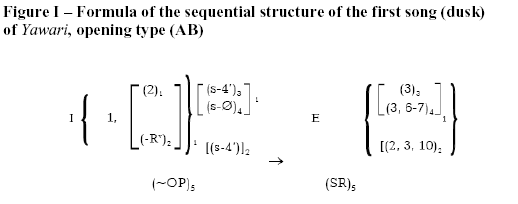
<body><![CDATA[<p><font face="verdana" size="2">&#91;…&#93; in tautegorical rather than allegorical      form, meaning that the kind of translation involved should not be conceived      in synonymic terms or as the reproduction of the same meanings by the different      signifying subsystems. It amounts to neither of these notions, since each      of these subsystems constitutes a separate way of expressing meanings from      other channels, dislocating them, however, from the subsequent meanings that      they mimetically produce (2001:348).</font></p> </blockquote>     <p><font face="verdana" size="2">This idea of <i>translation</i> is similar to    the kind advocated by Benjamin (1968), as the "search for resonances and reverberations    between distinct systems and codes, and for totalizations from partial points    of view" (see Carneiro da Cunha 1998:16).</font></p>     <p><font face="verdana" size="2">The second notable characteristic of the music    of the South American lowlands that I outlined in this text can be called <i>sequentiality</i>:    this concept refers to the musical organization of rituals at the inter-song    level – that is, at the level constituted by the interconnections between the    respective component songs (or instrumental or vocal-instrumental pieces). Notably,    Basso (1985:246-253) identifies Kalapalo rites as <i>musical</i>, arguing that    communication is enabled precisely through musical performance. Extending Basso's    point, the sequentiality to which I refer is explained by the fact that the    region's musical repertoires – in the vast majority of cases, as we have seen    above, part of complex semiotic chains – are organized in sequences (or sequences    of sequences) of chants (whether these are songs or vignettes), instrumental    pieces or vocal-instrumental pieces. These sequences, as well as the sequences    of sequences, frequently anchor the chronology of day and night and are anchored    by it. They may also be adapted to the chronologies of other temporal cycles,    such as months, seasons and so on, thereby composing musical calendars.</font></p>     <p><font face="verdana" size="2">Everything suggests, therefore, that isolated    musical pieces make little sense for lowland indigenous peoples. This sequentiality    at inter-song level – whose type of organization evokes that of the Western    suite (Fuller 2007) – was first described by myself in systematic form among    the Kamayurá (Tupi-Guarani) of the Upper Xingu (Menezes Bastos 1990, 1994, 1996a,    2004a, 2004b; Menezes Bastos &amp; Piedade 1999). It was then later studied    among the Kulina (Arawak) of Acre (Silva 1997), the Yepamesa (Tucano) (Piedade    1997), the Upper Xingu Waujá (Arawak) (Piedade 2004; Mello 1999, 2005), the    Guarani (Tupi-Guarani) of the Brazilian south and central-west (Montardo 2002),    the Arara (Carib) of Pará (Coelho 2003) and – precisely, so – among the Kalankó    'mixed Indians' of Alagoas (Herbetta 2006).</font></p>     <p><font face="verdana" size="2">It is my working hypothesis that this type of    organization is disseminated much more widely than the range of this sample    leads to suggest (although this sample is undoubtedly considerable, it is perhaps    somewhat self-replicating insofar as it is made up of my own ethnographies or    those of scholars who are or were my students and collaborators).</font></p>     <p><font face="verdana" size="2">A significant number of other ethnographies can    be listed here – none coming from the Santa Catarina circle, or indeed making    up part of any other circle, but involving indigenous groups geographically    distant and culturally diverse from each other. These include works by Beaudet    (1997 &#91;1977&#93;): on the Wayapi (Tupi-Guarani); Halmos (1979): Nambikwara; Aytai    (1985): Shavante (Gê); Basso (1985): Kuikúro (Karib Xinguano); Seeger (1987):    Suyá (Gê); Estival (1994): Arara (Carib); Cunha (1999): Pankararu – the latter    once again an example of 'mixed Indians.' All the evidence is that sequentiality    is one of the primary <i>rationales</i> for the organization of the region's    rituals at inter-song level. Detailed studies on the theme are now needed, though,    to consolidate this proposition. In the Kamayurá case investigated by myself,    sequentiality assumes an extremely complex form, following a pattern I have    denominated a <i>sequential structure</i>. Below I provide a small example of    this pattern, though one of great interest from the cognitive point of view,    and suggest that, as a pattern, it is typical rather than exceptional in the    lowlands (see Menezes Bastos 1990, 2004a, 2004b).</font></p>     <p><font face="verdana" size="2">The ethnography of the <i>Yawari</i> ritual that    I studied is massive, the ritual being one of those rites – very common in the    lowlands – with a long duration, whose preliminary phases may occur years before    their execution properly speaking.<a name="_ednref11"></a><a href="#_edn11"><sup>11</sup></a> However, when analyzed more    closely, the ethnography in question shows striking regularities: the song system    involved is a complex set of sequences of sequences of chants (songs or vignettes)    composed of repetitions – performed with large or small changes – of the sequences    making up part of the set. These repetitions are performed daily over the space    of 11 days. The component sequences are repeated isonomically and isotopically    as variants of each other. By <i>isonomy</i>, I mean the relation of structural    pertinence between sequences, characterizable as <i>transformations</i> (in    the Lévi-Straussian sense) of a structure (in the case at hand, a <i>sequential    structure</i>).<a name="_ednref12"></a><a href="#_edn12"><sup>12</sup></a> The term <i>isotopy</i> refers    to the sequence's temporal localization during the same part of the day. <i>Homologous</i>    sequences are simultaneously isonomic and isotopic. Changes are produced by    operations performed during the reiteration of the <i>reference sequence</i>    of each subset of variants.<a name="_ednref13"></a><a href="#_edn13"><sup>13</sup></a>    Songs or vignettes are thereby included, excluded, substituted, resequenced,    retrograded or repeated.</font></p>     <p><font face="verdana" size="2">Like the nuclides of certain chemical elements,    homologous sequences (or exceptionally, any sequence) swap components among    themselves (chants) as free (or almost free) particles that they incorporate    or release. I should note that the <i>Yawari</i> song system comprises nine    subsets of homologous sequences – variants of each other – which I also call    <i>cantos</i>, in the sense of macrounits of a protracted musical-poetic composition    (one evocative, indeed, of classical Mediterranean epopeias): dusk (types of    opening and return), night, deep night, early morning, dawn, late morning and    afternoon (types of reopening and continuation). Since for the Kamayurá the    day starts at twilight, dusk is the first song of <i>Yawari</i>; night, the    second, and so on until afternoon, the seventh and last canto.</font></p>     <p><font face="verdana" size="2">As I mentioned, the song system is organized    according to what I call a <i>sequential structure</i>. This can be seen as    both an <i>account</i> – a 'history' ­– and as a <i>program</i> – a 'structure'    of a composition of sequences (of chants &#91;songs and vignettes&#93; and sequences    of chants), administering two processes, <i>repetition</i> and <i>differentiation</i>,    taking chants as processing units. This results in three types of succession:    <i>progressions</i>, <i>regressions</i> and <i>stagnations</i>, which constitute    the 'future,' 'past' and 'present' tenses respectively. From the cognitive viewpoint,    the sequential structure is a teaching machine (like the Western suite and sonata    forms), in the sense used by Minsky (1983), while simultaneously comprising    a complex grouping (Snyder 2000:31-46) operating with long-term memory (2000:69-71).    Differently to the Western suite, though, it not only produces inter-song progression,    but also the return or regression, as well as stagnation – when the internal    time of the rite is itself annulled. As part of this process, the kinds of memory    employed involve both recognition (or identification) and forgetting (or effacement).    Or, to evoke a magnificent text, the marble <i>and</i> – because not <i>or</i>    – the myrtle.<a name="_ednref14"></a><a href="#_edn14"><sup>14</sup></a> In    order to explain my analysis more clearly, I briefly describe the first Yawari    canto, of opening (dusk) type. I produce a diagrammatic formula of its sequential    structure in which the inclusion (I) of chants regulate (&#8594;) their exclusion    (E).<a name="_ednref15"></a><a href="#_edn15"><sup>15</sup></a></font></p>     <p>&nbsp;</p>     ]]></body>
<body><![CDATA[<p align="center"><img src="/img/revistas/s_mana/v3nse/a01fig01.gif"></p>     <p>&nbsp;</p>     <p><font face="verdana" size="2">Expanding this formula, the opening (symbol AB)    of the Yawari song system has two main alternatives, namely:</font></p>     <blockquote>       <p><font face="verdana" size="2">1<sup>st </sup>: Its reference sequence (SR<sub>5</sub>),<a name="_ednref16"></a><a href="#_edn16"><sup>16</sup></a> when no (~) operation (OP) is      performed with any of its chants (~OP<sub>5</sub>) &#91;index 5&#93;.</font></p>       <p><font face="verdana" size="2">2<sup>nd</sup> : Its other sequences (which      follow the bifurcation signalled by the indices 1 and 2).</font></p> </blockquote>     <p><font face="verdana" size="2">The latter are generated in the following way:    depending on the inclusion (I) effected between chants 1 and 2 or 1 and (-R<sup>v</sup>)    – R<sup>v</sup> being one resequencing of chants – there are two possibilities    concerning the elements to be included (represented by indices 2, 3 and 4):</font></p>     <blockquote>       <p><font face="verdana" size="2">(s-4')</font></p>       <p><font face="verdana" size="2">(s-Ø)</font></p> </blockquote>     ]]></body>
<body><![CDATA[<p><font face="verdana" size="2">In these possibilities, <u>s</u> is a sequence    of chants (1', 2' and 3') with a high degree of stability, 4' is a chant and    Ø signals the absence of any chant. Both possibilities present a combination    with the first choice (index 1). However, only (s-4') combines with the second    (index 2).</font></p>     <p><font face="verdana" size="2">These inclusions regulate (<font face="Symbol"><b>®</b></font>)    the exclusions (E), which are as follows:</font></p>     <blockquote>       <p><font face="verdana" size="2">E (3)<sub>3</sub> for the combination of index      1, subindex 3, in which the 3 in brackets is another chant.</font></p>       <p><font face="verdana" size="2">E (3, 6-7)<sub>4</sub> for the combination      of index (1) again, subindex 4, in which 6-7 is the sequence of chants 6 and      7.</font></p>       <p><font face="verdana" size="2">E (2, 3, 10)<sub>2</sub> for the only possible      combination of index 2, in which 10 is another chant.</font></p> </blockquote>     <p><font face="verdana" size="2">This formula, written in function of the inclusions,    can be transposed into another formula – just as valid as the first – written    in function of the exclusions.</font></p>     <p><font face="verdana" size="2">The third characteristic of South American lowland    music I wish to discuss – what I have called the <i>nucleus-periphery structure</i>    – characterizes the types of relation between the individuals and groups of    performers making up the musical-choreographic groupings (solo, chorus, etc.).    From the outset, it is worth noting that this characteristic is not purely musical,    but also strongly choreological, that is, linked to dance.<a name="_ednref17"></a><a href="#_edn17"><sup>17</sup></a> Drawing from my studies of Upper    Xingu music and dance (Menezes Bastos 1990, 1994, 1996, 1999b), the relation    between the individuals and groups of performers making up the musical-choreographic    groupings in the indigenous lowlands is complex, unable to be reduced, for example,    to the two successive and alternating terms of the antiphonal form (solo and    chorus) frequently found in many other parts of the planet, such as sub-Saharan    Africa or in the West (Lomax 1968).</font></p>     <p><font face="verdana" size="2">The nucleus-periphery structure is constituted    by the relation – determined successively or simultaneously – between what I    term the <i>nucleus</i> and the <i>periphery</i>. The former is composed of    a male or female soloist (or master of music) and his or her helpers; the second    by the other performers (male or female). In the nucleus – made up of mature    adults – the soloist generally enters alone with the introduction (<i>caput</i>)    to each song or vignette, at the end of which he/she is followed by the helpers,    who the soloist typically repeats heterophonically.<a name="_ednref18"></a><a href="#_edn18"><sup>18</sup></a> Meanwhile the soloist continues    his or her song. Most of the time, this nucleus sings songs, here and there    intermediated with vignettes, which are generally onomatopoeic musical-linguistic    configurations with a high degree of stability.</font></p>     <p><font face="verdana" size="2">The periphery, on the other hand – composed of    young adults, adolescents and children – chant onomatopoeic sounds with varying    levels of musical-linguistic stability and/or improvise them, producing an extensive    polyphonic fabric. In the Upper Xingu case studied by myself, the nucleus and    the periphery are irreducible to one another, though they undoubtedly make up    part of the same whole. Their relation, which strongly evokes the Amerindian    conception of twinhood as an asymmetric duality (Lévi-Strauss 1993; Menezes    Bastos 1996), is given by the fact that both dramatize in their own way – through    the song and the musical-linguistic onomatopoeia, respectively – the myths at    the base of the rites.</font></p>     ]]></body>
<body><![CDATA[<p><font face="verdana" size="2">The nuclear-periphery structure can assume a    variety of forms, produced through the multiplication and/or cancellation of    its terms. Hence, individual solos and multiple individual solos (as in the    Suyá <i>akia</i> &#91;see Seeger 1987&#93;), as well as choruses (such as the Suyá <i>ngere</i>)    and other forms, can all be seen as variants of this base structure. In these    variations, the periphery ceases to exist: in the first case, the nucleus is    reduced to the solo; in the second, the solo – also chorus-less – is multiplied;    and in the third, only the chorus is present without the solo.</font></p>     <p><font face="verdana" size="2">From the choreographic viewpoint, some of the    most common dance patterns associated with this structure and its variations    are line, file (procession), wedge and block formations. Indeed, as emphasized    earlier, the third characteristic of the region's music is strongly choreographic    in nature, a sign that dance, as much as music and the other nodes of the intersemiotic    chain of ritual, is also a strategic area of interest in terms of understanding    the indigenous lowlands. In the Upper Xingu case (Menezes Bastos 1990, 2001;    Véras 2000), dance is manifested, including in native discourse, as the ultimate    reducer of the intersemiotic chain, a kind of limit of the latter beyond which    nothing more can exist.</font></p>     <p><font face="verdana" size="2">The third characteristic of the music found in    the South American lowlands region, systematically described in my work on Upper    Xingu music and dance, also seems to have a broad spectrum, spanning from the    Amazonian Northwest and Northeast (Piedade 1997; Beaudet 1997) to the south    of the lowlands (Montardo 2002); from the Brazilian Northeast (Cunha 1999; Herbetta    2006) to the southeast and southwest of Amazonia (Smith 1977; Silva 1997; Werlang    2001), covering numerous subregions within Amazonia (such as the cases studied    by Coelho 2003; Mello 2005; Seeger 1987; Véras 2000, as well as others).</font></p>     <p><font face="verdana" size="2">The fourth key characteristic concerns the main    process found in the region for composing musical pieces: <i>variation</i>.    In this process, the thematic material – typically the motifs,<a name="_ednref19"></a><a href="#_edn19"><sup>19</sup></a> usually exposed in the introduction    to the pieces – is developed through various procedures, including repetition,    augmentation, diminution, transposition, retrogradation and so on, with the    resulting transformations retaining the essential characteristics of the core    material.<a name="_ednref20"></a><a href="#_edn20"><sup>20</sup></a> This feature is widespread in    the region, spanning from Northern Amazonia (Piedade 1997; Beaudet 1997) to    the south of the continent (Montardo 2002); from the Brazilian Northeast (Cunha    1999; Herbetta 2006) to the south of Amazonia (Silva 1997; Werlang 2001), including    many subareas within the region. For a deeper analysis of this question, the    reader may confer, among many other works, the studies by Avery (1977); Halmos    (1979); Aytai (1985, 1978a-d, 1979a-c); Travassos (1984); Seeger (1987); Menezes    Bastos (1990); Véras (2000); Werlang (2001); Coelho (2003); Piedade (2004);    and Mello (2005).</font></p>     <p><font face="verdana" size="2">The detailed studies by Menezes Bastos (1990,    2004a, 2004b &#91;Kamayurá&#93;), Piedade (2004) and Mello (2005) &#91;Wauja&#93; reveal how    the process of variation lies at the base of musical composition at an intra-song    level among the Upper Xingu peoples. In the case of Kamayurá vocal music, what    I called <i>diatonic dyadism</i> is one of the most common procedures for generating    motifs, the diatonic dyad being constituted typically by notes ranging across    an interval of a third. Among the Kamayurá, this is the way par excellence of    constructing the tonal centre of a piece, whether ascending or descending, and    preferentially minor (major thirds tend to be much rarer). Once the piece's    initial motif is generated, its variations are then produced, forming sentences    and clauses, which usually regulate the process I have denominated <i>chromatic    serialism</i>, in which the original motif (or series) is varied by a gradual    <i>chromatic infilling</i>, which may result in the composition of completely    chromatic motifs derived form the original.</font></p>     <p><font face="verdana" size="2">Among the Wauja, Piedade (2004) in his study    of instrumental music shows with brilliance and rigour how motif variation lies    at the core of the process of musical composition of the so-called 'sacred flutes.'    The motifs – not necessarily equivalent to minimal segments – are here of two    types: <i>theme-motifs</i> and <i>play-motifs</i>, understood respectively as    signatures of the individual pieces and of the suites (sequences) of which the    former comprise part (2004:150). Among the variational principles, the author    notes those of augmentation, diminution, transposition, inversion and many others    (2004:201). Also among the Wauja, Mello (2005) shows how the process of variation    described by Piedade in relation to male instrumental music also applies to    female vocal music. On the other hand, developing analyses begun in her 1999    text, Mello (2005:9-11) demonstrates pursues an elegant musicological inquiry    to show how part of the male and female Wauja repertoires, typically those of    the so-called 'sacred flutes' and those of the female <i>Amurikumã</i> ritual,    strictly speaking, are variants of each other, as though women among this Arawakan    people sing vocal transpositions of the flute music, while men do the inverse,    performing flute renditions of the female vocal music.<a name="_ednref21"></a><a href="#_edn21"><sup>21</sup></a></font></p>     <p><font face="verdana" size="2">In other words, the process of variation traverses    musical genres and sexual genders. As well as variation distinguishing the process    of intra-song composition in the region, it also seems to mark it at the inter-song    level, that of the sequences, as in the case described above. In this sense,    each of the sequences making up the same universe of sequences is, as a rule,    a variant of the reference sequence.</font></p>     <p>&nbsp;</p>     <p><font face="verdana" size="3"><b>Final considerations</b></font></p>     <p><font face="verdana" size="2">As I stated at the start of this text, the current    situation of the studies on music in the indigenous societies of the South American    lowlands – a typical rather than specialist theme in regional ethnology –<sup>    </sup>is extremely promising. Although the ethnographic coverage available on    the subject is still small – though in no sense negligible,<a name="_ednref22"></a><a href="#_edn22"><sup>22</sup></a> as I have pointed out – it does    allow an appraisal of the general profile of music in the region, a basic requisite    for the development of future research. The present survey has highlighted four    essential characteristics of this profile. Firstly, the role of music in the    intersemiotic chain of ritual, pointing to the generic concept of <i>translation</i>.    This role is generally agreed to be of great interest; however, it needs to    be approached as a program for future investigation rather than an underlying    and paralysing parochial intellectual motif. I then proposed that, throughout    the region, sequentiality constitutes one of the <i>rationales</i> organizing    rituals at inter-song level; that is, the level composed by the interconnection    between the musical pieces (vocal, instrumental, vocal-instrumental) of the    respective song systems.</font></p>     ]]></body>
<body><![CDATA[<p><font face="verdana" size="2">The obvious and rather limited apprehension of    music as the 'art of time' – where memory figures as recognition – can be surpassed    through investigations into the links between this memory and the process of    forgetting. The nucleus-periphery structure with its variations – that is, transformations    – appears as the third characteristic in the present survey, anchoring our comprehension    of the complex relations involving the constituent elements of musical groupings    in the region. Not everything here can be reduced to the alternation between    solo and chorus, but the relation of irreducibility between the parts is also    an absolutely fundamental dimension. The structure in question signals that    dance – as much as music and the other nodes of the intersemiotic ritual chain    – is an area of strategic interest for understanding the region. This is a form    of dance, however, in which we find both <i>katabatic</i> tendencies – directed    towards the earth, with a desire for weight – and <i>acrobatic</i> tendencies    – directed towards the air, in search of 'freedom.'</font></p>     <p><font face="verdana" size="2">As the fourth and final characteristic, the present    study highlighted variation as a basic process of musical composition in the    region at intra-song level, referring to musical pieces, and inter-song level,    relating to their sequences. It should be noted that the idea of variation adopted    here does not simply discard the idea of development (see note 23). I suggest    that intensive and extensive research on these four points are now needed to    advance our specific knowledge concerning music and our general knowledge concerning    the ethnology of the South American lowlands.</font></p>     <p><font face="verdana" size="2">Clearly other topics need to be investigated    with the aim of complementing these studies. For example, to what extent are    linguistic-cultural divisions pertinent to the musical field and enable us to    speak in a consistent way about, for example, Tupi, Gê, Arawak and Carib musical    landscapes (Beaudet 1993:527)? What has been the impact of contact with the    'white world' on Amerindian musical systems, taking into account what the examples    of so-called 'mixed Indians,' such as the Pankararu (Cunha 1999) and Kalankó    (Herbetta 2006) seem to show? Finally, does Silva's findings among the Kulina    (Arawak) concerning the localization in the singing of crickets of the pulsation    for the music of a human ritual (Silva 1999) indicate a merely local phenomenon    or suggest something more widespread, perhaps revealing another feature of the    music of indigenous societies of the South American lowlands, linked to the    incorporation into human music of acoustic-musical elements derived from nature?</font></p>     <p>&nbsp;</p>     <p><font face="verdana" size="3"><b>Bibliography</b></font></p>     <!-- ref --><p><font face="Verdana, Arial, Helvetica, sans-serif" size="2">ADORNO, Teodor.    1983. "Id&eacute;ias para a sociologia da m&uacute;sica". In: P. E. Arantes    (org.), <i>Benjamin, Habermas, Horkheimer, Adorno</i>. S&atilde;o Paulo: Abril    Cultural. Cole&ccedil;&atilde;o <i>Os Pensadores</i>. pp.259-268.</font><!-- ref --><p><font face="Verdana, Arial, Helvetica, sans-serif" size="2">________. 1986.    "Sobre a l&oacute;gica das ci&ecirc;ncias sociais". In: G. Cohn (org.), <i>Sociologia:    Theodor W. Adorno</i>. S&atilde;o Paulo: &Aacute;tica. pp. 46-61.</font><!-- ref --><p><font face="Verdana, Arial, Helvetica, sans-serif" size="2">ARCANJO, Jozelito    Alves. 2003. Tor&eacute; e identidade &eacute;tnica: os Pipip&atilde; de Kambixuru    (&iacute;ndios da Serra Negra). Disserta&ccedil;&atilde;o de mestrado em antropologia,    Universidade Federal de Pernambuco, Recife.</font><!-- ref --><p><font face="Verdana, Arial, Helvetica, sans-serif" size="2">ARETZ, Isabel.    1991. <i>M&uacute;sica de los abor&iacute;genes de Venezuela</i>. Caracas: Fundef/    Conac.</font><!-- ref --><p><font face="Verdana, Arial, Helvetica, sans-serif" size="2">AVERY, Thomas L.    1973. "Relat&oacute;rio de dados etnomusicol&oacute;gicos" (referente a uma    visita &agrave; aldeia Tanorehana, Parec&iacute;) Ms.</font><!-- ref --><p><font face="Verdana, Arial, Helvetica, sans-serif" size="2">________. 1974.    "Mamaind&eacute; music transcriptions, 1973/1974". Bras&iacute;lia: Summer Institute    of Linguistics. Ms.</font><!-- ref --><p><font face="Verdana, Arial, Helvetica, sans-serif" size="2">________. 1973-1974.    "Mamaind&eacute; music analysis". 3 vols. Bras&iacute;lia: Summer Institute    of Linguistics. Ms.</font><!-- ref --><p><font face="Verdana, Arial, Helvetica, sans-serif" size="2">________. 1974-1975a    . "Mamaind&eacute; vocal music". Bras&iacute;lia: Summer Institute of Linguistics.    Ms. 42pp.</font><!-- ref --><p><font face="Verdana, Arial, Helvetica, sans-serif" size="2">________. 1974-1975b.    "Mamaind&eacute; vocal music". Bras&iacute;lia: Summer Institute of Linguistics.    Ms. (em carimbo: "an&aacute;lise provis&oacute;ria"). 31pp.</font><!-- ref --><p><font face="Verdana, Arial, Helvetica, sans-serif" size="2">________. 1977.    "Mamaind&eacute; vocal music". <i>Ethnomusicology,</i> 21(3):359-377.</font><!-- ref --><p><font face="Verdana, Arial, Helvetica, sans-serif" size="2">AYTAI, Desid&eacute;rio.    1978a. "Um microcosmo musical: cantos dos &iacute;ndios Xet&aacute;" (1). <i>Publica&ccedil;&otilde;es    do Museu Municipal de Paul&iacute;nia,</i> 3:1-8.</font><!-- ref --><p><font face="Verdana, Arial, Helvetica, sans-serif" size="2">________. 1978b.    "Um microcosmo musical: cantos dos &iacute;ndios Xet&aacute;" (2). <i>Publica&ccedil;&otilde;es    do Museu Municipal de Paul&iacute;nia</i>, 4:1-9.</font><!-- ref --><p><font face="Verdana, Arial, Helvetica, sans-serif" size="2">________. 1978c.    "Um microcosmo musical: cantos dos &iacute;ndios Xet&aacute;" (3). <i>Publica&ccedil;&otilde;es    do Museu Municipal de Paul&iacute;nia</i>, 5:1-17.</font><!-- ref --><p><font face="Verdana, Arial, Helvetica, sans-serif" size="2">________. 1978d.    "Um microcosmo musical: cantos dos &iacute;ndios Xet&aacute;" (4). <i>Publica&ccedil;&otilde;es    do Museu Municipal de Paul&iacute;nia</i>, 6:1-17.</font><!-- ref --><p><font face="Verdana, Arial, Helvetica, sans-serif" size="2">________. 1979a.    "Um microcosmo musical: cantos dos &iacute;ndios Xet&aacute;" (5). <i>Publica&ccedil;&otilde;es    do Museu Municipal de Paul&iacute;nia</i>, 8:13-19.</font><!-- ref --><p><font face="Verdana, Arial, Helvetica, sans-serif" size="2">________. 1979b.    "Um microcosmo musical: cantos dos &iacute;ndios Xet&aacute;" (6). <i>Publica&ccedil;&otilde;es    do Museu Municipal de Paul&iacute;nia</i>, 9:9-21.</font><!-- ref --><p><font face="Verdana, Arial, Helvetica, sans-serif" size="2">________. 1979c.    "Um microcosmo musical: cantos dos &iacute;ndios Xet&aacute;" (7). <i>Publica&ccedil;&otilde;es    do Museu Municipal de Paul&iacute;nia</i>, 10:15-22.</font><!-- ref --><p><font face="Verdana, Arial, Helvetica, sans-serif" size="2">________. 1981a.    "A flauta nasal nambikuara" (1). <i>Publica&ccedil;&otilde;es do Museu Municipal    de Paul&iacute;nia</i>, 17:6-17.</font><!-- ref --><p><font face="Verdana, Arial, Helvetica, sans-serif" size="2">________. 1981b.    "A flauta nasal nambikuara" (2). <i>Publica&ccedil;&otilde;es do Museu Municipal    de Paul&iacute;nia</i>, 18:11-26.</font><!-- ref --><p><font face="Verdana, Arial, Helvetica, sans-serif" size="2">________. 1982a.    "A flauta nasal nambikuara" (3). <i>Publica&ccedil;&otilde;es do Museu Municipal    de Paul&iacute;nia</i>, 19:12-19.</font><!-- ref --><p><font face="Verdana, Arial, Helvetica, sans-serif" size="2">________. 1982b.    "A flauta nasal nambikuara" (4). <i>Publica&ccedil;&otilde;es do Museu Municipal    de Paul&iacute;nia</i>, 20:8-16.</font><!-- ref --><p><font face="Verdana, Arial, Helvetica, sans-serif" size="2">________. 1985.    <i>O mundo sonoro xavante</i>. Cole&ccedil;&atilde;o Museu Paulista, Etnologia,    vol. 5. S&atilde;o Paulo: Universidade de S&atilde;o Paulo.</font><!-- ref --><p><font face="Verdana, Arial, Helvetica, sans-serif" size="2">AZEVEDO, Luiz Heitor    C. de. 1938. <i>Escala, ritmo e melodia dos &iacute;ndios brasileiros</i>. Rio    de Janeiro: Tipographia do Jornal do Com&eacute;rcio.</font><!-- ref --><p><font face="Verdana, Arial, Helvetica, sans-serif" size="2">________. 1941.    "Tupinamb&aacute; melodies in Jean de L&eacute;ry's 'Histoire d'un voyage faict    en la terre du Br&eacute;sil'". In: <i>Papers of the American Musicological    Society</i>, Annual Meeting, pp. 85-96.</font><!-- ref --><p><font face="Verdana, Arial, Helvetica, sans-serif" size="2">BARBOSA, Wallace    de Deus. 1991. Os &iacute;ndios Kambiw&aacute; de Pernambuco: arte e identidade    &eacute;tnica. Disserta&ccedil;&atilde;o de mestrado em belas artes, UFRJ, Rio    de Janeiro.</font><!-- ref --><p><font face="Verdana, Arial, Helvetica, sans-serif" size="2">BARROS, Liliam    Cristina da Silva. 2003. M&uacute;sica e identidade ind&iacute;gena na festa    de Santo Alberto: S&atilde;o Gabriel da Cachoeira, Alto Rio Negro, AM. Disserta&ccedil;&atilde;o    de mestrado em m&uacute;sica, Universidade Federal da Bahia, Salvador.</font><!-- ref --><p><font face="Verdana, Arial, Helvetica, sans-serif" size="2">________. M&uacute;sica    e identidade ind&iacute;gena na festa de Santo Alberto: preserva&ccedil;&atilde;o    e mudan&ccedil;a na cria&ccedil;&atilde;o de um acervo da comunidade do Bairro    da Praia. Tese de doutorado em m&uacute;sica (em andamento; in&iacute;cio em    2003). Universidade Federal da Bahia, Salvador.</font><!-- ref --><p><font face="Verdana, Arial, Helvetica, sans-serif" size="2">BASSO, Ellen B.    1985. <i>A musical view of the universe: kalapalo myth and ritual performances</i>.    Philadelphia: University of Pennsylvania Press.</font><!-- ref --><p><font face="Verdana, Arial, Helvetica, sans-serif" size="2">BEAUDET, Jean Michel.    1993. "L' ethonomusicologie de l' Amazonie". <i>L' Homme</i>, 126-128:527-533.</font><!-- ref --><p><font face="Verdana, Arial, Helvetica, sans-serif" size="2">________. 1997    &#91;1977&#93;. <i>Souffles d' Amazonie: les orchestres &laquo;Tule&raquo; des    Way&atilde;pi</i>. (Collection de la Soci&eacute;t&eacute; Fran&ccedil;aise    D' Ethnomusicologie, III). Nanterre: Soci&eacute;t&eacute; d' Ethnologie.</font><!-- ref --><p><font face="Verdana, Arial, Helvetica, sans-serif" size="2">BENJAMIN, Walter.    1968. "The task of the translator: an introduction to the translation of Beaudelaire's    'Tableaux parisiens'". In: <i>Illuminations</i>. New York: Schoken Books. pp.    69-82.</font><!-- ref --><p><font face="Verdana, Arial, Helvetica, sans-serif" size="2">BLASCO, Carlos    M. 2000. "Entre el folklore y la etnomusicologia: 60 a&ntilde;os de estudios    sobre la m&uacute;sica popular tradicional en Colombia". <i>Contratiempo &#151;    Revista de M&uacute;sica en la Cultura,</i> 11:36-49.</font><!-- ref --><p><font face="Verdana, Arial, Helvetica, sans-serif" size="2">CAM&Ecirc;U, Helza.    1977. <i>Introdu&ccedil;&atilde;o ao estudo da m&uacute;sica ind&iacute;gena    brasileira</i>. Rio de Janeiro: Conselho Federal de Cultura.</font><!-- ref --><p><font face="Verdana, Arial, Helvetica, sans-serif" size="2">CARNEIRO DA CUNHA,    Manuela. 1998. "Pontos de vista sobre a floresta amaz&ocirc;nica: xamanismo    e tradu&ccedil;&atilde;o". <i>Mana. Estudos de Antropologia Social,</i> 4(1):7-22.</font><!-- ref --><p><font face="Verdana, Arial, Helvetica, sans-serif" size="2">CESARINO, Pedro    de N. 2003. Palavras torcidas, met&aacute;fora e personifica&ccedil;&atilde;o    nos cantos xaman&iacute;sticos amer&iacute;ndios. Disserta&ccedil;&atilde;o    de mestrado em antropologia social, PPGAS/ Museu Nacional/ UFRJ, Rio de Janeiro.</font><!-- ref --><p><font face="Verdana, Arial, Helvetica, sans-serif" size="2">COELHO, Luis Fernando    Hering. 2003. Para uma antropologia da m&uacute;sica arara (Caribe): um estudo    do sistema das m&uacute;sicas vocais. Disserta&ccedil;&atilde;o de mestrado    em antropologia social, Universidade Federal de Santa Catarina, Florian&oacute;polis.</font><!-- ref --><p><font face="Verdana, Arial, Helvetica, sans-serif" size="2">________. 2004.    "M&uacute;sica ind&iacute;gena no mercado: sobre demandas, mensagens e ru&iacute;dos    no (des)encontro intermusical". <i>Campos</i>, 5:151-166.</font><!-- ref --><p><font face="Verdana, Arial, Helvetica, sans-serif" size="2">________. 2007.    "A nova edi&ccedil;&atilde;o de <i>Why Suy&aacute; Sing</i>, de Anthony Seeger,    e alguns estudos recentes sobre m&uacute;sica ind&iacute;gena nas terras baixas    da Am&eacute;rica do Sul". <i>Mana</i>. <i>Estudos de Antropologia Social</i>,    13(1):237-249.</font><!-- ref --><p><font face="Verdana, Arial, Helvetica, sans-serif" size="2">COOLEY, Timothy    J. 1997. "Custing shadows in the field: an introduction". In: F. Barz &amp;    T. J. Cooley (orgs.), <i>Shadows in the field: new perspectives for fieldwork    in ethnomusicology</i>. New York/ Oxford: Oxford University Press. pp.1-19.</font><!-- ref --><p><font face="Verdana, Arial, Helvetica, sans-serif" size="2">CUNHA, Maximiliano    Carneiro da. 1999. A m&uacute;sica encantada pankararu &#151; toantes, tor&eacute;s,    ritos e festas na cultura dos &iacute;ndios Pankararu. Disserta&ccedil;&atilde;o    de mestrado em antropologia cultural, Universidade Federal de Pernambuco, Recife.</font><!-- ref --><p><font face="Verdana, Arial, Helvetica, sans-serif" size="2">DALLANHOL, K&aacute;tia    Maria B. 2002. Jeroky e Jerojy: por uma antropologia da m&uacute;sica entre    os Mby&aacute;-Guarani de Morro dos Cavalos. Disserta&ccedil;&atilde;o de mestrado    em antropologia social, Universidade Federal de Santa Catarina, Florian&oacute;polis.</font><!-- ref --><p><font face="Verdana, Arial, Helvetica, sans-serif" size="2">DUDEQUE, Norton.    2005. "Aspectos do academicismo germ&acirc;nico no primeiro movimento do Quarteto    n. 3 de Alberto Nepomuceno". <i>Ictus,</i> 6:211-232.</font><!-- ref --><p><font face="Verdana, Arial, Helvetica, sans-serif" size="2">ERMEL, Priscilla    Barrak. 1988. O sentido m&iacute;tico do som: resson&acirc;ncias est&eacute;ticas    da m&uacute;sica tribal dos &iacute;ndios Cinta-larga. Disserta&ccedil;&atilde;o    de mestrado em antropologia social, Pontif&iacute;cia Universidade Cat&oacute;lica,    S&atilde;o Paulo.</font><!-- ref --><p><font face="Verdana, Arial, Helvetica, sans-serif" size="2">ESPINOZA, Birgitta    Leduc de. 1991. Les chants magiques achuar et leurs avatars instrumentaux. Paris:    Universit&eacute; Paris X &#151; Nanterre. Mem&oacute;ria de DEA.</font><!-- ref --><p><font face="Verdana, Arial, Helvetica, sans-serif" size="2">ESTIVAL, Jean-Pierre.    1994. Musiques instrumentales du Moyen Xingu et de l' Iriri (Br&eacute;sil).    Tese de doutorado em antropologia social, Universit&eacute; de Paris X, Nanterre.</font><!-- ref --><p><font face="Verdana, Arial, Helvetica, sans-serif" size="2">_______. 2006:    "Mem&oacute;ria, emo&ccedil;&atilde;o, cogni&ccedil;&atilde;o nos cantos Irade    dos Ayor&eacute; do Chaco Boreal". <i>Mana. Estudos de Antropologia Social</i>,    12(2):315-332.</font><!-- ref --><p><font face="Verdana, Arial, Helvetica, sans-serif" size="2">FRANCHETTO, Bruna.    1993. "A celebra&ccedil;&atilde;o da hist&oacute;ria nos discursos cerimoniais    kuikuro (Alto Xingu)". In: M. Carneiro da Cunha &amp; E. viveiros de Castro    (orgs.), <i>Amaz&ocirc;nia: etnologia e hist&oacute;ria ind&iacute;gena</i>.    S&atilde;o Paulo: N&uacute;cleo de Hist&oacute;ria Ind&iacute;gena e do Indigenismo    da USP/ Fapesp. pp. 95-116.</font><!-- ref --><p><font face="Verdana, Arial, Helvetica, sans-serif" size="2">________. 2000.    "La parole du chef: rencontres rituels dans le Haut Xingu". In&nbsp;: A. Monod-Becquelin    &amp; P. Erikson (orgs.), <i>Les rituels du dialogue: promenades ethnolinguistiques    en terres am&eacute;rindiennes</i>. Nanterre: Societ&eacute; d'Ethnologie, 99.    pp. 481-510.</font><!-- ref --><p><font face="Verdana, Arial, Helvetica, sans-serif" size="2">FUKS, Victor. 1989.    Demonstration of multiple relationships between music and culture of the Wai&atilde;pi    indians of Brazil. Tese de doutorado em antropologia social, Indiana University,    Bloomington.</font><!-- ref --><p><font face="Verdana, Arial, Helvetica, sans-serif" size="2">FULLER, David.    2007. "Suite". In: L. Macy (org.), <i>Grove music online</i>. <a href="http://www.grovemusic.com" target="_blank">http://www.    grovemusic.com</a>. Acesso em 07/04/2007.</font><!-- ref --><p><font face="Verdana, Arial, Helvetica, sans-serif" size="2">GALLOIS, Dominique    T. &amp; CARELLI, Vincent. 1995. "Di&aacute;logo entre povos ind&iacute;genas:    a experi&ecirc;ncia de dois encontros mediados pelo v&iacute;deo". <i>Revista    de Antropologia</i>, 38(1):205-259.</font><!-- ref --><p><font face="Verdana, Arial, Helvetica, sans-serif" size="2">GARC&Iacute;A,    Miguel A. 2002. "Making culture coherent: nomadism, 'Open Agenda' and music    in Wichi society&nbsp;". <i>Yearbook for Traditional Music,</i> 34:47-65.</font><!-- ref --><p><font face="Verdana, Arial, Helvetica, sans-serif" size="2">________. 2005.    <i>Paisajes sonoros de un mundo coherente. Pr&aacute;cticas musicales en la    sociedad Wich&iacute;</i>. Buenos Aires: Instituto Nacional de Musicologia.</font><!-- ref --><p><font face="Verdana, Arial, Helvetica, sans-serif" size="2">GEBHART-SAYER,    Angelika. 1986. "Una terapia est&eacute;tica. Los dise&ntilde;os vision&aacute;rios    de ayahuasca entre los Shipibo-Conibo". <i>Am&eacute;rica Ind&iacute;gena</i>,    46(1):189-218.</font><!-- ref --><p><font face="Verdana, Arial, Helvetica, sans-serif" size="2">________. 1987.    <i>Die Spitze des Bewusstseins. Untersuchungen zu Weltbild und Kunst der Shipibo-Conibo</i>.    Hohensch&auml;ftlarn: Klaus Renner Verlag.</font><!-- ref --><p><font face="Verdana, Arial, Helvetica, sans-serif" size="2">GORHAM, Jeffrey    Scott. 2005. Sonhos e cantos ind&iacute;genas. Exemplos de poder xaman&iacute;stico    sul-americano. Disserta&ccedil;&atilde;o de mestrado em antropologia social,    Universidade de Bras&iacute;lia.</font><!-- ref --><p><font face="Verdana, Arial, Helvetica, sans-serif" size="2">GRAHAM, Laura R.    1995. <i>Performing dreams: discourses of immortality among the Xavante of Central    Brazil</i>. Austin: University of Texas Press.</font><!-- ref --><p><font face="Verdana, Arial, Helvetica, sans-serif" size="2">GUSS, David M.    1990. <i>To weave and sing: art, symbol, and narrative in the South American    rainforest</i>. Berkeley/ Los Angeles: University of California Press.</font><!-- ref --><p><font face="Verdana, Arial, Helvetica, sans-serif" size="2">HALMOS, Istvan.    1979. "The music of Nambicuara indians (Mato Grosso, Brazil)". <i>Acta Ethnographica    Academiae Scientiarum Hungaricae,</i> 28:205-350.</font><!-- ref --><p><font face="Verdana, Arial, Helvetica, sans-serif" size="2">HERBETTA, Alexandre    Ferraz. 2006. O "idioma" kalank&oacute;: por uma etnografia da m&uacute;sica    no Alto-Sert&atilde;o alagoano. Disserta&ccedil;&atilde;o de mestrado em antropologia    social, Universidade Federal de Santa Catarina, Florian&oacute;polis.</font><!-- ref --><p><font face="Verdana, Arial, Helvetica, sans-serif" size="2">HILL, Jonathan.    1993. <i>Keepers of the sacred chants: the poetics of ritual power in an amazonian    society</i>. Tucson: University of Arizona Press.</font><!-- ref --><p><font face="Verdana, Arial, Helvetica, sans-serif" size="2">HIGUITA, Jes&uacute;s    M. Gir&oacute;n. 2004. <i>Recuperaci&oacute;n de cantos de baile de la etnia    Puinave del Departamento del Guain&iacute;a</i>. Bogot&aacute;: Universidad    de los Andes.</font><!-- ref --><p><font face="Verdana, Arial, Helvetica, sans-serif" size="2">HUGH-JONES, S.    1979. <i>The palm and the pleiades: initiation and cosmology in northwest Amazonia</i>.    Cambridge: Cambridge University Press.</font><!-- ref --><p><font face="Verdana, Arial, Helvetica, sans-serif" size="2">KUSS, Malena. 2004.    <i>Music in Latin Am&eacute;rica and the Caribbean: an encyclopedic History</i>.    vol.1. Austin: University of Texas Press.</font><!-- ref --><p><font face="Verdana, Arial, Helvetica, sans-serif" size="2">L&Eacute;RY, Jean    de. 1980 &#91;1578&#93;. <i>Viagem &agrave; terra do Brasil</i>. Belo Horizonte:    Itatiaia.</font><!-- ref --><p><font face="Verdana, Arial, Helvetica, sans-serif" size="2">L&Eacute;VI-STRAUSS,    Claude. 1980 &#91;1952&#93;. "A no&ccedil;&atilde;o de estrutura em etnologia".    In: M. Chau&iacute; (org.), <i>Os pensadores: L&eacute;vi-Strauss</i>. S&atilde;o    Paulo: Abril. pp.1-43.</font><!-- ref --><p><font face="Verdana, Arial, Helvetica, sans-serif" size="2">________. 1991    &#91;1964&#93;. <i>O cru e o cozido</i> (<i>Mitol&oacute;gicas I</i>). S&atilde;o    Paulo: Brasiliense.</font><!-- ref --><p><font face="Verdana, Arial, Helvetica, sans-serif" size="2">________. 1993    &#91;1991&#93;. "A ideologia bipartida dos amer&iacute;ndios". In: <i>Hist&oacute;ria    de lince</i>. S&atilde;o Paulo: Companhia das Letras. pp.204-217.</font><!-- ref --><p><font face="Verdana, Arial, Helvetica, sans-serif" size="2">LIDOV, David. 1975.    <i>On musical phrase</i>. Montreal: Universit&eacute; de Montreal.</font><!-- ref --><p><font face="Verdana, Arial, Helvetica, sans-serif" size="2">LIMA, Ana Paula    Ratto de. 1998. Tra&ccedil;os n&ocirc;mades: r&iacute;tmicas da m&uacute;sica    amer&iacute;ndia. Disserta&ccedil;&atilde;o de Mestrado em Antropologia Social,    PPGAS/ Museu Nacional/ UFRJ, Rio de Janeiro.</font><!-- ref --><p><font face="Verdana, Arial, Helvetica, sans-serif" size="2">LOMAX, Alan. 1968:    <i>Folk song style and culture</i>. Washington: American Association for the    Advancement of Science.</font><!-- ref --><p><font face="Verdana, Arial, Helvetica, sans-serif" size="2">LOUREN&Ccedil;O,    Sonia Regina. 2006. A dan&ccedil;a dos Aruan&atilde;s: rito, mito e m&uacute;sica    entre os Java&eacute; da Ilha do Bananal &#151; TO. Projeto de tese de doutorado    em antropologia social, Universidade Federal de Santa Catarina, Florian&oacute;polis.</font><!-- ref --><p><font face="Verdana, Arial, Helvetica, sans-serif" size="2">LUCAS, Maria Elizabeth    (org.). 1999. "M&uacute;sica e sociedade". <i>Horizontes Antropol&oacute;gicos</i>,    11.</font><!-- ref --><p><font face="Verdana, Arial, Helvetica, sans-serif" size="2">________. &amp;    MENEZES BASTOS, Rafael Jos&eacute; de (orgs.). 2000. <i>Pesquisas recentes em    estudos musicais no Mercosul</i>. Porto Alegre: Programa de P&oacute;s-Gradua&ccedil;&atilde;o    em M&uacute;sica (S&eacute;rie Estudos, 4).</font><!-- ref --><p><font face="Verdana, Arial, Helvetica, sans-serif" size="2">L&Uuml;HNING, &Acirc;ngela    Elisabeth &amp; ROSA, Laila C (orgs.). 2005. <i>Etnomusicologia: lugares e caminhos,    fronteiras e di&aacute;logos.</i> Anais do 2º. Encontro Nacional da Associa&ccedil;&atilde;o    Brasileira de Etnomusicologia<i>.</i> Salvador: Contexto.</font><!-- ref --><p><font face="Verdana, Arial, Helvetica, sans-serif" size="2">MAGALH&Atilde;ES,    Luiz C&eacute;sar Marques. 1994. A m&uacute;sica do povo calado: um estudo do    Tor&eacute; Kiriri. Disserta&ccedil;&atilde;o de mestrado em m&uacute;sica,    Universidade Federal da Bahia, Salvador.</font><!-- ref --><p><font face="Verdana, Arial, Helvetica, sans-serif" size="2">MELLO, Maria Ignez    Cruz. 1999. M&uacute;sica e mito entre os Wauja do Alto Xingu. Disserta&ccedil;&atilde;o    de mestrado em antropologia social, Universidade Federal de Santa Catarina,    Florian&oacute;polis.</font><!-- ref --><p><font face="Verdana, Arial, Helvetica, sans-serif" size="2">________. 2003.    "Arte e encontros inter&eacute;tnicos: a aldeia wauja e o planeta". <i>Antropologia    em Primeira M&atilde;o,</i> 54:4-23.</font><!-- ref --><p><font face="Verdana, Arial, Helvetica, sans-serif" size="2">________. 2005.    Iamurikuma: m&uacute;sica, mito e ritual entre os Wauja do Alto Xingu. Tese    de doutorado em antropologia social, Universidade Federal de Santa Catarina,    Florian&oacute;polis.</font><!-- ref --><p><font face="Verdana, Arial, Helvetica, sans-serif" size="2">MELO, Nelsa J.    De la Hoz. 2005. <i>Baile de tusi, de la boa al arco iris: rito, relaciones    sociales e identidad de la etnia Andoke, Medio Rio Caquet&aacute;, Amazon&iacute;a    Colombiana</i>. Bogot&aacute;: Universidad de los Andes.</font><!-- ref --><p><font face="Verdana, Arial, Helvetica, sans-serif" size="2">MENEZES BASTOS,    Rafael Jos&eacute; de. 1990. A festa da jaguatirica: uma partitura cr&iacute;tico-interpretativa.    Tese de doutorado em antropologia, Universidade de S&atilde;o Paulo.</font><!-- ref --><p><font face="Verdana, Arial, Helvetica, sans-serif" size="2">________. 1994.    "Aspects of music in Amazonia: comparative perspectives from the study of kamayur&aacute;    music (Ap&ugrave;ap/Upper-Xingu)". Paper presented in the 48<sup>th</sup> International    Congress of Americanists (Stockholm/Uppsala, July 4-9, 1994), Symposium: Music    in Native Latin America and the Caribbean: Comparative Perspectives (organizers    Rafael Jos&eacute; de Menezes Bastos and Jean-Michel Beaudet). Ms.</font><!-- ref --><p><font face="Verdana, Arial, Helvetica, sans-serif" size="2">________. 1995.    "Esbo&ccedil;o de uma teoria da m&uacute;sica: para al&eacute;m de uma antropologia    sem m&uacute;sica e de uma musicologia sem homem". <i>Anu&aacute;rio Antropol&oacute;gico</i>,    1993:9-73.</font><!-- ref --><p><font face="Verdana, Arial, Helvetica, sans-serif" size="2">________. 1996.    "M&uacute;sica nas terras baixas da Am&eacute;rica do Sul: ensaio a partir da    escuta de um disco de m&uacute;sica xikr&iacute;n". <i>Anu&aacute;rio Antropol&oacute;gico,</i>    1995:251-263.</font><!-- ref --><p><font face="Verdana, Arial, Helvetica, sans-serif" size="2">________. 1999a    &#91;1978&#93;. <i>A musicol&oacute;gica kamayur&aacute;: para uma antropologia    da comunica&ccedil;&atilde;o no Alto-Xingu</i>. Florian&oacute;polis: Editora    da Universidade Federal de Santa Catarina.</font><!-- ref --><p><font face="Verdana, Arial, Helvetica, sans-serif" size="2">________. 1999b.    "Music, number and man: theoretical and methodological points towards the study    of music in Lowland South America". Paper presented at the Department of Ethnomusicology,    Mus&eacute;e de l' Homme, Paris 1/25/1999, by invitation of the French Ethnomusicological    Society and CNRS's Laboratoire of Ethnomusicology. Ms.</font><!-- ref --><p><font face="Verdana, Arial, Helvetica, sans-serif" size="2">________. 2001.    "Ritual, hist&oacute;ria e pol&iacute;tica no Alto Xingu: observa&ccedil;&otilde;es    a partir dos Kamayur&aacute; e do estudo da festa da jaguatirica (Jawari)".    In: Bruna Franchetto &amp; Michael Heckenberger (orgs.), <i>Os povos do Alto    Xingu. Hist&oacute;ria e cultura</i>. Rio de Janeiro: Editora da UFRJ. pp. 335-357.</font><!-- ref --><p><font face="Verdana, Arial, Helvetica, sans-serif" size="2">________. 2002.    "Authenticity and entertainment: Ethnic Folkways Library, american ethnomusicology    and the ethnic music market". In: G. Berlin &amp; A. Simon (orgs.), <i>Music    archiving in the world</i>. Berlin: Werlag f&uuml;r Wissenschaft und Bildung.    pp. 385-391.</font><!-- ref --><p><font face="Verdana, Arial, Helvetica, sans-serif" size="2">________. 2004a.    "Estrutura seq&uuml;encial como <i>rationale</i> dos rituais musicais das terras    baixas da Am&eacute;rica do Sul: uma hip&oacute;tese de trabalho a partir do    estudo do <i>Yawari</i> kamayur&aacute;". Comunica&ccedil;&atilde;o apresentada    no simp&oacute;sio Antropologia e Est&eacute;tica &#151; as Narrativas Instituintes:    dos Mitos e Lendas &agrave;s Telenovelas, organizado por Eduardo Diahaty de    Menezes, 24ª. Reuni&atilde;o Brasileira de Antropologia (Recife 12-15/06/2004).    Ms.</font><!-- ref --><p><font face="Verdana, Arial, Helvetica, sans-serif" size="2">________. 2004b.    "The Yawari ritual of the Kamayur&aacute;: a xinguano epic". In: Malena Kuss    (org.), <i>Music in Latin America and the Caribbean: an encyclopedic history</i>    (vol.1: <i>Performing beliefs</i>). Austin: University of Texas Press. pp. 77-99.</font><!-- ref --><p><font face="Verdana, Arial, Helvetica, sans-serif" size="2">________. 2005a.    "Etnomusicologia no Brasil: algumas tend&ecirc;ncias hoje". In: &Acirc;ngela    Elisabeth L&uuml;hning &amp; Laila Andresa Cavalcante Rosa (orgs.), <i>Etnomusicologia:    lugares e caminhos, fronteiras e di&aacute;logos.</i> Anais do 2º. Encontro    Nacional da Associa&ccedil;&atilde;o Brasileira de Etnomusicologia. Salvador:    Contexto. pp. 89-103.</font><!-- ref --><p><font face="Verdana, Arial, Helvetica, sans-serif" size="2">________. 2005b.    "Brazil". In: J. Shepherd; D. Horn &amp; D. Laing (orgs.), <i>The continuum    encyclopedia of popular music of the world</i> &#91;vol.3: <i>Latin America    and the Caribbean</i>&#93;. Londres: The Continuum International Publishing    Group. pp. 212-248.</font><!-- ref --><p><font face="Verdana, Arial, Helvetica, sans-serif" size="2">________. 2006a.    "M&uacute;sica nas terras baixas da Am&eacute;rica do Sul (Primeira parte)".    <i>Antropologia em Primeira M&atilde;o,</i> 86:5-20.</font><!-- ref --><p><font face="Verdana, Arial, Helvetica, sans-serif" size="2">________. 2006b.    "M&uacute;sica nas terras baixas da Am&eacute;rica do Sul (Segunda parte)",    <i>Antropologia em Primeira M&atilde;o,</i> 89:5-20.</font><!-- ref --><p><font face="Verdana, Arial, Helvetica, sans-serif" size="2">________. &amp;    PIEDADE, Ac&aacute;cio Tadeu de Camargo. 1999. "Sopros da Amaz&ocirc;nia: sobre    as m&uacute;sicas das sociedades Tupi-Guarani". <i>Mana. Estudos de Antropologia    Social</i>, 5(2):125-143.</font><!-- ref --><p><font face="Verdana, Arial, Helvetica, sans-serif" size="2">MINSKY, Marvin.    1983. "Music, mind and meaning". In: Manfred Clynes (org.), <i>Music, mind and    brain: the neuropsychology of music</i>. New York: Plenum Press. pp. 1-19.</font><!-- ref --><p><font face="Verdana, Arial, Helvetica, sans-serif" size="2">MONTARDO, Deise    Lucy Oliveira. 2002. Atrav&eacute;s do "Mbaraka": m&uacute;sica e xamanismo    guarani. Tese de doutorado em antropologia social, Universidade de S&atilde;o    Paulo.</font><!-- ref --><p><font face="Verdana, Arial, Helvetica, sans-serif" size="2">________. &amp;    MARTINS, Marcy F. 1996. "Proposta para uma leitura etnomusicol&oacute;gica do    'Tesoro de la L&iacute;ngua Guarani' de Montoya". Comunica&ccedil;&atilde;o    apresentada nas 6as. Jornadas Internacionais sobre as Miss&otilde;es Jesu&iacute;ticas,    Marechal Rondon. Ms.</font><!-- ref --><p><font face="Verdana, Arial, Helvetica, sans-serif" size="2">MONTOYA, Antonio    Ruiz de. 1876 &#91;1639&#93;. <i>Arte vocabulario tesoro y catecismo de la lengua    guarani</i>. (3 vols.). Leipzig: B. G. Teubner.</font><!-- ref --><p><font face="Verdana, Arial, Helvetica, sans-serif" size="2">NASCIMENTO, Rom&eacute;rio    H. Zeferino. 1998. Aspectos musicais no Tol&ecirc; Fulni-&ocirc;: evidenciando    a identidade &eacute;tnica. Disserta&ccedil;&atilde;o de mestrado em m&uacute;sica,    Universidade Federal da Bahia, Salvador.</font><!-- ref --><p><font face="Verdana, Arial, Helvetica, sans-serif" size="2">NOVATI, Jorge.    1984. "El lenguaje sonoro comun al hombre y a las deidades: un estudio sobre    las canciones de los 'Mataco' del Chaco Argentino". <i>Temas de Etnomusicologia,</i>    1:9-43.</font><!-- ref --><p><font face="Verdana, Arial, Helvetica, sans-serif" size="2">OLIVEIRA J&Uacute;NIOR,    Gerson Augusto de. 1998. <i>Tor&eacute;m: brincadeira dos &iacute;ndios velhos</i>.    S&atilde;o Paulo: Annablume.</font><!-- ref --><p><font face="Verdana, Arial, Helvetica, sans-serif" size="2">OLSEN, Dale A.    1996. <i>Music of the Warao of Venezuela: song people of the Rain Forest</i>.    Gainesville: University Press of Florida.</font><!-- ref --><p><font face="Verdana, Arial, Helvetica, sans-serif" size="2">OLSEN, Dale A.    &amp; SHEEHY, Daniel E. 1998. <i>South America, Mexico, Central America, and    the Caribbean: The Garland Encyclopedia of world music</i>. vol. 2. New York:    Garland Publishing Inc.</font><!-- ref --><p><font face="Verdana, Arial, Helvetica, sans-serif" size="2">OVERING, Joanna.    1989. "The aesthetics of production: the sense of community among the Cubeo    and the Piaroa". <i>Dialectical Anthropology</i>, 14:159-175.</font><!-- ref --><p><font face="Verdana, Arial, Helvetica, sans-serif" size="2">PEREIRA, Jo&atilde;o    J. de F&eacute;lix. 1995. Morro da Saudade: a arte &ntilde;andeva de fazer e    tocar flauta de bambu. Disserta&ccedil;&atilde;o de mestrado em comunica&ccedil;&atilde;o    e semi&oacute;tica, Pontif&iacute;cia Universidade Cat&oacute;lica, S&atilde;o    Paulo.</font><!-- ref --><p><font face="Verdana, Arial, Helvetica, sans-serif" size="2">PIEDADE, Ac&aacute;cio    Tadeu de Camargo. 1997. M&uacute;sica yepamasa: por uma antropologia da m&uacute;sica    no Alto Rio Negro. Disserta&ccedil;&atilde;o de mestrado em antropologia social,    Universidade Federal de Santa Catarina, Florian&oacute;polis.</font><!-- ref --><p><font face="Verdana, Arial, Helvetica, sans-serif" size="2">________. 2004.    O canto do Kawok&aacute;: m&uacute;sica, cosmologia e filosofia entre os Wauja    do Alto Xingu. Tese de doutorado em antropologia social, Universidade Federal    de Santa Catarina, Florian&oacute;polis.</font><!-- ref --><p><font face="Verdana, Arial, Helvetica, sans-serif" size="2">PINTO, M&aacute;rnio    Teixeira. 1997. <i>Leipari: sacrif&iacute;cio e vida ritual entre os &iacute;ndios    Arara (Caribe)</i>. S&atilde;o Paulo: Hucitec.</font><!-- ref --><p><font face="Verdana, Arial, Helvetica, sans-serif" size="2">RANDEL, Don Michael.    1978. <i>Harvard concise dictionary of music</i>. Cambridge, Massachusetts:    Harvard University Press.</font><!-- ref --><p><font face="Verdana, Arial, Helvetica, sans-serif" size="2">ROSEN, Charles.    1994. "Explaining the obvious". In: <i>The frontiers of meaning</i>. New York:    Hill and Wang. pp. 72-126.</font><!-- ref --><p><font face="Verdana, Arial, Helvetica, sans-serif" size="2">RIBEIRO, Rosemary    Machado. 1992. O mundo encantado pankararu. Disserta&ccedil;&atilde;o de mestrado    em antropologia, Universidade Federal de Pernambuco, Recife.</font><!-- ref --><p><font face="Verdana, Arial, Helvetica, sans-serif" size="2">ROMANO, Isabel    Cristina. 2000. Contos, cantos e encantos dos Pankarar&eacute;. Disserta&ccedil;&atilde;o    de mestrado em letras e ling&uuml;&iacute;stica, Universidade Federal da Bahia,    Salvador.</font><!-- ref --><p><font face="Verdana, Arial, Helvetica, sans-serif" size="2">SALIVAS, Pierre.    1995. <i>Iruntramu Antukma: la r&eacute;union sonore. L' h&eacute;t&eacute;rophonie    Shuar</i>. Paris: Universit&eacute; Paris VIII, Saint Dennis. Mem&oacute;ria    de DEA em Est&eacute;ticas, Tecnologias e Cria&ccedil;&otilde;es Art&iacute;sticas.</font><!-- ref --><p><font face="Verdana, Arial, Helvetica, sans-serif" size="2">S&Aacute;NCHEZ,    Walter. 1998. "La plaza tomada. Proceso hist&oacute;rico y etnog&eacute;nesis    musical entre los Chiriguanos de Bol&iacute;via". <i>Latin American Music Review,</i>    19(2):218-243.</font><!-- ref --><p><font face="Verdana, Arial, Helvetica, sans-serif" size="2">________. 2001.    "'Sonidos', 'ruidos' y 'silencios' en las Misiones Franciscanas del Chaco Boliviano".    <i>Revista Argentina de Musicologia,</i> 2:9-47.</font><!-- ref --><p><font face="Verdana, Arial, Helvetica, sans-serif" size="2">S&Aacute;NCHEZ,    Walter &amp; YANDURA, Angel. 2002. "Producci&oacute;n sonora y cosmolog&iacute;a    guaran&iacute;". In: <i>La m&uacute;sica en Bolivia de la prehistoria a la actualidad</i>.    Cochabamba: Fundaci&oacute;n Sim&oacute;n T. Patino. pp. 95-143.</font><!-- ref --><p><font face="Verdana, Arial, Helvetica, sans-serif" size="2">SANDRONI, Carlos    (org.). 2006. "Etnomusicologia". <i>Revista Anthropol&oacute;gicas,</i> 17(1).</font><!-- ref --><p><font face="Verdana, Arial, Helvetica, sans-serif" size="2">SEEGER, Anthony.    1987. <i>Why Suy&aacute; sing: a musical anthropology of an amazonian people</i>.    Cambridge: Cambridge University Press.</font><!-- ref --><p><font face="Verdana, Arial, Helvetica, sans-serif" size="2">SHERZER, Joel &amp;    URBAN, Greg (orgs.). 1986. <i>Native south american discourse</i>. Berlin: Mouton    de Gruyter.</font><!-- ref --><p><font face="Verdana, Arial, Helvetica, sans-serif" size="2">SILVA, Domingos    A. Bueno da. 1997. M&uacute;sica e pessoalidade: por uma antropologia da m&uacute;sica    entre os Kulina do Alto Pur&uacute;s. Disserta&ccedil;&atilde;o de mestrado    em antropologia social, Universidade Federal de Santa Catarina, Florian&oacute;polis.</font><!-- ref --><p><font face="Verdana, Arial, Helvetica, sans-serif" size="2">________. 1999.    "O Rami em uma ambi&ecirc;ncia musical de floresta: uma reflex&atilde;o da intera&ccedil;&atilde;o    dos sons da natureza e do ritual". Trabalho apresentado em um semin&aacute;rio    realizado pelo MUSA/ PPGAS/ UFSC. Ms.</font><!-- ref --><p><font face="Verdana, Arial, Helvetica, sans-serif" size="2">SMITH, Richard    Chase. 1977. Deliverance from chaos for a song: a social and religious interpretation    of the ritual performance of amuesha music. Tese de doutorado em antropologia,    Cornell University, Ithaca.</font><!-- ref --><p><font face="Verdana, Arial, Helvetica, sans-serif" size="2">SNYDER, Bob. 2000.    <i>Music and memory: an introduction</i>. Cambridge/ Massachusetts: The MIT    Press.</font><!-- ref --><p><font face="Verdana, Arial, Helvetica, sans-serif" size="2">TRAVASSOS, Elizabeth.    1984. Xamanismo e m&uacute;sica entre os Kayab&iacute;. Disserta&ccedil;&atilde;o    de mestrado em antropologia social, Museu Nacional, Rio de Janeiro.</font><!-- ref --><p><font face="Verdana, Arial, Helvetica, sans-serif" size="2">TUGNY, Rosangela    P. de &amp; QUEIROZ, Ruben C. de (orgs.). 2006. <i>M&uacute;sicas africanas    e ind&iacute;genas no Brasil</i>. Belo Horizonte: Editora da Universidade Federal    de Minas Gerais.</font><!-- ref --><p><font face="Verdana, Arial, Helvetica, sans-serif" size="2">TURNER, Terence.    1993. "Imagens desafiantes: a apropria&ccedil;&atilde;o kayap&oacute; do v&iacute;deo".    <i>Revista de Antropologia,</i> 36:81-121.</font><!-- ref --><p><font face="Verdana, Arial, Helvetica, sans-serif" size="2">VEIGA, Manuel.    1981. Toward a brazilian ethnomusicology: amerindian phases. Ph. D. dissertation    in music, University of California at Los Angeles.</font><!-- ref --><p><font face="Verdana, Arial, Helvetica, sans-serif" size="2">VELTHEM, L&uacute;cia    Hussak van. 2003. <i> O belo e a fera: a est&eacute;tica da produ&ccedil;&atilde;o    e da preda&ccedil;&atilde;o entre os Wayana</i>. Lisboa: Ass&iacute;rio &amp;    Alvim.</font><!-- ref --><p><font face="Verdana, Arial, Helvetica, sans-serif" size="2">V&Eacute;RAS, Karin    Maria. 2000. A dan&ccedil;a matip&uacute;: corpos, movimentos e comportamentos    no ritual xinguano. Disserta&ccedil;&atilde;o de mestrado em antropologia social,    Universidade Federal de Santa Catarina, Florian&oacute;polis.</font><!-- ref --><p><font face="Verdana, Arial, Helvetica, sans-serif" size="2">VIVEIROS DE CASTRO,    Eduardo. 1986. <i>Arawet&eacute;: os deuses canibais</i>. Rio de Janeiro: Jorge    Zahar Editor.</font><!-- ref --><p><font face="Verdana, Arial, Helvetica, sans-serif" size="2">________. 2002.    "Entrevista com Eduardo Viveiros de Castro" (concedida a Rafael Jos&eacute;    de Menezes Bastos e Carmen Rial). <i>Ilha,</i> 4(2):113-129.</font><!-- ref --><p><font face="Verdana, Arial, Helvetica, sans-serif" size="2">WERLANG, Guilherme.    2001. Emerging peoples: marubo myth-chants. Tese de doutorado em antropologia    social, University of Saint Andrews</font><p>&nbsp;</p>     <p>&nbsp;</p>     ]]></body>
<body><![CDATA[<p><font face="verdana" size="2">Received on 20<sup>th</sup> May 2007    <br>   Approved on 21<sup>st</sup> August 2007</font></p>     <p>&nbsp;</p>     <p>&nbsp;</p>     <p><font face="verdana" size="3"><b>Notes</b></font></p>     <p><font face="verdana" size="2"><a name="_edn1"></a><a href="#_ednref1"><sup>1</sup></a>    On the first book – which Cooley (1997:6) argues is the world's first fieldwork-based    ethnomusicological description – see Azevedo (1941), Camêu (1977) and Veiga    (1981). For an ethnomusicological reading of Montoya's <i>Tesoro de la Lengua    Guaraní</i>, see Montardo &amp; Martins (1996) and Montardo (2002:220). On the    two works, see Menezes Bastos &amp; Piedade (1999).</font></p>     <p><font face="verdana" size="2"><a name="_edn2"></a><a href="#_ednref2"><sup>2</sup></a>    Among ethnomusicological monographs, see Menezes Bastos (1999a &#91;1978&#93;, 1990),    Halmos (1979), Aytai (1985), Seeger (1987), Ermel (1988), Hill (1993), Estival    (1994), Olsen (1996), Beaudet (1997 &#91;1977&#93;), Werlang (2001), Montardo (2002),    Piedade (1997, 2004), Mello (1999, 2005) and García (2005). Among ethnological    works, see Hugh-Jones (1979), Basso (1985), Viveiros de Castro (1986), Graham    (1995), Pinto (1997) and Velthem (2003). See Aretz (1991), Beaudet (1993), Menezes    Bastos (1994, 1999b and 2005a), Blasco (2000) and Coelho (2007) for partial    surveys.</font></p>     <p><font face="verdana" size="2"><a name="_edn3"></a><a href="#_ednref3"><sup>3</sup></a>    Pereira (1995), Magalhães (1994), Nascimento (1998) and Barros (2003) are some    of the exceptions to this trend, the former coming from the area of communication    and semiotics, the latter three from the area of music. See Higuita (2004) for    research derived from linguistics.</font></p>     <p><font face="verdana" size="2"><a name="_edn4"></a><a href="#_ednref4"><sup>4</sup></a>    Among the Brazilian postgraduate programs in social anthropology, the program    based at the Federal University of Santa Catarina occupies a leading position    in this respect. See the site of MUSA (<a href="http://musa.ufsc.br" target="_blank">http://musa.ufsc.br</a>),    its listing in the Research Groups Directory of CNPq (<a href="http://www.cnpq.br" target="_blank">http://www.cnpq.br</a>)    and the abstracts of master's dissertations and doctoral theses on the Theses    Database run by CAPES (<a href="http://www.capes.gov.br" target="_blank">http://www.capes.gov.br</a>).    Over the last fifteen to twenty years, US, British and French ethnomusicologists    studying the indigenous peoples of South America have tended to concentrate    on the highlands region. My thanks to Anthony Seeger, Jean-Pierre Chaumeil,    Jean-Michel Beaudet and Henry Stobart for helping me clarify this point. Other    Latin American countries have produced an increasingly rich literature in the    area of indigenous music. Among them, Argentina (see García 2002, 2005; Novati    1984), Colombia (Blasco 2000; Higuita 2004; Melo 2005) and Bolivia (Sánchez    1998, 2001).</font></p>     <p><font face="verdana" size="2"><a name="_edn5"></a><a href="#_ednref5"><sup>5</sup></a>    Viveiros de Castro (2002:121) has called this perspective 'immanent comparativism.'</font></p>     ]]></body>
<body><![CDATA[<p><font face="verdana" size="2"><a name="_edn6"></a><a href="#_ednref6"><sup>6</sup></a>    See the site of the Instituto Socioambiental (<a href="http://www.socioambiental.org/" target="_blank">http://www.socioambiental.org/</a>),    in the section referring to indigenous peoples, for information relating to    Brazil on CDs and videos. Also see the website run by the NGO Vídeo nas Aldeias    (<a href="http://www.videonasaldeias.org.br/" target="_blank">http://www.videonasaldeias.org.br/</a>)    for information on this program ('Video in the Villages') involving the work    of indigenous filmmakers. On the question of the indigenous appropriation of    acoustic recordings and videos, see Gallois &amp; Carelli (1995), Turner (1993),    Menezes Bastos (2002) and Coelho (2004).</font></p>     <p><font face="verdana" size="2"><a name="_edn7"></a><a href="#_ednref7"><sup>7</sup></a>    Note that many of the members of this new generation are still completing their    doctoral research (see, for example, Barros &#91;in progress&#93; and Lourenço 2006).</font></p>     <p><font face="verdana" size="2"><a name="_edn8"></a><a href="#_ednref8"><sup>8</sup></a>    The only text I have been able to consult by Avery, a missionary from the Summer    Institute of Linguistics, is a work published on the South American lowlands    from 1977.</font></p>     <p><font face="verdana" size="2"><a name="_edn9"></a><a href="#_ednref9"><sup>9</sup></a>    In note that my book from 1978 (see 1999a) transcribes <i>ipsis litteris</i>    my master's dissertation defended at the University of Brasilia in 1976.</font></p>     <p><font face="verdana" size="2"><a name="_edn10"></a><a href="#_ednref10"><sup>10</sup></a>    In arriving at her refined synthesis, Basso provides a fascinating study of    Kalapalo verbal art, approaching their musicality with considerable sensitivity.    For other key works that include musicality as one of their main themes, see    Sherzer &amp; Urban (1986) and Franchetto (1993, 2000).</font></p>     <p><font face="verdana" size="2"><a name="_edn11"></a><a href="#_ednref11"><sup>11</sup></a>    <i>Yawari</i> is a funerary ritual, set in motion by the death of someone who    is commemorated and 'co-forgotten' (since the Kamayurá invest in the ritual    the mnemonic processes of both remembrance and forgetting). The preliminary    phases of the rite I studied in 1981 could be traced back to a death occurring    in 1977 (see Menezes Bastos 1990, 2004a, 2004b). Mello (2005) studies rites    among the Wauja (Arawak) of the Upper Xingu whose eliciting events date from    ten years prior to their present-day performances.</font></p>     <p><font face="verdana" size="2"><a name="_edn12"></a><a href="#_ednref12"><sup>12</sup></a>    Inspired by Lévi-Strauss (1980 &#91;1952&#93;), I take the notion of <i>structure</i>    as an abstract construction that makes evident the rules constituting a given    phenomenal universe. For the author's concept of <i>transformation</i>, see    the same text.</font></p>     <p><font face="verdana" size="2"><a name="_edn13"></a><a href="#_ednref13"><sup>13</sup></a>    In the case of <i>Yawari</i>, the <i>reference sequence</i> is the one occurring    first in the reiterations of a particular sequence of sequences of chants. The    notion is obviously inspired by Lévi-Strauss's idea of a <i>reference myth</i>    (1991 &#91;1964&#93;).</font></p>     <p><font face="verdana" size="2"><a name="_edn14"></a><a href="#_ednref14"><sup>14</sup></a>    See Estival (2006) for a study of the question of musical memory among the Ayoré    of the Chaco region.</font></p>     <p><font face="verdana" size="2"><a name="_edn15"></a><a href="#_ednref15"><sup>15</sup></a>    As in elementary algebra, the curly brackets ({}) in this formula are hierarchically    superior to square brackets (&#91;&#93;), and the latter superior to parentheses (()).    In the formula, chants are represented by the numerals from 1 to 10 and 1' to    4'. The latter four chants are not found in SR, but are included in its reiterations.</font></p>     ]]></body>
<body><![CDATA[<p><font face="verdana" size="2"><a name="_edn16"></a><a href="#_ednref16"><sup>16</sup></a>    The SR is formed by 10 chants – including songs and vignettes – represented    by the numerals from 1 to 10. The AB as a whole is composed of 14 chants, with    those making up the subsequence of 1' to 4' added to the 10 chants of the SR.</font></p>     <p><font face="verdana" size="2"><a name="_edn17"></a><a href="#_ednref17"><sup>17</sup></a>    A dance, though, as Véras (2000) showed in her study of the Matipú (Carib) of    the Upper Xingu, which combines <i>katabatic</i> tendencies – directed down    towards the earth – and <i>acrobatic</i> tendencies – up towards the air.</font></p>     <p><font face="verdana" size="2"><a name="_edn18"></a><a href="#_ednref18"><sup>18</sup></a>    Put simply, heterophony is the simultaneous variation of a melody.</font></p>     <p><font face="verdana" size="2"><a name="_edn19"></a><a href="#_ednref19"><sup>19</sup></a>    I take the concept of <i>motif</i> from Lidov (1975), conceiving it as a minimal    segment of the syntactic stratum.</font></p>     <p><font face="verdana" size="2"><a name="_edn20"></a><a href="#_ednref20"><sup>20</sup></a>    On the process of variation, see Randel (1978:533-535). According to Rosen (1994:86-87),    the polar opposite of variation is <i>development</i>; in the latter, the resulting    transformations are differentiated from the original idea(s) by the intervention    of new idea(s). This differentiation between variation and development is problematic,    particularly in terms of the Schoenbergian concept of <i>progressive variation</i>,    understood as a gradual process of motif development (Dudeque 2005:228).</font></p>     <p><font face="verdana" size="2"><a name="_edn21"></a><a href="#_ednref21"><sup>21</sup></a>    Here we undoubtedly find the nexus of the auditory prescription on women hearing    the music of the 'sacred flutes,' contrasted with their visual proscription.</font></p>     <p><font face="verdana" size="2"><a name="_edn22"></a><a href="#_ednref22"><sup>22</sup></a>    On the distinction drawn by Popper between the "abundance of the known and the    unlimitedness of the unknown," see Adorno's celebrated commentary (1986).</font></p>     <p>&nbsp;</p>     <p>&nbsp;</p>     <p><font face="verdana" size="2">Quinta da Boa Vista s/n - São Cristóvão    ]]></body>
<body><![CDATA[<br>   20940-040 Rio de Janeiro RJ Brazil    <br>   Tel.: +55 21 2568-9642    <br>   Fax: +55 21 2254-6695    <br>   <a name="_ftn1"></a><a href="#_ftnref1">*</a> A previous version of this text was published    in two parts (see Menezes Bastos 2006a and 2006b). My thanks to Carlos Sandroni    for help with the bibliography and to <i>Mana</i>'s anonymous reviewers for    their suggestions concerning the present version. </font></p>      ]]></body><back>
<ref-list>
<ref id="B1">
<nlm-citation citation-type="book">
<person-group person-group-type="author">
<name>
<surname><![CDATA[ADORNO]]></surname>
<given-names><![CDATA[Teodor]]></given-names>
</name>
</person-group>
<article-title xml:lang="pt"><![CDATA[Idéias para a sociologia da música]]></article-title>
<person-group person-group-type="editor">
<name>
<surname><![CDATA[Arantes]]></surname>
<given-names><![CDATA[P. E.]]></given-names>
</name>
</person-group>
<source><![CDATA[Benjamin, Habermas, Horkheimer, Adorno]]></source>
<year>1983</year>
<page-range>259-268</page-range><publisher-loc><![CDATA[São Paulo ]]></publisher-loc>
<publisher-name><![CDATA[Abril Cultural]]></publisher-name>
</nlm-citation>
</ref>
<ref id="B2">
<nlm-citation citation-type="book">
<person-group person-group-type="author">
<name>
<surname><![CDATA[ADORNO]]></surname>
<given-names><![CDATA[Teodor]]></given-names>
</name>
</person-group>
<article-title xml:lang="pt"><![CDATA[Sobre a lógica das ciências sociais]]></article-title>
<person-group person-group-type="editor">
<name>
<surname><![CDATA[Cohn]]></surname>
<given-names><![CDATA[G.]]></given-names>
</name>
</person-group>
<source><![CDATA[Sociologia: Theodor W. Adorno]]></source>
<year>1986</year>
<page-range>46-61</page-range><publisher-loc><![CDATA[São Paulo ]]></publisher-loc>
<publisher-name><![CDATA[Ática]]></publisher-name>
</nlm-citation>
</ref>
<ref id="B3">
<nlm-citation citation-type="">
<person-group person-group-type="author">
<name>
<surname><![CDATA[ARCANJO]]></surname>
<given-names><![CDATA[Jozelito Alves]]></given-names>
</name>
</person-group>
<source><![CDATA[Toré e identidade étnica: os Pipipã de Kambixuru (índios da Serra Negra)]]></source>
<year>2003</year>
</nlm-citation>
</ref>
<ref id="B4">
<nlm-citation citation-type="book">
<person-group person-group-type="author">
<name>
<surname><![CDATA[ARETZ]]></surname>
<given-names><![CDATA[Isabel]]></given-names>
</name>
</person-group>
<source><![CDATA[Música de los aborígenes de Venezuela]]></source>
<year>1991</year>
<publisher-loc><![CDATA[Caracas ]]></publisher-loc>
<publisher-name><![CDATA[FundefConac]]></publisher-name>
</nlm-citation>
</ref>
<ref id="B5">
<nlm-citation citation-type="">
<person-group person-group-type="author">
<name>
<surname><![CDATA[AVERY]]></surname>
<given-names><![CDATA[Thomas L]]></given-names>
</name>
</person-group>
<source><![CDATA[Relatório de dados etnomusicológicos]]></source>
<year>1973</year>
</nlm-citation>
</ref>
<ref id="B6">
<nlm-citation citation-type="book">
<person-group person-group-type="author">
<name>
<surname><![CDATA[AVERY]]></surname>
<given-names><![CDATA[Thomas L]]></given-names>
</name>
</person-group>
<person-group person-group-type="editor">
<name>
</name>
</person-group>
<source><![CDATA[Mamaindé music transcriptions, 1973/1974]]></source>
<year>1974</year>
<publisher-loc><![CDATA[Brasília ]]></publisher-loc>
<publisher-name><![CDATA[Summer Institute of Linguistics]]></publisher-name>
</nlm-citation>
</ref>
<ref id="B7">
<nlm-citation citation-type="book">
<person-group person-group-type="author">
<name>
<surname><![CDATA[AVERY]]></surname>
<given-names><![CDATA[Thomas L]]></given-names>
</name>
</person-group>
<person-group person-group-type="editor">
<name>
</name>
</person-group>
<source><![CDATA[Mamaindé music analysis]]></source>
<year>1973</year>
<month>-1</month>
<day>97</day>
<volume>3</volume>
<publisher-loc><![CDATA[Brasília ]]></publisher-loc>
<publisher-name><![CDATA[Summer Institute of Linguistics]]></publisher-name>
</nlm-citation>
</ref>
<ref id="B8">
<nlm-citation citation-type="book">
<person-group person-group-type="author">
<name>
<surname><![CDATA[AVERY]]></surname>
<given-names><![CDATA[Thomas L]]></given-names>
</name>
</person-group>
<person-group person-group-type="editor">
<name>
</name>
</person-group>
<source><![CDATA[Mamaindé vocal music]]></source>
<year>1974</year>
<month>-1</month>
<day>97</day>
<publisher-loc><![CDATA[Brasília ]]></publisher-loc>
<publisher-name><![CDATA[Summer Institute of Linguistics]]></publisher-name>
</nlm-citation>
</ref>
<ref id="B9">
<nlm-citation citation-type="book">
<person-group person-group-type="author">
<name>
<surname><![CDATA[AVERY]]></surname>
<given-names><![CDATA[Thomas L]]></given-names>
</name>
</person-group>
<person-group person-group-type="editor">
<name>
</name>
</person-group>
<source><![CDATA[Mamaindé vocal music]]></source>
<year>1974</year>
<month>-1</month>
<day>97</day>
<publisher-loc><![CDATA[Brasília ]]></publisher-loc>
<publisher-name><![CDATA[Summer Institute of Linguistics]]></publisher-name>
</nlm-citation>
</ref>
<ref id="B10">
<nlm-citation citation-type="journal">
<person-group person-group-type="author">
<name>
<surname><![CDATA[AVERY]]></surname>
<given-names><![CDATA[Thomas L]]></given-names>
</name>
</person-group>
<article-title xml:lang="en"><![CDATA[Mamaindé vocal music]]></article-title>
<source><![CDATA[Ethnomusicology]]></source>
<year>1977</year>
<volume>21</volume>
<numero>3</numero>
<issue>3</issue>
<page-range>359-377</page-range></nlm-citation>
</ref>
<ref id="B11">
<nlm-citation citation-type="journal">
<person-group person-group-type="author">
<name>
<surname><![CDATA[AYTAI]]></surname>
<given-names><![CDATA[Desidério]]></given-names>
</name>
</person-group>
<article-title xml:lang="en"><![CDATA[Um microcosmo musical: cantos dos índios Xetá]]></article-title>
<source><![CDATA[Publicações do Museu Municipal de Paulínia]]></source>
<year>1978</year>
<volume>3</volume>
<page-range>1-8</page-range></nlm-citation>
</ref>
<ref id="B12">
<nlm-citation citation-type="journal">
<person-group person-group-type="author">
<name>
<surname><![CDATA[AYTAI]]></surname>
<given-names><![CDATA[Desidério]]></given-names>
</name>
</person-group>
<article-title xml:lang="pt"><![CDATA[Um microcosmo musical: cantos dos índios Xetá]]></article-title>
<source><![CDATA[Publicações do Museu Municipal de Paulínia]]></source>
<year>1978</year>
<volume>4</volume>
<page-range>1-9</page-range></nlm-citation>
</ref>
<ref id="B13">
<nlm-citation citation-type="journal">
<person-group person-group-type="author">
<name>
<surname><![CDATA[AYTAI]]></surname>
<given-names><![CDATA[Desidério]]></given-names>
</name>
</person-group>
<article-title xml:lang="pt"><![CDATA[Um microcosmo musical: cantos dos índios Xetá]]></article-title>
<source><![CDATA[Publicações do Museu Municipal de Paulínia]]></source>
<year>1978</year>
<volume>5</volume>
<page-range>1-17</page-range></nlm-citation>
</ref>
<ref id="B14">
<nlm-citation citation-type="journal">
<person-group person-group-type="author">
<name>
<surname><![CDATA[AYTAI]]></surname>
<given-names><![CDATA[Desidério]]></given-names>
</name>
</person-group>
<article-title xml:lang="pt"><![CDATA[Um microcosmo musical: cantos dos índios Xetá]]></article-title>
<source><![CDATA[Publicações do Museu Municipal de Paulínia]]></source>
<year>1978</year>
<volume>6</volume>
<page-range>1-17</page-range></nlm-citation>
</ref>
<ref id="B15">
<nlm-citation citation-type="journal">
<person-group person-group-type="author">
<name>
<surname><![CDATA[AYTAI]]></surname>
<given-names><![CDATA[Desidério]]></given-names>
</name>
</person-group>
<article-title xml:lang="pt"><![CDATA[Um microcosmo musical: cantos dos índios Xetá]]></article-title>
<source><![CDATA[Publicações do Museu Municipal de Paulínia]]></source>
<year>1979</year>
<volume>8</volume>
<page-range>13-19</page-range></nlm-citation>
</ref>
<ref id="B16">
<nlm-citation citation-type="journal">
<person-group person-group-type="author">
<name>
<surname><![CDATA[AYTAI]]></surname>
<given-names><![CDATA[Desidério]]></given-names>
</name>
</person-group>
<article-title xml:lang="pt"><![CDATA[Um microcosmo musical: cantos dos índios Xetá]]></article-title>
<source><![CDATA[Publicações do Museu Municipal de Paulínia]]></source>
<year>1979</year>
<volume>9</volume>
<page-range>9-21</page-range></nlm-citation>
</ref>
<ref id="B17">
<nlm-citation citation-type="journal">
<person-group person-group-type="author">
<name>
<surname><![CDATA[AYTAI]]></surname>
<given-names><![CDATA[Desidério]]></given-names>
</name>
</person-group>
<article-title xml:lang="pt"><![CDATA[Um microcosmo musical: cantos dos índios Xetá]]></article-title>
<source><![CDATA[Publicações do Museu Municipal de Paulínia]]></source>
<year>1979</year>
<volume>10</volume>
<page-range>15-22</page-range></nlm-citation>
</ref>
<ref id="B18">
<nlm-citation citation-type="journal">
<person-group person-group-type="author">
<name>
<surname><![CDATA[AYTAI]]></surname>
<given-names><![CDATA[Desidério]]></given-names>
</name>
</person-group>
<article-title xml:lang="pt"><![CDATA[A flauta nasal nambikuara]]></article-title>
<source><![CDATA[Publicações do Museu Municipal de Paulínia]]></source>
<year>1981</year>
<volume>17</volume>
<page-range>6-17</page-range></nlm-citation>
</ref>
<ref id="B19">
<nlm-citation citation-type="journal">
<person-group person-group-type="author">
<name>
<surname><![CDATA[AYTAI]]></surname>
<given-names><![CDATA[Desidério]]></given-names>
</name>
</person-group>
<article-title xml:lang="pt"><![CDATA[A flauta nasal nambikuara]]></article-title>
<source><![CDATA[Publicações do Museu Municipal de Paulínia]]></source>
<year>1981</year>
<volume>18</volume>
<page-range>11-26</page-range></nlm-citation>
</ref>
<ref id="B20">
<nlm-citation citation-type="journal">
<person-group person-group-type="author">
<name>
<surname><![CDATA[AYTAI]]></surname>
<given-names><![CDATA[Desidério]]></given-names>
</name>
</person-group>
<article-title xml:lang="pt"><![CDATA[A flauta nasal nambikuara]]></article-title>
<source><![CDATA[Publicações do Museu Municipal de Paulínia]]></source>
<year>1982</year>
<volume>19</volume>
<page-range>12-19</page-range></nlm-citation>
</ref>
<ref id="B21">
<nlm-citation citation-type="journal">
<person-group person-group-type="author">
<name>
<surname><![CDATA[AYTAI]]></surname>
<given-names><![CDATA[Desidério]]></given-names>
</name>
</person-group>
<article-title xml:lang="pt"><![CDATA[A flauta nasal nambikuara]]></article-title>
<source><![CDATA[Publicações do Museu Municipal de Paulínia]]></source>
<year>1982</year>
<volume>20</volume>
<page-range>8-16</page-range></nlm-citation>
</ref>
<ref id="B22">
<nlm-citation citation-type="book">
<person-group person-group-type="author">
<name>
<surname><![CDATA[AYTAI]]></surname>
<given-names><![CDATA[Desidério]]></given-names>
</name>
</person-group>
<person-group person-group-type="editor">
<name>
</name>
</person-group>
<source><![CDATA[O mundo sonoro xavante]]></source>
<year>1985</year>
<volume>5</volume>
<publisher-loc><![CDATA[São Paulo ]]></publisher-loc>
<publisher-name><![CDATA[Universidade de São Paulo]]></publisher-name>
</nlm-citation>
</ref>
<ref id="B23">
<nlm-citation citation-type="book">
<person-group person-group-type="author">
<name>
<surname><![CDATA[AZEVEDO]]></surname>
<given-names><![CDATA[Luiz Heitor C. de]]></given-names>
</name>
</person-group>
<source><![CDATA[Escala, ritmo e melodia dos índios brasileiros]]></source>
<year>1938</year>
<publisher-loc><![CDATA[Rio de Janeiro ]]></publisher-loc>
<publisher-name><![CDATA[Tipographia do Jornal do Comércio]]></publisher-name>
</nlm-citation>
</ref>
<ref id="B24">
<nlm-citation citation-type="confpro">
<person-group person-group-type="author">
<name>
<surname><![CDATA[AZEVEDO]]></surname>
<given-names><![CDATA[Luiz Heitor C. de]]></given-names>
</name>
</person-group>
<article-title xml:lang="fr"><![CDATA[Tupinambá melodies in Jean de Léry's 'Histoire d'un voyage faict en la terre du Brésil]]></article-title>
<source><![CDATA[Annual Meeting]]></source>
<year>1941</year>
<conf-name><![CDATA[ Papers of the American Musicological Society]]></conf-name>
<conf-loc> </conf-loc>
<page-range>85-96</page-range></nlm-citation>
</ref>
<ref id="B25">
<nlm-citation citation-type="">
<person-group person-group-type="author">
<name>
<surname><![CDATA[BARBOSA]]></surname>
<given-names><![CDATA[Wallace de Deus]]></given-names>
</name>
</person-group>
<source><![CDATA[Os índios Kambiwá de Pernambuco: arte e identidade étnica]]></source>
<year>1991</year>
</nlm-citation>
</ref>
<ref id="B26">
<nlm-citation citation-type="">
<person-group person-group-type="author">
<name>
<surname><![CDATA[BARROS]]></surname>
<given-names><![CDATA[Liliam Cristina da Silva]]></given-names>
</name>
</person-group>
<source><![CDATA[Música e identidade indígena na festa de Santo Alberto]]></source>
<year>2003</year>
<publisher-loc><![CDATA[São Gabriel da Cachoeira^eAMAlto Rio Negro AM]]></publisher-loc>
</nlm-citation>
</ref>
<ref id="B27">
<nlm-citation citation-type="">
<person-group person-group-type="author">
<name>
<surname><![CDATA[BARROS]]></surname>
<given-names><![CDATA[Liliam Cristina da Silva]]></given-names>
</name>
</person-group>
<person-group person-group-type="editor">
<name>
</name>
</person-group>
<source><![CDATA[Música e identidade indígena na festa de Santo Alberto: preservação e mudança na criação de um acervo da comunidade do Bairro da Praia]]></source>
<year></year>
</nlm-citation>
</ref>
<ref id="B28">
<nlm-citation citation-type="book">
<person-group person-group-type="author">
<name>
<surname><![CDATA[BASSO]]></surname>
<given-names><![CDATA[Ellen B]]></given-names>
</name>
</person-group>
<source><![CDATA[A musical view of the universe: kalapalo myth and ritual performances]]></source>
<year>1985</year>
<publisher-loc><![CDATA[Philadelphia ]]></publisher-loc>
<publisher-name><![CDATA[University of Pennsylvania Press]]></publisher-name>
</nlm-citation>
</ref>
<ref id="B29">
<nlm-citation citation-type="journal">
<person-group person-group-type="author">
<name>
<surname><![CDATA[BEAUDET]]></surname>
<given-names><![CDATA[Jean Michel]]></given-names>
</name>
</person-group>
<article-title xml:lang="fr"><![CDATA[L' ethonomusicologie de l' Amazonie]]></article-title>
<source><![CDATA[L' Homme]]></source>
<year>1993</year>
<volume>126-128</volume>
<page-range>527-533</page-range></nlm-citation>
</ref>
<ref id="B30">
<nlm-citation citation-type="book">
<person-group person-group-type="author">
<name>
<surname><![CDATA[BEAUDET]]></surname>
<given-names><![CDATA[Jean Michel]]></given-names>
</name>
</person-group>
<person-group person-group-type="editor">
<name>
</name>
</person-group>
<source><![CDATA[Souffles d' Amazonie: les orchestres &laquo;Tule&raquo; des Wayãpi]]></source>
<year>1997</year>
<volume>III</volume>
<publisher-loc><![CDATA[^eNanterre Nanterre]]></publisher-loc>
<publisher-name><![CDATA[Société d' Ethnologie]]></publisher-name>
</nlm-citation>
</ref>
<ref id="B31">
<nlm-citation citation-type="book">
<person-group person-group-type="author">
<name>
<surname><![CDATA[BENJAMIN]]></surname>
<given-names><![CDATA[Walter]]></given-names>
</name>
</person-group>
<article-title xml:lang="en"><![CDATA[The task of the translator: an introduction to the translation of Beaudelaire's 'Tableaux parisiens]]></article-title>
<source><![CDATA[Illuminations]]></source>
<year>1968</year>
<page-range>69-82</page-range><publisher-loc><![CDATA[New York ]]></publisher-loc>
<publisher-name><![CDATA[Schoken Books]]></publisher-name>
</nlm-citation>
</ref>
<ref id="B32">
<nlm-citation citation-type="journal">
<person-group person-group-type="author">
<name>
<surname><![CDATA[BLASCO]]></surname>
<given-names><![CDATA[Carlos M]]></given-names>
</name>
</person-group>
<article-title xml:lang="es"><![CDATA[Entre el folklore y la etnomusicologia: 60 años de estudios sobre la música popular tradicional en Colombia]]></article-title>
<source><![CDATA[Contratiempo - Revista de Música en la Cultura]]></source>
<year>2000</year>
<volume>11</volume>
<page-range>36-49</page-range></nlm-citation>
</ref>
<ref id="B33">
<nlm-citation citation-type="book">
<person-group person-group-type="author">
<name>
<surname><![CDATA[CAMÊU]]></surname>
<given-names><![CDATA[Helza]]></given-names>
</name>
</person-group>
<source><![CDATA[Introdução ao estudo da música indígena brasileira]]></source>
<year>1977</year>
<publisher-loc><![CDATA[Rio de Janeiro ]]></publisher-loc>
<publisher-name><![CDATA[Conselho Federal de Cultura]]></publisher-name>
</nlm-citation>
</ref>
<ref id="B34">
<nlm-citation citation-type="journal">
<person-group person-group-type="author">
<name>
<surname><![CDATA[CARNEIRO DA CUNHA]]></surname>
<given-names><![CDATA[Manuela]]></given-names>
</name>
</person-group>
<article-title xml:lang="pt"><![CDATA[Pontos de vista sobre a floresta amazônica: xamanismo e tradução]]></article-title>
<source><![CDATA[Mana. Estudos de Antropologia Social]]></source>
<year>1998</year>
<volume>4</volume>
<numero>1</numero>
<issue>1</issue>
<page-range>7-22</page-range></nlm-citation>
</ref>
<ref id="B35">
<nlm-citation citation-type="">
<person-group person-group-type="author">
<name>
<surname><![CDATA[CESARINO]]></surname>
<given-names><![CDATA[Pedro de N]]></given-names>
</name>
</person-group>
<source><![CDATA[Palavras torcidas, metáfora e personificação nos cantos xamanísticos ameríndios]]></source>
<year>2003</year>
</nlm-citation>
</ref>
<ref id="B36">
<nlm-citation citation-type="">
<person-group person-group-type="author">
<name>
<surname><![CDATA[COELHO]]></surname>
<given-names><![CDATA[Luis Fernando Hering]]></given-names>
</name>
</person-group>
<source><![CDATA[Para uma antropologia da música arara (Caribe): um estudo do sistema das músicas vocais]]></source>
<year>2003</year>
</nlm-citation>
</ref>
<ref id="B37">
<nlm-citation citation-type="journal">
<person-group person-group-type="author">
<name>
<surname><![CDATA[COELHO]]></surname>
<given-names><![CDATA[Luis Fernando Hering]]></given-names>
</name>
</person-group>
<article-title xml:lang="pt"><![CDATA[Música indígena no mercado: sobre demandas, mensagens e ruídos no (des)encontro intermusical]]></article-title>
<source><![CDATA[Campos]]></source>
<year>2004</year>
<volume>5</volume>
<page-range>151-166</page-range></nlm-citation>
</ref>
<ref id="B38">
<nlm-citation citation-type="journal">
<person-group person-group-type="author">
<name>
<surname><![CDATA[COELHO]]></surname>
<given-names><![CDATA[Luis Fernando Hering]]></given-names>
</name>
</person-group>
<article-title xml:lang="pt"><![CDATA[A nova edição de Why Suyá Sing, de Anthony Seeger, e alguns estudos recentes sobre música indígena nas terras baixas da América do Sul]]></article-title>
<source><![CDATA[Mana. Estudos de Antropologia Social]]></source>
<year>2007</year>
<volume>13</volume>
<numero>1</numero>
<issue>1</issue>
<page-range>237-249</page-range></nlm-citation>
</ref>
<ref id="B39">
<nlm-citation citation-type="book">
<person-group person-group-type="author">
<name>
<surname><![CDATA[COOLEY]]></surname>
<given-names><![CDATA[Timothy J]]></given-names>
</name>
</person-group>
<article-title xml:lang="en"><![CDATA[Custing shadows in the field: an introduction]]></article-title>
<person-group person-group-type="editor">
<name>
<surname><![CDATA[Barz]]></surname>
<given-names><![CDATA[F.]]></given-names>
</name>
<name>
<surname><![CDATA[Cooley]]></surname>
<given-names><![CDATA[T. J.]]></given-names>
</name>
</person-group>
<source><![CDATA[Shadows in the field: new perspectives for fieldwork in ethnomusicology]]></source>
<year>1997</year>
<page-range>1-19</page-range><publisher-loc><![CDATA[New YorkOxford ]]></publisher-loc>
<publisher-name><![CDATA[Oxford University Press]]></publisher-name>
</nlm-citation>
</ref>
<ref id="B40">
<nlm-citation citation-type="">
<person-group person-group-type="author">
<name>
<surname><![CDATA[CUNHA]]></surname>
<given-names><![CDATA[Maximiliano Carneiro da]]></given-names>
</name>
</person-group>
<source><![CDATA[A música encantada pankararu: toantes, torés, ritos e festas na cultura dos índios Pankararu]]></source>
<year>1999</year>
</nlm-citation>
</ref>
<ref id="B41">
<nlm-citation citation-type="">
<person-group person-group-type="author">
<name>
<surname><![CDATA[DALLANHOL]]></surname>
<given-names><![CDATA[Kátia Maria B]]></given-names>
</name>
</person-group>
<source><![CDATA[Jeroky e Jerojy: por uma antropologia da música entre os Mbyá-Guarani de Morro dos Cavalos]]></source>
<year>2002</year>
</nlm-citation>
</ref>
<ref id="B42">
<nlm-citation citation-type="journal">
<person-group person-group-type="author">
<name>
<surname><![CDATA[DUDEQUE]]></surname>
<given-names><![CDATA[Norton]]></given-names>
</name>
</person-group>
<article-title xml:lang="pt"><![CDATA[Aspectos do academicismo germânico no primeiro movimento do Quarteto n. 3 de Alberto Nepomuceno]]></article-title>
<source><![CDATA[Ictus]]></source>
<year>2005</year>
<volume>6</volume>
<page-range>211-232</page-range></nlm-citation>
</ref>
<ref id="B43">
<nlm-citation citation-type="">
<person-group person-group-type="author">
<name>
<surname><![CDATA[ERMEL]]></surname>
<given-names><![CDATA[Priscilla Barrak]]></given-names>
</name>
</person-group>
<source><![CDATA[O sentido mítico do som: ressonâncias estéticas da música tribal dos índios Cinta-larga]]></source>
<year>1988</year>
</nlm-citation>
</ref>
<ref id="B44">
<nlm-citation citation-type="book">
<person-group person-group-type="author">
<name>
<surname><![CDATA[ESPINOZA]]></surname>
<given-names><![CDATA[Birgitta Leduc de]]></given-names>
</name>
</person-group>
<source><![CDATA[Les chants magiques achuar et leurs avatars instrumentaux]]></source>
<year>1991</year>
<publisher-loc><![CDATA[ParisNanterre ]]></publisher-loc>
<publisher-name><![CDATA[Université Paris X]]></publisher-name>
</nlm-citation>
</ref>
<ref id="B45">
<nlm-citation citation-type="">
<person-group person-group-type="author">
<name>
<surname><![CDATA[ESTIVAL]]></surname>
<given-names><![CDATA[Jean-Pierre]]></given-names>
</name>
</person-group>
<source><![CDATA[Musiques instrumentales du Moyen Xingu et de l' Iriri (Brésil)]]></source>
<year>1994</year>
</nlm-citation>
</ref>
<ref id="B46">
<nlm-citation citation-type="journal">
<person-group person-group-type="author">
<name>
<surname><![CDATA[ESTIVAL]]></surname>
<given-names><![CDATA[Jean-Pierre]]></given-names>
</name>
</person-group>
<article-title xml:lang="pt"><![CDATA[Memória, emoção, cognição nos cantos Irade dos Ayoré do Chaco Boreal]]></article-title>
<source><![CDATA[Mana. Estudos de Antropologia Social]]></source>
<year>2006</year>
<volume>12</volume>
<numero>2</numero>
<issue>2</issue>
<page-range>315-332</page-range></nlm-citation>
</ref>
<ref id="B47">
<nlm-citation citation-type="book">
<person-group person-group-type="author">
<name>
<surname><![CDATA[FRANCHETTO]]></surname>
<given-names><![CDATA[Bruna]]></given-names>
</name>
</person-group>
<article-title xml:lang="pt"><![CDATA[A celebração da história nos discursos cerimoniais kuikuro (Alto Xingu)]]></article-title>
<person-group person-group-type="editor">
<name>
<surname><![CDATA[Cunha]]></surname>
<given-names><![CDATA[M. Carneiro da]]></given-names>
</name>
<name>
<surname><![CDATA[Castro]]></surname>
<given-names><![CDATA[E. viveiros de]]></given-names>
</name>
</person-group>
<source><![CDATA[Amazônia: etnologia e história indígena]]></source>
<year>1993</year>
<page-range>95-116</page-range><publisher-loc><![CDATA[São Paulo ]]></publisher-loc>
<publisher-name><![CDATA[Núcleo de História Indígena e do Indigenismo da USPFapesp]]></publisher-name>
</nlm-citation>
</ref>
<ref id="B48">
<nlm-citation citation-type="book">
<person-group person-group-type="author">
<name>
<surname><![CDATA[FRANCHETTO]]></surname>
<given-names><![CDATA[Bruna]]></given-names>
</name>
</person-group>
<article-title xml:lang="fr"><![CDATA[La parole du chef: rencontres rituels dans le Haut Xingu]]></article-title>
<person-group person-group-type="editor">
<name>
<surname><![CDATA[Monod-Becquelin]]></surname>
<given-names><![CDATA[A.]]></given-names>
</name>
<name>
<surname><![CDATA[Erikson]]></surname>
<given-names><![CDATA[P.]]></given-names>
</name>
</person-group>
<source><![CDATA[Les rituels du dialogue: promenades ethnolinguistiques en terres amérindiennes]]></source>
<year>2000</year>
<page-range>481-510</page-range><publisher-loc><![CDATA[Nanterre ]]></publisher-loc>
<publisher-name><![CDATA[Societé d'Ethnologie]]></publisher-name>
</nlm-citation>
</ref>
<ref id="B49">
<nlm-citation citation-type="">
<person-group person-group-type="author">
<name>
<surname><![CDATA[FUKS]]></surname>
<given-names><![CDATA[Victor]]></given-names>
</name>
</person-group>
<source><![CDATA[Demonstration of multiple relationships between music and culture of the Waiãpi indians of Brazil]]></source>
<year>1989</year>
</nlm-citation>
</ref>
<ref id="B50">
<nlm-citation citation-type="">
<person-group person-group-type="author">
<name>
<surname><![CDATA[FULLER]]></surname>
<given-names><![CDATA[David]]></given-names>
</name>
</person-group>
<article-title xml:lang="en"><![CDATA[Suite]]></article-title>
<person-group person-group-type="editor">
<name>
<surname><![CDATA[Macy]]></surname>
<given-names><![CDATA[L.]]></given-names>
</name>
</person-group>
<source><![CDATA[Grove music online]]></source>
<year>2007</year>
</nlm-citation>
</ref>
<ref id="B51">
<nlm-citation citation-type="journal">
<person-group person-group-type="author">
<name>
<surname><![CDATA[GALLOIS]]></surname>
<given-names><![CDATA[Dominique T.]]></given-names>
</name>
<name>
<surname><![CDATA[CARELLI]]></surname>
<given-names><![CDATA[Vincent]]></given-names>
</name>
</person-group>
<article-title xml:lang="pt"><![CDATA[Diálogo entre povos indígenas: a experiência de dois encontros mediados pelo vídeo]]></article-title>
<source><![CDATA[Revista de Antropologia]]></source>
<year>1995</year>
<volume>38</volume>
<numero>1</numero>
<issue>1</issue>
<page-range>205-259</page-range></nlm-citation>
</ref>
<ref id="B52">
<nlm-citation citation-type="journal">
<person-group person-group-type="author">
<name>
<surname><![CDATA[GARCÍA]]></surname>
<given-names><![CDATA[Miguel A]]></given-names>
</name>
</person-group>
<article-title xml:lang="en"><![CDATA[Making culture coherent: nomadism, 'Open Agenda' and music in Wichi society]]></article-title>
<source><![CDATA[Yearbook for Traditional Music]]></source>
<year>2002</year>
<volume>34</volume>
<page-range>47-65</page-range></nlm-citation>
</ref>
<ref id="B53">
<nlm-citation citation-type="book">
<person-group person-group-type="author">
<name>
<surname><![CDATA[GARCÍA]]></surname>
<given-names><![CDATA[Miguel A]]></given-names>
</name>
</person-group>
<person-group person-group-type="editor">
<name>
</name>
</person-group>
<source><![CDATA[Paisajes sonoros de un mundo coherente: Prácticas musicales en la sociedad Wichí]]></source>
<year>2005</year>
<publisher-loc><![CDATA[Buenos Aires ]]></publisher-loc>
<publisher-name><![CDATA[Instituto Nacional de Musicologia]]></publisher-name>
</nlm-citation>
</ref>
<ref id="B54">
<nlm-citation citation-type="journal">
<person-group person-group-type="author">
<name>
<surname><![CDATA[GEBHART-SAYER]]></surname>
<given-names><![CDATA[Angelika]]></given-names>
</name>
</person-group>
<article-title xml:lang="es"><![CDATA[Una terapia estética: Los diseños visionários de ayahuasca entre los Shipibo-Conibo]]></article-title>
<source><![CDATA[América Indígena]]></source>
<year>1986</year>
<volume>46</volume>
<numero>1</numero>
<issue>1</issue>
<page-range>189-218</page-range></nlm-citation>
</ref>
<ref id="B55">
<nlm-citation citation-type="book">
<person-group person-group-type="author">
<name>
<surname><![CDATA[GEBHART-SAYER]]></surname>
<given-names><![CDATA[Angelika]]></given-names>
</name>
</person-group>
<person-group person-group-type="editor">
<name>
</name>
</person-group>
<source><![CDATA[Die Spitze des Bewusstseins: Untersuchungen zu Weltbild und Kunst der Shipibo-Conibo]]></source>
<year>1987</year>
<publisher-loc><![CDATA[^eHohenschäftlarn Hohenschäftlarn]]></publisher-loc>
<publisher-name><![CDATA[Klaus Renner Verlag]]></publisher-name>
</nlm-citation>
</ref>
<ref id="B56">
<nlm-citation citation-type="">
<person-group person-group-type="author">
<name>
<surname><![CDATA[GORHAM]]></surname>
<given-names><![CDATA[Jeffrey Scott]]></given-names>
</name>
</person-group>
<source><![CDATA[Sonhos e cantos indígenas: Exemplos de poder xamanístico sul-americano]]></source>
<year>2005</year>
</nlm-citation>
</ref>
<ref id="B57">
<nlm-citation citation-type="book">
<person-group person-group-type="author">
<name>
<surname><![CDATA[GRAHAM]]></surname>
<given-names><![CDATA[Laura R]]></given-names>
</name>
</person-group>
<source><![CDATA[Performing dreams: discourses of immortality among the Xavante of Central Brazil]]></source>
<year>1995</year>
<publisher-loc><![CDATA[Austin ]]></publisher-loc>
<publisher-name><![CDATA[University of Texas Press]]></publisher-name>
</nlm-citation>
</ref>
<ref id="B58">
<nlm-citation citation-type="book">
<person-group person-group-type="author">
<name>
<surname><![CDATA[GUSS]]></surname>
<given-names><![CDATA[David M]]></given-names>
</name>
</person-group>
<source><![CDATA[To weave and sing: art, symbol, and narrative in the South American rainforest]]></source>
<year>1990</year>
<publisher-loc><![CDATA[BerkeleyLos Angeles ]]></publisher-loc>
<publisher-name><![CDATA[University of California Press]]></publisher-name>
</nlm-citation>
</ref>
<ref id="B59">
<nlm-citation citation-type="journal">
<person-group person-group-type="author">
<name>
<surname><![CDATA[HALMOS]]></surname>
<given-names><![CDATA[Istvan]]></given-names>
</name>
</person-group>
<article-title xml:lang="en"><![CDATA[The music of Nambicuara indians (Mato Grosso, Brazil)]]></article-title>
<source><![CDATA[Acta Ethnographica Academiae Scientiarum Hungaricae]]></source>
<year>1979</year>
<volume>28</volume>
<page-range>205-350</page-range></nlm-citation>
</ref>
<ref id="B60">
<nlm-citation citation-type="">
<person-group person-group-type="author">
<name>
<surname><![CDATA[HERBETTA]]></surname>
<given-names><![CDATA[Alexandre Ferraz]]></given-names>
</name>
</person-group>
<source><![CDATA[O "idioma" kalankó: por uma etnografia da música no Alto-Sertão alagoano]]></source>
<year>2006</year>
</nlm-citation>
</ref>
<ref id="B61">
<nlm-citation citation-type="book">
<person-group person-group-type="author">
<name>
<surname><![CDATA[HILL]]></surname>
<given-names><![CDATA[Jonathan]]></given-names>
</name>
</person-group>
<source><![CDATA[Keepers of the sacred chants: the poetics of ritual power in an amazonian society]]></source>
<year>1993</year>
<publisher-loc><![CDATA[Tucson ]]></publisher-loc>
<publisher-name><![CDATA[University of Arizona Press]]></publisher-name>
</nlm-citation>
</ref>
<ref id="B62">
<nlm-citation citation-type="book">
<person-group person-group-type="author">
<name>
<surname><![CDATA[HIGUITA]]></surname>
<given-names><![CDATA[Jesús M. Girón]]></given-names>
</name>
</person-group>
<source><![CDATA[Recuperación de cantos de baile de la etnia Puinave del Departamento del Guainía]]></source>
<year>2004</year>
<publisher-loc><![CDATA[Bogotá ]]></publisher-loc>
<publisher-name><![CDATA[Universidad de los Andes]]></publisher-name>
</nlm-citation>
</ref>
<ref id="B63">
<nlm-citation citation-type="book">
<person-group person-group-type="author">
<name>
<surname><![CDATA[HUGH-JONES]]></surname>
<given-names><![CDATA[S.]]></given-names>
</name>
</person-group>
<source><![CDATA[The palm and the pleiades: initiation and cosmology in northwest Amazonia]]></source>
<year>1979</year>
<publisher-loc><![CDATA[Cambridge ]]></publisher-loc>
<publisher-name><![CDATA[Cambridge University Press]]></publisher-name>
</nlm-citation>
</ref>
<ref id="B64">
<nlm-citation citation-type="book">
<person-group person-group-type="author">
<name>
<surname><![CDATA[KUSS]]></surname>
<given-names><![CDATA[Malena]]></given-names>
</name>
</person-group>
<source><![CDATA[Music in Latin América and the Caribbean: an encyclopedic History]]></source>
<year>2004</year>
<volume>1</volume>
<publisher-loc><![CDATA[Austin ]]></publisher-loc>
<publisher-name><![CDATA[University of Texas Press]]></publisher-name>
</nlm-citation>
</ref>
<ref id="B65">
<nlm-citation citation-type="">
<person-group person-group-type="author">
<name>
<surname><![CDATA[LÉRY]]></surname>
<given-names><![CDATA[Jean de]]></given-names>
</name>
</person-group>
<source><![CDATA[Viagem à terra do Brasil]]></source>
<year>1980</year>
<publisher-loc><![CDATA[Belo HorizonteItatiaia ]]></publisher-loc>
</nlm-citation>
</ref>
<ref id="B66">
<nlm-citation citation-type="book">
<person-group person-group-type="author">
<name>
<surname><![CDATA[LÉVI-STRAUSS]]></surname>
<given-names><![CDATA[Claude]]></given-names>
</name>
</person-group>
<article-title xml:lang="pt"><![CDATA[A noção de estrutura em etnologia]]></article-title>
<person-group person-group-type="editor">
<name>
<surname><![CDATA[Chauí]]></surname>
<given-names><![CDATA[M.]]></given-names>
</name>
</person-group>
<source><![CDATA[Os pensadores: Lévi-Strauss]]></source>
<year>1980</year>
<page-range>1-43</page-range><publisher-loc><![CDATA[São Paulo ]]></publisher-loc>
<publisher-name><![CDATA[Abril]]></publisher-name>
</nlm-citation>
</ref>
<ref id="B67">
<nlm-citation citation-type="book">
<person-group person-group-type="author">
<name>
<surname><![CDATA[LÉVI-STRAUSS]]></surname>
<given-names><![CDATA[Claude]]></given-names>
</name>
</person-group>
<person-group person-group-type="editor">
<name>
</name>
</person-group>
<source><![CDATA[O cru e o cozido (Mitológicas I)]]></source>
<year>1991</year>
<publisher-loc><![CDATA[São Paulo ]]></publisher-loc>
<publisher-name><![CDATA[Brasiliense]]></publisher-name>
</nlm-citation>
</ref>
<ref id="B68">
<nlm-citation citation-type="book">
<person-group person-group-type="author">
<name>
<surname><![CDATA[LÉVI-STRAUSS]]></surname>
<given-names><![CDATA[Claude]]></given-names>
</name>
</person-group>
<article-title xml:lang="pt"><![CDATA[A ideologia bipartida dos ameríndios]]></article-title>
<source><![CDATA[História de lince]]></source>
<year>1993</year>
<page-range>204-217</page-range><publisher-loc><![CDATA[São Paulo ]]></publisher-loc>
<publisher-name><![CDATA[Companhia das Letras]]></publisher-name>
</nlm-citation>
</ref>
<ref id="B69">
<nlm-citation citation-type="book">
<person-group person-group-type="author">
<name>
<surname><![CDATA[LIDOV]]></surname>
<given-names><![CDATA[David]]></given-names>
</name>
</person-group>
<source><![CDATA[On musical phrase]]></source>
<year>1975</year>
<publisher-loc><![CDATA[Montreal ]]></publisher-loc>
<publisher-name><![CDATA[Université de Montreal]]></publisher-name>
</nlm-citation>
</ref>
<ref id="B70">
<nlm-citation citation-type="">
<person-group person-group-type="author">
<name>
<surname><![CDATA[LIMA]]></surname>
<given-names><![CDATA[Ana Paula Ratto de]]></given-names>
</name>
</person-group>
<source><![CDATA[Traços nômades: rítmicas da música ameríndia]]></source>
<year>1998</year>
</nlm-citation>
</ref>
<ref id="B71">
<nlm-citation citation-type="book">
<person-group person-group-type="author">
<name>
<surname><![CDATA[LOMAX]]></surname>
<given-names><![CDATA[Alan]]></given-names>
</name>
</person-group>
<source><![CDATA[Folk song style and culture]]></source>
<year>1968</year>
<publisher-loc><![CDATA[Washington ]]></publisher-loc>
<publisher-name><![CDATA[American Association for the Advancement of Science]]></publisher-name>
</nlm-citation>
</ref>
<ref id="B72">
<nlm-citation citation-type="">
<person-group person-group-type="author">
<name>
<surname><![CDATA[LOURENÇO]]></surname>
<given-names><![CDATA[Sonia Regina]]></given-names>
</name>
</person-group>
<source><![CDATA[A dança dos Aruanãs: rito, mito e música entre os Javaé da Ilha do Bananal - TO]]></source>
<year>2006</year>
</nlm-citation>
</ref>
<ref id="B73">
<nlm-citation citation-type="journal">
<person-group person-group-type="author">
<name>
<surname><![CDATA[LUCAS]]></surname>
<given-names><![CDATA[Maria Elizabeth]]></given-names>
</name>
</person-group>
<article-title xml:lang="pt"><![CDATA[Música e sociedade]]></article-title>
<source><![CDATA[Horizontes Antropológicos]]></source>
<year>1999</year>
<volume>11</volume>
</nlm-citation>
</ref>
<ref id="B74">
<nlm-citation citation-type="book">
<person-group person-group-type="author">
<name>
<surname><![CDATA[LUCAS]]></surname>
<given-names><![CDATA[Maria Elizabeth]]></given-names>
</name>
</person-group>
<person-group person-group-type="editor">
<name>
</name>
<name>
<surname><![CDATA[MENEZES BASTOS]]></surname>
<given-names><![CDATA[Rafael José de]]></given-names>
</name>
</person-group>
<source><![CDATA[Pesquisas recentes em estudos musicais no Mercosul]]></source>
<year>2000</year>
<volume>4</volume>
<publisher-loc><![CDATA[Porto Alegre ]]></publisher-loc>
<publisher-name><![CDATA[Programa de Pós-Graduação em Música]]></publisher-name>
</nlm-citation>
</ref>
<ref id="B75">
<nlm-citation citation-type="confpro">
<person-group person-group-type="author">
<name>
<surname><![CDATA[LÜHNING]]></surname>
<given-names><![CDATA[Ângela Elisabeth]]></given-names>
</name>
<name>
<surname><![CDATA[ROSA]]></surname>
<given-names><![CDATA[Laila C]]></given-names>
</name>
</person-group>
<article-title xml:lang="pt"><![CDATA[Etnomusicologia: lugares e caminhos, fronteiras e diálogos]]></article-title>
<source><![CDATA[Anais]]></source>
<year>2005</year>
<conf-name><![CDATA[2 Encontro Nacional da Associação Brasileira de Etnomusicologia]]></conf-name>
<conf-loc>Salvador </conf-loc>
<publisher-name><![CDATA[Contexto]]></publisher-name>
</nlm-citation>
</ref>
<ref id="B76">
<nlm-citation citation-type="">
<person-group person-group-type="author">
<name>
<surname><![CDATA[MAGALHÃES]]></surname>
<given-names><![CDATA[Luiz César Marques]]></given-names>
</name>
</person-group>
<source><![CDATA[A música do povo calado: um estudo do Toré Kiriri]]></source>
<year>1994</year>
</nlm-citation>
</ref>
<ref id="B77">
<nlm-citation citation-type="">
<person-group person-group-type="author">
<name>
<surname><![CDATA[MELLO]]></surname>
<given-names><![CDATA[Maria Ignez Cruz]]></given-names>
</name>
</person-group>
<source><![CDATA[Música e mito entre os Wauja do Alto Xingu]]></source>
<year>1999</year>
</nlm-citation>
</ref>
<ref id="B78">
<nlm-citation citation-type="journal">
<person-group person-group-type="author">
<name>
<surname><![CDATA[MELLO]]></surname>
<given-names><![CDATA[Maria Ignez Cruz]]></given-names>
</name>
</person-group>
<article-title xml:lang="pt"><![CDATA[Arte e encontros interétnicos: a aldeia wauja e o planeta]]></article-title>
<source><![CDATA[Antropologia em Primeira Mão]]></source>
<year>2003</year>
<volume>54</volume>
<page-range>4-23</page-range></nlm-citation>
</ref>
<ref id="B79">
<nlm-citation citation-type="">
<person-group person-group-type="author">
<name>
<surname><![CDATA[MELLO]]></surname>
<given-names><![CDATA[Maria Ignez Cruz]]></given-names>
</name>
</person-group>
<person-group person-group-type="editor">
<name>
</name>
</person-group>
<source><![CDATA[Iamurikuma: música, mito e ritual entre os Wauja do Alto Xingu]]></source>
<year>2005</year>
</nlm-citation>
</ref>
<ref id="B80">
<nlm-citation citation-type="book">
<person-group person-group-type="author">
<name>
<surname><![CDATA[MELO]]></surname>
<given-names><![CDATA[Nelsa J. De la Hoz]]></given-names>
</name>
</person-group>
<source><![CDATA[Baile de tusi, de la boa al arco iris: rito, relaciones sociales e identidad de la etnia Andoke, Medio Rio Caquetá, Amazonía Colombiana]]></source>
<year>2005</year>
<publisher-loc><![CDATA[Bogotá ]]></publisher-loc>
<publisher-name><![CDATA[Universidad de los Andes]]></publisher-name>
</nlm-citation>
</ref>
<ref id="B81">
<nlm-citation citation-type="">
<person-group person-group-type="author">
<name>
<surname><![CDATA[MENEZES BASTOS]]></surname>
<given-names><![CDATA[Rafael José de]]></given-names>
</name>
</person-group>
<source><![CDATA[A festa da jaguatirica: uma partitura crítico-interpretativa]]></source>
<year>1990</year>
</nlm-citation>
</ref>
<ref id="B82">
<nlm-citation citation-type="confpro">
<person-group person-group-type="author">
<name>
<surname><![CDATA[MENEZES BASTOS]]></surname>
<given-names><![CDATA[Rafael José de]]></given-names>
</name>
</person-group>
<person-group person-group-type="editor">
<name>
</name>
</person-group>
<source><![CDATA[Aspects of music in Amazonia: comparative perspectives from the study of kamayurá music (Apùap/Upper-Xingu)]]></source>
<year>1994</year>
<conf-name><![CDATA[48 International Congress of AmericanistsSymposium: Music in Native Latin America and the Caribbean: Comparative Perspectives]]></conf-name>
<conf-date>July 4-9, 1994</conf-date>
<conf-loc>Stockholm </conf-loc>
</nlm-citation>
</ref>
<ref id="B83">
<nlm-citation citation-type="journal">
<person-group person-group-type="author">
<name>
<surname><![CDATA[MENEZES BASTOS]]></surname>
<given-names><![CDATA[Rafael José de]]></given-names>
</name>
</person-group>
<article-title xml:lang="pt"><![CDATA[Esboço de uma teoria da música: para além de uma antropologia sem música e de uma musicologia sem homem]]></article-title>
<source><![CDATA[Anuário Antropológico]]></source>
<year>1995</year>
<month>19</month>
<day>93</day>
<page-range>9-73</page-range></nlm-citation>
</ref>
<ref id="B84">
<nlm-citation citation-type="journal">
<person-group person-group-type="author">
<name>
<surname><![CDATA[MENEZES BASTOS]]></surname>
<given-names><![CDATA[Rafael José de]]></given-names>
</name>
</person-group>
<article-title xml:lang="pt"><![CDATA[Música nas terras baixas da América do Sul: ensaio a partir da escuta de um disco de música xikrín]]></article-title>
<source><![CDATA[Anuário Antropológico]]></source>
<year>1996</year>
<month>19</month>
<day>95</day>
<page-range>251-263</page-range></nlm-citation>
</ref>
<ref id="B85">
<nlm-citation citation-type="book">
<person-group person-group-type="author">
<name>
<surname><![CDATA[MENEZES BASTOS]]></surname>
<given-names><![CDATA[Rafael José de]]></given-names>
</name>
</person-group>
<person-group person-group-type="editor">
<name>
</name>
</person-group>
<source><![CDATA[A musicológica kamayurá: para uma antropologia da comunicação no Alto-Xingu]]></source>
<year>1999</year>
<publisher-loc><![CDATA[Florianópolis ]]></publisher-loc>
<publisher-name><![CDATA[Editora da Universidade Federal de Santa Catarina]]></publisher-name>
</nlm-citation>
</ref>
<ref id="B86">
<nlm-citation citation-type="">
<person-group person-group-type="author">
<name>
<surname><![CDATA[MENEZES BASTOS]]></surname>
<given-names><![CDATA[Rafael José de]]></given-names>
</name>
</person-group>
<person-group person-group-type="editor">
<name>
</name>
</person-group>
<source><![CDATA[Music, number and man: theoretical and methodological points towards the study of music in Lowland South America]]></source>
<year>1999</year>
</nlm-citation>
</ref>
<ref id="B87">
<nlm-citation citation-type="book">
<person-group person-group-type="author">
<name>
<surname><![CDATA[MENEZES BASTOS]]></surname>
<given-names><![CDATA[Rafael José de]]></given-names>
</name>
</person-group>
<article-title xml:lang="pt"><![CDATA[Ritual, história e política no Alto Xingu: observações a partir dos Kamayurá e do estudo da festa da jaguatirica (Jawari)]]></article-title>
<person-group person-group-type="editor">
<name>
<surname><![CDATA[Franchetto]]></surname>
<given-names><![CDATA[Bruna]]></given-names>
</name>
<name>
<surname><![CDATA[Heckenberger]]></surname>
<given-names><![CDATA[Michael]]></given-names>
</name>
</person-group>
<source><![CDATA[Os povos do Alto Xingu]]></source>
<year>2001</year>
<page-range>335-357</page-range><publisher-loc><![CDATA[Rio de Janeiro ]]></publisher-loc>
<publisher-name><![CDATA[História e culturaEditora da UFRJ]]></publisher-name>
</nlm-citation>
</ref>
<ref id="B88">
<nlm-citation citation-type="book">
<person-group person-group-type="author">
<name>
<surname><![CDATA[MENEZES BASTOS]]></surname>
<given-names><![CDATA[Rafael José de]]></given-names>
</name>
</person-group>
<article-title xml:lang="en"><![CDATA[Authenticity and entertainment: Ethnic Folkways Library, american ethnomusicology and the ethnic music market]]></article-title>
<person-group person-group-type="editor">
<name>
<surname><![CDATA[Berlin]]></surname>
<given-names><![CDATA[G.]]></given-names>
</name>
<name>
<surname><![CDATA[Simon]]></surname>
<given-names><![CDATA[A.]]></given-names>
</name>
</person-group>
<source><![CDATA[Music archiving in the world]]></source>
<year>2002</year>
<page-range>385-391</page-range><publisher-loc><![CDATA[Berlin ]]></publisher-loc>
<publisher-name><![CDATA[Werlag für Wissenschaft und Bildung]]></publisher-name>
</nlm-citation>
</ref>
<ref id="B89">
<nlm-citation citation-type="confpro">
<person-group person-group-type="author">
<name>
<surname><![CDATA[MENEZES BASTOS]]></surname>
<given-names><![CDATA[Rafael José de]]></given-names>
</name>
</person-group>
<person-group person-group-type="editor">
<name>
</name>
</person-group>
<source><![CDATA[Estrutura seqüencial como rationale dos rituais musicais das terras baixas da América do Sul: uma hipótese de trabalho a partir do estudo do Yawari kamayurá]]></source>
<year>2004</year>
<conf-name><![CDATA[24 simpósio Antropologia e Estética - as Narrativas Instituintes: dos Mitos e Lendas às TelenovelasReunião Brasileira de Antropologia]]></conf-name>
<conf-date>12-15/06/2004</conf-date>
<conf-loc>Recife </conf-loc>
</nlm-citation>
</ref>
<ref id="B90">
<nlm-citation citation-type="book">
<person-group person-group-type="author">
<name>
<surname><![CDATA[MENEZES BASTOS]]></surname>
<given-names><![CDATA[Rafael José de]]></given-names>
</name>
</person-group>
<article-title xml:lang="en"><![CDATA[The Yawari ritual of the Kamayurá: a xinguano epic]]></article-title>
<person-group person-group-type="editor">
<name>
<surname><![CDATA[Kuss]]></surname>
<given-names><![CDATA[Malena]]></given-names>
</name>
</person-group>
<source><![CDATA[Music in Latin America and the Caribbean: an encyclopedic history (vol. 1: Performing beliefs)]]></source>
<year>2004</year>
<page-range>77-99</page-range><publisher-loc><![CDATA[Austin ]]></publisher-loc>
<publisher-name><![CDATA[University of Texas Press]]></publisher-name>
</nlm-citation>
</ref>
<ref id="B91">
<nlm-citation citation-type="confpro">
<person-group person-group-type="author">
<name>
<surname><![CDATA[MENEZES BASTOS]]></surname>
<given-names><![CDATA[Rafael José de]]></given-names>
</name>
</person-group>
<article-title xml:lang="pt"><![CDATA[Etnomusicologia no Brasil: algumas tendências hoje]]></article-title>
<person-group person-group-type="editor">
<name>
<surname><![CDATA[Lühning]]></surname>
<given-names><![CDATA[Ângela Elisabeth]]></given-names>
</name>
<name>
<surname><![CDATA[Rosa]]></surname>
<given-names><![CDATA[Laila Andresa Cavalcante]]></given-names>
</name>
</person-group>
<source><![CDATA[Etnomusicologia: lugares e caminhos, fronteiras e diálogos]]></source>
<year>2005</year>
<conf-name><![CDATA[2 Encontro Nacional da Associação Brasileira de Etnomusicologia]]></conf-name>
<conf-loc>Salvador </conf-loc>
<page-range>89-103</page-range><publisher-name><![CDATA[Contexto]]></publisher-name>
</nlm-citation>
</ref>
<ref id="B92">
<nlm-citation citation-type="book">
<person-group person-group-type="author">
<name>
<surname><![CDATA[MENEZES BASTOS]]></surname>
<given-names><![CDATA[Rafael José de]]></given-names>
</name>
</person-group>
<article-title xml:lang="en"><![CDATA[Brazil]]></article-title>
<person-group person-group-type="editor">
<name>
<surname><![CDATA[Shepherd]]></surname>
<given-names><![CDATA[J.]]></given-names>
</name>
<name>
<surname><![CDATA[Horn]]></surname>
<given-names><![CDATA[D.]]></given-names>
</name>
<name>
<surname><![CDATA[Laing]]></surname>
<given-names><![CDATA[D.]]></given-names>
</name>
</person-group>
<source><![CDATA[The continuum encyclopedia of popular music of the world [vol.3: Latin America and the Caribbean]]]></source>
<year>2005</year>
<page-range>212-248</page-range><publisher-loc><![CDATA[Londres ]]></publisher-loc>
<publisher-name><![CDATA[The Continuum International Publishing Group]]></publisher-name>
</nlm-citation>
</ref>
<ref id="B93">
<nlm-citation citation-type="journal">
<person-group person-group-type="author">
<name>
<surname><![CDATA[MENEZES BASTOS]]></surname>
<given-names><![CDATA[Rafael José de]]></given-names>
</name>
</person-group>
<article-title xml:lang="pt"><![CDATA[Música nas terras baixas da América do Sul (Primeira parte)]]></article-title>
<source><![CDATA[Antropologia em Primeira Mão]]></source>
<year>2006</year>
<volume>86</volume>
<page-range>5-20</page-range></nlm-citation>
</ref>
<ref id="B94">
<nlm-citation citation-type="journal">
<person-group person-group-type="author">
<name>
<surname><![CDATA[MENEZES BASTOS]]></surname>
<given-names><![CDATA[Rafael José de]]></given-names>
</name>
</person-group>
<article-title xml:lang="pt"><![CDATA[Música nas terras baixas da América do Sul (Segunda parte)]]></article-title>
<source><![CDATA[Antropologia em Primeira Mão]]></source>
<year>2006</year>
<volume>89</volume>
<page-range>5-20</page-range></nlm-citation>
</ref>
<ref id="B95">
<nlm-citation citation-type="journal">
<person-group person-group-type="author">
<name>
<surname><![CDATA[MENEZES BASTOS]]></surname>
<given-names><![CDATA[Rafael José de]]></given-names>
</name>
<name>
<surname><![CDATA[PIEDADE]]></surname>
<given-names><![CDATA[Acácio Tadeu de Camargo]]></given-names>
</name>
</person-group>
<article-title xml:lang="pt"><![CDATA[Sopros da Amazônia: sobre as músicas das sociedades Tupi-Guarani]]></article-title>
<source><![CDATA[Mana. Estudos de Antropologia Social]]></source>
<year>1999</year>
<volume>5</volume>
<numero>2</numero>
<issue>2</issue>
<page-range>125-143</page-range></nlm-citation>
</ref>
<ref id="B96">
<nlm-citation citation-type="book">
<person-group person-group-type="author">
<name>
<surname><![CDATA[MINSKY]]></surname>
<given-names><![CDATA[Marvin]]></given-names>
</name>
</person-group>
<article-title xml:lang="en"><![CDATA[Music, mind and meaning]]></article-title>
<person-group person-group-type="editor">
<name>
<surname><![CDATA[Clynes]]></surname>
<given-names><![CDATA[Manfred]]></given-names>
</name>
</person-group>
<source><![CDATA[Music, mind and brain: the neuropsychology of music]]></source>
<year>1983</year>
<page-range>1-19</page-range><publisher-loc><![CDATA[New York ]]></publisher-loc>
<publisher-name><![CDATA[Plenum Press]]></publisher-name>
</nlm-citation>
</ref>
<ref id="B97">
<nlm-citation citation-type="">
<person-group person-group-type="author">
<name>
<surname><![CDATA[MONTARDO]]></surname>
<given-names><![CDATA[Deise Lucy Oliveira]]></given-names>
</name>
</person-group>
<source><![CDATA[Através do "Mbaraka": música e xamanismo guarani]]></source>
<year>2002</year>
</nlm-citation>
</ref>
<ref id="B98">
<nlm-citation citation-type="confpro">
<person-group person-group-type="author">
<name>
<surname><![CDATA[MONTARDO]]></surname>
<given-names><![CDATA[Deise Lucy Oliveira]]></given-names>
</name>
</person-group>
<person-group person-group-type="editor">
<name>
</name>
<name>
<surname><![CDATA[MARTINS]]></surname>
<given-names><![CDATA[Marcy F]]></given-names>
</name>
</person-group>
<source><![CDATA[Proposta para uma leitura etnomusicológica do 'Tesoro de la Língua Guarani' de Montoya]]></source>
<year>1996</year>
<conf-name><![CDATA[6 Jornadas Internacionais sobre as Missões Jesuíticas]]></conf-name>
<conf-loc>Marechal Rondon </conf-loc>
</nlm-citation>
</ref>
<ref id="B99">
<nlm-citation citation-type="book">
<person-group person-group-type="author">
<name>
<surname><![CDATA[MONTOYA]]></surname>
<given-names><![CDATA[Antonio Ruiz de]]></given-names>
</name>
</person-group>
<source><![CDATA[Arte vocabulario tesoro y catecismo de la lengua guarani]]></source>
<year>1876</year>
<publisher-loc><![CDATA[Leipzig ]]></publisher-loc>
<publisher-name><![CDATA[B. G. Teubner]]></publisher-name>
</nlm-citation>
</ref>
<ref id="B100">
<nlm-citation citation-type="">
<person-group person-group-type="author">
<name>
<surname><![CDATA[NASCIMENTO]]></surname>
<given-names><![CDATA[Romério H. Zeferino]]></given-names>
</name>
</person-group>
<source><![CDATA[Aspectos musicais no Tolê Fulni-ô: evidenciando a identidade étnica]]></source>
<year>1998</year>
</nlm-citation>
</ref>
<ref id="B101">
<nlm-citation citation-type="journal">
<person-group person-group-type="author">
<name>
<surname><![CDATA[NOVATI]]></surname>
<given-names><![CDATA[Jorge]]></given-names>
</name>
</person-group>
<article-title xml:lang="es"><![CDATA[El lenguaje sonoro comun al hombre y a las deidades: un estudio sobre las canciones de los 'Mataco' del Chaco Argentino]]></article-title>
<source><![CDATA[Temas de Etnomusicologia]]></source>
<year>1984</year>
<volume>1</volume>
<page-range>9-43</page-range></nlm-citation>
</ref>
<ref id="B102">
<nlm-citation citation-type="book">
<person-group person-group-type="author">
<name>
<surname><![CDATA[OLIVEIRA JÚNIOR]]></surname>
<given-names><![CDATA[Gerson Augusto de]]></given-names>
</name>
</person-group>
<source><![CDATA[Torém: brincadeira dos índios velhos]]></source>
<year>1998</year>
<publisher-loc><![CDATA[São Paulo ]]></publisher-loc>
<publisher-name><![CDATA[Annablume]]></publisher-name>
</nlm-citation>
</ref>
<ref id="B103">
<nlm-citation citation-type="book">
<person-group person-group-type="author">
<name>
<surname><![CDATA[OLSEN]]></surname>
<given-names><![CDATA[Dale A]]></given-names>
</name>
</person-group>
<source><![CDATA[Music of the Warao of Venezuela: song people of the Rain Forest]]></source>
<year>1996</year>
<publisher-loc><![CDATA[Gainesville ]]></publisher-loc>
<publisher-name><![CDATA[University Press of Florida]]></publisher-name>
</nlm-citation>
</ref>
<ref id="B104">
<nlm-citation citation-type="book">
<person-group person-group-type="author">
<name>
<surname><![CDATA[OLSEN]]></surname>
<given-names><![CDATA[Dale A]]></given-names>
</name>
<name>
<surname><![CDATA[SHEEHY]]></surname>
<given-names><![CDATA[Daniel E]]></given-names>
</name>
</person-group>
<source><![CDATA[South America, Mexico, Central America, and the Caribbean: The Garland Encyclopedia of world music]]></source>
<year>1998</year>
<volume>2</volume>
<publisher-loc><![CDATA[New York ]]></publisher-loc>
<publisher-name><![CDATA[Garland Publishing Inc]]></publisher-name>
</nlm-citation>
</ref>
<ref id="B105">
<nlm-citation citation-type="journal">
<person-group person-group-type="author">
<name>
<surname><![CDATA[OVERING]]></surname>
<given-names><![CDATA[Joanna]]></given-names>
</name>
</person-group>
<article-title xml:lang="en"><![CDATA[The aesthetics of production: the sense of community among the Cubeo and the Piaroa]]></article-title>
<source><![CDATA[Dialectical Anthropology]]></source>
<year>1989</year>
<volume>14</volume>
<page-range>159-175</page-range></nlm-citation>
</ref>
<ref id="B106">
<nlm-citation citation-type="">
<person-group person-group-type="author">
<name>
<surname><![CDATA[PEREIRA]]></surname>
<given-names><![CDATA[João J. de Félix]]></given-names>
</name>
</person-group>
<source><![CDATA[Morro da Saudade: a arte ñandeva de fazer e tocar flauta de bambu]]></source>
<year>1995</year>
</nlm-citation>
</ref>
<ref id="B107">
<nlm-citation citation-type="">
<person-group person-group-type="author">
<name>
<surname><![CDATA[PIEDADE]]></surname>
<given-names><![CDATA[Acácio Tadeu de Camargo]]></given-names>
</name>
</person-group>
<source><![CDATA[Música yepamasa: por uma antropologia da música no Alto Rio Negro]]></source>
<year>1997</year>
</nlm-citation>
</ref>
<ref id="B108">
<nlm-citation citation-type="">
<person-group person-group-type="author">
<name>
<surname><![CDATA[PIEDADE]]></surname>
<given-names><![CDATA[Acácio Tadeu de Camargo]]></given-names>
</name>
</person-group>
<person-group person-group-type="editor">
<name>
</name>
</person-group>
<source><![CDATA[O canto do Kawoká: música, cosmologia e filosofia entre os Wauja do Alto Xingu]]></source>
<year>2004</year>
</nlm-citation>
</ref>
<ref id="B109">
<nlm-citation citation-type="book">
<person-group person-group-type="author">
<name>
<surname><![CDATA[PINTO]]></surname>
<given-names><![CDATA[Márnio Teixeira]]></given-names>
</name>
</person-group>
<source><![CDATA[Leipari: sacrifício e vida ritual entre os índios Arara (Caribe)]]></source>
<year>1997</year>
<publisher-loc><![CDATA[São Paulo ]]></publisher-loc>
<publisher-name><![CDATA[Hucitec]]></publisher-name>
</nlm-citation>
</ref>
<ref id="B110">
<nlm-citation citation-type="book">
<person-group person-group-type="author">
<name>
<surname><![CDATA[RANDEL]]></surname>
<given-names><![CDATA[Don Michael]]></given-names>
</name>
</person-group>
<source><![CDATA[Harvard concise dictionary of music]]></source>
<year>1978</year>
<publisher-loc><![CDATA[Cambridge^eMassachusetts Massachusetts]]></publisher-loc>
<publisher-name><![CDATA[Harvard University Press]]></publisher-name>
</nlm-citation>
</ref>
<ref id="B111">
<nlm-citation citation-type="book">
<person-group person-group-type="author">
<name>
<surname><![CDATA[ROSEN]]></surname>
<given-names><![CDATA[Charles]]></given-names>
</name>
</person-group>
<article-title xml:lang="en"><![CDATA[Explaining the obvious]]></article-title>
<source><![CDATA[The frontiers of meaning]]></source>
<year>1994</year>
<page-range>72-126</page-range><publisher-loc><![CDATA[New York ]]></publisher-loc>
<publisher-name><![CDATA[Hill and Wang]]></publisher-name>
</nlm-citation>
</ref>
<ref id="B112">
<nlm-citation citation-type="">
<person-group person-group-type="author">
<name>
<surname><![CDATA[RIBEIRO]]></surname>
<given-names><![CDATA[Rosemary Machado]]></given-names>
</name>
</person-group>
<source><![CDATA[O mundo encantado pankararu]]></source>
<year>1992</year>
</nlm-citation>
</ref>
<ref id="B113">
<nlm-citation citation-type="">
<person-group person-group-type="author">
<name>
<surname><![CDATA[ROMANO]]></surname>
<given-names><![CDATA[Isabel Cristina]]></given-names>
</name>
</person-group>
<source><![CDATA[Contos, cantos e encantos dos Pankararé]]></source>
<year>2000</year>
</nlm-citation>
</ref>
<ref id="B114">
<nlm-citation citation-type="book">
<person-group person-group-type="author">
<name>
<surname><![CDATA[SALIVAS]]></surname>
<given-names><![CDATA[Pierre]]></given-names>
</name>
</person-group>
<source><![CDATA[Iruntramu Antukma: la réunion sonore. L' hétérophonie Shuar]]></source>
<year>1995</year>
<publisher-loc><![CDATA[ParisSaint Dennis ]]></publisher-loc>
<publisher-name><![CDATA[Université Paris VIII]]></publisher-name>
</nlm-citation>
</ref>
<ref id="B115">
<nlm-citation citation-type="journal">
<person-group person-group-type="author">
<name>
<surname><![CDATA[SÁNCHEZ]]></surname>
<given-names><![CDATA[Walter]]></given-names>
</name>
</person-group>
<article-title xml:lang="es"><![CDATA[La plaza tomada: Proceso histórico y etnogénesis musical entre los Chiriguanos de Bolívia]]></article-title>
<source><![CDATA[Latin American Music Review]]></source>
<year>1998</year>
<volume>19</volume>
<numero>2</numero>
<issue>2</issue>
<page-range>218-243</page-range></nlm-citation>
</ref>
<ref id="B116">
<nlm-citation citation-type="journal">
<person-group person-group-type="author">
<name>
<surname><![CDATA[SÁNCHEZ]]></surname>
<given-names><![CDATA[Walter]]></given-names>
</name>
</person-group>
<article-title xml:lang="es"><![CDATA[Sonidos', 'ruidos' y 'silencios' en las Misiones Franciscanas del Chaco Boliviano]]></article-title>
<source><![CDATA[Revista Argentina de Musicologia]]></source>
<year>2001</year>
<volume>2</volume>
<page-range>9-47</page-range></nlm-citation>
</ref>
<ref id="B117">
<nlm-citation citation-type="book">
<person-group person-group-type="author">
<name>
<surname><![CDATA[SÁNCHEZ]]></surname>
<given-names><![CDATA[Walter]]></given-names>
</name>
<name>
<surname><![CDATA[YANDURA]]></surname>
<given-names><![CDATA[Angel]]></given-names>
</name>
</person-group>
<article-title xml:lang="es"><![CDATA[Producción sonora y cosmología guaraní]]></article-title>
<source><![CDATA[La música en Bolivia de la prehistoria a la actualidad]]></source>
<year>2002</year>
<page-range>95-143</page-range><publisher-loc><![CDATA[Cochabamba ]]></publisher-loc>
<publisher-name><![CDATA[Fundación Simón T. Patino]]></publisher-name>
</nlm-citation>
</ref>
<ref id="B118">
<nlm-citation citation-type="journal">
<person-group person-group-type="author">
<name>
<surname><![CDATA[SANDRONI]]></surname>
<given-names><![CDATA[Carlos]]></given-names>
</name>
</person-group>
<article-title xml:lang="pt"><![CDATA[Etnomusicologia]]></article-title>
<source><![CDATA[Revista Anthropológicas]]></source>
<year>2006</year>
<volume>17</volume>
<numero>1</numero>
<issue>1</issue>
</nlm-citation>
</ref>
<ref id="B119">
<nlm-citation citation-type="book">
<person-group person-group-type="author">
<name>
<surname><![CDATA[SEEGER]]></surname>
<given-names><![CDATA[Anthony]]></given-names>
</name>
</person-group>
<source><![CDATA[Why Suyá sing: a musical anthropology of an amazonian people]]></source>
<year>1987</year>
<publisher-loc><![CDATA[Cambridge ]]></publisher-loc>
<publisher-name><![CDATA[Cambridge University Press]]></publisher-name>
</nlm-citation>
</ref>
<ref id="B120">
<nlm-citation citation-type="">
<person-group person-group-type="author">
<name>
<surname><![CDATA[SHERZER]]></surname>
<given-names><![CDATA[Joel]]></given-names>
</name>
<name>
<surname><![CDATA[URBAN]]></surname>
<given-names><![CDATA[Greg]]></given-names>
</name>
</person-group>
<source><![CDATA[Native south american discourse]]></source>
<year>1986</year>
<publisher-loc><![CDATA[Berlin ]]></publisher-loc>
</nlm-citation>
</ref>
<ref id="B121">
<nlm-citation citation-type="">
<person-group person-group-type="author">
<name>
<surname><![CDATA[SILVA]]></surname>
<given-names><![CDATA[Domingos A. Bueno da]]></given-names>
</name>
</person-group>
<source><![CDATA[Música e pessoalidade: por uma antropologia da música entre os Kulina do Alto Purús]]></source>
<year>1997</year>
</nlm-citation>
</ref>
<ref id="B122">
<nlm-citation citation-type="book">
<person-group person-group-type="author">
<name>
<surname><![CDATA[SILVA]]></surname>
<given-names><![CDATA[Domingos A. Bueno da]]></given-names>
</name>
</person-group>
<person-group person-group-type="editor">
<name>
</name>
</person-group>
<source><![CDATA[O Rami em uma ambiência musical de floresta: uma reflexão da interação dos sons da natureza e do ritual]]></source>
<year>1999</year>
<publisher-name><![CDATA[MUSA/ PPGAS/ UFSC]]></publisher-name>
</nlm-citation>
</ref>
<ref id="B123">
<nlm-citation citation-type="">
<person-group person-group-type="author">
<name>
<surname><![CDATA[SMITH]]></surname>
<given-names><![CDATA[Richard Chase]]></given-names>
</name>
</person-group>
<source><![CDATA[Deliverance from chaos for a song: a social and religious interpretation of the ritual performance of amuesha music]]></source>
<year>1977</year>
</nlm-citation>
</ref>
<ref id="B124">
<nlm-citation citation-type="book">
<person-group person-group-type="author">
<name>
<surname><![CDATA[SNYDER]]></surname>
<given-names><![CDATA[Bob]]></given-names>
</name>
</person-group>
<source><![CDATA[Music and memory: an introduction]]></source>
<year>2000</year>
<publisher-loc><![CDATA[CambridgeMassachusetts ]]></publisher-loc>
<publisher-name><![CDATA[The MIT Press]]></publisher-name>
</nlm-citation>
</ref>
<ref id="B125">
<nlm-citation citation-type="">
<person-group person-group-type="author">
<name>
<surname><![CDATA[TRAVASSOS]]></surname>
<given-names><![CDATA[Elizabeth]]></given-names>
</name>
</person-group>
<source><![CDATA[Xamanismo e música entre os Kayabí]]></source>
<year>1984</year>
</nlm-citation>
</ref>
<ref id="B126">
<nlm-citation citation-type="book">
<person-group person-group-type="author">
<name>
<surname><![CDATA[TUGNY]]></surname>
<given-names><![CDATA[Rosangela P. de]]></given-names>
</name>
<name>
<surname><![CDATA[QUEIROZ]]></surname>
<given-names><![CDATA[Ruben C. de]]></given-names>
</name>
</person-group>
<source><![CDATA[Músicas africanas e indígenas no Brasil]]></source>
<year>2006</year>
<publisher-loc><![CDATA[Belo Horizonte ]]></publisher-loc>
<publisher-name><![CDATA[Editora da Universidade Federal de Minas Gerais]]></publisher-name>
</nlm-citation>
</ref>
<ref id="B127">
<nlm-citation citation-type="journal">
<person-group person-group-type="author">
<name>
<surname><![CDATA[TURNER]]></surname>
<given-names><![CDATA[Terence]]></given-names>
</name>
</person-group>
<article-title xml:lang="pt"><![CDATA[Imagens desafiantes: a apropriação kayapó do vídeo]]></article-title>
<source><![CDATA[Revista de Antropologia]]></source>
<year>1993</year>
<volume>36</volume>
<page-range>81-121</page-range></nlm-citation>
</ref>
<ref id="B128">
<nlm-citation citation-type="">
<person-group person-group-type="author">
<name>
<surname><![CDATA[VEIGA]]></surname>
<given-names><![CDATA[Manuel]]></given-names>
</name>
</person-group>
<source><![CDATA[Toward a brazilian ethnomusicology: amerindian phases]]></source>
<year>1981</year>
</nlm-citation>
</ref>
<ref id="B129">
<nlm-citation citation-type="book">
<person-group person-group-type="author">
<name>
<surname><![CDATA[VELTHEM]]></surname>
<given-names><![CDATA[Lúcia Hussak van]]></given-names>
</name>
</person-group>
<source><![CDATA[O belo e a fera: a estética da produção e da predação entre os Wayana]]></source>
<year>2003</year>
<publisher-loc><![CDATA[Lisboa ]]></publisher-loc>
<publisher-name><![CDATA[Assírio & Alvim]]></publisher-name>
</nlm-citation>
</ref>
<ref id="B130">
<nlm-citation citation-type="">
<person-group person-group-type="author">
<name>
<surname><![CDATA[VÉRAS]]></surname>
<given-names><![CDATA[Karin Maria]]></given-names>
</name>
</person-group>
<source><![CDATA[A dança matipú: corpos, movimentos e comportamentos no ritual xinguano]]></source>
<year>2000</year>
</nlm-citation>
</ref>
<ref id="B131">
<nlm-citation citation-type="book">
<person-group person-group-type="author">
<name>
<surname><![CDATA[VIVEIROS DE CASTRO]]></surname>
<given-names><![CDATA[Eduardo]]></given-names>
</name>
</person-group>
<source><![CDATA[Araweté: os deuses canibais]]></source>
<year>1986</year>
<publisher-loc><![CDATA[Rio de Janeiro ]]></publisher-loc>
<publisher-name><![CDATA[Jorge Zahar Editor]]></publisher-name>
</nlm-citation>
</ref>
<ref id="B132">
<nlm-citation citation-type="journal">
<person-group person-group-type="author">
<name>
<surname><![CDATA[VIVEIROS DE CASTRO]]></surname>
<given-names><![CDATA[Eduardo]]></given-names>
</name>
</person-group>
<article-title xml:lang="pt"><![CDATA[Entrevista com Eduardo Viveiros de Castro]]></article-title>
<source><![CDATA[Ilha]]></source>
<year>2002</year>
<volume>4</volume>
<numero>2</numero>
<issue>2</issue>
<page-range>113-129</page-range></nlm-citation>
</ref>
<ref id="B133">
<nlm-citation citation-type="">
<person-group person-group-type="author">
<name>
<surname><![CDATA[WERLANG]]></surname>
<given-names><![CDATA[Guilherme]]></given-names>
</name>
</person-group>
<source><![CDATA[Emerging peoples: marubo myth-chants]]></source>
<year>2001</year>
</nlm-citation>
</ref>
</ref-list>
</back>
</article>