Parentes de sangue: incesto, substância e relação no pensamento Timbira
Marcela Coelho de Souza
Translated by David Allan Rodgers
Translation from Mana, Rio de Janeiro, v.10, n.1, p.25-60, Apr. 2004.
This article aims to comprehend the metamorphic consequences of incest in Timbira thinking, and, by exploring this theme, to deepen our understanding of the native concept of kinship. This aim in mind, the connections between certain aspects (terminological, behavioural, matrimonial) of the kinship system are examined, as well as the ontological premises of the Amerindian world, focusing in particular on the status of relations of substance (a classical topic in Gê ethnology) in light of what could be described as an indigenous theory of the Relation. The analysis is guided by three main hypotheses: that the fields of kinship and humanity are ideally co-extensive; that this coincidence must be achieved through a deliberate effort of bodily similarization, which involves the construction of kinship as a process of constructing human persons; and that the process has as its condition the given character of affinity as the schema of Difference and Relation in the indigenous world.
Key words: Kinship; Incest; Timbira Indians; Substance
RESUMO
O objetivo deste artigo é compreender as consequências metamórficas do incesto no pensamento timbira e, por meio desse tema, aprofundar o entendimento do conceito de parentesco nativo. Nesse sentido, serão exploradas as articulações entre certos aspectos (terminológicos, comportamentais, matrimoniais) do sistema de parentesco e as premissas ontológicas do mundo ameríndio, focalizando, em particular, o estatuto das relações de substância (um tópico tradicional da etnologia jê) em face do que poderia ser descrito como uma teoria indígena da Relação. A análise se guia por três hipóteses principais: a de que o campo do parentesco e o campo da humanidade são idealmente coextensivos; a de que essa coincidência deve ser construída por meio de um esforço deliberado de assemelhamento corporal, o qual constitui o processo de fabricação do parentesco como processo de fabricação de pessoas humanas; e a de que esse processo tem como condição o caráter dado da afinidade como esquema da diferença e da Relação no mundo indígena.
Palavras-chave: Parentesco; Incesto; Índios Timbira; Substância
At the end of the 1930s, the Canela told William Crocker (1990:162-163), a man began to behave like an animal after having sexual relations with his sister. Both went mad; the girl died soon after, but he, now wild and dangerous, had to be locked up and watched over in a small cage, a 'pigsty,' where he died fairly quickly.
]]> Similarly, the Apinayé recounted to DaMatta (1979:119) two cases of men who were transformed into monstrous animals, similar to dogs, after committing 'incest;' they also claimed, as a general rule, that sex with one's mother, sister or a close "niece/granddaughter"1 will provoke the person's metamorphosis into a thing or creature (me-bóyá) (DaMatta 1976a:171). In a more metaphoric key, the Krahó describe marriage between cousins as the "same as cockerels and hens" (Carneiro da Cunha 1978:126); "only animals have sex with their own daughter, they've no idea what kin are" (Ladeira 1982:86). The metaphoric potency of 'incest' is also attested in mythology and other expressions of indigenous thought.2 My interest here lies in deepening our comprehension of this connexion and, through it, our understanding of the native concept of kinship. This aim in mind, I shall explore the interconnections between certain aspects (terminological, behavioural, matrimonial) of the kinship system and the ontological premises of the Amerindian world, focusing in particular on the status of relations of substance (a traditional topic in Gê ethnology) in light of what could be described as an indigenous theory of the Relation.3
Bodies of kin
Among the Timbira, the field of kinship is conceived as a universe of determinate and particular relations; personal names, by contrast, as the ethnographer of the Krinkati writes, "are consistently used in reference and address to label positions which have not yet been combined into specific relationships. Therefore, they very often are applied to categories of people who are marginal to the society." (Lave 1979:24). This opposition between determinate relations, labelled by kinship terms, and indeterminate relations, marked by the use of names, provides the terms in which the Krinkati (for example) express their incest laws: "incest prohibitions are phrased in terms of names; sexual relations and marriage are permitted between persons who address and refer to each other by personal names and not between persons who use kin terminology" (Lave 1967:280-281). Once sex or marriage has taken place, though, it becomes improper to use names, which should be substituted by relational terms or teknonyms (formed from the name of the child's future child, who provides the basis for the construction of a new set of determinate relations). Since, in addition to transforming the tie between partners, sex and procreation also alter the relation of each of the spouses with the kin of the other (their group of effective affines), the latter become distinguished by a complete series of specific affinal terms.
The objective of this article is to shed light on the logic behind these uses, exploring them via a hypothesis concerning the meaning of the Amerindian concept of kinship. The hypothesis contains three main arguments. Firstly, the field of kinship and the field of humanity are ideally coextensive: true humans are always kin. Secondly, this coincidence and identity can only be achieved through a deliberate effort of bodily similarization; this effort constitutes the process of making kinship, concomitantly a process of making human persons. Thirdly, this process has as its condition the infinite ground of virtual sociality, denominated potential affinity by Viveiros de Castro (2002c:418). As the "intentional and constructed differentiation" of "universally given difference," the process of kinship as the fabrication of identity is no more than an actualization — that is, a depotentialization — of this affinity: "its reduction by (and to) marriage" (2002c:423). This article sustains the hypothesis that incest comprises the inversion of the direction of this process: a sexual and/or matrimonial conjunction that, instead of differentiating difference, ends up generalizing it.
Before turning to the analysis, two preliminary explanations need to be proved concerning the first argument, which may appear somewhat forced to Gê-ologists, and the second, in order to explain why the premise that the fabrication of kinship is situated on and in the body leads to a discussion of notions of substance (a connection that, as I look to demonstrate, is less natural than it appears).
As I said, the idea that kinship and humanity are coextensive may seem forced, especially where — as in the case of the Northern Gê — people marry non-kin and, in parallel, the village community is not conceived as a kindred and the residents do not describe themselves as kin, except in a 'metaphoric' sense.4 Elsewhere (Coelho de Souza 2001) I have argued that we need to take this 'metaphor' seriously, expanding our discussion to include categories of collective names (ethnonyms, terms translated as 'people' or 'kin'). Comparing the case of the Northern Gê — where the presence of crystallized group self-denominations allows the emergence of a distinction between the universe of the 'humans' and that of 'kin' — with the case of the Xokleng (Southern Gê) — where 'kin' and 'human' appear to be meanings condensed in the same words — I looked to show that, in both cases, humanity and kinship are equally the result of a process of fabricating the body. What we see as cultural attributes defining specific collective identities constitute, for the Indians, a set of aptitudes and affections to be deliberately and actively developed at the core of what anthropologists call the 'construction of the person' and what, involving the creation and transformation of determinate relations between persons, merges into the very process of kinship. Inscribed in the order of the made and not the given (natural), kinship and humanity become quantifiable and reversible (one can be and become more or less human, more or less kin), and this confers them the flexibility manifested by the semantic regime of concepts I sought to analyze. Hence, the difference between the levels of contrast in which a category such as 'my kin' is defined does not correspond to the difference between the literal and figurative, or 'metaphoric,' meaning of the term, but to a difference of degree — or, sometimes, indeed, perspective.5
This 'constructionist' solution immediately evokes a classical locus of Gê ethnology: the problem of 'relations of substance,' the 'physiological code,' which, by allowing distinctions of degree to be made in the continuum that spans from kin to non-kin, produces a scale to be differently categorized according to the present state (and future perspectives) of the ceremonial and affective relations existing between persons (DaMatta 1976a:165-168). This leads to my second preliminary explanation, concerning the prominence given here to this theme.
The interest in corporeality has perhaps been one of the most enduring and fertile legacies of the research undertaken by the Harvard-Central Brazil Project (HCBP). DaMatta's analysis of ideologies of consubstantiality among the Apinayé, and their role in the definition of kinship, had a strong influence on Americanist ethnology and lies at the origin of the attention to the body that went on to mark much of the subsequent production in the area and also anticipated parallel developments in other regional ethnologies. This lesson — which states that the problem of social organization and the problem of the bodily constitution of the person are one and the same (Seeger et al. 1987 [1979]) — seems to me to be a fundamental and indisputable acquisition of our subdiscipline. However, the nature of the substance supposedly subjacent to the idioms of consubstantiality was a mystery that lasted some time and saw various different attempts to resolve the problem.6 The solution primarily came from analyses that, by incorporating phenomena relating to the exchange and sharing of food, its resonances and effects on affects and dispositions, led to a questioning of the barrier between nature and nurture that underlies modern conceptions of kinship, as well as, inevitably, much of the anthropological examination of the theme.
Today, in fact, it is possible to identify the emergence of something like a "new anthropology of kinship" (or relatedness), that looks to distinguish itself from classical theories by refuting the barrier between natural given and social fact and emphasizing the role of commensality and conviviality in the construction of kinship ties culturally conceived as substantial — that is, belonging to the bodies of persons (for example, Carsten 2000, 2004). But this solution still remains insufficient, I believe, if we remain bound to a conception of relatedness, and the body in which this is inscribed, determined — by analogy with western kinship and bodies — by the notion of 'substance.' By focusing on bodily idioms and the symbolics of substances, this tendency in certain cases risks merely replacing 'our biology' with an expanded ethnobiology that, along with the (apparently) natural logic of bodily fluids such as sperm and blood, likewise incorporates the (transparently) social logic of food sharing and conviviality, substituting genetics by a kind of (socio)epigenetics.7
]]> Elsewhere (Coelho de Souza 2002), I have looked to problematize the correlation between the dualities of nature/culture, body/name, individual/persona, (ethno)biological/social, given substance/constructed relation, which have proven so productive in Gê-ology, in order to advocate the consideration of immaterial elements (notably, names) as constituents of kinship qua bodily relations. Although this is an important part of the problem — and perhaps leads to the same solution — developing this argument involves an analysis that I unfortunately have no space to pursue in this article. The discussion that I present here on the notion of substance is a preliminary step in developing this argument. It is primarily anchored in the analyses proposed by researchers from the HCBP, such as DaMatta and Melatti — due in part to their intrinsic value and later influence, undoubtedly, but due above all to the fact that much of what was written afterwards, aiming to pick up on themes and concepts that the HCBP scholars had left to one side, such as descent (Lea 1986, 1993), exchange and alliance (Ladeira 1982, Lea 1995), failed to illuminate the connections between these dimensions and indigenous discourse on the body and its substances.Perhaps now I can state my aim more clearly: my intention is to conceptualize kinship not as one genre or class of relationship among others, but as a mode of transformation that allows us to map its terminological, behavioural and matrimonial aspects, as well as ideologies of substance and narratives on incest.
Respect
Among the Timbira, along with sex and matrimony, there are other ways of determining a relationship: naming relations, ceremonial paternity/maternity, ritual partnerships, comradeship and formal friendship. All of these appear as constructed relationships standing out against the generic background of 'non-kinship' indicated by the use of personal names. These constructed relations are what DaMatta, discussing the Apinayé, calls 'ceremonial' relations (DaMatta 1979:124).8 In the case of affinity and formal friendship, such relations are marked by the behavioural complex of avoidance. However, as the author shows, the particularity of effective affinity compared to other links of a 'ceremonial' type is that over time it is eventually converted into a kinship relation and, moreover, a relation 'of substance.' Unlike formal friendship, affinity — as a modality of relationship marked by a specific etiquette — is thus eminently transitory:
A similar sort of change [the transformation of relations through conduct] takes place in marriage when a women and her relatives come to be considered kwóyá by her husband once children appear and the marriage has proved stable. Initially, these relationships are typically ceremonial and are described in terms of social distance (piâm). But as the ties between a man and his affines grow stronger, he and his wife come to be considered of the same blood and, as the Apinayé say, the two families become 'one and the same thing'. Hence while the wife and her relatives are initially classified as kwóyá kaág, they eventually become kwóyá kumrendy. (DaMatta 1982:107).
This consubstantialization is accompanied by a relaxation of the avoidance rules characteristic of the etiquette of affinity — a relaxation recorded by practically all Gê ethnographers, but which seems to have been taken most of the time as merely one expression of the scant notice paid by Indians to their own rules. However, it can be interpreted more positively, taking it, as DaMatta proposes, as the expression of a progressive conversion of effective affines into 'consanguines,' that is, kin.
The etiquette of affinity among the Timbira is sanctioned by pahàm (in Apinayé, piâm), 'respect/shame,' a key concept whose importance DaMatta himself was the first to highlight. Its relevance extends far beyond the field of relations between affines. Among the Krahó, "it denotes shyness, reserve, self-control, observance of etiquette, social distance, performance of social roles and in these senses opposes hôbre which means fierce, warlike, angry;" in certain contexts (in which precisely the conventions sanctioned by pahàm are broken), it acquires the meaning of 'humiliation' or 'shame' (Carneiro da Cunha 1978:123). Possessing pahàm is a distinctively human trait. Yet no-one is born with it; rather it is something which is learnt and cultivated. Like the dead, animals and strangers, small children are conceived to lack pahàm, as well as inconstant people and 'inveterate lovers:' in this sense, the notion is perhaps close to what we would colloquially call 'good sense,' 'reason,' 'judgment,' as when we say that someone is judicious or injudicious, or in the expression "the age of discretion" (Carneiro da Cunha 1978:78). "In summary, to be pahàmnõ [without pahàm] is to live in an unruly fashion, to live without social rules" (Carneiro da Cunha 1978:123).9
Crocker states that the Ramkokamekra talk of 'shame' as "inhibiting factor preventing an individual from performing less traditional forms of activity" (1990:176) and shows that certain people are more prone than others to factors of this kind: while individuals from the ritual class of the hàmren (which includes dignitaries with specific positions of prestige) supposedly possess a lot of pahàm, members of the ceremonial society of the Me?khen (Clowns) were said to possess little of it, "meaning that the members of this society were very little inhibited by most traditional requirements" (Crocker 1990:176). Susceptibility to pahàm also varies with the phase of the life-cycle: on reaching adolescence, boys and girls are normally described as me ?pahàm ("they shame: they have restraint; they are not self confident and do not come out fully to express themselves"); in adulthood, men and women are said to be kolmã me ?pahàm, "they still have some shame", but mature men after this phase are said not lack shame "because they have daring/alertness and courageousness/endurance;" finally, old people are the me ?pahàm hamr~e, "their shame has ended" (Crocker 1990:181, Table 9). While certain people are more subject to conventions than others, certain relations are more conventional than others (for example, those marked by generational or sexual difference, by affinity or by formal friendship). Other relations are conventionally anticonventional (joking). Kept within certain limits, 'deviant' behaviour is acceptable, or even obligatory; this is the case of the deliberately 'shameless' (me pahàm naare, "they shame not") performance of the members of the society of Clowns (Crocker 1990:176-177, 187), confined to a particular moment of the ritual. Likewise, the constraints of pahàm may be ignored by "fierce, warlike, angry" (hôbre) individuals. Hence, while the behaviour characterized as halkhwa-?khôt ("obeying orders") comprises an ideal, acting amyi-á-?khôt ("obeying oneself") amounts to "an acceptable form of behaviour under certain conditions" (Crocker 1990:191).
]]> The corresponding Apinayé concept, piâm, sometimes translated by the Indians as 'respect' or 'shame,' designates firstly a quality deemed necessary to the continuance of any relationship: "[…] it is almost a sociological axiom among the Apinayé that, for any social relation to operate well, a certain dose of piâm is necessary" (DaMatta 1976a:79). In this sense, the concept seems to refer to a personal faculty that may or may not be activated or developed: people who "selfishly fail to adhere to the most important prescriptions of Apinayé culture" are called piâm ket, "without piâm" and compared to dogs, "animals that understand everything said to them, but nonetheless continue to act anti-socially" (DaMatta 1979:100). Secondly, piâm seems to be a specific requisite of certain relationships (and not others): here, its main value resides in delimiting and mediating the boundaries between different social domains; the greater the difference between the fields and categories in contact, the greater the piâm. All relations involving a sexual, generational or age-group difference are therefore to some extent marked by piâm; the only relationships in which this is absent are those between uterine same-sex siblings, and even here it seems that their relative age — terminologically marked — introduces a principle of differentiation (strictly speaking, then, absolute familiarity has a limit value, corresponding to the absence of any differentiation). In any event, compared to those contexts involving contact between different 'domains,' intrafamilial relationships appear to be relatively free of piâm, and, in this sense, the Apinayé can claim that there are relations in which piâm is unnecessary (between parents and children, between husband and wife in a well-established marriage). Relations in which piâm is more intense are, therefore, those in which "people who represent discrete and/or segregated social fields enter into contact," relations in which the agents "have clearly defined matters to transact; they are therefore exchange relations" (DaMatta 1979:101) — for example, in the typical cases of the relationship between affines and between formal friends (DaMatta 1976a:79, 84-85). Formal friendship and affinity therefore constitute two specific modes of relationship that are distinguished from kinship by the intensity of piâm — which here takes the form of avoidance — and, consequently, by the formalized and balanced character of the exchange of foods, services and obligations that identify them, in opposition to the diffuse expectation of solidarity and sharing derived from cognation.Piâm is therefore a sociological marker indicating the necessary degree of respect that certain relationships require. That is to say, it denotes separation. But at the same time it reveals a disposition on the part of each person to conduct the relationship in a proper reciprocal way. hence it also indicates conjunction. I may have piâm toward my brother-in-law because we are in separate social domains, but I also wish to show that we can live harmoniously together.
(DaMatta 1976a:79).
What is the connection, then, between these three planes where the notion of 'respect/shame' applies — the universe of affines, the universe of kindred and the universe of (true) humankind — and between its two aspects, conjunctive and disjunctive?
On one hand, sexual and verbal self-control (frequently identified as one and the same, in fact) and the ideal values of generosity and solidarity denoted by the term manifest an attribute of the person that is inseparable from their status as kin; namely, their capacity to relate socially (and sociably). In this sense, the kinship universe is effectively coextensive with sociability — in other words, a conviviality generated by the conventions sanctioned by piâm and which basically revolve around these values. To be sociable is to behave as 'kin;' that is, generously, solidarily and respectfully. From this viewpoint, the etiquette of affinity emerges as a hyperbolic version of this ideal, a 'super' or 'hyperkinship,' an idea suggested by other authors (Viveiros de Castro 2002a:131; Gow 1997).10
On the other hand, while kinship as sociability implies sharing and consubstantiality (at the limit: identity), avoidance emerges as a disjunctive protocol ostensively focused on restricting the interaction between participants and thereby maintaining their separation — that is, the difference which connects them. Although this separation may be destined to vanish as it is transformed into something else — a transformation effected through the flow of foods and body fluids enabled, organized and channelled, in the context of a marriage, by this etiquette, and signalled by the relaxing of the latter — what its imposition indicates, at the outset of each new cycle of producing kin, is that the separation and difference between the participants constitutes a preliminary condition for the entire process. Once terminated, the process of kinship must restart somewhere else.
This brings us to the potential contradiction inhabiting these systems: on one hand, the generalization of kinship as a relational mode that defines the humanity of the participants; on the other, the sexual/matrimonial interdiction imposed on kin.
Incest
]]> This dilemma (and its solution) may be expressed by the Timbira in the form of the opposition between kinship term/personal name, following the Krinkati example:A person should marry or have sexual relations only with persons referred by name, that is, those with whom no relationship exists. Ideally, sexual ties should not be formed with those referred to by terms or naming terms. Since there is also great emphasis on referring to all members of the community by kin terms, to express a great degree of relatedness, the two rules frequently come into conflict. To cope with the problem, people often switch from kin terminology to the use of personal names as a means of indicating sexual interest.
(Lave 1979:24)
Thus, the 'rule' of marriage with non-parents — with people one calls by name, in other words — does not cease to have a 'prescriptive' aspect about it. Among the Ramkokamekra, opposite-sex individuals who are not kin, affines or formal friends, call each other by personal names and mutually treat each other as (classificatory) 'spouses.' Likewise, an unrelated person from other Timbira nations will always be considered a (classificatory) 'spouse' to all Ramkokamekra or Apanyekra of the opposite sex (Crocker 1990:258). On the other hand, "if the more distant cross-sex siblings have sex, they are no longer considered siblings; they have become 'other spouses'"; among affines from alternate generations, a comparable transformation can be achieved simply by adopting joking behaviour (Crocker 1990:246, 256). Hence, the phenomenon of 'reclassification' — so characteristic of prescriptive systems, to the point of threatening to make terminological prescription an entirely tautological notion — is extremely productive here. Melatti, for example, refers to the Krahó tendency to adapt terminology to behaviour, converting kin into affines through sex: "when a man behaves as the sexual partner of a woman who is a consanguine, he starts to call her wife, iprõ" (1970:162). It is thus possible to transform a 'kinswoman' into a 'wife,' "sufficing, for this to occur, to behave with her as one behaves to a 'wife'" (Melatti 1978:55). The adoption of this or that behaviour, and in particular the establishment of sexual relations, is equivalent to an act of reclassification, which may or may not provoke others; there is no general rule here (Melatti 1979:63-64).
The Ramkokamekra explicitly conceive this conversion to be produced by an act of 'incest,' which is how Crocker translates the expression to ayprè, "make transformed," which qualifies the first sexual relation — but not the subsequent ones — between the kin in question (Crocker 1990:258).11 The man must make a small payment to the woman for having caused this transformation. Whatever the exact scenario, it always amounts to a risky operation — between uterine siblings, apparently one of the worst family tragedies which a Ramkokamekra can (or even dare not) imagine, which would cause madness and eventually death within a few years; among more distant kin, it would shorten the life of the couple (Crocker 1990:162, 258). For the Krahó too, marriage with a kinswoman is more expensive (in terms of the presents due from the husband to the woman's kin): "a good payment ends the shame", say the Indians (Melatti 1979:63). Similarly, the defloration of a kinswoman requires higher compensation than generally expected for such an act (Melatti 1978:55). This aside, the event seems to be accepted more pragmatically than among the Ramkokamekra. Ladeira recounts (1982:58): "When I asked whether siblings could marry each other, the old woman Francelina (Krahô) replied: — 'yes, if they want to marry no-one will stop them, look at Cajari and Noema, didn't they marry their brothers and aren't they married still? Who stopped them?'" In both cases, the spouses were patrilateral parallel cousins; the marriages involved the reclassification of their respective ascendants of 'father' and 'mother' to 'father-in-law' and 'mother-in-law.' As the Krahó would say: "[they] ceased being kin" (Ladeira 1982:58). But this type of incest, Melatti states, suffers no more than 'purely sociological' sanctions relating primarily to the reduction in an individual's 'stock' of kin — or kindreds and the food provided by them: "Hence, the sanction is to have one more affine" (Melatti 1978:55; cf. 1979:63), an eventuality which also has political effects with a direct bearing on the individual's prestige. Among the Ramkokamekra, those who abuse this expedient may be subject to ridicule (Crocker 1990:179).
However, not every kinship relation is equally liable to this type of operation. Among the Krahó, Melatti writes, kin 'close' to Ego are immune, namely: "his or her linear ascendants and descendants, those born in the same residential sector, or those born to genitors in other residential sectors" (Melatti 1970:162). Other 'consanguines' (that is, cognates) "are more subject to transforming into affines" — a fact shown by examples of marriages/sexual relations with patrilateral and matrilateral cross-cousins, parallel cousins (daughters of half-brothers/half-sisters), half-sisters (via coadjutant genitors) or parallel nieces, women who come to be called 'spouses' as a result (Melatti 1979:63). In neither case, though, was residential sector exogamy broken, a breach which — found only in some very large sectors whose unity is already weakened — announces and ratifies the splitting of the group itself. This limit (to coresidence) is recurrently evoked in the literature.
Hence, the mechanics of reclassification depends on a differentiation within the kinship field based on a criterion of social distance. The force of DaMatta's analysis of this aspect of Apinayé kinship made his interpretation a landmark in South Americanist ethnology. The category kwóyá, he tells us, can be subdivided by the modifiers kumrendy ('legitimate,' 'true') and kaág or purô ('false,' 'imitation,' 'distant'). The first qualifies the category of 'near' or 'legitimate' kin, according to the Apinayé gloss; it generally designates those among whom one can trace genealogical relations and whose relationship displays the normative attributes definitive of kinship: food sharing, political solidarity and, we could add, sexual interdiction. The 'constant exchange of food,' without it needing to be requested, is a particularly salient criterion in native discourse. Among 'distant' (kaág or purô) kin, on the other hand, these attributes are only expressed in discontinuous and vague form (DaMatta 1976a:161). Marriage is strictly prohibited between kwóyá kumrendy, while possible among kaág kin — and this difference is justified in terms of a differential in consubstantiality, in a universe where corporality and corporation, the physical and the social, the domestic and the public, constitute rigorously opposed and complementary domains:
Actually, to copulate with relatives with whom one shares a common substance is to confuse two sets of relations and two entire social fields which are totally separate. It is not possible to maintain two such relationships at once because they imply different and opposed obligations, such as gift and trade, community and structure, body and social personality. To confound them invites the risk of becoming a being who transcends negatively the boundaries of human society: a monster, a 'thing' or an animal (mebo).
]]> (DaMatta 1979:119)
But the problem seems not to reside simply in the contradictory nature of the obligations implied by two improperly superimposed types of relationship — that is, in the confusion between domains. There are situations in which this confusion is possible and necessary, since it is not so much a question of maintaining two types of relationship 'at the same time,' as of substituting one by the other. The necessity is to establish the conditions of this substitution. DaMatta himself (1979:119) points the way in describing the procedure through which pre-existing ties 'of substance' are replaced by constructed or 'ceremonial' relations, that is, those based on 'adoptive' filiation, onomastics or formal friendship.
[…] as these ceremonial bonds are established, the ties of common substance between such persons and ego are broken. Indeed, relations of adoption, name-giving, and formal friendship are defined as different from those based on blood. As a result, when a brother gives his name to his sister's son, he acknowledges that his sister's substance group (her nuclear family) is a sociological fact. So at the same time as he severs the bonds of common substance that he has with her, he substitute ceremonial ties, through his nephew, who receives the his name. […] Thus all persons situated in this genealogical positions [MB, MF, FF; FZ, FM, MM] are likely to exchange ties of common substance for ceremonial bonds, and all are the potential name-givers for any ego. Male Apinayé are taking such matters into account when they say that sister's children (itamtxua) are farther away than brother's children.
As a corollary, the Apinayé consider what we call incest a transformation.
(DaMatta 1979:119; my emphasis)
The reason why this last statement is a corollary of the previous remains somewhat obscure in this passage. And it is precisely this connection which I wish to clarify here. Everything seems as though the establishment of the various 'constructed-ceremonial' modalities of relationship — 'adoption' relations, onomastics and formal friendship, as well as sexual or matrimonial relations — demand (in some cases at least) and imply (always) the rupture of pre-existing ties of substance. The result, though, of this operation is conditioned (differently in each case) by the prior distance between the people involved: some 'kin' are considered less 'kin' than others, enabling them to be successfully transformed into namers or affines. In these cases, the risks involved in this substitution are less, while substantial proximity makes it an inconceivable or fatal transformation. A 'close' maternal uncle (but not a FB) can be transformed more safely into a nominator than into a father-in-law. A 'distant' maternal uncle, on the other hand, can be equally converted into one or the other. In sum, what we could label the 'Melatti rule' (1976:145-146) — the principle that the fabrication of bodies and the transmission of names should be in complementary distribution — is supplemented by DaMatta with a gradient of consubstantiality, or bodily identity in other words, which solves the incest paradox (the interdiction on kinsfolk marrying in a world in which all are, in the final instance, kin), thereby explaining the 'flexibility' and 'manipulability' of the 'rules' and the 'system,' without which this paradox would have paralyzed everything.
Substance
Let's explore this point a bit more deeply by examining DaMatta's analysis in more detail. Among the Apinayé, he says, there is a tendency to identify 'true' or 'genuine' kin, kwóyá kumrendy, with kin 'of substance,' or at least 'of blood,' and to trace this consubstantiality, at least partially, back to the process of conception: 'true kin' are kabrô apten burog (of the 'same blood'), while kwóyá kaág ('false,' 'imitation') are kabrô apten nikzé or purô (of 'different blood'). An informant described, in Portuguese, kumrendy kin as 'parentes de parto,' 'birth kin' (DaMatta 1976a:162-164). Consubstantiality is manifested in the complex of obligations and interdictions of the couvade — which relate to diet, sex and other behavioural aspects — expressed by the notion of piangrí, also applicable to the reclusion due to sickness, observed by parents, children and siblings alike (Nimuendajú 1956:80; DaMatta 1976a:85-92; 1979:103). It is in terms of this notion that DaMatta characterizes the nuclear family — the co-abstinence group — as the "only Apinayé social group whose limits are clearly determined" (1976a:163). The Apinayé themselves tend to identify this group with the category of 'blood' kin (kabrô apten burog) and consequently with 'true' kin (kwóyá kumrendy), including members of the natal family and the conjugal family, since husband and wife, after living together (and especially after becoming co-parents, we may presume), eventually acquire the same blood (1976a:93, 163-166). DaMatta notes that cognation continues to be expressed in the language of substance beyond the nuclear family: "blood spreads across the entire village." But here the principle of gradation comes into play: consubstantiality weakens over distance. This is expressed by the rules of abstinence in response to sickness: no reclusion is undertaken in the case of kin outside the nuclear family, such as grandparents and grandchildren/nephews/nieces, since "the blood is weak and distant," the exception being when the grandchild/nephew/niece has been breastfed by a woman other than the mother, a nurturer/carer with whom the child acquires a closer relationship (1976a:93-94, 168-169).12
]]> Consubstantiality and the "obligatory and systematic exchange" of food are therefore, DaMatta argues, the distinctive traces of 'true' (kumrendy) kinship, simultaneously comprising a gradual continuum that takes the nuclear family as its paradigm. Beyond the boundaries of this nucleus, the weakening of 'blood' relations means that 'exchange' relations also become diluted, more dependent on individual initiative than on categorical and systematic obligations. But here while every kinsperson 'of substance' is a 'true' kinsperson, the inverse is not automatically the case. The gradation that internally structures the category of 'kin' does not correspond just to the progressive attenuation of the ties of consubstantiality, since another type of tie equally conceptualized as 'true kinship' is established on the periphery of this field — those ties which DaMatta designates as 'ceremonial' and whose paradigm resides in the namer/named relationship. As a result, 'true' kinship is an internally gradated category, which includes the nuclear family defined by consubstantiality and the field of ceremonial relations alike. In the latter case, however, the distinction between kumrendy and kaág kin becomes fairly unclear (1976a:163-164).In summary, the subcategory kwóyá kumrendy has two basic components and, depending on which is emphasized, the category can operate in different ways. In terms of substance, kwóyá kumrendy can be reduced to the nuclear family. This is the group most strongly connected by blood, and it is the primary model on which the category is based. In terms of ceremonies, kwóyá kumrendy is essentially constituted by a number of ceremonial ties and, as such, is only tenuously separated from kwóyá kumrendy.
(DaMatta 1982:109.
DaMatta therefore considers relations of substance and ceremonial relations to be two contrasting dimensions definitive of the class of 'true kin' (kwóyá kumrendy), dimensions whose foci are the nuclear family and the namer/named relation, respectively. The 'social' character of the ceremonial dimension opposes the 'biological' character of substance ties (1976a:165). In contrast to the latter, which, he argues, allow gradated distinctions between people to be established, ceremonial ties serve to integrate previously differentiated individuals or groups, operating as mechanisms capable of breaching the boundaries between more or less well-defined domains. Hence, relations of substance are found to operate according to a concentric dualism, while ceremonial relations operate according to diametral dualism. A potential namer, previously considered distant kin (or even, says DaMatta, a kwóyá ket, 'non-kin'), becomes a kwóyá kumrendy through the actualization of the relationship, so long as the tie is continually actualized in terms of the kinds of behaviour (relating to the exchange of goods and services) that it normatively implies. In this case, conduct transforms distant kin into close kin, thereby determining their classification (1976a:165-166).
It is the equation presumed by the author between 'substance' and 'given' relations, 'ceremonial' and 'constructed' relations, which allows him to 'explain' the different classificatory alternatives opened up by the system: "To use the terminological system is thus to resolve the contradictions between 'given' relations and 'constructed' relations: between relations of common substance and ceremonial relations" (DaMatta 1979:124). These contradictions, generated by the possibility of alternative classifications, derive from a number of factors,13 but are resolved according to a pattern in which a ceremonial relationship (onomastic, for example) or a recently formed relationship (such as effective affinity) prevails over prior relations of substance and overdetermines the classification (1976a:167). DaMatta specifies, however, that the transformation of the social relation may or may not provoke terminological reclassification, creating the 'so-called flexibility' of the system. Everything depends on the "alignments of social life and its dynamic" (1976a:166-168).
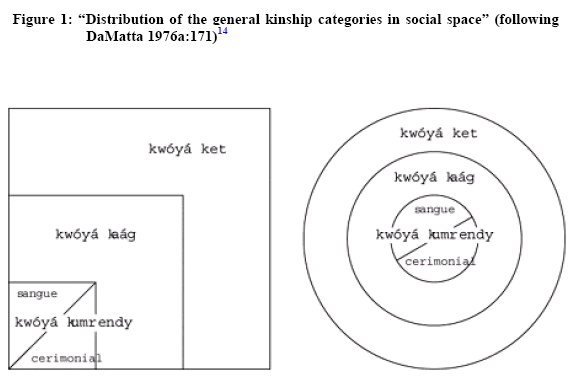
For DaMatta, then, although the circulation of bodily substances and ceremonial exchanges both constitute 'true' forms of kinship, this does not make these two modes of relationship equivalent: some true kin are more true than others. This is a point where he is unable to avoid a degree of ambiguity. The two diagrams (1976a:171, 176) with which he illustrates his argument are symptomatic:
It can be noted in these diagrams that the opposition between 'blood' kin and 'ceremonial' kin is different from the rest (kumrendy/kaág, kwóyá/kwóyá ket): the former assumes a 'diametral' form, while the latter are 'concentric,' suggesting that the substance/ceremonial opposition divides the field of close-true kin into two symmetric and complementary spheres, while the pairs kin/non-kin and true/false (or close/distant) comprise poles of a continuum. This difference disappears from the second representation that DaMatta provides of the relation between these categories:
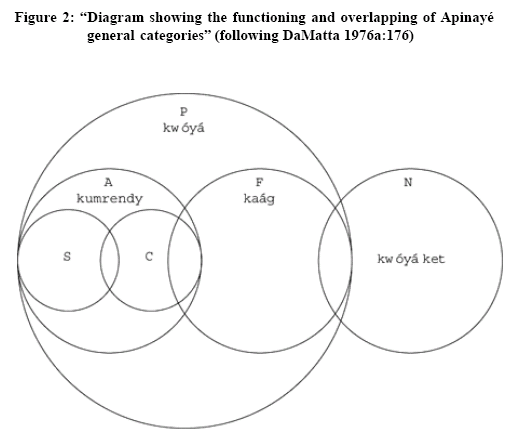
The author uses this figure to call attention to the intersections, which reveal how ceremonial relations mediate between different spheres: in the form of 'adoptive filiation,' between kin of substance [S] and ceremonial kin [C]; in the form of onomastic identity, between true/authentic kin [A] and distant/'false' kin [F]; and in the form of formal friendship, between kin [P] and non-kin [N]. In addition, this schema allows us to visualize the possibility of selecting different levels of contrast according to context: kin/non-kin, true/false, substance/ceremonial. However, DaMatta's main point is that these oppositions — which, in contrast to the situation described in the previous figure, maintain the same form at all levels — are connected in such a way that "circle A [...] is basically defined via circle S, the area marked by relations of substance, whose paradigm is the nuclear family" (1976a:176) — just as P is defined in terms of A ('true' P).
The opposition of substance/ceremonial relations was not as DaMatta points out, invented by him, having drawn his inspiration from Melatti's analysis (1976; 1979) of Krahó terminology. Its originality lies (at least in his own view) in the emphasis he confers on ideologies of substance and the opposition between relations of substance/ceremonial relations, as principles capable of explaining the 'flexibility' and 'manipulability' of these systems (DaMatta 1976a:177). The kinship system is seen to encompass relations given by 'biological ties' and 'social ties' alike. This double inscription of the system of relations is what "confers considerable manipulability […] and allows it to be the real conceptual bridge between the two domains of the Apinayé universe we are seeking to describe" (1976b:155). The (symmetric) complementarity of these two idioms is expressed in the diametral form which takes the distinction between them in the first two diagrams. But DaMatta also conceives this opposition, at the same time, concentrically; that is, as a relation of hierarchical opposition (in which the encompassing value is substance), supported by the supposition that the paradigm of kinship is a 'biological' and 'given' relation which may or may not be deliberately extended through 'social' ties of adoption, naming or formal friendship.
This understanding — that the paradigmatic kinship relations are those of consubstantiality between members of the same nuclear family and that the system's 'flexibility' is based on a combination of a language of substances that allows the given kinship to be quantified, and hence relativized, and an array of ceremonial transactions that allow it, on the other hand, to be constructed — corresponds to a way of conceptualizing the Central Brazilian dualisms that form the centre of the interpretative strategies of the HCBP researchers. I refer to the projection of these dualisms onto the Nature/Culture matrix (the Gê-ologists tend to refer more to Society), which opens up the possibility of analogically linking together a series of oppositions: domestic and public (politico-ceremonial), kinship and non-kinship, close and distant, biological and social, bodies and names, substance and relation, given and constructed, in such a way, though, that it is not always clear whether the meanings thereby mobilized are indigenous or introduced by the observer. Leaving aside for now the modernist anachronisms of this strategy, it is worth noting that it already clashed with the very ethnography that it intended to illuminate.
DaMatta was, in fact, one of the first to illustrate the constructed character of 'consanguinity' (cognation) in the lowlands, in showing that, for the Apinayé, the fact that affines should ideally leave the class of kwóyá ket not only means that they need to be recruited among non-kin, but that they also have to be converted into kin — thereby establishing, as we have seen, a parallel between the transformation of 'distant' kinship into 'true' kinship by naming and the conversion of affinity into kinship (into consubstantiality) by (co)procreation. So although it is clear that relations of distant kinship can be converted into relations of formal friendship or affinity, through the substitution of (weakened) ties of substance by 'ceremonial' kinds of ties (deliberately constructed and determined), this does not mean that relations 'of substance' should be seen as 'given' and 'primary.' Here we can capitalize on recent attempts in Amazonian ethnology to reconceive the relation between the cultural idioms of physical connection and shared substance, on one hand, and the idiom of respect and 'mutual sustentation' (to use a Ramkokamekra image in place of the untranslatable 'caring' celebrated by the British contingent of ethnologists) on the other — a reconceptualization that does not simply reduce this relation to an avatar of the dualism between given substance (identity) and constructed relation (difference), a derivative of the barrier mentioned above. Kinship, we learn from Gow, Overing, McCallum and many other authors, is love, mutual caring and memory; this memory is inscribed in the body and evident in properly human habits, dispositions and affects. Respectful, generous and eminently sociable behaviour is thus at once a psychological and a bodily disposition, and expresses the process of kinship as the successful fabrication of similar bodies. Consubstantiality speaks of this identity. This point is an inescapable finding of recent anthropology, and the "current understanding of kinship" not as "social identities given through marriage and fixed in a set of structural positions, but as a process of becoming" (Rival 1998:629) threatens to instil itself as a new orthodoxy. (Indeed, this approach commits the sin of confusing the 'understanding' of anthropologists with that of natives and ignoring the fact that something, for the latter, can [must] certainly still be posited as given, as Viveiros de Castro has argued [2002c].)
In the Timbira case, sex or affinity may indeed involve transformation in more than one direction: 'farther away,' when the participants are previously related, or 'closer,' if they initially see each other as 'non-kin.' But what this mechanics seems to presume is that the second operation, 'approximation' through marriage/procreation, has the first as its condition; that is, the prior negation of kinship and identity, the positing of an alterity. Were this otherwise, the operation becomes not only redundant (making the same from the same) but also dangerous, running the risk of provoking its opposite: not the fabrication of similars (kinship) but the transformation into an other — metamorphosis. But although the first operation's chances of success, and consequently the effects of the second, are not always calculable in advance, they still remain relatively predictable, according to the logic of distance. As we have seen, DaMatta interprets this conditioning as an effect of the principle of the primacy of substance as the given substrate of relations. However, it is possible, I think, to reread this interpretation in reworking his demonstration that consubstantiality is also something constructed.
]]> This — the notion that the identity of substance is a function of relations and not the contrary — seems to me to illuminate a frequently noted but little explored aspect of reclusion practices, namely their tentative, 'experimental' nature. Very often, more distant kin (co-genitors, grandparents, half-siblings) only start to adhere to the restrictions if there is a worsening of the sick person's state. Or to take another example, given a certain minimum distance, incest may or may not produce the feared consequences — only testing will show. Consubstantiality, in other words, is something that is recognized by its effects; it cannot be measured beforehand in the laboratory, and not just because the Indians lack the science and instruments: it involves a mutable quality that depends on the way in which subjects conduct the relationship and is revealed through the visible effects on the persons involved — on their bodies. In other words, it is a product of this relationship: not a (figurative) language that allows the 'manipulation' of real relations, but a real effect of a 'manipulation' that actually consists, whether in the 'construction' of kinship where it had 'not existed' (in the context of the conjugal family and effective affinity) or in its conservation, where it tends to fall away (in the context of the natal family).I wish to suggest, therefore, that the problem here — the problem of incest — does not simply reside in the idea of an abuse of identity provoked by an improper accumulation of the same substance. What makes 'true' kinship is not so much the (presupposition of) consubstantiality as the process of consubstantialization. And the problem of incest resides in its inversion of the direction assumed by this process. What distinguishes 'close-real' kin from 'distant' kin is the continuous reaffirmation of the ties of consubstantiality in the work of daily life. Co-residents are the focus of the prohibition (as the material shows) not because of an originary consubstantiality (which may actually be absent), by because they continue to consubstantialize themselves — consanguizing themselves through co-procreation, conviviality and commensality. The same does not occur with 'distant' kin, or rather, those who are distancing themselves. A distancing which, at each generation, '(re)begins' with the pair of opposite-sex siblings, just as the fabrication '(re)begins' with the conjugal pair.
The Ramkokamekra ethnography allows us to illustrate this point better. As the expression (m~e)kaprôô khwè indicates ('my blood group;' 'all my kin,' according to Crocker 1984:64; 1977:272, n.11), here too kinship is eminently a question of 'blood.' Uterine siblings (of both sexes) have a 'similar' or '(almost) identical' (i-pi~en) blood composition, since they came (like a branch or offshoot) from the same navel. This similarity extends to the immediate family: the father, mother, children and siblings all have 'equivalent' (ipip~en) blood to Ego's. The full identity of kin of substance serves as a base for the establishment of an identity of the same type, albeit diluted, between more distant kin. This dilution seems to derive primarily from the mediated nature of these other relations, a mediation expressed by the Ramkokamekra notion of hapàà, 'bridge,' which refers to the way in which the opposition between two terms without any direct connection (or with a negative connection) is mediated — modified — by the double positive relation which each of them has with a third party (Crocker 1990:328). The substantial identity between a brother and a sister, for example, establishes a 'bridge' between their respective descendents; according to Crocker, this is how the category of m~e kaprôô khwè, an individual's 'blood kin,' is expanded to encompass the entire kindred (Crocker 1990:266). The group of 'blood kin' thus comprises an extension of the group defined by the 'community of substance,' apparently different from the latter only due to the 'attenuated' nature of the ties that constitute it.
In addition to being flexible in degree, the identity of substance has a dynamic aspect, which complicates the above description slightly. Through the semen it encounters during sex, the woman's 'blood' mixes with that of her partners and makes her similar to them; after a time of living together, constantly swapping body fluids (through sex and the contact with each other's sweat), husband and wife come to have 'equivalent' 'blood' to the point that they should observe the same restrictions as the other during sickness (Crocker 1990:265; 1984:65; 1977:263).15 Concomitantly, a reverse process takes place among siblings, whose blood becomes progressively differentiated as it mixes with that of their respective spouses and partners. In this way, ""siblings 'drift away' from each other in blood composition and become more like their Sps and Cs" (Crocker 1977:263). It is worth noting that the original consubstantiality of the B/Z pair and the final consubstantiality of the H/W pair are not considered equivalent. This can be expressed in a variety of ways. Hence, among the Apinayé, H and W may come to be classified as 'true kin,' but they do not abstain from each other as B and Z do; inversely, among the Ramkokamekra, husband and wife become i-piyakhri katêyê to each other,16 that is, co-abstinent and consubstantial; however this does not make them into 'blood' or 'consanguine' kin, kaprôô khwè ou h~;u~ukhyê (Crocker 1990:265). This suggests that the relations of substantial identity implied in kinship are not distinguished solely in quantitative terms of greater or lesser 'proximity;' nor is the 'quality' of the substance (blood, milk or sperm) in question. In fact, what seems to me to be at stake is not just the origin of substantial identity but its destiny. While the universe of kinship may be described as a network in which any two kinspeople are connected to each other by one or more 'bridges' (pairs of primary consubstantial relations), it must be stressed that the B/Z and H/W relations amount to one-way 'bridges:' siblings are gradually differentiating apart, while spouses are gradually mixing together. The H/W relation is not just one more 'bridge' in this network, simply extending a pre-given substantial identity at the cost of diluting it. It regenerates this identity, introducing a difference — one between siblings and between their respective descendents — which is simultaneously the condition for reproduction, or the expansion of kinship in other words, to become possible. While the consubstantiality between siblings extends 'blood' kinship in space (Crocker 1990:266), but weakening it, the consubstantiality between husband and wife extends kinship in time (through procreation) and expands it.
B/Z and H/W are, then, inversely oriented pairs. As the Ramkokamekra expressly formulate this idea, H/W are becoming kin, that is becoming similar, while B/Z are becoming different and separating. These two movements do not have the same status. The first is the one the Canela keep their eyes on: it forms the focus of their action. The second emerges as a non-intentional effect of the construction of kinship — in actual fact, many of the obligations between 'siblings' (those sanctioned by the ethic of respect and generosity) seem to be directed towards curbing this second movement, to keeping kinship (memory, love) 'alive' between those who maturity and the consequent engagement in new relations (new procreative families) will inevitably separate to some degree. This unintentional effect is, however, a condition of the entire process and ensures its dynamic, since some difference is always necessary to 'kick start' the identification of Humans among themselves and their distinction from other types of subjects through kinship: forgetting and distance have this positive function of repotentializing relations that otherwise — taken as products of previous relations, as outcomes of the fabrication of kinship — would be sterile. But it is equally indispensable that human agency is exercised here in the appropriate direction; its direction cannot be inverted without running the risk of stimulating its opposite. To deliberately negate kinship — in a context where, as we have seen, kinship and humanity are synonymous — is to introduce the threat of dehumanization (cf. Wagner 1981:120; cf. 1972). As Viveiros de Castro says (2002c:419-420) concerning the "ground of metaphoric sociality implied in myth" — where, precisely, the indifferentiation between humans and non-humans signifies not the absence of difference, but an infinite difference within each being: "Human kinship comes from there, but must never (precisely because it always can) return to there" (Viveiros de Castro 2002c:420). And if the "effort manifest in devices such as the couvade [is] to cut the potential relations between the newborn and precosmological alterity," as the author continues (see too Vilaça 2002), incest — by treating kin as non-kin, the Same as an Other, a Human as a non-Human — can be understood to allude to precisely this kind of return, making it a highly risky operation. But not for this reason any less necessary.17
Relation
The problem incest poses for the Timbira has already been stated by Peter Gow in an excellent article on Piro kinship.
The Piro call themselves yine, 'Humans;' among themselves, though, call each other nomolene, 'my kin.' In general, the two terms are co-extensive: to be yine is to be nomolene to other yine; to be Human is to be kin to other humans. But at certain critical moments, it is necessary to find yine who are not nomolene.
]]> (Gow 1997:48)
Birth, the author shows, is one of these moments.18 Marriage (and sexual relations) are another, both for the Piro and for the Timbira (Gê), as for all those groups among whom marriage with cross-cousins — and, in general, with all those people one considers 'true' or 'close' kin — is 'forbidden,' wrong or dangerous. In a world in which the field of Humanity and the field of kinship are taken to be co-extensive, where being Human is, as Gow says, to be kin to other Humans, marrying a Human is, to some extent, to marry kin. And not because — as we could say is the case for ourselves — all the members of the human species, sharing a common origin, are 'kin,' but because Humanity, as a way of life that distinguishes the collected studied by the ethnographer from other collectives (animals, spirits, the dead, enemies), is something that is constructed through kinship with other Humans. In such a world, kinship obviously cannot appear as an obstacle to sex or marriage without creating the kind of awkward problem faced by the Piro father at the birth of his child: that of having to say to someone, "my kin, come quickly to cease being related to me" (Gow 1997:49).
Gow states that his intention is to analyze Piro kinship as an "autopoietic system, that is, a systems which generates its own conditions of existence" (1997:39). However, there is an aspect of this system which has to be introduced from 'outside' — precisely the need for the 'outside' in the process of Piro kinship. Why, after all, is the construction of kinship dependent on the intervention of human Others — who by being Others can always be revealed to be something other than Human? Why is incest — self-reproduction — a problem?
Framed in this way, the question immediately evokes Joanna Overing's assertion (for example, 1983-1984) that Amerindian social philosophies are based on the premise that identity implies safety, but also sterility, and that difference signifies danger, but also fertility, meaning that Humans are left to choose between introjecting and domesticating the latter (the case of the Gê) or denying and expelling it (the case of the Guianas). It remains the case that, either way, it must always be 'there,' since complete domestication or expulsion will only freeze the processes of introjection or denial which constitute, after all, the process of producing kinship in social life.
This dynamic relation between difference and identity seem to me to have been most clearly specified by the structure which Viveiros de Castro describes as the 'actualization' and 'counter-effectuation' of affinity, that is, potential affinity as a "generic given, a virtual ground against which a particular figure of consanguine sociality must be made to appear" (2002c:423-424). Consanguinity (kinship in the strict sense of the term) must, for its part, be deliberately fabricated, extracted from this virtual background — an extraction, the author shows us, that necessarily produces "more affinity," since the "potential of differentiation is given by affinity: to differentiate oneself from it is to affirm it by counter-effectuation" (2002c:432). Viveiros de Castro represents this double movement in a 'metadiagram:'
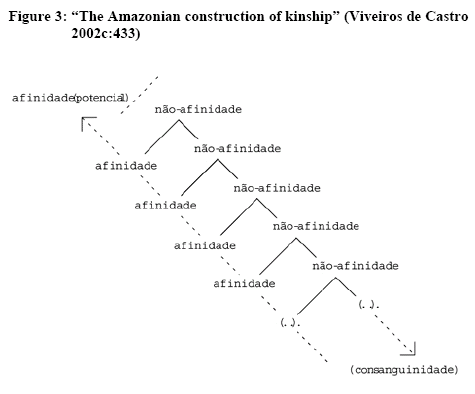
This diagram can be read (traversed) both upwards and downwards:
]]> […] while some South American societies (and/or their ethnographers) seem to place great emphasis […] on the vector of consanguinization that guides the process of kinship, others maintain their eyes firmly fixed, so to speak, on the overall source and condition of this process: potential affinity. This difference in orientation within the same cosmological schema explains, I believe, the contrasts continually surfacing in the region's ethnography: pacifism or bellicosity, intimate mutuality or predatory reciprocity, xenophobia or openness towards the other, a this-worldly or other-worldly philosophical outlook, and so on. These contrasts can only but surface: they are, precisely, superficial. In terms of their intuitive salience, are no more than partial versions of a single general structure that necessarily moves in both directions.(2002c:455)
Gow, it seems to me, is referring to the same structure when he speaks of "Piro social processes and hence Piro kinship, […] as the transformation of Others into Humans, and Humans into Others, over time" (1997:44), and when he defines Piro kinship in terms of a 'living well' which "stands out against a cosmic background of Alterity, a world of Others with whom Humans […] maintain a variety of relations, but with whom one cannot 'live well'" (1997:56). Nonetheless, it is worth remembering that the two directions of transformation — from Others into Humans and from Humans into Others — are not equivalent: "the ascending line still remains distinct from the descending line" (Viveiros de Castro 2002c:455). Although implicit in Gow's analysis, I think, this difference is not however accessible from the point of view in which he locates his argument, namely that of a phenomenological description of the "specific way in which subjectivity is posed, and presupposed, in and through the Piro lived world" (Gow 1997:42). For subjects, the transformation of Others into Humans does not have the same status as the transformation of Humans into Others, and connects with human agency in a fundamentally different manner. The fabrication of 'kin,' that is, Humans, is the explicit object of the construction of kinship; the counter-effectuation of affinity, a kind of collateral effect, non-deliberate, on which, however, the continuity of the said process, the possibility of restarting it, depends. My impression is that Peter Gow cannot explain the need for the 'outside' in terms of a description of the kinship system as autopoietic because kinship sensu stricto is not an autopoietic system. Its reproduction depends on what is 'outside' it, as its condition.
Despite recognizing the logically primary nature of 'brother-in-lawness' (1997:51), Gow identifies in the 'Maussian paradigm' of the gift the cause of the 'failure' of Lévi-Strauss's analysis to explore kinship as a structure of human consciousness (1997:42). He does not make explicit the terms of the criticism, but by taking advantage of the 'cue' and resorting to what, I hope, is something more than a mere play on words, it seems to me that, if he has a point, this is because what the paradigm of the gift allows us to explore here is precisely what lies outside kinship "as a structure of human consciousness." In other words, the gift signals what remains (and must remain) 'unconscious' in the description of kinship "as an autopoietic system" (since it must remain implicit for the actors as a pre-condition of their action): the reposition of the originary generic difference from which kinship must be made to emerge by (more) differentiation (determination). The decisive factor here is what is defined as an object appropriated by human agency and what presents itself to the latter as a given. And what presents itself to human action as given, in this universe where to make oneself human is to make oneself kin and 'similar' to other Humans, is the 'gift' — in other words: exchange, as a difference which connects and a connection which differentiates.
Here I have in mind the argument that, in the Amazonian world (and possibly elsewhere), alterity does not refer to a negative identity between two substances (terms), but refers to positive relations which each of these terms maintains with a third party: what distinguishes brothers-in-law is the differential relation that links them to the same woman, sister to one, wife to the other. The 'exchange of women,' is, in this sense, a play of perspectives: "the blood of humans is beer to the jaguar precisely as my sister is wife to my brother-in-law, and for the same reasons" (Viveiros de Castro 2002b:385; Gell 1999). This perhaps allows us to vindicate Lévi-Strauss's position that kinship as a human phenomenon — in its (cultural) language — is born with the 'exchange of women' and 'reciprocity.' A sister is a non-wife, rather than a wife being a non-sister; what constitutes a sister as a sister (matrimonially prohibited) is the need for her to be the wife of someone else, and not a primary relation of identity with the subject. The crucial point to retain here is the concept of affinity as a connection between two subjects mediated by their differential relation to a third (the person who is a sister for me is a wife for you). This is what the Lévi-Straussian incest prohibition and the (ill-fated) idea of the 'exchange of women' boils down to.
What do we gain from this perspective? An immediate dividend is the possibility of integrating the anthropology of relatedness (kinship as a constructed relation) and Lévi-Straussian-inspired analyses of systems of matrimonial alliance which, in South America, obtained important results and considerably refined its instruments since the 1970s. Another gain is that this conceptualization of the relation allows a continuity to be established between the inter and intrapersonal processes that we investigate under the rubrics of 'kinship' and 'alliance,' on one hand, and the 'person,' on the other.
The fundamental meaning of the Lévi-Straussian concept of affinity as an exchange relation resides in the priority he attributes to the relation over its terms. The 'obligation to reciprocate' is not a socially sanctioned norm, but the expression of an internal relation to which the terms cannot be seen to be pre-existent; created in it, they only subsist while remaining within this relation. As a result, while the partners may or may not reciprocate, for sure, non-retribution does not so much imply the dissolution of the relation as the dissolution of the partners — constituted by these relations, persons do not remain the same 'outside' of it (they will be recomposed on the basis of other relations). This way of putting the question can be compared to the way in which Melanesianists have thematized the partibility of the person:
]]> It is Marilyn Strathern herself who alludes to the 'continental formulations' of the mid 20th century that are, in contrast to British formulations, based on the premise that "persons have relations integral to them", and asks: "what else is the specification of the positive marriage rule?" (1992:86).In the way that Melanesians present social life to themselves, it would seem that there are no principles of organization that are not also found in the constitution of the person. External relations have the same effect as internal ones. In short, to imagine the person in this manner means that no switch of perspective between person and relation is required in order to 'see' social relations. Exchanging perspectives only differentiates one set of relations from another, as it does one kind of person from another.
(Strathern 1992:86).
Bibliography
BAMFORD, Sandra. 1998. "To eat for another: taboo and the elicitation of bodily form among the Kamea of Papua New Guinea". In: M. Lambek and A. Strathern (eds.), Bodies and persons: comparative perspectives from Africa and Melanesia. Cambridge: Cambridge University Press. pp. 158-171. [ Links ]
CARNEIRO DA CUNHA, Manuela. 1978. Os mortos e os outros. Uma análise do sistema funerário e da noção de pessoa entre os índios Krahó. São Paulo: Hucitec. [ Links ]
____. 1986. "Lógica do mito e da ação. O movimento messiânico canela de 1963". In: Antropologia do Brasil. Mito, história, etnicidade. São Paulo: Brasiliense/EDUSP. pp. 13-52. [ Links ]
CARSTEN, Janet (ed.). 2000. Culture of relatedness. Cambridge: Cambridge University Press. [ Links ]
____. 2004. After kinship. Cambridge: Cambridge University Press. [ Links ]
COELHO DE SOUZA, Marcela. 2001. "Nós os vivos: construção da pessoa e 'construção do parentesco' entre alguns grupos jê". Revista Brasileira de Ciências Sociais, 16(46):69-96. [ Links ]
____. 2002. O traço e o círculo: o conceito de parentesco entre os Jê e seus antropólogos. Doctoral thesis, PPGAS/Museu Nacional/ UFRJ, Rio de Janeiro. [ Links ]
CROCKER, William H. 1967. "The Canela messianic movement. An introduction". Atas do Simpósio da Biota Amazônica. Antropologia (Antropologia). Rio de Janeiro: Conselho Nacional de Pesquisas. pp. 69-83. [ Links ]
____. 1977. "Canela 'group' recruitment and perpetuity: incipient 'unilineality'?". In: J. Overing Kaplan (ed.), Actes du XLII Congrès International des Américanistes (Paris 1976). Paris: Société des Américanistes. pp. 259-275. [ Links ]
____. 1984. "Canela marriage: factors in change". In: K. Kensinger (ed.), Marriage practices in lowland South America. Urbana: University of Illinois Press. pp. 63-98. [ Links ]
____. 1990. The Canela (Eastern Timbira). I. An ethnographic introduction. Washington: Smithsonian Institution. [ Links ]
DAMATTA, Roberto. 1976a. Um mundo dividido: estrutura social dos índios Apinayé. Petrópolis, RJ: Vozes. [ Links ]
____. 1976b. "Uma reconsideração da morfologia social apinayé". In: E. Schaden (ed.), Leituras de etnologia brasileira. São Paulo: Cia. Editora Nacional. pp. 149-163. [ Links ]
____. 1979. "The Apinayé relationship system: terminology and ideology". In: D. Maybury-Lewis (ed.), Dialectical Societies: The Gê and Bororo of Central Brazil. Cambridge, Mass.: Harvard University Press. pp. 83-127. [ Links ]
FAUSTO, Carlos. 2002. "Banquete de gente: comensalidade e canibalismo na Amazônia". Mana. Estudos de Antropologia Social, 8(2):7-44. [ Links ]
FISHER, William. 2001. "Age-based genders among the Kayapo". In: T. Gregor e D. Tuzin (eds.), Gender in Amazonia and Melanesia: an exploration of the comparative method. Berkeley: University of California Press. pp. 115-140. [ Links ]
GELL, Alfred. 1999. "Strathernograms: or, the semiotics of mixed metaphors". In: The art of anthropology: essays and diagrams. London: The Athlone Press. [ Links ]
GIACCARIA, B. e HEIDE, A. 1975. Jerônimo Xavante conta: mitos e lendas. Campo Grande, MS: Editorial Dom Bosco. [ Links ]
GOW, Peter. 1997. "O parentesco como consciência humana". Mana. Estudos de Antropologia Social, 3(2):39-66. [ Links ]
LADEIRA, Maria E. 1982. A troca de nomes e a troca de cônjuges: uma contribuição ao estudo do parentesco timbira. Master's dissertation, University of São Paulo. [ Links ]
LAVE, Jean. 1967. Social taxonomy among the Krinkati (Gê) of Central Brazil. Ph. D. Thesis, Harvard University. [ Links ]
____. 1979. "Cycles and trends in Krinkatí naming practices". In: D. Maybury-Lewis (ed.), Dialectical societies: the Gê and Bororo of Central Brazil. Cambridge, Mass.: Harvard University Press. pp. 16-45. [ Links ]
LEA, Vanessa. 1986. Nomes e nekrets kayapó: uma concepção de riqueza. Doctoral thesis, PPGAS/Museu Nacional/UFRJ, Rio de Janeiro. [ Links ]
____. 1993. "Casas e casas mebengokre (Jê)". In: M. Carneiro da Cunha and E. B. Viveiros de Castro (eds.), Amazônia: etnologia e história indígena. São Paulo: Núcleo de História Indígena e do Indigenismo da USP/ FAPESP. [ Links ]
____. 1995. "Casa-se do outro lado: um modelo simulado da aliança mebengokre (Jê)". In: E. B. Viveiros de Castro (ed.), Antropologia do parentesco: estudos ameríndios. Rio de Janeiro: Editora UFRJ. pp. 321-359. [ Links ]
LOUNSBURY, Floyd G. 1969 [1964]. "The structural analysis of kinship semantics". In: S. Tyler (ed.), Cognitive anthropology. New York: Holt, Rinehart & Winston. pp. 193-211. [ Links ]
LUKESH, A. 1976 [1969]. Mito e vida dos índios Cayapós. São Paulo: Livraria Pioneira Editora. [ Links ]
MAYBURY-LEWIS, David. 1967. Akwe-Shavante society. Oxford: Clarendon Press. [ Links ]
MELATTI, Julio Cezar. 1970. O sistema social krahó. Doctoral thesis, University of São Paulo. [ Links ]
____. 1976. "Nominadores e genitores: um aspecto do dualismo krahó". In: E. Schaden (ed.), Leituras de etnologia brasileira. São Paulo: Cia. Editora Nacional. pp. 139-148. [ Links ]
____. 1978. Ritos de uma tribo timbira. São Paulo: Ática. [ Links ]
____. 1979. "The relationship system of the Krahó". In: D. Maybury-Lewis (ed.), Dialectical societies: the Gê and Bororo of Central Brazil. Cambridge, Mass.: Harvard University Press. pp. 46-82. [ Links ]
MENGET, Patrick. 1979. "Temps de naître, temps d'être: la couvade". In: M. Izard and P. Smith (eds.), La fonction symbolique. Paris: Gallimard. pp. 245-264. [ Links ]
NIMUENDAJÚ, Curt. 1956 [1939]. Os Apinajé. Belém: Museu Goeldi/Instituto Nacional de Pesquisas da Amazônia. [ Links ]
OVERING, Joanna. 1983-1984. "Elementary structures of reciprocity: a comparative note on Guianese, Central Brazilian and North-West Amazon socio-political thought". Antropologica, 59-62:331-348. [ Links ]
____. 1985. "Today I shall call him 'mummy': multiple words and classificatory confusion". In: J. Overing (ed.), Reason and morality. London/New York: Tavistock Publications. pp. 152-179. [ Links ]
RIVAL, Laura. 1998. "Androgynous parents and guest children: the huaraoni couvade". Journal of the Royal Anthropological Institute, 4:619-642. [ Links ]
SCHEFFLER, Harold e LOUNSBURY, Floyd. 1971. A study in structural semantics: the Siriono system of kinship. Englewood Cliffs, NJ.: Prentice-Hall. [ Links ]
SEEGER, Anthony. 1981. Nature and society in Central Brazil: the Suyá Indians of Mato Grosso. Cambridge, Mass: Harvard University Press. [ Links ]
____, DAMATTA, Roberto and VIVEIROS DE CASTRO, Eduardo B. 1987 [1979]. "A construção da pessoa nas sociedades indígenas brasileiras". In: J. P. de Oliveira (ed.), Sociedades indígenas e indigenismo no Brasil. Rio de Janeiro: UFRJ/Marco Zero. pp. 11-29. [ Links ]
STRATHERN, Marilyn. 1992. "Parts and wholes: refiguring relationships in a post-plural world". In: A. Kuper (ed.), Conceptualizing society. London: Routledge. pp. 75-104. [ Links ]
TAYLOR, Anne-Christine. 2001. "Wives, pets and affines: marriage among the Jivaro". In: L. M. Rival and N. L. Whitehead (eds.), Beyond the visible and the material: the ameriandianization of society in the work of Peter Rivière. Oxford: Oxford University Press. pp. 45-56. [ Links ]
TURNER, Terence. 1966. Social structure and political organization among the Northern Kayapó. Ph.D. Thesis, Harvard University. [ Links ]
____. 1995. "Social body and embodied subject: bodiliness, subjectivity and sociality among the Kayapo". Cultural Anthropology, 10(2):143-170. [ Links ]
VIDAL, Lux. 1977. Morte e vida de uma sociedade indígena brasileira. São Paulo: Hucitec/EDUSP. [ Links ]
VILAÇA, Aparecida. 2002. "Making kin out of others in Amazonia". The Journal of the Royal Anthropological Institute, 8(2):347-365. [ Links ]
VIVEIROS de Castro, Eduardo B. 2002a. "O problema da afinidade na Amazônia". In: A inconstância da alma selvagem e outros ensaios de antropologia. São Paulo: Cosac & Naify. pp. 87-180. [ Links ]
____. 2002b. "Multinaturalismo e perspectivismo na América indígena". In: A inconstância da alma selvagem e outros ensaios de antropologia. São Paulo: Cosac & Naify. pp. 345-399. [ Links ]
____. 2002c. "Atualização e contra-efetuação do virtual: o processo do parentesco". In: A inconstância da alma selvagem e outros ensaios de antropologia. São Paulo: Cosac & Naify. pp. 401-456. [ Links ]
WAGNER, Roy. 1972. "Incest and identity: a critique and theory on the subject of exogamy and incest prohibition. Man, 7(4):601-613. [ Links ]
____. 1981 [1975]. The invention of culture. Chicago: The University of Chicago Press. [ Links ]
Notes
* This article is based on a paper presented at the thematic seminar 'Uma Notável Reviravolta: Antropologia (Brasileira) e Filosofia (Indígena),' coordinated by Eduardo Viveiros de Castro and Márcio Ferreira da Silva, at the XXV Annual Conference of ANPOCS (2001), which was later incorporated into my doctoral thesis (Coelho de Souza 2002). I especially thank Eduardo Viveiros de Castro and Mana's anonymous readers for their reading, criticisms and comments on the text.
The name Timbira designates a set of peoples (Canela, Krahó and Krinkati, among others) who speak a language of the northern branch of the Gê family, distributed across the States of Maranhão, Tocantins and Pará. The Apinayé, sometimes referred to as western Timbira, located in the present-day State of Tocantins, are more differentiated socially, culturally and linguistically from the former groups. Part of a more wide-ranging survey that took into account the ethnography concerning all Gê peoples (including central and southern branches), this article concentrates on the Timbira case, for obvious reasons of space, but also because its theme was firstly and more directly explored by the researchers working with these groups.
1 All the Northern Gê classify ZD, SD and DD (as well as ZS, SS and DS) in the same category; reciprocally, a single term applies to MB, FF and MF ('uncle/grandfather'), and another to FZ, MM and FM ('aunt/grandmother'). These termonilogies vary, though, in terms of the classification of cross-cousins, assuming either a Crow profile or an Omaha profile (Coelho de Souza 2002, and the references cited therein, especially DaMatta 1976a; 1979; Lave 1979; Melatti 1979; Ladeira 1982).
2 The theme appears, for example, in a myth collected by Nimuendajú (1956 [1939]:136) among the Apinayé, and Vidal (1977:214-215) among the Xikrin (Kayapó), which tells of the trasnformation into birds of boys who have sexual relations with their sisters. The Xavante, who designate incest by the same word (tsiwamnãr) used for 'metamorphosis' (Maybury-Lewis 1967:75-76), also recount a history in which sexual relations between mother and child result in the transformation of both into tapirs (Giaccaria e Heide 1975:115-ff).
]]> 3 As formulated and explored recently by Viveiros de Castro (2002a; 2002b; 2002c).4 Nevertheless, the problem posed by this 'metaphor' was registered by some Gê-ologists (Lea 1986:39; Lave 1979).
5 The structure of the kinship terms was interpreted by the ethnosemantics school on the basis of a trichotomy between primary meaning (genealogical), secondary meaning (likewise, but by extension within the same semantic field) and metaphoric meaning (outside of this field) (see for example Lounsbury 1969 [1964]; Scheffler e Lounsbury 1971). Implicitly or explicitly, divisions of this type sustain the common use by anthropologists of qualifiers such as 'real,' 'classificatory,' 'fictitious' (or 'pseudo') and 'metaphoric' — the latter generally reserved for kin who do not belong to the human species. These distinctions correspond to differences established by native discourse (differences whose general sense will be discussed later), but interpret them in terms of ontological principles, as well as a semantic theory, alien to the latter. For a critique of the interpretation of the use of kinship terms as a metaphoric extension outside the field of human elations, see Overing (1985).
6 The most obvious problem concerns the apparent contradiction between the androcentrism of native theories of conception and the bilateralism of relations of conssubstantiality (as expresed, for example, in perinatal restrictions). As Menget noted, a contradiction only exists if we consider, "in perfectly ethnocentric fashion," that the human being is formed at birth (1979:250). The solution, he says, in the case of the Ikpeng, involves recognizing that the newborn is an unfinished being from the point of view of its physical (substantial) constitution, to be completed after birth. Undoubtedly, the suppression of the difference between innate substances and acquire substances potentially alters the place that substance occupies in the economy of the arguments: substantial connections cease to be able to be identified with a given and immutable substrate of kinship relations — a status they occupy in our ontogeny.
7 From epigenesis: Physiol. "theory according to which the constitution of beings begins from an amorphous cell and proceeds through the successive formation and addition of new parts that previously did not exist in the fertilized egg" (Aurélio XXI Century).
8 Naming relations (which include not just the relation formed between namer and named, but also those that are transformed through their identification) and 'adoptive' paternity/maternity also constitute ceremonial relations for DaMatta (which equally inplies their specific terminologies), but, differently to those discussed in this text, they directly overlap with kinship relations (they are established with kin from specific categories), making them ideally internal to the field of kwoyà ('kin'). It should be noted, though, that the recruitment of affines (and formal friends) among 'distant kin' will obscure this difference somewhat.
9 In Kayapó ethnography, the notion of piaam is generally treated in the context of the discussion of avoidance behaviours between affines and between formal friends, and glossed as 'shame' (Lea 1986:252; Vidal 1977:98), although there are various clues indicating that the scope of the notion is much wider (for example, Lukesh 1976 [1969]; Turner 1966:xix-xx; Vidal 1977:125). However the concept of respect/shame among the Kayapó has received less attention from ethnographers than, say, among the Timbira, where it comprises a fundamental idiom for speaking of the capacity of individuals to act socially (and sociably). Perhaps this is because the positive aspect of the concept shifts, in the Kayapó case, to a more 'physiological' key, where the notion of 'listening' comes to cover ceetrain aspects of 'respect' (Turner 1995:153). This inscription in the body of personal faculties on which the capacity to relate socially depends is typical. We also find it among the Xikrin (Fisher 2001), and the Suyá, where, in fact, it was analyzed in pioneering style by Seeger (1981); his description allows us to associate the notion of 'shame' (whiasàm) with the development of a specific personal caácity that combines the meanings of listening, understanding and knowing, glossed by the ethnographer as "hear-understand-know." Expressing observance of 'social norms,' generosity, sexual and dietary self-control, the notion involves the same values associated with the concept of 'respect/shame' in the Timbira and Apinayé ethnography.
10 If avoidance is the hyperbole of respect, then joking behaviour — which marks specific relationships, such as those between (some) maternal uncles and nephews/nieces, or opposite-sex siblings-in-law — is the pronounced form of familiarity. Unfortunately, an analysis of the traditional tetrad of kinship attitudes thereby evoked is unrealizable within the limits of this article (see Coelho de Souza 2002). I simply note that, from the viewpoint adopted here, rather than familiarity indicating consanguinity as an epitome of kinship relations — which, even among cognates, also function via differences between the participants (generation, gender, relative age) — it may be conceived as a non-affinal residue of these relations: a simple identity, that is, a non-difference and, therefore, a non-relation (Taylor 2001:51). Its pronounced form, joking, could therefore be interpreted as a negation of this identity: a mode of differentiation. It is not by chance that 'jovial relations' are prescribed between siblings-in-law who call each other 'other spouses,' but not between husband and wife (Crocker 1990).
11 The meaning of this type of act can be appreciated, for example, in the context of the 1963 messianic movement, whose elements included practices that
Crocker described as "unconscious attempt(s) to destroy the very structure of aboriginal kinship" (1967:80) — or in other words, incestuous sex, which would tend to reduce the number of kin, and the breaching of traditional patterns of avoidance. As Carneiro da Cunha points out (1986:44-46), this recourse to 'incest as a reducer of kinship,' as an operation that 'suspends' the 'rights and duties' implied by the latter, goes far beyond a parodic emulatiuon of the reduced kinship of those the Ramkokamekra called the 'civilized.' 0
]]> 12 On the other hand, DaMatta states that adopted father and child may undertake reclusion for each other in the case of sickness, which would also confer these relations with a 'natural or physical infrastructure' (1976b:151).13 Firstly, there is marriage with distant kin: consequently, an individual can, for example, consider the residents of a brother's wife's house as distant kin, due to previous ties, or as affines, following the brother's marriage. More generally, the overlapping of substance ties and cereonial ties have the same result (making alternative designations possible); hence, a man called hios FFW (a 'grandmother/aunt') 'sister,' since she had been adopted by his mother; another man was called ikrá ('son/daughter') by his geti ('grandfather/uncle') rather than tamtxua ('grandchild/nephew'), since the geti was his adoptive father and namer; another called his WM 'mother' since she was a distant 'sister' of his own mother…
14 The figure on the left is DaMatta's original diagram; the one on the right is an adaptation allowing clearer visualization of its properties.
15 One of the anonymous readers of this text called my attention to the fact that, among the Timbira, husband and wife only 'become equal' in old age, when by now sterile, and therefore incapable of producing new bodies. This matches my hypothesis: assimilation through conjugality and through co-procreation is a dynamic, accumulative and progressive process. It ends with the exhaustion of the (re)productive capacity of the H/W pair; this signals the fact that the latter depended on the difference between them, at the same time as it consumed the couple.
16 The situation, however, is not identical for all the Timbira. Apanyekra spouses, for example, do not seem to recognize relations of consubstantiality between themselves, at least not to the point of being ipiyakhri to each other (Crocker 1977:263). Melatti, on the Krahó, emphasizes thje difference between the meaning of abstention due to sickness practiced by immediate consanguines (F, M, C) from that practiced by spouses: the latter "never identify with those that a father, mother and children respect when the organism of one of them is in crisis. The reclusion of father, mother or children seeks to defend the body of the family member in crisis against the action of elements external to all of them. The husband's reclusion, on the other hand, is not aimed at protecting the health of his wife, but his own […]" (1970:150). Here he is thinking, it is true, of the restrictions realted to the wife's menstruation, but the opposition he traces seems to have a wider pertinence. Despite all the attention which these practices have already received in Amazonian ethnology, I think there is still room for an analysis which takes them as active procedures of differentiation and assimilation, rather than a mark of pre-established differences and identities (for a Melanesian parallel, see Bamford 1998).
17 Every sexual union is potentially incestuous, just as every act of devoration is potentially cannibalistic (Fausto 2002).
18 At birth, Gow tells us, in order to complete the Humanity of the new human, cutting the baby's umbilical cord and thus separating it from the placenta, the father of the child must find a Human who is not kin, or, put otherwise, someone who is willing to take on the role of Other (i.e., a non-Human) vis-à-vis Humans (the child's parents), by means of an action — the cutting of the cord — which implies the affirmation of their identity as simultaneously Human and non-Human. From the moment of birth onwards, the child's parents and the umbilical cord cutter no longer call each other by kinship terms, but by specific terms that define a kind of 'hyperkinship,' marked by an intensification of the memory and respect that characterizes relations between kin. Phrase in Gê language, perhaps, an intensification of piâm. Likewise, husband and wife "must be the same, both must be Human," but "they cannot be exactly the same" (Gow 1997:46). The father's dilemma at his child's birth is therefore "very similar to the dilemma of incest;" and this similarity lies, for Gow, in the fact that in both cases, it is "something difficult to speak about" (1997:49).
Received on 15th November 2003 ]]> Approved on 5th February 2004
Marcela Coelho de Souza received her Ph.D. in anthropology from PPGAS/Museu Nacional/UFRJ. She is currently a researcher for the Núcleo Transformações Indígenas (Projeto Pronex FAPERJ/CNPq). E-mail: <macoelhosouza@terra.com.br>
]]>