Fragmented and domesticated bodies in assisted reproduction*
Martha Ramírez-Gálvez**
Translated by Roger Barlow
Translated from Cadernos Pagu, Campinas, n.33, p. 83-115, Dez. 2009.
ABSTRACT
]]> This article examines the mechanisms producing the meaning of infertility and the new ways of producing life through the use of conceptive reproductive technologies. The normative underpinnings of maternity and/or reproduction are highlighted, as well as the emergence and shaping of this field as a contemporary drive toward the commodification and consumption of biotechnology. Scientific progress, in this case, is incorporated in the techno-embryo, linked to the fetishization of the gene and the assertion of traditional values associated with consanguineous families.Keywords: Assisted Reproduction, Biotechnology, Human Reproduction, Consumption of Technologies, Family.
RESUMO
Este artigo analisa os mecanismos de produção de sentido da infertilidade e dos novos modos de produção da vida, mediante o uso de tecnologias reprodutivas conceptivas. Destacam-se os pressupostos normativos de maternidade e/ou reprodução, assim como a relação do surgimento e configuração deste campo como um empreendimento contemporâneo de mercantilização e consumo de biotecnologias. O progresso científico, neste caso, é incorporado na figura do tecno-embrião, ligado à fetichização do gene e à afirmação de valores tradicionais associados à família consangüínea.
Palavras-chave: Reprodução Assistida, Biotecnologia, Reprodução Humana, Consumo de Tecnologias, Família.
Introduction
The progressive emergence of mainstream medicine in the 19th century is intertwined with the development of health policy and the perception of diseases as a political and economic problem. It is also intimately linked to the perception of family as not only a system of kinship and transmission of property, but also as place where human beings are "manufactured" under the best possible conditions. The family, from that point onward, has become a constant agent of medicalization. Medicine, especially since Foucault, has been indicated as one of the institutions through which individuals and their practices are normalized (Foucault, 1996).
Most investigations into the relationship between human reproduction and medicine point to the centrality of the female body and sexuality as the place, par excellence, for scrutiny and control policy. Attempts have been made to unravel the mysteries of reproduction throughout the history of humanity, and tentative explanations have been influenced by the interpretation of the world prevailing in each period. Some authors write that surgical and technological developments have played a determining role in medicine's mastering of the female body. Current medical technology is said to have originated in the 16th and 17th centuries, at the time of Descartes' rationalism and Newton's achievements in physics, which brought about an exacerbation of biological mechanisms and the emergence and establishment of the profit-driven health industry (Barros, 1991).
]]> Viera (1990) apud Barbosa (1999) notes that the care of the female body became legitimized as a separate field of medicine most notably from the emergence of obstetrics, which gave rise to other fields of medicine, such as gynecology, embryology and genetics. This medical practice, established in the 18th and 19th centuries, expanded with further developments through which it took command of conception, pregnancy, childbirth and birth control. Medicine expropriated these fields of care from so-called traditional medicine and from the lay knowledge and practice of social agents, such as midwives. Pregnancy and childbirth had until then been considered natural events of the human lifecycle. The implications of the medicalization of reproduction have been manifold, but are left aside here to focus on the creation of a pharmaceutics and diagnostics market, which has grown in parallel with reproduction management through the consumption of medical practice.The emergence of Assisted Reproduction (AR), which comprises a series of medical and technical procedures to achieve pregnancy otherwise then spontaneously, and medicine's mastering of the desire for childbearing are included by Corrêa (2001) in the process of social medicalization. This term designates the changes in medical practice through innovation in diagnostic and therapeutic methods in the pharmaceutical industry and in medical equipment, which result in an exaggerated increase in consumption of medical practice and medication. According to Corrêa (2001:24):
All these developments, once subject to discursive medical normalization, are incorporated into a given specialist medical practice; the new reproduction technologies, with their propositions to medicalize the absence of childbearing, are a recent example.
Barros (1991) highlights people's belief in the need to consume the arsenal of diagnostics and treatments to solve their problems, now included as diseases, as consequences of the medical model - linked to the pharmaceutical and medical supplies industry. It is commonly believed that the more modern and sophisticated the technology, the more likely it is to be effective.
Consumption ideology - which associates the notion of inclusion and the sense of "wellbeing" and "happiness" with the act of consuming - expands its domains to the goods and services designed to maintain and/or restore health, these becoming "commodities" subject to the laws of the market. The logic present in the commodification of medicine has gained an increasing presence in the lives of individuals and society. The "medicalization of women" is seen as an ample illustration of how life has been transformed into a sequence of events requiring different forms of consumption of goods, diagnostic services and therapies which, in some cases, do little to effectively improve an individual's quality of life (Barros, 1991).1
Normal life-cycle events, re-described in terms of modern medicine, become situations in which technology acts as a palliative, enabling a relationship with consumers unaware of the social determination of health or disease. This re-description brings into play the interests involved in the development of medical practices that entail the sale and consumption of services, drugs and equipment. In parallel, the effects of this process ultimately result in the development of medical knowledge, in the representation of medicalized events and in the behavioral patterns of individuals.
This paper investigates narratives on AR, with a focus on the normative underpinnings of maternity and/or reproduction, as well as the emergence and shaping of this field as a contemporary drive toward the commodification and consumption of biotechnologies, linked to the fetishization of the gene and the assertion of traditional values associated with consanguineous families. The data presented here focus on an analysis of the webpages and brochures of AR Brazilian clinics, drugs and equipment.2
Bodies rather than Persons
]]> The human body has been fragmented in many forms through various imaging technologies that depersonalize and dehumanize people into bodies or, as noted by Chazan (2002, 2007), into bodies "without Persons". This fragmentation, also present in Descartes' separation of body and mind, has another ramification of enabling the body and its parts to be commodified. In AR, specifically, the reproduction process has been fragmented to make room for the donation of gametes which, in some ways, has issues in common with organ donation.The donation and exchange of human body parts is only feasible with the technical mediation of researchers, physicians and other health care professionals, which enable human body parts to be transformed into a market. Without this mediation they would have no value for use or value for trade (Berlinguer and Garrafa, 2001).
The combination of biomedical technologies and market actions has allowed unforeseen and uncontrollable ways of commercializing reproductive functions to emerge. Social differences or markers, previously identified on the surface or inside of the body, are now inscribed in genes. The enthusiasm with which the mapping of the human genome was announced created a notion that the body and life are a digital map, information that can be decoded, and that in the future diseases will be resolved at their origin or through genetic therapy.
Although the results of the Genome Project were somewhat disappointing since researchers were unable to identify the genes responsible for certain skills and "disorders" (such as dyslexia, homosexuality, enterprising personalities, etc.), the promise to find the "truth about genes" seems to have produced certain effects. This fits into Finkler's (2001) assertion that contemporary conceptualizations of hereditary transmission build on Euro-American cultural conceptions of kinship and family, as conceived by Schneider (1968). That is, family and kinship relationships are established by reproduction and blood ties. Kinship is analogous to biogenetics, in the sense that it is established through the sharing of genetic material - a concept based on the scientific perspective that the biogenetic contributions of the father and mother are in equal proportion. The degree of kinship and the identities of parents can be determined as a function of shared DNA.
Of particular note, in this regard, is Finkler's argument on the inclusion of family and kinship as part of the human experiences being medicalized. Biogenetics constitutes a type of medical inspection through the prevailing biomedical understanding of disease etiology, that locates and stresses faulty genes. Both the doctor-patient encounter and the mass media tend to emphasize biological kinship as a function of the association between kinship and health. The notion of genetic risk has become a disease in itself. In this context, some US states have created laws allowing adoptees to obtain the identities of their genetic parents in order to gain access to their medical records, on the grounds that their medical history is part of their identity and memory.
The emphasis on the link between disease and kinship has influenced the daily lives of many people. Biological origin has become, in Finkler's view, central to one's destiny, a dialectic between anticipation of the future and remembrance of the past. The family medical history recapitulates the kinship history lost in people's memory, expands their perception of consanguine relationships, building on the concept of bilateral genetic identity that forms part of social beliefs and practices. In research on adoptees, the author mentions internal conflicts due to the lack of the medical history of a person's biological family. These questions, however, are not limited to biography or predisposition or risk of developing certain diseases, but also include explanations for preferences, likes and skills.
In relation to this trend, Nelkin (2001) goes beyond the medicalization of kinship to also include its commoditization, since DNA is not only a set of molecules, but also a powerful set of cultural representations.3 Belief in genetic determinism has driven a notable expansion of the reproduction technology industry. Discourse on reproduction is disseminated through images of banks, property, products, achievement; eggs and sperm are consumer goods valuated by their genetic value. In the genetic era, commercial ventures - such as the use of DNA testing to corroborate paternity or firms specializing in tracking biological parents - have proliferated to help people trace their genealogy.
The commodification of kinship is seen not only in the reconstruction of family history, but also in the selection and programming of the genes of techno-children. The ability to detect potential genetic diseases in an embryo has generated profitable business. Catalog selections of gametes and surrogate mothers, widely advertised on the Internet in the US, are a good example.
]]> Some authors point to surrogate motherhood as a clear expression of the commodification of the female body and its reproductive capacities. This practice is seen as a typical manifestation of so-called sale of use - the exchange of body functions for money. Surrogate motherhood has become an institution that is now intensely bureaucratized within the United States, involving brokers, complex contracts and fees4, similar to the process for recruiting egg donors. Newspapers and web pages provide details on the desirable characteristics of an egg donor (intelligence, beauty, manners, body size and poise), which seem to determine the value of the "services". An exhaustive application form completed by potential egg donors asks candidates about their religion, whether they use corrective lenses, right- or left-handedness, freckles, abilities in mathematics, science and literature, athletic abilities, artistic talent, use of tobacco, alcohol and other drugs, mental problems (depression, - schizophrenia, bipolar disorder, anorexia or bulimia, self-mutilation, obsessive-compulsive disorder (Center for Human Reproduction, Egg Donor Application). The questions on the latter aspects would not make sense if they were not considered to be genetically transmissible.Future parents can choose everything from the type of planned conception (with or without surrogate mothers, with sperm or egg donors, etc.) to the physical type and genetics of donors. An average US$18 thousand to US$60 thousand are spent per contract for surrogate motherhood (Bebê, 2000).
Though in Brazil surrogate motherhood and the sale of eggs as organized and available in other countries are forbidden5, this so-called sale for use takes other forms, such as the shared egg donation programs6 (Lopes et alii, s/d) implemented by many AR clinics. The absence of legislation specifically applying to this matter and the fact that assisted reproduction has been a transnational practice since its origin allows shared catalog-based gamete sales programs to exist, as reported by the local press (Almeida, 1999; Carelli, 2001).
The sale of human material, condemned by traditional values in which kinship is invaluable, is mitigated by the rhetoric of gift giving and the appeal to philanthropy, leading some women to subject themselves to the risks of these procedures in order to ease the suffering of those unable to conceive and bear children. This rhetoric of gift exchange disguises the origins of commercialized body parts, silencing in turn any discussion of the commodification process (Sharp, 2000).
In addition, narratives on the promotion of assisted reproduction services or special programs, such as shared egg donation or treatments paid in installments, draw on and reinforce the norms and values associated with maternity and/or reproduction, as seen in the advertising images of the pharmaceutical industry.
Enabling nature
Assisted reproduction medication brochures exhibit a certain homogeneity and reiteration in their content and images. The image used by Serono to advertise Cetrotide7 is not always accompanied by text and does not always repeat the same phrase: making life easier from the beginning, translated into Portuguese, Spanish or English depending on the region it is distributed in. The image could possibly dispense with text, as it is a "classical" image of motherly love: a woman taking joy in lovingly cuddling her baby.
Although drug manufacturers make use of images that exalt the values of maternity, or rather the attributes of biological maternity, technological childbearing is considered a miracle. This is possibly one of the greatest undertakings of the contemporary world, which is in the hands of physicians or relies on their assistance to achieve it, placing the specialist in the position of a generator of life. Medications and medical intervention become vital conditions of childbearing, as seemingly suggested by another image (Serono - Gonal F), in which a baby appears to float connected, by an object simulating an umbilical cord, to a package of medication.
The connection between the baby and the medication package technologizes the production of life. The image is reminiscent of Petchesky's analysis (1987) that the fetus as seen in ultrasound imaging is like a non-contained, free-floating entity. But the images used in assisted reproduction are not of fetuses, but of "finished" babies, with the beauty and the certainty of survival a baby acquires a few months after birth. The baby in the figure described is autonomous from the mother, but not from the medication. The power of generating life is transferred from the woman to the medication, the effectiveness of which depends on, inter alia, the skill of the physician in prescribing the right dose. This image seems to follow the same logic as the other advertisement from the same laboratory. A healthcare professional is shown holding a baby's hands, with the suggestive text: Sometimes even miracles need a helping hand...
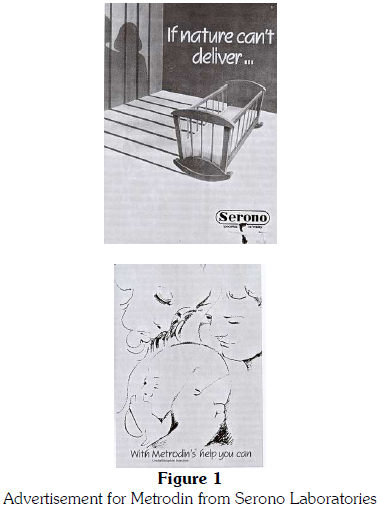
The image seems to depict the moment of birth, yet the mother is not even featured in the scene. The medication and the specialist are the protagonists of generating life, the helping hand, which denotes part of the strategies used to demonstrate the ineffectiveness of nature and the mastering thereof through biotechnology. In an article published in 1993, Franklin presents a two-part advertisement from Serono, the text of which is very similar to the previous advertisement: If nature can't deliver... with Metrodin's help you can.
]]>
The images, however, are different. The first depicts an empty crib, the bars of which cast a shadow on the wall, and behind them is the shadow of a couple. The bars superimposed on the shadow of the couple suggest the idea of a prison, possibly a sentence imposed by infertility. The second image, accompanied by the text "With Metrodin's help you can", depicts a drawing of a couple with a baby in their arms and with their faces fully outlined. The medication seems to allow them to pass from the darkness, caused by infertility, to the light, in which the subjects acquire an identity, a face and completeness.
The advertisements seem to be the same for all countries, as suggested by the same brochures being distributed in different languages and the investigations conducted by Franklin (1993) in the UK. The images explore the moment of fertilization and cell division which, as Chazan (2007) writes, have no equivalent in the "real" world. They objectify reproduction as a scientific and technically captured event that happens the same way in any social and cultural context.  This can be considered one of the material effects of visual technology: it has broadened depictions of the reproduction process to increasingly early stages, such that gametes have been adjectivized and decontextualized from the bodies that produce them.
These images are a material effect of the development of assisted reproduction technology and a means of giving meaning to the assistance of physicians and technology in reproduction (i.e. they are "cultural operators" designed for the introduction, dissemination and acceptance of new forms and concepts of producing life.) These images create room for communicating other possibilities of meaning, broadening the traditional depiction of reproduction.
Technological intervention in reproduction is depicted as overcoming the ineffectiveness of nature through the skills and abilities of specialists in monitoring, manipulating and controlling "divine" creation. Advertisements targeting assisted reproduction specialists explore the traditional values linked to biological maternity and establishing a nuclear family. At a first glance, these values appear to be the same as those in advertisements targeting the potential users of these technologies. However, a number of differences can be identified. The displacement or absence of women, given the central role attributed to physicians and techniques (physical or chemical) in advertising directed to health care professionals, is mitigated in images directed to the users of these services, which are predominately images of eggs, sperm, babies and "complete" families.
As observed by Maingueneau (1993) on the production of scientific discourse, it cannot be said that all the specialists involved at all different levels of this field of science have the same degree of involvement in the networks producing discourse and images on AR, but their production is an essential condition of the development and operation of this field of science.
The universe of AR is placed within reach of potential users through standardized discourse on infertility and the possibilities of AR. Frequent appeal is made to the desire to have children as a natural longing, the realization of which is a right to which all people have access. It is only fair, according to these narratives, to at least exhaust the resources that technology and science provide to overcome the challenges and limits imposed by nature, such as age.
This contemporary representation of infertility first alludes to women's desperation, to the suffering caused by being childless, to then indicate the benefits of using the reproductive technologies that enable the birth of the "miracle baby"Â (Pfeffer, 1993). As indicated by Franklin (1997), the modern myth of infertility appeals to the couple's emotions and hope by boasting medical and technical success, which imparts an obvious and apparent naturalness to science's abilities and to the "hope of a medical cure".
]]> In vitro fertilization (IVF) and Intracytoplasmic Sperm Injection (ICSI) techniques represent a rupture, a new paradigm in the treatment of infertility and the subversion of reproductive biology. IVF enables fertilization despite functional problems such as fallopian tube obstruction, but outside the woman's body; ICSI has enabled the mechanisms of natural selection to be altered8, at the cell level, by allowing men without sperm to reproduce; finally, the promise of laboratory-produced eggs - at the genetic engineering level - represents a complete desexualization of reproduction, in that it enables life to be produced from somatic cells. In these ruptures we identified a shift in what is considered natural: from the form of reproducing to the desire to reproduce.Acceleration seems also to be one of the essential characteristics of this field. In a matter of years, methods considered revolutionary (such as IVFG) become traditional as other, more sophisticated methods emerge in a very short space of time considering the time required to assess their implications, which affect not only their consumers and the individuals produced by these technologies, but also future generations. In this universe, the new and the novel are welcomed with enthusiasm:
The pace of technological and economic development is such that even what is current is soon to be obsolete: everything that is...is no more. (...) attention is drawn not to what now is, but to what is to come. The world's eyes are set on the future, or rather, on anticipating the future (Santos, 2000).
In considering the evolvement of techniques and the search for the causes of infertility, we observe that, in the not-so-distant past, the focus was on women, who were the subject of exhaustive investigations, largely into functional causes. More recently the concept of the infertile couple developed which, inter alia, broadened the field of human reproduction to involve a larger number of specialists. Investigations into infertility are increasingly conducted at a micro level, broadening the spectrum of situations and contexts for recommending both diagnostic and intervention technologies. Powerful imaging technologies have now established eggs as the privileged subject of investigation. Infertility could be determined by the aging of eggs, which is reversible through rejuvenation processes involving replacement of the cytoplasm or nucleus.
In promising the success of AR methods, actual effectiveness seems to be masked by strategies using different metrics: pregnancies/transfer, pregnancies/cycle, fertilization, cleavage, implantation; clinical or biochemical pregnancy, baby at home and each of these rates relative to age. Success rates are expressed either in terms as complex and confusing as the former, or in absurdly simplified terms, such as in the article Tudo por um filho published in the weekly news magazine Veja, which reported that "Nine out of ten infertile couples in Brazil are able to have children with the help of medicine" (Carelli, 2001). In any case, the enthusiasm and promise, as well as the efforts to reduce costs and increase access to AR, have enhanced public acceptance of, and stimulated demand for, AR, an aspect essential to its legitimization, which has also drawn upon recognizable and traditional conventions, and invoked the concept that children with shared genetic material are required to establish a "real" family (McNeil, 1993).
The testimonials of couples and women are also ways of validating technologies, in which Divine creation is re-described. Couples deliver emotional testimonials telling of how they overcame the unhappiness and despair caused by infertility thanks to medical-technological intervention, through which they were able to establish a family. In some ways, as indicated by Franklin (1999), providing happiness to these couples through a biological child is a buffer against the sense of threat engendered by the image of specialists playing God.
IVF and other more recent technologies have ruptured the continuing process of female procreation by allowing pregnancy to occur without sex and fertilization outside the body, replacing body function. However they do not attempt to restore a deficiency in body function. They establish themselves as the function in themselves. This development becomes possible by the way reproduction is conceived as a process caused by events and mechanisms that can be fragmented and individually influenced. This way of conceptualizing reproduction dissects the whole process into a sequence of self-contained, isolated and manipulatable stages (Kirejczyk, 1993). By replacing certain body functions, reproductive technology displaces women from their central role and capacity as agents in the reproductive process.
Though the lack of kinship is re-described in medical terms, intervention is no longer considered a healing process, but a facilitator for establishing a family. Medical intervention against infertility strengthens the role of medicine in creating meaning around sexuality and procreation. Medicine shifts from its function of curing to a political function of creating and transmitting norms about the body, health and behavior in the context of biopolitics (Foucault, 1997). This dominion is exercised by creating or inciting desires attached to specific identities and by establishing norms against which individuals and their behaviors and bodies are judged.
In these narratives, the explanation of how conception happens spontaneously broadens people's understanding of how life is created and reiterates everything that can go wrong. The fragmentation of the process, its reduction to molecular expression and the fact that it makes the body transparent bring to light the "ineffectiveness" of human fertility, an argument that, in turn, justifies the need for technology to lend a helping hand to nature: "So much can go wrong from the fertilization of an egg to the birth of a child that I always think it's a miracle when most babies are born perfect..." (Gleen Dosman, from the Institute for Achievement of Human Potential, cited on the Brazilian webpage of Instituto Paulista de Ginecologia e Obstetrícia). The narratives also suggest that technology is more efficient in reproduction than nature is.
]]> According to Franklin (1993), discourse on AR (in the media, scientific journals, parliamentary debate and ethical disquisitions) has challenged certain foundational assumptions upon which previous conceptions were based. An example is the removal of the conceptive process from naturalness, or at least its reinscription in a version of the natural that is altered by the manner in which it is assisted. In these narratives, technology plays a significant role: through it, the world of reproduction becomes visible and knowable in new ways. Creating new forms of access to reproduction allows appreciation and emphasis to be given to the potential assistance technology can give to the reproduction process.Technology reveals how much nature requires assistance by exposing its inefficiency. The helping hand of technology is both conflated with, and yet also displaces, nature. It can assist nature where nature fails, that is, it can do what nature would have done naturally, indicating that nature can be replaced with technology. This is a key aspect of the shift in the cultural meaning and organization of reproduction, the importance of which is in the legitimation and naturalization of assistance in the reproduction process. Paradoxically, as Franklin notes, it is legitimization through naturalization.
We consider that these narratives depict nature not only as ineffective, but also as unadapted to the contemporary world. That is, technology has exceeded and expanded the boundaries of nature, which has become too small to contain the contemporary world. Nature has become too small especially for late reproduction, which has become the major challenge for research on AR.
Techniques such as egg donation, cytoplasm and nucleus replacement, cryopreservation of ovarian tissue and egg production in laboratories are primarily targeted at women whose fertility has begun to decline with age and to which nature offers no other option. In these cases, the spectrum of complementary technologies (assisted hatching9, spindle view10, preimplantation genetic diagnostics11) also expands, with the justification of selecting the best embryos and increasing the chances of generating a healthy baby.
The material analyzed reiterates the need for AR to respond to changes in the contemporary world, one of which appears to be late maternity. Nature appears to be behaving unfairly in response to the global process of delaying maternity, to which science has responded by "returning to women the reproductive right that time has stolen." In the narratives, NTRs not only provide a helping hand to nature, but also replace it, filling the gaps left by its stagnation in relation to the demands of today's world.
From the bedroom to the laboratory
Assisting fertilization means more than assisting in the process of fertilization. It also means seeing, observing and witnessing the laboratory fertilization process from home. A clinic in São Paulo, for example, offers its users the possibility of seeing their "baby" evolve from conception to just before birth. Couples have password-protected online access to images of each stage of the fertilization process, from the formation of the embryo to the development of the baby. "We want to encourage parents to participate in the gestation of their children", says Paulo Perin, a fertilization specialist from Diason (Novo Milênio, 2002; Ebonet, 2002).
This clinic proposes to make the process more transparent for the mothers and fathers involved. Similar to unassisted couples who are thrilled at seeing ultrasound images that attach "identity" to the being in the womb, the owners of the clinic anticipate this moment to fertilization. Future fathers and mothers copy and paste the image to their computer, print it in high resolution and create an incredibly complete baby album.
]]> Rosana, who followed the process of in vitro fertilization from home over the Internet, attests to the convenience the system provides (Novo Milênio, 2002).
A clear rupture is observed from the convention that reproduction is the result of the union of bodies in an erotic-amorous exchange. What before was depicted as a private, intimate and secret act has become a public act; a medical, aseptic, supervised and controlled procedure mediated by economic exchanges.
The same clinic also established that the decision to cancel the AR cycle is made by the physician based on the results of exams conducted during ovulation induction. If an initiated attempt fails, the clinic encourages couples not to see it as a failure, but rather as a form of protection from the disappointment that could be caused by a negative pregnancy test. Though the promise of dreams coming true is maintained, clinics advise users of the need to undergo multiple cycles of AR. A negative result, they say, should not cause disappointment, as it allows the team to conduct assessments and move to the next cycle after correcting any previous faults. Any failure of the procedure is not absolute. Success and failure is assessed against previous procedures during and after each attempt.
An animated image of a stork is often used on the web pages of these clinics. It is, indeed, an appropriate image to depict reproduction without sex. The story of the stork, a traditional lie told to children to hide the sexuality of their parents, has become real in the context of AR. Children are generated without sex, in a special place away from their parents' intimate and reserved chambers.
Not only does this shift de-erotize and fragment reproduction, but, as noted below, it transforms body parts into commodities. The commodification of the body is understood here as objectification in some form, transforming persons and their bodies from a human category into objects of economic desire, in various ways: the medicalization of life, the fragmentation of the body, and the subjectification of individuals and categories of persons (Sharp, 2000). The body is not only fragmented, but also "biocomputerized" in the merging of computer science with biology, which reprograms and recombines "the texts of human life and the human environment" (Carneiro et alii, 2000), so that it becomes a source of raw materials, as Santos (2001) notes, usable in value-adding technological processes.
People provide raw materials and wait for it to be processed. Multiple failed AR attempts are used to encourage patients to undergo further cycles, in which any faults in previous attempts are hoped to be corrected. However, the will to undergo multiple attempts with no guarantee that a child will be born of them requires a "naturalized, atavic and despotic" desire for maternity and willingness to do "anything for a child". It is then not enough that the desire for descendants be a social one, capable of being satisfied by adoption. It must occupy a prominent, undisputed place inscribed in our genes by our evolutionary heritage, required for the survival of individuals and species, as noted by Silver (1997), Abdelmassih (1999) and on the websites of various AR clinics.
Franklin (1997), in research conducted with women who underwent IVF in the UK, observed a gap between hope for success and the actual means of obtaining the desired child through AR. Infertility appears as an obstacle to what is considered the normal and natural progression to realization of the female identity and conjugality. The narratives of these women seem to be based on ambiguity and contingency, rather than certainty; on the convention of romance, in which the enormous obstacles leading to a happy ending are hoped to be heroically overcome in agreement with the conventional norms of unity of the conjugal and procreative function. Hope, enthusiasm and faith in technology indicate that the risk is not in technology itself, but in the contingencies that deviate the path to desire.
The same author underlines the process of AR, specifically IVF, as a way of life for a woman and her family, as indicated by one of her respondents: You live, eat, drink - everything is IVF. Nothing else exists... I wasn't interested in anything else. If AR is seen as a means of realizing desire, it must at least be attempted. The pursuit of a child through AR becomes an end in itself. Barbosa (1999) observes that many Brazilian women interviewed in her research described the routine of AR as a difficulty to be managed together with the demands of paid employment. Frequent failure, resulting in repeated attempts, makes the relationship between reproductive and productive demands more complicated and often culminates in voluntary or compulsory termination of employment.
The dilemmas and hopes expressed in the pursuit of a miracle baby, and the complex negotiations between the success and failure of leading-edge conceptive technology, illustrate how scientific progress is literally embodied. The image of the desperate infertile woman used in AR advertising strategies is countered by the saving image of the technological universe as an undisputed expression of scientific progress. Also required is a devotion to scientific and technological progress and its capacity to be embodied (Franklin, 1997). The biological facts of reproduction are not only symbolic in the sense of creating networks of kinship, but also specific forms of knowledge, access to the truth, with the power of instrumentalization. Both biology and knowledge of biology are vested with childbearing power, in the sense that biological function can be assumed by technology.
In this research the narratives of women and/or couples using AR have not been explored in depth. Their accounts have been borrowed from other studies. But we considered it essential to plot the profiles of NRT users in Brazil not only in terms of their access to this universe, but also taking into consideration their various positions in society, which determine their different lifestyles, and the symbolic differences objectified in the living conditions of each group, as expressed by their tastes and by the material and symbolic adoption of objects or practices (Bourdieu, 1994). We believe that in this rationale of specifying symbolic spaces associated with social class, the embodiment of technological progress as a value and way of life can take various meanings depending on economic and symbolic capital, since in AR, bourgeois values prevail over biological or genetic determinism.
]]>The manufacturing of life
The market's engagement in the production of life can be better understood in the context of a transition or shift in contemporary capitalism. According to Rifkin (1999, 2001), the basis of modern life, in which property and market were synonymous, has begun to disintegrate with the emergence of other forms of value in the new market economy of cultural production. Selling access to cultural experiences that, taken to the commercial arena, are transformed into commodities, is one of the consequences of a new "hypercapitalism". Access to experiences has become as important as purchasing property was in the past. In this context, the question is no longer what one wants to own, but what one wants to experience.
The changes in the global economy are the product of a major technological revolution in the 21st century, emerging from the fusion of computer science and genetics into a single technological and economic force. This change is produced by the coming together of technological and social forces to create a new "operating matrix" consisting of, inter alia, the ability to locate, manipulate, and exploit genes for specific economic ends; the awarding of patents on human material; the wielding of power over the planet's biological resources; the possible alteration of the human species through eugenics; and the use of computers to organize and manage genetic information and the reinvention of nature (Rifkin, 1999).
The hegemony of the gene as a model for explaining diseases and social issues has economic, conceptual and political implications. Fragmentation and objectification through technology and medical practice expose the body to the world as commodities, redefining the social value of people or their parts and creating forms of segregation based on genotype. Genes become alienable objects that allow one to remodel and reimagine the body and the self (Sharp, 2000). This explanatory model denies the social, environmental and educational factors determining the situations of individuals and groups, exempting society and individuals from the responsibility of being partakers in their own history (Corrêa, 2002; Ribeiro, 2003). Political implications emerge in considering who has power to define which genes ought to be preserved and eliminated. If throughout history some have always controlled the future of others, currently control is exercised over future generations by manipulating the processes of biological life (Rifkin, 1999).
As noted by Nelkin and Lindee (1995) apud Rifkin (1999), the gene is becoming a "cultural icon, a symbol, a magical force" that is acquiring a social and political role by providing the power not only to explain health and disease, but also to determine behavior, skills, preferences, etc.
The development of molecular biology, as a determinant of the reinvention of nature, constitutes one of the strands leading to a new economic order. This development opens the way for reformulating biological attributes as a function of the ideas and desires of men, generating a type of divine power to select the characteristics and biological future of the next generations:
The laws of nature are being rewritten to conform to our latest manipulation of the natural world, allowing us to rationalize the new economic and technological activity of the biotech century through a mere reflection on the "natural order" of things (Rifkin, 1999:217).
Biotechnology, or more specifically the coming together of capital, science and technology, seems to command the domains of social science, imposing on it the laws of the market. Agreeing with Franklin (1993), we assert that AR has become an industry that offers, in terms of consumption logic, a series of techniques, products and professional services in the new market of infertility.
]]> If we observe what is behind the medicalization of childlessness, we find that there is a prescription not necessarily of fertility - since technology not only plays, but also appropriates itself of, this role - but of the desire for a child. Strathern (1992) observes that to achieve satisfaction in this context there must be desire, since the absence of desire is an affront to the meaning of satisfaction. Without the desire for a child there is no infertility, and without desire there would be no demand for assisted reproduction services.Late 20th century technology has placed itself at the service of human reproduction, creating living bodies. Whereas fertility and procreation were formerly events considered natural, today, if procreation through sexual intercourse fails, this is resolved through medical-technological assistance. NRTs are artificial, but are presented as being sympathetic to the realization of a natural desire to procreate, while thereby displacing what is considered natural. We could add that the preservation of some form of naturality in desire both enables the dissemination and acceptance of these technologies and expands their applicability, in the sense that it redefines infertility. Upon fragmenting the reproductive process, in which there may or may not be genetic continuity between the baby and the father and mother, what remains as a natural element may simply be the desire to have children otherwise than through adoption.
In this relationship between the market and AR, if the enabler in other fields is money, in the case of AR it is choice (Strathern, 1992), since the institution of family must be protected from the idea of financial exploitation. Thus, the circulation (by donation, sale or exchange) of gametes, uteruses and embryos is conceived as an act of altruism rather than a commercial transaction. However, since the sale of gametes and the temporary use of uteruses are forbidden in Brazil, money has become a determining factor, an enabler of assisted reproduction services. One need not go far into depth to observe the coexistence of an altruist language and a clearly commercial language, which sells not goods, but dreams and choices.
Perhaps the fundamental difference between AR services in the North and South is that in the latter they are included as private medical practice. In Brazil, despite efforts to "popularize test tube babies", access to assisted reproduction services continues to be limited by its high costs. In a country lacking primary healthcare services,
services such as assisted reproduction cannot be found other than in private medicine, reproducing across its entire extent what has been the history of consumption and exclusion from consumption in contemporary societies (Corrêa, 1997:94).
Theories, objects, medications and diagnostic and intervention instruments in the field of health care are invented in a process that involves a complex web of relations and interests. Biomedicine, in particular, is considered a cultural system and, like science, emerges in a particular chapter of the history of contemporary western society. Finkler (2001) asserts that the emphasis placed on genetic transmission - genetic determinism - elaborates on the native category of bilateral kinship. In this regard, the ample acceptance of the belief in genetic heritage is not surprising. This, coupled with the authority vested in science in the contemporary world, provides fertile ground for acceptance of the medicalization of family and kinship and, perhaps, of the manufacturing of life.
Thus, in parallel with the changes that introduced technologies for the creation of life, there has been a redimensioning of human reproduction which, in being shifted from the bedroom to the laboratory, acquires the nature of manufacturing life. Techno-children are offered as products of a mechanical process that produces socially desirable babies, discarding the undesirable aspects of humanity. The gift of life and the gift of childbearing obscure the commercial way in which they are offered. The experience of pregnancy and having a genetic child has become a commodity: a dream to be encouraged and that requires medication and technology to come true.
Bibliographical references
]]> Abdelmassih, Roger. Tudo por um bebê. 2ª ed. São Paulo, Globo, 1999.Almeida, Alexandra. Um novo jeito de ser mãe. Folha de S.Paulo, 26-Sep-1999, pp.3-8 [Cotidiano].
Barbosa, Rosana. Desejo de filhos e infertilidade: um estudo sobre a reprodução assistida no Brasil. Doctorate Thesis, Sociology, Universidade de São Paulo, 1999.
Barros, José Augusto. A medicalização da mulher no Brasil. In: Wolffers, Ivan; Hardon Anita; Janssen, Janita. O marketing da fertilidade. São Paulo, Hucitec, 1991.
Bebê 2000. Fertilização Assistida! A tomada de decisão. Available at: http://www.mulher.com.br/colabora/b_2000/fertilização_ assistida.htm [accessed: 01-Aug-2001].
Berlinguer, Giovanni; Garrafa, Volnei. A mercadoria final: a comercialização de parte do corpo humano. 2ª ed. Brasília, Editora UnB, 2001 [1996] [Tradução: Isabel Regina Augusto].
Bourdieu, Pierre. Gostos de classe e estilos de vida. In: Ortiz, Renato. (org.) Pierre Bourdieu. Coleção Grandes Cientistas. São Paulo, Ática, 1994 [1976].
Carelli, Gabriela.Tudo por um filho. Com ajuda de casais dispostos a se arriscar, a ciência está vencendo a infertilidade. Veja, Issue 1699, May 9, 2001, pp.108-115.
Carneiro, Fernanda; Emerick, Maria Celeste; Rocha, Marcos. Genoma Humano: limites ao acesso e uso de gen-tes. In: Carneiro, F. e Emerick, M. C. (orgs.) Limites: a ética e o debate jurídico sobre o acesso e uso do genoma humano. Rio de Janeiro, Ministério da Saúde/Fundação Oswaldo Cruz, 2000.
Center For Human Reproduction. www.centerforhumanreprod.com [accessed 16-May-2003].
]]> Chazan, Lilian Krakowski. "Meio quilo de gente": um estudo antropológico sobre ultra-som obstétrico. Rio de Janeiro, Fiocruz, 2007, (Série Coleção Antropologia e Saúde).___________. O corpo transparente: um panóptico invertido? Considerações sobre as tecnologias de imagem nas reconfigurações da Pessoa contemporânea. XXVI Encontro Anual da ANPOCS (GT Pessoa e corpo), Caxambu-MG, outubro de 2002.
Clínica e Centro de Pesquisa em Reprodução Humana Roger Abdelmassih. Tecnologia em favor da vida. Catálogo, 2000; 2003.
___________. Available at: http://www.abdelmassih.com.br/nossosbebes/index1.html [accessed: 24-March-2000].
Corrêa, Marilena. Admirável projeto genoma humano. Physis: Revista de Saúde Coletiva. vol. 12, nº 2, 2002.
___________. Tecnologias reprodutivas. Limites da biologia ou biologia sem limites?. Rio de Janeiro, Editora da UERJ, 2001.
___________. As novas tecnologias reprodutivas: uma revolução a ser assimilada. Physis: Rev. Saúde Coletiva, Rio de Janeiro, vol. 7, nº 1, 1997, pp.69-98.
Diason. Available at: http://www.diason.com.br/default.asp? corpo=medrep&doc=III [accessed: 18-April-2002].
Ebonet. Internet mostra desenvolvimento de bebê de proveta. Available at: www.ebonet.net/canais/verprn.cfm?m_id=3417 [accessed 18-April-2002].
Finkler, Kaja. The kin in the gene. The medicalization of family and kinship in American society. Current Anthropology, vol. 42, nº 2, April 2001.
]]> Foucault, Michel. História da sexualidade I. A vontade de saber. Rio de Janeiro, Edições Graal, 1997 [1988].___________. Microfísica do poder. Rio de Janeiro, Edições Graal, 1996 [1979].
Fonseca, Claudia. A certeza que pariu a dúvida: paternidade e DNA. Estudos Feministas 12(2), Florianópolis, maio-agosto 2004, pp.13-34.
___________. A vingança de Capitu: DNA, escolha e destino na família brasileira. In: Bruschini, Cristina; Unbehaum, Sandra. Gênero, democracia e sociedade brasileira. São Paulo, Fundação Carlos Chagas/Editoria 34, 2002, pp.269-293.
Franklin, Sarah. Embodied Progress. A cultural account of assisted conception. London and New York, Routledge, 1997.
___________. Postmodern procreation. Representing reproductive practice. Science as Culture, vol. 3, part 4, nº 17, 1993, pp.522-561.
Instituto Paulista de Ginecologia e Obstetrícia. www.ipgo.com.br [accessed: 01-Mar-2000].
Kirejczyk, Marta. Shifting the burden onto women. The gender character of the "in vitro" fertilization. Science as culture, vol. 3, part 4, nº 17, 1993, pp.507-521.
Lopes, J.R.C. et alii. Programa de doação compartilhada de óvulos. Jornal Brasileiro de Reprodução Assistida, s/d [199-]. Available at: http://www.sbra.com.br/artigo3.htm [accessed: 14-Feb-2001].
Maingueneau, Dominique. Novas tendências em análise do discurso. 2ª ed., Campinas-SP, Pontes/Editora da Unicamp, 1993.
]]> Manica, Daniela. Supressão da menstruação. Ginecologistas e laboratórios farmacêuticos re-apresentando natureza e cultura. Dissertação Mestrado, Antropologia Social, Unicamp, 2003.McNeil, Maureen. New reproductive technologies. Dreams and broken promises. Science as Culture, vol. 3, part 4, nº 17, 1993, pp.483-506.
Nelkin, Dorothy. Commen to: Finkler, Kaja. The kin in the gene. The medicalization of family and kinship in American society. Current Anthropology, vol. 24, nº 2, April 2001.
Nelkin, D.; Lindee, S. The DNA Mystique: The gene as a cultural icon. Nova York, W.H. Freeman, 1995.
Novo Milênio. Clínica de fertilidade mostra imagens na Web. É brasileira a primeira clínica do mundo a oferecer acompanhamento de ciclos de fertilização pela Internet. Available at: www.novomilenio.inf.br/ano02/0202b001.htm [accessed 24-March-2002].
Petchesky, Rosalind. Foetal images: the power of visual culture in the politics of reproduction. In: Stanworth, Michelle. (ed.) Reproductive technologies. Gender, motherhood and medicine. Cambridge/Oxford (UK), Polity Press/Basil Blackwell, 1988 [1987].
Pfeffer, Naomi. The stork and the syringe. A political history of reproductive medicine. Polity Press, Cambridge, 1993.
Ragoné, Helena. Surrogate Motherhood. Conception in the heart. Boulder (USA), Westview Press, 1994.
Ramírez-Gálvez, Martha Celia. Novas tecnologias reprodutivas conceptivas: Fabricando a vida, fabricando o futuro. Doctorate Thesis, Social Science, Unicamp, 2003.
Ribeiro, Renato. A cultura ameaçada pela natureza. Pesquisa FAPESP Especial: Dupla Hélice, 50 anos, 2003.
]]> Rifkin, Jeremy. Politizar as novas tecnologias. O impacto sócio-técnico da informação digital e genética. São Paulo, Ed. 34, 2003.___________. A era do acesso. A transição de mercados convencionais para networks e o nascimento de uma nova economia. São Paulo, Makron Books, 2001a.
___________. Perspectivas que a revolução micro-eletronica e a internet abrem à luta pelo socialismo. Seminário "Socialismo e Democracia" - Partido dos Trabalhadores, São Paulo, June 2001b.
___________. O século da biotecnologia. A valorização dos genes e a reconstrução do mundo. São Paulo, Makron Books, 1999.
Santos, Laymert Garcia. Consumindo o futuro. Folha de S.Paulo, 27-Feb-2000 [Mais!].
Schneider, D. American kinship: a cultural account. New Jersey, Prentice-Hall, 1968.
Sharp, Lesley. The commodification of the body and its parts. Ann. Rev. Anthropol., vol. 29, 2000, pp.287-328.
Silver, Lee. Vuelta al Edén. Mas allá de la clonación en un mundo feliz. Madrid, Taurus, 1997.
Stone, Linda. Kinship and Gender. Colorado, USA, Westview Press, 2000.
Strathern, Marilyn. Reproduction the future: essays on anthropology, kinship and the new reproductive technologies. Manchester, Manchester University Press, 1992.
]]> Vieira, Elisabeth. Prática médica e corpo feminino. Dissertação de Mestrado, Depto. de Medicina Preventiva, Faculdade de Medicina - USP, 1990.
* Received for publication in September 2008, accepted in September 2009. A previous version of this article was published in the magazine Nada, issue 9, Portugal, 2007.
** Professor of the Social Science Department of the State University of Londrina - Research Group CTeMe/Unicamp. marthacerg@gmail.com
1 Menstrual suppression, hormone replacement therapy at the onset of menopause and other treatments have been the subject of controversy not only as to their effectiveness, but also as to whether they may trigger other processes requiring even more complex and debilitating treatments. For a discussion on menstrual suppression, see Manica (2003).
2 This discussion is part of Social Science Doctorate research (Ramírez-Gálvez, 2003) conducted under the supervision of Prof. Dr. Mariza Corrêa (to whom I will always be very grateful) and funded by FAPESP.
3 Fonseca (2002, 2004) provides interesting insight into the growth and implications of the use of DNA testing in Brazil. According to the author, although DNA testing is not the core business of any given laboratory, it is thier greatest source of revenue and has generated strong competition over the market among state and private laboratories.
4 For a complete ethnography on these services in the US, see Ragoné (1994).
5 In the US there are companies specializing in recruiting and offering surrogate motherhood services, in a clearly commercial language, though mitigated by the invaluable miracle of life. ICNY, a company based in New York and operating in 15 countries, sends brochures to gynecologists explaining the advantages of their work procedures. The material consists of photos of children and testimonials from parents - "our love and our thanks for making our little gift come down from heaven" - accompanied by information on application, payment and guarantees for the physical and mental health of surrogate mothers, as well as a waiver by the surrogate mothers of any right of parenthood (Berlinguer and Garrafa, 200:110). ]]>