Heloisa Pontes
Professor at UNICAMP, Anthropology Department, and Pagu researcher. helopontes@uol.com.br
Translated by Thaddeus Gregory Blanchette
Translation from Cad. Pagu, Campinas, no.33, pp. 139-166, 2009.
ABSTRACT
]]> Drawing from broader research on gender inflections in the Brazilian intellectual field and in Brazilian drama between 1940 and 1968, the present article discusses the relationships between aesthetics and gender and their implications on the careers of actresses Cacilda Becker, Maria Della Costa, Tônia Carrero and Cleyde Yáconis.According to the testimony of those who saw her perform on stage, Cacilda was never hampered by her less than favorable physical attributes. The hypothesis is that this was due to the cunning tricks of the conventions of the dramatic arts, which allowed her to dodge social, gender and physical constraints. Widely evoked by the media to portray, underline, or diminish women, beauty rarely features as a relevant dimension in the analysis of female trajectories, hence our interest in discussing the subject through its refraction via the process of social construction of artistic careers.
Key Words: Gender, Embodiment and Aesthetics, Actresses, Brazilian Drama, Prostitution and Representation.
Based on wider research into the inflections of gender on the Brazilian theater and intellectual field between 1940 and 1968 (Pontes, 2008) the present article seeks to discuss the relationships between beauty, esthetics and gender and the implications these had on the careers of certain famous actresses (Cacilda Becker, Maria Della Costa, Tônia Carrero e Cleyde Yáconis). If, in the case of the modernist painters, beauty contributed to the success and security of Tarsila do Amaral, its absence (as Gilda de Mello e Souza demonstrated) enmeshed Anita Malfatti in the expressionist problematic as an echo of "the life which did not make her beautiful".1 However, according to the eloquent testimony of those who saw her perform, actress Cacilda Becker suffered no negative impact from her less than favorable physical attributes. The hypothesis most commonly heard regarding this is that theatrical tricks were used which, when combined with the talent of an actress of Calida's stature, permitted a series of problems – physical, social and gender – to be overlooked. If it were any other actress, these problems would have seriously restricted if not wrecked her career. Beauty (always subject to the relativity of cultural and esthetic patterns) rarely appears as a relevant dimension in the analyses of female life trajectories produced by historians and social scientists, though it is widely present in the media and popular culture and is often used to describe, diminish or otherwise describe women, especially models, actresses and politicians. On the few occasions when beauty appears in social scientific texts, however, it's almost as if it were a shameful topic, certainly nothing to compare with the "serious" issues such analyses deal with. This situation is in strict opposition to the conversations routinely engaged in by women's fans, admirers and detractors.
Knowing whether or not the daily wear of famous actresses and certain first ladies – Michelle Obama, Carla Bruni and the legendary Eva Perón spring to mind – is as "expressive" as their evening gowns seems to be a question more appropriate for gossip columnists and their class, gender and race-segregated readers who frequent newsstands and checkout counters.2 It doesn't seem to a worthwhile topic for "serious" analysts, however. "Irrelevant" and "mundane", these subjects are not considered worthy of attention , principally when they are wrapped up in such volatile characteristics as beauty and "good taste". For this reason, few social scientists investigate how these characteristics have impacted on female careers. Capable writers, however, are very attentive to details and are experts in descrying the impact of socially sanctioned beauty, fashion and esthetic judgments in the lives of the personages they write about.
One notable contribution to the science of beauty is "Beleza", written by Beatriz Sarlo (2003). In this essay, Sarlo reveals Eva Perón's rocky road in light of the growing importance her body, her clothes and her style began to acquire in the Peronist regime. A middling actress of radio soap operas (the most popular media of the time) who did not have the physical characteristics necessary to compete neck-and-neck with the great stars of the day, Eva Duarte became a central figure in Argentine history following her marriage with Juan Perón. Sarlo pays attention to unusual registers which are often ignored by most analysts of Peronism. In particular, the author looks at Eva as a first lady and conducts a brilliant scrutiny of her bodily morphology, her clothes, hair styles, accessories, jewelry and poses.
In order to understand how Eva Peron constructed a style which was converted into beauty in the political scene, Sarlo uses a comparative analysis because beauty, as a part of wider cultural and esthetic patterns, can only be analytically grasped as part of a relational system. Eva Duarte, the radio personality, was not the type of beauty which was well recognized in the cultural industry of the times. This industry valued ingénues (gracious and enchanting, with angelical smiles, small noses and mouths), strong actresses (meaty women or women with histories, interesting, with wide mouths and strong sensuality) and notorious beauties (women who would be strong actresses ten years further on) (Id.ib.:52-53). Eva Duarte did not fit into any of these categories. What set her apart, according to Sarlo:
]]> …was a series of absent qualities (she did not have big eyes or what was considered a standard smile; her body was not exceptional and neither was her taste in fashion; she did not pose in a way that indicated good manners, innocence, or even extreme youth, though she was very young). What Eva did not have [when she tried to start a career in acting] was exactly what the fashion of the times understood to be the signs of beauty (Id.ib.:56, author's italics).
In 1946, Evita Duarte became First Lady Eva Duarte Perón. From this moment on, her face, clothes, poses and body are compared not only with those of actresses, but also with those of women of the elite. It is in this context and in the scenario of Peronism in general that Eva and her earlier unremarkable physical attributes will become exceptional. According to Sarlo,
...highly exceptional, due to the transference to the political field of abilities and capacities which were insufficient in the artistic field, but which would shine in politics. (Id.ib.:70).
Red nails, ever blonder hair molded following the lines of her cranium, translucent flesh, exuberant evening gowns, serious work clothes: these were the insignia which demarcated the body of the First Lady who had already been trained, as an actress, to use clothing which stood out from normal everyday wear.3 What was a disadvantage when Eva sought out a radio career but found her objectives blocked due to insufficient beauty became exceptional qualities which made Eva into a timeless female figure in the field of politics. A mixture of two anthological figures of the cinema, "one in the past, Greta Garbo, and one in the future, Audrey Hepburn", Eva, in virtue of her ever-more straight and curveless body, seemed "to be beyond and above fashion" (Sarlo, 2003:83). From this kaleidoscopic view of Eva's bodily image and the centrality her visual image came to have in the Peronist regime's political propaganda, comes a breathtaking analysis of the importance real bodies have as a visual form of the political body.4
****
By revealing the importance of "esthetics, gender and body" in a renewed understanding of politics, Beatriz Sarlo's essay echoes Braudel's telling observation that "...history is a hundred correlations at the same time, of which we can only perceive a few, at best. We should thus not rapidly accept simplistic explanatory schemes" (2007:177).
Inspired by Sarlo's analytical vigor and by Braudel's warning, I will examine how this equation of body, esthetics and gender played itself out in the field of the Brazilian theater. To this end, I will examine the equation in three distinct and interconnected registers:
1) A brief comparison of film and theater actresses in order to call attention to the specificity of theatrical practices.
]]> 2) The presence of beauty or its absence in the artistic recognition of the actresses Cacilda Becker (1921-1969), Maria Della Costa (1926) and Tônia Carrero (1922).3) The interpretations Tônia Carrero and Cleyde Yáconis (1923) gave to two of the most striking characters in Brazilian dramaturgy: the prostitutes Geni and Neusa Suely, created by Neslon Rodrigues and Plínio Marcos (respectively). My goal here is to open our view of the relationships between esthetics and gender to phenomena which stretch beyond the more visible planes of physical beauty.
1.
For aficionados of the performing arts, Greta Garbo and Sarah Bernhardt are names to conjure with. The first due to the "glamour" that she infused in the "seventh art". The second for her work on and off stage. Both are divas whose notoriety is inseparable from the means with which they expressed themselves and the characters which they interpreted. Garbo gained her fame in the cinema while Bernhardt earned it in the theater. From this, interesting implications arise, such as the differences between theatrical and cinematographic characters.
Greta Garbo sparked thousands of fans' imaginations due to her almost mythical "inaccessibility". Different from the great actors and actresses of the theater, who give their best performances when the interpret characters from western dramaturgy, Garbo interpreted many other female characters but was best known for interpreting herself – or a "personage" who was constructed around her. For this reason, what has persisted of Garbo isn't precisely the actress, "but this fictional character whose sociological roots are more powerful than pure drama", according to cinema critic and scholar Paulo Emílio Salles Gomes.5
I bring up Greta Garbo in order to point out one of the most notable differences between the theater and the cinema with regards to the characters which are interpreted. In both media, characters are played by the flesh-and-blood and social bodies of the actors. In the cinema, however, "the most typical actors and actresses are always similar to themselves" because "in the final analysis, they symbolize and express a collective sentiment" (Id ib). Aside from this, films can be watched repeatedly and can thus insure a sort of immortality to their actors. By contrast, theater actors are subject to the ravages of time. "When a theater actor stops playing, nothing is left of the performance except the memories of those who watched the spectacle"6, according to the woman who is considered to be the greatest living actress of the Brazilian theater, Fernanda Montenegro.
Though they have been registered in painting and photographs, theater actors and actresses are a slippery visual subject, given that they practice an art which leaves few physical traces of its existence. Though the texts of plays may be read centuries after they first reach the stage, the spectacle itself survives only in the memories and testimony of those who watched it, in printed stage bills and in the writings of critics. Even when a play is filmed, it becomes something entirely different from what it was.7 An important part of the theater's "mystery", "enchantment" and "magic" (to use the native terminology of the theater) is lost when it's filmed, as this "essence" can only be captured live, given that it depends upon the talents of the actors and their ability to capture the public's sympathy and imagination. An excellent example of this can be seen in the evaluation the Maurice Vaneau (a Belgian director living in Brazil) gave to the impact of one of the Brazilian theater's most emblematic actresses: Cacilda Becker. Comparing her to the great actresses of the world, Vaneau emphasized:
]]> Playing many different types of characters, Cacilda became a consummate artist and actress. And this is the great difference between a screen and a theater actress: the first tends to repeat herself when she becomes great while in the world of the theater, notoriety comes from one's capacity to play the most diverse set of characters possible.8(…) that she had a talent of extraordinary dimensions. When she was on the stage, she occupied it entirely, projecting to the audience (and not just the first two rows) all the feelings of the character which she was interpreting (…) Cacilda was immensely fluid. She emitted waves, sending them from the stage out into the audience and receiving them back, in a system that's at the base of the theater. Only this flow is capable of touching the intellect, heart, stomach, nerves, arteries and blood of the spectator.
2.
If all who worked with or write about Cacilda Becker are unanimous in their recognition of her extraordinary capacity as an actress, they also are in complete agreement that some of her physical characteristics weren't quite "resolved". Cacilda had a weak voice with an inadequate timbre. She also had the strange habit of accenting the last syllable of each word9 and, crucially, was far too thin for the standards of the time. These problems, however, didn't even slightly impact her career as an actress. When she died prematurely at 48 in 1969 due to a brain aneurism which practically struck her down on the stage (she had been hurriedly taken off the set of Waiting for Godot during the interval, still dressed in her clown costume), Cacilda was already consecrated as one of the Brazilian theater's greatest actresses.
Cacilda's thinness, which ran so counter to the dominant patterns of beauty (she rarely weighed more than 47 kilos), and the fact that she seemed to literally physically consume herself on-stage, would have been seen as more problematic in the 1940s and '50s and with fewer reservation in the 1960s. commenting on the reasons why she was not considered to be an appropriate actress for the cinema (and, in particular, upon the poor showing of A luz dos meus olhos, a film she made in 1947), Cacilda claimed that:
I was too girlish, a type which didn't quite fit in to the style of beauty of the times. I was too thin, really thin, like Audrey Hepburn.... And I was considered to be someone who just wasn't made for films because I was anti-photogenic, too many bones poking out here and there. Many years later, seeing the film, I could see how the concept of beauty had changed. I could have been worked with, though, and continued [in films]. But I didn't...10
Given in 1966, Cacilda's evaluation of herself would be ratified by her hair-dresser Giovani Martucelli, a dear friend and one of the most enthusiastic admirers of the actresses' body image. During this period Cacilda bought her clothes at Casa Vogue, São Paulo's most sophisticated fashion house (a sort of Daslu11 of the 1960s), used such Brazilian stylists as Denner, Clodovil and Hugo Castelana, and adored Dior and. Chanel. Impressed by her elegance, Martucelli claims that "she had a spectacular thin body: everything fit well on her".12
Twenty years earlier, the impression caused by Cacilda would have been completely different. The thinness that was too extreme for the 1940s was associated with a lack of aisance (ease) of the actress according to the codes of sociability of mundane society. Though neither beautiful nor elegant during that period, Cacilda caught the attention of Alfredo Mesquita, critic, amateur director and one of the central figures in the movement to renew the Brazilian theater. Mesquita was attracted to her precisely because of this lack of attributes. He saw Cacilda on stage for the first time in 1941 in Coração, produced by the Raul Roulien Company. Alfredo Mesquita would in later days remember the image of the beginning actress at a reception for the painter Di Cavalcanti and his wife Noêmia, organized by the Company's cast. According to Mesquita (1995:82-83):
]]> With the arrival of the brilliant actors and several rounds of whisky, the meeting got animated. There in a corner, hunched and alone, a glass of Coca-Cola shaking in her trembling hands, eyes wide and visibly frightened, was the little actress who had caught my attention on stage earlier [due to the simple and just manner which she represented her character]. (...) I complimented her on her acting that night and tried to cheer her up with some happy words. She was having none of it. She tried to force a smile, but couldn't. Her lips moved up into a little grimace while her eyes stared at me, frightened. In order to not prolong her martyrdom, I thought it better to abandon the "mission". And so I did, without hearing a single word issue from her mouth.
Mesquita's portrayal of Cacilda is notable for what he says and for what he leaves between the lines. A member of the powerful Mesquita family which owned the Estado de S. Paulo newspaper, Alfredo had been socialized in the world of the Paulista elite and had what we might call "savoir faire" in abundance. In sociological terms, he had an internalized habitus regarding the ways in which bodies were displayed, perceived and critiqued. In his first encounter with Cacilda (whom he would later befriend and greatly admire), he painted a portrait of the young actresses' initial "fragilities" without reservations and with the condescension of those who are very socially secure. We thus get a portrait of how she appeared at the time, long before she was celebrated as the "leading actress" of the Brazilian Comedy Theater (TBC) in 1950 or became the "elegant woman" of the 1960s. Here she is portrayed as lacking beauty and the social graces. Each of these "absences" on their own would probably not be enough to catch Alfredo's attention. If actresses such as Laura Suarez (a dancehall girl of the times) and Bibi Ferreira could smoothly switch from Portuguese to French and then onto English, the same could not be said of most of their professional contemporaries who, unlike amateur actresses, mostly came from poor or lower middle-class families, had little formal education and who had often cut their acting teeth in burlesque. But if their origins were "low", the "greatest" of these women could compensate for their social flaws with come particular physical triumph, such as the famous beauty of Tônia Carrero and Maria Della Costa.
Not as beautiful as Maria Della Costa – with her blue eyes, thin nose, abundant blonde hair and the tall elegance of a local Catherine Deneuve – Cacilda shared Maria's humble social origins. If professional insertion in the theater allowed her to accomplish a series of important conquests, it still didn't wipe out the stigma of poverty and the feelings of humiliation which she had experienced in her childhood and adolescence. Access to social circles which would normally be impenetrable to someone of her social origins, brought about by a successful theater career, the acquisition material and symbolic goods (most importantly her "own name"), a series of striking love affairs (with Tito Fleury, her first husband and, for a time, a professional actor; with Italian director Adolfo Celi; and, finally, with actor and director Walmor Chagas, with whom she'd found her own company, the Cacilda Becker Theater (TCB), after leaving the TBC in 1957) and, above all, recognition as the greatest actress of the day were all essential to changing Cacilda's public and self image. But none of this erased the tumultuous and painful sentiments which had been created by her earlier poverty and which wound themselves into her in a distinct form of bodily héxis exhibited by the socially excluded. In Cacilda's case, this was dominated by the sovereignty and development typical of a great actress who steels her body to transmit various sorts of experiences, often far removed from her personal or family experiences, and who can dominate theatrical conventions to the point where she gives feelings a plethora of new and unexpected meanings, not through an act of intellectual will, but principally by embodying them. In this "incorporation" of life experiences, actors and actresses fly in the face of social conventions of class, gender and age, impressing verisimilitude upon the characters they portray. These are renewed by that electric voltage, that "nervous spark", which the public recognizes when it sees it onstage, even though few writers (Décio de Almeida Prado being one) can precisely translate into words.
Neither pretty nor well-educated, due to her social origins and inadequate schooling, always "branded", in her words, "by poverty", Cacilda nevertheless triumphed because she raised her competence as an actress to dizzying heights within a very particular context: that of the renovation of the Brazilian theater. Counting upon the accumulated experience of foreign directors like Ziembienski (who came to Brazil escaping ethnic persecution during the Second World War) or the Italians who passed through the TBC Adolfo Celi, Ruggero Jacobbi e Gianni Ratto13 (who sought work overseas due to bad market conditions following the war), Cacilda was able to overcome her educational deficiencies and less-than-favorable physique and familiarize herself with the theatrical techniques and conventions that made the TBC a model of excellence in the Brazilian theater up to the mid-1950s. Believing totally in the work of her directors, Cacilda learned a new manner of acting from these foreigners, quite distinct from that which Adolfo Celi claims was "a Portuguese descendant of the old theater, which correspond to an obsolete manner of acting in Italy".14 Celi sought to "finish" this tradition and, upon being contracted by the TBC in 1949, found in Cacilda the ideal actress to carry forward his project of renewing the theater. A total professional, punctual and disciplined, Cacilda was always the first to arrive at and the last to leave the theater. She gave herself over "totally to the roles" which she played and "loved to repeat" her lines until she was "exhausted" (Fernandes and Vargas, 1995:121).
In the words of Ziembinski, the director with whom Cacilda worked the most throughout her career (and who would direct ten plays in which she appeared, four in the TBC and six in the TCB) one of her slogans, whenever he proposed a new spectacle, was "We're going to work! We're going to have a hell of a lot of work!" According to Ziembinski, for Cacilda:
A 'hell of a lot of work' was happiness, the need for extreme efforts. In the heat of work, in the struggle to conquer new values, she felt herself reborn and at the same time, her slight body would become that of a giant, an illuminated body.15
]]>
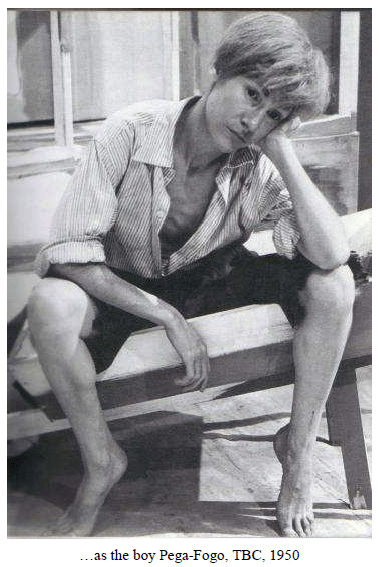
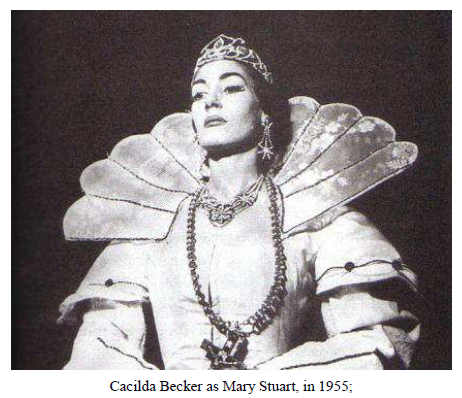
Cacilda's capacity for and joy in work permitted her to switch from one very different character to another, from Mary Queen of Scotts, say, to the boy Pega-Fogo. This transformation was not simply the result of a wardrobe change, dumping the queen's majestic robes and taping down her breasts with rolls of gauze so that she'd look more boyish. Above all, it was the fruit of Cacilda's capacity to convert her childhood experiences of humiliation and privation into a powerful interpretative key. This characteristic was much recognized by the people who were closest to her and who were entirely immersed, like her, in the world of the theater as actors, directors and critics. Remarking on Cacilda's performance in Pega-Fogo, Adolfo Celi claimed that:
..it was the most beautiful thing I ever saw her do. It was an extraordinary thing. (...) She was able to show off her whole childhood, a childhood which couldn't have been easy. She was able to transmit that pain, the pain of a child who was not happy, who had never been happy.16
This evaluation is also corroborated by critic Sábato Magaldi, who, disturbed by the fact that his two favorite roles in the actresses' career were both masculine (Pega-Fogo and Estragon, in Beckett's Waiting for Godot), reveals the meaning of this coincidence. According to Magaldi, Cacilda did not "give off an air of masculinity on stage". To the contrary, "She was quite feminine in her creations. [Her personal fragility] is what inspired Pega-Fogo and Estragon: a deeply human cut. Dejectedness, sadness, perplexity when faced with life, repressed suffering, humiliation – these were the raw materials which she drew from her childhood and imprinted upon her characters, making them seem so authentic"17.
Though masculine, these two roles are an excellent example of how, in the case of great actresses such as Italian Eleonora Duse, Russian Ludmilla Pittöeff and the Brazilians Fernanda Montenegro and Cacilda Becker, "one's own name" can become associated with illusion-creating mechanisms produced by theatrical conventions. By making the body its most important prop, the theater permits great actresses to get around the implacable imperatives of beauty and the limitations imposed by aging. This is rare in other dramatic domains which are noted for the centrality of the body in their productions, such as cinema, classical ballet and fashion. Actresses like Cacilda lead us to think about the place beauty holds in artistic activity.
Gilda de Mello e Souza has perhaps taken this reflection to its greatest limits in her analysis of the man she considers to be the greatest modern dancer, Fred Astaire (1899-1987). Fred Astaire's modernity is translated in the manner in which he sings, in his selection of composers, in his choice of clothes (black jacket, top hat, cane, black varnished shoes) and, above all, in the way in which he uses and adjusts his body and wardrobe: bringing lightness to the formal clothes that he wears. Fred Astaire danced and leaped "as if he had no legs" and for this reason, what we take away in our image of him is "the arabesque of his coat-tails in full flight, the graphic clarity of his design, black on white".18
Reducing the body to "a supporting element of the gesture which at no time becomes symbolized by muscular beauty and bodily plasticity, as was the case with Gene Kelly", Fred Astaire liberated and at the same time simulated the "beauty of the gesture – pure, free, autonomous and disincarnate" (Id.ib.:172). The fact that Astaire was not a beautiful man actually contributed to this performance, because "being how he was, he maintained his presence by gesture, pure gesture, pure grace; liberating himself from the habits of the young to become one who draws dance, a graphic dancer, pure arabesques without color" (Id.ib.:177). In this paradoxical chemistry, in which the beauty projected by the modern artist only becomes wholly manifest when it erases its bodily support, resides Astaire's genius and also the genius of the bodily interpretations of Cacilda Becker.
]]> 3.
Far from being a trump card, in the eyes of Décio de Almeida Prado – critic and the greatest historian of the Brazilian theater – a beauty can actually complicate things. This, in his view, was the case of Maria Della Costa. According to Décio:
The biggest obstacle [which she confronted] in order to reach her position [was] beauty. This set her apart from other women and opened up a series of easy careers which could turn the head of any girl. Maria Della Costa was a showgirl, she exhibited herself in casinos, she entered the fashion world as a "model" and to all these jobs brought her habits of hard work, her professional conscience and her ambition to be a great actress (...) Without any literary culture (she had no time for books), she preferred then theater and, with the humility she showed to art that was her best quality and the rarest in a beautiful woman. She studied and voluntarily submitted herself as best she could to the discipline of the director, making a point of creating a troupe which was not based upon the exaltation of her person, but upon the value of the group as a whole (Almeida Prado, 1988:228, my emphasis).
Décio de Almeida Prado's commentary comes from a larger critical work which he wrote in 1955, when the Maria Della Costa Theater opened with O canto da cotovia, by Jean Anouilh, under the impeccable direction and scenography of Gianni Ratto. Writing about the career trajectory of the company's "leading actress", Décio calls attention to the paradoxical place that beauty has in the theater world. For models, beauty is a sort of "open sesame" and it's almost essential for a career in movies. For theater actresses, however, beauty can be an obstacle which needs to be overcome. It is a powerful distinguishing mark which, if it becomes too tightly "stuck" to the actress, can lead to her not being able to adequately work according to theatrical conventions. It can, in fact, impede the actress from interpreting the wide variety of characters theoretically available to her. This is what happened to Tônia Carrero.
Tony Carrero was an actress who was gifted as few are with beauty and a sense of timing for first-class comedy and these characteristics are well captured in her cinematographic performances. Carrero, however, never achieved the degree of "perfection" required by the resources necessary to disguise the theatrical craft. She improved as an actress between the time that she opened her first company in 1949 and the end of her second in 1961 (a period that also included a brief season with the Vera Cruz cinema company and her rapid and tumultuous passage through the TBC in 1954) and this improvement could be clearly seen when she took to the stage in 1967 as Neusa Suely, the prostitute of Navalha na carne. Plínio Marcos' piece was a watershed for both national drama and for this actresses' career. As Neusa, Tônia finally "shook off" the kind of character which she had for so long been cast as: the elegant and sophisticated woman. She had been locked into this role due to her unfortunate "uncommon beauty". Daring and brave, Tônia brought to the stage an unknown side of prostitution using a language that was not common for the times and thus she gained the unanimous applause of the critics.
Another famous prostitute of the modern Brazilian theater, Geni, of Nelson Rodrigues'
Toda nudez será castigada, was interpreted by Cleyde Yáconis. The opportunity to play a part in a piece written by Rodrigues came from the dramaturge himself in 1964. Made "desperate" by the refusal of other actresses, including Fernanda Montenegro and Teresa Raquel, Nelson called Cleyde hoping to convince her to accept the role. When she heard that Ziembinski would be the director and that the cast would be made up of Luiz Linhares, Nelson Xavier and Elza Gomes, Yáconis accepted without having read the piece.19 Rodrigues' "signature" and the direction of the man who best understood Nelson Rodrigues' work seemed sufficient to guarantee the quality of the text and to disperse any doubts regarding the theatric potential of the character that she was to play on stage. Geni was a prostitute who was obsessed with the idea that she would one day have breast cancer and for whom, in the words of Cleyde, "sex was something that didn't touch the soul" (Id.ib.:86).
On the first day of the play, Geni's lines caused indignation in some and "frisson" in others. In particular, the character said that she "got all wet" just looking at Herculano and was always willing to "make sweet love" to him, before later exclaiming that "You'll only lay your hands on me by marrying me!".20 The "most concise and tight" carioca tragedy of all those written by Nelson Rodrigues, according to Ziembinski21, was brought to the stage for the first time (not coincidentally) in Rio de Janeiro in June 1965, in a packed opening night in which the "public watched on their feet, stupefied, applauding, screaming".22 It was the first time that Cleyde took the stage as an independent actress, not playing within a fixed troupe, since the closing of the TBC the previous year. In the role of Geni she was applauded mid-scene and later won the most coveted prize of the time: the Molière, the same prize Tônia would receive two years later for her interpretation of the prostitute Neusa Suely in Navalha na carne. In order to play Geni and to understand a world which was totally unknown to her, Cleyde went to the Carioca neighborhood of Lapa several times to listen to, observe and about the cheap prostitutes who worked the local streets. Many of these girls were 12 to 14 years old, expulsed from their homes by their parents after they had "made a bad decision". For this reason, according to the actress, the prostitutes would often be "mentally stuck at that age" and this could be seen in their rooms in the brothels, in the "pink fringed decoration, in the doll on the bed and in their reading materials: movie magazines and gossip rags" (Id.ib.:90).
]]> Aside from these immersions in the "field", Cleyde read widely on the topic of prostitution. The result was a widened comprehension of the lives of these girls and greater empathy for them, two characteristics which appear in the final composition of Geni, with Cleyde pinpointing Ziembinski's vision of the character. Breaking with the convention of the "traditional whore with a slit black skirt, black net stockings and high heels", the director proposed that Cleyde use the same clothes on stage that she used during rehearsals: "a raggedy cotton tube dress with pink and white stripes", that the actress herself had made in order to better withstand Rio's "suffocating heat". Dressed in this fashion and wearing sandals and no make-up, Cleyde was a success, interpreting a prostitute who swore like a sailor but who was "mentally still that girl who read soap opera and film trade magazines, with her doll laying on her bed", for whom, as she said, "all you need to do is wash your cunt out and you're ready" (Id.ib.).
If Cleyde Yáconis shown in innumerable theatrical interpretations, among them as the prostitute Geni, she also participated in several T.V. soap operas, almost always as a high-society madam in towering heels, playing these characters with an elegance and wit at odds with the personal experiences of privation which she had suffered in childhood and adolescence. Not only her, but also Maria Della Costa, Fernanda Montenegro and especially Tônia Carrero, who only gained widespread recognition – especially from the critics – grudgingly and slowly, becoming unanimously acclaimed only after her interpretation of Neusa Suely.
It's not a coincidence that both Cleyde and Tônia gained their recognition by playing roles as prostitutes, when the topic of prostitution began to take to the Brazilian stage in the irreverent and innovative works of playwrights such as Nelson Rodrigues and Plínio Marcos. These men's plays continue to be lively and entertaining, even though their impact is not today as great as it was when they firsat came out. This is not due to a decline in the quality of the actresses, however, but rather in virtue of the banalization of the theme of prostitution, caused by the general liberation of customs and sexuality in Brazil. The brio with which today's actresses interpret prostitutes, however, remains.23
This fascination, or in the words of Nelson Rodrigues true "enchantment", the idea of playing a prostitute holds among actresses caught the attention of the dramaturge when he accompanied the rehearsals for Vestido de noiva (which opened in 1943). Rodrigues was surprised by the fact that one of the play's amateur actresses, a "good family girl", "passionately" and loudly demanded to play the role of Madame Clessy. "There isn't an actress who doesn't want to use the clothes, gestures, expressions, inflections and laughter of the 'daughters of disgrace'", he observed. "Both here [in Brazil] and in all other places and idioms" (Rodrigues, 2002:202). In this role, Nelson observed, actresses transform themselves:
There is no actress, no matter how inept, incompetent or mediocre, who plays a prostitute poorly. That's what makes the role irresistible. The theater's whore is perfect, even if the woman interpreting her is ham-handed. Suddenly, the actress is capable of speaking, inflecting and gesticulating as if she were an [Eleonora] Duse (Id.ib.).
Nelson Rodrigues' comments can be deepened by a discussion of the mechanisms of disguise, which were propitiated and stimulated by theatrical conventions, when these were put into the service of revealing the social constraints to which the women of the times were subject and to which actresses were particularly vulnerable. If, during the period when modern theater was being implemented and consolidated in Brazil, the actresses had conquered prestige and the status of having a "signature" in the theatrical scene, they could still suffer from the social prejudices that were directed against their profession due to its use of tricks of dissimulation which were also common in the world of prostitution. Half-true, this explanation needs to be grounded in an even greater (and for this reason more uncomfortable) polemic. In order to confront this, I follow Annie Mignard's "elementary propositions: .
If women can not be indifferent when faced with prostitution, it is because they know the relationship that men have with prostitutes is the relationship that they have with women in general – or better yet, with the image they put in place of real women. If women are often fascinated or even tempted by prostitution, it as if it were with a borderline case of acting whose power and reach only these women are capable of understanding (Mignard, 1976:1540-41).24
Inspired by the author's "elementary considerations" regarding prostitution, art historian T.J. Clarck casts a sharp eye on the hidden meanings that the theme received in one of modernist painting's most famous works, Manet's Olympia. 19th century French dramaturgy was fully of courtesans and prostitutes and so where the country's paintings, though in a way that was more or less hidden by the conventions of the time. According to Clarck, the scandal that the 1865 exhibition of Olympia produced was due to the fact that in this particular painting, the "signifiers of sex are exposed in profusion, in the body of the subject and her accompaniments" (Clarck, 2004:198). These are organized, however, in a way that runs counter to the conventions used to portray prostitutes, courtesans and their bodies and, symbolically, these point to spaces which are totally different from those expected of women of the same social extraction as the model who posed for Manet. For this reason, says Clarck, the greatest difficulty critics had with Olympia came, paradoxically, from the fact that it did not show prostitution as portrayed in painting or on stage at the time. It's not that Olympia was painted as a prostitute which shocked them but the fact that she was painted without subterfuges, exhibiting in her nudity the indelible signs of her class. By "class", Clarck means:
]]>...a name given to that complex and determined space which is assigned to us in the social body; the name given to all that which signifies a certain history that lives in us and confers our individuality upon us. By nudity, I mean to designate those signs – that intermittent and interminable circuit – according to which we are in no place but in our body, being constructed by it and by the way it incorporates other people's signs (...) Nudity consists of a strong class-related sign, a dangerous instance of class, and in this light the reasoning behind the reaction of the critics in 1865 becomes more comprehendible. They were confused by the fact that Olympia's class was nowhere to be seen except on her body: the cat, the black servant, the orchid, the bouquet of flowers, the sandals, the pearl earrings, the necklace, the screen, the shawl – all of these are false leads which mean nothing, or at least nothing in particular (Id.ib:208-209).
When we set aside obvious differences due to time, place and genre (painting versus theater), the impact produced by the interpretations that Cleyde Yáconis and Tônia Carrero gave to Nelson Rodrigues and Plínio Marcos' prostitutes also came from the verisimilitude that they were able to imprint upon the bodies of their characters with the aid of clothes and symbols of the so-called "prostitution underworld". The striped dress, the sandals and no make-up, in the case of Geni. Swearing, gutter dialect and verbal economy in the case of Neusa Suely. In this language and in these clothes reside the class markings of these prostitutes and with them the actresses perform their "brutal stripping", in the words of Anatol Rosenfeld, "without a single drop of saccharine, without disguises and without ambiguity"25, an entire universe which had, up until then, been ignored by Brazilian drama.
That these characters were interpreted by two very different actresses – a repertoire actress, in the case of Cleyde Yáconis, and an entrepreneurial actress, in the case of Tônia Carrero – at the very moment when the theatrical paradigm in which both women were trained (under the aegis of stage companies with fixed casts) was being overthrown leads us to think in two new directions. On the one hand, this situation points to the general framework of conditions that made viable the implementation of modern theater in Brazil, the oscillation between (and fascination for) "foreign" repertoire and national dramaturgy. On the other hand, it shows that the impact that this dramaturgy had was not simply due to its internal literary qualities but also to the strengths and talents of the actresses who interpreted it. In this sense, then, it seems significant that it was these women, in active collaboration with the directors, who were principally responsible for acting out the transgressive "imaginary nature of gender"26 of the times, deconstructing the social, erotic and cognitive marks which shaped the representation of prostitution on the stage. It is in this interlacing of esthetic dimensions, which are set against or refract dominant patterns of beauty, and the full embodiment of agency engaged in innovating theatrical conventions, that one finds one possible interpretation. In conclusion, I am reminded of Braudel's observation which served to inspire this article, together with Beatriz Sarlo's essay: "history [like anthropology] is a hundred correlations at the same time, of which we can only perceive a few, at best. We should thus not rapidly accept simplistic explanatory schemes (Braudel, 2007:177).
Bibliographic References
ALIVERTI, Maria Inês. La naissance de l'acteur moderne: l'acteur et son portrait au XVIII siècle. Paris, Gallimard, 1998. [ Links ]
ALMEIDA, Maria Inez Barros de. Panorama visto do Rio: Companhia Tonia-Celi-Autran. Rio de Janeiro, Inacen, 1987. [ Links ]
]]>ALMEIDA PRADO, Décio de. O teatro brasileiro moderno. São Paulo, Perspectiva, 1988. [ Links ]
BAXANDALL, Michael. Padrões de intenção: a explicação histórica dos quadros. São Paulo, Companhia das Letras, 2006. [ Links ]
BRAUDEL, Fernand. O modelo italiano. São Paulo, Companhia das Letras, 2007. [ Links ]
CANDIDO, Antonio; ROSELFELD, Anatol; ALMEIDA PRADO, Décio de and SALLES GOMES, Paulo Emílio. A personagem de ficção. São Paulo, Perspectiva, 1992.
FERNANDES, Nanci and VARGAS, Maria Tereza. Uma atriz: Cacilda Becker. 2ª. ed. São Paulo, Perspectiva, 1995.
CLARCK, T. J. A pintura da vida moderna. Paris na arte de Manet e de seus seguidores. São Paulo, Companhia das Letras, 2004. [ Links ]
]]>CORRÊA, Mariza. A natureza imaginária do gênero na história da antropologia. Cadernos Pagu (5), Núcleo de Estudos de Gênero – Pagu/Unicamp, 1995. [ Links ]
GUZIK, Alberto. Paulo Autran: um homem no palco. São Paulo, Boitempo, 1998. [ Links ]
_________. TBC: crônica de um sonho. São Paulo, Perspectiva, 1986. [ Links ]
_________ e PEREIRA, Maria Lúcia. (orgs.) Dionysos, nº 25, Rio de Janeiro, setembro de 1980. [ Links ]
KANTOROWICZ, Ernest. Os dois corpos do rei: um estudo sobre a teologia medieval. São Paulo, Companhia das Letras, 1998. [ Links ]
]]>LEDESMA, Vilmar. Cleyde Yáconis: dama discreta. São Paulo, Imprensa Oficial, 2004, Coleção Aplauso. [ Links ]
MELLO E SOUZA, Gilda de. A idéia e o figurado. São Paulo, Duas Cidades, 2005. [ Links ]
MESQUITA, Alfredo. "De como vim a conhecer Cacilda Becker e o que se seguiu." In: FERNANDES, Nanci and VARGAS, Maria Tereza. Uma atriz: Cacilda Becker. 2nd ed., São Paulo, Perspectiva, 1995.
MICELI, Sérgio e MATTOS, Luis Fernando Franklin. (orgs.) Gilda, a paixão pela forma. Rio de Janeiro, Ouro Sobre Azul/Fapesp, 2007. [ Links ]
MIGNARD, Annie. "Propos elementaires sur la prostitution". Les Temps Modernes, mars 1976. [ Links ]
MIRA, Maria Celeste. O leitor e a banca de revistas. São Paulo, Olho d‟Água/Fapesp, 2001. [ Links ]
MONTENEGRO, Fernanda. Viagem ao outro: sobre a arte do ator. Rio de Janeiro, Fundacen, 1998. [ Links ]
PISCITELLI, Adriana. "Corporalidades em confronto: gênero e nacionalidade no marco da indústria transnacional do sexo." Revista Brasileira de Ciências Sociais, vol. 22, nº 64, 2007. [ Links ]
PONTES, Heloisa. Intérpretes da metrópole. História social e relações de gênero no teatro e no campo intelectual, 1940-1968. Livre-docência thesis, Unicamp Anthropology Department, 2008.
PRADO, Luis André do. Cacilda Becker: fúria santa. São Paulo, Geração Editorial, 2002. [ Links ]
RATTO, Gianni. A mochila do mascate. São Paulo, Hucitec, 1996. [ Links ]
]]>RAULINO, Berenice. Ruggero Jacobbi: presença italiana no teatro brasileiro. São Paulo, Perspectiva, 2002. [ Links ]
RODRIGUES, Nelson. Teatro completo de Nelson Rodrigues. 2nd ed. Rio de Janeiro, Nova Fronteira, vol. 4, 2004.
_________. A menina sem estrelas. São Paulo, Companhia das Letras, 2002. [ Links ]
SARLO, Beatriz. La pasión e y la excepción. Buenos Aires, Siglo XXI Editores Argentina, 2003. [ Links ]
Received for publication in September 2009 and accepted in November 2009. The article was greatly improved by a careful reading on the part of my student Graziele Andreazza Rossetto, who I thank for her suggestions and for the enthusiasm with which she researched the relationships between the anthropology and social history of the Brazilian theater. The article has also benefited from discussions within the Fapesp Thematic group "Gender and corporeality", coordinated by Mariza Corrêa. ]]>
1 Quote by Gilda de Mello e Souza taken from Nelson Aguilar's article, "A orientadora" (Miceli and Mattos, 2007:196).
2 For a wide analysis of the logic which dominates the organization of this branch of the cultural industry, see Mira (2001).
3 Having exercised her body with heavier clothing than normal, Eva knew how to carry her large evening gowns with grace and style. The gowns were designed by a stylist hand-picked by Perón: Paco Jaumandreu (who began his career as a costume artist for the cinema and theater). Jaumandreu was responsible for the creation of an outfit which set Eva's image in the public mind: a "Prince of Wales" suit. The stylist would be responsible for the First Lady's clothing for three years, until her clothes began to come directly from Dior in Paris.
4 Sarlo's analysis of Eva Perón's body follows of symbolic line of thought developed by Kantorowicz in his study of the Royal Body as a natural and political object. Based on the notion that the King's body is at once a philosophical, religious and political body, monarchy secures its continuity in the political body. Imperishable, the Royal Body is not subject to the contingencies which affect the natural and material body of the King. (Cf. Kantorowicz, 1998).
5 Cf. Paulo Emílio Salles Gomes, "A personagem cinematográfica" (Candido, Roselfeld, Almeida Prado e Salles Gomes, 1992:114).
6 Cf. "Aula inaugural" (Montenegro, 1998:13).
7 A naturalist emphasis permeates both cinema and photography. Photography, however, is more able to capture the "deformations" produced by theatrical convention (exaggerated and expansive gesture, heavy make up and the intense physiognomy of the players) which distinguish live-action drama from the more "natural" images created by television and the cinema. In spite of these differences, we must recognize that both filmed theater and the photographing of theatrical spectacles, as well as the painted portraits of actors, cannot escape from the analytical and methodological questions posed by art historians confronting the problem of how to deal with the mediations that are necessary in order to "read" a visual document. Regarding this issue, see Baxandall (2006). Regarding the analysis of actors' portraits, see Aliverti (1998).
8 Interview given in 1981 to Maurice Vaneau and reproduced in Fernandes and Vargas (1995:150-151).
9 Translator's note: In Portuguese, it's common for the accent to fall on the penultimate syllable.
10 Cacilda's words come from Prado (2002:226). ]]>
11 Translator's note: Daslu is currently São Paulo's leading fashion house.
12 Martucelli's words taken from Prado (2002:488).
13 Regarding these directors and their work, see Guzik (1998 and 1986), Almeida (1987), Guzik and Pereira (1980), Almeida Prado (1988), Raulino (2002). Also see the testimony of Adolfo Celi, Ruggero Jacobbi and Gianni Ratto in Fernandes and Vargas (1995), as well as Gianni Ratto's memoirs (1996).
14 Part of na interview with with Adolfo Celi in March 1981, in Rome, conducted by Júlio Lerner (Fernandes and Vargas, 1995:124).
15 Part of presentation by Ziembinski in the program "Homenagem a Cacilda", Rádio, Televisão e Cultura, Canal 2, on April 6th, 1979 (Fernandes and Vargas, 1995:142).
16 Part of an interview given by Adolfo Celi to Júlio Lerner (Fernandes and Vargas, 1995:120).
17 Cf. Sábato Magaldi, "À maneira de prefácio e depoimento" (Fernandes and Vargas, 1995:19).
18 Cf. "Notas sobre Fred Astaire" (Mello and Souza, 2005:176).
19 This information comes from an interview with Cleyde Yáconis for the SESC magaizne, A terceira Idade, vol.16, nº 30, February 2005.
20 Cf. "Toda nudez será castigada" (Rodrigues, 2004:130). ]]>
21 Ziembinski's evaluation is part of a greater text he wrote entitled "A ciranda do Nelson" for the program of the presentation of the play which opened in 1965 at the Serrador Theater in Rio de Janeiro.
22 Part of na interview given by Cleyde to Vilmar Ledesma (Ledesma, 2004:155).
23 The appeal of these characters and the popularity actresses can gain by playing them can be witnessed both in the theater and in television. A recent example of this can be seen in the character of the prostitute Bebel in the soap opera Paraíso Tropical, by Gilberto Braga, exhibited by Globo in 2007. In this role, actress Camila Pitanga won the public over and became a "must" on the fashion catwalks, in celebrity magazines and in luxury publications like Vogue (whose cover she twice posed for in 2007, as well as being used as "filler" in sophisticated and stylized photographic essays). Not coincidently, in 1968 – months after Tônia Carrero's success in the role of the prostitute Neusa Suely – Vogue also placed that actress on its cover and in its pages, in a long photo essay in which she played an "elegant woman" of the elite who made up the magazine's consumer base. Thirteen years later, in 1981, after her success as the high-society lady Stela in Gilberto Braga's Água Viva soap opera, Tônia was once again in Vogue in the essay "Tônia Carrero: sparkling". Information obtained in the "Tônia Carrero" dossier, available for consultations in the Documentation and Information Center of Funarte, located in Rio de Janeiro.
24 It's worth emphasizing that the discussion regarding prostitution which I've undertaken here seeks only to reflect how the topic was grasped in theatrical conventions, laying out the implications of this in the careers of the actresses who played prostitutes. I am not, of course, dealing in the present article with the varied and large bibliography that has been produced about the topic, especially with regards to those works which seek to inscribe the question in a larger context that conects gender to corporality. Regarding this, see the works of Adriana Piscitelli and, in particular "Corporalidades em confronto: gênero e nacionalidade no marco da indústria transnacional do sexo" (2007).
25 Sections of the article Anatol Rosenfeld wrote on 15/07/1967for the Estado de S. Paulo, reproduced in the program for the play Navalha na Carne, in 1967.
26 The expression was coined by Mariza Corrêa and serves as a title for her beautiful article, "A natureza imaginária do gênero na história da antropologia" (1995).