Guita Grin DebertI; Marcella Beraldo de OliveiraII
IAnthropologist, tenured professor of the Departament of Anthropology at Unicamp and Researcher for the Center for Gender Studies/Pagu, State University of Campinas (Unicamp), E-mail: ggdebert@uol.com.br
IIDoctor in Social Sciences through the Philosophy and Human Sciences Institute, State University of Campinas (Unicamp), E-mail: marcellaberaldo@hotmail.com
Translated by Thaddeus Gregory Blanchette
Translated from Cadernos Pagu, Campinas, n.29 p. 305-337, July/Dec. 2007.
]]>
ABSTRACT
Alternative conflict resolution based on conciliation have been identified as a possible response to problems of access to courts deriving from the numbers, costs and length of proceedings in the Brazilian's judicial system. This paper focuses on these alternative forms of justice, regarding domestic violence. Using ethnographic studies of Women's Police Stations and at Small Claim Courts, we argue that conciliation can be very different in these two institutions of the judicial system. The contrasts between moral values and the symbols used in different forms by these two institutions offer elements that can further be our understanding of the context in which Maria da Penha Law was created on August 17th of 2006. With the promulgation of this law, cases of domestic violence against women were excluded from Small Claim Courts in Brazil.
Key Words: Domestic Violence, Conciliation, Women's Police Stations, Small Claim Courts.
In an article entitled "Coercive Harmony", Laura Nader argues that the conciliatory style of conflict resolution which gained force in the United States during the 1970s is, in fact, part of a pacification policy. The 1960s were taken up by a critique of laws and marked by the struggles for civil, consumer, environmental and women's rights. However, the past 30 years in that country, according to Nader, have seen a shift from:
]]> Within this shift, a justice model centered on the courts and based upon the logic of winners and losers has been substituted by another model in which conciliation and agreement seek to create resolutions that produce only winners. The transformative enthusiasm of the U.S. during the 1960s has been replaced by intolerance for any forms of conflicts. No longer does one seek to resolve the causes of discord: rather, one seeks to avoid their manifestation. Within this context, it is often proclaimed that the U.S. court system was over burdened and that lawyers and the American people were excessively litigious, while the virtues of alternative legal mechanisms which seek to promote harmony were actively extolled. This repositioning of public discourse has, in turn, created a context in which law is eschewed and consensus valued. According to Nader, however, the belief that harmony is benign is in fact a powerful form of social and political control, for those who are in error and break the law are always more interested in creating a conciliatory solution....a concern for justice to a concern for harmony and efficiency and a turn from the ethics of right and wrong to the ethics of treatment.
Conflict resolution based upon conciliation has recently gained greater attention in the Brazilian context due to the formation of Special Civil and Criminal Courts1 which are certainly the most obvious manifestations of how the shift towards harmony has become institutionalized in our country. It's important to recognize, however, that conciliatory practices and extrajudicial mechanisms for conflict resolution have been informally present for some time now in different areas of the Brazilian justice system, such as police stations and the public ministries.2
As Nader points out, when we oppose two distinct juridical political economies – one which is supposedly based upon consensus and the other on conflict – we simplify the political meanings which conciliatory procedures may gain in different contexts.
The present article takes as its base of analysis the Special Criminal Courts (Juizados Especiais Criminais – JECrim) and the Police Stations for the Defense of Women's Rights (Delegacias de Defesa dos Direitos da Mulher – DDM) and shows that conciliation can have quite different outcomes when the question is violence between the members of a couple.
In the JECrim, the defense of the family – understood by the courts' agents to be an institution based upon affective relations and complimentary duties and obligations which are differentiated according to the age and gender of its members – orients conciliatory proceedings, reproducing the hierarchies and conflicts which are typical of the family as a an institution. By contrast, the DDMs where created in order to defend women as bearers of civil rights, in response to demands by the Brazilian feminist movement, which sought to expose the social relations of power and domination within the family environment. The stations are one of the more visible aspects of the politicization of the justice system in an attempt to guarantee women's rights. They are a means of pressuring the justice system to interfere in situations which were once considered to be private matters. This does not mean, however, that these issues are not at some risk of reprivatization, a process which in fact began to occur in 1995 with the creation of the JECrim.
Ethnographies undertaken before the creation of these special courts indicate, however, that daily practices within precinct houses often centered on attempts at conciliating female victims with their male aggressors3.
It is important to remember, however, that the concept of woman as a rights-holding subject organizes the procedures adopted in these stations, even when these result in a couple's reconciliation. The egalitarian agenda and an aversion to forms of personal dependency even orient policewomen's criticisms of their own work and of the citizens who use the station house in an inappropriate way.
In order to show that conciliation may be subject to quite distinct moral economies, the first part of this article presents data which demonstrates that JECrim is passing through a process of feminization. These courts have changed the dynamics of the Women's Police Stations, which – much to the surprise of their original founders – have been transformed into the places where domestic violence is denounced, only to be passed on to the Courts, as data from the Campinas JECrim demonstrates.
Based on data from several DDMs located in different cities in the state of São Paulo and on analyses of Women's Stations in other regions of Brazil, our second section shows the changes which have occurred in these stations following the creation of the special Courts.
Our third section offers a view of the ways in which domestic violence is treated by the Campinas JECrim. This view permits us to better understand the meanings of the feminist struggles which resulted in the promulgation of the "Maria da Penha" Law on August 7th, 2006. This law removed those crimes which involved domestic or family violence against women from the purview of the Special Criminal Courts.4 Finally, we conclude the article with an analysis of this new law's advantages and limits, considered from the point of view of a more just and egalitarian society.
]]>The JECrims and domestic violence5
Oriented by the principle of conciliation, the JECrims were created by Law #9.909 in 1995 in order to widen access to the justice system, promote rapid restitution for victims and accelerate the justice process in general in a system which had become dangerously overwhelmed. Another objective of the new courts was depenalization, offering those who committed minor crimes an opportunity to not be charged as criminals (Grinover et alli, 1997). Legal professionals refer to this law as a "boon" granted to the accused.
The conciliatory conflict resolution model which orients these courts differs greatly from the classic accusatory model of Brazilian justice.
Article 98, item 1 of the 1988 Brazsilian Constitution changed things by inserting into the dynamics of the special courts the concepts of conciliation and penal transaction, which had hitherto been unheard of in traditional Brazilian jurisprudence (…) which follows the tradition of Roman law, the so-called civil law tradition (Kant de Lima et alli, 2003:6).6
The law establishes that conciliation will occur during a court hearing – the "Preliminary Conciliation Hearing". In Campinas, these hearings take place in the Common Criminal Courts, as there is no special place reserved for JECrim proceedings in the city. Hearings are also conducted by the sitting judge of the criminal court because, as of yet, the position conciliator has not been created. Likewise, the court personnel used during a Conciliatory Hearing are the same as would be used in a common criminal justice case.7 This situation is similar to that in other Special Criminal Courts in the State of São Paulo. Generally speaking, the JECrims operate in the same spaces and with the same professional cadre, altering only the logic which orients the proceedings. Those cases which involve a lesser degree of potential offense (so-called "small claims") are treated according to the conciliatory model and common crimes according to the accusatory model. Faisting (1999) has labeled this sort of shifting in paradigms a "double institutionalization of judiciary power".
Penal action is not contemplated during a JECrim conciliatory hearing. The hearing simply opens the case and does not decide whether the accused is or is not guilty of a transgression. This is already presumed as, by accepting the conciliatory alternative to a regular hearing, the accused assumes guilt for the infraction under contemplation.
The JECrims were created to resolve small claims whose maximum penalty does not exceed two years of imprisonment. This includes "light battery" ("lesão corporal leve": article 129 of the Brazilian Penal Code) and "threats" (article 147 of the Penal Code), the crimes which are most typically dealt with by the Women's Police Stations.8
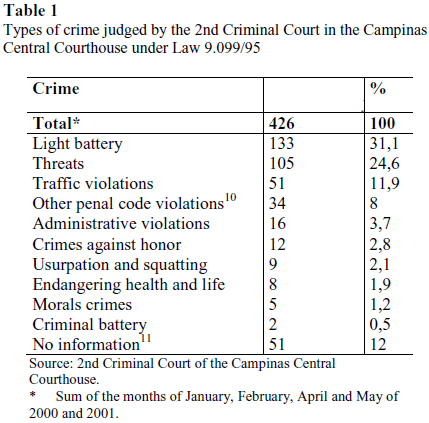
Research conducted in the Special Criminal Courts of Rio de Janeiro (Kant de Lima, Amorim e Burgos, 2003), in Porto Alegre (Campos, 2002 and Azevedo, 2000), in São Carlos (Faisting, 1999) and São Paulo (Izumino, 2003) shows that the majority of the crimes which arrive in front of these courts are precisely those involving "light battery" and "threats". Research undertaken in the Campinas Central Courthouse dealing with cases from the year 20019 also shows these crimes as those which most commonly appear in JECrim: 31,1% of the cases are classified as "light battery" and 24,6% as "threats" (Table 1).
]]>
Of the 133 cases of "battery" related in Table 1, 59.4% were remitted to the court from the Campinas Women's Police Station. 65.7% of the 105 instances of "threats" likewise originated in the DDM. In other words, the majority of the battery and threats cases dealt with by the Campinas JECrim do not originate in bars fights, transit accidents, or in confrontations between strangers: they are crimes in which the victim is a woman. In this way, the Campinas JECrim has been transformed into a court which plays a central role in dealing with crimes against women.
Studies of various JECrim have also shown that, in these courts, the majority of criminals are men and the majority of victims women. In Campinas, we found the following numbers for 2001:
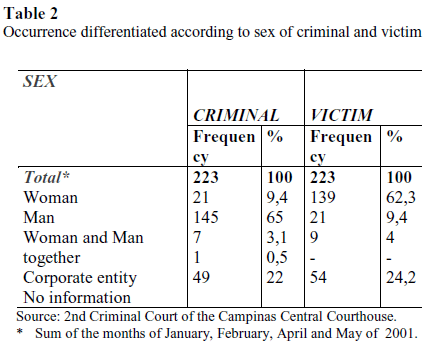
Research undertaken in Rio de Janeiro by Kant de Lima, Amorim and Burgos (2003) shows an even higher proportion of male criminals and female victims: 82.2% of the criminals revealed by this study were men and 79.9% of the victims were women. A study realized by Azevedo (1999) in Porto Alegre also revealed that the majority of the victims (62%) in the JECrims of that city were women. We thus feel justified in claiming that the JECrims passed through a process of feminization in which the majority of victims passing through these institutions were women who had been victimized precisely due to the fact that they were women.
]]> The JECrims were created in order to speed up justice by simplifying and informalizing the procedures adopted in judging those crimes which were considered to have lesser offensive potential. But much to the surprise of their creators and defenders, the Special Courts (as we've seen above) ended up dealing with a series of crimes that rarely arrived in front of the regular courts and which were channeled into the justice system through the activities of special police precinct houses.The city of Campinas has 12 police precincts but the Women's Police Stations has been the one which has ended up forwarding the most crimes to the JECrim for judgment (Table 3).
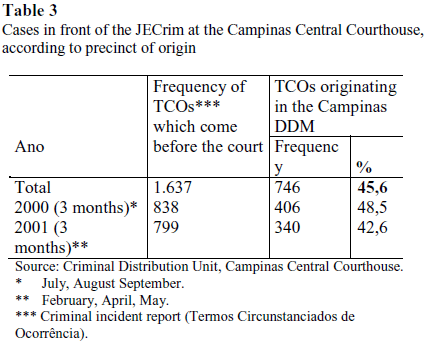
The creation of the JECrims changed the way DDM police stations function. For example, the reports registered in the Women's Police Station are rapidly sent on to the Courts because the majority of these are classified as "battery" and "threats", which are crimes considered to have lesser offensive potential and thus do not need Occurrence Reports or police inquiry. Instead, a simpler document is created: the "criminal incident report" (Termo Circunstanciado de Ocorrência - TCO), which relates the case's facts and characterizes those involved. This simplified paperwork allows the case to arrive rapidly in front of a judge (Cf. Debert, 2002).
In Campinas, the high number of domestic violence cases brought to the JECrim surprised its agents and those who study the Special Courts. It's apparent, however, that it is the Women's Police Station which allows this sort of crime to appear in front of the JECrim and it is hard to say if this situation is reproduced in other Brazilian cities. It is unquestionable that the Women's Police Stations have played an important symbolic role in divulging the fact that aggression against one's spouse is a crime that will be punished by the justice system.
Recourse to the JECrim changes the political meaning of this sort of crime, however, and thus we must now turn to an examination of how this change works.
]]>Women's Stations and the Gender Discourse
Before Law 9,099, aggression– no matter what its results – got hauled up in front of the Court. This was obligatory (...) What happened in that scenario? Well, sometimes the woman would come back to the stationhouse and say ‘For the love of God, stop! My problem's been taken care of!'… That old story we all know too well. And so oftentimes the officer on duty, or whoever, would (…) illegally disappear (…) the Occurrence Report. Or they'd do what the law demanded and send it on to the courts and, before the case was opened, [the state's prosecutor] would move it be tabled and archived. It was also quite common [for the prosecutor] to suggest that the case be archived in the name of maintaining peace in the family, so the judge would just zoom it outta there… They are all sexists. None of them can see that this act of violence is going to generate another and another… They forget that. They want to rid themselves of a domestic case, which is the kind of case that causes a lot of work. But, after all, that's how things worked.
So the guy gets called in for a talking to and is brought in by the DDM. He's in jail for only three days, true, but at least he's in jail for three days. And being jailed – even for an hour – is a pretty hard deal. He's taken in front of a police unit and he's told that his actions constitute a crime. That's because their first reaction is always ‘I'm a worker and you're treating me like a criminal'. [So we say] ‘You, sir, are a criminal, as much as any murderer or drug dealer'. And this all has a reasonably preventative effect.
After Law 9,099 it became possible to conciliate the parts. The law wasn't made for this, it was made for other purposes, but one of the results that it has had is on domestic violence cases. Most domestic violence involves threats and light battery. The Law treats this as a conciliation issue and in fact makes the attempt at conciliation obligatory. This attempt occurs because they don't know anything about how gendered violence works. So it's ‘Now, my lad, stop this bruiting about and send her some flowers and we'll close this case'. The prosecutor wants the case out of his hands as soon as possible and so do the court employees. Everyone wants it closed quickly. No one is prepared to deal with gender violence. Now [the aggressor] doesn't get hauled into the station anymore. Both he and the victim are brought in together by the police who have to do this for the conciliation attempt.
We fought 12 years to get domestic violence classified as a crime and suddenly it was turned into a joke. So men go on being aggressive towards women and end up buying a bunch of flowers or paying some small fine as ‘restitution'. It's "I'll go down there, buy you some flowers and that's that'.
I'm certain (though I can't prove this with statistics) that domestic violence has maybe not increased, but the degree of violence has increased. What once was at least blocked by a trip to the precinct house's jail is now no longer blocked and its natural tendency is to grow until someone gets killed.
The vehement description above comes from a female Police officer assigned to a São Paulo DDM. It illustrates the fact that extra-judicial resolution of conflicts did indeed occur in the precinct houses before the institution of the JECrims. These conciliation did not necessarily involve the imprisonment of the aggressor in the Station for a few days, nor the repression of an Occurrence Report in order to resolve the case. Often, simply enumerating the procedures which would be used to punish the aggressor would result in the victim withdrawing her complaint before any legal paperwork began.
Today, Brazil has more than 300 Women's Stations spread across a wide variety of cities. These Stations are equipped and structured in differing ways and have differing degrees of institutional prestige within their respective state security systems. With the creation of the Women's Police Stations, it has been the increasing tendency for the police districts operating within the State of São Paulo to refer complaints of domestic crimes where the woman is a victim to the nearest DDM. In this sense, then, the state security apparatus recognizes that physical aggression and threats directed against women by their spouses are crimes, but it tends to channel these sorts of occurrences to a specialized precinct house.
]]> In spite of the differences between the various Women's Stations, studies regarding them demonstrate several similarities, especially with regards to the public that uses their services and the ways in which the station's officers and employees represent this public and their work with it.12The similarities which these studies reveal regarding police discourses on why women seek out the DDMs is quite significant. As Sandra Brockson reveals in her research into the São Carlos Women's Precinct (2006), the station's personnel tend to assume a position of solidarity with what they perceive to be an oppressed group when they speak of women in general. On the other hand, this position of solidarity is rarely maintained when they relate specific cases which come into the station. The agents tend to divide their clientele into two types, which they then characterize in a succinct manner. According to one station secretary interviewed by Oliveira (2006:270),
There are the decisive ones, who take the cases against their aggressors to the bitter end and there are those who complain to the station only every once in awhile, as they've been the victims of aggression due to rare circumstances within the domestic context. This second type never takes their complaints against their partners to the logical conclusion.
Elaine Reis Brandão, in her study of a station in Rio de Janeiro, believes that the main reason which pushes women of the popular classes to seek out the Women's Precincts is the difficulty these women have in establishing a family regime which they consider to be ideal. This regime is characterized by the author in the following terms:
Different from the "modern couple" conjugal model which is found in certain segments of the middle class, the model most accepted by the working classes still evidences a strong demarcation of conjugal roles, which are valued differently and which occupy different hierarchical positions according to morality patterns established by kinship and locality networks. (Brandão, 1999: 60).
According to Brandão, trips to the Women's Police Station are undertaken in order to push the male partner to readjust his behavior in accordance with the predominant expectations of the local popular classes. The women thus delegate to the police the task of correcting men accused of aggression and of not fulfilling their expected conjugal roles.
Station personnel are uncomfortable in attending to this sort of demand because they believe that it situates them in the role of social workers and not police. As one officer points out:
]]> The poor and uneducated are the ones who show up most often at the Women's Stations because they think we can solve everything (...) Many women also come to the stations just to complain and get their stories off their chest, but they don't want to file a report (...) And there are a lot of women who come into the Precincts looking for advice or looking to scare their aggressive partners.
The available literature regarding the topic also shows that Station personnel tend to blame their clientele for bastardizing police work and for the monotony of daily life in the DDMs. The police claim to involve themselves enthusiastically in investigations because this is what they have trained for. Instead, they are "reduced" to the roles of councilors and conflict mediators in a context in which both parties wish to avoid punishing the guilty. Research has also shown that the Station personnel consider the conciliations undertaken by the Precinct to be ineffective in the medium and long term.
Brandão (1999:124-125) demonstrates that DDM personnel in Rio de Janeiro are quite conscious of the fact that the crimes of aggression with which they deal, have a high incidence of recurrence. The author claims that it is common practice for detectives to orient women to return to the station if necessary and that this often momentarily calms the victim, who may then decide not to fill out an Occurrence Bulletin. Paradoxically, however, when the victim returns, she is then criticized for suspending the earlier Bulletin. The officer in charge will generally tell her "Let's make sure you don't quit this time". The Station personnel often feel that these women are "playing" with the criminal justice apparatus and are, in fact, complacent with the violence directed against them.
In this manner, women are constructed as a type of citizen which does not know how to fight for their rights, either due to insurmountable ignorance or some sort of moral defect in their character.
The DDM personnel's views regarding why women seek out the Precincts, on the one hand, and the perception which they have regarding the distrust of police in other spheres of the criminal justice system, on the other, create a specific dynamic for the procedures adopted by the Women's Stations. No matter what city these are situated in and regardless of their equipment and human resources, the majority of complaints which pass through their doors are typified as "light battery" and "threats" and are then sent off to the Special Criminal Courts.
The personnel of the Women's Stations understand that the family is often a violent environment. It's commonplace to hear police officers claim that they had been "enslaved" by their husbands, had been "kept barefoot, pregnant and in the kitchen", or had been a "victim of hidden domestic violence". In these cases, the search for salaried employment is seen as the best way for a woman to gain autonomy and become independent (cf. Debert, 2002). MacDowell (1999) carefully analyzes the degree of influence that feminist discourse on the juridical culture of policewomen in the State of São Paulo (which pioneered the Women's Precincts and which currently has some 126 functioning Stations) and concludes that this has varied in accordance with the political conjuncture of the times. The relationship between the DDMs and the feminist movement was originally quite intense and, during this initial period, feminist discourse was predominant. In other periods, this relationship waned and MacDowell shows that there has been an appropriation of gendered discourse within the stations without any concomitant alliance with the feminist movement.
We highlight the importance of this appropriation because it involves the perception of woman as a rights-bearing subject. This view also organizes concepts regarding the ideal type of work which should be undertaken by Women's Police Stations in defense of women's rights. Furthermore, it orients the disappointment as to what kinds of work are actually being done by the Precincts, given the sorts of complaints which come through their doors.
The appropriation of gender discourse is undertaken in a specific way when it is combined with a professional police ethos. However, the ways in which Station personnel perceive the violence in the family and the conjugal social contract offer up a specific content which differs from the logic underlying the procedures that are adopted by the JECrims to resolve cases of domestic violence.
Conciliation in the JECrim
]]> The Court's use of conciliatory logic to deal with the question of violence against women has created specific and singular consequences. Law 9,009/95 stipulates that the defendant in a "small claim" (lesser offensive potential) case can transform his criminal case into a reconciliatory act (generally the payment of the equivalent of less than a monthly minimum wage to the victim), but it also stipulates that he can only pass through this procedure once in a five year period. However, domestic violence often recurs in a given family. Some JECrim and DDM personnel are aware of the fact that the current system is inadequate when it comes to dealing with recurring aggression. According to one female lawyer who works for JECrim:The conciliatory model is not the best when it comes to dealing with this sort of crime because the husband will often repeat his aggression. He's not afraid and he pushes his wife around. The situation can get even worse if the woman involves the justice system (...) I have a client who's partner has already paid fines four times, twice within a period of six months, some of these stipulated by the same court. The woman sought out the justice system and got slammed. Now she won't ever come back for legal help!
However, whereas in the Stations an officer might say to a victim "Let's make sure you don't quit this time", once the case reaches the Campinas Criminal Courts, a series of different agents will attempt to induce the victim to not proceed with her case.13
In one of the cases in the Campinas Central Courthouse studied by Beraldo de Oliveira (2006), court records established that the aggressor was passing through the JECrim conciliation process for the second time in less than five years. The first hearing on a charge of battery had taken place the previous year involving a different victim and legal penalties had been waived in favor of the conciliation process. Now, the aggressor was back in court, once again at the behest of the Woman's Precinct, for the same crime: battery against a female victim. Waiting in the corridor outside the courtroom, the current victim (who was no longer living with the aggressor) commented on her interest in continuing with the case:
I want to go the whole way with this. When you start something, you should see it through to the end.
However, the judge opened the proceeding saying…
We have in front of us a battery case which has been sent in by the Women's Station. The facts taken down in the station are conflicting and we can't know what really happened because we weren't there at the time. The Medical Institute's examination proves that there was bodily damage, but there are no witnesses as to what occurred. I have no way to know who is right: it's your version against hers. So before we begin, I want to explain that if this case moves forward, the consequences won't be bombastic. Aside from this, both of you are older than me and you should know how to resolve this sort of thing on your own. I think you were correct to go to the Women's Station, because nothing justifies him hitting you, ma'am. But this is a case that's only going to cause headaches if it goes forward.
The State prosecutor during this hearing, perhaps reacting to the researcher's shock and knowing that she was studying domestic violence, then commented that:
]]>The victim should quit the case and this is what the judge is trying to get her to do. If she continues, he'll have to be tried as a criminal because he can't conciliate again by paying a fine (…) And, if this process goes forward, she can be sued for false witness and she doesn't know that! This is because there is no proof that he actually hit her, there are no witnesses (…) She's going to end up with trouble if she continues with this case!
The victim finally spoke to the judge, saying...
I want to make it clear that I'm quitting the case, but that I'd continue if it were up to me. I want him to know that!
In this way, the conciliation audience can be transformed into a privileged space in the justice system for inducing victims to give up their case. During conciliation, domestic violence can be simultaneously addressed and dismissed by the Court. Research into the JECrims shows that the larger part of the crimes which enter into the conciliation process do not result in any penalty whatsoever.14 Pushing the victim to quit her claim is the definitive way in which the criminal nature of domestic violence can be completely eliminated, for if there is no case, there is no crime.
The cases sent by the Women's Stations to the courts are characterized by legal system personnel as having more of a "social" rather than a "criminal" nature and, in this sense, the accused are not properly seen as criminals. What is in question here is not whether the aggression was serious or not, but the position that this kind of crime occupies in a more general hierarchy of criminality.
One prosecutor whom we interviewed characterized intra-couple aggression in the following terms:
The problem is that this is a social and not a legal problem! In these cases, the victim needs to denounce her partner several times before he starts to think about changing. He's not going to change and stop hitting her the first time he gets dragged in front of a hearing here. That just doesn't happen. And the victim is also going to have to pass through a series of fights before she finally winds up here.
The treatment of these cases by the courts is permeated with ambiguity: the prosecutor claims that a victim needs to "denounce her partner several times" in order to achieve some sort of result while, at the same time, he works to persuade her to give up the claim if the aggressor has had a previous trip through the conciliation process given that, in this situation, a criminal case would have to be prepared.
]]> By minimizing the importance of the recurrence of violent acts and inducing women to give up their cases against their aggressors, domestic violence is effectively rendered invisible in the judicial system. Though all agents of the legal system affirmed in their interviews that they believed it is a criminal act for a man to hit a woman, the way JECrim treats this crime insures that its resolution will occur in the family and not the public sphere.The conciliation hearings in the Campinas JECrim are generally very short, usually lasting no more than ten minutes. The penalty proposed is almost always the payment of some small fine to one of the city's charitable institutions.
The judges themselves recognize that this penalty may result in the banalization of the punishment for crimes of violence against women. According to a judge of Campinas' 3rd Criminal Court, "Once one of these husbands said to me 'So all I have to do is pay a fine then? If I'd known that it was so cheap to beat my wife, I'd have beaten her more often'".
The existence of the DDMs salient the fact that violence against women is a crime. The JECrim work in the opposite direction, re-privatizing domestic violence. These two institutions, created with different objectives, thus function in different ways with regards to domestic violence and their personnel work with different concepts of women and family. This situation can be illustrated by the following report from a Campinas hearing.
At the Vila Mimosa Regional Courthouse, the doorman calls in each party by name and tells them to sit down in the hearing chamber. The woman, extremely overweight, makes a lot of noise as she enters the room, pushing chairs to and fro and calling everyone's attention to herself. People watch her, chuckling. Then the husband walks in. Man and wife sit down together at the same table. The State's attorney, conducting the proceedings, opens with a question to the wife:
"So do you want to give him a chance, ma'am?"
"Yes I do!" she responds quickly and loudly.
The husband then speaks up: "I didn't do anything to her. It's all lies!"
The woman doesn't defend herself against the charge and confirms that she wants to drop all charges. Both the husband and wife sign the appropriate documents and leave the room. The State's attorney then says "Obviously, she was going to drop all charges. I mean, who else would want that woman? If she breaks up with that man, she'll never get another!"
]]> In the words of these JECrim personnel, then, it seems that a woman's natural desire is to have a husband and that this desire is independent of how this social role is played out. This conception of women's "natural" desires is even more evident in the words of a female lawyer who works for the Campinas JECrim:If I'm the man's lawyer, we're going to pay a small fine and have done with it. If I'm the woman's lawyer, I'm going to act in a different manner. I'm well prepared, with thirty years of legal work under my belt and not only I, but all of my colleagues will try to bring the couple to conciliation. I'll talk to the husband, talk to the wife and say "Take your wife out for a beer". If the woman says "But I don't like beer," I'll tell her to learn to like it, to go with her husband as he's her companion. If he likes to fish, I'll tell her to go fish with him. Captivate him! Gain his confidence! I'll ask why they aren't doing so well and he'll say "Because when I get home, there's my wife, reeking of onions and garlic, all sloppy!" So you need to take the woman aside and say "Look, you can't act like that". Then she'll say "But how am I supposed to be beautiful and clean all the time? There aren't enough hours in the day!" Well, the biggest part of the problem is with us! Always! So you try to conciliate them and push her towards trying to captivate her husband. That is the only way! There is no other! You need to push the woman to use her head, conquer her husband, be his companion and carry that weight on her own. That's what gets you a lasting and reasonable marriage!
The stereotypical vision of conciliation expressed by this female lawyer is in complete harmony with the Court's general desire to provide a rapid conclusion to the case. The general view seems to be that domestic violence isn't a "serious" crime which requires the full attention of the justice system. Rather, it's a social problem better resolved within the domestic sphere itself, which should be preserved at any cost and this is understood to be the desire of all involved: justice system personnel, husband and wife.
In an article in the newspaper Zero Hora (21/07/2001:3), the Honorable Dr. Maria Berenice Dias of the Rio Grande do Sul Justice Department, accurately points out the traps created by the need for victims to push for prosecution in intra-couple crimes:
We have not paid sufficient attention to the fact that, in creating the JECrims and defining the crime of light battery, Law 9,099/95 has stipulated that the prosecution of such a crime is dependent upon the victim's desire to prosecute. With this, the State has omitted itself from the responsibility to act, placing such responsibility squarely upon the victim's shoulders. It is thus the victim who must seek out punishment for her aggressor. When this sort of convenient legislation is applied to domestic crimes, the result is the practical freezing of any legal action whatsoever, as long as the aggressor is the victim's husband or companion. When this sort of connection exists between the victim and her aggressor, the logic becomes "save family harmony at all costs" [our emphasis]. This, in turn, leads to a high rate of absolution, given that crimes apparently are considered to be less grave as long as they occur within the domestic sphere. In this way, domestic crimes of this sort become practically invisible. This is not enough, however, to prove that the justice system maintains a prejudiced and discriminatory outlook when the victim of a crime is a woman.
JECrim thus does not concern itself with protecting women as bearers of rights: rather, its focus is the maintenance of the family and of the couple relationship. In this way, the Special Courts reify hierarchies among couples so that these conflicts do not disturb the justice system's "real" work.
Those judges and prosecutors who are sensitive to domestic violence and to the ways in which women are treated by their companions tend to chastise the accused, taking upon themselves a sort of missionary function in the sense that they attempt to establish rules which orientate the couple's conjugal life.
For example, during a battery hearing in the 1st Criminal Court at the Campinas Central Courthouse, we witnessed the following scene. The victim had indicated that she wished to drop the case and the prosecuting attorney, a woman, thus sat down in front of the husband, looked him straight in the eye and said "You, sir, should thank your wife for having dropped the case. She is being very generous in not prosecuting you. You'd better not hit her anymore!"
]]> Legal personnel rarely recognize that domestic violence is a highly sexualized crime which is founded upon a prejudiced and hierarchical view of gender. In this sort of crime, women are victimized simply and only because they are women! In this way, violence against women is once again rendered invisible. In the words of one judge whom we interviewed, "They need to resolve their problems between themselves. They should only go to court if someone was badly injured". In this judge's view, then, family problems should be taken care of at home.In this understanding of domestic violence, women are not understood to be bearers of rights, a belief which is in frank contrast with that expressed by the legal personnel working at the Women's Stations, who are constantly asking victims if they wish to exercise their rights or not. The JECrim believes that couples' conciliation means the dissolution of the roles of victim and accused and family is invoked in order to resolve a situation which, it is understood, never should have arrived in front of the courts in the first place.
JECrim personnel are aware of the fact that the justice system cannot create good families. Their main goal, in this context, is to push these crimes out of the legal sphere so that the justice system can concentrate on crimes which are considered to be more important.
Conciliation and the juridical political economy
Carmem de Campos shows that the lack of a gender paradigm within the justice system leads to the banalization of domestic violence by the JECrim and the re-privatization of conflict precisely because it remits power to the aggressor. However, according to the author:
Law 9,099/95 does not inaugurate new procedures. It simply shifts informal conciliation from the police station house to the judicial branch, formalizing it by bringing it front of a judge who has legal powers to resolve such cases (Campos, 2002:20).
In the present article, we have sought to show how the flow of cases from the Women's Stations to the Special Courts has created a shift in practices which is much greater than has generally been imagined. These two areas are not simply different localities in which conciliation may occur through the exercise of judges' or police officers' symbolic power over those who seek out the justice system to address wrongs. Rather, this shift has resulted in a radical change of the actors involved in such cases, the actions undertaken and the logic which orients the conflict resolution process.
In this shift, a victim who is a bearer of rights is reconstituted as a wife or a companion and her aggressor becomes a husband or a companion. The crime is transformed into a social problem or into a lack of moral character on the part of those involved which, in the view of the justice system, can be easily remedied by a good talking to, or, in the more radical cases, the application of a small fine. The logic which orients conciliation in the Special Courts implies the search for rapid, simple, informal and economic solutions to cases which are seen as inappropriately taking up the Courts' time and energy.
]]> Research conducted in the DDMs has shown that victims resorting to the Station's services can also result in conciliation, however temporary. As we have seen above, however, distinct moral economies operate in the Women's Precincts and the JECrim.Focusing on violence against women, the Stations were created in order to respond to a demand of clear-cut rights-bearing subjects. The Station's personnel, in fact, are often upset by the fact that women choose to not exercise these rights. JECrim judges, by contrast, have a greater degree of symbolic power than the police officers who run the DDMs. The judges, however, were not educated nor prepared to deal with the question of violence against women and, in fact, are not even expected to be educated or prepared in this sense, even though this crime is recurrent and common within their jurisdictions (as the data from the Campinas JECrim clearly shows). Judges' perceptions of the family and the importance of its social role orient the decisions undertaken in the JECrims.
Indignation with the way in which domestic violence was treated by the Brazilian legal system and the conviction that this crime deserved a different sort of treatment pushed Brazil's feminist movements to struggle for changes which eventually led to the August 2006 "Maria da Penha" Law, Law no. 11,340. Article 1 of this law:
...provides for the creation of Family and Domestic Violence Against Women Courts and established means to assist and protect women caught in domestic or family violence.
The new law changes the way domestic violence crimes against women are treated by the justice system15. Among these changes, the most important are:
1) Increasing the maximum penalty for these crimes from one to three years, thus removing them from the classification of crimes of lesser offensive potential.
2) Removing these crimes from jurisdiction of the Special Criminal Courts.
3) The stipulation of imprisonment in cases of domestic violence against women.
4) The prohibiting of the paying of fines as a means of conciliation in cases of domestic violence and insisting – as Law 9,099/95 had earlier insisted – that they be subject to police investigation.
]]> It is hoped that these changes will restore to the Women's Precincts the practices which had been common before the passage of the 1995 law.The new Family and Domestic Violence Against Women Courts are the result of a politicization of the justice system. Different from the Women's Station's however, their focus is on the family and on violence towards women within the domestic context. How will these new courts act in defense of women's rights? This is the question which now calls our attention. Is woman as the bearer of rights the underlying concept which will inform these courts' actions? Or is it woman and men as the (re)producers of certain roles within a family context? An accurate general response at this point in time is impossible given the differences which mark Brazil and the activities of different spheres of interest within the country's justice system. We can say, however, that the new law is at least focused on violence against women within the conjugal and family context, ignoring, for the time being, the violence which women suffer as women in the public sphere and the workplace, among other areas of society.
Bibliography
AMARAL, C.G. et alli. Dores Invisíveis: Violência em Delegacias da Mulher no Nordeste. Fortaleza, Edições Rede Feminista Norte e Nordeste de Estudos e Pesquisas sobre a Mulher e Relações de Gênero (REDOR), 2001.
AMORIM, M. S. Cidadania e jurisdição de direitos nos Juizados Especiais Criminais. In: AMORIM, M. S.; KANT DE LIMA, R.; BURGOS, M. B. (orgs.) Juizados Especiais Criminais, sistema judicial e sociedade no Brasil: ensaios interdisciplinares. Niterói, Intertexto, 2003, pp.205-229.
ARAÚJO, L. F. Violência contra a mulher: a ineficácia da justiça penal consensuada. Campinas/São Paulo, CS/Lex, 2003.
]]>ARDAILLON, D. Estado e Mulher: Conselhos dos Direitos da Mulher e Delegacias de Defesa da Mulher. São Paulo, Fundação Carlos Chagas, mimeo., 1989.
___________. e DEBERT, G.G. Quando a vítima é mulher – Análise de julgamentos de crimes de estupro, espancamento e homicídio. Brasília, Conselho Nacional dos Direitos da Mulher, 1987.
AZEVEDO, M. A. Mulheres Espancadas: A Violência Denunciada. São Paulo, Cortez, 1985.
AZEVEDO, R. G. Informalização da Justiça e Controle Social – Estudo Sociológico da Implementação dos Juizados Especiais Criminais em Porto Alegre. São Paulo, IBCCRIM, 2000.
___________. Juizados Especiais Criminais: Uma abordagem sociológica sobre a informalização da justiça penal no Brasil. Revista Brasileira de Ciências Sociais, vol. 16, nº 47, outubro de 2001.
]]>BERALDO DE OLIVEIRA, M. Crime Invisível: a Mudança de Significados da Violência de Gênero no Juizado Especial Criminal. Dissertação de Mestrado, Departamento de Antropologia Social, Instituto de Filosofia e Ciências Humanas/UNICAMP, 2006.
BLAY, E. e OLIVEIRA, M. Em briga de Marido e Mulher... Rio de Janeiro/ São Paulo, IDAC/Conselho da Condição Feminina, 1986.
BRANDÃO, E. Violência Conjugal e o Recurso Feminino à Polícia. In: BRUSCHINI, C. e HOLLANDA, H. B. (orgs.) Horizontes Plurais. São Paulo, Fundação Carlos Chagas/Editora 34, 1999.
BROCKSON, S. A Delegacia de Defesa da Mulher de São Carlos, SP. In: Debert, G. G. et alii. Gênero e Distribuição da Justiça: as Delegacias de Defesa da Mulher e a construção das diferenças. Campinas-SP, Núcleo de Estudos de Gênero – Pagu/UNICAMP, Coleção Encontros, 2006.
BURGOS, M. B. Conflito e sociabilidade: a administração da violência pelos Juizados Especiais Criminais. Cidadania e Justiça: revista da AMB, ano 5, nº 10, Rio de Janeiro, 1º sem. 2001, pp.222-235.
]]>CAMPOS, C. H. A violência doméstica no espaço da lei. In: BRUSCHINI, C.; PINTO, C. R. (orgs.) Horizontes Plurais: novos estudos de gênero no Brasil. São Paulo, Editora 34/Fundação Carlos Chagas, 2001, pp.301-322.
___________. Justiça Consensual e Violência Doméstica. Textos Bem Ditos, vol. 1, Porto Alegre, Themis, 2002.
___________. Juizados Especiais Criminais e seu déficit teórico. Estudos Feministas, 11(1)336, Florianópolis, UFSC, jan-jun de 2003, pp.155-170.
CARDOSO DE OLIVEIRA, L. R. Entre o justo e o solidário: Os dilemas dos direitos de cidadania no Brasil e nos EUA. Revista Brasileira de Ciências Sociais (ANPOCS), ano 11, nº 31, 1996, pp.67-81.
___________. Direito Legal e Insulto Moral – Dilemas da cidadania no Brasil, Quebec e EUA. Rio de Janeiro, Relume Dumará, 2002.
]]>___________. Honra, Dignidade e Reciprocidade. Série Antropologia, nº 344, mimeo., 2004.
CARRARA, S. et alli. "Crimes de Bagatela": a violência contra a mulher na justiça do Rio de Janeiro. In: CORRÊA, M. (org.) Gênero e Cidadania. Campinas, Núcleo de Estudos de Gênero – Pagu/Unicamp, Coleção Encontros, 2002.
CUNHA, L. G. S. Juizado Especial: ampliação do acesso à justiça? In: SADEK, M. T. (org.) Acesso à Justiça. São Paulo, Fundação Konrad Adenauer, 2001.
DEBERT, G. G. e GREGORI, M. F. As Delegacias Especiais de Polícia e o Projeto Gênero e Cidadania. In: CORRÊA, M. (org.) Gênero e Cidadania. Campinas, Núcleo de Estudos de Gênero – Pagu/Unicamp, Coleção Encontros, 2002, pp.9-19.
DEBERT, G.G. A família e as novas políticas sociais no contexto brasileiro. Interseções – Revista de Estudos Interdisciplinares, ano 3, nº 2, UERJ, 2001.
]]>___________. Arenas de Conflitos Éticos nas Delegacias Especiais de Polícia. Primeira Versão, nº 114, IFCH/Unicamp, Novembro de 2002.
FAISTING, A L. O dilema da Dupla Institucionalização do Poder Judiciário: O Caso do Juizado Especial de Pequenas Causas. In: SADEK, M. T. (org.) O Sistema de Justiça. São Paulo, Editora Sumaré, 1999.
GRINOVER, A. P.; GOMES FILHO, A. M.; FERNANDES, A. S.; GOMES, L. F. Juizados Especiais Criminais – Comentários à Lei 9099. 2ª ed. São Paulo, Editora Revista dos Tribunais, 1997.
GROSSI, M. P. Vítimas ou Cúmplices? Dos diferentes Caminhos da Produção Acadêmica sobre Violência contra a Mulher no Brasil, São Paulo, ANPOCS, mimeo., 1991.
___________. Novas/Velhas Violências contra a Mulher no Brasil. Estudos Feministas, vol. 2, 1994.
]]>___________. Rimando Amor e Dor: Reflexões sobre a violência no vínculo afetivo conjugal. In: PEDRO, J. e GROSSI, M. P. (orgs.) Masculino, Feminino, Plural. Florianópolis, Ed. Mulheres, 1998.
HERMANN, L. Violência Doméstica: a dor que a lei esqueceu. Considerações sobre a lei 9099/95. Campinas, Cel-Lex Editora, 2000.
IZUMINO, W. P. Justiça para todos: os Juizados Especiais Criminais e a violência de gênero. Tese de Doutorado, Departamento de Sociologia da Faculdade de Filosofia, Letras e Ciências Humanas da USP, 2003.
___________. Justiça Criminal e Violência contra a Mulher – O Papel do Judiciário na Resolução dos Conflitos de Gênero. Dissertação de Mestrado, FFLCH/USP, 1997.
KANT DE LIMA, R. et alli. A violência doméstica nos Juizados Especiais Criminais: desafios para o direito e para os tribunais brasileiros. 2003, (www.uff.br/nufep/paginas/aba.htm).
]]>___________. L’administration de la violence quotidienne au Brésil. L’experience de Tribunaux criminels spécialisés. Droit e Culture – Revue Semestrielle d'anthropologie et d'histoire, n. hors série, 2001.
KANT DE LIMA, R. A Polícia da Cidade do Rio de Janeiro: seus dilemas e paradoxos. Rio de Janeiro, Editora Forense, 1995.
MACDOWELL SANTOS, C. Cidadania de Gênero Contraditória: Queixas, Crimes e Direitos na Delegacia da Mulher de São Paulo. In: AMARAL, A. J. e PERRONE-MOISÉS, C. (orgs.) O Cinqüentenário da Declaração Universal dos Direitos do Homem. São Paulo, Editora da USP, 1999.
MACHADO, L. Z. E.; MAGALHÃES, M. T. B. Violência Conjugal: os Espelhos e as Marcas. In: SUÁREZ, M. e BANDEIRA, L. M. (eds.) Violência, Gênero e Crime no Distrito Federal. Brasília, EDUnB/Ed. Paralelo 15, 1999.
MUNIZ, J. Os Direitos dos Outros e os Outros Direitos: Um Estudo sobre a Negociação de Conflitos das DEAMs/RJ. In: SOARES, L. E. (ed.) Violência e Política no Rio de Janeiro. Rio de Janeiro, ISER/Relume Dumará, 1996.
]]>NADER, L. Harmonia Coerciva: a economia política dos modelos jurídicos. Revista Brasileira de Ciências Sociais, ano 9, nº 29, 1994, pp.18-29.
NELSON, S. Constructing and Negotiating Gender in Women’s Police Stations in Brazil. Latin American Perspectives, vol. 23, nº 1, 1996.
OLIVEIRA, P. A Delegacia de Defesa da Mulher em São José do Rio Pardo. In: DEBERT, G.G. et alii. Gênero e Distribuição da Justiça: as Delegacias de Defesa da Mulher e a construção das diferenças. Campinas-SP, Núcleo de Estudos de Gênero – Pagu/Unicamp, Coleção Encontros, 2006.
RIFIOTIS, T. As Delegacias Especiais de Proteção à Mulher no Brasil e a "judicialização" dos conflitos conjugais. Mimeo., 2001.
___________. As Delegacias Especiais de Proteção à Mulher no Brasil e a "judicialização" dos conflitos conjugais. Anuário 2003. Direito e Globalização. Atas do Seminário do GEDIM, Universidade Cândido Mendes, Rio de Janeiro, Editora Lumen Juris/UNESCO/MOST, 2003, pp.381-409.
]]>SADEK, M. T. Acesso à Justiça. São Paulo, Fundação Konrad Adenauer, 2001.
SAFFIOTI, H. I. B. Violência Doméstica: questão de polícia e da sociedade. In: Corrêa, M. (org.) Gênero e Cidadania. Campinas-SP, Núcleo de Estudos de Gênero – Pagu/Unicamp, Coleção Encontros, 2002.
___________ e Almeida, S. S. Violência de Gênero: Poder e Impotência. Rio de Janeiro, Revinter, 1995.
SOARES, B. M. Mulheres Invisíveis: violência conjugal e as novas políticas de segurança. Rio de Janeiro, Ed. Civilização Brasileira, 1999.
SOARES, L. E. et alli. Violência e Política no Rio de Janeiro. Rio de Janeiro, Relume Dumar·/ISER, 1996.
]]>SUÁREZ, M. e BANDEIRA, L.M. (eds.) Violência, Gênero e Crime no Distrito Federal. Brasília, EDUnB/Ed. Paralelo 15, 1999.
___________. A Politização da Violência Contra a Mulher e o Fortalecimento da Cidadania. Série Sociológica, nº 191, Brasília-DF, UnB, 2001.
TAUBE, M. J. Quebrando Silêncios, Construindo mudanças. In: CORRÊA, M. (org.) Gênero e Cidadania. Campinas-SP, Núcleo de Estudos de Gênero – Pagu/Unicamp, Coleção Encontros, 2002.
VIANNA, L. W. et alli. A Judicialiazação da Política e das relações sociais no Brasil. Rio de Janeiro, Ed. Renavan, 1999.
* Published in cadernos pagu n.29, Campinas, jul./dez. 2007. Translated by Thaddeus Gregory Blanchette. ]]>
1 Translator's Note: these courts are roughly the equivalent of U.S. small claims courts.
2 Regarding police stations see in particular Kant de Lima's 1995 ethnography; regarding the public ministries, see Sadek, 2001.
3 Regarding Women's Stations, see Amaral et alii, 2001; Azevedo, 1985; Ardaillon, 1989; Blay and Oliveira, 1986; Brandão, 1999; Brockson, 2006; Carrara et alii, 2002; Debert e Gregori, 2002; Debert, 2002; Grossi 1994, 1998; MacDowell dos Santos, 1999; Machado e Magalhães, 1999; Muniz, 1996; Nelson, 1996; Oliveira, 2006; Rifiotis, 2001, 2003; Saffiotti, 1995, 2002; Soares, 1999; Soares et alii, 1996; Suárez e Bandeira, 1999; Taube, 2002.
4 Law 11.340/2006 was nicknamed the "Maria da Penha Law" in homage to a Cearense (someone who was born in the state of Ceará in Brasil) woman who was left paraplegic due to the criminal acts of her husband in an event which was widely regarded as one of the most tragic accounts of violence against women in Brazil and a clear instance of aggressor impunity. Nineteen ()years after the crime, due to the activities of human rights and feminist groups together with the Interamenrican Commission on Human Rights of the OAS, Maria's aggressor was finally brought to justice and punished.
5 Among students of violence, there's a certain difficulty in defining the phenomenon which we are discussing. Occasionally it is understood as violence against women and on other occasions as domestic violence, intrafamiliar violence, or even gendered violence. There is no consensus yet regarding it. In the present article, we use "domestic violence" to indicate that type of violence which the Women's Police Stations deal with.
6 Regarding Special Criminal Courts, see also 2003; Azevedo, 2000, 2001; Burgos, 2001; Campos, 2001, 2002, 2003; Cardoso de Oliveira, 1996, 2002, 2004; Faisting, 1999; Sadek, 2001; Cunha, 2001; Kant de Lima et alli, 2003; Izumino, 2003; Vianna et alli, 1999; Araújo, 2003.
7 For a more complete view of the JECrims in Campinas, see Beraldo de Oliviera, 2006.
8 In 2004, with the establishment of Law 10.886, paragraph 9th was added to article 129 – battery –, typifying domestic violence in the Brazilian Penal Code: "If battery is practiced against an ascending or descending relative, sibling, spouse or companion, or against someone with whom the accused lives or has lived, or with whom domestic relations are maintained in any form, even under the rubric of cohabitation or hospitality, then the penalty shall be imprisonment from six months up to a year". This law didn't substantially change the way domestic violence is treated by the Brazilian justice system. Though it typified domestic violence in one paragraph of the article dealing with "battery", distinguishing it from "light battery" and increasing the minimum penalty from 3 to 6 months, it still situated domestic violence as a crime of lesser offensive potential. This kept the crime within the purview of the Special Criminal Courts. The Maria da Penha Law" changed paragraph 9th of article 129, setting the maximum penalty at three years and thus taking domestic violence out of the category of crimes with lesser offensive potential.
9 The data for Campinas presented in this article is from Beraldo de Oliveira, 2006.
10The "other penal code violations" category includes crimes involving unruly behavior ("vias de fato") (art.21, CP), "disturbance of the peace" (art. 42, CP), "disturbance of tranquility" (art. 65, CP) and "offensive acts" (art 61, CP)". ]]>
11 Table 1 was concocted based upon information found in the Livro de Registro de Feitos (Crime Registry) produced by the 2nd Criminal Court of the Central Courthouse. In some cases, the space set aside for "type of crime" in these reports was left blank. We classify these instances as "no information".
12 See Blay and Oliveira, 1986; Brandão, 1999; Carrara et alli, 2002; Amaral et alii, 2001; Rifiotis, 2001; Soares, 1999.
13 Kant de Lima et alli (2003:12-13), researched two JECrims in the city of Rio de Janeiro and observed that a large percentage of the victims end up abandoning the process. Further research has shown, however, that this percentage can vary enormously from court to court. In one court studied, for example, the percentage of case abandonment was over 50% while in the second it was less than 25%. The authors affirm that this difference is principally due to the fact that the first JECrim makes quick case resolution a priority and keeps statistical track of this. By contrast, the second court orientates, both parties in a conciliation case, to not quit the process, believing that a high level of abandoned cases would indicate institutional failure, resulting in zero reduction of violence. According to the personnel of this second court, one of the JECrim's principal responsibilities is to reduce violence through conflict resolution. Kant et alls research demonstrates that we cannot generalize the attitudes of personnel involved in the JECrims, but that it is also important to emphasize the impact of non-representation (victims agreeing to not continue prosecution) in cases involving domestic violence.
14 Research into other states' JECrims shows that the principal result of the cases that come in front of these courts is the abandonment of the case. The research conducted by Kant de Lima, Amorim and Burgos (2003: 10) in Rio de Janeiro shows that 4.6% of all cases are closed in the initial hearing, 33.2% are resolved through conciliaton, a further 22.9% are resolved via criminal penalties and 39.3% are abandoned. In Porto Alegre, Azevedo (2001:104) shows that abandonment or non-representation is a much more frequent occurrence in the city's JECrims than conciliation or the assignment of criminal penalties. But the most common resolution of these courts, at least in 1996 and 1997, is the "arquiving" or tabling of the case. Izumino, studying São Paulo (2003: 299), observed that 44.4% of all cases in front of the JECrims resulted in this sort of decision during the years stretching from 1999 to 2003, with penalties not being assigned and the victim not being represented in criminal court. It's not news that the greater part of these cases has been resolved in this fashion, as this phenomenon has been reported by all researchers (Azevedo, 2000; Viana, 1999; Kant de Lima, 2003; Faisting, 1999; Campos, 2001; Hermann, 2000).
15 Crime discribed in Article 129, §9º of the Penal Code.