Alceu Penna and the elaboration of a Brazilian style: fashion and costumes*
Alceu Penna e a construção de um estilo Brasileiro: modas e figurinos
Maria Claudia Bonadio; Maria Eduarda Araujo Guimarães
ICentro Universitário Senac - mariacbonadio@uol.com.br
IICentro Universitário Senac - madu@uol.com.br
]]>
In this study we examined the important work of the graphic artist Alceu Penna (1915-1980) through the analysis of articles, illustrations and texts created by him for the fashion section of the magazine O Cruzeiro between 1939-1947, as well as his probable collaboration in the development of costumes for Carmen Miranda. We note how he demonstrated concern for the "creation" of a Brazilian style in fashion by presenting the latest international fashion news, often in a critical manner, and sketching costumes for the Carnaval, creating, thus, a "Brazilian visuality" based on the ideas proposed by the New State. We consider yet how his experience in looking at Brazil from the United States and his reviews of the images of "Brazil" proposed by Hollywood are relevant in this process.
Keywords: Alceu Penna, fashion, identity and style.
RESUMO
Neste estudo, observamos a importância do trabalho do artista gráfico Alceu Penna (1915-1980), através da análise de reportagens, ilustrações e textos por ele criados para a seção de moda da revista O Cruzeiro, entre 1934-1947, e de sua provável colaboração nos figurinos de Carmen Miranda. Notamos como, ao apresentar de forma muitas vezes crítica as últimas novidades da moda internacional e esboçar - a partir da criação de fantasias para o carnaval - uma "visualidade brasileira", demonstra preocupação com a "criação" de um estilo brasileiro na moda, calcado nos ideais identitários propostos pelo Estado Novo. Consideramos, ainda, como sua experiência em olhar o Brasil a partir dos Estados Unidos e das imagens de "brasilidade" propostas por Hollywood são relevantes nesse processo.
Palavras-chave: Alceu Penna, estilo, identidade, moda.
1. Alceu Penna and the images of Brazil
I know - through information and research - of the importance of J. Carlos in his time, with his dandies and his flappers; I got to know Péricles' work, through his Amigo da Onça, but I am certain that, neither one or the other has acted through their drawings upon the Brazilian way of being or determined ways of behaving, feeling, choosing, clothing.
]]> In sum: creating a Brazilian fashion.(Ziraldo, 1985)
Born in Curvelo (MG), Alceu de Paula Penna (1915-1980) moved to Rio when he was 17 years old to study Architecture in the School of Arts, when he started going to newspapers and magazines with the objective of disseminating and selling his drawings. Shortly after, he debuted as an illustrator for different publishers, amongst which were the children's section of O Jornal (1891-1968) and O Globo Juvenil (1937-1954). In the 1930s, he began to create covers and illustrations for the magazine O Cruzeiro (1928-1975).
Throughout his career, Penna worked in many different areas of fashion, costumes and design: i) he created illustrations for the covers of magazines (O Cruzeiro, A Cigarra e Tricô Crochê), comics, books, covers of children's music albums (the series Disquinho, directed by Braguinha), packages and marketing (Cigarros Souza Cruz, Melhoral, Biotônico Fontoura, amongst others); ii) he designed stage settings and costumes for concerts, Casinos, theaters, cinemas and television; iii) he designed costumes for Samba schools; stamps for the textile industry and fashion collections (Rhodia e Ducal). Considering all this, Penna can be seen as a versatile graphic artist.
Amongst his works, the one that would be best known and attract the most attention was the section Garotas [Girls], upright section printed in colors and that, between the years of 1938-1964, occupied a prominent space in the weekly editions of the magazine O Cruzeiro, "presenting every week a diversity of audacious youngsters, followed by well-humored texts". (PENNA, 2007, p. 24)
Announced as "(…) the expression of modern life, (…) unquiet and devilish" (NETTO, 1998, p. 25), these Garotas were drawn with traces that were somewhere in between the sensual and the ludic, always dresses in the latest fashion and enjoying the beach, parties, the movies, hence, the best that Rio de Janeiro's social life could offer. During 26 years, they inhabited the pages of O Cruzeiro and also the imaginary of the young ladies and gentlemen, since they inspired the male's juvenile fantasy and worked as a model of fashion and beauty for the ladies.
Considering its longevity and the increasing number of academic studies, memories and exhibitions dealing with the subject1, the section can be considered one of the most popular in the magazine, culminating in the creation of a radio version in 1943, broadcast by Tupi Radio of Rio de Janeiro every Friday at 7:30 p.m.
Many studies agree on the importance of the magazine O Cruzeiro for the diffusion of "images of Brazil", especially during the period that it reached its selling peak, between the years of 1940-1950 (MARTIS, 2007); and (DES HONS, 1985). There are also researches (such as those of Gabriela Penna and Carla Bassanezi, cited on note 2) that analyze the importance of the section Garotas as a way of diffusion of female fashion and behavior (often seen as beyond its time). In this article we observe how this column and other collaborations of Alceu Penna to the magazine - such as the fashion section and international articles - reflected and reproduced, through text and representations of the trends and other visual aspects of culture, some of the important ideals that formed the political and cultural actions of the New State [Estado Novo, in Portuguese], in a nutshell: the "formulations about what we are" (LUSTOSA, 1985, p. 22) and the subsequent collaboration to the configuration of a visuality, thus, "a set of discourses and practices constituting distinctive forms of visual experience in historically specific circumstances" 2 that represented the national identity.
We also note that his trip to the United States between 1939-1941 (that happens during Brazil's participation in the New York World's Fair and the increasing success of his friend Carmen Miranda), distanced him from Brazil and placed him in direct contact with the country that was being seen by Brazilians as a "model of development", both economically and culturally and which had in such period already developed a fashion industry. This probably led him, as it did with modernist artists of the 1920s, to ask himself "how make his international experience compatible with the tasks that developing societies presented" (CANCLINI, 2006, p. 78). This closer contact with international fashion drives the illustrator to observe the peculiarities of our "imagined community" (ANDERSON, 1983, pp. 16-23) and, together with the linkage between these elements and international fashion, to construct, through his collaborations with O Cruzeiro, definitions in text and images of the first lines of a visuality that would permeate and characterize what, from the 1960s on, was called the Brazilian fashion3, observing to which extent this national identity projected onto fashion was connected with "invented traditions" by the New State.
We observe still that the conception of a state of being Brazilian presented in the illustrator's work was elaborated based on the questioning of the Brazilian images propagated though movies and North American fashions, at the same time that it was fed by such representations.
]]>2. The New State and the project of a new Brazil
Amongst the changes that occurred in the 1930s in many aspects of the national life, those that were related to the cultural field were the most noticeable and, perhaps, the ones that made changes that would never be equaled, for they endeavored to establish a national identity that had so far been undefined.
The transformations initiated with the decline of the Old Republic, marked by the rise of Getúlio Vargas to the power in the movement that was later known as the 1930 Revolution, were not, according to Antonio Candido,
an absolute start, neither a first and mechanical cause, for in history there are not such things. But it was an axis and a catalyzer: an axis around which the Brazilian culture circled, catalyzing disperse elements to organize them in a new configuration. In this sense, it was a historical hallmark, one of those that makes us clearly feel that there was a ‘before' different than an ‘after'. (1984, pp. 26-37)
Getúlio Vargas' political project implicated, fundamentally, in the centralization of power, which, during the period of the Old Republic was fragmented in the power of the most important provinces: São Paulo, Minas Gerais and Rio de Janeiro. In order to do so, it was necessary that the Brazilian identified themselves with the nation as a whole.
The proposals for a Brazilian culture, that emerged in the previous decade with the Modernist Movement, would find their consolidation under Getúlio's regime. In their first phase, the Modernist Movement had greater ambitions in the aesthetical point of view, seeking, at the same time, to create a rupture with the European model that was so far conventional, and endeavoring to find some sort of originality in Brazilian culture. According to Antonio Candido, the movement had in its first phase the objective of a
]]> The second phase of this movement, initiated in the 1930s, reflects a process of politicization and startslocal breakthrough; the assimilation of an European vanguard. Let us also emphasize the acute nationalism of this renewal generation, that leave aside the ornamental patriotism of Bilac, Coelho Neto or Rui Barbosa, to love in its utmost the exotic found in the country for its curiosities freed from academic injunctions. A certain number of writers were focused on showing how we are different from Europe and how, because of this, we should see and express things diversely. (2000, p. 121)
to worry more directly with social problems, producing historical and sociological essays, the denounce romance, the militant and combat poetics. It is no longer a matter of ‘adjusting' the country's social situation to a more modern reality; it is a matter of reforming or starting a revolution in this reality, of modifying deeply beyond (or beneath) the bourgeois proposition: writers and intellectuals of the left wing showed the figure of the proletariat (the Jubiabá, for example) and the peasant (Vidas Secas) roused against the structures that keep them in a state of sub-humanity, on the other hand, the catholic conservativeness, the traditionalism of Gilberto Freyre, the integralism theses, are manners of reaction against modernization itself. (LAFETÁ, 1974, pp.18-19).
It is the passage from an aesthetical project to one that can be considered ideological, as well as the beginning of the modern phase of the concepts of culture in Brazil.
The political changes initiated on the 1930s, with the revolution lead by Getúlio Vargas and, latter, the rise of the New State in 1937, transformed in a radical way the Brazilian nationalism. The political centralization will have as its corollary the centralization of symbolic power in such way that the State will take as its responsibility the challenge of building a national identity. Besides, according to Silvana Goulart:
the nationalist movement presupposed the identification of all society members with a common destiny, originated in the past, as well as it identified a historical collective as a nation, a set of moral values that formed a organic whole, whose objectives were reached through the State: the responsible for moral order, the tutor of civic virtue and the immanent conscience of the collective whole. Nationalism was justified, thus, based on the ‘conscience of delay', what justified also the defense of the principal role of the State. It represented the possibility of Brazil overcoming the distance from nations developed by modernization. (1990, p. 16)
The Brazilian state acted on two different spheres as means of performing such symbolic power. One of them was the Educational field, with the creation of the Ministry of Education on November 14th 1930, as one of the first acts of the Provisory Government, whose jurisdiction acted also on the Public Health. The other, in the area of Culture, was the promotion of studies and researches that had Brazil and Brazilians as central themes. The presence of the public power also occurred directly in the cultural production, leading to the creation of the Department of Press and Advertisement in 1939 (DIP, in Portuguese), that would act as an organ of regulation of cultural activities and of the censorship of literal works, theatrical pieces, radio programs and song lyrics. The State, according to Ernest Shurmann:
]]> This revival of a national past that the government of 1930 would do, as a way of seeking its legitimacy, occurred through many different cultural mechanisms, amongst which was the reediting of a vast literature about Brazil, since its first chroniclers, and the incentive to the production of new studies about the country. In this way, the relation between State and the intellectuals, artificers of this construction, was of paramount importance. This period was described by Carlos Ghilherme Mota as aas a way of establishing the class domination system, the State would eventually create coercion ways capable of inhibiting that the dominated classes, roused because of the exploration that was imposed to them, gained conscience of their situation and of the political possibilities of organizing themselves as a way of subverting the established order. It was through these means of coercion that the State, through the power of its sovereignty, would impose respect to its authority regarding these established norms. Amongst these means there was the repression, through military and police order, as well as the persuasion of ideological order, being that in the first social formations of civilization there would be a relevant role of culture in general and art and music in particular. It was in this way that, instituted sometimes as essential and sometimes as complementary, the cultural domination would be put in practice. (SCHURMANN, 1989, p.34)
rediscovering of Brazil", which, in the period of 1933 to 1937, "could be registered in the succession of historiographical productions that appeared after the Revolution of 1930. If the Revolution did not go far enough as to breakthrough the forms of social organization, it at least managed to stir the lines of interpretation of the Brazilian reality - that were already scratched by the intellectuality that emerged from the Week of Modern Art of 1922 and the foundation of the Communist party. (1977, pp. 27-28)
Getúlio Vargas' government also gave great emphasis to the legitimation of popular culture being spread by the radio, the press, the movies and the theater.
Seeking to create an image of Brazil that could, at last, make Brazilians recognize themselves as being Brazilians through a link of elements of a common culture, the government of Getúlio Vargas transforms elements of popular culture into elements of national culture.
Noteworthy, Samba and Carnaval were clearly the two cultural productions most used in this strategy.
The institutionalization of Samba begins as a privileged form of national culture representation with the first organized parade of the Samba schools in 1932 (AUGRAS, 2008). In the following years, Carnaval is increasingly transformed into an element that establishes a national identity. An outcome of this is the imposition by DIP to the schools partaking the official Carnaval parade of plots and themes linked to Brazilian culture.
The radio would be the great responsible for the consecration of Samba as the music representative of a "Brazility", and, amongst the great number of radio stations that existed in that period, it is noteworthy the fundamental role of the National Radio of Rio de Janeiro and their casting, formed by the biggest names of Brazilian music of the period.4
Other means were also incorporated in the task of consolidating an image of Brazil, including magazines, even though they had a greater reach in medium and higher classes, where the greater part of readers were. Amongst them, Maria Celeste Mira points out the magazine O Cruzeiro, "created by Assis Chauteaubriand in 1928, as part of the campaign that led Getúlio Vargas to the power" (MIRA, 2001, p. 23).
Magazines were the means through which music stars were publicized. Amongst them, the one that best incorporates the image of Brazil formed throughout that period was Carmen Miranda.
]]> Carmen, with her stylish baiana clothes and turbans, a clear reference to the tropics, formed the image that was connect to the sound of Samba as a way to create a representation that is still today immediately associated to a Brazilian national identity.Carnaval and Samba became the representation of a Brazilian soul and, thus, of its national identity. For this reason, it would be in the design of Carnaval costumes that Alceu Penna would most effectively create an image of Brazil in the fashion universe.
3. Sketching a "Brazilian" style
During the decades of 1930-1940, in Brazil the matter of a national fashion was not yet set, despite the fact that the textile and cloth industries - that from the 1960s on would function as developers of this field5 - had already by the 1920s reached the technical level of European and American industries, "in the sense of being able to produce competitive cloth, what presupposes the production of equivalent and competitive goods" (NEIRA, 2008), were managed by businessmen that were more worried about guaranteeing with the government the creation of protectionist measures (such as the creation of customs barriers, for example) than seeking to elaborate any fashion of national expression (MARINHO, 2002). Moreover, the elite that both consumed fashion and formed opinion still considered that being elegant was to dress up in the Parisian high fashion way, and amongst the medium classes of the population the lines dictated by Paris would compete with the trends propagated by the actresses of American movies.
For this reason, the majority of fashion sections conveyed through national magazines in the 1940s attained to presenting and describing (most of the time without any additional comments) the news in international fashion. Alceu Penna would, however, go beyond this and would gradually open some room for the discussion and proposition of a Brazilian style, either through the fashion pages or by proposing costumes for Carnaval.
3.1 Carnaval costumes, fashion and Brazility.
On February 14th 1943 the first Carnaval costumes elaborated by the graphic artist were conveyed in the magazine O Cruzeiro. In two colored pages there were harlequins, columbines, beings of nature and historical outfits, as well as a costume composed by a striped shirt, turban, necklaces and bracelets, backcloth and a skirt with the stamp of a pandeiro [pan], musical notes and an acoustic guitar, that seemed to make reference to the baiana and the malandro** at the same time - two social stereotypes that by then were still marginalized - but when fused in a hybrid image were softened in a curious anticipation of processes that would occur a little later in relation to the baiana - that gains popularity amongst elegant women from Rio, at least in the form of a costume for Carnaval and the success of the outfit of Carmen Miranda in Banana da Terra [Black and White, Sonofilmes / Metro Goldwyn Mayer, Direction: João de Barro] and especially after her success in the United States (GARCIA, 2005) - as well as the malandro, whose outfit would from the 1940s on "gain a positive meaning, without insinuating a certain kind of marginality allowed by society" (ROCHA, 2006).
In the following years some stylized baianas, whose balangandãs (trinkets, such as talismans, keys, fruit etc.) were substituted by necklaces and bracelets of colored stones and with the backcloth tied in the waist, would once again appear in the costumes created by the illustrator and conveyed through the magazine, and it is also with his stylized baiana that Alceu would be awarded with first place in the Ball category of costumes for the Carnaval that was promoted by the Association of Brazilian Artists and sponsored by the Commission of Tourism of the City of Rio de Janeiro.6
Until the year of 1939, amongst the Carnaval costumes elaborated by Alceu Penna for the magazine O Cruzeiro there was a majority of those inspired in History, in different professions, in the typical outfits of foreign countries and in the characters of the Venetian carnival, and, apart from the already mentioned baiana, two other types made reference to Brazil, the gaucho "as they want him to be in the Hollywood studios" (February 22nd1936, p. 35), and the Caramuru (February 14th 1939, p. 33). After his period in the United States, there is an increase in the proposition of costumes with names, colors, motives and forms that allude to characteristic elements of our "imagined community", especially those of popular culture explored by the cultural politics of the New State.
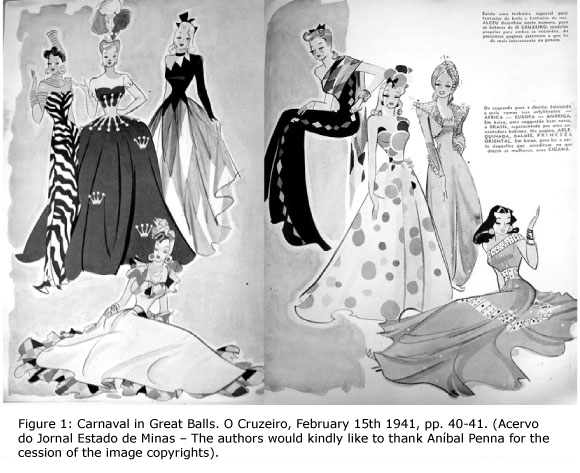
]]> One might suggest that the distance from his homeland and the observation of the great success of Carmen Miranda abroad have sharpened the attention towards Brazil and inspired new creations. Thus, even though the stylized baianas were to continue to be the most frequent costume amongst the national themes, from 1942 (until the end of his collaborations in the magazine in 1964), costumes with names such as Orange of Bahia, Plantain Banana, Copacabana, Maladrinha and Malandragem, Tico-Tico, and Mulata start to be conveyed in the section.Some of the motives, explored by the illustrator in his creations for Carnaval in an original way for the period, would later become symbols of Brazility and would be used many times by contemporary Brazilian fashion with the effort of delimiting a national style for fashion, such as the malandro, the sidewalk of Copacabana (which sinuous lines composed the skirt of the costume conveyed on January 31st 1942, p. 55)7, the chintz (fabric with the silk of big and colorful flowers represented in the illustration of the Mulata [January 3rd 1948, p. 95], which subtitles indicated that the dress should be produced in the specified fabric8) and the paradigmatic stylized baiana - especially through the image of Carmen Miranda.9 (See Figure 1)
The baianas, despite being a theme thoroughly worked by Alceu Penna before 1939, gain a new connotation from this year on, being frequently used in the section as a symbol of Brazility. The first representation of the costume with such meaning occurred on February 4th 1939 (curiously 6 days before the premiere of the movie Banana da Terra) in the section called O mundo em foco (the World in focus), where, in front of a world map background, there could be seen costumes of Chinese, Portuguese, Cuban, Indian, Tyrolean, Midinette (denomination that at that time was a reference to the saleswomen of French fashion stores) and one baiana with her belly exposed (such as was the style consecrated by Carmen Miranda), white smock and a colorful turban ornamented with colorful little balls in a clear reference to Brazil.
A similar usage happens in one of his first collaborations with the magazine O Cruzeiro done during Alceu Penna's permanence in the United States: the section Carnaval nos Grandes Bailes [Carnaval at Great Balls] (February 15th 1941, p. 40) had in its second page four different costumes with the names of countries and continents, respectively named Africa (long tight dress in zebra patterns), Europe (red dress with the stamp of golden crowns), America (a dress that probably made reference to the United States, since it was composed by a black bodice and a skirt in the colors of the American flag) and Brazil, which graphic representation was a stylized baiana with a white smock with large ruffled in the shoulders (such as was the style proposed by the costume designer Adrian in the movie Letty Lynton [black and white, Metro-Goldwin-Mayer, Dir. Clarence Brown, 1932]), white long skirt, sewing cloth tied on her waist, turban with a fruit basket, necklaces and bracelets. What can be inferred is that in 1939 the baiana costume was already seen by Alceu Penna as one (amongst others) of the possible representations of a Brazility. Nevertheless, since that in 1941 the baiana represented in the section was named Brazil she had, at least in the author's perspective, the status of a major sign of Brazility. (See Figure 1)
Despite the fact that some of these costumes were inspired in themes that came from popular and black culture, at least in the costumes that were created to the disclosure of the magazine such references were quite diminished through the act of stylization. The costume of the Malandrinha [Little Roguish Woman] (conveyed on March 6th 1946, p. 56), for example, was composed of a white dress with the bust adorned with red stripes and shoes in the same pattern, that was neither evocative of the marginality nor aggressiveness so often associated with the malandros, and "dressed" a young lady with a delicate face and sweet expression. The same occurs with the so-called Malandragem (January 17th 1947, p. 70), composed by a straw hat, white trousers and a striped shirt of green and white colors with a knot in the waist.
]]> During the 1940s and also throughout the entire career of Alceu Penna in the magazine O Cruzeiro, thus, between 1934-1964, the baiana costumes would be the most common suggestions regarding Carnaval costumes with national inspiration, appearing also with some assiduity in the section Garotas conveyed in that time of the year and generally in a special position in the center of the page. Such as in the section for the Carnaval, such baianas were always very stylized and presented in costumes with lines and silhouettes in consonance with the fashion in vogue (characteristic also present in the costumes of the malandro, that featured also in the section Garotas).The pattern in between fashion and costumes presented in the Carnaval section would be present during the entire publishing period of the magazine. During the 1930s, there is an abundance of costumes with long dresses with a bias cut, lines on the shoulders or on the back, large shoulders, such as was the style of Hollywood, or women with stylish top-hats and tail-coats, most likely a reference to Marlene Dietrich, as in The Blue Angel (Der blaue Angel, black and white, Universum Film, Dir. Josef Von Stenberg, 1930) and to the clothes she used in everyday life. In the beginning of the decade of 1940, Alceu Penna seeks in the North American fashion some of the main references that he presented in the section, such as the long skirts and bustiers, bringing from the European fashion just the dresses in the peasant style.
Nonetheless, in the same way that his creations in the section often showed a strong connection with international fashion, they other times presented many costumes with short skirts (over the knees), that seemed to be completely disconnected from the standard international fashion. That seems to reinforce even more the idea that the illustrator used his freedom of creation departed from the compromise of conveying international fashions as a way of sketching, still in the first years of his career, the first traits of his profession as a fashion stylist (a profession that he would be fully dedicated to in the 1960s) and, why not, in the delimiting - even if in an unconscious way - of a Brazilian style.
3.2 Brazil in vogue?
The first collaborations of Alceu Penna to the fashion pages of O Cruzeiro were conveyed in the middle 1930s. However, until 1941 his contributions in the section were sporadic, for only from the end of that year on would he sign the section weekly until 1964.
His preoccupation of making the national evident through fashion is already clear in one of the first collaborations of Alceu Penna for the fashion pages of the magazine O Cruzeiro (for which he would become responsible from 1941 till 1964), named Verão em Catalina [Summer in Catalina]. Conveyed on 16 November 1940, it brought illustrations presenting bathing suits and summer clothes used in that Californian island. In the text, the illustrator makes it clear that such drawings were done as a way to appease the way he missed the brunette women from Rio. Thus, the first "inspiration" he found for his fashion section were not the models seen in the American summer, but the longing he felt for the beaches and brunettes from Rio.
It is noteworthy that, because of the Second World War between 1939 and 1945, Paris was isolated from the major fashion consuming markets. The United States, that since the decade of 1920 were gaining more international terrain because of the success of their cinematographic costumes, consolidate their position as a fashion center, especially regarding "ready" clothing (BAUDOT, 2000)10. Therefore, in the first years when Alceu Penna was responsible for the fashion section, the news regarding clothing and accessories presented weekly in the section were majorly American and reproduced models made for the main "fashion houses" of the United States, such as Bergdorf, Altman & Co, Saks, Bloomingdale's, amongst others.
We dedicate special attention in the period considered in this article to the text that went together with the images, written by the illustrator himself. Quite frequently Alceu Penna used it to reflect upon the specificities of the national fashion visuality and also as ways to legitimate himself as an agent of diffusion of the international fashion in Brazil, making constant allusion to his period in the United States. That is the case of "Rain or Sun, coldness or heat", conveyed on January 18th 1941, p. 56:
]]> Such legitimation as a privileged agent of the transposition of international fashion to Brazil allows him to gain more terrain to present a certain fashion with national characteristics. Even though in the beginning such preoccupation was only regarding climate, little by little the usage of the national raw-material and fabric would also be presented, such as on April 25th 1942, p. 57, when he highlights in an article called "Cotton" that: "For us Brazilians the fashion regarding cotton is of particular interest, since we are producers of the good since the plant until the fabric itself. Let us see how there are beautiful models for every hour of the day".Rain and Sun - Coldness and Heat, varieties of the summer of Rio in particular and in Brazil in general. After a 40 degrees Celsius, when the rain comes we have a kind of winter only twenty-four hours later, with the need for less summery toilets. Back from the United States (our emphasis), composed these pages with ideas for such climatic variations.
Such condition allows him to produce a fashion section more argumentative and sometimes even critical towards international fashion, in special towards those representations of Brazility propagated by the American fashion of that period, as can be observed in the section conveyed on May 3rd 1942, pp. 41-42, carefully named South American Way:
]]> The text begins in a positive tone emphasizing the success of "South American fashions" in the land of Uncle Sam, narrating with enthusiasm the taste of American girls when tying to their hair "the beautiful butterflies from Rio de Janeiro that adorn the forests of Tijuca" and follows in similar manner informing the readers that clothes inspired in the traditional clothing of the gauchos and in Carmen Miranda could be found in the showcase of one of the major American department stores of that period.South American fashions are having success in North America. In the present pages (…) we can see some recent styles that debuted in New York (…) Above, two hats with Gaucho and Mexican inspiration.
A beautiful bolero that the famous Altman fashion house in New York baptized with the name ‘Pampeiro', draws inspiration from the gaucho lands and the cordilleras from Rio Grande do Sul.
The beautiful butterflies from Rio de Janeiro that adorn the forests of Tijuca are now tied to the hair of North American blond girls as adornments even more appreciated than flowers.
(…) two beautiful models created by Altman (…) The first is called ‘Copacabana', in velvet, black lacework and black organza. Besides, if it draws something from Copacabana it might be just the black and white of the sidewalks.
The other model is also called, yet we don't know why, ‘Samba'. It is a taffeta with white and red stripes (…)
To the right - two hats with South American inspiration. It is not necessary to mention that the turban came from Carmen Miranda and the other hat, with its brims inside out, most have come from the Panama Canal zone.
Here we have a little bundle, ‘hurl balls' and a kind of gypsy kerchief. The little bundle come from the baianas, the hurl balls from the pampas. Now the kerchief that is called ‘carioca' must have come from Rio… Have you pretty girls from the marvelous city seen something like this besides during Carnaval?
However, his enthusiasm is soon substituted by the ironic critique that questions the reason why the taffeta with red and white stripes called "Samba" and the choice of the name "Carioca" for a gypsy kerchief, a piece that, according to the illustrator, was just used during Carnaval.
The image of Brazility proposed by the fashion presented in this article is in consonance with those seen on Hollywood movies that "highlighted the natural exuberance of the landscape and of the local culture, mainly those related to popular culture or to folklore" (GARCIA, 2005. p. 145). And at the same time they transformed "Latin America in an undistinguishable unit of its cultural manifestations, picturing everybody in Mexican sombreros, doing siesta and dancing something similar to rumba" (GARCIA, 2005, p. 145) and; (MOURA, 1984, p. 11).
This homogenization of visuality, habits and cultures of Latin America proposed by the United States did not please Alceu Penna and had previously been criticized by him in a text called "What about Samba?", published in the magazine on November 2nd 1940, p. 23, shortly after the premiere in New York of the movie Down Way to Argentina (colors, 20th Century Fox, Dir. Irving Cummings, 1940), first Hollywood movie featuring Carmen Miranda:
(…) I can say I am disappointed. I do not understand the reason why while using a great Brazilian star Fox would create a plot that happens in Argentina. Is it to also please our neighbors from the Plate? I believe we are facing a legitimate "coupe d'état" as it is said in the delicious language of Guanabara. It will not please anybody, neither the Brazilian, for this and many other reasons, nor the Argentineans, who naturally would prefer to see an authentic tango singer instead of Carmen Miranda. Moreover, our Samba, which everybody in Brazil thought was quite known in North America, now is sadly mistaken with Cuban music. See what the advertisement that was printed in almost every magazine and newspapers here and we reproduced here says: The irresistible ritmo of Rumbas and Congas! (...) Now we can only wait for another movie of Carmen (…), this time filmed in Rio de Janeiro. Let us wait, for this one was not valid.
The critic reviews show that, despite having sympathy for the North American culture - what can be seen when during his stay in the United States the section Garotas takes place in that country and presents, always through a positive angle, some cultural traces of North Americans - Alceu Penna saw with some reserve the generalizations elaborated by the Americans concerning Latin America, especially those regarding the Brazilian culture.
His opinion concerning the first appearance of Carmen Miranda in Hollywood is in consonance with the spirit that was spreading throughout the country in the beginning of the 1940s, when Brazil lives the consolidation of the proposals made by Getúlio and the consequent "triumph of nationalism" (LAUERHASS, 1986). In that period, the reactions to foreign influences created a series of nationalist sambas that formulated "chronicles of a poor but happy Brazil, united, active, the tropical paradise, the Brazilian God, often having chauvinist and almost xenophobic tones" (MATOS, 1982, p. 47).
An example of such nationalism is Quero um samba [I want a Samba] (1943) of Wilson Batista and Waldemar Gomes, recorded by Aracy de Almeida (Quero um samba/Gosto mais do Salgueiro, 1943, Odeon), that translates the clear option of the authors for what is a "Brazilian" as opposed to what is foreign:
]]> Não danço tango, I don't dance tango,Nem swing e nem rumba Neither swing nor rumba
Gosto do choro I like choro
Do batuque e da macumba Batuque and Macumba
Sou brasileira I am Brazilian
Tenho a pele cor de sapoti I have brown skin color
Gosto do samba porque faz I like Samba because it does
Meu corpo sacudir My body shake
This idealized Brazil of the period, partly because of the official project, but also because of the ideological construction of works such as Casa Grande & Senzala of Gilberto Freyre (1933), whose interpretation of Brazil created the idea of a "racial democracy", was then represented by images - even though they were far away of a real Brazil - that became part of an image that did not fade away with time, an image where the three aspects Samba, Carnaval and mulatta were still an inescapable reference to Brazil.
]]> 4. Costumes of "Brazility": Alceu Penna and Carmen Miranda
Despite the critiques regarding the fact that the setting of the movie was in Argentina, the absence of Samba in the first movie starred by Carmen Miranda and the stereotyped vision of Brazil conveyed by North American fashion expressed in South American Way, Alceu Penna was also seduced by the North American way.
It is possible to say that he had great admiration by the American culture. His trip to the United States, for instance, was a private initiative, paid for with his own money, and not as an invitation of O Cruzeiro. The illustrator had the objective of working in the North American press and, according to the oral account of his sister Thereza Penna (Rio de Janeiro, January of 2007), it is most likely that he published some of his works in the magazine Esquire. The difficulty of elaborating humorous texts in a foreign language would be a great obstacle to the continuity of such work, but the barriers found in working with the American press would be compensated by the opportunity of creating costumes for concerts and movie participations of the singer in the United States.
Carmen Miranda and Alceu Penna met around the year of 1935 in the Urca Casino, but only came to be closer in 1939, when he was covering the singer presentations in the New York Fair. According to Gonçalo Júnior, it is in this period that the illustrator starts to create some costumes for the singer and the Moon Band, being the responsible for the elaboration of the "Cuban" inspired costume, composed by tuxedo paints, shoes and striped shirts, used by the band during some of their presentations abroad (JÚNIOR, 2004).
It is not possible to determine precisely how many and which of the costumes used by the singer in her movies were created by Alceu Penna. His collaboration occurred on a more informal manner and in the movies of the singer there are no credits for the illustrator. We point out that the theme, despite being highlighted by Ruy Castro and Gonçalo Júnior, has not yet been subject to a more detailed investigation11. The illustrator himself has left little records regarding this collaboration, one of which was published in text in the presentation of the series Americanized Carnaval, conveyed on February 27th 1960, p. 48:
Every audience has its sins. The one from Scala in Milan hissed many master-pieces of modern Opera. (…) The wordt sin of our audience was perhaps the bad reception given to Carmen Miranda in her first visit to Rio after her triumph in New York. They thought she was way too much Americanized. In the manners, her rhythm, her clothes. For some of those clothes I am to be held responsible… I would like to make myself responsible for such flaw, if there ever has been one. Stylization is stylization, Carmen was not a folklore singer, she was a stylized one."
The comparison between croquis created by Alceu Penna and costumes used by the singer in her movies, in addition to the crossed references of information conveyed in the cited biographies and the investigation of articles on Carmen Miranda in the magazine O Cruzeiro, allow us to indicate the existence of at least two costumes that were probably created by the illustrator for her: the one that has been used in the scene of the Casino in Madrid in Week-end in Havana (color, 20th Century Fox, Dir. Walter Lang, 1941) and the one from the opening scene of The Gang's all here (color, 20th Century Fox, Dir. Busby Berkeley, 1943).
The evidence of the creation of the costume of Week-end in Havana appears in a short article named "Conchita"12, published in O Cruzeiro on June 28th 1941. In this occasion Accioly Neto, then the chief director of the magazine and friend of Alceu, under the pseudonym of "Marius Swenderson" writes:
]]> After finishing her second movie, when she really acted like a ‘star' and was unanimously praised by the critics, Carmen Miranda awaited a second season on Broadway. The producers of Fox Films, though, seeing the immense success of "That Night in Rio", decided to start filming another movie in a tropical environment called Honeymoon in Havana, where the Brazilian bombshell was named with the Spanish name Conchita. In this movie, that is to be in Technicolor and of a great luxury, as we already had the occasion of publishing, Carmen Miranda wears as many stylized baianas, truly sensational and sumptuous ball dresses. The following model that we publish first hand is a creation of Alceu Penna, who has already designed other clothes of the little wonder, will be wore as we see in the poster, in the scene of the Casino in Madrid.
In the movie situated in Havana, Carmen interprets Rosita Rivas, a short-tempered Cuban singer. The costume created by Alceu Penna was used in the final scene of the movie, when the singer appears singing the rumba The Nango (Harry Warren e Mack Gordon, 1941), and was composed by a golden skirt, decorated with an anthurium (a common plant in Brazil of Colombian origins) and skirting board of green, yellow and red colors; golden top with bulky sleeves in the same colors of the skirt and a turban ornamented with red and golden balls, in a visual quite similar to that of the rumba dancers.
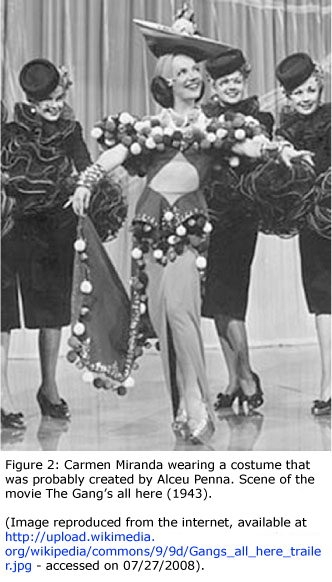
The costume used by Carmen Miranda in the opening scene of the movie The Gang's all here (1943) is probably a creation of Alceu Penna. It is composed of a set of purple skirt and red shirt and a dress tail in the same color of the shirt, adorned with colorful pompons. The usage of pompons as adornments in different dispositions is a resource frequently found in sketches of costumes designed by the illustrator in that period. The comparison of such costume with the sketch of a Sheppard that Alceu Penna created around 1940 bears two other resemblances: the diamond shaped cuts in the region of the abdomen and the usage of large edges hats to bring balance to the width of the shoulders. The picture does not give credit to the illustrator, but the hypothesis draws its strength when we take into account the previous close contact and collaboration between them both, as well as the resemblance between the croquis, the costume and the frequent use of pompons in costumes created by Alceu Penna in the late 1930s13. (See Figure 2 and 3)
]]>
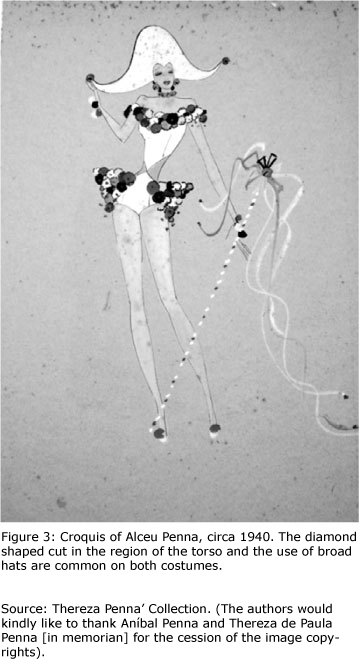
Apart from the turban and the hat (that reminds us of a fruit basket), this costume does not have elements that make a direct reference to a "Brazility" or to a Latinity, but the observation of its usage in the film directly refers to Brazil and to the exotic. Let us follow to the description of the scene in which Carmen appears wearing such costume.
The movie starts with the song "Aquarela do Brasil" (Ary Barroso, 1939), sang in Portuguese by Aloysio de Oliveira, whose face is shown in front of a black background. Suddenly the entire frame is illuminated and the scene opens showing that the singer is chanting the song in a ship called "SS Brasil". The cameras start to focus, then, the landing of passengers and products. Some people get out of the boat happily waving and, later on, we see some sailors passing through with handcars that carry sacks of sugar and coffee. Next, the camera focuses from top to bottom the unloading of a net (hoisted by a hook that slowly brings it down) full of fruits and vegetables (bananas, pineapples, pumpkins, apples, coffee beans, amongst others) and right under this net we can see Carmen Miranda, wearing the described costume, also singing "Aquarela do Brasil", followed by the Band of the Moon. In other words, the viewer has the impression that the fruits and vegetables are coming out of Carmen's turban (in a similar effect used in the most famous scene of the movie, when numerous bunch of bananas "get out" of the singer's turban while she sings The lady of the tutty frutty há" [Leo Robin and Harry Warren, 1943]) or, if we take into account the descending movement of the camera, the impression is that Carmen is the one "getting out", or a part of the colorful mix of fruits and vegetables.
Following that, there comes a scene when a man wearing a tailcoat gets out of a convertible car and delivers the city keys to the singer who, as a thanking act, sings You discover, you're in New York (Leo Robin and Harry Warren, 1943). In the background, some men and women neatly dressed watch the scene. That is also the case of the chorists, who wear black discrete clothes and in the middle of the song start singing with Carmen. Thus, there is no denying that the singer, with her colorful and blatant clothes, is there to represent Brazil, its "happiness" and "tropicality". This is even more evident in the final scene, when Carmen puts in a man's top hat and little sack of coffee and he answers: "It is the politics of good neighbors"
Carmen Miranda's trip to the United States was part of the efforts of culturally approaching the United States and South America, which started to happen throughout the 1930s - when the war scenario starts to be drawn - and gain an official character from 1940 on with the creation of the Office for Coordination of Commercial and Cultural Relations between the American Republics, headed by the North American millionaire Nelson Rockefeller14. While taking part in many successful movies produced by 20th Century Fox between 1939-1945, Carmen Miranda took the role of representative of the Brazilian popular music culture in the United States. Taking such circumstances into account, we can consider that by creating the costumes used by the singer in the movie, Alceu Penna has not only collaborated for the elaboration of the image of "Brazility" conveyed abroad, but also had an intuitive role in the consolidation of the politics of good neighborhood.
Amongst the actions that were developed for the creation of a closer cultural relation between the United States and Brazil we can highlight the increasing number of trips of North American directors to film in Brazil, which the most known example is that of director Orson Welles to film É Tudo Verdade (It's all true, 1942, unfinished), the creation of the character "Zé Carioca" (1942) by the Walt Disney studios and the consolidation of Carmen Miranda as a Hollywood star.
In the premiere of the movie Serenata Tropical, Carmen Miranda declares that "for the first time an authentic manifestation of the Brazilian popular soul, such as it is in reality, has been depicted on a Hollywood movie" (TOTA, op. cit, p. 118).
The end of the Second World War creates a world divided in two political-military blocks led by the United States on one side and the Soviet Union on the other. The effort of each block to increase areas of influence led to the bigger stimulus of the penetration of the North American Culture in the countries of Latin America, and, in special, in Brazil. The mass production of manufactured goods of domestic and personal use helped this process as well, but it would be in the cultural area that the American influence would increasingly spread over the country. From the movies to rock'n'roll, young American idols would become reference and models for the young Brazilians.
Hence, during the Second World War and in the subsequent years, we see in Brazil the substitution of European culture for the North American culture, with the substitution of French language as second language in the schools, which was the representation of what was cult in the nineteenth century and in the beginning of the twentieth century, by English.
]]> When outlining a history of the intellectual Brazilian thought in relation to the United States since the nineteenth century, Thomas Skidmore concludes thatthe question is clear: the successive generations of the most important Brazilian intellectuals saw the United States as a crucial force in the future of the country. No matter what was their ideological tendency, there was a crucial question at stake: what was the scope for Brazil to create its own society and what role would the United States play in such creation? (1994, p. 49)
This is a question also addressed by Alceu Penna, as we have seen in his reflections on the relations between Brazilian and North American cultures.
5. Alceu Penna and the peculiarities of "Brazilian fashion".
It is impossible to forget the impact caused by his drawings: the colors, the movement and the liveness and the creativity. The movement of the skirts and of the bodies of his Garotas or the brightness and the lively sensuality of his costumes for concerts and Carnaval. Alceu mixed, like few did, textures, brightness, ruffles and dreams. The illustrator's style followed and was ahead of many of the transformations that Brazil lived.
(Ruy Castro15)
Alceu Penna's production would have a similar aspect of the production of other authors of the same period, such as Gilberto Freyre and Sergio Buarque, who conceived their works (Casa Grande & Senzala, 1933, and Raízes do Brasil, 1936, respectively) from a perspective about the Brazilian culture created from a certain distance, for these authors were living abroad when they started their reflections that can be seen in such texts. Apart from this outside perspective, he also followed the construction of an image of Brazil in the United States, with the circulation of movies, cartoons, songs, in other words, a production that aimed to establish a Pan Americanism, because of the "politics of good neighborhood", but in reality only increased the cultural stereotypes of Brazil and other South American countries.
]]> It is noteworthy the fact that throughout this period his drawings would be defined by traces and forms characteristics, leaving aside the more straight traces and the geometrical figures - most likely influences of J. Carlos - for illustrations marked by sensuality expressed through traces that make evident female forms such as a thin waist, outlines of hips and breasts, sumptuous lips, red cheeks and long eyelashes that shaped quite expressive eyes. Moreover, his texts and illustrations start to form his perception and his questioning of the possibilities of the existence of a "typical Brazilian" visuality in appearances.Despite beginning with the adaptation of the foreign to the national in the field of clothing, it is from his critiques to this "mistaken Brazility" propagated by the Americans through the fashion shown in South American Way, thus the observation of what "we were not", that Alceu Penna would compose (through text) some of his most original reflections on what would be the Brazilian fashion16.
The elaboration of a visuality or Brazilian style on fashion from the demarcation of a difference can be possibly explained based on the logic that characterized the culture of looks in Brazil in the nineteenth century until the 1950s, according to which the distinction was based on the possibility of following international fashion. Such line of thought was reinforced by the national textile and fabric industry, whose objective was to follow the line of and reach the quality standards of the French (BONADIO, op. cit.). Considering this, it is not too much to say that, in the 1940s, trend clothes with the "face" of Brazil would hardly be found in national stores or magazines. So, what would be left for the consumer who around the 1940s looked for some typically national clothes?
Carnaval costumes and folklore or "typical" clothing. It is symptomatic that the costumes from Carnaval and, a little further, the clothes for June parties had a privileged space in the magazine O Cruzeiro.17 In the weeks that preceded such festivities, the costumes created by Alceu Penna would occupy more then ten pages of the magazine (the fashion section would normally occupy two pages per edition) and conveyed around 40 croquis per edition, especially throughout the 1950s, when the magazine lived the peak of its popularity, reaching sales that would go beyond 500.000 copies.
The creative freedom that was given to the illustrator during the Carnaval period allows him to "think" the country through the creation of costumes (frequently sensuous and very colorful) that represented a culturally "mixed" Brazil (Schwarcz, 1998), inspired in the stylized baianas of Carmen Miranda18, in the figure of the malandro and the sidewalk of Copacabana etc.
If we take into account that clothing and its visual-textual representations are instruments of communication that can subvert, or at least intervene on, a certain group or manner this group sees itself in relation to others (CRANE, 2006), and that such visuality initially proposed as a costume to Carnaval would be, from the 1960s on, embodied in the Brazilian fashion, at least in its themes, we can consider the work of Alceu Penna, in the studied period, as a component part of the "project" of invention of a Brazilian identity proposed by the New State, namely one that was based on the appreciation of the popular-national - especially Samba and Carnaval - and the endeavor to use the folklore and regional as ways of making evident our "difference" in relation to the "other" 19.
References
ANDERSON. Benedict. Nação e consciência nacional. São Paulo: Àtica, 1983.
ANDRADE, Priscila. Zuzu Angel e o campo do design. Dissertação de mestrado. PUC-RJ, 2006. [ Links ]
As Garotas do Alceu. In: Catálogo do prêmio Multi Moda 85, sd. (coleção Thereza Penna).
AUGRAS, Monique. A ordem na desordem: a regulamentação do desfile das escolas de samba e a exigência de "motivos nacionais". Disponível em http://www.anpocs.org.br/portal/publicacoes/rbcs_00_21/rbcs21_08.htm. Acesso em 05/08/2008.
BASSANEZI, Carla; URSINI, Carla. O Cruzeiro e As Garotas. In: Cadernos Pagu, no. 4, 1995, pp. 243-260.
BAUDOT, François. Trad. Maria Thereza Rezende Costa. São Paulo: Cosac & Naif, 2000
BONADIO, Maria Claudia. O fio sintético é um show! Moda, política e publicidade. (Rhodia S.A 1960-1970). Tese de doutorado em História, Unicamp, 2005.
BURKE, Peter. Testemunha ocular: história em imagens. Bauru: EDUSC, 2004.
CANCLINI, Nestor Garcia. Culturas Híbridas: Estratégias para entrar e sair da modernidade. São Paulo: Edusp, 2006.
CANDIDO, Antonio. A Revolução de trinta e a cultura. in Novos Estudos Cebrap, São Paulo, v.2, abril,1984, pp.27-37.
CANDIDO, Antonio. Literatura e sociedade: estudos de teoria e história literária. 8ª edição, São Paulo: T. A. Queiroz Editor, 2000, p. 121.
]]> CASTRO, Ana Lúcia; CAMARGO, Luiz Octávio Lima e RAMOS, Maria Lúcia Bueno. Das butiques à São Paulo Fashion Week: história e organização do campo da moda (notas sobre um trabalho de pesquisa em andamento). In: Anais do IV Colóquio Nacional de Moda. Novo Hamburgo: Centro Universitário Feevale, 2008.CASTRO, Ruy. Carmen: uma biografia. São Paulo: Companhia das Letras, 2005.
CASTRO, Ruy. Texto de apresentação da exposição O Brasil na ponta do lápis. São Paulo: 2007. (mimeo)
CRANE, Diana. A moda e seu papel social. Classe, gênero e identidade das roupas. São Paulo: Editora Senac, 2006.
DURAND, José Carlos. Moda, luxo e economia. São Paulo: Babel Cultural, 1987.
GARCIA, Tânia da Costa. O "it" verde e amarelo de Carmen Miranda. São Paulo: Annblume, 2005.
GOULART, Silvana. Sob a verdade oficial: ideologia, propaganda e censura no Estado Novo. São Paulo: Marco Zero; Brasília: CNPQ, 1990.
IMBROISI, Renato; MELÃO, Renata (Org.). Que chita bacana. São Paulo: Editora A Casa Casa-Museu do objeto brasileiro, 2004.
JOFFILY, Ruth. Jornalismo de moda, jornalismo feminino e a obra de Alceu Penna. Dissertação de Mestrado. UFRJ, 2002.
LAFETÁ, João Luiz. 1930: a crítica e o modernismo. São Paulo: Livraria Duas Cidades, 1974.
]]> LAUERHASS, Jr. Ludwig. Getúlio Vargas e o triunfo do nacionalismo brasileiro: estudo do advento da geração nacionalista de 1930. Belo Horizonte: Itatiaia; São Paulo: Editora da Universidade de São Paulo, 1986.LEITÃO, Débora Krischke. Brasil à moda da casa: Imagens da nação na moda brasileira contemporânea. Tese de doutorado em Antropologia em Antropologia Social, UFRGS, 2006.
LUSTOSA, Isabel. A descoberta da América: O lugar dos EUA no Modernismo brasileiro. Rio de Janeiro: Fundação Casa de Rui Barbosa, 1995.
LUSTOSA, Isabel. A descoberta da América: O lugar dos EUA no Modernismo brasileiro. Fundação Casa de Rui Barbosa: Rio de Janeiro, 1995.
MARINHO, Maria Gabriela S.M.C.. Moda: Condicionantes sociais de sua institucionalização acadêmica em São Paulo. In: ALMEIDA, Adilson José; WAJNMAM, Solange (Org.). Moda, Comunicação e Cultura. São Paulo: Arte & Ciência Editora, 2002. pp. 13-26.
MARTIS, Ana Cecília Impellizeri de Souza. Bem na foto: A invenção do Brasil na fotografia de Jean Manzon. Dissertação em História Social, PUC-RJ, 2007.DES HONS, André de Seguin. Le Brésil: presse et historie 1930-1985. Paris: L'Harmattan, 1985.
MATOS, Cláudia Neiva de. Acertei no milhar: malandragem e samba no tempo de Getúlio Vargas. Rio de Janeiro: Paz e Terra, 1982, p. 47.
MENEZES, Ulpiano Bezerra de. "Fontes visuais, cultura visual, história visual: Balanço provisório, medidas cautelares". In: Revista Brasileira de História, v. 23, no. 45, p. 31, 2003.
MIRA, Maria Celeste. O leitor e a banca de revistas: a segmentação da cultura no século XX. São Paulo: Olho d' Água/Fapesp, 2001, p.23.
MOTA, Carlos Guilherme. Ideologia da cultura brasileira (1933-1974): ponto de partida para uma revisão histórica. São Paulo: Ática, 1977, pp. 27-28.
]]> MOURA, Gerson. Tio Sam chega ao Brasil: A penetração cultural americana. São Paulo: Brasiliense, 1984.NEIRA, Luz Garcia. A invenção da moda brasileira. In: Caligrama. Volume 4, número 1, janeiro a agosto de 2008. disponível em: http://www.eca.usp.br/caligrama/n_10/04_neira.pdf. Acessado em 16/12/2008.
NETTO, Accioly. Império de Papel. Os bastidores de O Cruzeiro. Porto Alegre: Sulina, 1998.
NOVAIS, Fernando. Condições de privacidade na colônia. In: História da vida privada no Brasil, vol. 1. São Paulo: Companhia das Letras, 1997.
PENNA, Gabriela Ordones. Vamos Garotas! Alceu Penna, moda, corpo e emancipação feminina. (1938-1957). Dissertação de Mestrado. Centro Universitário Senac, 2007.
REGEN, Adriana. Alta-costura e cinema: o papel da estrela no roteiro da moda. Dissertação de Mestrado em Moda, Cultura e Arte. São Paulo: SENAC, 2007.
ROCHA, Gilmar. "Navalha não corta seda": Estética e Performance no Vestuário do Malandro. Tempo, Niterói, v. 10, n. 20, Jan. 2006. Disponível em http://www.scielo.br/scielo.php?script=sci_arttext&pid=S1413-77042006000100007&lng=en&nrm=iso. acessado em 19 de Outubro de 2009. doi: 10.1590/S1413-77042006000100007.
SANTOS, Joaquim Ferreira dos. Feliz 1958: o ano que não devia terminar. Rio de Janeiro: Record, 2003.
SCHURMANN, Ernst F. A música como linguagem: uma abordagem histórica. São Paulo: Brasiliense/ CNPQ, 1989, p.34.
Schwarcz, Lilia. Nem preto nem branco, muito pelo contrário: cor e raça na intimidade. In: SCHWARCZ, Lilia. História da vida privada no Brasil, vol. 4. São Paulo: Companhia das Letras, 1998.
]]> Skidmore, Thomas E. O Brasil visto de fora. São Paulo: Paz e Terra, 1994.Sobre a Rádio Nacional, ver SAROLDI, Luiz Carlos e MOREIRA, Sonia V. Rádio Nacional: o Brasil em sintonia. Rio de Janeiro: Funarte/Instituto Nacional de Música/Divisão de Música Popular, 1984.
TOTA, Antonio Pedro, O imperialismo sedutor: a americanização do Brasil na época da Segunda Guerra. São Paulo, Companhia das Letras, 2000.
VEILLON, Dominique. Moda e guerra: Um retrato da França ocupada. Trad. André Telles. Rio de Janeiro: Jorge Zahar Editor, 2004.
VILLAS, Alberto. O mundo não acabou. São Paulo: Globo, 2006.
* The authors would like to thank Gabriela Ordones Penna and Bruna Martins Pinto for the collaboration in the research on Alceu Penna.