Tecnologias sociais e sistemas locais de poluição
Henri Acselrad
Professor at IPPUR/UFRJ and CNPq researcher
Translated by Cristopher Tribe
Translated from Horizontes Antropológicos, Porto Alegre, v.12, n.25, p.117-138, Jan./June 2006.
]]>
ABSTRACT
The article presents the main results of research into corporate practices of locating toxic waste in Rio de Janeiro state, Brazil. A total of 121 complaints made to the Rio de Janeiro state environment agency and the state Public Prosecutor's Office between 1992 and 2004 about the improper siting of toxic and hazardous waste were examined. The cases were analyzed according to the strategies adopted by the companies, by the state agencies, and by the people affected. Evidence suggests that corporate locational efficiency depends on the accumulation of destitution factors in the populations living in peripheral areas: low income, insufficient access to public services and infrastructure, and little ability to influence monitoring and control by the authorities.
Keywords: Pollution – toxic waste – environmental inequality – state of exception
RESUMO
O texto apresenta resultados de uma pesquisa sobre as práticas empresariais de alocação de lixo tóxico no Estado Rio de Janeiro. Foram levantadas, no período 1992/2002, 121 denúncias de alocação indevida de lixo tóxico e perigoso junto à Feema - órgão ambiental do governo do Estado do Rio de Janeiro - e ao Ministério Público do Estado do Rio de Janeiro. Os casos foram analisados do ponto de vista das estratégias adotadas pelas empresas, pelo Estado e pelas populações atingidas. As evidências sugerem que a eficiência alocativa empresarial constitui-se a partir da sobreposição de condições de destituição experimentadas pelas populações que residem nas áreas periféricas: baixa renda, insuficiência no acesso a serviços públicos e à infra-estrutura, assim como reduzida capacidade de influência sobre o poder regulatório e fiscalizatório.
Palavras-chave: desigualdade ambiental, estado de exceção, lixo tóxico, poluição ambiental.
]]> Two complementary lines of reasoning are used to account for the ongoing reproduction of the spatial dimensions of social inequality in cities. The first focuses on the unequal appropriation of urban benefits, emphasizing the way in which residential segregation and inequalities in living conditions between different parts of Brazil's metropolises result from the action of social groups interested both in appropriating real benefits, in terms of consuming collective goods and services, and in the profits to be made from the increased real-estate value of the best-served plots of land.1 The second line of reasoning, from the viewpoint of a political economy of environmental risks, highlights the correlation between class positions in social space and the way in which sources of risk are locationally distributed. The analysis thus concentrates on the mechanisms by which environmental risks generated by the production of goods and services tend to be concentrated among the lowest social strata.2 Water, soil, and air pollution due to toxic industrial waste and its harmful effects on human health, for instance, disproportionately affect workers and the unemployed, while owners, managers and investors can use their wealth to buy homes in environmentally safe areas.3
According to the first line of reasoning, a process of circular causation tends to establish itself, increasing social inequality in the city, because the regions that contain a greater concentration of real benefits are those that house the higher-income segments, with the result that private land ownership allows these higher-income groups to keep exclusive control over the best-serviced and most valuable areas. It also suggests that the greater social and political power of these groups likewise gives them an advantage in the dispute for the spatial distribution of public investment in the city, preventing the excess generated from being clawed back by the authorities through property taxation and redistributed to less favored socio-territorial segments.4
In the second form of analysis, it is the difference in mobility between rich and poor or the segmentation of their spaces for mobility that causes the lower-income groups to be at higher risk both at work and at home, while the rich remain relatively well protected in both places.5 The higher-income classes thus tend to live some distance from potentially hazardous production units, usually upstream and upwind of industrial discharges or landfill pollution. Workers and lower-income groups, however, tend to live close to production units, and downstream and downwind of the discharges and nuisances associated with industrial plants and landfill sites.6 Lower-income social groups are thus exposed to carcinogenic substances and other toxins resulting from production and consumption, whereas managers, owners and investors are not.
Under the first rationale, the prevalence of circular causation in Brazilian cities is due to the aggregation of economic and political benefits for the strong players on the market. An 'urban accumulation' circuit is established, formed by public works contractors and utility providers in alliance with the segments involved in appropriating the various kinds of land-based wealth, centering on real-estate developers in association with builders and landowners.7 For the second line of reasoning, there is an aggregation of economic and environmental problems for the social groups trapped in the segmental risk circuit, not because poor communities are any less concerned with protecting their health and environment, but because they have less freedom to act in line with their environmental and health concerns when faced with the consequences of acute destitution. The concentration of the unemployed and underemployed in specific locations thus creates what have been termed economically desperate communities. In such conditions, these poor, working-class communities feel forced to accept any economic development initiative that promises them more jobs locally. As a result, poor communities feel less able to reject specific proposals to locate production units or waste sites in their vicinity than do rich communities, where new opportunities for work or income generation are a less pressing concern.8 Here too, political mechanisms are seen as essential in imposing the environmental problems on those least able to make themselves heard in decision-making circles, and in this respect the unequal spatial distribution of power works on two levels. First, those seeking a site to install a hazardous production unit can apply their perception of the spatial geography of power by choosing locations where political resistance is expected to be low. Secondly, the more powerful communities can mobilize their abundant resources to defeat any attempt to site such units near them. Thus, as suggested above, the two lines of reasoning reveal complementary processes: economic resource appropriation and an ability to influence political decision-making in the first case, and a lack of mobility and an inability to influence decisions on the location of environmental evils in the second. In combination, these processes segregate and concentrate benefits and ill effects both socially and geographically. Thus the accumulation of needs and its counterpart, the accumulation of benefits, interact to exacerbate the dynamics of inequality.
Despite the insights that they give, the explanations proposed above do not sufficiently specify the mechanisms by which the social actors involved determine their actions. That is because the processes described above are the result of action strategies through which each kind of social actor internalizes the unequal conditions of power. As suggested by Pellow,9 in order to understand the formation and reproduction of environmental inequality as historical processes, one has to put aside the standard perpetrator-victim scenario and instead highlight the relational dynamics through which the various actors operate the conflict and negotiation. In particular, it is important to bear in mind the unequal conditions of power in every practical or discursive action making up the actors' different strategies. In this contribution, we will discuss how such strategies developed in the case of the allocation of toxic waste dumps in Rio de Janeiro state, based on a survey of complaints made to FEEMA (the environmental agency of the Rio de Janeiro State Government), to the Rio de Janeiro State Public Prosecutor's Office, to the Department of Mineral Resources, and to the Rio de Janeiro Municipal Secretariat for the Environment, between 1992 and 2004. The results of the survey will then be used to reveal four stages of strategy development by the various social actors involved.
Corporate locational strategy: disposal and movement of toxic waste
The Rio de Janeiro State Legislative Assembly's Committee on the Environment has estimated that 800,000 tons of industrial waste are produced in the state every year, 240,000 tons of which are toxic. Of this volume of toxic waste, it is believed that there is no environmental agency control at all over 120,000 tons, or 50%. The agency in charge of environmental control in Rio de Janeiro state, FEEMA, estimates that 24,000 industrial units are operating outside of the control of the state's environmental agencies, and many of them are contributing to the production of toxic waste. Besides these uncontrolled sources located within the state, there is also an influx of waste from outside, from the states of São Paulo, Minas Gerais and Bahia. Such waste is authorized to enter Rio de Janeiro for incineration, but it is thought that part of it is dumped illegally at sites along the route to avoid incineration charges, taking advantage of the deficiencies of the monitoring system.
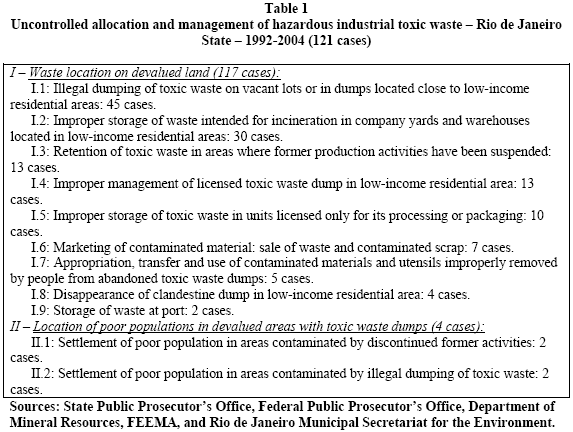
A non-random socio-spatial dynamic means that the location of sources of environmental problems coincides with areas where lower-income groups live.10 This overlap suggests an association between two mobility patterns: a pattern for the mobility and allocation of sources of environmental risks, and a pattern for the mobility and location of low-income populations. On the basis of complaints about the improper allocation of industrial waste that led to action being taken by the State Public Prosecutor's Office and FEEMA, we examine the dynamics of the movement of people and waste that resulted in unequal exposure to those kinds of environmental risk (Table 1).
]]>
Thus the improper waste location events reported as occurring outside of regulatory control particularly involve clandestine dumping on vacant lots and improper storage in warehouses or deactivated factory units. There are also cases of improper management or storage in areas licensed only for waste processing, as well as person-to-person transfer of contaminated material and utensils, sometimes resulting in the disappearance of waste from a previously detected clandestine dump. All these events are associated with illicit activities, either infringing environmental regulations by ignoring licensing requirements, or avoiding supervisory controls.
When the originating company accumulates a reasonable amount of waste, it hires specialist contractors to take care of its final disposal or to send it to be incinerated or incorporated into clay products at brickyards and ceramics factories. Since licensing temporary storage yards for industrial waste is a slow process, requiring an environmental impact assessment and public hearings, some companies purchase brickyards authorized to incorporate waste into bricks and set up irregular storage yards where, in some cases, the waste can be left for up to four years before being incinerated, with impact on the air, soil, and groundwater.
The authorities' control over static sites may be precarious, but they find it even more difficult to control the transportation of waste. It was only because of truck accidents involving hazardous waste that the environmental agencies discovered which routes were generally taken by toxic waste.11 FEEMA attempts to monitor the destinations of toxic waste by insisting that companies periodically submit what are known as 'waste manifests', but its Industrial Control Division admits to not being in complete control of the situation, much of the information being effectively confined to waste producers, transporters and disposal contractors. Thus it often happens that the amount of waste legally registered for transportation does not correspond to the amount that actually arrives at its destination. The missing volume actually ends up on riverbanks or roadsides.12 There are also cases of companies that enter into false contracts and pay for the transportation services described in the fraudulent documentation.13 Environmental control agencies sometimes initiate proceedings against companies that provide false information, alter technical details requested by public authorities, or dispose of materials in an inappropriate manner liable to cause pollution.14
Conversely, there are also rarer cases where poor people are settled in devalued and contaminated areas, either on deactivated factory sites or on land illegally used for dumping waste, as a result of careless local authority planning or where social movements have taken over unoccupied land.
Moreover, there is some evidence that, in view of the destitution in which certain communities live, the dumping of contaminated rubble in peripheral areas is sometimes approved, encouraged and even paid for by residents who want to fill in marshy land and level off their precarious lots. Multiple factors thus contribute to the prevalent situation whereby the location of sources of environmental problems coincides with low-income residential areas. This overlap, as we have seen, derives from the association between two different patterns of mobility: one, a pattern of mobility and of allocation of environmental risk sources that is governed by the microdecisions of the real-estate market and government land-use policies; the other, a pattern of mobility and of location of low-income residents governed by need and embodied in their financial and political deprivation, which makes it difficult for the poorest segments of society to access the market and public housing programs.15
Collective action by residents: the complaints
]]> Complaints are made when people react to smells from unexpected locations, such as junkyards, soccer fields, and parking lots, and consider them to cause nausea, vomiting, eye irritation, aches and pains, skin rashes, nosebleeds, fainting fits and breathing difficulties. Residents also react to such signs when they come from less unexpected places, such as warehouses, disused factories, waste dumps, and ceramic plants. Residents sometimes witness the illegal dumping of materials on vacant lots, pastures, and marshland. Accidents involving children, sometimes fatal, result in complaints. Some actions by residents demonstrate a belief that no political solution to the environmental aggression will be forthcoming. These include temporarily moving away to escape the smell produced by incinerating toxic waste or taking the initiative to set fire to the waste. The first of these may be termed an 'exit' strategy, while in the second case the strategy is to directly eliminate the apparent cause of the problem. At another level of interpretation of options for action, telephone complaints are made to the company assumed to be responsible for the nuisance. In some cases, however, no causal relation is established between the ill effects and the source of the health hazard: a complaint about the quality of water from a well, for instance, was not associated with illegal waste storage on nearby ground, of which FEEMA was in fact aware.By complaining, people mobilize civil defense agencies, FEEMA, municipal authorities, political parties, and environmental bodies; they demand the removal of the waste, encourage debate, and call for the rehabilitation of contaminated areas. People take an interest in FEEMA inspections, inform it about companies' apparent operating conditions, take part in diagnosing the environmental conditions (wind, temperature, etc.) associated with health risks, help identify those responsible for environmental hazards, and point to corporate bankruptcy as a strategy used by companies to escape liability for their environmental debts. The information they submit comes from their visual observations together with insight to link symptoms to supposed sources of pollution.16
Residents write letters, organize protests, or complain by telephone, putting pressure on the authorities to perform laboratory analyses, to publish the results, and to settle the environmental conflict, which is sometimes associated with a conflict over land. They also demand healthcare for those exposed to contamination, and compensatory measures, such as occupational training, for the local community. Complaints are sometimes recurrent, revealing that the situation remains unbearable, that chemical smells are still released on hot days, or that dumping of chemical products is continuing.
In a small number of cases, residents have publicized the environmental conflict in the press and in public debates, or have attempted to institutionalize the conflict by sending complaints to the Public Prosecutor's Office, which has started administrative proceedings or taken civil action against those liable for the source of pollution. The issue is sometimes politicized, where residents demand that decisions be made for the collective good, as illustrated by the arguments used by a resident in an affected area:
'I am interested in the good of my community. I want them to take that trash away… Not to put it in another community. They should put it somewhere where there isn't anybody or anything. Really deserted, where there's nothing that will harm any people or animals.'
Such an attitude tends to give rise to mobilization and collective action:
]]> Non-institutionalized action has also been taken, such as looting equipment and materials from disused factories and setting fire to them under police gunfire, damaging furniture, removing gas tanks, burning materials and tires, stoning company offices, and invading abandoned areas, often carried out by children. In these cases, the residents' associations, which potentially make the complaints, at the same time have been used as mediators by the authorities trying to crack down on looting and other violent action.'So we stopped everything… We started a protest here, we called the press… It was a big protest that we made. All the traffic was diverted through here. Our protest scared them. The big man got scared, so he came and took the trash away.'
'The trash came here when they forced it out of Campo Alegre… up there on the Vila Americana highway. Because it was costing them too much there: the local people themselves stopped the waste trucks from dumping it there. They stopped the trucks with their sickles, machetes, hoes and sticks. They didn't let them dump it there. So what did they do? They removed all the trash from there and opened a landfill here. That's how all this trash got here.'
In contrast, in a similar number of cases the residents have claimed that the source of pollution is not a risk, so that they will not have to abandon the contaminated area where they live as the authorities have suggested; or so as not to affect sales of the fish on which they depend, in case it were considered contaminated; or even to avoid the community being stigmatized as one that lives amid toxic waste. Some residents' comments are as follows:
'Because today you… "Oh, you live in Santo Expedito? Good lord! Hey, don't drink the water there, will you! People who live there, you who live there, there's cancer there." Understand? So people want to sell up and go away… Why? Because of the rumor that there's cancer in the water. Understand? That's hard.'
'She said she wasn't crazy enough to buy a house here because we're living on top of a bomb. We are living on top of a bomb.'
'It's like, "I'm not going there. God forbid you should live there." Understand? And we don't want that. What we want is for people to say good things about Santo Expedito as a neighborhood. So you bad-mouthing the neighborhood… This is a great neighborhood.'
'Some people even thought they were being discriminated against… Yeah, even me, as a resident, we've been discriminated against… and so people would say, "I live in Queimados, in Santo Expedito neighborhood." When I said that, people used to say, "So you live down in the chemical waste, then." The neighborhood's claim to fame is chemical waste. So they'd say, "How can you live there?" That's how they described the neighborhood. So the neighborhood's going downhill, right? The properties here have lost a lot of value because of that.'
'The only thing that we're going through, that's hitting us hard, is discrimination because we live here…'
In isolated cases, however, members of the affected population opt for getting compensation, even standing up for the polluting company after it has given them the benefits of medical care and leisure facilities.
]]>The authorities' reactions to the complaints
The reactions of government environmental agencies to the complaints fall into four groups, based on the degree to which the measures adopted imply that liability has been assigned.
In rather more than half of the cases, direct action is taken at the initiative of the state environmental agency itself. Such action may include information gathering through area inspections, localized measurements, and sampling for laboratory testing and impact assessment. Other measures aim at reducing risk, by sealing sites, directly removing the materials (where only small amounts are present), and moving the population affected. Corrective or mitigating action may be imposed on those considered responsible for the damage; they may be penalized and ordered to clear up the materials (where large volumes are involved), and they may have concessions suspended and activities banned. Agreements also may be signed with other public bodies to rehabilitate the degraded area or tenders may be invited from contractors to treat and dispose of solid waste in an appropriate manner and to rehabilitate the area.
In rather less than one-fourth of the cases, the state environmental agencies take indirect action, such as coordinating companies to help with emergency assistance; advising local healthcare organizations; referring to other government agencies for information, technical assistance, investigation of criminal liability and prosecution of those responsible; surveying the number of people with health problems arising from the polluting activity; or suggesting that polluters sign agreements to change their conduct.
In 15% of cases, judicial or extrajudicial measures are taken, such as forcing polluters to sign agreements to change their conduct, setting up civil inquiries, or taking civil action.
In 10% of cases, the authorities publicly promise action, justify inaction through lack of resources, propose institutional changes, argue that they are not responsible, or play down the evidence and causal relations. They try to soothe public opinion by minimizing the impact of the events, portraying repeated events as chance accidents, and downplaying the level of contamination risk (by claiming, for instance, that hazardous cyanide is likely to be ethanol or caustic soda). In some cases, they espouse a counter-epidemiology to reject the causal relations between sources of contamination and cases of sickness, in response to complaints from social movements and environmentalist bodies. They promise to take punitive action, to trace the source of the waste, to remove contaminating materials, to identify those responsible, to fence off affected areas, to repair damage, to reprocess materials, and to create waste exchanges. In certain cases, the agencies allege that they are unable to exercise the necessary environmental control because of a lack of resources. Proposals for institutional change include transferring environmental control to municipal authorities, and setting up an intermunicipal environmental consortium.
With regard to the cognitive aspect of the complaints, public agencies show a clear preference for what Halfacre et al. call 'managerial language of regulation'.17 This kind of discourse assumes that the public interest is calculable and that experts have the competence to objectively establish the occurrence, nature and impact of an environmental risk. In so-called 'community' language, citizens are considered the best source for defining what the public interest is, since they are its main spokespeople, regardless of any mediation by experts or politicians; such language seems to occur only informally, when affected residents present themselves as qualified to help the environmental agencies in identifying and characterizing a risk situation. 'Pluralist' language, which assumes that the public interest emerges from a confrontation between the various parties in a competitive arena in which all actors agree to abide by the rules of the game, also seems to operate only partially and informally, as when authorities and companies appeal to the press to justify and seek legitimacy for their positions, but without there being any formal, legitimate space for a confrontation of the parties.
From the standpoint of the meaning of the initiatives, such reactions show that there are structural obstacles in the system by which information on the nature and locational distribution of environmental risks is produced, disseminated and followed up. According to residents:
]]> 'So they came and had a look and said that those yards that they were accused of having, that they'd come and disinfect them and so on. But we're still waiting and nobody's come to disinfect anything.''I've already complained about that. I complained to the health council, but so far they haven't been round to see.'
'There was this report on TV that said there wasn't any kind of contamination. But I kind of think that actually it might have been a way for them to play things down. Not the TV, but the people who told the TV. Why? Because until now we haven't been given any kind of call, any kind of document, so we can't say anything for sure: they've done the tests, they collected several samples, but unfortunately we haven't been told anything.'
'They're the only ones who know, and they haven't passed it on to us.'
'Why did they do the tests? Because my husband died of cancer. Do you understand? But I haven't had an answer yet. About that water that they took, I haven't had an answer.'
'Then they took water from the well to do a test, but so far I've never been told the results of the test. They phoned here straight away when I talked about his problem and they showed it on television, didn't they? Photo, they asked to take my photo, they made all that fuss, but so far I've not had any news of anything: water, nothing.'
'So then we asked… we demanded, right? We're tired of asking, right? We've spent our whole lives asking. We're tired of asking, right? But so far we haven't had a reply about that.'
Corporate reactions to the complaints
In most cases, when faced with complaints, company representatives avoid accepting liability, which would mean taking steps to eliminate the sources of risk or to change their practices. In almost half of the cases, the corporate reaction is to conceal the evidence: they may attempt to make the materials disappear by burning them or dumping them at night, removing waste from identified dumps, pouring it into surface-water sewers, or covering it with soil. Sometimes they try to prevent environmental inspectors from performing their duties. They may also prefer to pay any fines, which are unlikely to be levied, rather than change their current waste management practices. In some cases, companies continue to break environmental laws, incurring fines which they pay, ignore, or appeal against in any one of countless possible ways.
]]> In almost half of the cases, practical remedial steps are undertaken, such as decontaminating the land, collecting the waste, disposing of it or hiring a contractor to do so, collecting samples of abandoned waste to check whether the company did in fact produce it, or meeting with representatives of the authorities and civil society to seek joint solutions to the problem.In terms of discourse, in a large percentage of cases the companies try to deny any liability for clandestine waste, arguing that they did not cause it or alleging that they did not know how toxic the waste was. Refusing to accept the current definition of toxic waste forms part of the conflict over waste control.18 They also play for time by telling the government agencies that they are technically or financially unable to make the changes required by environmental legislation, or that they promise to move their industrial plant elsewhere. Strategies that they use in their argument include alleging that the environmental risks and damage are natural19 and an inherent part of economic development, or claiming that scientific methods are the only valid way of objectively determining the risk, thus seeking to invalidate the complaints made by residents' associations, trade unions or nongovernmental organizations.
According to a resident's statement, a company representative:
'… told me, "You should go see the doctor, then, and talk to her, because technically you don't understand anything about risk." '
Some companies resort to putting pressure on the affected population, hoping to encourage residents to abandon the area and leave it free for industrial activity to continue. Sometimes they try to demobilize the residents through political pressure or by trying to sow division among the affected groups. Some companies invest in building an image of being receptive to complaints by incorporating a 'green' discourse or offering the affected population goods and services that the state has failed to provide adequately, as a means to maintaining cordial relations with the people and discouraging protest. In order to perfect the desired friendly relationship with the community, there are cases where the company contracts consultants specializing in community relations to manage 'joint company-community projects'.
There are cases where protests are incorporated into plant management mechanisms themselves. Acting on complaints received, for instance, a waste processing company started operating its ventilation equipment so as to change the direction taken by the pollution emitted from its stacks, sending it to other areas. This demonstrates the adoption of what Bezerra calls a 'just-in-time conflict resolution model', based on 'constant demand monitoring'. The aim is to achieve a 'zero stock' of protests on the basis of cost-free collaboration by residents so as to avoid additional environmental control costs and possible fines.20
'Local pollution systems' and the reproduction of environmental inequality
The mobility differential and the segregation of mobility spaces are mechanisms that favor the political optimization of corporate locational decisions and limit the possible choices for locating destitute populations. These processes, however, always result from action strategies by which each type of social actor acts according to the unequal conditions of power, while at the same time trying to consolidate or change them, depending on their relative position in the social space.21 Thus the interaction between the government agencies' failure to act and the companies' optimization strategies establishes a social division of environmental risks. This unequal division becomes feasible through the interlinked mechanisms of concealment of polluting practices, systematic disinformation, and the accumulation of destitution factors – forms of social technology, which can be defined, by way of analogy with Marcel Mauss, as a set of organized or traditional actions that jointly lead to the achievement of social ends.22 That explains why the hazardous waste
]]>'… only comes in at night. There's no way we can know… That way you don't know if it's coming in or being taken away. The activity's at night.'
By dumping and burning at night, and by secretly transporting materials from one dump to another, companies attempt to conceal any traces of illegal activity. According to the statements of residents who have witnessed clandestine dumping:
'The drums only come in at night. They claim that they work at night; that time when we asked why, he said he was working using the truck headlights… I said it was crazy, you know. Using the truck headlights… They said it was so as not to pollute the air.'
The effort to conceal improper practices includes more extensive strategies of systematic disinformation. A resident of the Santo Expedito community, who lives next to the waste treatment plant (CENTRES) in Queimados municipality, says:
'He promised me that he would make a report and he would send me the report every time the waste came out. He never sent me any report at all, and he banned me from going onto the site to carry out any kind of investigation […] The little information that we had about CENTRES was their ecological proposals, proposals to carry out recycling, educating people. They were carrying out an awareness campaign. But I think it was actually to kind of cover up what they really wanted. They wanted to get the residents' trust, get the community's trust, so that they could do what they did afterwards.'
In this contradiction of the myth of trustworthy information as the basis of the market economy, one can see what Moberg, referring to the growing number of financial scandals associated with US economic deregulation, calls the 'disinformation economy', in which 'there is a systematic effort to hide, distort and lie as a way of gaining wealth and power'.23 In the residents' words:
]]> 'Those cans started coming in; there hadn't been any until then. When we started seeing the cans coming in, we noticed that the bad smell of the smoke from that dump was mixing with the chemical smell from those cans, because some of them were leaking, and people started getting poisoned early in the morning; lots of people… breathing problems, you know.''The man said it was vinegar. He said they were cans of vinegar.'
'I saw them making that enormous hole there in the bank… and I even asked what was going on, and if they were going to make a pool or something there, a club maybe. No, they were burying the cans.'
The acceptability of polluting practices and of systematic disinformation to a large part of the affected population is certainly associated with the prevalence of a spatial concentration of social vulnerabilities. An accumulation of destitution factors thus favors the overlap between the social and the spatial distribution of environmental risks, through the spatial concentration of social vulnerabilities. For their part, companies avoid investing in waste treatment and incineration because they can dump the waste in devalued areas that are abandoned by public investment in urban infrastructure and are inhabited by poorer, less well-organized populations. Thus they enjoy overlapping benefits that allow them to maximize their locational freedom of choice: technical savings (by cutting out steps in their physical and chemical processes), regulatory savings (by ignoring technical, planning and environmental standards), and transfer savings (by transferring the costs of environmental treatment and monitoring to the state and to residents).
Making these 'savings', however, also involves the formation of a local consumption circuit and a 'submarket' in contaminated junk, materials and utensils for home and construction use: drums containing toxic residues are used for storing water, given the lack of a water supply; contaminated sand and other materials are used for leveling lots and building homes, given the lack of urban infrastructure and housing; and toxic products are even used as playthings, given the lack of schools and leisure areas. In other words, the accumulation of benefits for companies goes hand-in-hand with an accumulation of destitution factors for the populations living in peripheral areas: insufficient income, insufficient access to public services and infrastructure, and insufficient power to influence the authorities responsible for regulation and control. Corporate locational efficiency is thus developed through actual spatial sociopolitical processes.
Such processes also involve a specific time factor, since illegal dumping of toxic materials takes place preferentially at night. In his book The Nights of Labor (La Nuit des prolétaires), on the beginnings of the proletarian condition, Jacques Rancière describes how at night, in their time off work, workers sought to experience an inversion of the world, the opposite of work 'where life is lost', and attempted to hold off the sleep that would restore the strength demanded by the factory machine. They wished to interrupt the hierarchy that subordinated manual workers to those people granted the privilege of intellectual work: they invested in nights of study, drunkenness, learning, dreams, debate, or writing. They wanted to show that they were different, to tell those in power that they yearned to be treated as people who deserved various lives, and to be acknowledged as having a different dignity than that of simply belonging to the wage-earning category, despite the discourse on workers' identity.24 Conversely, the companies referred to here are not trying to show that they are different by adopting their nocturnal activities, but rather that they are the same as they always have been, optimizing the spatial and temporal conditions for accumulation by taking advantage of the lack of official monitoring at night.
Just as the economic literature talks of 'local production systems' to mean 'productive arrangements whose interdependence, connection and consistent links result in interaction, cooperation and learning, enabling innovation in products, processes and organizational formats, and generating greater corporate competitiveness and social improvement,'25 we might suggest that certain kinds of 'local pollution systems' are operating here: productive arrangements whose interdependence and links result in a spatial interaction of the negative externalities of production, optimizing investments by distributing environmental risks among the agents least endowed with economic and political resources. Toxic waste is not seen as an urban problem, like the threat of traffic gridlock and congestion, such that cities are threatened by their own discharges, so long as the mechanisms that direct those same discharges to the poorest communities are kept well oiled.26 Placed outside the market, although willing to join the flow of wealth by trading their qualities, the 'excluded' find that they are an integral part of the routine of the exchange circuit,27 as they are forced to consume the unsaleable products of capitalist activity. To discover that, however, they will have to deconstruct the whole discursive framework that 'feigns emancipation, simulates abundance in a ceremonial that aims not merely at 'entertaining' the workers, but at giving them the feeling that they are taking part in the same ideal, that they belong to a single human race, when they feel more isolated than ever, transported far away from any real world in common.'28
It is by exposing the accumulation of unequal benefits and destitution factors that some complainants reveal this nocturnal side of capitalism, with its prevailing systemic disinformation, organized shirking of any responsibility, and policy of systematic underestimation of risks (a policy that Beck calls 'symbolic detoxification'29 ). By means of these expedients, the penalization of the least protected becomes the rule and the democratic control of risks the exception.
As Luiz Gonzaga Belluzzo reminds us:
]]> 'In "conventional" capitalism, the rules of the game are those of accumulating monetary wealth obtained on the market, that is, by means of fierce competition between companies, States and individuals. In its neo-liberal clothing, this game presupposes that its rules will be systematically broken. The relations between the political and the economic are arranged so as to remove any obstacle to the expansion of large corporations. […] It is the emergence in the legal-political sphere of the permanent exception, consolidating the law of the strongest, to the displeasure of those who imagined they were descendants of the Enlightenment and its program of guarantees of liberty and equality.'30
If the sovereign is 'the one who decides on the state of exception,'31 sovereignty over the deregulated environment in question here is exercised by forces that condemn residents in poor areas to a permanent state of exception. Many of the complaints about the dumping of toxic waste seek to achieve the normalization of the environment and the application of environmental rules in areas where they are ineffective. Some of these conflicts, however – the politicized ones and those in which people resort to violence – call into question the discriminatory nature of this localized state of exception.
For these victims of a state of exception that has become the rule, according to Agamben, 'naked life reaches its most extreme indetermination.'32 By preferentially allocating industrial toxic risks to the most destitute, capitalism establishes a kind of environmental order, albeit not a formal legal order. In it, a regime of law is defined in which a formal legal provision (an environmental one, in this case) is valid, but is not applied (because it lacks force), and acts that do not have the status of law (the environmental penalization of the poor) acquire impositive force.33 Thus a space is created without rights, an area of lawlessness in which all legal determinations are deactivated, confirming Walter Benjamin's eighth thesis on the philosophy of history,34 whereby the tradition of the oppressed teaches us that we must always bear in mind conceptions of History in which the state of exception is the rule, even when, as in this case, these states of exception are socio-spatially circumscribed.
References
Abramo, Pedro, 'Uma Teoria econômica da favela: quatro notas sobre o mercado imobiliário informal em favelas e a mobilidade residencial dos pobres', in Cadernos IPPUR year XVI, no. 2 Aug.-Dec. 2002, pp.103-134. [ Links ]
Acselrad, Henri, 'Justiça ambiental – ação coletiva e estratégias argumentativas', in Acselrad, H., Herculano, S., and Pádua, J. A. (eds.), Justiça Ambiental e Cidadania, Relume Dumará, 2004, Rio de Janeiro, pp. 23-40. [ Links ]
Agamben, Giorgio, 'A Zona Morta da Lei', Caderno MAIS, Folha de São Paulo, March 16, 2003, p. 5. [ Links ]
Beck, Ulrich, 'From Industrial to Risk Society: questions of survival, social structure and ecological enlightenment' in Theory, Culture & Society, 1992, vol. 9, pp. 97-123. [ Links ]
Belluzzo, Luis Gonzaga, 'Democracia e Capitalismo', in Folha de São Paulo, August 4, 2002, p. B2. [ Links ]
Benjamin, Walter, 'Thèses sur la philosophie de l'histoire', in L'Homme, le langage et la culture, Denoel-Gonthier, Paris, 1971, pp. 183-195. [ Links ]
Bezerra, Gustavo das Neves, 'A "Poluência" de Magé', in H. Acselrad (ed.) Conflitos Ambientais no Estado do Rio de Janeiro, Relume Dumará, Rio de Janeiro, 2004, pp. 227-238. [ Links ]
Bullard, Robert, Dumping in Dixie: Race, Class and Environmental Quality, Westview, Boulder, CO 1990. [ Links ]
Célis, Raphael, 'De la ville marchande à l'espace-temps', in R. Alexander et al., Le Temps et l'Espace, OUSIA, Brussels, 1992, pp. 97-103. [ Links ]
Dyer-Witheford, Nick, Cyber-Marx: Cycles and Circuits of Struggle in High-Technology Capitalism. University of Illinois Press, Urbana, 1999. [ Links ]
Gould, Kenneth, 'Classe social, justiça ambiental e conflito político', in Acselrad, H., Herculano, S., Pádua, J. A. (eds.), Justiça Ambiental e Cidadania, Relume Dumará, Rio de Janeiro, 2004, pp. 69-80. [ Links ]
Halfacre, A. C., Matheny, A. R., and Rosenbaum, W. A., 'Regulating contested local hazards: is constructive dialogue possible among participants in community risk management?', in Policy Studies Journal, vol. 28, no. 3, 2000, pp. 648-667. [ Links ]
Marques, Eduardo Cesar, 'Infra-estrutura urbana e produção do espaço metropolitano no Rio de Janeiro'. In Cadernos IPPUR, year XII, no. 2, Aug.-Dec. 1998. [ Links ]
Moberg, D., 'Enronomics 101: Business as usual in the disinformation economy', in In These Times, February 2002, http://www.inthesetimes.com/issue/26/07feature1.shtml, visited on December 16, 2002. [ Links ]
Motchane, J.-L., and Raffoul, M., 'Le vagabondage des déchets toxiques', in Le Monde Diplomatique, September 1996, pp. 24-25. [ Links ]
Mumford, Lewis, Technics and Civilization. Harcourt Brace Jovanovich, New York, 1934. [ Links ]
Nunes, J. A., and Matias, M., 'Controvérsia científica e conflitos ambientais em Portugal: o caso da co-incineração de resíduos industriais perigosos', in Revista Crítica de Ciências Sociais, Lisbon, no. 65, May 2003, pp. 129-150. [ Links ]
Pellow, David N., 'Environmental Inequality Formation', in American Behavioural Scientist, vol. 43, no. 4, Jan. 2000, pp. 581-601. [ Links ]
Rancière, Jacques, La Nuit des prolétaires: archives du rêve ouvrier, Fayard, Paris, 1981. [ Links ] An English translation by John Drury was published as The Nights of Labor: The Workers' Dream in Nineteenth-Century France, Temple University Press, Philadelphia, 1989. [ Links ]
Ribeiro, Luis Cesar Queiroz, 'Segregação, acumulação urbana e poder: classes e desigualdades na metrópole do Rio de Janeiro', in Cadernos IPPUR/UFRJ, 2001-2 / 2002/1, pp.79-103. [ Links ]
Schnaiberg, Allan, and Gould, Kenneth, Environment and Society: the enduring conflict. Cambridge University Press, Cambridge, 1994. [ Links ]
Szasz, Andrew, EcoPopulism: Toxic Waste and the Movement for Environmental Justice, University of Minnesota Press, Minneapolis, 1994. [ Links ]
]]>Taylor, Dorceta. E., 'The rise of the environmental justice paradigm', in American Behavioural Scientist, vol. 43, no. 4, Jan. 2000, pp.508-580. [ Links ]
Vetter, David, and Massena, R. 'Quem se apropria dos benefícios líquidos dos investimentos do Estado em infra-estrutura?' in Machado, L. Solo urbano: tópicos sobre o uso da terra, Zahar, Rio de Janeiro, 1981. [ Links ]
Young, I. M., and Hunold, C., 'Justice, democracy and hazardous siting', in Political Studies, vol. 46, 1998, pp. 82-95. [ Links ]
* The research on which this article is based received support from the Brazilian Science and Technology Research Council (CNPq) and was conducted with the participation of Joana Tolentino, Felipe Caixeta, José Luiz Soares, Gustavo Bezerra, and Kátia Perobelli. Translated from Portuguese by Cristopher Tribe.
1 D. Vetter & R. Massena. 'Quem se apropria dos benefícios líquidos dos investimentos do Estado em infra-estrutura?' in L. Machado. Solo urbano: tópicos sobre o uso da terra. Zahar, Rio de Janeiro, 1981. E. C. Marques, 'Infra-estrutura urbana e produção do espaço metropolitano no Rio de Janeiro', in Cadernos IPPUR, year XII, no. 2, August/December 1998. L. C. Q. Ribeiro, 'Segregação, acumulação urbana e poder: classes e desigualdades na metrópole do Rio de Janeiro', in Cadernos IPPUR/UFRJ, 2001-2 / 2002/1, pp. 79-103. ]]>
2 A. Schnaiberg and K. Gould, Environment and Society: the Enduring Conflict. Cambridge University Press, Cambridge, 1994.
3 K. Gould, 'Classe social, justiça ambiental e conflito político', in Acselrad, H., Herculano, S., and Pádua, J. A. (eds.), Justiça Ambiental e Cidadania, Relume Dumará, Rio de Janeiro, 2004, pp. 69-80.
4 L. C. Q. Ribeiro, op. cit.
5 A. Szasz, EcoPopulism: Toxic Waste and the Movement for Environmental Justice, University of Minnesota Press, Minneapolis, 1994.
6 L. Mumford, Technics and Civilization. Harcourt Brace Jovanovich, New York, 1934.
7 L. C. Q. Ribeiro, op. cit.
8 K. Gould, op. cit.
9 D. N. Pellow, 'Environmental inequality formation', in American Behavioural Scientist, vol. 43, no. 4, Jan. 2000, p. 592.
10 An explanation of the mechanisms guiding locational choices for the environmental problems associated with toxic waste in the case of the United States was given by sociologist Robert Bullard. R. Bullard, Dumping in Dixie; race, class and environmental quality, Westview, Boulder, CO, 1990; D. E. Taylor, 'The rise of the environmental justice paradigm', in American Behavioral Scientist, vol. 43, no. 4, Jan. 2000, pp. 508-580; I. M. Young and C. Hunold, 'Justice, democracy and hazardous siting', in Political Studies, vol. 46, 1998, pp. 82-95.
11 After an accident in July 2000, for instance, FEEMA required one company, Ambiência, to inform it of the routes most used for waste transportation. In its reply, the company stated that the waste leaving Magé went to seven destinations via their respective routes: 1 – CTR Curitiba – BR 040, Av. Brasil, BR 116; 2 – CTR Itaberaba – BR 040, Av. Brasil, BR 116; 3 – CTR Caieiras – BR 040, Av. Brasil, BR 116; 4 – Plastimassa – BR 116 Rio Teresópolis, Estrada Municipal Alan Brummer; 5 – Rio Negro cement factory – BR 116, RJ 116; 6 – Rio Branco do Sul cement factory – BR 040, Av. Brasil, BR 116; 7 – Mauá cement factory – BR 116, RJ 116. ]]>
12 FEEMA, Inspection report no. 300245/00.
13 FEEMA, Inspection report no. 300362/99.
14 FEEMA, NR02/98, Annex IX.
15 P. Abramo, 'Uma Teoria econômica da favela: quatro notas sobre o mercado imobiliário informal em favelas e a mobilidade residencial dos pobres', in Cadernos IPPUR year XVI, no. 2, Aug.-Dec. 2002, p.104.
16 There are many cases in which residents report that a certain site has been used as an illegal dump, supply the name of the company responsible for dumping the waste, and describe how the waste was illegally handled (e.g. dumped on cattle pasture, or covered with clay and soil). They may report that a company used to operate on the site where toxic waste has been dumped, how long the site has been disused, whether a company on whose disused site waste is illegally stored has been operating in another state, how long the illegal dumping of toxic waste has been going on, and the number of people who have been in contact with it.
17 A. C. Halfacre, A. R. Matheny, and W. A. Rosenbaum, 'Regulating contested local hazards: is constructive dialogue possible among participants in community risk management?', in Policy Studies Journal, vol. 28, no. 3, 2000, pp. 651-52. In a similar approach, Nunes and Matias, basing themselves on Michael, use the term 'agonistic spaces' for the various arenas in which there is confrontation for legitimacy between forms of knowledge and their respective social actors involved in environmental conflicts: J. A. Nunes and M. Matias, 'Controvérsia científica e conflitos ambientais em Portugal: o caso da co-incineração de resíduos industriais perigosos', in Revista Crítica de Ciências Sociais, no. 65, May 2003, p.141; M. Michael, Constructing Identities, Sage, London, 1996.
18 Acknowledging the failure to control 'toxic waste tourism' in Europe, Motchane and Raffoul claim that 'the pressure was so great to escape from the ignominious definition of toxic waste that, surprising as it may seem, we went on in ignorance of what happened to the industrial toxic waste between its appearance and its elimination.' A top official in the European Commission in charge of waste management stated, 'We cannot even agree on a simple definition of the term "waste", let alone on "hazardous", except, of course, for some industrialists who are good at juggling their ambiguities and manage to turn terrifying toxic waste into innocent recyclable commodities.' J.-L. Motchane and M. Raffoul, 'Le vagabondage des déchets toxiques', in Le Monde Diplomatique, September 1996, pp. 24-25.
19 Rejection of the 'naturalness' strategy can be seen in one resident's statement: 'One day I went past on the bus and saw a fire... a little one, like that. So I said, Gee, they've set fire to it again. They say it happens by itself. Of course it's not by itself.'
20 G. N. Bezerra, 'A "Poluência" de Magé', in H. Acselrad (ed.), Conflitos Ambientais no Estado do Rio de Janeiro, Relume Dumará, Rio de Janeiro, 2004, p. 235.
21 H. Acselrad, 'Justiça ambiental – ação coletiva e estratégias argumentativas', in H. Acselrad, S. Herculano, and J. A. Pádua (eds.), Justiça Ambiental e Cidadania, Relume Dumará, Rio de Janeiro, 2004, pp. 23-40. ]]>
22 In Mauss's definition, 'technology is the set of actions, organized or traditional, that jointly lead to the achievement of a purely material – physical, chemical or organic – end.' M. Mauss, 'Les Techniques et la technologie', in I. Meyerson (ed.), Le Travail et les techniques, PUF, Paris, 1948, p. 73.
23 D. Moberg, 'Enronomics 101: Business as usual in the disinformation economy', in In These Times, February 2002, http://www.inthesetimes.com/issue/26/07feature1.shtml, visited on December 16, 2002.
24 J. Rancière, La Nuit des Prolétaires, Fayard, Paris, 1981, pp. 7-10. English translation by John Drury published as The Nights of Labor: The Workers' Dream in Nineteenth-Century France, Temple University Press, Philadelphia, 1989.
25 CNPq/FINEP/SEBRAE, Interagir para Competir – promoção de arranjos produtivos e inovativos no Brasil, Brasília, 2002, p.13.
26 'As public awareness of the damage wrought by radioactive emissions, industrial wastes, and pesticide poisoning mounted, capitalism found its freedom to "externalize" costs by dumping poisons onto the surrounding communities challenged by unfamiliar forms of resistance.' N. Dyer-Witheford, Cyber-Marx: Cycles and Circuits of Struggle in High Technology Capitalism. University of Illinois Press, Urbana, 1999, p. 233.
27 R. Célis, 'De la ville marchande à l'espace-temps', in R. Alexander et al. (eds.) , Le Temps et l'espace, OUSIA, Brussels, 1992, pp. 97 and 103.
28 R. Célis, op. cit., p. 102.
29 U. Beck, 'From Industrial to Risk Society: questions of survival, social structure and ecological enlightenment', in Theory, Culture & Society, 1992, 9: 97-123.
30 L. G. Belluzzo, 'Democracia e Capitalismo', in Folha de São Paulo, August 4, 2002, p. B2.
31 G. Agamben, 'A Zona Morta da Lei', in Caderno MAIS, Folha de São Paulo, March 16, 2003, p. 5 ]]>
32 G. Agamben, op. cit., p. 5.
33 G. Agamben, op. cit., p. 6.
34 W. Benjamin, 'Thèses sur la philosophie de l'histoire', in L'Homme, le langage et la culture, Denoel-Gonthier, Paris, 1971, pp. 183-195.