<?xml version="1.0" encoding="ISO-8859-1"?><article xmlns:mml="http://www.w3.org/1998/Math/MathML" xmlns:xlink="http://www.w3.org/1999/xlink" xmlns:xsi="http://www.w3.org/2001/XMLSchema-instance">
<front>
<journal-meta>
<journal-id>0104-7183</journal-id>
<journal-title><![CDATA[Horizontes Antropológicos]]></journal-title>
<abbrev-journal-title><![CDATA[Horiz.antropol.]]></abbrev-journal-title>
<issn>0104-7183</issn>
<publisher>
<publisher-name><![CDATA[Programa de Pós-graduação em Antropologia Social - IFCH-UFRGS]]></publisher-name>
</publisher>
</journal-meta>
<article-meta>
<article-id>S0104-71832007000100005</article-id>
<title-group>
<article-title xml:lang="en"><![CDATA[Extreme messianism: the Chabad movement and the impasse of the charisma]]></article-title>
</title-group>
<contrib-group>
<contrib contrib-type="author">
<name>
<surname><![CDATA[Pace]]></surname>
<given-names><![CDATA[Enzo]]></given-names>
</name>
<xref ref-type="aff" rid="A01"/>
</contrib>
</contrib-group>
<aff id="A01">
<institution><![CDATA[,University of Padova  ]]></institution>
<addr-line><![CDATA[ ]]></addr-line>
<country>Italy</country>
</aff>
<pub-date pub-type="pub">
<day>00</day>
<month>00</month>
<year>2007</year>
</pub-date>
<pub-date pub-type="epub">
<day>00</day>
<month>00</month>
<year>2007</year>
</pub-date>
<volume>3</volume>
<numero>se</numero>
<fpage>0</fpage>
<lpage>0</lpage>
<copyright-statement/>
<copyright-year/>
<self-uri xlink:href="http://socialsciences.scielo.org/scielo.php?script=sci_arttext&amp;pid=S0104-71832007000100005&amp;lng=en&amp;nrm=iso"></self-uri><self-uri xlink:href="http://socialsciences.scielo.org/scielo.php?script=sci_abstract&amp;pid=S0104-71832007000100005&amp;lng=en&amp;nrm=iso"></self-uri><self-uri xlink:href="http://socialsciences.scielo.org/scielo.php?script=sci_pdf&amp;pid=S0104-71832007000100005&amp;lng=en&amp;nrm=iso"></self-uri><abstract abstract-type="short" xml:lang="en"><p><![CDATA[The article deals with the social construction of the charisma of the seventh leader (rebbe) of the Jewish Chabad movement, Menachem Mendel Schneerson (19021994). The comprehensive analysis of the charismatic carrier of the leader shows the process by which the spiritual power of Schneerson moved from a classical (according to Weber) interaction between charisma and a community that recognizes this power to a identification of his figure with the Messiah. Schneerson and the Chabad movement actually represent an effort to modernize one of the two tendencies present in the Chassidic tradition concerning the figure of Messiah: in contrast with the idea that considers not predictable the arrival of Messiah, Chabad, particularly because of the Schneerson's charisma, believe the advent of Messiah imminent. The task of the leader consequently is to pay attention on the premonitory signs of the forthcoming event. The identification between charisma and Messiah in Chabad movement represents a case study of extreme messianism that means a real impasse to solve and rule the question of succession of charisma after the death of the Rebbe.]]></p></abstract>
<abstract abstract-type="short" xml:lang="pt"><p><![CDATA[Este artigo trata da construção social do carisma do sétimo líder (rabino) do movimento judaico Chabad, Menachem Mendel Schneerson (1902-1994). A análise compreensiva da carreira carismática do líder mostra o processo pelo qual o poder espiritual de Scheneerson deslocou-se de uma clássica (de acordo com Weber) interação entre carisma e uma comunidade que reconhece esse poder pela identificação da figura de Schneerson com o messias. Scheneerson e o movimento Chabad realmente representam um esforço para modernizar uma das duas tendências presentes na tradição chassídica concernente à figura do messias: em contraste com a idéia que considera não previsível a chegada do messias Chabad, particularmente por causa do carisma de Schneerson, acredita que o advento do messias está iminente. A tarefa do líder conseqüentemente é prestar atenção nos sinais premonitórios do evento futuro. A identificação entre carisma e messias no movimento Chabad representa um estudo de caso de extremo messianismo que significa um real impasse para revolver e regular a questão da sucessão do carisma depois da morte do rabino.]]></p></abstract>
<kwd-group>
<kwd lng="en"><![CDATA[charisma]]></kwd>
<kwd lng="en"><![CDATA[messianism]]></kwd>
<kwd lng="en"><![CDATA[Chassidic tradition]]></kwd>
<kwd lng="en"><![CDATA[Ultra-orthodox Judaism]]></kwd>
<kwd lng="pt"><![CDATA[messianismo]]></kwd>
<kwd lng="pt"><![CDATA[carisma]]></kwd>
<kwd lng="pt"><![CDATA[judaísmo ultra-ortodoxo]]></kwd>
<kwd lng="pt"><![CDATA[tradição chassídica]]></kwd>
</kwd-group>
</article-meta>
</front><body><![CDATA[ <p><font size="4" face="Verdana, Arial, Helvetica, sans-serif"><b>Extreme messianism.    The Chabad movement and the <i>impasse</i> of the charisma</b></font></p>     <p>&nbsp;</p>     <p>&nbsp;</p>     <p><font size="2" face="Verdana, Arial, Helvetica, sans-serif"><b>Enzo Pace</b></font></p>     <p><font size="2" face="Verdana, Arial, Helvetica, sans-serif"> University of    Padova &#150; Italy</font></p>     <p><font face="verdana" size="2">Replicated from <b>Horizontes Antropol&oacute;gicos</b>,    Porto Alegre, v.13, n.27, p.37-48, Jan./June 2007.</font></p>     <p>&nbsp;</p>     <p>&nbsp;</p> <hr size="1" "noshade">     <p><font size="2" face="Verdana, Arial, Helvetica, sans-serif"><b>ABSTRACT</b></font></p>     <p><font size="2" face="Verdana, Arial, Helvetica, sans-serif"> The article deals    with the social construction of the charisma of the seventh leader (<i>rebbe</i>)    of the Jewish Chabad movement, Menachem Mendel Schneerson (19021994). The comprehensive    analysis of the charismatic carrier of the leader shows the process by which    the spiritual power of Schneerson moved from a classical (according to Weber)    interaction between charisma and a community that recognizes this power to a    identification of his figure with the Messiah. Schneerson and the Chabad movement    actually represent an effort to modernize one of the two tendencies present    in the Chassidic tradition concerning the figure of Messiah: in contrast with    the idea that considers not predictable the arrival of Messiah, Chabad, particularly    because of the Schneerson's charisma, believe the advent of Messiah imminent.    The task of the leader consequently is to pay attention on the premonitory signs    of the forthcoming event. The identification between charisma and Messiah in    Chabad movement represents a case study of extreme messianism that means a real    impasse to solve and rule the question of succession of charisma after the death    of the Rebbe. </font></p>     ]]></body>
<body><![CDATA[<p><font size="2" face="Verdana, Arial, Helvetica, sans-serif"><b>Keywords:</b>    charisma, messianism, Chassidic tradition, Ultra-orthodox Judaism. </font></p> <hr size="1" "noshade">     <p><font size="2" face="Verdana, Arial, Helvetica, sans-serif"><b>RESUMO</b> </font></p>     <p><font size="2" face="Verdana, Arial, Helvetica, sans-serif">Este artigo trata    da constru&ccedil;&atilde;o social do carisma do s&eacute;timo l&iacute;der    (rabino) do movimento judaico Chabad, Menachem Mendel Schneerson (1902-1994).    A an&aacute;lise compreensiva da carreira carism&aacute;tica do l&iacute;der    mostra o processo pelo qual o poder espiritual de Scheneerson deslocou-se de    uma cl&aacute;ssica (de acordo com Weber) intera&ccedil;&atilde;o entre carisma    e uma comunidade que reconhece esse poder pela identifica&ccedil;&atilde;o da    figura de Schneerson com o messias. Scheneerson e o movimento Chabad realmente    representam um esfor&ccedil;o para modernizar uma das duas tend&ecirc;ncias    presentes na tradi&ccedil;&atilde;o chass&iacute;dica concernente &agrave; figura    do messias: em contraste com a id&eacute;ia que considera n&atilde;o previs&iacute;vel    a chegada do messias Chabad, particularmente por causa do carisma de Schneerson,    acredita que o advento do messias est&aacute; iminente. A tarefa do l&iacute;der    conseq&uuml;entemente &eacute; prestar aten&ccedil;&atilde;o nos sinais premonit&oacute;rios    do evento futuro. A identifica&ccedil;&atilde;o entre carisma e messias no movimento    Chabad representa um estudo de caso de extremo messianismo que significa um    real impasse para revolver e regular a quest&atilde;o da sucess&atilde;o do    carisma depois da morte do rabino. </font></p>     <p><font size="2" face="Verdana, Arial, Helvetica, sans-serif"><b>Palavras-chave:</b>    messianismo, carisma, juda&iacute;smo ultra-ortodoxo, tradi&ccedil;&atilde;o    chass&iacute;dica. </font></p> <hr size="1" "noshade">     <p>&nbsp;</p>     <p>&nbsp;</p>     <p align="right"><font size="2" face="Verdana, Arial, Helvetica, sans-serif"><i>They    said the Messiah was coming, and many members     <br>   of the Chabad religious movement believed it and     <br>   arrived at the Tel Aviv basketball stadium to greet him.     <br>   Their Messiah is supposedly the late Rabbi Menachem     ]]></body>
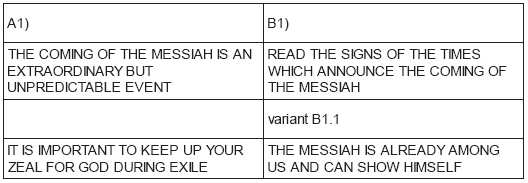
<body><![CDATA[<br>   Schneerson&hellip; According to some, if all the Jews of    <br>   Israel kept two full Sabbaths, then the Messiah would     <br>   show up. I think we have a long wait. </i>    <br>   (<a href="http://www.chabad.org" target="_blank">www.chabad.org</a>) </font></p>     <p>&nbsp;</p>     <p><font size="3" face="Verdana, Arial, Helvetica, sans-serif"><b>The messianism    as idea-typus </b></font></p>     <p><font size="2" face="Verdana, Arial, Helvetica, sans-serif">The subject of    my paper is messianism as a type of socio-religious action within the context    of modern Judaism. As a concept, messianism often takes the form of a collective    movement based on religion. It is therefore a <i>symbolic resource</i> mobilized    by collective subjects in the process of constructing their own identity and    in order to ensure their social success. From the sociological viewpoint, two    of the most interesting aspects of the messianic phenomenon are the identity    and organizational performances of the religious movement. From this perspective,    messianism comes within Weber's ideal-type of charismatic action, since it presupposes    the appearance of a <i>virtuoso of social redemption</i>, i.e. a subject able    to interpret the waiting for change. Because he has <i>yet to come</i> and be    recognized, it is of no importance whether this figure is still faceless or    a flesh-and-blood person. In sociological terms, messianism is an organized    way of believing that creates real, effective social bonds, in alternative to    the constituted social order. Here, we are only marginally interested in reviewing    the notion of messianism as such; rather what interests us is to attempt to    measure the social effects it produces, when it becomes the chief concern in    a system of belief. We prefer to see it here as a <i>means of communication</i>    which is gradually changing within a socio-religious movement into a fully-fledged    <i>collective narrative</i>. For instance, if the Messiah has already come or    his arrival is imminent, a movement that believes in this proposition tends    to <i>transfigure the particular into the universal</i>, going beyond the distinction    between the life of the individual and that of society, including everyday life,    in order to create moral and religious unity. Thus, even when it points to a    belief in the world to come, messianism helps reformulate social bonds here    and now; in a word: it creates society. The problem for sociologists is therefore    to discover through investigation and analysis what type of social order is    established: the model of authority experienced, the social relations set up,    the interactive rituals and lastly the social outcome produced by organizational    performances (both in terms of reproduction of the organization which the messianic    movement gives rise to and in more practical terms, e.g. the mobilization of    human and financial resources). We will concern ourselves here with a particular    case: the Chabad-Lubavitch movement, which forms part of the Chassidic (mystical)    branch of modern Judaism (dating back to seventeenth century central and eastern    Europe). </font></p>     <p>&nbsp;</p>     <p><font size="3" face="Verdana, Arial, Helvetica, sans-serif"><b>Two currents    in Jewish Messianism </b></font></p>     <p><font size="2" face="Verdana, Arial, Helvetica, sans-serif">Before briefly    outlining the characteristics of this movement with its headquarters in Crown    Heights, New York, it is worth summarizing the various conceptions of messianism    in Judaism. Reducing to a thumb-nail Gershom Scholem's (Idel, 2004; Scholem,    1993) important work on this subject, we offer the following diagram: </font></p>     ]]></body>
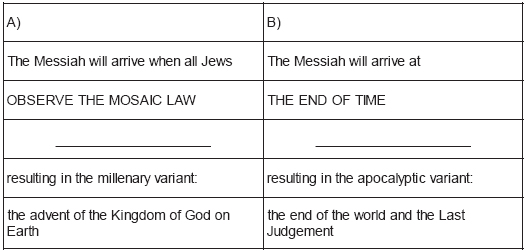
<body><![CDATA[<p>&nbsp;</p>     <p align="center"><img src="/img/revistas/s_ha/v3nse/a05dg01.jpg" ></p>     <p>&nbsp;</p>     <p><font size="2" face="Verdana, Arial, Helvetica, sans-serif">Because the coming    of the Messiah was no longer deemed imminent, at the end of the eighteenth century    both interpretations were superseded by the notion of being at the service of    God in exile. </font></p>     <p><font size="2" face="Verdana, Arial, Helvetica, sans-serif">After the Shoa,    the distinction between the two orientations was reestablished:</font></p>     <p>&nbsp;</p>     <p align="center"><img src="/img/revistas/s_ha/v3nse/a05dg02.jpg" ></p>     <p>&nbsp;</p>     <p><font size="2" face="Verdana, Arial, Helvetica, sans-serif">These two conceptions,    which differ as to the nature of messianic redemption, are to be found again    in the discussion which took place (and which is still hotly debated) between    the rabbis of the various schools of thought. Opinions range from those who    associate the coming of the Messiah with merit and those who believe that not    everything depends on the moral perfection of Man, and therefore external intervention    is required to help Man overcome his limitations. Through these conceptual developments,    we catch a glimpse of the two different notions of messianism: the first considers    the messianic era an event that the action of Man can either hasten or delay;    the <i>second</i> considers the coming of the Messiah an unconditional event,    sudden and gratuitous, that bursts in on history from the outside and totally    transforms it. One of the greatest thinkers of our times, Levinas (1961) pondered    at length on this question. In the end, he opted to side with those who maintain    that the messianic age coincides with mankind's hopes to see the historical    triumph of the end of violence and the establishment of a society founded on    justice. What interests the French philosopher is the intersubjective dimension    (<i>the Other</i>, one's neighbour), encompassing the notion of messianism.    "The age of the Messiah", according to Levinas, distinguishes itself from "the    future world" because it needs the "fecundity of time"; it is not the equivalent    of the liberation of time, yet it takes place in <i>time</i> (Levinas, 1974).    Thus, messianism may be linked to a charismatic figure, but it performs an ethical-social    function; it establishes a social order which prefigures the waiting for salvation.    </font></p>     <p>&nbsp;</p>     ]]></body>
<body><![CDATA[<p><font size="3" face="Verdana, Arial, Helvetica, sans-serif"><b>The messianism    of the Chabad movement </b></font></p>     <p><font size="2" face="Verdana, Arial, Helvetica, sans-serif">What distinguishes    the Chabad movement from Levinas' interpretation is not so much the ethical-social    dimension that the movement in question has expressed over the last thirty years,    but rather the emergence of a figure who has gradually managed to gain credence    not only as a charismatic leader (which is nothing particularly new in the Chassidic    tradition), but also &#150; and perhaps this went beyond the intentions of the    last spiritual head of the movement, who died in 1994 - as the Messiah, the    bearer of an extraordinary <i>personal </i>gift<i>. Menachem</i> (in Hebrew:    the consoler), is in fact an attribute associated with one who feels a messianic    vocation but it is also the name of the late leader of Chabad. Finally, it should    be remembered that the Hebrew term <i>mashiach </i>(from which the Greek word    <i>messias </i>is derived) really means "anointed" and occurs in the Old Testament    as the attribute of most of the kings of Israel or Judea (<i>ha-melekh ha-mashiach,    </i>"the anointed king"). At the time, anointment was the equivalent of enthronement    (compare for example the anointment of David, recounted in 1 Sam 16, 3-12).    Later, <i>mashiach </i>was also used with reference to priests, patriarchs and    prophets, as anointment came to indicate consecration. Only with the post-exile    epoch, and then in late Judaism, did the term <i>mashiach </i>assume an eschatological    meaning to indicate someone invested with a divine mission, summoned to fulfil    a promise of liberation or salvation. Chabad is an acronym derived from the    first letters of Hebrew words: <i>Hochmah </i>(wisdom), <i>Binah</i> (understanding),    and <i>Da'at</i> (knowledge). The movement began in a small town in Belarus,    called Lubavitch, around the figure of the first <i>rebbe </i>(charismatic leader)    Schneur Zalman from Liadi (1745-1813). The movement forms part of a larger network    of Chassidic communities (or courts) (<i>chassidim </i>meaning 'the pious' in    Hebrew), composed of a number of families. Originally, these families traced    their common descent from a charismatic leader who transmitted his extraordinary    powers "through the blood". The leader of a Chassidic court is considered a    mediator between the "celestial court" and the "earthly" one. Thanks to his    exceptional powers of sanctity, the leader is able to put the human community    in communication with the world of the divine. At the same time, he has often    been seen as a spiritual master and healer, the community's political leader    and the bearer of a special gift, the ability to perform miracles (<i>mofsin</i>),    and ward off misfortune. Because of this concentration of extraordinary powers,    the Chassidic communities chose to call their leaders <i>rebbe</i>, rather than    use the traditional name of rabbi. </font></p>     <p>&nbsp;</p>     <p><font size="3" face="Verdana, Arial, Helvetica, sans-serif"><b>The charismatic    leadership of the Menachem Schneerson </b></font></p>     <p><font size="2" face="Verdana, Arial, Helvetica, sans-serif">The last <i>rebbe</i>    of the Chabad movement was Menachem Mendel Schneerson. His views form part of    the Jewish Messianic school of thought which sees redemption as a <i>public    event which will occur in history and arise within the community of the pious    who await the Messiah</i>. The community is therefore a sort of living laboratory    from which the face of the Messiah will emerge. The Messiah in question is Ben    David, of whom Schneerson often spoke, as an eschatological but at the same    time real figure, in whom all the new ideas of the Last Times will appear. This    concept not only helps strengthen the authority of the charismatic leader &#150;    easily identifiable by his holiness and exemplary nature with the Messiah to    come &#150;, but also represents a strong cohesive factor for the group, exalting    the special virtues of which he is the embodiment, the vanguard of the central    event in the messianic belief. This explains the particularly important effects    on organizational performances, both as regards the missionary zeal which guides    the movement's collective action, and as regards the authority structure of    the relationship between master and followers. If you are convinced that the    Messiah is "amongst us", then the intensive activity of proselytism, which is    not traditionally widespread in Judaism, can be justified. Furthermore, if this    conviction is continually enhanced by the process of beatification or sanctification    "on earth" of the figure of the charismatic leader carried out by the community    and seconded by the leader, <i>messianism becomes a symbolic resource with a    high organizational value</i>. When Schneerson was nominated in 1951 as the    legitimate successor to the 6th <i>rebbe</i> (Yosef Yitzhak Schneersohn), in    his inaugural speech he stated that: </font></p>     <blockquote>        <p><font size="2" face="Verdana, Arial, Helvetica, sans-serif">This generation      will announce the Age of the Messiah", bringing to an end the <i>teshuvah</i>,      the penitence which pre-announces the coming of the Messiah. (see official      website of the organization). </font></p> </blockquote>     <p><font size="2" face="Verdana, Arial, Helvetica, sans-serif">The decision he    made on the occasion of the Six-Day War in 1967 to send spiritual assistants    from the movement to the soldiers at the Front was based on a precise eschatological    conviction. By so doing, in fact, he rehabilitated in the eyes of many ultra-orthodox    Jews abroad the theological legitimacy of the State of Israel, which had until    then been considered an unholy, artificial creation by many movements. The argument    he used to persuade his followers was that by winning the war the holy borders    of the Promised Land (<i>Eretz Yisrael</i>) would be re-established in their    entirety. Such an event would confirm the imminent arrival of the Messiah. The    messianic wait was therefore linked to a series of events which were practical    and not imaginary. From that moment on, the movement was urged by the Rebbe    to engage in an intensive campaign of re-Judaization in the neighbourhoods of    Brooklyn. He launched the idea of what came to be called <i>mitzvah tank</i>s,    i.e. "tanks of the commandments", groups of proselytizing missionaries in minibuses    working the streets of the metropolis. In 1989, he assured his followers that    the age of the Messiah was imminent: "the obscurity of <i>golus</i> (exile)    is about to be transformed into Light". This prediction, based on a Kabbalistic    interpretation, enabled him to explain both the reestablishment of Eretz Yisrael    and the collapse of the Berlin Wall. The announcement was interpreted by his    followers as an explicit reference to the role of the <i>rebbe</i> as a visible    link between the Earthly Court and the Celestial one, between the community    of the pious on Earth and the Messiah above. Despite the numerous conflicts    with other Chassidic courts (the Satmar court, for example) which accused Chabad    of being a personality cult, the messianic function of Schneerson's leadership    was boosted by the dramatic events which affected Israeli society. During the    Gulf War of 1991, for example, the Rebbe prophesied that nothing would happen    to the Children of Israel. With the defeat of Iraq and the relatively little    war damage to Israel, he gained a reputation as a credible prophet, and not    only among his own followers; many <i>chassidim </i>were reported to have left    other courts for the Chabad one. Interest in his sanctity and extraordinary    powers grew steadily. On his death in 1994, the process of mourning amongst    his followers proved long and complex for two main reasons. In the first place,    many believed, and still believe, that he was the Messiah; hence the problem    of explaining his disappearance from the Earth. Secondly, there was the difficulty    of finding a successor to his charisma. If Menachem is the Messiah, no-one can    succeed him. But then who will take on the guiding role in the community? It    is no accident that the place where the Rebbe is buried is called <i>ohel</i>    (literally "the tent"), and is visited by a constant stream of pilgrims. The    force of his messianic and charismatic power is allegedly still active (Abramovitch;    Galvin, 2002; Allouche-Benayoun; Podselver, 2003; Bauer, 1998; Brodowicz, 1998;    Ehrlich, 2000; Feldman, 2003; Greilsammer, 1991; Guolo, 2000; Gutwirth, 2004;    Mintz, 1992; Pace, 2003; Pace; Guolo, 2000; Ravitzky, 1996). </font></p>     <p>&nbsp;</p>     <p><font size="3" face="Verdana, Arial, Helvetica, sans-serif"><b>Messianism as    an organizational culture </b></font></p>     ]]></body>
<body><![CDATA[<p><font size="2" face="Verdana, Arial, Helvetica, sans-serif">In many ways, the    messianic tension of Chabad recalls the Ernst Bloch's well-known theory on the    revolutionary theology of Thomas M&uuml;nzer (Bloch, 1981). In one extraordinarily    effective passage, Bloch compares Anabaptist millenarianism with the Jewish    Kabbalistic Messianic movement, Safed, which awaits the end of impiety on Earth    and the coming of a new kingdom resplendent with the power of the Lord (L&ouml;wy,    1998). Applying Bloch's theory, we could say that Chabad represents a variation    of revolutionary messianism for the following reasons: </font></p>     <blockquote>        <p><font size="2" face="Verdana, Arial, Helvetica, sans-serif">a) it keeps alive      the memory of the exodus &#150; the uprooting and Diaspora of the Jews &#150;      which fuels the desire to return to the Promised Land;    <br>     b) the Promised Land has, in fact, still to be redeemed, since the State of      Israel is an unsound political creation, having no basis in the Torah; it      is suspended in indefinite time, awaiting the Messiah, who will finally materialize      in the form of the Rebbe;    <br>     c) <i>in the meantime</i>, social and religious action must enable people      to really imagine what it means to live as if the Messiah had come, prefiguring      here and now the possibility of changing the social structure and power relations.      </font></p> </blockquote>     <p><font size="2" face="Verdana, Arial, Helvetica, sans-serif">The Chabad communities    are utopian in character; they believe in the practice of equality and fraternity    in contrast to a social and political structure which they perceive as impious    and unjust. The ideological device &#150; the firm belief in the imminent coming    of the Messiah &#150; does not give rise to a withdrawal from the world. On    the contrary, it mobilizes human, material and organizational resources to transcend    reality and prefigure <i>those times</i>, when the world will no longer be as    alien as it appears today to the vanguard of pure faith. This is how the followers    of Chabad see themselves, in contrast to their religious brethren who, in their    view, have become secularized. </font></p>     <p><font size="2" face="Verdana, Arial, Helvetica, sans-serif">In 1949, Yosef    Yitzhak Schneersohn, then head of the Chabad community, decided to create a    small self-sufficient village in Israel called Kfar Chabad (which grew from    1,540 inhabitants in 1969 to approximately 3,500 in 2003). This caused a considerable    shift of opinion: previously the State of Israel and Zionism had been considered    unholy. After the Yom Kippur War in 1973, Menachem stated that Israel had the    full (divine) right to annex the occupied territories, according to the principle    of <i>pikuach nefesh</i>. Literally, this means "respect for life", but in the    present context, it is the rabbinical expression applied to the essential duty    to save the life of a Jew when it is under threat, even if it means breaking    Judaic law. </font></p>     <p><font size="2" face="Verdana, Arial, Helvetica, sans-serif">The fact that the    Chabad movement came to believe that the seventh <i>rebbe</i> was the Messiah    meant that tension in the community was kept high. It also charged up the wait    for imminent change in the social order, in particular in Israel, the last frontier    of the manifestation of the Messiah and, at the same time, the waiting for the    building of a celestial Jerusalem. From 1980 on, the messianic tension within    the movement became more pronounced and expressed itself in ever more zealous    forms. At the beginning of 1990, Chabad launched a campaign in the major American    newspapers to announce the coming of the Messiah. At the same time, they organized    the mass distribution of leaflets and stickers bearing the slogan: "<i>we want    Messiah now, we don't want to wait</i>". On June 19th 1991, the <i>New York    Times</i> carried a Lubavitch advertisement which ran: "the mass return of Jews    to the land of Israel from the former Soviet Union and the defeat of Iraq after    the first Gulf War are unequivocal signs of the coming of the Messiah". In this    climate, the followers of Chabad consolidated their conviction that the seventh    <i>rebbe</i> was, in fact, the long-awaited Messiah. In truth, Schneerson never    proclaimed himself to be the Messiah, but, on the other hand, he did little    to counter this belief. In April 1992, a group of Lubavitch rabbis made an authoritative    statement in which they identified the messianic traits of Rebbe Schneerson    (Ravitzky, 1996, p. 205), provoking criticism from within the movement itself    by other more cautious rabbis who had misgivings about the identification of    the figure of the Messiah with the head of the movement. When their leader died    at the venerable age of 92 in the summer of 1994, many of the faithful continued    to believe that he was the Messiah and that, in fact, he was not really dead,    and would soon become visible again after his imminent resurrection. Certain    rabbis who were fond of the Kabbalah took delight in indicating other signs    of Schneerson's messianic profile using numerology. One of them, Butman, pointed    out that the number 770 indicated the house of the Messiah in the Kabbalah,    and that the Rebbe's abode was 770 Eastern Parkway, Crown Heights! </font></p>     <p><font size="2" face="Verdana, Arial, Helvetica, sans-serif">This belief in    the resurrection of the Rebbe prompted other Chassidic communities, always critical    of the Chabad movement, to say that the movement was not very <i>kosher,</i>    because its non-orthodox beliefs at times bordered on Christian eschatology.    </font></p>     <p><font size="2" face="Verdana, Arial, Helvetica, sans-serif">Ten years after    the Rebbe's death, the messianic belief is still very much alive. Its missionary    zeal provides ample proof of this: the movement has grown by 30% in ten years    and can boast approximately 3,000 missionaries in 107 countries around the world.    </font></p>     ]]></body>
<body><![CDATA[<p><font size="2" face="Verdana, Arial, Helvetica, sans-serif">Chabad Messianism    thus represents a sort of symbolic capital which has accumulated thanks to the    charismatic force of the leader, who became, in his lifetime, a cultural resource    <i>for the organization </i>which has helped make the Chabad movement active    and competitive in the contemporary Jewish religious <i>market</i>. </font></p>     <p>&nbsp;</p>     <p><font size="3" face="Verdana, Arial, Helvetica, sans-serif"><b>Conclusion </b></font></p>     <p><font size="2" face="Verdana, Arial, Helvetica, sans-serif">Chabad, therefore,    represents a form of <i>extreme </i>messianism capable of mobilizing its militants    to perform a type of social action which is rational and undoubtedly oriented    toward the affirmation of religious values. However, it is also a means to an    end: if the age of the Messiah has come, its announcement must know no limits.    The Movement is thus authorized to push the tradition to the very limits, inventing    new and innovative repertoires of religious action and narratives. At the same    time, the announcement of the Messiah cannot rest or accept compromises, especially    not in Eretz Yisrael, the Land of Israel, that extraordinary place in the universe    which is both real and symbolic. The radical position taken by Chabad on the    question of the territory occupied by the Israeli army after the wars of 1967    and 1973 is highly indicative. The restitution of even the smallest part is    perceived not only as an attack on the "lives of the children of Israel" (according    to the principle of <i>pikuach nefesh</i>), but also as an intolerable delay    in the coming of the Messiah, or rather, as incredible blindness on the part    of the Jews with regard to the clear signs of the imminent revelation, now that    finally the borders of the Land of Israel are again those drawn up by the will    of God in the Pact of Alliance. </font></p>     <p><font size="2" face="Verdana, Arial, Helvetica, sans-serif">In this case, messianic    extremism is a form of inner-world ascetism which ensures the Chabad movement    not only social success and a relatively efficient organization, but also a    type of rational action: extremism becomes a factor of rationalization in individual    and collective life. Thus, it enables the movement to better achieve the goal    for which it was formed and for which it was transformed under the seventh <i>rebbe</i>.    From being a mystical community of pious <i>chassidim</i>, it has become a successful    modern charismatic enterprise on the market of symbolic and religious goods,    able to compete with other socio-religious subjects in the same social environment.    </font></p>     <p>&nbsp;</p>     <p><font size="3" face="Verdana, Arial, Helvetica, sans-serif"><b>References </b></font></p>     <!-- ref --><p><font size="2" face="Verdana, Arial, Helvetica, sans-serif">ABRAMOVITCH, I.;    GALVIN, S. (Ed.). <i>Jews in Brooklyn</i>. London: University Press of New England,    2002.    &nbsp;&nbsp;&nbsp;&nbsp;&nbsp;&nbsp;&nbsp;&nbsp;[&#160;<a href="javascript:void(0);" onclick="javascript: window.open('/scielo.php?script=sci_nlinks&ref=055576&pid=S0104-7183200700010000500001&lng=','','width=640,height=500,resizable=yes,scrollbars=1,menubar=yes,');">Links</a>&#160;]<!-- end-ref --> </font></p>     <!-- ref --><p><font size="2" face="Verdana, Arial, Helvetica, sans-serif">ALLOUCHE-BENAYOUN,    J.; PODSELVER, L. <i>Les mutations de la fonction rabbinique</i>. Paris: Observatoire    du Monde Juif, 2003.    &nbsp;&nbsp;&nbsp;&nbsp;&nbsp;&nbsp;&nbsp;&nbsp;[&#160;<a href="javascript:void(0);" onclick="javascript: window.open('/scielo.php?script=sci_nlinks&ref=055578&pid=S0104-7183200700010000500002&lng=','','width=640,height=500,resizable=yes,scrollbars=1,menubar=yes,');">Links</a>&#160;]<!-- end-ref --> </font></p>     <!-- ref --><p><font size="2" face="Verdana, Arial, Helvetica, sans-serif">BAUER, J. <i>Les    partis religieux en Isra&euml;l</i>. Paris: PUF, 1998.    &nbsp;&nbsp;&nbsp;&nbsp;&nbsp;&nbsp;&nbsp;&nbsp;[&#160;<a href="javascript:void(0);" onclick="javascript: window.open('/scielo.php?script=sci_nlinks&ref=055580&pid=S0104-7183200700010000500003&lng=','','width=640,height=500,resizable=yes,scrollbars=1,menubar=yes,');">Links</a>&#160;]<!-- end-ref --> </font></p>     <!-- ref --><p><font size="2" face="Verdana, Arial, Helvetica, sans-serif">BLOCH, E. <i>Thomas    M&uuml;nzer teologo della rivoluzione</i>. Milano: Feltrinelli, 1981.    &nbsp;&nbsp;&nbsp;&nbsp;&nbsp;&nbsp;&nbsp;&nbsp;[&#160;<a href="javascript:void(0);" onclick="javascript: window.open('/scielo.php?script=sci_nlinks&ref=055582&pid=S0104-7183200700010000500004&lng=','','width=640,height=500,resizable=yes,scrollbars=1,menubar=yes,');">Links</a>&#160;]<!-- end-ref --> </font></p>     <!-- ref --><p><font size="2" face="Verdana, Arial, Helvetica, sans-serif">BRODOWICZ, S. <i>L'&acirc;me    d' Isra&euml;l</i>. Paris: Edition du Rocher, 1998.    &nbsp;&nbsp;&nbsp;&nbsp;&nbsp;&nbsp;&nbsp;&nbsp;[&#160;<a href="javascript:void(0);" onclick="javascript: window.open('/scielo.php?script=sci_nlinks&ref=055584&pid=S0104-7183200700010000500005&lng=','','width=640,height=500,resizable=yes,scrollbars=1,menubar=yes,');">Links</a>&#160;]<!-- end-ref --> </font></p>     <!-- ref --><p><font size="2" face="Verdana, Arial, Helvetica, sans-serif">EHRLICH, A. M.    <i>Leadership in the Habad Movement</i>. Jerusalem: Jason Aronson, 2000.    &nbsp;&nbsp;&nbsp;&nbsp;&nbsp;&nbsp;&nbsp;&nbsp;[&#160;<a href="javascript:void(0);" onclick="javascript: window.open('/scielo.php?script=sci_nlinks&ref=055586&pid=S0104-7183200700010000500006&lng=','','width=640,height=500,resizable=yes,scrollbars=1,menubar=yes,');">Links</a>&#160;]<!-- end-ref --> </font></p>     <!-- ref --><p><font size="2" face="Verdana, Arial, Helvetica, sans-serif">FELDMAN, J. <i>Lubavitcher    as Citizens</i>. Ithaca: Cornell University Press, 2003.    &nbsp;&nbsp;&nbsp;&nbsp;&nbsp;&nbsp;&nbsp;&nbsp;[&#160;<a href="javascript:void(0);" onclick="javascript: window.open('/scielo.php?script=sci_nlinks&ref=055588&pid=S0104-7183200700010000500007&lng=','','width=640,height=500,resizable=yes,scrollbars=1,menubar=yes,');">Links</a>&#160;]<!-- end-ref --></font></p>     <!-- ref --><p><font size="2" face="Verdana, Arial, Helvetica, sans-serif"> GREILSAMMER, I.    <i>Isra&euml;l</i>: les hommes en noir. Paris: Presses de la Fondation de Sciences    Politiques, 1991.    &nbsp;&nbsp;&nbsp;&nbsp;&nbsp;&nbsp;&nbsp;&nbsp;[&#160;<a href="javascript:void(0);" onclick="javascript: window.open('/scielo.php?script=sci_nlinks&ref=055590&pid=S0104-7183200700010000500008&lng=','','width=640,height=500,resizable=yes,scrollbars=1,menubar=yes,');">Links</a>&#160;]<!-- end-ref --> </font></p>     <!-- ref --><p><font size="2" face="Verdana, Arial, Helvetica, sans-serif">GUOLO, R. <i>Terra    e redenzione</i>. Milano: Guerini e Associati, 2000.    &nbsp;&nbsp;&nbsp;&nbsp;&nbsp;&nbsp;&nbsp;&nbsp;[&#160;<a href="javascript:void(0);" onclick="javascript: window.open('/scielo.php?script=sci_nlinks&ref=055592&pid=S0104-7183200700010000500009&lng=','','width=640,height=500,resizable=yes,scrollbars=1,menubar=yes,');">Links</a>&#160;]<!-- end-ref --> </font></p>     <!-- ref --><p><font size="2" face="Verdana, Arial, Helvetica, sans-serif">GUTWIRTH, J. <i>La    renaissance du hassidisme</i>. Paris: Odile Jacob, 2004.    &nbsp;&nbsp;&nbsp;&nbsp;&nbsp;&nbsp;&nbsp;&nbsp;[&#160;<a href="javascript:void(0);" onclick="javascript: window.open('/scielo.php?script=sci_nlinks&ref=055594&pid=S0104-7183200700010000500010&lng=','','width=640,height=500,resizable=yes,scrollbars=1,menubar=yes,');">Links</a>&#160;]<!-- end-ref --></font></p>     <!-- ref --><p><font size="2" face="Verdana, Arial, Helvetica, sans-serif"> IDEL, M. <i>Mistici    messianici</i>. Milano: Adelphi, 2004.    &nbsp;&nbsp;&nbsp;&nbsp;&nbsp;&nbsp;&nbsp;&nbsp;[&#160;<a href="javascript:void(0);" onclick="javascript: window.open('/scielo.php?script=sci_nlinks&ref=055596&pid=S0104-7183200700010000500011&lng=','','width=640,height=500,resizable=yes,scrollbars=1,menubar=yes,');">Links</a>&#160;]<!-- end-ref --></font></p>     <!-- ref --><p><font size="2" face="Verdana, Arial, Helvetica, sans-serif"> LEVINAS, E. <i>Totalit&eacute;    et infini</i>: essai sur l'ext&eacute;riorit&eacute;. Paris: LGF, 1961.    &nbsp;&nbsp;&nbsp;&nbsp;&nbsp;&nbsp;&nbsp;&nbsp;[&#160;<a href="javascript:void(0);" onclick="javascript: window.open('/scielo.php?script=sci_nlinks&ref=055598&pid=S0104-7183200700010000500012&lng=','','width=640,height=500,resizable=yes,scrollbars=1,menubar=yes,');">Links</a>&#160;]<!-- end-ref --> </font></p>     <!-- ref --><p><font size="2" face="Verdana, Arial, Helvetica, sans-serif">LEVINAS, E. <i>Autrement    qu'&ecirc;tre ou au-del&agrave; de l'essence</i>. Nijhof: Kluwer Academic, 1974.    &nbsp;&nbsp;&nbsp;&nbsp;&nbsp;&nbsp;&nbsp;&nbsp;[&#160;<a href="javascript:void(0);" onclick="javascript: window.open('/scielo.php?script=sci_nlinks&ref=055600&pid=S0104-7183200700010000500013&lng=','','width=640,height=500,resizable=yes,scrollbars=1,menubar=yes,');">Links</a>&#160;]<!-- end-ref -->    </font></p>     <!-- ref --><p><font size="2" face="Verdana, Arial, Helvetica, sans-serif">L&Ouml;WY M. <i>Redemption    and Utopia</i>. Stanford: Stanford University Press, 1998.    &nbsp;&nbsp;&nbsp;&nbsp;&nbsp;&nbsp;&nbsp;&nbsp;[&#160;<a href="javascript:void(0);" onclick="javascript: window.open('/scielo.php?script=sci_nlinks&ref=055602&pid=S0104-7183200700010000500014&lng=','','width=640,height=500,resizable=yes,scrollbars=1,menubar=yes,');">Links</a>&#160;]<!-- end-ref --> </font></p>     <!-- ref --><p><font size="2" face="Verdana, Arial, Helvetica, sans-serif">MINTZ, J. R. <i>Hasidic    people in the New World</i>. Cambridge: Harvard University Press, 1992.    &nbsp;&nbsp;&nbsp;&nbsp;&nbsp;&nbsp;&nbsp;&nbsp;[&#160;<a href="javascript:void(0);" onclick="javascript: window.open('/scielo.php?script=sci_nlinks&ref=055604&pid=S0104-7183200700010000500015&lng=','','width=640,height=500,resizable=yes,scrollbars=1,menubar=yes,');">Links</a>&#160;]<!-- end-ref --> </font></p>     <!-- ref --><p><font size="2" face="Verdana, Arial, Helvetica, sans-serif">PACE, E. <i>Perch&eacute;    le religioni scendono in Guerra</i>. Roma-Bari: Laterza, 2003.    &nbsp;&nbsp;&nbsp;&nbsp;&nbsp;&nbsp;&nbsp;&nbsp;[&#160;<a href="javascript:void(0);" onclick="javascript: window.open('/scielo.php?script=sci_nlinks&ref=055606&pid=S0104-7183200700010000500016&lng=','','width=640,height=500,resizable=yes,scrollbars=1,menubar=yes,');">Links</a>&#160;]<!-- end-ref --> </font></p>     <!-- ref --><p><font size="2" face="Verdana, Arial, Helvetica, sans-serif">PACE, E.; GUOLO,    R. <i>I fondamentalismi</i>. Roma-Bari: Laterza, 2000.    &nbsp;&nbsp;&nbsp;&nbsp;&nbsp;&nbsp;&nbsp;&nbsp;[&#160;<a href="javascript:void(0);" onclick="javascript: window.open('/scielo.php?script=sci_nlinks&ref=055608&pid=S0104-7183200700010000500017&lng=','','width=640,height=500,resizable=yes,scrollbars=1,menubar=yes,');">Links</a>&#160;]<!-- end-ref --> </font></p>     <!-- ref --><p><font size="2" face="Verdana, Arial, Helvetica, sans-serif">RAVITZKY, A. <i>Messianism,    Zionism and Jewish Religious Radicalism</i>. Chicago: Chicago University Press,    1996.    &nbsp;&nbsp;&nbsp;&nbsp;&nbsp;&nbsp;&nbsp;&nbsp;[&#160;<a href="javascript:void(0);" onclick="javascript: window.open('/scielo.php?script=sci_nlinks&ref=055610&pid=S0104-7183200700010000500018&lng=','','width=640,height=500,resizable=yes,scrollbars=1,menubar=yes,');">Links</a>&#160;]<!-- end-ref --> </font></p>     <!-- ref --><p><font size="2" face="Verdana, Arial, Helvetica, sans-serif">SCHOLEM, S. <i>Le    grandi correnti della mistica ebraica</i>. Torino: Einaudi, 1993.    &nbsp;&nbsp;&nbsp;&nbsp;&nbsp;&nbsp;&nbsp;&nbsp;[&#160;<a href="javascript:void(0);" onclick="javascript: window.open('/scielo.php?script=sci_nlinks&ref=055612&pid=S0104-7183200700010000500019&lng=','','width=640,height=500,resizable=yes,scrollbars=1,menubar=yes,');">Links</a>&#160;]<!-- end-ref --> </font></p>     <p>&nbsp;</p>     <p>&nbsp;</p>     <p><font size="2" face="Verdana, Arial, Helvetica, sans-serif">Received on 30/10/2006        <br>   Approved on09/01/2007 </font></p>      ]]></body>
<back>
<ref-list>
<ref id="B1">
<nlm-citation citation-type="book">
<person-group person-group-type="author">
<name>
<surname><![CDATA[ABRAMOVITCH]]></surname>
<given-names><![CDATA[I.]]></given-names>
</name>
<name>
<surname><![CDATA[GALVIN]]></surname>
<given-names><![CDATA[S.]]></given-names>
</name>
</person-group>
<source><![CDATA[Jews in Brooklyn]]></source>
<year>2002</year>
<publisher-loc><![CDATA[London ]]></publisher-loc>
<publisher-name><![CDATA[University Press of New England]]></publisher-name>
</nlm-citation>
</ref>
<ref id="B2">
<nlm-citation citation-type="book">
<person-group person-group-type="author">
<name>
<surname><![CDATA[ALLOUCHE-BENAYOUN]]></surname>
<given-names><![CDATA[J.]]></given-names>
</name>
<name>
<surname><![CDATA[PODSELVER]]></surname>
<given-names><![CDATA[L.]]></given-names>
</name>
</person-group>
<source><![CDATA[Les mutations de la fonction rabbinique]]></source>
<year>2003</year>
<publisher-loc><![CDATA[Paris ]]></publisher-loc>
<publisher-name><![CDATA[Observatoire du Monde Juif]]></publisher-name>
</nlm-citation>
</ref>
<ref id="B3">
<nlm-citation citation-type="book">
<person-group person-group-type="author">
<name>
<surname><![CDATA[BAUER]]></surname>
<given-names><![CDATA[J.]]></given-names>
</name>
</person-group>
<source><![CDATA[Les partis religieux en Israël]]></source>
<year>1998</year>
<publisher-loc><![CDATA[Paris ]]></publisher-loc>
<publisher-name><![CDATA[PUF]]></publisher-name>
</nlm-citation>
</ref>
<ref id="B4">
<nlm-citation citation-type="book">
<person-group person-group-type="author">
<name>
<surname><![CDATA[BLOCH]]></surname>
<given-names><![CDATA[E.]]></given-names>
</name>
</person-group>
<source><![CDATA[Thomas Münzer teologo della rivoluzione]]></source>
<year>1981</year>
<publisher-loc><![CDATA[Milano ]]></publisher-loc>
<publisher-name><![CDATA[Feltrinelli]]></publisher-name>
</nlm-citation>
</ref>
<ref id="B5">
<nlm-citation citation-type="book">
<person-group person-group-type="author">
<name>
<surname><![CDATA[BRODOWICZ]]></surname>
<given-names><![CDATA[S.]]></given-names>
</name>
</person-group>
<source><![CDATA[L'âme d' Israël]]></source>
<year>1998</year>
<publisher-loc><![CDATA[Paris ]]></publisher-loc>
<publisher-name><![CDATA[Edition du Rocher]]></publisher-name>
</nlm-citation>
</ref>
<ref id="B6">
<nlm-citation citation-type="book">
<person-group person-group-type="author">
<name>
<surname><![CDATA[EHRLICH]]></surname>
<given-names><![CDATA[A. M]]></given-names>
</name>
</person-group>
<source><![CDATA[Leadership in the Habad Movement]]></source>
<year>2000</year>
<publisher-loc><![CDATA[Jerusalem ]]></publisher-loc>
<publisher-name><![CDATA[Jason Aronson]]></publisher-name>
</nlm-citation>
</ref>
<ref id="B7">
<nlm-citation citation-type="book">
<person-group person-group-type="author">
<name>
<surname><![CDATA[FELDMAN]]></surname>
<given-names><![CDATA[J.]]></given-names>
</name>
</person-group>
<source><![CDATA[Lubavitcher as Citizens]]></source>
<year>2003</year>
<publisher-loc><![CDATA[Ithaca ]]></publisher-loc>
<publisher-name><![CDATA[Cornell University Press]]></publisher-name>
</nlm-citation>
</ref>
<ref id="B8">
<nlm-citation citation-type="book">
<person-group person-group-type="author">
<name>
<surname><![CDATA[GREILSAMMER]]></surname>
<given-names><![CDATA[I.]]></given-names>
</name>
</person-group>
<source><![CDATA[Israël: les hommes en noir]]></source>
<year>1991</year>
<publisher-loc><![CDATA[Paris ]]></publisher-loc>
<publisher-name><![CDATA[Presses de la Fondation de Sciences Politiques]]></publisher-name>
</nlm-citation>
</ref>
<ref id="B9">
<nlm-citation citation-type="book">
<person-group person-group-type="author">
<name>
<surname><![CDATA[GUOLO]]></surname>
<given-names><![CDATA[R.]]></given-names>
</name>
</person-group>
<source><![CDATA[Terra e redenzione]]></source>
<year>2000</year>
<publisher-loc><![CDATA[Milano ]]></publisher-loc>
<publisher-name><![CDATA[Guerini e Associati]]></publisher-name>
</nlm-citation>
</ref>
<ref id="B10">
<nlm-citation citation-type="book">
<person-group person-group-type="author">
<name>
<surname><![CDATA[GUTWIRTH]]></surname>
<given-names><![CDATA[J.]]></given-names>
</name>
</person-group>
<source><![CDATA[La renaissance du hassidisme]]></source>
<year>2004</year>
<publisher-loc><![CDATA[Paris ]]></publisher-loc>
<publisher-name><![CDATA[Odile Jacob]]></publisher-name>
</nlm-citation>
</ref>
<ref id="B11">
<nlm-citation citation-type="book">
<person-group person-group-type="author">
<name>
<surname><![CDATA[IDEL]]></surname>
<given-names><![CDATA[M.]]></given-names>
</name>
</person-group>
<source><![CDATA[Mistici messianici]]></source>
<year>2004</year>
<publisher-loc><![CDATA[Milano ]]></publisher-loc>
<publisher-name><![CDATA[Adelphi]]></publisher-name>
</nlm-citation>
</ref>
<ref id="B12">
<nlm-citation citation-type="book">
<person-group person-group-type="author">
<name>
<surname><![CDATA[LEVINAS]]></surname>
<given-names><![CDATA[E.]]></given-names>
</name>
</person-group>
<source><![CDATA[Totalité et infini: essai sur l'extériorité]]></source>
<year>1961</year>
<publisher-loc><![CDATA[Paris ]]></publisher-loc>
<publisher-name><![CDATA[LGF]]></publisher-name>
</nlm-citation>
</ref>
<ref id="B13">
<nlm-citation citation-type="book">
<person-group person-group-type="author">
<name>
<surname><![CDATA[LEVINAS]]></surname>
<given-names><![CDATA[E.]]></given-names>
</name>
</person-group>
<source><![CDATA[Autrement qu'être ou au-delà de l'essence]]></source>
<year>1974</year>
<publisher-loc><![CDATA[Nijhof ]]></publisher-loc>
<publisher-name><![CDATA[Kluwer Academic]]></publisher-name>
</nlm-citation>
</ref>
<ref id="B14">
<nlm-citation citation-type="book">
<person-group person-group-type="author">
<name>
<surname><![CDATA[LÖWY]]></surname>
<given-names><![CDATA[M.]]></given-names>
</name>
</person-group>
<source><![CDATA[Redemption and Utopia]]></source>
<year>1998</year>
<publisher-loc><![CDATA[Stanford ]]></publisher-loc>
<publisher-name><![CDATA[Stanford University Press]]></publisher-name>
</nlm-citation>
</ref>
<ref id="B15">
<nlm-citation citation-type="book">
<person-group person-group-type="author">
<name>
<surname><![CDATA[MINTZ]]></surname>
<given-names><![CDATA[J. R.]]></given-names>
</name>
</person-group>
<source><![CDATA[Hasidic people in the New World]]></source>
<year>1992</year>
<publisher-loc><![CDATA[Cambridge ]]></publisher-loc>
<publisher-name><![CDATA[Harvard University Press]]></publisher-name>
</nlm-citation>
</ref>
<ref id="B16">
<nlm-citation citation-type="book">
<person-group person-group-type="author">
<name>
<surname><![CDATA[PACE]]></surname>
<given-names><![CDATA[E.]]></given-names>
</name>
</person-group>
<source><![CDATA[Perché le religioni scendono in Guerra]]></source>
<year>2003</year>
<publisher-loc><![CDATA[Roma-Bari ]]></publisher-loc>
<publisher-name><![CDATA[Laterza]]></publisher-name>
</nlm-citation>
</ref>
<ref id="B17">
<nlm-citation citation-type="book">
<person-group person-group-type="author">
<name>
<surname><![CDATA[PACE]]></surname>
<given-names><![CDATA[E.]]></given-names>
</name>
<name>
<surname><![CDATA[GUOLO]]></surname>
<given-names><![CDATA[R.]]></given-names>
</name>
</person-group>
<source><![CDATA[I fondamentalismi]]></source>
<year>2000</year>
<publisher-loc><![CDATA[Roma-Bari ]]></publisher-loc>
<publisher-name><![CDATA[Laterza]]></publisher-name>
</nlm-citation>
</ref>
<ref id="B18">
<nlm-citation citation-type="book">
<person-group person-group-type="author">
<name>
<surname><![CDATA[RAVITZKY]]></surname>
<given-names><![CDATA[A.]]></given-names>
</name>
</person-group>
<source><![CDATA[Messianism, Zionism and Jewish Religious Radicalism]]></source>
<year>1996</year>
<publisher-loc><![CDATA[Chicago ]]></publisher-loc>
<publisher-name><![CDATA[Chicago University Press]]></publisher-name>
</nlm-citation>
</ref>
<ref id="B19">
<nlm-citation citation-type="book">
<person-group person-group-type="author">
<name>
<surname><![CDATA[SCHOLEM]]></surname>
<given-names><![CDATA[S.]]></given-names>
</name>
</person-group>
<source><![CDATA[Le grandi correnti della mistica ebraica]]></source>
<year>1993</year>
<publisher-loc><![CDATA[Torino ]]></publisher-loc>
<publisher-name><![CDATA[Einaudi]]></publisher-name>
</nlm-citation>
</ref>
</ref-list>
</back>
</article>