Performance e experiência nas narrativas orais da fronteira entre Argentina, Brasil e Uruguai
Luciana Hartmann
Federal University of Rio de Janeiro – Brazil
Translated by Michele Andrea Markowitz
Translation from Horizontes Antropológicos, Porto Alegre, v.11, n.24, p.125-153, July/Dec. 2005.
]]>
ABSTRACT
In the frontier among Argentina, Brazil and Uruguay oral narratives transpose political limits. On circulating in this region, narratives reveal identities, traditions and even feelings. In these countries the practice of storytelling is a central aspect of a "culture of frontier", it is fundamental for transmitting values and knowledge. In this paper I present an specific aspect of this culture: the story-tellers performances and its importance on the organization and transmission of the experience of living in the frontier. Firstly, it is done a theoretical approach about the relationship among experience, performance and narrative definitions. Then, presenting two narratives – one a comic story, and the other a personal life narrative – I explain how concepts of "performance as an exhibition" and "performance as skill" can be useful to understand the different forms storytellers act in narrative events.
Keywords: borders, experience, oral narratives, performance.
RESUMO
Na fronteira entre Argentina, Brasil e Uruguai as narrativas orais transgridem limites políticos e, ao circularem entre as vizinhas regiões, vão revelando identidades, tradições, sentimentos. Esta transmissão de valores e práticas que se dá através da narração de histórias é parte fundamental da "cultura da fronteira", existente entre os três países enfocados. Neste artigo abordo um aspecto específico desta cultura, aquele que diz respeito às performances dos contadores de causos/cuentos e sua importância na organização e transmissão da experiência de viver na fronteira. Inicialmente faço um levantamento teórico da relação entre experiência, performance e narrativa. Na seqüência, demonstro, através de duas narrativas – um "causo" cômico e uma história pessoal – como os conceitos de "performance como espetáculo" e "performance como desempenho", depreendidos da análise dos dados empíricos, auxiliaram na compreensão das diferentes formas de engajamento de contadores e ouvintes nos eventos narrativos da região.
Palavras-chave: experiência, fronteira, narrativas orais, performance.
For many researchers, working with narratives is always, and inevitably, related to the problematic of experience. According to this perspective, which is also mine, one of the main ways in which human beings may manifest, communicate and comprehend experience is by placing it in a narrative form. This "form", however, involves putting words into intelligible structures of meaning as well as organizing a series of codes and cultural dispositions that permit the narrative to be understood. Such words are richer and tell us more about the culture in question when they are observed in an "event,"1 in which meanings are negotiated and updated right as they are produced. In other words, contrary to what takes place in written narratives, in narrative performances, the narrator’s time and space is the same as the audience’s, propitiating interaction, a dialogue and an exchange of experiences happening and being shared "here and now", manifesting culture itself in its emergence (Bauman, 1977).
]]> Before going into the question of performance, itself, 2 I feel it would be worthwhile to consider the notion of experience. According to Bruner (1986, p. 4), experience doesn’t only involve data, cognition, or reason, but also sentiments and expectations. Using Dilthey, for whom reality only exists through consciousness given to it by inner experience, Bruner argues that vivid experience, like thought and desire, words and images, is primordial reality. As such, all experience is exclusively personal, individual, and unique and can never be completely shared. The key to transcending these limits is interpreting expressions of experience. It is these expressions (performances, narratives, texts…) that give form and meaning to experience, in the context of intersubjectivity. This takes us to Dilthey's hermeneutical circle (apud Bruner, 1986, p. 6, my translation), since "experience structures expressions and expressions structure experience".The focus of Anthropology of Experience, to which this work is affiliated, and the possible keys to interpreting its meanings lies in the relationship, tension, and in the inevitable gaps between reality(what’s really there, what can be there), experience (the reality that presents itself to consciousness) and expressions (how individual experience is framed and articulated). Narratives emerge, in Bruner’s perspective, not as fixed texts, but as a kind of expression inserted in the flow of social action. By regarding narratives as part of a context that is also historical, we come across the question of the temporal dimension of experience:
We create units of experience and meaning of the continuity of life. Each narrative is an arbitrary imposition of meaning in the flow of memory, in which we enlighten certain causes and obfuscate others; i.e., all narratives are interpretative. (Bruner, 1986, p. 7, my translation).
Hence, what Bruner is defending is that studying culture should start with expressions, since it is these which represent articulating and formulating experience into unities of analysis established by their own members. One should consider, however, that those who participate in a performance, ritual, or narrated event don’t necessarily share a common experience or meaning, and that the only thing they have in common is participating in the particular event in question. It’s in this process of "interpreting cultures", as anthropologists so desire, that two interpretative levels converge, according to Bruner (1985, p. 10): the members of the culture being studied, who interpret their own experiences in expressive ways, and the anthropologists, who interpret these expressions for their colleagues (producing other expressions on their own).
Of the many strategies that anthropologists use when looking for meaning, I would like to pause on those which seek an ever more intense approximation with the "native’s point of view" (Geertz, 1997), and find in their narratives and performances privileged access to interpreting what the members of these cultures being studied make of themselves (Bauman; Briggs, 1990; Briggs, 1985; Hartmann, 2002; Langdon, 1999; Maluf, 1999; Rosaldo, 1986), and, what’s more, assume ethnography as a narrative form itself that, as such, is also modeled on and subject to the author’s moods and his colleagues' demands (Bruner, 1986). This leaves us in the realm of relativism: each performance and each ethnographical piece are related to a determined cultural context and its meaning may only be understood in this context. Yet what makes this context comprehensible? Precisely that which unites us as cultural beings, according to Lévi-Strauss (1967), our capacity to communicate through symbols, language. The question, then, isn’t dealing with mere written or spoken language, grammatical codes, but something much greater, that language developed through gestures, sounds, a relationship with physical space and personal contact, which we call "performance". Performances also possess their own codes, but make it possible for knowledge to be produced through culture as well as to reflect on culture, engaging its participants in a "multi-sensorial" way (Langdon, 1999, p. 29).
In The Anthropology of Experience, Kapferer (1986) also stresses the importance of performance in analyzing meaning and the experience proportioned by ritual and other kinds of symbolic action. For this author (Kapferer, 1986, p. 191), performances form a unit between text and action, constituting and ordaining experience and also serve for reflecting upon and communicating experience. In the same book, Geertz (1986, p. 380) comments that experiences construct even while they are constructed in tales, parties, ceramics, rites, dramas, images, memories, ethnographies and allegorical machinery.
Reviewing theories on the nature of performance, Sullivan (1986), finds common demands: 1) a "recognized procedure" that orders performance action; 2) a deliberate sense of collective representation; 3) a common "consciousness" that performs acts are different from ordinary everyday events (Sullivan, 1986, p. 5). According to this author, all of these theories are attempts to delineate, analyze, or interpret. 3 In a performance, symbolic expressions converge in a "unity of the senses" (synesthesia) that enables culture to "entertain itself with the idea of unified meanings" (Sullivan, 1986, p. 6, my translation). Fundamentally, however, performance is a form of hermeneutics for this author, since its action is constituted mainly towards reflexivity. Yet, before reflecting, it’s related to apprehending experience itself: "[…] the act of understanding is performative in nature" (Sullivan, 1986, p. 30, my translation), which takes us back to the hermeneutic circle, since, according to this perspective, performance gives and is given form by way of experience.
Zumthor (2000, p. 37), on the other hand, proposes an inversion of the ethnological perspective, since, for this author, while ethnology refers to the contents of performance, or to the way they’re transmitted, it deals with them as "receptive habits". Even so, the characteristics which the author uses for defining performance are perfectly related to ethnographical/anthropological research. These would be: 1) The performance realizes, makes concrete, passes something to me that I recognize, from a virtual to a real state; 2) the performance is situated in a both cultural and situational context: in this context it appears as "emergence", 5 3.) Performance is a conduct assumed by the subject, openly and functionally, a responsibility, and is a kind of behavior that can be repeated without being repetitive (just like what Schechner (1988) defined as "restored behavior"6); 4) performance modifies knowledge. It’s not just a means of communication: by communicating, performance marks knowledge. In another moment in his text, Zumthor brings to light what I believe is the merit of his approach: relating it to the practice of a poetic language, and connecting this language to the body.
[…] the poetic (differently from other discourses) is profound enough, fundamentally necessary, to be perceived in its quality and to generate its effects, of an active presence in a body: of a subject in its own psycho-physiological fulfillment, its own way of existing in space and time and that hears, sees, breathes, opens up its perfumes, to the tact of things. That a text be recognized as poetic (literary) or not, depends on the feelings our body has. Necessity to produce its effects; i.e., to give us pleasure. (Zumthor, 2000, p. 41).
As one may perceive, Sullivan as much as Zumthor, directly or indirectly, are inspired by the same sources and common factors can be verified in their characterizing performance, since both perspectives may be channeled into Bauman’s classic definition (1977, p. 11), which understands performance as a mode of verbal communication which consists in taking responsibility, of a performer, with regards to an audience, by manifesting its communicative competence. This competence is supported in knowledge and talent that it possesses to speak in the socially appropriate way. From the audience’s point of view, the performer’s expressive acts are subject to evaluation, according to their efficiency. The better the capacity, the more intense the experience will be, thanks to the pleasure offered by the intrinsic qualities of the expressive act. However, Bauman, by maintaining his analysis in the realm of verbal communication, doesn’t bring up the point to which other authors quoted above give so much attention: the question of the body’s full integration and its proper sensations in each and every act of performance.
]]> Another important approach to studying performance, proposed in an article by Bauman e Briggs (1990), follows the same line as Sullivan and Zumthor, adopting, however, a more critical perspective for rethinking ways in which the context is dealt with in analyzing narrative performances. Assuming that a text can’t be understood in its relative context, the authors do propose, however, that this context be understood in "normative, conventional and institutional" terms (Bauman; Briggs, 1990, p. 67) yet also as "an active process of negotiation in which participants examine the discourse reflexively in the way that it emerges […]" (Bauman; Briggs, 1990, p. 69, my translation). This process, in which the ethnographer himself must also be included, is what Bauman e Briggs call contextualization: the analysis of texts emerging in contexts. Also, for these authors, performance is a highly reflexive way of communicating, which carries out a "poetic function" (Jakobson apud Bauman; Briggs, 1990, p. 73).In a 1999 article, Langdon plots out the history of oral literature studies in Anthropology, from its beginning through myth analyses, in which fixed texts are used to provide information on a given culture, its language or its psychology, up to contemporary approaches, which analyze the oral text according to a dramatic performatic perspective, in which its aesthetic and emergent qualities are especially valorized. The author doesn’t only work with the question of "fixing the narrative", as appears in the article’s title, but also as fixing experience in social interaction (subject taken up by Geertz), especially experience which is marked by narrative events in a written text. Following the ways that performance, as a concept, is used in Anthropology, restored by "post-modern" authors, in the last 20 years, she considers that performance is related to the unexpected (or improvised), to heterogeneity, to vocal polyphony, power relations, subjectivity and continual transformations, also pointing out that the concept takes analyses of social phenomena into account, in complex societies as well as illiterate ones. According to this author, the notion of performance involves two anthropological paradigms: 7
a) social life as dramaturgy (Goffman, 1983) or as social drama (Geertz, 1989; Turner, 1981, 1992): for these last two authors, contrary to Goffman, the focus isn’t on the rule, but on the praxis and interaction among social actors: here, life is seen as a sequence of social dramas, resulting in a continual tension between harmony and conflict. Langdon calls attention to Turner’s later interest in "cultural performances", using work developed by Singer (1972) and Schechner (1992). In this perspective, moments in which performance takes place appear as moments of reflexivity, which may bring about transformation – the narrative is seen as a social event involving experience, subjectivity, and artistic expressions. The emphasis of this approach is on the relationship between culture-performance-society;
b) performance as event (Bauman, 1977, 1986; Bauman; Sherzer, 1975): in its "performatic perspective", Bauman is concerned with the creation/construction of performance in different cultures and in different genres. Performance, as an act of communication, is distinct from other speech acts because of its expressive or "poetic" function – according to Jakobson (1974), the way of expressing a message and not its content). Performance thus appears as a "contextualized human experience", whose performatic acts may be distinguished in various characteristics, such as: display (exhibiting the actors), responsibility of demonstrating competence, evaluating the participants, putting experience into relief, keying (signals that focus the event and indicate how it should by interpreted). In this perspective, according to Langdon, performance is seen as a universal activity, hence the concern for the problematic of translation and fixing performance events in written texts that contemplate their emerging aspects as well as negotiations between participants, dialogue, poetic power and the rhetoric involved therein (Bauman; Briggs, 1990).
Langdon (1999) constructs a comparative chart between the "classic way" of analyzing narratives and the "performatic way", in which problems such as translation, theoretical focus, genre of literature, register, voice, reader, text, and narrator are contemplated. For her, concern with textualizing oral literature is a positive step, besides being an important element in attempting cultural translation, especially considering that such contemporary approaches are dedicated to a greater appreciation of the aesthetic and creative qualities of oral literature. The author goes on to highlight that if performance is a multi-sensorial experience, in which many elements contribute towards constructing/representing experience itself – and here such factors as corporal movement, using different sonorities and others, come in handy –, in Anthropology, limits persist in communicating the totality of these experiences.
Regarding performance studies, I would still like to present two perspectives that, although originating in the theater, suffered the influence of and influenced, in their turn, Anthropology, especially as regards analyzing oral narratives, dance, ritual, theatrical and paratheatrical representations, and traditional and popular celebrations. I believe that, in my work, considering these two perspectives is justified because, despite the important theoretical turn proportioned by Bauman, on the one hand, directed towards "the verbal arts", and of Turner and Goffman’s dramatic approaches, on the other, narrators' corporal manifestations – their gestures, posture, positioning and movement in time and space – still haven’t been sufficiently contemplated, and even less subjected to specific analyses.
The line of research called "ethnoscenology" is one of the approaches that intend to account for the analyses of "spectacular" events as a whole. Ethnoscenology surged, based on criticism of the ethnocentrism of the term "theater" (applicable only to certain Western cultures), as an alternative concept that seeks to contemplate the universality of spectacular practices. This approach has been under development in the last few years, especially by Jean-Marie Pradier, in France, and it’s objective, according to this author is, "studying different cultures, practices and spectacular organized human behavior" (Pradier, 1996, p. 16, my translation). Inspired in John Blacking, especially his arguments for creating ethnomusicology, Pradier defends that ethnoscenology fills in the gaps left by studying the relationship between body and symbolic production. This is where the term "spectacular" gains space, defined as "a way of being, behaving, moving, acting in space, expressing emotions, talking, singing and distinctly decorating one’s everyday life" (Pradier, 1998, p. 24). Pradier, however, admits that there are ambiguities in the term and problems with its definition, since ethnoscenographical research ends up going beyond its original limits, looking for spectacular experiences and expressions in practices, values and symbols that are also used in everyday life.8
Schechner's work (1988, 1992), on the other hand, located in the confluence between theatrical and anthropological research (the author worked together with Victor Turner), makes an interesting connection between both analytical perspectives. For this author, performance is rooted in practice and is fundamentally interdisciplinary and intercultural (Schechner, 1988, p. xv).9 Considering that performances studies involve a number of arts, activities and kinds of behavior, Schechner (1992, p. 273) organizes performative activities in the following way: according to the relative "artificialness" of the activity or genre, according to the necessity of formal training, the relationship between "theatrical space" and "theatrical event" and the social and ontological status of he or she who is acting and being represented. Yet, in the author’s own words, this taxonomy is defective, since a performance frequently mixes or excludes some of these categories. The lively discussion on performance studies, which Schechner has evoked during the last 20 years, permits envisioning, in his words, the amplitude of questions involved in this perspective of approaching society:
Performance is no longer easy to define or locate: the concept and structure is now quite widespread. It is ethnic and intercultural, historical and a-historical, aesthetic and ritual, sociological and political. Performance is a mode of behavior, an approach to experience; it is play, sport, aesthetics, popular entertainment, experimental theater, and more. But in order for this broad perspective to develop, performance must be written about with precision and in full detail. (Schechner, 1992, p. 4).
According to Schechner (1992), performance is a central concept in Turner’s thought precisely because performative acts are living examples of ritual in/as action. The author concludes that, as such, performance, if openly ritualistic – like a ceremony for curing, a shamanic trip or Grotowski's "poor theater", will always be centered on ritual action, where there is "restored behavior".
]]> The spetaculaire (French) form, as well as the performance (North American), may be adopted to my proposal of dealing with narrators and oral narratives in border regions, especially because I’ve proposed analyzing expressive phenomena as a whole, considering the form and meaning of events starting from the elements that constitute them – the performer, the audience, corporal and vocal techniques, the interaction between them, use of objects, ornaments and dress, spatial and temporal location, etc. –, contextualized in the cultural in which they were generated.Starting from the aforementioned definitions of performance, it’s important to keep in mind that this form of expression uses poetic language, of which the body is the vehicle that gives form to that which one wishes to communicates and of which each act of performance is reflexive, creating an experience while reflecting upon this experience at the same time. When I work with the notion of poetic language, I’m taking inspiration from Jakobson (1974) who attributes this notion to verbal language, amplifying it to the level of bodily language: poetics are involved with unusual combinations and selections of elements. Besides this, the poetic function is the only function of language that deals with the message itself, i.e., self-referential, hence propitiating reflection on the proper constitutive processes of language. 10
Performance thus becomes not only an object of research, but "the" privileged object of research to account for a multifaceted universe, fragmented, processual and dialogical of culture. This concept, however, as we have seen, calls attention for possessing uses and connotations considerably differentiated. In my research, 11 I work with two perspectives: on the one hand, performance as accomplishment, which presupposes the teller’s integral involvement in the act of narrating, his vocal and corporal accomplishments, even if his emphasis is still on content, i.e., on the "narrated event" (as happens in personal narratives); on the other hand, performance as spectacle, which involves greater aesthetic elaboration, read as poetic language, demanding the presence of an audience characterized as such, with well defined beginnings and endings, i.e., giving priority to the "narrative event" (as is the case of most of the performances of causos/cuentos (tales) on the border).
During this article two narrative performances will be analyzed, one of which is public, in which the idea of "verbal art" is more developed and the aesthetic aspects can be analyzed better (the notion of "performance as spectacle"), and the other private, in which – despite being diluted in an autobiographical account, whose emphasis is on content (which will also be analyzed) – the poetic character of frontier culture may also be observed (notion of "performance as accomplishment").
Performance as a spectacle: Senhor Reni's narrative
In the oral narratives told on the border, except for those told during big events (a luncheon, a birthday party or a peña folklórica), it was hard to know exactly when they started or ended. This is because, in general, the traditional causos or cuentos came up in the middle of more extensive tales, about the tellers' lives, and many of them end up being incorporated into tales about their own personal experiences. The narrative which will now be discussed, however, is characteristic of a "performance as spectacle", i.e., besides counting with well marked dispositions of beginning, middle, and end, it was public, read with poetic language and involving great corporal and vocal engagement on the part of the teller, who tries to show "communicative competence" (Hymes, 1975).
By taking up this performance, this work intends to, besides experimenting forms of textualizing oral forms into written ones, do an analysis that permits gathering as much information as possible on the oral strategies of this narrative community.
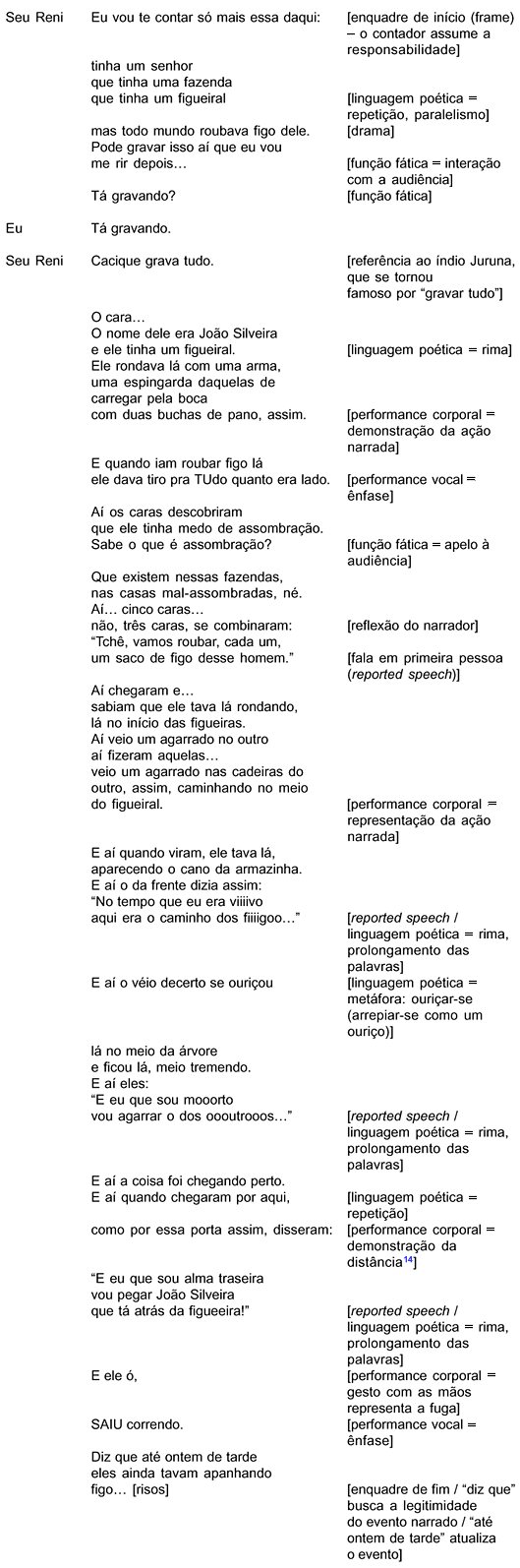
By transcribing this narrative, I have sought to make a diagram as close as possible to the flow of emission in its oral form. This is why I’ve chosen the following dispositions: changing lines indicates separations in sentences as well as short breathing pauses on the part of the teller; uppercase letters indicate pronunciation emphasized more loudly; repeating vowels indicates drawn-out syllables; incorrect spelling is used to represent how these words were pronounced. This diagram also permits that different strategies used by the teller, such as recurring to poetic language (rhymes, repetition), the "fact function" (appealing to the audience), representing characters' speech (reported speech), etc., transpires in a more evident way. Regarding reported speech, I would like to make clear that this is one of the main dispositions used by tellers to connect the narrated events as narrative events (Bauman; Briggs, 1990, p. 70). This updating of the narrated event, made possible through first-person speech permits the narrator to express a great variety of voices, behavior, and points of view, also making opportune a demonstration of his competence. 12 In any case, these are only alternatives to analyzing and "translating" oral into written language.13
This performance took place on a rainy afternoon, in a council office in the city council in Caçapava do Sul (RS), where I came across the councilman Joãozinho, 40 years old, his assistant, Senhor ("Seu") Clóvis, 62 years old, Seu Reni, 65 years old, and Seu Valter, 67. The councilman, in this case, was a known story-teller in the city and in his council office and, as I observed, genuine "story (causos) circles" got together there. On that day, all present disputed the microphone so they could tell stories like this one:
]]>
What’s behind the evidence of the questions pointed out here? In the first place, there’s a certain moral that emerges from this narrative performance. In attempting an interpretation, one may come to the conclusion that, for these gauchos, a man who doesn’t share his possessions ends up losing them. Stealing, in this case, appears here as perfectly legitimate. One might even risk saying that courage isn’t worth anything if one is "haunted"; it’s basically armed cowardice. It’s the victory of cunning over social norms that privileges few (we might go further if we think of the very concept of "private property" being treated ambiguously in the region). A performance like this also makes playing around possible, not only with social rules, but also with words, meanings, with one’s own body and in terms of contact with others, thus creating, besides transmitting cultural behavior codes, entertainment and pleasure to all who participate.
It’s also interesting to reflect, from this causo, supported by Hymes' perspective (1975), what emerges from it as a way of speaking – and, I would add, a way of acting (creating a performance) in this narrative community. Hence, in the first place, one may perceive an intention of entertaining and making the audience laugh, being that the laughter comes precisely from the contrast between the playful way of telling the story whose theme is actually quite serious (in this case, stealing). This contrast is made more strongly evident through corporal performance, as a representation of men being tied to each other’s belts.
Regarding performance, the story teller assumes responsibility for the narration, announcing it as a frame indicating the beginning of the tale. He also makes slight dramatizations, corporally as well as in the reported speech, in which his characters' behavior is represented, i.e., momentarily abandoning the use of the third person and, instead of narrating; he acts out, representing the roles in first person. This aspect may remind us of Mato's argument (1990) defending the classification of oral narratives in the ambit of dramatic forms, scenic, which accounts for the terminology he uses to define this kind of expression: "the art of narrating".
Finally, Seu Valter takes up themes related to society in general in an ironic way, instigating the audience, using this resource, in order to reflect and take on a critical attitude.
Performance as accomplishment: Gaucho Barreto's life story
My idea here is to work with the notion of "performance as accomplishment" based on the transcription and analysis of a fragment of a life story of one of the border narrators. Instead of a story with a beginning, middle and end, I now wish to point out the daily fluency of a report that links different narratives, without giving them an end. In this sense, I’ve followed Kirshenblatt-Gimblett's perspective (1975), in which tales in oral tradition are not autonomous pieces. The author criticizes researchers' not considering, through speech acts – other non-narrative forms or depositions – that precede the tales. For this author, these non-narrative forms create frames of reference for the stories to be told. She also argues that the "context of the situation" – information on the environment, audience, etc. – helps understand how the narrative event is structured and how the creative story teller integrates a traditional (or publicly known) story in a specific context of social interaction. As such, I initially present the narrator in question, situating him in relation to his context. Afterwards, I literally transcribe our conversation and then finally analyze his achievement/performance during the narration. Thus, even though I try to recuperate the relationship between this story-teller’s life experiences and the stories he tells,15 this will be done in the ambit of the narrative event (the teller’s performance and his oral strategies), in detriment of the narrated events (the content being used). Since this tale is endowed with different characteristics than the last one analyzed, the elements composing this one will be mentioned on the side, but only at the end of the narrative.
]]> Barreto is a known teller of causos, especially on the Brazilian side of the border, thanks to his loquacious style, his good-hearted nature, his cutting humor and the shamelessness with which he tells certain stories that don’t always make his community proud. The presentation format of his life story obeys the sequence he established at the moment of the performance.Editing was difficult because, besides following the analysis I’ve proposed, I also didn’t want to tire out the reader. These cuts are indicated in the text by ellipses between brackets […]. The other graphical signs used are the same as in the last transcription. I opted to maintain my own comments and questions during my interaction with Barreto, since I believe that these are an integral part of the context and, as such, important for understanding the narrative event as a whole.
I’ve already known Barreto for a long time. We had been introduced when I was visiting a traditionalist camping grounds that was taking the "Chama Crioula" (native torch) from Alegrete to Santana do Livramento (RS). He was with a group of gauchos, some of whom were already a bit borrachos (drunk), "barbequing" and telling causos in a small shed on the property that took us in for the night. Later on, we would meet on many other occasions. Besides being a great story teller, Barreto owns a bolicho (bar/grocery) where the farmhands and other country folk in general get together to drink or eat something as well as look for work, since it’s common for the farmers in the region to pin up job offers there.
This conversation, which I’ve transcribed below, took place in the kitchen/dining hall in the back of the bolicho, in the city of Santana do Livramento, on a warm November afternoon.
Me – to start, I would like you to tell me…
Barreto – Ask me. You’re the one who makes the questions.
Me – OK, I’d like you to tell me your full name…
B – Antônio Carlos Guedes Barreto, Alegrete, February 23, 1940, Lajeado Grande. I was born in the country with the help of a midwife, Maria Isabel. A black chick cut my umbilical cord. She’s my godmother. As black as my past.
Out in the country in the old days… the women bore their children far away, there was no maternity ward, but midwives, from the country. Like grandma Chininha here, grandma Chininha was a country midwife. She’s almost a hundred years old, you have to speak to her. […]
This is how my family was: I was born of a man poor like myself. My father sold tickets in Santana do Livramento, he was a ticket man, in a time when tickets gave out luck… he polished shoes… after reaching a certain age, semi-illiterate, my grandfather had many children – he was kind of perverse, my grandfather was the vice station chief of police – my father left for… Cacequi, where he had a brother. At that time, he made his living off contrabanding silk, that silk, Uruguayan silk, was much spoken of at the time. And my uncle had a band of mules, cargo mules, and my father went to work with him. […] ]]>
Time went by and my father was already nineteen when he met my mother who was 29, ten years older than he was. My father was a man… how should I tell you… rustic, rude, but… a real conquistador type, a dancer, my father danced well, he made his presence felt. A young man, rude, but with good appearance, he liked getting dressed up well. He found that old woman back in the field in Alegrete… […] where he met mom… and that’s how they started dating. My grandfather didn’t want him to have anything to do with her. He even paid a black– back then they always had a black, back then they would say "a black", on foot – to warn my father that he didn’t approve, that he would get into trouble, if he tried to do anything about this causo with my mother, the black guy would kill him. The black guy was… how will I tell you… my grandfather’s henchman, my grandfather was a powerful farmer at the time. But nothing happened with the henchman, Senhor Cório Barreto, very good-looking, a great tango dancer, went taking, went taking and took the old man… and there my father wed and stayed on… and they had to give him a piece of land. […]
And he lived there with my mother, they got married, they went to live there in that back of the field, but shortly after, he being much yooonnnnnggger and she much oolllddder, and they had a child... And you see that the woman became much older looking than the man. And he didn’t know anything about the country, nothing, nothing, nothing, nothing! She taught him everything; riding on horseback… he barely and badly knew how to saddle a donkey and didn’t ride on the horse. She was the one who knew how to take care of cattle and… and so it went, but things didn’t last long and my father became a good for nothing, a rascal. […]
We were still little when he left my mother. I was… when he left my mother I was twelve… 13 to 14 years old. This is when I hoisted myself to the world. I saw that fight at home, that bickering, I stood up and told my mother: "Look, I’m going away so I won’t get into a fight with my father, whose bickering and leaving and leaving and not leaving… and my little sisters have necessities, I’m going to look for a job." "But boy…", "No, I can’t take him anymore, he’s cursing me a lot and I see him cursing you out, and so I’m leaving." […]
And I ran away from home, I didn’t ask… just a horse, a change of clothes and I went to the first farm, owned by Mário Paiva who has already passed away. I arrived there running away. When… at the crossroads of the Lopes mark, at that time there were some posts… of the brigade soldiers, they told us "the rurals". It was Jaime, he was very black, and he arrested me. I came on that horse that was already limping, and he saw that farmhand on foot, pulling a horse… with some pieces of meat, a brim hat, he saw that I wasn't … "From whereabouts are you? You’re under arrest!" Very well, I spent two days at the brigade post. He told me: "If you try to run away, I’ll kill you. Where are you headed?" I then told him what really happened: "No, I ran away from home because of this and that and the other thing. I’m so-and-so's son." Then he let me off […]
I wanted to go to a big farm where I could learn how to work and earn enough to help my mother. I had left home when I was 13 going on 14, I left when I was 19 to do my military service, I did three years in the barracks, came back, did five more years on the farm. I was well thought of on the farm, always very spontaneous, hard-working, I liked working, I didn’t bother anyone … I never had a bend towards booze, drinking, I was never… I always liked the dances when I was younger, but I never got involved in fights there. In the beginning three, four, five months would go by without me coming into town, and when I did, it was because I came with money to help my mother. […]
Me – And this bolicho that you had on the borderline [on the border]: you had your bolicho together with your little truck to contraband?
B – No, no, no I didn’t have a truck at the time. The bolicho, I’ll tell you straight off since you want to know how things are what they are: I went to the border to… I knew there was contraband there. I lived there for tem years. There I said to Barbeiro, who’s already died: "Tchê, people are being able to import cattle. Let’s ask around to see what we can do, no?" Said and done, off we went. […] That bar there had a little bar facade, but in the back I had a little yellow VW Beetle, we came here, went over to the Uruguayan side and brought back, carrying…because a Beetle is like a donkey, crosses over to any side… We brought back from there 30, 40 packages of cigarettes, two, three videocassette players, 15, 20 liters of whiskey. […] Afterwards, things got worse, and this scheme didn’t work anymore. Little Bolicho… that’s right. Two doors, one in the front and the other, one in Brazil and another in Uruguay, the house riiigghhhtt on the line, riigghhttt on the limit [he shows me], plenty of space… […]
Me – Barreto, and the farmhands, when they wanted to go out with girls or see their wives they had to come into town?
B – Yes, they always visited each other when it was close. Close, if you will, right, five, six hours on horseback, trotting to arrive. Big dance, horse raises… There was already a harmonica player out on the curve, he played one song, another… And he drank a beer, and was already looking at the foreman’s daughter, she looked over a little bit, sends out a password to say if she’ll be able to steal away or not, walks around the block, leaves behind a tree or goes through one or another shadow, and you arrive slowly. And if they can tango or not, if not – good evening to you. But a gaucho is never uncertain about anything. Breaking a plate is difficult. Ah, no, the gaucho, no. If he liked a girl… he took her out to the dance floor… and already asked her: "you want me and I want you, we are two want-wants, right… What do you think of me, little gaucha girl? I’m a man half big bachelor, half big gaucho, I’m looking for a gift." One of them might say... they used sweet-talk: that you are pretty, you are beautiful, your smile, your look… "This brunette has a spontaneous walk", Canabarro, who’s already died, poor thing, would say. When he came across a pretty brunette he would tell me like this: "Tchê, Barreto, this brunette has a sultry look and a spontaneous walk." Country joke (chuckles). And those men that fumbled: "Shall we dance?" And the trickiest of them stood a little bit farther off, seeing if things would work out or not… If she messed around with her hair in a certain way [he shows me how], than it was a sign that things would work out, that she wanted to dance with you. A short while after, when the parents left, she came, then you could see if she had that sultry look and that spontaneous walk! (chuckles) This Luciana is going to take stuff home to tell about these borders!16
The context of the event in which I extracted the narratives transcribed above, as I’ve already mentioned, was an informal conversation, in the back of Barreto's bolicho. We were the only two in the bar, sitting at a table drinking mate (Paraguayan Tea). Despite this situation not being very propitious for executing a grand Performance (especially with such a little audience), Barreto proved to be a talented narrator whose fame spread across the region.
]]> As he spoke, Barreto gesticulated quite a bit, even though he didn’t stand up much on the occasion. He also used many different vocal variations, which gave great vivacity to his narrative and stimulated his audience’s attention. These variations often include first person representation of his characters' reported speech, a resource, as we’ve seen, that approximates the narrated event to the narrative event and lets the character and the audience meet up in the present. The characters that Barreto represented could be himself during another time in his life ("Look here, I’m leave home so I don’t get into a fight with my father …") or a brigade soldier ("Where abouts are you from? You’re under arrest!") among others.Barreto developed strong interaction with the audience (with me, the researcher, in this case), which reveals the pleasure he feels telling tales and also the influence that an attentive listener can exert, both in the execution of the performance as well as in the content of that which is narrated. At the beginning of our conversation, Barreto interrupted my first question saying: "Go ahead and ask me, you’re the one who should ask." By using the "fact function", the story teller made me feel comfortable asking him questions.
Many other times, Barreto spoke with me, pointing out other story tellers: "you have to speak with her" (referring to grandma Chininha). As such, besides recognizing the network of other story tellers, this teller indirectly alleviated his own responsibility, after all, grandma Chininha is almost a hundred years old, which gives her much more legitimacy than Barreto to tell tales. This is a much used strategy with story tellers on the border, who initially deny responsibility – disclaimers(Bauman, 1977) – for that which they are telling, transferring responsibility, only to assume this role shortly afterwards.
When he announces: "This is how my family was:" Barreto is framing the narratives he will tell, offering frames so the audience will be prepared for what it is about to hear. As such, the personal narrative follows up on the enunciation.
The use of poetic language, using metaphors, for example ("as black as my past"; "I hoisted myself to the world"), and the elaborate way in which he chooses his words ("I was born of a poor man like myself"), besides showing the teller’s dominating this language, also lets us imagine that he’s been playing this role for a long time and has possibly narrated the same personal stories and causos more than once. The metaphors, certainly chosen from a local repertoire, are also symbolic expressions of the ethos of gauchos such as Barreto represents: his "black" past "black" = in this case, wrong; "hoist" = refers to the bovine cattle or someone with a disobedient attitude or who, taking an unexpected resolution by escaping into the forests or marshes becoming wild, turns into a savage (Nunes; Nunes, 2000, p. 26). It’s not by chance that the metaphors analyzed here remit to a rural universe, key reference, as I’ve pointed out in my PhD dissertation (Hartmann, 2004), about the imaginary on the border.17
Besides metaphors, Barreto also recurs to other dispositions of poetic language, such as repetition ("I didn’t know nothing, nothing, nothing…", referring to his father; prolonged words, generously used by story tellers in the region ("him much yoouunngerrr, she a lot oolllddderrr"), and recurring to local proverbs during the reports, conversations, or narratives ("AVW Beetle is just like a donkey, it crosses on any side") which also demonstrate the population’s familiarity with this form of language. When he talks about the dance halls he’s been to, Barreto also uses this poetic language frequently, possibly inspired by the situations mentioned: "I took her to the dance floor...and I was already asking: 'You want me and I want you, we’re two want-wants…'", or still: "this brunette has a sultry look and a spontaneous walk."
Using poetic language, as one may perceive, doesn’t exclusively belong to the domain of "performances as spectacle", but on the contrary, is present in this community’s everyday life, this allows for it to be manipulated in situations of intimacy, such as in events in which personal narratives are told. In other words, this "poetics" participates in oral expressivity on the border on different levels.
Another aspect that emerges in Barreto's narratives, very important for understanding the oral traditions on the border, is the combined use of languages – in this case, Portuguese and Spanish, identifying its narrative community as a "speech community" on the border. Barreto is Brazilian, but his experience "on the border line", through friendship, commerce (contraband) or leisure activities, generates its own forms of expression proper to border regions. Hence, he frequently uses the Spanish word cuento as synonymous with the Portuguese word causo, borderline commission to refer to the government sector that coordinates handing over border territory, etc.
The fact that Barreto travels – as a contrabandist – confirms one of the main characteristics of border story tellers: transit between neighboring countries. Responsible for making oral narratives circulate around the region, the travelers – herders, tamers, shearers, contrabandists, midwives… –, by telling their stories, create a community that traces, through the narratives, new limits for its borders, not any longer political, but symbolic.
The question of reflexivity provoked by the narratives may also be gathered from Barreto's speech. For example, after mentioning a friend’s speech ("this brunette has a sultry look…"), Barreto reflects upon the actual fact told: "Country joke." By regulating this commentary, it’s interesting to underline that the country, or rural milieu, appears once again as a frame of reference which permits contextualizing the narrated event and thus understanding its meaning.
]]> At the end of our conversation, the storyteller shows how he perceives my presence there and the importance of his work for mine: "This Luciana is going to take a lot of stuff with her to tell about these borders!"The teller’s corporal performance, as was initially mentioned, is characterized not by moving through space, but by a talented manipulation of narrative times, intercalating silence with strong vocal expressivity. His posture, even while sitting, shares codes of masculine border behavior:18 back slightly curved frontward, legs spread apart, with one of his hands (normally the right hand) resting on the inner thigh, forming a ninety degree angle with his forearm and the opposite forearm resting the other thigh.
Another characteristic of Barreto, similar to other storytellers in the region, is acting out his characters' or his own specific roles through gesture. As such, at the end of his deposition, when he speaks of seduction strategies used by gauchos and gauchas in the dancehalls, he humorously acts out the way the girls stroke their hair to let a boy know it their interested or not in him.
Thinking along the lines of Hymes (1975, p. 70), for whom tradition is made up of people, one may consider that, in the performance analysis above, certain aspects stand out, such as the storyteller assuming responsibility for what he’s telling, even if in determined moments he passes authorship to third parties. It’s also important to note that the causos/cuentos themselves are always integrated into longer narratives, in a sequence for which the narrator establishes his own logic.19 Analytically, as we’ve seen, the cuentos/causos may be delineated because they’ve been framed into performance frameworks that are as corporal as they are verbal.
The importance of being familiar with, registering and analyzing the narrative context as well as the narrative itself is related to the question of meaning: meaning isn’t sought out in the story, but in how various stories is linked together, which is relative to a specific context of interaction with an audience. In this sense, the audience’s own interpretation is stimulated by the context (Kirshenblatt-Gimblett, 1975, p. 130). Finally, the teller demonstrates special disposition, enthusiasm and, why not say, generosity in narrating, reflecting upon his own experience – which, all in all, is also the experience of living on the border, with its own culture, imaginary, and stories.
Throughout this article, I’ve tried to demonstrate that the practice of telling and listening to stories on the border is inserted in complex speech events that represent the vitality of a tradition that is recreated day after day. Characterizing an important part of what I’ve denominated as "border culture", the narrative performances are constituted based on certain common factors, which I’ve tried to detect and understand. One of the primary aspects for analyzing these performances was observing storytellers' verbal and corporal accomplishments. As regards verbal achievements, we’ve seen that the tellers use poetic language through such tools like repetition, rhyme, and emphasizing and prolonging certain words especially relevant for the context of the enunciation. They also frequently use the "fact function", through which they stimulate the involvement of the audience in the narrative event. Another verbal – but also corporal – strategy that story tellers on the border use is acting out their characters in first person (reported speech). Even though in my analyses I’ve only emphasized their importance as a speech strategy, this certainly presupposes the narrator’s full engagement.
It should still be underscored that how much these resources are used is determined, largely, by the context of the narration. Thus, depending on how challenged or stimulated the narrator feels by his audience, the more he will use these resources. This means that in public as well as private performances, regarding personal narratives/life stories, the resources can be made available in greater or lesser quantity by the narrator, since they are all equally part of his repertoire for playing out roles – even if unconsciously.
References
BAUMAN, Richard. Verbal Art as performance. Rowley, Mass.: Newbury House Publishers, 1977. [ Links ]
BAUMAN, Richard. Story, performance and event: contextual studies of oral narrative. Cambridge: Cambridge University Press, 1986. [ Links ]
BAUMAN, Richard. Ed Bell, Texas storyteller: the framing and reframing of life experience. In: HOFER, Tamás; NIEDERMÜLLER, Péter (Ed.). Life History as cultural construction/performance. Budapest: The Ethnographic Institute of the Hungarian Academy of Sciences, 1988. p. 247-280. [ Links ]
BAUMAN, Richard; BRIGGS, Charles. Poetics and performance as critical perspectives on language and social life. Annual Review of Anthropology, Palo Alto, v. 19, p. 58-88,1990. [ Links ]
BAUMAN, Richard; SHERZER, Joel. The Ethnography of speaking. Annual Reviews of Anthropology, Palo Alto, v. 4, p. 95-119, 1975. [ Links ]
BRIGGS, Charles. The pragmatics of proverb performances in New Mexican Spanish. American Anthropologist, Washington, DC, v. 87, n. 4, p. 793-810, 1985. [ Links ]
BRUNER, Edward. Ethnography as narrative. In: TURNER, V.; BRUNER, E. (Org.). The Anthropology of Experience. Urbana: University of Illinois Press, 1986. p. 139-155. [ Links ]
CRUIKSHANK, Julie. The social life of stories: narrative and knowledge in the Yukon Territory. University of Nebraska Press, 1998. [ Links ]
GEERTZ, Clifford. Making Experience, Authoring Selves. In: TURNER, V.; BRUNER, E. (Org.). The Anthropology of Experience. Urbana: University of Illinois Press, 1986. p. 373-380. [ Links ]
GEERTZ, Clifford. A interpretação das culturas. Rio de Janeiro: Guanabara Koogan, 1989. [ Links ]
GEERTZ, Clifford. "Do ponto de vista dos nativos": a natureza do entendimento antropológico. In: GEERTZ, Clifford. O saber local: novos ensaios em antropologia interpretativa. Tradução de Vera Mello Joscelyne. Petrópolis: Vozes, 1997. p. 85-107. [ Links ]
GOFFMAN, E. The interaction order. American Sociological Review, v. 48, p. 1-17, 1983. [ Links ]
HARTMANN, Luciana. Identidade, ambigüidade, conflito: as performances narrativas como estratégia de análise da cultura da fronteira entre Brasil, Argentina e Uruguai. Revista de Investigaciones Folclóricas, Buenos Aires, v. 17, p. 114-122, dic. 2002. [ Links ]
HARTMANN, Luciana. "Aqui nessa fronteira onde tu vê beira de linha tu vai ver cuento": tradições orais na fronteira entre Argentina, Brasil e Uruguai. Tese (Doutorado em Antropologia Social)–PPGAS/UFSC, Florianópolis, 2004. [ Links ]
HYMES, Dell. Breakthrough into performance. In: BEN-AMOS, Dan; GOLDSTEIN, Kenneth S. (Org.). Folklore – performance and communication. Paris: Mouton, 1975. p. 11-74. [ Links ]
JAKOBSON, Roman. Lingüística e poética. In: JAKOBSON, Roman. Lingüística e comunicação. Tradução de Izidoro Bilkstein e José Paulo Paes. São Paulo: Cultrix, 1974. p. 118-163. [ Links ]
KAPCHAN, Deborah A. Common ground: keywords for the study of expressive culture – performance. Journal of American Folklore, v. 108, n. 430, p. 479-507, 1995. [ Links ]
KAPFERER, Bruce. Performance and the structuring of meaning and experience. In: TURNER, V.; BRUNER, E. (Org.). The Anthropology of Experience. Urbana: University of Illinois Press, 1986. p. 188-203. [ Links ]
KIRSHENBLATT-GIMBLETT. A parable in context: a social interactional analysis of storytelling performances. In: BEN-AMOS, Dan; GOLDSTEIN, Kenneth S. (Org.). Folklore – performance and communication. Paris: Mouton, 1975. p. 105-130. [ Links ]
LAKOFF, George; JOHSON, Mark. Metaphors we live by. Chicago: The University of Chicago Press, 1980. [ Links ]
LANGDON, E. Jean. A fixação da narrativa: do mito para a poética da literatura oral. Horizontes Antropológicos, Porto Alegre: PPGAS/UFRGS, ano 5, n. 12, p. 13-36, dez. 1999. [ Links ]
LÉVI-STRAUSS, Claude. Antropologia estrutural. Trad. Chaim Samuel Katz e Edinardo Pires. Rio de Janeiro: Tempo Brasileiro, 1967. [ Links ]
MALUF, Sônia. Antropologia, narrativas e a busca de sentido. Horizontes Antropológicos, Porto Alegre: PPGAS/UFRGS, ano 5, n. 12, p. 69-82, dez. 1999. [ Links ]
MAROCCO, Inês Alcaraz. Le geste spetaculaire dans la culture "gaucha" du Rio Grande do Sul – Brésil. Tese (Doutorado em Estética, Ciências e Tecnologia das Artes)–Université de Paris VIII, Saint-Denis – Vincennes, 1996. [ Links ]
MATO, Daniel. Cuenteros afrovenezuelanos en acción. Oralidad: lenguas, identidad y memoria de América, La Habana, n. 2, p. 41-47, 1990. [ Links ]
NUNES, Zeno Cardoso; NUNES, Rui Cardoso. Dicionário de regionalismo do Rio Grande do Sul. 9. ed. Porto Alegre: Martins Livreiro, 2000. [ Links ]
PRADIER, Jean-Marie (Org.). Ethnoscénologie: la profondeur des émergences. Internationale de l'Imaginaire: nouvelle série, Paris: Babel/Maison des Cultures du Monde, n. 5, p. 13-41, 1996. [ Links ]
PRADIER, Jean-Marie. Etnocenologia. In: GREINER, Christine; BIÃO, Armindo (Org.). Etnocenologia: textos selecionados. São Paulo: Annablume: GIPE-CIT, 1998. p. 23-29. [ Links ]
ROSALDO, Renato. Ilongot hunting as story and experience. In: TURNER, V.; BRUNER, E. (Org.). The Anthropology of Experience. Urbana: University of Illinois Press, 1986. p. 97-138. [ Links ]
SCHECHNER, Richard. Performance theory. New York: Routledge, 1988. [ Links ]
SCHECHNER, Richard. Victor Turner's last adventure. In: TURNER, Victor. The Anthropology of Performance. 2nd ed. New York: PAJ Publications, 1992. p. 7-20. [ Links ]
SCHIEFFELIN, Edward L. On failure and performance: throwing the medium out of the seance. In: LEADERMAN, Carol; ROSEMAN, Marina (Ed.). The performance of healing. London: Routledge, 1996. p. 58-89. [ Links ]
SCHIEFFELIN, Edward L. Problematizing performance. In: HUGHES-FREELAND, Felicia (Ed.). Ritual, performance, media. London: Routledge, 1998. p. 194-207. [ Links ]
SINGER, Milton. When a great tradition modernizes. Chicago: University of Chicago Press, 1972. [ Links ]
SULLIVAN, Lawrence E. Sound and senses: toward a hermeneutics of performance. History of Religions, v. 26, n. 1, p. 1-33, 1986. [ Links ]
TEDLOCK, Dennis. Ethnography as interaction: the storyteller, the audience, the fieldworker, and the machine. In: TEDLOCK, Dennis. The spoken word and the work of interpretation. Philadelphia: University of Pennsylvania Press, 1983. p. 285-301. [ Links ]
TEDLOCK, Dennis. From Voice and ear to hand and eye. Journal of American Folklore, n. 103, p. 133-156, 1990. [ Links ]
TURNER, Victor. Social dramas and stories about them. In: MITCHELL, W. J. T. (Org.). On narrative. Chicago: University of Chicago Press, 1981. p. 137-164. [ Links ]
TURNER, Victor. The Anthropology of Performance. 2nd ed. New York: PAJ Publications, 1992. [ Links ]
ZUMTHOR, Paul. Performance, recepção, leitura. Tradução de Jerusa Pires Ferreira e Suely Fenerich. São Paulo: Educ, 2000. [ Links ]
]]>
Received on 31/05/2005
Approved on 04/07/2005
1 One of the key concepts in Bauman’s work (1977), the event – subdivided into the "narrative event" (the discursive situation of its narrative) and "narrated event" (words and actions reported within the event) is one of the organizing principals of ethnography of performance. The term is used to designate a limited and culturally defined segment of flow of behavior and experience, which constitutes a meaningful context for action.
2 The concept of performance utilized here regards aesthetic practices which involve patterns of behavior, ways of speaking, and corporal behavior – whose repetitions situate social actors in time and space, structuring individual and group identities (Kapchan, 1995).
3 The author is using Singer’s concept (1972) of "cultural performance" – a form of artistic expression that obeys a community’s previous programming, with an appropriate place for its taking place, defined times for starting and finishing activities, delimitations between performers and public, etc.
4 It’s interesting to perceive in the etymology of the word, par former, of French origin, its primary acceptation already tied to "giving form" (to knowledge, experience, imagination, etc.).
5 We’ll see the same question better developed in Bauman (1977). ]]>
6 The theory of "restored behavior" considers those corporal actions which may be repeated (updated, restored) in the same way by subjects "performing". The difference is that this behavior, according to Schechner (1988; 1992), wouldn’t be a mark of everyday social/cultural identification, but symbolic action, of an aesthetic bend, taking place specifically in ritual processes or in aesthetic dramas.
7 Schieffelin (1996, 1998) has also been working in this sense, dividing the use of the term "performance" in two principal currents in Anthropology. Differently from Langdon, however, this author aligns the debate on everyday performance, from Goffman, not to Turner and Schechner's work (to which my own work is affiliated), but to "practice theory", in Bourdieu (in which the performances participate in the habitus as "regulated improvising").
8 In Brazil, Marocco (1996) has been developing research in this sense for more than ten years, seeking, in dealing with rural peon farmhands' chores (making lassos, roping, domesticating, etc.) and popular music, an analysis of the "spectacular gesture in gaucha culture". One must also realize that it’s not only in rural frontier culture, but, I believe, in all culture lacking organized "theater", in Western terms, the line that separates spectacular organized manifestations from everyday activities and, at times, a fine line at that.
9 Even though both approaches keep in mind the relationship between performance and culture, there is, however, a difference between the North American school of performance studies, developed by Schechner, and the French ethnoscenology in Pradier: while the latter focuses on the emic and individualized character of the representations, the former, even while considering emic attributions, is more turned towards an intercultural perspective, to comparative studies, fathoming universal qualities in human behavior.
10 Another function of language observed by Jakobson (1974), especially useful in my analysis of narrative performances, is the so-called "fact function", which makes evident contact between the narrator and listener (such as when the accountant uses expressions such as "huh", "see?" or makes some sort of comment that calls the listener’s attention to the narrated fact). Jakobson also evaluates the uses of "connotative" functions (directed towards the person destined to receive them), "metalinguistics" (referencing the linguistic codes being used), "referential" (relative to the context) and "emotive" (relative to the remittent) in the language processes. These, however, won’t be used here.
11 Fieldwork done in the border region between Argentina, Brazil and Uruguay since 1998, in a strip that advances around 100 km within the political limits of each of the three countries. Although the two narrative events included in this article took place on the Brazilian side, they may be considered, in my analytical perspective, in the same way as the events which took place in the other two countries (which are in my PhD dissertation – Hartmann, 2004). All of these are, in this perspective, "on the border".
12 Besides this, according to Bauman and Briggs (1990), this decentralizing of the narrative event and the narrator’s voice, occasioned by the use of reported speech, opens possibilities for renegotiating meanings and social relationships that go beyond the parameters of one’s own performance.
13 I’ve found inspiration especially in Tedlock's work (1983, 1990), since I especially agree with his criticism of the abusive uses of notes that, for this author, end up hindering the maintenance of the "illusion of textual integrity". The author proposes that the principal indications of vocal performance be made by way of graphic signs – as I’ve tried to use here – and that the researcher’s commentaries (analyses/interpretations) not be made "between" the passages or narrative sequences, but "with" each one of them.
14 Here’s a demonstration of the capacity of performance, as pointed out by Zumthor (2000, p. 36), of provoking recognition of something which was virtual up to the moment into something currently real. Tedlock (1983) also points out this convergence of temporalities and spatialities in oral narratives, which accounts for their "updatedness".
15 In his beautiful work, realized together with three indigenous North American narrators, Cruikshank (1998) parts from the premise that orally narrated life histories are a strategy for representing cultural experience. For this author, autobiographies are also modeled by narrative conventions. She considers that the narratives use traditional dimensions of culture as a resource for speaking about the past, which could anchor contributions for understanding cultural processes lived by them. According to the author, in order to interpret an orally narrated life story, it’s necessary for the researcher to be sufficiently familiar with the background of the narrator, constructing the context to be heard – and understand – what is said. ]]>
16 Despite being extensive as a quote, what I’ve maintained in this fragment of a long conversation with Barreto was the minimum necessary, I believe, to proportion the reader with a comprehension of the narrative linking, intermingled with questions and comments that characterize the dynamics of this sort of event.
17 According to Lakoff; Johnson (1980), metaphors aren’t an exclusive disposition of poetic imagination, but participate in daily life. According to the authors, metaphors are as much a part of language as of thought and action – "our conceptual system is fundamentally metaphorical" (Lakoff; Johnson , 1980, p. 3, my translation). And since communication is based on the same conceptual system that we use to think and to act, language functions as an important resource to make evident/give form to this system. In this way, according to the authors, a culture that develops its conceptual base in terms of a "war", utilizes metaphors in this sense. In our case, it’s possible to claim that the narrative community on the border, whose ruralness is one of its strongest referential, adopts in its daily and extra-daily language metaphors that remit to this referential.
18 It’s important to stress that this behavior, however, is not exclusive to border regions.
19 This particular logic should be considered when, for example, the same narrator adds to his life trajectory different stories, telling them differently in distinct situations. Legitimizing this process, which may be called the teller’s "creative memory", is taken up by Bauman (1988).