"Então se forma a história bonita" - relações entre folhetos de cordel e literatura erudita
Márcia Abreu
Universidade de Campinas – Brasil
Translated by David Allan Rodgers
Translation from Horizontes Antropológicos, Porto Alegre, v.10, n.22, p.199-218, July/Dec. 2004.
]]>
ABSTRACT
Brazilian popular poets very often retell famous literary works in verse. The aim of this article is to compare some of these novels and their popular versions, the cordel pamphlets, examining the different kinds of reading and evaluations made by pamphlet readers.
Keywords: Brazilian popular literature (folhetos de cordel), comparison, novel, reading.
RESUMO
Autores de folhetos de cordel, muitas vezes, recontam em versos romances da literatura erudita nacional e internacional. Neste artigo é feito um estudo comparativo entre obras da literatura erudita e suas versões para folhetos de cordel, examinando-se as formas de ler e os critérios de avaliação próprios aos leitores de folhetos.
Palavras-chave: comparação, folhetos de cordel, leitura, romance.
The cordel (‘cord’1) pamphlet literature produced in the Brazilian Northeast since the end of the 19th century has allowed poor men and women to assume the roles of authors, readers, editors and critics of poetical compositions. Usually these positions are associated with the elite – if not the financial, then at least the intellectual elite – but in the case of pamphlets, people with little or no formal education have become intensely involved in the world of letters, producing and selling pamphlets, composing and analyzing verses, reading and listening to stories.
]]> The success of the pamphlets is explained by a variety of factors, including the strong links with orality retained by these compositions. In an interview with Mauro Almeida, the poet Manoel de Almeida Filho explains that[…] the vast majority of our public read the book singing. As people read, they learn the songs of the violeiros [guitar players], and they sing along. […] Back home they gather as a family, three or four, and sing the music like real violeiros […] The pamphlet has the sweetness of verse. And the Northeasterner is used to reading verse. So he doesn’t like books in prose, not even newspapers, the news in newspapers […] its incomprehensible to him. […] Because he’s used to reading in rhyme, reading in verse. […] That kind of news doesn’t appeal to him; pamphlets do because he can read the pamphlet singing.
(Almeida 1979 p. 202).
Pamphlets are effective, according to Manoel de Almeida Filho (1963), because they are written in verse composed according to a pattern that favours collective sessions of reading aloud. Although the form is effectively fundamental, the superiority of pamphlets is also due to the fact that they present the news interpreted according to the values shared by their public. For this reason, they are perceived to be better than newspapers in which news is presented in prose.2
Pamphlet readers and listeners pay close attention to the news transmitted by the media, just as they are interested in literary works; however, nothing seems perfect while it remains without "rhyme and verse."
The distinction between the composition and reception of Northeastern pamphlets, on one hand, and the production of erudite literary works, on the other, becomes clear when we examine pamphlet versions of literary works – a relatively common practice within pamphlet literature, where we find versions of A Escrava Isaura by Bernardo Guimarães, Ubirajara, Iracema, A Viuvinha by José de Alencar, Amor de Perdição by Camilo Castelo Branco, Paul et Virginie by Bernardin de Saint Pierre, Romeo and Juliet by Shakespeare, and Le Comte de Monte-Cristo by Alexandre Dumas, to cite just a few examples.
But if the public wants to discover stories produced within so-called classical literature, why not read the originals instead of resorting to pamphlets? Why were some literary works selected and others ignored from the many available? What criteria are involved in these choices? What is preserved and what is altered during the process of adaptation? What criteria influence these alterations and preservations? The responses to these questions help reveal specific ways of dealing with writing and narration. Studying the alterations made to the narratives, it becomes clear that the two groups of texts – the original works and the adaptations – require very different skills in terms of their comprehension and appreciation.
The short list of titles mentioned above enables us to perceive that interest is not directed indiscriminately at just at any type of literary text, but reveals a logic behind the selection of texts to be turned into verse. In general, the poets3 choose stories with structures similar to the cordel ‘novels’ – pamphlets of 24 or more pages, containing fictional stories, in which the main themes are basically love and strife. These cordel ‘novels’ can be subdivided into three basic themes: virtuous women pursued by evil would-be lovers; thwarted love affairs (made impossible by social or religious differences or the trials and tribulations of fate) and confrontations between the powerful and the courageous.
Literary works are chosen whose plots fit one of these three basic themes (or a mixture of their elements), therefore privileging stories similar to the traditional narratives of pamphlet literature. In some cases, the poets take pains to explain the thematic line which the story pursues right at the start of their texts: "Sad novel! painful pages in which love and duty come between two young people, a terrible struggle between the passion of a loved woman and filial love; a story set to move the hearts of those who love." On reading this preamble to the pamphlet Entre o Amor e a Espada, an adaptation of El Cid made by José Camelo (1960), any reader well acquainted with pamphlets will understand that the narrative fits into a set of stories about thwarted love, tales in which an external obstacle prevents the happy union of a couple in love – in this case, the conflict between ‘filial love’ and the ‘passion of a loved woman.’
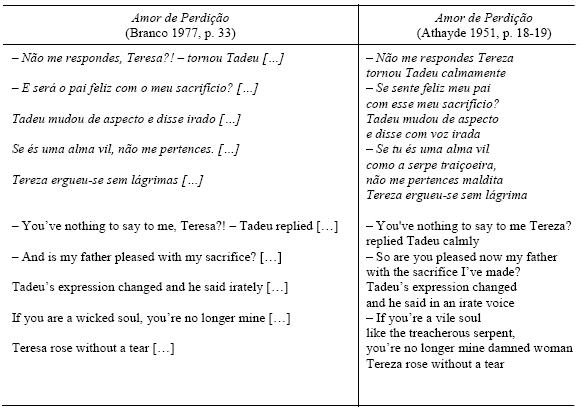
]]> A conventional story alone is not enough, though. It has to be presented according to the ‘rules’ of pamphlet composition, since interest in the theme, or the plot, is not sufficient for the pamphlet-reading public to appreciate a literary text.4 The most fundamental alteration is the transposition of prose into verse, adapting the narrative to the poetic form of the pamphlets. Even when a practically literal transcription of the source text is involved, cuts are made in order to obtain heptasyllabic verses and words are introduced – or their order is changed – in order to create rhymes. João Martins de Athayde, for example, in retelling Amor de Perdição by Camilo Castelo Branco, follows the original text closely but segments it in order to obtain verses that obey the pamphlet style:
In some sections, dividing the sentence is enough to obtain a seven syllable verse; in others, a small change needs to be made to obtain the desired meter or rhyme. Versification is the most fundamental of the alterations introduced, since it adjusts texts produced within written literary culture to the patterns of pamphlet literature, allowing them to be comprehended and memorized by Northeastern communities steeped to varying degrees in oral culture. Translated into verse, the stories can be read orally or sung according to the practices of collective reading. From the viewpoint of the pamphlet consumers, the original stories are faulty in terms of their form, meaning that their appreciation requires the intervention of a poet to "translate into ballad / what he spoke in prose," as the poet explained in the pamphlet Romance de Iracema – A Virgem dos Lábios de Mel (Lima 1981, p. 1).
Some pamphlet authors provide explicit accounts of the way in which they interact with the books they browse (Almeida Filho 1963, p. 1):
| Já tomei por distração Que sabe satisfazer A alma dum trovador. | Distracted, I've picked up |
| Há poucos dias atrás ]]> Li um famoso romanceChamado: "A Noiva do Diabo" Decorei lance por lance Para transformá-lo em versos Como está no meu alcance. | A few days ago I read a famous novel Called: "A Noiva do Diabo" I memorized it blow-by-blow And transformed it into verses Since that’s within my reach. |
For Manoel de Almeida Filho, author of the above verses, reading ‘novels of love’ is a form of ‘distraction.’ So far, his ideas are little different from the thinking of most novel readers. However, there is something peculiar in his aims: he reads to move closer to his fellow writers – he, a troubadour, drinks poetry directly from the pen of a writer, author of the novel. More peculiar still, his mode of reading associates ‘reading’ and ‘memorization’ – "I read a famous novel/ I memorized it blow-by-blow." In this conception of reading, recurrent among pamphlet authors and readers, to read is to transfer knowledge fixed on paper to memory. They behave as though they constitute illiterate communities in which all knowledge has to be stored in the brain, since no exterior forms for conserving these contents exist. The cordel poets, though they know how to read, do not feel released from the task of storing knowledge and information in their "cranial part."
Manoel de Almeida Filho sets himself the specific objective of memorizing when reading: transforming the read stories into verse, "since that’s within my reach." This final verse affords at least two interpretations: the poet is being modest, saying he does what he can, or the poet is asserting his poetic skill, saying he makes verses as he sees fit (following, therefore, the conventions of pamphlet literature).
Transforming stories into cordel verses does not mean just adding meter and rhyme to a text; the syntax and lexicon must also be suitably adapted. The poet Apolônio Alves dos Santos,5 in reworking A Escrava Isaura by Bernardo Guimarães, felt this need:
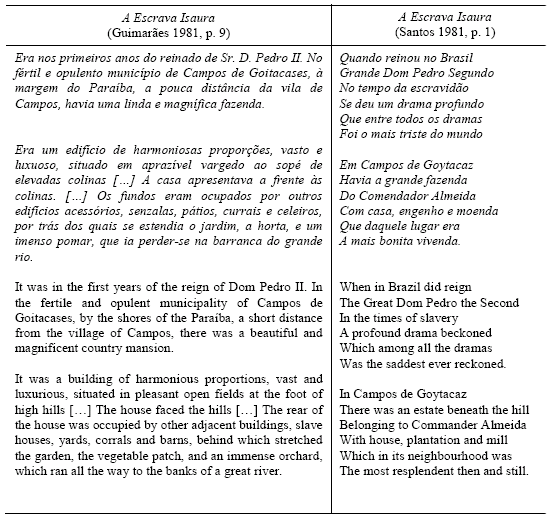
The pamphlet is more succinct and to the point, simplifying the punctuation and producing a more direct clause structure. The exuberant use of adjectives in Guimarães is heavily pruned, transforming phrases such as "the fertile and opulent municipality of Campos de Goitacases" into simply "Campos de Goytacaz" or squeezing the lengthy description of the farm and converted farmhouse into "There was a large estate/ with house, plantation and mill/ the most resplendent then and still." Not only is the text made drier, it is brought closer to the lifeworld of its readers; hence the list of "adjacent buildings, slave houses, yards, corrals and barns" is converted into a more familiar setting: "plantation and mill."
Since most of the texts put into verse predate the 20th century, one of the main concerns of the poets is updating the vocabulary, since the pamphlets basically use the contemporary everyday language used by their public.
However, it is not enough to versify and adapt the language of the narratives, since the pamphlets are composed according to particular formulas of plot structure, known as ‘oration.’ What authors mean by oration is coherence and cohesion: in other words, the interconnecting of facts, opinions and ideas, both from a logical point of view and in terms of the concatenation of the text. According to the poet Silvino Pirauá de Lima, interviewed by Mauro Almeida (1979 p. 203):
]]>The story script needs to be detangled and filled with episodes. Detangled means there are few complications in the episodes, when they are not confused with each other but remain separate. Then you produce a beautiful story.
Composing a ‘detangled story’ means having to avoid overburdening it with different characters and plotlines: hence, it is inadvisable to develop parallel plots or make room for secondary characters. Complying with this principle of oration, information external to the main plot is condensed or excluded, such as the rich description which opens A Escrava Isaura by Bernardo Guimarães, converted in the version by Apolônio Alves dos Santos into a succinct depiction of the location where the action unfolds.
José Galdino da Silva Duda (1982), for example, in his adaptation of José de Alencar’s A Viuvinha, ‘disentangles’ the plot by eliminating the double identity assumed by Carolina’s husband. As those familiar with the original know, Jorge, the husband, returns from the United States under the pseudonym of Carlos, concealing his true identity in order to pay off his father’s debts and test his wife’s fidelity. In Os Martírios de Jorge e Carolina, the young man’s intentions remain the same, but he does not create a double (Carlos). Although different after five years of absence, the narrator continues to refer to him by the name Jorge. His new appearance deceives the other characters, but not the reader who, in contrast to the plot developed by Alencar, is fully aware of the identity of the man who pays the debts and writes love letters to Carolina.
A ‘disentangled story’ also requires few characters, preferably separated into good and bad. In the version of Notre-Dame de Paris, for example, the gallery of characters created by Victor Hugo is reduced by the poet Paulo de Aragão [n.d.] to just six: Claude, Quasimodo, Fleur-de-Lys, Phoebus, Esméralda and her mother. The pamphlet concentrates on the love plot involving the gypsy, the father, the captain and the hunchback, doing away with all the information superfluous to these relationships. Curiously, Paulo de Aragão thought it relevant to mention Djali, Esmeralda’s goat:
| Me esquecia de uma cabra | I forgot about a goat Which the gypsy girl owned It was her guardian angel Her most faithful guide Wherever she went The goat followed by her side. |
(Aragão [n.d.] p. 8).
The goat had been forgotten, probably because its role in the plot development is minor, but it was later recalled – maybe because of the mnemonic appeal of an animal capable of indicating, through taps on a tambourine, the day, month and hour. This fact must have impressed the author when he read the work but, since it was not essential to the progress of the story, he failed to mention it at the right time. As though telling the story orally, Paulo Aragão added the information at the moment when he remembered and not at the moment in which it appears in novel. In a written text, the forgotten section can be inserted at the point desired, since it can be re-written as often as necessary. Paulo Aragão, possibly, has more affinities with orality than with writing, since it does not occur to him to rewrite the text: instead it seems more appropriate to him to refer to forgetting the goat and mentioning the animal the instant it came to back mind.
Highlighting minor characters, like the goat Djali, is a rare occurrence. The pamphlets usually focus on those responsible for the central actions. And even these undergo transformations, since the pamphlets typically use fairly succinct characterizations, indicating just a few physical and moral attributes. These sketch a quick history of the characters in the plot. The characterization of heroines, for instance, is almost always the same: beautiful, honest, charitable, faithful. Despite being pretty by necessity, the physical characterization is not the most developed aspect; what is really of interest is the fact they are honest, resolute, loyal, proper, generous and kind. These attributes are indissociable, making up the profile of the heroin – beautiful and virtuous. The poet need only say that she was ‘beautiful’ or ‘resolute and steadfast’ for listeners to know that she possesses all the moral and aesthetic predicates typical of a female lead character. It is impossible for a woman to be pretty and bad, or the opposite, ugly and kind. The physical and moral attributes form a whole, evoked by the mention of just one of her characteristics.
Although less developed, the description of male protagonists is also fairly uniform: they are valiant, honest, intelligent, fair and loyal. Their looks are rarely mentioned: where men are concerned, the fundamental aspect is character. The villains especially are characterized by their moral attributes: they are ‘wicked,’ ‘parasites,’ ‘bandits,’ ‘cruel,’ ‘sadistic.’ In some cases, the trait capable of characterizing a criminal is economic in kind – being very rich may be a sign of bad behaviour, explaining why villains may be called ‘tycoon,’ ‘capitalist,’ ‘rich landowner’ and making abundantly clear the relationship between being ‘rich’ and being ‘evil by profession.’
]]> As well as characterizing the protagonists, these descriptions serve to delineate their behaviour within the narrative. If a woman is presented as beautiful and loyal, the reader already knows that she will resist all adversities, will never fail to keep her word, will never betray the man she loves and will finally have her wishes fulfilled. If a man is valiant and honest, she will fight to obtain what she wants without ever wavering from the rules of good conduct or ever being intimidated, obtaining the just rewards for her efforts at the end of the narrative. If someone possesses the ‘eyes of a traitor,’ every kind of diabolical deed can be expected, but one can also be certain that he will be unsuccessful and that, sooner or later, he will pay for his actions.These principles in mind, the pamphlet versions omit almost all description of the protagonists made in the novels, except for a hew physical and moral traits. The story A Escrava Isaura, adapted by Apolônio Alves dos Santos (1981), restricts the presentations of the characters to:
| A beleza de Isaura Era de admirar Morena clara simpática Capaz de impressionar Qualquer rapaz que a visse Tinha que se apaixonar. […] [Leôncio era] Poderoso e impoluto ]]> Fazendo o que bem queria Por ser perverso e corrupto. […] Então o dito feitor Que se chamava Miguel Era um senhor português De alma pura e fiel […] Miguel que era um rapaz Disposto forte e de linha. | ]]>
The beauty of Isaura Aroused admiration in all Dark-haired, pale and kind Capable of enthralling Any young man who saw her Who was soon left adoring. [...] [Leôncio was] Powerful and unblemished Doing whatever he wanted ]]> Since he was perverse and corrupt. [...] And so the said foreman A man called Miguel Was a gentlemen from Portugal Of pure and loyal soul. [...] Miguel who was a young man With a strong and correct disposition. |
(Santos 1981 p. 3).
]]> Condensing pages and pages of description in the original text, Apolônio Alves dos Santos reduces the characterization of Isaura, Leôncio and Miguel down to the essential – even so, he makes it clear what kind of people they are. Isaura and Miguel are on the side of good, opposing Leôncio, the villain, depicted as ‘powerful and unblemished,’ ‘perverse and corrupt.’ The adjective ‘impoluto’ – meaning honest, virtuous, unblemished – was probably used because of its sonority rather than its meaning. Rhyming with ‘corrupto,’ the term is another negative attribute associated with a series of pejorative terms that includes the adjective ‘powerful,’ used here as a condemnation. The other characters are presented in an even more succinct form: Malvina is ‘a young woman with class,’ a ‘adored beautiful angel;’ Henrique is presented as simply ‘Malvina’s brother’ and Álvaro, a fundamental character in the drama’s resolution, is merely ‘a lad from a rich family.’Rather than using description, the characters are revealed through their attitudes, which provide the basis for the plot structure. However, not even the behaviour of protagonists in the source literary works meets the favour of the poets, demanding modifications that remove personality shifts, doubts and psychological conflicts. For example, the character Simão Botelho, in Amor de Perdição, does things unsuitable for a hero. He was an irresponsible trouble maker until becoming infatuated with Tereza, the moment when he turned himself into the most diligent and serious student in Coimbra. When he discovers Tereza’s father’s plans to marry her to Baltasar, he finds himself split between the need to kill his rival and his fear of the potential consequences. He quails and decides to go merely to Viseu to meet his loved one. The Simão presented in the Northeast version by João Martins de Athayde (1951, 1954) is unswerving in his behaviour: his brawling is transformed into displays of bravery, continued after he becomes involved with Tereza, leading him to confront Baltazar, his trial and imprisonment, all faced with courage and serenity. This Simão knows nothing of doubts, crises and torments, and never has any problem knowing what attitude to adopt.
Wishing to turn him into a Northeastern hero, Athayde expands passages in which Simão’s bravery is revealed, such as the fight with the aguadeiros or the disputes with political adversaries in Coimbra. The young man also takes a more active part in the love affair, which in Branco’s text (1977) was limited to letters and glances. In the Northeastern version, the young man kisses and hugs his lover, holding her tight "against his heart." As befits a hero in love, he proposes to the young woman that they flee on horseback far from the oppressive father.
Ambiguous or conflicted characters have no place in these compositions. Hence, it is unsurprising no Northeastern version of Macbeth exists.
Sometimes the alterations have to be more radical than simply eliminating the vacillations of characters. In order to fit the stories into the plotlines typical to the pamphlets, in certain cases the narrative has to be altered drastically: this occurs, for example, at he end of Northeastern version of the Notre-Dame de Paris (Aragão, [n.d.]), in which Phoebus and Esmeralda end up together and happy:
| Agora Phebo consigo Levou ela pela mão Tendo como essencial Ir fazer nula a prisão Na primeira oportunidade ]]> Com ela casou-se o capitão. | Now Phoebus took her With him by the hand And being within his power Annulled the prison order On the first opportunity The captain did marry her. |
(Aragão [n.d.], p. 36).
As we know, at the end of Victor Hugo’s story, Esmeralda is hanged and Phoebus marries another. Claude also dies along with Quasimodo, later found buried next to the gypsy girl. In the cordel pamphlets, young couples in love, after overcoming various adversities, live happily ever after. Paulo de Aragão undoubtedly felt attracted to the story of Notre-Dame de Paris – or else he would not have retold it – but the ending must have seemed fairly awry, prompting him to marry Esmeralda and Phoebus. The other would-be lovers, a priest and a hunchback, were completely inappropriate for the role of happy husband. As a result, the only solution capable of allowing the narrative to adapt to the compositional standards of pamphlets was to promote the marriage between the beautiful young couple. The weakness in the captain’s character is conveniently suppressed by the poet, who makes him fall deeply and sincerely in love with the gypsy girl the first time he sees her, a mutual instant passion.
In other situations, the situation is even more tricky, such as the pamphlet version of Camille by Alexandre Dumas. The poet João Martins de Athayde (1938) must have faced considerable problems in telling the love story of a prostitute, since, as noted earlier, the pamphlet heroines are invariably pure, loyal and honest. What to do, then, with a Marguerite Gautier who sells herself for money in her desire for luxury and wealth? Athayde turns her into a "poor girl, ignorant and innocent," who "without friends or family" leaves for Paris in search of a "decent job." There, she becomes a seamstress, but is fired by the evil woman in charge. Faced with little option, she goes to live with Prudence, "an old, experienced woman" with "few morals." It is the "bad advice" from Prudence which leads her to becomes the "lover of a baron." Athayde takes pains to create a justification for Marguerite’s prostitution, despite the lack of any such background explanation in Dumas’s text.6
In contrast to the behaviour of Marguerite, called Margarida in the pamphlet, Athayde’s heroin falls in love with Armand as soon as she sees him:
| ]]>
Margarida até então, Não gostava de ninguém, Na sua vida de orgias, A nada queria bem, Era fria, indiferente, A corte aquela gente, Ferindo com seu desdém. | Margarida until then, Didn’t like anyone at all In her life of orgies, Nothing could please her ]]> She was cold and indifferent, The court of those people, Provoking her deep disdain. |
| Porém aquele rapaz Mudou o seu sentimento, Falava tanto de amor, Sem mentira ou fingimento, Que ela logo acreditou, Correspondeu e amou, Desde o primeiro momento. | But that young man Swept away her feeling ]]> He spoke so much of love, Without lying or scheming, That she soon believed, Ceded and likewise fell in love From that very first meeting. |
(Athayde 1938, p. 6).
This kind of love interest is not particular to this tale; on the contrary, it comprises the spark for most cordel romances which generally deal with the love between two young people. Although a consistent theme, the feeling of love is not the main focus of the texts: it emerges suddenly, as soon as the protagonists see each other for the first time, and becomes undying and unswerving. There are extreme cases such as the Romance do Pavão Misterioso, The Story of the Mysterious Peacock, a classic of cordel literature, in which the couple does not even have to know each other – the boy falls in love on seeing the portrait of the girl:
| quando viu o retrato quis falar, tremeu a fala […] pois meu irmão, eu te digo ]]> vou sair do meu país não posso ficar contigo pois a moça do retrato deixou-me a vida em perigo. | when I saw the portrait I wanted to speak but spluttered [...] so my brother, to you I say I’m going to leave my country I can’t stay another day because the girl in the portrait ]]> has put danger in my way. |
(Silva 1982, p. 8).
After seeing the portrait and falling in love, all his efforts are directed towards meeting the girl, getting to know her and marrying.
Once the feeling of love has been consolidated, the subject is not broached again, any description of the sensations, afflictions or desires of the lovers apparently being superfluous. There are no traces of eroticism and almost no lyricism to the stories: the couple’s love is a given which, once affirmed, is never again open to discussion or placed in doubt. The love encounter serves only as a catalyst to the subsequent conflict, since in all of these tales the amorous relationship faces troubled waters ahead. Indeed, surmounting difficulties is the most developed aspect of the text, the main plotline being the actions of the protagonists, not their feelings.
Typical of cordel stories, this feature is worked into the versions. Although love stories are basically chosen, passages in the original texts that involve the expression of feelings, doubts and anxieties are invariably cut. The poets focus the narrative structure on the development of actions. And as we have already observed, the protagonists always act in a linear manner – once their behaviour is defined, it will invariably remain the same all the way through.
However, some of literary works pose severe problems for this kind of plot conception. Camille, for instance, does not match this principle. The story is narrated is the confidant of Armand Duval, who meets the latter when Marguerite is already dead. This narrator allows the voices of a number of other characters, who assume the task of reconstructing the lovers’ past. The narrative is composed in non-linear fashion by the successive accounts given by Armand, by the reproduction of letters written by the couple and by the presentation of the diary covering the courtesan’s final days, finished by her friend Julie Duprat. This different narrative voices disappear from version by Athayde (1938), who constructs an omnipresent narrator, responsible for the chronological ordering of the narrated material. Sticking to the essential, the poet presents Marguerite’s immersion in the world of prostitution, her frequenting of balls, theatres and parties, her involvement with Armand, the negative social repercussion of their love affair, Marguerite’s decision to abandon the city and love in the country with her lover, their subsequent fall into poverty, the intervention of Armand’s father (alleging that their relationship will compromise his daughter’s engagement and the boy’s future), Marguerite’s decision to abandon him, the boy’s madness, Marguerite’s illness, her return to prostitution, Armand’s jealousies, the death of the courtesan. Athayde transforms the multifaceted plot into a series of linked actions in causal sequence.
Sticking to the linear development of actions can be a difficult undertaking, especially when the central figures do not appear in the same scenes, meaning their plotlines have to be developed independently. In these cases, it is up to the narrator to ensure the reader does not lose the narrative thread, meaning he has to warn about these changes in focus. There are considerable problems, for example, in retelling the plot of Ubirajara, since the histories of Jandira, Ubirajara and Araci lead off in different directions at some points. The poet Francisco Sales ([n.d.]) resorts to calling the reader’s attention to these changes:
| Deixo aqui na grande festa chefe pagé e moacara para falar de Jandira com sua beleza rara ]]> filha do índio Magé a noiva de Ubirajara […] Agora vamos deixar Jandira em procuração falamos de Ubirajara desde aquela ocasião que avistou Araci guardou-a no coração […] ]]> Deixamos ficar Jandira na mais profunda agonia seguimos Ubirajara que caminhando se ia a procura de Araci formosa estrela do dia […] Portanto vamos deixar Jandira triste e magoada e falamos de Araci ]]> que também foi à caçada e encontrou-se com eles na mata escura e fechada […] Deixamos ficar aqui as virgens lá na floresta e vamos voltar a tribo para falar sobre a festa dos servos de Araci para ganhar o amor desta. | ]]>
Here I leave the great festival of shaman chief and moacara to speak of Jandira with her rare beauty daughter of the Indian Magé the fiancée of Ubirajara […] Now let’s leave Jandira searching and speak of Ubirajara ]]> ever since the time he caught sight of Araci he kept her in his heart […] Let’s leave Jandira in the deepest agony and follow Ubirajara who is off on his way in search of Araci the lovely star of the day ]]> […] Therefore let’s leave Jandira sad and hurting and talk of Araci who also went hunting and found herself with them in the forest deep and dark […] Here let’s leave behind the virgins in the forest ]]> and return to the tribe to talk about the festival of the serfs of Araci held to win over her love. |
(Sales [n.d.], p. 12).
Like his fellow pamphlet authors, Francisco Sales makes use of formulas that enable the narrative to be composed and comprehensible, marking changes mid action with expressions such as "I leave… to tell you about…" or equivalents such as "let’s leave… let’s speak about...," "let’s stay with… we follow…" These formulas, used in all the pamphlets in which more than one action is taking place simultaneously, allow the narrator to summarize and freeze the information relating to one protagonist and introduce events involving another.
The narrator is also responsible for interpreting the attitudes of characters and the general direction of the story, especially at the beginning and the end of the text, when he addresses the reader with ethical or moral considerations:
| Deus é Grande e Poderoso | God is Great and Powerful |
| A Verdade é um farol ]]>
mas não se sabe onde mora | The Truth is a beacon |
| Aonde a mentira reinaVence a honra e o defeito | Where the lie reigns Only the one with right wins |
| Em 1815 | In 1815 |
(Leite 1964, p. 1).
So begins the Romance do "Conde de Monte-Cristo" in the version by José da Costa Leite (1964), commenting in advance on the values exemplified by the narrative: the danger of falsity and the advantage of honesty. These opening verses link up with other stanzas in which the narrator explains the moral of the story, resuming the first-person dialogue:
| Já descrevi para o povo | I’ve already described to the people |
The narrator’s role – just like the other components of the narrative – is codified. In general, the pamphlets lack narrator-characters, privileging the omniscient narrator, responsible for presenting the information needed for the story’s development, revealing the thoughts, wishes, dreams, plans and, above all, actions of the protagonists. Since dialogues are few and far between, and any flow of consciousness of the characters is absent, the story basically depends on the narrator. However, he does not call attention to himself, reserving his voice for the moments demanding an analysis of the narrative’s meaning or the behaviour of the characters.
| Portanto, naquele tempo | Therefore, at that time is soon exposed and hated by the people worse than a communist. |
(Leite 1964, p. 3).
Fearing his readers would not understand what a ‘Bonapartist’ meant, the poet explains the term – "in favour of Bonaparte" – and, in case the explanation was insufficient, draws an analogy with a situation from his own time "hated by the people / worse than a communist."
The stories told in the cordel pamphlets generally possess an exemplary tone: they present an organized world in which good and bad people confront each other, in order to arrive at a climax in which justice invariably prevails: the efforts of those who act correctly are rewarded; villains are condemned to suffering, death, abandonment and poverty. The narrative with its moral character can be proposed as a model of behaviour:
| Moços que amais nessa vida, | You lads who love in this life |
These commentaries liken the pamphlets to oral narratives in which the narrator comes face-to-face with the public and can interrupt the recital to express his opinions – so too the listeners, praising the heroes, criticizing villains, rooting for the happiness of the young lovers. Orality also makes its presence felt in the use of formulas, in the constitution of unconflicted characters in the way of compiling the plots. The pamphlets clearly demonstrate that the boundaries between writing and orality among literate and illiterate people depend on much more than the ability to decipher a graphic code and are much less simple than usually imagined. Part of the traditional pamphlet public is capable of recognizing the words written in the literary novels; however, this ability is not sufficient for them to appreciate the text.7 Some poets, on the other hand, read national and international literary works, perceive their qualities, but recognize the specificities of the text which would put off their usual readers. Identifying the moments when the written production enters into conflict with the desires of a community close to the oral universe, they rework the narratives to adapt them to the Northeastern patterns of composition. "This is how you tell a good story."
The adaptations of literary works for pamphlet literature show what every anthropologist knows, but what not all literary critics admit: there is no universal beauty, nor a story which is to the taste of everyone.
References
ABREU, Márcia. Cangaceiros: história ou ficção. In: AGUIAR, F.; SEBE, J. C.; VASCONCELOS, S. (Eds.). Gêneros de fronteira: cruzamento entre o histórico e o literário. São Paulo: Xamã, 1997. p. 323-330.
ABREU, Márcia. Histórias de cordéis e folhetos. Campinas: Mercado de Letras: ALB, 1999.
ALMEIDA, Mauro William Barbosa de. Folhetos (a literatura de cordel no Nordeste brasileiro). Dissertation (Master in Anthropology )–PPG of the Social Sciences Department of the Faculty of Philosophy, Letters and Human Sciences, University of São Paulo, São Paulo 1979.
ALMEIDA FILHO, Manoel de. A noiva do Diabo. São Paulo: Editora Prelúdio, 1963.
ARAGÃO, Paulo de. O Corcunda de Notre Dame. Recife: [n.n.], [n.d. ].
ATHAYDE, João Martins de. A dama das camélias. Recife: [n.n.], 1938.
ATHAYDE, João Martins de. Amor de perdição. Juazeiro: José Bernardo da Silva, 1951. v. 1.
ATHAYDE, João Martins de. Amor de perdição. Juazeiro: José Bernardo da Silva, 1954. v 2.
BRANCO, Camilo Castelo. Amor de perdição. São Paulo: Ática, 1977.
CAMELO, José. Entre o amor e a espada. Juazeiro: José Bernardo da Silva, 1960.
DUDA, José Galdino. Os martírios de Jorge e Carolina. Juazeiro: Filhas de José Bernardo da Silva, 1982. Published under the name of João Martins de Athayde.
GALVÃO, Ana Maria de Oliveira. Cordel: leitores e ouvintes. Belo Horizonte: Autêntica, 2001.
GUIMARÃES, Bernardo. A escrava Isaura. São Paulo: Ática, 1981.
LEITE, José da Costa. Romance do "Conde de Monte-Cristo". Guarabira: Editor Proprietário José Alves Pontes, 1964. 2 v.
LIMA, Alfredo Pessoa de. Romance de Iracema – a virgem dos lábios de mel. Juazeiro: Filhas de José Bernardo da Silva, 1981. Published under the name of João Martins de Athayde.
SALES, Francisco. O guerreiro Ubirajara. [s.l.]: Editor Proprietário João José da Silva, [n.d. ].
SANTOS, Apolônio Alves dos. A escrava Isaura, a jovem sofredora. [s.l.]: Editor Manoel Caboclo e Silva, 1981.
SILVA, João Melquíades Ferreira da. Romance do Pavão Misterioso: história completa. Juazeiro: Editor Proprietário Filhas de José Bernardo da Silva, 1982.
Received on 23/06/2004
Aproved on 02/08/2004
* Research supported by CNPq.
1 TN: So called because of the practice of displaying the pamphlets strung on cords at the side of newsstands.
2 For an analysis of pamphlet versions of journalistic texts, see Abreu (1997). ]]>
3 Establishing the authorship of the pamphlets is a fairly controversial topic, since, although poets have an interest in claiming authorship of their compositions, a practice exists of selling the rights over a text to an editor, who thereby acquires the right to replace the author’s name with his or her own. Since most editors are also poets, it becomes difficult to distinguish the pamphlets composed by themselves from those they have edited, especially where old pamphlets are concerned. The dating of pamphlets is also complicated since editors very often show no concern in printing information such as the issue date and number
4 The rules involved in pamphlet composition are presented in Almeida (1979) and Abreu (1999).
5 Two versions of Bernardo Guimarães’s novel exist; one written by Apolônio Alves dos Santos and the other by Francisco das Chagas Batista.
6 José de Alencar, ao compor o enredo de Lucíola,deve ter se visto em dificuldade semelhante para modelar uma outra prostituta, Lúcia. Assim como Athayde, cria uma justificativa nobre para a prostituição: ela entrega-se por precisar de dinheiro para salvar a família doente.
7 For a detailed study of the pamphlet literature and its relations to orality, see Galvão (2001).