Burocracia pública e classes dirigentes no Brasil
Bureaucratie publique et les classes dirigeantes au Brésil
Luiz Carlos Bresser-Pereira
Getúlio Vargas Foundation of São Paulo state (FGV-SP)
Translated by Maria Cristina Godoy ]]> Translation from Revista de Sociologia e Política, Curitiba, n.28, p. 9-30, June 2007.
ABSTRACT
Brazil underwent industrialization and major economic development during the period that spanned 1930 to 1980 This is the period of strategic national development initiated by Getulio Vargas and taken up again after the crisis of the 1960s by the military regime that was in power. Throughout the entire period, public bureaucracy played a key role, always in consort with the industrial bourgeoisie. These two classes emerged as actors in political life as of the 1930s and – together with the workers who were minor partners – promoted the Brazilian industrial revolution. During the 1960s the radicalization of the Left and the right-wing alarmism which were both to a large extent stimulated by the Cuban revolution led to a military coup in which the bourgeoisie and the military joined interests with the United States. Nonetheless, both the bourgeoisie and public bureaucracy returned to a nationalist and developmentalist policy during the years that followed. Yet the major foreign debt crisis that took place during the 1980s led to the breaking apart of these alliances, and over the course of the decade, to the surrender to neo-liberalism coming from the North. At that moment, a disoriented public bureaucracy attempted to defend its own corporate interests. As of the 1990s, however, the sector involved itself in the State Administrative Reform of 1995; furthermore, neoliberalism, which then became the dominant current, went on to lose its hegemony over the following decade due to failure in promoting economic development. These two facts work, on the one hand, to re-establish new republican perspectives for public bureaucracy and, on the other, suggest that the renewed alliance of public bureaucracy and industrial bourgeoisie may again be turning into the nation's route to re-establishing economic development.
Keywords: bureaucracy; ruling classes; entrepreneurs; economic development.
RESUMO
O Brasil experimentou a industrialização e um grande desenvolvimento econômico entre 1930 e 1980. É o período da estratégia nacional-desenvolvimentista iniciada por Getúlio Vargas e retomada, depois de uma crise nos anos 1960, pelos militares no poder. Em todo esse período, a burocracia pública desempenhou papel-chave, sempre associada à burguesia industrial. Essas duas classes surgem para a vida política nos anos 1930 e, associadas aos trabalhadores que desempenham o papel de sócios menores, promovem a Revolução Industrial brasileira. Nos anos 1960, a radicalização de esquerda e o alarmismo de direita, provocados principalmente pela Revolução Cubana de 1959, levam a um golpe militar em que burguesia e militares associam-se aos Estados Unidos. Não obstante, burguesia e burocracia pública voltam a adotar uma política econômica nacionalista e desenvolvimentista nos anos seguintes. Nos anos 1980, porém, a grande crise da dívida externa leva ao rompimento desta aliança, e, a partir do início dos anos 1990, à rendição ao neoliberalismo vindo do Norte. Nesse momento, a burocracia pública, desorientada, tratou de defender seus próprios interesses corporativos. A partir dos anos 1990, porém, envolve-se na Reforma gerencial do Estado de 1995. O neoliberalismo, contudo, que tornara-se dominante, perde hegemonia nos anos 2000 devido a seu fracasso em promover o desenvolvimento econômico. Estes dois fatos, de um lado, restabelecem novas perspectivas republicanas para a burocracia pública; de outro, sugerem que uma aliança renovada entre a burocracia pública e a burguesia industrial pode ser novamente possível, de forma que o país retome o desenvolvimento econômico.
Palavras-chaves: Estado; burocracia; empresários; pacto político.
Entre 1930 et 1980, le Brésil a connu une industrialisation et un important développement économique. C'est la période de la stratégie nationale pour le développement que Getúlio Vargas a inaugurée et qui a été reprise, après la crise des années 1960, par les militaires au pouvoir. Tout au long de cette période, la bureaucratie publique, associée à la bourgeoisie industrielle, a joué un grand rôle. Ces deux classes naissent pour la vie politique dans les années 1930, et, avec les travailleurs qui s'y sont associés d'une façon moins importante, ont promu la Révolution Industrielle brésilienne. Dans les années 1960, les positions plus radicales de la gauche et l'alarmisme de droite, influencés surtout par la Révolution Cubaine de 1959, ont amené au coup d'état militaire pendant lequel la bourgeoisie et les militaires s'associent aux Etats-Unis. Cependant, la bourgeoisie et la bureaucratie publique reprennent la politique économique nationaliste et de développement économique dans les années qui se suivent. Mais dans les années 1980, la crise de la dette extérieure provoque la rupture de cette alliance et, à partir du début des années 1990, la capitulation au néolibéralisme originaire du Nord. La bureaucratie publique, alors déboussolée, se met à défendre ses propres intérêts. A partir des années 1990, pourtant, elle fait partie de la Réforme de Gestion de l'Etat de 1995. D'autre part, le néolibéralisme qui triomphait, perd son hégémonie dans les années 2000 en raison de son échec à promouvoir la croissance économique. Ces deux événements non seulement introduisent de nouvelles perspectives républicaines à l'égard de la bureaucratie publique, mais encore suggèrent qu'une nouvelle alliance entre la bureaucratie publique et la bourgeoisie industrielle puisse devenir encore une fois possible si bien que le pays se redresse économiquement.
Mots-clés: bureaucratie; classe dirigeante; entrepreneurs; développement économique.
I. INTRODUCTION
In modern societies, entrepreneurial class and senior public bureaucracy are the two strategic social groups, from a political point of view. In the process of capitalist development, social classes have always been in a process of transformation: aristocracy lost power and significance during the nineteenth century as well as the peasant class, the bourgeoisie was no longer just a 'middle class' but also included an upper layer, the working class diversified and part of it became a middle layer or middle stratum, and bureaucracy, which was a small status group primarily located inside the state organization, became a large or even huge professional class or a technobureaucracy both public and private1. In this whole process, however, the upper bourgeoisie, consisting of entrepreneurs and rentiers, and the senior political bureaucracy, consisting of professional bureaucrats and elected politicians, have always played the strategic political role2.
Even if, from the twentieth century on, when democracy became the dominant political regime, workers, as well as middle bourgeois and professional layers, have increased their influence thanks to the voting power, the major entrepreneurs and the political bureaucracy – the former as part of the capitalist class and the other, as part of the professional class – have always been the main power holders. And although they have often been in conflict, because of their different corporate interests, they have been more often associated around the construction, building, and consolidation of their respective nations. They have always knew that their power and prestige depend essentially on the autonomy and might of the Nation-state they rule, which leads them to share common interests that overshadow any ideological differences.
]]> In this paper, I will try to do a comprehensive analysis of the role played by public bureaucracy in Brazilian society – that is, by the sector of the professional class comprising civil servants, managers of government-owned companies, public administration consultants, and professional politicians; since I am interested in ruling classes, my attention shall be directed to the upper layers of such groups, which may be called 'senior public bureaucracy' or 'political bureaucracy'. I include consultants in public bureaucracy because they usually are former employees who play an important role in the definition of organizational and administrative strategies of the state apparatus, and are part of the community of public managers.I include the politicians because, although they often are of bourgeois origin and more recently also of working-class origin, when politicians succeed they become professionals and most of their revenues will derive from the state. I also include them because, on the other hand, senior non-elected bureaucrats do play political roles. The fact of including professional politicians in the concept of public bureaucracy doesn't mean that I ignore the extensive literature on the conflicts between politicians and bureaucrats, nor that I disregard the insistence of Brazilian senior non-elected bureaucracy of being distinct from professional politicians since the 1930s.
There is a long history of this dispute, which persists even today between senior civil servants. However, the political nature of the activity of senior civil servants was fully demonstrated in the classic research conducted in the USA by Aberbach, Putnam and Rockman (1981). On the other hand, as Loureiro and Abrucio have stressed (1999: 70), "with the people's increased democratic demands and the need of an increasingly effective state action, the threshold between the task of a bureaucrat and the task of a politician becomes thinner and thinner and, sometimes, there is a complete 'mix-up' of those two functions". The distinction between bureaucrats or 'technicians', who would be competent and identified with rationality and efficiency, and 'politicians', who would be prone to pork-barrel practices and unprepared, is a technobureaucratic ideology. In Brazil the distinction was justified at the early stages of its capitalist development, when federal-level politicians were still too attached to "patrons" ["coronéis"] and to local clientelism; it was a way for public bureaucracy to gain legitimacy by opposing the traditional forms of doing politics. These forms, however, began to change from 1930 on, as the political system democratized, so that it became clear that there was, on the one hand, a proximity between technicians and politicians, and, on the other hand, a need to democratically control both, not only the politicians. Ângela de Castro Gomes (1994), who studied the new Brazilian bureaucratic elites composed mostly of economists and engineers, stressed the Manichean nature of this division, its 'invented tradition' nature3.
In modern societies, as the professional class progresses, the process of professionalization takes place not only with public non-elected bureaucrats, but also with elected ones; public elected bureaucrats are in the same position, regarding entrepreneurs, of public non-elected bureaucrats regarding private managers – they have more political resources and are more inclined to risk or to accept a relative insecurity – but ultimately they are all part of a same professional class whose most important asset is knowledge, and whose main justification is efficiency or rationality.
II. FORMS OF STATE AND POLITICAL PACTS
It is within this broad picture, in which the state is the expression of society and the instrument par excellence of the Nation's collective action, that we should understand public bureaucracy. Public bureaucracy, together with the private professional class, is part of the professional class that claims the monopoly of technical, organizational, and communication knowledge by intending to be the only class with the ability to achieve efficiency in work processes.
Public bureaucracy's political activity will reflect this basic condition. As a sector of a social class, it will protect its interests; as a constitutive part of the state, it will be identified with the state organization, will be the state's 'company man', and, at the same time, will respond to the pressures of the other social classes. According to Paulo Sérgio Pinheiro (1978: 31), in his analysis of urban middle classes in the Primeira República (1989-1930) [First Republic], public bureaucracy's political action "will depend on the actual functioning of the state apparatus and on the relationships between the state and the different social classes". As part of the professional class and a constitutive element of the state apparatus, public bureaucracy tends to be part of the ruling class. It was already part of the ruling class as a patrimonial bureaucracy, during the Empire and the Primeira República; it will be part of it as a modern bureaucracy at the time of the proclamation of the Republic and after 1930; it will reach the status of main ruling class between 1964 and 1984; and from then on it definitely loses power along with the industrial bourgeoisie with which it allied since the 1930s.
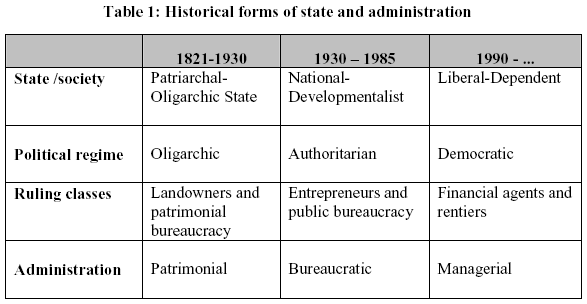
The historical forms of state in Brazil are naturally connected to the nature of its society, thus expressing, on the one hand, the changes society is undergoing and, on the other hand, how the original power, derived from wealth or from knowledge, as well as from the ability of organization, is distributed in that society. The forms of Brazilian state, conceived according to this criterion, are condensed in Table 1. The nineteenth century society is essentially 'patriarchal' and 'mercantile', since it is dominated by agricultural-exporting "latifúndios" [large landed estates] and by local merchants who still do not incorporate the ideas of technical progress and productivity, whereas the state has an the important participation of a patrimonial bureaucracy.
The first historical form of state, the Patriarchal-Oligarchic State, is patriarchal regarding domestic social and economic relations, and mercantile regarding foreign economic relations, and characterized by the participation of a patrimonial bureaucracy in the oligarchic ruling class; it is a dependent state, because its elites do not have enough national autonomy to formulate a national development strategy: they just copy foreign ideas and institutions, slightly adapted to local conditions. From the 1930s on, when Brazilian Industrial Revolution begins, society becomes 'industrial' because now industrial entrepreneurs are dominant, whereas the state becomes 'national-developmentalist' because it is involved in a successful national development strategy.
In the National-Developmentalist State, prevailing between 1930 and 1980, the ruling class is characterized by a strong alliance between industrial bourgeoisie and public bureaucracy, and the period is marked by a major economic development. It is not only the time of Industrial Revolution, but also of National Revolution: it is the only time when the Nation overcomes its dependence condition. Its main political meaning is the transition from authoritarianism to democracy, but it will be characterized by two setbacks, one in 1937 and the other in 1964. The 1980s are a time of crisis and transition, when the country will face the worst economic crisis in its history – a crisis of foreign debt and high inertial inflation – that deserves the name of The Great Crisis of the 1980s. This crisis will facilitate the democratic transition, but, as a trade-off, it weakens the Nation and makes it dependent once again. We see then the emergence of the form of state still prevailing in Brazil: the Liberal-Dependent State.
From 1991 on, public policies, while preserving the social nature agreed upon during democratic transition, become once again economically dependent, and follow to the letter the guidelines coming from the North. Society and state are disoriented, the state is weakened and unable to do what it had done between 1930 and 1980: coordinate a national development strategy. Through trade and financial opening, it loses the ability to protect itself against the tendency to the exchange rate overvaluation that characterizes developing countries, and enters a phase of de-industrialization and near-stagnation. The return to the dependence condition coincides, with a small difference, with the democratic transition, because it takes place when the political forces that had led the transition did not have an alternative project to cope with the crisis of the national-developmentalist model. And also because, in the 1990s, soon after the collapse of the Soviet Union, the North's ideological hegemony over Latin America became almost absolute.
Although the National-Developmentalist period is usually identified with corporatism, I do not use this concept because it confuses things rather than explaining them. In the 1930s there is in fact a corporatist element in Brazilian state that is reflected in the 1934 Constitution, which provides for class representation in Congress. But the most generally used is the concept of corporatism of Schmitter, 1974, and Cawson, 1986, who used it to explain advanced political systems such as Germany's, in which one of the roles of the state is to intermediate the interests of capitalist and working classes represented by unions. In this case, Brazilian 'corporatism' is negatively seen as authoritarian and excluding workers (Santos, 1990; Costa, 1999) – which indeed it was - but we must understand that the degree of political development in Brazil did not allow for anything else.
In this paper I will also examine the reforms of the state apparatus. From an administrative point of view, the state will be patrimonial until the 1930s, thus prevailing the confusion, intrinsic or inherent to patrimonialism, between public and private property. In the 1930s the Bureaucratic Reform or civil service reform begins, and administration becomes bureaucratic or Weberian, mainly concerned with the effectiveness of public action. From 1995 on, when the Managerial (or Public Management) Reform begins, administration takes on an increasingly managerial quality, as the efficiency criterion becomes a decisive factor. To those forms of state correspond forms of bureaucracy: patrimonial, Weberian and managerial; the latter two may be considered as 'modern', but the Weberian one is still concerned with the organization's formal rationality and with the effectiveness of its rules and regulations, whereas the managerial one is oriented to the efficient performance of tasks, that is, to cost reduction and increase in service quality, regardless of regulations and routines, that remain necessary but are softened.
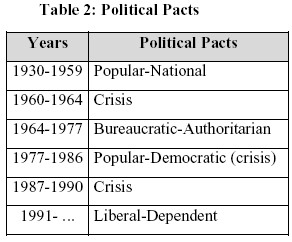
In Table 1, we also have the dominant political regimes in those three periods: it was oligarchic between 1822 and 1930, authoritarian between 1930 and 1985, and democratic from then on. Maybe more significant, however, are the political pacts that characterize Brazilian society since 1930, and that are shown in Table 2. The 1930-1959 period corresponds to the Getúlio Vargas Popular-National Pact, in which take part the new industrial bourgeoisie, the new modern public bureaucracy, sectors of the old oligarchy, and the workers; it is also the first phase of the National-Developmentalist State.
Democracy is established in 1945, but there was no change in the political pact because, even if in the fifteen previous years workers could not vote, they were somehow already taking part in the political process, through Vargas' populism; and also because president Dutra, who preceded him, as well as president Kubitschek, who will succeed him after a brief interval, will be elected in the scope of the Popular-National Pact headed by Getúlio Vargas. A crisis follows, between 1960 and 1964, which does not change the economic model (which continues to substitute imports and to be national-developmentalist), but changes the political pact, that becomes Bureaucratic-Authoritarian, because workers are excluded and a larger role is assigned to military public bureaucracy.
In 1977 a crisis begins to affect both this pact and the military regime, and another political coalition appears, the 1977 Popular-Democratic Pact. This pact is a consequence of the breach of the alliance that the bourgeoisie had made with the military, and becomes effective when entrepreneurs, particularly industrial ones, adhere to the forces that fought for redemocratization. The Popular-Democratic Pact comes to power in 1985, but collapses two years later, when the Cruzado Plan fails, as it became clear that the new government leaders had no project for the new conditions faced by the country and particularly for the Great Foreign Debt and High Inflation Crisis of the 1980s. We have then a new intermediate period of crisis that becomes hyperinflation in March, 1990. In the following year, after the failure of a new stabilization plan, the Collor Plan, the country surrenders to the conventional orthodoxy coming from the North, and the new dominant political pact is now the Liberal-Dependent Pact, whose main participants are major rentiers living on interests, financial sector agents that receive commissions from them, multinational corporations, and foreign interests in the country attracted by appreciated exchange rates. I mention financial sector 'agents' instead of entrepreneurs, because most of them come directly from the private professional class, and make their gains on the market on account of their knowledge, not of their capital.
]]> During this period, however, there is a major economic development, which is the stabilization of high inflation by the Real Plan – a plan of stabilization conducted by Fernando Henrique Cardoso in the transitional government of Itamar Franco. This plan, however, had nothing to do with the already prevailing conventional orthodoxy, but resulted from the application of the theory of inertial inflation developed by Brazilian economists to solve a problem that haunted Brazilian society since 1980.
III. MODERN BUREAUCRACY APPEARS: 1930-1945
Modern state bureaucracy, which is part of the professional class, was already appearing in the late nineteenth century, but only gains political force in the agitated 1920s, when the urban middle layers of which it is part strongly manifest their dissatisfaction with the supremacy of the coffee-growing oligarchy that, profiting from the open voting that allowed it to control the votes of rural population and from the possibility of electoral fraud, did not give them political space. Virginio Santa Rosa (1933 [1976]: 38) vigorously emphasizes the meaning of the "tenentismo" [a rebel movement of young Army officers] and of the 1930 Revolution as a result of the profound dissatisfaction of urban middle layers, which included the petty bourgeoisie, professionals, private employees, and middle civil and military servants. In his words, "the urban middle classes, excluded from positions of power and elective offices by the decisive action of the people of the "latifúndios", remained, absurdly and wrongly, cut off from Brazilian politicians, with no guiding influence in the country's future". However, from the dispute that took place in the 1960s between the São Paulo school of sociology and ISEB for the monopoly of the legitimate sociological knowledge, a sort of 'consensus' was formed as to the non-bourgeois but oligarchic nature of the 1930 Revolution, and, therefore, as to its lower significance in Brazilian history. This is not the time for reviewing this mistaken vision that, by rejecting the possibility of a national industrial bourgeoisie in the country, also gave up the idea of Nation. That notion is currently discarded: we know that 1930 was a watershed in Brazilian history, that Brazilian Industrial Revolution began at this time, establishing the end of the Oligarchic State and the beginning of the National-Developmentalist State. This transformation was only possible, however, because the oligarchy itself was regionally divided, with its sectors oriented to the domestic market becoming allied to the urban middle layers in the fight for greater political participation. According to Nelson Werneck Sodré (1962: 322), "when the dominant class split, the possibility appeared of restoring the alliance between sectors of that class and active groups of the middle class". The command was given to an authoritarian and nationalist politician whose youthful liberalism and positivism, imported from Europe, yielded to the reality of a country that had not yet achieved its Capitalist Revolution but only its Commercial Revolution. Getúlio Vargas headed an heterogeneous political coalition, the Liberal Alliance, to carry out the revolution, and then gradually, without a plan but with a sense of opportunity, ability to conciliate, republican spirit, and a vision of the future, set up a new political coalition based on the alliance between import substitution sectors ["substituidores de importações"] of the old oligarchy, industrial entrepreneurs, government technicians and military personnel, and urban workers4. Before 1930 there was no feudal Brazil, as imagined by the interpreters of the first half of the twentieth century, but there was a patriarchal and mercantile capitalism, which, during the "Primeira República", was under the rule of the coffee-growing bourgeoisie of São Paulo. During that period, however, was emerging in São Paulo an industrial bourgeoisie of immigrants and descendants of immigrants with little or no capacity for political formulation and activity5. Thanks, however, to the leadership of Getúlio Vargas, and to the favorable conditions that opened to Brazil with the crisis of the central system in the 1930s, modern public bureaucracy will finally have a role among Brazilian ruling classes, associated with the new manufacturing bourgeoisie and with the old sectors of the oligarchy oriented to the domestic market. Between 1930 and 1964 those three classes shall run the country, replacing the agricultural-exporting oligarchy associated with foreign interests. For 15 years under authoritarian or semi-authoritarian regime and, from 1945 on, under democratic regime. The authoritarian period played a functional role in achieving the transition of power, in allowing the National Revolution – that is, the formation of the Nation-state – and the Industrial Revolution to complete the Capitalist Revolution. Before there was no democracy, but the biased electoral regime prevented any change – a change that the authoritarian system made possible. The voting by secret ballot attained soon after the 1930 Revolution was fundamental, from 1945 on, to prevent the power from returning to the agricultural-exporting oligarchy in a country that still remained mostly based on crop and livestock farming. As observed by Pedro Cezar Dutra Fonseca (1989: 144 and 184), in his analysis of the Vargas administrations, the 1930 Revolution was originally bourgeois and oligarchic; it obviously did not create the industrial bourgeoisie because "today there is a large bibliography showing the significance of Brazilian industry in the "República Velha" [Old Republic]; but if its origin was oligarchic and bourgeois, its results were eminently bourgeois or capitalist; "in 1930 a new type of capitalist development began in Brazil. In general, it consisted in overcoming the agrarian and commercial capitalism based on exports of primary products, towards another one whose dynamics would gradually depend on industry and on the domestic market". As remarked by Octavio Ianni (1971: 13), "what characterizes the years following 1930 is the fact that it creates conditions for the development of the bourgeois state".
Within public bureaucracy, the military and, specifically, the 'tenentes' [lieutenants] played a decisive political role. As observed by Mary Cecília Forjaz (1978: 20), "the political and ideological behavior of the "tenentes" can only be explained by the combination of two dimensions: their institutional situation as members of the state military apparatus and their social composition as members of the urban middle layers". The "tenentismo" movement, that arises from the rebellions of 1922, 1924, and 1926, is an original political and military phenomenon. Although the "tenentes" rebelled against the hierarchy of the Army – and there is no greater offense against a military bureaucratic organization – they were not expelled from the Army, and the sanctions they suffered were ultimately less severe, because they rebelled in the name of the Army's prestige and mission6. Although they participated in rebellions or revolutions, they shared an essentially bourgeois ideology, such as Vargas'. It was not, however, a liberal ideology, but a nationalist and interventionist ideology. Liberalism is undoubtedly the ideology par excellence of the bourgeoisie: it was based on liberalism that the bourgeoisie succeeded in defeating the Absolutist state dominated by the aristocracy. But European and American bourgeoisies have always been nationalist as well: it was nationalism that made it possible for the bourgeoisie, in this case associated first to the absolute king and later to parliamentary governments, to form the Nation-states, to define their boundaries – the boundaries of their safe markets – and to achieve economic success in the competition with the other National states. In the 1920s, when the 'tenentes' appear, or in the 1930s, when Vargas abandons the liberals and associates with the "tenentes", Brazilian industrial development required that nationalism should prevail over liberalism – and this is what happened.
The 'tenentes' were the military side of the modern state bureaucracy that, as of the 1930 Revolution, is part of the new political coalition or power group that is then formed. There was, however, a civil state bureaucracy that also begins to assume a decisive role from then on. This required, however, the development of the state apparatus itself, creating positions for the middle class that was being formed by the graduate schools. And this effectively happened. In the 1930s, liberalism was abandoned and interventionism increased worldwide. This also happened in Brazil, not merely as a mechanism of defense against the depression, as occurred in the United States and in Europe, but as a way of furthering a national development strategy. And it left no room for economic liberalism, for laissez faire. It is the time to organize the state, to provide it with personnel and instruments in order to set up an national economic development policy.
Since his coming to power, Getúlio Vargas realizes that administrative deficiencies were central to explain the country's economic backwardness. To explain the revolution, Getúlio Vargas states in a 1931 speech: "since those damages were worsened by administrative anarchy, [state] financial disorganization, and economic depression... reaction was imperative"7. During that period, the motto is 'rationalization', another name for state intervention planning. Without a 'good administration' nothing would be possible. From this point of view, the bureaucratic reform or civil service reform was imperative. In 1936, with the creation of the Federal Civil Service Board, Vargas embarks his administration on that endeavor. The 1936 Bureaucratic Reform, whose forerunner was the ambassador Maurício Nabuco, shall have in Luiz Simões Lopes the main political and administrative figure8. Afterwards, the 1937 Constitution takes a step forward by requiring public hiring competitions for civil servants and by providing for an administrative department with the Office of the President of the Republic. In the following year, this department becomes a reality with the creation of DASP (Public Service Administrative Department) which came to be the powerful agency in charge of accomplishing the reform9.
With the "Estado Novo" [New State], Brazilian authoritarianism reappeared in force but now assuming a modernizing quality. In order to justify the arbitrary decision, the government appealed to the fight against communism and integralism, movements that had recently tried to seize power, but its true logic was in the orientation, given by Vargas and an important part of Brazilian nationalist elites, of completing the National Revolution started in 1930: of achieving the country's modernizing revolution, providing it with an efficient state and promoting industrialization despite the insistence of the agrarian and mercantile oligarchy on the 'essentially agricultural' nature of Brazil. Although the National Revolution was a bourgeois revolution, the "Estado Novo" will emphasize the role of technique and technicians or professionals in enterprises and particularly in the state organization, a role that was strategic to the desired economic development. Sometimes, professionals' role was merely to justify decisions already taken, but in many other cases Vargas would really use, to take his decisions, advices and suggestions from technicians or public intellectuals that gathered around DASP and more broadly around the government. It was not only through DASP, but also through the Geography Board and the Board of Economics and Finance, as well as the Ministry of Education, which was also at that time a source of thinking, and through other government agencies created as of 1930, that Brazilian state reorganized, gained administrative consistency and a national sense for its action; at the same time, a rigid fiscal discipline kept it financially sound. This way, a strong state – an efficient one – was being built, a state whose senior public bureaucracy now had, for the first time, a decisive role in Brazilian economic development: a state that was no longer a mere guarantor of the social order, as occurred until 1930, but was taking on the role of providing social services and particularly of being an agent of economic development, a state whose technical and political bureaucracy formed, together with the industrial bourgeoisie, the country's ruling classes.
]]> Public bureaucracy would still have, in the first Vargas administration, an important role by participating in the creation of the first semi-public companies that would have a decisive role in the country's development. In World War II Vargas hesitated between supporting the United States and England and supporting Germany and Italy, but he realized that victory would be with the former and decided to ally himself with them, at a time when victory was not yet assured. It is widely known how Vargas used this decision to obtain the necessary financing and technology for the creation of the first major national iron and steel industry – the Companhia Siderúrgica Nacional in Volta Redonda. With the creation of this company, as well as the creation of Companhia de Álcalis and Companhia do Vale do Rio Doce, a large space was opened for the development of public bureaucracy. The country now had two types of modern public bureaucracy: the state bureaucracy and the bureaucracy of government-owned companies – two groups that would have some disputes among themselves, but that would be especially supportive of each other in the search for more power and prestige, on the one hand, and for success in the national development project under way, on the other hand. The two technical or modern groups of bureaucracy, in turn, became more equipped to associate themselves with private entrepreneurs. As observed by Martins (1973: 127, "on the one hand, the association of entrepreneurs with bureaucracy's 'technical groups' inside the state apparatus; and, on the other hand, the fact of being on equal terms with entrepreneurs, enable technocracy to acquire the necessary 'freedom' to plan capitalist development from 'universalist' criteria". This agreement established, therefore, the bases for the Nation, through trial and error, to gain political density, to make the diagnosis of its backwardness, and to formulate a successful national industrialization strategy.
IV. THE VICTORY OF NATIONAL-DEVELOPMENTALISM: 1945-1960
By allying himself with the United States in World War II, Getúlio Vargas was winning in the short run, but he knew that the fate of "Estado Novo" was sealed. It was not surprising, therefore, that in 1945, with the peaceful fall of Getúlio Vargas, Brazil became, for the first time, a democracy worthy of the name – still an elite democracy but based on free and full elections10. The dictatorial regime had violated rights, but at the end of the fifteen years of the first Vargas administration, Brazil had changed: it was in full process of industrial and national revolution. Yet, with democracy, and as if it was an essential part of it, economic liberalism came from the North, threatening to put a stop to the transformation under way. In two years, the large international reserves that the country had accumulated during the war were transformed in consumption of luxury goods imported by the nouveaux riches and by a bedazzled middle class. However, since the democratic transition had not implied a major social conflict, but had rather been the outcome of a near-consensus established between the middle classes and the elites excited by the victory of democratic countries in the war, it did not imply a substantial change in the political coalition prevailing in Brazil as of 1930. Therefore, it was not surprising that, as of 1948, the government's economic policy reproduced once again the national agreement between industrial bourgeoisie, public bureaucracy, and workers around the import substitution strategy of economic development. The new policy lacked the necessary ideological legitimation, since the former one, based on great intellectuals such as Oliveira Vianna and Azevedo Amaral, was damaged by the support it had given to the "Estado Novo". This legitimation, however, would appear in the turn of the 50s, in Brazil with the ideas of the group that, as of 1955, would be known as the ISEB group, and in Latin America, with the ideas of CEPAL11.
With the ideas of Raul Prebisch and Celso Furtado, from CEPAL, the economic strategy of protecting national industry was validated. This legitimation was based on the successful experiences of state intervention in the economy in Europe and Japan, on the new Keynesian-based macroeconomics, and on the criticism of the law of comparative advantages of international trade, which had been liberal imperialism's main ideological weapon to hinder the industrialization of peripheral and dependent countries. Brazilian economic policy as of 1930 anticipated those criticisms in much the same way as the expansionist fiscal policies of Franklin Delano Roosevelt had anticipated Keynes' General Theory. On the other hand, the ideas of ISEB's great intellectuals, Guerreiro Ramos, Ignácio Rangel, Vieira Pinto, and Hélio Jaguaribe will be fundamental to politically legitimate import substitution industrialization. They will be the ones that will diagnose and defend with more energy and consistency the political pact conceived by Getúlio Vargas and the corresponding national development strategy – the national-developmentalism. They show that Brazil was a semi-colony until 1930, dominated by an agrarian and mercantile oligarchy allied with imperialism, and that in 1930 the Brazilian National and Industrial Revolution begins, based on a political coalition formed by industrial bourgeoisie, public bureaucracy, workers, and import substitution oligarchy.
This analysis gains substance and strength when, in 1950, Getúlio Vargas is elected President of the Republic with a large majority of votes. In the next four years, until his suicide in 1954, Vargas' national-developmentalism will always be conducted by himself, as well as by an economic staff of the Office of the President, led by two senior public bureaucrats – Rômulo de Almeida and Jesus Soares Pereira. This staff is able to restore the bases of national development with the creation of new government-owned companies that would be in charge of developing the country's economic infrastructure; Petrobrás and Eletrobrás will be the most important results of this work. On the other hand, another group of more liberal technicians, more concerned with international cooperation, which includes Ary Torres, Roberto Campos, Lucas Lopes, and Glycon de Paiva, gather around the Brazil-United States Mixed Committee, which, however, under Vargas command, performs a task that rather complements than neutralizes the work of the other group. A contributing factor for this issue is the fact that those works and debates took place within an intellectual frame in which development's economic planning was legitimate: the frame of Development Economics, issued from the studies of Rosenstein-Rodan, Nurkse, Myrdal, Lewis, Singer, Rostow, Celso Furtado, and Raul Prebisch – a group of development economists whose origin was in the process of creation of the United Nations and, indirectly, of the World Bank. The liberalism of that time, therefore, was very relative, and had nothing to do with neo-liberalism, which would appear in the United States in the 1960s and would become dominant in the 1980s.
The new government-owned companies and the state's decision of investing in economic infrastructure represented a victory for the nationalist segment of the economic public bureaucracy that achieved, as a result, its development plans and, at the same time, created work positions, prestige and power for itself. Its major victory, however, will be the creation of BNDE [Brazilian Economic Development Bank], in 1952, by a proposition of the then Finance Minister, the industrial entrepreneur of São Paulo, Horácio Lafer. At that time, Banco do Brasil was in charge of financing production, and, with the creation of CEXIM [Export and Import Division], it also finances Brazilian foreign trade. The funding of industrial investments, however, still did not have a proper agency. This will only happen in 1952, after the return of Vargas to the government. In 1951, the Brazil-United States Mixed Committee is formed. This committee was preceded, during the Dutra administration, in 1948, by an American mission, the Abink Mission, that had as its Brazilian counterpart Otávio Gouvêa de Bulhões; in spite of its liberal formation, it had accepted the project of establishing an "industrial capitalism" in Brazil. This proposition will take shape within the Economic Staff and the Brazil-United States Mixed Committee created to discuss and formulate a development plan for the country and its international financing. Although dominated by the liberal field, the Mixed Committee suggests that the state be in charge of the infrastructure (energy, transportation, communication) whereas the private and foreign sectors would be in charge of mining (then the main strategic interest of the United States regarding Brazil) and the Brazilian state would guarantee the access of American companies to its market. There was, of course, a conflict between the two groups of public technobureaucrats, particularly because the nationalist group wanted the state monopoly of oil, which was rejected by the other one. But both groups were equally oriented to economic planning and the establishment of a transportation and energy infrastructure based on the state. The policy of the Mixed Committee already outlined what would become the "Plano de Metas" [Target Plan] of Juscelino Kubitschek.
Besides contributing to economic development, BNDES [Brazilian Economic and Social Development Bank] would be, from then on, and even today – in spite of all the accidents experienced by Brazilian public bureaucracy – one of the bases of the autonomy and power of Brazilian public bureaucracy. BNDES, as well as "Banco Central" [Central Bank of Brazil], Petrobrás, and some other agencies oriented to economic coordination, would be the materialization of the strategy of bureaucratic insulation that characterizes the economic development of countries such as Brazil, in which public bureaucracy plays a decisive role, but the incipient democracy forces politicians to exercise clientelism. Whereas agencies belonging particularly to social ministries are the subject of a political distribution among the parties supporting the government, and agencies related to infrastructure are relatively preserved, economic coordination agencies are insulated from clientelism. This is a demand from public bureaucracy, but also a decision made by the politicians themselves, who thus recognize the strategic nature of economic coordination agencies and the risk they incur in submitting those agencies to clientelism. However, as long as economic development is followed by the country's political development, this kind of insulation loses its relative importance because, on the one hand, the number of agencies not submitted to clientelism decreases, and, on the other hand, because society exercises a more direct control over the policies they promote.
While public bureaucracy in a broad sense was developing fast within the sphere of Banco do Brasil, BNDES, and government-owned companies, the statutory public bureaucracy, that the 1936 Bureaucratic Reform had tried to define and to make meritocratic, had backtracked. When Getúlio Vargas returns to the government, he tries to restore the reform by sending to the Congress, in 1953, a global project of administrative reform, but he is unable to obtain its approval, as much as Juscelino Kubitschek, who will make the same attempt. Even so, according to Celso Lafer (1970), Brazilian public administration was progressing: it was estimated that, in 1952, the percentage of public servants chosen on merit went to 9%, as opposed to 4% in 194312. The great development of Brazilian public bureaucracy, however, was being achieved, at the same time, by government-owned companies, by organizations – that were then nearly-state-owned organizations – such as the Getúlio Vargas Foundation, created in 1944 by Vargas, and by "autarquias" [government agencies] such as BNDES. When Juscelino Kubitschek decides, in 1956, to carry out an ambitious "Programa de Metas" that will complete the Brazilian Industrial Revolution started by Vargas, particularly through automobile industry, once again the problem arises of which sector of bureaucracy – whether the statutory one or the 'parallel' one – should be primarily concerned. Although the president tries the statutory path, in the end it is the parallel path that proves to be faster and more flexible; the great number of agencies that are then created, among which GEIA (Executive Group of the Automobile Industry) led by Lúcio Meira, employ a public bureaucracy that is non-statutory but competent, hired according to merit criteria; it is the managerial bureaucracy that is emerging, while the Weberian bureaucracy had not yet completely materialized. As observed by Celso Lafer (1970: 85), "Kubitschek's direct assistants for the implementation of the "Programa de Metas" were all top-level technicians, experienced not only in the previous planning attempts but also in important political positions". Among them, we may point out, besides Lúcio Meira, Lucas Lopes, Roberto Campos, and, later on, Celso Furtado, in order to create SUDENE [Northeast Development Agency]. The choice of a parallel bureaucracy, which already anticipated the logic of the Decree Law 200, of 1967, and of the 1995 Management Reform, was essential to the success of the plan.
National-developmentalism had won. Brazil of 1960 was a different country as compared with the one of 1930. Its economic development had been extraordinary, a sophisticated and integrated industrial infrastructure had been set up, and therefore we could say that its Industrial Revolution was complete; the Nation had gained cohesion, autonomy and identity, its state, as an organization, was more structured and professionalized, and as a legal and constitutional system, was more legitimated by an incipient democracy, so that also its National Revolution was complete; and when those two revolutions are achieved, so it is the Capitalist Revolution: Brazil was no longer a mercantile and patriarchal or oligarchic society, but a capitalist industrial society in which capital accumulation and the incorporation of technical progress were now an essential part of the economic process.
]]> This is already a different world from the patrimonialist world described by Faoro, who, by freezing society and the state in that formation, postulates that the Vargas Administration was still an expression of the patrimonial state. Faoro is very clear about it: "From D. João I to Getúlio Vargas, in a six-century travel, a political and social structure resisted all changes... the centuries-old persistence of the patrimonial structure, proudly and inviolably resisting the progressive repetition of the capitalist experience." Now, by insisting on this theory, Faoro (1957/75: 733-736) ignores the fundamental difference between patrimonialism and rational-legal bureaucracy, so much stressed by Weber. He does not take into account the essentially traditional nature of the patrimonial state, as opposed to the modern, rational-legal nature of industrial capitalism and modern bureaucracy. A mistake that Sérgio Buarque de Holanda (1936/69: 106), for instance, although writing years before, did not commit when he stated: "Patrimonial functionalism may, with the progressive division of functions and with rationalization, acquire bureaucratic features. But, in its essence, the more characterized are the two types, the more patrimonial functionalism differs from the bureaucratic one". However, an unforeseen event – the 1959 Cuban Revolution that soon becomes a key episode in the Cold War between the United States and the Soviet Union – will politically alter the optimistic situation left by the Kubitschek administration, whereas a domestic economic crisis will deepen the political crisis.
V. PUBLIC BUREAUCRACY IN POWER: 1964-1984
During the Collor administration public bureaucracy will live on edge due to the radical policy adopted by economic authorities to reduce state expenses. There is, however, an important initiative that is the effort to transfer to the public sector the 'total quality strategy' – a successful type of management in the private sector. This initiative pointed to a new direction. The same is not true of the creation of 'câmaras setoriais' [guild chambers]; according to Eli Diniz (1997: 139), "this mechanism represented the resumption of experiences – used in the past with different degrees of success – related to the building of spaces for designing targets and guidelines agreed upon between state-owned elites and representatives of the private sector". This initiative was warmly received by different sectors that expected to see the re-establishment of the old type of association between entrepreneurs and public bureaucracy, but it was an attempt to go back to the past in a setting in which the state, completely drowned in fiscal crisis and high inflation, was no longer able to effectively intervene in the economy. The chambers' greatest 'success' was the so-called "Acordo das Montadoras" [Original Equipment Manufacturers Agreement] that, significantly, benefited a series of multinational corporations.
As a consequence of the Popular-National Pact and of the national-developmentalist strategy that was adopted between 1930 and 1960, Brazil was, at the end of this period, a country in full economic development that had practically completed its Industrial and National Revolution. In 1959, however, the Cuban Revolution takes place – a revolution that was initially just anti-oligarchic and anti-imperialist, but that, in a Cold War setting, and given the United States' impossibility of accepting the nationalization of American companies that the revolutionary began to carry out, becomes a communist revolution supported by the Soviet Union. Wright Mills traveled to Cuba soon after the revolution, observed that the revolution was not a communist one, and appealed to his American compatriots to accept it instead of throwing the country into the arms of communism. His Listen Yankees (1960), however, was not heard, and Fidel Castro moved towards communism. This is not the place to discuss the consequences of this revolution for the Cuban people; for Latin America and particularly for Brazil, however, they have been undoubtedly disastrous. The socialist revolution in Cuba, at a time when the Soviet Union's economy was still growing fast and Kruschev promised to reach, in a near future, the level of development of the United States, led immediately to a political radicalization of important sectors of Brazilian left wing that thought they could replicate the Cuban experience in Brazil.
This radicalization occurred here at a time when, to the economic crisis caused by excessive expenses and by the exchange rate appreciation during the Kubitschek administration, was added the political crisis caused by the election and following resignation of president Jânio Quadros, and by the ascension of João Goulart to the Presidency of the Republic. Due to his left-wing tendencies, Goulart lacked both the confidence of a bourgeoisie that was now politically unifying, after remaining divided for 30 years, and the confidence of the military, who also radically rejected socialism or communism. The result of the radicalization of the Left and the alarmism of the Right, in a setting of economic crisis and political instability, was the 1964 military coup that occurs with the support of the United States.
Vargas' Popular-National Pact, combining industrial bourgeoisie, political bureaucracy and workers, which was in crisis since 1960, is definitively broken. The new pact that will gather the whole bourgeoisie and the political bureaucracy in which the military are once again pre-eminent is the Bureaucratic-Authoritarian Pact. The Nation and Development Cycle that characterized the society during the whole first half of the century was finished, as long as the two most nationalist sectors of the capitalist class and of the public bureaucracy, respectively the industrial entrepreneurs and the military, had allied themselves with the American. A little later, at the end of the 1960s, another cycle would begin in society - a cycle that I call Democracy and Social Justice Cycle, in which society forgot the idea of Nation by accepting dependence, and believed that economic development was ensured (we were right in the middle of the 'Economic Miracle'); but, as a trade-off, it defined as basic social goals the correction of the two distortions caused by that development: authoritarianism and inequality.
At state level, however, the national-developmentalist strategy would continue with a political pact in which the political bureaucracy, especially the military, but also the civilian one, kept its alliance with the bourgeoisie, and particularly with the industrial bourgeoisie. The political model was not only authoritarian but also exclusionary from a political and social point of view, keeping the workers and the left wing away from power, and promoting a strong concentration of income from the middle class upwards, within the frame of what I called 'industrialized underdevelopment model'13.
Between 1964 and 1984 the relationship between industrial bourgeoisie and political bureaucracy in Brazil is reversed because this latter, supported by its military sector, comes to have precedence over the former. After a process of fiscal and foreign adjustment, conducted by Roberto Campos and Otavio Gouvêa de Bulhões, that brings inflation back to acceptable levels and balances the country's current account, and after a number of reforms that, significantly, lead to the nationalization of telephone services and to the creation of Eletrobrás in spite of the liberal and internationalist credo of the two economists, the Banco Central is created to replace Sumoc, the department of Banco do Brasil that played that role since 1944. And the model of industrialization by import substitution, or, more broadly, the national-developmentalist strategy, is vigorously resumed by means of two national development plans. Eletrobrás is stimulated and a tripartite model is defined, involving the state, national entrepreneurs, and multinational corporations, in order to set up petrochemical industry in the country.
As for public administration, two apparently contradictory phenomena will happen: the concentration and centralization of power in the federal government, and "the fast and significant expansion of the indirect or decentralized administration vis à vis the direct or centralized administration at federal level" (Wahrlich, 1979: 8). A conviction had been formed, since the beginning of the 60s, that the use of strict principles of bureaucratic public administration was an obstacle to the country's development. In fact, this dissatisfaction dated from the previous decade, but the accelerated economic development that was then taking place allowed that the solutions found to circumvent the problem had an ad hoc quality, as was the case of the executive guild groups of the Kubitschek administration. However, when the crisis breaks out, in the beginning of the 60s, the issue returns. Guerreiro Ramos (1971: 19) expresses the dissatisfaction with the prevailing bureaucratic model: "An obsolete model of organization and bureaucracy characterizes the dominant administrative practice. Consciously or unconsciously dominated by rooted interests, many administrators are trying to solve today's problems with yesterday's solutions". The studies for a reform that would make the public administration more efficient began in 1963, when President João Goulart appointed the representative Amaral Peixoto Special Minister for Administrative Reform, with the task of directing several groups of studies, in charge of formulating reform projects14.
]]> At the end of that year, the Committee presented four important projects, with a view to an extensive and general reorganization of government's structure and activities. However, this reform would only be accomplished after the 1964 coup.In 1967, Roberto Campos conducts an extensive administrative reform – the reform of the Decree Law 200 or the Developmentalist Reform – that will be a pioneer, anticipating the 1995 Management or Public Management Reform. To formulate and implement the reform a committee had been set up as early as 1964, the COMESTRA (Special Studies Committee of the Administrative Reform), with Hélio Beltrão as its president and main inspirer of innovations15. The reform had a clearly decentralized nature.
I call this reform a Developmentalist Reform because it was conducted within the frame of national-developmentalism, when all the country's efforts were once again directed to industrialization, after the crisis of the first half of the 1960s, and because it somehow endorsed and gave more consistency to the experience of decentralization and establishment of a parallel administration that had characterized this development at the administrative level. Two ideas are central to it: the distinction between direct and indirect administration, and, within the indirect administration, the creation of public foundations that are allowed to hire employees under the legislation applied to private companies. There is a clear correlation between this institution and the social organizations that would be at the center of the 1995 Management Reform.
As of 1979, Hélio Beltrão, who had participated actively in the 1967 Developmentalist Reform, returns to the scene, now heading the Ministry of Desburocratization of the Figueiredo administration. Between 1979 and 1983 Beltrão became a herald of the new ideas, criticizing once again the centralization of power, the formalism of the administrative process, and the distrust that was behind the excess of bureaucratic regulation, and proposing a citizen-oriented public administration. His National Desburocratization Program was defined by him as a political proposal with a view to, through public administration, "release the user from his colonial subordinate status to invest him as a citizen, to whom all the activity of the state is destined"16.
Thanks to macroeconomic adjustment, to the strengthening of government-owned companies, to the nationalization of telephone services, and to the great development experienced by the state from then on, under the command of the Minister of Communications, Euclides Quandt de Oliveira, and thanks to the reforms, particularly tax and administrative reforms, the state is strengthened, its project of industrialization is reinforced, and the country returns fast to economic development. A contribution to the then prevailing 'Economic Miracle' (1968-74) is the new pragmatic macroeconomic policy conducted since 1968 by Antonio Delfim Netto, who realizes that the residual inflation was rather a managed or cost inflation rather than a demand inflation; following then the teachings of Ignácio Rangel, he seizes the opportunity and adopts an expansive policy that leads to a decrease in the rate of inflation. While this was happening at macroeconomic level, within public bureaucracy, in which politicians had lost power, the new structure of the state apparatus and the strengthening of the nucleus of government-owned companies facilitate the economic development process, on the aggregate supply side. The effort of planning the offer will be headed, during most of the 1970s, by the Planning Minister, João Paulo dos Reis Velloso.
The economic success of the undertaking leads to a new increase in the power and influence of the public technobureaucracy. And also promotes the deepening of its alliance with the industrial bourgeoisie through the execution of the two PNDs. Despite public bureaucracy's success in promoting economic development, and despite government's efforts to implement the Developmentalist Reform through the Planning Ministry, Brazilian administrative system was still being criticized for not adapting to the classical model of public administration; this criticism will appear particularly in the study conducted by Edson Nunes (1984), who sees in those practices a key obstacle to the country's economic development, and the bureaucratic insulation strategy as a way of circumventing the problem. Although this criticism was understandable, it was not entirely justified. Clientelism, that had resurfaced in 1946 with the first democratization, would return in 1985, with redemocratization. During the military regime it remains present, without however preventing the state from accomplishing its role in the promotion of economic development.
This was possible because through the parallel system had come out a high-quality public bureaucracy, well prepared, well paid, which had a fundamental role in the execution of the industrial development projects of the time. A sharp cleavage is then established, within the country's public bureaucracy and despite the mobility of senior bureaucrats, between the senior public officials and the managers of government-owned companies. In the research conducted by Luciano Martins (1985: 72 and 208) in 1976, "the key problem is the relationship between the government sector and the state's productive sector": the public executives of the second sector earn a large autonomy, their salaries are disconnected from those of the employees, and they are relatively less controlled.
Their recruitment is made rather by co-optation than by a public hiring competition; and their self-identification is with the status of 'executives' rather than with the status of 'employees'; in the research made with 107 senior servants, 77% of the servants of the government or of the state apparatus and 95% of the executives of government-owned companies identified themselves with the first denomination, rather than with the second one. At that time, I was orienting the Ph.D. thesis of Vera Thorstensen (1980), whose key subject was the conflict between the two sectors of public bureaucracy in their relationship with private companies, government representatives seeking to regulate not only private companies but also state-owned companies, whereas the executives of these latter searched for a more direct association with private entrepreneurs.
This political bureaucratic elite, hired mainly through government-owned companies, followed an informal and very flexible career, that Ben Ross Schneider (1991) studied in an innovative way17. The new public managers were mainly engineers and economists, who had nothing to do with the bureaucratic system of rigid careers provided for in the 1938 Bureaucratic Reform. The results they achieved in their "autarquias", foundations, government-controlled companies, and semi-public companies were substantial. The key issue that arose was to explain how such a poorly institutionalized state as the Brazilian one had such a positive effect on the country's industrialization. When he asked this question, he naturally had as alternative model the Weberian model of bureaucracy, in which the bureaucratic organization is strongly institutionalized, and bureaucrats are strictly faithful to it.
This was not what Schneider observed in Brazil. On the contrary, what he saw were poorly structured and fragmented state-owned organizations, the inexistence of clearly defined and formalized careers, and an intense circulation of bureaucrats among the agencies. He also verified that the promotion criteria were not bureaucracy's classical criteria - seniority and merit assessed mainly by exams - but the confidence that the bureaucrat was able to inspire in his chief and the ability to accomplish results. The very concept of bureaucrat had to be enlarged. Bureaucrats, or, more precisely, senior bureaucrats, were all those who worked in the chief positions of Brazilian government. But those bureaucrats did not fit the ideal model of a bureaucratic employee. Schneider identified and defined four types of public bureaucrats: the politicians, the military, the technicians, and the political technicians. The politicians are the bureaucrats who, although participating in the electoral process, occupy important positions in public administration. The military are officers that occupy positions in the public administration outside the Armed Forces. The technicians are those who are more close to the bureaucratic conventional model, and also the less important. And the political technicians are those who mediate between bureaucracy and politics, that is, who are able to sacrifice the bureaucratic purity in the name of political support. All those bureaucrats, who were less than one thousand in Brazil, were successful, ambitious, technically well prepared men and women who had studied in the best universities in the country and abroad. They were all, at the time of the research, national-developmentalists and pro-capitalists. They received high salaries, and circulated among the agencies every four or five years. They were bureaucrats, but they were politicians as well, even the technicians. Although they were in an authoritarian regime, they knew that full bureaucratic insulation regarding politics is not viable or desirable. Schneider's fundamental argument is that the efficiency of this informal bureaucratic system is related to the fact that it is structured in careers, which are carried out through personal nominations. Schneider claims to have been the first one to go to the limit with this "career approach" – I would say "careers and nominations" – as an alternative to the conventional approach based on organizations. In a country where, when a new President of the Republic takes office, fifty thousand positions are open for nomination, they become a fundamental strategic issue. And if they are used in a reasonably systematic and competent way, as it happened in Brazil, they can be the way par excellence of defining careers of successful bureaucrats and structuring the state. This way, nominations and careers, more than organizations, structure Brazilian state. As explained by Schneider, "the fast bureaucratic circulation weakens the organizational loyalties and increases dependence in personal relationships, a fact that, in turn, undermines formal organizations. High mobility enables employees to formulate and coordinate policies in spite of organizational fragmentation, because they care little about their agencies and because the strong personalities supply the alternative channels of communication. Personalism can actually improve bureaucratic performance". According to this approach, the essential thing is to understand the bureaucrat's career and how it is carried out through nominations. Studying the way one enters a career, the circulation among the agencies, the promotions and the types of leaving or dismissal, the career approach enables Schneider to understand, in a systematic and innovative way, the personalist and disorganized nature, yet flexible and effective, of Brazilian state. Although through other ways, Gilda Portugal Gouvêa (1994) reaches similar conclusions in her analysis of the financial reform conducted in the Finance Ministry between 1983 and 1987 by a large number of technicians, among which João Batista de Abreu, Osires de Oliveira Lopes Filho, Maílson da Nóbrega, and Yoshiaki Nakano. The episode she analyzed, whose last acts I have signed as Finance Minister, were the last great moment of Brazilian political bureaucracy – a social group that was then already in deep crisis.
]]>VI. DEMOCRATIC-POPULAR PACT
The glorious times of this senior political bureaucracy in power, however, were numbered since 1974 and particularly since 1977. The choice of General Ernesto Geisel as President of the Republic (1974) and the definition of a second extremely ambitious PND contributed to deepen the alliance between political bureaucracy and entrepreneurs and to the highest prestige of the former group, but also lead to the first initiatives of the new president and of General Golbery do Couto e Silva to promote political opening, which is then called 'distention'. This way, the military recognized the unavoidability of redemocratization, but tried to postpone it through a 'slow and gradual' process of redemocratization. The fact that world economy was already slowing down since 1973, however, showed that this project was hardly likely to succeed, and that the beginning of the real democratic transition – a transition that society demanded – was waiting for a crisis to happen. This crisis arrives in April 1977, when President Geisel, in view of the difficulties he faces in approving in Congress a project to reform the Judiciary, shuts the Congress down temporarily and changes the Constitution by decree. The 'pacote de Abril' [April package], as it was called, causes a strong reaction in the whole society, including the bourgeoisie. For the first time since 1964, entrepreneurs start to voice dissatisfaction with the regime and demand the return of democracy. I realized at that time that democratic transition was beginning, and I published in 1978, seven years before its achievement, the book O Colapso de uma Aliança de Classes [The Collapse of an Alliance of Classes] that predicted this transition from the breaking of the agreement between the entrepreneurs and the military, which was then starting to occur.
The democratic transition that begins in 1977 and ends in early 1985 was the outcome of a new informal political pact, the 1977 Popular-Democratic Pact – a popular political coalition, because it counts again on the workers, but whose great novelty was that the bourgeoisie was allied to them and, more directly, to a number of sectors of the professional class, including public bureaucracy, not directly committed to the military regime. This political coalition corresponded, at state level, to the Democracy and Social Justice Cycle that began, at society level, as a reaction to the 1964 military coup, in much the same way as the Popular-National Pact and the national development strategy to which it gave rise – the national-developmentalist strategy – had corresponded, as of 1930, to the Nation and Development Cycle that had come to light in the early twentieth century. The interesting thing about this popular and democratic coalition is that it is formed before coming to power, as early as 1977, it comes to power in 1985, and collapses two years later, with the terrible failure of the Cruzado Plan, despite the generosity of its democratic and social purposes and its relative success in achieving redemocratization. There are many justifications to this, but the main one was the fact that democracy was achieved amid an economic crisis of unprecedented severity – the Great Foreign Debt Crisis of the 1980s – that brought with it the collapse of the national-developmentalist strategy which, since 1930, played the role of an institution that oriented investment decisions and, thus, the country's economic development. This collapse would not have been a problem should the Democratic-Popular Pact have another strategy to replace it. This was not the case. The entrepreneurs and political bureaucrats that came to power in 1985 had not realized the severity of the foreign debt crisis – a crisis that, besides being unsolved given the resistance of the creditors in realizing the losses, had become a fiscal crisis of the state. They decided to ignore it and return to the high rates of economic development that had been possible in the 1950s with democracy.
The 1980s, however, were different times, and required a new strategy – a new developmentalism – something that government leaders were not prepared to adopt. They had to realize that the foreign debt crisis needed an independent negotiation, that could only be achieved if combined with a new and rigid discipline that tackled the fiscal crisis, and with an exchange rate policy that kept the economy internationally competitive. The ]]> 18. On the other hand, the extended political bureaucracy that had gained power with the democratic transition, argued, in a populist and irresponsible way, for a national-developmentalism that, even in its responsible version, was already overcome by the fact that the country's ]]> [big center] – plunged in 1988 and 1989 into an uncontrolled economic policy and, in the beginning of 1990, into hyperinflation. President Collor, elected at the end of the previous year, implements immediately a stabilization plan, but the Collor Plan fails, since it was unable to neutralize the inflationary inertia, although it implied a huge fiscal and monetary adjustment. In 1991, with the beginning of the second Collor administration, that is, with an overall ministerial change, and, especially, with the change in the economic team, the new liberal, conservative, and cosmopolitan political coalition that was forming since the failure of the Cruzado Plan comes to power. From then on the country will be under the rule of the Liberal-Dependent ]]> 19. However, given the inflation's inertial nature, the inflation rate remains at the same level, in spite of the economic cooling and the public deficit caused by the rise in the interest rate. Two years later, already in the Itamar Franco administration, the Real Plan is finally able to heterodoxically neutralize the high inertial inflation that penalized the country since 1994. The application of a strategy that escaped the provisions of Washington and New York, however, ]]> catch up, but also behind rich countries.
]]> VII. CONCLUSION
The Management Reform started in 1995, besides making the state apparatus more efficient, is giving back Brazilian public bureaucracy some of the social prestige that it had lost as a consequence, on the one hand, of the very collapse of the military regime, and, on the other hand, of the exhaustion of the national-developmentalist strategy. In both political processes, public bureaucracy had a decisive role that, however, was substantially reduced when Brazil, after the Great Crisis of the 1980s, is unable to replace the national-developmentalist strategy with a new strategy and once again subordinates to the North. Public bureaucracy plays an important role when the corresponding society and particularly the bourgeois class that plays in it a dominant role are reasonably aware of the goals to be attained and the methods to be adopted. This happened between 1930 and 1980, with an intervening crisis in the first half of the 1960s; but since the Great Crisis of the 1980s Brazil lacks a national development strategy, as long as it accepted an anti-strategy which is the conventional orthodoxy exported by the North.
There are several causes explaining this national disaster, all of them associated to the failure of the 1977 Popular-Democratic Pact to run the country. This pact was able to promote democratic transition, gave rise to a whole series of social policies that contributed to slightly decrease the huge concentration of income existing in the country, but it lacked a proposition regarding economic development, and, during its brief time in power, in 1985, led the country to the great disaster of the Cruzado Plan. A profound change in economic policies was then needed, for which Brazilian society was not prepared. The immediate causes of the Great Crisis were the foreign debt incurred in the 1970s and the high inertial inflation resulting from the use of price indexation, but it was also necessary to shift from the old developmentalism based on import substitution and on state investments to a new developmentalism that focused on making Brazilian economy more competitive abroad through macroeconomic policies combining stability with growth, and guaranteeing entrepreneurs moderate interest rates and especially competitive exchange rates. This is essentially the subject of Macroeconomia da Estagnação [Macroeconomics of Stagnation] (2007) whose ideas I will not repeat here.
The most important thing to point out here is that the factors that led Brazil to national defeat in the second Collor administration and to the coming to power of a political coalition intrinsically against the country's economic development – the Liberal-Dependent Pact – are disappearing. Although growth rates are very low when compared with other countries', Brazilian economy is no longer living the crisis situation of the 1980's. On the other hand, the assumption of their intellectual elites, marked by the dependency theory and by the Democracy and Social Justice Cycle, that economic development was ensured, and there was no need to be concerned with it, lost touch with reality: the development that was ensured lasted only during the 1970s. Third, it is becoming evident for the whole society, here and in other countries such as Argentina and Mexico, the failure of conventional orthodoxy to promote economic development; when, in this setting, Argentina breaks with conventional orthodoxy and adopts macroeconomic strategies similar to those of Asian countries (competitive exchange rate, moderate interest rate, and strict fiscal adjustment), it begins to grow strongly. Fourth, the American ideological hegemony, which became absolute in the 1990s, weakened extraordinarily in the 2000s, due to the failure of conventional orthodoxy to promote economic development, and due to the disaster that Iraq war meant to the United States. Finally, we observe among industrial entrepreneurs, who silenced during the 1990s, a new awareness of national problems and a new competence of their advisory staffs in macroeconomic matters that will be essential to the definition, in combination with public bureaucracy, of a new developmentalism.
It is in this broader frame – the one of the new developmentalist strategy – opposed both to the old developmentalism (that played its role but was overcome) and to the conventional orthodoxy (which, as a strategy proposed by our competitors, rather neutralizes than promotes economic development), that we should consider the role of public bureaucracy. For the moment, it remains essentially disoriented. Its economic area is limited to the rationality of reducing expenses – which is necessary but far from sufficient. Its social area had great triumphs, especially in public healthcare, thanks to the success of SUS (Brazilian unified healthcare system) in establishing a healthcare system for the whole population, at a low cost and with reasonable quality. It has also advances in fundamental education, where the number of students is no longer a problem, and the key issue is now the teaching quality. And it may advance further as long as this quality depends not only on better training for the teachers, but mainly on new forms of ownership and education management. It fails in university teaching, which in Brazil, due to the fact that it is state-owned, as in France and in Germany, rather than public non-state as in the United States and in Great Britain, presents highly unsatisfactory results. In the area of management, thanks to annual public hiring competitions for all careers in the management cycle and especially for the public manager career, Brazilian state has today, at federal level, a much better prepared and efficient bureaucracy than usually presumed. At state level, there is also an increasing number of public manager careers. In the legislative branch, public bureaucracy experienced a great development due to the careers in consulting created in the Senate and in the Brazilian House of Representatives.
In only one of the three branches, the Judiciary, stricto senso bureaucrats have the final power; in the other branches, that power belongs to the politicians. Since the Constitution of 1988, the autonomy of the senior judicial bureaucracy - which includes, besides the judges themselves, the "Ministério Público" [Public Prosecutor's Office], the "Advocacia do Estado" [Office of the Attorney General], and the "Defensoria Pública" [Public Defenders] - became much stronger – sometimes, too strong. There was a process of gradual detachment of the public judges from a liberal and formalist ideology that fulfils the interests of the powers that be, and their commitment, on the one hand, to their own corporate interests, and, on the other hand, to the interests of social justice that inspired the 1988 Constitution. Yet, according to Vianna et al. (1997: 38), although "being part of the state, entrenched in its structures, the Judiciary as an agent is not destined to emerge as a bearer of ruptures from a rational construct that denounces the world as unfair". The slow process of independence of the Judiciary from economic interests is a positive factor that reflects the fact that judges perceive themselves as part of the professional class with duties towards the poor, rather than being part of the capitalist class.
It is obvious, however, that the whole public bureaucracy and particularly the judicial public bureaucracy need more social control or accountability. The 1965 Management Reform gave a decisive role to social control, that is, to the accountability of public bureaucracy to society, but this is happening slowly. It is clear, however, that democracy implies not only freedom of thought and free elections, not only an effective representation of the citizens by politicians and more broadly by public bureaucracy, but it also means permanent accountability by public bureaucracy, so that the citizens are able to take part in the political process. The four pillars of democracy are freedom, representation, accountability, and participation. In another paper (Bresser-Pereira, 2004), I saw three historical stages of democracy: the elite democracy or liberal democracy, in the first half of the twentieth century, the public opinion democracy or social democracy, in the second half of that century, and the participative democracy that is gradually appearing. In Brazil, the three forms of democracy are present and mixed: we have a lot of elite democracy, we already are a social democracy, and the Constitution of 1988 opened the way to a participative democracy. Before arriving to it, however, besides improving our systems of participation, we must make public bureaucracy more accountable to society.
I don't believe, however, that this change would be possible if Brazilian society does not go back to constitute a true Nation and to have a national development strategy, in which this development would not only be economic but social and political. Between the beginning of the twentieth century and 1964 Brazilian society, in the setting of the Nation and Development Cycle, emphasized just those two goals, and left behind democracy and social justice. From the beginning of the 1970s, a new cycle began in society – the Democracy and Social Justice Cycle, that achieved a lot in those two directions, but set aside the Nation and economic development. The great challenge faced today by Brazilian society is to make a synthesis of those two cycles – something that is possible and that will provide guidance and meaning to its public bureaucracy.
REFERENCES
]]>ABERBACH, Joel D., PUTNAM, Robert D. and ROCKMAN, Bert A. (1981) Bureaucrats & Politicians in Western Democracies. Cambridge, Ma: Harvard University Press. [ Links ]
BELTRÃO, Hélio (1984) Descentralização e Liberdade. Rio de Janeiro: Record. [ Links ]
BRESSER-PEREIRA, Luiz Carlos (1964) "Origens étnicas e sociais do empresário paulista". Revista de Administração de Empresas 3(11): 83-103. [ Links ]
___________________ (1968/2003) Desenvolvimento e Crise no Brasil: 1930-2003. Fifth edition. São Paulo: Editora 34. [ Links ]
___________________ (1970) "Dividir ou multiplicar? A distribuição da renda e a recuperação da economia brasileira". Visão, November 21, 1970. Available in www.bresserpereira.org.br. [ Links ] Republished in Bresser-Pereira (1968/2003: 168-178). [ Links ]
___________________ (1977a) Estado e Subdesenvolvimento Industrializado. São Paulo: Editora Brasiliense. [ Links ]
___________________ (1977b) "Notas introdutórias ao modo tecnoburocrático ou estatal de produção". Estudos CEBRAP, 21: 75-110. [ Links ]
CASTRO GOMES, Ângela de (1994) "Novas elites burocráticas". In: Castro Gomes, Ângela de, org. (1994): 1-12. [ Links ]
________________ Org. (1994) Engenheiros e Economistas: Novas Elites Burocráticas. Rio de Janeiro: Editora Fundação Getúlio Vargas. [ Links ]
COSTA, Vanda Maria Ribeiro (1999) A Armadilha do Leviatã. Rio de Janeiro: Editora da Universidade do Estado do Rio de Janeiro. [ Links ]
DINIZ, Eli (1997) Crise, Reforma do Estado e Governabilidade. Rio de Janeiro: Editora da Fundação Getúlio Vargas. [ Links ]
DRUMMOND, José Augusto (1986) O Movimento Tenentista. Rio de Janeiro: Graal. [ Links ]
FAORO, Raymundo (1975 [1957]) Os Donos do Poder, second edition. Porto Alegre/São Paulo: Editora Globo e Editora da Universidade de São Paulo, 1975. First edition, 1957; second edition reviewed, 1975. [ Links ]
GAETANI, Francisco (2005) Public Management Constitutional Reforms in Modern Brazil 1930-1998. Ph.D. thesis in the University of London. [ Links ]
GOUVÊA, Gilda Portugal (1994) Burocracia e Elites Dominantes do País. São Paulo: Editora Paulicéia. [ Links ]
GRAHAM, Lawrence S. (1968) Civil Service Reform in Brazil. Austin: University of Texas Press. [ Links ]
IANNI, Octávio (1971) Estado e Planejamento Econômico no Brasil [1930-1970]. Rio de Janeiro: Editora Civilização Brasileira. [ Links ]
LAFER, Celso (1970 [2002]) JK e o Programa de Metas - 1956-1961. Rio de Janeiro: Editora da Fundação Getúlio Vargas. Ph.D. thesis, Cornell University, 1970. [ Links ]
LOUREIRO, Maria Rita e Abrucio, Fernando Luiz (1999) "Política e democracia no presidencialismo brasileiro: o papel do Ministério da Fazenda no primeiro governo Fernando Henrique Cardoso". Revista Brasileira de Ciências Sociais 14 (41), outubro 1999: 69-89. [ Links ]
MARTINS, Luciano (1976) Pouvoir et Développement Economique. Paris: Editions Anthropos. [ Links ]
__________ (1985) Estado Capitalista e Burocracia no Brasil Pós-64. Rio de Janeiro: Editora Paz e Terra. [ Links ]
MILLS, C. Wright (1960) Listen Yankee. The Revolution in Cuba. New York: Ballantine. [ Links ]
NUNES, Edson de Oliveira (1984 [1997]) A Gramática Política do Brasil. Rio de Janeiro e Brasília: Zahar Editores e Escola Nacional de Administração, 1997. Thesis, University of Berkeley, 1984. [ Links ]
PINHEIRO, Paulo Sérgio (1978) "Classes médias urbanas: formação, natureza, intervenção na vida política". In Boris Fausto, org. (1978): 9-37. [ Links ]
RANGEL, Ignácio M. (1980) "Revisitando a 'Questão nacional'". Encontros com a Civilização Brasileira, n°.27, 1980. [ Links ]
ROSA, Virginio Santa (1933 [1976]) O Sentido do Tenentismo. Third printing. São Paulo: Editora Alfa-Omega. First printing, 1933. [ Links ]
SANTOS, Wanderley Guilherme (1990) "Regulamentação no Brasil: uma agenda para pesquisa". Paper presented in the seminar "Regulamentação e Desregulamentação Econômica" promoted by the Institute of Economics and Management of the Universidade de Santa Úrsula, Rio de Janeiro. Copy. [ Links ]
SCHMITTER, Philippe C. (1974) "Still a century of corporatism?". Review of Politics 36(1): 7-52. [ Links ]
SCHNEIDER, Ben Ross (1991 [1994]) Burocracia Pública e Política Industrial no Brasil. São Paulo: Editora Sumaré, 1994. [ Links ]
SODRÉ, Nelson Werneck (1962) Formação Histórica do Brasil. São Paulo: Editora Brasiliense. [ Links ]
THORSTENSEN, Vera (1980) O Setor de Bens de Capital, o Estado Produtor e o Estado Planejador: Conflito ou Cooperação? Ph.D. thesis approved by the São Paulo School of Business Administration of the Getúlio Vargas Foundation, 1980. [ Links ]
VIANNA, Luiz Werneck; CARVALHO, Maria Alice Rezende de; MELO, Manuel Palácios Cunha; BURGOS, Marcelo Baumann (1997) Corpo e Alma da Magistratura Brasileira. Rio de Janeiro: Editora Revan. [ Links ]
WAHRLICH, Beatriz Marques de Souza (1979) "Organização governamental e administrativa, voltada para o processo de desenvolvimento nacional: o caso brasileiro". Revista de Administração Pública 12(2): 7-36. [ Links ]
____________ (1984) "Desburocratização e desestatização: novas considerações sobre as prioridades brasileiras de reforma administrativa na década de 80". Revista de Administração Pública 18(4): 72-87. [ Links ]
Luiz Carlos Bresser-Pereira (lcbresser@uol.com.br) is Emeritus Professor of the Getúlio Vargas Foundation of São Paulo state (FGV-SP) - www.bresserpereira.org.br.
1 I am using the word 'class' in its classical meaning, present both in Marx and in Weber, as depending on the forms of ownership. In this case, the professional class controls the 'organization' (it holds the collective ownership of the organization, as I have discussed in Bresser-Pereira, 1977b), in much the same way as the capitalist class holds the individual ownership of capital. I use 'layer' or 'stratum' in the sense used by the sociology of social stratification, which is based on income, education, and social prestige criteria; in this case, each class may include more than one layer.
2 We understand here as rent-seekers the idle capitalists who live on dividends, interests and rents. ]]>
3 The researcher, however, stressed that "although in the last few years such a representation suffered serious setbacks, we should not question its survival ability" (Castro Gomes, 1994: 2).
4 The expression "substituidor de importações" [import substitution] to characterize the sector of the agricultural oligarchy that took part in the 1930 Revolution comes from Ignácio Rangel (1980: 47).
5 The great exception was Roberto Simonsen.
6 As observed by José Augusto Drummond (1986: 51) in his study on the "tenentismo" movement, the "tenentes" "did not lose their valued bond with military institutions nor their rank of officers".
7 Quoted by Dutra Fonseca (1986: 160).
8 Maurício Nabuco was the pioneer of the bureaucratic reform in Brazil by establishing the principles of merit in Itamaraty in the late 1920s. However, Luís Simões Lopes was the reform's main public entrepreneur. "Lopes is the main entrepreneur of public policies in the period 1934-1937, although Nabuco played an important role in starting the process of definition of the reform, and Vargas had been the political entrepreneur during the whole time" (Francisco Gaetani, 2005: 99). Luiz Simões Lopes would continue his task of rationalizing the state apparatus by creating the Getúlio Vargas Foundation in 1944, which, through the Brazilian School of Public Administration, would become the country's most important center of studies on public administration. In 1954, he creates in São Paulo the São Paulo School of Business Administration, and, in the 60s, its Public Administration Course. Also relevant was the contribution of Lawrence S. Graham (1968) to this reform.
9 DASP was created by the Decree-law 579, of June, 1938. It was essentially a central agency for personnel, materials, budget, organization and methods. It absorbed the Public Civil Service Federal Board that had been created by Law # 284, of October, 1936, which also instituted the first general plan of position classification and introduced a merit system.
10 Illiterates still did not have right to vote, and communists elected in 1946 were soon disenfranchised, but these restrictions are not enough to consider the 1945-1964 regime as non democratic.
11 ISEB (High Institute of Brazilian Studies), founded in 1955 as a division of the Ministry of Education, resulted from the transformation of an entity established under private law, the IBESP (Brazilian Institute of Economics, Sociology and Politics), which, in turn, assembled the Itatiaia Group that gathered together since the end of the 50s in Itatiaia to discuss Brazilian problems. CEPAL (Economic Commission for Latin America) begins its activities in 1948, and, in 1949, publishes its historical study that founds the Latin American structuralist school.
12 In his classical work on the "Programa de Metas" [Target Program] of Juscelino Kubitschek, Lafer (1970 [2002]) included a chapter on Brazilian public administration, in order to evaluate its ability to implement such a comprehensive government plan. ]]>
13 I have analyzed this new model initially in Bresser-Pereira (1970); I included and enlarged the analysis in Desenvolvimento e Crise no Brasil (1968/2003: 168-178) as of its third edition, of 1972; and I completed it in the book Estado e Subdesenvolvimento Industrializado (1977a). In this book I extensively discuss the professional middle class and its public bureaucracy.
14 With the purpose of "reforming federal public services", the Amaral Peixoto Committee was created by the Decree # 51705, of February 14, 1963.
15 José N. T. Dias will be its executive secretary; he had a fundamental role in the implementation of the reform.
16 Hélio Beltrão (1984: 11); see Wahrlich (1984).
17 It is curious, however, to observe that Schneider, who in his study adopted a line similar to the work of Peter Evans (1979) on petrochemical industry and on the alliance then established between state bureaucracy, national business circles and multinational corporations, does not point out, as Evans did not, that this successful Developmentalist and managerial bureaucracy had little to do with the 'Weberian bureaucrat'.
18 I define globalism as the ideology born of globalization that states the loss of autonomy and significance of the state in modern world, in which would prevail not only a global market but a global society.
19 In 1991, Marcílio Marques Moreira replaced Zélia Cardoso in the Finance Ministry.