<?xml version="1.0" encoding="ISO-8859-1"?><article xmlns:mml="http://www.w3.org/1998/Math/MathML" xmlns:xlink="http://www.w3.org/1999/xlink" xmlns:xsi="http://www.w3.org/2001/XMLSchema-instance">
<front>
<journal-meta>
<journal-id>0104-4478</journal-id>
<journal-title><![CDATA[Revista de Sociologia e Política]]></journal-title>
<abbrev-journal-title><![CDATA[Rev. Sociol. Polit.]]></abbrev-journal-title>
<issn>0104-4478</issn>
<publisher>
<publisher-name><![CDATA[Universidade Federal do Paraná]]></publisher-name>
</publisher>
</journal-meta>
<article-meta>
<article-id>S0104-44782006000200004</article-id>
<title-group>
<article-title xml:lang="en"><![CDATA[A political history of the Brazilian transition from military dictatorship to democracy]]></article-title>
<article-title xml:lang="pt"><![CDATA[Uma história política da transição brasileira: da ditadura militar à democracia]]></article-title>
<article-title xml:lang="fr"><![CDATA[Histoire politique de la transition brésilienne: de la dictature militaire à la démocratie]]></article-title>
</title-group>
<contrib-group>
<contrib contrib-type="author">
<name>
<surname><![CDATA[Codato]]></surname>
<given-names><![CDATA[Adriano Nervo]]></given-names>
</name>
<xref ref-type="aff" rid="A01"/>
</contrib>
<contrib contrib-type="author">
<name>
<surname><![CDATA[Adelman]]></surname>
<given-names><![CDATA[Miriam]]></given-names>
</name>
</contrib>
</contrib-group>
<aff id="A01">
<institution><![CDATA[,Universidade Federal do Paraná  ]]></institution>
<addr-line><![CDATA[ ]]></addr-line>
</aff>
<pub-date pub-type="pub">
<day>00</day>
<month>00</month>
<year>2006</year>
</pub-date>
<pub-date pub-type="epub">
<day>00</day>
<month>00</month>
<year>2006</year>
</pub-date>
<volume>2</volume>
<numero>se</numero>
<fpage>0</fpage>
<lpage>0</lpage>
<copyright-statement/>
<copyright-year/>
<self-uri xlink:href="http://socialsciences.scielo.org/scielo.php?script=sci_arttext&amp;pid=S0104-44782006000200004&amp;lng=en&amp;nrm=iso"></self-uri><self-uri xlink:href="http://socialsciences.scielo.org/scielo.php?script=sci_abstract&amp;pid=S0104-44782006000200004&amp;lng=en&amp;nrm=iso"></self-uri><self-uri xlink:href="http://socialsciences.scielo.org/scielo.php?script=sci_pdf&amp;pid=S0104-44782006000200004&amp;lng=en&amp;nrm=iso"></self-uri><abstract abstract-type="short" xml:lang="en"><p><![CDATA[This article discusses Brazilian political history, from the military-political coup in 1964 through Fernando Henrique Cardoso's second presidential term. Written in the form of an explanatory summary, three themes are joined in a narrative on the transition from a military dictatorship to a liberal democratic regime: the military, the political and the bureaucratic. We seek to establish causal inferences linking content, methods and the reasons for and meaning of political change beginning in 1974 with the quality of the democratic regime as it emerged during the 1990s. Our explanation is premised on the need to analyze two different but interconnected spaces of the political: transformation in the institutional systems of the State apparatus and the evolution of the broader political scenario. We conclude that neo-liberal economic reforms not only dispensed with true political reform able to increase representation and with reform of the State in ways that would favor participation. Neo-liberal reforms also continued to be premised on authoritarian arrangements of governing processes inherited from the previous political period.]]></p></abstract>
<abstract abstract-type="short" xml:lang="pt"><p><![CDATA[O artigo trata da história política brasileira do golpe político-militar de 1964 ao segundo governo de Fernando Henrique Cardoso. Escrito sob a forma de um resumo explicativo, três temas unificam a narrativa sobre a transição do regime ditatorial-militar para o regime liberal-democrático: o militar, o político e o burocrático. Procura-se estabelecer inferências causais entre o conteúdo, o método, as razões e o sentido da mudança política a partir de 1974 e a qualidade do regime democrático na década de 1990. A explicação destaca a necessidade de se analisar dois espaços políticos diferentes, mas combinados: as transformações no sistema institucional dos aparelhos do Estado e as evoluções da cena política. Conclui-se que as reformas econômicas neoliberais não apenas prescindiram de uma verdadeira reforma política que aumentasse a representação, e de uma reforma do Estado que favorecesse a participação. As reformas neoliberais tiveram como precondição o arranjo autoritário dos processos de governo herdados do período político anterior.]]></p></abstract>
<abstract abstract-type="short" xml:lang="fr"><p><![CDATA[Cet article traite de l'histoire politique brésilienne du coup d'État de 1964 jusqu'à la seconde mandature du président Fernando Henrique Cardoso. Il est présenté sous forme de résumé explicatif dont trois thèmes unifient le récit sur la transition du régime de la dictature militaire vers le régime libéral-démocratique : le militaire, le politique et le bureaucratique. Nous cherchons à établir les inférences causales entre le contenu, la méthode, les raisons et le sens du changement politique à partir de 1974 et la qualité du régime démocratique dans les années 90. L'explication souligne le besoin d'analyser deux espaces politiques différents qui sont pourtant associés : les transformations dans le système institutionnel des appareils d'État et les évolutions de la scène politique. Nous concluons que les réformes économiques néolibérales non seulement écartent une réforme d'État favorisant la participation, mais encore rejetent une véritable réforme politique qui permettrait l'accroissement de la représentation. Les réformes libérales furent contituées d'un arrangement autoritaire des processus de gouvernement, hérité de la période politique antérieure.]]></p></abstract>
<kwd-group>
<kwd lng="en"><![CDATA[Brazilian politics [1964-2002]]]></kwd>
<kwd lng="en"><![CDATA[military dictatorship]]></kwd>
<kwd lng="en"><![CDATA[political transition]]></kwd>
<kwd lng="en"><![CDATA[democracy]]></kwd>
<kwd lng="en"><![CDATA[neo-liberalism]]></kwd>
<kwd lng="pt"><![CDATA[política brasileira (1964-2002)]]></kwd>
<kwd lng="pt"><![CDATA[regime ditatorial-militar]]></kwd>
<kwd lng="pt"><![CDATA[transição política]]></kwd>
<kwd lng="pt"><![CDATA[democracia]]></kwd>
<kwd lng="pt"><![CDATA[neoliberalismo]]></kwd>
<kwd lng="fr"><![CDATA[politique brésilienne (1964-2002)]]></kwd>
<kwd lng="fr"><![CDATA[régime dictatorial-militaire]]></kwd>
<kwd lng="fr"><![CDATA[transition politique]]></kwd>
<kwd lng="fr"><![CDATA[démocratie]]></kwd>
<kwd lng="fr"><![CDATA[néolibéralisme]]></kwd>
</kwd-group>
</article-meta>
</front><body><![CDATA[ <p align=left><font face="Verdana, Arial, Helvetica, sans-serif" size="4"><b><a name="_ftnref1" ></a>A political history of the Brazilian transition from military    dictatorship to democracy<a href="#_ftn1"  ><sup>1</sup></a></b></font></p>     <p align=left>&nbsp;</p>     <p><b><font face="Verdana, Arial, Helvetica, sans-serif" size="3">Uma hist&oacute;ria    pol&iacute;tica da transi&ccedil;&atilde;o brasileira: da ditadura militar &agrave;    democracia</font></b></p>     <p>&nbsp;</p>     <p><b><font face="Verdana, Arial, Helvetica, sans-serif" size="3">Histoire politique    de la transition br&eacute;silienne: de la dictature militaire &agrave; la d&eacute;mocratie</font></b></p>     <p>&nbsp;</p>     <p>&nbsp;</p>     <p align=left><font face="Verdana, Arial, Helvetica, sans-serif" size="2"><b>Adriano    Nervo Codato</b></font></p>     <p align=left><font face="Verdana, Arial, Helvetica, sans-serif" size="2">Universidade    Federal do Paraná</font></p>     <p align=left><font face="Verdana, Arial, Helvetica, sans-serif" size="2">Translated    by Miriam Adelman    ]]></body>
<body><![CDATA[<br>   </font><font face="Verdana, Arial, Helvetica, sans-serif" size="2">Translation    from <a href="http://www.scielo.br/scielo.php?script=sci_arttext&pid=S0104-44782005000200008&lng=en&nrm=iso" target="_blank"><b>Revista    de Sociologia e Política</b>, Curitiba, n.25, p.83-106, Nov. 2005</a>.</font></p>     <p>&nbsp;</p>     <p>&nbsp;</p> <hr size="1" noshade>     <p><font face="Verdana, Arial, Helvetica, sans-serif" size="2"><b>ABSTRACT</b></font></p>     <p><font face="Verdana, Arial, Helvetica, sans-serif" size="2">This article discusses    Brazilian political history, from the military-political coup in 1964 through    Fernando Henrique Cardoso's second presidential term. Written in the form of    an explanatory summary, three themes are joined in a narrative on the transition    from a military dictatorship to a liberal democratic regime: the military, the    political and the bureaucratic. We seek to establish causal inferences linking    content, methods and the reasons for and meaning of political change beginning    in 1974 with the quality of the democratic regime as it emerged during the 1990s.    Our explanation is premised on the need to analyze two different but interconnected    spaces of the political: transformation in the institutional systems of the    State apparatus and the evolution of the broader political scenario. We conclude    that neo-liberal economic reforms not only dispensed with true political reform    able to increase representation and with reform of the State in ways that would    favor participation. Neo-liberal reforms also continued to be premised on authoritarian    arrangements of governing processes inherited from the previous political period.<i>    </i></font></p>     <p><font face="Verdana, Arial, Helvetica, sans-serif" size="2"><b>Keywords:</b>    Brazilian politics &#91;1964-2002&#93;; military dictatorship; political transition;    democracy; neo-liberalism.</font></p> <hr size="1" noshade>     <p><font face="Verdana, Arial, Helvetica, sans-serif" size="2"><b>RESUMO</b></font></p>     <p><font face="Verdana, Arial, Helvetica, sans-serif" size="2">O artigo trata    da hist&oacute;ria pol&iacute;tica brasileira do golpe pol&iacute;tico-militar    de 1964 ao segundo governo de Fernando Henrique Cardoso. Escrito sob a forma    de um resumo explicativo, tr&ecirc;s temas unificam a narrativa sobre a transi&ccedil;&atilde;o    do regime ditatorial-militar para o regime liberal-democr&aacute;tico: o militar,    o pol&iacute;tico e o burocr&aacute;tico. Procura-se estabelecer infer&ecirc;ncias    causais entre o conte&uacute;do, o m&eacute;todo, as raz&otilde;es e o sentido    da mudan&ccedil;a pol&iacute;tica a partir de 1974 e a qualidade do regime democr&aacute;tico    na d&eacute;cada de 1990. A explica&ccedil;&atilde;o destaca a necessidade de    se analisar dois espa&ccedil;os pol&iacute;ticos diferentes, mas combinados:    as transforma&ccedil;&otilde;es no sistema institucional dos aparelhos do Estado    e as evolu&ccedil;&otilde;es da cena pol&iacute;tica. Conclui-se que as reformas    econ&ocirc;micas neoliberais n&atilde;o apenas prescindiram de uma verdadeira    reforma pol&iacute;tica que aumentasse a representa&ccedil;&atilde;o, e de uma    reforma do Estado que favorecesse a participa&ccedil;&atilde;o. As reformas    neoliberais tiveram como precondi&ccedil;&atilde;o o arranjo autorit&aacute;rio    dos processos de governo herdados do per&iacute;odo pol&iacute;tico anterior.</font></p>     <p><font face="Verdana, Arial, Helvetica, sans-serif" size="2"><b>Palavras-chave:</b>    pol&iacute;tica brasileira (1964-2002); regime ditatorial-militar; transi&ccedil;&atilde;o    pol&iacute;tica; democracia; neoliberalismo.</font></p> <hr size="1" noshade>     <p><font face="Verdana, Arial, Helvetica, sans-serif" size="2"><b>R&Eacute;SUM&Eacute;</b></font></p>     ]]></body>
<body><![CDATA[<p><font face="Verdana, Arial, Helvetica, sans-serif" size="2">Cet article traite    de l'histoire politique br&eacute;silienne du coup d'&Eacute;tat de 1964 jusqu'&agrave;    la seconde mandature du pr&eacute;sident Fernando Henrique Cardoso. Il est pr&eacute;sent&eacute;    sous forme de r&eacute;sum&eacute; explicatif dont trois th&egrave;mes unifient    le r&eacute;cit sur la transition du r&eacute;gime de la dictature militaire    vers le r&eacute;gime lib&eacute;ral-d&eacute;mocratique : le militaire, le    politique et le bureaucratique. Nous cherchons &agrave; &eacute;tablir les inf&eacute;rences    causales entre le contenu, la m&eacute;thode, les raisons et le sens du changement    politique &agrave; partir de 1974 et la qualit&eacute; du r&eacute;gime d&eacute;mocratique    dans les ann&eacute;es 90. L'explication souligne le besoin d'analyser deux    espaces politiques diff&eacute;rents qui sont pourtant associ&eacute;s : les    transformations dans le syst&egrave;me institutionnel des appareils d'&Eacute;tat    et les &eacute;volutions de la sc&egrave;ne politique. Nous concluons que les    r&eacute;formes &eacute;conomiques n&eacute;olib&eacute;rales non seulement    &eacute;cartent une r&eacute;forme d'&Eacute;tat favorisant la participation,    mais encore rejetent une v&eacute;ritable r&eacute;forme politique qui permettrait    l'accroissement de la repr&eacute;sentation. Les r&eacute;formes lib&eacute;rales    furent contitu&eacute;es d'un arrangement autoritaire des processus de gouvernement,    h&eacute;rit&eacute; de la p&eacute;riode politique ant&eacute;rieure.</font></p>     <p><font face="Verdana, Arial, Helvetica, sans-serif" size="2"><b>Mots-cl&eacute;s:</b>    politique br&eacute;silienne (1964-2002); r&eacute;gime dictatorial-militaire;    transition politique; d&eacute;mocratie; n&eacute;olib&eacute;ralisme.</font></p> <hr size="1" noshade>     <p><font face="Verdana, Arial, Helvetica, sans-serif" size="2"><i>&nbsp;</i></font></p>     <p>&nbsp;</p>     <p><font face="Verdana, Arial, Helvetica, sans-serif" size="3"><b>I. INTRODUCTION:    ISSUES OF TERMINOLOGY AND PERIODIZATION</b></font></p>     <p><font face="Verdana, Arial, Helvetica, sans-serif" size="2">In Brazil, the    military dictatorship lasted 25 years, from 1964 to 1989, included six different    presidential administrations (one of them headed by a civilian), and its history    may be divided into five major stages.</font></p>     <p><font face="Verdana, Arial, Helvetica, sans-serif" size="2">The first stage,    characterized by the <i>constitution of the military dictatorship as political    regime, </i>roughly corresponds to the Castello Branco and Costa e Silva administrations    (in office from March of 1964 until December, 1968). A second stage, of <i>regime    consolidation</i>, corresponds to the Medici administration (1969-1974). A third    stage, the Geisel administration (1974-1979), can be seen as a <i>regime transformation,    </i>followed by a stage of <i>dissolution</i> during the Figueiredo administration    (1979-1985). Lastly, there is the stage of <i>transition </i>to a liberal-democratic    regime (the Sarney administration: 1985-1989). </font></p>     <p><font face="Verdana, Arial, Helvetica, sans-serif" size="2">From the start,    there are three aspects of this history that deserve particular emphasis. First,    the process of "political détente", later referred to as a "politics of opening"    and eventually of "political transition", was initiated by the military, rather    than springing from pressures coming from "civil society". The latter did have    a decisive influence on these events, though less over the course they followed    and more over the pace at which they occurred Second, the nature, unfolding    and goals of the process were also <i>determined</i> by the military (or, more    precisely, by one of its many political and ideological currents). Finally,    it corresponded to the needs of the military itself, in the sense of permitting    a solution for that corporation's internal problems, rather than representing    a sudden conversion to democracy on the part of military officials.<a href="#_ftn2" name="_ftnref2" title=""><sup>2</sup></a></font></p>     <p><font face="Verdana, Arial, Helvetica, sans-serif" size="2">The control that    the Armed Forces held over the State apparatus and their ostensive presence    on the political scene ended up bringing a series of political and ideological    conflicts within the military apparatus, thus subverting the traditional hierarchy    and the chains of command derived from it. As has been observed in the literature,    the transformation of the Brazilian "political model" (to use Cardoso's (1972)    expression) was not originally meant "as the military's return to the barracks,    but as the expulsion of politics from the latter". (Martins, 1979-1980, p. 22)</font></p>     <p><font face="Verdana, Arial, Helvetica, sans-serif" size="2">The faction that    recovered control of the government after General Geisel took office as President    in March of 1974 – faction that had been politically marginalized when General    Costa e Silva became the supreme commander of the "Revolution" in 1967 (Gaspari,    2002a) – had two basic strategic goals, one political and the other military:    to reestablish the structure and order within the military establishment, and    to guarantee greater institutional stability and political predictability for    the dictatorial regime. In order to carry out the first of these tasks, that    of <i>internal disciplining</i>, this faction would have to gradually distance    the Armed Forces from the global command of national politics and restrain the    activities of its sectors of information and State repression, thus reducing    as well one of sources of power of the rival faction. The changes imposed on    the organization and mode of functioning of the State apparatus, whose most    salient trait was a significant <i>centralization </i>of power in the figure    of the President of the Republic (Codato, 1997), were thus meant to place limitations    on the extreme right, transferring decisions regarding prisons, political rights,    and elections to the upper echelons of the Executive. </font></p>     ]]></body>
<body><![CDATA[<p><font face="Verdana, Arial, Helvetica, sans-serif" size="2">The second task,    that of <i>regime security, </i>involved revising certain aspects of the regime    in order to institutionalize a more liberal model of politics, through a progressive    restoration of some minimal civil liberties. The final goal was not exactly    to revoke authoritarianism and institute "democracy", but to make the military    dictatorship less politically conservative.<a href="#_ftn3" name="_ftnref3" title=""><sup>3</sup></a></font></p>     <p><font face="Verdana, Arial, Helvetica, sans-serif" size="2">The original military    project evolved as a pendular process alternating periods of greater and lesser    political violence, according to a logic that was more circumstantial than it    was instrumental; in itself, it is indicative of the difficulties that the government    was experiencing in controlling all of the variables implicated in transition    politics. The politics of liberalization of the Brazilian military dictatorship    continued throughout the Figueiredo government (1979-1985) – now referred to    as "political opening" – due to the normalization of parliamentary activity    and the maintenance of an electoral calendar, after the partial revoking of    emergency measures (in 1978), the granting of political amnesty and political    party reform (in 1979). The relatively free elections that were carried out    in the seventies and the eighties "created a dynamics of their own" (Lima Jr.,    1993, p. 39), making the transition <i>process </i>to some extent different    than the original military <i>project</i>. Thus, in Brazil, the relationship    between <i>voting </i>and <i>democratization </i>(of the political sphere)<i>    </i>was no coincidence. (Lamounier, 1986) though it was, to a certain extent,    unexpected. The elections influenced the course of events, speeding up the pace    of regime transformation, albeit without changing its conservative character.    The "New Republic" (1985-1990), that is, the last administration in the cycle    of the regime of military dictatorship (although civilian-headed) wraps up this    lengthy period of transition by establishing the political hegemony of a party    that opposed the regime (1986), promulgating a new Constitution (1988) and carrying    out popular presidential elections (1989). </font></p>     <p><font face="Verdana, Arial, Helvetica, sans-serif" size="2">The decade of the    nineties was <b>– </b>according to a major part of the literature – the decade    of <i>consolidation </i>of the liberal democratic regime. This process spans    the Collor de Mello administration (1990-1992), the Itamar Franco administration    (1992-1995) and Fernando Henrique Cardoso's presidency (1995-2002). The "democratic    consolidation" took place within a peculiar institutional situation. The scenario    resulting from the new Constitution, conjugated<i> presidentialism </i>as a    form of government with <i>federalism </i>as a formula for the relationship    between the State and the sub-national units (Mainwaring, 1997), the <i>political    coalition </i>as a formula for governability (Abranches, 1988) and all of the    above resting on a <i>fragmented party system </i>(Nicolau, 1996) with a low    level of institutionalization and excessively regionalized (Abrucio, 1998).    This institutional combination (or, according to some, <i>institutional deformation</i>)    led the transition process, in the end, in the following direction: toward an    <i>electoral </i>democracy, an <i>imperial </i>Executive and a congressional    regime functioning sometimes as collaborator and sometimes as veto player to    the initiatives taken by the president, the political system's main actor<a href="#_ftn4" name="_ftnref4" title=""><sup>4</sup></a>.</font></p>     <p><font face="Verdana, Arial, Helvetica, sans-serif" size="2">The goal of this    article is to rethink national political history as of 1974, attempting to clarify    the variables that influenced the political and institutional configuration    of the current regime. My premise is not just that "history matters", which    is a mere truism, but that there are causal relationships between the content,    methods, reasons for and meanings of the political change from dictatorship    to democracy in Brazil.</font></p>     <p>&nbsp;</p>     <p><font face="Verdana, Arial, Helvetica, sans-serif" size="3"><b>II. AN ANALYTICAL    MODEL</b></font></p>     <p><font face="Verdana, Arial, Helvetica, sans-serif" size="2">It seems to make    sense to summarize recent Brazilian history in terms of on the most significant    aspects of the political transition (1974-1989) and of the consolidation of    democracy (1989-2002), in order to propose an <i>interpretation</i> of this    history. Stepping back in this manner from an "empirically oriented" Political    Science which would present general hypotheses deduced from a typology of transitions    and a (<i>descriptive and normative) </i>model of democratization, it becomes    indispensable to go beyond a merely classificatory perspective and recover the    <i>historical dimensions </i>of the political process.</font></p>     <p><font face="Verdana, Arial, Helvetica, sans-serif" size="2">The vast literature    that specializes on "political transitions" emerged in the eighties and nineties    inspired by the institutionalist paradigm promoted an important transformation    in political scientists' analyses of processes of political change. The at that    time prevailing "macro-structural" model of reference, based on economic and    social explanatory variables, came to be questioned by a research agenda that    emphasized eminently political variables for our understanding of the passage    from "authoritarianism" to democracy.</font></p>     <p><font face="Verdana, Arial, Helvetica, sans-serif" size="2">This new generation    of works – which can be grouped under the precise, though hardly euphonious    heading of "transitology"<a href="#_ftn5" name="_ftnref5" title=""><sup>5</sup></a>    – has three important characteristics which distinguish it from macro-oriented    analyses: <i>(i) </i>an emphasis on the study of <i>political actors </i>– their    interests, values, strategies, etc. (in synch with the theory of rational choice    and methodological individualism; thus in opposition to classical explanations);    <i>(ii) </i>salience given to the <i>endogenous factors </i>in each country    in the study of the course taken by the transition process (and not to global    factors such as "transformations in processes of capital accumulation"), and    <i>(iii) </i>the adoption of a <i>minimalist</i> (<i>à la</i> Schumpeter: democracy    is a method for choosing leaders) and not very extensive notion of "democracy",    since it was held that this was the only way to comprehend a series of national    cases that have significant differences. Perhaps the most problematic aspect    of these approaches is their excessively contingent perspective (Reis, 1997),    often in the wake of the uncertainties of the political situation and <i>ad    hoc </i>commitments of "strategic" actors.</font></p>     <p><font face="Verdana, Arial, Helvetica, sans-serif" size="2">Following a different    course than the one that focuses only on events pertaining to the political    scenario and institutional factors for purposes of explanation, I believe it    is necessary to emphasize here the political and ideological requirements that    prevailed in the process of construction of political democracy in Brazil over    the last decade. In this approach, the historical dimension is considered essential<a href="#_ftn6" name="_ftnref6" title=""><sup>6</sup></a>.    Recent history is the backdrop of a long and erratic process of construction    of a liberal-democratic order out of the spoils of a military dictatorship.    Thus, the attempt here is to call attention to this dimension, whether due to    its absence in certain formalist analyses of transition/consolidation or to    the incidental presence of selected "facts" in certain narratives, reduced to    mere examples used only to illustrate a postulate or confirm a "theory". </font></p>     ]]></body>
<body><![CDATA[<p><font face="Verdana, Arial, Helvetica, sans-serif" size="2">The legitimacy    of this typological approach – characteristic of a certain kind of Political    Science – is evidently not at issue here. It is just as useful as the macro    sociological interpretations inspired by Political Sociology. Rather, what is    really at issue is the question of the character of the <i>variables </i>that    make up the analysis based on models – whichever ones are chosen. Furthermore,    what we are really discussing is whether these variables are or are not a translation,    at the abstract level, of concrete and historically – produced elements. Therefore,    the perspective adopted here considers more productive "<i>the historical determination    </i>of abstract aspects that are arbitrarily isolated for hermeneutic purposes    and the restitution to the protagonists of political processes, who have been    sociologically conceived as subjects of non-specified interests, of their socially    concrete character, examining them in their constitution and their historical    evolution". (Quartim de Moraes, 1985)</font></p>     <p><font face="Verdana, Arial, Helvetica, sans-serif" size="2">In order to elaborate    an interpretation of the period under discussion, we should, in the first place,    present a summary of the political "facts" in the most conventional sense of    the word. These events are organized here according to a new proposal for periodizing    regimes – whether dictatorial or democratic – in which the long interval between    1964 and 2002 is divided into phases and these phases, into stages. Each one    of these phases – which may or may not coincide with particular governments    as they do in common chronologies – does however correspond to a process: constitution,    consolidation, transformation, etc. of a political model. The stages refer to    turning points within each phase and also between one phase and the next (which,    in general, coincide with <i>political crises.</i>) This is not meant to represent    more than an initial indication of the time sequences these political processes    follow, since real explanation would demand that attention be given to each    crisis and the moments of rupture within this continuum. In the second place,    some analytical parameters for an analysis of the <i>Brazilian political process</i>,    in accordance with <i>Brazilian political</i> <i>history </i>are established<i>.</i>    We intend to suggest that the program of political change can be better understood    when the connections between four interrelated problems are taken into account:    the content, nature, reasons for and more general meaning of the transition    from one regime to another. In the third and final place, we seek to understand    the political movement occurring between 1974 and 2002 through two pre-defined    parameters: transformations in the form taken by the State, and the evolution    of the form taken by the political regime. Each one of these variables covers    a different political space. The first enables us to capture changes in the    relation of forces between the apparatuses and branches of the State system;    second, disputes in the political party system (Poulantzas, 1968). The analyses    we present here are more suggested than developed, involving as they do a wide    spectrum of topics. There are three themes through which we attempt, in the    end, to bring unity to the narrative: the <i>military</i>, the <i>political    </i>and the <i>bureaucratic</i>. The essay-like tone of this paper derives not    only from the level of abstraction – the focus here being on large-scale processes    – but also from its basic intention: to offer a reasonably faithful overview    of the dynamics of recent Brazilian politics.</font></p>     <p>&nbsp;</p>     <p><font face="Verdana, Arial, Helvetica, sans-serif" size="3"><b>III. THE POLITICAL    HISTORY OF THE BRAZILIAN TRANSITION</b></font></p>     <p><font face="Verdana, Arial, Helvetica, sans-serif" size="2">The 1964 coup marked    a decisive modification in the political function of the military in Brazil.    The final action taken against the populist democratic regime (1946-1964) or,    in the terms preferred by the conservatives, the "Revolution" that they carried    out, brought with it two novelties. No longer was it a matter of intermittent    operations of the Armed Forces, aimed at specific goals – usually to "combat    disorder" (mass politics) or "communism" (social government policy) or "corruption"    (i.e. politics per se) – but now meant <i>permanent intervention.</i> What had    previously been a political guarantee that the Armed Forces provided to civilian    governments, most notably in the post-1930 period, now became a <i>military    government</i>. There was, in fact, a change in "political regime". Similarly,    it was no longer another <i>pronunciamiento, </i>in which a prestigious military    chief or a group of officials refused to obey the government, but an <i>institutional    </i>movement of the Armed Forces (O'Donnell, 1975; Cardoso, 1982). This was    the first time a <i>military apparatus </i>rather than a political leader of    the military took over control first of the government (<i>i.e</i>. the Executive),    then the State (and its various apparatuses) and later the political scenario    (<i>i.e. </i>institutions of representation).<a href="#_ftn7" name="_ftnref7" title=""><sup>7</sup></a>    </font></p>     <p><font face="Verdana, Arial, Helvetica, sans-serif" size="2">If this type of    action is at the root of the relative autonomy of the military apparatus over    the "civil world" after 1964, it should nonetheless be kept in mind that the    presence of military officials on the national political scene was not in itself    a novelty, and especially not after the Revolution of 1930.</font></p>     <p><font face="Verdana, Arial, Helvetica, sans-serif" size="2">But the <i>military</i>    <i>interventions </i>of 1937 (the coup of the <i>Estado Novo</i>) or 1945 (the    coup that puts an end to the <i>Estado Novo) </i>have nothing to do with a supposed    "moderator pattern" that the Armed Forces have been said to have played in all    national political crises, mediating the conflicts between civilian politicians    since the Republic (Stepan, 1971). This hypothetical pattern actually corresponds    to a specific series of <i>historical determinations </i>that are the source    of the political autonomy and ideological singularity exhibited by the military    branch of the Brazilian State. They are due basically to: <i>(i)</i> the centralization    of military power (in two ways: from the base to the top of the bureaucratic    apparatus; from the periphery to the center of the political system); <i>(ii)</i>    the ideological swing of those in the upper echelons of power in the Armed Forces,    from <i>getulismo </i>(i.e. authoritarianism) to <i>antigetulismo </i>in 1945    and 1964 (i.e. anti-populism); <i>(iii) </i>officials' aversion to a mass politics,    with the latter represented by incentives to trade union mobilization and nationalist    exaltation (which would explain the above-mentioned swing); and <i>(iv) </i>the    attitude taken by the military in relation to democracy, or more precisely,    its refusal not of the principal of universal suffrage but of its practical    consequences: the "wrong" electoral results of the 1945-1964 period. (Quartim    de Moraes, 1985)</font></p>     <p><font face="Verdana, Arial, Helvetica, sans-serif" size="2">It is precisely    these historical determinations – this <i>elitism</i>, in a broad sense – that    are at the base of the intervention of the upper echelons of the Armed Forces    in the political process in 1964. It is the upper echelons that attempt to legitimate    or, better put, to justify their governing role in light of the political crisis    of the 1960s; that inform the strategy for the modification of the dictatorial    regime in the 1970s; that in the eighties – at the end of this modification    – give shape to the desired form of government; and, in the end preserve their    own political and institutional autonomy in the 1990s. </font></p>     <p><font face="Verdana, Arial, Helvetica, sans-serif" size="2">From a purely chronological    point of view the political<i> </i>history of the military dictatorship and    Brazilian transition from military dictatorship to liberal democracy can be    described in the following manner:</font></p>     <p><font face="Verdana, Arial, Helvetica, sans-serif" size="2">Phase 1: <i>Constitution    of the military dictatorship</i> (Castello Branco and Costa e Silva administrations)</font></p>     ]]></body>
<body><![CDATA[<blockquote>        <p><font face="Verdana, Arial, Helvetica, sans-serif" size="2"><i>Stage 1</i>:      March 1964 (coup d'État) – October 1965 (political parties abolished<a href="#_ftn8" name="_ftnref8" title=""><sup>8</sup></a>)</font></p>       <p><font face="Verdana, Arial, Helvetica, sans-serif" size="2"><i>Stage 2</i>:      October 1965 (indirect elections for the President of the Republic are established)      – January 1967 (new Constitution)</font></p>       <p><font face="Verdana, Arial, Helvetica, sans-serif" size="2"><i>Stage 3</i>:      March 1967 (Costa e Silva takes presidential office) – November 1967 (armed      struggle begins<a href="#_ftn9" name="_ftnref9" title=""><sup>9</sup></a>) </font></p>       <p><font face="Verdana, Arial, Helvetica, sans-serif" size="2"><i>Stage 4</i>:      March 1968 (beginning of student protest) <b>– </b>December 1968 (increased      political repression<a href="#_ftn10" name="_ftnref10" title=""><sup>10</sup></a>)      </font></p> </blockquote>     <p>&nbsp;</p>     <p><font face="Verdana, Arial, Helvetica, sans-serif" size="2">Phase 2: <i>Consolidation    of the military dictatorship</i> (Costa e Silva e Medici administrations)</font></p>     <blockquote>        <p><font face="Verdana, Arial, Helvetica, sans-serif" size="2"><i>Stage 5</i>:      August 1969 (Costa e Silva takes ill; a military junta takes over the government)      – September 1969 (Medici is chosen as President of the Republic<a href="#_ftn11" name="_ftnref11" title=""><sup>11</sup></a>)      </font></p>       <p><font face="Verdana, Arial, Helvetica, sans-serif" size="2"><i>Stage 6</i>:      October 1969 (new Constitution) – January 1973 (ebbing of armed struggle)      </font></p>       ]]></body>
<body><![CDATA[<p><font face="Verdana, Arial, Helvetica, sans-serif" size="2"><i>Stage 7</i>:      June 1973 (Medici announces his successor) – January 1974 (indirect congressional      election of President Geisel) </font></p> </blockquote>     <p>&nbsp;</p>     <p><font face="Verdana, Arial, Helvetica, sans-serif" size="2">Phase 3: <i>Transformation    of the military dictatorship</i> (Geisel government)</font></p>     <blockquote>        <p><font face="Verdana, Arial, Helvetica, sans-serif" size="2"><i>Stage 8</i>:      March 1974 (Geisel takes office) – August 1974 (politics of regime transformation      announced) </font></p>       <p><font face="Verdana, Arial, Helvetica, sans-serif" size="2"><i>Stage 9</i>:      November 1974 (MDB victory in Senate elections) – April 1977 (Geisel shuts      down the National Congress) </font></p>       <p><font face="Verdana, Arial, Helvetica, sans-serif" size="2"><i>Stage 10</i>:      October 1977 (dismissal of head of the Armed Forces) – January 1979 (Institutional      Act no. 5 revoked) </font></p> </blockquote>     <p>     <p><font face="Verdana, Arial, Helvetica, sans-serif" size="2">Phase 4: <i>Decomposition    of the military regime</i> (Figueiredo government)</font></p>     <blockquote>        ]]></body>
<body><![CDATA[<p><font face="Verdana, Arial, Helvetica, sans-serif" size="2"><i>Stage 11</i>:      March 1979 (Figueiredo takes office) – November 1979 (extinction of the two      political parties, ARENA and MDB) </font></p>       <p><font face="Verdana, Arial, Helvetica, sans-serif" size="2"><i>Stage 12</i>:      April 1980 (workers strike in São Paulo) – August 1981 (Golbery leaves the      government) </font></p>       <p><font face="Verdana, Arial, Helvetica, sans-serif" size="2"><i>Stage 13</i>:      November 1982 (direct elections for state governorships; opposition becomes      majority in the House of Representatives) – April 1984 (amendment for direct      elections defeated<a href="#_ftn12" name="_ftnref12" title=""><sup>12</sup></a>) </font></p>       <p><font face="Verdana, Arial, Helvetica, sans-serif" size="2"><i>Stage 14</i>:      January 1985 (Opposition wins in Presidential elections) – March 1985 (José      Sarney takes office<a href="#_ftn13" name="_ftnref13" title=""><sup>13</sup></a>)      </font></p> </blockquote>     <p>&nbsp;</p>     <p><font face="Verdana, Arial, Helvetica, sans-serif" size="2">Phase 5: <i>Transition    – under military tutelage – to a liberal democratic regime</i> (Sarney administration)    </font></p>     <blockquote>        <p><font face="Verdana, Arial, Helvetica, sans-serif" size="2"><i>Stage 15</i>:      April/May 1985 (Tancredo Neves dies; constitutional amendment reestablishes      direct presidential elections) – February 1986 (the <i>Plano Cruzado</i> to      combat inflation is announced) </font></p>       <p><font face="Verdana, Arial, Helvetica, sans-serif" size="2"><i>Stage 16</i>:      November 1986 (PMDB victory in the general elections) – October 1988 (new      constitution is promulgated) </font></p>       <p><font face="Verdana, Arial, Helvetica, sans-serif" size="2"><i>Stage 17</i>:      March 1989 (beginning of campaigning for the upcoming presidential elections)      – December 1989 (Collor de Mello elected president)</font></p> </blockquote>     ]]></body>
<body><![CDATA[<p>&nbsp;</p>     <p><font face="Verdana, Arial, Helvetica, sans-serif" size="2">Phase 6: <i>Consolidation    of the liberal-democratic regime</i> (Collor, Itamar Franco, and Fernando Henrique    Cardoso administrations)</font></p>     <blockquote>        <p><font face="Verdana, Arial, Helvetica, sans-serif" size="2"><i>Stage 18</i>:      March 1990 (Fernando Collor de Mello takes presidential office; economic plan      – <i>Plano Collor I</i> – announced) – January 1991 (<i>Plano Collor II</i>      is announced)</font></p>       <p><font face="Verdana, Arial, Helvetica, sans-serif" size="2"><i>Stage 19</i>:      December 1992 (President Collor is <i>impeached</i>. Vice-president Itamar      Franco takes over as President of the Republic) – July 1994 (economic plan,      the <i>Plano Real</i> is announced)</font></p>       <p><font face="Verdana, Arial, Helvetica, sans-serif" size="2"><i>Stage 20</i>:      January 1995 (Fernando Henrique Cardoso takes office as president) – June      1997 (amendment approving reelection to a second term as President of the      Republic and for heads of state and municipal governments is approved)</font></p>       <p><font face="Verdana, Arial, Helvetica, sans-serif" size="2">Stage 21: January      1999, (Fernando Henrique Cardoso begins his second term in office) – October/November      2000 (opposition parties are victorious in municipal elections throughout      the country)</font></p>       <p><font face="Verdana, Arial, Helvetica, sans-serif" size="2">Stage 22 : July      2002 (presidential campaigning begins) – January 2003 (Luis Inacio Lula da      Silva takes office as president)</font></p> </blockquote>     <p>&nbsp;</p>     <p><font face="Verdana, Arial, Helvetica, sans-serif" size="2">This simplified    periodization of the political scenario (with perhaps a small dose of arbitrariness    in the selection of the events) maps out the time span of the military regime    (1964-1974), the transition period (1974-1989) and the period of time that it    took to consolidate the new regime (1989-2002)<a href="#_ftn14" name="_ftnref14" title=""><sup>14</sup></a>. Nonetheless, it should not be considered    indicative of the most significant traits of contemporary Brazilian politics,    nor does it permit us to infer causal relations that explain the succession    of events or the passage from one stage to another. In reality, it is not possible    to understand neither the political transition nor the democratic consolidation    <i>in isolation from </i>their connections to <i>concrete political processes.    </i>The latter in turn must be seen as dependent upon the country's historical    trajectory as well as the historical conditions that spring from this trajectory,    or – in the absence of a better name – the "contexts" and the interaction between    the diverse actors, which in this case means the <i>Armed Forces</i> (as political    agent), the <i>State</i> (as institutional organization) and <i>Society </i>(as    the entirety of social agents).</font></p>     ]]></body>
<body><![CDATA[<p><font face="Verdana, Arial, Helvetica, sans-serif" size="2">Nonetheless, the    interaction between these elements – <i>the Armed Forces, the State and society    – </i>could be understood in a merely formalist manner if in the analysis they    are not taken as historically determined units. The origin of the power of the    military apparatus over other social institutions and its ideological distance    from "real democracy" was made clear above. There is no space here to give further    development to the other topics that are implicated. What we are simply attempting    to emphasize here is that a more extensive understanding of the "State" requires    seeing it as a complex of institutions, organisms, apparatuses and bureaucratic    agencies whose configuration is not indifferent to the evolution of the relations    of hierarchy and subordination between different decision-making centers, on    the one hand, and the concrete articulation of these apparatuses (and their    respective occupants) with classes and social groups, on the other. Similarly,    "Society" is the result of a specific pattern of capitalist development (a "model    of development" springing from a "mode of production") that is linked to a particular    combination – within a concrete social formation – of structures of production    and class structure. (Abranches, 1979; Martins, 1985)</font></p>     <p>&nbsp;</p>     <p><font face="Verdana, Arial, Helvetica, sans-serif" size="3"><b>IV. SOME VARIABLES    OF POLITICAL ANALYSES</b></font></p>     <p><font face="Verdana, Arial, Helvetica, sans-serif" size="2">Analysis of the    political dynamics of transition requires responding to at least four basic    questions: </font></p>     <blockquote>        <p><font face="Verdana, Arial, Helvetica, sans-serif" size="2">1) <i>What changes?      </i>In other words, which political institutions are suppressed or restored      or transformed in this process of political evolution?    <br>     </font><font face="Verdana, Arial, Helvetica, sans-serif" size="2">2) <i>How      do these changes occur? </i>That is, what is the nature of the process that      governs these changes?    <br>     </font><font face="Verdana, Arial, Helvetica, sans-serif" size="2">3) <i>Why      do these changes occur? </i>In other words, what are the reasons behind the      substitution of one political model with another?    <br>     </font><font face="Verdana, Arial, Helvetica, sans-serif" size="2">4) <i>What      direction is change going in? </i>That is, what is the broader meaning of      political conversion? </font></p> </blockquote>     <p><font face="Verdana, Arial, Helvetica, sans-serif" size="2">The first question    – that is, what it is in the regime that changes over time – requires a definition    of the nature (conservative, liberal or radical) and the breadth (greater, lesser)    of the political and institutional changes introduced in the political model    of regime over the course of time by the (military) political elite. From this    perspective, the approach to the problem is wedded to political history but    is not reducible to a simple chronicle of events in the form of an explanatory    summary.<a href="#_ftn15" name="_ftnref15" title=""><sup>15</sup></a> In the    proper sense of the term, it is not a "chronology" (i.e. an arrangement of facts    in a recognizable temporal sequence, one after the other) but a <i>periodization;    </i>a temporal subdivision of the political space that is linked to overt or    covert actions of social classes and political and military groups. This general    periodization should be complemented by a specifically <i>political periodization,    </i>which means a sequential arrangement of different political regimes over    time, regimes that are linked to the party disputes of the political scene.    (Poulantzas, 1968) In the specific case of regimes of military dictatorship    there are at least two important complications: "classes" are not the only actors    in the political process (nor are they the most important ones) and political    parties tend to lose their representation function, which is transferred to    the State apparatus. This transfer also involves some difficulties and complexities,    which explain the competition between segments of the armed forces and the civilian    state elite (the "technocrats"). In short, let us leave things this way: the    higher echelons of the Armed Forces assume responsibility for political and    ideological questions and the state (civilian) elite, for economic issues (Codato,    2005).</font></p>     ]]></body>
<body><![CDATA[<p><font face="Verdana, Arial, Helvetica, sans-serif" size="2">Thus, a more complete    and rigorous periodization than the one presented here should cover transformations    in the <i>state system</i> (e.g. dislocations of the centers of power, the alterations    in their respective hierarchies as well as their degree of "militarization")    <i>and </i>the institutional evolution and involution of the political scenario    (e.g. the widening or restriction of "liberties" and their influence over both    movements of "civil society" and political party dynamics). These two levels    or regions of political space are not only correlated but mutually determining.    The motivation behind the introduction, within the regime, of certain liberal    institutions and practices cannot be understood without keeping in mind changes,    for instance, in the relation of forces between the different apparatuses (and,    respectively, those who control them) that make up the state system. The Geisel    administration – and the President's dominion over the presidency – serves as    the best example of what this means.</font></p>     <p><font face="Verdana, Arial, Helvetica, sans-serif" size="2">To attempt to answer    the second question – how do changes occur? – means providing an exposition    of the political process, with fundamental emphasis on the action of "strategic    actors" (Martins, 1979-1980, p. 20-21) and on the reaction that other "strategic    actors" have toward them. According to Luciano Martins, the crucial issue involves    discovering in whose hands the <i>initiatives</i> of the process lie; who has    <i>control</i> over the political process (since the latter does not necessarily    follow the former); how the arrangements or political coalitions that lead to    the evolution of a program for change are put together; and which, among the    various political projects for regime transformation, is preponderant. (Martins,    1988, p. 113) The narrative that we present here tends to obey a general logic    of "cause and effect". Yet it is always risky to isolate one independent variable    that is capable of explaining the entire political process. Since there is always    interaction not only between political actors (and social agents) but also between    political actors and political institutions, and since their respective performances    are dependent precisely on this interaction, it would be wiser to think in terms    of the interdependence of variables (political, economic, social, ideological,    etc.) and in the change that occurs over time in the character, importance and    significance of these same variables,<a href="#_ftn16" name="_ftnref16" title=""><sup>16</sup></a>    as they are historically determined. It is not enough to indicate that the self-reform    of the regime was a result of the decision of a military president to restrain    the autonomy of the military bureaucracy as seems to be the case in Elio Gaspari's    understanding (2003; 2004). For better or for worse, once in action, the process    of reform of the military dictatorship tended to move beyond the original project.    </font></p>     <p><font face="Verdana, Arial, Helvetica, sans-serif" size="2">The third question    – why does the regime change? – reminds the observer of the need for a precise    grasp of the contradictions of the model itself and its difficulties in terms    of: <i>(i)</i> political legitimation; <i>(ii) </i>internal organization and    <i>(iii)</i> institutional evolution<i>. </i>As it is evident, these are not    simple problems – neither for analysts of dictatorship politics, nor for the    constitutionalists of dictatorship politics. The nature and scope of change    are conditioned by the type of answer the elite in control of political initiative    gives to those problems. The problem of the <i>legitimation </i>of the military    regime, for example, is present from the very start. Should the military government    stimulate an "active consensus" (that would mean some degree of social mobilization,    with all the risks there implied), or seek support in a "passive consent", that    is, tacit, as is the case in liberal democracies?<a href="#_ftn17" name="_ftnref17" title=""><sup>17</sup></a></font></p>     <p><font face="Verdana, Arial, Helvetica, sans-serif" size="2">The problem of    institutional <i>evolution </i>is initially double-faced: on the one hand, there    is the matter of the State and its occupants, and on the other, the civil society    and its movements. </font></p>     <p><font face="Verdana, Arial, Helvetica, sans-serif" size="2">Schematically speaking,    the first dimension is linked to the controversy over the new function of the    <i>President </i>of the Republic (what are the limits to his prerogatives?)    and over presidential succession (how should the successor be chosen? And who    should be chosen?) Should the presidency be the <i>locus</i> of the political    coordination and ideological supervision of the state system (with the ministries,    councils and commissions remaining in the hands of the executive)? This seems    to be the form taken on under the Medici administration. Or should it be the    one organ that concentrates the power of the state as occurred under Geisel?    Should the president be seen as a mere "delegate of the Revolution" or as a    "supreme commander" of the Armed Forces<em>?</em><a href="#_ftn18" name="_ftnref18" title=""><sup>18</sup></a><em> Since the regime did not create clear rules regarding    the turnover of power, nor assume – for external and internal consumption –    the figure of the dictator, as was the case in Chile, the conflict around succession    always tended to be the sharpest and most difficult of the entire military period.    (Martins Filho, 1995) </em></font></p>     <p><font face="Verdana, Arial, Helvetica, sans-serif" size="2"><em>On the side    of society, the institutional evolution of the regime is at a first moment directly    linked to repression (both in terms of degree and of its "favorite clientele").    This is followed by a second moment in which the central point is the process    of liberalization. Once censorship has been abolished, political prisoners have    been freed, amnesty has been conceded, habeas corpus has been guaranteed, and    two-party system has been revoked, what tasks remain for legal opposition? Where    can the limits of contestation be found? What, from the point of view of the    political and military group at the forefront of regime change, remains non-negotiable?    </em></font></p>     <p><font face="Verdana, Arial, Helvetica, sans-serif" size="2"><em>The question    of internal organization is, naturally, a question of the specific arrangements    of the institutional system of the apparatuses of the State. How to provide    order (and later, coordinate) the relationship between the civil and military    parts of the state system? How to forge new structures of authority? What criteria    should be used to recruit the State elite? How to organize decision-making processes?    What is the limit of military influence over political questions? And so forth.</em><a href="#_ftn19" name="_ftnref19" title=""><sup>19</sup></a> These problems become    all the more delicate when it is kept in mind that, as part of the more general    process of the "hypertrophy of the State" in military dictatorships, a series    of almost infinite "administrative" maladjustments and organizational distortions    unfold. Regarding <i>bureaucracy</i>: the ill-definition of the functional boundaries    between branches of the State; the juxtaposition of functions and responsibilities,    which becomes an almost infinite source of bureaucratic conflict; the expansion    of prerogatives and overflowing of spheres of responsibility that generate new    sites of tension; sharpened inter-bureaucratic competition launched by the movement    to take over new political spaces and new power resources on the part of specific    agencies; and, lastly, the transformation of bureaucratic agencies into agencies    for interest representation. Regarding <i>bureaucrats</i>: the strengthening    of bonds with external (i.e. social) "allies" as a support mechanism to be widely    used in internal political struggles; the articulation of alliances between    segments of the bureaucratic apparatus and its clientele, generating privileged    arenas and a personalistic style of management, and so forth.<a href="#_ftn20" name="_ftnref20" title=""><sup>20</sup></a></font></p>     <p><font face="Verdana, Arial, Helvetica, sans-serif" size="2">The final question    – what, after all, is the direction of political change? – reveals the need    to distinguish between certain changes (of degree) that can be introduced <i>within</i>    the political regime without signifying the transformation <i>of </i>the regime    into its opposite (a change in its nature, so to speak). The higher echelons    of the military that direct the "transition" process have, as we can assume,    completely vested interests only in the first alternative. This means <i>institutionalization    </i>of the dictatorial regime but under another "political form". It is, paradoxically,    authoritarianism without a dictatorship. The crucial matter is that the decision-making    process remained centralized within the Executive (while the military continued    to control, albeit at a distance, the real centers of power), the activity of    political parties remains restricted to electoral periods, the power of the    Legislative remains little more than ornamental and, as Luciano Martins reminds    us, the expression of a "popular will" does not imply any type of autonomous    participation on the part of society (Martins, 1979-1980, p. 31)</font></p>     <p><font face="Verdana, Arial, Helvetica, sans-serif" size="2">Nonetheless, the    step toward the institutionalization of authoritarianism dos not mean that the    dictatorial regime was little or not at all institutionalized,<a href="#_ftn21" name="_ftnref21" title=""><sup>21</sup></a> but that the institutional    arrangement that was in effect was neither functional nor stable, thus giving    rise to frequent political crises (1965, 1968, 1974, 1977, 1981 etc.); therefore,<i>    </i>the institutional arrangement that was in effect would have to be reformed    in order to handles these crises, without implying a "populist" (pre-64 type)    regression nor a democratic advance. </font></p>     <p><font face="Verdana, Arial, Helvetica, sans-serif" size="2">These are not the    only parameters for an analysis of the political history of the political regime.    And surely more complete answers to these questions cannot be elaborated within    the limited space available here. Nonetheless, perhaps a few brief answers may    serve as a guide in understanding the overall meaning of the periodization outlined    above, and, most importantly, identify certain historical determinants that    contribute to an explanation of the substitution of an "authoritarian regime"    by authoritarianism, in consonance with my hypothesis.</font></p>     ]]></body>
<body><![CDATA[<p>&nbsp;</p>     <p><font face="Verdana, Arial, Helvetica, sans-serif" size="3"><b>V. THE DYNAMICS    OF "POLITICAL OPENING" IN BRAZIL</b></font></p>     <p><font face="Verdana, Arial, Helvetica, sans-serif" size="2">The most general    premiss for the analysis of the dynamics of the "political opening" in Brazil    is that the revocation of dictatorial political regimes and the re-establishment    of democratic, semi-democratic, or semi-dictatorial forms of government are    not necessarily carried out through their overthrow, by way of a coup d'état    or even through the rise of popular movements (Poulantzas, 1975). These changes    can also come about as a result of – as in the Brazilian case – processes of    evolutionary change. Thus, Schmitter suggests that the transition to democracy    involves two possibilities: either <i>(i) </i>there is a "transfer of power"    from the military to politicians allied with the regime, or <i>(ii</i>) there    is a (negotiated) submission of the military to the politicians who represent    a moderate opposition to the regime. (O'Donnell and Schmitter, 1988) In the    Brazilian case, there was a bit of both, and really of neither. The military    did not "transfer" all its power to the government party (Arena, and then later,    the PDS). Rather, they kept strategic positions within the State apparatus and    maintained ability to veto certain initiatives of civilian politicians on constitutional    and institutional topics, as occurred in the 1980s (comparison with the Argentine    case here speaking for itself). The conciliation promoted by the political elite    was so wide that once the alternative for regime transformation via the electoral    route had been defeated, in 1984, both representatives of the regime and of    its opposition formed, in 1985, the first civilian government, following its    approval by the armed forces<a href="#_ftn22" name="_ftnref22" title=""><sup>22</sup></a>.</font></p>     <p><font face="Verdana, Arial, Helvetica, sans-serif" size="2">It should be kept    in mind that the re-establishment of democratic forms of government is only    one of the possible results of the political transformation of "authoritarian    regimes". (Martins, 1988, p. 108) As Moisés suggests, "the transitions from    ‘non-democratic' regimes in the seventies and the eighties &#91;...&#93; began    as transitions from authoritarianism to some ‘other thing', but there was nothing    there to assure that this ‘other thing' &#91;were&#93; necessarily a democratic    regime." (Moisés, 1994, p. 88) The teleological temptation that is present in    some studies that attempt to identify in the political transition a course heading    toward the goal that in the last instance would be the true fulfillment of liberal    democracy can be tricky at least two ways. In one sense, because certain analysts    presuppose that the strategic objective of the military who lead the process    is (was) the "re-establishment of democracy". In the second, because they free    themselves from the need to evaluate remaining authoritarianism in the institutions    of the new regime, as well as the evaluation of if and how such vestiges can    affect institutional structure and democratic political dynamics. At this point    it would be wise to avoid comparative constitutional studies. </font></p>     <p><font face="Verdana, Arial, Helvetica, sans-serif" size="2"><b>V.1 <i>The content    of political change: liberal institutions, authoritarian practices </i></b></font></p>     <p><font face="Verdana, Arial, Helvetica, sans-serif" size="2">The original project    of the military faction that took over hegemony of the political process after    1974, the "<i>castellistas</i>",<a href="#_ftn23" name="_ftnref23" title=""><sup>23</sup></a> represented by two generals, Ernesto Geisel and Golbery    do Couto e Silva, was much more of a "political change" than a "political transformation."    The change was meant to bring about a <i>liberalization </i>of the dictatorial    regime but not necessarily the <i>democratization </i>of the political system.    (Stepan, 1988, p. 12-13)<a href="#_ftn24" name="_ftnref24" title=""><sup>24</sup></a>    Whereas in Spain, the "democratic transition" followed a <i>conditional </i>course    – each democratic institution introduced in the political system demanded (conditioned)    in turn other democratic institutions –, in Brazil the course of political change    was sequential: certain <i>classical liberal rights </i>were re-introduced,    following an incremental and moderate strategy, under the direction of the government    and with the collaboration of the opposition, in order to avoid the risk of    authoritarian regression. (Skidmore, 1988, p. 323-325)<a href="#_ftn25" name="_ftnref25" title=""><sup>25</sup></a>    Regarding the differences between Brazil and Spain, Share and Mainwaring (1986)    establish a useful parallel on the mode of political change in both countries    with regard to the mode of political transition that they refer to as "transition    through transaction" in order to emphasize the negotiated character of the processes.<a href="#_ftn26" name="_ftnref26" title=""><sup>26</sup></a></font></p>     <p><font face="Verdana, Arial, Helvetica, sans-serif" size="2">The Geisel government    (1974-1979) proposed détente (i.e. a relaxing) in the political controls held    over society. Previously implemented censorship was partially suspended, and    electoral results, after a certain amount of manipulation of the rules,<a href="#_ftn27" name="_ftnref27" title=""><sup>27</sup></a> were admitted, entrepreneurs'    protest against the "economic model" were regarded with tolerance, albeit reserve,    and the unexpected workers' mobilization that began in 1978 were an unexpected    effect of the liberalizing actions. This project was maintained, with controversial    actions and under opposition from the extreme right, throughout the Figueiredo    (1979-1985) government, under the name of a "politics of opening". This process,    which would only come to a close in the Sarney administration (1985-1990), was    without a doubt peculiar: the "political transition" (from 1974 a 1989) ironically    lasted longer than the regime itself (1964-1974), and its fundamental characteristic    was the exceptional continuity that it represented in terms of authoritarianism    (Martins, 1988) in the institutions of government that were supposed to represent    a "government of transition". Stepan and Linz have suggested that "the uncommon    lengthiness of the Brazilian transition", when compared to that of other countries    of more or less the same period, is related to "the fact that the authoritarian    regime &#91;...&#93; was hierarchically controlled by a military organization    that had enough power to control the pace of transition and to exact a high    price for its withdrawal from power." (Linz and Stepan, 1999, p. 205)<a href="#_ftn28" name="_ftnref28" title=""><sup>28</sup></a></font></p>     <p><font face="Verdana, Arial, Helvetica, sans-serif" size="2">This refers basically    to the political side of the strategy. The military side should also be considered.    One of the most important (and difficult) tasks of the change in political formulae    was the gradual disengagement of the Armed Forces in the daily conduction of    State business and its return to its customary role as guardian of domestic    order. One of the main ingredients of this politics was the strengthening of    the Presidency and the affirmation of the latter's authority over the various    groups and factions that made up the military corporation itself, especially    those that controlled the organs of security and had acquired considerable freedom    of action (or as it was called, "operational autonomy") under previous administrations,    acting as a power parallel to that of the State. (Quartim de Moraes, 1982, p.    771; Gaspari, 2002b) There is one more peculiarity here: the victory of the    military President over the military corporation thus occurred through an increase    rather than a decrease in authoritarianism. This is why the dismissal of the    Minister of the Armed Forces (Sylvio Frota) in October of 1977 can be considered    one of the most influential occurrences in this process (Gaspari, 2004),<a href="#_ftn29" name="_ftnref29" title=""><sup>29</sup></a> indicative of a shift in the <i>form </i>of political    change.</font></p>     <p><font face="Verdana, Arial, Helvetica, sans-serif" size="2"><b>V.2<i> The Method    of Political Change: Centralization and Control</i></b></font></p>     <p><font face="Verdana, Arial, Helvetica, sans-serif" size="2">The motto of the    Geisel government was, as is well-known: a "slow, gradual and safe" political    opening. This political procedure was to take long enough as to guarantee that    there would be no pretexts for an open impugnation of the extreme right that    could be taken as a retreat from the "Revolution" and thus serve as a pretext    for open contestation by the extreme right, military and civilian. It was also    to be gradual, i.e. progressive and limited so as not to simply clear the way    for an offensive on the part of the opposition that could lead to a democratic    rupture; (Quartim de Moraes, 1982, p. 766-767) and under the control of the    President himself, since the two above-mentioned tasks demanded strict supervision    of the political action of the military right and the parliamentary left. This    is the only way to reconstruct the meaning of Geisel's pendular strategy: swinging    back and forth from the right (suspension of political rights), to the left    (elections).<a href="#_ftn30" name="_ftnref30" title=""><sup>30</sup></a></font></p>     ]]></body>
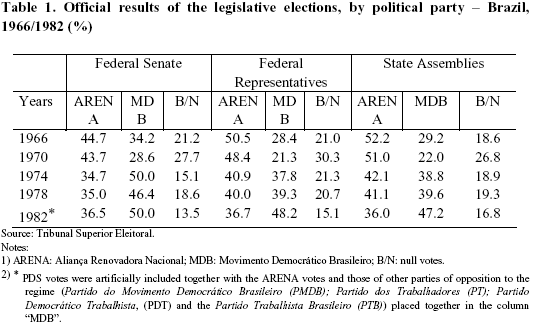
<body><![CDATA[<p><font face="Verdana, Arial, Helvetica, sans-serif" size="2">Nonetheless, as    was emphasized above, the original <i>project</i> of liberalization of the dictatorial    regime was not identical to the political <i>process</i> that it launched. Once    underway, the movement acquired a logic of its own and the various crises in    the Geisel and Figueiredo governments can clearly be seen in relation to the    presidents' attempts to reinforce their control over the process and the opposition's    (civil and military) attempts to move the project in a different direction.    The complication was more or less the following: if "political détente" under    military tutelage was the only form that the power elite could imagine to resolve    the contradictions of the military apparatus and the "military regime" itself,    "political opening" allowed definitively for the intervention of the national    business class, the middle classes and the workers in politics. Thus, the phases    and stages indicated in the periodization presented above cannot be reduced    exclusively to the political and bureaucratic dynamics of the military apparatus    (i.e., the internal struggles, ideological disputes or warring among different    personalities).<a href="#_ftn31" name="_ftnref31" title=""><sup>31</sup></a> To a large extent the periodization    of the dictatorial regime also corresponds to three arrangements: <i>(i)</i>    to the new geography that was established between politicians and the military,    in which elections are the best indicator of the growing importance of "civilians"    on the political scene; <i>(ii)</i> to the redefinition of the relation of forces    between social classes (Cruz e Martins, 1983) in which the passage of the hegemonic    position from one fraction of a class (multinational industrial capital and    associated national capital) to another (finance capital) are illustrative of    the new contradictions between "government" and "entrepreneurs"<a href="#_ftn32" name="_ftnref32" title=""><sup>32</sup></a>;    and <i>(iii)</i> to the redefinition of the relation of forces between classes    and the military establishment, as demonstrated by the growing protests of the    workers and middle class professionals (lawyers through their professional organization,    the OAB, journalists through the ABI, etc.). Furthermore, albeit indirectly,    workers' strikes and the rise of social movements represent the new pace of    the "rebirth of civil society".<a href="#_ftn33" name="_ftnref33" title=""><sup>33</sup></a></font></p>     <p><font face="Verdana, Arial, Helvetica, sans-serif" size="2">Data on the elections    for the legislature (state and federal) illustrate the evolution of the parliamentary    opposition, suggesting their growing importance within the political system.    </font></p>     <p><font face="Verdana, Arial, Helvetica, sans-serif" size="2">Given the regime's    maintenance of the institutions of classical representative democracy (parties,    the parliament and elections),<a href="#_ftn34" name="_ftnref34" title=""><sup>34</sup></a> our understanding of the transformation of the political    system necessarily includes analysis of the influence of electoral dynamics    over the political process in the decades of the 1970s and 80s. The tables below    (<a href="#tab1">tables 1</a> and <a href="#tab2">2</a>) summarize the results    of elections for the legislature in Brazil between 1966 and 1986. If we divide    the votes into two opposing currents, the government (ARENA) and the opposition    (MDB), the following results emerge: </font></p>     <p><a name="tab1"></a></p>     <p>&nbsp;</p>     <p align="center"><img src="/img/revistas/s_rsocp/v2nse/a04tab1.gif"></p>     <p>&nbsp;</p>     <p><a name="tab2"></a></p>     <p>&nbsp;</p>     <p align="center"><img src="/img/revistas/s_rsocp/v2nse/a04tab2.gif"></p>     ]]></body>
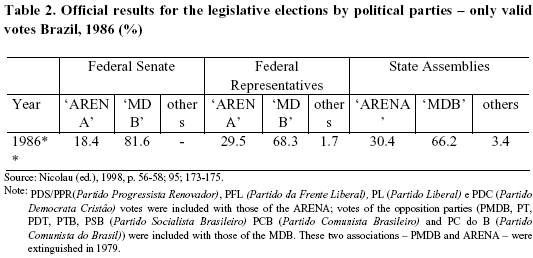
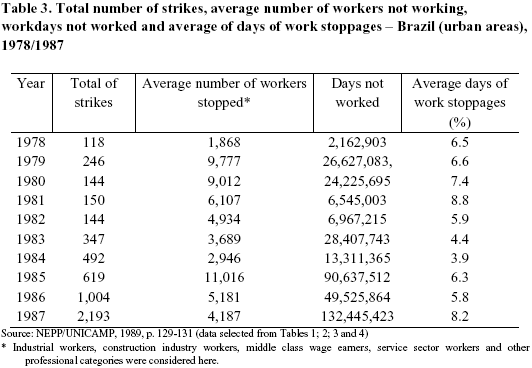
<body><![CDATA[<p>&nbsp;</p>     <p><font face="Verdana, Arial, Helvetica, sans-serif" size="2">As should be noted,    what was only meant to have been a liberal façade for a dictatorial regime became    a powerful element that added dynamics to program of the transition process,    particularly in the early 1980s. A quick inspection of the numbers presented    in the two tables above allows four conclusions to be drawn: <i>(i) </i>the    votes for the government party were, over time, inversely proportionate to those    of the opposition party <i>(ii) </i>although the growth rates of the opposition    vote are different in the three legislative houses (greatest in the Federal    Senate and least in the state Legislative assemblies), they are almost constant;    (<i>iii</i>) at the end of the first time sequence (1982) the opposition has    almost 50% of the electorate, against 36% of the government party; <i>(iv) </i>the    only moment in which the sequence is modified (1970) corresponds exactly with    the growth of null and blank votes, which was at that time the only way of protesting    the regime. Thus, in 1979, the "recognition of the government's inability to    secure a solid base of parliamentary support made the dissolution of the two-party    system imperative" in 1979. (Kinzo, 1988, p. 224)</font></p>     <p><font face="Verdana, Arial, Helvetica, sans-serif" size="2">It is probable,    as Lamounier (1986) argues, that the electoral scenario was more important in    the Brazilian case than in those other "transition" processes occurring elsewhere    in Latin America in the seventies. Nonetheless, we should not ignore the other    side of the coin. Saes emphasizes that the privileged place for opposition to    the military dictatorship was not, for all social classes and fractions, "the    political party scenario (since the MDB, the party contrary to the government,    kept its distance from popular movements)". The instrument of the modern working    class was, in fact, the trade union. Thus, "the most effective form of protest    taken by the opposition &#91;...&#93; was not the vote but the strike". (Saes,    1984, p. 227) </font></p>     <p><font face="Verdana, Arial, Helvetica, sans-serif" size="2"><a href="#tab3">Table    3</a> presents a useful indicator for measuring society's disassociation with    the regime and its economic model.</font></p>     <p><a name="tab3"></a></p>     <p>&nbsp;</p>     <p align="center"><img src="/img/revistas/s_rsocp/v2nse/a04tab3.gif"></p>     <p>&nbsp;</p>     <p><font face="Verdana, Arial, Helvetica, sans-serif" size="2">Parallel to the    evolution of opposition parties, the two latter military governments (Geisel    e Figueiredo) were obliged to deal with more modern forms of political organization,    the "new unionism".<a href="#_ftn35" name="_ftnref35" title=""><sup>35</sup></a>    This challenge was part of a wider context and is related to the process of    the restructuring of the system of representation of social interests within    the State. For the time being, it is enough to note that in this period, trade    unionist dynamics and politically party dynamics interact, without this implying    any relationship of determinism between them </font></p>     <p><font face="Verdana, Arial, Helvetica, sans-serif" size="2">Looking solely    at the column, "total number of strikes" on <a href="#tab3">table 3</a>, we    can suppose that, over this period of 10 years (1978-1987), the leap from 118    strikes (in 1978) to 2,183 (in 1987) must have made an impact on the process    of regime change. Nonetheless, the most important information here is the ten-fold    increase in the number of striking workers between 1978 and 1979. Although he    carries his argument a bit too far, Diniz (1986) seems to be correct in saying    that the "political opening" was a result of two dynamics that acted simultaneously    on the political system: the dynamics of <i>negotiation </i>within the realm    of the elite and the dynamic of societal <i>pressures </i>(working class, middle    classes) on the military State. It may be possible to suggest here that while    the first dynamic established the content, defined the mode and imposed the    character of the transition, the second determined its pace. </font></p>     ]]></body>
<body><![CDATA[<p><font face="Verdana, Arial, Helvetica, sans-serif" size="2"><b>V.3 <i>The Reasons    for Political Change: A Regime in Perennial Crisis </i></b></font></p>     <p><font face="Verdana, Arial, Helvetica, sans-serif" size="2">The political processes    that are the root of the 1974 reform of the dictatorial regime are not identical    to those that prevailed when it began, in 1964. (Martins, 1979-1980, p. 19)    Each one of them corresponds to a specific political crisis, though in both    cases the Armed Forces is the main protagonist.</font></p>     <p><font face="Verdana, Arial, Helvetica, sans-serif" size="2">If we are able    to associate the emergence of the military dictatorships in Latin America to    two types of factors, one that is <i>structural</i> – corresponding to the need    for the reorganization of the model of capitalist accumulation in the periphery    (O'Donnell, 1975) – and the other, <i>circumstantial</i> – that is, having to    do with the way the Brazilian military perceived the situation as social chaos    and bureaucratic disorder necessitating their intervention (Soares, 1994)<a href="#_ftn36" name="_ftnref36" title=""><sup>36</sup></a>    – we must still keep in mind that the reasons for changing the form of government    in 1974 have more to do with the internal difficulties of the "military regime    itself". Difficulties that originate in the military branch of the state apparatus,    (Dreifuss and Dulci, 1983) have repercussions in the Armed Forces and through    them spread to other apparatus and branches. Therefore, the reformist proposal    of Geisel-Golbery should not be associated with more global factors such as    "social" or "economic" crisis. The economic crisis (measurable, for example,    through the increase in inflation and disequilibrium in the balance of payments)    ran <i>parallel</i> to the dictatorship's attempts at self-reform. The social    crisis (represented by both the negative results of the politics of "income    distribution" and by the reaction to the latter – strikes) was <i>revealed </i>through    the liberalizing effects of the dictatorship's strategy of self-reform.</font></p>     <p><font face="Verdana, Arial, Helvetica, sans-serif" size="2">This does not mean    that the military dictatorship was stable. In Brazil, for example, the dictatorial    regime never reached a satisfactory state of political balance between liberal    politicians, conservative leaders and military reactionaries. There was also    no consensus among the military itself, given that the existence of different    rival groups in the Armed Forces was indicative of the presence of several ideological    projects, mainly with regard to the <i>nature – </i>provisional or long-lasting    – and the <i>objectives </i>– broad or restricted – of its intervention in national    political life after 1964. </font></p>     <p><font face="Verdana, Arial, Helvetica, sans-serif" size="2">For this very reason,    the Brazilian regime had a hard time establishing a definitive institutional    formula. It was, as frequently occurs in these cases of political regimes of    exception, a regime in permanent crisis. (Poulantzas, 1975) The very absence    of a clear rule for the presidential succession of military chiefs is an indication    of the unresolvable conflict between a political model that attempts to preserve    a civilized image – unwilling to resort to the classical figure of the "Latin    American dictator" – and the impossibility of "civilizing" State command (that    is, hand the Presidency over to a trustworthy civilian politician). The classical    problem of consensus or coercion – the degree to which there is social consent    and the intensity of State repression – were also the reason and expression    of the difficulties in creating its own political institutions. Lack of control    over "what went on in the basement" (CENIMAR, DOPS, DOI-CODI etc.)<a href="#_ftn37" name="_ftnref37" title=""><sup>37</sup></a>,    although appearing as "anarchy" (according to Gaspari, for example) was the    more or less normal or possible form for combating a real opposition (armed    struggle) or imaginary opposition ("the communists") at that particular juncture.    In turn, the cost of producing an active consensus that could approach legitimacy    would depend heavily on cycles of economic expansion, with pro-dictatorship    and "civic and moral education" publicity campaigns serving as modest examples    of the fabrication of a dominant and effective authoritarian culture that was    nonetheless very different from the exalted nationalism of the Vargas period.    </font></p>     <p><font face="Verdana, Arial, Helvetica, sans-serif" size="2">In short, I believe    that the absence of order/hierarchy among the different branches of the State    apparatus and the precariousness of the regime's own system of ideological justification    (as for example that of the <i>Estado Novo</i> period) was due basically to    three combined problems: <i>(i) </i>the difficulty of building a "rational"    structure for decision-making, as the frequent "administrative reforms" of the    State show;<a href="#_ftn38" name="_ftnref38" title=""><sup>38</sup></a> <i>(ii) </i>the absence of ideological coherence and    cohesion among the different <i>civilian and military </i>groups that commanded    national politics;<a href="#_ftn39" name="_ftnref39" title=""><sup>39</sup></a> and <i>(iii) </i>the    inexistence of clear and institutionalized set of rules for institutional evolution,    whose most apparent symptom was the uncertainty regarding who would be at the    head of government, how power would be exercised and in what direction the regime    should move.<a href="#_ftn40" name="_ftnref40" title=""><sup>40</sup></a></font></p>     <p><font face="Verdana, Arial, Helvetica, sans-serif" size="2">In view of this,    it is possible to speculate that the strategic objective of the liberal re-conversion    of the authoritarian regime was, thus, an <i>institutionalization</i> of a series    of authoritarian mechanisms (Quartim de Moraes, 1982, p. 766) that would guarantee,    after the cycle of the military generals was finished, the legitimacy, stability    and functioning of a new political model that would be neither "populist" nor    fully "democratic", given the existing risks of the latter turning into the    former, again. Just as had been the case, in the view of the Armed Forces, of    the regime of the 1946 Constitution. </font></p>     <p><font face="Verdana, Arial, Helvetica, sans-serif" size="2"><b>V.4 <i>The Meaning    of Political Change: The Institutionalization of Authoritarianism</i></b></font></p>     <p><font face="Verdana, Arial, Helvetica, sans-serif" size="2">The military governments    did not invent their own institutions of political representation, as, for example,    a party that mobilized the masses. The "political party reform" of 1965 (the    AI-2) was limited to canceling the registration of the earlier parties that    had been created after the "<i>Estado Novo</i>" (1937-1945) period and to re-organizing    the pro-regime and anti-regime factions under just two parties: the ARENA e    MDB. Similarly, the system of interest representation did not promote a "classical"    corporatism (as had been the case under the 1934 Constitution) but was also    unable to find the ideal formula for the reconstruction of the links between    "society" and the "State", in an anti-liberal context. Particularly in this    case, the link between certain sectors of the business class and certain centers    of decision-making in the State apparatus were perfected during the Costa e    Silva and Medici administrations in accordance with the same model of technical    councils that had been employed under Vargas' authoritarianism. Nonetheless,    this system, given the distortions it created in the State system (Balcanization,    fragmentation, entropy, etc.) was revoked under the Geisel government and then    restored and widened during the Figueiredo administration. (Codato, 1997)</font></p>     <p><font face="Verdana, Arial, Helvetica, sans-serif" size="2">Although these    two pieces of evidence confirm the dictatorship's precarious hold over the edification    of a juridical and political structure, they do not justify the claim that Brazil    was experiencing a "authoritarian situation." (Linz, 1973) Nor should the periodic    crises and the instability characteristic of the dictatorial regime from there    derived be considered an indicator of the incipient and transitory<i> </i>nature    of the "political model". There are two points of confusion in this reasoning.    One, that associates a lack of constancy with low levels of institutionalization,    and another that links institutions with processes of institutionalization.    The presence or absence of certain institutions is less important than the function    that they assume in concrete political dynamics. We can begin with the two-party    system. Conceived of in order to discriminate and control allies and dissidents,    its functioning over time – once a more or less fixed electoral calendar had    been established and several political offices had been made available through    electoral competition – was over time both a factor of stability (until 1974)    and a factor of instability for the regime (from 1974 on)<a href="#_ftn41" name="_ftnref41" title=""><sup>41</sup></a>.</font></p>     ]]></body>
<body><![CDATA[<p><font face="Verdana, Arial, Helvetica, sans-serif" size="2">However, since    the main executive offices were never put up for dispute (the presidency, state    governorships, mayoral offices in capital cities), the political crises that    the electoral dynamics produced were not enough to annul the fundamental trait    of the dictatorial regime: the Armed Forces' political monopoly. The impossibility    of "alternating power" between civilian groups (even the most conservative)    and the military is the most certain reference for the institutionalization    of the regime. When at the beginning of the Geisel administration there was    an impulse to modify the regime it was not, as Cruz and Martins have argued    "a project of institutionalization of the <i>authoritarian regime, </i>that    foresees the establishment of liberalizing measures but only to the extent that    they serve its purposes". (Cruz and Martins, 1983, p. 46; my emphasis) Rather,    this was the institutionalization of <i>authoritarianism</i>, or better put,    the institutionalization of certain mechanisms for control of society by the    State. In the tortuous words of President Ernesto Geisel himself: </font></p>     <blockquote>        <p><font face="Verdana, Arial, Helvetica, sans-serif" size="2">"The exceptional      instruments that the government is armed with for the maintenance of an atmosphere      of safety and order &#91;...&#93; I would like to see not so much as a long-listing      or frequent exercise but rather as a potential for repressive action or more      vigorous contention, just until they have been superseded by a creative political      imagination that is capable of establishing effective safeguards and efficient      remedies ready for use within an institutional context, just as soon as that      becomes opportune." (Geisel, 1974, p. 5) </font></p> </blockquote>     <p><font face="Verdana, Arial, Helvetica, sans-serif" size="2">The creative political    imagination that was put into practice led to the following result: at the end    of 1978, the National Congress approved Constitutional Amendment no. 11 (to    the 1967 Constitution) which conjugated certain political reforms with the maintenance    of "effective safeguards". It abolished Institutional Act no. 5, reestablishing    <i>habeas corpus</i>; it suspended radio and television censorship, revoked    capital punishment and life term prison sentences; restored independence to    the Judiciary and so forth. Yet at the same time, it guaranteed the executive    its discretionary powers. In place of AI-5, certain "safeguards in defense of    the State" were written into the Constitution, such as the "state of emergency".    The president was given the right to declare a state of emergency without previous    congressional approval. In contrast with the AI-5, the president was no longer    able to make laws, but parliamentary immunity was not completely reestablished.    Although the chief of the Executive could no longer terminate mandates and suspend    political rights, members of the parliament could be tried by the dictatorship    for what were deemed cases of "crimes against national security".<a href="#_ftn42" name="_ftnref42" title=""><sup>42</sup></a></font></p>     <p><font face="Verdana, Arial, Helvetica, sans-serif" size="2">This problem of    the institutionalization of authoritarian mechanisms of control over State power,    in light of an eventual loss of command over the political process in the case    of a possible, though still uncertain loosening of authoritarian controls, had    been on the order of the day since the early 1970. When General Geisel's group    came to power, they had already dismissed the option of a corporative regime,    as had been defended by Medici administration advisors between 1970-1971. They    had also dismissed the idea of transforming the <i>Aliança Renovadora Nacional</i>    (ARENA) into a dominant party in the style of the Mexican PRI, following the    proposal made by Samuel Huntington. (Skidmore, 1988, p. 321) The prevailing    option was to establish a more stable, controlled and predictable form of government,    in which the system of political parties and electoral routine – which in the    seventies had surprisingly become a powerful means of protesting against the    regime – would not hold authoritarianism in check, nor provide opportunities    for the "excesses" of the "populist" period manifested by the advance of popular    mobilization under a "charismatic and demagogic leadership".</font></p>     <p><font face="Verdana, Arial, Helvetica, sans-serif" size="2">When all has been    said and done, considering the conservative<i> </i>nature of the process of    political transition in Brazil, its restricted<i> </i>objectives and authoritarian<i>    </i>means, it is no surprise to find that same political group remains in power    after 1985 even when this required its political transformation. Nor is it a    surprise that the whole process was guided and executed by the same association    of professional politicians and authoritarian generals. The longevity of the    ARENA-PDS-PFL triad on the political scenario<a href="#_ftn43" name="_ftnref43" title=""><sup>43</sup></a> makes it hard for us    to forget that there was no real substitution of the groups linked to the dictatorship,    but rather a re-accommodation within the realm of the elites, with the Armed    Forces taking backstage while not losing their prerogatives, such as veto power.<a href="#_ftn44" name="_ftnref44" title=""><sup>44</sup></a> </font></p>     <p><font face="Verdana, Arial, Helvetica, sans-serif" size="2">The Sarney administration    (1985-1990) was the culminating point that demonstrated how this iron circle    was able to maintain successful control over political change in Brazil. It    is worthwhile here to remember the words of order of the <i>Aliança Democrática,</i>    "conciliation" and "social pact", that were able to neutralize both the attempts    to oppose the dictatorial regime that emerged in the particular 1977-1980 conjuncture    (workers' strikes, grass roots social movements and entrepreneurial protests    against "State intervention in the economy"), at the time of the famous campaign    for direct presidential election, in 1984. The result was the perfection of    an anti-popular and anti-populist regime or, as Florestan Fernandes called it,    a "strong democracy", that is, a political form that was neither explicitly<i>    </i>dictatorial (to the point of being fought against as such), nor completely<i>    </i>liberal and democratic. (Fernandes, 1981, p. 10)</font></p>     <p><font face="Verdana, Arial, Helvetica, sans-serif" size="2">Thus, the decade    of the eighties consummated the generals' dreams: a "relative democracy", to    use General Geisel's curious expression Thus, it would be correct not to characterize    the Sarney government as a government of "transition" (to democracy) or a "mixed"    government, but as the last government – in this case, civilian – of a cycle    of non-democratic governments in Brazil.<a href="#_ftn45" name="_ftnref45" title=""><sup>45</sup></a>    Saes (1988) has correctly suggested that it is possible to think this way as    long as we give up on analyzing "separately – that is, one by one – the "political    institutions" that were brought back through the process of political opening,    relegating the question about the type of relationship that these institutions    had to others" (Saes, 1988, p. 18). </font></p>     <p><font face="Verdana, Arial, Helvetica, sans-serif" size="2">A series of typically    democratic political liberties or institutions may be present even within a    dictatorial regime. The central question asks what precise <i>function </i>the    pluralist party system or the majority elections have. During the Sarney administration,    these institutions fulfilled the function of "hiding the ultimately militarized    nature of the state decision making process." (Saes, 1988, p. 19) Zaverucha    (1994), in this same vein, has convincingly demonstrated that the Sarney administration    maintained the political prerogatives of the military and "the authoritarian    enclaves within the State apparatus", thus contributing to the establishment    of a "tutored democracy".<a href="#_ftn46" name="_ftnref46" title=""><sup>46</sup></a> </font></p>     <p><font face="Verdana, Arial, Helvetica, sans-serif" size="2">This proposition    has two analytical implications. Not only the <i>liberalization</i> of the dictatorial    regime should not be confounded with the <i>democratization</i> of the political    system, but the liberalization imposed by the higher echelons of the military    was "more a factor of continuity than of the collapse of the dictatorship".    (Fernandes, 1981, p. 28) There was no actual rupture with authoritarianism but    a transformation – slow, gradual and secure – of forms of government. McSherry    (1995) has argued that the Latin American military institutions preserved the    organization culture of the Cold War period and its national security<i> </i>defense    ideology. In Brazil, the principles behind Law of National Security is still    in effect and the Federal Constitution of 1988 guarantees the role of the Armed    Forces in maintaining "Law and Order" in the country.<a href="#_ftn47" name="_ftnref47" title=""><sup>47</sup></a></font></p>     ]]></body>
<body><![CDATA[<p>&nbsp;</p>     <p><font face="Verdana, Arial, Helvetica, sans-serif" size="3"><b>VI. AN AUTHORITARIAN    DEMOCRACY?</b></font></p>     <p><font face="Verdana, Arial, Helvetica, sans-serif" size="2">During the decade    of the nineties, most analyses of the democratization of the regime disassociated    political and institutional transformations<i> </i>from the changes within the    apparatuses of the State.</font></p>     <p><font face="Verdana, Arial, Helvetica, sans-serif" size="2">Public discussion,    whether in the academic or political milieu, took on some very specific questions,    such as<i> political parties' structure</i> (and their low level of institutionalization),    the <i>party system</i> (and their high level of fragmentation) the <i>electoral    system</i> (its "disfunctional" proportional formula with its open list), <i>the    system of government</i> (federalism and the competition between the states),    <i>form of government </i>(presidentialism and its improprieties), and <i>intergovernmental    relations</i> (competition between Executive vs. Legislative powers), etc. The    literature's almost exclusive focus on the political scenario brought the (conservative)    theme of governability<i> </i>to the forefront of public debate. Inspired by    a minimalist definition of democracy, this topic then became the fundamental    problem of the process of government, eclipsing the problem of the transformation    of the State system. </font></p>     <p><font face="Verdana, Arial, Helvetica, sans-serif" size="2">The question of    the State and its "crises" was, in turn, more associated with the problem of    the "efficiency" (of public expenses) and its solution – the "reform of the    State" – more wedded to an administrative (or managerial<a href="#_ftn48" name="_ftnref48" title=""><sup>48</sup></a>) perspective, than to essential aspects    of the reconfiguration of the relations of force/influence between the state    system and its apparatuses of power. To a certain extent, concern with the relationship    between the Executive and the Legislative or, more properly, with president's    ability to make decisions and implement them,<a href="#_ftn49" name="_ftnref49" title=""><sup>49</sup></a><b>    </b>took priority over concerns with the Executive itself, or specifically,    with the internal dislocations of relations of force between the apparatuses    of the State, relegating the identification of new centers of real power (and    those who control them) and their links to social interests to a secondary level.    </font></p>     <p><font face="Verdana, Arial, Helvetica, sans-serif" size="2">An important dimension    of the institutional legacy of the military dictatorship over governments of    the nineties was the permanence of the specific nuclei of power within the Brazilian    State. These nuclei had both large degrees of independence and no <i>political</i>    (i.e. parliamentary) or <i>social</i> (i.e. public) control. In the Cardoso    administrations (1995-1998; and 1999-2002), to take the best example, we can    find three specific expressions of this phenomenon. In the economic arena, just    as under the dictatorial arrangements, the scheme of a "super ministry" (today    represented by the triad made up the Central Bank, the Council on Monetary Policy    and the Ministry of Finance)<a href="#_ftn50" name="_ftnref50" title=""><sup>50</sup></a> continued to function. In the military    arena, three untouchable "bureaucratic fiefdoms" were maintained: the Office    of Institutional Security (previously, <i>Casa Militar</i>), the Brazilian Information    Agency (ex-SNI, or <i>Serviço Nacional de Inteligência</i>) and the Military    Justice department<a href="#_ftn51" name="_ftnref51" title=""><sup>51</sup></a>. Lastly, in the "entrepreneurial sphere",    i.e. those State apparatuses in which, due to their nature or competence, "market    interests" are managed (policies on privatization, on transportation, on foreign    trade, communications, education, etc.) the rule followed was that of direct    contact by influential representatives of the world of big business with strategic    decision-makers, a not very transparent mechanism that Cardoso (1975) had referred    to, with regard to its presence in the authoritarian regime, as "bureaucratic    rings" ("<i>anéis burocráticos</i>").</font></p>     <p><font face="Verdana, Arial, Helvetica, sans-serif" size="2">If these similarities    between certain aspects of the organization of the state system in two different    regimes are not only formal, as they really do not seem to be, why does this    occur? This non-democratic pattern of relationship persists for a basic reason.    When the agenda of the Fernando Henrique Cardoso administration is inspected,    the famous "market-oriented reforms" are salient, i.e. the privatization of    State firms, de-regulation of spheres once regulated by the State, rigorous    control over inflation and the public deficit, the re-dimensioning of "social    expenses" (in the areas of education, health and social welfare), commercial    and financial opening, etc. In truth, economic reforms did not require a real    reform of politics that would increase representation, and of the State, that    would increase participation. Or better said: the neo-liberal reforms had as    their pre-condition the authoritarian arrangements of processes and lack of    accountability on the part of those who governed. This is why the implementation    of such policies did not come together with demands for the widening of citizenship    and social control over the State, its bureaucracies and its apparatuses of    power.<a href="#_ftn52" name="_ftnref52" title=""><sup>52</sup></a> Thus there was a continuity between    (liberal) ideological discourse and (authoritarian) political practices that    was expressed in the insistence on exclusive devotion to building the social    hegemony of neo-liberal capitalism rather than new forms of democratic political    legitimacy. The deficit in citizenship is only the most visible aspect of this    process.</font></p>     <p>&nbsp;</p>     <p align=left><font face="Verdana, Arial, Helvetica, sans-serif" size="3"><b>REFERENCES</b></font></p>     <!-- ref --><p><font face="Verdana, Arial, Helvetica, sans-serif" size="2">Abranches, S. H.    1978. <i>The Divided Leviathan</i>: State and Economic Policy Formation in Authoritarian    Brazil. PhD. Dissertation. University of Cornell.</font><!-- ref --><p><font face="Verdana, Arial, Helvetica, sans-serif" size="2">Abranches, S. H.    1979. "Uma perspectiva de análise política estrutural". <i>Dados</i>, v. 20,    p. 47-69.</font><!-- ref --><p><font face="Verdana, Arial, Helvetica, sans-serif" size="2">Abranches, S. H.    1988. "Presidencialismo de coalizão: o dilema institucional brasileiro". <i>Dados</i>,    v. 31 n. 1, p. 5-33.</font><!-- ref --><p><font face="Verdana, Arial, Helvetica, sans-serif" size="2">Abrucio, F. L.    1998. <i>Os Barões da Federação</i>: os governadores e a redemocratização brasileira.    São Paulo, Hucitec/USP.</font><!-- ref --><p><font face="Verdana, Arial, Helvetica, sans-serif" size="2">Barros, A. 1988.    "Problemas de transição democrática na frente militar: a definição do papel    dos militares, a mudança da doutrina e a modernização do País". <i>Política    e Estratégia</i>, v. 6 n. 2, p. 206-214, abr./jun.</font><!-- ref --><p><font face="Verdana, Arial, Helvetica, sans-serif" size="2">Bayart, J.-F. 1976.    "L'analyse des situations autoritaires: étude bibliographique". <i>Revue Française    de Science Politique</i>, v. 26 n. 3, juin. </font><!-- ref --><p><font face="Verdana, Arial, Helvetica, sans-serif" size="2">Bunce, V. 2000.    "Comparative Democratization: Big and Bounded Generalizations". <i>Comparative    Political Studies</i>, v. 33 n. 6-7, p. 703-734, Aug.-Sept.</font><!-- ref --><p><font face="Verdana, Arial, Helvetica, sans-serif" size="2">Camargo, A. 1990.    "República: conservadorismo <i>versus</i> modernidade". <i>Análise and Conjuntura</i>,    v. 5 n. 2, p. 175-181, maio/ago.</font><!-- ref --><p><font face="Verdana, Arial, Helvetica, sans-serif" size="2">Cardoso, F. H.    1972. <i>O modelo político brasileiro e outros ensaios</i>. São Paulo, Difel.</font><!-- ref --><p><font face="Verdana, Arial, Helvetica, sans-serif" size="2">Cardoso, F. H.    1975. <i>Autoritarismo e democratização</i>. Rio de Janeiro, Paz e Terra.</font><!-- ref --><p><font face="Verdana, Arial, Helvetica, sans-serif" size="2">Cardoso, F. H.    1982. "Da caracterização dos regimes autoritários na América Latina". In Collier,    D. (ed.). <i>O novo autoritarismo na América Latina</i>. Rio de Janeiro, Paz    e Terra. </font><!-- ref --><p><font face="Verdana, Arial, Helvetica, sans-serif" size="2">Codato, A. N. 1997.    <i>Sistema estatal e política econômica no Brasil pós-64</i>. Sao Paulo, Hucitec/ANPOCS/Ed.    da UFPR.</font><!-- ref --><p><font face="Verdana, Arial, Helvetica, sans-serif" size="2">Codato, A. N. 2005.    O processo decisório de política econômica na ditadura militar brasileira e    o papel das Forças Armadas. Conferência apresentada no Laboratório de Estudos    sobre Militares e Política (LEMP) na Universidade Federal do Rio de Janeiro    (UFRJ), digit.</font><!-- ref --><p><font face="Verdana, Arial, Helvetica, sans-serif" size="2">Codato, A. N. 2006.    (ed.). 2006. <i>Political Transition and Democratic Consolidation</i>: Studies    on Contemporary Brazil. New York, Nova Science Publishers.</font><!-- ref --><p><font face="Verdana, Arial, Helvetica, sans-serif" size="2">Couto, C. G. 1998.    "A longa constituinte: reforma do Estado e fluidez institucional no Brasil".    <i>Dados</i>, v. 41 n. 1, p. 51-86.</font><!-- ref --><p><font face="Verdana, Arial, Helvetica, sans-serif" size="2">Cruz, S. C. V.    and Martins, C. E. 1983. "De Castello a Figueiredo: uma incursão na pré-história    da ‘abertura'". In Sorj, B. e Almeida, M. H. T. de (eds.). <i>Sociedade e política    no Brasil pós-64</i>. São Paulo, Brasiliense.</font><!-- ref --><p><font face="Verdana, Arial, Helvetica, sans-serif" size="2">Cruz, S. V. e.    2005. As peripécias do quatro na política brasileira. <i>Lua Nova</i>, n. 64,    p. 39-45, jan./abr.</font><!-- ref --><p><font face="Verdana, Arial, Helvetica, sans-serif" size="2">D'Araújo, M. C.    and Castro, C. (eds.). 1997. <i>Ernesto Geisel</i>. Rio de Janeiro, Editora    Fundação Getulio Vargas.</font><!-- ref --><p><font face="Verdana, Arial, Helvetica, sans-serif" size="2">Diniz, E. and Boschi,    R. 1989. "A consolidação democrática no Brasil: atores políticos, processos    sociais e intermediação de interesses". In Diniz, E. and Boschi, R. and Lessa,    R. <i>Modernização e consolidação democrática no Brasil</i>: dilemas da Nova    República. São Paulo, Vértice.</font><!-- ref --><p><font face="Verdana, Arial, Helvetica, sans-serif" size="2">Diniz, E. 1986.    "A transição política no Brasil: perspectivas para a democracia". <i>Sociedade    e Estado</i>, v. 1 n. 2, p., 65-88, jul./dez.</font><!-- ref --><p><font face="Verdana, Arial, Helvetica, sans-serif" size="2">Dreifuss, R. A.    and Dulci, O. S. 1983. "As Forças Armadas e a política". In Sorj, B. and Almeida,    M. H. T. de (eds.). <i>Sociedade e política no Brasil pós-64</i>. São Paulo,    Brasiliense.</font><!-- ref --><p><font face="Verdana, Arial, Helvetica, sans-serif" size="2">Fernandes, F. 1981.    <i>A ditadura em questão</i>. São Paulo, T. A. Queiroz.</font><!-- ref --><p><font face="Verdana, Arial, Helvetica, sans-serif" size="2">Fiechter, G. A.    1974. <i>O regime modernizador do Brasil</i>: 1964-1972. Rio de Janeiro, FGV.</font><!-- ref --><p><font face="Verdana, Arial, Helvetica, sans-serif" size="2">Fleischer, D. 1986.    "Governabilidade e abertura política: as desventuras da engenharia política    no Brasil, 1964-84". <i>Revista de Ciência Política</i>, v. 29 n. 1, p. 12-39,    jan./mar.</font><!-- ref --><p><font face="Verdana, Arial, Helvetica, sans-serif" size="2">Gaspari, E. 2002a.    <i>A ditadura envergonhada</i>. São Paulo, Companhia das Letras.</font><!-- ref --><p><font face="Verdana, Arial, Helvetica, sans-serif" size="2">Gaspari, E. 2002b.    <i>A ditadura escancarada</i>. São Paulo: Companhia das Letras.</font><!-- ref --><p><font face="Verdana, Arial, Helvetica, sans-serif" size="2">Gaspari, E. 2003.    <i>A ditadura derrotada</i>. São Paulo: Companhia das Letras.</font><!-- ref --><p><font face="Verdana, Arial, Helvetica, sans-serif" size="2">Gaspari, E. 2004.    <i>A ditadura encurralada</i>. São Paulo, Companhia das Letras.</font><!-- ref --><p><font face="Verdana, Arial, Helvetica, sans-serif" size="2">Keck, M. 1988.    "O ‘novo sindicalismo' na transição brasileira". In Stepan, A. (ed.). <i>Democratizando    o Brasil</i>. Rio de Janeiro, Paz e Terra.</font><!-- ref --><p><font face="Verdana, Arial, Helvetica, sans-serif" size="2">Kinzo, M. D. G.    1988. <i>Oposição e autoritarismo</i>. Gênese e trajetória do MDB: 1966-1979.    São Paulo, Vértice.</font><!-- ref --><p><font face="Verdana, Arial, Helvetica, sans-serif" size="2">Kinzo, M. D. G.    2001. "A democratização brasileira: um balanço do processo político desde a    transição". <i>São Paulo em Perspectiva</i>, v.15 n.4, p. 3-12, out./dez.</font><!-- ref --><p><font face="Verdana, Arial, Helvetica, sans-serif" size="2">Lafer, C. 1975.    <i>O sistema político brasileiro</i>: estrutura e processo. São Paulo, Perspectiva.</font><!-- ref --><p><font face="Verdana, Arial, Helvetica, sans-serif" size="2">Lamounier, B. 1986.    "<i>Authoritarian Brazil</i> revisitado: o impacto das eleições na abertura    política brasileira, 1974-1982". <i>Dados</i>, v. 29 n. 3, p. 283-317.</font><!-- ref --><p><font face="Verdana, Arial, Helvetica, sans-serif" size="2">Lima Jr., O. B.    de and Abranches, S. H. (eds.). 1987. <i>As origens da crise</i>: Estado autoritário    e planejamento no Brasil. São Paulo, Vértice. </font><!-- ref --><p><font face="Verdana, Arial, Helvetica, sans-serif" size="2">Lima Jr., O. B.    de. 1993. <i>Democracia e instituições políticas no Brasil dos anos 80</i>.    São Paulo, Loyola.</font><!-- ref --><p><font face="Verdana, Arial, Helvetica, sans-serif" size="2">Linz, J. 1964.    "An Authoritarian Regime: the Case of Spain". In Allard, E. and Littunen, Y.    (eds.). <i>Cleavages, Ideologies, and Party Systems</i>. Helsinki: Westermark    Society.</font><!-- ref --><p><font face="Verdana, Arial, Helvetica, sans-serif" size="2">Linz, J. 1973.    The Future of an Authoritarian Situation and the Institutionalization of an    Authoritarian Regime: the Case of Brazil. In Stepan, A. (ed.). <i>Authoritarian    Brazil</i>: Origins, Policies, and Future. Baltimore, The Johns Hopkins University    Press.</font><!-- ref --><p><font face="Verdana, Arial, Helvetica, sans-serif" size="2">Linz, J. J. and    Stepan, A. 1999. <i>A transição e consolidação da democracia</i>: a experiência    do Sul da Europa e da América do Sul. São Paulo, Paz e Terra.</font><!-- ref --><p><font face="Verdana, Arial, Helvetica, sans-serif" size="2">Loureiro, M. R.    and Abrucio, F. L. 1999. "Política e burocracia no presidencialismo brasileiro:    o papel do Ministério da Fazenda no primeiro governo Fernando Henrique Cardoso".    <i>Revista Brasileira de Ciências Sociais</i>, v. 14, n.41, p.69-89, out.</font><!-- ref --><p><font face="Verdana, Arial, Helvetica, sans-serif" size="2">Mainwaring, S.    1997. "Multipartism, Robust Federalism and Presidentialism in Brazil". In Mainwaring,    S. e Shugart, M. S. (eds.). <i>Presidentialism and Democracy in Latin America</i>.    Cambridge, Cambridge University Press.</font><!-- ref --><p><font face="Verdana, Arial, Helvetica, sans-serif" size="2">Mainwaring, S.;    Meneguello, R. and Power, T. 2000. <i>Partidos conservadores no Brasil contemporâneo</i>:    quais são, o que defendem, quais são suas bases. São Paulo, Paz e Terra.</font><!-- ref --><p><font face="Verdana, Arial, Helvetica, sans-serif" size="2">Maroni, A. A. 1982.    <i>A estratégia da recusa</i>: análise das greves de maio/78. São Paulo, Brasiliense.</font><!-- ref --><p><font face="Verdana, Arial, Helvetica, sans-serif" size="2">Martins Filho,    J. R. 1995. <i>O palácio e a caserna: </i>a dinâmica militar das crises políticas    na ditadura (1964-1969). São Carlos: Editora da UFSCar.</font><!-- ref --><p><font face="Verdana, Arial, Helvetica, sans-serif" size="2">Martins, C. E.    1977. <i>Capitalismo de Estado e modelo político no Brasil</i>. Rio de Janeiro,    Graal. </font><!-- ref --><p><font face="Verdana, Arial, Helvetica, sans-serif" size="2">Martins, L. 1979-1980.    "A política (e os limites) da ‘abertura'". <i>Ensaios de Opinião</i>, v. 15,    p. 18-33, dez.-ago.</font><!-- ref --><p><font face="Verdana, Arial, Helvetica, sans-serif" size="2">Martins, L. 1985.    <i>Estado capitalista e burocracia no Brasil pós-64</i>. Rio de Janeiro, Paz    e Terra.</font><!-- ref --><p><font face="Verdana, Arial, Helvetica, sans-serif" size="2">Martins, L. 1988.    "A ‘liberalização' do regime autoritário no Brasil". In O'Donnell, G.; Schmitter,    P. and Whitehead, L. (eds.). <i>Transições do regime autoritário</i>: América    Latina. São Paulo, Vértice.</font><!-- ref --><p><font face="Verdana, Arial, Helvetica, sans-serif" size="2">McSherry, J. P.    1995. "Military Political Power and Guardian Structures in Latin America". <i>Journal    of Third World Studies</i>, v. 12 n. 1, p. 80-119, spring.</font><!-- ref --><p><font face="Verdana, Arial, Helvetica, sans-serif" size="2">Moisés, J. A. 1994.    "Entre a incerteza e a tradição política: uma crítica da primeira geração de    estudos da transição". <i>Novos Estudos Cebrap</i>, v. 40, p. 88-100, nov.</font><!-- ref --><p><font face="Verdana, Arial, Helvetica, sans-serif" size="2">NEPP &#91;Núcleo    de Estudos de Políticas Públicas&#93;/UNICAMP. 1989. <i>Brasil 1987</i>: relatório    da situação social do País. Campinas, Universidade Estadual de Campinas.</font><!-- ref --><p><font face="Verdana, Arial, Helvetica, sans-serif" size="2">Nicolau, J. M.    (ed.). 1998. <i>Dados eleitorais do Brasil</i> (1982-1996). Rio de Janeiro,    Revan/IUPERJ-UCAM.</font><!-- ref --><p><font face="Verdana, Arial, Helvetica, sans-serif" size="2">Nicolau, J. M.    1996. "Multipartidarismo, maiorias parlamentares e democracia: notas sobre o    caso brasileiro". In Diniz, E. (ed.), <i>O desafio da democracia na América    Latina</i>. Rio de Janeiro, IUPERJ.</font><!-- ref --><p><font face="Verdana, Arial, Helvetica, sans-serif" size="2">O'Donnell, G. and    Schmitter, P. 1988. <i>Transições do regime autoritário</i>: primeiras conclusões.    Rio de Janeiro, Vértice/Ed. Revista dos Tribunais.</font><!-- ref --><p><font face="Verdana, Arial, Helvetica, sans-serif" size="2">O'Donnell, G. 1975.    <i>Reflexiones sobre las tendencias de cambio del Estado burocrático-autoritário</i>.    Buenos Aires, Documento CEDES/G.E. CLACSO, v. 1.</font><!-- ref --><p><font face="Verdana, Arial, Helvetica, sans-serif" size="2">O'Donnell, G.;    Schmitter, P. and Whitehead, L. 1986. <i>Transitions from Authoritarian Rule</i>.    Baltimore, Johns Hopkins University Press.</font><!-- ref --><p><font face="Verdana, Arial, Helvetica, sans-serif" size="2">Oliveira, E. R.    1980. "Conflits militaires et décisions sous la présidence du Général Geisel".    In Rouquié, A. (ed.). <i>Les partis militaires au Brésil</i>. Paris, Presses    de la FNSP. </font><!-- ref --><p><font face="Verdana, Arial, Helvetica, sans-serif" size="2">Oliveira, E. R.    1987. O aparelho militar : papel tutelar na Nova República. In Moraes, J. Q.    de; Costa, W. P. &amp; Oliveira, E. R. <i>A tutela militar</i>. São Paulo, Vértice/    Editora Revista dos Tribunais.</font><!-- ref --><p><font face="Verdana, Arial, Helvetica, sans-serif" size="2">Oliveira, E. R.    1994. <i>De Geisel a Collor</i>: Forças Armadas, transição e democracia. Campinas,    Papirus.</font><!-- ref --><p><font face="Verdana, Arial, Helvetica, sans-serif" size="2">Ottmann, G. 1995.    "Movimentos sociais urbanos e democracia no Brasil: uma abordagem cognitiva".    <i>Novos Estudos Cebrap</i>, v. 41, p. 186-207, mar.</font><!-- ref --><p><font face="Verdana, Arial, Helvetica, sans-serif" size="2">Palermo, V. 2000.    Como se governa o Brasil? O debate sobre instituições políticas e gestão de    governo. <i>Dados</i>, v.43 n.3, p.521-557.</font><!-- ref --><p><font face="Verdana, Arial, Helvetica, sans-serif" size="2">Poulantzas, N.    1968. <i>Pouvoir politique et classes sociales</i>. Paris, François Maspero.</font><!-- ref --><p><font face="Verdana, Arial, Helvetica, sans-serif" size="2">Poulantzas, N.    1975. <i>La crise des dictatures</i>. Portugal, Grèce, Espagne. Paris, François    Maspero.</font><!-- ref --><p><font face="Verdana, Arial, Helvetica, sans-serif" size="2">Quartim de Moraes,    J. 1982. <i>Les militaires et les régimes politiques au Brésil de Deodoro à    Figueiredo (1889-1979)</i>. Paris, Institut D'Etudes Politiques de Paris.</font><!-- ref --><p><font face="Verdana, Arial, Helvetica, sans-serif" size="2">Quartim de Moraes,    J. 1985. "Alfred Stepan e o mito do poder moderador". <i>Filosofia Política</i>,    v. 2, p. 163-199, inverno.</font><!-- ref --><p><font face="Verdana, Arial, Helvetica, sans-serif" size="2">Reis, F. W. et    al. 1997. "As Ciências Sociais nos últimos 20 anos: três perspectivas". <i>Revista    Brasileira de Ciências Sociais</i>, vol.12, n.35, fev. </font><!-- ref --><p><font face="Verdana, Arial, Helvetica, sans-serif" size="2">Sader, E. S. 1988.    <i>Quando novos personagens entraram em cena</i>: experiências, falas e lutas    dos dos trabalhadores da grande São Paulo (1970-1980). Rio de Janeiro, Paz e    Terra.</font><!-- ref --><p><font face="Verdana, Arial, Helvetica, sans-serif" size="2">Saes, D. 1984.    <i>Classe média e sistema político no Brasil</i>. São Paulo, T.A. Queiroz.</font><!-- ref --><p><font face="Verdana, Arial, Helvetica, sans-serif" size="2">Saes, D. 1988.    "O processo político brasileiro, da ‘Abertura' à ‘Nova República': uma ‘transição    para a democracia' (burguesa)?" <i>Teoria e Política</i>, n. 9, p. 11-28. </font><!-- ref --><p><font face="Verdana, Arial, Helvetica, sans-serif" size="2">Saes, D. 1990.    "O Estado brasileiro pós-64 e a organização da hegemonia no seio do bloco no    poder". In Laranjeira, S. <i>Classes e movimentos sociais na América Latina</i>.    São Paulo, Hucitec.</font><!-- ref --><p><font face="Verdana, Arial, Helvetica, sans-serif" size="2">Saint-Pierre, H.    L. &amp; Mathias, S. K. (eds.). 2001. <i>Entre votos e botas</i>: as Forças    Armadas no labirinto latino-americano do novo milênio. São Paulo, Ed. UNESP.    </font><!-- ref --><p><font face="Verdana, Arial, Helvetica, sans-serif" size="2">Sallum Jr., B.    2003. "Metamorfoses do Estado brasileiro no final do século XX". <i>Revista    Brasileira de Ciências Sociais</i>, v. 18 n.52, p. 35-55, jun.</font><!-- ref --><p><font face="Verdana, Arial, Helvetica, sans-serif" size="2">Santos, F. 2000.    "Escolhas institucionais e transição por transação: sistemas políticos de Brasil    e Espanha em perspectiva comparada". <i>Dados</i>, v. 43 n. 4, p. 637-669.</font><!-- ref --><p><font face="Verdana, Arial, Helvetica, sans-serif" size="2">Santos, W. G. dos.    1978. <i>Poder e política</i>: crônica do autoritarismo brasileiro. Rio de Janeiro,    Forense-Universitária.</font><!-- ref --><p><font face="Verdana, Arial, Helvetica, sans-serif" size="2">Schmidt, B. V.    1990. "Trajetórias críticas e reconstrução política na Espanha, Argentina e    Brasil". <i>Sociedade e Estado</i>, v. 5 n. 2, p. 175-191, jul./dez.</font><!-- ref --><p><font face="Verdana, Arial, Helvetica, sans-serif" size="2">Schneider, R. M.    1971. <i>The Political System of Brazil</i>: Emergence of a "Modernizing" Authoritarian    Regime, 1964-1970. New York and London, Columbia University Press.</font><!-- ref --><p><font face="Verdana, Arial, Helvetica, sans-serif" size="2">Share, D. and Mainwaring,    S. 1986. "Transição pela transação: democratização no Brasil e na Espanha".    <i>Dados</i>, v. 29 n. 2, p. 207-236.</font><!-- ref --><p><font face="Verdana, Arial, Helvetica, sans-serif" size="2">Silva, G. do C.    e. 1981. <i>Conjuntura politica nacional</i>: o poder Executivo and geopolítica    do Brasil. Rio de Janeiro, J. Olympio.</font><!-- ref --><p><font face="Verdana, Arial, Helvetica, sans-serif" size="2">Skidmore, T. E.    1967. <i>Politics in Brazil</i>, 1930-1964. An Experiment in Democracy. New    York, Oxford University Press.</font><!-- ref --><p><font face="Verdana, Arial, Helvetica, sans-serif" size="2">Skidmore, T. E.    1988. <i>The Politics of Military Rule in Brazil</i>, 1964-85. Oxford, Oxford    University Press.</font><!-- ref --><p><font face="Verdana, Arial, Helvetica, sans-serif" size="2">Soares, G. A. D.    1989. "Censura durante o regime autoritário". <i>Revista Brasileira de Ciências    Sociais</i>, v. 4 n. 10, p. 21-43, jun. </font><!-- ref --><p><font face="Verdana, Arial, Helvetica, sans-serif" size="2">Soares, G. A. D.    1994. "O golpe de 64". In Soares, G. A. D. and D'Araújo, M. C. (eds.). <i>21    anos de regime militar</i>: balanços e perspectivas. Rio de Janeiro: Ed. da    FGV. </font><!-- ref --><p><font face="Verdana, Arial, Helvetica, sans-serif" size="2">Stepan, A. (ed.).    1988. "Introdução". <i>Democratizando o Brasil</i>. Rio de Janeiro, Paz e Terra.</font><!-- ref --><p><font face="Verdana, Arial, Helvetica, sans-serif" size="2">Stepan, A. 1971.    <i>The Military in Politics</i>: Changing Patterns in Brazil. Princeton, Princeton    University Press.</font><!-- ref --><p><font face="Verdana, Arial, Helvetica, sans-serif" size="2">Zaverucha, J. 1992.    "As prerrogativas militares nas transições brasileira, argentina e espanhola".    <i>Revista Brasileira de Ciências Sociais</i>, v. 7 n. 19, p. 56-65, jun.</font><!-- ref --><p><font face="Verdana, Arial, Helvetica, sans-serif" size="2">Zaverucha, J. 1994.    "Relações civil-militares no primeiro governo da transição brasileira: uma democracia    tutelada". <i>Revista Brasileira de Ciências Sociais</i>, v. 9 n. 26, p. 162-178,    out.</font><p>&nbsp;</p>     <p>&nbsp;</p>     <p><font face="Verdana, Arial, Helvetica, sans-serif" size="2">Received on July    7, 2005     <br>   Approved for publication on October 5, 2005</font></p>     <p>&nbsp;</p>     <p>&nbsp;</p>     ]]></body>
<body><![CDATA[<p><font face="Verdana, Arial, Helvetica, sans-serif" size="2">Adriano Nervo Codato    (<a href="mailto:adriano@ufpr.br">adriano@ufpr.br</a>) is Professor of Political    Science at the Federal University of Paraná (UFPR) where he coordinates the    Research Group in Brazilian Political Sociology (<i>Núcleo de Pesquisa em Sociologia    Política Brasileira</i>). He is the author of the book <i>Sistema Estatal e    Política Econômica no Brasil Pós-64 </i>and editor of the journal <i>Revista    de Sociologia e Política</i>.    <br>   </font><font face="Verdana, Arial, Helvetica, sans-serif" size="2"><a href="#_ftnref1" name="_ftn1" title="">1</a>    A different version of this article, destined for a foreign readership, appeared    in 2006 in the edited volume I organized (CODATO, 2006).    <br>   </font><font face="Verdana, Arial, Helvetica, sans-serif" size="2"><a href="#_ftnref2" name="_ftn2" title="">2</a>    Barbara Geddens notes that "different types of authoritarianism enter into collapse    through characteristically different modes &#91;...&#93; A study of 163 authoritarian    regimes in 94 countries provides proof that there are real differences in patterns    of collapse &#91;...&#93; Classifying authoritarian regimes into three different    types –personalist, military and one-party – Geddes argues that "the transition    from military government usually begin with divisions within the governing military    elite &#91;...&#93; There &#91;...&#93; a consensus in the literature regarding    the fact that the majority of professional soldiers value the survival and the    efficiency of the military above and beyond all else &#91;...&#93; Most members    of officialdom are more concerned with the unity of the armed forces than with    the military control or lack of control over the government". (Geddes, 2001,    p. 221, 228, 232 and 235, respectively).    <br>   </font><font face="Verdana, Arial, Helvetica, sans-serif" size="2"><a href="#_ftnref3" name="_ftn3" title="">3</a>    As a confirmation of the non-democratic objectives behind the project of the    political liberalization of the regime, see the long interview with General    Geisel with the CPDOC. (D'Araújo e Castro (eds.), 1997)    <br>   </font><font face="Verdana, Arial, Helvetica, sans-serif" size="2"><a href="#_ftnref4" name="_ftn4" title="">4</a>    Although his institutional prerogatives, particularly the legislative ones,    would not yield <i>automatic </i>returns in terms of actual capacity to make    and implement decisions, the president continued to figure as the center of    the political system. For a discussion on these aspects as related to the history    of the Brazilian transition, see Kinzo (2001).    <br>   </font><font face="Verdana, Arial, Helvetica, sans-serif" size="2"><a href="#_ftnref5" name="_ftn5" title="">5</a>    Stéphane Monclaire's contribution to this book (Chapter 4: "Democracy, Transition    and Consolidation: Making Concepts More Precise") presents an insightful discussion    of studies on this issue.    <br>   </font><font face="Verdana, Arial, Helvetica, sans-serif" size="2"><a href="#_ftnref6" name="_ftn6" title="">6</a>    For a more detailed discussion of this approach, see Fernandes (2002).    <br>   </font><font face="Verdana, Arial, Helvetica, sans-serif" size="2"><a href="#_ftnref7" name="_ftn7" title="">7</a>    This new form of intervention, more bureaucratic and less provisory, was followed    – albeit with some regional differences – by all South American military regimes    (Brazil, Argentina, Chile and Uruguay) during the 1960s and 1970s. Mathias (2004)    engages in a detailed discussion of all the related aspects of the "process    of militarization" of the Brazilian state during that period.    <br>   </font><font face="Verdana, Arial, Helvetica, sans-serif" size="2"><a href="#_ftnref8" name="_ftn8" title="">8</a>    Through the Institutional Act no. 2 (Oct. 27, 1965). The multi-party system    (1945-1965) is transformed into a two-party system: a pro-regime party ARENA    (<i>Aliança Renovadora Nacional; </i>National Alliance for Renovation); and    an opposition party, the MDB (<i>Movimento Democrático Brasileiro; </i>Brazilian    Democratic Movement).    <br>   </font><font face="Verdana, Arial, Helvetica, sans-serif" size="2"><a href="#_ftnref9" name="_ftn9" title="">9</a>    First action by the <i>Aliança Libertadora Nacional</i> (ALN) in São Paulo under    Carlos Marighella's leadership.    ]]></body>
<body><![CDATA[<br>   </font><font face="Verdana, Arial, Helvetica, sans-serif" size="2"><a href="#_ftnref10" name="_ftn10" title="">10</a> After the promulgation of Institutional Act no. 5 (Dec. 13, 1968).    <br>   </font><font face="Verdana, Arial, Helvetica, sans-serif" size="2"><a href="#_ftnref11" name="_ftn11" title="">11</a> The "election" of Costa e Silva's successor was carried out by    consulting the High Command of the Armed Forces. (Martins Filho, 1995, p. 184)    <br>   </font><font face="Verdana, Arial, Helvetica, sans-serif" size="2"><a href="#_ftnref12" name="_ftn12" title="">12</a> The high point in the campaign for the reestablishment of direct    presidential elections, that began in January 1984 in Curitiba, was in April    of that same year, when a rally in Rio de Janeiro with the presence of the main    figures of the opposition to the military regime brought almost one million    people together, and more than a million a few days later (the 16<sup>th</sup>)    in São Paulo. On the 25<sup>th</sup>, the National Congress rejected the Constitutional    amendment that provided for immediate direct elections the following year (1985)    For a discussion of the relationship between these social movements and the    process of regime change, see Alberto Tosi Rodrigues' article (2001).    <br>   </font><font face="Verdana, Arial, Helvetica, sans-serif" size="2"><a href="#_ftnref13" name="_ftn13" title="">13</a> The PDS (<i>Partido Democrático Social</i>), political association    that was heir to the ARENA party, undergoes a split in 1984; the dissident faction    supports the Tancredo Neves-José Sarney candidacy for upcoming presidential    elections.    <br>   </font><font face="Verdana, Arial, Helvetica, sans-serif" size="2"><a href="#_ftnref14" name="_ftn14" title="">14</a>    Cruz (2005) suggests a more simplified periodization of the regime, dividing    it into ten-year cycles: 1964 (beginning with the coup); 1974 (an inflection:    political transition); 1984 (the high point of the opposition movement).    <br>   </font><font face="Verdana, Arial, Helvetica, sans-serif" size="2"><a href="#_ftnref15" name="_ftn15" title="">15</a> Bayart (1976) provides a classification of three different histories    of the Brazilian authoritarian regime as: Skidmore, 1967 (we could include here    Skidmore, 1988); Schneider, 1971; and Fiechter, 1974.    <br>   </font><font face="Verdana, Arial, Helvetica, sans-serif" size="2"><a href="#_ftnref16" name="_ftn16" title="">16</a> Couto (1998) suggests a very complex model to understand the process    of political and <i>economic </i>transition in Brazil, in the decade of the    nineties. He argues that three dimensions should be simultaneously integrated    into analysis of the political system: institutions (and their changes), actors    (and their conversions) and the general political and social context, which    always varies from one conjuncture to the next.    <br>   </font><font face="Verdana, Arial, Helvetica, sans-serif" size="2"><a href="#_ftnref17" name="_ftn17" title="">17</a> This topic was discussed by Linz, 1964, in relation to Franco´s    Spain. Cardoso prefers to speak of the "authentification" of the regime rather    than its political legitimacy. (Cardoso, 1972)    <br>   </font><font face="Verdana, Arial, Helvetica, sans-serif" size="2"><a href="#_ftnref18" name="_ftn18" title="">18</a> For a particularly illustrative discussion of this problem, see    Gaspari, 2004.On the first question, see Cardoso, 1975, Lafer, 1975 and Codato,    1997.    <br>   </font><font face="Verdana, Arial, Helvetica, sans-serif" size="2"><a href="#_ftnref19" name="_ftn19" title="">19</a> Cardoso notes that, during the "authoritarian regime", conflict    between the Executive and the Legislative branches was dislocated to the Executive    and there was a real competition between "technocrats" and the military regarding    decision-making. (Cardoso, 1982)    ]]></body>
<body><![CDATA[<br>   </font><font face="Verdana, Arial, Helvetica, sans-serif" size="2"><a href="#_ftnref20" name="_ftn20" title="">20</a> For a general vision of these issues, see Martins, 1985 and Abranches,    1978. For an analysis of several cases, see Lima Jr. &amp; Abranches, 1987.    For a discussion on the theme of "transition" as related to these problems,    see Diniz e Boschi, 1989.    <br>   </font><font face="Verdana, Arial, Helvetica, sans-serif" size="2"><a href="#_ftnref21" name="_ftn21" title="">21</a> For Linz (1973), on the contrary, this was only an "authoritarian    situation".    <br>   </font><font face="Verdana, Arial, Helvetica, sans-serif" size="2"><a href="#_ftnref22" name="_ftn22" title="">22</a> With the defeat of the movement for a return to the popular vote    for the presidency, the Electoral College met on January 15, 1985 and elected    Tancredo Neves (PMDB) by 480 votes against the 180 votes for Paulo Maluf (PDS).    Shortly thereafter, Tancredo fell ill; thus, he never assumed the presidency.    In his place, Jose Sarney assumed executive office (March 15, 1985). Sarney    was a former leader of the party that supported the military regime (ARENA).    <br>   </font><font face="Verdana, Arial, Helvetica, sans-serif" size="2"><a href="#_ftnref23" name="_ftn23" title="">23</a> The expression "<i>castellistas</i>" refers to followers of Castello    Branco, the first president under the Brazilian military dictatorship. Commonly,    though in my view erroneously, these "<i>castellistas</i>" are associated with    "liberal" positions and their rivals in the Armed Forces, the "hard-liners"    are seen as radicals. Nonetheless, I think that the division between these two    groups that is most faithful to the facts should associate the first group with    the institutionalization of the regime and the second, with the management of    repression. It should be kept in mind that it was the "liberals" of the army    who created the <i>Serviço Nacional de Informações</i> (June, 1964) and who    edited the Institutional Act n.2 (October, 1965) which suppressed political    parties and determined that presidential elections were to be, as of that moment,    indirect. They were also the ones who promulgated a new Constitution (January,    1967) and closed the National Congress (April 1977) introducing a series of    measures ("casiutries", according to the expression used at that time) in electoral    legislation. Oliveiros Ferreira (2000) proposes another division between the    two main ideological and political currents of the Armed Forces: the "military    establishment" (i.e. those who acted in accordance with constitutional legality)    and the "uniformed party" (<i>partido fardado) </i>(i.e. members of the military    who were willing to intervene in politics in order to establish constitutional    law and order).    <br>   </font><font face="Verdana, Arial, Helvetica, sans-serif" size="2"><a href="#_ftnref24" name="_ftn24" title="">24</a> Regarding the difference between these two processes and their    possible interaction, see O'Donnell &amp; Schmitter, 1988.    <br>   </font><font face="Verdana, Arial, Helvetica, sans-serif" size="2"><a href="#_ftnref25" name="_ftn25" title="">25</a> The more general design of the reformist program can be found    in Santos. (1978, p. 143-211) In a paper entitled <i>Estratégias de Descompressão    Política</i>, Santos emphasized the need to reestablish some liberal political    rights, through a gradual and moderate strategy, with the collaboration of the    opposition, in order to avoid risks of a possible authoritarian regression.    The first measure to be taken was the elimination of censorship and the guarantee    of freedom of expression. For a concrete analysis of the mechanisms through    which censorship functioned during the Brazilian military regime, see Soares,    1989.    <br>   </font><font face="Verdana, Arial, Helvetica, sans-serif" size="2"><a href="#_ftnref26" name="_ftn26" title="">26</a> Santos (2000) demonstrated that, through similar courses, the    two transition processes had the same results: the prevalence of the Executive    over the Legislature. A comparison of re-democratization in Spain, Brazil and    Argentine can be found in Schmidt, 1990. For a discussion of the methodological    implications of this type of comparison, see Bunce, 2000.    <br>   </font><font face="Verdana, Arial, Helvetica, sans-serif" size="2"><a href="#_ftnref27" name="_ftn27" title="">27</a> In order to understand a series of "casuistries" that altered    the political process thanks to the manipulation of the electoral system (with    results not always favorable to the dictatorial regime) see Fleischer, 1986.    <br>   </font><font face="Verdana, Arial, Helvetica, sans-serif" size="2"><a href="#_ftnref28" name="_ftn28" title="">28</a> Unless I am mistaken, Alfred Stepan was the first author to suggest    the importance of the maintenance of "authoritarian enclaves" (directed by the    military) in the State apparatus, even after what the majority of authors refer    to as "democracy" (i.e. the Sarney government) went into effect (see Stepan,    1986). For further information on the possibility of Armed Forces´ supervision    of the constituent process (1987-1988) see Aguiar (1986) cit. by Zaverucha e    Teixeira (2004, p. 409).    <br>   </font><font face="Verdana, Arial, Helvetica, sans-serif" size="2"><a href="#_ftnref29" name="_ftn29" title="">29</a> General Geisel dealt successfully with the three military crises    that shook his administration: he dismissed the commander of the Second Army    (1976) &#91;<i>Segundo Exército</i>&#93;, exonerated the Minister of the Armed    Forces (1977) e immediately accepted the resignation of the head of the <i>Casa    Militar</i> (1978). For more on this issue see Oliveira, 1980.    ]]></body>
<body><![CDATA[<br>   </font><font face="Verdana, Arial, Helvetica, sans-serif" size="2"><a href="#_ftnref30" name="_ftn30" title="">30</a> General Golbery do Couto e Silva, President Geisel's chief advisor,    described this process with a silly metaphor: the successive changes of the    political system as it attempts to adapt to the conflicts that are part and    parcel of the dynamics of transition can be thought of as "systoles" e "diastoles".    See. Silva, 1981.    <br>   </font><font face="Verdana, Arial, Helvetica, sans-serif" size="2"><a href="#_ftnref31" name="_ftn31" title="">31</a> For a clear view on this issue, see Oliveira, 1994. Gaspari (2002a;    2002b; 2003; e 2004) presents a detailed history of the contradictions present    within military institutions.    <br>   </font><font face="Verdana, Arial, Helvetica, sans-serif" size="2"><a href="#_ftnref32" name="_ftn32" title="">32</a> On this shift in hegemony, see Saes (1990). For a critical evaluation    of the literature regarding conflicts between the Brazilian bourgeiosie and    the military Executive power, see Codato (1995).    <br>   </font><font face="Verdana, Arial, Helvetica, sans-serif" size="2"><a href="#_ftnref33" name="_ftn33" title="">33</a> There is a large stock of literature on this topic. See Sader,    1988, in particular.    <br>   </font><font face="Verdana, Arial, Helvetica, sans-serif" size="2"><a href="#_ftnref34" name="_ftn34" title="">34</a> O'Donnell &amp; Schmitter argue that the Brazilian regime "was    not characterized by any serious attempt to <i>create</i> authoritarian institutions";    the military governed "resorting to the <i>distortion</i> rather than the <i>destruction</i>    of the basic institutions of political democracy." (O'Donnell &amp; Schmitter,    1988, p. 46, my emphasis)    <br>   </font><font face="Verdana, Arial, Helvetica, sans-serif" size="2"><a href="#_ftnref35" name="_ftn35" title="">35</a> In short, the "new unionism" was a new form of workers' organization    in terms of its relationship to official state trade-unionism (created in the    post-1930 period) and a different manner of raising its wage demands, The main    issue was the attempt to negotiate directly with bosses, rather than through    the Ministry of Labor as intermediary. For an optimistic view of the phenomenon,    see Maroni, 1978; for a general analysis of the evolution of the new trade unionism    from the seventies to the eighties, see Keck, 1988. Alongside this phenomenon,    there were also new urban social movements that appeared at the end of the seventies.    A good historical perspective on this issue can be found in Ottmann, 1995.    <br>   </font><font face="Verdana, Arial, Helvetica, sans-serif" size="2"><a href="#_ftnref36" name="_ftn36" title="">36</a> For an elegant formalization of this explanation, see Geddes (2001,    p.233-235).    <br>   </font><font face="Verdana, Arial, Helvetica, sans-serif" size="2"><a href="#_ftnref37" name="_ftn37" title="">37</a> <i>Centro de Informações da Marinha; Delegacia de Ordem Política    e Social; Destacamento de Operações de Informacões – Centro de Operações de    Defesa Interna.    <br>   </i></font><font face="Verdana, Arial, Helvetica, sans-serif" size="2"><a href="#_ftnref38" name="_ftn38" title="">38</a> The decision-making system corresponded to a variety of arrangements    that reflected the correlation of forces within the (civil and military) bureaucracy.    For more on this matter, see Lafer, 1975; Martins, 1985; and Codato, 1997.    <br>   </font><font face="Verdana, Arial, Helvetica, sans-serif" size="2"><a href="#_ftnref39" name="_ftn39" title="">39</a> Among the military there were internationalists (in favor of a    more "open" market economy) and right-wing nationalists (in favor of an industrially    developed "national economy") There was also a liberal civilian sector that    had supported the military coup – in their view, the "counter-revolution" that    stopped "the establishment of a trade-unionist republic in the country, with    Fidel Castro's visible support" <b>–</b> but saw the deepening of political    repression as of 1968 as "an unfortunate authoritarian turn" away from its original    goals<b>. </b>See. "<i>30 anos depois</i>". (1994, p. A3.)    ]]></body>
<body><![CDATA[<br>   </font><font face="Verdana, Arial, Helvetica, sans-serif" size="2"><a href="#_ftnref40" name="_ftn40" title="">40</a> Regarding this last point, General Hugo Abreu's testimony (1979)    is illuminating.    <br>   </font><font face="Verdana, Arial, Helvetica, sans-serif" size="2"><a href="#_ftnref41" name="_ftn41" title="">41</a> This is the case, for example, of the elections for the Federal    Senate, which took on a plebiscitary and anti-regime character. See Table 1    above.    <br>   </font><font face="Verdana, Arial, Helvetica, sans-serif" size="2"><a href="#_ftnref42" name="_ftn42" title="">42</a> The entire project can be found in the news daily <i>O Estado    de S. Paulo</i>, Sept. 21, 1978. These institutional reforms, that should have    entered into effect on March 15, 1979, were put into effect in advance, on January    1<sup>st</sup>, even before the inauguration of the new president.    <br>   </font><font face="Verdana, Arial, Helvetica, sans-serif" size="2"><a href="#_ftnref43" name="_ftn43" title="">43</a> For a more detailed account of the electoral success of right    wing parties in Brazil during this period, see Mainwaring; Meneguello &amp;    Power, 2000    <br>   </font><font face="Verdana, Arial, Helvetica, sans-serif" size="2"><a href="#_ftnref44" name="_ftn44" title="">44</a> Carvalho argues – in my view, correctly – that "The Brazilian    Armed Forces were not forced to accept a role that was radically different from    the one they had held during the authoritarian phase, in which they were more    responsible for the implementation of public policies and influence over the    positions taken by all other social actors." (Carvalho, 2004, p. 136)    <br>   </font><font face="Verdana, Arial, Helvetica, sans-serif" size="2"><a href="#_ftnref45" name="_ftn45" title="">45</a> The suggestion to characterize the Brazilian regime as a mixed    one – in which liberal and authoritarian institutions are combined – belongs    to Martins (1977).    <br>   </font><font face="Verdana, Arial, Helvetica, sans-serif" size="2"><a href="#_ftnref46" name="_ftn46" title="">46</a> On the "tutelary" role of the Armed Forces, see Oliveira (1987).    For a comparative vision of this problem between Brazil, Argentina and Spain,    see Zaverucha, 1992. For a similar argument, see Camargo, 1990. Barros (1988)    during the debates that were going on in the Constitutive Assembly that drafted    the 1988 Constitution, criticized over juridical views on the "constitutional"    role of the Armed Forces and the formalist attempts to block political intervention    or military coup by legal means. Saint-Pierre and Mathias (2001) gathered together    a series of studies discussing the sucess or failure of attempts at civil control    over the military during processes of political transition in seven Latin American    countries.    <br>   </font><font face="Verdana, Arial, Helvetica, sans-serif" size="2"><a href="#_ftnref47" name="_ftn47" title="">47</a> According to the 1988 Constitution of the Federal Republic of    Brazil, "The Armed Forces, made up the Marine Force, the Army and the Air Division,    are permanent and regular national institutions, organized on the basis of hierarchy    and discipline, under the supreme authority of the President of the Republic,    and committed to national defense, the guarantee of constitutional powers and,    through the initiative of any of the above, to the maintenance of law and order".    (Brasil, 1988)    <br>   </font><font face="Verdana, Arial, Helvetica, sans-serif" size="2"><a href="#_ftnref48" name="_ftn48" title="">48</a> See Bresser Pereira (2001, p. 2) for whom the change in the form    of management of "public administration" was a correlate of the democratization    of the political system: "In synthesis, at the political level we moved from    an oligarchic to a democratic (democracy of elites) State; at the administrative    level, we moved from a patrimonial to a managerial State.    <br>   </font><font face="Verdana, Arial, Helvetica, sans-serif" size="2"><a href="#_ftnref49" name="_ftn49" title="">49</a> According to Palermo (2000), there are four different interpretations    on how to understand the legislative process (and thus, the nature of the new    political regime) to be found in the literature: <i>(i) </i>the president competes    with the Congress; <i>(ii) </i>the president excludes the Congress; <i>(iii)    </i>the president forces Congress to cooperate, and <i>(iv) </i>the president    negotiates with Congress. In this last case, governability depends on the formation    of wide coalitions.    ]]></body>
<body><![CDATA[<br>   </font><font face="Verdana, Arial, Helvetica, sans-serif" size="2"><a href="#_ftnref50" name="_ftn50" title="">50</a> Loureiro &amp; Abrucio have observed that "&#91;...&#93; the Ministry    of Finance became the main nucleus of power in the presidential cabinet, particularly    during Fernando Henrique Cardoso's first term in office." (Loureiro &amp; Abrucio,    1999, p. 70) However, for these authors this was a result of the demands of    governability. In order to deal with the effects of "clientelismo" – since the    distribution of positions is the method <i>par excellence</i> used to guarantee    a parliamentary majority – the Ministry of Finance had to be elevated to the    status of "the highest organ, controlling the entire ministerial sphere, spreading    its logic over all the other ministries through formal and informal mechanisms"    (p. 85).    <br>   </font><font face="Verdana, Arial, Helvetica, sans-serif" size="2"><a href="#_ftnref51" name="_ftn51" title="">51</a> On the autonomy and degree of militarization of the ABIN, see    Antunes (2002). Regarding the actions of the High Military Tribune and the difficulties    they posed for real democratization, see Zaverucha and Melo Filho (2004).    <br>   </font><font face="Verdana, Arial, Helvetica, sans-serif" size="2"><a href="#_ftnref52" name="_ftn52" title="">52</a> Martins (2005) characterizes the political regime at the end of    the transition process in the following manner: "What we have before us is unremarkable:    it is just a normally functioning liberal regime – with one reservation, that    the purity of its liberalism is tarnished by a bit of corporatism and technocratism.    If we remove these stains – which of course, are not democratic at all – we    are left with just a common case of liberal pluralism." (2005, p. 19) For a    conclusion opposite the one that is proposed here, see Sallum Jr., 2003.</font></p>      ]]></body><back>
<ref-list>
<ref id="B1">
<nlm-citation citation-type="">
<person-group person-group-type="author">
<name>
<surname><![CDATA[Abranches]]></surname>
<given-names><![CDATA[S. H.]]></given-names>
</name>
</person-group>
<source><![CDATA[The Divided Leviathan: State and Economic Policy Formation in Authoritarian Brazil]]></source>
<year>1978</year>
</nlm-citation>
</ref>
<ref id="B2">
<nlm-citation citation-type="journal">
<person-group person-group-type="author">
<name>
<surname><![CDATA[Abranches]]></surname>
<given-names><![CDATA[S. H.]]></given-names>
</name>
</person-group>
<article-title xml:lang="pt"><![CDATA[Uma perspectiva de análise política estrutural]]></article-title>
<source><![CDATA[Dados]]></source>
<year>1979</year>
<volume>20</volume>
<page-range>47-69</page-range></nlm-citation>
</ref>
<ref id="B3">
<nlm-citation citation-type="journal">
<person-group person-group-type="author">
<name>
<surname><![CDATA[Abranches]]></surname>
<given-names><![CDATA[S. H.]]></given-names>
</name>
</person-group>
<article-title xml:lang="pt"><![CDATA[Presidencialismo de coalizão: o dilema institucional brasileiro]]></article-title>
<source><![CDATA[Dados]]></source>
<year>1988</year>
<volume>31</volume>
<numero>1</numero>
<issue>1</issue>
<page-range>5-33</page-range></nlm-citation>
</ref>
<ref id="B4">
<nlm-citation citation-type="book">
<person-group person-group-type="author">
<name>
<surname><![CDATA[Abrucio]]></surname>
<given-names><![CDATA[F. L.]]></given-names>
</name>
</person-group>
<source><![CDATA[Os Barões da Federação: os governadores e a redemocratização brasileira]]></source>
<year>1998</year>
<publisher-loc><![CDATA[São Paulo ]]></publisher-loc>
<publisher-name><![CDATA[HucitecUSP]]></publisher-name>
</nlm-citation>
</ref>
<ref id="B5">
<nlm-citation citation-type="journal">
<person-group person-group-type="author">
<name>
<surname><![CDATA[Barros]]></surname>
<given-names><![CDATA[A.]]></given-names>
</name>
</person-group>
<article-title xml:lang="pt"><![CDATA[Problemas de transição democrática na frente militar: a definição do papel dos militares, a mudança da doutrina e a modernização do País]]></article-title>
<source><![CDATA[Política e Estratégia]]></source>
<year>1988</year>
<month>ab</month>
<day>r.</day>
<volume>6</volume>
<numero>2</numero>
<issue>2</issue>
<page-range>206-214</page-range></nlm-citation>
</ref>
<ref id="B6">
<nlm-citation citation-type="journal">
<person-group person-group-type="author">
<name>
<surname><![CDATA[Bayart]]></surname>
<given-names><![CDATA[J.-F.]]></given-names>
</name>
</person-group>
<article-title xml:lang="fr"><![CDATA[L'analyse des situations autoritaires: étude bibliographique]]></article-title>
<source><![CDATA[Revue Française de Science Politique]]></source>
<year>1976</year>
<volume>26</volume>
<numero>3</numero>
<issue>3</issue>
</nlm-citation>
</ref>
<ref id="B7">
<nlm-citation citation-type="journal">
<person-group person-group-type="author">
<name>
<surname><![CDATA[Bunce]]></surname>
<given-names><![CDATA[V.]]></given-names>
</name>
</person-group>
<article-title xml:lang="en"><![CDATA[Comparative Democratization: Big and Bounded Generalizations]]></article-title>
<source><![CDATA[Comparative Political Studies]]></source>
<year>2000</year>
<volume>33</volume>
<numero>6-7</numero>
<issue>6-7</issue>
<page-range>703-734</page-range></nlm-citation>
</ref>
<ref id="B8">
<nlm-citation citation-type="journal">
<person-group person-group-type="author">
<name>
<surname><![CDATA[Camargo]]></surname>
<given-names><![CDATA[A.]]></given-names>
</name>
</person-group>
<article-title xml:lang="pt"><![CDATA[República: conservadorismo versus modernidade]]></article-title>
<source><![CDATA[Análise and Conjuntura]]></source>
<year>1990</year>
<month>ma</month>
<day>io</day>
<volume>5</volume>
<numero>2</numero>
<issue>2</issue>
<page-range>175-181</page-range></nlm-citation>
</ref>
<ref id="B9">
<nlm-citation citation-type="book">
<person-group person-group-type="author">
<name>
<surname><![CDATA[Cardoso]]></surname>
<given-names><![CDATA[F. H.]]></given-names>
</name>
</person-group>
<source><![CDATA[O modelo político brasileiro e outros ensaios]]></source>
<year>1972</year>
<publisher-loc><![CDATA[São Paulo ]]></publisher-loc>
<publisher-name><![CDATA[Difel]]></publisher-name>
</nlm-citation>
</ref>
<ref id="B10">
<nlm-citation citation-type="book">
<person-group person-group-type="author">
<name>
<surname><![CDATA[Cardoso]]></surname>
<given-names><![CDATA[F. H.]]></given-names>
</name>
</person-group>
<source><![CDATA[Autoritarismo e democratização]]></source>
<year>1975</year>
<publisher-loc><![CDATA[Rio de Janeiro ]]></publisher-loc>
<publisher-name><![CDATA[Paz e Terra]]></publisher-name>
</nlm-citation>
</ref>
<ref id="B11">
<nlm-citation citation-type="book">
<person-group person-group-type="author">
<name>
<surname><![CDATA[Cardoso]]></surname>
<given-names><![CDATA[F. H.]]></given-names>
</name>
</person-group>
<article-title xml:lang="pt"><![CDATA[Da caracterização dos regimes autoritários na América Latina]]></article-title>
<person-group person-group-type="editor">
<name>
<surname><![CDATA[Collier]]></surname>
<given-names><![CDATA[D.]]></given-names>
</name>
</person-group>
<source><![CDATA[O novo autoritarismo na América Latina]]></source>
<year>1982</year>
<publisher-loc><![CDATA[Rio de Janeiro ]]></publisher-loc>
<publisher-name><![CDATA[Paz e Terra]]></publisher-name>
</nlm-citation>
</ref>
<ref id="B12">
<nlm-citation citation-type="book">
<person-group person-group-type="author">
<name>
<surname><![CDATA[Codato]]></surname>
<given-names><![CDATA[A. N.]]></given-names>
</name>
</person-group>
<source><![CDATA[Sistema estatal e política econômica no Brasil pós-64]]></source>
<year>1997</year>
<publisher-loc><![CDATA[Sao Paulo ]]></publisher-loc>
<publisher-name><![CDATA[HucitecANPOCSEd. da UFPR]]></publisher-name>
</nlm-citation>
</ref>
<ref id="B13">
<nlm-citation citation-type="confpro">
<person-group person-group-type="author">
<name>
<surname><![CDATA[Codato]]></surname>
<given-names><![CDATA[A. N.]]></given-names>
</name>
</person-group>
<source><![CDATA[O processo decisório de política econômica na ditadura militar brasileira e o papel das Forças Armadas]]></source>
<year>2005</year>
<conf-name><![CDATA[ Conferência apresentada no Laboratório de Estudos sobre Militares e Política]]></conf-name>
<conf-loc> </conf-loc>
</nlm-citation>
</ref>
<ref id="B14">
<nlm-citation citation-type="book">
<person-group person-group-type="author">
<name>
<surname><![CDATA[Codato]]></surname>
<given-names><![CDATA[A. N.]]></given-names>
</name>
</person-group>
<source><![CDATA[Political Transition and Democratic Consolidation: Studies on Contemporary Brazil]]></source>
<year>2006</year>
<publisher-loc><![CDATA[New York ]]></publisher-loc>
<publisher-name><![CDATA[Nova Science Publishers]]></publisher-name>
</nlm-citation>
</ref>
<ref id="B15">
<nlm-citation citation-type="journal">
<person-group person-group-type="author">
<name>
<surname><![CDATA[Couto]]></surname>
<given-names><![CDATA[C. G.]]></given-names>
</name>
</person-group>
<article-title xml:lang="pt"><![CDATA[A longa constituinte: reforma do Estado e fluidez institucional no Brasil]]></article-title>
<source><![CDATA[Dados]]></source>
<year>1998</year>
<volume>41</volume>
<numero>1</numero>
<issue>1</issue>
<page-range>51-86</page-range></nlm-citation>
</ref>
<ref id="B16">
<nlm-citation citation-type="book">
<person-group person-group-type="author">
<name>
<surname><![CDATA[Cruz]]></surname>
<given-names><![CDATA[S. C. V.]]></given-names>
</name>
<name>
<surname><![CDATA[Martins]]></surname>
<given-names><![CDATA[C. E.]]></given-names>
</name>
</person-group>
<article-title xml:lang="pt"><![CDATA[De Castello a Figueiredo: uma incursão na pré-história da ‘abertura']]></article-title>
<person-group person-group-type="editor">
<name>
<surname><![CDATA[Sorj]]></surname>
<given-names><![CDATA[B.]]></given-names>
</name>
<name>
<surname><![CDATA[Almeida]]></surname>
<given-names><![CDATA[M. H. T. de]]></given-names>
</name>
</person-group>
<source><![CDATA[Sociedade e política no Brasil pós-64]]></source>
<year>1983</year>
<publisher-loc><![CDATA[São Paulo ]]></publisher-loc>
<publisher-name><![CDATA[Brasiliense]]></publisher-name>
</nlm-citation>
</ref>
<ref id="B17">
<nlm-citation citation-type="journal">
<person-group person-group-type="author">
<name>
<surname><![CDATA[Cruz]]></surname>
<given-names><![CDATA[S. V. e]]></given-names>
</name>
</person-group>
<article-title xml:lang="pt"><![CDATA[As peripécias do quatro na política brasileira]]></article-title>
<source><![CDATA[Lua Nova]]></source>
<year>2005</year>
<month>ja</month>
<day>n.</day>
<numero>64</numero>
<issue>64</issue>
<page-range>39-45</page-range></nlm-citation>
</ref>
<ref id="B18">
<nlm-citation citation-type="book">
<person-group person-group-type="author">
<name>
<surname><![CDATA[D'Araújo]]></surname>
<given-names><![CDATA[M. C.]]></given-names>
</name>
<name>
<surname><![CDATA[Castro]]></surname>
<given-names><![CDATA[C.]]></given-names>
</name>
</person-group>
<source><![CDATA[Ernesto Geisel]]></source>
<year>1997</year>
<publisher-loc><![CDATA[Rio de Janeiro ]]></publisher-loc>
<publisher-name><![CDATA[Editora Fundação Getulio Vargas]]></publisher-name>
</nlm-citation>
</ref>
<ref id="B19">
<nlm-citation citation-type="book">
<person-group person-group-type="author">
<name>
<surname><![CDATA[Diniz]]></surname>
<given-names><![CDATA[E.]]></given-names>
</name>
<name>
<surname><![CDATA[Boschi]]></surname>
<given-names><![CDATA[R.]]></given-names>
</name>
</person-group>
<article-title xml:lang="pt"><![CDATA[A consolidação democrática no Brasil: atores políticos, processos sociais e intermediação de interesses]]></article-title>
<person-group person-group-type="editor">
<name>
<surname><![CDATA[Diniz]]></surname>
<given-names><![CDATA[E.]]></given-names>
</name>
<name>
<surname><![CDATA[Boschi]]></surname>
<given-names><![CDATA[R.]]></given-names>
</name>
<name>
<surname><![CDATA[Lessa]]></surname>
<given-names><![CDATA[R.]]></given-names>
</name>
</person-group>
<source><![CDATA[Modernização e consolidação democrática no Brasil: dilemas da Nova República]]></source>
<year>1989</year>
<publisher-loc><![CDATA[São Paulo ]]></publisher-loc>
<publisher-name><![CDATA[Vértice]]></publisher-name>
</nlm-citation>
</ref>
<ref id="B20">
<nlm-citation citation-type="journal">
<person-group person-group-type="author">
<name>
<surname><![CDATA[Diniz]]></surname>
<given-names><![CDATA[E.]]></given-names>
</name>
</person-group>
<article-title xml:lang="pt"><![CDATA[A transição política no Brasil: perspectivas para a democracia]]></article-title>
<source><![CDATA[Sociedade e Estado]]></source>
<year>1986</year>
<month>ju</month>
<day>l.</day>
<volume>1</volume>
<numero>2</numero>
<issue>2</issue>
<page-range>65-88</page-range></nlm-citation>
</ref>
<ref id="B21">
<nlm-citation citation-type="book">
<person-group person-group-type="author">
<name>
<surname><![CDATA[Dreifuss]]></surname>
<given-names><![CDATA[R. A.]]></given-names>
</name>
<name>
<surname><![CDATA[Dulci]]></surname>
<given-names><![CDATA[O. S.]]></given-names>
</name>
</person-group>
<article-title xml:lang="pt"><![CDATA[As Forças Armadas e a política]]></article-title>
<person-group person-group-type="editor">
<name>
<surname><![CDATA[Sorj]]></surname>
<given-names><![CDATA[B.]]></given-names>
</name>
<name>
<surname><![CDATA[Almeida]]></surname>
<given-names><![CDATA[M. H. T. de]]></given-names>
</name>
</person-group>
<source><![CDATA[Sociedade e política no Brasil pós-64]]></source>
<year>1983</year>
<publisher-loc><![CDATA[São Paulo ]]></publisher-loc>
<publisher-name><![CDATA[Brasiliense]]></publisher-name>
</nlm-citation>
</ref>
<ref id="B22">
<nlm-citation citation-type="book">
<person-group person-group-type="author">
<name>
<surname><![CDATA[Fernandes]]></surname>
<given-names><![CDATA[F.]]></given-names>
</name>
</person-group>
<source><![CDATA[A ditadura em questão]]></source>
<year>1981</year>
<publisher-loc><![CDATA[São Paulo ]]></publisher-loc>
<publisher-name><![CDATA[T. A. Queiroz]]></publisher-name>
</nlm-citation>
</ref>
<ref id="B23">
<nlm-citation citation-type="book">
<person-group person-group-type="author">
<name>
<surname><![CDATA[Fiechter]]></surname>
<given-names><![CDATA[G. A.]]></given-names>
</name>
</person-group>
<source><![CDATA[O regime modernizador do Brasil: 1964-1972]]></source>
<year>1974</year>
<publisher-loc><![CDATA[Rio de Janeiro ]]></publisher-loc>
<publisher-name><![CDATA[FGV]]></publisher-name>
</nlm-citation>
</ref>
<ref id="B24">
<nlm-citation citation-type="journal">
<person-group person-group-type="author">
<name>
<surname><![CDATA[Fleischer]]></surname>
<given-names><![CDATA[D.]]></given-names>
</name>
</person-group>
<article-title xml:lang="pt"><![CDATA[Governabilidade e abertura política: as desventuras da engenharia política no Brasil, 1964-84]]></article-title>
<source><![CDATA[Revista de Ciência Política]]></source>
<year>1986</year>
<month>ja</month>
<day>n.</day>
<volume>29</volume>
<numero>1</numero>
<issue>1</issue>
<page-range>12-39</page-range></nlm-citation>
</ref>
<ref id="B25">
<nlm-citation citation-type="book">
<person-group person-group-type="author">
<name>
<surname><![CDATA[Gaspari]]></surname>
<given-names><![CDATA[E.]]></given-names>
</name>
</person-group>
<source><![CDATA[A ditadura envergonhada]]></source>
<year>2002</year>
<month>a</month>
<publisher-loc><![CDATA[São Paulo ]]></publisher-loc>
<publisher-name><![CDATA[Companhia das Letras]]></publisher-name>
</nlm-citation>
</ref>
<ref id="B26">
<nlm-citation citation-type="book">
<person-group person-group-type="author">
<name>
<surname><![CDATA[Gaspari]]></surname>
<given-names><![CDATA[E.]]></given-names>
</name>
</person-group>
<source><![CDATA[A ditadura escancarada]]></source>
<year>2002</year>
<month>b</month>
<publisher-loc><![CDATA[São Paulo ]]></publisher-loc>
<publisher-name><![CDATA[Companhia das Letras]]></publisher-name>
</nlm-citation>
</ref>
<ref id="B27">
<nlm-citation citation-type="book">
<person-group person-group-type="author">
<name>
<surname><![CDATA[Gaspari]]></surname>
<given-names><![CDATA[E.]]></given-names>
</name>
</person-group>
<source><![CDATA[A ditadura derrotada]]></source>
<year>2003</year>
<publisher-loc><![CDATA[São Paulo ]]></publisher-loc>
<publisher-name><![CDATA[Companhia das Letras]]></publisher-name>
</nlm-citation>
</ref>
<ref id="B28">
<nlm-citation citation-type="book">
<person-group person-group-type="author">
<name>
<surname><![CDATA[Gaspari]]></surname>
<given-names><![CDATA[E.]]></given-names>
</name>
</person-group>
<source><![CDATA[A ditadura encurralada]]></source>
<year>2004</year>
<publisher-loc><![CDATA[São Paulo ]]></publisher-loc>
<publisher-name><![CDATA[Companhia das Letras]]></publisher-name>
</nlm-citation>
</ref>
<ref id="B29">
<nlm-citation citation-type="book">
<person-group person-group-type="author">
<name>
<surname><![CDATA[Keck]]></surname>
<given-names><![CDATA[M.]]></given-names>
</name>
</person-group>
<article-title xml:lang="pt"><![CDATA[O ‘novo sindicalismo' na transição brasileira]]></article-title>
<person-group person-group-type="editor">
<name>
<surname><![CDATA[Stepan]]></surname>
<given-names><![CDATA[A.]]></given-names>
</name>
</person-group>
<source><![CDATA[Democratizando o Brasil]]></source>
<year>1988</year>
<publisher-loc><![CDATA[Rio de Janeiro ]]></publisher-loc>
<publisher-name><![CDATA[Paz e Terra]]></publisher-name>
</nlm-citation>
</ref>
<ref id="B30">
<nlm-citation citation-type="book">
<person-group person-group-type="author">
<name>
<surname><![CDATA[Kinzo]]></surname>
<given-names><![CDATA[M. D. G.]]></given-names>
</name>
</person-group>
<source><![CDATA[Oposição e autoritarismo: Gênese e trajetória do MDB: 1966-1979]]></source>
<year>1988</year>
<publisher-loc><![CDATA[São Paulo ]]></publisher-loc>
<publisher-name><![CDATA[Vértice]]></publisher-name>
</nlm-citation>
</ref>
<ref id="B31">
<nlm-citation citation-type="journal">
<person-group person-group-type="author">
<name>
<surname><![CDATA[Kinzo]]></surname>
<given-names><![CDATA[M. D. G.]]></given-names>
</name>
</person-group>
<article-title xml:lang="pt"><![CDATA[A democratização brasileira: um balanço do processo político desde a transição]]></article-title>
<source><![CDATA[São Paulo em Perspectiva]]></source>
<year>2001</year>
<month>ou</month>
<day>t.</day>
<volume>15</volume>
<numero>4</numero>
<issue>4</issue>
<page-range>3-12</page-range></nlm-citation>
</ref>
<ref id="B32">
<nlm-citation citation-type="book">
<person-group person-group-type="author">
<name>
<surname><![CDATA[Lafer]]></surname>
<given-names><![CDATA[C.]]></given-names>
</name>
</person-group>
<source><![CDATA[O sistema político brasileiro: estrutura e processo]]></source>
<year>1975</year>
<publisher-loc><![CDATA[São Paulo ]]></publisher-loc>
<publisher-name><![CDATA[Perspectiva]]></publisher-name>
</nlm-citation>
</ref>
<ref id="B33">
<nlm-citation citation-type="journal">
<person-group person-group-type="author">
<name>
<surname><![CDATA[Lamounier]]></surname>
<given-names><![CDATA[B.]]></given-names>
</name>
</person-group>
<article-title xml:lang="pt"><![CDATA[Authoritarian Brazil revisitado: o impacto das eleições na abertura política brasileira, 1974-1982]]></article-title>
<source><![CDATA[Dados]]></source>
<year>1986</year>
<volume>29</volume>
<numero>3</numero>
<issue>3</issue>
<page-range>283-317</page-range></nlm-citation>
</ref>
<ref id="B34">
<nlm-citation citation-type="book">
<person-group person-group-type="author">
<name>
<surname><![CDATA[Lima Jr.]]></surname>
<given-names><![CDATA[O. B. de]]></given-names>
</name>
<name>
<surname><![CDATA[Abranches]]></surname>
<given-names><![CDATA[S. H.]]></given-names>
</name>
</person-group>
<source><![CDATA[As origens da crise: Estado autoritário e planejamento no Brasil]]></source>
<year>1987</year>
<publisher-loc><![CDATA[São Paulo ]]></publisher-loc>
<publisher-name><![CDATA[Vértice]]></publisher-name>
</nlm-citation>
</ref>
<ref id="B35">
<nlm-citation citation-type="book">
<person-group person-group-type="author">
<name>
<surname><![CDATA[Lima Jr.]]></surname>
<given-names><![CDATA[O. B. de]]></given-names>
</name>
</person-group>
<source><![CDATA[Democracia e instituições políticas no Brasil dos anos 80]]></source>
<year>1993</year>
<publisher-loc><![CDATA[São Paulo ]]></publisher-loc>
<publisher-name><![CDATA[Loyola]]></publisher-name>
</nlm-citation>
</ref>
<ref id="B36">
<nlm-citation citation-type="book">
<person-group person-group-type="author">
<name>
<surname><![CDATA[Linz]]></surname>
<given-names><![CDATA[J.]]></given-names>
</name>
</person-group>
<article-title xml:lang="en"><![CDATA[An Authoritarian Regime: the Case of Spain]]></article-title>
<person-group person-group-type="editor">
<name>
<surname><![CDATA[Allard]]></surname>
<given-names><![CDATA[E.]]></given-names>
</name>
<name>
<surname><![CDATA[Littunen]]></surname>
<given-names><![CDATA[Y.]]></given-names>
</name>
</person-group>
<source><![CDATA[Cleavages, Ideologies, and Party Systems]]></source>
<year>1964</year>
<publisher-loc><![CDATA[Helsinki ]]></publisher-loc>
<publisher-name><![CDATA[Westermark Society]]></publisher-name>
</nlm-citation>
</ref>
<ref id="B37">
<nlm-citation citation-type="book">
<person-group person-group-type="author">
<name>
<surname><![CDATA[Linz]]></surname>
<given-names><![CDATA[J.]]></given-names>
</name>
</person-group>
<article-title xml:lang="en"><![CDATA[The Future of an Authoritarian Situation and the Institutionalization of an Authoritarian Regime: the Case of Brazil]]></article-title>
<person-group person-group-type="editor">
<name>
<surname><![CDATA[Stepan]]></surname>
<given-names><![CDATA[A.]]></given-names>
</name>
</person-group>
<source><![CDATA[Authoritarian Brazil: Origins, Policies, and Future]]></source>
<year>1973</year>
<publisher-loc><![CDATA[Baltimore ]]></publisher-loc>
<publisher-name><![CDATA[The Johns Hopkins University Press]]></publisher-name>
</nlm-citation>
</ref>
<ref id="B38">
<nlm-citation citation-type="book">
<person-group person-group-type="author">
<name>
<surname><![CDATA[Linz]]></surname>
<given-names><![CDATA[J. J.]]></given-names>
</name>
<name>
<surname><![CDATA[Stepan]]></surname>
<given-names><![CDATA[A.]]></given-names>
</name>
</person-group>
<source><![CDATA[A transição e consolidação da democracia: a experiência do Sul da Europa e da América do Sul]]></source>
<year>1999</year>
<publisher-name><![CDATA[São Paulo, Paz e Terra]]></publisher-name>
</nlm-citation>
</ref>
<ref id="B39">
<nlm-citation citation-type="journal">
<person-group person-group-type="author">
<name>
<surname><![CDATA[Loureiro]]></surname>
<given-names><![CDATA[M. R.]]></given-names>
</name>
<name>
<surname><![CDATA[Abrucio]]></surname>
<given-names><![CDATA[F. L.]]></given-names>
</name>
</person-group>
<article-title xml:lang="pt"><![CDATA[Política e burocracia no presidencialismo brasileiro: o papel do Ministério da Fazenda no primeiro governo Fernando Henrique Cardoso]]></article-title>
<source><![CDATA[Revista Brasileira de Ciências Sociais]]></source>
<year>1999</year>
<volume>14</volume>
<numero>41</numero>
<issue>41</issue>
<page-range>69-89</page-range></nlm-citation>
</ref>
<ref id="B40">
<nlm-citation citation-type="book">
<person-group person-group-type="author">
<name>
<surname><![CDATA[Mainwaring]]></surname>
<given-names><![CDATA[S.]]></given-names>
</name>
</person-group>
<article-title xml:lang="en"><![CDATA[Multipartism, Robust Federalism and Presidentialism in Brazil]]></article-title>
<person-group person-group-type="editor">
<name>
<surname><![CDATA[Mainwaring]]></surname>
<given-names><![CDATA[S.]]></given-names>
</name>
<name>
<surname><![CDATA[Shugart]]></surname>
<given-names><![CDATA[M. S.]]></given-names>
</name>
</person-group>
<source><![CDATA[Presidentialism and Democracy in Latin America]]></source>
<year>1997</year>
<publisher-loc><![CDATA[Cambridge ]]></publisher-loc>
<publisher-name><![CDATA[Cambridge University P]]></publisher-name>
</nlm-citation>
</ref>
<ref id="B41">
<nlm-citation citation-type="book">
<person-group person-group-type="author">
<name>
<surname><![CDATA[Mainwaring]]></surname>
<given-names><![CDATA[S.]]></given-names>
</name>
<name>
<surname><![CDATA[Meneguello]]></surname>
<given-names><![CDATA[R.]]></given-names>
</name>
<name>
<surname><![CDATA[Power]]></surname>
<given-names><![CDATA[T.]]></given-names>
</name>
</person-group>
<source><![CDATA[Partidos conservadores no Brasil contemporâneo: quais são, o que defendem, quais são suas bases]]></source>
<year>2000</year>
<publisher-loc><![CDATA[São Paulo ]]></publisher-loc>
<publisher-name><![CDATA[Paz e Terra]]></publisher-name>
</nlm-citation>
</ref>
<ref id="B42">
<nlm-citation citation-type="book">
<person-group person-group-type="author">
<name>
<surname><![CDATA[Maroni]]></surname>
<given-names><![CDATA[A. A.]]></given-names>
</name>
</person-group>
<source><![CDATA[A estratégia da recusa: análise das greves de maio/78]]></source>
<year>1982</year>
<publisher-loc><![CDATA[São Paulo ]]></publisher-loc>
<publisher-name><![CDATA[Brasiliense]]></publisher-name>
</nlm-citation>
</ref>
<ref id="B43">
<nlm-citation citation-type="book">
<person-group person-group-type="author">
<name>
<surname><![CDATA[Martins Filho]]></surname>
<given-names><![CDATA[J. R.]]></given-names>
</name>
</person-group>
<source><![CDATA[O palácio e a caserna: a dinâmica militar das crises políticas na ditadura (1964-1969)]]></source>
<year>1995</year>
<publisher-loc><![CDATA[São Carlos ]]></publisher-loc>
<publisher-name><![CDATA[Editora da UFSCar]]></publisher-name>
</nlm-citation>
</ref>
<ref id="B44">
<nlm-citation citation-type="book">
<person-group person-group-type="author">
<name>
<surname><![CDATA[Martins]]></surname>
<given-names><![CDATA[C. E.]]></given-names>
</name>
</person-group>
<source><![CDATA[Capitalismo de Estado e modelo político no Brasil]]></source>
<year>1977</year>
<publisher-loc><![CDATA[Rio de Janeiro ]]></publisher-loc>
<publisher-name><![CDATA[Graal]]></publisher-name>
</nlm-citation>
</ref>
<ref id="B45">
<nlm-citation citation-type="journal">
<person-group person-group-type="author">
<name>
<surname><![CDATA[Martins]]></surname>
<given-names><![CDATA[L.]]></given-names>
</name>
</person-group>
<article-title xml:lang="pt"><![CDATA[A política (e os limites) da ‘abertura']]></article-title>
<source><![CDATA[Ensaios de Opinião]]></source>
<year></year>
<volume>15</volume>
<page-range>18-33</page-range></nlm-citation>
</ref>
<ref id="B46">
<nlm-citation citation-type="book">
<person-group person-group-type="author">
<name>
<surname><![CDATA[Martins]]></surname>
<given-names><![CDATA[L.]]></given-names>
</name>
</person-group>
<source><![CDATA[Estado capitalista e burocracia no Brasil pós-64]]></source>
<year>1985</year>
<publisher-loc><![CDATA[Rio de Janeiro ]]></publisher-loc>
<publisher-name><![CDATA[Paz e Terra]]></publisher-name>
</nlm-citation>
</ref>
<ref id="B47">
<nlm-citation citation-type="book">
<person-group person-group-type="author">
<name>
<surname><![CDATA[Martins]]></surname>
<given-names><![CDATA[L.]]></given-names>
</name>
</person-group>
<article-title xml:lang="pt"><![CDATA[A ‘liberalização' do regime autoritário no Brasil]]></article-title>
<person-group person-group-type="editor">
<name>
<surname><![CDATA[O'Donnell]]></surname>
<given-names><![CDATA[G.]]></given-names>
</name>
<name>
<surname><![CDATA[Schmitter]]></surname>
<given-names><![CDATA[P.]]></given-names>
</name>
<name>
<surname><![CDATA[Whitehead]]></surname>
<given-names><![CDATA[L.]]></given-names>
</name>
</person-group>
<source><![CDATA[Transições do regime autoritário: América Latina]]></source>
<year>1988</year>
<publisher-loc><![CDATA[São Paulo ]]></publisher-loc>
<publisher-name><![CDATA[Vértice]]></publisher-name>
</nlm-citation>
</ref>
<ref id="B48">
<nlm-citation citation-type="journal">
<person-group person-group-type="author">
<name>
<surname><![CDATA[McSherry]]></surname>
<given-names><![CDATA[J. P.]]></given-names>
</name>
</person-group>
<article-title xml:lang="en"><![CDATA[Military Political Power and Guardian Structures in Latin America]]></article-title>
<source><![CDATA[Journal of Third World Studies]]></source>
<year>1995</year>
<volume>12</volume>
<numero>1</numero>
<issue>1</issue>
<page-range>80-119</page-range></nlm-citation>
</ref>
<ref id="B49">
<nlm-citation citation-type="journal">
<person-group person-group-type="author">
<name>
<surname><![CDATA[Moisés]]></surname>
<given-names><![CDATA[J. A.]]></given-names>
</name>
</person-group>
<article-title xml:lang="pt"><![CDATA[Entre a incerteza e a tradição política: uma crítica da primeira geração de estudos da transição]]></article-title>
<source><![CDATA[Novos Estudos Cebrap]]></source>
<year>1994</year>
<volume>40</volume>
<page-range>88-100</page-range></nlm-citation>
</ref>
<ref id="B50">
<nlm-citation citation-type="book">
<collab>UNICAMP^dNúcleo de Estudos de Políticas Públicas</collab>
<source><![CDATA[Brasil 1987: relatório da situação social do País]]></source>
<year></year>
<publisher-loc><![CDATA[Campinas ]]></publisher-loc>
<publisher-name><![CDATA[Universidade Estadual de Campinas]]></publisher-name>
</nlm-citation>
</ref>
<ref id="B51">
<nlm-citation citation-type="book">
<person-group person-group-type="author">
<name>
<surname><![CDATA[Nicolau]]></surname>
<given-names><![CDATA[J. M.]]></given-names>
</name>
</person-group>
<source><![CDATA[Dados eleitorais do Brasil (1982-1996)]]></source>
<year>1998</year>
<publisher-loc><![CDATA[Rio de Janeiro ]]></publisher-loc>
<publisher-name><![CDATA[RevanIUPERJ-UCAM]]></publisher-name>
</nlm-citation>
</ref>
<ref id="B52">
<nlm-citation citation-type="book">
<person-group person-group-type="author">
<name>
<surname><![CDATA[Nicolau]]></surname>
<given-names><![CDATA[J. M.]]></given-names>
</name>
</person-group>
<article-title xml:lang="pt"><![CDATA[Multipartidarismo, maiorias parlamentares e democracia: notas sobre o caso brasileiro]]></article-title>
<person-group person-group-type="editor">
<name>
<surname><![CDATA[Diniz]]></surname>
<given-names><![CDATA[E.]]></given-names>
</name>
</person-group>
<source><![CDATA[O desafio da democracia na América Latina]]></source>
<year>1996</year>
<publisher-loc><![CDATA[Rio de Janeiro ]]></publisher-loc>
<publisher-name><![CDATA[IUPERJ]]></publisher-name>
</nlm-citation>
</ref>
<ref id="B53">
<nlm-citation citation-type="book">
<person-group person-group-type="author">
<name>
<surname><![CDATA[O'Donnell]]></surname>
<given-names><![CDATA[G.]]></given-names>
</name>
<name>
<surname><![CDATA[Schmitter]]></surname>
<given-names><![CDATA[P.]]></given-names>
</name>
</person-group>
<source><![CDATA[Transições do regime autoritário: primeiras conclusões]]></source>
<year>1988</year>
<publisher-loc><![CDATA[Rio de Janeiro ]]></publisher-loc>
<publisher-name><![CDATA[VérticeEd. Revista dos Tribunais]]></publisher-name>
</nlm-citation>
</ref>
<ref id="B54">
<nlm-citation citation-type="book">
<person-group person-group-type="author">
<name>
<surname><![CDATA[O'Donnell]]></surname>
<given-names><![CDATA[G.]]></given-names>
</name>
</person-group>
<source><![CDATA[Reflexiones sobre las tendencias de cambio del Estado burocrático-autoritário]]></source>
<year>1975</year>
<publisher-loc><![CDATA[Buenos Aires ]]></publisher-loc>
<publisher-name><![CDATA[Documento CEDESG.E. CLACSO]]></publisher-name>
</nlm-citation>
</ref>
<ref id="B55">
<nlm-citation citation-type="book">
<person-group person-group-type="author">
<name>
<surname><![CDATA[O'Donnell]]></surname>
<given-names><![CDATA[G.]]></given-names>
</name>
<name>
<surname><![CDATA[Schmitter]]></surname>
<given-names><![CDATA[P.]]></given-names>
</name>
<name>
<surname><![CDATA[Whitehead]]></surname>
<given-names><![CDATA[L.]]></given-names>
</name>
</person-group>
<source><![CDATA[Transitions from Authoritarian Rule]]></source>
<year>1986</year>
<publisher-loc><![CDATA[Baltimore ]]></publisher-loc>
<publisher-name><![CDATA[Johns Hopkins University Press]]></publisher-name>
</nlm-citation>
</ref>
<ref id="B56">
<nlm-citation citation-type="book">
<person-group person-group-type="author">
<name>
<surname><![CDATA[Oliveira]]></surname>
<given-names><![CDATA[E. R.]]></given-names>
</name>
</person-group>
<article-title xml:lang="fr"><![CDATA[Conflits militaires et décisions sous la présidence du Général Geisel]]></article-title>
<person-group person-group-type="editor">
<name>
<surname><![CDATA[Rouquié]]></surname>
<given-names><![CDATA[A.]]></given-names>
</name>
</person-group>
<source><![CDATA[Les partis militaires au Brésil]]></source>
<year>1980</year>
<publisher-loc><![CDATA[Paris ]]></publisher-loc>
<publisher-name><![CDATA[Presses de la FNSP]]></publisher-name>
</nlm-citation>
</ref>
<ref id="B57">
<nlm-citation citation-type="book">
<person-group person-group-type="author">
<name>
<surname><![CDATA[Oliveira]]></surname>
<given-names><![CDATA[E. R.]]></given-names>
</name>
</person-group>
<article-title xml:lang="pt"><![CDATA[O aparelho militar: papel tutelar na Nova República]]></article-title>
<person-group person-group-type="editor">
<name>
<surname><![CDATA[Moraes]]></surname>
<given-names><![CDATA[J. Q. de]]></given-names>
</name>
<name>
<surname><![CDATA[Costa]]></surname>
<given-names><![CDATA[W. P.]]></given-names>
</name>
<name>
<surname><![CDATA[Oliveira]]></surname>
<given-names><![CDATA[E. R.]]></given-names>
</name>
</person-group>
<source><![CDATA[A tutela militar]]></source>
<year>1987</year>
<publisher-loc><![CDATA[São Paulo ]]></publisher-loc>
<publisher-name><![CDATA[VérticeEditora Revista dos Tribunais]]></publisher-name>
</nlm-citation>
</ref>
<ref id="B58">
<nlm-citation citation-type="book">
<person-group person-group-type="author">
<name>
<surname><![CDATA[Oliveira]]></surname>
<given-names><![CDATA[E. R.]]></given-names>
</name>
</person-group>
<source><![CDATA[De Geisel a Collor: Forças Armadas, transição e democracia]]></source>
<year>1994</year>
<publisher-loc><![CDATA[Campinas ]]></publisher-loc>
<publisher-name><![CDATA[Papirus]]></publisher-name>
</nlm-citation>
</ref>
<ref id="B59">
<nlm-citation citation-type="journal">
<person-group person-group-type="author">
<name>
<surname><![CDATA[Ottmann]]></surname>
<given-names><![CDATA[G.]]></given-names>
</name>
</person-group>
<article-title xml:lang="pt"><![CDATA[Movimentos sociais urbanos e democracia no Brasil: uma abordagem cognitiva]]></article-title>
<source><![CDATA[Novos Estudos Cebrap]]></source>
<year>1995</year>
<volume>41</volume>
<page-range>186-207</page-range></nlm-citation>
</ref>
<ref id="B60">
<nlm-citation citation-type="journal">
<person-group person-group-type="author">
<name>
<surname><![CDATA[Palermo]]></surname>
<given-names><![CDATA[V.]]></given-names>
</name>
</person-group>
<article-title xml:lang="pt"><![CDATA[Como se governa o Brasil?: O debate sobre instituições políticas e gestão de governo]]></article-title>
<source><![CDATA[Dados]]></source>
<year>2000</year>
<volume>43</volume>
<numero>3</numero>
<issue>3</issue>
<page-range>521-557</page-range></nlm-citation>
</ref>
<ref id="B61">
<nlm-citation citation-type="book">
<person-group person-group-type="author">
<name>
<surname><![CDATA[Poulantzas]]></surname>
<given-names><![CDATA[N.]]></given-names>
</name>
</person-group>
<source><![CDATA[Pouvoir politique et classes sociales]]></source>
<year>1968</year>
<publisher-loc><![CDATA[Paris ]]></publisher-loc>
<publisher-name><![CDATA[François Maspero]]></publisher-name>
</nlm-citation>
</ref>
<ref id="B62">
<nlm-citation citation-type="book">
<person-group person-group-type="author">
<name>
<surname><![CDATA[Poulantzas]]></surname>
<given-names><![CDATA[N.]]></given-names>
</name>
</person-group>
<source><![CDATA[La crise des dictatures]]></source>
<year>1975</year>
<publisher-loc><![CDATA[Paris ]]></publisher-loc>
<publisher-name><![CDATA[François Maspero]]></publisher-name>
</nlm-citation>
</ref>
<ref id="B63">
<nlm-citation citation-type="book">
<person-group person-group-type="author">
<name>
<surname><![CDATA[Quartim de Moraes]]></surname>
<given-names><![CDATA[J.]]></given-names>
</name>
</person-group>
<source><![CDATA[Les militaires et les régimes politiques au Brésil de Deodoro à Figueiredo (1889-1979)]]></source>
<year>1982</year>
<publisher-loc><![CDATA[Paris ]]></publisher-loc>
<publisher-name><![CDATA[Institut D'Etudes Politiques de Paris]]></publisher-name>
</nlm-citation>
</ref>
<ref id="B64">
<nlm-citation citation-type="journal">
<person-group person-group-type="author">
<name>
<surname><![CDATA[Quartim de Moraes]]></surname>
<given-names><![CDATA[J.]]></given-names>
</name>
</person-group>
<article-title xml:lang="pt"><![CDATA[Alfred Stepan e o mito do poder moderador]]></article-title>
<source><![CDATA[Filosofia Política]]></source>
<year>1985</year>
<volume>2</volume>
<page-range>163-199</page-range></nlm-citation>
</ref>
<ref id="B65">
<nlm-citation citation-type="journal">
<person-group person-group-type="author">
<name>
<surname><![CDATA[Reis]]></surname>
<given-names><![CDATA[F. W.]]></given-names>
</name>
</person-group>
<article-title xml:lang="pt"><![CDATA[As Ciências Sociais nos últimos 20 anos: três perspectivas]]></article-title>
<source><![CDATA[Revista Brasileira de Ciências Sociais]]></source>
<year>1997</year>
<month>fe</month>
<day>v</day>
<volume>12</volume>
<numero>35</numero>
<issue>35</issue>
</nlm-citation>
</ref>
<ref id="B66">
<nlm-citation citation-type="book">
<person-group person-group-type="author">
<name>
<surname><![CDATA[Sader]]></surname>
<given-names><![CDATA[E. S.]]></given-names>
</name>
</person-group>
<source><![CDATA[Quando novos personagens entraram em cena: experiências, falas e lutas dos dos trabalhadores da grande São Paulo (1970-1980)]]></source>
<year>1988</year>
<publisher-loc><![CDATA[Rio de Janeiro ]]></publisher-loc>
<publisher-name><![CDATA[Paz e Terra]]></publisher-name>
</nlm-citation>
</ref>
<ref id="B67">
<nlm-citation citation-type="book">
<person-group person-group-type="author">
<name>
<surname><![CDATA[Saes]]></surname>
<given-names><![CDATA[D.]]></given-names>
</name>
</person-group>
<source><![CDATA[Classe média e sistema político no Brasil]]></source>
<year>1984</year>
<publisher-loc><![CDATA[São Paulo ]]></publisher-loc>
<publisher-name><![CDATA[T.A. Queiroz]]></publisher-name>
</nlm-citation>
</ref>
<ref id="B68">
<nlm-citation citation-type="journal">
<person-group person-group-type="author">
<name>
<surname><![CDATA[Saes]]></surname>
<given-names><![CDATA[D.]]></given-names>
</name>
</person-group>
<article-title xml:lang="pt"><![CDATA[O processo político brasileiro, da ‘Abertura' à ‘Nova República': uma ‘transição para a democracia' (burguesa)?]]></article-title>
<source><![CDATA[Teoria e Política]]></source>
<year>1988</year>
<numero>9</numero>
<issue>9</issue>
<page-range>11-28</page-range></nlm-citation>
</ref>
<ref id="B69">
<nlm-citation citation-type="book">
<person-group person-group-type="author">
<name>
<surname><![CDATA[Saes]]></surname>
<given-names><![CDATA[D.]]></given-names>
</name>
</person-group>
<article-title xml:lang="pt"><![CDATA[O Estado brasileiro pós-64 e a organização da hegemonia no seio do bloco no poder]]></article-title>
<person-group person-group-type="editor">
<name>
<surname><![CDATA[Laranjeira]]></surname>
<given-names><![CDATA[S.]]></given-names>
</name>
</person-group>
<source><![CDATA[Classes e movimentos sociais na América Latina]]></source>
<year>1990</year>
<publisher-loc><![CDATA[São Paulo ]]></publisher-loc>
<publisher-name><![CDATA[Hucitec]]></publisher-name>
</nlm-citation>
</ref>
<ref id="B70">
<nlm-citation citation-type="book">
<person-group person-group-type="author">
<name>
<surname><![CDATA[Saint-Pierre]]></surname>
<given-names><![CDATA[H. L.]]></given-names>
</name>
<name>
<surname><![CDATA[Mathias]]></surname>
<given-names><![CDATA[S. K.]]></given-names>
</name>
</person-group>
<source><![CDATA[Entre votos e botas: as Forças Armadas no labirinto latino-americano do novo milênio]]></source>
<year>2001</year>
<publisher-loc><![CDATA[São Paulo ]]></publisher-loc>
<publisher-name><![CDATA[Ed. UNESP]]></publisher-name>
</nlm-citation>
</ref>
<ref id="B71">
<nlm-citation citation-type="journal">
<person-group person-group-type="author">
<name>
<surname><![CDATA[Sallum Jr.]]></surname>
<given-names><![CDATA[B.]]></given-names>
</name>
</person-group>
<article-title xml:lang="pt"><![CDATA[Metamorfoses do Estado brasileiro no final do século XX]]></article-title>
<source><![CDATA[Revista Brasileira de Ciências Sociais]]></source>
<year>2003</year>
<month>ju</month>
<day>n</day>
<volume>18</volume>
<numero>52</numero>
<issue>52</issue>
<page-range>35-55</page-range></nlm-citation>
</ref>
<ref id="B72">
<nlm-citation citation-type="journal">
<person-group person-group-type="author">
<name>
<surname><![CDATA[Santos]]></surname>
<given-names><![CDATA[F.]]></given-names>
</name>
</person-group>
<article-title xml:lang="pt"><![CDATA[Escolhas institucionais e transição por transação: sistemas políticos de Brasil e Espanha em perspectiva comparada]]></article-title>
<source><![CDATA[Dados]]></source>
<year>2000</year>
<volume>43</volume>
<numero>4</numero>
<issue>4</issue>
<page-range>637-669</page-range></nlm-citation>
</ref>
<ref id="B73">
<nlm-citation citation-type="book">
<person-group person-group-type="author">
<name>
<surname><![CDATA[Santos]]></surname>
<given-names><![CDATA[W. G. dos]]></given-names>
</name>
</person-group>
<source><![CDATA[Poder e política: crônica do autoritarismo brasileiro]]></source>
<year>1978</year>
<publisher-loc><![CDATA[Rio de Janeiro ]]></publisher-loc>
<publisher-name><![CDATA[Forense-Universitária]]></publisher-name>
</nlm-citation>
</ref>
<ref id="B74">
<nlm-citation citation-type="journal">
<person-group person-group-type="author">
<name>
<surname><![CDATA[Schmidt]]></surname>
<given-names><![CDATA[B. V.]]></given-names>
</name>
</person-group>
<article-title xml:lang="pt"><![CDATA[Trajetórias críticas e reconstrução política na Espanha, Argentina e Brasil]]></article-title>
<source><![CDATA[Sociedade e Estado]]></source>
<year>1990</year>
<month>ju</month>
<day>l.</day>
<volume>5</volume>
<numero>2</numero>
<issue>2</issue>
<page-range>175-191</page-range></nlm-citation>
</ref>
<ref id="B75">
<nlm-citation citation-type="book">
<person-group person-group-type="author">
<name>
<surname><![CDATA[Schneider]]></surname>
<given-names><![CDATA[R. M.]]></given-names>
</name>
</person-group>
<source><![CDATA[The Political System of Brazil: Emergence of a "Modernizing" Authoritarian Regime, 1964-1970]]></source>
<year>1971</year>
<publisher-loc><![CDATA[New YorkLondon ]]></publisher-loc>
<publisher-name><![CDATA[Columbia University Press]]></publisher-name>
</nlm-citation>
</ref>
<ref id="B76">
<nlm-citation citation-type="journal">
<person-group person-group-type="author">
<name>
<surname><![CDATA[Share]]></surname>
<given-names><![CDATA[D.]]></given-names>
</name>
<name>
<surname><![CDATA[Mainwaring]]></surname>
<given-names><![CDATA[S.]]></given-names>
</name>
</person-group>
<article-title xml:lang="pt"><![CDATA[Transição pela transação: democratização no Brasil e na Espanha]]></article-title>
<source><![CDATA[Dados]]></source>
<year>1986</year>
<volume>29</volume>
<numero>2</numero>
<issue>2</issue>
<page-range>207-236</page-range></nlm-citation>
</ref>
<ref id="B77">
<nlm-citation citation-type="book">
<person-group person-group-type="author">
<name>
<surname><![CDATA[Silva]]></surname>
<given-names><![CDATA[G. do C. e]]></given-names>
</name>
</person-group>
<source><![CDATA[Conjuntura politica nacional: o poder Executivo and geopolítica do Brasil]]></source>
<year>1981</year>
<publisher-loc><![CDATA[Rio de Janeiro ]]></publisher-loc>
<publisher-name><![CDATA[J. Olympio]]></publisher-name>
</nlm-citation>
</ref>
<ref id="B78">
<nlm-citation citation-type="book">
<person-group person-group-type="author">
<name>
<surname><![CDATA[Skidmore]]></surname>
<given-names><![CDATA[T. E.]]></given-names>
</name>
</person-group>
<source><![CDATA[Politics in Brazil, 1930-1964: An Experiment in Democracy]]></source>
<year>1967</year>
<publisher-loc><![CDATA[New York ]]></publisher-loc>
<publisher-name><![CDATA[Oxford University Press]]></publisher-name>
</nlm-citation>
</ref>
<ref id="B79">
<nlm-citation citation-type="book">
<person-group person-group-type="author">
<name>
<surname><![CDATA[Skidmore]]></surname>
<given-names><![CDATA[T. E.]]></given-names>
</name>
</person-group>
<source><![CDATA[The Politics of Military Rule in Brazil, 1964-85]]></source>
<year>1988</year>
<publisher-loc><![CDATA[Oxford ]]></publisher-loc>
<publisher-name><![CDATA[Oxford University Press]]></publisher-name>
</nlm-citation>
</ref>
<ref id="B80">
<nlm-citation citation-type="journal">
<person-group person-group-type="author">
<name>
<surname><![CDATA[Soares]]></surname>
<given-names><![CDATA[G. A. D.]]></given-names>
</name>
</person-group>
<article-title xml:lang="pt"><![CDATA[Censura durante o regime autoritário]]></article-title>
<source><![CDATA[Revista Brasileira de Ciências Sociais]]></source>
<year>1989</year>
<volume>4</volume>
<numero>10</numero>
<issue>10</issue>
<page-range>21-43</page-range></nlm-citation>
</ref>
<ref id="B81">
<nlm-citation citation-type="book">
<person-group person-group-type="author">
<name>
<surname><![CDATA[Soares]]></surname>
<given-names><![CDATA[G. A. D.]]></given-names>
</name>
</person-group>
<article-title xml:lang="pt"><![CDATA[O golpe de 64]]></article-title>
<person-group person-group-type="editor">
<name>
<surname><![CDATA[Soares]]></surname>
<given-names><![CDATA[G. A. D.]]></given-names>
</name>
<name>
<surname><![CDATA[D'Araújo]]></surname>
<given-names><![CDATA[M. C.]]></given-names>
</name>
</person-group>
<source><![CDATA[21 anos de regime militar: balanços e perspectivas]]></source>
<year>1994</year>
<publisher-loc><![CDATA[Rio de Janeiro ]]></publisher-loc>
<publisher-name><![CDATA[Ed. da FGV]]></publisher-name>
</nlm-citation>
</ref>
<ref id="B82">
<nlm-citation citation-type="journal">
<person-group person-group-type="author">
<name>
<surname><![CDATA[Stepan]]></surname>
<given-names><![CDATA[A.]]></given-names>
</name>
</person-group>
<article-title xml:lang="pt"><![CDATA[Introdução]]></article-title>
<source><![CDATA[Democratizando o Brasil]]></source>
<year>1988</year>
<publisher-loc><![CDATA[Rio de Janeiro ]]></publisher-loc>
<publisher-name><![CDATA[Paz e Terra]]></publisher-name>
</nlm-citation>
</ref>
<ref id="B83">
<nlm-citation citation-type="book">
<person-group person-group-type="author">
<name>
<surname><![CDATA[Stepan]]></surname>
<given-names><![CDATA[A.]]></given-names>
</name>
</person-group>
<source><![CDATA[The Military in Politics: Changing Patterns in Brazil]]></source>
<year>1971</year>
<publisher-loc><![CDATA[Princeton ]]></publisher-loc>
<publisher-name><![CDATA[Princeton University Press]]></publisher-name>
</nlm-citation>
</ref>
<ref id="B84">
<nlm-citation citation-type="journal">
<person-group person-group-type="author">
<name>
<surname><![CDATA[Zaverucha]]></surname>
<given-names><![CDATA[J.]]></given-names>
</name>
</person-group>
<article-title xml:lang="pt"><![CDATA[As prerrogativas militares nas transições brasileira, argentina e espanhola]]></article-title>
<source><![CDATA[Revista Brasileira de Ciências Sociais]]></source>
<year>1992</year>
<volume>7</volume>
<numero>19</numero>
<issue>19</issue>
<page-range>56-65</page-range></nlm-citation>
</ref>
<ref id="B85">
<nlm-citation citation-type="journal">
<person-group person-group-type="author">
<name>
<surname><![CDATA[Zaverucha]]></surname>
<given-names><![CDATA[J.]]></given-names>
</name>
</person-group>
<article-title xml:lang="pt"><![CDATA[Relações civil-militares no primeiro governo da transição brasileira: uma democracia tutelada]]></article-title>
<source><![CDATA[Revista Brasileira de Ciências Sociais]]></source>
<year>1994</year>
<month>ou</month>
<day>t</day>
<volume>9</volume>
<numero>26</numero>
<issue>26</issue>
<page-range>162-178</page-range></nlm-citation>
</ref>
</ref-list>
</back>
</article>